
All Topics  
Salvador Allende

 
Salvador Allende

   Email Print
   Bookmark   Link


Salvador Allende


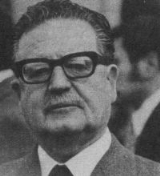
Salvador Isabelino Allende Gossens (26 June 1908 – 11 September 1973) was President
President of Chile

The President of Chile is both the chief of state and the head of government. Under the current Constitution of Chile , the President is elected by popular vote to serve for a period of four years, with immediate re-election being prohibited....
 of Chile
Chile

Chile, officially the Republic of Chile , is a country in South America occupying a long and narrow coastal strip wedged between the Andes mountains and the Pacific Ocean....
 from November 1970 until his death during the coup d'état of 11 September 1973.

Allende's involvement in Chilean political life spanned a period of nearly forty years. As a member of the Socialist Party
Socialist Party of Chile

The Socialist Party of Chile is part of the ruling Coalition of Parties for Democracy coalition. Its historical leader was the late President of Chile Salvador Allende Gossens, deposed by General Augusto Pinochet....
, he was a senator
Senate of Chile

The Senate of the Republic of Chile is the upper house of Chile's Bicameralism National Congress of Chile, as established in the current Constitution of Chile....
, deputy and cabinet minister. He unsuccessfully ran for the presidency in the 1952
Chilean presidential election, 1952

A presidential election was held in Chile on September 4 1952. It was the first presidential election where women were allowed to vote, after gaining the right in 1949....
, 1958
Chilean presidential election, 1958

A presidential election was held in Chile on September 4 1958. Because none of the candidates obtained an absolute majority needed to win outright, a confirmation by Congress was carried out on October 24 1958 to declare the winner....
, and 1964
Chilean presidential election, 1964

A presidential election was held in Chile on September 4, 1964. Christian Democratic Party of Chile candidate Eduardo Frei Montalva won the election by an absolute majority....
 elections, but was elected in 1970
Chilean presidential election, 1970

A presidential election was held in Chile on 4 September 1970. A narrow plurality was secured by Salvador Allende, the candidate of the Popular Unity coalition of left-wing politics parties....
.

nde was born on 26 June 1908 in Valparaíso
Valparaíso

Valpara?so is a major city in Chile and one of that country's most important seaports and an increasingly vital cultural center in the hemisphere's Pacific Southwest....
.


Discussion
Ask a question about 'Salvador Allende'
Start a new discussion about 'Salvador Allende'
Answer questions from other users
Full Discussion Forum


Quotations


(Attributed) I am not the president of all the Chileans. I am not a hypocrite that says so. — At a public rally, quoted by all Chilean newspapers, January 17, 1971. President Allende sent a public letter to El Mercurio newspaper to deny this alleged statement.

¡Viva Chile! ¡Viva el pueblo! ¡Vivan los trabajadores!

("Long live Chile! Long live the people! Long live the workers!") — last known words (in a radio broadcast on the morning of September 11, 1973)


Encyclopedia


Salvador Isabelino Allende Gossens (26 June 1908 – 11 September 1973) was President
President of Chile

The President of Chile is both the chief of state and the head of government. Under the current Constitution of Chile , the President is elected by popular vote to serve for a period of four years, with immediate re-election being prohibited....
 of Chile
Chile

Chile, officially the Republic of Chile , is a country in South America occupying a long and narrow coastal strip wedged between the Andes mountains and the Pacific Ocean....
 from November 1970 until his death during the coup d'état of 11 September 1973.

Allende's involvement in Chilean political life spanned a period of nearly forty years. As a member of the Socialist Party
Socialist Party of Chile

The Socialist Party of Chile is part of the ruling Coalition of Parties for Democracy coalition. Its historical leader was the late President of Chile Salvador Allende Gossens, deposed by General Augusto Pinochet....
, he was a senator
Senate of Chile

The Senate of the Republic of Chile is the upper house of Chile's Bicameralism National Congress of Chile, as established in the current Constitution of Chile....
, deputy and cabinet minister. He unsuccessfully ran for the presidency in the 1952
Chilean presidential election, 1952

A presidential election was held in Chile on September 4 1952. It was the first presidential election where women were allowed to vote, after gaining the right in 1949....
, 1958
Chilean presidential election, 1958

A presidential election was held in Chile on September 4 1958. Because none of the candidates obtained an absolute majority needed to win outright, a confirmation by Congress was carried out on October 24 1958 to declare the winner....
, and 1964
Chilean presidential election, 1964

A presidential election was held in Chile on September 4, 1964. Christian Democratic Party of Chile candidate Eduardo Frei Montalva won the election by an absolute majority....
 elections, but was elected in 1970
Chilean presidential election, 1970

A presidential election was held in Chile on 4 September 1970. A narrow plurality was secured by Salvador Allende, the candidate of the Popular Unity coalition of left-wing politics parties....
.

Early life

Allende was born on 26 June 1908 in Valparaíso
Valparaíso

Valpara?so is a major city in Chile and one of that country's most important seaports and an increasingly vital cultural center in the hemisphere's Pacific Southwest....
. He was the son of Salvador Allende Castro and Laura Gossens Uribe. Allende's family belonged to the Chilean upper-class and had a long tradition of political involvement in progressive and liberal
Liberalism

Liberalism is a broad class of political philosophy that considers individualism liberty and equality to be the most important political goals....
 causes. His grandfather was a prominent physician and a social reformist who founded one of the first secular
Secularity

Secularity is the state of being separate from religion. For instance, eating and bathing may be regarded as examples of secular activities, because there is nothing inherently religious about them....
 schools in Chile.

Allende attended high school at the Liceo Eduardo de la Barra in Valparaíso. As a teenager, his main intellectual and political influence came from the shoe-maker Juan De Marchi, an Italian-born anarchist. Allende then graduated with a medical degree
Medical degree

Medical degree is a...
 in 1926 at the University of Chile..

He co-founded section Socialist Party of Chile
Socialist Party of Chile

The Socialist Party of Chile is part of the ruling Coalition of Parties for Democracy coalition. Its historical leader was the late President of Chile Salvador Allende Gossens, deposed by General Augusto Pinochet....
 (founded in 1933 with Marmaduque Grove
Marmaduque Grove

Air Commodore Marmaduque Grove Vallejo was a Chilean Air Force officer, political figure and member of the Government Junta of the Socialist Republic of Chile in 1932....
 and others) in Valparaíso and became its chairman. He married Hortensia Bussi with whom he had three daughters. In 1933, he published his doctoral thesis Higiene Mental y Delincuencia in which he criticized Cesare Lombroso
Cesare Lombroso

Cesare Lombroso, born Ezechia Marco Lombroso was a Jewish-Italy criminology and founder of the Italian school of criminology. Lombroso rejected the established Classical school, which held that crime was a characteristic trait of human nature....
's proposals

In 1938, Allende was in charge of the electoral campaign of the Popular Front
Popular Front (Chile)

The Popular Front in Chile was an electoral and political left-wing coalition from 1937 to February 1941, during the Presidential Republic Era ....
 headed by Pedro Aguirre Cerda
Pedro Aguirre Cerda

Pedro Abelino Aguirre Cerda was a Chilean political figure. A member of the Radical Party , he was chosen as the Popular Front 's candidate for the Chilean presidential election, 1938, and was triumphally elected....
. The Popular Front's slogan was "Bread, a Roof and Work!". After its electoral victory, he became Minister of Health in the Reformist Popular Front government which was dominated by the Radicals
Radical Party (Chile)

The Radical Party of Chile was a List of political parties in Chile formed in 1863 by some dissatisfied Liberal Party . It originally represented the extreme anticlericalism faction of Chilean politics....
. Entering the government he relinquished his parliamentary seat for Valparaíso which he won in 1937. Around that time, he wrote La Realidad Médico Social de Chile (The social and medical reality of Chile). After the Kristallnacht
Kristallnacht

File:1938 Interior of Berlin synagogue after Kristallnacht.jpgKristallnacht or the Night of Broken Glass or "night of shattered crystal" was a pogrom in Nazi Germany on November 9?10, 1938....
 in Nazi Germany
Nazi Germany

Nazi Germany and the Third Reich are the colloquial English names for Germany under the regime of Adolf Hitler and the Nazi Party , which established a Totalitarianism dictatorship that existed from 1933 to 1945....
, Allende and other members of the Parliament sent a telegram to Adolf Hitler
Adolf Hitler

Adolf Hitler was an Austrian-born Germany politician and the leader of the National Socialist German Workers Party , popularly known as the Nazi Party....
 denouncing the persecution of Jews. Following Aguirre's death in 1941, he was again elected deputy while the Popular Front was re-named Democratic Alliance
Democratic Alliance (Chile)

The Democratic Alliance of Chile was a coalition of left-wing parties from 1941 to 1946, which succeeded to the Popular Front headed by Pedro Aguirre Cerda's government ....
.

In 1945, Allende became senator for the Valdivia
Valdivia Province

Valdivia is a province of Chile located in the Los R?os Region. Located in the province are two important rivers, the Calle-Calle / Valdivia River and the Cruces River....
, Llanquihue
Llanquihue

Llanquihue, a Mapudungun word meaning "immersed place," may refer to:*Lake Llanquihue*Llanquihue Province*Llanquihue Municipality*Llanquihue, Chile...
, Chiloé
Chiloé Province

Chilo? is one of the provinces of Los Lagos Region of Chile.Chilo? Province includes Chilo? Island and many smaller islands. The area of Chilo? province is 9181 km? ....
, Aisén and Magallanes
Magallanes

Magallanes is the Spanish language name of Ferdinand Magellan. It can refer to a number of things:Places in the Philippines:* Magallanes, Agusan del Norte...
 provinces; then for Tarapacá
Tarapacá

Tarapac? may refer to:*Tarapac? Region, Chile*Tarapac? Province, Per? *Tarapac? Province, Chile *Tarapac?, Colombia ...
 and Antofagasta
Antofagasta

is a port city in northern Chile, about north of Santiago, Chile. It is the capital of both Antofagasta Province and Antofagasta Region. According to the 2002 census, the city has an urban population of 281,155 and a municipal population of 296,905....
 in 1953; for Aconcagua
Aconcagua

Cerro Aconcagua is the Extremes of Altitude in the Americas, and the highest mountain outside Asia. It is located in the Andes mountain range, in the Argentina Provinces of Argentina of Mendoza Province....
 and Valparaíso
Valparaíso

Valpara?so is a major city in Chile and one of that country's most important seaports and an increasingly vital cultural center in the hemisphere's Pacific Southwest....
 in 1961; and once more for Chiloé, Aisén and Magallanes in 1969. He became president of the Chilean Senate in 1966.

His three unsuccessful bids for the presidency (in the 1952
Chilean presidential election, 1952

A presidential election was held in Chile on September 4 1952. It was the first presidential election where women were allowed to vote, after gaining the right in 1949....
, 1958
Chilean presidential election, 1958

A presidential election was held in Chile on September 4 1958. Because none of the candidates obtained an absolute majority needed to win outright, a confirmation by Congress was carried out on October 24 1958 to declare the winner....
 and 1964 election
Chilean presidential election, 1964

A presidential election was held in Chile on September 4, 1964. Christian Democratic Party of Chile candidate Eduardo Frei Montalva won the election by an absolute majority....
s) prompted Allende to joke that his epitaph would be "Here lies the next President of Chile." In 1952, as candidate for the Frente de Acción Popular (Popular Action Front, FRAP), he obtained only 5.4% of the votes, partly due to a division within socialist ranks over support for Carlos Ibáñez. In 1958, again as the FRAP candidate, Allende obtained 28.5% of the vote. This time, his defeat was attributed to votes lost to the populist
Populism

Populism is a discourse which supports "the people" versus "the elites." Populism may involve either a philosophy urging social and political system changes and/or a rhetorical style deployed by members of political or social movements competing for advantage within the existing party system....
 Antonio Zamorano. In 1964, once more as the FRAP candidate, he lost again, polling 38.6% of the votes against 55.6% for Christian Democrat
Christian Democrat Party of Chile

The Christian Democratic Party of Chile is a political party in Chile and governs as part of the Coalition of Parties for Democracy coalition....
 Eduardo Frei
Eduardo Frei Montalva

Eduardo Nicanor Frei Montalva was a Chilean political figure and president of Chile from 1964 to 1970. His eldest son, Eduardo Frei Ruiz-Tagle, also became president of Chile ....
. As it became clear that the election would be a race between Allende and Frei, the political right
Right-wing politics

In politics, right-wing, rightist and the Right are terms applied to Conservatism and reactionary positions. Originally, during the French Revolution, right-wing referred to seating arrangements in parliament; those who sat on the right supported the monarchy and aristocracy....
 which initially had backed Radical
Social Democrat Radical Party

The Social Democratic Radical Party is a social democratic party in Chile.The party is a member of Socialist International.The party was founded in August 18, 1994, out of a union between the Radical Party and the Social Democratic Party of Chile, both of which had received poor results in the parliamentary elections....
 Julio Durán settled for Frei as "the lesser evil". Allende's socialist beliefs and friendship with Cuban president Fidel Castro
Fidel Castro

Fidel Alejandro Castro Ruz is a Cuban revolutionary leader who was prime minister of Cuba from February 1959 to December 1976 and then president, premier until his resignation from the office in February 2008....
 made him deeply unpopular within the administrations of successive U.S. presidents, from John F. Kennedy
John F. Kennedy

John Fitzgerald "Jack" Kennedy , often referred to by his initials JFK, was the List of Presidents of the United States President of the United States, serving from 1961 until John F....
 to Richard Nixon
Richard Nixon

Richard Milhous Nixon was the List of Presidents of the United States President of the United States and the only president to resign the office....
; they believed there was a danger of Chile becoming a communist state
Communist state

Communist state is a term used by many political scientists to describe a form of government in which the state operates under a single-party state and declares allegiance to Marxism-Leninism or a derivative thereof....
 and joining the Soviet Union's sphere of influence
Sphere of influence

A sphere of influence is an area or region over which an organization or state exercises cultural, economic, military or political domination....
. Allende however publicly condemned the Soviet invasion of Hungary
1956 Hungarian Revolution

The Hungarian Revolution of 1956 was a spontaneous nationwide revolt against the People's Republic of Hungary of Hungary and its Soviet Union-imposed policies, lasting from 23 October until 10 November 1956....
 (1956) and of Czechoslovakia
Prague Spring

The Prague Spring was a period of political liberalization in Czechoslovakia during the era of its domination by the Soviet Union after World War II....
 (1968) and he later made Chile the first Government in continental America to recognize the People's Republic of China
People's Republic of China

The People's Republic of China , commonly known as China, is the largest country in East Asia and the List of countries by population in the world with over 1.3 billion people, approximately a fifth of the world's population....
 (1971).

Various U.S. corporation
Corporation

A corporation is a legal entity separate from the persons that form it. It is a legal entity owned by individual stockholders. In British tradition it is the term designating a body corporate, where it can be either a corporation sole or a corporation aggregate ....
s (including ITT
ITT Corporation

ITT Corporation is a global diversified manufacturing company with 2007 revenues of $9.0 billion. ITT participates in global markets including water and fluids management, defense and security, and motion and flow control....
, Anaconda and Kennecott) owned property and mineral rights
Mineral rights

In the United States, Mineral rights, mining rights, oil rights or drilling rights, are the rights to remove minerals, oil, or sometimes water, that may be contained in and under some land....
 in Chile. The Nixon administration feared that these companies might be nationalized
Nationalization

Nationalization, also spelled nationalisation, is the act of taking an industry or assets into the public ownership of a national government or state....
 by a socialist government, and was openly hostile to Allende. During Nixon's presidency, U.S. officials attempted to prevent Allende's election by financing political parties aligned with opposition candidate Jorge Alessandri
Jorge Alessandri

Jorge Alessandri Rodr?guez was List of Presidents of Chile of Chile from 1958 to 1964, and was the candidate of the centre-right in Chile's crucial presidential election of 1970....
 and supporting strikes in the mining and transportation sectors.

Relationship with the Chilean Communist Party

Allende had a close relationship with the Chilean Communist Party from the beginning of his political career. On his fourth (and successful) bid for the presidency, the Communist Party appointed him as the alternate for its own candidate, the world-renowned poet Pablo Neruda
Pablo Neruda

Pablo Neruda was the pen name and, later, legal name of the Chilean writer and politician Neftal? Ricardo Reyes Basoalto. Neruda assumed his pen name as a teenager, partly because it was in vogue, partly to hide his poetry from his father, a rigid man who wanted his son to have a "practical" occupation....
.

During his presidential term, Allende took positions held by the communists, in opposition to the views of the socialists. Some argue however that this reversed at the end of his period in office.

Election

Allende Supporters
Allende won the 1970 Chilean presidential election as leader of the Unidad Popular ("Popular Unity") coalition. On 4 September 1970, he obtained a narrow plurality
Plurality

In voting, a plurality is the largest number of Voting to be received by any candidate or proposition when three or more choices are possible. With only two choices the winner would have a majority, barring a strong showing from a write-in....
 of 36.2 percent to 34.9 percent over Jorge Alessandri
Jorge Alessandri

Jorge Alessandri Rodr?guez was List of Presidents of Chile of Chile from 1958 to 1964, and was the candidate of the centre-right in Chile's crucial presidential election of 1970....
, a former president, with 27.8 percent going to a third candidate (Radomiro Tomic
Radomiro Tomic

Radomiro Tomic Romero was a Chilean politician of Croats origin. He was one of the most prominent leaders of that country's Christian Democrat Party of Chile....
) of the Christian Democratic Party (PDC), whose electoral platform was similar to Allende's. According to the Chilean Constitution of the time, if no presidential candidate obtained a majority of the popular vote, Congress would choose one of the two candidates with the highest number of votes as the winner. Tradition was for Congress to vote for the candidate with the highest popular vote, regardless of margin. Indeed, former president Jorge Alessandri had been elected in 1958 with only 31.6 percent of the popular vote, defeating Allende.

The CIA claim that Allende's presidential campaign received $350,000 from Cuba
Cuba

The Republic of Cuba is a country in the Caribbean. It consists of the island of Cuba , the island of Isla de la Juventud, and several adjacent small islands....
.

On October 22, 1970, General René Schneider
René Schneider

General Ren? Schneider Chereau was the Chilean Army of the Chilean Army at the time of the 1970 Chilean presidential election, when he was assassinated during a botched kidnapping attempt....
, Commander in Chief of the Chilean Army, was shot resisting a kidnap attempt by a group led by General Roberto Viaux
Roberto Viaux

General Roberto Viaux Marambio was a Chilean Army General and the primary planner in two failed coup d'?tat attempt in Chile in 1969 and 1970. The first was against President Eduardo Frei Montalva and the second aimed to prevent Socialist Party of Chile Salvador Allende's election....
. Hospitalized, he died of his wounds three days later. This attempt followed two others on the 19th and 20th. Viaux's kidnapping plan had been supported by the CIA, although the then National Security Advisor Henry Kissinger
Henry Kissinger

Henry Alfred Kissinger is a Germany-born United States Jewish political scientist, bureaucrat, diplomat, and winner of the Nobel Peace Prize. He served as United States National Security Advisor and later concurrently as United States Secretary of State in the Nixon administration....
 had ordered the plans postponed at the last moment. Schneider was a defender of the "constitutionalist" doctrine
Schneider Doctrine

Schneider Doctrine was a political doctrine originally espoused by Chile General Ren? Schneider, which allowed the election of Salvador Allende as President of Chile, and was the main ideological obstacle to a military coup d'?tat against him....
 that the army's role is exclusively professional, its mission being to protect the country's sovereignty and not to interfere in politics.

General Schneider's death was widely disapproved of and, for the time, ended military opposition to Allende, whom the parliament finally chose on 24 October. On 26 October, President Eduardo Frei
Eduardo Frei Montalva

Eduardo Nicanor Frei Montalva was a Chilean political figure and president of Chile from 1964 to 1970. His eldest son, Eduardo Frei Ruiz-Tagle, also became president of Chile ....
 named General Carlos Prats
Carlos Prats

General Carlos Prats Gonz?lez was a Chilean Army officer, a political figure, minister and Vice President of Chile during President Salvador Allende's government, and General Augusto Pinochet's predecessor as Chilean Army of the Chilean Army....
 as commander in chief of the army to replace René Schneider.

Allende assumed the presidency on 3 November 1970 after signing a Statute of Constitutional Guarantees proposed by the Christian Democrats in return for their support in Congress. In an extensive interview with Régis Debray
Régis Debray

Jules R?gis Debray is a France intellectual, journalist, government official and professor. He is known for his theorization of mediology, a critical theory of the long-term transmission of cultural meaning in human society; and for having fought in 1967 with Marxist revolutionary Che Guevara in Bolivia....
, Allende explained his reasons for agreeing to the guarantees. Some critics have interpreted Allende's responses as an admission that signing the Statute was only a tactical move.

Presidency


Upon assuming power, Allende began to carry out his platform of implementing a socialist program called La vía chilena al socialismo ("the Chilean Path to Socialism"). This included nationalization
Nationalization

Nationalization, also spelled nationalisation, is the act of taking an industry or assets into the public ownership of a national government or state....
 of large-scale industries (notably copper mining and banking), and government administration of the health care
Health care

File:Ear surgery on a patient.jpgFile:Monoclonal antibodies3.jpgHealth care, or healthcare, refers to the treatment and management of illness, and the preservation of health through services offered by the Medicine, pharmaceutical, Dentistry, clinical laboratory sciences , nursing, and allied health professions....
 system, educational system, a program of free milk for children (given out arbitrarily by GAP "Group of Personal Friends of the President"), and an expansion of the land seizure and redistribution already begun under his predecessor Eduardo Frei Montalva, who had nationalized between one-fifth and one-quarter of all the properties listed for takeover). The Allende government's intention was to seize all holdings of more than eighty irrigated hectares. Allende also intended to improve the socio-economic welfare of Chile's poorest citizens; a key element was to provide employment, either in the new nationalised enterprises or on public work projects.

Chilean presidents were allowed a maximum term of six years, which may explain Allende's haste to restructure the economy. Not only was a major restructuring program organized (the Vuskovic plan
Vuskovic plan

The Vuskovic Plan was the basis for the economic policy of the Popular Unity Chile under Allende Salvador Allende. It was drafted by and named after his first Economics Minister Pedro Vuskovic, who had worked before with the CEPAL....
), he had to make it a success if a Socialist successor to Allende was going to be elected. In the first year of Allende's term, the short-term economic results of Minister of the Economy Pedro Vuskovic
Pedro Vuskovic

Pedro Vuskovic Bravo was a Chilean economist of Croats descent, political figure, minister and author of the economic plan implemented by Salvador Allende during his government....
's expansive monetary policy were favorable: 12% industrial growth and an 8.6% increase in GDP
Gross domestic product

File:GDP nominal per capita world map IMF 2008.pngThe gross domestic product or gross domestic income is one of the measures of national income and output for a given country's economy....
, accompanied by major declines in inflation (down from 34.9% to 22.1%) and unemployment (down to 3.8%). However by 1972, the Chilean escudo had an inflation rate of 140%. The average Real GDP contracted between 1971 and 1973 at an annual rate of 5.6% ("negative growth"); and the government's fiscal deficit soared while foreign reserves declined [Flores, 1997: source requires title/publisher]. The combination of inflation and government-mandated price-fixing, together with the "disappearance" of basic commodities from supermarket shelves, led to the rise of black markets in rice, beans, sugar, and flour. The Chilean economy also suffered as a result of a US campaign against the Allende government.

The Allende government announced it would default on debt
Debt

Debt is that which is owed; usually referencing assets owed, but the term can cover other obligations. In the case of assets, debt is a means of using future purchasing power in the present before a summation has been earned....
s owed to international creditors and foreign governments. Allende also froze all prices while raising salaries. His implementation of these policies was strongly opposed by landowners, employers, businessmen and transporters associations, and some civil servants and professional unions. The rightist opposition was led by National Party, the Roman Catholic Church
Roman Catholic Church

The Roman Catholic Church, officially known as the Catholic Church is the world's largest Christianity Ecclesia , representing over half of all Christians and one-sixth of the world population....
 (which in 1973 was displeased with the direction of educational policy), and eventually the Christian Democrats
Christian Democrat Party of Chile

The Christian Democratic Party of Chile is a political party in Chile and governs as part of the Coalition of Parties for Democracy coalition....
. There were growing tensions with foreign multinational corporation
Multinational corporation

A multinational corporation or transnational corporation is a corporation or enterprise that manages production or delivers services in more than one country....
s and the government of the United States.

Allende also undertook Project Cybersyn
Project Cybersyn

Project Cybersyn was a Chilean attempt at real-time computing computer-controlled planned economy in the years 1970?1973 . It was essentially a network of teleprinter machines that linked factories with a single computer centre in Santiago, Chile, which controlled them using principles of cybernetics....
, a system of networked telex
Telex

Telex may refer to:* Telegraphy#Telex, a communications network** Teleprinter, the device used on the above network* Telex , a Belgian pop group...
 machines and computers. Cybersyn was developed by British cybernetics
Cybernetics

Cybernetics is the interdisciplinary study of the structure of regulatory systems. Cybernetics is closely related to control theory and systems theory....
 expert Stafford Beer
Anthony Stafford Beer

Anthony Stafford Beer was a United Kingdom theorist, consultant and professor at the Manchester Business School. He is best known for his work in the fields of operational research and management cybernetics....
. The network transmitted data from factories to the government in Santiago, allowing for economic planning in real-time.

In 1971, Chile re-established diplomatic relations with Cuba
Cuba

The Republic of Cuba is a country in the Caribbean. It consists of the island of Cuba , the island of Isla de la Juventud, and several adjacent small islands....
, joining Mexico and Canada in rejecting a previously-established Organization of American States
Organization of American States

The Organization of American States is an international organization, headquartered in Washington, D.C., United States. Its members are the thirty-five independent states of the Americas....
 convention prohibiting governments in the Western Hemisphere
Western Hemisphere

The Western Hemisphere, also Western hemisphere or western hemisphere, is a geography term for the half of the Earth that lies west of the Prime Meridian , the other half being the Eastern Hemisphere....
 from establishing diplomatic relations with Cuba. Shortly afterward, Cuban president Fidel Castro
Fidel Castro

Fidel Alejandro Castro Ruz is a Cuban revolutionary leader who was prime minister of Cuba from February 1959 to December 1976 and then president, premier until his resignation from the office in February 2008....
 made a month-long visit to Chile. The visit, in which Castro held massive rallies and gave public advice to Allende, was seen by those on the political right as proof to support their view that "The Chilean Path to Socialism" was an effort to put Chile on the same path as Cuba.

October 1972 saw the first of what were to be a wave of strikes. The strikes were led first by truckers, and later by small businessmen, some (mostly professional) unions, and some student groups. Other than the inevitable damage to the economy, the chief effect of the 24-day strike was to induce Allende to bring the head of the army, general Carlos Prats
Carlos Prats

General Carlos Prats Gonz?lez was a Chilean Army officer, a political figure, minister and Vice President of Chile during President Salvador Allende's government, and General Augusto Pinochet's predecessor as Chilean Army of the Chilean Army....
, into the government as Interior Minister. Allende also instructed the government to begin requisitioning trucks in order to keep the nation from coming to a halt. Government supporters also helped to mobilize trucks and buses but violence served as a deterrent to full mobilization, even with police protection for the strike breakers. Allende's actions were eventually declared unlawful by the Chilean appeals court and the government was ordered to return trucks to their owners.

Throughout this presidency racial tensions between the poor descendants of indigenous people and slaves who supported Allende's reforms and the white settler elite increased.

Allende raised wages on a number of occasions throughout 1970 and 1971, but these wage hikes were negated by the in-tandem inflation
Inflation

In economics, inflation is a rise in the general price level of goods and services in an economy over a period of time. The term "inflation" once referred to increases in the money supply ; however, economic debates about the relationship between money supply and price levels have led to its primary use today in describing price inflatio...
 of Chile's fiat currency
Fiat currency

Fiat currency is money that exists because an authority or custom declares it to be money. . It achieves value because a government requires it in payment of taxes and says it can be used to pay debt or buy goods and services and because people trust that the value of the currency will be reasonably stable....
. Although price rises had also been high under Frei (27% a year between 1967 and 1970), a basic basket of consumer goods rose by 120% from 190 to 421 escudos in one month alone, August 1972. In the period 1970-72, while Allende was in government, exports fell 24% and imports rose 26%, with imports of food rising an estimated 149%. Although nominal wages were rising, there was not a commensurate increase in the standard of living.

Export income fell due to a decline in the price of copper
Copper

Copper is a chemical element with the symbol Cu and atomic number 29.It is a ductile metal with very high thermal and electrical conductivity....
 on international markets; copper being the single most important export (more than half of Chile's export receipts were from this sole commodity). Adverse fluctuation in the international price of copper negatively affected the economy throughout 1971-2: The price of copper fell from a peak of $66 per ton in 1970 to only $48-9 in 1971 and 1972.

Throughout his presidency, Allende remained at odds with the Chilean Congress, which was dominated by the Christian Democratic Party. The Christian Democrats (who had campaigned on a socialist platform in the 1970 elections, but drifted away from those positions during Allende's presidency, eventually forming a coalition with the National Party), continued to accuse Allende of leading Chile toward a Cuban-style dictatorship, and sought to overturn many of his more radical policies. Allende and his opponents in Congress repeatedly accused each other of undermining the Chilean Constitution and acting undemocratically.

Allende's increasingly bold socialist policies (partly in response to pressure from some of the more radical members within his coalition), combined with his close contacts with Cuba
Cuba

The Republic of Cuba is a country in the Caribbean. It consists of the island of Cuba , the island of Isla de la Juventud, and several adjacent small islands....
, heightened fears in Washington
Washington, D.C.

Washington, D.C. , formally the District of Columbia and commonly referred to as Washington, the District, or simply D.C., is the Capital of the United States, founded on July 16, 1790....
. The Nixon administration
Richard Nixon

Richard Milhous Nixon was the List of Presidents of the United States President of the United States and the only president to resign the office....
 began exerting economic pressure on Chile via multilateral
Multilateralism

Multilateralism is a term in international relations that refers to multiple countries working in concert on a given issue.Most international organizations, such as the United Nations and the World Trade Organization are multilateral in nature....
 organizations, and continued to back Allende's opponents in the Chilean Congress. Almost immediately after his election, Nixon directed CIA and U.S. State Department officials to "put pressure" on the Allende government.

The coup


There had been rumors of a possible coup since at least 1972; in 1973, partly due to Allende's economic policies, partly as a result of the rapidly declining price of copper (Chile's main export), but especially because of illegal seizures of industries and invasions of farming lands by UP-sponsored activists, the economy took a major downturn. By September, high inflation (508% for the entire year) and shortages had plunged the country into near-chaos.

Despite declining economic indicators, Allende's Popular Unity coalition actually increased its vote to 43% in the parliamentary elections early in 1973. However, by this point, what had started as an informal alliance with the Christian Democrats was anything but; the Christian Democrats now joined with the right-wing National Party to oppose Allende's government, the two parties calling themselves the Confederación Democrática (CODE). The conflict between the executive and legislature paralyzed initiatives from either side.

On 29 June 1973, a tank regiment under the command of Colonel Roberto Souper
Roberto Souper

Lt. Colonel Roberto Federico Souper Onfray was a Chilean military officer who launched an unsuccessful coup d'?tat against the regime of Salvador Allende, surrounding the presidential palace with a tank regiment....
 surrounded the presidential palace (La Moneda
Palacio de La Moneda

Palacio de La Moneda , or simply La Moneda, is the seat of the President of Chile of the Chile. It also houses the offices of three cabinet ministers: Ministry of the Interior , General Secretariat of the Presidency and General Secretariat of the Government....
) in an unsuccessful coup attempt known as the Tanquetazo
Tanquetazo

El Tanquetazo or El Tancazo are the names used to refer to the failed coup d'?tat attempt in Chile led by Army Lieutenant Colonel Roberto Souper against the government of Socialist Party of Chile President of Chile Salvador Allende....
. On 9 August, General Carlos Prats
Carlos Prats

General Carlos Prats Gonz?lez was a Chilean Army officer, a political figure, minister and Vice President of Chile during President Salvador Allende's government, and General Augusto Pinochet's predecessor as Chilean Army of the Chilean Army....
 was made Minister of Defense, but this decision proved so unpopular with the military that, on 22 August, he was forced to resign not only this position but his role as Commander-in-Chief of the Army; he was replaced in the latter role by General Augusto Pinochet.

In August 1973 the Supreme Court
Supreme Court of Chile

The Supreme Court of Chile is the highest court in Chile. It also administrates the lower courts in the nation. It is located in the capital Santiago, Chile....
 complained about the government's inability to enforce the law of the land. On 22 August, the Chamber of Deputies
Chamber of Deputies of Chile

The Chamber of Deputies of the Republic of Chile is the lower house of Chile's Bicameralism National Congress of Chile. Its organisation and its powers and duties are defined in articles 42 to 59 of Chile's current Constitution of Chile....
 (with the Christian Democrats uniting with the National Party) voted in favor of a Declaration of the Breakdown of Chile's Democracy, which accused Allende's government of unconstitutional acts and called on the military ministers to assure the constitutional order. They accused Allende of disregarding the courts, attempting to restrict freedom of speech, and supporting unauthorized seizures of farms and private industry for the purpose of establishing state control of the economy. The Chamber of Deputies also attacked Allende for seeking to "establish a totalitarian system absolutely opposed to the representative system of government established by the Constitution." However, a majority in the Senate still held firm for Allende.

In early September 1973, Allende floated the idea of resolving the constitutional crisis with a plebiscite. His speech outlining such a solution was scheduled for 12 September, but he was never able to deliver it. On September 11 1973, the Chilean military staged a coup
Chilean coup of 1973

The Chilean coup d'?tat of 1973 is a landmark in the history of Chile and the Soviet-American Cold War. On 11 September 1973, the government of President Salvador Allende was overthrown by the military in a coup d??tat....
 against Allende.

Death

Just prior to the capture of La Moneda
Palacio de La Moneda

Palacio de La Moneda , or simply La Moneda, is the seat of the President of Chile of the Chile. It also houses the offices of three cabinet ministers: Ministry of the Interior , General Secretariat of the Presidency and General Secretariat of the Government....
 (the Presidential Palace), with gunfire and explosions clearly audible in the background, Allende gave his (subsequently famous) farewell speech
Salvador Allende's Last Speech

Sorry, no overview for this topic
 to Chileans on live radio, speaking of himself in the past tense, of his love for Chile and of his deep faith in its future. He stated that his commitment to Chile did not allow him to take an easy way out and be used as a propaganda tool by those he called "traitors" (accepting an offer of safe passage), clearly implying he intended to fight to the end.
"Workers of my country, I have faith in Chile and its destiny. Other men will overcome this dark and bitter moment when treason seeks to prevail. Keep in mind that, much sooner than later, the great avenues will again be opened through which will pass free men to construct a better society. Long live Chile! Long live the people! Long live the workers!"
President Salvador Allende's farewell speech, 11 September 1973.
Shortly afterwards, Allende died. An official announcement declared that he had committed suicide with an automatic rifle, purportedly the AK-47
AK-47

The AK-47 is a 7.62x39mm assault rifle developed in the Soviet Union by Mikhail Kalashnikov in two versions: the fixed stock AK-47 and the AKS-47 variant equipped with an underfolding metal shoulder stock....
 assault rifle
Assault rifle

An assault rifle is a rifle designed for combat, with selective fire . Assault rifles are the standard small arms in most modern Army, having largely superseded or supplemented battle rifles such as the World War II-era M1 Garand rifle and SVT-40....
 given to him as a gift by Fidel Castro
Fidel Castro

Fidel Alejandro Castro Ruz is a Cuban revolutionary leader who was prime minister of Cuba from February 1959 to December 1976 and then president, premier until his resignation from the office in February 2008....
, which bore a golden plate engraved "To my good friend Salvador from Fidel, who by different means tries to achieve the same goals."

In his 2004 documentary
Salvador Allende
Salvador Allende (film)

Salvador Allende is a 2004 documentary film about Chilean president Salvador Allende, from his election campaign to the coup d'?tat which ended up his presidency....
, Patricio Guzmán
Patricio Guzmán

Patricio Guzm?n Lozanes is a Chile documentary film director. He is internationally renowned for films such as La bataille du Chili and Salvador Allende ....
 incorporates a graphic image of Allende's corpse in the position it was found after his death. According to Guzmán's documentary, Allende shot himself with a gun and not a rifle.

At the time, and for many years after, his supporters presumed that he was killed by the forces staging the coup. In recent years the view that he committed suicide has become more accepted, particularly as different testimonies confirm details of the suicide reported in news and documentary interviews. Members of Allende's immediate family including his daughter, accept that it was a suicide.

Foreign involvement in Chile during Allende's Term


Soviet involvement

Allende
According to Vasili Mitrokhin
Mitrokhin Archive

The Mitrokhin Archive, by Vasili Mitrokhin, details the U.S.S.R.'s intelligence operations in the world. Major Mitrokhin compiled them during his thirty years as a KGB archivist in the foreign intelligence service and the First Chief Directorate; he published them in the U.K....
, a former KGB
KGB

KGB is the Russian language abbreviation of Committee for State Security , which was the official name of the umbrella organization serving as the Soviet Union's premier security agency, secret police, and intelligence agency, from 1954 to 1991....
 bureaucrat, regular Soviet contact with Allende after his election was maintained by his KGB
KGB

KGB is the Russian language abbreviation of Committee for State Security , which was the official name of the umbrella organization serving as the Soviet Union's premier security agency, secret police, and intelligence agency, from 1954 to 1991....
 case officer, Svyatoslav Kuznetsov, who was instructed by the centre to "exert a favourable influence on Chilean government policy". According to Allende's KGB file, he "was made to understand the necessity of reorganising Chile's army and intelligence services, and of setting up a relationship between Chile's and the USSR's intelligence services". Allende was said to react positively.

In October 1971, on instructions from the Politburo
Politburo

Politburo, short for Political Bureau, Russian language Politicheskoye Buro, is the executive organization for a number of political parties, most notably those of Communist Party....
, Allende was given $300,000 "in order to solidify the trusted relations" with him. On December 7, in a memorandum to the Politburo, the KGB proposed giving Allende another $60,000 for what was termed "his work with political party leaders, military commanders and parliamentarians."

According to Christopher Andrew's account of the Mitrokhin archives, "In the KGB's view, Allende's fundamental error was his unwillingness to use force against his opponents. Without establishing complete control over all the machinery of the State, his hold on power could not be secure."

According to General Nikolai Leonov, former Sub-Director KGB, the Soviet Union supported Allende's regime economically, politically and militarily.

Economic Support includes over 100 million dollars in credit, three fishing ships (that distributed 17,000 tons of frozen fish to the population), factories (as help after the 1971 earthquake), 3,100 tractors, 74,000 tons of wheat and more than a million tins of condensed milk.

Political and moral support came mostly through the Communist Party and unions. However, there were some fundamental differences between Allende and the Marxists in Russia who believed that more violence should have been used.

Soviet weaponry (tanks and artillery) never got to Chile but was well on its way in the the Northern hemisphere summer of 1973. In addition to weapon, Soviet Union also provided financial support; 100 million dollar in soft loans to buy these weapons. It is the military coup that interrupted the delivery of weapons to Chile.

US Involvement/Corporate Business Interests

The possibility of Allende winning Chile's 1970 election was deemed a disaster by a US government desirous of protecting US business interests and preventing any further spread of communism
Communism

Communism is a socioeconomic structure and political ideology that promotes the establishment of an egalitarianism, classlessness, stateless society based on common ownership and control of the means of production and property in general....
 during the Cold War
Cold War

The Cold War was the continuing state of conflict, tension and competition that existed between a number of world powers, including the United States, the Soviet Union, People's Republic of China, France, United Kingdom and those countries' respective allies from the mid-1940s to the early 1990s....
. In September 1970, President Nixon
Richard Nixon

Richard Milhous Nixon was the List of Presidents of the United States President of the United States and the only president to resign the office....
 informed the CIA that an Allende regime in Chile would not be acceptable and authorized $10 million to stop Allende from coming to power or unseat him. The CIA's plans to impede Allende's investiture as President of Chile were known as
"Track I" and "Track II"; Track I sought to prevent Allende from assuming power via so-called "parliamentary trickery", while under the Track II initiative, the CIA tried to convince key Chilean military officers to carry out a coup.

After the 1970 election, the Track I operation attempted to incite Chile's outgoing president, Eduardo Frei Montalva
Eduardo Frei Montalva

Eduardo Nicanor Frei Montalva was a Chilean political figure and president of Chile from 1964 to 1970. His eldest son, Eduardo Frei Ruiz-Tagle, also became president of Chile ....
, to persuade his party (PDC) to vote in Congress for Alessandri. Under the plan, Alessandri
Alessandri

Alessandri is a surname, and may refer to:* Alessandri family of Chile* Alessandro Alessandri* Angelo Alessandri* Arturo Alessandri* Fernando Alessandri...
 would resign his office immediately after assuming it and call new elections. Eduardo Frei would then be constitutionally able to run again (since the Chilean Constitution did not allow a president to hold two consecutive terms, but allowed multiple non-consecutive ones), and presumably easily defeat Allende. The Chilean Congress instead chose Allende as President, on the condition that he would sign a "Statute of Constitutional Guarantees" affirming that he would respect and obey the Chilean Constitution, and that his reforms would not undermine any element of it.

Track II was aborted, as parallel initiatives already underway within the Chilean military rendered it moot.

The United States has acknowledged having played a role in Chilean politics prior to the coup, but its degree of involvement in the coup itself is debated. The CIA was notified by its Chilean contacts of the impending coup two days in advance, but contends it "played no direct role in" the coup.

President Allende's economic policy had involved nationalizations of many key companies, notably U.S.-owned copper mines
Chilean nationalization of copper

The nationalization of the Chilean copper industry commonly described as the Spanish language or "Chileanisation of copper," was the progressive process by which the Chilean government acquired control of the major foreign-owned section of the Chilean copper mining industry....
. This had been a significant reason behind the United States opposition to Allende's reformist socialist government, in addition to his establishing diplomatic relations and cooperation agreements with Cuba
Cuba

The Republic of Cuba is a country in the Caribbean. It consists of the island of Cuba , the island of Isla de la Juventud, and several adjacent small islands....
 and the Soviet Union. Much of the internal opposition to Allende's policies came from business sector, and recently-released U.S. government documents confirm that the U.S. funded the truck drivers' strike, which had exacerbated the already chaotic economic situation prior to the coup.

The most prominent U.S. corporations in Chile prior to Allende's presidency were the Anaconda and Kennecott Copper companies, and ITT, International Telephone and Telegraph. Both the copper corporations aimed to expand privatized copper production in the city of El Teniente, Chile, the world's largest underground copper mine. At the end of 1968, according to Department of Commerce data, U.S. corporate holdings in Chile amounted to $964 million. Anaconda and Kennecott accounted for 28% of U.S. holdings, but ITT had by far the largest holding of any single corporation, with an investment of $200 million in Chile. In 1970, before Allende was elected, ITT owned 70% of Chitelco, the Chilean Telephone Company and funded El Mercurio, a Chilean right-wing newspaper. Documents released in 2000 by the CIA confirmed that before the elections of 1970, ITT gave $700,000 to Allende's conservative opponent, Jorge Alessandri, with help from the CIA on how to channel the money safely. ITT president Harold Geneen also offered $1 million to the CIA to help defeat Allende in the elections.

After General Pinochet assumed power, U.S. Secretary of State
Secretary of State

Secretary of State is a commonly used title for a member of government. The role varies between countries, and in some cases there are multiple Secretaries of State in the government....
 Henry Kissinger
Henry Kissinger

Henry Alfred Kissinger is a Germany-born United States Jewish political scientist, bureaucrat, diplomat, and winner of the Nobel Peace Prize. He served as United States National Security Advisor and later concurrently as United States Secretary of State in the Nixon administration....
 told U.S. President
President of the United States

The President of the United States is the head of state and head of government of the United States and is the highest political official in the United States by influence and recognition....
 Richard Nixon that the U.S.
"didn't do it," but "we helped them...created the conditions as great as possible." (referring to the coup itself). Recent documents declassified under the Clinton administration's Chile Declassification Project show that the United States government and the CIA had sought the overthrow of Allende in 1970 immediately before he took office ("Project FUBELT
Project FUBELT

Project FUBELT is the codename for the secret CIA operations that were intended to undermine Salvador Allende's government and promote a 1973 Chilean coup d'?tat....
"), but claims of their direct involvement in the 1973 coup are not proven by any publicly available documentary evidence, although many documents still remain classified.

Legacy and debate


Family

Likely the best-known relative of Salvador Allende is Isabel Allende
Isabel Allende

Isabel Allende Llona, , is a Chilean-United States novelist. Allende, whose works sometimes contain aspects of the "magic realism" tradition, is one of the first successful women novelists in Latin America....
, author of novels such as
The House of Spirits, and daughter of his first cousin Tomás Allende, a Chilean diplomat.

On May 3, 2007, newspaper
La Tercera
La Tercera

La Tercera , formerly known as La Tercera de la Hora, is a daily newspaper published in Santiago, Chile and owned by Copesa. It is El Mercurios closest competitor....
published a story claiming Gloria Gaitán, daughter of Jorge Eliécer Gaitán
Jorge Eliécer Gaitán

File:Jorge Eli?cer Gait?n Ayala.jpgJorge Eli?cer Gait?n was a politician, a leader of a populism movement in Colombia, a former Education Minister and Labor Minister , List of mayors of Bogot? of Bogot? and chief of the Colombian Liberal Party ....
, had an unborn child with Allende.

Memorials to Allende include a statue in front of the Palacio de la Moneda.

Additional information


See also

  • Cuban packages
    Cuban packages

    The Cuban packages was a Chilean smuggling scandal, involving President Salvador Allende, his Minister of the Interior, Hern?n del Canto and the Director of the Civil Police Eduardo Paredes....
  • Allende stamps
    Allende stamps

    One of the first postage stamps to commemorate Salvador Allende, released after the 1973 coup in Chile, was the Soviet Union one. It was issued just two months after the event and had a circulation of 3.8 million....


Other sources

  • , (From the United States' National Security Archive
    National Security Archive

    The National Security Archive is a 501 non-governmental, non-profit research and archival institution located within The George Washington University in Washington, D.C.....
    ).
  • Thomas Karamessines (1970). , Washington: United States National Security Council.
  • Isabel Allende
    Isabel Allende

    Isabel Allende Llona, , is a Chilean-United States novelist. Allende, whose works sometimes contain aspects of the "magic realism" tradition, is one of the first successful women novelists in Latin America....
    , chilena writer, Allende's niece.
  • Henry A. Kissinger


External links

  • Spanish text with English translation. The transcript of the last radio broadcast of Chilean President Salvador Allende, made on 11 September 1973, at 9:10 am. MP3 audio available .
  • . While nominally a page about the Pinochet case, this large collection of links includes Allende's dissertation and numerous documents (mostly PDFs) related to the dissertation and to the controversy about it, ranging from the Cesare Lombroso material discussed in Allende's dissertation to a collective telegram of protest over Kristallnacht
    Kristallnacht

    File:1938 Interior of Berlin synagogue after Kristallnacht.jpgKristallnacht or the Night of Broken Glass or "night of shattered crystal" was a pogrom in Nazi Germany on November 9?10, 1938....
     signed by Allende.
  • An Interview with Salvadore Allende: President of Chile, interviewed by Saul Landau
    Saul Landau

    Saul Landau is an American author, documentary filmmaker, and academic whose work has focused in large part on Latin America. Now a professor at American University, he was previously Director of Digital Media Programs and Hugh O....
    , Dove Films, 1971, 32 min. (previously unreleased):
    • (Spanish with English subtitles) in El Clarin de Chile. (Alternative location , added June 8, 2008)
    • in La Nacion, September 24, 2005.
  • of the Resolution of 22 August 1973 (English, Spanish, French, German, Polish