
All Topics  
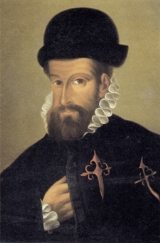
Francisco Pizarro

 
Francisco Pizarro

   Email Print
   Bookmark   Link


Francisco Pizarro


Francisco Pizarro González, 1st Marqués de los Atabillos (c. 1471 or 1476 – 26 June 1541) was a Spanish
Spain

Spain or the Kingdom of Spain , is a country located in Southern Europe on the Iberian Peninsula.The Spanish constitution does not establish any official denomination of the country, even though Espa?a , Estado espa?ol and Naci?n espa?ola are used interchangeably....
 conquistador
Conquistador

Conquistador is the name given to the Spaniards soldiers, leaders, List of explorers, and adventurers involved in the conquest of the Americas following the discovery of the New World by Christopher Columbus in 1492....
, conqueror of the Incan Empire and founder of Lima
Lima

Lima is the Capital and largest city of Peru. It is located in the valleys of the Chill?n River, R?mac River and Lur?n River rivers, on a coast overlooking the Pacific Ocean....
, the modern-day capital of Peru
Peru

Peru , officially the Republic of Peru , is a country in western South America. It is bordered on the north by Ecuador and Colombia, on the east by Brazil, on the southeast by Bolivia, on the south by Chile, and on the west by the Pacific Ocean....
. Pizarro was born in Trujillo
Trujillo, Spain

Trujillo is a town located in Extremadura, Spain....
, Extremadura
Extremadura

Extremadura is an autonomous communities in Spain of western Spain whose capital city is M?rida, Spain. It includes the provinces of Spain of C?ceres and Badajoz ....
, Spain
Spain

Spain or the Kingdom of Spain , is a country located in Southern Europe on the Iberian Peninsula.The Spanish constitution does not establish any official denomination of the country, even though Espa?a , Estado espa?ol and Naci?n espa?ola are used interchangeably....
. Sources differ in the birth year they assign to him: 1471, 1475–1478, or unknown. He was an illegitimate son of Gonzalo Pizarro Rodríguez de Aguilar (senior) (1446-1522) who as colonel
Colonel

Colonel is a military rank of a commissioned officer, with corresponding ranks existing in almost every country in the world. It is also used in some police forces and other paramilitary rank structures....
 of infantry
Infantry

Infantry are soldiers who are primarily trained for the role of fighting on foot. A soldier in the infantry is known as an infantryman. Infantry units have more physically demanding training than other branches of armies, and place a greater emphasis on fitness, physical strength and aggression....
 served in the Italian campaigns
Italian Wars

The Italian Wars, often referred to as the Great Italian Wars or the Great Wars of Italy in historical works, were a series of conflicts from 1494 to 1559 that involved, at various times, most of the Italian city-states, the Papal States, all the major states of western Europe as well as the Ottoman Empire....
 under Gonzalo Fernández de Córdoba
Gonzalo Fernández de Córdoba

Gonzalo Fern?ndez de C?rdoba, Duke of Terranova and Santangelo, also known simply as Gonzalo de C?rdoba , was a Spain general who made Spain the preeminent world military power for almost a century and half....
, and in Navarre
Navarre

Navarre is a region in northern Spain, constituting one of its autonomous communities in Spain - the "Foral Community of Navarre" ....
, with some distinction.


Discussion
Ask a question about 'Francisco Pizarro'
Start a new discussion about 'Francisco Pizarro'
Answer questions from other users
Full Discussion Forum


Recent Posts


Encyclopedia


Francisco Pizarro González, 1st Marqués de los Atabillos (c. 1471 or 1476 – 26 June 1541) was a Spanish
Spain

Spain or the Kingdom of Spain , is a country located in Southern Europe on the Iberian Peninsula.The Spanish constitution does not establish any official denomination of the country, even though Espa?a , Estado espa?ol and Naci?n espa?ola are used interchangeably....
 conquistador
Conquistador

Conquistador is the name given to the Spaniards soldiers, leaders, List of explorers, and adventurers involved in the conquest of the Americas following the discovery of the New World by Christopher Columbus in 1492....
, conqueror of the Incan Empire and founder of Lima
Lima

Lima is the Capital and largest city of Peru. It is located in the valleys of the Chill?n River, R?mac River and Lur?n River rivers, on a coast overlooking the Pacific Ocean....
, the modern-day capital of Peru
Peru

Peru , officially the Republic of Peru , is a country in western South America. It is bordered on the north by Ecuador and Colombia, on the east by Brazil, on the southeast by Bolivia, on the south by Chile, and on the west by the Pacific Ocean....
. Pizarro was born in Trujillo
Trujillo, Spain

Trujillo is a town located in Extremadura, Spain....
, Extremadura
Extremadura

Extremadura is an autonomous communities in Spain of western Spain whose capital city is M?rida, Spain. It includes the provinces of Spain of C?ceres and Badajoz ....
, Spain
Spain

Spain or the Kingdom of Spain , is a country located in Southern Europe on the Iberian Peninsula.The Spanish constitution does not establish any official denomination of the country, even though Espa?a , Estado espa?ol and Naci?n espa?ola are used interchangeably....
. Sources differ in the birth year they assign to him: 1471, 1475–1478, or unknown. He was an illegitimate son of Gonzalo Pizarro Rodríguez de Aguilar (senior) (1446-1522) who as colonel
Colonel

Colonel is a military rank of a commissioned officer, with corresponding ranks existing in almost every country in the world. It is also used in some police forces and other paramilitary rank structures....
 of infantry
Infantry

Infantry are soldiers who are primarily trained for the role of fighting on foot. A soldier in the infantry is known as an infantryman. Infantry units have more physically demanding training than other branches of armies, and place a greater emphasis on fitness, physical strength and aggression....
 served in the Italian campaigns
Italian Wars

The Italian Wars, often referred to as the Great Italian Wars or the Great Wars of Italy in historical works, were a series of conflicts from 1494 to 1559 that involved, at various times, most of the Italian city-states, the Papal States, all the major states of western Europe as well as the Ottoman Empire....
 under Gonzalo Fernández de Córdoba
Gonzalo Fernández de Córdoba

Gonzalo Fern?ndez de C?rdoba, Duke of Terranova and Santangelo, also known simply as Gonzalo de C?rdoba , was a Spain general who made Spain the preeminent world military power for almost a century and half....
, and in Navarre
Navarre

Navarre is a region in northern Spain, constituting one of its autonomous communities in Spain - the "Foral Community of Navarre" ....
, with some distinction. His mother was Francisca González Mateos, a woman of slender means from Trujillo, daughter of Juan Mateos, of the family called Los Roperos, and wife María Alonso, labradores pecheros from Trujillo. His mother married late in life and had a son Francisco Martín de Alcántara, married to Inés Muñoz, who from the beginning was at the Conquest of Perú, where he then lived, always at his brother's side, who held him always as one of his most trustful men. Through his father, Francisco was second cousin to Hernán Cortés
Hernán Cortés

Hern?n Cort?s de Monroy y Pizarro, 1st Marqu?s del Valle de Oaxaca was a Spain conquistador who led an expedition that caused the conquest of the Aztec Empire and brought large portions of mainland Mexico under the Crown of Castile, in the early 16th century....
, the famed conquistador of Mexico.

Expedition to the Americas

On 13 February 1502, he sailed from Spain with the new appointed Governor of Hispaniola Nicolás de Ovando y Cáceres on a fleet of thirty ships. It was the largest fleet that had ever sailed to the New World. The thirty ships carried 2,500 colonists.

Pizarro in Panama

In 1513, he accompanied Vasco Núñez de Balboa
Vasco Núñez de Balboa

Vasco N??ez de Balboa was a Spanish people explorer, governor, and conquistador. He is best known for having crossed the Isthmus of Panama to the Pacific Ocean in 1513, becoming the first European to lead an expedition to have seen or reached the Pacific from the New World....
 in his crossing of the Isthmus of Panama
Isthmus of Panama

The Isthmus of Panama, also historically known as the Isthmus of Darien, is the narrow strip of land that lies between the Caribbean Sea and the Pacific Ocean, linking North America and South America....
 and became the first Europeans to view the Pacific
Pacific Ocean

The Pacific Ocean is the largest of the Earth's oceanic divisions. Its name is derived from the Latin name Mare Pacificum, "peaceful sea", bestowed upon it by the Portugal explorer Ferdinand Magellan....
 coast of the New World. The following year, in 1514, Pedro Arias de Avila (Pedrarias) became the newly appointed governor of Castilla de Oro
Castilla de Oro

Castilla de Oro was the name given by the Spaniards settlers at the beginning of the sixteenth century to the Central America territories from the Gulf of Urab?, near today's Colombia-Panama border, to the Bel?n River....
 and succeeded Balboa. The next five years Pizarro became a close associate of Pedrarias Dávila and the governor assigned him a repartimiento
Repartimiento

The Repartimiento de Labor was a colonial Unfree labour system imposed upon the indigenous peoples of the Americas and the Spanish East Indies. In concept it was similar to other tribute-labor systems, such as the mita of the Inca Empire or the corv?e of Ancien R?gime in France: the natives were forced to do low-paid or unpaid labor for...
 of natives and cattle. When Pedrarias Dávila decided to get rid of Balboa out of distrust, he instructed Pizarro to personally arrest him and bring him to stand trial. Balboa was duly convicted and beheaded in January of 1519. For his loyalty to Pedrarias Dávila, Pizarro was bestowed the important political position of mayor (Alcalde
Alcalde

Alcalde , or Alcalde ordinario, is the traditional Spain municipal magistrate, who had both judicial and Administration functions. An alcalde was, in the absence of a corregidor , the presiding officer of the Crown of Castile Cabildo and judge of first instance of a town....
) and magistrate of the then recently founded Panama City
Panama City

Panama City is the Capital and largest city of the Panama. It has a population of 708,738, with a total metro population of 1,063,000, and it is located at the Pacific entrance of the Panama Canal, at ....
 from 1519 to 1523.

Expeditions to South America

The first attempt to explore western South America was undertaken in 1522 by Pascual de Andagoya
Pascual de Andagoya

Pascual de Andagoya was a Spain Basque people conquistador. He was born in the village of Andagoya, in the valley of Cuartango, , in Spain....
. The native South Americans he encountered told him about a gold-rich territory called Virú, which was on a river called Pirú (later corrupted to Perú) and from which they came. These reports were related by the Spanish-Inca mestizo
Mestizo

Mestizo is a Spanish language term that was used in the Spanish Empire to refer to people of mixed Europe and Indigenous peoples of the Americas ancestry in Latin America....
 writer Garcilaso de la Vega
Inca Garcilaso de la Vega

Garcilaso de la Vega, was a Peruvian historian and writer who is recognized primarily for his contributions to Inca history, culture, and society....
 in his famous Comentarios Reales de los Incas (1609).

Andagoya eventually established contact with several Native American curacas (chiefs), some of whom he later claimed were sorcerers and witches. Having reached as far as the San Juan River (part of the present boundary between Ecuador
Ecuador

Ecuador , officially the , literally, "Republic of the equator") is a representative democratic republic in South America, bordered by Colombia on the north, by Peru on the east and south, and by the Pacific Ocean to the west....
 and Colombia
Colombia

Colombia , officially the Republic of Colombia , is a country in north-western South America. Colombia is bordered to the east by Venezuela and Brazil; to the south by Ecuador and Peru; to the north by the Caribbean Sea; to the north west by Panama; and to the west by the Pacific Ocean....
), Andagoya fell very ill and decided to return. Back in Panama, he spread the news and stories about "Pirú" –- a great land to the south rich with gold (the legendary El Dorado
El Dorado

El Dorado is a legend that began with the story of a South American tribal chief who covered himself with gold dust and would dive into a lake of pure mountain water....
). These revelations, along with the accounts of success of Hernán Cortés
Hernán Cortés

Hern?n Cort?s de Monroy y Pizarro, 1st Marqu?s del Valle de Oaxaca was a Spain conquistador who led an expedition that caused the conquest of the Aztec Empire and brought large portions of mainland Mexico under the Crown of Castile, in the early 16th century....
 in Mexico
Mexico

The United Mexican States , commonly known as Mexico , is a federalism constitutionalism republic in North America. It is bordered on the north by the United States; on the south and west by the Pacific Ocean; on the southeast by Guatemala, Belize, and the Caribbean Sea; and on the east by the Gulf of Mexico....
 years before, caught the immediate attention of Pizarro, prompting a new series of expeditions to the south in search of the riches of the Incan Empire.

In 1524, while still in Panama, Pizarro formed a partnership with a priest, Hernando de Luque
Hernando de Luque

Hernando de Luque was a Spain priest who travelled to the New World in the 16th century. He arrived in 1514 with the expedition of Pedrarias D?vila to Panama, where he met Francisco Pizarro....
, and a soldier, Diego de Almagro
Diego de Almagro

Diego de Almagro , also known as Adelantado and El Viejo , was a Spain conquistador and a companion and later rival of Francisco Pizarro....
, to explore and conquer the south. Pizarro, Almagro, and Luque later renewed their compact more explicitly, agreeing to conquer and divide equally among themselves the opulent empire they hoped to discover. While historians agree their accord was strictly verbal (no written document exists to prove otherwise), they are known to have dubbed their enterprise the "Empresa del Levante" and determined that Pizarro would command the expedition, Almagro would provide the military and food supplies, and Luque would be in charge of finances and any additional provisions they might need.

First expedition (1524)

On 13 September 1524, the first of three expeditions left from Panama for the conquest of Peru with about 80 men and 40 horses. Diego de Almagro was left behind because he was to recruit men, gather additional supplies, and join Pizarro later. The governor of Panama, Pedro Arias Dávila
Pedrarias Dávila

File:PedrariasDavila.jpgPedrarias D?vila , was a Spain colonial administrator. He led the first great Spanish expedition in the New World.He married an intimate friend of queen Isabella I of Spain and saw some service in Europe....
, at first approved in principle of exploring South America. Pizarro's first expedition, however, turned out to be a failure as his conquistadors, sailing down the Pacific coast, reached no farther than Colombia before succumbing to such hardships as bad weather, lack of food, and skirmishes with hostile natives -- one of which caused Almagro to lose an eye by arrow-shot. Moreover, the place names the Spanish bestowed along their route, including Puerto deseado (desired port), Puerto del hambre (port of hunger) and Puerto quemado (burned port), only confirm their straits. Fearing subsequent hostile encounters like the one the expedition endured at the Battle of Punta Quemada
Battle of Punta Quemada

The Battle of Punta Quemada, fought sometime in January 1525, was a brief but deadly encounter between a band of Spain conquistadors and the warlike indigenous peoples of Colombia, thought to be a northern tributary tribe to the Andes Kingdom of Quito, subordinate to and as well northern capital of the Inca Empire....
, Pizarro chose to end his tentative first expedition and return to Panama.

Second expedition (1526)

Two years after the first very unsuccessful expedition, Pizarro, Almagro, and Luque started the arrangements for a second expedition with permission from Pedrarias Dávila. The governor, who himself was preparing an expedition north to Nicaragua
Nicaragua

Nicaragua officially the Republic of Nicaragua , is a representative democracy republic. It is the largest state in Central America with an area of 130,000 km2, about the size of the state of New York....
, was reluctant to permit another expedition, having lost confidence in the outcome of Pizarro's expeditions. The three associates, however, eventually won his trust and he acquiesced. Also by this time, a new governor was to arrive and succeed Pedrarias Dávila. This was Pedro de los Ríos
Pedro de los Ríos y Gutiérrez de Aguayo

Pedro de los R?os y Guti?rrez de Aguayo was a Spanish colonial administrator who succeeded Pedrarias D?vila as governor of Castilla del Oro and of Nicaragua ....
, who took charge of the post in July of 1526 and had manifested his initial approval of Pizarro's expeditions (he would later join him several years later in Peru). In August 1526, after all preparations were ready, Pizarro left Panama with two ships with 160 men and several horses, reaching as far as the Colombian San Juan River. Soon after arriving the party separated, with Pizarro staying to explore the new and often perilous territory off the swampy Colombian coasts, while the expedition's second-in-command, Almagro, was sent back to Panama for reinforcements. Pizarro's Piloto Mayor (main pilot), Bartolomé Ruiz, continued sailing south and, after crossing the equator
Equator

The equator is the intersection of the Earth's surface with the Plane perpendicular to the Earth's rotation and containing the Earth's center of mass....
, found and captured a balsa (raft) of natives from Tumbes
Tumbes

Tumbes is a city in northwestern Peru, on the banks of the Tumbes River. It is the capital of the Tumbes Region, as well as of Tumbes Province and Tumbes District....
 who were supervising the area. To everyone's surprise, these carried a load of textiles, ceramic objects, and some much-desired pieces of gold, silver
Silver

Silver is a chemical element with the chemical symbol Ag and atomic number 47. A soft, white, lustrous transition metal, it has the highest electrical conductivity of any element and the highest thermal conductivity of any metal....
, and emeralds, making Ruiz's findings the central focus of this second expedition which only served to pique the conquistadors' interests for more gold and land. Some of the natives were also taken aboard Ruiz's ship to serve later as interpreters. He then set sail north for the San Juan river, arriving to find Pizarro and his men exhausted from the serious difficulties they had faced exploring the new territory. Soon Almagro also sailed into the port with his vessel laden with supplies, and a considerable reinforcement of at least eighty recruited men who had arrived at Panama from Spain with the same expeditionary spirit. The findings and excellent news from Ruiz along with Almagro's new reinforcements cheered Pizarro and his tired followers. They then decided to sail back to the territory already explored by Ruiz and, after a difficult voyage due to strong winds and currents, reached Atacames
Atacames

Atacames is a beach town located on Ecuador's Northern Pacific coast. It is located in the province of Esmeraldas, approximately 30 kilometers away from the capital of that province, which is also called Esmeraldas....
 in the Ecuadorian coast. Here they found a very large native population recently brought under Inca rule. Unfortunately for the conquistadors, the warlike spirit of the people they had just encountered seemed so defiant and dangerous in numbers that the Spanish decided not to enter the land.
Conquest Peru 1531

The Thirteen of the Fame
After much wrangling between Pizarro and Almagro, it was decided that Pizarro would stay at a safer place, the Isla de Gallo, near the coast, while Almagro would return yet again to Panama with Luque for more reinforcements — this time with proof of the gold they had just found and the news of the discovery of an obvious wealthy land they had just explored. The new governor of Panama, Pedro de los Ríos, had learned of the mishaps of Pizarro's expeditions and the deaths of various settlers who had gone with him. Fearing an unsuccessful outcome, he outright rejected Almagro's application for a third expedition in 1527. In addition, he ordered two ships commanded by Juan Tafur to be sent immediately with the intention of bringing Pizarro and everyone back to Panama. The leader of the expedition had no intention of returning, and when Tafur arrived at the now famous Isla de Gallo, Pizarro drew a line in the sand, saying: "There lies Peru with its riches; Here, Panama and its poverty. Choose, each man, what best becomes a brave Castilian." Only thirteen men decided to stay with Pizarro and later became known as The Famous Thirteen ("Los trece de la fama"), while the rest of the expeditioners left back with Tafur aboard his ships. Ruiz also left in one of the ships with the intention of joining Almagro and Luque in their efforts to gather more reinforcements and eventually return to aid Pizarro. Soon after the ships left, the thirteen men and Pizarro constructed a crude boat and left nine miles (14 km) north for La Isla Gorgona, where they would remain for seven months before the arrival of new provisions.

Back in Panama, Pedro de los Rios (after much convincing by Luque) had finally acquiesced to the requests for another ship, but only to bring Pizarro back within six months and completely abandon the expedition. Both Almagro and Luque quickly grasped the opportunity and left Panama (this time without new recruits) for la Isla Gorgona to once again join Pizarro. On meeting with Pizarro, the associates decided to continue sailing south on the recommendations of Ruiz's Indian interpreters. By April 1528, they finally reached the northwestern Peruvian Tumbes Region
Tumbes Region

Tumbes is a coastal Subdivisions of Peru in northwestern Peru. Due to the region's location near the Equator it has a warm climate, with beaches that are considered among the finest in Peru....
. Tumbes became the territory of the first fruits of success the Spanish had so long desired, as they were received with a warm welcome of hospitality and provisions from the Tumpis, the local inhabitants. On subsequent days two of Pizarro's men reconnoitered the territory and both, on separate accounts, reported back the incredible riches of the land, including the decorations of silver and gold around the chief's residence and the hospitable attentions which they were received with by everyone. The Spanish also saw, for the first time, the Peruvian Llama
Llama

The llama is a South American camelid, widely used as a pack animal by the Incas and other natives of the Andes mountains. In South America llamas are still used as beasts of burden, as well as for the production of fiber and meat....
 which Pizarro called the "little camels". The natives also began calling the Spanish the "Children of the Sun" due to their fair complexion and brilliant armor. Pizarro, meanwhile, continued receiving the same accounts of a powerful monarch who ruled over the land they were exploring. These events only served as evidence to convince the expedition of the wealth and power displayed at Tumbes as an example of the riches the Peruvian territory had awaiting to conquer. The conquistadors decided to return to Panama to prepare the final expedition of conquest with more recruits and provisions. Before leaving, however, Pizarro and his followers sailed south not so far along the coast to see if anything of interest could be found. Historian William H. Prescott recounts that after passing through territories they named such as Cabo Blanco, port of Payta, Sechura, Punta de Aguja, Santa Cruz, and Trujillo
Trujillo, Peru

Trujillo, in northwestern Peru, is the capital of the La Libertad Region, and the second largest city in Peru. The urban area has 811,979 inhabitants and is an economic hub in northern Peru....
 (founded by Almagro years later), they finally reached for the first time the ninth degree of the southern latitude in South America. On their return towards Panama, Pizarro briefly stopped at Tumbes, where two of his men had decided to stay to learn the customs and language of the natives. Pizarro was also offered a native or two himself, one of which was later baptized as Felipillo
Felipillo

Felipillo was a native Peruvian who accompanied Francisco Pizarro and Diego de Almagro on their various expeditions to Peru. Born on the Pun? Island, Felipillo learned Quechua in T?mbez from natives who spoke it as a second language....
 and served as an important interpreter, the equivalent of Cortés' La Malinche
La Malinche

File:Cortez & La Malinche.jpgLa Malinche , known also as Malintzin, Malinali or Do?a Marina, was a woman from the Mexican Gulf of Mexico, who played an active and powerful role in the Spain conquest of Mexico, acting as interpreter, advisor and intermediary for Hern?n Cort?s....
 of Mexico. Their final stop was at La Isla Gorgona, where two of his ill men (one had died) had stayed before. After at least eighteen months away, Pizarro and his followers anchored off the coasts of Panama to prepare for the final expedition.

Capitulación de Toledo

Emperor Charles V
When the new governor of Panama, Pedro de los Ríos, had refused to allow for a third expedition to the south, the associates resolved for Pizarro to leave for Spain and appeal to the sovereign in person. Pizarro sailed from Panama for Spain in the spring of 1528, reaching Seville
Seville

||-||}Seville is the artistic, cultural, and financial capital of southern Spain. It is the capital of Andalusia and of the province of Seville ....
 in early summer. King Charles I
Charles V, Holy Roman Emperor

Charles V was ruler of the Holy Roman Empire from 1519 and, as Charles I of Spain, of the Spanish realms from 1516 until his abdication in 1556....
, who was at Toledo
Toledo, Spain

Toledo is a city and municipality located in central Spain, 70 km south of Madrid. It is the capital city of the province of Toledo and of the autonomous communities of Spain of Castile-La Mancha....
, had an interview with Pizarro and heard of his expeditions in South America, a territory the conquistador described as very rich in gold and silver which he and his followers had bravely explored "to extend the empire of Castile." The King, who was soon to leave for Italy, was impressed at the accounts of Pizarro and promised to give his support for the conquest of Peru. It would be Queen Isabel
Isabella of Portugal

Isabella of Portugal was the daughter of Manuel I of Portugal and Maria of Aragon . By her marriage to Charles V, Holy Roman Emperor, Isabella was also List of Holy Roman Empresses and German queens and Queen consort of Aragon and Crown of Castile....
, however, who, in the absence of the King, would sign the , a license document which authorized Francisco Pizarro to proceed with the conquest of Peru. Pizarro was officially named the Governor, Captain General, and the "Adelantado
Adelantado

Adelantado was a military title held by some Spain Conquistadors of the 15th, 16th and 17th centuries. Adelantados were charter directly by the Monarch the right to become governors and judge of a specific region, which they charged with conquering, in exchange for funding and organizing the initial explorations, settlements and pacif...
" of the New Castile for the distance of 200 leagues along the newly discovered coast, and invested with all the authority and prerogatives, his associates being left in wholly secondary positions (a fact which later incensed Almagro and would lead to eventual discords with Pizarro). One of the conditions of the grant was that within six months Pizarro should raise a sufficiently equipped force of two hundred and fifty men, of whom one hundred might be drawn from the colonies.

This gave Pizarro time to leave for his native Trujillo and convince his brother Hernándo Pizarro
Hernándo Pizarro

Hernando Pizarro y de Vargas was a Spain conquistador and one of the Pizarro brothers who ruled over Peru. He ultimately died in Spain of severly extended age, contrary to his brothers who all suffered a violent fate....
 and other close friends to join him on his third expedition. Along with him also came Francisco de Orellana
Francisco de Orellana

Francisco de Orellana was a Spain explorer and conquistador. He completed the first known navigation through the length of the Amazon River. He named this river and founded Guayaquil....
, who would later discover and explore the entire length of the Amazon River
Amazon River

The Amazon River of South America is the list of rivers by length in the world by volume, with a total river flow greater than the next top eight largest rivers combined....
. Two more of his brothers, Juan Pizarro and Gonzalo Pizarro
Gonzalo Pizarro

Gonzalo Pizarro y Alonso was a Spain conquistador and younger half-brother of Francisco Pizarro, the conqueror of the Inca Empire. Illegitimate son of Captain Gonzalo Pizarro y Rodr?guez de Aguilar who as colonel of infantry served in the Italian Wars under Gonzalo Fern?ndez de C?rdoba, and in Navarre, with some distinction, and Mar?a A...
, would later decide to also join him as well as his cousin Pedro Pizarro
Pedro Pizarro

Pedro Pizarro was a Spain chronicler and conquistador. He took part in most events of the Spanish conquest of Peru and wrote an extensive chronicle of them under the title Relaci?n del descubrimiento y conquista de los reinos del Per? , which he finished in 1571....
 who served as his page
Page (servant)

A page or page boy is a traditionally young male domestic worker....
. When the expedition was ready and left the following year, it numbered three ships, one hundred and eighty men, and twenty-seven horses.

Since Pizarro could not meet the number of men the Capitulación had required, he sailed clandestinely from the port of Sanlúcar de Barrameda
Sanlúcar de Barrameda

Sanl?car de Barrameda is a city in the northwest of C?diz , part of the autonomous communities of Spain of Andalusia in southern Spain. Sanl?car is located at the mouth of the Guadalquivir....
 for the Canary Island of La Gomera
La Gomera

La Gomera is the second-smallest of Spain's Canary Islands, located in the Atlantic Ocean off the coast of Africa. It is located at ....
 in January 1530. He was there to be joined by his brother Hernando and the remaining men in two vessels that would sail back to Panama. Pizarro's third and final expedition left Panama for Peru on 27 December 1530.

Conquest of Peru (1532)

In 1532 Pizarro once again landed in the coasts near Ecuador, where some gold, silver, and emeralds were procured and then dispatched to Almagro, who had stayed in Panama to gather more recruits. Though Pizarro's main objective was to then set sail and dock at Tumbes like his previous expedition, he was forced to confront the Punian natives in the Battle of Puná
Battle of Puná

The Battle of Pun?, a peripheral engagement of Francisco Pizarro's Spanish conquest of Peru, was fought in April 1531 on the island of Pun? Island ....
, leaving three Spaniards dead and 400 dead or wounded Punians. Soon after, Hernando de Soto
Hernando de Soto (explorer)

Hernando de Soto was a Spanish people Exploration and conquistador who, while leading the first European expedition deep into the territory of the modern-day United States, was the first European to discover the Mississippi River....
, another conquistador that had joined the expedition, arrived to aid Pizarro and with him sailed towards Tumbes, only to find the place deserted and destroyed. Their two fellow conquistadors expected they had disappeared or died under murky circumstances. The chiefs explained the fierce tribes of Punians had attacked them and ransacked the place.

As Tumbes no longer afforded the safe accommodations Pizarro sought, he decided to lead an excursion into the interior of the land and established the first Spanish settlement in Peru (third in South America after Santa Marta
Santa Marta

Santa Marta is a city and municipality, located in northern Colombia by the Caribbean sea and the Sierra Nevada de Santa Marta mountains, capital of the Magdalena Department....
, Colombia in 1526), calling it San Miguel de Piura
Piura

Piura is a city in northwestern Peru. It is the capital of the Piura Region and the Piura Province. The population is 377,496.It was here that Spanish Conqueror Francisco Pizarro founded the first Spanish city in South America, San Miguel de Piura, in 1532....
 in July 1532. The first repartimiento in Peru was established here. After these events, Hernando de Soto was dispatched to explore the new lands and, after various days away, returned with an envoy from the Inca
Atahualpa

Atahualpa, Atahuallpa, Atabalipa, or Atawallpa , was the last sovereign emperor of the Tahuantinsuyu, or the Inca Empire. He became emperor upon defeating his older half-brother Hu?scar in a civil war sparked by the death of their father, Inca Huayna Capac, from an infectious disease thought to be smallpox....
 himself and a few presents with an invitation for a meeting with the Spaniards.

Pizarro in Lima
Following the defeat of his brother, Huascar
Huáscar

Inti Cusi Huallpa Hu?scar was Sapa Inca of the Inca empire from 1527 to 1532 AD, succeeding his father Huayna Capac and brother Ninan Cuyochi, both of whom died of smallpox while campaigning near Quito....
, Atahualpa
Atahualpa

Atahualpa, Atahuallpa, Atabalipa, or Atawallpa , was the last sovereign emperor of the Tahuantinsuyu, or the Inca Empire. He became emperor upon defeating his older half-brother Hu?scar in a civil war sparked by the death of their father, Inca Huayna Capac, from an infectious disease thought to be smallpox....
 had been resting in the Sierra of northern Peru, near Cajamarca, in the nearby thermal baths known today as the Baños del Inca (Incan Baths). After marching for almost two months towards Cajamarca, Pizarro and his force of just 106 foot-soldiers and 62 horsemen arrived and initiated proceedings for a meeting with Atahualpa. Pizarro sent Hernando de Soto, friar Vicente de Valverde and native interpreter Felipillo to approach Atahualpa at Cajamarca's central plaza. Atahualpa, however, refused the Spanish presence in his land by saying he would "be no man's tributary." His complacency, because there were fewer than 200 Spanish as opposed to his 80,000 soldiers sealed his fate and that of the Incan empire.

Atahualpa's refusal led Pizarro and his force to attack the Incan army in what became the Battle of Cajamarca
Battle of Cajamarca

The Battle of Cajamarca was a surprise attack on the Inca Empire royal entourage orchestrated by Francisco Pizarro. Sprung on the evening of November 16, 1532 in the great plaza of Cajamarca, the ambush claimed the lives of thousands of Incas and achieved the goal of capturing Emperor Atahualpa....
 on 16 November 1532. The Spanish were successful and Pizarro executed Atahualpa's 12-man honor guard and took the Inca captive at the so-called ransom room. Despite fulfilling his promise of filling one room ( by ) with gold and two with silver, Atahualpa was convicted of killing his brother and plotting against Pizarro and his forces, and was executed by garrote
Garrote

A garrote or garrote vil is a handheld weapon, most often referring to a ligature of chain, rope, scarf, wire or fishing line used to strangle someone to death....
 on 26 July 1533. Pizarro wished to find a reason for executing Atahualpa without angering the people he was attempting to subdue.

Pizarro Signature
A year later, Pizarro invaded Cuzco
Cusco

||}Cusco is a city in southeastern Peru, near the Urubamba Valley of the Andes mountain range. It is the capital of the Cusco Region as well as the Cusco Province....
 with indigenous troops and with it sealed the conquest of Peru. It is argued by some historians that the growing resistance from the new Inca, Manco Inca Yupanqui
Manco Inca Yupanqui

Manco Inca Yupanqui was one of the Incas of Vilcabamba. He was also known as "Manco II" and "Manco Capac II" . Born in 1516, he was one of the sons of Huayna Capac and came from a lower class of the nobility....
, prolonged the conquest. Manco Inca Yupanqui was the brother of the puppet ruler, Tupac Huallpa
Tupac Huallpa

T?pac Huallpa or Huallpa T?pac was a puppet Sapa Inca of the conquistadors in 1533, during the Spanish conquest of Peru led by Francisco Pizarro....
.

During the exploration of Cuzco, Pizarro was impressed and through his officers wrote back to King Charles
Charles V, Holy Roman Emperor

Charles V was ruler of the Holy Roman Empire from 1519 and, as Charles I of Spain, of the Spanish realms from 1516 until his abdication in 1556....
 of Spain, saying:

"This city is the greatest and the finest ever seen in this country or anywhere in the Indies... We can assure your Majesty that it is so beautiful and has such fine buildings that it would be remarkable even in Spain."

After the Spanish had sealed the conquest of Peru by taking Cuzco in 1533, Jauja
Jauja

Jauja is a town of 25,000 people in central Peru, capital of a province with a population of 105,000. It is situated in the fertile Mantaro Valley, 45 kilometers to the north of Huancayo , at an altitude of 3,400 m....
 in the fertile Mantaro Valley
Mantaro Valley

The Mantaro Valley, with its main city of Huancayo, lies east of the capital of Peru, Lima. It is a fertile valley containing fields of corn, artichokes, carrots and potatoes, alongside which flows the Mantaro river....
 was established as Peru's provisional capital in April 1534. But it was too far up in the mountains and far from the sea to serve as the Spanish capital of Peru. Pizarro thus founded the city of Lima
Lima

Lima is the Capital and largest city of Peru. It is located in the valleys of the Chill?n River, R?mac River and Lur?n River rivers, on a coast overlooking the Pacific Ocean....
 in Peru's central coast on 18 January 1535, a foundation that he considered as one of the most important things he had created in life.

After the final effort of the Inca to recover Cuzco had been defeated by Almagro
Diego de Almagro

Diego de Almagro , also known as Adelantado and El Viejo , was a Spain conquistador and a companion and later rival of Francisco Pizarro....
, a dispute occurred between him and Pizarro respecting the limits of their jurisdiction. This led to confrontations between the Pizarro brothers
Pizarro brothers

The Pizarro brothers were Spain conquistadors who came to Peru in 1532.The four brothers were:* Francisco Pizarro * Gonzalo Pizarro * Juan Pizarro II ...
 and Almagro, who was eventually defeated during the Battle of Las Salinas
Battle of Las Salinas

The Battle of Las Salinas was a military conflict and decisive confrontation between the forces of Hernando Pizarro and Gonzalo Pizarro against those of rival conquistador Diego de Almagro, on April 26, 1538, during the Spanish conquest of Peru....
 (1538) and executed. Almagro's son, also named Diego and known as "El Mozo", was later stripped of his lands and left bankrupt by Pizarro.

Pizarro's death

Pizarro Tomb
In Lima , Peru on 26 June 1541 "a group of twenty heavily armed supporters of young Almagro stormed Pizarro's palace, assassinated him, and then forced the terrified city council to appoint young Almagro as the new governor of Peru", according to Burkholder and Johnson. "Most of Pizarro's guests fled, but a few fought the intruders, numbered variously between seven and 25. While Pizarro struggled to buckle on his breastplate, his defenders, including his half-brother Alcántara, were killed. For his part Pizarro killed two attackers and ran through a third. While trying to pull out his sword, he was stabbed in the throat, then fell to the floor where he was stabbed many times." Pizarro (who now was maybe as old as 70 years, and at least 62), collapsed on the floor, alone, painted a cross in his own blood and cried for Jesus Christ
Jesus

Jesus of Nazareth , also known as Jesus Christ, is the central figure of Christianity and is revered by most Christian churches as the Son of God and the Incarnation ....
. He reportedly cried: Come my faithful sword, companion of all my deeds. He died moments after. Diego de Almagro the younger was caught and executed the following year after losing the battle of Chupas
Battle of Chupas

After the assassination of Francisco Pizarro, in retaliation for Diego de Almagro execution in 1538, Diego de Almagro II, El Mozo, continued to press claims as the rightful ruler of Peru and as leader of his father's supporters....
.

Pizarro's remains were briefly interred in the cathedral courtyard; at some later time his head and body were separated and buried in separate boxes underneath the floor of the cathedral. In 1892, in preparation for the anniversary of Columbus'
Christopher Columbus

Christopher Columbus was a Republic of Genoa navigator, colonialist and explorer whose voyages across the Atlantic Ocean?funded by Queen Isabella of Spain?led to general European awareness of the America in the Western Hemisphere....
 discovery of the Americas, a body believed to be that of Pizarro was exhumed
Burial

Burial, also called interment and inhumation, is the act of placing a person or object into the ground. This is accomplished by excavating a pit or trench, placing an object in it, and covering it over....
 and put on display in a glass coffin
Coffin

A coffin is a funerary box used in the display and containment of deceased remains ? either for burial or cremation....
. However, in 1977 men working on the cathedral's foundation discovered a lead
Lead

Lead is a main-group Chemical element with symbol Pb and atomic number 82. Lead is a soft, malleable poor metal, also considered to be one of the heavy metal ....
 box in a sealed niche, which bore the inscription "Here is the head of Don Francisco Pizarro Demarkes, Don Francisco Pizarro who discovered Peru and presented it to the crown of Castile." A team of forensic scientists from the United States, led by Dr. William Maples
William R. Maples

William Ross Maples, Ph.D. was a noted forensic anthropology working at the C.A. Pound Human Identification Laboratory at the Florida Museum of Natural History....
, was invited to examine the two bodies, and they soon determined that the body which had been honored in the glass case for nearly a century had been incorrectly identified. The skull within the lead box not only bore the marks of multiple sword blows, but the features bore a remarkable resemblance to portraits made of the man in life.

Pizarro's legacy

Pizarro Statue in Trujillo
By his marriage to N de Trujillo, Pizarro had a son also named Francisco, who married his relative Inés Pizarro, without issue. After Pizarro's death, Inés Yupanqui, whom he took as a mistress, favourite sister of Atahualpa, who had been given to Francisco in marriage by her brother, married a Spanish cavalier named Ampuero and left for Spain, taking her daughter who would later be legitimized by imperial decree. Francisca Pizarro Yupanqui eventually married her uncle Hernándo Pizarro
Hernándo Pizarro

Hernando Pizarro y de Vargas was a Spain conquistador and one of the Pizarro brothers who ruled over Peru. He ultimately died in Spain of severly extended age, contrary to his brothers who all suffered a violent fate....
 in Spain, on 10 October 1537; a third son of Pizarro, Francisco, by a relative of Atahualpa renamed Angelina, who was never legitimized, died shortly after reaching Spain.

Historians have often compared Pizarro and Cortés' conquests in North and South America as very similar in style and career. Pizarro, however, faced the Incas with a smaller army and fewer resources than Cortés at a much greater distance from the Spanish Caribbean outposts that could easily support him, which has led some to rank Pizarro slightly ahead of Cortés in their battles for conquest. Based on sheer numbers alone, Pizarro's military victory was one of the most improbable in recorded history. For example, Pizzarro had fewer soldiers than George Armstrong Custer did at the Battle of the Little Big Horn, while the Incas commanded forty times as many soldiers as Crazy Horse and Sitting Bull did.

Though Pizarro is well known in Peru for being the leader behind the Spanish conquest of the Inca Empire, a growing number of Peruvians regard him as a kind of criminal. By taking advantage of the natives, Pizarro ruled Peru for almost a decade and initiated the decline of Inca culture. The Incas’ polytheistic religion was replaced by Christianity and both Quechua
Quechua

Quechua is a Native American language of South America. It was already widely spoken across the Central Andes long before the time of the Inca Empire, who established it as the official language of administration for their Empire, and is still spoken today in various regional forms by some 10 million people through much of South America, in...
 and Aymara
Aymara language

Aymara is an Aymaran languages language spoken by the Aymara ethnic group of the Andes. It is one of only a handful of Indigenous languages of the Americas with over a million speakers....
 — the main Inca languages — were reduced to a marginal role in society for centuries, while Spanish became the official language of Peru, Ecuador, Bolivia and Chile. The cities of the Inca Empire were transformed into Spanish, Catholic cities. Pizarro is also vilified for having ordered Atahualpa's death despite his paid ransom of filling a room with gold and two with silver which was later split among all his closest Spanish associates.

Pizarro's sculptures
In the early 1930s, sculptor Ramsey MacDonald created three copies of an anonymous European foot soldier resembling a conquistador with a helmet, wielding a sword and riding a horse. The first copy was offered to Mexico to represent Hernán Cortés, though it was rejected. Since the Spanish conquerors had the same appearance with helmet and beard, the statue was taken to Lima in 1934. One other copy of the statue resides in Wisconsin. The mounted statue of Pizarro in the Plaza Major in Trujillo, Spain was created by Charles Rumsey, an American sculptor. It was presented to the city by his widow in 1926.

In 2003, after years of lobbying by indigenous and mixed-raced majority requesting for the equestrian statue of Pizarro to be removed, the mayor of Lima, Luis Castañeda Lossio
Luis Castañeda Lossio

?scar Luis Casta?eda Lossio is the current mayor of Lima, Peru. Born in Chiclayo, his father was this city's mayor.He was trained as a lawyer at the Pontifical Catholic University of Peru, in Sweden and Mexico....
, approved the transfer of the statue to another location: an adjacent square to the country's Government Palace
Government Palace (Peru)

The Government Palace of Peru, also known as House of Pizarro, built in 1937, is located on the north side of the Plaza Mayor of Lima, Lima, "City of the Kings." It was the house of the Peruvian government headquarters and was built over a huge Indian burying ground Waka that had a shrine of Indian chief Taulichusco....
. Since 2004, however, Pizarro's statue has been placed in a rehabilitated park surrounded by the recently restored 17th century pre-hispanic murals in the Rímac District
Rímac District

R?mac is a district in the Lima Province, Peru. It lies directly to the north of Lima District, to which it is connected by six bridges over the R?mac River....
. The statue faces the Rímac River
Rímac River

The R?mac River is located in western Peru and is the most important source of potable water for the Lima and Callao Metropolitan Area.The river belongs to the Pacific Ocean watershed and has a length of 160 km....
 and the Government Palace.

In popular culture

Pizarro is the title and subject of a dramatic tragedy by Richard Brinsley Sheridan
Richard Brinsley Sheridan

Richard Brinsley Sheridan was an Irish playwright and British Whig Party statesman....
, presented in 1799. Sheridan based his work on the German tragedy by August von Kotzebue, Die Spanier in Peru.

Pizarrolimawalls
Francisco Pizarro is depicted as a villain in the 1980s animated series The Mysterious Cities of Gold
The Mysterious Cities of Gold

, abbreviated MCoG, is an anime series co-produced by DiC Entertainment and Studio Pierrot. Comprised of 39 episodes, the series originally aired in Japan on NHK from its premiere on May 1, 1982 to its conclusion on September 5, 1983....
. In it, Pizarro is a ruthless conqueror of the Incas who values gold above all else.

Pizarro is mentioned in a song of the Disney movie Pocahontas
Pocahontas

Pocahontas was a Native Americans in the United States woman who married an Englishman, John Rolfe, and became a celebrity in London in the last year of her life....
 sung by the British after arriving in America.

Ron Pardo
Ron Pardo

Ron Pardo is a Canadian actor and impressionist, known for playing a wide variety of characters on the television show History Bites.He was raised in Pardoville, Ontario , a small farming hamlet near Chatham, Ontario and went to school in nearby Blenheim, Ontario....
 portrays Francisco Pizarro in an episode of History Bites
History Bites

History Bites was a television series on the History Television network that ran from 1998-2003. Created by Rick Green , History Bites explored what would be on television if the medium had been around for the last 5,000 years of human history....
 as a parody
Parody

A parody , in contemporary usage, is a work created to mock, comment on, or poke fun at an original work, its subject, or author, or some other target, by means of humorous, satiric or ironic imitation....
 of actor William Shatner
William Shatner

William Alan Shatner is a Canadian double Emmy-, Golden Globe- and Saturn Award-winning actor and novelist. He gained worldwide fame and became a cultural icon for his portrayal of James T....
's portrayal of James T. Kirk
James T. Kirk

James Tiberius Kirk is a character in the fictional Star Trek media franchise. First portrayed by William Shatner as the principal protagonist in the Star Trek: The Original Series, Kirk also appears in the Star Trek: The Animated Series, the first seven Star Trek movies, and in numerous books, comics, and video games....
, captain of the starship Enterprise
USS Enterprise (NCC-1701)

The USS Enterprise is a starship in the Star Trek media franchise. The program depicts its crew's mission "to explore strange new worlds; to seek out new life and new civilizations; to boldly go where no man has gone before" under the command of Captain James T....
 in the 1960s television series Star Trek
Star Trek: The Original Series

Star Trek is a science fiction television series created by Gene Roddenberry that aired from September 8, 1966 to September 2, 1969. Though the original series was titled simply Star Trek, it has acquired the retronym Star Trek: The Original Series to distinguish it from the spinoffs that followed, and from the Star Trek fi...
.

Francisco Pizarro is the main character in Peter Schaffer's play 'The Royal Hunt of the Sun
The Royal Hunt of the Sun

The Royal Hunt of the Sun is a 1964 play by Peter Shaffer that portrays the destruction of the Inca empire by conquistador Francisco Pizarro....
'.

Pizarro is referenced in Pirates of the Caribbean: At World's End. Captain Jack Sparrow is talking to a group of prostitutes when he says, "By the way, no, I have never actually met Pizarro but I love his pies."

Francisco Pizarro is mentioned in Orson Scott Card
Orson Scott Card

Orson Scott Card is an United States author, critic and public speaking. He writes in several genres, but is primarily known for his science fiction....
's book Speaker for the Dead
Speaker for the Dead

Speaker for the Dead is a science fiction novel by Orson Scott Card and an indirect sequel to the novel Ender's Game. This book takes place around the year 5270, some 3,000 years after the events in Ender's Game....
 while Ender Wiggin
Ender Wiggin

Andrew "Ender" Wiggin is a fictional character from Orson Scott Card's science fiction story Ender's Game and its sequels , as well as in the first part of the spin-off series, Ender's Shadow....
 is negotiating with the Piggies. The narrator says, "Surely Pizarro, for all his shortcomings, had an easier time of it with Atahualpa
Atahualpa

Atahualpa, Atahuallpa, Atabalipa, or Atawallpa , was the last sovereign emperor of the Tahuantinsuyu, or the Inca Empire. He became emperor upon defeating his older half-brother Hu?scar in a civil war sparked by the death of their father, Inca Huayna Capac, from an infectious disease thought to be smallpox....
."

Pizarro is a character in the novel "Inés of My Soul" ("Inés del alma mía") by Isabel Allende
Isabel Allende

Isabel Allende Llona, , is a Chilean-United States novelist. Allende, whose works sometimes contain aspects of the "magic realism" tradition, is one of the first successful women novelists in Latin America....
 (HarperCollins, 2006).

In Jared Diamond
Jared Diamond

Jared Mason Diamond is an American evolutionary biologist, physiologist, biogeography, lecturer, and nonfiction author. Diamond works as a professor of geography and physiology at University of California, Los Angeles....
's Pulitzer Prize
Pulitzer Prize

The Pulitzer Prize is an United States award regarded as the highest national honor in newspaper journalism, literary achievements and musical composition....
 winning book, Guns, Germs, and Steel
Guns, Germs, and Steel

Guns, Germs, and Steel: The Fates of Human Societies is a 1997 book by Jared Diamond, professor of geography and physiology at University of California, Los Angeles....
,
the Battle of Cajamarca
Battle of Cajamarca

The Battle of Cajamarca was a surprise attack on the Inca Empire royal entourage orchestrated by Francisco Pizarro. Sprung on the evening of November 16, 1532 in the great plaza of Cajamarca, the ambush claimed the lives of thousands of Incas and achieved the goal of capturing Emperor Atahualpa....
 is used to introduce Diamond's theory: Eurasian hegemony stems from environmental factors alone.

Ancestors


See also

  • Battle of Punta Quemada
    Battle of Punta Quemada

    The Battle of Punta Quemada, fought sometime in January 1525, was a brief but deadly encounter between a band of Spain conquistadors and the warlike indigenous peoples of Colombia, thought to be a northern tributary tribe to the Andes Kingdom of Quito, subordinate to and as well northern capital of the Inca Empire....
  • Battle of Puná
    Battle of Puná

    The Battle of Pun?, a peripheral engagement of Francisco Pizarro's Spanish conquest of Peru, was fought in April 1531 on the island of Pun? Island ....
  • Battle of Cajamarca
    Battle of Cajamarca

    The Battle of Cajamarca was a surprise attack on the Inca Empire royal entourage orchestrated by Francisco Pizarro. Sprung on the evening of November 16, 1532 in the great plaza of Cajamarca, the ambush claimed the lives of thousands of Incas and achieved the goal of capturing Emperor Atahualpa....
  • Francisco de Orellana
    Francisco de Orellana

    Francisco de Orellana was a Spain explorer and conquistador. He completed the first known navigation through the length of the Amazon River. He named this river and founded Guayaquil....
  • Spanish colonization of the Americas
    Spanish colonization of the Americas

    The Spanish colonization of the Americas was Spain's conquest, settlement, and rule over much of the western hemisphere. Beginning with the arrival of Christopher Columbus in 1492, over three centuries the Spanish Empire expanded from early small settlements in the Caribbean to include Central America, most of South America, Mexico, what toda...


Footnotes


External links

  • , a Head of His Time
  • *"Francisco Pizarro," February 1992, National Geographic