

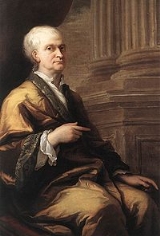
James Thornhill

Encyclopedia
Painting
Painting is the practice of applying paint, pigment, color or other medium to a surface . The application of the medium is commonly applied to the base with a brush but other objects can be used. In art, the term painting describes both the act and the result of the action. However, painting is...
of historical subjects, in the Italian baroque
Baroque
The Baroque is a period and the style that used exaggerated motion and clear, easily interpreted detail to produce drama, tension, exuberance, and grandeur in sculpture, painting, literature, dance, and music...
tradition.
Life
James Thornhill was born in Melcombe RegisMelcombe Regis
Melcombe Regis is an area of Weymouth in Dorset, England.Situated on the north shore of Weymouth Harbour and originally part of the waste of Radipole, it seems only to have developed as a significant settlement and seaport in the 13th century...
. He was the son of Walter Thornhill of Wareham
Wareham, Dorset
Wareham is an historic market town and, under the name Wareham Town, a civil parish, in the English county of Dorset. The town is situated on the River Frome eight miles southwest of Poole.-Situation and geography:...
and Mary, eldest daughter of Colonel William Sydenham
Colonel William Sydenham
William Sydenham was a Cromwellian soldier; and the eldest brother of Thomas Sydenham. He fought for Parliament and defeated the Royalists in various skirmishes in Dorset. He was member of the various parliaments of the Commonwealth, avowal conservative principles, and defended the liberties of...
, governor of Weymouth. In 1689, he was apprenticed to Thomas Highmore (1660–1720), a specialist in non-figurative decorative painting. Young James also learned much from Antonio Verrio
Antonio Verrio
The Italian-born Antonio Verrio was responsible for introducing Baroque mural painting into England and served the Crown over a thirty year period.-Career:...
(1639?–1707) and Louis Laguerre
Louis Laguerre
Louis Laguerre , was a French decorative painter mainly working in England.Born in Versailles in 1663 and trained at the Paris Academy under Charles Le Brun, he came to England in 1683, where he first worked with Antonio Verrio, and then on his own...
(1663–1721), prominent foreign decorative painters then working in England. In 1696 he completed his apprenticeship and in March 1704 became a Freeman of the Painter-Stainers’ Company of London. From 1707 on, Thornhill successfully worked for the upper class as a history painter.
Thornhill decorated palace interiors with large-scale compositions. The figures of these wall paintings are commonly shown in idealized and rhetorical postures. In 1711, Thornhill was one of the 12 original directors of Sir Godfrey Kneller
Godfrey Kneller
Sir Godfrey Kneller, 1st Baronet was the leading portrait painter in England during the late 17th and early 18th centuries, and was court painter to British monarchs from Charles II to George I...
's academy at Great Queen Street
Great Queen Street
Great Queen Street is a street in central London, England in the West End. It is a continuation of Long Acre from Drury Lane to Kingsway. It runs from 1 to 44 along the north side, east to west, and 45 to about 80 along the south side, west to east...
, London. In 1716, he succeeded Kneller as Governor there and held the post until 1720. He then established his own private drawing school at Covent Garden
Covent Garden
Covent Garden is a district in London on the eastern fringes of the West End, between St. Martin's Lane and Drury Lane. It is associated with the former fruit and vegetable market in the central square, now a popular shopping and tourist site, and the Royal Opera House, which is also known as...
, but this was soon closed.
In 1715 Thornhill was given the commission to decorate the Painted Hall at Greenwich Hospital (1707–1727) by "a whig, low-church dominated committee inspired by a moral Anglican nationalism". The Archbishop of Canterbury, Thomas Tenison
Thomas Tenison
Thomas Tenison was an English church leader, Archbishop of Canterbury from 1694 until his death. During his primacy, he crowned two British monarchs.-Life:...
, is said to have remarked: "I am no judge of painting, but on two articles I think I may insist: first that the painter employed be a Protestant; and secondly that he be an Englishman". In June 1715 the Weekly Packet said that the decision to award Thornhill the commission would "put to silence all the loud applauses hitherto given to foreign artists". The allegorical wall and ceiling decorations of the Painted Hall depicted the Protestant succession of English monarchs from William and Mary
William and Mary
The phrase William and Mary usually refers to the coregency over the Kingdoms of England, Scotland and Ireland, of King William III & II and Queen Mary II...
to George I
George I of Great Britain
George I was King of Great Britain and Ireland from 1 August 1714 until his death, and ruler of the Duchy and Electorate of Brunswick-Lüneburg in the Holy Roman Empire from 1698....
.
In June 1718 George I
George I of Great Britain
George I was King of Great Britain and Ireland from 1 August 1714 until his death, and ruler of the Duchy and Electorate of Brunswick-Lüneburg in the Holy Roman Empire from 1698....
made Thornhill court painter, and in March 1720 Serjeant Painter. On 2 May 1720, the king knighted him, the first native artist to be knighted. In the same year, he was master of the Painters' Company and in 1723 fellow of the Royal Society. In October 1720, Louis Cheron
Louis Chéron
Louis Chéron was a French painter, illustrator and art tutor.-Life:Born into a French Protestant family of artists . He trained under his father then at the Académie Royale de Peinture et de Sculpture...
and John Vanderbank
John Vanderbank
John Vanderbank was an English portrait painter and book illustrator, who enjoyed a high reputation for a short while during the reign of King George I, but who died relatively young due to an intemperate and extravagant lifestyle.-Life:Vanderbank was born in London, the eldest son of John...
opened another academy in an old Presbyterian meeting house in St. Martin's Lane, which survived a few years. One of the subscribers was William Hogarth
William Hogarth
William Hogarth was an English painter, printmaker, pictorial satirist, social critic and editorial cartoonist who has been credited with pioneering western sequential art. His work ranged from realistic portraiture to comic strip-like series of pictures called "modern moral subjects"...
From 1722 to 1734 Thornhill was also a member of Parliament for Melcombe Regis
Weymouth and Melcombe Regis (UK Parliament constituency)
Weymouth and Melcombe Regis was a parliamentary borough in Dorset represented in the English House of Commons, later in that of Great Britain, and finally in the Parliament of the United Kingdom. It was formed by an Act of Parliament of 1570 which amalgamated the existing boroughs of Weymouth and...
..
His last major commission was to paint the chapel at Wimpole Hall
Wimpole Hall
Wimpole Hall is a country house located within the Parish of Wimpole, Cambridgeshire, England, about 8½ miles southwest of Cambridge. The house, begun in 1640, and its 3,000 acres of parkland and farmland are owned by the National Trust and are regularly open to the public.Wimpole is...
, he started work on the preliminary sketches in 1713 and the work was finished by 1724, the north wall has fictive architecture and four statues all in Trompe-l'œil of the four Doctors of the Church: St. Gregory
Pope Gregory I
Pope Gregory I , better known in English as Gregory the Great, was pope from 3 September 590 until his death...
, St. Ambrose
Ambrose
Aurelius Ambrosius, better known in English as Saint Ambrose , was a bishop of Milan who became one of the most influential ecclesiastical figures of the 4th century. He was one of the four original doctors of the Church.-Political career:Ambrose was born into a Roman Christian family between about...
, St. Augustine
Augustine of Hippo
Augustine of Hippo , also known as Augustine, St. Augustine, St. Austin, St. Augoustinos, Blessed Augustine, or St. Augustine the Blessed, was Bishop of Hippo Regius . He was a Latin-speaking philosopher and theologian who lived in the Roman Africa Province...
& St. Jerome
Jerome
Saint Jerome was a Roman Christian priest, confessor, theologian and historian, and who became a Doctor of the Church. He was the son of Eusebius, of the city of Stridon, which was on the border of Dalmatia and Pannonia...
. The east wall above the altar is painted with the Adoration of the Magi.
In November 1724, Thornhill made a second attempt to establish a new free academy in his private house at Covent Garden. This was more successful, and Hogarth must have been a member from the beginning. On 23 March 1729, Hogarth married Sir James' daughter Jane, indicating the depth of their relationship.
Important works
A major example of Thornhill's work are the eight scenes executed in grisailleGrisaille
Grisaille is a term for painting executed entirely in monochrome or near-monochrome, usually in shades of grey. It is particularly used in large decorative schemes in imitation of sculpture. Many grisailles in fact include a slightly wider colour range, like the Andrea del Sarto fresco...
from the Life of St. Paul
Paul of Tarsus
Paul the Apostle , also known as Saul of Tarsus, is described in the Christian New Testament as one of the most influential early Christian missionaries, with the writings ascribed to him by the church forming a considerable portion of the New Testament...
in the cupola of St Paul's Cathedral
St Paul's Cathedral
St Paul's Cathedral, London, is a Church of England cathedral and seat of the Bishop of London. Its dedication to Paul the Apostle dates back to the original church on this site, founded in AD 604. St Paul's sits at the top of Ludgate Hill, the highest point in the City of London, and is the mother...
(1716–19). In Dorset
Dorset
Dorset , is a county in South West England on the English Channel coast. The county town is Dorchester which is situated in the south. The Hampshire towns of Bournemouth and Christchurch joined the county with the reorganisation of local government in 1974...
, his birthplace, Thornhill decorated the reredos
Reredos
thumb|300px|right|An altar and reredos from [[St. Josaphat's Roman Catholic Church|St. Josaphat Catholic Church]] in [[Detroit]], [[Michigan]]. This would be called a [[retable]] in many other languages and countries....
at St. Mary's Church, Weymouth, with a picture of the Last Supper
Last Supper
The Last Supper is the final meal that, according to Christian belief, Jesus shared with his Twelve Apostles in Jerusalem before his crucifixion. The Last Supper provides the scriptural basis for the Eucharist, also known as "communion" or "the Lord's Supper".The First Epistle to the Corinthians is...
.
Thornhill's vast murals in great houses often related to topical events, as seen through the eye's of his mainly Whig patrons. At Chatsworth, during 1707-8 Thornhill painted a number of walls and ceilings, the most notable being the continuous wall and ceiling painting of the Sabine room, then a lobby, but since used as a bedroom. Here he painted the The Rape of the Sabine Women
The Rape of the Sabine Women
The Rape of the Sabine Women is an episode in the legendary history of Rome in which the first generation of Roman men acquired wives for themselves from the neighboring Sabine families. The English word "rape" is a conventional translation of Latin raptio, which in this context means "abduction"...
, a vast panorama of mounted warriors carrying off the Sabine women to Rome. He chooses to feature strongly Hersilia
Hersilia
In Roman mythology, Hersilia was the wife of Romulus, the founder and first King of Rome. She is described as such in both Livy and Plutarch; but in Dionysius, Macrobius, and another tradition recorded by Plutarch, she was instead the wife of Hostus Hostilius, a Roman champion at the time of Romulus...
, who was deified for her loyalty to her Roman husband, Romulus
Romulus
- People:* Romulus and Remus, the mythical founders of Rome* Romulus Augustulus, the last Western Roman Emperor* Valerius Romulus , deified son of the Roman emperor Maxentius* Romulus , son of the Western Roman emperor Anthemius...
, as against her Sabine family - a deliberate reference to Mary
Mary II of England
Mary II was joint Sovereign of England, Scotland, and Ireland with her husband and first cousin, William III and II, from 1689 until her death. William and Mary, both Protestants, became king and queen regnant, respectively, following the Glorious Revolution, which resulted in the deposition of...
, lauded by the Whigs for supporting her Protestant husband, William
William III of England
William III & II was a sovereign Prince of Orange of the House of Orange-Nassau by birth. From 1672 he governed as Stadtholder William III of Orange over Holland, Zeeland, Utrecht, Guelders, and Overijssel of the Dutch Republic. From 1689 he reigned as William III over England and Ireland...
, against her Catholic father, James
James II of England
James II & VII was King of England and King of Ireland as James II and King of Scotland as James VII, from 6 February 1685. He was the last Catholic monarch to reign over the Kingdoms of England, Scotland, and Ireland...
.
At Hanbury Hall
Hanbury Hall
Hanbury Hall was built by the chancery lawyer Thomas Vernon in the early 18th century. Thomas Vernon was the great grandson of the first Vernon to come to Hanbury, Worcestershire, Rev Richard Vernon...
, beneath an imposing view of the Olympian Gods, dominating the ceiling of the main staircase, Thornhill shows Rev Henry Sacheverell
Henry Sacheverell
Henry Sacheverell was an English High Church clergyman and politician.-Early life:The son of Joshua Sacheverell, rector of St Peter's, Marlborough,...
, a Tory
Tory
Toryism is a traditionalist and conservative political philosophy which grew out of the Cavalier faction in the Wars of the Three Kingdoms. It is a prominent ideology in the politics of the United Kingdom, but also features in parts of The Commonwealth, particularly in Canada...
propagandist put on trial for sedition by the Whig government in 1710, being cast to the Furies. In 1716 Thornhill painted the ceiling of the Great Hall in Blenheim Palace
Blenheim Palace
Blenheim Palace is a monumental country house situated in Woodstock, Oxfordshire, England, residence of the dukes of Marlborough. It is the only non-royal non-episcopal country house in England to hold the title of palace. The palace, one of England's largest houses, was built between...
for John Churchill, 1st Duke of Marlborough
John Churchill, 1st Duke of Marlborough
John Churchill, 1st Duke of Marlborough, Prince of Mindelheim, KG, PC , was an English soldier and statesman whose career spanned the reigns of five monarchs through the late 17th and early 18th centuries...
, newly returned to the country after being prosecuted by the Tory ministry in the last years of Queen Anne
Anne of Great Britain
Anne ascended the thrones of England, Scotland and Ireland on 8 March 1702. On 1 May 1707, under the Act of Union, two of her realms, England and Scotland, were united as a single sovereign state, the Kingdom of Great Britain.Anne's Catholic father, James II and VII, was deposed during the...
. The subject is, inevitably, the Duke's 1704 victory at the Battle of Blenheim
Battle of Blenheim
The Battle of Blenheim , fought on 13 August 1704, was a major battle of the War of the Spanish Succession. Louis XIV of France sought to knock Emperor Leopold out of the war by seizing Vienna, the Habsburg capital, and gain a favourable peace settlement...
, during the War of the Spanish Succession
War of the Spanish Succession
The War of the Spanish Succession was fought among several European powers, including a divided Spain, over the possible unification of the Kingdoms of Spain and France under one Bourbon monarch. As France and Spain were among the most powerful states of Europe, such a unification would have...
. Thornhill was also a notable portraitist.
In 1718 Sir James took a large house on Covent Garden
Covent Garden
Covent Garden is a district in London on the eastern fringes of the West End, between St. Martin's Lane and Drury Lane. It is associated with the former fruit and vegetable market in the central square, now a popular shopping and tourist site, and the Royal Opera House, which is also known as...
Piazza, and in 1725 he built Thornhill House in the south of Stalbridge
Stalbridge
Stalbridge is a small town and civil parish in Dorset, England, situated in the Blackmore Vale area of North Dorset district, near the border with Somerset. In 2001 the town had a population of 2,579, and is still growing. 30.8% of the inhabitants are retired...
, near Sturminster Newton
Sturminster Newton
Sturminster Newton, known to locals as Stur, is a town in the Blackmore Vale area of Dorset, England. It is situated on a low limestone ridge in a meander of the River Stour. The town is at the centre of a large dairy agriculture region, around which the town's economy is built...
, Dorset
Dorset
Dorset , is a county in South West England on the English Channel coast. The county town is Dorchester which is situated in the south. The Hampshire towns of Bournemouth and Christchurch joined the county with the reorganisation of local government in 1974...
. He probably designed this house himself in the Palladian
Andrea Palladio
Andrea Palladio was an architect active in the Republic of Venice. Palladio, influenced by Roman and Greek architecture, primarily by Vitruvius, is widely considered the most influential individual in the history of Western architecture...
manner.
In 1720 Thornhill tried his hand at architecture. Along with Giacomo Leoni
Giacomo Leoni
Giacomo Leoni , also known as James Leoni, was an Italian architect, born in Venice. He was a devotee of the work of Florentine Renaissance architect Leon Battista Alberti, who had also been an inspiration for Andrea Palladio. Leoni thus served as a prominent exponent of Palladianism in English...
, he designed Moor Park
Moor Park (house)
Moor Park is a Grade I listed Palladian mansion set within several hundred acres of parkland in Hertfordshire, England. It is called Moor Park Mansion because it is in the old park of the Manor of More. The original house was built in 1678–9 for James, Duke of Monmouth, and inherited by his...
, for which he also painted the entrance hall ceiling and other rooms.
By the end of his life Thornhill was receiving no major commissions. So he began to copy the Raphael Cartoons
Raphael Cartoons
The Raphael Cartoons are seven large cartoons for tapestries, now in the Victoria and Albert Museum, London, painted by the High Renaissance painter Raphael in 1515-16 and showing scenes from the Gospels and Acts of the Apostles...
at Hampton Court. Apart from full-size copies, completed in 1731, he made 162 smaller studies of heads, hands and feet intending to publish them in printed form for the use of art students, but his death left this work unfinished. The original small wash designs of details of the Raphael Cartoons are now kept in the Victoria and Albert Museum
Victoria and Albert Museum
The Victoria and Albert Museum , set in the Brompton district of The Royal Borough of Kensington and Chelsea, London, England, is the world's largest museum of decorative arts and design, housing a permanent collection of over 4.5 million objects...
, London.
Further reading
- Memorial of Sir James Thornhill (The Gentlemen's magazine and historical review, Volume 195, Jan 1855) p486 ff.
- Sir James Thornhill (Dictionary of National Biography, 1885–1900, Volume 57).
- Sir James Thornhill (1911 Encyclopædia Britannica entry)
External links
- James Thornhill online ArtCyclopedia
- James Thornhill biography (The Dorset Page)
- Thornhill gallery of works ("Art Browser")
- The Thornhills of Gloucestershire