
All Topics  
Central London

 
Central London

   Email Print
   Bookmark   Link


Central London


The term Central London refers to the districts of London
London

London is the capital of both England and the United Kingdom, and the most populous municipality in the European Union. An important settlement for two millennia, History of London goes back to its founding by the Roman Empire....
 which are considered closest to the centre. There is no conventional definition, nor any official one, for the entire area that can be called "central London". Central London covers about 10 square miles (26 square kilometres) on both areas of north-south River Thames
River Thames

The Thames is a major river flowing through southern England. While best known because its lower reaches flow through central London, the river flows through several other towns and cities, including Oxford, Reading, Berkshire and Windsor, Berkshire....
. Central London
Central London

The term Central London refers to the districts of London which are considered closest to the centre. There is no conventional definition, nor any official one, for the entire area that can be called "central London"....
 can be split into three main sections, the City
City of London

The City of London is a geographically small city status in the United Kingdom within Greater London, England. It is the historic core of London around which, along with Westminster, the modern conurbation grew....
, the West End
West End of London

The West End of London is an area of Central London, England, containing many of the city's major tourist attractions, businesses, headquarters and the commercial West End theatres....
, and South Bank
South Bank

The South Bank is the area in London on the southern bank of the River Thames near Waterloo station that houses a number of important cultural buildings/institutions....
. The South Bank stretches over the river from these regions.

starting point in considering what "Central London" means, it is important to recognise that London does not consist of a small high rise core surrounded by a belt of very low density districts.


Discussion
Ask a question about 'Central London'
Start a new discussion about 'Central London'
Answer questions from other users
Full Discussion Forum


Encyclopedia


The term Central London refers to the districts of London
London

London is the capital of both England and the United Kingdom, and the most populous municipality in the European Union. An important settlement for two millennia, History of London goes back to its founding by the Roman Empire....
 which are considered closest to the centre. There is no conventional definition, nor any official one, for the entire area that can be called "central London". Central London covers about 10 square miles (26 square kilometres) on both areas of north-south River Thames
River Thames

The Thames is a major river flowing through southern England. While best known because its lower reaches flow through central London, the river flows through several other towns and cities, including Oxford, Reading, Berkshire and Windsor, Berkshire....
. Central London
Central London

The term Central London refers to the districts of London which are considered closest to the centre. There is no conventional definition, nor any official one, for the entire area that can be called "central London"....
 can be split into three main sections, the City
City of London

The City of London is a geographically small city status in the United Kingdom within Greater London, England. It is the historic core of London around which, along with Westminster, the modern conurbation grew....
, the West End
West End of London

The West End of London is an area of Central London, England, containing many of the city's major tourist attractions, businesses, headquarters and the commercial West End theatres....
, and South Bank
South Bank

The South Bank is the area in London on the southern bank of the River Thames near Waterloo station that houses a number of important cultural buildings/institutions....
. The South Bank stretches over the river from these regions.

Pattern of settlement

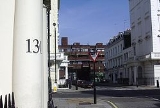
Pimlico Street
As a starting point in considering what "Central London" means, it is important to recognise that London does not consist of a small high rise core surrounded by a belt of very low density districts. The situation is more complex. The section of London that is of an urban
Urban area

An urban area is an area with an increased Population density of human-created structures in comparison to the areas surrounding it. Urban areas may be city, towns or conurbations, but the term is not commonly extended to rural settlements such as villages and hamlet ....
, as opposed to a suburban, character is very extensive, encompassing most of the districts built before 1914. Before World War I
World War I

World War I, or the First World War , was a global military conflict which involved the Great powers, organized into two opposing military alliances: the Allies of World War I and the Central Powers....
, most London housing, including housing in the most expensive districts, was terraced
Terraced house

In architecture and city planning, a terrace or row house or townhouse is a style of medium-density housing that originated in Europe in the late 17th century, where a row of identical or mirror-image houses share side walls....
. Low-density suburbs were first built in the early 19th century, but they did not become predominant for another hundred years.

During the 20th century, and especially in the decades after World War II
World War II

World War II, or the Second World War , was a global military conflict which involved a Participants in World War II, including all of the great powers, organised into two opposing military alliances: the Allies of World War II and the Axis powers....
, the size of the fashionable central area of London shrank considerably as the old aristocratic London elite faded away and many members of the middle classes decided that living close to the city centre was no longer appealing. At that time, government planners often had a negative view of urban life as well, and a large amount of housing in central London had been destroyed during World War II. Thus, many members of the working class were induced to move out of the city centre as well, either to suburban developments around London or to new town
New town

A new town, planned community or planned city is a city, town, or community that was carefully planned from its inception and is typically constructed in a previously undeveloped area....
s further afield. However, since the 1980s, many of these areas have become gentrified
Gentrification

Gentrification, or urban gentrification, is the change in an urban area associated with the population mobility of more affluent individuals into a lower-class area....
, and they are regarded as desirable areas of central London once again. A very large section of urban West London still contains areas which are extremely expensive to live in. These areas are Mayfair, Knightsbridge
Knightsbridge

Knightsbridge is a road which gives its name to an exclusive district lying to the west of Central London. The road runs along the south side of Hyde Park, London, west from Hyde Park Corner, spanning the City of Westminster and the Royal Borough of Kensington and Chelsea....
, Brompton
Brompton, Kensington

Brompton is a locality in the Royal Borough of Kensington and Chelsea. It is roughly defined by the triangle of Brompton Road, Sloane Street and Sloane Avenue....
, Kensington
Kensington

Kensington is a district of West London, England within the Royal Borough of Kensington and Chelsea, located west of Charing Cross. An affluent and densely-populated area, its commercial heart is Kensington High Street and it contains the well-known museum district of South Kensington....
, Chelsea
Chelsea, London

Chelsea is an area of south-west London, England, bounded to the south by the River Thames, where its frontage runs from Chelsea Bridge along the Chelsea Embankment, Cheyne Walk, Lots Road power station and Chelsea Harbour....
, South Kensington
South Kensington

South Kensington is a district in the Royal Borough of Kensington and Chelsea in London. It is a built-up area located 2.4 miles west south-west of Charing Cross....
, Fulham
Fulham

Fulham is an area of south-west London in the London Borough of Hammersmith and Fulham, located south west of Charing Cross. It is situated in between Putney and Chelsea, London....
, Belgravia
Belgravia

Belgravia is a district of central London in the City of Westminster, situated to the south-west of Buckingham Palace. Belgravia is approximately bounded by Knightsbridge to the north , Grosvenor Place and Buckingham Palace Road to the east, Pimlico Road to the south, and Sloane Street to the west....
, Holland Park
Holland Park

Holland Park is a district and a public park in the Royal Borough of Kensington and Chelsea, in west central London in England. Holland Park is widely regarded as one of the most romantic parks in London, due to its abundant wildlife and secluded hideaways....
, Notting Hill
Notting Hill

Notting Hill is an area in West London, England close to the north-western corner of Hyde Park, London, and lying within the Royal Borough of Kensington and Chelsea....
, St John's Wood
St John's Wood

|country = England|region=London|official_name= St John's Wood|latitude= 51.5361|longitude= -0.1751...
, Marylebone
Marylebone

Marylebone is an affluent, inner-city area of central London, located within the City of Westminster. It can be pronounced as Marribun or Mar-lee-bone Marylebone is in an area of London that can be roughly defined as the area bounded by Oxford Street to the south, Marylebone Road to the north, Edgware Road to the west and Portland Place to...
 and Soho
Soho

Soho is an area in the centre of the West End of London of London, England, in the City of Westminster. It is an entertainment district which for much of the later part of the 20th century had a reputation for its sex shops as well as its night life and film industry....
.

Changing definition


Introduction of postal districts

In 1858 London was divided into postal districts
London postal district

The London postal district is the area in England, currently of 241 square miles, to which mail addressed to the LONDON post town is delivered....
  in order to aid the forwarding of mail items. The two most central districts were "EC" - East Central which broadly covered the City of London and "WC" - West Central which covered the area immediately west of there as far as Charing Cross Road and Tottenham Court Road.

Coming of the railways

When the railways were first constructed in London during the latter 1800s an area of central London was defined by government and railway lines were not permitted to pass beyond it, at least not above ground. The restrictions were relaxed a little and the new, more central, terminals were constructed at Waterloo (replacing Nine Elms), Fenchurch Street (Minories) and Liverpool Street (Bishopsgate). This created the ring of terminal stations which still exists today. The railways were thus instrumental in both enabling the rapid expansion of London and also helped to reinforce the boundary of the central area.

1901 census

The 1901 census defined the central area as consisting of St George's, Hanover Square, Westminster
Westminster

Westminster is an area of Central London, within the City of Westminster. It lies on the north bank of the River Thames, southwest of the City of London and southwest of Charing Cross....
, Marylebone
Marylebone

Marylebone is an affluent, inner-city area of central London, located within the City of Westminster. It can be pronounced as Marribun or Mar-lee-bone Marylebone is in an area of London that can be roughly defined as the area bounded by Oxford Street to the south, Marylebone Road to the north, Edgware Road to the west and Portland Place to...
, St Giles
St Giles in the Fields

St Giles in the Fields is a church in the London Borough of Camden, in the West End. It is close to Centre Point and Tottenham Court Road tube station....
, Strand
Strand, London

The Strand is a street in the City of Westminster, London, England. It currently starts at Trafalgar Square and runs east to join Fleet Street at Temple Bar London, which marks the boundary of the City of London at this point, though its #History has been longer than this....
, Holborn
Holborn

Holborn is an area of Central London, England. Holborn is also the name of the area's principal east-west street, running from St Giles's High Street as High Holborn to Gray's Inn Road to Holborn Viaduct, crossing the borders of the City of Westminster, London Borough of Camden and the City of London....
, London City
City of London

The City of London is a geographically small city status in the United Kingdom within Greater London, England. It is the historic core of London around which, along with Westminster, the modern conurbation grew....
, Shoreditch
Shoreditch

Shoreditch is an area of London within the London Borough of Hackney. It is a built-up part of the inner city immediately to the north of the City of London, located north east of Charing Cross....
 and St Olave, Southwark
Southwark

Southwark, or the Borough, is an area of south-east London in the London Borough of Southwark, situated 1.5 miles east of Charing Cross....
.

Modern times

In the late 1970s the population of Greater London was at its lowest level since the 1920s, and "central London" might have included:

  • City of London
    City of London

    The City of London is a geographically small city status in the United Kingdom within Greater London, England. It is the historic core of London around which, along with Westminster, the modern conurbation grew....
  • Most of the City of Westminster
    City of Westminster

    The City of Westminster is a London borough of London with City status in the United Kingdom. It is located west of the City of London and north of the River Thames, and forms part of Inner London and the bulk of London's central area....
  • Most of Kensington and Chelsea
    Royal Borough of Kensington and Chelsea

    The Royal Borough of Kensington and Chelsea is a London borough in the west side of central London.It is an urban area and was named in the United Kingdom Census 2001 as the most densely populated local authority in the United Kingdom, with a population of 158,919 at 13,244 per square kilometre ....
  • The section of Camden
    London Borough of Camden

    The London Borough of Camden is a London borough of London, England, which forms part of Inner London. The southern reaches of Camden form part of Central London....
     south of the Euston Road
    Euston Road

    Euston Road is an important thoroughfare in central London, England and forms part of the A501 road. It is part of the New Road from Paddington to Islington, and was opened as part of the New Road in 1756....
  • The section of Islington
    London Borough of Islington

    The London Borough of Islington is a London borough in North London and Inner London. It was formed in 1965 by merging the former Metropolitan Borough of Metropolitan Borough of Islington and Metropolitan Borough of Finsbury....
     south of Pentonville Road and City Road
    City Road

    Often referred to by Londoners as "The City Road", the western extremity of the road is at the Angel, Islington where it forms a continuation of Pentonville Road....


These five districts all contain dense concentrations of characteristically metropolitan activities: major corporate offices; buildings housing the functions of the state; universities; professional institutions; large scale retailing, including department stores; museums, libraries, theatres, concert halls and other important entertainment facilities. They also have a large amount of housing, some of that in the private sector being among the most expensive in the world.

Since 1970s there has been a long term trend for the number of districts in London which can credibly be considered part of "central London" to increase. Some non-residential land uses in London, such as offices and hotels, have become more widely distributed, but these new candidate districts for "central London" status tend to be more residential than the core districts listed above.

The Central London Partnership covers six London boroughs plus the City, the boroughs are: Camden, Islington, Kensington and Chelsea, Lambeth
London Borough of Lambeth

The London Borough of Lambeth is a London borough in South London, England and forms part of Inner London....
, Southwark
London Borough of Southwark

The London Borough of Southwark is a London borough in south east London, England. It is directly south of the River Thames and the City of London, and forms part of Inner London....
, and Westminster. In December 2005 the London Development Agency
London Development Agency

The London Development Agency is the Regional Development Agency for Greater London, England. It is a functional body of the Greater London Authority....
 published a draft 'Central London Tourism Strategy' covering the Central London Partnership area. It excluded the City of London but said that its 'central importance' would be taken into account as part of the strategy.

Nationaltheatre London

South Bank and its environs

London began on the north bank of the Thames, and its centre of gravity is still strongly on that side of the river, but a wide range of major buildings and facilities have been built south of the river in recent decades. The South Bank
South Bank

The South Bank is the area in London on the southern bank of the River Thames near Waterloo station that houses a number of important cultural buildings/institutions....
 and Bankside
Bankside

Bankside is an area in Southwark, London, on the southern bank of the River Thames, situated between Blackfriars Bridge to the west and London Bridge to the east....
 areas are now accepted as being part of "central London", and some people would include other districts on this side of the river as well.

The East End

Although much of the East End of London
East End of London

The East End of London, known locally as the East End, is the area of London, England, east of the medieval walled City of London and north of the River Thames, although it is not defined by universally accepted formal boundaries....
 is completely urban in character, compared to the West End of London
West End of London

The West End of London is an area of Central London, England, containing many of the city's major tourist attractions, businesses, headquarters and the commercial West End theatres....
 it has historically been the poorer side of the city. With extensive redevelopment, social change and rising land values this contrast has been reduced.

Inner suburbs

To the west and north west of the core districts listed above there is a ring of fashionable mainly Victorian
Victorian architecture

The term Victorian architecture can refer to one of a number of architectural styles predominantly employed during the Victorian era. As with the latter, the period of building that it covers may slightly overlap the actual reign, 20 June 1837 ? 22 January 1901, of Queen Victoria of the United Kingdom after whom it is named....
 and primarily residential districts around all four sides of Hyde Park
Hyde Park, London

Hyde Park is one of the largest parks in central London, England and one of the Royal Parks of London, famous for its Speakers' Corner.The park is divided in two by the Serpentine ....
 and Kensington Gardens
Kensington Gardens

See also Kensington Gardens, South Australia, a suburb of Adelaide, AustraliaKensington Gardens, once the private gardens of Kensington Palace, is one of the Royal Parks of London, lying immediately to the west of Hyde Park, London....
, such as Holland Park
Holland Park

Holland Park is a district and a public park in the Royal Borough of Kensington and Chelsea, in west central London in England. Holland Park is widely regarded as one of the most romantic parks in London, due to its abundant wildlife and secluded hideaways....
 and Notting Hill
Notting Hill

Notting Hill is an area in West London, England close to the north-western corner of Hyde Park, London, and lying within the Royal Borough of Kensington and Chelsea....
. Some people consider all of these districts to be part of "central London". Similar claims would also be made by many for the fashionable north western districts as far out as Hampstead
Hampstead

Hampstead is an area of London, England, located north-west of Charing Cross. It is part of the London Borough of Camden. It is situated within Inner London....
.

Central London and Inner London

Londoninner
Inner London
Inner London

Inner London is the name for the group of London boroughs which form the interior part of Greater London and are surrounded by Outer London. The area was first officially defined in 1965 and for purposes such as statistics, the definition has changed over time....
 is the name for the group of London boroughs which form the interior part of Greater London
Greater London

Greater London is the top-level administrative subdivision covering London, England. The administrative area was officially created in 1965 and covers the City of London , the City of Westminster and the other 31 London boroughs....
 and are surrounded by Outer London
Outer London

Outer London is the name for the group of London Boroughs that form a ring around Inner London.These were areas that were not part of the County of London and became formally part of Greater London in 1965....
. The area was first officially defined in 1965 and for purposes such as statistics, the definition has changed over time.

Use of Inner London in some contexts can carry negative connotations and be used only to describe those inner-city areas affected by poverty, crime, and social problems while Central London carries more prestigious connotations and is used in terms of business, entertainment, tourism and desirable housing. In this context it is suggested that Central London is surrounded by Inner London and not part of it.

It is important to note that unlike in some major cities in the United States and elsewhere, these two faces of urban life are intermingled. There is social housing in almost all of the prestigious central London districts, even Mayfair, and nowadays expensive private housing is often built in poor neighbourhoods where most of the existing occupants live in social housing without these poorer occupants being moved elsewhere. All sorts of people live cheek-by-jowl in London, though often without having much contact with people outside of their own group.

Other definitions


Maps

The Geographer's A-Z Street Atlas and other map sources often include a section covering central London at an increased scale. The area chosen as central may vary.
London Underground Zone 1

Transport

  • The area inside the Circle Line of the London Underground
    London Underground

    The London Underground is a metro system serving a large part of Greater London and neighbouring areas of Essex, Hertfordshire and Buckinghamshire in the UK....
    . This is a fairly wide definition in the western areas, but entirely ignores any districts south of the Thames and the recent expansion of central activities to part of the East End of London
    East End of London

    The East End of London, known locally as the East End, is the area of London, England, east of the medieval walled City of London and north of the River Thames, although it is not defined by universally accepted formal boundaries....
    , with the development of Docklands. Thus it is probably not used as much as it was some years ago.


  • Travelcard Zone 1
    Travelcard Zone 1

    Travelcard Zone 1 is the central zone of Transport for London's zonal system used for calculating co-ordinated inter-modal Travelcard fares within London....
     in the public transport
    Transport for London

    Transport for London is the local government body responsible for most aspects of the transport system in Greater London in England. Its role is to implement the transport strategy and to manage transport services across London....
     system, which is a little more generous, taking in some areas to the south of the Thames. Although the zones are not perfectly circular, the approximate centre for zone 1 is slightly southwest of Piccadilly Circus
    Piccadilly Circus

    Piccadilly Circus is a famous junction and public space of London's West End of London in the City of Westminster,built in 1819 to connect Regent Street with the major shopping street of Piccadilly....
     station.


  • Central London 'Journey Planner' maps in tube carriages show a varying area as central.


  • The congestion charging zone.


Central London

Postal districts

The East Central and West Central postal district created in 1858 which were further divided in 1917 into the modern EC1, EC2, EC3, EC4, WC1 and WC2 London postal district
London postal district

The London postal district is the area in England, currently of 241 square miles, to which mail addressed to the LONDON post town is delivered....
s. These do not reflect changes in perceptions which have occurred since then, and they were perhaps not intended to define "Central London" for general purposes even then. An area closer to a typical modern definition of Central London can be arrived at by combining the aforementioned districts with the head districts of the other sectors e.g. W1.

Parlance


One way of identifying which areas are central is the language used to describe them by Londoners. When describing non-central areas the relevant place name is used. When the central area is being referred to it is most commonly called 'The City' for the City of London and 'Town', 'West End' or 'West' for the central shopping, entertainment and business districts outside the City. One might be 'going up to Town' if shopping on Oxford Street or Bond Street but not if shopping on the Kings Road.

Phone codes


In passing, it should be noted that it is thought by some that, if a telephone number begins with 020 7, it may be assumed to be located in Central London. This, however, is not always the case.

Central activities zone

The Central Activities Zone (CAZ): This is a term used in the London Plan
London Plan

The London Plan is a planning document written by the Mayor of London in the United Kingdom and published by the Greater London Authority. The plan was first published in final form on 10 February 2004 and has since been amended....
, which derives in its turn from definitions used in the local plans of the various boroughs whose areas form part of Central London. It covers only those areas with a very high concentration of metropolitan activities, generally those where 50 per cent or more of each street block is in commercial use. This results in a small and extremely irregularly shaped area.

2005 07 10   United Kingdom   England   London   Charing Cross   Eleanor Cross

Charing Cross

On a traffic island at the southern end of Trafalgar Square was the original Charing Cross, where the Strand from the City met Whitehall, coming north from Westminster. The site is now occupied by an equestrian statue of Charles I
Charles I of England

Charles I was List of English monarchs, List of monarchs of Scotland and King of Ireland from 27 March 1625 until his capital punishment on 30 January 1649....
, behind which a plaque states:
On the site now occupied by the statue of King Charles was erected the original Queen Eleanor's Cross
Eleanor cross

The Eleanor crosses were 12 lavishly decorated stone monuments, of which three survive intact, in a line down part of the east of England. Edward I of England had the crosses erected between 1291 and 1294 in memory of his wife Eleanor of Castile, marking the nightly resting-places along the route taken by her body as it was taken to London....
, a replica of which stands in front of Charing Cross station. Mileages from London are measured from the site of the original cross.
The original cross was erected on one of twelve places where Queen Eleanor
Eleanor of Castile

Eleanor of Castile was the first Queen consort of Edward I of England....
's body rested on its procession from Lincoln
Lincoln, Lincolnshire

Lincoln is a cathedral city and county town of Lincolnshire, England.The non-metropolitan district of Lincoln has a population of around 101,000 - the 2001 census gave the entire urban area of Lincoln a population of 120,779....
 to Westminster Abbey
Westminster Abbey

The Collegiate Church of St Peter at Westminster, which is almost always referred to popularly and informally as Westminster Abbey, is a large, mainly Gothic architecture Church , in Westminster, London, just to the west of the Palace of Westminster....
. An ornate reconstruction of 1863 now stands in the forecourt of the station. By convention, distances from London, that appear on road signs, are still measured from the original Charing Cross.

London boroughs


With the exception of the "square mile" of the City of London
City of London

The City of London is a geographically small city status in the United Kingdom within Greater London, England. It is the historic core of London around which, along with Westminster, the modern conurbation grew....
, the London borough
London borough

The administrative area of Greater London contains thirty-two London boroughs. Inner London comprises twelve of these boroughs plus the City of London....
s all include some districts which would not be considered to be part of "central London" at least by some of the stricter definitions. London boroughs can be defined in terms of 'inner' or 'outer' London, but cannot be defined as central or otherwise. However, the London Plan
London Plan

The London Plan is a planning document written by the Mayor of London in the United Kingdom and published by the Greater London Authority. The plan was first published in final form on 10 February 2004 and has since been amended....
 in 2004 defined the Central London sub-region as comprising the boroughs of Kensington and Chelsea, Camden, Islington, Wandsworth, Lambeth, Southwark and the City of Westminster, omitting the City of London itself.

Summary of districts


The City of London
City of London

The City of London is a geographically small city status in the United Kingdom within Greater London, England. It is the historic core of London around which, along with Westminster, the modern conurbation grew....
 is taken as being entirely and undisputedly central. Here follow some districts which are also commonly thought of as central and some fringe cases that are sometimes considered so.

London borough Districts considered central Fringes
London Borough of Tower Hamlets

The London Borough of Tower Hamlets is a London borough to the east of the City of London, England and north of the River Thames in East London, England, taking in much of the East End of London....
Tower Hill
Tower Hill

Tower Hill is an elevated spot north-west of the Tower of London, just outside the limits of the City of London in the London Borough of Tower Hamlets....
 
Whitechapel
Whitechapel

Whitechapel is a built-up inner city district in the London Borough of Tower Hamlets, England. It is located east of Charing Cross and roughly bounded by the Bishopsgate thoroughfare on the west, Hanbury Street on the north, Brady Street and Cavell Street on the east and Commercial Road on the south....
, Wapping
Wapping

Wapping is a place in the London Borough of Tower Hamlets which forms part of the London Docklands to the east of the City of London. It is situated between the north bank of the River Thames and the ancient thoroughfare simply called The Highway....
London Borough of Hackney

The London Borough of Hackney is a London borough in East London, and forms part of inner London and North London....
Shoreditch
Shoreditch

Shoreditch is an area of London within the London Borough of Hackney. It is a built-up part of the inner city immediately to the north of the City of London, located north east of Charing Cross....
, Old Street
Old Street

Old Street is a street in east London that runs west to east from Goswell Road in Clerkenwell, in the London Borough of Islington, to the crossroads where it intersects with Shoreditch High Street , Kingsland Road and Hackney Road in Shoreditch in the London Borough of Hackney....
 
North and east of City Road
City Road

Often referred to by Londoners as "The City Road", the western extremity of the road is at the Angel, Islington where it forms a continuation of Pentonville Road....
London Borough of Islington

The London Borough of Islington is a London borough in North London and Inner London. It was formed in 1965 by merging the former Metropolitan Borough of Metropolitan Borough of Islington and Metropolitan Borough of Finsbury....
Clerkenwell
Clerkenwell

Clerkenwell is an area of central London in the London Borough of Islington. Clerkenwell was once known as London's "Little Italy" due to its extensive Italian population from the 1850s to the 1960s....
 
North of the Angel, Islington
London Borough of Camden

The London Borough of Camden is a London borough of London, England, which forms part of Inner London. The southern reaches of Camden form part of Central London....
Holborn
Holborn

Holborn is an area of Central London, England. Holborn is also the name of the area's principal east-west street, running from St Giles's High Street as High Holborn to Gray's Inn Road to Holborn Viaduct, crossing the borders of the City of Westminster, London Borough of Camden and the City of London....
, Bloomsbury
Bloomsbury

Bloomsbury may refer to:* Bloomsbury, an area in central London.* the Bloomsbury Group, an English literary group active around from around 1905 to the start of World War II....
, Fitzrovia
Fitzrovia

Fitzrovia is an area of central London, near London's West End, London. It is a formally designated area lying partly in the London Borough of Camden and partly in the City of Westminster ....
 
North of Euston Road
Euston Road

Euston Road is an important thoroughfare in central London, England and forms part of the A501 road. It is part of the New Road from Paddington to Islington, and was opened as part of the New Road in 1756....
, Kings Cross
Kings Cross, London

Kings Cross is an area of London partly in the London Borough of Camden and partly in the London Borough of Islington. It is an inner-city district located 1.5 miles north of Charing Cross....
, Camden Town
Camden Town

Camden Town is the name of an area within the London Borough of Camden, situated in London, England. It is occasionally shortened to Camden....
City of Westminster
City of Westminster

The City of Westminster is a London borough of London with City status in the United Kingdom. It is located west of the City of London and north of the River Thames, and forms part of Inner London and the bulk of London's central area....
All except north west Bayswater
Bayswater

Bayswater is an area of west London in the City of Westminster. It is a built-up district located 3 miles west north-west of Charing Cross and borders the north of Hyde Park, London over Kensington Gardens....
, St John's Wood
St John's Wood

|country = England|region=London|official_name= St John's Wood|latitude= 51.5361|longitude= -0.1751...
, Maida Vale
Maida Vale

Maida Vale is a residential district in West London between St John's Wood and Kilburn, London. It is part of City of Westminster. The area is mostly residential, and mainly affluent, consisting of many large Edwardian blocks of mansion flats....
Royal Borough of Kensington and Chelsea

The Royal Borough of Kensington and Chelsea is a London borough in the west side of central London.It is an urban area and was named in the United Kingdom Census 2001 as the most densely populated local authority in the United Kingdom, with a population of 158,919 at 13,244 per square kilometre ....
Chelsea
Chelsea, London

Chelsea is an area of south-west London, England, bounded to the south by the River Thames, where its frontage runs from Chelsea Bridge along the Chelsea Embankment, Cheyne Walk, Lots Road power station and Chelsea Harbour....
, Knightsbridge
Knightsbridge

Knightsbridge is a road which gives its name to an exclusive district lying to the west of Central London. The road runs along the south side of Hyde Park, London, west from Hyde Park Corner, spanning the City of Westminster and the Royal Borough of Kensington and Chelsea....
 
Kensington
Kensington

Kensington is a district of West London, England within the Royal Borough of Kensington and Chelsea, located west of Charing Cross. An affluent and densely-populated area, its commercial heart is Kensington High Street and it contains the well-known museum district of South Kensington....
, Notting Hill
Notting Hill

Notting Hill is an area in West London, England close to the north-western corner of Hyde Park, London, and lying within the Royal Borough of Kensington and Chelsea....
, Earl's Court
London Borough of Lambeth

The London Borough of Lambeth is a London borough in South London, England and forms part of Inner London....
South Bank
South Bank

The South Bank is the area in London on the southern bank of the River Thames near Waterloo station that houses a number of important cultural buildings/institutions....
, Waterloo
Lambeth

Lambeth is a place in the London Borough of Lambeth, although the area is now more commonly known as Waterloo, after the railway station whose viaduct separates the former centre of the village from the River Thames....
, North Lambeth
North Lambeth

North Lambeth is a term used to describe two differing areas of the London Borough of Lambeth in London, England.Since the 19th century North Lambeth has been one of the names to describe the area around Waterloo station and the shopping district around Lower Marsh market, which was the heart of the original Lambeth village....
 
Vauxhall
Vauxhall

Vauxhall is an inner city area of South London in the London Borough of Lambeth.It has also given its name to the Vauxhall , which also includes parts of Brixton and Clapham...
, Kennington
Kennington

Kennington is an area of South London, England, in the London Borough of Lambeth. It is a mixed class residential area, and is the location of the The Oval, the well-known cricket stadium....
London Borough of Southwark

The London Borough of Southwark is a London borough in south east London, England. It is directly south of the River Thames and the City of London, and forms part of Inner London....
The Borough Elephant & Castle, Bermondsey
Bermondsey

Bermondsey is an area in London on the south bank of the river Thames, and is part of the London Borough of Southwark. To the west lies Southwark, to the east Rotherhithe, and to the south, Walworth, London....
, Walworth
Walworth, London

Walworth is an inner-city district in the London Borough of Southwark. Walworth probably derives its name from the old English "Wealhworth" which meant Welsh farm....


External links

  • - the scale has been selected for convenience only and the map edges do not correspond with any definition of central London. By some definitions central London extends beyond the edges of this map, especially to the east, where Canary Wharf is off the map. The black and white square just above centre is at Charing Cross
    Charing Cross

    Charing Cross denotes the junction of the Strand, London, Whitehall and Cockspur Street, just south of Trafalgar Square in City of Westminster within Central London, England....
    .