

Charing Cross

Encyclopedia
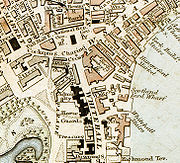
Charing Cross denotes the junction of Strand
, Whitehall
and Cockspur Street
, just south of Trafalgar Square
in central London
, England
. It is named after the now demolished Eleanor cross
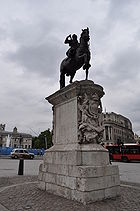
that stood there, in what was once the hamlet of Charing. The site of the cross is now occupied by an equestrian statue
of King Charles I
. Since the second half of the 18th century Charing Cross has been seen as the centre of London. It is the primary of the central datum points for measuring distances from London along with the London Stone
, Hicks Hall and the doors of St Mary-le-Bow
church.
The name "Charing Cross" originates from the Eleanor cross
erected in 1291–94 by King Edward I
as a memorial to his wife, Eleanor of Castile
, and placed between the former hamlet of Charing and the entrance to the Royal Mews
of the Palace of Whitehall
. The cross was the work of the medieval sculptor, Alexander of Abingdon. Originally built in wood, it was replaced with a stone and marble monument.
The name of the hamlet of Charing is derived from the old English word "cierring", referring to the nearby bend in the River Thames
.
Since 1675 the site of the cross has been occupied by a statue of King Charles I
mounted on a horse. This original position of the cross is recognised by modern convention as the centre of London for the purpose of indicating distances by road in favour of other previous measurement points (such as St Paul's Cathedral
which remains as the root of the English and Welsh part of the Great Britain road numbering scheme
). Furthermore, all residential roads in Greater London
have the houses numbered such that number 1 is at the end nearest Charing Cross. Charing Cross is marked on modern maps as a road junction, though it was previously also a postal address denoting the stretch of road between Great Scotland Yard and Trafalgar Square
. Since 1 January 1931 this section of road has been designated as part of the Whitehall thoroughfare.
The Cross has given its name to a railway station
, a hotel, a hospital
, a police station; and two places of entertainment, the Charing Cross Theatre and the Charing Cross Music Hall
(which lay beneath the arches of the station). Charing Cross Road
the main route from the north (which becomes the east side of Trafalgar Square) was named after the railway station, which was a major destination for traffic, rather than for the original cross.
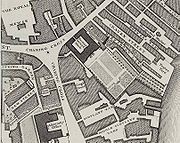 At some time between 1232 and 1236, the Chapel and Hospital of St Mary Rounceval was founded at Charing. This occupied land at the corner of the modern Whitehall and into the centre of Northumberland Avenue
, running down to a wharf by the river. It was an Augustinian house, tied to a mother house at Roncesvalles
, in the Pyrenees
. The house and lands were seized for the King in 1379, under a statute "for the forfeiture of the lands of schismatic aliens". Protracted legal action returned some rights to the Prior, but in 1414, Henry V
finally suppressed the 'alien' houses. The priory fell into a long decline due to lack of money, with further arguments over the collection of tithes with the parish church of St Martin-in-the-Fields
. In 1541, religious artefacts were removed to St Margaret's
, and the chapel was adapted as a private house, with the almshouse being sequestered to the Royal Palace.
.jpg) In 1608–09, the Earl of Northampton
In 1608–09, the Earl of Northampton
built Northumberland House
on the eastern portion of the property. In June 1874, the whole of the Duke's property at Charing Cross, was purchased by the Metropolitan Board of Works
for the formation of Northumberland Avenue.
The frontage of the Rounceval property caused the narrowing at the end of the Whitehall entry to Charing Cross, and formed the section of Whitehall formerly known as Charing Cross, until road widening in the 1930s caused the rebuilding of the south side of the street – creating the current wide thoroughfare.
. This was an attempt by Thomas Wyatt
and others to overthrow Queen Mary I of England
, soon after her accession to the throne and replace her with Lady Jane Grey
. Wyatt's army had come from Kent, and with London Bridge
barred to them, had crossed the river by what was then the next bridge upstream, at Hampton Court. Their circuitous route brought them down St. Martin's Lane
to Whitehall.
The palace was defended by 1,000 men under Sir John Gage at Charing Cross; they retreated within Whitehall after firing their shot, causing consternation within — thinking the force had changed sides. The rebels – themselves, fearful of artillery on the higher ground around St James's – did not press their attack and marched onto Ludgate
; where they were met by the Tower Garrison
and surrendered.
 The Eleanor Cross was pulled down, by order of Parliament, in 1647, at the time of the English Civil War
, becoming the subject of a popular Royalist
ballad
:
At the Restoration eight of the regicide
s were executed here, including the notable Fifth Monarchist, Colonel Thomas Harrison. A statue of Charles I, was later erected on the site. This statue had been made in 1633 by Hubert Le Sueur
, in the reign of Charles I, but, in 1649, was ordered to be destroyed by Parliament. Subsequently, after being hidden by the man charged with destroying the statue, it resurfaced at the Restoration; and was erected here in 1675.
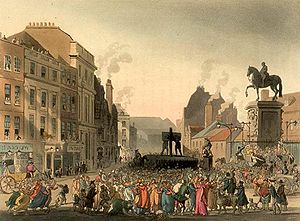 A prominent pillory
, where malefactors were publicly flogged, was situated next to the statue of King Charles. To the south of Charing Cross was the Hungerford Market
, established at the end of the 16th century; and to the north was the King's Mews, a royal stable. The area around the pillory was a popular place of street entertainment. Samuel Pepys
records in his diaries visiting the surrounding taverns and watching the entertainments and executions that were held there. This whole area was transformed when Trafalgar Square
was built on the site in 1832.
A famous inn called the "Golden Cross" - first mentioned in 1643 - stood in the former village of Charing. From here, in the eighteenth and nineteenth centuries, coaches departed by various routes to Dover
, Brighton
, Bath, Bristol
, Cambridge
, Holyhead
and York
. The inn features in Sketches by Boz
, David Copperfield
and The Pickwick Papers
by Charles Dickens
. In the last, the dangers to public safety of the low archway between the inn to the street were memorably pointed out by Mr Jingle :
The inn was demolished for the creation of Trafalgar Square
and a new Golden Cross Hotel was built in the 1830s on the triangular site now fronted by South Africa House
. Though this hotel is now also gone, the memory is preserved in commercial offices facing the Strand named Golden Cross House.
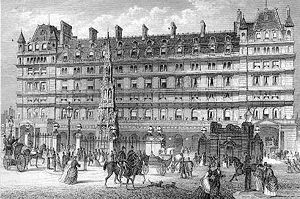
 The railway station opened in 1864, fronted on the Strand
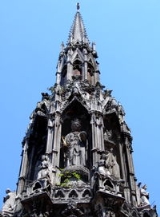
with the Charing Cross Hotel. In 1865, a replacement cross was commissioned from E. M. Barry by the South Eastern Railway
as the centrepiece of the station forecourt; about 160 feet (49 m) east of the original site. It is not a replica, being of an ornate Victorian
Gothic design
based on George Gilbert Scott
's Oxford Martyrs' Memorial
(1838). The Cross rises 70 feet (21.3 m) in three main stages on an octagonal plan, surmounted by a spire and cross. The shields in the panels of the first stage are copied from the Eleanor Crosses and bear the arms of England
, Castile
, Leon
and Ponthieu
; above the 2nd parapet are 8 statues of Queen Eleanor. The Cross was designated a Grade II* monument on 5 February 1970. The month before, the bronze equestrian statue of Charles, on a pedestal of carved Portland stone was given Grade I listed protection.
Fragments of the medieval original remain in the Museum of London
.
used Charing Cross as a central point to define its geographical scope. Its later use in legislation waned in favour of providing a schedule of local government areas and became mostly obsolete with the official creation of Greater London
in 1965.
 Nearest stations
To the east of the Charing Cross road junction is Charing Cross railway station
situated on the Strand
. On the other side of the river, connected by the pedestrian Golden Jubilee Bridges are Waterloo East station and Waterloo station
.
The nearest London Underground stations are Charing Cross
and Embankment
.
Strand, London
Strand is a street in the City of Westminster, London, England. The street is just over three-quarters of a mile long. It currently starts at Trafalgar Square and runs east to join Fleet Street at Temple Bar, which marks the boundary of the City of London at this point, though its historical length...
, Whitehall
Whitehall
Whitehall is a road in Westminster, in London, England. It is the main artery running north from Parliament Square, towards Charing Cross at the southern end of Trafalgar Square...
and Cockspur Street
Cockspur Street
Cockspur Street is a short thoroughfare in the City of Westminster, London, which links Trafalgar Square to Pall Mall, The Haymarket and Pall Mall East. On 29 June 2007, a car containing significant amounts of explosives was found on Cockspur Street. It did not detonate...
, just south of Trafalgar Square
Trafalgar Square
Trafalgar Square is a public space and tourist attraction in central London, England, United Kingdom. At its centre is Nelson's Column, which is guarded by four lion statues at its base. There are a number of statues and sculptures in the square, with one plinth displaying changing pieces of...
in central London
Central London
Central London is the innermost part of London, England. There is no official or commonly accepted definition of its area, but its characteristics are understood to include a high density built environment, high land values, an elevated daytime population and a concentration of regionally,...
, England
England
England is a country that is part of the United Kingdom. It shares land borders with Scotland to the north and Wales to the west; the Irish Sea is to the north west, the Celtic Sea to the south west, with the North Sea to the east and the English Channel to the south separating it from continental...
. It is named after the now demolished Eleanor cross
Eleanor cross
The Eleanor crosses were twelve originally wooden, but later lavishly decorated stone, monuments of which three survive intact in a line down part of the east of England. King Edward I had the crosses erected between 1291 and 1294 in memory of his wife Eleanor of Castile, marking the nightly...
that stood there, in what was once the hamlet of Charing. The site of the cross is now occupied by an equestrian statue
Statue of King Charles I, London
thumb|right|upright|The Statue of King Charles I on its plinth at Whitehall, LondonThe statue of King Charles I is an equestrian statue of Charles I of England in Whitehall, London. It was cast by the French sculptor Hubert Le Sueur in 1638, before the English Civil War. Following the war it was...
of King Charles I
Charles I of England
Charles I was King of England, King of Scotland, and King of Ireland from 27 March 1625 until his execution in 1649. Charles engaged in a struggle for power with the Parliament of England, attempting to obtain royal revenue whilst Parliament sought to curb his Royal prerogative which Charles...
. Since the second half of the 18th century Charing Cross has been seen as the centre of London. It is the primary of the central datum points for measuring distances from London along with the London Stone
London Stone
The London Stone is a historic stone that is now set within a Portland stone surround and iron grille on Cannon Street, in the City of London.-Features:...
, Hicks Hall and the doors of St Mary-le-Bow
St Mary-le-Bow
St Mary-le-Bow is an historic church in the City of London, off Cheapside. According to tradition, a true Cockney must be born within earshot of the sound of the church's bells.-Bells:...
church.
Location and etymology
"Erect a rich and stately carved cross,
Whereon her statue shall with glory shine;
And henceforth see you call it Charing Cross." George PeeleGeorge PeeleGeorge Peele , was an English dramatist.-Life:Peele was christened on 25 July 1556. His father, who appears to have belonged to a Devonshire family, was clerk of Christ's Hospital, and wrote two treatises on bookkeeping...
The Famous Chronicle of King Edward the FirstFamous Chronicle of King Edward the First"The Famous Chronicle of King Edward the First" is a play by George Peele, published 1593, chronicling the career of Edward I of England.The play concentrates on the power struggle between Edward I and Llywelyn ap Gruffudd, also glancing at the reign and fall of John Balliol...
(1593)
The name "Charing Cross" originates from the Eleanor cross
Eleanor cross
The Eleanor crosses were twelve originally wooden, but later lavishly decorated stone, monuments of which three survive intact in a line down part of the east of England. King Edward I had the crosses erected between 1291 and 1294 in memory of his wife Eleanor of Castile, marking the nightly...
erected in 1291–94 by King Edward I
Edward I of England
Edward I , also known as Edward Longshanks and the Hammer of the Scots, was King of England from 1272 to 1307. The first son of Henry III, Edward was involved early in the political intrigues of his father's reign, which included an outright rebellion by the English barons...
as a memorial to his wife, Eleanor of Castile
Eleanor of Castile
Eleanor of Castile was the first queen consort of Edward I of England. She was also Countess of Ponthieu in her own right from 1279 until her death in 1290, succeeding her mother and ruling together with her husband.-Birth:...
, and placed between the former hamlet of Charing and the entrance to the Royal Mews
Royal Mews
A Royal Mews is a mews of the British Royal Family. In London the Royal Mews has occupied two main sites, formerly at Charing Cross, and since the 1820s at Buckingham Palace....
of the Palace of Whitehall
Palace of Whitehall
The Palace of Whitehall was the main residence of the English monarchs in London from 1530 until 1698 when all except Inigo Jones's 1622 Banqueting House was destroyed by fire...
. The cross was the work of the medieval sculptor, Alexander of Abingdon. Originally built in wood, it was replaced with a stone and marble monument.
The name of the hamlet of Charing is derived from the old English word "cierring", referring to the nearby bend in the River Thames
River Thames
The River Thames flows through southern England. It is the longest river entirely in England and the second longest in the United Kingdom. While it is best known because its lower reaches flow through central London, the river flows alongside several other towns and cities, including Oxford,...
.
Since 1675 the site of the cross has been occupied by a statue of King Charles I
Charles I of England
Charles I was King of England, King of Scotland, and King of Ireland from 27 March 1625 until his execution in 1649. Charles engaged in a struggle for power with the Parliament of England, attempting to obtain royal revenue whilst Parliament sought to curb his Royal prerogative which Charles...
mounted on a horse. This original position of the cross is recognised by modern convention as the centre of London for the purpose of indicating distances by road in favour of other previous measurement points (such as St Paul's Cathedral
St Paul's Cathedral
St Paul's Cathedral, London, is a Church of England cathedral and seat of the Bishop of London. Its dedication to Paul the Apostle dates back to the original church on this site, founded in AD 604. St Paul's sits at the top of Ludgate Hill, the highest point in the City of London, and is the mother...
which remains as the root of the English and Welsh part of the Great Britain road numbering scheme
Great Britain road numbering scheme
The Great Britain road numbering scheme is a numbering scheme used to classify and identify all roads in Great Britain. Each road is given a single letter, which represents the road's category, and a subsequent number, with a length of between 1 and 4 digits. Originally introduced to arrange...
). Furthermore, all residential roads in Greater London
Greater London
Greater London is the top-level administrative division of England covering London. It was created in 1965 and spans the City of London, including Middle Temple and Inner Temple, and the 32 London boroughs. This territory is coterminate with the London Government Office Region and the London...
have the houses numbered such that number 1 is at the end nearest Charing Cross. Charing Cross is marked on modern maps as a road junction, though it was previously also a postal address denoting the stretch of road between Great Scotland Yard and Trafalgar Square
Trafalgar Square
Trafalgar Square is a public space and tourist attraction in central London, England, United Kingdom. At its centre is Nelson's Column, which is guarded by four lion statues at its base. There are a number of statues and sculptures in the square, with one plinth displaying changing pieces of...
. Since 1 January 1931 this section of road has been designated as part of the Whitehall thoroughfare.
The Cross has given its name to a railway station
Charing Cross railway station
Charing Cross railway station, also known as London Charing Cross, is a central London railway terminus in the City of Westminster, England. It is one of 18 stations managed by Network Rail, and trains serving it are operated by Southeastern...
, a hotel, a hospital
Charing Cross Hospital
Charing Cross Hospital is a general, acute hospital located in London, United Kingdom and established in 1818. It is located several miles to the west of the city centre in the London Borough of Hammersmith and Fulham....
, a police station; and two places of entertainment, the Charing Cross Theatre and the Charing Cross Music Hall
Charing Cross Music Hall
The Charing Cross Music Hall was a music hall established beneath the Arches of Charing Cross railway station in 1866 by brothers, Giovanni and Carlo Gatti to replace the former Hungerford Hall...
(which lay beneath the arches of the station). Charing Cross Road
Charing Cross Road
Charing Cross Road is a street in central London running immediately north of St Martin-in-the-Fields to St Giles Circus and then becomes Tottenham Court Road...
the main route from the north (which becomes the east side of Trafalgar Square) was named after the railway station, which was a major destination for traffic, rather than for the original cross.
St Mary Rounceval
Northumberland Avenue
Northumberland Avenue is a London street, running from Trafalgar Square in the west to The Embankment in the east. The avenue was built on the site of Northumberland House, the London home of the Percy family, the Dukes of Northumberland....
, running down to a wharf by the river. It was an Augustinian house, tied to a mother house at Roncesvalles
Roncesvalles
Roncesvalles is a small village and municipality in Navarre, northern Spain. It is situated on the small river Urrobi at an altitude of some 900 metres in the Pyrenees, about 8 kilometres from the French frontier....
, in the Pyrenees
Pyrenees
The Pyrenees is a range of mountains in southwest Europe that forms a natural border between France and Spain...
. The house and lands were seized for the King in 1379, under a statute "for the forfeiture of the lands of schismatic aliens". Protracted legal action returned some rights to the Prior, but in 1414, Henry V
Henry V of England
Henry V was King of England from 1413 until his death at the age of 35 in 1422. He was the second monarch belonging to the House of Lancaster....
finally suppressed the 'alien' houses. The priory fell into a long decline due to lack of money, with further arguments over the collection of tithes with the parish church of St Martin-in-the-Fields
St Martin-in-the-Fields
St Martin-in-the-Fields is an Anglican church at the north-east corner of Trafalgar Square in the City of Westminster, London. Its patron is Saint Martin of Tours.-Roman era:Excavations at the site in 2006 led to the discovery of a grave dated about 410...
. In 1541, religious artefacts were removed to St Margaret's
St. Margaret's, Westminster
The Anglican church of St. Margaret, Westminster Abbey is situated in the grounds of Westminster Abbey on Parliament Square, and is the parish church of the House of Commons of the United Kingdom in London...
, and the chapel was adapted as a private house, with the almshouse being sequestered to the Royal Palace.
Henry Howard, 1st Earl of Northampton
Henry Howard, 1st Earl of Northampton was a significant English aristocrat and courtier. He was suspect as a crypto-Catholic throughout his life, and went through periods of royal disfavour, in which his reputation suffered greatly. He was distinguished for learning, artistic culture and his...
built Northumberland House
Northumberland House
Northumberland House was a large Jacobean mansion in London, which was so called because for most of its history it was the London residence of the Percy family, who were the Earls and later Dukes of Northumberland, and one of England's richest and most prominent aristocratic dynasties for many...
on the eastern portion of the property. In June 1874, the whole of the Duke's property at Charing Cross, was purchased by the Metropolitan Board of Works
Metropolitan Board of Works
The Metropolitan Board of Works was the principal instrument of London-wide government from 1855 until the establishment of the London County Council in 1889. Its principal responsibility was to provide infrastructure to cope with London's rapid growth, which it successfully accomplished. The MBW...
for the formation of Northumberland Avenue.
The frontage of the Rounceval property caused the narrowing at the end of the Whitehall entry to Charing Cross, and formed the section of Whitehall formerly known as Charing Cross, until road widening in the 1930s caused the rebuilding of the south side of the street – creating the current wide thoroughfare.
Battle
In 1554, Charing Cross was the site of the final battle of Wyatt's RebellionWyatt's rebellion
Wyatt's Rebellion was a popular uprising in England in 1554, named after Thomas Wyatt the younger, one of its leaders. The rebellion arose out of concern over Queen Mary I's determination to marry Philip II of Spain, which was an unpopular policy with the English...
. This was an attempt by Thomas Wyatt
Thomas Wyatt the younger
Sir Thomas Wyatt the younger was a rebel leader during the reign of Queen Mary I of England; his rising is traditionally called "Wyatt's rebellion".-Birth and career:...
and others to overthrow Queen Mary I of England
Mary I of England
Mary I was queen regnant of England and Ireland from July 1553 until her death.She was the only surviving child born of the ill-fated marriage of Henry VIII and his first wife Catherine of Aragon. Her younger half-brother, Edward VI, succeeded Henry in 1547...
, soon after her accession to the throne and replace her with Lady Jane Grey
Lady Jane Grey
Lady Jane Grey , also known as The Nine Days' Queen, was an English noblewoman who was de facto monarch of England from 10 July until 19 July 1553 and was subsequently executed...
. Wyatt's army had come from Kent, and with London Bridge
London Bridge
London Bridge is a bridge over the River Thames, connecting the City of London and Southwark, in central London. Situated between Cannon Street Railway Bridge and Tower Bridge, it forms the western end of the Pool of London...
barred to them, had crossed the river by what was then the next bridge upstream, at Hampton Court. Their circuitous route brought them down St. Martin's Lane
St. Martin's Lane
St. Martin's Lane is a street on the edge of Covent Garden in Central London, which runs from the church of St. Martin-in-the-Fields, after which it is named, near Trafalgar Square northwards to Long Acre.A narrow street with relatively little traffic, St...
to Whitehall.
The palace was defended by 1,000 men under Sir John Gage at Charing Cross; they retreated within Whitehall after firing their shot, causing consternation within — thinking the force had changed sides. The rebels – themselves, fearful of artillery on the higher ground around St James's – did not press their attack and marched onto Ludgate
Ludgate
Ludgate was the westernmost gate in London Wall. The name survives in Ludgate Hill, an eastward continuation of Fleet Street, and Ludgate Circus.-Etymology:...
; where they were met by the Tower Garrison
Tower of London
Her Majesty's Royal Palace and Fortress, more commonly known as the Tower of London, is a historic castle on the north bank of the River Thames in central London, England. It lies within the London Borough of Tower Hamlets, separated from the eastern edge of the City of London by the open space...
and surrendered.
Civil war removal
English Civil War
The English Civil War was a series of armed conflicts and political machinations between Parliamentarians and Royalists...
, becoming the subject of a popular Royalist
Cavalier
Cavalier was the name used by Parliamentarians for a Royalist supporter of King Charles I and son Charles II during the English Civil War, the Interregnum, and the Restoration...
ballad
Ballad
A ballad is a form of verse, often a narrative set to music. Ballads were particularly characteristic of British and Irish popular poetry and song from the later medieval period until the 19th century and used extensively across Europe and later the Americas, Australia and North Africa. Many...
:
- Methinks the common-council shou'd
- Of it have taken pity,
- 'Cause, good old cross, it always stood
- So firmly in the city.
- Since crosses you so much disdain,
- Faith, if I were you,
- For fear the King should rule again,
- I'd pull down TiburnTyburnTyburn is a former village just outside the then boundaries of London that was best known as a place of public execution.Tyburn may also refer to:* Tyburn , river and historical water source in London...
too. (extract from "The Downfall of Charing Cross")
At the Restoration eight of the regicide
Regicide
The broad definition of regicide is the deliberate killing of a monarch, or the person responsible for the killing of a monarch. In a narrower sense, in the British tradition, it refers to the judicial execution of a king after a trial...
s were executed here, including the notable Fifth Monarchist, Colonel Thomas Harrison. A statue of Charles I, was later erected on the site. This statue had been made in 1633 by Hubert Le Sueur
Hubert Le Sueur
Hubert Le Sueur was a French sculptor with the contemporaneous reputation of having trained in Giambologna's Florentine workshop, who assisted Giambologna's foreman, Pietro Tacca, in Paris, finishing and erecting the equestrian statue of Henri IV on the Pont Neuf...
, in the reign of Charles I, but, in 1649, was ordered to be destroyed by Parliament. Subsequently, after being hidden by the man charged with destroying the statue, it resurfaced at the Restoration; and was erected here in 1675.
Pillory
The pillory was a device made of a wooden or metal framework erected on a post, with holes for securing the head and hands, formerly used for punishment by public humiliation and often further physical abuse, sometimes lethal...
, where malefactors were publicly flogged, was situated next to the statue of King Charles. To the south of Charing Cross was the Hungerford Market
Hungerford Market
Hungerford Market was a market in London, near Charing Cross on the Strand, housed in two different buildings on the same site from around 1680 to 1862. The first market was held from about 1680 in a London house of the Hungerford family. This building became dilapidated, and was replaced by a...
, established at the end of the 16th century; and to the north was the King's Mews, a royal stable. The area around the pillory was a popular place of street entertainment. Samuel Pepys
Samuel Pepys
Samuel Pepys FRS, MP, JP, was an English naval administrator and Member of Parliament who is now most famous for the diary he kept for a decade while still a relatively young man...
records in his diaries visiting the surrounding taverns and watching the entertainments and executions that were held there. This whole area was transformed when Trafalgar Square
Trafalgar Square
Trafalgar Square is a public space and tourist attraction in central London, England, United Kingdom. At its centre is Nelson's Column, which is guarded by four lion statues at its base. There are a number of statues and sculptures in the square, with one plinth displaying changing pieces of...
was built on the site in 1832.
A famous inn called the "Golden Cross" - first mentioned in 1643 - stood in the former village of Charing. From here, in the eighteenth and nineteenth centuries, coaches departed by various routes to Dover
Dover
Dover is a town and major ferry port in the home county of Kent, in South East England. It faces France across the narrowest part of the English Channel, and lies south-east of Canterbury; east of Kent's administrative capital Maidstone; and north-east along the coastline from Dungeness and Hastings...
, Brighton
Brighton
Brighton is the major part of the city of Brighton and Hove in East Sussex, England on the south coast of Great Britain...
, Bath, Bristol
Bristol
Bristol is a city, unitary authority area and ceremonial county in South West England, with an estimated population of 433,100 for the unitary authority in 2009, and a surrounding Larger Urban Zone with an estimated 1,070,000 residents in 2007...
, Cambridge
Cambridge
The city of Cambridge is a university town and the administrative centre of the county of Cambridgeshire, England. It lies in East Anglia about north of London. Cambridge is at the heart of the high-technology centre known as Silicon Fen – a play on Silicon Valley and the fens surrounding the...
, Holyhead
Holyhead
Holyhead is the largest town in the county of Anglesey in the North Wales. It is also a major port adjacent to the Irish Sea serving Ireland....
and York
York
York is a walled city, situated at the confluence of the Rivers Ouse and Foss in North Yorkshire, England. The city has a rich heritage and has provided the backdrop to major political events throughout much of its two millennia of existence...
. The inn features in Sketches by Boz
Sketches by Boz
Sketches by "Boz," Illustrative of Every-day Life and Every-day People is a collection of short pieces published by Charles Dickens in 1836 accompanied by illustrations by George Cruikshank. The 56 sketches concern London scenes and people and are divided into four sections: "Our Parish",...
, David Copperfield
David Copperfield (novel)
The Personal History, Adventures, Experience and Observation of David Copperfield the Younger of Blunderstone Rookery , commonly referred to as David Copperfield, is the eighth novel by Charles Dickens, first published as a novel in 1850. Like most of his works, it originally appeared in serial...
and The Pickwick Papers
The Pickwick Papers
The Posthumous Papers of the Pickwick Club is the first novel by Charles Dickens. After the publication, the widow of the illustrator Robert Seymour claimed that the idea for the novel was originally her husband's; however, in his preface to the 1867 edition, Dickens strenuously denied any...
by Charles Dickens
Charles Dickens
Charles John Huffam Dickens was an English novelist, generally considered the greatest of the Victorian period. Dickens enjoyed a wider popularity and fame than had any previous author during his lifetime, and he remains popular, having been responsible for some of English literature's most iconic...
. In the last, the dangers to public safety of the low archway between the inn to the street were memorably pointed out by Mr Jingle :
"Heads, heads - take care of your heads", cried the loquacious stranger as they came out under the low archway which in those days formed the entrance to the coachyard. "Terrible place - dangerous work - other day - five children - mother - tall lady, eating sandwiches - forgot the arch - crash - knock - children look round - mother's head off - sandwich in her hand - no mouth to put it in - head of family off"
The inn was demolished for the creation of Trafalgar Square
Trafalgar Square
Trafalgar Square is a public space and tourist attraction in central London, England, United Kingdom. At its centre is Nelson's Column, which is guarded by four lion statues at its base. There are a number of statues and sculptures in the square, with one plinth displaying changing pieces of...
and a new Golden Cross Hotel was built in the 1830s on the triangular site now fronted by South Africa House
South Africa House
The High Commission of South Africa in London is the diplomatic mission from South Africa to the United Kingdom. It is located at South Africa House, a building on Trafalgar Square, London...
. Though this hotel is now also gone, the memory is preserved in commercial offices facing the Strand named Golden Cross House.
Replacement
Strand, London
Strand is a street in the City of Westminster, London, England. The street is just over three-quarters of a mile long. It currently starts at Trafalgar Square and runs east to join Fleet Street at Temple Bar, which marks the boundary of the City of London at this point, though its historical length...
with the Charing Cross Hotel. In 1865, a replacement cross was commissioned from E. M. Barry by the South Eastern Railway
South Eastern Railway (UK)
The South Eastern Railway was a railway company in south-eastern England from 1836 until 1922. The company was formed to construct a route from London to Dover. Branch lines were later opened to Tunbridge Wells, Hastings, Canterbury and other places in Kent...
as the centrepiece of the station forecourt; about 160 feet (49 m) east of the original site. It is not a replica, being of an ornate Victorian
Victorian era
The Victorian era of British history was the period of Queen Victoria's reign from 20 June 1837 until her death on 22 January 1901. It was a long period of peace, prosperity, refined sensibilities and national self-confidence...
Gothic design
Gothic architecture
Gothic architecture is a style of architecture that flourished during the high and late medieval period. It evolved from Romanesque architecture and was succeeded by Renaissance architecture....
based on George Gilbert Scott
George Gilbert Scott
Sir George Gilbert Scott was an English architect of the Victorian Age, chiefly associated with the design, building and renovation of churches, cathedrals and workhouses...
's Oxford Martyrs' Memorial
Martyrs' Memorial
The Martyrs' Memorial is a stone monument positioned at the intersection of St Giles', Magdalen Street and Beaumont Street in Oxford, England just outside Balliol College...
(1838). The Cross rises 70 feet (21.3 m) in three main stages on an octagonal plan, surmounted by a spire and cross. The shields in the panels of the first stage are copied from the Eleanor Crosses and bear the arms of England
England
England is a country that is part of the United Kingdom. It shares land borders with Scotland to the north and Wales to the west; the Irish Sea is to the north west, the Celtic Sea to the south west, with the North Sea to the east and the English Channel to the south separating it from continental...
, Castile
Castile and León
Castile and León is an autonomous community in north-western Spain. It was so constituted in 1983 and it comprises the historical regions of León and Old Castile...
, Leon
Castile and León
Castile and León is an autonomous community in north-western Spain. It was so constituted in 1983 and it comprises the historical regions of León and Old Castile...
and Ponthieu
Ponthieu
Ponthieu was one of six feudal counties that eventually merged together to become part of the Province of Picardy, in northern France. Its chief town is Abbeville.- History :...
; above the 2nd parapet are 8 statues of Queen Eleanor. The Cross was designated a Grade II* monument on 5 February 1970. The month before, the bronze equestrian statue of Charles, on a pedestal of carved Portland stone was given Grade I listed protection.
Fragments of the medieval original remain in the Museum of London
Museum of London
The Museum of London documents the history of London from the Prehistoric to the present day. The museum is located close to the Barbican Centre, as part of the striking Barbican complex of buildings created in the 1960s and 70s as an innovative approach to re-development within a bomb damaged...
.
Official use as central point
Since the second half of the 18th century Charing Cross has been seen as the centre of London. From the early 19th century, legislation applicable only to the London metropolisMetropolis
A metropolis is a very large city or urban area which is a significant economic, political and cultural center for a country or region, and an important hub for regional or international connections and communications...
used Charing Cross as a central point to define its geographical scope. Its later use in legislation waned in favour of providing a schedule of local government areas and became mostly obsolete with the official creation of Greater London
Greater London
Greater London is the top-level administrative division of England covering London. It was created in 1965 and spans the City of London, including Middle Temple and Inner Temple, and the 32 London boroughs. This territory is coterminate with the London Government Office Region and the London...
in 1965.
| Use | Scope |
|---|---|
| Metropolitan Police District Metropolitan Police District The Metropolitan Police District is the police area which is policed by London's Metropolitan Police Service. It currently consists of Greater London, excluding the City of London.-History:... |
The Metropolitan Police Act 1829 Metropolitan Police Act 1829 The Metropolitan Police Act 1829 was an Act of Parliament introduced by Sir Robert Peel and passed by the Parliament of the United Kingdom. The Act established the Metropolitan Police of London , replacing the previously disorganized system of parish constables and watchmen... made provision that all parishes within 12 miles of Charing Cross could be added. This was expanded to 15 miles by the Metropolitan Police Act 1839 Metropolitan Police Act 1839 The Metropolitan Police Act 1839 was an Act of Parliament passed by the Parliament of the United Kingdom. The Act enlarged the district of, and gave greatly increased powers to the Metropolitan Police established by the Metropolitan Police Act 1829.Section 2 of the Act allowed for the enlargement... . |
| Metropolitan Buildings Office Metropolitan Buildings Office The Metropolitan Buildings Office was formed in 1845 to regulate the construction and use of buildings in the metropolitan area of London. Surveyors were empowered to enforce building regulations which sought to improve the standard of houses and business premises, and to regulate activities that... |
The London Building Act 1844 allowed that any place within 12 miles of Charing Cross could be added to the area of responsibility. |
| Hackney carriage Hackney carriage A hackney or hackney carriage is a carriage or automobile for hire... licensing & The Knowledge |
The London Hackney Carriage Act 1831 and subsequent legislation set the radius within which cab drivers were obliged to take a fare. Streets within a six-mile radius of Charing Cross are still included in taxi driver training. |
| Street Trading | The Metropolitan Streets Act 1856 gave the Commissioner of Metropolitan Police the power to control various activities within a six mile radius of Charing Cross. Powers to licence shoeblack pitches are still in force but in practice are superseded by individual London borough London borough The administrative area of Greater London contains thirty-two London boroughs. Inner London comprises twelve of these boroughs plus the City of London. Outer London comprises the twenty remaining boroughs of Greater London.-Functions:... s' street trading arrangements. |
Transport and locale
To the east of the Charing Cross road junction is Charing Cross railway station
Charing Cross railway station
Charing Cross railway station, also known as London Charing Cross, is a central London railway terminus in the City of Westminster, England. It is one of 18 stations managed by Network Rail, and trains serving it are operated by Southeastern...
situated on the Strand
Strand, London
Strand is a street in the City of Westminster, London, England. The street is just over three-quarters of a mile long. It currently starts at Trafalgar Square and runs east to join Fleet Street at Temple Bar, which marks the boundary of the City of London at this point, though its historical length...
. On the other side of the river, connected by the pedestrian Golden Jubilee Bridges are Waterloo East station and Waterloo station
Waterloo station
Waterloo station, also known as London Waterloo, is a central London railway terminus and London Underground complex. The station is owned and operated by Network Rail and is close to the South Bank of the River Thames, and in Travelcard Zone 1....
.
The nearest London Underground stations are Charing Cross
Charing Cross tube station
Charing Cross tube station is a London Underground station at Charing Cross in the City of Westminster with entrances located in Trafalgar Square and The Strand. The station is served by the Northern and Bakerloo lines and provides an interchange with the National Rail network at station...
and Embankment
Embankment tube station
Embankment is a London Underground station in the City of Westminster, known by various names during its history. It is served by the Circle, District, Northern and Bakerloo lines. On the Northern and Bakerloo lines, the station is between Waterloo and Charing Cross stations; on the Circle and...
.