


Canonical hours

Encyclopedia
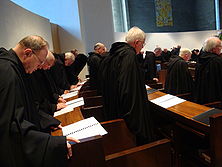
Prayer
Prayer is a form of religious practice that seeks to activate a volitional rapport to a deity through deliberate practice. Prayer may be either individual or communal and take place in public or in private. It may involve the use of words or song. When language is used, prayer may take the form of...
s of the daily round. A Book of Hours
Book of Hours
The book of hours was a devotional book popular in the later Middle Ages. It is the most common type of surviving medieval illuminated manuscript. Like every manuscript, each manuscript book of hours is unique in one way or another, but most contain a similar collection of texts, prayers and...
contains such a set of prayers.
In western Catholicism
Roman Catholic Church
The Catholic Church, also known as the Roman Catholic Church, is the world's largest Christian church, with over a billion members. Led by the Pope, it defines its mission as spreading the gospel of Jesus Christ, administering the sacraments and exercising charity...
, canonical hours may also be called offices, since they refer to the official set of prayer of the Roman Catholic Church
Roman Catholic Church
The Catholic Church, also known as the Roman Catholic Church, is the world's largest Christian church, with over a billion members. Led by the Pope, it defines its mission as spreading the gospel of Jesus Christ, administering the sacraments and exercising charity...
that is known variously as the Divine Office
Divine Office
Divine Office may refer to:* Liturgy of the Hours, the recitation of certain Christian prayers at fixed hours according to the discipline of the Roman Catholic Church* Canonical hours, the recitation of such prayers in Christianity more generally...
(from the Latin
Latin
Latin is an Italic language originally spoken in Latium and Ancient Rome. It, along with most European languages, is a descendant of the ancient Proto-Indo-European language. Although it is considered a dead language, a number of scholars and members of the Christian clergy speak it fluently, and...
officium divinum meaning "divine service" or "divine duty"), and the Opus Dei (meaning in Latin, "Work of God"). The current official version of the hours in the Latin Rite of the Roman Catholic Church
Roman Catholic Church
The Catholic Church, also known as the Roman Catholic Church, is the world's largest Christian church, with over a billion members. Led by the Pope, it defines its mission as spreading the gospel of Jesus Christ, administering the sacraments and exercising charity...
is called the Liturgy of the Hours
Liturgy of the hours
The Liturgy of the Hours or Divine Office is the official set of daily prayers prescribed by the Catholic Church to be recited at the canonical hours by the clergy, religious orders, and laity. The Liturgy of the Hours consists primarily of psalms supplemented by hymns and readings...
(Latin: Liturgia horarum) in North America or Divine Office in the British Isles.
In the Anglican tradition, they are often known as the Daily Office or Divine Office, to distinguish them from the other Offices of the Church.

Horologion
The 'Horologion' , or Book of Hours, provides the fixed portions of the Daily Cycle of services as used by the Eastern Orthodox and Eastern Catholic churches...
. There may be numerous small differences in practice according to jurisdiction; but the overall order is the same among eastern Christians who follow the Byzantine style of services (the usage among the Oriental Orthodox Churches will differ from the Byzantine in a number of ways).
The practice of daily prayers grew from the Jewish
Judaism
Judaism ) is the "religion, philosophy, and way of life" of the Jewish people...
practice of reciting prayers at set times of the day: for example, in the Book of Acts
Acts of the Apostles
The Acts of the Apostles , usually referred to simply as Acts, is the fifth book of the New Testament; Acts outlines the history of the Apostolic Age...
, Peter
Saint Peter
Saint Peter or Simon Peter was an early Christian leader, who is featured prominently in the New Testament Gospels and the Acts of the Apostles. The son of John or of Jonah and from the village of Bethsaida in the province of Galilee, his brother Andrew was also an apostle...
and John
John the Evangelist
Saint John the Evangelist is the conventional name for the author of the Gospel of John...
visit the Temple
Temple in Jerusalem
The Temple in Jerusalem or Holy Temple , refers to one of a series of structures which were historically located on the Temple Mount in the Old City of Jerusalem, the current site of the Dome of the Rock. Historically, these successive temples stood at this location and functioned as the centre of...
for the afternoon prayers . Psalm 119
Psalm 119
Psalm 119 is the longest psalm as well as the longest chapter in the Bible. It is referred to in Hebrew by its opening words, "Ashrei temimei derech" . It is the prayer of one who delights in and lives by the Torah, the sacred law...
:164 states: "Seven times a day I praise you for your righteous laws."
This practice is believed to have been passed down through the centuries from the Apostles, with different practices developing in different places. As monasticism
Christian monasticism
Christian monasticism is a practice which began to develop early in the history of the Christian Church, modeled upon scriptural examples and ideals, including those in the Old Testament, but not mandated as an institution in the scriptures. It has come to be regulated by religious rules Christian...
spread, the practice of specified hours and liturgical formats began to develop and become standardized. Around the year 484, Sabbas
Sabbas the Sanctified
Saint Sabbas the Sanctified , a Cappadocian-Greek monk, priest and saint, lived mainly in Palaestina Prima. He was the founder of several monasteries, most notably the one known as Mar Saba...
began the process of recording the liturgical
Liturgy
Liturgy is either the customary public worship done by a specific religious group, according to its particular traditions or a more precise term that distinguishes between those religious groups who believe their ritual requires the "people" to do the "work" of responding to the priest, and those...
practices around Jerusalem. In 525, Benedict of Nursia
Benedict of Nursia
Saint Benedict of Nursia is a Christian saint, honored by the Roman Catholic Church as the patron saint of Europe and students.Benedict founded twelve communities for monks at Subiaco, about to the east of Rome, before moving to Monte Cassino in the mountains of southern Italy. There is no...
wrote the first official western manual for praying the Hours. With the Cluniac reforms of the 11th century there was a new emphasis on liturgy and the canonical hours in the reformed Benedictine
Benedictine
Benedictine refers to the spirituality and consecrated life in accordance with the Rule of St Benedict, written by Benedict of Nursia in the sixth century for the cenobitic communities he founded in central Italy. The most notable of these is Monte Cassino, the first monastery founded by Benedict...
priories with the Abbey of Cluny at their head. The Holy See
Holy See
The Holy See is the episcopal jurisdiction of the Catholic Church in Rome, in which its Bishop is commonly known as the Pope. It is the preeminent episcopal see of the Catholic Church, forming the central government of the Church. As such, diplomatically, and in other spheres the Holy See acts and...
did not issue an official Roman breviary
Breviary
A breviary is a liturgical book of the Latin liturgical rites of the Catholic Church containing the public or canonical prayers, hymns, the Psalms, readings, and notations for everyday use, especially by bishops, priests, and deacons in the Divine Office...
until the 11th century, as part of the reforms that were designed to bring all the variant usages of Christian churches in the West
Western world
The Western world, also known as the West and the Occident , is a term referring to the countries of Western Europe , the countries of the Americas, as well all countries of Northern and Central Europe, Australia and New Zealand...
into conformity.
Already well-established by the ninth century, these canonical offices consisted of eight daily prayer events and three (or four) nightly divisions (called "nocturns
Nocturns
Nocturns are divisions of Matins, the night office of the Christian Liturgy of the Hours. A nocturn consists of psalms with antiphons followed by three lessons, which are taken either from scripture or from the writings of the Church Fathers. The office of Matins is composed of one to three nocturns...
", "watches," or "vigils
Vigils
Vigils is a term for night prayer in ancient Christianity. See Vespers, Compline, Nocturns, Matins, and Lauds for more information. A Vigil is a night spent in prayer....
"). Building on the recitation of psalms
Psalms
The Book of Psalms , commonly referred to simply as Psalms, is a book of the Hebrew Bible and the Christian Bible...
and canticle
Canticle
A canticle is a hymn taken from the Bible. The term is often expanded to include ancient non-biblical hymns such as the Te Deum and certain psalms used liturgically.-Roman Catholic Church:From the Old Testament, the Roman Breviary takes seven canticles for use at Lauds, as follows:*...
s from scripture
Religious text
Religious texts, also known as scripture, scriptures, holy writ, or holy books, are the texts which various religious traditions consider to be sacred, or of central importance to their religious tradition...
, the Church has added (and, at times, subtracted) hymn
Hymn
A hymn is a type of song, usually religious, specifically written for the purpose of praise, adoration or prayer, and typically addressed to a deity or deities, or to a prominent figure or personification...
s, hagiographical
Hagiography
Hagiography is the study of saints.From the Greek and , it refers literally to writings on the subject of such holy people, and specifically to the biographies of saints and ecclesiastical leaders. The term hagiology, the study of hagiography, is also current in English, though less common...
readings, and other prayers.
Judaism and the Early Church
As is noted above, the canonical hours stemmed from Jewish prayerPrayer
Prayer is a form of religious practice that seeks to activate a volitional rapport to a deity through deliberate practice. Prayer may be either individual or communal and take place in public or in private. It may involve the use of words or song. When language is used, prayer may take the form of...
. In the Old Testament
Old Testament
The Old Testament, of which Christians hold different views, is a Christian term for the religious writings of ancient Israel held sacred and inspired by Christians which overlaps with the 24-book canon of the Masoretic Text of Judaism...
, God commanded the Israelite priests to offer sacrifices of animals in the morning and evening . Eventually, these sacrifices soon moved from the Tabernacle to the Temple built by Solomon
Solomon
Solomon , according to the Book of Kings and the Book of Chronicles, a King of Israel and according to the Talmud one of the 48 prophets, is identified as the son of David, also called Jedidiah in 2 Samuel 12:25, and is described as the third king of the United Monarchy, and the final king before...
in Jerusalem. During the Babylonian Exile, when the Temple was no longer in use, the first synagogue
Synagogue
A synagogue is a Jewish house of prayer. This use of the Greek term synagogue originates in the Septuagint where it sometimes translates the Hebrew word for assembly, kahal...
s were established, and the services (at fixed hours of the day) of Torah
Torah
Torah- A scroll containing the first five books of the BibleThe Torah , is name given by Jews to the first five books of the bible—Genesis , Exodus , Leviticus , Numbers and Deuteronomy Torah- A scroll containing the first five books of the BibleThe Torah , is name given by Jews to the first five...
readings, psalms
Psalms
The Book of Psalms , commonly referred to simply as Psalms, is a book of the Hebrew Bible and the Christian Bible...
, and hymns began to evolve. This "sacrifice of praise" began to be substituted for the sacrifices of animals.
After the people returned to Judea
Judea
Judea or Judæa was the name of the mountainous southern part of the historic Land of Israel from the 8th century BCE to the 2nd century CE, when Roman Judea was renamed Syria Palaestina following the Jewish Bar Kokhba revolt.-Etymology:The...
, the prayer services were incorporated into Temple worship as well. As time passed, the Jews began to be scattered across the Greco-Roman world in what is known as the Diaspora
Jewish diaspora
The Jewish diaspora is the English term used to describe the Galut גלות , or 'exile', of the Jews from the region of the Kingdom of Judah and Roman Iudaea and later emigration from wider Eretz Israel....
. By the time of the Roman Empire
Roman Empire
The Roman Empire was the post-Republican period of the ancient Roman civilization, characterised by an autocratic form of government and large territorial holdings in Europe and around the Mediterranean....
, the Jews (and eventually early Christians) began to follow the Roman system of conducting the business day in scheduling their times for prayer. In Roman cities, the bell
Bell (instrument)
A bell is a simple sound-making device. The bell is a percussion instrument and an idiophone. Its form is usually a hollow, cup-shaped object, which resonates upon being struck...
in the forum
Forum (Roman)
A forum was a public square in a Roman municipium, or any civitas, reserved primarily for the vending of goods; i.e., a marketplace, along with the buildings used for shops and the stoas used for open stalls...
rang the beginning of the business day at about six o'clock in the morning (Prime
Prime (liturgy)
Prime, or the First Hour, is a fixed time of prayer of the traditional Divine Office , said at the first hour of daylight , between the morning Hour of Lauds and the 9 a.m. Hour of Terce. It is part of the Christian liturgies of Eastern Christianity, but in the Latin Rite it was suppressed by the...
, the "first hour"), noted the day's progress by striking again at about nine o'clock in the morning (Terce
Terce
Terce, or Third Hour, is a fixed time of prayer of the Divine Office of almost all the Christian liturgies. It consists mainly of psalms and is said at 9 a.m. Its name comes from Latin and refers to the third hour of the day after dawn....
, the "third hour"), tolled for the lunch break at noon (Sext
Sext
Sext, or Sixth Hour, is a fixed time of prayer of the Divine Office of almost all the traditional Christian liturgies. It consists mainly of psalms and is said at noon...
, the "sixth hour"), called the people back to work again at about three o'clock in the afternoon (None
None (liturgy)
None , or the Ninth Hour, is a fixed time of prayer of the Divine Office of almost all the traditional Christian liturgies. It consists mainly of psalms and is said around 3 p.m...
, the "ninth hour"), and rang the close of the business day at about six o'clock in the evening (the time for evening prayer).
The first miracle of the apostles, the healing of the crippled man on the temple steps, occurred because Peter
Saint Peter
Saint Peter or Simon Peter was an early Christian leader, who is featured prominently in the New Testament Gospels and the Acts of the Apostles. The son of John or of Jonah and from the village of Bethsaida in the province of Galilee, his brother Andrew was also an apostle...
and John
John the Apostle
John the Apostle, John the Apostle, John the Apostle, (Aramaic Yoħanna, (c. 6 - c. 100) was one of the Twelve Apostles of Jesus. He was the son of Zebedee and Salome, and brother of James, another of the Twelve Apostles...
went to the Temple to pray . Also, one of the defining moments of the early Church, the decision to include Gentiles among the community of believers, arose from a vision Peter had while praying at noontime .
As Christianity
Christianity
Christianity is a monotheistic religion based on the life and teachings of Jesus as presented in canonical gospels and other New Testament writings...
began to separate from Judaism
Judaism
Judaism ) is the "religion, philosophy, and way of life" of the Jewish people...
, the practice of praying at fixed times continued. The early church was known to pray the Psalms , which has remained a part of the canonical hours and all Christian prayer since. By 60 AD, the Didache
Didache
The Didache or The Teaching of the Twelve Apostles is a brief early Christian treatise, dated by most scholars to the late first or early 2nd century...
, the oldest known liturgical manual for Christians, recommended disciples to pray the Lord's Prayer
Lord's Prayer
The Lord's Prayer is a central prayer in Christianity. In the New Testament of the Christian Bible, it appears in two forms: in the Gospel of Matthew as part of the discourse on ostentation in the Sermon on the Mount, and in the Gospel of Luke, which records Jesus being approached by "one of his...
three times a day; this practice found its way into the canonical hours as well. Pliny the Younger
Pliny the Younger
Gaius Plinius Caecilius Secundus, born Gaius Caecilius or Gaius Caecilius Cilo , better known as Pliny the Younger, was a lawyer, author, and magistrate of Ancient Rome. Pliny's uncle, Pliny the Elder, helped raise and educate him...
(63 – c. 113), who was not a Christian himself, mentions not only fixed times of prayer by believers, but also specific services—other than the Eucharist—assigned to those times: “they met on a stated day before it was light, and addressed a form of prayer to Christ, as to a divinity ... after which it was their custom to separate, and then reassemble, to eat in common a harmless meal. .”
By the second and third centuries, such Church Fathers
Church Fathers
The Church Fathers, Early Church Fathers, Christian Fathers, or Fathers of the Church were early and influential theologians, eminent Christian teachers and great bishops. Their scholarly works were used as a precedent for centuries to come...
as Clement of Alexandria
Clement of Alexandria
Titus Flavius Clemens , known as Clement of Alexandria , was a Christian theologian and the head of the noted Catechetical School of Alexandria. Clement is best remembered as the teacher of Origen...
, Origen
Origen
Origen , or Origen Adamantius, 184/5–253/4, was an early Christian Alexandrian scholar and theologian, and one of the most distinguished writers of the early Church. As early as the fourth century, his orthodoxy was suspect, in part because he believed in the pre-existence of souls...
, and Tertullian
Tertullian
Quintus Septimius Florens Tertullianus, anglicised as Tertullian , was a prolific early Christian author from Carthage in the Roman province of Africa. He is the first Christian author to produce an extensive corpus of Latin Christian literature. He also was a notable early Christian apologist and...
wrote of the practice of Morning and Evening Prayer, and of the prayers at terce, sext, and none. The prayers could be prayed individually or in groups. By the third century, the Desert Fathers (the earliest monks), began to live out St. Paul's command to "pray without ceasing" by having one group of monks pray one fixed-hour prayer while having another group pray the next prayer.
Middle Ages
As the format of unbroken fixed-hour prayer developed in the Christian monastic communities in the East and West, longer prayers soon grew, but the cycle of prayer became the norm in daily life in monasteriesMonastery
Monastery denotes the building, or complex of buildings, that houses a room reserved for prayer as well as the domestic quarters and workplace of monastics, whether monks or nuns, and whether living in community or alone .Monasteries may vary greatly in size – a small dwelling accommodating only...
. By the fourth century, the characteristics of the canonical hours more or less took their present shape. For secular (non-monastic) clergymen and lay people, the fixed-hour prayers were by necessity much shorter. In many churches and basilicas staffed by monks, the form of the fixed-hour prayers was a hybrid of secular and monastic practice.
In the East, the development of the Divine Services shifted from the area around Jerusalem to Constantinople
Constantinople
Constantinople was the capital of the Roman, Eastern Roman, Byzantine, Latin, and Ottoman Empires. Throughout most of the Middle Ages, Constantinople was Europe's largest and wealthiest city.-Names:...
. In particular, St. Theodore the Studite
Theodore the Studite
Theodore the Studite was a Byzantine Greek monk and abbot of the Stoudios monastery in Constantinople. He played a major role in the revivals both of Byzantine monasticism and of classical literary genres in Byzantium...
(c. 758 – c. 826) combined a number of influences from the Byzantine court ritual with monastic practices common in Asia Minor
Asia Minor
Asia Minor is a geographical location at the westernmost protrusion of Asia, also called Anatolia, and corresponds to the western two thirds of the Asian part of Turkey...
, and added thereto a number of hymns composed by himself and his brother Joseph (see Typicon for further details).
In the West, St. Benedict in his famous Rule modeled his guidelines for the prayers on the customs of the basilica
Basilica
The Latin word basilica , was originally used to describe a Roman public building, usually located in the forum of a Roman town. Public basilicas began to appear in Hellenistic cities in the 2nd century BC.The term was also applied to buildings used for religious purposes...
s of Rome
Rome
Rome is the capital of Italy and the country's largest and most populated city and comune, with over 2.7 million residents in . The city is located in the central-western portion of the Italian Peninsula, on the Tiber River within the Lazio region of Italy.Rome's history spans two and a half...
. It was he who expounded the concept in Christian prayer of the inseparability of the spiritual life from the physical life. St. Benedict was known to have said "Orare est laborare, laborare est orare" ("To pray is to work, to work is to pray"). Thus, the fixed-hour prayers came to be known as the "Divine Office" (office coming from the Latin word for work). The Benedictines began to call the prayers the Opus Dei or "Work of God."
As the Divine Office grew more important in the life of the Church, the rituals became more elaborate. Soon, praying the Office began to require various books, such as a Psalter
Psalter
A psalter is a volume containing the Book of Psalms, often with other devotional material bound in as well, such as a liturgical calendar and litany of the Saints. Until the later medieval emergence of the book of hours, psalters were the books most widely owned by wealthy lay persons and were...
for the psalms, a lectionary
Lectionary
A Lectionary is a book or listing that contains a collection of scripture readings appointed for Christian or Judaic worship on a given day or occasion.-History:...
to find the assigned Scripture reading for the day, a Bible
Bible
The Bible refers to any one of the collections of the primary religious texts of Judaism and Christianity. There is no common version of the Bible, as the individual books , their contents and their order vary among denominations...
to proclaim the reading, a hymnal
Hymnal
Hymnal or hymnary or hymnbook is a collection of hymns, i.e. religious songs, usually in the form of a book. The earliest hand-written hymnals are known since Middle Ages in the context of European Christianity...
for singing, etc. As parish
Parish
A parish is a territorial unit historically under the pastoral care and clerical jurisdiction of one parish priest, who might be assisted in his pastoral duties by a curate or curates - also priests but not the parish priest - from a more or less central parish church with its associated organization...
es grew in the Middle Ages away from cathedral
Cathedral
A cathedral is a Christian church that contains the seat of a bishop...
s and basilicas, a more concise way of arranging the hours was needed. So, a sort of list developed called the Breviary
Breviary
A breviary is a liturgical book of the Latin liturgical rites of the Catholic Church containing the public or canonical prayers, hymns, the Psalms, readings, and notations for everyday use, especially by bishops, priests, and deacons in the Divine Office...
, which gave the format of the daily office and the texts to be used. The spread of breviaries eventually reached Rome, where Pope Innocent III
Pope Innocent III
Pope Innocent III was Pope from 8 January 1198 until his death. His birth name was Lotario dei Conti di Segni, sometimes anglicised to Lothar of Segni....
extended its use to the Roman Curia
Roman Curia
The Roman Curia is the administrative apparatus of the Holy See and the central governing body of the entire Catholic Church, together with the Pope...
. The Franciscans sought a one-volume breviary for its friar
Friar
A friar is a member of one of the mendicant orders.-Friars and monks:...
s to use during travels, so the order
Religious order
A religious order is a lineage of communities and organizations of people who live in some way set apart from society in accordance with their specific religious devotion, usually characterized by the principles of its founder's religious practice. The order is composed of initiates and, in some...
adopted the Breviarium Curiae
Breviary
A breviary is a liturgical book of the Latin liturgical rites of the Catholic Church containing the public or canonical prayers, hymns, the Psalms, readings, and notations for everyday use, especially by bishops, priests, and deacons in the Divine Office...
, but substituting the Gallican
Gallican rite
The Gallican Rite is a historical sub-grouping of the Roman Catholic liturgy in western Europe; it is not a single rite but actually a family of rites within the Western Rite which comprised the majority use of most of Christianity in western Europe for the greater part of the 1st millennium AD...
Psalter for the Roman. The Franciscans gradually spread this breviary throughout Europe
Europe
Europe is, by convention, one of the world's seven continents. Comprising the westernmost peninsula of Eurasia, Europe is generally 'divided' from Asia to its east by the watershed divides of the Ural and Caucasus Mountains, the Ural River, the Caspian and Black Seas, and the waterways connecting...
. Pope Nicholas III
Pope Nicholas III
Pope Nicholas III , born Giovanni Gaetano Orsini, Pope from November 25, 1277 to his death in 1280, was a Roman nobleman who had served under eight Popes, been made cardinal-deacon of St...
would then adopt the widely-used Franciscan breviary to be the breviary used in Rome. By the 14th century, the breviary contained the entire text of the canonical hours.
Roman Rite since the Council of Trent
Revision by Pope Pius V
The Council of TrentCouncil of Trent
The Council of Trent was the 16th-century Ecumenical Council of the Roman Catholic Church. It is considered to be one of the Church's most important councils. It convened in Trent between December 13, 1545, and December 4, 1563 in twenty-five sessions for three periods...
, in its final session on 4 December 1563, entrusted the reform of the Breviary to the Pope. On 9 July 1568, Pope Pius V
Pope Pius V
Pope Saint Pius V , born Antonio Ghislieri , was Pope from 1566 to 1572 and is a saint of the Catholic Church. He is chiefly notable for his role in the Council of Trent, the Counter-Reformation, and the standardization of the Roman liturgy within the Latin Church...
, the successor of the Pope who closed the Council of Trent, promulgated an edition, known as the Roman Breviary, with his Apostolic Constitution
Apostolic constitution
An apostolic constitution is the highest level of decree issued by the Pope. The use of the term constitution comes from Latin constitutio, which referred to any important law issued by the Roman emperor, and is retained in church documents because of the inheritance that the canon law of the...
Quod a nobis, imposing it in the same way in which, two years later, he imposed his Roman Missal
Roman Missal
The Roman Missal is the liturgical book that contains the texts and rubrics for the celebration of the Mass in the Roman Rite of the Catholic Church.-Situation before the Council of Trent:...
and using language very similar to that in the bull Quo primum
Quo Primum
Quo Primum is the name of an Apostolic constitution in the form of a Papal bull issued by Pope St. Pius V on 14 July 1570...
with which he promulgated the Missal, regarding, for instance, the perpetual force of its provisions, the obligation to use the promulgated text in all places, and the total prohibition of adding or omitting anything, declaring in fact: "No one whosoever is permitted to alter this letter or heedlessly to venture to go contrary to this notice of Our permission, statute, ordinance, command, precept, grant, indult declaration, will decree and prohibition. Should anyone, however, presume to commit such an act, he should know that he will incur the wrath of Almighty God and of the Blessed Apostles Peter and Paul."
Further revision before the Second Vatican Council
Later Popes altered the Roman Breviary of Pope Pius V. Pope Clement VIIIPope Clement VIII
Pope Clement VIII , born Ippolito Aldobrandini, was Pope from 30 January 1592 to 3 March 1605.-Cardinal:...
made changes that he made obligatory on 10 May 1602, 34 years after Pius V's revision. Pope Urban VIII
Pope Urban VIII
Pope Urban VIII , born Maffeo Barberini, was pope from 1623 to 1644. He was the last pope to expand the papal territory by force of arms, and was a prominent patron of the arts and reformer of Church missions...
made further changes, including "a profound alteration in the character of some of the hymns. Although some of them without doubt gained in literary style, nevertheless, to the regret of many, they also lost something of their old charm of simplicity and fervour." For the profound revision of the book by Pope Pius X see Reform of the Roman Breviary by Pope Pius X.
Pope Pius XII also began reforming the Roman Breviary, allowing use of a new translation of the Psalms
Psalms
The Book of Psalms , commonly referred to simply as Psalms, is a book of the Hebrew Bible and the Christian Bible...
and establishing a special commission to study a general revision, with a view to which all the Catholic bishops were consulted in 1955. His successor, Pope John XXIII
Pope John XXIII
-Papal election:Following the death of Pope Pius XII in 1958, Roncalli was elected Pope, to his great surprise. He had even arrived in the Vatican with a return train ticket to Venice. Many had considered Giovanni Battista Montini, Archbishop of Milan, a possible candidate, but, although archbishop...
, made a further revision in 1960.
Latin typical editions
Following the Second Vatican Council
Second Vatican Council
The Second Vatican Council addressed relations between the Roman Catholic Church and the modern world. It was the twenty-first Ecumenical Council of the Catholic Church and the second to be held at St. Peter's Basilica in the Vatican. It opened under Pope John XXIII on 11 October 1962 and closed...
, the Catholic Church's Roman Rite
Roman Rite
The Roman Rite is the liturgical rite used in the Diocese of Rome in the Catholic Church. It is by far the most widespread of the Latin liturgical rites used within the Western or Latin autonomous particular Church, the particular Church that itself is also called the Latin Rite, and that is one of...
simplified the observance of the canonical hours and sought to make them more suited to the needs of today's apostolate and accessible to the laity, hoping to restore their character as the prayer of the entire Church.
The Council itself abolished the office of Prime, and envisioned a manner of distributing the psalms over a period of more than 1 week. In the succeeding revision, the character of Matins was changed to an Office of Readings so that it could be used at any time of the day as an office of Scriptural and hagiographical readings. Furthermore, the period over which the entire Psalter is recited has been expanded from one week to four. Since 1985, with the publication of the second typical edition of the Latin liturgical books, the Latin hymns of the Roman Office were once again restored to their pre-Urban revision.
What was called the Roman Breviary is now published by Catholic Book Publishing Corp. under the title Liturgia Horarum ("Liturgy of the Hours
Liturgy of the hours
The Liturgy of the Hours or Divine Office is the official set of daily prayers prescribed by the Catholic Church to be recited at the canonical hours by the clergy, religious orders, and laity. The Liturgy of the Hours consists primarily of psalms supplemented by hymns and readings...
") in four volumes, arranged according to the liturgical seasons of the Church year.
- Volume I: Advent & Christmastide
- Volume II: Lent, the Sacred Triduum & Eastertide
- Volume III: Weeks 1 to 17 of the Year
- Volume IV: Weeks 18 to 34 of the Year
The current liturgical book
Liturgical book
A liturgical book is a book published by the authority of a church, that contains the text and directions for the liturgy of its official religious services.-Roman Catholic:...
s for the celebration of the Hours in Latin are those of the editio typica altera (second typical edition) promulgated in 1985. The official title is Officium Divinum, Liturgia Horarum iuxta Ritum Romanum, editio typica altera.
Official English translations
Two English translations are in use.
The Divine Office (non-ICEL)
The Divine Office is translated by a commission set up by the Episcopal Conferences of England and Wales, Australia and Ireland. First published in 1974 by HarperCollins
HarperCollins
HarperCollins is a publishing company owned by News Corporation. It is the combination of the publishers William Collins, Sons and Co Ltd, a British company, and Harper & Row, an American company, itself the result of an earlier merger of Harper & Brothers and Row, Peterson & Company. The worldwide...
, this edition is the official English edition for use the above countries, as well as many Asian and African dioceses. This title comes complete in three volumes:
- Volume I: AdventAdventAdvent is a season observed in many Western Christian churches, a time of expectant waiting and preparation for the celebration of the Nativity of Jesus at Christmas. It is the beginning of the Western liturgical year and commences on Advent Sunday, called Levavi...
, Christmastide & Weeks 1-9 of the Year - Volume II: LentLentIn the Christian tradition, Lent is the period of the liturgical year from Ash Wednesday to Easter. The traditional purpose of Lent is the preparation of the believer – through prayer, repentance, almsgiving and self-denial – for the annual commemoration during Holy Week of the Death and...
and EastertideEastertideEastertide, or the Easter Season, or Paschal Time, is the period of fifty days from Easter Sunday to Pentecost Sunday.It is celebrated as a single joyful feast, indeed as the "great Lord's Day". Each Sunday of the season is treated as a Sunday of Easter, and, after the Sunday of the Resurrection,... - Volume III: Weeks of the YearOrdinary TimeOrdinary Time is a season of the Christian liturgical calendar, in particular the calendar of the Roman rite and related liturgical rites. The English name is intended to translate the Latin term Tempus per annum...
(6-34).
The psalms are taken from the 1963 Grail Psalms, while the Scriptural readings and canticles are taken from various versions of the Bible, including the Revised Standard Version
Revised Standard Version
The Revised Standard Version is an English translation of the Bible published in the mid-20th century. It traces its history to William Tyndale's New Testament translation of 1525. The RSV is an authorized revision of the American Standard Version of 1901...
, the Jerusalem Bible
Jerusalem Bible
The Jerusalem Bible is a Roman Catholic translation of the Bible which first was introduced to the English-speaking public in 1966 and published by Darton, Longman & Todd...
, the Knox Bible, the Good News Bible
Good News Bible
The Good News Bible , also called the Good News Translation , is an English language translation of the Bible by the American Bible Society, first published as the New Testament under the name Good News for Modern Man in 1966...
, and the New English Bible
New English Bible
The New English Bible is a translation of the Bible into modern English directly from the original Greek, Hebrew, and Aramaic texts . The New Testament was published in 1961...
.
Collins also publishes shorter editions of The Divine Office:
- Daily Prayer - comprising the complete Divine Office, except for the Office of Readings
- Morning & Evening Prayer - comprising the complete Morning, Evening and Night prayers from the Divine Office
- Shorter Morning & Evening Prayer - comprising the Psalter for Morning, Evening and Night prayers and a selection of texts from the liturgical seasons and feasts
Between 2005 and 2006, Collins republished The Divine Office and its various shorter editions with a new cover.
Liturgy of the Hours (ICEL)
The Liturgy of the Hours
Liturgy of the hours
The Liturgy of the Hours or Divine Office is the official set of daily prayers prescribed by the Catholic Church to be recited at the canonical hours by the clergy, religious orders, and laity. The Liturgy of the Hours consists primarily of psalms supplemented by hymns and readings...
is translated by the International Commission on English in the Liturgy (ICEL). First published in 1975 by Catholic Book Publishing Company in the USA, this edition is the official English edition for use in the USA, Canada and several other English-speaking dioceses. This title comes complete in four volumes in an arrangement identical to the original Latin typical edition.
The psalm are taken mainly from the 1963 Grail Psalms, while the Scriptural readings and canticles are taken from the New American Bible
New American Bible
The New American Bible is a Catholic Bible translation first published in 1970. It had its beginnings in the Confraternity Bible, which began to be translated from the original languages in 1948....
.
Shorter editions of the Liturgy of the Hours are also available from various publishers: Christian Prayer (Daughters of St Paul and Catholic Book Publishing Company) and Shorter Christian Prayer (Catholic Book Publishing Company only). In 2007, Liturgy Training Publications released the new Mundelein Psalter, which provided the complete Morning, Evening and Night Prayers from ICEL's translation set to chant tones.
Both these editions are based on the Latin 1971 editio typica.
Current practice
Priests are required by canon lawCanon law
Canon law is the body of laws & regulations made or adopted by ecclesiastical authority, for the government of the Christian organization and its members. It is the internal ecclesiastical law governing the Catholic Church , the Eastern and Oriental Orthodox churches, and the Anglican Communion of...
to pray the entire Divine Office each day while permanent deacons are required to pray the morning and evening hours. All clerics are free to use the Liturgy of the Hours or the traditional Roman Breviary, according to the motu proprio Summorum Pontificum
Summorum Pontificum
Summorum Pontificum is an Apostolic Letter of Pope Benedict XVI, issued "motu proprio" . The document specified the rules, for the Latin Rite of the Catholic Church, for celebrating Mass according to the "Missal promulgated by John XXIII in 1962" , and for administering most of the sacraments in...
, to fulfill this obligation. The practice among religious communities varies according to their rules and constitution
Constitution
A constitution is a set of fundamental principles or established precedents according to which a state or other organization is governed. These rules together make up, i.e. constitute, what the entity is...
s. The Second Vatican Council
Second Vatican Council
The Second Vatican Council addressed relations between the Roman Catholic Church and the modern world. It was the twenty-first Ecumenical Council of the Catholic Church and the second to be held at St. Peter's Basilica in the Vatican. It opened under Pope John XXIII on 11 October 1962 and closed...
also exhorted the Christian laity to take up the practice, and as a result, many lay people have begun reciting portions of the Liturgy of the Hours.
The modern Liturgy of the Hours usage focuses on three major hours and from two to four minor hours:
- InvitatoryInvitatoryThe Invitatory is the psalm Venite exsultemus, traditionally numbered 94 in the Septuagint or 95 in the Masoretic text, used to start Nocturns in the Divine Office. After the reform of the Liturgy of the Hours following the Second Vatican Council, the Invitatory is said either before the Office of...
(not an hour properly called, but the introduction to the first hour said on the current day, whether it be the Office of Readings or Morning Prayer). - the Office of Readings (formerly MatinsMatinsMatins is the early morning or night prayer service in the Roman Catholic, Anglican, Lutheran and Eastern Orthodox liturgies of the canonical hours. The term is also used in some Protestant denominations to describe morning services.The name "Matins" originally referred to the morning office also...
), major hour - Morning prayer (LaudsLaudsLauds is a divine office that takes place in the early morning hours and is one of the two major hours in the Roman Catholic Liturgy of the Hours. In the Eastern Orthodox tradition, it forms part of the Office of Matins...
), major hour - Daytime prayerLittle HoursThe Little Hours are the fixed daytime hours of prayer in the Divine Office of Christians, in both Western Christianity and the Eastern Orthodox Church. These Hours are called 'little' due to their shorter and simpler structure compared to the Night Hours...
, which can be one or all of- Midmorning prayer (TerceTerceTerce, or Third Hour, is a fixed time of prayer of the Divine Office of almost all the Christian liturgies. It consists mainly of psalms and is said at 9 a.m. Its name comes from Latin and refers to the third hour of the day after dawn....
) - Midday prayer (SextSextSext, or Sixth Hour, is a fixed time of prayer of the Divine Office of almost all the traditional Christian liturgies. It consists mainly of psalms and is said at noon...
) - Midafternoon prayer (NoneNone (liturgy)None , or the Ninth Hour, is a fixed time of prayer of the Divine Office of almost all the traditional Christian liturgies. It consists mainly of psalms and is said around 3 p.m...
)
- Midmorning prayer (Terce
- Evening prayer (VespersVespersVespers is the evening prayer service in the Western Catholic, Eastern Catholic, and Eastern Orthodox, Anglican, and Lutheran liturgies of the canonical hours...
), major hour - Night Prayer (ComplineComplineCompline is the final church service of the day in the Christian tradition of canonical hours. The English word Compline is derived from the Latin completorium, as Compline is the completion of the working day. The word was first used in this sense about the beginning of the 6th century by St...
)
Major hours
The major hours consist of the Office of Readings (formerly MatinsMatins
Matins is the early morning or night prayer service in the Roman Catholic, Anglican, Lutheran and Eastern Orthodox liturgies of the canonical hours. The term is also used in some Protestant denominations to describe morning services.The name "Matins" originally referred to the morning office also...
), Morning (or Lauds
Lauds
Lauds is a divine office that takes place in the early morning hours and is one of the two major hours in the Roman Catholic Liturgy of the Hours. In the Eastern Orthodox tradition, it forms part of the Office of Matins...
) and Evening Prayer (or Vespers
Vespers
Vespers is the evening prayer service in the Western Catholic, Eastern Catholic, and Eastern Orthodox, Anglican, and Lutheran liturgies of the canonical hours...
).
The Office of Readings consists of:
- a hymnHymnA hymn is a type of song, usually religious, specifically written for the purpose of praise, adoration or prayer, and typically addressed to a deity or deities, or to a prominent figure or personification...
- one or two long psalmsPsalmsThe Book of Psalms , commonly referred to simply as Psalms, is a book of the Hebrew Bible and the Christian Bible...
divided into three parts - a long passage from scripture, usually arranged so that in any one week, all the readings come from the same text
- a long hagiographical passage, such as an account of a saintSaintA saint is a holy person. In various religions, saints are people who are believed to have exceptional holiness.In Christian usage, "saint" refers to any believer who is "in Christ", and in whom Christ dwells, whether in heaven or in earth...
's martyrMartyrA martyr is somebody who suffers persecution and death for refusing to renounce, or accept, a belief or cause, usually religious.-Meaning:...
dom, or a theological treatise commenting on some aspect of the scriptural reading, or a passage from the documents of the Second Vatican CouncilSecond Vatican CouncilThe Second Vatican Council addressed relations between the Roman Catholic Church and the modern world. It was the twenty-first Ecumenical Council of the Catholic Church and the second to be held at St. Peter's Basilica in the Vatican. It opened under Pope John XXIII on 11 October 1962 and closed... - on nights preceding Sundays and feast days, the office may be expanded to a vigil by inserting three Old TestamentOld TestamentThe Old Testament, of which Christians hold different views, is a Christian term for the religious writings of ancient Israel held sacred and inspired by Christians which overlaps with the 24-book canon of the Masoretic Text of Judaism...
canticles and a reading from the gospels - the hymn Te DeumTe DeumThe Te Deum is an early Christian hymn of praise. The title is taken from its opening Latin words, Te Deum laudamus, rendered literally as "Thee, O God, we praise"....
(solemnities, feasts, and Sundays outside of Lent) - the concluding prayer
- a short concluding verse (especially when prayed in groups)
The character of Morning Prayer is that of praise; of Evening Prayer, that of thanksgiving. Both follow the same format:
- a hymn, composed by the Church
- two psalms, or one long psalm divided into two parts, and a scriptural canticle (taken from the Old Testament in the morning and the New TestamentNew TestamentThe New Testament is the second major division of the Christian biblical canon, the first such division being the much longer Old Testament....
in the evening) - a short passage from scripture
- a responsoryResponsory-Definition:The most general of a responsory is any psalm, canticle, or other sacred musical work sung responsorially, that is, with a cantor or small group singing verses while the whole choir or congregation respond with a refrain. However, this article focuses on those chants of the western...
, typically a verse of scripture, but sometimes liturgical poetry - a canticle taken from the Gospel of LukeGospel of LukeThe Gospel According to Luke , commonly shortened to the Gospel of Luke or simply Luke, is the third and longest of the four canonical Gospels. This synoptic gospel is an account of the life and ministry of Jesus of Nazareth. It details his story from the events of his birth to his Ascension.The...
: the Canticle of Zechariah (BenedictusBenedictus (Song of Zechariah)The Benedictus , given in Gospel of , is one of the three canticles in the opening chapters of this Gospel. The Benedictus was the song of thanksgiving uttered by Zechariah on the occasion of the birth of his son, John the Baptist.The whole canticle naturally falls into two parts...
) for morning prayer, and the Canticle of Mary (MagnificatMagnificatThe Magnificat — also known as the Song of Mary or the Canticle of Mary — is a canticle frequently sung liturgically in Christian church services. It is one of the eight most ancient Christian hymns and perhaps the earliest Marian hymn...
) for evening prayer - intercessions, composed by the Church
- the Lord's PrayerLord's PrayerThe Lord's Prayer is a central prayer in Christianity. In the New Testament of the Christian Bible, it appears in two forms: in the Gospel of Matthew as part of the discourse on ostentation in the Sermon on the Mount, and in the Gospel of Luke, which records Jesus being approached by "one of his...
- the concluding prayer, composed by the Church
- a blessing given by the priestPriestA priest is a person authorized to perform the sacred rites of a religion, especially as a mediatory agent between humans and deities. They also have the authority or power to administer religious rites; in particular, rites of sacrifice to, and propitiation of, a deity or deities...
or deaconDeaconDeacon is a ministry in the Christian Church that is generally associated with service of some kind, but which varies among theological and denominational traditions...
leading Morning or Evening Prayer, or in the absence of clergy and in individual recitation, a short conclusion
Minor hours
The daytime hoursLittle Hours
The Little Hours are the fixed daytime hours of prayer in the Divine Office of Christians, in both Western Christianity and the Eastern Orthodox Church. These Hours are called 'little' due to their shorter and simpler structure compared to the Night Hours...
follow a simpler format, like a very compact form of the Office of Readings:
- a hymn
- three short psalms, or, three pieces of longer psalms; in the daytime hours it is usual to begin one part of the longest psalm, psalm 119
- a very short passage of scripture, followed by a responsorial verse
- the concluding prayer
- a short concluding verse (especially when prayed in groups)
Night prayer has the character of preparing the soul for its passage to eternal life:
- an examination of conscienceExamination of conscienceExamination of conscience is a review of one's past thoughts, words, actions, and omissions for the purpose of ascertaining their conformity with, or deviation from, the moral law. Among Christians, this is generally a private review; secular intellectuals have, on occasion, published autocritiques...
- a hymn
- a psalm, or two short psalms, or simply Psalm 91
- a short reading from scripture
- the responsory In manus tuas, Domine (Into Your Hands, Lord)
- the Canticle of Simeon, Nunc dimittisNunc dimittisThe Nunc dimittis is a canticle from a text in the second chapter of Luke named after its first words in Latin, meaning 'Now dismiss...'....
, from the Gospel of LukeGospel of LukeThe Gospel According to Luke , commonly shortened to the Gospel of Luke or simply Luke, is the third and longest of the four canonical Gospels. This synoptic gospel is an account of the life and ministry of Jesus of Nazareth. It details his story from the events of his birth to his Ascension.The...
, framed by the antiphonAntiphonAn antiphon in Christian music and ritual, is a "responsory" by a choir or congregation, usually in Gregorian chant, to a psalm or other text in a religious service or musical work....
Protect us, Lord - a concluding prayer
- a short concluding blessing
- a hymn to Mary, the mother of Jesus
In each office, the psalms and canticle are framed by antiphons, and each concludes with the traditional Catholic doxology
Doxology
A doxology is a short hymn of praises to God in various Christian worship services, often added to the end of canticles, psalms, and hymns...
.
Liturgical variation
In addition to the basic four-week cycle of praying nearly the entire set of Psalms with each of the canonical hours, the Church also provides an alternate collection of hymns, readings, psalms, canticles and antiphons, for use in marking specific dates on the Roman CalendarRoman calendar
The Roman calendar changed its form several times in the time between the founding of Rome and the fall of the Roman Empire. This article generally discusses the early Roman or pre-Julian calendars...
, which sets out the order of celebrations for the liturgical year
Liturgical year
The liturgical year, also known as the church year, consists of the cycle of liturgical seasons in Christian churches which determines when feast days, including celebrations of saints, are to be observed, and which portions of Scripture are to be read. Distinct liturgical colours may appear in...
. These alternate selections are found in the 'Proper of Seasons' (selections for Advent
Advent
Advent is a season observed in many Western Christian churches, a time of expectant waiting and preparation for the celebration of the Nativity of Jesus at Christmas. It is the beginning of the Western liturgical year and commences on Advent Sunday, called Levavi...
, Christmas
Christmas
Christmas or Christmas Day is an annual holiday generally celebrated on December 25 by billions of people around the world. It is a Christian feast that commemorates the birth of Jesus Christ, liturgically closing the Advent season and initiating the season of Christmastide, which lasts twelve days...
, Lent
Lent
In the Christian tradition, Lent is the period of the liturgical year from Ash Wednesday to Easter. The traditional purpose of Lent is the preparation of the believer – through prayer, repentance, almsgiving and self-denial – for the annual commemoration during Holy Week of the Death and...
and Easter
Easter
Easter is the central feast in the Christian liturgical year. According to the Canonical gospels, Jesus rose from the dead on the third day after his crucifixion. His resurrection is celebrated on Easter Day or Easter Sunday...
), and the 'Proper of Saints' (selections for feast days
Calendar of saints
The calendar of saints is a traditional Christian method of organizing a liturgical year by associating each day with one or more saints and referring to the feast day of said saint...
of the Saints). A breviary
Breviary
A breviary is a liturgical book of the Latin liturgical rites of the Catholic Church containing the public or canonical prayers, hymns, the Psalms, readings, and notations for everyday use, especially by bishops, priests, and deacons in the Divine Office...
is generally keyed to help the user navigate these overlays in the liturgy.
Historical development
From the 4th century on, the history of the eastern Office is parallel with the development of monasticism. In his Lausaic History, Palladius of GalatiaPalladius of Galatia
Palladius of Galatia was bishop of Helenopolis in Bithynia, and a devoted disciple of Saint John Chrysostom. He is best remembered for his work, the Lausiac History; he was also, in all probability, the author of the Dialogue on the Life of Chrysostom....
, Bishop of Helenopolis, records that the early Christian hermits not only prayed the Psalms
Psalms
The Book of Psalms , commonly referred to simply as Psalms, is a book of the Hebrew Bible and the Christian Bible...
, but also sang hymns and recited prayers (often in combinations of twelve). With the rise of Cenobitic
Cenobitic
Cenobitic monasticism is a monastic tradition that stresses community life. Often in the West, the community belongs to a religious order and the life of the cenobitic monk is regulated by a religious rule, a collection of precepts...
monasticism (i.e., living in a community under an Abbot
Abbot
The word abbot, meaning father, is a title given to the head of a monastery in various traditions, including Christianity. The office may also be given as an honorary title to a clergyman who is not actually the head of a monastery...
, rather than as solitary hermits), the cycle of prayer became more fixed and complex, with different ritual practices in different places.
Egeria, a pilgrim who visited the Holy Land
Holy Land
The Holy Land is a term which in Judaism refers to the Kingdom of Israel as defined in the Tanakh. For Jews, the Land's identifiction of being Holy is defined in Judaism by its differentiation from other lands by virtue of the practice of Judaism often possible only in the Land of Israel...
about 381–384, recorded the following about the Canonical Hours:
But among all things it is a special feature that they arrange that suitable psalms and antiphons are said on every occasion, both those said by night, or in the morning, as well as those throughout the day, at the sixth hour, the ninth hour, or at lucernare, all being so appropriate and so reasonable as to bear on the matter in hand. (XXV, 5)
The standardization of Byzantine Orthodox worship began with Saint Sabbas the Sanctified
Sabbas the Sanctified
Saint Sabbas the Sanctified , a Cappadocian-Greek monk, priest and saint, lived mainly in Palaestina Prima. He was the founder of several monasteries, most notably the one known as Mar Saba...
(439–532), who recorded the Office as it was practiced at his time in the area around Jerusalem, passing on what had been handed down to him by St. Euthymius the Great (377–473) and St. Theoktistos (c. 467). This area was at the time a major center of both pilgrimage and monasticism, and as a result the daily cycle of services became highly developed. St. Sophronius, Patriarch of Jerusalem (560–638) revised the Typicon, and the material was then expanded by St. John Damascene
John of Damascus
Saint John of Damascus was a Syrian monk and priest...
(c. 676 – 749). This ordering of services was later known as the Jerusalem or Sabbaite Typicon.
Later, in the 8th century, the center of liturgical development moved to Constantinople, particularly to the Monastery of the Stoudios
Stoudios
The Monastery of Stoudios, more fully Monastery of Saint John the Forerunner "at Stoudios" The Monastery of Stoudios, more fully Monastery of Saint John the Forerunner "at Stoudios" The Monastery of Stoudios, more fully Monastery of Saint John the Forerunner "at Stoudios" (Greek Μονή του Αγίου...
, where the services were further developed and sophisticated, in particular with regard to Great Lent
Great Lent
Great Lent, or the Great Fast, is the most important fasting season in the church year in Eastern Christianity, which prepares Christians for the greatest feast of the church year, Pascha . In many ways Great Lent is similar to Lent in Western Christianity...
and the Pentecostarion
Pentecostarion
The Pentecostarion is the liturgical book used by the Eastern Orthodox and Eastern Catholic Churches which follow the Byzantine Rite during the Paschal Season which extends from Pascha to the Sunday following All Saints Sunday The Pentecostarion (Greek: Πεντηκοστάριον, Pentekostárion; Slavonic:...
. It is in this form that the Typicon is used today in most Slavic churches.
In the 19th century the Ecumenical Patriarchate of Constantinople made a number of revisions and modernizations to the Typicon and published it for use in churches under its jurisdiction. This revised Typicon, known as The Ecclesiastical Typikon according to the Style of the Great Church of Christ - Τύπικον της εκκλησιάστικον κατα το ηυχος της του Χριστού Μεγάλης Εκκλήσιας/Tupikon Ekklisiastikon kata to ifos tis tou Christou Megalis Ekklisias (Konstantinos Protopsaltis, Constantinople, 1839), is in use in most Greek-speaking churches to this day.
The Divine Services used by Eastern Christians are highly developed and quite complex. The various cycles combine so that it is infrequent for the exact same combination to reoccur within one person's lifetime. In addition to this, new services are being composed all the time as new saints are being glorified
Canonization
Canonization is the act by which a Christian church declares a deceased person to be a saint, upon which declaration the person is included in the canon, or list, of recognized saints. Originally, individuals were recognized as saints without any formal process...
in the Church. While being inexorably rooted in Sacred Tradition
Sacred Tradition
Sacred Tradition or Holy Tradition is a theological term used in some Christian traditions, primarily in the Roman Catholic, Anglican, Eastern Orthodox and Oriental Orthodox traditions, to refer to the fundamental basis of church authority....
, the cycle of prayer is a living and continuously evolving expression of the timeless worship of the Church.
Liturgical books
The HorologionHorologion
The 'Horologion' , or Book of Hours, provides the fixed portions of the Daily Cycle of services as used by the Eastern Orthodox and Eastern Catholic churches...
, or Book of Hours, provides the fixed portions
Acolouthia
Acolouthia, in the Eastern Orthodox and Eastern Catholic churches, signifies the arrangement of the Divine Services , perhaps because the parts are closely connected and follow in order...
of the Daily Cycle of services as used by the Eastern Orthodox
Eastern Orthodox Church
The Orthodox Church, officially called the Orthodox Catholic Church and commonly referred to as the Eastern Orthodox Church, is the second largest Christian denomination in the world, with an estimated 300 million adherents mainly in the countries of Belarus, Bulgaria, Cyprus, Georgia, Greece,...
and Eastern Catholic churches.
Into this fixed framework, numerous moveable parts of the service are inserted. These are taken from a variety of liturgical books:
- PsalterPsalterA psalter is a volume containing the Book of Psalms, often with other devotional material bound in as well, such as a liturgical calendar and litany of the Saints. Until the later medieval emergence of the book of hours, psalters were the books most widely owned by wealthy lay persons and were...
(Greek: Ψαλτήριον, Psalterion; Slavonic: Ѱалтырь or Ѱалтирь, Psaltyr' )—A book containing the 150 PsalmsPsalmsThe Book of Psalms , commonly referred to simply as Psalms, is a book of the Hebrew Bible and the Christian Bible...
divided into Kathismata together with the Biblical CanticleCanticleA canticle is a hymn taken from the Bible. The term is often expanded to include ancient non-biblical hymns such as the Te Deum and certain psalms used liturgically.-Roman Catholic Church:From the Old Testament, the Roman Breviary takes seven canticles for use at Lauds, as follows:*...
s which are chanted at Matins. The Psalter is used at Vespers and Matins, and normally contains tables for determining which Kathismata are to be read at each service, depending upon the day of the week and the liturgical season of the year.
- OctoechosOctoechos (liturgy)The Octoechos —literally, the book "of the Eight Tones"—contains an eight-week cycle, providing texts to be chanted for every day at Vespers, Matins, the Divine Liturgy, Compline and the Midnight Office...
(Greek: Παρακλητική, Paraklētikē; Slavonic: Октоихъ, Oktoikh or Осмогласникъ, Osmoglasnik)—Literally, the Book of the "Eight Tones" or modesMusical modeIn the theory of Western music since the ninth century, mode generally refers to a type of scale. This usage, still the most common in recent years, reflects a tradition dating to the middle ages, itself inspired by the theory of ancient Greek music.The word encompasses several additional...
. This book contains an eight-week cycle, providing texts to be chanted for every day of the week at Vespers, Matins, Compline and (on Sundays) the Midnight Office. Each week, the hymns are sung in a different liturgical Mode or Tone. The origins of this book go back to compositions by St. John DamasceneJohn of DamascusSaint John of Damascus was a Syrian monk and priest...
.
- MenaionMenaionThe Menaion refers to the annual fixed cycle of services in the Eastern Orthodox and Greek-Catholic Churches. Commemorations in the Menaion are tied to the day of the calendar year.-Service books:...
(Greek: Μηναίον; Slavonic: Минеѧ, Mineya)—A twelve-volume set which provides liturgical texts for each day of the calendar year. The twelve volumes correspond to the months of the year. The liturgical year begins in September, so the first volume of the Menaion is September.
- Menologion—A collection of the lives of the saints. The selection for the day is read after the Kontakion and Oikos at Matins.
- TriodionTriodionThe Triodion , also called the Lenten Triodion , is the liturgical book used by the Eastern Orthodox and Eastern Catholic Churches of Byzantine rite during Great Lent, the three preparatory weeks leading up to it, and during Holy Week.Many canons in the Triodion contain only three odes or...
(Greek: Τριῴδιον, Triodion; Slavonic: Постнаѧ Трїωдь, Postnaya Triod' ; Romanian: Triodul)—Also called the Lenten Triodion. During Great LentGreat LentGreat Lent, or the Great Fast, is the most important fasting season in the church year in Eastern Christianity, which prepares Christians for the greatest feast of the church year, Pascha . In many ways Great Lent is similar to Lent in Western Christianity...
the services undergo profound changes. The Lenten Triodion contains propers for:- the Pre-Lenten SeasonPre-Lenten SeasonThe Pre-Lenten Season is the period of preparation before the beginning of the liturgical season of Lent.-Western Churches:...
- the Forty Days of Great Lent itself
- Lazarus SaturdayLazarus SaturdayLazarus Saturday, in the Orthodox Church and those Eastern Catholic Churches which follow the Byzantine Rite, is the day before Palm Sunday, and is liturgically linked to it...
and Palm SundayPalm SundayPalm Sunday is a Christian moveable feast that falls on the Sunday before Easter. The feast commemorates Jesus' triumphal entry into Jerusalem, an event mentioned in all four Canonical Gospels. .... - Holy WeekHoly WeekHoly Week in Christianity is the last week of Lent and the week before Easter...
- the Pre-Lenten Season
- PentecostarionPentecostarionThe Pentecostarion is the liturgical book used by the Eastern Orthodox and Eastern Catholic Churches which follow the Byzantine Rite during the Paschal Season which extends from Pascha to the Sunday following All Saints Sunday The Pentecostarion (Greek: Πεντηκοστάριον, Pentekostárion; Slavonic:...
(Greek: Πεντηκοστάριον, Pentekostarion; Slavonic: Цвѣтнаѧ Трїωдь, Tsvetnaya Triod' , literally "Flowery Triodon"; Romanian: Penticostar)—This volume contains the propers for the period from PaschaEasterEaster is the central feast in the Christian liturgical year. According to the Canonical gospels, Jesus rose from the dead on the third day after his crucifixion. His resurrection is celebrated on Easter Day or Easter Sunday...
to the Sunday of All Saints. This period can be broken down into the following periods:- Bright WeekBright WeekBright Week or Renewal Week is the name used by the Eastern Orthodox Church and Eastern Catholic Churches of the Byzantine Rite for the period of seven days beginning on Pascha and continuing up to the following Sunday, which is known as Thomas Sunday...
(Easter Week)—The seven days from the PaschaEasterEaster is the central feast in the Christian liturgical year. According to the Canonical gospels, Jesus rose from the dead on the third day after his crucifixion. His resurrection is celebrated on Easter Day or Easter Sunday...
(Easter Sunday) through the following Saturday - Paschal Season—The period from Thomas Sunday until Ascension
- Ascension and its AfterfeastAfterfeastAn Afterfeast is a period of celebration attached to one of the Great Feasts celebrated by the Eastern Orthodox and Eastern Catholic Churches ....
- Pentecost and its Afterfeast
- All Saints Sunday (the Sunday after Pentecost)
- Bright Week
- Synaxarion (Greek: Συναξάριον; Romanian: Sinaxar)—The SynaxarionSynaxariumSynaxarion, Synexarion, pl. Synaxaria —Latin: Synaxarium, Synexarium—the name given in the Eastern Orthodox, Oriental Orthodox and Eastern Catholic Churches to a compilation of hagiographies corresponding roughly to the martyrology of the Roman Church.There are two kinds of synaxaria:*Simple...
contains brief lives of the saints for each day of the year, usually read at Matins.
- IrmologionIrmologionIrmologion is a liturgical book of the Eastern Orthodox Church and those Eastern Catholic Churches which follow the Byzantine Rite, and it contains texts for liturgical singing in Church. Specifically, it contains irmoi for the various canons which are chanted at Matins and other services...
(Greek: Ειρμολόγιον, Heirmologion; Slavonic: Ирмологий, Irmologii)—Contains the IrmoiIrmosThe irmos is the initial troparion of each individual ode in a canon as chanted in the Eastern Orthodox Church and those Eastern Catholic Churches which use the Byzantine Rite...
chanted at the CanonCanon (hymnography)A canon is a structured hymn used in a number of Eastern Orthodox services. It consists of nine odes, sometimes called canticles or songs depending on the translation, based on the Biblical canticles. Most of these are found in the Old Testament, but the final ode is taken from the Magnificat and...
of Matins and other services.
- EuchologionEuchologionThe Euchologion is one of the chief liturgical books of the Orthodox Church and Eastern Catholic Churches, containing the portions of the services which are said by the bishop, priest, or deacon...
(Greek: Ευχολόγιον, Eukhologion; Slavonic: Слѹжебникъ, Sluzhebnik)—Contains the portions of the services which are said by the priest and deacon.
- Gospel BookGospel BookThe Gospel Book, Evangelion, or Book of the Gospels is a codex or bound volume containing one or more of the four Gospels of the Christian New Testament...
(Greek: Ευαγγέλιον, Evangelion)—Book containing the Gospel readings that are used at Matins, Divine Liturgy, and other services. Among the Greeks the Evangélion is laid out in order of the cycle of readings as they occur in the ecclesiastical year, with a section in the back providing the Gospel readings for Matins, FeastsGreat Feasts of the Orthodox ChurchThe feast of the Resurrection of Jesus, called Pascha , is the greatest of the feasts of the Eastern Orthodox Church. In addition, there are other days of great importance in the life of the Church - the Twelve Great Feasts ....
and special occasions. In the Slavic usage, the Evangélion contains the four gospels in canonical order (MatthewGospel of MatthewThe Gospel According to Matthew is one of the four canonical gospels, one of the three synoptic gospels, and the first book of the New Testament. It tells of the life, ministry, death, and resurrection of Jesus of Nazareth...
, MarkGospel of MarkThe Gospel According to Mark , commonly shortened to the Gospel of Mark or simply Mark, is the second book of the New Testament. This canonical account of the life of Jesus of Nazareth is one of the three synoptic gospels. It was thought to be an epitome, which accounts for its place as the second...
, LukeGospel of LukeThe Gospel According to Luke , commonly shortened to the Gospel of Luke or simply Luke, is the third and longest of the four canonical Gospels. This synoptic gospel is an account of the life and ministry of Jesus of Nazareth. It details his story from the events of his birth to his Ascension.The...
, JohnGospel of JohnThe Gospel According to John , commonly referred to as the Gospel of John or simply John, and often referred to in New Testament scholarship as the Fourth Gospel, is an account of the public ministry of Jesus...
) with annotations in the margin to indicate the beginning and ending of each reading (and an index in the back).
- Epistle Book (Greek: Απόστολος, Apostolos; Slavonic: Апостолъ, Apostol)—Contains the readings from the Epistles and the Acts of the ApostlesActs of the ApostlesThe Acts of the Apostles , usually referred to simply as Acts, is the fifth book of the New Testament; Acts outlines the history of the Apostolic Age...
(the ApocalypseBook of RevelationThe Book of Revelation is the final book of the New Testament. The title came into usage from the first word of the book in Koine Greek: apokalupsis, meaning "unveiling" or "revelation"...
is not read during Divine Services in the Orthodox Church). It also contains the ProkeimenonProkeimenonIn the liturgical practice of the Orthodox Church, a Prokeimenon is a psalm or canticle refrain sung responsorially at certain specified points of the Divine Liturgy or the Divine Office, usually to introduce a scripture reading...
and AlleluiaAlleluiaThe word "Alleluia" or "Hallelujah" , which at its most literal means "Praise Yah", is used in different ways in Christian liturgies....
verses that are chanted with the readings. The Apostól is laid out in the same manner as the Evangélion, depending on whether the book was prepared for the Greek or Slavic usage.
- Collections (Greek: Ανθολόγιον, Anthologion; Slavonic: Сборникъ, Sbornik)—There are numerous smaller anthologies available, taking portions from the books mentioned above, or from other sources. For instance, the Festal Menaion contains only those portions of the Menaion that have to do with the Great FeastsGreat Feasts of the Orthodox ChurchThe feast of the Resurrection of Jesus, called Pascha , is the greatest of the feasts of the Eastern Orthodox Church. In addition, there are other days of great importance in the life of the Church - the Twelve Great Feasts ....
; and the General Menaion contains propers for each class of saints (with blank spaces for the name of the saint) which may be employed when one does not have the propers for that particular saint; etc.
- Typicon (Greek: Τυπικόν, Typikon; Slavonic: Тѵпикъ, Typik)—A book which contains all of the rules for the performance of the Divine Services, giving directions for every possible combination of the materials from the books mentioned above into the Daily Cycle of Services.
Liturgical cycles
Various cycles of the liturgical year influence the manner in which the materials from the liturgical books (above) are inserted into the daily services:- Weekly Cycle—Each day of the week has its own commemoration:
- Sunday—Resurrection of ChristResurrection of JesusThe Christian belief in the resurrection of Jesus states that Jesus returned to bodily life on the third day following his death by crucifixion. It is a key element of Christian faith and theology and part of the Nicene Creed: "On the third day he rose again in fulfillment of the Scriptures"...
- Monday—The Holy Angels
- Tuesday—St. John the Forerunner
- Wednesday—The CrossChristian crossThe Christian cross, seen as a representation of the instrument of the crucifixion of Jesus Christ, is the best-known religious symbol of Christianity...
and the TheotokosTheotokosTheotokos is the Greek title of Mary, the mother of Jesus used especially in the Eastern Orthodox, Oriental Orthodox, and Eastern Catholic Churches. Its literal English translations include God-bearer and the one who gives birth to God. Less literal translations include Mother of God... - Thursday—The Holy Apostles and St. Nicholas
- Friday—The Cross and the TheotokosTheotokosTheotokos is the Greek title of Mary, the mother of Jesus used especially in the Eastern Orthodox, Oriental Orthodox, and Eastern Catholic Churches. Its literal English translations include God-bearer and the one who gives birth to God. Less literal translations include Mother of God...
- Saturday—All SaintsAll SaintsAll Saints' Day , often shortened to All Saints, is a solemnity celebrated on 1 November by parts of Western Christianity, and on the first Sunday after Pentecost in Eastern Christianity, in honour of all the saints, known and unknown...
and the departedRequiemA Requiem or Requiem Mass, also known as Mass for the dead or Mass of the dead , is a Mass celebrated for the repose of the soul or souls of one or more deceased persons, using a particular form of the Roman Missal...
- Sunday—Resurrection of Christ
These materials are found for the most part in the Octoechos. However, portions of them are found in the Horologion and Sluzhebnik (i.e., prokeimena
Prokeimenon
In the liturgical practice of the Orthodox Church, a Prokeimenon is a psalm or canticle refrain sung responsorially at certain specified points of the Divine Liturgy or the Divine Office, usually to introduce a scripture reading...
and dismissal
Dismissal (liturgy)
The Dismissal is the final blessing said by a Christian priest or minister at the end of a religious service. In liturgical churches the dismissal will often take the form of ritualized words and gestures, such as raising the minister's hands over the congregation, or blessing with the sign of the...
s), as well as the Lenten Triodion (particularly in the triodes
Canon (hymnography)
A canon is a structured hymn used in a number of Eastern Orthodox services. It consists of nine odes, sometimes called canticles or songs depending on the translation, based on the Biblical canticles. Most of these are found in the Old Testament, but the final ode is taken from the Magnificat and...
).
The Weekly Cycle also determines which Kathisma
Kathisma
A Kathisma , literally, "seat", is a division of the Psalter, used by Eastern Orthodox Christians and Eastern Catholics who follow the Byzantine Rite...
ta (selections from the Psalter
Psalter
A psalter is a volume containing the Book of Psalms, often with other devotional material bound in as well, such as a liturgical calendar and litany of the Saints. Until the later medieval emergence of the book of hours, psalters were the books most widely owned by wealthy lay persons and were...
) will be read at the Divine Services, though the season of the liturgical year also affects this. During most of the year, the entire Psalter is read through in the course of a week, but during Great Lent, the Psalter is read twice each week.
- Fixed Cycle—Commemorations on the fixed cycle depend upon the day of the calendar year—both specific calendar dates, and specific days of the week that fall on or near specific calendar dates. This material is taken primarily from the Menaion.
- Moveable CyclePaschal cycleThe Paschal cycle in the Eastern and Oriental Orthodox Churches, is the cycle of the moveable feasts built around Pascha . The cycle consists of approximately ten weeks before and seven weeks after Pascha. The ten weeks before Pascha are known as the period of the Triodion...
or Paschal Cycle—Commemorations on the moveable cycle depend upon the date of PaschaEasterEaster is the central feast in the Christian liturgical year. According to the Canonical gospels, Jesus rose from the dead on the third day after his crucifixion. His resurrection is celebrated on Easter Day or Easter Sunday...
(Easter). Found in the Pentecostarion, Octoechos, and Lenten Triodion. The Sunday Matins Gospels and the daily Epistle and Gospel readings for Liturgy also depend upon the Paschal cycle. Thus the Paschal Cycle, just like the Fixed Cycle, runs through the entire year.
- OctoechosOctoechos (liturgy)The Octoechos —literally, the book "of the Eight Tones"—contains an eight-week cycle, providing texts to be chanted for every day at Vespers, Matins, the Divine Liturgy, Compline and the Midnight Office...
—The eight Tones, found in the Octoechos. Dependent, like the Moveable Cycle on the date of Pascha:- Each day of Bright WeekBright WeekBright Week or Renewal Week is the name used by the Eastern Orthodox Church and Eastern Catholic Churches of the Byzantine Rite for the period of seven days beginning on Pascha and continuing up to the following Sunday, which is known as Thomas Sunday...
(Easter Week) uses propers in a different tone (Sunday: Tone One, Monday: Tone Two, etc.—excluding Tone Seven, the "grave" tone). - Then, each week from Pascha to Pentecost uses one of the Tones in order (again excluding Tone Seven).
- Starting on the Sunday of All Saints (i.e., the Sunday after PentecostPentecostPentecost is a prominent feast in the calendar of Ancient Israel celebrating the giving of the Law on Sinai, and also later in the Christian liturgical year commemorating the descent of the Holy Spirit upon the disciples of Christ after the Resurrection of Jesus...
), the eight tones run uninterrupted until Palm SundayPalm SundayPalm Sunday is a Christian moveable feast that falls on the Sunday before Easter. The feast commemorates Jesus' triumphal entry into Jerusalem, an event mentioned in all four Canonical Gospels. ....
of the following year.
- Each day of Bright Week
- Matins GospelMatins GospelThe Matins Gospel is the solemn chanting of a lection from one of the Four Gospels during Matins in the Orthodox Church and those Eastern Catholic churches which follow the Byzantine Rite....
s—Eleven Gospel readings (all accounts of the Resurrection of Christ) are appointed to be read at Sunday Matins. The cycle begins with the first Gospel (Matthew 28:16–20) on the Sunday after Pentecost (All Saints Sunday), reading one Gospel each week, in order, and repeating the cycle until the next Palm Sunday. There are also hymns appointed to be sung at Matins that correspond with the particular Gospel read that Sunday.
- Daily Cycle—The cycle of services (acolouthiaAcolouthiaAcolouthia, in the Eastern Orthodox and Eastern Catholic churches, signifies the arrangement of the Divine Services , perhaps because the parts are closely connected and follow in order...
) which repeats every single day, and during which all of the fixed and changeable parts of the services are chanted.
Daily Cycle of services
The Daily Cycle begins with VespersVespers
Vespers is the evening prayer service in the Western Catholic, Eastern Catholic, and Eastern Orthodox, Anglican, and Lutheran liturgies of the canonical hours...
at sunset and proceeds throughout the night and day according to the following table:
| Name of service in Greek | Name of service in English | Time of service | Description/purpose |
|---|---|---|---|
| Hesperinos | Vespers | At sunset | The beginning of the (liturgical) day. Meditating Christian meditation Christian meditation is a form of prayer in which a structured attempt is made to get in touch with and deliberately reflect upon the revelations of God. The word meditation comes from the Latin word meditārī, which has a range of meanings including to reflect on, to study and to practice... on Christ as the "Light." |
| Apodeipnon lit. "after-supper" |
Compline Compline Compline is the final church service of the day in the Christian tradition of canonical hours. The English word Compline is derived from the Latin completorium, as Compline is the completion of the working day. The word was first used in this sense about the beginning of the 6th century by St... |
At bedtime | Meditating on our final falling asleep, i.e. our death. |
| Mesonyktikon | Midnight Office Midnight Office The Midnight Office is one of the Canonical Hours that compose the cycle of daily worship in the Eastern Orthodox Church. The office originated as a purely monastic devotion inspired by Psalm 118:62, At midnight I arose to give thanks unto Thee for the judgments of Thy righteousness , and also by... |
At midnight | Prayed in monasteries in the middle of the night. |
| Orthros | Matins or Orthros | At dawn | Prayer in the watches before dawn. Praising God at the rising of the sun. |
| Prōtē Hōra | First Hour (Prime) | At ~7 AM | Meditating on the Creation, Banishment of Adam and Eve Adam and Eve Adam and Eve were, according to the Genesis creation narratives, the first human couple to inhabit Earth, created by YHWH, the God of the ancient Hebrews... from Paradise Paradise Paradise is a place in which existence is positive, harmonious and timeless. It is conceptually a counter-image of the miseries of human civilization, and in paradise there is only peace, prosperity, and happiness. Paradise is a place of contentment, but it is not necessarily a land of luxury and... , the appearance of Christ before Caiaphas Caiaphas Joseph, son of Caiaphas, Hebrew יוסף בַּר קַיָּפָא or Yosef Bar Kayafa, commonly known simply as Caiaphas in the New Testament, was the Roman-appointed Jewish high priest who is said to have organized the plot to kill Jesus... . |
| Tritē Hōra | Third Hour (Terce) | At ~9 AM | Meditating on the descent of the Holy Spirit Holy Spirit Holy Spirit is a term introduced in English translations of the Hebrew Bible, but understood differently in the main Abrahamic religions.While the general concept of a "Spirit" that permeates the cosmos has been used in various religions Holy Spirit is a term introduced in English translations of... at Pentecost Pentecost Pentecost is a prominent feast in the calendar of Ancient Israel celebrating the giving of the Law on Sinai, and also later in the Christian liturgical year commemorating the descent of the Holy Spirit upon the disciples of Christ after the Resurrection of Jesus... , which happened at this hour. |
| Hektē Hōra | Sixth Hour (Sext) | At noon | Meditating on Christ's crucifixion Crucifixion Crucifixion is an ancient method of painful execution in which the condemned person is tied or nailed to a large wooden cross and left to hang until dead... , which happened at this hour |
| Ennatē Hōra | Ninth Hour (None) * | At ~3 PM | Meditating on the death of Christ, which happened at this hour. |
* To this list could be added the Typica, a service which is read whenever the Divine LiturgyDivine LiturgyDivine Liturgy is the common term for the Eucharistic service of the Byzantine tradition of Christian liturgy. As such, it is used in the Eastern Orthodox and Eastern Catholic Churches. Armenian Christians, both of the Armenian Apostolic Church and of the Armenian Catholic Church, use the same term...
is not celebrated. Though not strictly one of the Canonical Hours, the Typicon calls for it to be chanted either before or after the Ninth Hour (depending upon the liturgical season).
During the Lesser Fasts (Nativity Fast, Apostles Fast, Dormition Fast) in addition to the services listed above, each of the Little Hours (First, Third, Sixth and Ninth Hours) has a special brief service appended to it called an Inter-Hour. Inter-Hours
Inter-Hours
The Inter-Hours are brief services in the Daily Office of the Eastern Orthodox and Greek Catholic Churches. The Inter-Hours are called for during the Lenten seasons of the Church year...
follow much the same format as the regular Hours, only they are slightly briefer.
In cathedral
Cathedral
A cathedral is a Christian church that contains the seat of a bishop...
s and monasteries
Monastery
Monastery denotes the building, or complex of buildings, that houses a room reserved for prayer as well as the domestic quarters and workplace of monastics, whether monks or nuns, and whether living in community or alone .Monasteries may vary greatly in size – a small dwelling accommodating only...
it is more common to find someone present at the church praying these prayers at each of these hours. In many, chiefly Slavic, churches, the Third and Sixth Hours are read prior to the Divine Liturgy
Divine Liturgy
Divine Liturgy is the common term for the Eucharistic service of the Byzantine tradition of Christian liturgy. As such, it is used in the Eastern Orthodox and Eastern Catholic Churches. Armenian Christians, both of the Armenian Apostolic Church and of the Armenian Catholic Church, use the same term...
; however, among the Greeks and Arabs, Liturgy is usually preceded by Orthros (Matins
Matins
Matins is the early morning or night prayer service in the Roman Catholic, Anglican, Lutheran and Eastern Orthodox liturgies of the canonical hours. The term is also used in some Protestant denominations to describe morning services.The name "Matins" originally referred to the morning office also...
). There is usually little or no pause between the end of one and the beginning of the next.

The Midnight Office
Midnight Office
The Midnight Office is one of the Canonical Hours that compose the cycle of daily worship in the Eastern Orthodox Church. The office originated as a purely monastic devotion inspired by Psalm 118:62, At midnight I arose to give thanks unto Thee for the judgments of Thy righteousness , and also by...
is a particularly monastic practice, which arose as a response to Psalm 118:62, "At midnight I arose to give thanks unto Thee for the judgments of Thy righteousness." Although not normally prayed by the laity (either privately in the home or publicly in parishes), the Midnight Office does comprise the first part of Paschal Vigil
Easter Vigil
The Easter Vigil, also called the Paschal Vigil or the Great Vigil of Easter, is a service held in many Christian churches as the first official celebration of the Resurrection of Jesus. Historically, it is during this service that people are baptized and that adult catechumens are received into...
and is therefore read in parishes at that time.
Aggregates
According to the Slavonic Typicon, the different Canonical Hours (including Midnight Office and Typica) may be grouped together into aggregates so that there are three major times of prayer a day: Evening, Morning and Midday. This is to conform with Psalm 55:17, "Evening, morning, and noonday will I tell of it and will declare it, and He will hear my voice." While the aggregations will vary depending upon the liturgical season, the most common groupings are as follows:- Evening—Ninth Hour, Vespers
- Morning—Midnight Office, Matins, First Hour
- Noonday—Third Hour, Sixth Hour, Divine LiturgyDivine LiturgyDivine Liturgy is the common term for the Eucharistic service of the Byzantine tradition of Christian liturgy. As such, it is used in the Eastern Orthodox and Eastern Catholic Churches. Armenian Christians, both of the Armenian Apostolic Church and of the Armenian Catholic Church, use the same term...
(or Typica)
On the eves before Great Feasts
Great Feasts of the Orthodox Church
The feast of the Resurrection of Jesus, called Pascha , is the greatest of the feasts of the Eastern Orthodox Church. In addition, there are other days of great importance in the life of the Church - the Twelve Great Feasts ....
and Sundays in some traditions, Vespers, Matins, and the First Hour are served together in an aggregation called the All-Night Vigil
All-Night Vigil
The All-Night Vigil , Opus 37, is an a cappella choral composition by Sergei Rachmaninoff,written and premiered in 1915. It consists of settings of texts taken from the Russian Orthodox All-night vigil ceremony. It has been praised as Rachmaninoff's finest achievement and "the greatest musical...
. In other traditions it is more common for the Ninth Hour and Vespers to be served separately the evening before, and for Matins to be served in the morning before the Liturgy. Some Great Feasts prescribe a Vesperal Divine Liturgy to be served on the afternoon before; in these cases, Great Compline is substituted for Vespers during the All-night Vigil.
In addition to these public prayers, there are also private prayers which are said both by monastics and by laypersons. These include Morning and Evening Prayers (said privately in one's room), canons
Canon (hymnography)
A canon is a structured hymn used in a number of Eastern Orthodox services. It consists of nine odes, sometimes called canticles or songs depending on the translation, based on the Biblical canticles. Most of these are found in the Old Testament, but the final ode is taken from the Magnificat and...
to be prayed in preparation for receiving the Eucharist
Eucharist
The Eucharist , also called Holy Communion, the Sacrament of the Altar, the Blessed Sacrament, the Lord's Supper, and other names, is a Christian sacrament or ordinance...
, and also devotional akathist
Akathist
The Akathist Hymn is a hymn of Eastern Orthodox and Eastern Catholic tradition dedicated to a saint, holy event, or one of the persons of the Holy Trinity...
hymns and canons regarding specific subjects, and which may be addressed directly to God or to a saint, asking that saint to convey the petitions to God. Devotional canons and akathists may also be inserted at specific points in the prayers of the hours.
Coptic usage
The Coptic cycle of canonical hours is largely monastic, primarily composed of psalm readings. The Coptic equivalent of the Byzantine Horologion is the AgpeyaAgpeya
The Coptic cycle of canonical hours is largely monastic, primarily composed of psalm readings. The Coptic equivalent of the Byzantine Horologion is the Agpeya....
.
Seven canonical hours exist, corresponding largely to the Byzantine order, with an additional "Prayer of the Veil" which is said by Bishops, Priests, and Monks (something like the Byzantine Midnight Office
Midnight Office
The Midnight Office is one of the Canonical Hours that compose the cycle of daily worship in the Eastern Orthodox Church. The office originated as a purely monastic devotion inspired by Psalm 118:62, At midnight I arose to give thanks unto Thee for the judgments of Thy righteousness , and also by...
).
The hours are chronologically laid out, each containing a theme corresponding to events in the life of Jesus Christ:
- "Midnight Praise" (said in the early morning before dawn) commemorates the Second Coming of Christ. It consists of three watches, corresponding to the three stages of Christ's prayer in the Garden of Gethsemane ( ).
- Prime (dawn) is said upon waking in the morning or after the Midnight Praise the previous night. Associated with the Eternity of God, the Incarnation of Christ, and his Resurrection from the dead.
- Terce (9 a.m.) commemorates Christ's trial before PilatePontius PilatePontius Pilatus , known in the English-speaking world as Pontius Pilate , was the fifth Prefect of the Roman province of Judaea, from AD 26–36. He is best known as the judge at Jesus' trial and the man who authorized the crucifixion of Jesus...
, the descent of the Holy Spirit at PentecostPentecostPentecost is a prominent feast in the calendar of Ancient Israel celebrating the giving of the Law on Sinai, and also later in the Christian liturgical year commemorating the descent of the Holy Spirit upon the disciples of Christ after the Resurrection of Jesus...
. - Sext (noon) commemorates the Passion of Christ.
- Terce and Sext are prayed before each Divine Liturgy.
- None (3 p.m.) commemorates the death of Christ on the Cross. This hour is also read during fasting days.
- Vespers (sunset) commemorates the taking down of Christ from the Cross.
- Compline (9 p.m. – before bedtime) commemorates the burial of Christ, the Final Judgment.
- Vespers and Compline are both read before the Liturgy during Lent and the fast of Nineveh.
- The Veil is reserved for bishops, priests and monks, as an examination of conscience.
Every one of the Hours follows the same basic outline:
- Introduction, which includes the Lord’s Prayer
- Prayer of Thanksgiving
- Psalm 50 (LXX).
- Various Psalms
- An excerpt from the Holy Gospel
- Short Litanies
- Some prayers (Only during Prime and Compline)
- Lord Have Mercy is then chanted 41 times (representing the 39 lashes Christ received before the crucifixion, plus one for the spear in His side, plus one for the crown of thorns)
- Prayer of "Holy Holy Holy..." and Lord's Prayer
- Prayer of Absolution
- Prayer of Every Hour
East Syrian
The East Syrian Rite (also known as the Chaldean, Assyrian, or Persian Rite) has historically been used in Syria, Mesopotamia, Persia, and Malabar. The nucleus of the Daily Office is of course the recitation of the Psalter. There are only three regular hours of service (Evening, Midnight, and Morning), with a rarely used Compline. When East Syrian monasteries existed (which is no longer the case) seven hours of prayer were the custom in them, and three hulali (sections) of the Psalter were recited at each service. This would accomplish the unique feat of the common recitation of the entire Psalter each day.The present arrangement provides for seven hulali at each ferial night service, ten on Sundays, three on "Memorials", and the whole Psalter on Feasts of the Lord. At the evening service there is a selection of from four to seven psalms, varying with the day of the week, and also a Shuraya, or short psalm, with generally a portion of Psalm 118
Psalm 119
Psalm 119 is the longest psalm as well as the longest chapter in the Bible. It is referred to in Hebrew by its opening words, "Ashrei temimei derech" . It is the prayer of one who delights in and lives by the Torah, the sacred law...
, varying with the day of the fortnight. At the morning service the invariable psalms are 109, 90, 103:1–6, 112, 92, 148, 150, 116. On ferias and "Memorials" Psalm 146 is said after Psalm 148, and on ferias Psalm 1:1–18, comes at the end of the psalms.
The rest of the services consist of prayers, antiphons, litanies, and verses (giyura) inserted—like the Greek stichera, but more extensively—between verses of psalms. On Sundays the Gloria in Excelsis and Benedicte
Bénédicte
Bénédicte may refer to:* Bénédicte Couvreur, a French film producerBenedicte may refer to:* a Christian prayer said on Sundays, see Canonical hours-Other versions of the name:*Benedictus *Benoit *Benedict...
are said instead of Psalm 146. Both morning and evening services end with several prayers, a blessing, (Khuthama, "Sealing" ), the kiss of peace, and the Creed.
The variables, besides the psalms, are those of the feast or day, which are very few, and those of the day of the fortnight. These fortnights consist of weeks called "Before" (Qdham) and "After" (Wathar), according to which of the two choirs begins the service. Hence the book of the Divine Office is called Qdham u wathar, or at full length Kthawa daqdham wadhwathar, the "Book of Before and After".
The East Syrian liturgical Calendar is unique. The year is divided into periods of about seven weeks each, called Shawu'i; these are Advent (called Subara, "Annunciation"), Epiphany, Lent, Easter, the Apostles, Summer, "Elias and the Cross", "Moses", and the "Dedication" (Qudash idta). "Moses" and the "Dedication" have only four weeks each. The Sundays are generally named after the Shawu'a in which they occur, "Fourth Sunday of Epiphany", "Second Sunday of the Annunciation ", etc., though sometimes the name changes in the middle of a Shawu'a. Most of the "Memorials" (dukhrani), or saints' days, which have special lections, occur on the Fridays between Christmas and Lent, and are therefore movable feasts; but some, such as Christmas
Christmas
Christmas or Christmas Day is an annual holiday generally celebrated on December 25 by billions of people around the world. It is a Christian feast that commemorates the birth of Jesus Christ, liturgically closing the Advent season and initiating the season of Christmastide, which lasts twelve days...
, Theophany
Theophany
Theophany, from the Ancient Greek , meaning "appearance of God"), refers to the appearance of a deity to a human or other being, or to a divine disclosure....
, the Dormition, and about thirty smaller days without proper readings, are on fixed days.
There are four shorter fasting periods besides the Great Lent
Great Lent
Great Lent, or the Great Fast, is the most important fasting season in the church year in Eastern Christianity, which prepares Christians for the greatest feast of the church year, Pascha . In many ways Great Lent is similar to Lent in Western Christianity...
; these are:
- the Fast of Mar Zaya (three days after the second Sunday of the Nativity)
- the Fast of the Virgins (after the first Sunday of the Epiphany)
- the Fast of the Ninevites (seventy days before Easter)
- the Fast of Mart Mariam (Our Lady) (from the first to the fourteenth of August)
The Fast of the Ninevites commemorates the repentance of Nineveh at the preaching of Jonas, and is carefully kept. Those of Mar Zaya and the Virgins are nearly obsolete. The Malabar Rite has largely adopted the Roman Calendar, and several Roman days have been added to that of the Chaldean Catholics. The Chaldean Easter coincides with that of the Eastern Orthodox Church, as the Julian Calendar
Julian calendar
The Julian calendar began in 45 BC as a reform of the Roman calendar by Julius Caesar. It was chosen after consultation with the astronomer Sosigenes of Alexandria and was probably designed to approximate the tropical year .The Julian calendar has a regular year of 365 days divided into 12 months...
is used to calculate Easter. The years are numbered, not from the birth of Christ, but from the Seleucid era
Seleucid era
The Seleucid era was a system of numbering years in use by the Seleucid Empire and other countries among the ancient Hellenistic civilizations. The era dates from the return of Seleucus I Nicator to Babylon in 311 BC after his exile in Ptolemaic Egypt, considered by Seleucus and his court to mark...
(year 1 = 311 B.C.).
West Syrian
The West Syrian Rite, used in SyriaSyria
Syria , officially the Syrian Arab Republic , is a country in Western Asia, bordering Lebanon and the Mediterranean Sea to the West, Turkey to the north, Iraq to the east, Jordan to the south, and Israel to the southwest....
by the Syriac Orthodox
Syriac Orthodox Church
The Syriac Orthodox Church; is an autocephalous Oriental Orthodox church based in the Eastern Mediterranean, with members spread throughout the world. The Syriac Orthodox Church claims to derive its origin from one of the first Christian communities, established in Antioch by the Apostle St....
(Jacobites) and Catholic Syrians
Syriac Catholic Church
The Syriac Catholic Church is a Christian church in the Levant having practices and rites in common with the Syriac Orthodox Church. They are one of the Eastern Catholic Churches following the Antiochene rite, the Syriac tradition of Antioch, along with the Maronites and Syro-Malankara Christians...
is in its origin simply the old rite of Antioch
Antioch
Antioch on the Orontes was an ancient city on the eastern side of the Orontes River. It is near the modern city of Antakya, Turkey.Founded near the end of the 4th century BC by Seleucus I Nicator, one of Alexander the Great's generals, Antioch eventually rivaled Alexandria as the chief city of the...
in the Syriac language. The translation must have been made very early, evidently before the division in the church over Chalcedon
Council of Chalcedon
The Council of Chalcedon was a church council held from 8 October to 1 November, 451 AD, at Chalcedon , on the Asian side of the Bosporus. The council marked a significant turning point in the Christological debates that led to the separation of the church of the Eastern Roman Empire in the 5th...
, before the influence of Constantinople
Patriarch of Constantinople
The Ecumenical Patriarch is the Archbishop of Constantinople – New Rome – ranking as primus inter pares in the Eastern Orthodox communion, which is seen by followers as the One, Holy, Catholic, and Apostolic Church....
over the Antiochian Rite had begun. No doubt as soon as Christian communities arose in the rural areas of Syria the prayers which in the cities (Antioch, Jerusalem, etc.) were said in Greek, were, as a matter of course, translated into Syriac for common use.
In accordance with Psalm 119
Psalm 119
Psalm 119 is the longest psalm as well as the longest chapter in the Bible. It is referred to in Hebrew by its opening words, "Ashrei temimei derech" . It is the prayer of one who delights in and lives by the Torah, the sacred law...
:164, “Seven times in the day have I praised Thee for Thy judgments, O Righteous One,” the Syriac Orthodox Church observes seven services of prayer each day:
- Evening or Ramsho prayer (Vespers)
- Drawing of the Veil or Sootoro, meaning "Protection", from Psalm 91, which is sung at this prayer, "He who sits under the protection of the Most High" (Compline)
- Midnight or Lilyo prayer (Matins)
- Morning or Saphro prayer (Prime, 6 a.m.)
- Third Hour or Tloth sho`in prayer (Terce, 9 a.m.)
- Sixth Hour or Sheth sho`in prayer (Sext, noon)
- Ninth Hour or Tsha` sho`in prayer (None, 3 p.m.)
The Midnight prayer (Matins) consists of three qawme or "watches" (literarily "standings"). As in other traditional rites, the ecclesiastical day begins in the evening at sunset with Vespers (Ramsho). Today, even in monasteries, the services are grouped together: Vespers and Compline are said together; Matins and Prime are said together; and the Third, Sixth and Ninth Hours are said together; resulting in three times of prayer each day.
The Syriac Orthodox Book of Hours is called the Shhimo, "simple prayer." The shhimo has offices for the canonical hours for each day of the week. Each canonical office begins and ends with a qawmo, a set of prayers that includes the Lord's Prayer
Lord's Prayer
The Lord's Prayer is a central prayer in Christianity. In the New Testament of the Christian Bible, it appears in two forms: in the Gospel of Matthew as part of the discourse on ostentation in the Sermon on the Mount, and in the Gospel of Luke, which records Jesus being approached by "one of his...
. At the end of the office, the Nicene Creed
Nicene Creed
The Nicene Creed is the creed or profession of faith that is most widely used in Christian liturgy. It is called Nicene because, in its original form, it was adopted in the city of Nicaea by the first ecumenical council, which met there in the year 325.The Nicene Creed has been normative to the...
is recited. The great part of the office consists of lengthy liturgical poems composed for the purpose, similar to the Byzantine odes
Canon (hymnography)
A canon is a structured hymn used in a number of Eastern Orthodox services. It consists of nine odes, sometimes called canticles or songs depending on the translation, based on the Biblical canticles. Most of these are found in the Old Testament, but the final ode is taken from the Magnificat and...
.
Armenian usage
The Daily Services in the Armenian Church are made up of nine services. The daily cycle of prayer begins with the Night Service, according to the ancient belief that a new day begins at nightfall.The Night Service (midnight) Dedicated to the praising of God the Father
God the Father
God the Father is a gendered title given to God in many monotheistic religions, particularly patriarchal, Abrahamic ones. In Judaism, God is called Father because he is the creator, life-giver, law-giver, and protector...
. Themes of the service are: thanksgiving to God for the blessing of sleep and asking that the remainder of the night pass in peace and tranquility, and that the next day be spent in purity and righteousness.
The Morning Service (dawn) Dedicated to the praising of God the Son
God the Son
God the Son is the second person of the Trinity in Christian theology. The doctrine of the Trinity identifies Jesus of Nazareth as God the Son, united in essence but distinct in person with regard to God the Father and God the Holy Spirit...
. Symbolizes the Resurrection of Christ and his appearance to the Myrrh-bearing Women.
The Sunrise Service (6:00 a.m.) Dedicated to the praising of the Holy Spirit
Holy Spirit
Holy Spirit is a term introduced in English translations of the Hebrew Bible, but understood differently in the main Abrahamic religions.While the general concept of a "Spirit" that permeates the cosmos has been used in various religions Holy Spirit is a term introduced in English translations of...
. Symbolizes the appearance to Christ to the disciples after the Resurrection.
The Third Hour (9:00 a.m.) Dedicated to the Holy Spirit. Symbolizes Eve’s original tasting the forbidden fruit and eventual liberation from condemnation through Jesus Christ. The service has a profound penitential meaning.
The Sixth Hour (noon) Dedicated to God the Father. Symbolizes Christ’s Crucifixion. The prayers at the service ask for God’s help towards feeble human nature.
The Ninth Hour (3:00 p.m.) Dedicated to God the Son. Symbolizes Christ’s death and liberation of humanity from the power of the Hell.
The Evening Service (before sunset) Dedicated to God the Son. Symbolizes Christ’s burial, asks God for a quiet night and a peaceful sleep.
The Peace Service (after sunset) Dedicated to the Holy Spirit. Symbolizes Christ’s descent into Hell and liberation of the righteous from torments.
The Rest Service (before retiring for sleep) Dedicated to God the Father. In early times it was the continuation of the Peace Service.
In ancient times all nine services were offered every day, especially in monasteries. At present the following services are conducted in churches daily for the majority of the year:
- In the morning: Night and Morning Services together
- In the evening: Evening Service
During Great Lent
Great Lent
Great Lent, or the Great Fast, is the most important fasting season in the church year in Eastern Christianity, which prepares Christians for the greatest feast of the church year, Pascha . In many ways Great Lent is similar to Lent in Western Christianity...
, all of the services are offered on weekdays (except Saturday and Sunday) according to the following schedule:
- In the morning: Night, Morning and Sunrise Services
- In the afternoon: Third, Sixth, Ninth Hours
- In the evening:
- Monday, Tuesday, Thursday: Peace Service
- Wednesday, Friday: Rest Service
- Saturday, Sunday: Evening Service
The book which contains the hymns which constitute the substance of the musical system of Armenian liturgical chant is the Sharagnots (see Armenian Octoechos), a collection of hymns known as Sharakan. Originally, these hymns were Psalms
Psalms
The Book of Psalms , commonly referred to simply as Psalms, is a book of the Hebrew Bible and the Christian Bible...
and biblical Canticles that were chanted during the services, similar to the Byzantine Canon
Canon (hymnography)
A canon is a structured hymn used in a number of Eastern Orthodox services. It consists of nine odes, sometimes called canticles or songs depending on the translation, based on the Biblical canticles. Most of these are found in the Old Testament, but the final ode is taken from the Magnificat and...
. In addition, the eight modes are applied to the psalms of the Night office, called ganonaklookh (Canon head).
Anglican usage
The Book of Common PrayerBook of Common Prayer
The Book of Common Prayer is the short title of a number of related prayer books used in the Anglican Communion, as well as by the Continuing Anglican, "Anglican realignment" and other Anglican churches. The original book, published in 1549 , in the reign of Edward VI, was a product of the English...
, first published in 1549 and revised down the centuries, constitutes the basis of the liturgy for Anglicans and Anglican Use
Anglican Use
The term Anglican Use has two meanings. First, it refers to parish churches founded by former Episcopalians, members of the United States' branch of the Anglican Communion, who have joined the Catholic Church...
Roman Catholics. All Anglican prayer books provide offices for Morning Prayer (often called Mattins or Matins
Matins
Matins is the early morning or night prayer service in the Roman Catholic, Anglican, Lutheran and Eastern Orthodox liturgies of the canonical hours. The term is also used in some Protestant denominations to describe morning services.The name "Matins" originally referred to the morning office also...
) and Evening Prayer
Evening Prayer (Anglican)
Evening Prayer is a liturgy in use in the Anglican Communion and celebrated in the late afternoon or evening...
(colloquially known as Evensong when the evening office is sung).
Since the early 20th century, revised editions of the Book of Common Prayer or supplemental service books published by Anglican churches have added offices for midday prayer and Compline
Compline
Compline is the final church service of the day in the Christian tradition of canonical hours. The English word Compline is derived from the Latin completorium, as Compline is the completion of the working day. The word was first used in this sense about the beginning of the 6th century by St...
. The Book of Common Prayer (1928) also restored the office of Prime
Prime (liturgy)
Prime, or the First Hour, is a fixed time of prayer of the traditional Divine Office , said at the first hour of daylight , between the morning Hour of Lauds and the 9 a.m. Hour of Terce. It is part of the Christian liturgies of Eastern Christianity, but in the Latin Rite it was suppressed by the...
, although it has not appeared in later revisions. In England and other Anglican provinces, service books now include four offices:
- Morning Prayer, corresponding to MatinsMatinsMatins is the early morning or night prayer service in the Roman Catholic, Anglican, Lutheran and Eastern Orthodox liturgies of the canonical hours. The term is also used in some Protestant denominations to describe morning services.The name "Matins" originally referred to the morning office also...
and LaudsLaudsLauds is a divine office that takes place in the early morning hours and is one of the two major hours in the Roman Catholic Liturgy of the Hours. In the Eastern Orthodox tradition, it forms part of the Office of Matins...
. - Prayer During the DayPrayer During the DayPrayer During the Day is a liturgy of the Church of England from the service book Common Worship. Along with Night Prayer , it is a daily prayer service to supplement Morning Prayer and Evening Prayer, the only daily prayer services provided for by the Book of Common Prayer...
, conflating the lesser hours of TerceTerceTerce, or Third Hour, is a fixed time of prayer of the Divine Office of almost all the Christian liturgies. It consists mainly of psalms and is said at 9 a.m. Its name comes from Latin and refers to the third hour of the day after dawn....
, SextSextSext, or Sixth Hour, is a fixed time of prayer of the Divine Office of almost all the traditional Christian liturgies. It consists mainly of psalms and is said at noon...
, and NoneNone (liturgy)None , or the Ninth Hour, is a fixed time of prayer of the Divine Office of almost all the traditional Christian liturgies. It consists mainly of psalms and is said around 3 p.m...
. - Evening PrayerEvening Prayer (Anglican)Evening Prayer is a liturgy in use in the Anglican Communion and celebrated in the late afternoon or evening...
, corresponding to VespersVespersVespers is the evening prayer service in the Western Catholic, Eastern Catholic, and Eastern Orthodox, Anglican, and Lutheran liturgies of the canonical hours...
. - Night Prayer, or ComplineComplineCompline is the final church service of the day in the Christian tradition of canonical hours. The English word Compline is derived from the Latin completorium, as Compline is the completion of the working day. The word was first used in this sense about the beginning of the 6th century by St...
.
Most prayer books also include a selection of prayers and devotions for family use. The 1979 Book of Common Prayer of the Episcopal Church in the U.S. also provides an "Order of Worship for the Evening" as a prelude to Evensong with blessings for the lighting of candles and the singing of the ancient Greek lamp-lighting hymn, the Phos Hilaron
Phos Hilaron
Phos Hilaron is an ancient Christian hymn originally written in New Testament Greek. Often referred to by its Latin title Lumen Hilare it has been translated into English as Hail Gladdening Light or O Gladsome/Joyous Light. It is the earliest known Christian hymn recorded outside of the Bible...
. In the Church of England, the publication in 2005 of Daily Prayer, the third volume of Common Worship
Common Worship
Common Worship is the name given to the series of services authorised by the General Synod of the Church of England and launched on the first Sunday of Advent in 2000. It represents the most recent stage of development of the Liturgical Movement within the Church and is the successor to the...
, adds "Prayer During the Day" to the services for Morning Prayer, Evening Prayer and Compline, and adds a selection of antiphons and responsories for the seasons of the Church Year. The 1989 New Zealand Prayer Book provides different outlines for Mattins and Evensong on each day of the week, as well as "Midday Prayer," "Night Prayer," and "Family Prayer."
In 1995, the Episcopal Church (United States)
Episcopal Church (United States)
The Episcopal Church is a mainline Anglican Christian church found mainly in the United States , but also in Honduras, Taiwan, Colombia, Ecuador, Haiti, the Dominican Republic, Venezuela, the British Virgin Islands and parts of Europe...
published the Contemporary Office Book in one volume with the complete psalter and all readings from the two-year Daily Office lectionary.
The traditional structure of Matins and Evensong in most Anglican prayer books reflects the intention by the reforming Archbishop of Canterbury, Thomas Cranmer
Thomas Cranmer
Thomas Cranmer was a leader of the English Reformation and Archbishop of Canterbury during the reigns of Henry VIII, Edward VI and, for a short time, Mary I. He helped build a favourable case for Henry's divorce from Catherine of Aragon which resulted in the separation of the English Church from...
, to return to the office's older roots as the daily prayer of parish churches. For this purpose, he eliminated the lesser hours and conflated the medieval offices of Matins and Lauds, incorporating the canticles associated with each: the Benedictus
Benedictus (Song of Zechariah)
The Benedictus , given in Gospel of , is one of the three canticles in the opening chapters of this Gospel. The Benedictus was the song of thanksgiving uttered by Zechariah on the occasion of the birth of his son, John the Baptist.The whole canticle naturally falls into two parts...
and Te Deum
Te Deum
The Te Deum is an early Christian hymn of praise. The title is taken from its opening Latin words, Te Deum laudamus, rendered literally as "Thee, O God, we praise"....
. Similarly, Evening Prayer incorporated both the Magnificat
Magnificat
The Magnificat — also known as the Song of Mary or the Canticle of Mary — is a canticle frequently sung liturgically in Christian church services. It is one of the eight most ancient Christian hymns and perhaps the earliest Marian hymn...
from Vespers and the Nunc Dimittis
Nunc dimittis
The Nunc dimittis is a canticle from a text in the second chapter of Luke named after its first words in Latin, meaning 'Now dismiss...'....
from Compline. In Cranmer's design, each canticle was preceded by a reading from scripture. This parallelism of two readings, each followed by a canticle, is a distinctive feature of the Anglican daily office. For the sake of simplicity, Cranmer also eliminated responsories and antiphons, although these have been restored in many contemporary Anglican prayer books.
Like many other Reformers, Cranmer sought to restore the daily reading or singing of psalms as the heart of Christian daily prayer. Since his time, every edition of the Book of Common Prayer has included the complete psalter along with a system for reading through all 150 psalms over four weeks. One distinctive contribution of Anglican worship is a broad repertory of Anglican Chant
Anglican chant
Anglican chant is a way to sing un-metrical texts, such as prose translations of the psalms, canticles, and other, similar biblical texts by matching the natural speech-rhythm of the words in each verse to a short piece of metrical music. It may be fairly described as "harmonized recitative"...
settings for the psalms and canticles.
The daily offices have always had an important place in Anglican spirituality. Until recently Mattins and Evensong were the principal Sunday services in most Anglican churches, sung to settings by notable composers from Thomas Tallis
Thomas Tallis
Thomas Tallis was an English composer. Tallis flourished as a church musician in 16th century Tudor England. He occupies a primary place in anthologies of English church music, and is considered among the best of England's early composers. He is honoured for his original voice in English...
in the 16th century to Herbert Howells
Herbert Howells
Herbert Norman Howells CH was an English composer, organist, and teacher, most famous for his large output of Anglican church music.-Life:...
in the 21st.
While Evensong with its musical repertory spanning five centuries continues to play an important role in Anglican worship, the eucharist has replaced Morning Prayer as the principal service on Sunday mornings in many Anglican parishes and cathedrals.
Most Anglican monastic communities use a Daily Office based on the Book of Common Prayer but with additional antiphons and devotions. The Order of the Holy Cross
Order of the Holy Cross
The Order of the Holy Cross is an international Anglican monastic Order that follows the Rule of St. Benedict.-History:The Order was founded in 1884 by the Rev. James Otis Sargent Huntington, an Episcopal priest, in New York City. The Order moved to Maryland briefly before settling in West Park,...
and Order of St. Helena published A Monastic Breviary (Wilton, Conn.: Morehouse-Barlow) in 1976. The Order of St. Helena published the St. Helena Breviary (New York: Church Publishing) in 2006 with a revised psalter eliminating male pronouns in reference to God. The All Saints Sisters of the Poor
All Saints Sisters of the Poor
The All Saints Sisters of the Poor is a religious order of sisters established within the Church of England in 1851 in the parish of All Saints, Margaret Street in London. An American congregation was established in Baltimore in 1872, but in 2009 was received into the Roman Catholic Church....
also use an elaborated version of the Anglican Daily Office. The Society of St. Francis publishes Celebrating Common Prayer, which has become especially popular for use among Anglicans.
Some Anglo-Catholics use the Anglican Breviary
Anglican Breviary
The Anglican Breviary is a privately published Anglo-Catholic edition of the Divine Office translated into English. It is based on the Roman Breviary as it existed prior to both the Second Vatican Council and the 1955 liturgical reforms of Pope Pius XII....
, an adaptation of the Pre-Vatican II Roman Rite and the Sarum Rite
Sarum Rite
The Sarum Rite was a variant of the Roman Rite widely used for the ordering of Christian public worship, including the Mass and the Divine Office...
in the style of Cranmer's original Book of Common Prayer, along with supplemental material from other western sources, including a common of Octaves, a common of Holy Women, and other material. It provides for the eight historical offices in one volume, but does not include the Little Office of the Blessed Virgin Mary, which was bound along with many editions of the Breviarium Romanum. Other Anglo-Catholics use the Roman Catholic Liturgy of the Hours (U.S.) or Divine Office (U.K.).
Historically, Anglican clergy are vested in cassock
Cassock
The cassock, an item of clerical clothing, is an ankle-length robe worn by clerics of the Roman Catholic Church, Eastern Orthodox Church, Anglican Church, Lutheran Church and some ministers and ordained officers of Presbyterian and Reformed churches. Ankle-length garment is the meaning of the...
, surplice
Surplice
A surplice is a liturgical vestment of the Western Christian Church...
and tippet
Tippet
A tippet is a stole or scarf-like narrow piece of clothing, worn over the shoulders. They evolved in the fourteenth century from long sleeves and typically had one end hanging down to the knees...
for Morning and Evening Prayer, while bishops wear the rochet
Rochet
A rochet is a white vestment generally worn by a Roman Catholic or Anglican Bishop in choir dress. It is unknown in the Eastern Churches. The rochet is similar to a surplice, except that the sleeves are narrower...
and chimere
Chimere
A chimere is a garment that was formally worn as part of academic dress, or by Anglican bishops in choir dress.A descendant of a riding cloak, the chimere resembles an academic gown but without sleeves, and is usually made of scarlet or black cloth. In modern English use the garment is worn as part...
. In some monastic communities and Anglo-Catholic parishes, the officiant wears surplice or alb
Alb
The alb , one of the liturgical vestments of the Roman Catholic, Anglican and many Protestant churches, is an ample white garment coming down to the ankles and usually girdled with a cincture. It is simply the long linen tunic used by the Romans...
, stole and cope
Cope
The cope is a liturgical vestment, a very long mantle or cloak, open in front and fastened at the breast with a band or clasp. It may be of any liturgical colour....
when Evensong is celebrated solemnly.
The canons of the Church of England and some other Anglican provinces require clergy to read Morning and Evening Prayer daily, either in public worship or privately. According to Canon C.24, "Every priest having a cure of souls shall provide that, in the absence of reasonable hindrance, Morning and Evening Prayer daily and on appointed days the Litany shall be said in the church, or one of the churches, of which he is the minister." Canon C.26 stipulates that "Every clerk (cleric) in Holy Orders is under obligation, not being let (prevented) by sickness or some other urgent cause, to say daily the Morning and Evening Prayer...." In other Anglican provinces, the Daily Office is not a canonical obligation but is strongly encouraged.
Liberal Catholic usage
The Liberal Catholic ChurchLiberal Catholic Church
The Liberal Catholic Church is a form of Christianity open to theosophical ideas and even reincarnation. It is not connected to the Roman Catholic Church, which considers it heretical and schismatic...
, and many groups in the Liberal Catholic movement, also use a simple version of the Western canonical hours, said with various scripture reading and collects. According to the Liturgy of the Liberal Catholic Church, the Scriptures used are generally limited to the readings of the day, and the complete psalter is not incorporated unless at the discretion of the priest presiding, if as a public service, or of the devotee in private use. The Hours of the Liberal Rite consist of: Lauds, Prime, Sext, Vespers, and Complin.
Its recitation is not obligatory on Liberal Catholic priests or faithful, according to current directs from the General Episcopal Synod.
A pew edition of the Hours was published in 2002 by St. Alban's Press. However, the Liturgy of the Liberal Catholic Church also includes the Hours for recitation.
Reformed and Lutheran usage
Some Reformed churches—notably the Presbyterian Church (USA)Presbyterian Church (USA)
The Presbyterian Church , or PC, is a mainline Protestant Christian denomination in the United States. Part of the Reformed tradition, it is the largest Presbyterian denomination in the U.S...
and the United Church of Christ
United Church of Christ
The United Church of Christ is a mainline Protestant Christian denomination primarily in the Reformed tradition but also historically influenced by Lutheranism. The Evangelical and Reformed Church and the Congregational Christian Churches united in 1957 to form the UCC...
—have published daily office books adapted from the ancient structure of morning and evening prayer in the Western church, usually revised for the purpose of inclusive language.
The New Century Psalter, published in 1999 by The Pilgrim Press, includes an inclusive-language revision of the psalms adapted from the New Revised Standard Version
New Revised Standard Version
The New Revised Standard Version of the Bible is an English translation of the Bible released in 1989 in the USA. It is a thorough revision of the Revised Standard Version .There are three editions of the NRSV:...
of the Bible with refrains and complete orders for Morning and Evening Prayer. Simple family prayers for morning, evening and the close of day are also provided.
Book of Common Worship Daily Prayer, published in 1994 by Westminster John Knox Press, includes the daily offices from the The Book of Common Worship of 1993
The Book of Common Worship of 1993
The Book of Common Worship of 1993 is the fifth liturgical book of the Presbyterian Church .With the reunion of the United Presbyterian Church and the Presbyterian Church , which took place in 1983, the need arose for a new liturgical book of the Presbyterian Church...
, the liturgy of the Presbyterian Church USA. In addition to Morning and Evening Prayer there is a complete service for Compline. Its psalter—an inclusive-language revision of the psalter from the 1979 American Book of Common Prayer
Book of Common Prayer
The Book of Common Prayer is the short title of a number of related prayer books used in the Anglican Communion, as well as by the Continuing Anglican, "Anglican realignment" and other Anglican churches. The original book, published in 1549 , in the reign of Edward VI, was a product of the English...
—also includes a collect for each psalm. Antiphons and litanies are provided for the seasons of the church year.
Both books are intended for ecumenical use and can be used with any daily lectionary.
Lutheran worship books usually include orders for Morning and Evening Prayer as well as Compline. Liturgies published by immigrant Lutheran communities in North America were based at first on the Book of Common Prayer
Book of Common Prayer
The Book of Common Prayer is the short title of a number of related prayer books used in the Anglican Communion, as well as by the Continuing Anglican, "Anglican realignment" and other Anglican churches. The original book, published in 1549 , in the reign of Edward VI, was a product of the English...
. In recent years, under the impact of the liturgical movement, Lutheran churches have restored the historic form of the Western office. Both Evangelical Lutheran Worship
Evangelical Lutheran Worship
Evangelical Lutheran Worship or ELW is the current, primary liturgical and worship guidebook and hymnal for use in the Evangelical Lutheran Church in America and the Evangelical Lutheran Church in Canada, replacing its three predecessors, the Lutheran Book of Worship , the Hymnal Supplemental , and...
published by the Evangelical Lutheran Church in America
Evangelical Lutheran Church in America
The Evangelical Lutheran Church in America is a mainline Protestant denomination headquartered in Chicago, Illinois. The ELCA officially came into existence on January 1, 1988, by the merging of three churches. As of December 31, 2009, it had 4,543,037 baptized members, with 2,527,941 of them...
and the Evangelical Lutheran Church in Canada
Evangelical Lutheran Church in Canada
The Evangelical Lutheran Church in Canada is Canada's largest Lutheran denomination, with 152,788 baptized members in 624 congregations, with the second largest, the Lutheran Church–Canada, having 72,116 baptized members...
as well as the Lutheran Service Book
Lutheran Service Book
Lutheran Service Book is the newest official hymnal of the Lutheran Church–Missouri Synod and the Lutheran Church–Canada . It was prepared by the LCMS Commission on Worship and published by Concordia Publishing House, the official publisher of the LCMS...
of the Lutheran Church-Missouri Synod provide daily offices along with a complete psalter.
See also
- Little Office of the Blessed Virgin Mary
- Liturgy of the HoursLiturgy of the hoursThe Liturgy of the Hours or Divine Office is the official set of daily prayers prescribed by the Catholic Church to be recited at the canonical hours by the clergy, religious orders, and laity. The Liturgy of the Hours consists primarily of psalms supplemented by hymns and readings...
- PlenariumPlenariumIn the Roman Catholic Church, plenarium or plenarius refers to any complete book of formulas and texts that contains all matters pertaining to one subject that might otherwise be scattered in several books...
- Salat timesSalat timesSalat times refers to times when Muslims perform prayers . The term is primarily used for the five daily prayers plus the Friday prayer. According to Muslim beliefs, the salat times were taught by Allah through Gabriel to Muhammad....
External links
Roman Rite- Officium Divinum Dynamic version of the canonical hours according to the rubrics of 1961
- Liturgia Horarum Online A Latin version.
- The Hypertext Book of Hours - Online edition of Medieval Daily Office.
- A Traditional Catholic site promoting the Divine Office
- The Liturgy of the Hours presented by Universalis.com
- The Liturgy of the Hours Apostolate. Uses the Office as last revised by Pope Pius X.
- The Sarum Breviary (The Sarum UsageSarum RiteThe Sarum Rite was a variant of the Roman Rite widely used for the ordering of Christian public worship, including the Mass and the Divine Office...
is a subset of the Roman Rite) - Daily Office of the Roman Catholic Church According to the Anglican Use - Online version of the Daily Office from the Book of Divine Worship an ecclesiatically approved variant on the Roman Rite of the Catholic Church.
- Divine Office Ministry A Catholic ministry providing free daily audio based on the English 1975 Liturgy of the Hours published by Catholic Book Publishing Company
Eastern Orthodox and Greek-Catholic
- Orthodox hours (first, third, sixth, and ninth), designed for personal use
- An online copy of the Horologion, the Orthodox "Book of the Hours"
- Cycle of Services in the Eastern Orthodox Church by Archimandrite Nektarios Serfes
Oriental Orthodox
- Liturgy of the Hours according to the rite of the Syriac Orthodox Church
- Agpeya: Coptic Book of Hours - for the Coptic Orthodox ChurchCoptic ChristianityThe Coptic Orthodox Church of Alexandria is the official name for the largest Christian church in Egypt and the Middle East. The Church belongs to the Oriental Orthodox family of churches, which has been a distinct church body since the Council of Chalcedon in AD 451, when it took a different...
- East Syrian Rite
- West Syrian Rite
Anglican
- The Daily Office Online - Rite I, Rite II, Other Offices
- How to Pray the Daily Office from the Book of Common Prayer
- Liturgy of the Hours - Reflections and resources for Daily Prayer for all Christians
- The Anglican Breviary
Reformed and Lutheran