


Bright Week

Encyclopedia
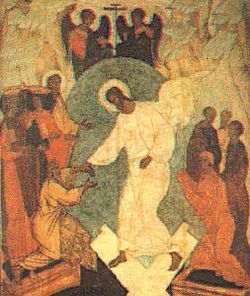
Eastern Orthodox Church
The Orthodox Church, officially called the Orthodox Catholic Church and commonly referred to as the Eastern Orthodox Church, is the second largest Christian denomination in the world, with an estimated 300 million adherents mainly in the countries of Belarus, Bulgaria, Cyprus, Georgia, Greece,...
and Eastern Catholic Churches of the Byzantine Rite
Byzantine Rite
The Byzantine Rite, sometimes called the Rite of Constantinople or Constantinopolitan Rite is the liturgical rite used currently by all the Eastern Orthodox Churches, by the Greek Catholic Churches , and by the Protestant Ukrainian Lutheran Church...
for the period of seven days beginning on Pascha
Easter
Easter is the central feast in the Christian liturgical year. According to the Canonical gospels, Jesus rose from the dead on the third day after his crucifixion. His resurrection is celebrated on Easter Day or Easter Sunday...
(Easter) and continuing up to (but not including) the following Sunday, which is known as Thomas Sunday. Latin Rite and other Christian groups such as Anglicans
Anglicanism
Anglicanism is a tradition within Christianity comprising churches with historical connections to the Church of England or similar beliefs, worship and church structures. The word Anglican originates in ecclesia anglicana, a medieval Latin phrase dating to at least 1246 that means the English...
refer to this period as Easter Week
Easter Week
Easter Week is the period of seven days from Easter Sunday through the Saturday following.-Western Church:In the Latin Rite of Roman Catholicism, Anglican and other Western churches, Easter Week is the week beginning with the Christian feast of Easter and ending a week later on Easter Saturday...
, not to be confused with the Octave of Easter
Octave of Easter
The term Octave of Easter may refer either to the eight day period from Easter Sunday until the Sunday following Easter, inclusive; or it may refer only to that Sunday after Easter, the Octave Day of Easter . That Sunday is also known historically as St...
, which includes the following Sunday.
The entire week following Pascha is to be set aside by Orthodox Christians for the celebration of the Resurrection. According to the 66th canon
Canon law
Canon law is the body of laws & regulations made or adopted by ecclesiastical authority, for the government of the Christian organization and its members. It is the internal ecclesiastical law governing the Catholic Church , the Eastern and Oriental Orthodox churches, and the Anglican Communion of...
of the Council in Trullo: "from the holy day of the Resurrection of Christ our God until New Sunday (i.e. Thomas Sunday) for a whole week the faithful in the holy churches should continually be repeating psalms, hymns and spiritual songs, rejoicing and celebrating Christ, and attending to the reading of the Divine Scriptures and delighting in the Holy Mysteries. For in this way shall we be exalted with Christ; raised up together with Him. For this reason on the aforesaid days that by no means there be any horse races or any other public spectacle". In Imperial Russia, the taverns used to be closed during Bright Week, and no alcoholic beverages were sold.
Liturgical aspects
The entire week is considered to be one continuous day, and the name of each day of the week is called "Bright" (e.g., "Bright Monday"). Every service during the week is completely different than at any other time of the year. Thus only during Bright Week the Paschal Verses (i.e., Psalm verses 68:1, 2, 3 & 118:24 are sung responsorially with the Paschal troparionPaschal troparion
The Paschal troparion or Christos anesti is the characteristic hymn for the celebration of Pascha in the Eastern Orthodox Church and those Eastern Catholic Churches which follow the Byzantine Rite....
) at the beginning of the Divine Liturgy
Divine Liturgy
Divine Liturgy is the common term for the Eucharistic service of the Byzantine tradition of Christian liturgy. As such, it is used in the Eastern Orthodox and Eastern Catholic Churches. Armenian Christians, both of the Armenian Apostolic Church and of the Armenian Catholic Church, use the same term...
, in place of Psalm 103 at the beginning of Vespers
Vespers
Vespers is the evening prayer service in the Western Catholic, Eastern Catholic, and Eastern Orthodox, Anglican, and Lutheran liturgies of the canonical hours...
and in place of the Six Psalms (i.e., 3, 37, 69, 87, 102 & 142) at the beginning of Matins
Matins
Matins is the early morning or night prayer service in the Roman Catholic, Anglican, Lutheran and Eastern Orthodox liturgies of the canonical hours. The term is also used in some Protestant denominations to describe morning services.The name "Matins" originally referred to the morning office also...
. Everything in the services is sung joyfully rather than read. Thus, for example, the priest while censing the church before the Divine Liturgy recites the hymn, "Having beheld the Resurrection of Christ . . .", rather than the usual Psalm 51 recited on all other days of the year. Normally, the entire Psalter
Psalter
A psalter is a volume containing the Book of Psalms, often with other devotional material bound in as well, such as a liturgical calendar and litany of the Saints. Until the later medieval emergence of the book of hours, psalters were the books most widely owned by wealthy lay persons and were...
is read during the course of a week (and twice a week during Great Lent
Great Lent
Great Lent, or the Great Fast, is the most important fasting season in the church year in Eastern Christianity, which prepares Christians for the greatest feast of the church year, Pascha . In many ways Great Lent is similar to Lent in Western Christianity...
), but during Bright Week no psalms
Psalms
The Book of Psalms , commonly referred to simply as Psalms, is a book of the Hebrew Bible and the Christian Bible...
at all are read. Each of the Little Hours
Little Hours
The Little Hours are the fixed daytime hours of prayer in the Divine Office of Christians, in both Western Christianity and the Eastern Orthodox Church. These Hours are called 'little' due to their shorter and simpler structure compared to the Night Hours...
is replaced by a special service known as the Paschal Hours
Paschal Hours
The Paschal Hours are the form in which the Little Hours are chanted on Pascha and throughout Bright Week in the Eastern Orthodox Church and those Eastern Catholic Churches which follow the Byzantine Rite.Specifically, the Paschal Hours replace:...
. The normal Prayers Before Communion
Eucharistic discipline
Eucharistic discipline is the term applied to the regulations and practices associated with an individual preparing for the reception of the Eucharist...
are replaced with the Paschal Canon
Canon (hymnography)
A canon is a structured hymn used in a number of Eastern Orthodox services. It consists of nine odes, sometimes called canticles or songs depending on the translation, based on the Biblical canticles. Most of these are found in the Old Testament, but the final ode is taken from the Magnificat and...
.
The hymns chanted every day are identical to those chanted on the Sunday of Pascha, with the exception of a few parts that are taken from the Sunday Resurrection propers of the Octoechos
Octoechos (liturgy)
The Octoechos —literally, the book "of the Eight Tones"—contains an eight-week cycle, providing texts to be chanted for every day at Vespers, Matins, the Divine Liturgy, Compline and the Midnight Office...
(the "Book of the Eight Tones
Octoechos
Oktōēchos is the name of the eight mode system used for the composition of religious chant in Syrian, Coptic, Byzantine, Armenian, Latin and Slavic churches since the middle ages...
"). Each day has a different tone assigned to it: Easter Sunday is Tone One, Bright Monday is Tone Two, and so on through the eight tones (skipping Tone Seven, the "Grave Tone"):
- Sunday of Pascha (Tone One)
- Bright Monday (Tone Two)
- Bright Tuesday (Tone Three)
- Bright Wednesday (Tone Four)
- Bright Thursday (Tone Five)
- Bright Friday (Tone Six)
- Bright Saturday (Tone Eight)

Iconostasis
In Eastern Christianity an iconostasis is a wall of icons and religious paintings, separating the nave from the sanctuary in a church. Iconostasis also refers to a portable icon stand that can be placed anywhere within a church...
are kept open—the only time of the year when this occurs. The open doors represent the stone rolled away from the Tomb of Christ, and the Epitaphios
Epitaphios
Epitaphios may refer to:* Funeral oration or epitaphios logos* Epitaphios or epitaphion, a cloth icon used during Holy Week in churches that follow the Byzantine rite...
(Slavonic: Plashchanitza), representing the burial clothes, is visible through them on the Holy Table (altar). The doors are closed before the Ninth Hour on the eve of Thomas Sunday. However, the Afterfeast
Afterfeast
An Afterfeast is a period of celebration attached to one of the Great Feasts celebrated by the Eastern Orthodox and Eastern Catholic Churches ....
of Pascha will continue until the eve of the Ascension.
In Bright Week the normal fasting rules are suspended, and the entire week is fast-free, with special Paschal foods, such as pascha (a special dish made of cheese, eggs and other products that were forbidden during Great Lent), kulich
Kulich
Kulich is a kind of Easter bread, traditional in the Orthodox Christian faith and eaten in Russia, Belarus, Bulgaria and Serbia....
and other easter bread
Easter Bread
In many European countries, there are various traditions surrounding the use of bread during the Easter holiday.-Sardinia:In Sardinia, Italy, bread is a part of a wide social context. It is the most important food in Sardinia, as well as all over Italy and the Mediterranean. "Bread is a nexus of...
s being eaten every day. Red Easter eggs are blessed at the end of the Paschal Vigil, and are eaten throughout Bright Week (though some are usually reserved for Radonitza).
At the end of Vespers
Vespers
Vespers is the evening prayer service in the Western Catholic, Eastern Catholic, and Eastern Orthodox, Anglican, and Lutheran liturgies of the canonical hours...
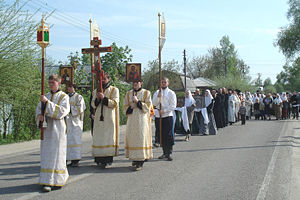
on the Sunday of Pascha there is a Cross Procession
Crucession
A Crucession, or Cross Procession , is a procession that takes place in the Eastern Orthodox and Eastern Catholic liturgical traditions. The name derives from the fact that the procession is headed by a cross....
three times around the church, at which the Icon
Icon
An icon is a religious work of art, most commonly a painting, from Eastern Christianity and in certain Eastern Catholic churches...
of the Resurrection
Resurrection of Jesus
The Christian belief in the resurrection of Jesus states that Jesus returned to bodily life on the third day following his death by crucifixion. It is a key element of Christian faith and theology and part of the Nicene Creed: "On the third day he rose again in fulfillment of the Scriptures"...
and the Artos are carried. On the last circuit, there is a reading from the Gospel
Gospel Book
The Gospel Book, Evangelion, or Book of the Gospels is a codex or bound volume containing one or more of the four Gospels of the Christian New Testament...
and the priest sprinkles the faithful with holy water
Holy water
Holy water is water that, in Catholicism, Anglicanism, Eastern Orthodoxy, Lutheranism, Oriental Orthodoxy, and some other churches, has been sanctified by a priest for the purpose of baptism, the blessing of persons, places, and objects; or as a means of repelling evil.The use for baptism and...
. On Bright Monday through Bright Saturday, this Cross Procession takes place in the same manner after Matins
Matins
Matins is the early morning or night prayer service in the Roman Catholic, Anglican, Lutheran and Eastern Orthodox liturgies of the canonical hours. The term is also used in some Protestant denominations to describe morning services.The name "Matins" originally referred to the morning office also...
or the Divine Liturgy
Divine Liturgy
Divine Liturgy is the common term for the Eucharistic service of the Byzantine tradition of Christian liturgy. As such, it is used in the Eastern Orthodox and Eastern Catholic Churches. Armenian Christians, both of the Armenian Apostolic Church and of the Armenian Catholic Church, use the same term...
.
Easter Vigil
The Easter Vigil, also called the Paschal Vigil or the Great Vigil of Easter, is a service held in many Christian churches as the first official celebration of the Resurrection of Jesus. Historically, it is during this service that people are baptized and that adult catechumens are received into...
, and is symbolic of the physical presence of the Resurrected Christ among the Apostles. This Artos is kept in the church during Bright Week, either in the nave
Nave
In Romanesque and Gothic Christian abbey, cathedral basilica and church architecture, the nave is the central approach to the high altar, the main body of the church. "Nave" was probably suggested by the keel shape of its vaulting...
, next to the Icon of the Resurrection; in front of the Icon of Christ on the Iconostasis
Iconostasis
In Eastern Christianity an iconostasis is a wall of icons and religious paintings, separating the nave from the sanctuary in a church. Iconostasis also refers to a portable icon stand that can be placed anywhere within a church...
; or in front of the Holy Doors. Throughout the week, whenever anyone enters the church, he or she kisses the Artos, as a means of symbolically greeting the resurrected Christ.
On Bright Friday, in addition to the normal Paschal hymns and the hymns from the Octoechos, special stichera and a canon in honor of the Theotokos
Theotokos
Theotokos is the Greek title of Mary, the mother of Jesus used especially in the Eastern Orthodox, Oriental Orthodox, and Eastern Catholic Churches. Its literal English translations include God-bearer and the one who gives birth to God. Less literal translations include Mother of God...
(Mother of God) as the "Life-giving Spring
Life-giving Spring
The Life-giving Spring or Life-giving Font is a feast day in the Orthodox Church that is associated with a historic church in Constantinople, as well as an icon of the Theotokos which is venerated by the Eastern Orthodox Church and those Eastern Catholic Churches which follow the Byzantine...
."
On Bright Saturday, after the Divine Liturgy, the priest says a prayer over the Artos and it is broken up and distributed to the faithful.
Bright Week begins the liturgical season known as the Pentecostarion
Pentecostarion
The Pentecostarion is the liturgical book used by the Eastern Orthodox and Eastern Catholic Churches which follow the Byzantine Rite during the Paschal Season which extends from Pascha to the Sunday following All Saints Sunday The Pentecostarion (Greek: Πεντηκοστάριον, Pentekostárion; Slavonic:...
, the period of fifty days which begins on Pascha and continues to Pentecost
Pentecost
Pentecost is a prominent feast in the calendar of Ancient Israel celebrating the giving of the Law on Sinai, and also later in the Christian liturgical year commemorating the descent of the Holy Spirit upon the disciples of Christ after the Resurrection of Jesus...
and its afterfeast
Afterfeast
An Afterfeast is a period of celebration attached to one of the Great Feasts celebrated by the Eastern Orthodox and Eastern Catholic Churches ....
. Every day throughout the coming year is dependent upon the date of Pascha for determining both the Tone of the Week (Octoechos) and the Epistle and Gospel readings.
Paschal funeral
If it becomes necessary to celebrate a funeralChristian burial
A Christian burial is the burial of a deceased person with specifically Christian ecclesiastical rites; typically, in consecrated ground. Until recent times Christians generally objected to cremation, and practised inhumation almost exclusively, but this opposition has weakened, and now vanished...
during Bright Week, even this service is radically different, and follows for the most part the format for Paschal Matins, with only a few funeral hymns being chanted. It is held that those Orthodox Christians who die in penitence during this time are released from the bonds of their sins and are accepted into the Kingdom of Heaven
Kingdom of God
The Kingdom of God or Kingdom of Heaven is a foundational concept in the Abrahamic religions: Judaism, Christianity and Islam.The term "Kingdom of God" is found in all four canonical gospels and in the Pauline epistles...
.
External links
- Holy Pascha: The Resurrection of Our Lord Orthodox iconIconAn icon is a religious work of art, most commonly a painting, from Eastern Christianity and in certain Eastern Catholic churches...
and synaxarion - Bright Monday
- Bright Tuesday
- Bright Wednesday
- Bright Thursday
- Bright Friday
- Bright Saturday
- Paschal Week, from Handbook for Church Servers (Kharkov, 1900) by S. V. Bulgakov