


Lakhmids

Encyclopedia
The Lakhmids Banu Lakhm (Arabic
: ), Muntherids (Arabic
: ), were a group of Arab Christians who lived in Southern Iraq
, and made al-Hirah
their capital in 266
. Poets described it as a Paradise on earth, an Arab Poet described the city's pleasant climate and beauty "One day in al-Hirah is better than a year of treatment". The al-Hirah ruins are located 3 kilometers south of Kufa
, on the west bank of the Euphrates. Their descendants today are the Mandharis, who are a prominent tribe who are considered Sheikhs in Iraq, the United Arab Emirates, and the Sultanate of Oman. The Abbabids, another prominent tribe in Yemen and the southern part of The Sultanate of Oman. And the Na'amanis, another Arab tribe in Oman. All of the tribes mentioned before belong to either Ibadhi or Sunni Islam. Some other famous descendants include the Arslans
(Arslan meaning Lion in Turkish) which is a very powerful Lebanese family and is a hereditary Druze
leadership. It is a princely family
.
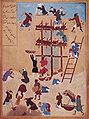
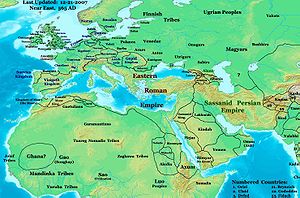 The Lakhmid Kingdom was founded by the Lakhum tribe that emigrated from Yemen
in the 2nd century and ruled by the Banu Lakhm
, hence the name given it. The founder of the dynasty was 'Amr, whose son Imru' al-Qais (not to be confused with the famous poet Imru' al-Qais
who lived in the 6th century) converted to Christianity. Gradually the whole city converted to that faith.
Imru' al-Qais dreamt of a unified and independent Arab kingdom and, following that dream, he seized many cities in Arabia. He then formed a large army and developed the Kingdom as a naval power, which consisted of a fleet of ships operating along the Bahrain
i coast. From this position he attacked the coastal cities of Iran
(Persia) - which at that time was in civil war, due to a dispute as to the succession - even raiding the birthplace of the Sassanid kings, the province of Pars
(Fars).
In 325
, the Persians, led by Shapur II
, began a campaign against the Arab kingdoms. When Imru' al-Qais realised that a mighty Persian army composed of 60,000 warriors was approaching his kingdom, he asked for the assistance of the Roman Empire
. Constantius II
promised to assist him but was unable to provide that help when it was needed. The Persians advanced toward al-Hirah
and a series of vicious battles took place over al-Hirah and the surrounding cities.
Shapur II crushed the Lakhmid army and captured al-Hirah. He ordered the extermination of its population in retaliation of their raids on Pars. In this, the young Shapur acted much more violently than was normal at the time in order to demonstrate to both the Arab Kingdoms and the Persian nobility his power and authority. Shapur's title in Arabic is Zol 'Aktāf meaning owner of the shoulders, as he pierced the shoulders of his captives and chained them to each other by a rope. He installed Aus ibn Qallam and gave the city autonomy, thus making the kingdom a buffer zone between the Persian Empire's mainland and the territory of other Arabs in the Peninsula.
Imru' al-Qais escaped to Bahrain, taking his dream of a unified Arab nation with him, and then to Syria
seeking the promised assistance from Constantius II
which never materialized, so he stayed there until he died. With him ended the dream of a united Arab kingdom until after the advent of Islam. When he died he was entombed at al-Nimarah in the Syrian desert.
Imru' al-Qais' funerary inscription is written in an extremely difficult type of script. Recently there has been a revival of interest in the inscription, and controversy has arisen over its precise implications. It is now certain that Imru' al-Qais claimed the title "King of all the Arabs" and also claimed in the inscription to have campaigned successfully over the entire north and centre of the peninsula, as far as the border of Najran
.
Two years after his death, in the year 330
, a revolt took place where Aus ibn Qallam was killed and succeeded by the son of Imru' al-Qais, 'Amr. Thereafter, the Lakhmids' main rivals were the Ghassanids
, who were vassals of the Sassanids' arch-enemy, the Byzantine Empire
. The Lakhmid kingdom was a major centre of the Nestorian sect of Christianity which was nurtured by the Sassanids, as it opposed the Orthodox
religion of Byzantium.
The Lakhmids remained influential throughout the 6th century. Nevertheless, in 602
, the last Lakhmid king, Nu'man III, was put to death by the Sassanid king Khosrau II
because of a false suspicion of treason, and the Lakhmid kingdom was annexed. Islam overran the Sassanid Empire in the 7th century. At that point, the city was abandoned and its materials were used to re-construct Kufa
, its exhausted twin city.
It is now widely believed that the annexation of the Lakhmid kingdom was one of the main factors behind the Fall of Sassanid dynasty to the Muslim Arabs and the Islamic conquest of Persia, as the Lakhmids agreed to act as spies for the Muslims after being defeated in the Battle of Hira
by Khalid ibn al-Walid
.
s in southern Iraq and a Persian army, c. 609
.
According to the Arab historian Abu 'Ubaida
(d. 824), Khosrau II
was angry with King Numan III for refusing to give him his daughter in marriage, and therefore imprisoned him. Subsequently, Khusraw sent troops to recover the Numan family armor, but Hany bin Masud (Numan's friend) refused, and the Persian forces were defeated at the battle of Dhi Qar, near Al-Hirah
, the Lakhmid dynasty's capital. Hirah, sometimes spelled "Hira," was just south of the Iraqi city of Kufa
.
Á
The Arslan family was sent to the coast of the Lebanon by the Islamic Khalifa in 634 AD and they were responsible of guarding the coast and protecting it. They ruled Beirut for 476 years (from 634 AD till 1110 AD). However, Prince Arslan bin al-Mundhir founded the Principality of Sin-el-Fil in 759 AD in Beirut. The Principality of Sin-el-Fil was the base of the afterwards Principality of Mount Lebanon who was the base of the foundation of Greater Lebanon.
The "Arslan dynasty" is still one of the most powerful Lebanese political families, and is now considered to be a hereditary Druze
leadership dynasty. The current leader is Prince Talal bin Majeed bin Toufic Arslan
(1989–present) whose father was the Lebanese independence hero, and Lebanese minister of defense for over 30 years: Prince Majeed bin Toufic bin Majeed Arslan.
Arabic language
Arabic is a name applied to the descendants of the Classical Arabic language of the 6th century AD, used most prominently in the Quran, the Islamic Holy Book...
: ), Muntherids (Arabic
Arabic language
Arabic is a name applied to the descendants of the Classical Arabic language of the 6th century AD, used most prominently in the Quran, the Islamic Holy Book...
: ), were a group of Arab Christians who lived in Southern Iraq
Iraq
Iraq ; officially the Republic of Iraq is a country in Western Asia spanning most of the northwestern end of the Zagros mountain range, the eastern part of the Syrian Desert and the northern part of the Arabian Desert....
, and made al-Hirah
Al-Hirah
Al Hīra was an ancient city located south of al-Kufah in south-central Iraq.- Middle Ages:Al Hīra was a significant city in pre-Islamic Arab history. Originally a military encampment, in the 5th and 6th centuries CE it became the capital of the Lakhmids.The Arabs were migrating into the Near East...
their capital in 266
266
Year 266 was a common year starting on Monday of the Julian calendar. At the time, it was known as the Year of the Consulship of Gallienus and Sabinillus...
. Poets described it as a Paradise on earth, an Arab Poet described the city's pleasant climate and beauty "One day in al-Hirah is better than a year of treatment". The al-Hirah ruins are located 3 kilometers south of Kufa
Kufa
Kufa is a city in Iraq, about south of Baghdad, and northeast of Najaf. It is located on the banks of the Euphrates River. The estimated population in 2003 was 110,000....
, on the west bank of the Euphrates. Their descendants today are the Mandharis, who are a prominent tribe who are considered Sheikhs in Iraq, the United Arab Emirates, and the Sultanate of Oman. The Abbabids, another prominent tribe in Yemen and the southern part of The Sultanate of Oman. And the Na'amanis, another Arab tribe in Oman. All of the tribes mentioned before belong to either Ibadhi or Sunni Islam. Some other famous descendants include the Arslans
Talal Arslan
-Political career:Arslan was elected to the Lebanese Parliament as a deputy of the Aley District in 1991, 1992, 1996, 2000 and 2009. From 1990 to 1992 he was the Lebanese Minister of Tourism, from 1996 to 1998 he was Minister of Emigrants and served as Minister of State twice from 2000 to 2003 and...
(Arslan meaning Lion in Turkish) which is a very powerful Lebanese family and is a hereditary Druze
Druze
The Druze are an esoteric, monotheistic religious community, found primarily in Syria, Lebanon, Israel, and Jordan, which emerged during the 11th century from Ismailism. The Druze have an eclectic set of beliefs that incorporate several elements from Abrahamic religions, Gnosticism, Neoplatonism...
leadership. It is a princely family
Royal family
A royal family is the extended family of a king or queen regnant. The term imperial family appropriately describes the extended family of an emperor or empress, while the terms "ducal family", "grand ducal family" or "princely family" are more appropriate to describe the relatives of a reigning...
.
History
Yemen
The Republic of Yemen , commonly known as Yemen , is a country located in the Middle East, occupying the southwestern to southern end of the Arabian Peninsula. It is bordered by Saudi Arabia to the north, the Red Sea to the west, and Oman to the east....
in the 2nd century and ruled by the Banu Lakhm
Banu Lakhm
Banu Lakhm is a large Arab tribe tracing their lineage backto Qahtan, who among many achievements, created anArab kingdom in Al-Hira, near modern Kufa, Iraq...
, hence the name given it. The founder of the dynasty was 'Amr, whose son Imru' al-Qais (not to be confused with the famous poet Imru' al-Qais
Imru' al-Qais
Imru` al-Qais bin Hujr al-Kindi was an Arabian poet in the 6th century AD, and also the son of one of the last Kindite kings. His qaseeda, or long poem, "Let us stop and weep" is one of the seven Mu'allaqat, poems prized as the best examples of pre-Islamic Arabian verse...
who lived in the 6th century) converted to Christianity. Gradually the whole city converted to that faith.
Imru' al-Qais dreamt of a unified and independent Arab kingdom and, following that dream, he seized many cities in Arabia. He then formed a large army and developed the Kingdom as a naval power, which consisted of a fleet of ships operating along the Bahrain
Bahrain
' , officially the Kingdom of Bahrain , is a small island state near the western shores of the Persian Gulf. It is ruled by the Al Khalifa royal family. The population in 2010 stood at 1,214,705, including 235,108 non-nationals. Formerly an emirate, Bahrain was declared a kingdom in 2002.Bahrain is...
i coast. From this position he attacked the coastal cities of Iran
Iran
Iran , officially the Islamic Republic of Iran , is a country in Southern and Western Asia. The name "Iran" has been in use natively since the Sassanian era and came into use internationally in 1935, before which the country was known to the Western world as Persia...
(Persia) - which at that time was in civil war, due to a dispute as to the succession - even raiding the birthplace of the Sassanid kings, the province of Pars
Pars
Pars may refer to:* Fārs Province, modern Persian language name for Pars Province, central Iranian kingdom of the ancient Persian empire* Pars News Agency and Pars Agency, names of the national Iranian news agency prior to the Iranian Revolution in 1979...
(Fars).
In 325
325
Year 325 was a common year starting on Friday of the Julian calendar. At the time, it was known as the Year of the Consulship of Proculus and Paulinus...
, the Persians, led by Shapur II
Shapur II
Shapur II the Great was the ninth King of the Persian Sassanid Empire from 309 to 379 and son of Hormizd II. During his long reign, the Sassanid Empire saw its first golden era since the reign of Shapur I...
, began a campaign against the Arab kingdoms. When Imru' al-Qais realised that a mighty Persian army composed of 60,000 warriors was approaching his kingdom, he asked for the assistance of the Roman Empire
Roman Empire
The Roman Empire was the post-Republican period of the ancient Roman civilization, characterised by an autocratic form of government and large territorial holdings in Europe and around the Mediterranean....
. Constantius II
Constantius II
Constantius II , was Roman Emperor from 337 to 361. The second son of Constantine I and Fausta, he ascended to the throne with his brothers Constantine II and Constans upon their father's death....
promised to assist him but was unable to provide that help when it was needed. The Persians advanced toward al-Hirah
Al-Hirah
Al Hīra was an ancient city located south of al-Kufah in south-central Iraq.- Middle Ages:Al Hīra was a significant city in pre-Islamic Arab history. Originally a military encampment, in the 5th and 6th centuries CE it became the capital of the Lakhmids.The Arabs were migrating into the Near East...
and a series of vicious battles took place over al-Hirah and the surrounding cities.
Shapur II crushed the Lakhmid army and captured al-Hirah. He ordered the extermination of its population in retaliation of their raids on Pars. In this, the young Shapur acted much more violently than was normal at the time in order to demonstrate to both the Arab Kingdoms and the Persian nobility his power and authority. Shapur's title in Arabic is Zol 'Aktāf meaning owner of the shoulders, as he pierced the shoulders of his captives and chained them to each other by a rope. He installed Aus ibn Qallam and gave the city autonomy, thus making the kingdom a buffer zone between the Persian Empire's mainland and the territory of other Arabs in the Peninsula.
Imru' al-Qais escaped to Bahrain, taking his dream of a unified Arab nation with him, and then to Syria
Syria
Syria , officially the Syrian Arab Republic , is a country in Western Asia, bordering Lebanon and the Mediterranean Sea to the West, Turkey to the north, Iraq to the east, Jordan to the south, and Israel to the southwest....
seeking the promised assistance from Constantius II
Constantius II
Constantius II , was Roman Emperor from 337 to 361. The second son of Constantine I and Fausta, he ascended to the throne with his brothers Constantine II and Constans upon their father's death....
which never materialized, so he stayed there until he died. With him ended the dream of a united Arab kingdom until after the advent of Islam. When he died he was entombed at al-Nimarah in the Syrian desert.
Imru' al-Qais' funerary inscription is written in an extremely difficult type of script. Recently there has been a revival of interest in the inscription, and controversy has arisen over its precise implications. It is now certain that Imru' al-Qais claimed the title "King of all the Arabs" and also claimed in the inscription to have campaigned successfully over the entire north and centre of the peninsula, as far as the border of Najran
Najran
Najran , formerly known as Aba as Sa'ud, is a city in southwestern Saudi Arabia near the border with Yemen. It is the capital of Najran Province. Designated a New town, Najran is one of the fastest-growing cities in the kingdom; its population has risen from 47,500 in 1974 and 90,983 in 1992 to...
.
Two years after his death, in the year 330
330
Year 330 was a common year starting on Thursday of the Julian calendar. At the time, it was known as the Year of the Consulship of Gallicanus and Tullianus...
, a revolt took place where Aus ibn Qallam was killed and succeeded by the son of Imru' al-Qais, 'Amr. Thereafter, the Lakhmids' main rivals were the Ghassanids
Ghassanids
The Ghassanids were a group of South Arabian Christian tribes that emigrated in the early 3rd century from Yemen to Syria, Jordan, Lebanon and the Holy Land....
, who were vassals of the Sassanids' arch-enemy, the Byzantine Empire
Byzantine Empire
The Byzantine Empire was the Eastern Roman Empire during the periods of Late Antiquity and the Middle Ages, centred on the capital of Constantinople. Known simply as the Roman Empire or Romania to its inhabitants and neighbours, the Empire was the direct continuation of the Ancient Roman State...
. The Lakhmid kingdom was a major centre of the Nestorian sect of Christianity which was nurtured by the Sassanids, as it opposed the Orthodox
Orthodox Christianity
The term Orthodox Christianity may refer to:* the Eastern Orthodox Church and its various geographical subdivisions...
religion of Byzantium.
The Lakhmids remained influential throughout the 6th century. Nevertheless, in 602
602
Year 602 was a common year starting on Monday of the Julian calendar. The denomination 602 for this year has been used since the early medieval period, when the Anno Domini calendar era became the prevalent method in Europe for naming years.- Byzantine Empire :* Maurice, at war with the Avars and...
, the last Lakhmid king, Nu'man III, was put to death by the Sassanid king Khosrau II
Khosrau II
250px|thumb|Khosrau II 250px|thumb|Khosrau II 250px|thumb|Khosrau II (Khosrow II, Chosroes II, or Xosrov II in classical sources, sometimes called Parvez, "the Ever Victorious" – (in Persian: خسرو پرویز), was the twenty-second Sassanid King of Persia, reigning from 590 to 628...
because of a false suspicion of treason, and the Lakhmid kingdom was annexed. Islam overran the Sassanid Empire in the 7th century. At that point, the city was abandoned and its materials were used to re-construct Kufa
Kufa
Kufa is a city in Iraq, about south of Baghdad, and northeast of Najaf. It is located on the banks of the Euphrates River. The estimated population in 2003 was 110,000....
, its exhausted twin city.
It is now widely believed that the annexation of the Lakhmid kingdom was one of the main factors behind the Fall of Sassanid dynasty to the Muslim Arabs and the Islamic conquest of Persia, as the Lakhmids agreed to act as spies for the Muslims after being defeated in the Battle of Hira
Battle of Hira
Al-Hirah city, widely known for its size and wealth, was a Sassanian dukedom as it was the capital of the Persian province of Iraq. Many of its Lakhmid Christian Arab inhabitants patrolled the desert on behalf of the Sassanians...
by Khalid ibn al-Walid
Khalid ibn al-Walid
Khālid ibn al-Walīd also known as Sayf Allāh al-Maslūl , was a companion of the Islamic prophet Muhammad. He is noted for his military tactics and prowess, commanding the forces of Medina and those of his immediate successors of the Rashidun Caliphate; Abu Bakr and Umar...
.
Arab-Persian War
'The Battle of Dhi Qar (Arabic,يوم ذي قار) was a Pre-Islamic battle fought between ArabArab
Arab people, also known as Arabs , are a panethnicity primarily living in the Arab world, which is located in Western Asia and North Africa. They are identified as such on one or more of genealogical, linguistic, or cultural grounds, with tribal affiliations, and intra-tribal relationships playing...
s in southern Iraq and a Persian army, c. 609
609
Year 609 was a common year starting on Wednesday of the Julian calendar. The denomination 609 for this year has been used since the early medieval period, when the Anno Domini calendar era became the prevalent method in Europe for naming years.- Asia :* Edessa is taken by the Sassanids.* The tax...
.
According to the Arab historian Abu 'Ubaida
Abu 'Ubaida
Abu ’Ubaida or Ubayda was a Muslim scholar.Born in Basra, he was a mawla of a family from the Arab tribe of Quraish, and said to have been Jewish.” In his youth, he was a pupil of Abu 'Amr ibn al-'Ala', and in 803 he was called to Baghdad by the Caliph Harun al-Rashid...
(d. 824), Khosrau II
Khosrau II
250px|thumb|Khosrau II 250px|thumb|Khosrau II 250px|thumb|Khosrau II (Khosrow II, Chosroes II, or Xosrov II in classical sources, sometimes called Parvez, "the Ever Victorious" – (in Persian: خسرو پرویز), was the twenty-second Sassanid King of Persia, reigning from 590 to 628...
was angry with King Numan III for refusing to give him his daughter in marriage, and therefore imprisoned him. Subsequently, Khusraw sent troops to recover the Numan family armor, but Hany bin Masud (Numan's friend) refused, and the Persian forces were defeated at the battle of Dhi Qar, near Al-Hirah
Al-Hirah
Al Hīra was an ancient city located south of al-Kufah in south-central Iraq.- Middle Ages:Al Hīra was a significant city in pre-Islamic Arab history. Originally a military encampment, in the 5th and 6th centuries CE it became the capital of the Lakhmids.The Arabs were migrating into the Near East...
, the Lakhmid dynasty's capital. Hirah, sometimes spelled "Hira," was just south of the Iraqi city of Kufa
Kufa
Kufa is a city in Iraq, about south of Baghdad, and northeast of Najaf. It is located on the banks of the Euphrates River. The estimated population in 2003 was 110,000....
.
Lakhmid Kingdom facts
- al-HirahAl-HirahAl Hīra was an ancient city located south of al-Kufah in south-central Iraq.- Middle Ages:Al Hīra was a significant city in pre-Islamic Arab history. Originally a military encampment, in the 5th and 6th centuries CE it became the capital of the Lakhmids.The Arabs were migrating into the Near East...
was the cradle of the Arabic alphabetArabic alphabetThe Arabic alphabet or Arabic abjad is the Arabic script as it is codified for writing the Arabic language. It is written from right to left, in a cursive style, and includes 28 letters. Because letters usually stand for consonants, it is classified as an abjad.-Consonants:The Arabic alphabet has...
. - It was the birthplace of famous poets like al-Nabighah al-Thubyani, Laqete ibn Ya'amur al-Ayadi, 'Alqama ibn 'Abada'Alqama ibn 'Abada'Alqama ibn 'Ubada , Arabic علقمة بن عبدة generally known as 'Alqama al-Fahl علقمة الفحل , an Arabian poet of the tribe Tamim, who flourished in the second half of the 6th century....
and Uday ibn Zaid al-Abbadi. It was visited by other great poets like Tarafah ibn al-'AbdTarafaTarafa , was a 6th century Arabian poet of the tribe of the Bakr.After a wild and dissipated youth spent in Bahrain, left his native land after peace had been established between the tribes of Bakr and Taghlib and went with his uncle Al-Mutalammis to the court of the king of Hira, 'Amr ibn-Hind ,...
, Amr ibn KulthumAmr ibn KulthumAmr ibn Kulthum Ibn Malik Ibn A`tab Abu Al-Aswad al-Taghlibi , a knight and the leader of the Taghlab tribe which was in Al-Forat island and was famous for its glory, bravery and merciless behavior in battle...
(who killed 'Amr III'Amr III ibn al-MundhirAmr III ibn al-Mundhir was the king of the Lakhmid Arabs in 554–569.He was the son of the great al-Mundhir III ibn al-Nu'man , and succeeded to the throne upon his father's death. He is also often called Amr ibn Hind after his mother, Hind bint al-Harith b. Amr b. Hujr Akil al-Murar al-Kindi...
). - Sassanid armySassanid armyThe birth of the Sassanid army dates back to the rise of Ardashir I , the founder of the Sassanid dynasty, to the throne. Ardashir aimed at the revival of the Persian Empire, and to further this aim, he reformed the military by forming a standing army which was under his personal command and whose...
along with al-Mundhir III ibn al-Nu'man himself and his army defeated the famed Byzantine general BelisariusBelisariusFlavius Belisarius was a general of the Byzantine Empire. He was instrumental to Emperor Justinian's ambitious project of reconquering much of the Mediterranean territory of the former Western Roman Empire, which had been lost less than a century previously....
at the Battle of CallinicumBattle of CallinicumThe Battle of Callinicum took place Easter day, 19 April 531, between the armies of the Eastern Roman Empire under Belisarius and the Sassanid Persians under Azarethes. After a defeat at the Battle of Dara, the Sassanids moved to invade Syria in an attempt to turn the tide of the war...
(531). - After the death of al-Nu'man III, Arabs defeated the Persians in the Battle of Thi-Qar.
- Lakhmids sometimes had good relations with Persians. Bahram VBahram VBahram V was the fourteenth Sassanid King of Persia . Also called Bahram Gur or Bahramgur , he was a son of Yazdegerd I , after whose sudden death he gained the crown against the opposition of the grandees by the help of Mundhir, the Arab dynast of al-Hirah.- Reign and war with Rome :Bahram V...
lived in Al-HirahAl-HirahAl Hīra was an ancient city located south of al-Kufah in south-central Iraq.- Middle Ages:Al Hīra was a significant city in pre-Islamic Arab history. Originally a military encampment, in the 5th and 6th centuries CE it became the capital of the Lakhmids.The Arabs were migrating into the Near East...
and was educated at the court of al-Mundhir I, whose support helped him gain the throne after the assassination of his father.
Á
Descendants
The Lakhmid dynasty had a Prince once called Arslan bin Malek bin Barakat. After the abolishment of the Lakhmid Kingdom of the Hira, the family name of Arslan was given to the descendants of the Kingly dynasty.The Arslan family was sent to the coast of the Lebanon by the Islamic Khalifa in 634 AD and they were responsible of guarding the coast and protecting it. They ruled Beirut for 476 years (from 634 AD till 1110 AD). However, Prince Arslan bin al-Mundhir founded the Principality of Sin-el-Fil in 759 AD in Beirut. The Principality of Sin-el-Fil was the base of the afterwards Principality of Mount Lebanon who was the base of the foundation of Greater Lebanon.
The "Arslan dynasty" is still one of the most powerful Lebanese political families, and is now considered to be a hereditary Druze
Druze
The Druze are an esoteric, monotheistic religious community, found primarily in Syria, Lebanon, Israel, and Jordan, which emerged during the 11th century from Ismailism. The Druze have an eclectic set of beliefs that incorporate several elements from Abrahamic religions, Gnosticism, Neoplatonism...
leadership dynasty. The current leader is Prince Talal bin Majeed bin Toufic Arslan
Talal Arslan
-Political career:Arslan was elected to the Lebanese Parliament as a deputy of the Aley District in 1991, 1992, 1996, 2000 and 2009. From 1990 to 1992 he was the Lebanese Minister of Tourism, from 1996 to 1998 he was Minister of Emigrants and served as Minister of State twice from 2000 to 2003 and...
(1989–present) whose father was the Lebanese independence hero, and Lebanese minister of defense for over 30 years: Prince Majeed bin Toufic bin Majeed Arslan.
External links
- Battle of Dhi
- Al Sejel el Arslaneh (the book of the history of the Arslan dynasty)