


Gadsden Purchase

Encyclopedia
The Gadsden Purchase is a 29670 square miles (76,844.9 km²) region of present-day southern Arizona
and southwestern New Mexico
that was purchased by the United States
in a treaty signed by James Gadsden
, the American ambassador to Mexico
at the time, on December 30, 1853. It was then ratified, with changes, by the U.S. Senate
on April 25, 1854 and signed by President Franklin Pierce
, with final approval action taken by Mexico on June 8, 1854. The purchase was the last major territorial acquisition in the contiguous United States
, adding a large area to the United States.
The purchase included lands south of the Gila River
and west of the Rio Grande
. The Gadsden Purchase was for the purpose of the US's construction of a transcontinental railroad
along a deep southern route. It was also related to reconciliation of outstanding border issues following the Treaty of Guadalupe Hidalgo
, which ended the Mexican–American War
of 1846–48.
As the railroad age progressed, business-oriented Southerners saw that a railroad linking the South with the Pacific Coast would expand trade opportunities. They thought the topography of the southern portion of the Mexican Cession
was too mountainous to allow a direct route. Projected southern routes tended to run to the north at their eastern ends, which would favor connections with northern railroads and ultimately favor northern seaports. Southerners saw that to avoid the mountains, a route with a southeastern terminus might need to swing south into what was then Mexican territory.
The administration of President Franklin Pierce, strongly influenced by Secretary of War Jefferson Davis
, saw an opportunity to acquire land for the railroad, as well as to acquire significant other territory from northern Mexico. In the end, territory for the railroad was purchased for $10 million ($ today), but Mexico balked at any large-scale sale of territory. In the United States, the debate over the treaty became involved in the sectional dispute over slavery, ending progress before the American Civil War
in the planning or construction of a transcontinental railroad.
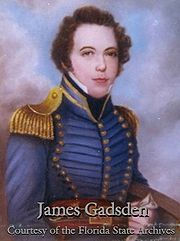 In January 1845 Asa Whitney
of New York state presented the US Congress with the first plan to construct a transcontinental railroad. Although Congress took no action on his proposal, a commercial convention of 1845 in Memphis
took up the issue. Prominent attendees included John C. Calhoun
, Clement C. Clay, Sr.
, John Bell
, William Gwin
, and Edmund P. Gaines
, but it was James Gadsden
of South Carolina who was influential in the convention’s recommending a southern route for the proposed railroad, beginning in Texas
and ending in San Diego or Mazatlán
. Southerners hoped that such a route would ensure southern prosperity while opening the “West to southern influence and settlement.”
Southern interest in railroads in general, and the Pacific railroad in particular, accelerated after the conclusion of the Mexican-American War in 1848. During that war, topographical
officers William H. Emory
and James W. Abert
had conducted surveys that demonstrated the feasibility of a railroad's originating in El Paso
or western Arkansas
and ending in San Diego. J. D. B. DeBow
, the editor of DeBow's Review
, and Gadsden both publicized within the South the benefits of building this railroad.
Gadsden had become the president of the South Carolina Canal and Rail Road Company
in 1839; about a decade later, the company had laid 136 miles (218.9 km) of track extending west from Charleston, South Carolina
, and it was 3 million dollars ($ today) in debt. Gadsden wanted to connect all Southern railroads into one sectional network. He was concerned that the increasing railroad construction in the North was shifting trade in lumber, farm goods, and manufacturing goods from the traditional north-south route based on the Ohio
and Mississippi
rivers to an east-west axis that would bypass the South. He also saw Charleston, his home town, losing its prominence as a seaport. In addition, many Southern business interests feared that a northern transcontinental route would cut the South off from trade with the Orient
. Other Southerners argued for diversification from a plantation economy to keep the South independent from northern bankers.
In October 1849 a convention to discuss railroads was held in Memphis, in response to a separate convention called in St. Louis earlier in the fall, which had discussed a northern route. The Memphis convention overwhelmingly advocated the construction of a route beginning there, to connect with an El Paso
to San Diego line. Disagreement arose only over the issue of financing. The convention president, Matthew Fontaine Maury
of Virginia
, preferred strict private financing, whereas John Bell and others thought that Federal land grants to railroad developers would be necessary.
in 1831. In 1850 he advocated secession by South Carolina when California
was admitted to the Union as a free state. Gadsden considered slavery “a social blessing” and abolitionists “the greatest curse of the nation.”
When the secession proposal failed, Gadsden, working with his cousin Isaac Edward Holmes
, a lawyer in San Francisco since 1851, and the California state senator Thomas Jefferson Green
, attempted to divide California in two. They proposed that the southern half would allow slavery. Gadsden planned to establish a slaveholding colony there based on rice, cotton, and sugar. He would use slave labor to build a railroad and highway, originating in either San Antonio or on the Red River
, that would transport people to the California gold fields. Toward this end, on December 31, 1851, Gadsden asked Green to secure from the California state legislature a large land grant located between the 34th and 36th parallels; it would eventually serve as the dividing line for the two California states.
A few months after this, Gadsden and 1,200 potential settlers from South Carolina and Florida
submitted a petition to the California legislature for permanent citizenship and permission to establish a rural district that would be farmed by "not less than Two Thousand of their African Domestics". The petition stimulated some debate, but it finally died in committee.
, which created the Utah Territory
and the New Mexico Territory
, would facilitate a southern route to the West Coast
since all territory for the railroad was now organized and would allow for Federal land grants as a financing measure. Competing northern or central routes championed, respectively, by Stephen Douglas of Illinois and Thomas Hart Benton
of Missouri would still need to go through unorganized territories. A precedent for using federal land grants had been established when Millard Fillmore
signed a bill promoted by Douglas that allowed a Mobile
to Chicago
railroad to be financed by "federal land grants for the specific purpose of railroad construction." To satisfy Southern opposition to the general principle of Federally supported internal improvements, the land grants would first be transferred to the appropriate state or territorial government, which would oversee the final transfer to private developers.
By 1850, however, the majority of the South was not interested in exploiting its advantages in developing a transcontinental railroad or railroads in general. Businessmen like Gadsden, who advocated economic diversification, were in the minority. The Southern economy was based on cotton exports, and then-current transportation networks met the plantation system's needs. There was little home market for an intra-South trade. In the short term, the best use for capital was to invest it in more slaves and land rather than in taxing it to support canals, railroads, roads, or in dredging rivers. Historian Jere W. Roberson wrote:
ended the Mexican-American War, but there were issues affecting both sides that still needed to be resolved: possession of the Mesilla Valley
, protection for Mexico from Indian raids, and the right of transit in the Isthmus of Tehuantepec
.
. Bordering the Rio Grande, the valley consisted of flat desert land measuring about 50 miles (80.5 km), north to south, by 200 miles (321.9 km), east to west. This valley was essential for the construction of a transcontinental railroad using a southern route.
John Bartlett
of Rhode Island
, the United States negotiator, agreed to allow Mexico to retain the Mesilla Valley (setting the boundary at 32° 22′ N, north of the American claim 31° 52′ and at the easternmost part, also north of the Mexican-claimed boundary at 32° 15′) in exchange for a boundary not turning north until 110° W in order to include the Santa Rita Mountains
, which were believed to have rich copper
deposits, and some silver
and gold
which had not yet been mined. Southerners opposed this alternative because of its implication for the railroad, but it was supported by President Fillmore. Southerners in Congress prevented any action on the approval of this separate border treaty and eliminated further funding for surveying of the disputed borderland. Bartlett was replaced with Robert Blair Campbell
, a pro-railroad politician from Alabama
. Mexico asserted that the commissioners' determinations were valid and prepared to send in troops to enforce the unratified agreement.
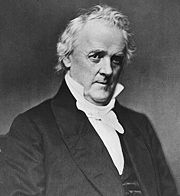 Article XI of the Treaty of Guadalupe-Hidalgo contained a guarantee that the United States would protect Mexicans by preventing cross-border raids by Native American
tribes. At the time the treaty was ratified, Secretary of State James Buchanan
had believed that the United States had both the commitment and resources to enforce this promise. Historian Richard Kluger
, however, described the difficulties of the task:
In the five years after approval of the Treaty, the United States spent $12 million ($ today) in this area, and General Winfield Scott
estimated that five times that amount would be necessary to police the border. Mexican officials, frustrated with the failure of the United States to effectively enforce its guarantee, demanded reparations for the losses inflicted on Mexican citizens by the raids. The United States argued that the Treaty did not require any compensation nor did it require any greater effort to protect Mexicans than was expended in protecting its own citizens. During the Fillmore administration, Mexico claimed damages of $40 million ($ today) but offered to allow the U. S. to buy out Article XI for $12 million ($ today). Fillmore had proposed a settlement that was $10 million less ($ today).
. The idea of building a railroad here had been considered for a long time. In 1842 Mexican President Antonio López de Santa Anna
sold the rights to build a railroad or canal across the isthmus. The deal included land grants 300 miles (482.8 km)-wide along the right-of-way for future colonization and development. In 1847 a British bank bought the rights, raising US fears of British colonization in the hemisphere, in violation of the precepts of the Monroe Doctrine
. United States interest in the right-of-way was increased by the 1848 discovery of gold
in California.
The Memphis commercial convention of 1849 recommended that the United States pursue the trans-isthmus route, since it appeared unlikely that a transcontinental railroad would be built anytime soon. Interests in Louisiana were especially adamant about this option, as they believed that any transcontinental railroad would divert commercial traffic away from the Mississippi and New Orleans, and they at least wanted to secure a southern route. Also showing interest was Peter A. Hargous of New York who ran an import-export business between New York and Vera Cruz
. Hargous purchased the rights to the route for $25,000 ($ today), but realized that the grant had little value unless it was supported by the Mexican and American governments.
In Mexico, topographical officer George W. Hughes
reported to Secretary of State John M. Clayton
that a railroad across the isthmus was a “feasible and practical” idea. Clayton then instructed Robert P. Letcher
, the minister to Mexico, to negotiate a treaty to protect Hargous’ rights. The United States’ proposal gave Mexicans a 20% discount on shipping, guaranteed Mexican rights in the zone, allowed the United States to send in military if necessary, and gave the United States most-favored-nation status for Mexican cargo fees. This treaty, however, was never finalized.
The Clayton-Bulwer Treaty
between the United States and Great Britain, which guaranteed the neutrality of any such canal, was finalized in April 1850. Mexican negotiators refused the treaty because it would eliminate Mexico's ability to play the U.S. and U.K. against each other. They eliminated the right of the United States to unilaterally intervene militarily. The United States Senate approved the treaty in early 1851, but the Mexican Congress refused to accept the treaty.
In the meantime, Hargous proceeded as if the treaty would be approved eventually. Judah P. Benjamin
and a committee of New Orleans businessmen joined with Hargous and secured a charter from the Louisiana legislature to create the Tehuantepec Railroad Company. The new company sold stock and sent survey teams to Mexico. Hargous started to acquire land even after the Mexican legislature rejected the treaty, a move that led to the Mexicans canceling Hargous’ contract to use the right of way. Hargous put his losses at $5 million ($ today) and asked the United States government to intervene. President Fillmore refused to do so.
Mexico sold the canal franchise, without the land grants, to A. G. Sloo and Associates in New York for $600,000 ($ today). In March 1853 Sloo contracted with a British company to build a railroad and sought an exclusive contract from the new Franklin Pierce
Administration to deliver mail from New York to San Francisco. However, Sloo soon defaulted on bank loans and the contract was sold back to Hargous.
was sent to Spain to negotiate the annexation of Cuba. Expansionists John Y. Mason of Virginia
and Solon Borland of Arkansas
were appointed as ministers, respectively, to France
and Nicaragua
. Pierce's Secretary of War, Jefferson Davis
, was already on record as favoring a southern route for a transcontinental railroad, so southern rail enthusiasts had every reason to be encouraged.
The South as a whole, however, remained divided. In January 1853 Senator Thomas Jefferson Rusk
of Texas introduced a bill to create two railroads, one with a northern route and one with a southern route starting below Memphis on the Mississippi River. Under the Rusk legislation, the President would be authorized to select the specific termini and routes as well as the contractors who would build the railroads. Some southerners, however, worried that northern and central interests would leap ahead in construction and opposed any direct aid to private developers on constitutional grounds. Other southerners preferred the isthmian proposals. An amendment was added to the Rusk bill to prohibit direct aid, but southerners still split their vote in Congress and the amendment failed.
This rejection led to legislative demands, sponsored by William Gwin of California and Salmon P. Chase
of Ohio
and supported by the railroad interests, for new surveys for possible routes. Gwin expected that a southern route would be approved — both Davis and Robert J. Walker
, former secretary of the treasury, supported it. Both were stockholders in a Vicksburg
-based railroad that planned to build a link to Texas to join up with the southern route. Davis argued that the southern route would have an important military application in the likely event of future troubles with Mexico.
had issued a proclamation claiming the Mesilla Valley as part of New Mexico, leading to protests from Mexico. Pierce was also aware of efforts by France, through its consul in San Francisco, to acquire the Mexican state of Sonora
.
Pierce recalled Lane in May and replaced him with David Meriwether
of Kentucky. Meriwether was given orders to stay out of the Mesilla Valley until negotiations with Mexico could be completed. With the encouragement of Davis, Pierce also appointed James Gadsden to negotiate with Mexico over the acquisition of additional territory. Secretary of State William L. Marcy
gave Gadsden clear instructions: he was to secure the Mesilla Valley for the purposes of building a railroad through it, convince Mexico that the US had done its best regarding the Indian raids, and elicit Mexican cooperation in efforts by US citizens to build a canal or railroad across the Tenhuantepec isthmus. Supporting the Sloo interests was not part of the instructions.
The Mexican government was going through political and financial turmoil. In the process, Santa Anna
had been returned to power about the same time that Pierce was inaugurated. Santa Anna was willing to deal because he needed money to rebuild the Mexican Army
for defense against the United States, but he initially rejected the extension of the border further south to the Sierra Madre Mountains
. He initially insisted on reparations for the damages caused by American Indian raids, but agreed to let an international tribunal resolve this. Gadsden realized that Santa Anna needed money and passed this information along to Secretary Marcy.
Marcy and Pierce responded with new instructions. Gadsden was authorized to purchase any of six parcels of land with a price fixed for each. The price would include the settlement of all Indian damages and relieve the United States from any further obligation to protect Mexicans. $50 million ($ today) would have bought the Baja California Peninsula
and a large portion of its northwestern Mexican states while $15 million ($ today) bought the 38000 square miles (98,419.5 km²) of desert necessary for the railroad plans.
Santa Anna was put off by "Gadsden’s antagonistic manner." Gadsden had advised Santa Anna that "the spirit of the age" would soon lead the northern states to secede so he might as well sell them now. The Mexican President felt threatened by William Walker's attempt to capture Baja California
with 50 troops and annex Sonora
. Gadsden disavowed any government backing of Walker, who was expelled by the US and placed on trial as a criminal. Santa Anna worried that the US would allow further aggression against Mexican territory. Santa Anna needed to get as much money for as little territory as possible. When Great Britain rejected Mexican requests to assist in the negotiations, Santa Anna opted for the $15 million package.
Gadsden, however, suggested that northern senators would block the treaty in order to deny the South a railroad.
Although signed by Pierce and Santa Anna, the treaty needed to be ratified by a 2/3 vote of the U.S. Senate, where it met strong opposition. Antislavery senators opposed further acquisition of slave territory. Lobbying by speculators gave the treaty a bad reputation. Some senators objected to furnishing Santa Anna financial assistance.
The treaty had reached the Senate as that body was focused on the debate over the Kansas-Nebraska Act
. On April 17, after much debate, the Senate voted 27 to 18 in favor of the treaty, falling three votes short of the necessary two-thirds required for treaty approval. After this defeat, Secretary Davis and southern senators pressed Pierce to add more provisions to the treaty including:
This version of the treaty successfully passed the U.S. Senate April 25, 1854 by a vote of 33 to 12. The reduction in territory was an accommodation of northern senators who opposed the acquisition of additional slave territory. In the final vote, northerners split 12 to 12. Gadsden took the revised treaty back to Santa Anna, who accepted the changes. The treaty went into effect June 30, 1854.
While the land was available for construction of a southern railroad, the issue had become too strongly associated with the sectional debate over slavery to receive federal funding. Roberson wrote:
The effect was such that railroad development, which accelerated in the North, stagnated in the South.
, Baja California Sur
, Coahuila
, Chihuahua, Sonora
, Nuevo León
, and Tamaulipas
. The Mexican people opposed such boundaries, as did anti-slavery
U.S. Senators, who saw the purchase as acquisition of more slave territory. Even the sale of a relatively small strip of land angered the Mexican people, who saw Santa Anna's actions as a betrayal of their country. They watched in dismay as he squandered the funds generated by the Purchase. Contemporary Mexican historians continue to view the deal negatively and believe that it has defined the American-Mexican relationship in a deleterious way.
The purchased lands were initially appended to the existing New Mexico Territory
. To help control the new land, the U.S. Army established Fort Buchanan on Sonoita Creek
in present-day southern Arizona on November 17, 1856. The difficulty of governing the new areas from the territorial capital at Santa Fe, NM led to efforts as early as 1856 to organize a new territory out of the southern portion. Many of the early settlers in the region were, however, pro-slavery and sympathetic to the South
, resulting in an impasse in Congress
as to how best to reorganize the territory.
The shifting of the course of the Rio Grande
would cause a later dispute over the boundary between Purchase lands and those of the state of Texas, known as the Country Club Dispute
.
, the Confederate States of America
formed the Confederate Territory of Arizona
, including in the new territory mainly areas acquired by the Gadsden Purchase. In 1863, using a north-to-south dividing line, the Union created its own Arizona Territory
out of the western half of the New Mexico Territory. The new American Arizona Territory also included most of the lands acquired in the Gadsden Purchase. This territory would be admitted into the Union as the State of Arizona
on February 14, 1912, the last area of the Lower 48 States
to receive statehood.
, Mariano Samaniego, and Leopoldo Carillo families, remained primarily Mexican American until the coming of the railroad in the 1880s. When the Sonora Exploring and Mining Company opened silver mines in southern Arizona, it sought to employ educated, middle-class Americans who shared a work ethic and leadership abilities to operate the mines. A biographical analysis of some 200 of its employees, classed as capitalists, managers, laborers, and general service personnel, reveals that the resulting work force included Europeans, Americans, Mexicans, and Indians. This mixture failed to stabilize the remote area, which lacked formal social, political, and economic organization in the years from the Gadsden Purchase to the Civil War.
From the late 1840s into the 1870s Texas stockmen drove their beef cattle over southern Arizona on the Texas-California trail. Texans were impressed with the grazing possibilities offered by the Gadsden Purchase country of Arizona. By the last third of the century they were moving their herds into Arizona and establishing the range cattle industry there. Not only did the Texans contribute their proven range methods to the new grass country of Arizona but their problems as well. Texas rustlers brought lawlessness, poor management resulted in overstocking, and carelessness introduced destructive diseases. But these difficulties did force laws and associations in Arizona to curb and resolve them. The Anglo-American cattleman frontier in Arizona was an extension of the Texas experience.
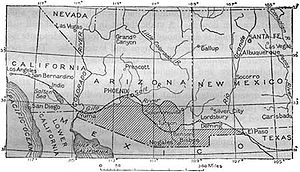 The Southern Pacific Railroad
from Los Angeles
reached Yuma, Arizona
, in 1877, Tucson in March 1880, El Paso
in May 1881, and this completed the second transcontinental railroad
in December 1881. The portion in Arizona was originally largely in the Gadsden Purchase but the western part was later rerouted north of the Gila River to serve the city of Phoenix. The portion in New Mexico runs largely through the territory that had been disputed between Mexico and the United States after the Treaty of Guadalupe Hidalgo had gone into effect, and before the time of the Gadsden Purchase. The Santa Fe Railroad Company
also completed a railroad across Northern Arizona, via Prescott, Winslow, Flagstaff, and Kingman in August 1883.
The remainder of the Gila Valley pre-Purchase border area was traversed by the Arizona Eastern Railway by 1899 and the Copper Basin Railway by 1904. Excluded was a 20 miles (32.2 km) section 33.1°N 110.6°W in the San Carlos Apache Indian Reservation
, from today's San Carlos Lake
to Winkelman at the mouth of the San Pedro River
, including the Needle's Eye Wilderness
.
The section of U.S. Highway 60
about 20 miles (32.2 km) to the northwest, between Superior and Miami
via Top-of-the-World, takes an alternate route (17.4 road miles) between the Magma Arizona Railroad and the Arizona Eastern Railway railheads on each side of this gap. This highway is well north of the Gadsden Purchase.
Given the elevations of those three places, at least a 3% grade would have been required.
The boundaries of most counties in Arizona do not follow the northern boundary of the Gadsden Purchase, but six counties in Arizona do have most of their populations within the land of the Gadsden Purchase. Four of these also contain areas north of the Gadsden Purchase, but these areas do have low population densities, with the exception of northeastern Pinal County, AZ, including the towns of Apache Junction and Florence. Maricopa County also extends south into the area of the Gadsden Purchase, but this area is also thinly populated.
The northmost point of the Gadsden Purchase, and also along the American-Mexican border during period of 1848 - 53 is at approximately 33°23′30"N 112°23′0"W in the town of Goodyear, Arizona
, about 30 miles (48.3 km) southwest of Phoenix.
Arizona
Arizona ; is a state located in the southwestern region of the United States. It is also part of the western United States and the mountain west. The capital and largest city is Phoenix...
and southwestern New Mexico
New Mexico
New Mexico is a state located in the southwest and western regions of the United States. New Mexico is also usually considered one of the Mountain States. With a population density of 16 per square mile, New Mexico is the sixth-most sparsely inhabited U.S...
that was purchased by the United States
United States
The United States of America is a federal constitutional republic comprising fifty states and a federal district...
in a treaty signed by James Gadsden
James Gadsden
James Gadsden was an American diplomat, soldier and businessman and namesake of the Gadsden Purchase, in which the United States purchased from Mexico the land that became the southern portion of Arizona and New Mexico. James Gadsden served as Adjutant General of the U. S...
, the American ambassador to Mexico
Mexico
The United Mexican States , commonly known as Mexico , is a federal constitutional republic in North America. It is bordered on the north by the United States; on the south and west by the Pacific Ocean; on the southeast by Guatemala, Belize, and the Caribbean Sea; and on the east by the Gulf of...
at the time, on December 30, 1853. It was then ratified, with changes, by the U.S. Senate
United States Senate
The United States Senate is the upper house of the bicameral legislature of the United States, and together with the United States House of Representatives comprises the United States Congress. The composition and powers of the Senate are established in Article One of the U.S. Constitution. Each...
on April 25, 1854 and signed by President Franklin Pierce
Franklin Pierce
Franklin Pierce was the 14th President of the United States and is the only President from New Hampshire. Pierce was a Democrat and a "doughface" who served in the U.S. House of Representatives and the Senate. Pierce took part in the Mexican-American War and became a brigadier general in the Army...
, with final approval action taken by Mexico on June 8, 1854. The purchase was the last major territorial acquisition in the contiguous United States
Contiguous United States
The contiguous United States are the 48 U.S. states on the continent of North America that are south of Canada and north of Mexico, plus the District of Columbia....
, adding a large area to the United States.
The purchase included lands south of the Gila River
Gila River
The Gila River is a tributary of the Colorado River, 650 miles long, in the southwestern states of New Mexico and Arizona.-Description:...
and west of the Rio Grande
Rio Grande
The Rio Grande is a river that flows from southwestern Colorado in the United States to the Gulf of Mexico. Along the way it forms part of the Mexico – United States border. Its length varies as its course changes...
. The Gadsden Purchase was for the purpose of the US's construction of a transcontinental railroad
Transcontinental railroad
A transcontinental railroad is a contiguous network of railroad trackage that crosses a continental land mass with terminals at different oceans or continental borders. Such networks can be via the tracks of either a single railroad, or over those owned or controlled by multiple railway companies...
along a deep southern route. It was also related to reconciliation of outstanding border issues following the Treaty of Guadalupe Hidalgo
Treaty of Guadalupe Hidalgo
The Treaty of Guadalupe Hidalgo is the peace treaty, largely dictated by the United States to the interim government of a militarily occupied Mexico City, that ended the Mexican-American War on February 2, 1848...
, which ended the Mexican–American War
Mexican–American War
The Mexican–American War, also known as the First American Intervention, the Mexican War, or the U.S.–Mexican War, was an armed conflict between the United States and Mexico from 1846 to 1848 in the wake of the 1845 U.S...
of 1846–48.
As the railroad age progressed, business-oriented Southerners saw that a railroad linking the South with the Pacific Coast would expand trade opportunities. They thought the topography of the southern portion of the Mexican Cession
Mexican Cession
The Mexican Cession of 1848 is a historical name in the United States for the region of the present day southwestern United States that Mexico ceded to the U.S...
was too mountainous to allow a direct route. Projected southern routes tended to run to the north at their eastern ends, which would favor connections with northern railroads and ultimately favor northern seaports. Southerners saw that to avoid the mountains, a route with a southeastern terminus might need to swing south into what was then Mexican territory.
The administration of President Franklin Pierce, strongly influenced by Secretary of War Jefferson Davis
Jefferson Davis
Jefferson Finis Davis , also known as Jeff Davis, was an American statesman and leader of the Confederacy during the American Civil War, serving as President for its entire history. He was born in Kentucky to Samuel and Jane Davis...
, saw an opportunity to acquire land for the railroad, as well as to acquire significant other territory from northern Mexico. In the end, territory for the railroad was purchased for $10 million ($ today), but Mexico balked at any large-scale sale of territory. In the United States, the debate over the treaty became involved in the sectional dispute over slavery, ending progress before the American Civil War
American Civil War
The American Civil War was a civil war fought in the United States of America. In response to the election of Abraham Lincoln as President of the United States, 11 southern slave states declared their secession from the United States and formed the Confederate States of America ; the other 25...
in the planning or construction of a transcontinental railroad.
Southern commercial conventions
Asa Whitney
Asa Whitney was an American merchant and great railroad promoter. Whitney lived in New Rochelle, New York, just to the north of New York City where he was a highly successful dry-goods merchant....
of New York state presented the US Congress with the first plan to construct a transcontinental railroad. Although Congress took no action on his proposal, a commercial convention of 1845 in Memphis
Memphis, Tennessee
Memphis is a city in the southwestern corner of the U.S. state of Tennessee, and the county seat of Shelby County. The city is located on the 4th Chickasaw Bluff, south of the confluence of the Wolf and Mississippi rivers....
took up the issue. Prominent attendees included John C. Calhoun
John C. Calhoun
John Caldwell Calhoun was a leading politician and political theorist from South Carolina during the first half of the 19th century. Calhoun eloquently spoke out on every issue of his day, but often changed positions. Calhoun began his political career as a nationalist, modernizer, and proponent...
, Clement C. Clay, Sr.
Clement Comer Clay
Clement Comer Clay was the eighth Governor of the U.S. state of Alabama from 1835 to 1837.Clay was born in Halifax County, Virginia. His father, William Clay, was an officer in the American Revolutionary War, who moved to Grainger County, Tennessee, after the war. Clay attended public schools and...
, John Bell
John Bell (Tennessee politician)
John Bell was a U.S. politician, attorney, and plantation owner. A wealthy slaveholder from Tennessee, Bell served in the United States Congress in both the House of Representatives and Senate. He began his career as a Democrat, he eventually fell out with Andrew Jackson and became a Whig...
, William Gwin
William M. Gwin
William McKendree Gwin was an American medical doctor and politician.Born near Gallatin, Tennessee, his father, the Reverend James Gwin, was a pioneer Methodist minister under the Rev. William McKendree, his son's namesake. Rev. James Gwin also served as a soldier on the frontier under General...
, and Edmund P. Gaines
Edmund P. Gaines
Edmund Pendleton Gaines was a United States army officer who served with distinction during the War of 1812, the Seminole Wars and the Black Hawk War.-Early life:...
, but it was James Gadsden
James Gadsden
James Gadsden was an American diplomat, soldier and businessman and namesake of the Gadsden Purchase, in which the United States purchased from Mexico the land that became the southern portion of Arizona and New Mexico. James Gadsden served as Adjutant General of the U. S...
of South Carolina who was influential in the convention’s recommending a southern route for the proposed railroad, beginning in Texas
Texas
Texas is the second largest U.S. state by both area and population, and the largest state by area in the contiguous United States.The name, based on the Caddo word "Tejas" meaning "friends" or "allies", was applied by the Spanish to the Caddo themselves and to the region of their settlement in...
and ending in San Diego or Mazatlán
Mazatlán
Mazatlán is a city in the Mexican state of Sinaloa; the surrounding municipio for which the city serves as the municipal seat is Mazatlán Municipality. It is located at on the Pacific coast, across from the southernmost tip of the Baja California peninsula.Mazatlán is a Nahuatl word meaning...
. Southerners hoped that such a route would ensure southern prosperity while opening the “West to southern influence and settlement.”
Southern interest in railroads in general, and the Pacific railroad in particular, accelerated after the conclusion of the Mexican-American War in 1848. During that war, topographical
Topography
Topography is the study of Earth's surface shape and features or those ofplanets, moons, and asteroids...
officers William H. Emory
William H. Emory
William Hemsley Emory was an United States Army officer and surveyor of Texas.-Early life and career:...
and James W. Abert
James William Abert
James William Abert was an American soldier, explorer, ornithologist and topographical artist.-Early life:...
had conducted surveys that demonstrated the feasibility of a railroad's originating in El Paso
El Paso
El Paso, a city in the U.S. state of Texas, on the border with Mexico.El Paso may also refer to:-Geography:Colombia:* El Paso, CesarSpain:*El Paso, Santa Cruz de TenerifeUnited States:...
or western Arkansas
Arkansas
Arkansas is a state located in the southern region of the United States. Its name is an Algonquian name of the Quapaw Indians. Arkansas shares borders with six states , and its eastern border is largely defined by the Mississippi River...
and ending in San Diego. J. D. B. DeBow
James Dunwoody Brownson DeBow
James Dunwoody Brownson DeBow was an American publisher and statistician, best known for his influential magazine DeBow's Review, who also served as head of the U.S...
, the editor of DeBow's Review
DeBow's Review
DeBow's Review was a widely circulated magazine of "agricultural, commercial, and industrial progress and resource" in the American South during the upper middle of the 19th century, from 1846 until 1884. It bore the name of its first editor, James Dunwoody Brownson DeBow DeBow's Review was a...
, and Gadsden both publicized within the South the benefits of building this railroad.
Gadsden had become the president of the South Carolina Canal and Rail Road Company
South Carolina Canal and Rail Road Company
Chartered in 1827, the South Carolina Canal and Rail Road Company ran scheduled steam service over its line from Charleston, South Carolina, to Hamburg, South Carolina. beginning in 1833. At that time it was the longest railroad in the world...
in 1839; about a decade later, the company had laid 136 miles (218.9 km) of track extending west from Charleston, South Carolina
Charleston, South Carolina
Charleston is the second largest city in the U.S. state of South Carolina. It was made the county seat of Charleston County in 1901 when Charleston County was founded. The city's original name was Charles Towne in 1670, and it moved to its present location from a location on the west bank of the...
, and it was 3 million dollars ($ today) in debt. Gadsden wanted to connect all Southern railroads into one sectional network. He was concerned that the increasing railroad construction in the North was shifting trade in lumber, farm goods, and manufacturing goods from the traditional north-south route based on the Ohio
Ohio River
The Ohio River is the largest tributary, by volume, of the Mississippi River. At the confluence, the Ohio is even bigger than the Mississippi and, thus, is hydrologically the main stream of the whole river system, including the Allegheny River further upstream...
and Mississippi
Mississippi River
The Mississippi River is the largest river system in North America. Flowing entirely in the United States, this river rises in western Minnesota and meanders slowly southwards for to the Mississippi River Delta at the Gulf of Mexico. With its many tributaries, the Mississippi's watershed drains...
rivers to an east-west axis that would bypass the South. He also saw Charleston, his home town, losing its prominence as a seaport. In addition, many Southern business interests feared that a northern transcontinental route would cut the South off from trade with the Orient
Orient
The Orient means "the East." It is a traditional designation for anything that belongs to the Eastern world or the Far East, in relation to Europe. In English it is a metonym that means various parts of Asia.- Derivation :...
. Other Southerners argued for diversification from a plantation economy to keep the South independent from northern bankers.
In October 1849 a convention to discuss railroads was held in Memphis, in response to a separate convention called in St. Louis earlier in the fall, which had discussed a northern route. The Memphis convention overwhelmingly advocated the construction of a route beginning there, to connect with an El Paso
El Paso
El Paso, a city in the U.S. state of Texas, on the border with Mexico.El Paso may also refer to:-Geography:Colombia:* El Paso, CesarSpain:*El Paso, Santa Cruz de TenerifeUnited States:...
to San Diego line. Disagreement arose only over the issue of financing. The convention president, Matthew Fontaine Maury
Matthew Fontaine Maury
Matthew Fontaine Maury , United States Navy was an American astronomer, historian, oceanographer, meteorologist, cartographer, author, geologist, and educator....
of Virginia
Virginia
The Commonwealth of Virginia , is a U.S. state on the Atlantic Coast of the Southern United States. Virginia is nicknamed the "Old Dominion" and sometimes the "Mother of Presidents" after the eight U.S. presidents born there...
, preferred strict private financing, whereas John Bell and others thought that Federal land grants to railroad developers would be necessary.
James Gadsden and California
Gadsden had supported nullificationNullification Crisis
The Nullification Crisis was a sectional crisis during the presidency of Andrew Jackson created by South Carolina's 1832 Ordinance of Nullification. This ordinance declared by the power of the State that the federal Tariff of 1828 and 1832 were unconstitutional and therefore null and void within...
in 1831. In 1850 he advocated secession by South Carolina when California
California
California is a state located on the West Coast of the United States. It is by far the most populous U.S. state, and the third-largest by land area...
was admitted to the Union as a free state. Gadsden considered slavery “a social blessing” and abolitionists “the greatest curse of the nation.”
When the secession proposal failed, Gadsden, working with his cousin Isaac Edward Holmes
Isaac E. Holmes
Isaac Edward Holmes was a U.S. Representative from South Carolina.Born in Charleston, South Carolina, Holmes attended the common schools, received private tuition, and was graduated from Yale College in 1815.He studied law....
, a lawyer in San Francisco since 1851, and the California state senator Thomas Jefferson Green
Thomas Jefferson Green
Thomas Jefferson Green was an American politician who served in the legislatures of three different U.S. states and also of Texas, which was not yet a state....
, attempted to divide California in two. They proposed that the southern half would allow slavery. Gadsden planned to establish a slaveholding colony there based on rice, cotton, and sugar. He would use slave labor to build a railroad and highway, originating in either San Antonio or on the Red River
Red River (Mississippi watershed)
The Red River, or sometimes the Red River of the South, is a major tributary of the Mississippi and Atchafalaya Rivers in the southern United States of America. The river gains its name from the red-bed country of its watershed. It is one of several rivers with that name...
, that would transport people to the California gold fields. Toward this end, on December 31, 1851, Gadsden asked Green to secure from the California state legislature a large land grant located between the 34th and 36th parallels; it would eventually serve as the dividing line for the two California states.
A few months after this, Gadsden and 1,200 potential settlers from South Carolina and Florida
Florida
Florida is a state in the southeastern United States, located on the nation's Atlantic and Gulf coasts. It is bordered to the west by the Gulf of Mexico, to the north by Alabama and Georgia and to the east by the Atlantic Ocean. With a population of 18,801,310 as measured by the 2010 census, it...
submitted a petition to the California legislature for permanent citizenship and permission to establish a rural district that would be farmed by "not less than Two Thousand of their African Domestics". The petition stimulated some debate, but it finally died in committee.
Stephen Douglas and land grants
The Compromise of 1850Compromise of 1850
The Compromise of 1850 was a package of five bills, passed in September 1850, which defused a four-year confrontation between the slave states of the South and the free states of the North regarding the status of territories acquired during the Mexican-American War...
, which created the Utah Territory
Utah Territory
The Territory of Utah was an organized incorporated territory of the United States that existed from September 9, 1850, until January 4, 1896, when the final extent of the territory was admitted to the Union as the State of Utah....
and the New Mexico Territory
New Mexico Territory
thumb|right|240px|Proposed boundaries for State of New Mexico, 1850The Territory of New Mexico was an organized incorporated territory of the United States that existed from September 9, 1850, until January 6, 1912, when the final extent of the territory was admitted to the Union as the State of...
, would facilitate a southern route to the West Coast
West Coast of the United States
West Coast or Pacific Coast are terms for the westernmost coastal states of the United States. The term most often refers to the states of California, Oregon, and Washington. Although not part of the contiguous United States, Alaska and Hawaii do border the Pacific Ocean but can't be included in...
since all territory for the railroad was now organized and would allow for Federal land grants as a financing measure. Competing northern or central routes championed, respectively, by Stephen Douglas of Illinois and Thomas Hart Benton
Thomas Hart Benton (senator)
Thomas Hart Benton , nicknamed "Old Bullion", was a U.S. Senator from Missouri and a staunch advocate of westward expansion of the United States. He served in the Senate from 1821 to 1851, becoming the first member of that body to serve five terms...
of Missouri would still need to go through unorganized territories. A precedent for using federal land grants had been established when Millard Fillmore
Millard Fillmore
Millard Fillmore was the 13th President of the United States and the last member of the Whig Party to hold the office of president...
signed a bill promoted by Douglas that allowed a Mobile
Mobile, Alabama
Mobile is the third most populous city in the Southern US state of Alabama and is the county seat of Mobile County. It is located on the Mobile River and the central Gulf Coast of the United States. The population within the city limits was 195,111 during the 2010 census. It is the largest...
to Chicago
Chicago
Chicago is the largest city in the US state of Illinois. With nearly 2.7 million residents, it is the most populous city in the Midwestern United States and the third most populous in the US, after New York City and Los Angeles...
railroad to be financed by "federal land grants for the specific purpose of railroad construction." To satisfy Southern opposition to the general principle of Federally supported internal improvements, the land grants would first be transferred to the appropriate state or territorial government, which would oversee the final transfer to private developers.
By 1850, however, the majority of the South was not interested in exploiting its advantages in developing a transcontinental railroad or railroads in general. Businessmen like Gadsden, who advocated economic diversification, were in the minority. The Southern economy was based on cotton exports, and then-current transportation networks met the plantation system's needs. There was little home market for an intra-South trade. In the short term, the best use for capital was to invest it in more slaves and land rather than in taxing it to support canals, railroads, roads, or in dredging rivers. Historian Jere W. Roberson wrote:
Treaty of Guadalupe-Hidalgo
The Treaty of Guadalupe HidalgoTreaty of Guadalupe Hidalgo
The Treaty of Guadalupe Hidalgo is the peace treaty, largely dictated by the United States to the interim government of a militarily occupied Mexico City, that ended the Mexican-American War on February 2, 1848...
ended the Mexican-American War, but there were issues affecting both sides that still needed to be resolved: possession of the Mesilla Valley
Mesilla Valley
The Mesilla Valley is a geographic feature of Southern New Mexico and far West Texas. It was formed by repeated heavy spring floods of the Rio Grande.The fertile Mesilla Valley extends from about Hatch, New Mexico to the west side of El Paso, Texas...
, protection for Mexico from Indian raids, and the right of transit in the Isthmus of Tehuantepec
Isthmus of Tehuantepec
The Isthmus of Tehuantepec is an isthmus in Mexico. It represents the shortest distance between the Gulf of Mexico and the Pacific Ocean, and prior to the opening of the Panama Canal was a major shipping route known simply as the Tehuantepec Route...
.
Mesilla Valley
The treaty provided for a joint commission, made up of a surveyor and commissioner from each country, to determine the final boundary between the United States and Mexico. The treaty specified that the Rio Grande Boundary would veer west eight miles (13 km) north of El Paso. The treaty was based on the attached 1847 copy of a twenty-five-year-old map. Surveys revealed that El Paso was 36 miles (57.9 km) further south and 100 miles (160.9 km) further west than the map showed. Mexico favored the map, but the United States put faith in the results of the survey. The disputed territory involved a few thousand square miles and about 3,000 residents; more significantly, it included the Mesilla ValleyMesilla Valley
The Mesilla Valley is a geographic feature of Southern New Mexico and far West Texas. It was formed by repeated heavy spring floods of the Rio Grande.The fertile Mesilla Valley extends from about Hatch, New Mexico to the west side of El Paso, Texas...
. Bordering the Rio Grande, the valley consisted of flat desert land measuring about 50 miles (80.5 km), north to south, by 200 miles (321.9 km), east to west. This valley was essential for the construction of a transcontinental railroad using a southern route.
John Bartlett
John Russell Bartlett
John Russell Bartlett was an American historian and linguist.-Biography:Bartlett was born in Providence, Rhode Island...
of Rhode Island
Rhode Island
The state of Rhode Island and Providence Plantations, more commonly referred to as Rhode Island , is a state in the New England region of the United States. It is the smallest U.S. state by area...
, the United States negotiator, agreed to allow Mexico to retain the Mesilla Valley (setting the boundary at 32° 22′ N, north of the American claim 31° 52′ and at the easternmost part, also north of the Mexican-claimed boundary at 32° 15′) in exchange for a boundary not turning north until 110° W in order to include the Santa Rita Mountains
Santa Rita Mountains
The Santa Rita Mountains, located about 65 km southeast of Tucson, Arizona, extend 42 km from north to south, then trending southeast. They merge again southeastwards into the Patagonia Mountains, trending northwest by southeast...
, which were believed to have rich copper
Copper
Copper is a chemical element with the symbol Cu and atomic number 29. It is a ductile metal with very high thermal and electrical conductivity. Pure copper is soft and malleable; an exposed surface has a reddish-orange tarnish...
deposits, and some silver
Silver
Silver is a metallic chemical element with the chemical symbol Ag and atomic number 47. A soft, white, lustrous transition metal, it has the highest electrical conductivity of any element and the highest thermal conductivity of any metal...
and gold
Gold
Gold is a chemical element with the symbol Au and an atomic number of 79. Gold is a dense, soft, shiny, malleable and ductile metal. Pure gold has a bright yellow color and luster traditionally considered attractive, which it maintains without oxidizing in air or water. Chemically, gold is a...
which had not yet been mined. Southerners opposed this alternative because of its implication for the railroad, but it was supported by President Fillmore. Southerners in Congress prevented any action on the approval of this separate border treaty and eliminated further funding for surveying of the disputed borderland. Bartlett was replaced with Robert Blair Campbell
Robert B. Campbell
Robert Blair Campbell was a U.S. Representative from South Carolina, brother of John Campbell, also of South Carolina.Born in Marlboro County, South Carolina, Campbell was educated by a private tutor....
, a pro-railroad politician from Alabama
Alabama
Alabama is a state located in the southeastern region of the United States. It is bordered by Tennessee to the north, Georgia to the east, Florida and the Gulf of Mexico to the south, and Mississippi to the west. Alabama ranks 30th in total land area and ranks second in the size of its inland...
. Mexico asserted that the commissioners' determinations were valid and prepared to send in troops to enforce the unratified agreement.
Indian raids
Indigenous peoples of the Americas
The indigenous peoples of the Americas are the pre-Columbian inhabitants of North and South America, their descendants and other ethnic groups who are identified with those peoples. Indigenous peoples are known in Canada as Aboriginal peoples, and in the United States as Native Americans...
tribes. At the time the treaty was ratified, Secretary of State James Buchanan
James Buchanan
James Buchanan, Jr. was the 15th President of the United States . He is the only president from Pennsylvania, the only president who remained a lifelong bachelor and the last to be born in the 18th century....
had believed that the United States had both the commitment and resources to enforce this promise. Historian Richard Kluger
Richard Kluger
Richard Kluger worked as a journalist before becoming an accomplished Pulitzer Prize-winning author and book publisher.-Journalism:...
, however, described the difficulties of the task:
In the five years after approval of the Treaty, the United States spent $12 million ($ today) in this area, and General Winfield Scott
Winfield Scott
Winfield Scott was a United States Army general, and unsuccessful presidential candidate of the Whig Party in 1852....
estimated that five times that amount would be necessary to police the border. Mexican officials, frustrated with the failure of the United States to effectively enforce its guarantee, demanded reparations for the losses inflicted on Mexican citizens by the raids. The United States argued that the Treaty did not require any compensation nor did it require any greater effort to protect Mexicans than was expended in protecting its own citizens. During the Fillmore administration, Mexico claimed damages of $40 million ($ today) but offered to allow the U. S. to buy out Article XI for $12 million ($ today). Fillmore had proposed a settlement that was $10 million less ($ today).
Isthmus of Tehuantepec
During negotiations of the treaty, Americans had failed to secure the right of transit across the 125 miles (201.2 km)-wide Isthmus of TehuantepecIsthmus of Tehuantepec
The Isthmus of Tehuantepec is an isthmus in Mexico. It represents the shortest distance between the Gulf of Mexico and the Pacific Ocean, and prior to the opening of the Panama Canal was a major shipping route known simply as the Tehuantepec Route...
. The idea of building a railroad here had been considered for a long time. In 1842 Mexican President Antonio López de Santa Anna
Antonio López de Santa Anna
Antonio de Padua María Severino López de Santa Anna y Pérez de Lebrón , often known as Santa Anna or López de Santa Anna, known as "the Napoleon of the West," was a Mexican political leader, general, and president who greatly influenced early Mexican and Spanish politics and government...
sold the rights to build a railroad or canal across the isthmus. The deal included land grants 300 miles (482.8 km)-wide along the right-of-way for future colonization and development. In 1847 a British bank bought the rights, raising US fears of British colonization in the hemisphere, in violation of the precepts of the Monroe Doctrine
Monroe Doctrine
The Monroe Doctrine is a policy of the United States introduced on December 2, 1823. It stated that further efforts by European nations to colonize land or interfere with states in North or South America would be viewed as acts of aggression requiring U.S. intervention...
. United States interest in the right-of-way was increased by the 1848 discovery of gold
California Gold Rush
The California Gold Rush began on January 24, 1848, when gold was found by James W. Marshall at Sutter's Mill in Coloma, California. The first to hear confirmed information of the gold rush were the people in Oregon, the Sandwich Islands , and Latin America, who were the first to start flocking to...
in California.
The Memphis commercial convention of 1849 recommended that the United States pursue the trans-isthmus route, since it appeared unlikely that a transcontinental railroad would be built anytime soon. Interests in Louisiana were especially adamant about this option, as they believed that any transcontinental railroad would divert commercial traffic away from the Mississippi and New Orleans, and they at least wanted to secure a southern route. Also showing interest was Peter A. Hargous of New York who ran an import-export business between New York and Vera Cruz
Veracruz, Veracruz
Veracruz, officially known as Heroica Veracruz, is a major port city and municipality on the Gulf of Mexico in the Mexican state of Veracruz. The city is located in the central part of the state. It is located along Federal Highway 140 from the state capital Xalapa, and is the state's most...
. Hargous purchased the rights to the route for $25,000 ($ today), but realized that the grant had little value unless it was supported by the Mexican and American governments.
In Mexico, topographical officer George W. Hughes
George Wurtz Hughes
George Wurtz Hughes was a U.S. Representative from the 6th Congressional district of Maryland.Born in Elmira, New York, Hughes received a liberal schooling. He graduated from the United States Military Academy at West Point in 1827, and became a civil engineer in New York City...
reported to Secretary of State John M. Clayton
John M. Clayton
John Middleton Clayton was an American lawyer and politician from Delaware. He was a member of the Whig Party who served in the Delaware General Assembly, and as U.S. Senator from Delaware and U.S. Secretary of State....
that a railroad across the isthmus was a “feasible and practical” idea. Clayton then instructed Robert P. Letcher
Robert P. Letcher
Robert Perkins Letcher was a politician and lawyer from the US state of Kentucky. He served as a U.S. Representative, Minister to Mexico, and the 15th Governor of Kentucky. He also served in the Kentucky General Assembly where he was Speaker of the House in 1837 and 1838. A strong supporter of the...
, the minister to Mexico, to negotiate a treaty to protect Hargous’ rights. The United States’ proposal gave Mexicans a 20% discount on shipping, guaranteed Mexican rights in the zone, allowed the United States to send in military if necessary, and gave the United States most-favored-nation status for Mexican cargo fees. This treaty, however, was never finalized.
The Clayton-Bulwer Treaty
Clayton-Bulwer Treaty
The Clayton–Bulwer Treaty was a treaty between the United States and the United Kingdom, negotiated in 1850 by John M. Clayton and Sir Henry Lytton Bulwer, later Lord Dalling...
between the United States and Great Britain, which guaranteed the neutrality of any such canal, was finalized in April 1850. Mexican negotiators refused the treaty because it would eliminate Mexico's ability to play the U.S. and U.K. against each other. They eliminated the right of the United States to unilaterally intervene militarily. The United States Senate approved the treaty in early 1851, but the Mexican Congress refused to accept the treaty.
In the meantime, Hargous proceeded as if the treaty would be approved eventually. Judah P. Benjamin
Judah P. Benjamin
Judah Philip Benjamin was an American politician and lawyer. Born a British subject in the West Indies, he moved to the United States with his parents and became a citizen. He later became a citizen of the Confederate States of America. After the collapse of the Confederacy, Benjamin moved to...
and a committee of New Orleans businessmen joined with Hargous and secured a charter from the Louisiana legislature to create the Tehuantepec Railroad Company. The new company sold stock and sent survey teams to Mexico. Hargous started to acquire land even after the Mexican legislature rejected the treaty, a move that led to the Mexicans canceling Hargous’ contract to use the right of way. Hargous put his losses at $5 million ($ today) and asked the United States government to intervene. President Fillmore refused to do so.
Mexico sold the canal franchise, without the land grants, to A. G. Sloo and Associates in New York for $600,000 ($ today). In March 1853 Sloo contracted with a British company to build a railroad and sought an exclusive contract from the new Franklin Pierce
Franklin Pierce
Franklin Pierce was the 14th President of the United States and is the only President from New Hampshire. Pierce was a Democrat and a "doughface" who served in the U.S. House of Representatives and the Senate. Pierce took part in the Mexican-American War and became a brigadier general in the Army...
Administration to deliver mail from New York to San Francisco. However, Sloo soon defaulted on bank loans and the contract was sold back to Hargous.
Pierce administration
The Pierce administration, which took office in March 1853, had a strong pro-southern, pro-expansion mindset. Louisiana Senator Pierre SouléPierre Soulé
Pierre Soulé was a U.S. politician and diplomat from Louisiana during the mid-19th century. He is best known for his role in writing the Ostend Manifesto, which was written in 1854 as part of an attempt to annex Cuba to the United States...
was sent to Spain to negotiate the annexation of Cuba. Expansionists John Y. Mason of Virginia
Virginia
The Commonwealth of Virginia , is a U.S. state on the Atlantic Coast of the Southern United States. Virginia is nicknamed the "Old Dominion" and sometimes the "Mother of Presidents" after the eight U.S. presidents born there...
and Solon Borland of Arkansas
Arkansas
Arkansas is a state located in the southern region of the United States. Its name is an Algonquian name of the Quapaw Indians. Arkansas shares borders with six states , and its eastern border is largely defined by the Mississippi River...
were appointed as ministers, respectively, to France
France
The French Republic , The French Republic , The French Republic , (commonly known as France , is a unitary semi-presidential republic in Western Europe with several overseas territories and islands located on other continents and in the Indian, Pacific, and Atlantic oceans. Metropolitan France...
and Nicaragua
Nicaragua
Nicaragua is the largest country in the Central American American isthmus, bordered by Honduras to the north and Costa Rica to the south. The country is situated between 11 and 14 degrees north of the Equator in the Northern Hemisphere, which places it entirely within the tropics. The Pacific Ocean...
. Pierce's Secretary of War, Jefferson Davis
Jefferson Davis
Jefferson Finis Davis , also known as Jeff Davis, was an American statesman and leader of the Confederacy during the American Civil War, serving as President for its entire history. He was born in Kentucky to Samuel and Jane Davis...
, was already on record as favoring a southern route for a transcontinental railroad, so southern rail enthusiasts had every reason to be encouraged.
The South as a whole, however, remained divided. In January 1853 Senator Thomas Jefferson Rusk
Thomas Jefferson Rusk
Thomas Jefferson Rusk was an early political and military leader of the Republic of Texas, serving as its first Secretary of War as well as a general at the Battle of San Jacinto. He was later a U.S. politician and served as a Senator from Texas from 1846 until his suicide...
of Texas introduced a bill to create two railroads, one with a northern route and one with a southern route starting below Memphis on the Mississippi River. Under the Rusk legislation, the President would be authorized to select the specific termini and routes as well as the contractors who would build the railroads. Some southerners, however, worried that northern and central interests would leap ahead in construction and opposed any direct aid to private developers on constitutional grounds. Other southerners preferred the isthmian proposals. An amendment was added to the Rusk bill to prohibit direct aid, but southerners still split their vote in Congress and the amendment failed.
This rejection led to legislative demands, sponsored by William Gwin of California and Salmon P. Chase
Salmon P. Chase
Salmon Portland Chase was an American politician and jurist who served as U.S. Senator from Ohio and the 23rd Governor of Ohio; as U.S. Treasury Secretary under President Abraham Lincoln; and as the sixth Chief Justice of the United States Supreme Court.Chase was one of the most prominent members...
of Ohio
Ohio
Ohio is a Midwestern state in the United States. The 34th largest state by area in the U.S.,it is the 7th‑most populous with over 11.5 million residents, containing several major American cities and seven metropolitan areas with populations of 500,000 or more.The state's capital is Columbus...
and supported by the railroad interests, for new surveys for possible routes. Gwin expected that a southern route would be approved — both Davis and Robert J. Walker
Robert J. Walker
Robert John Walker was an American economist and statesman.- Early life and education :Born in Northumberland, Pennsylvania, the son of a judge. He lived in Bellefonte, Pennsylvania from 1806 to 1814, where his father was presiding judge of the judicial district. Walker was educated at the...
, former secretary of the treasury, supported it. Both were stockholders in a Vicksburg
Vicksburg, Mississippi
Vicksburg is a city in Warren County, Mississippi, United States. It is the only city in Warren County. It is located northwest of New Orleans on the Mississippi and Yazoo rivers, and due west of Jackson, the state capital. In 1900, 14,834 people lived in Vicksburg; in 1910, 20,814; in 1920,...
-based railroad that planned to build a link to Texas to join up with the southern route. Davis argued that the southern route would have an important military application in the likely event of future troubles with Mexico.
Gadsden and Santa Anna
On March 21, 1853, a treaty initiated in the Fillmore administration, that would provide joint Mexican and United States protection for the Sloo grant was signed in Mexico. At the same time that this treaty was received in Washington, Pierce learned that New Mexico Territorial Governor William C. LaneWilliam Carr Lane
William Carr Lane was a doctor and the first Mayor of St. Louis, Missouri, serving from 1823 to 1829 and 1837 to 1840...
had issued a proclamation claiming the Mesilla Valley as part of New Mexico, leading to protests from Mexico. Pierce was also aware of efforts by France, through its consul in San Francisco, to acquire the Mexican state of Sonora
Sonora
Sonora officially Estado Libre y Soberano de Sonora is one of the 31 states which, with the Federal District, comprise the 32 Federal Entities of Mexico. It is divided into 72 municipalities; the capital city is Hermosillo....
.
Pierce recalled Lane in May and replaced him with David Meriwether
David Meriwether (senator)
David Meriwether was a United States Senator from Kentucky and Governor of New Mexico Territory.Born in Louisa County, Virginia, Meriwether moved with his parents to Jefferson County, Kentucky, in 1803. He attended the common schools and engaged in fur trading in 1818 near what is now Council...
of Kentucky. Meriwether was given orders to stay out of the Mesilla Valley until negotiations with Mexico could be completed. With the encouragement of Davis, Pierce also appointed James Gadsden to negotiate with Mexico over the acquisition of additional territory. Secretary of State William L. Marcy
William L. Marcy
William Learned Marcy was an American statesman, who served as U.S. Senator and the 11th Governor of New York, and as the U.S. Secretary of War and U.S. Secretary of State.-Early life:...
gave Gadsden clear instructions: he was to secure the Mesilla Valley for the purposes of building a railroad through it, convince Mexico that the US had done its best regarding the Indian raids, and elicit Mexican cooperation in efforts by US citizens to build a canal or railroad across the Tenhuantepec isthmus. Supporting the Sloo interests was not part of the instructions.
The Mexican government was going through political and financial turmoil. In the process, Santa Anna
Antonio López de Santa Anna
Antonio de Padua María Severino López de Santa Anna y Pérez de Lebrón , often known as Santa Anna or López de Santa Anna, known as "the Napoleon of the West," was a Mexican political leader, general, and president who greatly influenced early Mexican and Spanish politics and government...
had been returned to power about the same time that Pierce was inaugurated. Santa Anna was willing to deal because he needed money to rebuild the Mexican Army
Mexican Army
The Mexican Army is the combined land and air branch and largest of the Mexican Military services; it also is known as the National Defense Army. It is famous for having been the first army to adopt and use an automatic rifle, , in 1899, and the first to issue automatic weapons as standard issue...
for defense against the United States, but he initially rejected the extension of the border further south to the Sierra Madre Mountains
Sierra Madre Occidental
The Sierra Madre Occidental is a mountain range in western Mexico.-Setting:The range runs north to south, from just south of the Sonora–Arizona border southeast through eastern Sonora, western Chihuahua, Sinaloa, Durango, Zacatecas, Nayarit, Jalisco, Aguascalientes to Guanajuato, where it joins...
. He initially insisted on reparations for the damages caused by American Indian raids, but agreed to let an international tribunal resolve this. Gadsden realized that Santa Anna needed money and passed this information along to Secretary Marcy.
Marcy and Pierce responded with new instructions. Gadsden was authorized to purchase any of six parcels of land with a price fixed for each. The price would include the settlement of all Indian damages and relieve the United States from any further obligation to protect Mexicans. $50 million ($ today) would have bought the Baja California Peninsula
Baja California Peninsula
The Baja California peninsula , is a peninsula in northwestern Mexico. Its land mass separates the Pacific Ocean from the Gulf of California. The Peninsula extends from Mexicali, Baja California in the north to Cabo San Lucas, Baja California Sur in the south.The total area of the Baja California...
and a large portion of its northwestern Mexican states while $15 million ($ today) bought the 38000 square miles (98,419.5 km²) of desert necessary for the railroad plans.
Santa Anna was put off by "Gadsden’s antagonistic manner." Gadsden had advised Santa Anna that "the spirit of the age" would soon lead the northern states to secede so he might as well sell them now. The Mexican President felt threatened by William Walker's attempt to capture Baja California
Baja California
Baja California officially Estado Libre y Soberano de Baja California is one of the 31 states which, with the Federal District, comprise the 32 Federal Entities of Mexico. It is both the northernmost and westernmost state of Mexico. Before becoming a state in 1953, the area was known as the North...
with 50 troops and annex Sonora
Sonora
Sonora officially Estado Libre y Soberano de Sonora is one of the 31 states which, with the Federal District, comprise the 32 Federal Entities of Mexico. It is divided into 72 municipalities; the capital city is Hermosillo....
. Gadsden disavowed any government backing of Walker, who was expelled by the US and placed on trial as a criminal. Santa Anna worried that the US would allow further aggression against Mexican territory. Santa Anna needed to get as much money for as little territory as possible. When Great Britain rejected Mexican requests to assist in the negotiations, Santa Anna opted for the $15 million package.
Ratification
Pierce and his cabinet began debating the treaty in January 1854. Although disappointed in the amount of territory secured and some of the terms, they submitted it to the Senate on February 10.Gadsden, however, suggested that northern senators would block the treaty in order to deny the South a railroad.
Although signed by Pierce and Santa Anna, the treaty needed to be ratified by a 2/3 vote of the U.S. Senate, where it met strong opposition. Antislavery senators opposed further acquisition of slave territory. Lobbying by speculators gave the treaty a bad reputation. Some senators objected to furnishing Santa Anna financial assistance.
The treaty had reached the Senate as that body was focused on the debate over the Kansas-Nebraska Act
Kansas-Nebraska Act
The Kansas–Nebraska Act of 1854 created the territories of Kansas and Nebraska, opening new lands for settlement, and had the effect of repealing the Missouri Compromise of 1820 by allowing settlers in those territories to determine through Popular Sovereignty if they would allow slavery within...
. On April 17, after much debate, the Senate voted 27 to 18 in favor of the treaty, falling three votes short of the necessary two-thirds required for treaty approval. After this defeat, Secretary Davis and southern senators pressed Pierce to add more provisions to the treaty including:
- protection for the Sloo grant;
- a requirement that Mexico “protect with its whole power the prosecution, preservation, and security of the work [referring to the isthmian canal]”;
- permission for the United States to intervene unilaterally “when it may feel sanctioned and warranted by the public or international law”; and
- a reduction of the territory to be acquired by 9000 square miles (23,309.9 km²) and dropping the price from $15 million ($) to $10 million ($).
This version of the treaty successfully passed the U.S. Senate April 25, 1854 by a vote of 33 to 12. The reduction in territory was an accommodation of northern senators who opposed the acquisition of additional slave territory. In the final vote, northerners split 12 to 12. Gadsden took the revised treaty back to Santa Anna, who accepted the changes. The treaty went into effect June 30, 1854.
While the land was available for construction of a southern railroad, the issue had become too strongly associated with the sectional debate over slavery to receive federal funding. Roberson wrote:
The effect was such that railroad development, which accelerated in the North, stagnated in the South.
Post-ratification controversy
As originally envisioned, the purchase would have encompassed a much larger region, extending far enough south to include most of the current Mexican states of Baja CaliforniaBaja California
Baja California officially Estado Libre y Soberano de Baja California is one of the 31 states which, with the Federal District, comprise the 32 Federal Entities of Mexico. It is both the northernmost and westernmost state of Mexico. Before becoming a state in 1953, the area was known as the North...
, Baja California Sur
Baja California Sur
Baja California Sur , is one of the 31 states which, with the Federal District, comprise the 32 Federal Entities of Mexico. Before becoming a state on October 8, 1974, the area was known as the South Territory of Baja California. It has an area of , or 3.57% of the land mass of Mexico and comprises...
, Coahuila
Coahuila
Coahuila, formally Coahuila de Zaragoza , officially Estado Libre y Soberano de Coahuila de Zaragoza is one of the 31 states which, with the Federal District, comprise the 32 Federal Entities of Mexico...
, Chihuahua, Sonora
Sonora
Sonora officially Estado Libre y Soberano de Sonora is one of the 31 states which, with the Federal District, comprise the 32 Federal Entities of Mexico. It is divided into 72 municipalities; the capital city is Hermosillo....
, Nuevo León
Nuevo León
Nuevo León It is located in Northeastern Mexico. It is bordered by the states of Tamaulipas to the north and east, San Luis Potosí to the south, and Coahuila to the west. To the north, Nuevo León has a 15 kilometer stretch of the U.S.-Mexico border adjacent to the U.S...
, and Tamaulipas
Tamaulipas
Tamaulipas officially Estado Libre y Soberano de Tamaulipas is one of the 31 states which, with the Federal District, comprise the 32 Federal Entities of Mexico. It is divided in 43 municipalities and its capital city is Ciudad Victoria. The capital city was named after Guadalupe Victoria, the...
. The Mexican people opposed such boundaries, as did anti-slavery
History of slavery in the United States
Slavery in the United States was a form of slave labor which existed as a legal institution in North America for more than a century before the founding of the United States in 1776, and continued mostly in the South until the passage of the Thirteenth Amendment to the United States Constitution in...
U.S. Senators, who saw the purchase as acquisition of more slave territory. Even the sale of a relatively small strip of land angered the Mexican people, who saw Santa Anna's actions as a betrayal of their country. They watched in dismay as he squandered the funds generated by the Purchase. Contemporary Mexican historians continue to view the deal negatively and believe that it has defined the American-Mexican relationship in a deleterious way.
The purchased lands were initially appended to the existing New Mexico Territory
New Mexico Territory
thumb|right|240px|Proposed boundaries for State of New Mexico, 1850The Territory of New Mexico was an organized incorporated territory of the United States that existed from September 9, 1850, until January 6, 1912, when the final extent of the territory was admitted to the Union as the State of...
. To help control the new land, the U.S. Army established Fort Buchanan on Sonoita Creek
Sonoita Creek
Sonoita Creek is a stream in Santa Cruz County, Arizona. It originates near and takes its name from the abandoned Pima mission in the high valley near Sonoita...
in present-day southern Arizona on November 17, 1856. The difficulty of governing the new areas from the territorial capital at Santa Fe, NM led to efforts as early as 1856 to organize a new territory out of the southern portion. Many of the early settlers in the region were, however, pro-slavery and sympathetic to the South
Southern United States
The Southern United States—commonly referred to as the American South, Dixie, or simply the South—constitutes a large distinctive area in the southeastern and south-central United States...
, resulting in an impasse in Congress
United States Congress
The United States Congress is the bicameral legislature of the federal government of the United States, consisting of the Senate and the House of Representatives. The Congress meets in the United States Capitol in Washington, D.C....
as to how best to reorganize the territory.
The shifting of the course of the Rio Grande
Rio Grande
The Rio Grande is a river that flows from southwestern Colorado in the United States to the Gulf of Mexico. Along the way it forms part of the Mexico – United States border. Its length varies as its course changes...
would cause a later dispute over the boundary between Purchase lands and those of the state of Texas, known as the Country Club Dispute
Country Club Dispute
The Country Club Area is a suburb of El Paso, Texas. It was the object of a lengthy border dispute between Texas and New Mexico.-Origins:As part of the Compromise of 1850, Texas gave up its claim to portions of present-day New Mexico, Colorado, Wyoming, Kansas and Oklahoma in exchange for...
.
Army control
The residents of the area gained full U.S. citizenship and slowly assimilated into American life over the next half-century. The principal threat to the peace and security of settlers and travelers in the area were raids by Apache Indians. The U.S. Army took control of the purchase lands in 1854 but not until 1856 were troops stationed in the troubled region. In June 1857 it established Fort Buchanan south of the Gila at the head of the Sonoita Creek Valley. The fort protected the area until it was evacuated and destroyed in July 1861. The new stability brought miners and ranchers. By the late 1850s, mining camps and military posts had not only transformed the Arizona countryside; they had also generated new trade linkages to the province of Sonora, Mexico. Magdalena, Sonora, became a supply center for Tubac, wheat from nearby Cucurpe fed the troops at Fort Buchanan, and the town of Santa Cruz sustained the Mowry mines, just miles to the north.Civil War
In 1861, during the American Civil WarAmerican Civil War
The American Civil War was a civil war fought in the United States of America. In response to the election of Abraham Lincoln as President of the United States, 11 southern slave states declared their secession from the United States and formed the Confederate States of America ; the other 25...
, the Confederate States of America
Confederate States of America
The Confederate States of America was a government set up from 1861 to 1865 by 11 Southern slave states of the United States of America that had declared their secession from the U.S...
formed the Confederate Territory of Arizona
Arizona Territory (CSA)
The Territory of Arizona was a territory claimed by the Confederate States of America during the American Civil War, between 1861 and 1865. It consisted of the portion of the New Mexico Territory south of the 34th parallel north including parts of the modern states of New Mexico and Arizona. Its...
, including in the new territory mainly areas acquired by the Gadsden Purchase. In 1863, using a north-to-south dividing line, the Union created its own Arizona Territory
Arizona Territory
The Territory of Arizona was an organized incorporated territory of the United States that existed from February 24, 1863 until February 14, 1912, when it was admitted to the Union as the 48th state....
out of the western half of the New Mexico Territory. The new American Arizona Territory also included most of the lands acquired in the Gadsden Purchase. This territory would be admitted into the Union as the State of Arizona
Arizona
Arizona ; is a state located in the southwestern region of the United States. It is also part of the western United States and the mountain west. The capital and largest city is Phoenix...
on February 14, 1912, the last area of the Lower 48 States
Contiguous United States
The contiguous United States are the 48 U.S. states on the continent of North America that are south of Canada and north of Mexico, plus the District of Columbia....
to receive statehood.
Social development
After the Gadsden Purchase, southern Arizona's social elite, including the Estevan OchoaEstevan Ochoa
Estevan Ochoa was a Mexican-born American businessman and politician who participated in the creation of the Arizona Territory.-Biography:...
, Mariano Samaniego, and Leopoldo Carillo families, remained primarily Mexican American until the coming of the railroad in the 1880s. When the Sonora Exploring and Mining Company opened silver mines in southern Arizona, it sought to employ educated, middle-class Americans who shared a work ethic and leadership abilities to operate the mines. A biographical analysis of some 200 of its employees, classed as capitalists, managers, laborers, and general service personnel, reveals that the resulting work force included Europeans, Americans, Mexicans, and Indians. This mixture failed to stabilize the remote area, which lacked formal social, political, and economic organization in the years from the Gadsden Purchase to the Civil War.
From the late 1840s into the 1870s Texas stockmen drove their beef cattle over southern Arizona on the Texas-California trail. Texans were impressed with the grazing possibilities offered by the Gadsden Purchase country of Arizona. By the last third of the century they were moving their herds into Arizona and establishing the range cattle industry there. Not only did the Texans contribute their proven range methods to the new grass country of Arizona but their problems as well. Texas rustlers brought lawlessness, poor management resulted in overstocking, and carelessness introduced destructive diseases. But these difficulties did force laws and associations in Arizona to curb and resolve them. The Anglo-American cattleman frontier in Arizona was an extension of the Texas experience.
Railroad development
Southern Pacific Railroad
The Southern Pacific Transportation Company , earlier Southern Pacific Railroad and Southern Pacific Company, and usually simply called the Southern Pacific or Espee, was an American railroad....
from Los Angeles
Los Ángeles
Los Ángeles is the capital of the province of Biobío, in the commune of the same name, in Region VIII , in the center-south of Chile. It is located between the Laja and Biobío rivers. The population is 123,445 inhabitants...
reached Yuma, Arizona
Yuma, Arizona
Yuma is a city in and the county seat of Yuma County, Arizona, United States. It is located in the southwestern corner of the state, and the population of the city was 77,515 at the 2000 census, with a 2008 Census Bureau estimated population of 90,041....
, in 1877, Tucson in March 1880, El Paso
El Paso
El Paso, a city in the U.S. state of Texas, on the border with Mexico.El Paso may also refer to:-Geography:Colombia:* El Paso, CesarSpain:*El Paso, Santa Cruz de TenerifeUnited States:...
in May 1881, and this completed the second transcontinental railroad
Transcontinental railroad
A transcontinental railroad is a contiguous network of railroad trackage that crosses a continental land mass with terminals at different oceans or continental borders. Such networks can be via the tracks of either a single railroad, or over those owned or controlled by multiple railway companies...
in December 1881. The portion in Arizona was originally largely in the Gadsden Purchase but the western part was later rerouted north of the Gila River to serve the city of Phoenix. The portion in New Mexico runs largely through the territory that had been disputed between Mexico and the United States after the Treaty of Guadalupe Hidalgo had gone into effect, and before the time of the Gadsden Purchase. The Santa Fe Railroad Company
Atchison, Topeka and Santa Fe Railway
The Atchison, Topeka and Santa Fe Railway , often abbreviated as Santa Fe, was one of the larger railroads in the United States. The company was first chartered in February 1859...
also completed a railroad across Northern Arizona, via Prescott, Winslow, Flagstaff, and Kingman in August 1883.
The remainder of the Gila Valley pre-Purchase border area was traversed by the Arizona Eastern Railway by 1899 and the Copper Basin Railway by 1904. Excluded was a 20 miles (32.2 km) section 33.1°N 110.6°W in the San Carlos Apache Indian Reservation
San Carlos Apache Indian Reservation
The San Carlos Apache Indian Reservation, in southeastern Arizona, United States, was established in 1871 as a reservation for the Chiricahua Apache tribe. It was referred to by some as "Hell's Forty Acres," due to a myriad of dismal health and environmental conditions.-Formation:President U.S....
, from today's San Carlos Lake
San Carlos Lake
San Carlos Lake was formed by the construction of the Coolidge Dam and is rimmed by of shoreline. The lake is located within the San Carlos Apache Indian Reservation, and is thus subject to tribal regulations....
to Winkelman at the mouth of the San Pedro River
San Pedro River (Arizona)
San Pedro River is a northward-flowing stream originating about ten miles south of Sierra Vista, Arizona near Cananea, Sonora, Mexico. It is one of only two rivers which flow north from Mexico into the United States. The river flows north through Cochise County, Pima County, Graham County, and...
, including the Needle's Eye Wilderness
Needle's Eye Wilderness
Needle's Eye Wilderness is a wilderness area located approximately southeast of the town of Globe in Gila County in the U.S. state of Arizona.-Topography:...
.
The section of U.S. Highway 60
U.S. Route 60 in Arizona
U.S. Route 60 is an east–west United States highway within Arizona. The highway runs for from a junction with Interstate 10 near Quartzsite to the New Mexico State Line near Springerville...
about 20 miles (32.2 km) to the northwest, between Superior and Miami
Miami, Arizona
Miami is a town in Gila County, Arizona, United States. Miami is a classic Western copper boomtown, though the copper mines are largely dormant now...
via Top-of-the-World, takes an alternate route (17.4 road miles) between the Magma Arizona Railroad and the Arizona Eastern Railway railheads on each side of this gap. This highway is well north of the Gadsden Purchase.
Given the elevations of those three places, at least a 3% grade would have been required.
Population
The suburb Sunland Park (pop. 13,309 in 2000), of El Paso, Tex. in Doña Ana County, NM, is the largest community of New Mexico in the Gadsden Purchase. Lordsburg, NM (pop. 3,379 in 2000), the county seat of Hidalgo County, was in the disputed area before the Gadsden Purchase, and Deming, NM, the county seat of Luna County, NM, was north of both the Mexican and American land claims before the Gadsden Purchase, though the proposed Bartlett-Conde compromise of 1851 would have left it in Mexico.The boundaries of most counties in Arizona do not follow the northern boundary of the Gadsden Purchase, but six counties in Arizona do have most of their populations within the land of the Gadsden Purchase. Four of these also contain areas north of the Gadsden Purchase, but these areas do have low population densities, with the exception of northeastern Pinal County, AZ, including the towns of Apache Junction and Florence. Maricopa County also extends south into the area of the Gadsden Purchase, but this area is also thinly populated.
| County | Seat | Pop. | Area (mi²) | |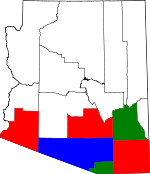 |
|---|---|---|---|---|
| Cochise Cochise County, Arizona -2010:Whereas according to the 2010 U.S. Census Bureau:*78.5% White*4.2% Black*1.2% Native American*1.9% Asian*0.3% Native Hawaiian or Pacific Islander*4.0% Two or more races*9.6% Other races*32.4% Hispanic or Latino -2000:... |
Bisbee Bisbee, Arizona Bisbee is a city in Cochise County, Arizona, United States, 82 miles southeast of Tucson. According to 2005 Census Bureau estimates, the population of the city was 6,177... |
117,755 | 6,219 | |
| Graham Graham County, Arizona -2010:Whereas according to the 2010 U.S. Census Bureau:*72.1% White*1.8% Black*14.4% Native American*0.5% Asian*0.1% Native Hawaiian or Pacific Islander*2.8% Two or more races*8.3% Other races*30.4% Hispanic or Latino -2000:... |
Safford Safford, Arizona - History :Safford was founded by Joshua Eaton Bailey, Hiram Kennedy and Edward Tuttle, who came from Gila Bend, in southwestern Arizona. They left Gila Bend in the winter of 1873-74; their work on canals and dams having been destroyed by high water the previous summer... |
33,489 | 4,641 | |
| Pima Pima County, Arizona -2010:Whereas according to the 2010 U.S. Census Bureau:*74.3% White*3.5% Black*3.3% Native American*2.6% Asian*0.2% Native Hawaiian or Pacific Islander*3.7% Two or more races*12.4% Other races*34.6% Hispanic or Latino -2000:... |
Tucson Tucson, Arizona Tucson is a city in and the county seat of Pima County, Arizona, United States. The city is located 118 miles southeast of Phoenix and 60 miles north of the U.S.-Mexico border. The 2010 United States Census puts the city's population at 520,116 with a metropolitan area population at 1,020,200... |
843,746 | 9,189 | |
| Pinal Pinal County, Arizona -2010:Whereas according to the 2010 U.S. Census Bureau:*72.4% White*4.6% Black*5.6% Native American*1.7% Asian*0.4% Native Hawaiian or Pacific Islander*3.8% Two or more races*11.5% Other races*28.5% Hispanic or Latino -2000:... |
Florence Florence, Arizona -Demographics:As of the census of 2000, there were 17,054 people, 2,226 households, and 1,540 families residing in the town. The population density was 2,056.2 people per square mile . There were 3,216 housing units at an average density of 387.7 per square mile... |
179,727 | 5,374 | |
| Santa Cruz Santa Cruz County, Arizona -2010:Whereas according to the 2010 U.S. Census Bureau:*73.5% White*0.4% Black*0.7% Native American*0.5% Asian*0.0% Native Hawaiian or Pacific Islander*2.0% Two or more races*22.9% Other races*82.8% Hispanic or Latino -2000:... |
Nogales Nogales, Arizona Nogales is a city in Santa Cruz County, Arizona, United States. The population was 21,017 at the 2010 census. According to 2005 Census Bureau estimates, the population of the city is 20,833. The city is the county seat of Santa Cruz County.... |
38,381 | 1,238 | |
| Yuma Yuma County, Arizona -2010:Whereas according to the 2010 U.S. Census Bureau:*70.4% White*2.0% Black*1.6% Native American*1.2% Asian*0.2% Native Hawaiian or Pacific Islander*3.8% Two or more races*20.8% Other races*59.7% Hispanic or Latino -2000:... |
Yuma Yuma, Arizona Yuma is a city in and the county seat of Yuma County, Arizona, United States. It is located in the southwestern corner of the state, and the population of the city was 77,515 at the 2000 census, with a 2008 Census Bureau estimated population of 90,041.... |
160,026 | 5,519 | |
| Total | 1,373,124 |
The northmost point of the Gadsden Purchase, and also along the American-Mexican border during period of 1848 - 53 is at approximately 33°23′30"N 112°23′0"W in the town of Goodyear, Arizona
Goodyear, Arizona
Goodyear is a city in Maricopa County, Arizona, United States. According to the 2010 census, the population of the city is 65,275...
, about 30 miles (48.3 km) southwest of Phoenix.
See also
- Butterfield Overland MailButterfield Overland MailThe Butterfield Overland Mail Trail was a stagecoach route in the United States, operating from 1857 to 1861. It was a conduit for the U.S. mail from two eastern termini, Memphis, Tennessee and St. Louis, Missouri, meeting Fort Smith, Arkansas, and continuing through Indian Territory, New Mexico,...
- Historic regions of the United StatesHistoric regions of the United StatesThis is a list of historic regions of the United States.-Colonial era :-The Thirteen Colonies:* Connecticut Colony* Delaware Colony* Province of Georgia* Province of Maryland...
- Mexico – United States border
- Republic of SonoraRepublic of SonoraThe Republic of Sonora was a federal republic composed of two states: Baja California and Sonora....
External links
- US Geological Survey USGS Public Lands Survey Map including survey townshipSurvey townshipSurvey township, sometimes called Congressional township, as used by the United States Public Land Survey System, refers to a square unit of land, that is nominally six miles on a side...
(6 mile) lines - Map of proposed Arizona Territory. From explorations by A. B. Gray & others, to accompany memoir by Lieut. Mowry U.S. Army, Delegate elect. with some proposed railroad routes Medium-sized JPG Zoom navigator
- National Park Service Map including route of the Southern Pacific railroad finally built in the 1880s
- US Department of State - Gadsden Purchase, 1853-1854, Office of the Historian
- 3-cent stamp showing small version of northeast boundary of Purchase - i.e. claiming more territory for U.S. pre-Purchase


