


Matthew Fontaine Maury

Encyclopedia
Matthew Fontaine Maury United States Navy
was an American
astronomer
, historian
, oceanographer, meteorologist, cartographer, author
, geologist
, and educator.
He was nicknamed "Pathfinder of the Seas" and "Father of Modern Oceanography and Naval Meteorology" and later, "Scientist of the Seas," due to the publication of his extensive works in his books, especially Physical Geography of the Sea (1855), the first extensive and comprehensive book on oceanography to be published. Maury made many important new contributions to charting winds and ocean currents, including ocean lanes for passing ships at sea.
In 1825 at age 19, Maury joined the United States Navy
as a midshipman on board the frigate USS Brandywine. Almost immediately he began to study the seas and record methods of navigation. When a leg injury left him unfit for sea duty, Maury devoted his time to the study of navigation, meteorology, winds, and currents. His hard work on and love of plotting the oceans paid off when he became Superintendent of the U.S. Naval Observatory and head of the Depot of Charts and Instruments. Here, Maury studied thousands of ships' logs and charts. He published the Wind and Current Chart of the North Atlantic, which showed sailors how to use the ocean's currents and winds to their advantage and drastically reduced the length of ocean voyages. Maury's uniform system of recording oceanographic data was adopted by navies and merchant marines around the world and was used to develop charts for all the major trade routes.
With the outbreak of the Civil War
, Maury, a Virginia
n, resigned his commission as a U. S. Navy commander and joined the Confederacy. He spent the war in the South, as well as abroad in Great Britain
, acquiring ships for the Confederacy
. Following the war, Maury accepted a teaching position at the Virginia Military Institute
in Lexington, Virginia
. He died at his home in Lexington in 1873 after completing an exhausting national lecture tour.
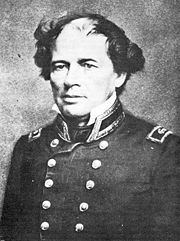 Maury was of Huguenot
ancestry whose family can be traced back to 15th century France
. Matthew Fontaine Maury's grandfather (the Reverend James Maury
) was an inspiring teacher to a future U. S. president, Thomas Jefferson
. Maury also had Dutch-American ethnicity from the "Minor" family of early Virginia.
M. F. Maury was born in 1806 in Spotsylvania County, Virginia
, but his family moved to Franklin, Tennessee
when he was five. He wanted to emulate the naval career of his older brother, Flag Lieutenant John Minor Maury
, who however caught yellow fever
after fighting pirates as an officer in the United States Navy
. As a result of John's painful death, Matthew Maury's father, Richard, forbade him from joining the Navy. Maury strongly considered attending West Point to get a better education than the navy could offer at that time, but instead he obtained a Naval appointment through the influence of Senator Sam Houston
in 1825, at the age of 19.
Maury joined the Navy as a midshipman
on board the frigate
Brandywine which was carrying the Marquis de La Fayette
home to France
. Almost immediately, Maury began to study the seas and record methods of navigation
. One of the experiences that piqued this interest was when he circumnavigated the globe on the USS Vincennes
, the first US warship to travel around the world.
Matthew Maury's seagoing days came to an abrupt end at the age of 33 after a stagecoach accident broke his hip and knee. Thereafter, he devoted his time to the study of naval meteorology, navigation
, charting the winds and currents, seeking the "Paths of the Seas" mentioned in Psalms 8:8 "The fowl of the air, and the fish of the sea, and whatsoever passeth through the paths of the seas." Maury had known of the Psalms of David since childhood. In "A Life of Matthew Fontaine Maury; compiled by his daughter, Diana Fontaine Maury Corbin (1888)" she states on pages 7–8, "Matthew's father was very exact in the religious training of his family, now numbering five sons and four daughters, viz., John Minor, Mary, Walker, Matilda, Betsy, Richard Launcelot, Matthew Fontaine, Catherine, and Charles. He would assemble them night and morning to read the Psalter for the day, verse and verse about; and in this way, so familiar did this barefooted boy [M. F. Maury] become with the Psalms of David, that in after life he could cite a quotation, and give chapter and verse, as if he had the Bible
open before him.
His hard work on and love of plotting the oceans paid off when he became the first superintendent of the United States Naval Observatory
in 1842, holding that position until his resignation in April 1861. The observatory's primary mission was to care for the United States Navy's marine chronometers, charts, and other navigational equipment. Maury was in fact one of the principle advocates for the founding of a national observatory, and appealed to science enthusiast and U.S. President John Quincy Adams
for the creation of what would eventually become the Naval Observatory. Maury did on occasion host Adams, who enjoyed astronomy as an avocation, at the Naval Observatory.
As a sailor, Maury noted that there were numerous lessons that had been learned by ship-masters about the effects of adverse winds and drift currents on the path of a ship. The captains recorded these lessons faithfully in their logbooks, but they were then forgotten. At the Observatory, Maury uncovered an enormous collection of thousands of old ships' logs and charts in storage in trunks dating back to the start of the United States Navy
. Maury pored over these documents to collect information on winds, calms, and currents for all seas in all seasons. His dream was to put this information in the hands of all captains.
Maury also used the old ships' logs to chart the migration
of whales. Whalers at the time went to sea, sometimes for years, without knowing that whales migrate and that their paths could be charted.
Maury's work on ocean currents led him to advocate his theory of the Northwest Passage
, as well as the hypothesis that an area in the ocean near the North Pole
is occasionally free of ice. The reasoning behind this was sound. Logs of old whaler ships indicated the designs and markings of harpoons. Harpoons found in captured whales in the Atlantic had been shot by ships in the Pacific and vice versa, and this occurred with a frequency that would have been impossible had the whales traveled around Cape Horn.
Maury, knowing a whale to be a mammal, theorized that a northern passage between the oceans that was free of ice must exist to enable the whales to surface and breathe. This became a popular idea that inspired many explorers to seek a reliably navigable sea route. Many of those explorers died in their search.
Lieutenant Maury published his Wind and Current Chart of the North Atlantic, which showed sailors how to use the ocean's currents and winds to their advantage and drastically reduced the length of ocean voyages; his Sailing Directions and Physical Geography of the Seas and Its Meteorology remain standard. Maury's uniform system of recording synoptic oceanographic data
was adopted by navies and merchant marines around the world and was used to develop charts for all the major trade routes.
Maury's Observatory team included James Melville Gilliss
, Lieutenant John Mercer Brooke
, William Lewis Herndon
, Lieutenant Isaac Strain
, John Minor Maury of the U.S.N. 1854 Darien Exploration Expedition, Lardner Gibbon and others — but their duty was always temporary at the Observatory, and new men had to be trained over and over again. Thus Lt. M F Maury was working with astronomical work and nautical work at the same time, while constantly training new temporary men to assist in these works.
Maury advocated much in the way of naval reform, including a school for the Navy that would rival the army's West Point. This reform was heavily pushed by Maury's many "Scraps from the Lucky Bag" and other articles printed in the newspapers and many changes came about in the navy including his finally fulfilled dream of the creation of the United States Naval Academy
.
Maury also advocated an international sea and land weather service. Having charted the seas and currents, he worked on charting land weather forecasting. Congress refused to appropriate funds for a land system of weather observations.
Maury early became convinced that adequate scientific knowledge of the sea could be obtained only through international cooperation. He proposed that the United States invite the maritime nations of the world to a conference to establish a “universal system” of meteorology, and he was the leading spirit of that pioneer scientific conference when it met in Brussels in 1853. Within a few years, nations owning three fourths of the shipping of the world were sending their oceanographic observations to Maury at the Naval Observatory, where the information was evaluated and the results given worldwide distribution.
Maury was sent by the United States as advocator of his sea data collecting ideas but not for land. Still, as a result of the Brussels conference a large number of nations, including many traditional enemies, agreed to cooperate in the sharing of land and sea weather data using uniform standards.
It was soon after the Brussels conference when Prussia, Spain, Sardinia, the free city of Hamburg, the republic of Bremen, Chile, Austria, and Brazil, and others all joined the enterprise.
The Pope established honorary flags of distinction for the ships of the papal states, which could be awarded only to those vessels which filled out and sent to Maury in Washington D.C. the Maury abstract logs.
In the early 1850s Matthew Fontaine Maury had planned and did send by 1851, his cousin, William Lewis Herndon
, and another co-worker at the Naval Observatory, Lardner Gibbon, both of whom worked at the USN Observatory, to explore the Valley of the Amazon region to Brazil
and the Atlantic Ocean
, while gathering as much information as possible for trade and slavery in any of those areas. In addition, Maury thought the area could serve as a "safety valve" by allowing Southern slave owners to move there or sell their slaves there. He reasoned that Brazil was bringing in new slaves from Africa
and by moving those who were already slaves in the United States to Brazil, there would be less slavery or in time perhaps no slavery in as many areas of the United States as possible while also cutting down on bringing new slaves into Brazil which only increased slavery through the capture and enslavement in Brazil of more Africans. "Imagine", Maury wrote to his cousin, "waking up some day and finding our country free of slavery!"
In 1849, Maury spoke out on the need for a transcontinental railroad
to join the eastern United States to California
. He recommended a southerly route with Memphis, Tennessee
as the eastern terminus, since the city is equidistant from Lake Michigan
and the Gulf of Mexico
. He argued that a southerly route running through Texas
would avoid winter snows and could open up commerce with the northern states of Mexico
. Maury also advocated construction of a railroad across the Isthmus of Panama
.
, Maury, a native of Virginia, ended the career that he dearly loved by handing in his commission as a U.S. Navy Commander
in order to serve Virginia, which had joined the Confederacy, as Chief of Sea Coast, River and Harbor Defences. Because he was an international figure, he was ordered to go abroad for many reasons including propaganda for the Confederacy, for peace, and for purchasing ships. He also went to England
, Ireland
, and France
, acquiring ships and supplies for the Confederacy. Through speeches and newspaper publications, Maury tried desperately to get other nations to stop the American Civil War, carrying pleas for peace in one hand and a sword in the other, each to deal with whatever the outcome.
Maury also perfected an electric torpedo
which raised havoc with northern shipping. Maury had experience with the transatlantic cable and electricity flowing through wires underwater when working with Cyrus West Field
and Samuel Finley Breese Morse. The torpedoes, similar to present-day contact mines, were said by the Secretary of the Navy in 1865 "to have cost the Union more vessels than all other causes combined."
The war brought ruin to many in Fredericksburg, Virginia, where Maury's immediate family lived. Following the war, after serving Maximilian
in Mexico as "Imperial Commissioner of Immigration" and building Carlotta and New Virginia Colony
for displaced Confederates and immigrants from other lands, Maury accepted a teaching position at the Virginia Military Institute
(VMI), holding the chair of physics
.
Maury advocated the creation of an agricultural college to complement VMI. This led to the establishment of the Virginia Agricultural and Mechanical College (Virginia Tech) in Blacksburg, Virginia
in 1872. Maury declined the offer to become its first president partly because of his age. He had previously been suggested as president of the College of William and Mary
in Williamsburg, Virginia in 1848 by Benjamin Blake Minor
in his publication the Southern Literary Messenger
. Maury considered becoming president of St. John's College in Annapolis Maryland, the University of Alabama
, and the University of Tennessee
. It appears that he preferred being close to General Robert E. Lee in Lexington from statements Maury made in letters. Maury served as a pall bearer for General Lee.
During his time at VMI, Maury wrote a book entitled The Physical Geography
of Virginia. He had once been a gold mining superintendent outside of Fredericksburg, Virginia, and had studied geology
intensely during that time, so was well equipped to write such a book. During the Civil War, more battles took place in Virginia than any other state (Tennessee was second), and Maury's aim was to assist war-torn Virginia in discovering and extracting minerals, improving farming and whatever else could assist her to rebuild after such destruction.
During its first 1848 meeting, Maury helped launch the American Association for the Advancement of Science
(AAAS).
Maury later gave talks in Europe about cooperation on a weather bureau for land just as he had charted the winds and predicted storms at sea many years before. He gave these Weather on Land speeches until his last days when he collapsed giving a speech. He went home after he recovered and told Ann Hull Herndon-Maury, his wife, "I have come home to die."
Matthew Fontaine Maury died at home in Lexington. He was exhausted from traveling throughout this nation while giving speeches promoting Land Meteorology. Maury breathed his last breath at 12:40 P.M., on Saturday, February 1, 1873. He was attended by his eldest son, Major Richard Launcelot Maury and son-in- law, Major Spottswood Wellford Corbin. Maury asked his daughters and wife to leave the room. His last words were, "All's well", a nautical expression telling of calm conditions at sea, as he raised his hands into the air as though being taken to a better place. His body was placed on display in the VMI library. Maury was initially buried in the Gilham family vault in Lexington's cemetery, across from Thomas "Stonewall" Jackson, until, after some delay into the next year, when his remains were taken through Goshen Pass
to Richmond, Virginia
. He was reburied between Presidents James Monroe
and John Tyler
in Hollywood Cemetery in Richmond, Virginia.
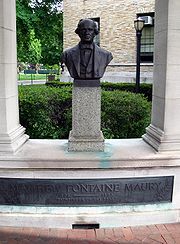 After decades of national and international hard work averaging 14 hours per day, Maury received fame and honors, including being knighted by several nations and given medals with precious gems, as well as a collection of all medals struck by Pope Pius IX
during his pontificate, a book dedication and more from Father Angelo Secchi
, who was a student of Maury from 1848 – 1849 in the U.S. Naval Observatory. The two remained life-long friends. Other religious friends of Maury included James Hervey Otey
, M. F. Maury's former teacher who, before 1857, worked with Bishop Leonidas Polk
on the construction of the University of the South in Tennessee. While visiting there, Maury was convinced by his old teacher to give the "cornerstone speech".
As a United States Navy
officer, he declined awards from foreign nations as their acceptance was against U.S. military policy. However, they were offered to Commander Matthew Fontaine Maury's wife, Ann Hull Herndon-Maury, who accepted them for her husband. Some have been placed at Virginia Military Institute
, others were loaned to the Smithsonian and yet others remain in the family. Matthew Maury became a Commodore
(often a title of courtesy) in the Virginia Provisional Navy, and a Commander in the Confederacy.
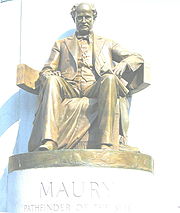 A monument to Maury, by sculptor Frederick William Sievers
, was unveiled in Richmond on November 11, 1929. Maury Hall, the home of the Naval Science Department at the University of Virginia
and headquarters of the University's Navy ROTC battalion
, was named in his honor. The original building of the College of William & Mary Virginia Institute of Marine Science
is named Maury Hall as well. Another Maury Hall, named after him, houses the Electrical and Computer Engineering Department and the Systems Engineering Department at the United States Naval Academy
in Annapolis, Maryland
.
Ships have been named in his honor, including three United States Navy ships named USS Maury
. A fourth United States Navy ship named in his honor was the "USS Commodore Maury" (SP-656), patrol vessel and mine sweeper. of World War I. A World War II Liberty Ship was also named in his honor. Additionally, Tidewater Community College, based in Norfolk Virginia, owns the R/V Matthew F. Maury. This ship is used for Oceanography research and student cruises.
Lake Maury
in Newport News, Virginia
is named after Maury. The Lake is located on the Mariners' Museum
property and is encircled by a walking trail. The Maury River, located entirely in Rockbridge County, Virginia, near Virginia Military Institute (where Maury was on faculty), also honors the scientist, as does a Maury (crater)
on the Moon.
Additionally, a high school in Norfolk, VA is named for Maury, and has been ranked in the top 1000 high schools in the country, and the highest in the city, by Newsweek
. Matthew Fontaine Maury High School
is located in Norfolk Public Schools which was named the Best Urban School District last year. Maury County, TN is named for his great-uncle.
Also, Maury Elementary School, in Alexandria, VA was named for Matthew Maury. Maury Elementary was built in 1926.
Dan Graves listed Matthew Maury among his 48 great Scientists of Faith on grounds that: Maury lived by the Scriptures; he fully and unconditionally believed in what the Holy Scriptures stated; he hardly ever spoke or wrote without the inclusion of scriptural references; he prayed every day.
United States Navy
The United States Navy is the naval warfare service branch of the United States Armed Forces and one of the seven uniformed services of the United States. The U.S. Navy is the largest in the world; its battle fleet tonnage is greater than that of the next 13 largest navies combined. The U.S...
was an American
United States
The United States of America is a federal constitutional republic comprising fifty states and a federal district...
astronomer
Astronomer
An astronomer is a scientist who studies celestial bodies such as planets, stars and galaxies.Historically, astronomy was more concerned with the classification and description of phenomena in the sky, while astrophysics attempted to explain these phenomena and the differences between them using...
, historian
Historian
A historian is a person who studies and writes about the past and is regarded as an authority on it. Historians are concerned with the continuous, methodical narrative and research of past events as relating to the human race; as well as the study of all history in time. If the individual is...
, oceanographer, meteorologist, cartographer, author
Author
An author is broadly defined as "the person who originates or gives existence to anything" and that authorship determines responsibility for what is created. Narrowly defined, an author is the originator of any written work.-Legal significance:...
, geologist
Geologist
A geologist is a scientist who studies the solid and liquid matter that constitutes the Earth as well as the processes and history that has shaped it. Geologists usually engage in studying geology. Geologists, studying more of an applied science than a theoretical one, must approach Geology using...
, and educator.
He was nicknamed "Pathfinder of the Seas" and "Father of Modern Oceanography and Naval Meteorology" and later, "Scientist of the Seas," due to the publication of his extensive works in his books, especially Physical Geography of the Sea (1855), the first extensive and comprehensive book on oceanography to be published. Maury made many important new contributions to charting winds and ocean currents, including ocean lanes for passing ships at sea.
In 1825 at age 19, Maury joined the United States Navy
United States Navy
The United States Navy is the naval warfare service branch of the United States Armed Forces and one of the seven uniformed services of the United States. The U.S. Navy is the largest in the world; its battle fleet tonnage is greater than that of the next 13 largest navies combined. The U.S...
as a midshipman on board the frigate USS Brandywine. Almost immediately he began to study the seas and record methods of navigation. When a leg injury left him unfit for sea duty, Maury devoted his time to the study of navigation, meteorology, winds, and currents. His hard work on and love of plotting the oceans paid off when he became Superintendent of the U.S. Naval Observatory and head of the Depot of Charts and Instruments. Here, Maury studied thousands of ships' logs and charts. He published the Wind and Current Chart of the North Atlantic, which showed sailors how to use the ocean's currents and winds to their advantage and drastically reduced the length of ocean voyages. Maury's uniform system of recording oceanographic data was adopted by navies and merchant marines around the world and was used to develop charts for all the major trade routes.
With the outbreak of the Civil War
American Civil War
The American Civil War was a civil war fought in the United States of America. In response to the election of Abraham Lincoln as President of the United States, 11 southern slave states declared their secession from the United States and formed the Confederate States of America ; the other 25...
, Maury, a Virginia
Virginia
The Commonwealth of Virginia , is a U.S. state on the Atlantic Coast of the Southern United States. Virginia is nicknamed the "Old Dominion" and sometimes the "Mother of Presidents" after the eight U.S. presidents born there...
n, resigned his commission as a U. S. Navy commander and joined the Confederacy. He spent the war in the South, as well as abroad in Great Britain
Great Britain
Great Britain or Britain is an island situated to the northwest of Continental Europe. It is the ninth largest island in the world, and the largest European island, as well as the largest of the British Isles...
, acquiring ships for the Confederacy
Confederate States of America
The Confederate States of America was a government set up from 1861 to 1865 by 11 Southern slave states of the United States of America that had declared their secession from the U.S...
. Following the war, Maury accepted a teaching position at the Virginia Military Institute
Virginia Military Institute
The Virginia Military Institute , located in Lexington, Virginia, is the oldest state-supported military college and one of six senior military colleges in the United States. Unlike any other military college in the United States—and in keeping with its founding principles—all VMI students are...
in Lexington, Virginia
Lexington, Virginia
Lexington is an independent city within the confines of Rockbridge County in the Commonwealth of Virginia. The population was 7,042 in 2010. Lexington is about 55 minutes east of the West Virginia border and is about 50 miles north of Roanoke, Virginia. It was first settled in 1777.It is home to...
. He died at his home in Lexington in 1873 after completing an exhausting national lecture tour.
Early life and career
Huguenot
The Huguenots were members of the Protestant Reformed Church of France during the 16th and 17th centuries. Since the 17th century, people who formerly would have been called Huguenots have instead simply been called French Protestants, a title suggested by their German co-religionists, the...
ancestry whose family can be traced back to 15th century France
France
The French Republic , The French Republic , The French Republic , (commonly known as France , is a unitary semi-presidential republic in Western Europe with several overseas territories and islands located on other continents and in the Indian, Pacific, and Atlantic oceans. Metropolitan France...
. Matthew Fontaine Maury's grandfather (the Reverend James Maury
James Maury
The Reverend James Maury was a prominent Virginia educator and minister during the American Colonial period.He was the son of Matthew Maury, a French Huguenot, who was born in Castel Mauron, in Gascony, and his wife, Mary Anne Fontaine, daughter of Rev. James Fontaine and Anne Elizabeth...
) was an inspiring teacher to a future U. S. president, Thomas Jefferson
Thomas Jefferson
Thomas Jefferson was the principal author of the United States Declaration of Independence and the Statute of Virginia for Religious Freedom , the third President of the United States and founder of the University of Virginia...
. Maury also had Dutch-American ethnicity from the "Minor" family of early Virginia.
M. F. Maury was born in 1806 in Spotsylvania County, Virginia
Spotsylvania County, Virginia
As of the census of 2000, there were 90,395 people, 31,308 households, and 24,639 families residing in the county. The population density was 226 people per square mile . There were 33,329 housing units at an average density of 83 per square mile...
, but his family moved to Franklin, Tennessee
Franklin, Tennessee
Franklin is a city within and the county seat of Williamson County, Tennessee, United States. The population was 62,487 as of the 2010 census Franklin is located approximately south of downtown Nashville.-History:...
when he was five. He wanted to emulate the naval career of his older brother, Flag Lieutenant John Minor Maury
John Minor Maury
John Minor Maury was a lieutenant in the United States Navy.John's life was saved by David Porter, USN, of the ship, Essex...
, who however caught yellow fever
Yellow fever
Yellow fever is an acute viral hemorrhagic disease. The virus is a 40 to 50 nm enveloped RNA virus with positive sense of the Flaviviridae family....
after fighting pirates as an officer in the United States Navy
United States Navy
The United States Navy is the naval warfare service branch of the United States Armed Forces and one of the seven uniformed services of the United States. The U.S. Navy is the largest in the world; its battle fleet tonnage is greater than that of the next 13 largest navies combined. The U.S...
. As a result of John's painful death, Matthew Maury's father, Richard, forbade him from joining the Navy. Maury strongly considered attending West Point to get a better education than the navy could offer at that time, but instead he obtained a Naval appointment through the influence of Senator Sam Houston
Sam Houston
Samuel Houston, known as Sam Houston , was a 19th-century American statesman, politician, and soldier. He was born in Timber Ridge in the Shenandoah Valley of Virginia, of Scots-Irish descent. Houston became a key figure in the history of Texas and was elected as the first and third President of...
in 1825, at the age of 19.
Maury joined the Navy as a midshipman
Midshipman
A midshipman is an officer cadet, or a commissioned officer of the lowest rank, in the Royal Navy, United States Navy, and many Commonwealth navies. Commonwealth countries which use the rank include Australia, New Zealand, South Africa, India, Pakistan, Singapore, Sri Lanka and Kenya...
on board the frigate
Frigate
A frigate is any of several types of warship, the term having been used for ships of various sizes and roles over the last few centuries.In the 17th century, the term was used for any warship built for speed and maneuverability, the description often used being "frigate-built"...
Brandywine which was carrying the Marquis de La Fayette
Gilbert du Motier, marquis de La Fayette
Marie-Joseph Paul Yves Roch Gilbert du Motier, Marquis de La Fayette , often known as simply Lafayette, was a French aristocrat and military officer born in Chavaniac, in the province of Auvergne in south central France...
home to France
France
The French Republic , The French Republic , The French Republic , (commonly known as France , is a unitary semi-presidential republic in Western Europe with several overseas territories and islands located on other continents and in the Indian, Pacific, and Atlantic oceans. Metropolitan France...
. Almost immediately, Maury began to study the seas and record methods of navigation
Navigation
Navigation is the process of monitoring and controlling the movement of a craft or vehicle from one place to another. It is also the term of art used for the specialized knowledge used by navigators to perform navigation tasks...
. One of the experiences that piqued this interest was when he circumnavigated the globe on the USS Vincennes
USS Vincennes (1826)
USS Vincennes was a 703-ton Boston-class sloop of war in the United States Navy from 1826 to 1865. During her service, Vincennes patrolled the Pacific, explored the Antarctic, and blockaded the Confederate Gulf coast in the Civil War. Named for the Revolutionary War Battle of Vincennes, she was...
, the first US warship to travel around the world.
Matthew Maury's seagoing days came to an abrupt end at the age of 33 after a stagecoach accident broke his hip and knee. Thereafter, he devoted his time to the study of naval meteorology, navigation
Navigation
Navigation is the process of monitoring and controlling the movement of a craft or vehicle from one place to another. It is also the term of art used for the specialized knowledge used by navigators to perform navigation tasks...
, charting the winds and currents, seeking the "Paths of the Seas" mentioned in Psalms 8:8 "The fowl of the air, and the fish of the sea, and whatsoever passeth through the paths of the seas." Maury had known of the Psalms of David since childhood. In "A Life of Matthew Fontaine Maury; compiled by his daughter, Diana Fontaine Maury Corbin (1888)" she states on pages 7–8, "Matthew's father was very exact in the religious training of his family, now numbering five sons and four daughters, viz., John Minor, Mary, Walker, Matilda, Betsy, Richard Launcelot, Matthew Fontaine, Catherine, and Charles. He would assemble them night and morning to read the Psalter for the day, verse and verse about; and in this way, so familiar did this barefooted boy [M. F. Maury] become with the Psalms of David, that in after life he could cite a quotation, and give chapter and verse, as if he had the Bible
Bible
The Bible refers to any one of the collections of the primary religious texts of Judaism and Christianity. There is no common version of the Bible, as the individual books , their contents and their order vary among denominations...
open before him.
His hard work on and love of plotting the oceans paid off when he became the first superintendent of the United States Naval Observatory
United States Naval Observatory
The United States Naval Observatory is one of the oldest scientific agencies in the United States, with a primary mission to produce Positioning, Navigation, and Timing for the U.S. Navy and the U.S. Department of Defense...
in 1842, holding that position until his resignation in April 1861. The observatory's primary mission was to care for the United States Navy's marine chronometers, charts, and other navigational equipment. Maury was in fact one of the principle advocates for the founding of a national observatory, and appealed to science enthusiast and U.S. President John Quincy Adams
John Quincy Adams
John Quincy Adams was the sixth President of the United States . He served as an American diplomat, Senator, and Congressional representative. He was a member of the Federalist, Democratic-Republican, National Republican, and later Anti-Masonic and Whig parties. Adams was the son of former...
for the creation of what would eventually become the Naval Observatory. Maury did on occasion host Adams, who enjoyed astronomy as an avocation, at the Naval Observatory.
As a sailor, Maury noted that there were numerous lessons that had been learned by ship-masters about the effects of adverse winds and drift currents on the path of a ship. The captains recorded these lessons faithfully in their logbooks, but they were then forgotten. At the Observatory, Maury uncovered an enormous collection of thousands of old ships' logs and charts in storage in trunks dating back to the start of the United States Navy
United States Navy
The United States Navy is the naval warfare service branch of the United States Armed Forces and one of the seven uniformed services of the United States. The U.S. Navy is the largest in the world; its battle fleet tonnage is greater than that of the next 13 largest navies combined. The U.S...
. Maury pored over these documents to collect information on winds, calms, and currents for all seas in all seasons. His dream was to put this information in the hands of all captains.
Maury also used the old ships' logs to chart the migration
Fish migration
Many types of fish migrate on a regular basis, on time scales ranging from daily to annually or longer, and over distances ranging from a few metres to thousands of kilometres...
of whales. Whalers at the time went to sea, sometimes for years, without knowing that whales migrate and that their paths could be charted.
Maury's work on ocean currents led him to advocate his theory of the Northwest Passage
Northwest Passage
The Northwest Passage is a sea route through the Arctic Ocean, along the northern coast of North America via waterways amidst the Canadian Arctic Archipelago, connecting the Atlantic and Pacific Oceans...
, as well as the hypothesis that an area in the ocean near the North Pole
North Pole
The North Pole, also known as the Geographic North Pole or Terrestrial North Pole, is, subject to the caveats explained below, defined as the point in the northern hemisphere where the Earth's axis of rotation meets its surface...
is occasionally free of ice. The reasoning behind this was sound. Logs of old whaler ships indicated the designs and markings of harpoons. Harpoons found in captured whales in the Atlantic had been shot by ships in the Pacific and vice versa, and this occurred with a frequency that would have been impossible had the whales traveled around Cape Horn.
Maury, knowing a whale to be a mammal, theorized that a northern passage between the oceans that was free of ice must exist to enable the whales to surface and breathe. This became a popular idea that inspired many explorers to seek a reliably navigable sea route. Many of those explorers died in their search.
Lieutenant Maury published his Wind and Current Chart of the North Atlantic, which showed sailors how to use the ocean's currents and winds to their advantage and drastically reduced the length of ocean voyages; his Sailing Directions and Physical Geography of the Seas and Its Meteorology remain standard. Maury's uniform system of recording synoptic oceanographic data
Joint Typhoon Warning Center
The Joint Typhoon Warning Center is a joint United States Navy – United States Air Force task force located at the Naval Maritime Forecast Center in Pearl Harbor, Hawaii...
was adopted by navies and merchant marines around the world and was used to develop charts for all the major trade routes.
Maury's Observatory team included James Melville Gilliss
James Melville Gilliss
James Melville Gilliss was an astronomer, United States Navy officer and founder of the United States Naval Observatory.-History:...
, Lieutenant John Mercer Brooke
John Mercer Brooke
John Mercer Brooke was an American sailor, engineer, scientist, and educator. He was instrumental in the creation of the Transatlantic Cable, and was a noted marine and military innovator.-Early life and career:...
, William Lewis Herndon
William Lewis Herndon
Commander William Lewis Herndon was one of the United States Navy's outstanding explorers and seamen. He chose to go down with his ship while other lives were still aboard and while in command of the steamer Central Americas 44th trip, which sank in a three day and night hurricane off Cape...
, Lieutenant Isaac Strain
Isaac Strain
Isaac G. Strain was born March 4, 1821, in Roxbury, Franklin County, Pennsylvania, of Scots-Irish origin, and died May 14, 1857, in Aspinwall, Colombia. At age 17 he joined the U.S...
, John Minor Maury of the U.S.N. 1854 Darien Exploration Expedition, Lardner Gibbon and others — but their duty was always temporary at the Observatory, and new men had to be trained over and over again. Thus Lt. M F Maury was working with astronomical work and nautical work at the same time, while constantly training new temporary men to assist in these works.
Maury advocated much in the way of naval reform, including a school for the Navy that would rival the army's West Point. This reform was heavily pushed by Maury's many "Scraps from the Lucky Bag" and other articles printed in the newspapers and many changes came about in the navy including his finally fulfilled dream of the creation of the United States Naval Academy
United States Naval Academy
The United States Naval Academy is a four-year coeducational federal service academy located in Annapolis, Maryland, United States...
.
Maury also advocated an international sea and land weather service. Having charted the seas and currents, he worked on charting land weather forecasting. Congress refused to appropriate funds for a land system of weather observations.
Maury early became convinced that adequate scientific knowledge of the sea could be obtained only through international cooperation. He proposed that the United States invite the maritime nations of the world to a conference to establish a “universal system” of meteorology, and he was the leading spirit of that pioneer scientific conference when it met in Brussels in 1853. Within a few years, nations owning three fourths of the shipping of the world were sending their oceanographic observations to Maury at the Naval Observatory, where the information was evaluated and the results given worldwide distribution.
Maury was sent by the United States as advocator of his sea data collecting ideas but not for land. Still, as a result of the Brussels conference a large number of nations, including many traditional enemies, agreed to cooperate in the sharing of land and sea weather data using uniform standards.
It was soon after the Brussels conference when Prussia, Spain, Sardinia, the free city of Hamburg, the republic of Bremen, Chile, Austria, and Brazil, and others all joined the enterprise.
The Pope established honorary flags of distinction for the ships of the papal states, which could be awarded only to those vessels which filled out and sent to Maury in Washington D.C. the Maury abstract logs.
In the early 1850s Matthew Fontaine Maury had planned and did send by 1851, his cousin, William Lewis Herndon
William Lewis Herndon
Commander William Lewis Herndon was one of the United States Navy's outstanding explorers and seamen. He chose to go down with his ship while other lives were still aboard and while in command of the steamer Central Americas 44th trip, which sank in a three day and night hurricane off Cape...
, and another co-worker at the Naval Observatory, Lardner Gibbon, both of whom worked at the USN Observatory, to explore the Valley of the Amazon region to Brazil
Brazil
Brazil , officially the Federative Republic of Brazil , is the largest country in South America. It is the world's fifth largest country, both by geographical area and by population with over 192 million people...
and the Atlantic Ocean
Atlantic Ocean
The Atlantic Ocean is the second-largest of the world's oceanic divisions. With a total area of about , it covers approximately 20% of the Earth's surface and about 26% of its water surface area...
, while gathering as much information as possible for trade and slavery in any of those areas. In addition, Maury thought the area could serve as a "safety valve" by allowing Southern slave owners to move there or sell their slaves there. He reasoned that Brazil was bringing in new slaves from Africa
Africa
Africa is the world's second largest and second most populous continent, after Asia. At about 30.2 million km² including adjacent islands, it covers 6% of the Earth's total surface area and 20.4% of the total land area...
and by moving those who were already slaves in the United States to Brazil, there would be less slavery or in time perhaps no slavery in as many areas of the United States as possible while also cutting down on bringing new slaves into Brazil which only increased slavery through the capture and enslavement in Brazil of more Africans. "Imagine", Maury wrote to his cousin, "waking up some day and finding our country free of slavery!"
In 1849, Maury spoke out on the need for a transcontinental railroad
Transcontinental railroad
A transcontinental railroad is a contiguous network of railroad trackage that crosses a continental land mass with terminals at different oceans or continental borders. Such networks can be via the tracks of either a single railroad, or over those owned or controlled by multiple railway companies...
to join the eastern United States to California
California
California is a state located on the West Coast of the United States. It is by far the most populous U.S. state, and the third-largest by land area...
. He recommended a southerly route with Memphis, Tennessee
Memphis, Tennessee
Memphis is a city in the southwestern corner of the U.S. state of Tennessee, and the county seat of Shelby County. The city is located on the 4th Chickasaw Bluff, south of the confluence of the Wolf and Mississippi rivers....
as the eastern terminus, since the city is equidistant from Lake Michigan
Lake Michigan
Lake Michigan is one of the five Great Lakes of North America and the only one located entirely within the United States. It is the second largest of the Great Lakes by volume and the third largest by surface area, after Lake Superior and Lake Huron...
and the Gulf of Mexico
Gulf of Mexico
The Gulf of Mexico is a partially landlocked ocean basin largely surrounded by the North American continent and the island of Cuba. It is bounded on the northeast, north and northwest by the Gulf Coast of the United States, on the southwest and south by Mexico, and on the southeast by Cuba. In...
. He argued that a southerly route running through Texas
Texas
Texas is the second largest U.S. state by both area and population, and the largest state by area in the contiguous United States.The name, based on the Caddo word "Tejas" meaning "friends" or "allies", was applied by the Spanish to the Caddo themselves and to the region of their settlement in...
would avoid winter snows and could open up commerce with the northern states of Mexico
Mexico
The United Mexican States , commonly known as Mexico , is a federal constitutional republic in North America. It is bordered on the north by the United States; on the south and west by the Pacific Ocean; on the southeast by Guatemala, Belize, and the Caribbean Sea; and on the east by the Gulf of...
. Maury also advocated construction of a railroad across the Isthmus of Panama
Isthmus of Panama
The Isthmus of Panama, also historically known as the Isthmus of Darien, is the narrow strip of land that lies between the Caribbean Sea and the Pacific Ocean, linking North and South America. It contains the country of Panama and the Panama Canal...
.
Civil War
With the outbreak of the American Civil WarAmerican Civil War
The American Civil War was a civil war fought in the United States of America. In response to the election of Abraham Lincoln as President of the United States, 11 southern slave states declared their secession from the United States and formed the Confederate States of America ; the other 25...
, Maury, a native of Virginia, ended the career that he dearly loved by handing in his commission as a U.S. Navy Commander
Commander
Commander is a naval rank which is also sometimes used as a military title depending on the individual customs of a given military service. Commander is also used as a rank or title in some organizations outside of the armed forces, particularly in police and law enforcement.-Commander as a naval...
in order to serve Virginia, which had joined the Confederacy, as Chief of Sea Coast, River and Harbor Defences. Because he was an international figure, he was ordered to go abroad for many reasons including propaganda for the Confederacy, for peace, and for purchasing ships. He also went to England
England
England is a country that is part of the United Kingdom. It shares land borders with Scotland to the north and Wales to the west; the Irish Sea is to the north west, the Celtic Sea to the south west, with the North Sea to the east and the English Channel to the south separating it from continental...
, Ireland
Ireland
Ireland is an island to the northwest of continental Europe. It is the third-largest island in Europe and the twentieth-largest island on Earth...
, and France
France
The French Republic , The French Republic , The French Republic , (commonly known as France , is a unitary semi-presidential republic in Western Europe with several overseas territories and islands located on other continents and in the Indian, Pacific, and Atlantic oceans. Metropolitan France...
, acquiring ships and supplies for the Confederacy. Through speeches and newspaper publications, Maury tried desperately to get other nations to stop the American Civil War, carrying pleas for peace in one hand and a sword in the other, each to deal with whatever the outcome.
Maury also perfected an electric torpedo
Torpedo
The modern torpedo is a self-propelled missile weapon with an explosive warhead, launched above or below the water surface, propelled underwater towards a target, and designed to detonate either on contact with it or in proximity to it.The term torpedo was originally employed for...
which raised havoc with northern shipping. Maury had experience with the transatlantic cable and electricity flowing through wires underwater when working with Cyrus West Field
Cyrus West Field
Cyrus West Field was an American businessman and financier who, along with other entrepreneurs, created the Atlantic Telegraph Company and laid the first telegraph cable across the Atlantic Ocean in 1858.-Life and career:...
and Samuel Finley Breese Morse. The torpedoes, similar to present-day contact mines, were said by the Secretary of the Navy in 1865 "to have cost the Union more vessels than all other causes combined."
The war brought ruin to many in Fredericksburg, Virginia, where Maury's immediate family lived. Following the war, after serving Maximilian
Maximilian I of Mexico
Maximilian I was the only monarch of the Second Mexican Empire.After a distinguished career in the Austrian Navy, he was proclaimed Emperor of Mexico on April 10, 1864, with the backing of Napoleon III of France and a group of Mexican monarchists who sought to revive the Mexican monarchy...
in Mexico as "Imperial Commissioner of Immigration" and building Carlotta and New Virginia Colony
New Virginia Colony
The New Virginia Colony was a colonization plan in central Mexico, to resettle ex-Confederates and any other immigrants from any nation. and other Americans after the American Civil War...
for displaced Confederates and immigrants from other lands, Maury accepted a teaching position at the Virginia Military Institute
Virginia Military Institute
The Virginia Military Institute , located in Lexington, Virginia, is the oldest state-supported military college and one of six senior military colleges in the United States. Unlike any other military college in the United States—and in keeping with its founding principles—all VMI students are...
(VMI), holding the chair of physics
Physics
Physics is a natural science that involves the study of matter and its motion through spacetime, along with related concepts such as energy and force. More broadly, it is the general analysis of nature, conducted in order to understand how the universe behaves.Physics is one of the oldest academic...
.
Maury advocated the creation of an agricultural college to complement VMI. This led to the establishment of the Virginia Agricultural and Mechanical College (Virginia Tech) in Blacksburg, Virginia
Blacksburg, Virginia
Blacksburg is an incorporated town located in Montgomery County, Virginia, United States, with a population of 42,620 at the 2010 census. Blacksburg, Christiansburg, and Radford are the three principal jurisdictions of the Blacksburg-Christiansburg-Radford Metropolitan Statistical Area which...
in 1872. Maury declined the offer to become its first president partly because of his age. He had previously been suggested as president of the College of William and Mary
College of William and Mary
The College of William & Mary in Virginia is a public research university located in Williamsburg, Virginia, United States...
in Williamsburg, Virginia in 1848 by Benjamin Blake Minor
Benjamin Blake Minor
Benjamin Blake Minor was an American writer, educator, legal scholar, and fourth President of the University of Missouri, from 1860-1862. Today, he is most known as the editor of the Southern Literary Messenger. He also compiled the second edition of the reports of the decisions of George Wythe,...
in his publication the Southern Literary Messenger
Southern Literary Messenger
The Southern Literary Messenger was a periodical published in Richmond, Virginia, from 1834 until June 1864. Each issue carried a subtitle of "Devoted to Every Department of Literature and the Fine Arts" or some variation and included poetry, fiction, non-fiction, reviews, and historical notes...
. Maury considered becoming president of St. John's College in Annapolis Maryland, the University of Alabama
University of Alabama
The University of Alabama is a public coeducational university located in Tuscaloosa, Alabama, United States....
, and the University of Tennessee
University of Tennessee
The University of Tennessee is a public land-grant university headquartered at Knoxville, Tennessee, United States...
. It appears that he preferred being close to General Robert E. Lee in Lexington from statements Maury made in letters. Maury served as a pall bearer for General Lee.
During his time at VMI, Maury wrote a book entitled The Physical Geography
Physical geography
Physical geography is one of the two major subfields of geography. Physical geography is that branch of natural science which deals with the study of processes and patterns in the natural environment like the atmosphere, biosphere and geosphere, as opposed to the cultural or built environment, the...
of Virginia. He had once been a gold mining superintendent outside of Fredericksburg, Virginia, and had studied geology
Geology
Geology is the science comprising the study of solid Earth, the rocks of which it is composed, and the processes by which it evolves. Geology gives insight into the history of the Earth, as it provides the primary evidence for plate tectonics, the evolutionary history of life, and past climates...
intensely during that time, so was well equipped to write such a book. During the Civil War, more battles took place in Virginia than any other state (Tennessee was second), and Maury's aim was to assist war-torn Virginia in discovering and extracting minerals, improving farming and whatever else could assist her to rebuild after such destruction.
During its first 1848 meeting, Maury helped launch the American Association for the Advancement of Science
American Association for the Advancement of Science
The American Association for the Advancement of Science is an international non-profit organization with the stated goals of promoting cooperation among scientists, defending scientific freedom, encouraging scientific responsibility, and supporting scientific education and science outreach for the...
(AAAS).
Maury later gave talks in Europe about cooperation on a weather bureau for land just as he had charted the winds and predicted storms at sea many years before. He gave these Weather on Land speeches until his last days when he collapsed giving a speech. He went home after he recovered and told Ann Hull Herndon-Maury, his wife, "I have come home to die."
Matthew Fontaine Maury died at home in Lexington. He was exhausted from traveling throughout this nation while giving speeches promoting Land Meteorology. Maury breathed his last breath at 12:40 P.M., on Saturday, February 1, 1873. He was attended by his eldest son, Major Richard Launcelot Maury and son-in- law, Major Spottswood Wellford Corbin. Maury asked his daughters and wife to leave the room. His last words were, "All's well", a nautical expression telling of calm conditions at sea, as he raised his hands into the air as though being taken to a better place. His body was placed on display in the VMI library. Maury was initially buried in the Gilham family vault in Lexington's cemetery, across from Thomas "Stonewall" Jackson, until, after some delay into the next year, when his remains were taken through Goshen Pass
Goshen Pass
Goshen Pass is a water gap, or gorge, in the Little North Mountain, formed by the passage of the Maury River, approximately northwest of Lexington in Rockbridge County, Virginia. State Route 39 traverses the pass along the banks of the Maury River....
to Richmond, Virginia
Richmond, Virginia
Richmond is the capital of the Commonwealth of Virginia, in the United States. It is an independent city and not part of any county. Richmond is the center of the Richmond Metropolitan Statistical Area and the Greater Richmond area...
. He was reburied between Presidents James Monroe
James Monroe
James Monroe was the fifth President of the United States . Monroe was the last president who was a Founding Father of the United States, and the last president from the Virginia dynasty and the Republican Generation...
and John Tyler
John Tyler
John Tyler was the tenth President of the United States . A native of Virginia, Tyler served as a state legislator, governor, U.S. representative, and U.S. senator before being elected Vice President . He was the first to succeed to the office of President following the death of a predecessor...
in Hollywood Cemetery in Richmond, Virginia.
International honors
Pope Pius IX
Blessed Pope Pius IX , born Giovanni Maria Mastai-Ferretti, was the longest-reigning elected Pope in the history of the Catholic Church, serving from 16 June 1846 until his death, a period of nearly 32 years. During his pontificate, he convened the First Vatican Council in 1869, which decreed papal...
during his pontificate, a book dedication and more from Father Angelo Secchi
Angelo Secchi
-External links:...
, who was a student of Maury from 1848 – 1849 in the U.S. Naval Observatory. The two remained life-long friends. Other religious friends of Maury included James Hervey Otey
James Hervey Otey
James Hervey Otey , Christian educator and the first Episcopal Bishop of Tennessee, established the first Anglican church in the state and its first parish churches.-Biography:...
, M. F. Maury's former teacher who, before 1857, worked with Bishop Leonidas Polk
Leonidas Polk
Leonidas Polk was a Confederate general in the American Civil War who was once a planter in Maury County, Tennessee, and a second cousin of President James K. Polk...
on the construction of the University of the South in Tennessee. While visiting there, Maury was convinced by his old teacher to give the "cornerstone speech".
As a United States Navy
United States Navy
The United States Navy is the naval warfare service branch of the United States Armed Forces and one of the seven uniformed services of the United States. The U.S. Navy is the largest in the world; its battle fleet tonnage is greater than that of the next 13 largest navies combined. The U.S...
officer, he declined awards from foreign nations as their acceptance was against U.S. military policy. However, they were offered to Commander Matthew Fontaine Maury's wife, Ann Hull Herndon-Maury, who accepted them for her husband. Some have been placed at Virginia Military Institute
Virginia Military Institute
The Virginia Military Institute , located in Lexington, Virginia, is the oldest state-supported military college and one of six senior military colleges in the United States. Unlike any other military college in the United States—and in keeping with its founding principles—all VMI students are...
, others were loaned to the Smithsonian and yet others remain in the family. Matthew Maury became a Commodore
Commodore (rank)
Commodore is a military rank used in many navies that is superior to a navy captain, but below a rear admiral. Non-English-speaking nations often use the rank of flotilla admiral or counter admiral as an equivalent .It is often regarded as a one-star rank with a NATO code of OF-6, but is not always...
(often a title of courtesy) in the Virginia Provisional Navy, and a Commander in the Confederacy.
Frederick William Sievers
Frederick William Sievers was an American sculptor, born in Fort Wayne, Indiana. Sievers moved to Richmond, Virginia, as a young man, furthering his art studies by attending the Royal Academy of Fine Arts in Rome and the Académie Julian in Paris...
, was unveiled in Richmond on November 11, 1929. Maury Hall, the home of the Naval Science Department at the University of Virginia
University of Virginia
The University of Virginia is a public research university located in Charlottesville, Virginia, United States, founded by Thomas Jefferson...
and headquarters of the University's Navy ROTC battalion
Battalion
A battalion is a military unit of around 300–1,200 soldiers usually consisting of between two and seven companies and typically commanded by either a Lieutenant Colonel or a Colonel...
, was named in his honor. The original building of the College of William & Mary Virginia Institute of Marine Science
Virginia Institute of Marine Science
The Virginia Institute of Marine Science is one of the oldest and largest schools of oceanographyfocused on coastal ocean and estuarine science in the United States....
is named Maury Hall as well. Another Maury Hall, named after him, houses the Electrical and Computer Engineering Department and the Systems Engineering Department at the United States Naval Academy
United States Naval Academy
The United States Naval Academy is a four-year coeducational federal service academy located in Annapolis, Maryland, United States...
in Annapolis, Maryland
Maryland
Maryland is a U.S. state located in the Mid Atlantic region of the United States, bordering Virginia, West Virginia, and the District of Columbia to its south and west; Pennsylvania to its north; and Delaware to its east...
.
Ships have been named in his honor, including three United States Navy ships named USS Maury
USS Maury
USS or USNS Maury may refer to:*USS Commodore Maury , was a fishing steamer that served in a noncommissioned status in the 5th Naval District during World War I was a Wickes class destroyer during World War I...
. A fourth United States Navy ship named in his honor was the "USS Commodore Maury" (SP-656), patrol vessel and mine sweeper. of World War I. A World War II Liberty Ship was also named in his honor. Additionally, Tidewater Community College, based in Norfolk Virginia, owns the R/V Matthew F. Maury. This ship is used for Oceanography research and student cruises.
Lake Maury
Lake Maury
Lake Maury is a reservoir which was created as part of the natural park on the grounds of the Mariners' Museum located in the independent city of Newport News in the Hampton Roads region of southeastern Virginia....
in Newport News, Virginia
Newport News, Virginia
Newport News is an independent city located in the Hampton Roads metropolitan area of Virginia. It is at the southeastern end of the Virginia Peninsula, on the north shore of the James River extending southeast from Skiffe's Creek along many miles of waterfront to the river's mouth at Newport News...
is named after Maury. The Lake is located on the Mariners' Museum
Mariners' Museum
The Mariners' Museum is located in Newport News, Virginia. It is one of the largest maritime museums in the world as well as being the largest in North America.- History :The museum was founded in 1932 by Archer Milton Huntington, son of Collis P...
property and is encircled by a walking trail. The Maury River, located entirely in Rockbridge County, Virginia, near Virginia Military Institute (where Maury was on faculty), also honors the scientist, as does a Maury (crater)
Maury (crater)
Maury is a small lunar impact crater named for two cousins. It was first named in honor of Lieutenant Matthew Fontaine Maury of the U. S. Naval Observatory and later shared to honor Antonia Maury of Harvard College Observatory. The crater lies in the northeastern part of the Moon, just to the east...
on the Moon.
Additionally, a high school in Norfolk, VA is named for Maury, and has been ranked in the top 1000 high schools in the country, and the highest in the city, by Newsweek
Newsweek
Newsweek is an American weekly news magazine published in New York City. It is distributed throughout the United States and internationally. It is the second-largest news weekly magazine in the U.S., having trailed Time in circulation and advertising revenue for most of its existence...
. Matthew Fontaine Maury High School
Matthew Fontaine Maury High School
Matthew Fontaine Maury High School, one of five city comprehensive high schools, is a high school located in historic Ghent area of Norfolk, Virginia...
is located in Norfolk Public Schools which was named the Best Urban School District last year. Maury County, TN is named for his great-uncle.
Also, Maury Elementary School, in Alexandria, VA was named for Matthew Maury. Maury Elementary was built in 1926.
Dan Graves listed Matthew Maury among his 48 great Scientists of Faith on grounds that: Maury lived by the Scriptures; he fully and unconditionally believed in what the Holy Scriptures stated; he hardly ever spoke or wrote without the inclusion of scriptural references; he prayed every day.
See also
- National Institute for the Promotion of ScienceNational Institute for the Promotion of ScienceThe National Institution for the Promotion of Science organization was established in Washington, D.C. in May, 1840, and was heir to the mantle of the earlier Columbian Institute for the Promotion of Arts and Sciences...
- Notable global oceanographers
- Bathymetric chart
Further reading
- Flying Cloud – An 1851 true story of America's most famous clipper ship that raced other ships from New York, around Cape Horn, to San Francisco by using both Maury's Wind and Current Charts plus his Sailing Directions. The clipper ship, Flying Cloud, was Captained by Josiah Perkins Creesy and http://naval-history.us/Flying-Cloud/index.html navigated by his wife Ellenor Prentiss-Creesy who was the first person to navigate around the Horn by using the new route laid down by then-Lieutenant Matthew Fontaine Maury, of the national observatory at Washington. She used Maury's Sailing Directions and Winds and Currents. She gained and held the 89 day speed record of that route for decades. The old route was usually 100+ days from New York, around the dangerous Cape Horn at the tip of South America and then onward to San Francisco. Source: Flying Cloud by David W. Shaw (copyright) 2001. ISBN 0-06-093478-6 (pbk.) and Physical Geography of the Sea (1855) by Matthew Fontaine Maury.
- Physical GeographyPhysical geographyPhysical geography is one of the two major subfields of geography. Physical geography is that branch of natural science which deals with the study of processes and patterns in the natural environment like the atmosphere, biosphere and geosphere, as opposed to the cultural or built environment, the...
of the Sea by Matthew Fontaine Maury 1855. - Physical Geography of the Sea and its MeteorologyMeteorologyMeteorology is the interdisciplinary scientific study of the atmosphere. Studies in the field stretch back millennia, though significant progress in meteorology did not occur until the 18th century. The 19th century saw breakthroughs occur after observing networks developed across several countries...
by Matthew Fontaine Maury (1861). - WindWindWind is the flow of gases on a large scale. On Earth, wind consists of the bulk movement of air. In outer space, solar wind is the movement of gases or charged particles from the sun through space, while planetary wind is the outgassing of light chemical elements from a planet's atmosphere into space...
and CurrentOcean currentAn ocean current is a continuous, directed movement of ocean water generated by the forces acting upon this mean flow, such as breaking waves, wind, Coriolis effect, cabbeling, temperature and salinity differences and tides caused by the gravitational pull of the Moon and the Sun...
Charts by Matthew Fontaine Maury - Sailing DirectionsSailing DirectionsSailing Directions is a 42-volume American navigation publication published by the National Geospatial-Intelligence Agency . Sailing Directions consists of 37 Enroute volumes, 4 Planning Guide volumes, and 1 volume combining both types...
by Matthew Fontaine Maury - http://www.usno.navy.mil/pao/History/SOJ_Contents.shtml Sky and Ocean Joined—The U.S. Naval Observatory 1830–2000 by Steven J. Dick (2003) ("The Maury Years" 1844–1861)
- The Pathfinder of the Seas, The Life of Matthew Fontaine Maury, by John W. Wayland, (1930). Professor Wayland writes, in the back of the book, under Chronology, that in 1916 the Virginia legislature created a law whereby "Maury Day " "..would be celebrated in all Virginia schools" (and it was); but it has been abandoned for unknown reasons.
- Tracks in the sea: Matthew Fontaine Maury and the Mapping of the Oceans by Chester G. Hearn (Camden, Maine: International Marine, 2002) ISBN 0-07-136826-4
- Prophet Without HonorProphet Without HonorProphet Without Honor is a 1939 short documentary film that was nominated for an Academy Award in 1940 for Best Live Action Short Film, One-Reel. It was directed by Felix E. Feist...
a 1939 Academy award nominated short film http://www.imdb.com/title/tt0031827/combined biography of Matthew Fontaine Maury
Maury's publications
- On the Navigation of Cape Horn; by M.F.Maury, Passed Midshipman, U.S.Navy
- Whaling Charts
- Wind and Current Charts
- Sailing Directions
- U.S.Navy Contributions to Science and Commerce (1847)
- Explanations and Sailing Directions to Accompany the Wind and Current Charts, 1851, 1854, 1855
- Lieut. Maury’s Investigations of the Winds and Currents of the Sea, 1851
- On the Probable Relation between Magnetism and the Circulation of the Atmosphere, 1851
- Maury’s Wind and Current Charts: Gales in the Atlantic, 1857
- http://books.google.com/books?id=hlxDAAAAIAAJ&dq=Matthew+Fontaine+Maury&as_brr=1 The Physical Geography of the Sea, 1855, 1856, 1859
- Observations to Determine the Solar Parallax, 1856
- Amazon, and the Atlantic Slopes of South America, 1853
- Commander M. F. Maury on American Affairs, 1861
- The Physical Geography of the Sea and Its Meteorology, 1861
- Maury’s New Elements of Geography for Primary and Intermediate Classes
- Geography: "First Lessons"
- Elementary Geography: Designed for Primary and Intermediate Classes.
- Geography: "The World We Live In" by M. F. Maury
- Published Address of Com. M. F. Maury, before the Fair of the Agricultural & Mechanical Society.
- Geology: A Physical Survey of VirginiaVirginiaThe Commonwealth of Virginia , is a U.S. state on the Atlantic Coast of the Southern United States. Virginia is nicknamed the "Old Dominion" and sometimes the "Mother of Presidents" after the eight U.S. presidents born there...
; Her Geographical Position, Its Commercial Advantages and National Importance, Virginia Military InstituteVirginia Military InstituteThe Virginia Military Institute , located in Lexington, Virginia, is the oldest state-supported military college and one of six senior military colleges in the United States. Unlike any other military college in the United States—and in keeping with its founding principles—all VMI students are...
, 1869
External links
- http://www.archive.org/search.php?query=mediatype%3A(texts)%20-contributor%3Agutenberg%20AND%20(subject%3A%22Maury%2C%20Matthew%20Fontaine%2C%201806-1873%22%20OR%20creator%3A%22Maury%2C%20Matthew%20Fontaine%2C%201806-1873%22%20OR%20creator%3A%22Matthew%20Fontaine%20Maury%22%20OR%20title%3A%22Matthew%20Fontaine%20Maury%22%20OR%20description%3A%22Maury%2C%20Matthew%20Fontaine%22)Works by or about Matthew Fontaine Maury] at Internet ArchiveInternet ArchiveThe Internet Archive is a non-profit digital library with the stated mission of "universal access to all knowledge". It offers permanent storage and access to collections of digitized materials, including websites, music, moving images, and nearly 3 million public domain books. The Internet Archive...
(scanned books original editions color illustrated) - Matthew Fontaine Maury website with unique pages.
- Images of Maury's medals and letters. 1996 website retrieved via the WaybackWayback MachineThe Wayback Machine is a digital time capsule created by the Internet Archive non-profit organization, based in San Francisco, California. It is maintained with content from Alexa Internet. The service enables users to see archived versions of web pages across time, which the Archive calls a "three...
Search Engine - CBNnews VIDEO on Commander Matthew Fontaine Maury "The Father of Modern Oceanography"
- Naval Oceanographic Office—Matthew Fontaine Maury Oceanographic Library — The World's Largest Oceanographic Library.
- United States Naval Sea Cadet Corps — Matthew Fontaine Maury — Pathfinders Division.
- The Maury Project; A comprehensive national program of teacher enhancement based on studies of the physical foundations of oceanography.
- The Mariner's Museum: Matthew Fontaine Maury Society.
- Letter to President John Quincy Adams from Commander Matthew Fontaine Maury (1847) on the "National" United States Naval ObservatoryUnited States Naval ObservatoryThe United States Naval Observatory is one of the oldest scientific agencies in the United States, with a primary mission to produce Positioning, Navigation, and Timing for the U.S. Navy and the U.S. Department of Defense...
regarding a written description of the observatory, in detail, with other information relating thereto, including an explanation of the objects and uses of the various instruments. - The National (Naval) Observatory and The Virginia Historical Society (May 1849)
- Biography of Matthew Fontaine Maury at U.S. Navy Historical CenterNaval Historical CenterThe Naval History & Heritage Command is the official history program of the United States Navy and is located at the historic Washington Navy Yard in the District of Columbia.-Mission :...
. - The Diary of Betty Herndon Maury, daughter of Matthew Fontaine Maury, 1861–1863.
- Matthew Fontaine Maury School in Richmond, Virginia, USA, 1950s. Photographer: Nina Leen. Approximately 200 TIME-LIFE photographs
- Astronomical Observations from the Naval Observatory 1845.