


Pythia

Encyclopedia
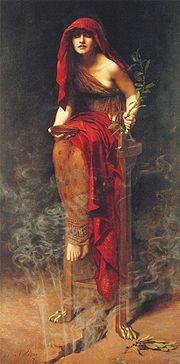
Oracle
In Classical Antiquity, an oracle was a person or agency considered to be a source of wise counsel or prophetic predictions or precognition of the future, inspired by the gods. As such it is a form of divination....
of Delphi, was the priestess at the Temple of Apollo
Apollo
Apollo is one of the most important and complex of the Olympian deities in Greek and Roman mythology...
at Delphi
Delphi
Delphi is both an archaeological site and a modern town in Greece on the south-western spur of Mount Parnassus in the valley of Phocis.In Greek mythology, Delphi was the site of the Delphic oracle, the most important oracle in the classical Greek world, and a major site for the worship of the god...
, located on the slopes of Mount Parnassus
Mount Parnassus
Mount Parnassus, also Parnassos , is a mountain of limestone in central Greece that towers above Delphi, north of the Gulf of Corinth, and offers scenic views of the surrounding olive groves and countryside. According to Greek mythology, this mountain was sacred to Apollo and the Corycian nymphs,...
. The Pythia was widely credited for her prophecies
Prophecy
Prophecy is a process in which one or more messages that have been communicated to a prophet are then communicated to others. Such messages typically involve divine inspiration, interpretation, or revelation of conditioned events to come as well as testimonies or repeated revelations that the...
inspired by Apollo. The Delphic oracle was established in the 8th century BC
8th century BC
The 8th century BC started the first day of 800 BC and ended the last day of 701 BC.-Overview:The 8th century BC was a period of great changes in civilizations. In Egypt, the 23rd and 24th dynasties led to rule from Nubia in the 25th Dynasty...
. The last recorded response was given in AD 393, when the emperor Theodosius I
Theodosius I
Theodosius I , also known as Theodosius the Great, was Roman Emperor from 379 to 395. Theodosius was the last emperor to rule over both the eastern and the western halves of the Roman Empire. During his reign, the Goths secured control of Illyricum after the Gothic War, establishing their homeland...
ordered pagan temples to cease operation. During this period the Delphic Oracle was the most prestigious and authoritative oracle in the Greek world.
The oracle is one of the best-documented religious institutions of the classical Greek world. Writers who mention the oracle include Aeschylus
Aeschylus
Aeschylus was the first of the three ancient Greek tragedians whose work has survived, the others being Sophocles and Euripides, and is often described as the father of tragedy. His name derives from the Greek word aiskhos , meaning "shame"...
, Aristotle
Aristotle
Aristotle was a Greek philosopher and polymath, a student of Plato and teacher of Alexander the Great. His writings cover many subjects, including physics, metaphysics, poetry, theater, music, logic, rhetoric, linguistics, politics, government, ethics, biology, and zoology...
, Clement of Alexandria
Clement of Alexandria
Titus Flavius Clemens , known as Clement of Alexandria , was a Christian theologian and the head of the noted Catechetical School of Alexandria. Clement is best remembered as the teacher of Origen...
, Diodorus, Diogenes
Diogenes of Sinope
Diogenes the Cynic was a Greek philosopher and one of the founders of Cynic philosophy. Also known as Diogenes of Sinope , he was born in Sinope , an Ionian colony on the Black Sea , in 412 or 404 BCE and died at Corinth in 323 BCE.Diogenes of Sinope was a controversial figure...
, Euripides
Euripides
Euripides was one of the three great tragedians of classical Athens, the other two being Aeschylus and Sophocles. Some ancient scholars attributed ninety-five plays to him but according to the Suda it was ninety-two at most...
, Herodotus
Herodotus
Herodotus was an ancient Greek historian who was born in Halicarnassus, Caria and lived in the 5th century BC . He has been called the "Father of History", and was the first historian known to collect his materials systematically, test their accuracy to a certain extent and arrange them in a...
, Julian
Julian the Apostate
Julian "the Apostate" , commonly known as Julian, or also Julian the Philosopher, was Roman Emperor from 361 to 363 and a noted philosopher and Greek writer....
, Justin
Justin
Justin is a given name. It may refer to:People* Justin , a common given name* Justin , 3rd century Roman historian* Justin I , or Flavius Iustinius Augustus, an Eastern Roman Emperor who ruled from 518 to 527...
, Livy
Livy
Titus Livius — known as Livy in English — was a Roman historian who wrote a monumental history of Rome and the Roman people. Ab Urbe Condita Libri, "Chapters from the Foundation of the City," covering the period from the earliest legends of Rome well before the traditional foundation in 753 BC...
, Lucan
Marcus Annaeus Lucanus
Marcus Annaeus Lucanus , better known in English as Lucan, was a Roman poet, born in Corduba , in the Hispania Baetica. Despite his short life, he is regarded as one of the outstanding figures of the Imperial Latin period...
, Ovid
Ovid
Publius Ovidius Naso , known as Ovid in the English-speaking world, was a Roman poet who is best known as the author of the three major collections of erotic poetry: Heroides, Amores, and Ars Amatoria...
, Pausanias
Pausanias (geographer)
Pausanias was a Greek traveler and geographer of the 2nd century AD, who lived in the times of Hadrian, Antoninus Pius and Marcus Aurelius. He is famous for his Description of Greece , a lengthy work that describes ancient Greece from firsthand observations, and is a crucial link between classical...
, Pindar
Pindar
Pindar , was an Ancient Greek lyric poet. Of the canonical nine lyric poets of ancient Greece, his work is the best preserved. Quintilian described him as "by far the greatest of the nine lyric poets, in virtue of his inspired magnificence, the beauty of his thoughts and figures, the rich...
, Plato
Plato
Plato , was a Classical Greek philosopher, mathematician, student of Socrates, writer of philosophical dialogues, and founder of the Academy in Athens, the first institution of higher learning in the Western world. Along with his mentor, Socrates, and his student, Aristotle, Plato helped to lay the...
, Plutarch
Plutarch
Plutarch then named, on his becoming a Roman citizen, Lucius Mestrius Plutarchus , c. 46 – 120 AD, was a Greek historian, biographer, essayist, and Middle Platonist known primarily for his Parallel Lives and Moralia...
, Sophocles
Sophocles
Sophocles is one of three ancient Greek tragedians whose plays have survived. His first plays were written later than those of Aeschylus, and earlier than or contemporary with those of Euripides...
, Strabo
Strabo
Strabo, also written Strabon was a Greek historian, geographer and philosopher.-Life:Strabo was born to an affluent family from Amaseia in Pontus , a city which he said was situated the approximate equivalent of 75 km from the Black Sea...
, Thucydides
Thucydides
Thucydides was a Greek historian and author from Alimos. His History of the Peloponnesian War recounts the 5th century BC war between Sparta and Athens to the year 411 BC...
, and Xenophon
Xenophon
Xenophon , son of Gryllus, of the deme Erchia of Athens, also known as Xenophon of Athens, was a Greek historian, soldier, mercenary, philosopher and a contemporary and admirer of Socrates...
.
The name 'Pythia' derived from Pytho, which in myth was the original name of Delphi. The Greeks derived this place name from the verb, pythein (πύθειν, "to rot"), which refers to the decomposition of the body of the monstrous Python
Python (mythology)
In Greek mythology, Python was the earth-dragon of Delphi, always represented in Greek sculpture and vase-paintings as a serpent. He presided at the Delphic oracle, which existed in the cult center for his mother, Gaia, "Earth," Pytho being the place name that was substituted for the earlier Krisa...
after she was slain by Apollo.
One common view has been that the Pythia delivered oracles in a frenzied state induced by vapors rising from a chasm in the rock, and that she spoke gibberish which priests reshaped into the enigmatic prophecies preserved in Greek literature.
This picture has been challenged by scholars such as Joseph Fontenrose
Joseph Fontenrose
Joseph Eddy Fontenrose was an American classical scholar. He was centrally interested in Greek religion and Greek mythology; he was also an expert on John Steinbeck, commenting on the mythology in Steinbeck's work.He was from Sutter Creek, California...
and Lisa Maurizio, who argue that the ancient sources uniformly represent the Pythia speaking intelligibly, and giving prophecies in her own voice. Recent geological investigations have shown that gas emissions from a geologic chasm in the earth could have inspired the Delphic Oracle to "connect with the divine." Some researchers suggest the possibility that ethylene
Ethylene
Ethylene is a gaseous organic compound with the formula . It is the simplest alkene . Because it contains a carbon-carbon double bond, ethylene is classified as an unsaturated hydrocarbon. Ethylene is widely used in industry and is also a plant hormone...
gas caused the Pythia's state of inspiration. However, Lehoux argues that ethylene is "impossible" and benzene is "crucially underdetermined." Others argue instead that methane
Methane
Methane is a chemical compound with the chemical formula . It is the simplest alkane, the principal component of natural gas, and probably the most abundant organic compound on earth. The relative abundance of methane makes it an attractive fuel...
might have been the gas emitted from the chasm, or CO2 and H2S
Hydrogen sulfide
Hydrogen sulfide is the chemical compound with the formula . It is a colorless, very poisonous, flammable gas with the characteristic foul odor of expired eggs perceptible at concentrations as low as 0.00047 parts per million...
, arguing that the chasm itself might have been a seismic ground rupture.
Origins of the Oracle
The earliest account of the origin of the Delphic oracle is provided in the Homeric Hymn to Delphic Apollo, which recent scholarship dates within a narrow range, ca. 580-570 BC. It describes in detail how Apollo chose his first priests, whom he selected in their "swift ship"; they were "Cretans from Minos' city of Knossos" who were voyaging to sandy Pylos. But Apollo, who had Delphinios as one of his cult epithets, leapt into the ship in the form of a dolphin (delphinos). Dolphin-Apollo revealed himself to the terrified Cretans, and bade them follow him up to the "place where you will have rich offerings". The Cretans "danced in time and followed, singing Iē Paiēon, like the paeanPaean
A paean is a song or lyric poem expressing triumph or thanksgiving. In classical antiquity, it is usually performed by a chorus, but some examples seem intended for an individual voice...
s of the Cretans in whose breasts the divine Muse has placed "honey-voiced singing". G.L. Huxley observes, "If the hymn to (Delphic) Apollo conveys a historical message, it is above all that there were once Cretan priests at Delphi." Robin Lane Fox notes that Cretan bronzes are found at Delphi from the eighth century onwards, and Cretan sculptures are dedicated as late as ca 620-600 BC: ""Dedications at the site cannot establish the identity of its priesthood," he observes, "but for once we have an explicit text to set beside the archaeological evidence." An early visitor to these "dells of Parnassus", at the end of the eighth century, was Hesiod
Hesiod
Hesiod was a Greek oral poet generally thought by scholars to have been active between 750 and 650 BC, around the same time as Homer. His is the first European poetry in which the poet regards himself as a topic, an individual with a distinctive role to play. Ancient authors credited him and...
, who was shown the omphalos
Omphalos
An omphalos is an ancient religious stone artifact, or baetylus. In Greek, the word omphalos means "navel" . According to the ancient Greeks, Zeus sent out two eagles to fly across the world to meet at its center, the "navel" of the world...
.
There are also many later stories of the origins of the Delphic Oracle. One late explanation, which is first related by the 1st century BC writer, Diodorus Siculus
Diodorus Siculus
Diodorus Siculus was a Greek historian who flourished between 60 and 30 BC. According to Diodorus' own work, he was born at Agyrium in Sicily . With one exception, antiquity affords no further information about Diodorus' life and doings beyond what is to be found in his own work, Bibliotheca...
, tells of a goat herder named Coretas, who noticed one day that one of his goats, who fell into a crack in the earth, was behaving strangely. On entering the chasm, he found himself filled with a divine presence and could see outside of the present into the past and the future. Excited by his discovery he shared it with nearby villagers. Many started visiting the site to experience the convulsions and inspirational trances, though some were said to disappear into the cleft due to their frenzied state. A shrine was erected at the site, where people began worshiping in the late Bronze Age, by 1600 B.C. The villagers chose a single young woman as the liaison for the divine inspirations. Eventually she spoke on behalf of gods.
According to earlier myths, the office of the oracle was initially held by the goddesses Themis
Themis
Themis is an ancient Greek Titaness. She is described as "of good counsel", and is the embodiment of divine order, law, and custom. Themis means "divine law" rather than human ordinance, literally "that which is put in place", from the verb τίθημι, títhēmi, "to put"...
and Phoebe
Phoebe (mythology)
In Greek mythology "radiant" Phoebe , was one of the original Titans, who were one set of sons and daughters of Uranus and Gaia. She was traditionally associated with the moon , as in Michael Drayton's Endimion and Phœbe, , the first extended treatment of the Endymion myth in English...
, and the site was initially sacred to Gaia
Gaia (mythology)
Gaia was the primordial Earth-goddess in ancient Greek religion. Gaia was the great mother of all: the heavenly gods and Titans were descended from her union with Uranus , the sea-gods from her union with Pontus , the Giants from her mating with Tartarus and mortal creatures were sprung or born...
. Subsequently it was held sacred to Poseidon
Poseidon
Poseidon was the god of the sea, and, as "Earth-Shaker," of the earthquakes in Greek mythology. The name of the sea-god Nethuns in Etruscan was adopted in Latin for Neptune in Roman mythology: both were sea gods analogous to Poseidon...
, the "Earth-shaker" god of earthquakes. During the Greek Dark Age, from the 11th to the 9th century BC, the arrival of a new god of prophecy saw the temple being seized by Apollo who expelled the twin guardian serpents of Gaia. Later myths stated that Phoebe or Themis had "given" the site to Apollo, rationalizing its seizure by priests of the new god, but presumably, having to retain the priestesses of the original oracle because of the long tradition. Apparently Poseidon was mollified by the gift of a new site in Troizen.
Diodorus also explained how, initially, the Pythia was an appropriately clad young virgin, for great emphasis was placed on the Oracle's chastity and purity to be reserved for union with the god Apollo. But one consultant notes,
The scholar Martin Litchfield West
Martin Litchfield West
Martin Litchfield West is an internationally recognised scholar in classics, classical antiquity and philology...
writes that the Pythia shows many traits of shamanistic
Shamanism
Shamanism is an anthropological term referencing a range of beliefs and practices regarding communication with the spiritual world. To quote Eliade: "A first definition of this complex phenomenon, and perhaps the least hazardous, will be: shamanism = technique of ecstasy." Shamanism encompasses the...
practices, likely inherited or influenced from Central Asian practices, although there is no evidence of any Central Asian connection at this time. He cites the Pythia sitting in a cauldron on a tripod, while making her prophecies in an ecstatic trance state, like shamans
Shamanism
Shamanism is an anthropological term referencing a range of beliefs and practices regarding communication with the spiritual world. To quote Eliade: "A first definition of this complex phenomenon, and perhaps the least hazardous, will be: shamanism = technique of ecstasy." Shamanism encompasses the...
, and her unintelligible utterings.
Personnel
Though little is known of how the priestess was chosen, the Pythia was probably selected, at the death of her predecessor, from amongst a guild of priestesses of the temple. These women were all natives of Delphi and were required to have led a pure life and be of good character. Although some were married, upon assuming their role as the Pythia, the priestesses ceased all family responsibilities, marital relations, and individual identity. In the heyday of the oracle, the Pythia may have been a woman chosen from a prominent family, well educated in geography, politics, history, philosophy, and the arts. In later periods, however, uneducated peasant women were chosen for the role, which may explain why the poetic pentameterPentameter
Pentameter may refer to:*the iambic pentameter of the modern period*the dactylic pentameter of antiquity...
or hexameter
Hexameter
Hexameter is a metrical line of verse consisting of six feet. It was the standard epic metre in classical Greek and Latin literature, such as in the Iliad and Aeneid. Its use in other genres of composition include Horace's satires, and Ovid's Metamorphoses. According to Greek mythology, hexameter...
prophecies of the early period, later were made only in prose
Prose
Prose is the most typical form of written language, applying ordinary grammatical structure and natural flow of speech rather than rhythmic structure...
. The archaeologist John Hale reports:
Working in the role of the Pythia did allow for upward mobility of social standing; the job of a priestess, especially the Pythia, was a respectable career for Greek women. Priestesses enjoyed many liberties and rewards for their high societal position, such as freedom from taxation, the right to own property and attend public events, a salary and housing provided by the state, a wide range of duties depending on their affiliation, and often gold crowns.
During the height of the oracle's popularity, as many as three women served as Pythia, another vestige of the triad, with two taking turns in giving prophecy and another kept in reserve.
Plutarch said that the Pythia's life was shortened through the service of Apollo. The sessions were said to be exhausting. At the end of each period the Pythia would be like a runner after a race or a dancer after an ecstatic dance. It clearly must have had a physical effect on the health of the Pythia.
Several other officials served the oracle in addition to the Pythia. After 200 BC at any given time there were two priests of Apollo, who were in charge of the entire sanctuary; Plutarch, who served as a priest in the late first century and early second century AD, gives us the most information about the organization of the oracle at that time. Before 200 BC, while the temple was dedicated to Apollo, there was probably only one priest of Apollo. Priests were chosen from among the leading citizens of Delphi, and were appointed for life. In addition to overseeing the oracle, priests would also conduct sacrifices at other festivals of Apollo, and had charge of the Pythian games. Earlier arrangements, before the temple became dedicated to Apollo, are not documented.
The other officials associated with the oracle are less well understood. These are the hosioi ("holy ones") and the prophētai (singular prophētēs). Prophētēs is the origin of the English word "prophet", but a better translation of the Greek word might be "one who speaks on behalf of another person." The prophetai are referred to in literary sources, but their function is unclear; it has been suggested that they interpreted the Pythia's prophecies, or even reshaped her utterances into verse, but it has also been argued that the term prophētēs is a generic reference to any cult officials at the sanctuary, including the Pythia. There were five hosioi, whose responsibilities are unclear, but may have been involved in some way with the operation of the oracle.
Oracular procedure
In the traditions associated with Apollo, the oracle only gave prophecies during the nine warmest months of each year. In the winter months, Apollo was said to have deserted his temple, his place being taken by his divine half-brother DionysusDionysus
Dionysus was the god of the grape harvest, winemaking and wine, of ritual madness and ecstasy in Greek mythology. His name in Linear B tablets shows he was worshipped from c. 1500—1100 BC by Mycenean Greeks: other traces of Dionysian-type cult have been found in ancient Minoan Crete...
, whose tomb was within the temple. It is not known whether the Oracle participated in the Dionysian rites of the Maenads or Thyades in the Korykion cave on Mount Parnassos, although Plutarch
Plutarch
Plutarch then named, on his becoming a Roman citizen, Lucius Mestrius Plutarchus , c. 46 – 120 AD, was a Greek historian, biographer, essayist, and Middle Platonist known primarily for his Parallel Lives and Moralia...
informs us that his friend Clea was both a Priestess to Apollo and to the secret rites of Dionysus. The male priests seem to have had their own ceremonies to the dying and resurrecting God. Apollo was said to return at the beginning of Spring, on the 7th day of the month of Vysios, his birthday. This also would reiterate the absences of the great goddess Demeter
Demeter
In Greek mythology, Demeter is the goddess of the harvest, who presided over grains, the fertility of the earth, and the seasons . Her common surnames are Sito as the giver of food or corn/grain and Thesmophoros as a mark of the civilized existence of agricultural society...
in winter also, which would have been a part of the earliest traditions.
Once a month, thereafter, the oracle would undergo purification rites, including fasting, to ceremonially prepare the Pythia for communications with the divine. On the seventh day of each month, she would bathe in the Castalian Spring
Castalian Spring
The Castalian Spring, in the ravine between the Phaedriades at Delphi, is where all visitors to Delphi — the contestants in the Pythian Games, and especially suppliants who came to consult the Delphic Oracle — stopped to wash their hair; and where Roman poets came to receive poetic...
then would drink the holier waters of the Kassotis, which ran closer to the temple, where a naiad
Naiad
In Greek mythology, the Naiads or Naiades were a type of nymph who presided over fountains, wells, springs, streams, and brooks....
possessing magical powers was said to live.
She then descended into the adyton (Greek for "inaccessible") and mounted her tripod seat, holding laurel leaves and a dish of Kassotis spring water into which she gazed. Nearby was the omphalos
Omphalos
An omphalos is an ancient religious stone artifact, or baetylus. In Greek, the word omphalos means "navel" . According to the ancient Greeks, Zeus sent out two eagles to fly across the world to meet at its center, the "navel" of the world...
(Greek for "navel"), which was flanked by two solid gold eagles representing the authority of Zeus
Zeus
In the ancient Greek religion, Zeus was the "Father of Gods and men" who ruled the Olympians of Mount Olympus as a father ruled the family. He was the god of sky and thunder in Greek mythology. His Roman counterpart is Jupiter and his Etruscan counterpart is Tinia.Zeus was the child of Cronus...
, and the cleft from which emerged the sacred Pneuma
Pneuma (disambiguation)
Pneuma is an ancient Greek word for "breath", and in a religious context for "spirit" or "soul."Pneuma may also refer to:* Pneuma , the "breath of life" in Stoic philosophy...
.
Consultants, carrying laurel branches sacred to Apollo, approached the temple along the winding upward course of the Sacred Way, bringing an animal for sacrifice in the forecourt of the temple, and a monetary fee. Petitioners drew lots to determine the order of admission, but representatives of a city-state or those who brought larger donations to Apollo were secured a higher place in line. The sacrificial animal, often a goat as representation of the site's discovery, was first showered with water and observed to ensure that it shivered from the hooves upward, an auspicious sign that the oracular reading could proceed. Upon sacrifice, the animal's organs, particularly its liver, were examined to ensure the signs were favorable.
Plutarch describes the events of one session in which the omens were ill-favored, but the Oracle was consulted nonetheless. The priests pressed onward to receive the prophecy, but the result was a hysterical uncontrollable reaction from the priestess that resulted in her death a few days later.
At times when the Pythia was not available, consultants could obtain guidance by asking simple Yes-or-No questions to the priests. A response was returned through the tossing of colored beans, one color designating "yes," another "no." Little else is known of this practice.
Between 535 and 615 of the Oracles of Delphi are known to have survived since classical times, of which over half are said to be historically accurate (see the article Famous Oracular Statements from Delphi
Famous oracular statements from Delphi
Pythia was the priestess presiding over the Oracle of Apollo at Delphi. There are more than 500 supposed Oracular statements which have survived from various sources referring to the oracle at Delphi. Many are anecdotal, and have survived as proverbs. Several are ambiguously phrased, apparently...
for some examples).
The experience of supplicants
It would appear that the supplicant to the oracle would undergo a four-stage process, typical of shamanic journeys.- Step 1: Journey to Delphi — Supplicants were motivated by some need to undertake the long and sometimes arduous journey to come to Delphi in order to consult the oracle. This journey was motivated by an awareness of the existence of the oracle, the growing motivation on the part of the individual or group to undertake the journey, and the gathering of information about the oracle as providing answers to important questions.
- Step 2: Preparation of the Supplicant — Supplicants were interviewed in preparation of their presentation to the Oracle, by the priests in attendance. The genuine cases were sorted and the supplicant had to go through rituals involving the framing of their questions, the presentation of gifts to the Oracle and a procession along the Sacred Way carrying laurel leaves to visit the temple, symbolic of the journey they had made.
- Step 3: Visit to the Oracle — The supplicant would then be led into the temple to visit the adyton, put his question to the Pythia, receive his answer and depart. The degree of preparation already undergone would mean that the supplicant was already in a highly aroused and meditative state, similar to the shamanic journey elaborated on in the article.
- Step 4: Return Home — Oracles were meant to give advice to shape future action, that was meant to be implemented by the supplicant, or by those that had sponsored the supplicant to visit the Oracle. The validity of the Oracular utterance was confirmed by the consequences of the application of the oracle to the lives of those people who sought Oracular guidance.
Fumes and vapors
There have been many attempts to find a scientific explanation for the Pythia's inspiration. However, most commonly, these refer to an observation made by PlutarchPlutarch
Plutarch then named, on his becoming a Roman citizen, Lucius Mestrius Plutarchus , c. 46 – 120 AD, was a Greek historian, biographer, essayist, and Middle Platonist known primarily for his Parallel Lives and Moralia...
, who presided as high priest
Priest
A priest is a person authorized to perform the sacred rites of a religion, especially as a mediatory agent between humans and deities. They also have the authority or power to administer religious rites; in particular, rites of sacrifice to, and propitiation of, a deity or deities...
at Delphi for several years, who stated that her oracular powers appeared to be linked to vapors from the Kerna spring waters
Spring (hydrosphere)
A spring—also known as a rising or resurgence—is a component of the hydrosphere. Specifically, it is any natural situation where water flows to the surface of the earth from underground...
that ran under the temple. It has often been suggested that these vapors may have been hallucinogenic gases.
Excavations
Beginning in 1892, a team of French archaeologists led by Théophile Homolle of the Collège de FranceCollège de France
The Collège de France is a higher education and research establishment located in Paris, France, in the 5th arrondissement, or Latin Quarter, across the street from the historical campus of La Sorbonne at the intersection of Rue Saint-Jacques and Rue des Écoles...
excavated the site at Delphi. Contrary to ancient literature, they found no fissure and no possible means for the production of fumes.
An English scholar "with the very French name" of Adolphe Paul Oppé published an influential article in 1904, which made three crucial claims: No chasm or vapor ever existed; no natural gas could create prophetic visions; and the recorded incidents of a priestess undergoing violent and often deadly reactions was inconsistent with the more customary reports. Oppé explained away all the ancient testimony as being reports of gullible travelers fooled by wily local guides who, Oppé believed, invented the details of a chasm and a vapor, in the first place.
Following this definitive statement, such scholars as Frederick Poulson, E.R. Dodds, Joseph Fontenrose, and Saul Levin all stated that there were no vapors and no chasm. For the decades to follow, scientists and scholars believed the ancient descriptions of a sacred, inspiring pneuma to be fallacious. In 1950, the French hellenist
Hellenic studies
Hellenic Studies is an interdisciplinary scholarly field that focuses on the study of Greek culture, ancient, Medieval and modern, including Hellenic diaspora communities around the world....
Pierre Amandry, who had worked at Delphi and later directed the French excavations there, concurred with Oppé's pronouncements, claiming that gaseous emissions were not even possible in a volcanic zone such as Delphi. Neither Oppé nor Amandry were geologists, though, and no geologists had been involved in the debate up to that point.
Subsequent re-examination of the French excavations, however, has shown that this consensus may have been mistaken. Broad (2007) demonstrates that a French photograph of the excavated interior of the temple clearly depicts a springlike pool as well as a number of small vertical fissures, indicating numerous pathways by which vapors could enter the base of the temple.
In the 1980s, the interdisciplinary team of geologist Jelle Zeilinga de Boer, archaeologist John R. Hale, forensic chemist Jeffrey P. Chanton, and toxicologist Henry R. Spiller investigated the site at Delphi using this photograph and other sources as evidence, as part of a United Nations survey of all active faults in Greece.
Jelle Zeilinga de Boer saw evidence of a fault line in Delphi that ran under the ruined temple.
Over several expeditions, they discovered two major fault lines, one lying north-south, the Kerna fault, and the other lying east-west, the Delphic fault, which parallels the shore of the Corinthian Gulf. The rift
Rift
In geology, a rift or chasm is a place where the Earth's crust and lithosphere are being pulled apart and is an example of extensional tectonics....
of the Gulf of Corinth is one of the most geologically active sites on Earth; shifts there impose immense strains on nearby fault lines, such as those below Delphi. The two faults cross one another, and they intersect right below where the adyton was probably located. (The actual, original oracle chamber had been destroyed by the moving faults, but there is strong structural evidence that indicates where it was most likely located.) They also found evidence for underground passages and chambers, and drains for spring water. Additionally, they discovered at the site formations of travertine
Travertine
Travertine is a form of limestone deposited by mineral springs, especially hot springs. Travertine often has a fibrous or concentric appearance and exists in white, tan, and cream-colored varieties. It is formed by a process of rapid precipitation of calcium carbonate, often at the mouth of a hot...
, a form of calcite created when water flows through limestone and dissolves calcium carbonate
Calcium carbonate
Calcium carbonate is a chemical compound with the formula CaCO3. It is a common substance found in rocks in all parts of the world, and is the main component of shells of marine organisms, snails, coal balls, pearls, and eggshells. Calcium carbonate is the active ingredient in agricultural lime,...
, which is later redeposited. Further investigation revealed that deep beneath the Delphi region lies bituminous deposit, rich in hydrocarbons and full of pitch, that has a petrochemical content as high as 20%. Friction created by earthquakes heat the bituminous layers resulting in vaporization of the hydrocarbons which rise to the surface through small fissures in the rock.
Illusions in the adyton
It has been disputed as to how the adyton was organized, but it appears clear that this temple was unlike any other in Ancient Greece. The small chamber was located below the general floor of the temple and offset to one side, perhaps specifically constructed over the crossing faults. The intimate chamber allowed the escaping vapors to be contained in quarters close enough to provoke intoxicating effects. Plutarch reports that the temple was filled with a sweet smell when the deity was present:De Boer's research led him to speculate ethylene
Ethylene
Ethylene is a gaseous organic compound with the formula . It is the simplest alkene . Because it contains a carbon-carbon double bond, ethylene is classified as an unsaturated hydrocarbon. Ethylene is widely used in industry and is also a plant hormone...
as a gas known to possess this sweet odor. Toxicologist Henry R. Spiller specified that inhalation of even a small amount of ethylene can cause both benign trances and euphoric frenzied states. Other effects include physical detachment, loss of inhibitions, the relieving of pain, and rapidly changing moods without dulling consciousness. He also noted that uncontrolled doses can lead to confusion, agitation, delirium, and loss of muscle coordination. Anesthesiologist
Anesthesiologist
An anesthesiologist or anaesthetist is a physician trained in anesthesia and peri-operative medicine....
Isabella Herb found that a dose of 20% ethylene gas administered to a subject was a clear threshold. A dosage higher than 20% caused unconsciousness. With less than 20% a trance was induced where the subject could sit up, hear questions and answer them logically, although the tone of their voice might be altered, their speech pattern could be changed, and they may have lost some awareness of their hands and feet, (with some it was possible to have poked a pin or pricked them with a knife and they would not feel it). When patients were removed from the area where the gas accumulated they had no recollection of what had happened, or what they had said. With a dosage of more than 20% the patient lost control over the movement of their limbs and may thrash wildly, groaning in strange voices, losing balance and frequently repeatedly falling. All of these symptoms match the experience of the Pythia in action, as related by Plutarch, who witnessed many prophecies.
In 2001, water samples from the nearby springs hailed evidence of the presence of the hallucinogenic hydrocarbon. The Kerna spring, originating uphill from the temple, yielded 0.3 parts per million of ethylene. Today, the waters of the Kerma spring are diverted from the temple for use by the nearby modern town of Delphi. It is unknown the degree to which ethylene or other gases would be detected at the temple should these waters still run free, as they did in the ancient world.
Chunks of travertine
Travertine
Travertine is a form of limestone deposited by mineral springs, especially hot springs. Travertine often has a fibrous or concentric appearance and exists in white, tan, and cream-colored varieties. It is formed by a process of rapid precipitation of calcium carbonate, often at the mouth of a hot...
, calcareous rock formed of mineral spring deposits, were also extracted from the temple and tested, but no traces of ethylene were identified. The nature of the hydrocarbon accounts for this. Ethylene is extremely light and volatile, having a highly reactive nature, and therefore could have presumably escaped the rock long ago. By testing the samples from the spring water, the team was at least able to identify the substance's current presence at the site, giving them insight that a presumably larger quantity existed in the waters thousands of years earlier.
Frequent earthquake
Earthquake
An earthquake is the result of a sudden release of energy in the Earth's crust that creates seismic waves. The seismicity, seismism or seismic activity of an area refers to the frequency, type and size of earthquakes experienced over a period of time...
s produced by the fact that Greece lies at the intersection of three separate tectonic plates
Tectonic Plates
Tectonic Plates is a 1992 independent Canadian film directed by Peter Mettler. Mettler also wrote the screenplay based on the play by Robert Lepage. The film stars Marie Gignac, Céline Bonnier and Robert Lepage.-Plot summary:...
seem to have been responsible for the observed cracking of the limestone, and the opening up of new channels by which hydrocarbons enter the flowing waters of the Kassotis. This would cause the amounts of ethylene emitted to fluctuate, increasing or decreasing the potency of the drug released, over time. It has been suggested that the decline in the importance of the Oracle past the era of Roman Emperor Hadrian
Hadrian
Hadrian , was Roman Emperor from 117 to 138. He is best known for building Hadrian's Wall, which marked the northern limit of Roman Britain. In Rome, he re-built the Pantheon and constructed the Temple of Venus and Roma. In addition to being emperor, Hadrian was a humanist and was philhellene in...
was due in part to the fact that there had not been an earthquake in the area for a significant length of time.
Venom
Another interpretation, by art historian Merlin StoneMerlin Stone
Merlin Stone was an author, sculptor, and professor of art and art history. She is best-known for her book, When God Was a Woman.-Biography:...
, suggests the use of venom rather than ethylene. As she describes in When God was a Woman
When God Was a Woman
When God Was a Woman is the U.S. title of a 1976 book by sculptor and art historian Merlin Stone. It was published earlier in the UK as The Paradise Papers: The Suppression of Women's Rites...
, when people, after having being immunized against snake-bite, are bitten, particularly by krait, cobra
Cobra
Cobra is a venomous snake belonging to the family Elapidae. However, not all snakes commonly referred to as cobras are of the same genus, or even of the same family. The name is short for cobra capo or capa Snake, which is Portuguese for "snake with hood", or "hood-snake"...
or another elapids, they experience an emotional and mental state that has been compared to the effects of hallucinogenic substances.
Auditory hallucinations
Psychologist Julian JaynesJulian Jaynes
Julian Jaynes was an American psychologist, best known for his book The Origin of Consciousness in the Breakdown of the Bicameral Mind , in which he argued that ancient peoples were not conscious....
attributed the Oracle to auditory hallucinations heard by the Pythia, in line with his so-called bicameral mind theory. According to Jaynes, such hallucinations had been previously experienced by all humans, attributed to gods, obeyed unquestioningly, and were the foundation of religion and social control. But, by the time of the Delphic Oracle, these hallucinations were dying out, due to changes in human psychology - specifically, the development of introspection, planning and decision-making. The priestesses at the Oracle were among the few people who still experienced auditory hallucinations regularly, but as the latter were still believed to be of divine origin, their content was highly prized by others.
See also
- The Apollonian and DionysianApollonian and DionysianThe Apollonian and Dionysian is a philosophical and literary concept, or dichotomy, based on certain features of ancient Greek mythology. Several Western philosophical and literary figures have invoked this dichotomy in critical and creative works....
concept of human dichotomyDualismDualism denotes a state of two parts. The term 'dualism' was originally coined to denote co-eternal binary opposition, a meaning that is preserved in metaphysical and philosophical duality discourse but has been diluted in general or common usages. Dualism can refer to moral dualism, Dualism (from...
. - Delphi methodDelphi methodThe Delphi method is a structured communication technique, originally developed as a systematic, interactive forecasting method which relies on a panel of experts.In the standard version, the experts answer questionnaires in two or more rounds...
, a structured communication technique, unrelated to the Oracle of Delphi.
Ancient sources
- HerodotusHerodotusHerodotus was an ancient Greek historian who was born in Halicarnassus, Caria and lived in the 5th century BC . He has been called the "Father of History", and was the first historian known to collect his materials systematically, test their accuracy to a certain extent and arrange them in a...
, The Histories, at the Perseus Project - Homeric Hymn to Apollo, at the Perseus Project
- PausaniasPausanias (geographer)Pausanias was a Greek traveler and geographer of the 2nd century AD, who lived in the times of Hadrian, Antoninus Pius and Marcus Aurelius. He is famous for his Description of Greece , a lengthy work that describes ancient Greece from firsthand observations, and is a crucial link between classical...
, Description of Greece, (ed. and translated with commentary by Sir James FrazerJames FrazerSir James George Frazer , was a Scottish social anthropologist influential in the early stages of the modern studies of mythology and comparative religion...
), 1913 edition. Cf. v.5 - PlutarchPlutarchPlutarch then named, on his becoming a Roman citizen, Lucius Mestrius Plutarchus , c. 46 – 120 AD, was a Greek historian, biographer, essayist, and Middle Platonist known primarily for his Parallel Lives and Moralia...
, De defectu oraculorum ("On the Decline of Oracles") and De Pythiae Oraculis ("On the Oracles of the Pythia"), in Moralia, vol. 5 (Loeb Library, Harvard University Press)
Modern sources
- de Boer, Jelle Zeilinga, John Rigby Hale & Henry A. Spiller, "The Delphic Oracle: A Multidisciplinary Defense of the Gaseous Vent Theory." Clinical ToxicologyClinical ToxicologyClinical Toxicology is a journal of primary interest to practicing clinical toxicologists, whether based in hospitals, poison control centers, academia, government or industry...
40.2 189-196 (2000) - de Boer, Jelle Zeilinga, Jeffrey P. Chandon & John Rigby HaleJohn Rigby HaleSir John Rigby Hale was a British Renaissance historian, translator, editor, and university professor.John Rigby Hale was born September 17, 1923, in Ashford, Kent, in the United Kingdom. He was educated at Jesus College, Oxford . He also attended Johns Hopkins University and Harvard University...
, "New Evidence for the Geological Origins of the Ancient Delphic Oracle," GeologyGeology (journal)Geology is a publication of the Geological Society of America . The GSA claims that it is the most widely read scientific journal in the field of earth science...
29.8, 707-711 (2001) - de Boer, Jelle Zeilinga, Jeffrey P. Chandon, John Rigby Hale & Henry A. Spiller, "Questioning the Delphic Oracle", Scientific AmericanScientific AmericanScientific American is a popular science magazine. It is notable for its long history of presenting science monthly to an educated but not necessarily scientific public, through its careful attention to the clarity of its text as well as the quality of its specially commissioned color graphics...
(August 2003) - Bouché-Leclercq, AugusteAuguste Bouché-Leclercq- Life :Auguste Bouché-Leclercq was born in 1842 at Francières, Oise as son of Louis-Thomas Bouché and Marie-Joséphine Leclercq. His parents were farmers. He was educated at seminaries and took his school-leaving exam in 1861 in Paris. Later he travelled as private tutor several months through...
, Histoire de la divination dans l'Antiquité, volumes I-IV, Paris (1879-1882) - Broad, William J.William BroadWilliam J. Broad is an author and a Senior Writer at The New York Times.-Awards:Broad has won two Pulitzer Prizes with Times colleagues, as well as an Emmy and a DuPont. He won the Pulitzers for coverage of the space shuttle Challenger disaster and the feasibility of antimissile arms...
The Oracle: Ancient Delphi and the Science Behind Its Lost Secrets, New York, Penguin Press, ISBN 9780143038597 (2007); hardcover edition The Oracle: the lost secrets and hidden message of ancient Delphi, Penguin Press, ISBN 1-59420-081-5 (2006) - Burkert, WalterWalter BurkertWalter Burkert is a German scholar of Greek mythology and cult.An emeritus professor of classics at the University of Zurich, Switzerland, he also has taught in the United Kingdom and the United States...
Greek Religion, Harvard University Press, ISBN 0674362802 (1985); Orig. in German (1977) - Connelly, Joan BretonJoan Breton ConnellyJoan Breton Connelly is an American classical archaeologist and Professor of Classics and Art History at New York University. She is Director of the Yeronisos Island Excavations and Field School in Cyprus. Connelly was awarded a MacArthur Fellowship in 1996...
Portrait of a Priestess: Women and Ritual in Ancient Greece, Princeton University Press, 2007, ISBN 0-691-12746-8 - Courby, Fernand, Feuilles de Delphi: Tome 2, Topographie et Architecture, La Terrace du Temple (1927)
- Dempsey, T., Reverend, The Delphic oracle, its early history, influence and fall, Oxford, B.H. Blackwell (1918)
- Dodds, E. R. The Greeks and the Irrational, Berkeley, University of California Press (1963)
- Etiope, G., D. Christodoulou, M. Geraga, P. Favali, & G. Papatheodorou, "The geological links of the ancient Delphic Oracle (Greece): a reappraisal of natural gas occurrence and origin", Geology, 34, 821-824 (2006)
- Farnell, Lewis RichardLewis Richard FarnellLewis Richard Farnell FBA was a classical scholar and Oxford academic, where he served as Vice-Chancellor from 1920 to 1923.Lewis Farnell was born in Salisbury, southern England, in 1856. He was educated at the City of London School and Exeter College, Oxford, where he graduated with a first class...
, The Cults of the Greek States, Volumes I-V, Clarendon Press, (1896-1909); cf. especially, volume IV on the Pythoness and Delphi - Fontenrose, Joseph EddyJoseph FontenroseJoseph Eddy Fontenrose was an American classical scholar. He was centrally interested in Greek religion and Greek mythology; he was also an expert on John Steinbeck, commenting on the mythology in Steinbeck's work.He was from Sutter Creek, California...
, Python; a study of Delphic myth and its origins, New York, Biblio & Tannen, ISBN 0-8196-0285-X (1959; 1974) - Fontenrose, Joseph EddyJoseph FontenroseJoseph Eddy Fontenrose was an American classical scholar. He was centrally interested in Greek religion and Greek mythology; he was also an expert on John Steinbeck, commenting on the mythology in Steinbeck's work.He was from Sutter Creek, California...
, The Delphic oracle, its responses and operations, with a catalogue of responses, Berkeley : University of California Press, ISBN 0-520-03360-4 (1978) - Foster J., Lehoux D.R., "The Delphic Oracle and the ethylene-intoxication hypothesis", Clinical ToxicologyClinical ToxicologyClinical Toxicology is a journal of primary interest to practicing clinical toxicologists, whether based in hospitals, poison control centers, academia, government or industry...
, 45, 85-89 (2007) - Golding, WilliamWilliam GoldingSir William Gerald Golding was a British novelist, poet, playwright and Nobel Prize for Literature laureate, best known for his novel Lord of the Flies...
, The Double Tongue, London, Faber (1995). Posthumous, fictional novel by the NobelNobel PrizeThe Nobel Prizes are annual international awards bestowed by Scandinavian committees in recognition of cultural and scientific advances. The will of the Swedish chemist Alfred Nobel, the inventor of dynamite, established the prizes in 1895...
prize winner about a Pythia in the 1st century BC. - Goodrich, Norma Lorre, Priestesses, New York : F. Watts, ISBN 0-531-15113-1 (1989); Harper Collins, Perennial, ISBN 0-06-097316-1 (1990)
- Guthrie, William Keith ChambersW. K. C. GuthrieWilliam Keith Chambers Guthrie was a Scottish classical scholar, best known for his History of Greek Philosophy, published in six volumes between 1962 and his death.-Early life and education:...
, The Greeks and their Gods (1950) - Hall, Manly PalmerManly Palmer HallManly Palmer Hall was a Canadian-born author and mystic. He is perhaps most famous for his 1928 work The Secret Teachings of All Ages.-Early years:...
, The Secret Teachings of All Ages, Cf Chapter 14, (1928) - Holland, Leicester B., "The Mantic Mechanism at Delphi," American Journal of ArchaeologyAmerican Journal of ArchaeologyThe American Journal of Archaeology , the peer-reviewed journal of the Archaeological Institute of America, has been published since 1897...
37 pp. 201-214 (1933) - Jaynes, JulianJulian JaynesJulian Jaynes was an American psychologist, best known for his book The Origin of Consciousness in the Breakdown of the Bicameral Mind , in which he argued that ancient peoples were not conscious....
The Origin of Consciousness in the Breakdown of the Bicameral Mind, Mariner Books (1976); paperback ISBN 9780618057078 (2000) - Lehoux D.R., "Drugs and the Delphic Oracle", Classical World, 101, 1, 41-56 (2007)
- Maass, E., De Sibyllarum Indicibus, Berlin (1879)
- Maurizio, Lisa, "The Voice at the Centre of the World: The Pythia's Ambiguity and Authority" pp. 46–50 in editors Andre Lardinois and Laura McClure Making Silence Speak: Women's Voices in Greek Literature and Society, Princeton University Press (2001)
- Miller, Water, Daedalus and Thespis Vol 1, (1929)
- Mitford, WilliamWilliam MitfordWilliam Mitford , English historian, was the elder of the two sons of John Mitford, a barrister and his wife Philadelphia Reveley.-Youth:...
, The History of Greece (1784); Cf. v.1, Chapter III, Section 2, p. 177, "Origin and Progress of the Oracles" - Morgan, Catherine. Athletes and Oracles, Cambridge (1990)
- Parke, Herbert William, A History of the Delphic Oracle, Basil Blackwell, Oxford, ASINAmazon Standard Identification NumberThe Amazon Standard Identification Number is a unique identification number assigned by Amazon.com and its partners for product identification within the Amazon.com organization. Amazon.ca, Amazon.co.uk, Amazon.de, Amazon.fr, Amazon.it, Amazon.co.jp, Amazon.cn, and Amazon.es also use ASINs.ASINs...
B002NZWT0Y (1939) - Parke, Herbert William, Sibyls and Sibylline Prophecy in Classical Antiquity, Routledge, London, ISBN 978-0415076388 (reprinted 1992)
- Piccardi, L., "Active faulting at Delphi: seismotectonic remarks and a hypothesis for the geological environment of a myth", Geology, 28, 651-654 (2000)
- Piccardi L., C. Monti, , F. Tassi O. Vaselli, D. Papanastassiou & K. Gaki-Papanastassiou , "Scent of a myth: tectonics, geochemistry and geomythology at Delphi (Greece)", Journal of the Geological Society, London, 165, 5-18 (2008)
- Potter, David Stone, Prophecy and history in the crisis of the Roman Empire: a historical commentary on the Thirteenth Sibylline Oracle, Cf. Chapter 3 (1990)
- Poulson, Frederick. Dephi Gleydenhall, London (1920)
- Rohde, ErwinErwin RohdeErwin Rohde was one of the great German classical scholars of the 19th and early 20th centuries.Rohde was born in Hamburg and was the son of a doctor. Outside of antiquarian circles, Rohde is known today chiefly for his friendship and correspondence with fellow-philologist Friedrich Nietzsche...
, Psyche: The Cult of Souls and the Belief in Immortality among the Greeks, trans. from the 8th edn. by W. B. Hillis, Routledge & Kegan Paul, London, (1925); reprinted by Routledge (2000); full text in English - West, Martin LitchfieldMartin Litchfield WestMartin Litchfield West is an internationally recognised scholar in classics, classical antiquity and philology...
, The Orphic Poems, Oxford: Clarendon Press ISBN 0-19-814854-2 (1983)
External links
- "Delphic Oracle's Lips May Have Been Loosened by Gas Vapors" National Geographic August 14, 2001