


John Martin (painter)

Encyclopedia
John Martin was an English
Romantic
painter
, engraver and illustrator.
, near Hexham
in Northumberland
, the 4th son of Fenwick Martin, a one time fencing
master. He was apprenticed by his father to a coachbuilder in Newcastle upon Tyne
to learn heraldic painting
, but owing to a dispute over wages the indentures were cancelled, and he was placed instead under Boniface Musso, an Italian artist, father of the enamel painter Charles Muss. With his master, Martin moved from Newcastle to London
in 1806, where he married at the age of nineteen, and supported himself by giving drawing lessons, and by painting in watercolours, and on china and glass - his only surviving painted plate is now in a private collection in England. His leisure was occupied in the study of perspective and architecture. His brothers were William
, the eldest, an inventor; Richard, a soldier who fought in the Peninsular War
and at Waterloo
; and Jonathan, a preacher tormented by madness who set fire to York Minster
in 1829, for which he stood trial.
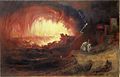
Martin began to supplement his income by painting sepia watercolours. He sent his first oil painting to the Royal Academy in 1810 but it was not hung. In 1811 he sent the painting once again, when it was hung under the title "A Landscape Composition" as item no.46 in the Great Room. Thereafter, he produced a succession of large exhibited oil paintings: some landscapes, but more usually grand biblical themes inspired by the Old Testament. His landscapes have the ruggedness of the Northumberland crags, while some authors claim that his vast apocalyptic canvasses, like The Destruction of Sodom and Gomorrah show his familiarity with the forges and ironworks of the Tyne Valley – certainly, they display his intimate knowledge of the Old Testament. His timing could not have been better. In the years of the Regency from 1812 onwards there was a fashion for such ‘sublime’ paintings, encouraged by the publications of travellers returning from the Grand Tour or the Middle East with exotic tales of places like Ur and Babylon, Pompeii and Alexandria.
Martin’s break came at the end of a season at the Royal Academy, where his first great sublime canvas Sadak in Search of the Waters of Oblivion
had been hung – and ignored. He brought it home, only to find there a visiting card from William Manning MP, a governor of the Bank of England. Manning wanted to buy it from him.
Such influential patronage propelled Martin’s career onto a major stage though he was never, to his disgust, elected to the Royal Academy. This promising career was interrupted though, by the death of his father, mother, grandmother and young son – all in a single year. Another distraction was William, who frequently asked him to draw up plans for his inventions, and whom he always indulged with help and money. But, heavily influenced by the works of Milton, he continued with his grand themes, despite a number of financial and artistic setbacks - one of his works was ruined while waiting to be hung at the Academy by a careless artist spilling a pot of dark varnish over it. In 1816 he finally achieved public acclaim with Joshua Commanding the Sun to Stand Still upon Gibeon, an immense theme which struck a popular chord even though it broke many of the conventional rules of composition. In 1818, on the back of the sale of the Fall of Babylon for £420, he finally rid himself of debt and bought a house in Marylebone - then, as now, a fashionable and desirable part of London, where he came into contact with a wide range of artists, writers, scientists and Whig nobility.
His triumph was Belshazzar’s Feast, of which he boasted beforehand, “it shall make more noise than any picture ever did before... only don’t tell anyone I said so.” Five thousand people paid to see it. It was later, in a superb historical irony, nearly ruined when the carriage in which it was being transported was struck by a train at a level crossing near Oswestry; in 1841, with John Martin himself on the footplate, Isambard Kingdom Brunel ran a train at 90 mph to disprove Stephenson’s theory that locomotives could not go faster than horses.
In private Martin was passionate, a devotee of chess - and, in common with his brothers, swordsmanship and javelin-throwing - and a devout Christian, believing in "Natural Religion". Despite an often cited singular instance of his hissing at the national anthem, he was courted by royalty and presented with several gold medals, one of them from the Russian Tsar Nicholas, on whom a visit to Wallsend colliery on Tyneside had made an unforgettable impression: ‘My God,’ he had cried, ‘it is like the mouth of Hell.’ Martin became the official historical painter to Prince Leopold of Saxe-Coburg – Queen Victoria’s ‘dearest Uncle’ - who would have been Queen Charlotte’s consort had she lived, and who later became the first King of Belgium, where he constructed Europe’s first major railway. Leopold was the godfather of Martin’s son Leopold, and endowed Martin with one of Belgium’s first knighthoods, the Order of Leopold. Martin frequently had early morning visits from another Saxe-Coburg, Prince Albert, who would engage him in banter from his horse – Martin standing in the doorway still in his dressing gown – at seven o'clock in the morning. Martin, and his highly intelligent wife Susan were warm and affectionate friends to many, but he was also a passionate defender of deism and Natural Religion, evolution (long before Darwin) and rationality.
Georges Cuvier, the great French naturalist, became an admirer of Martin’s, and he increasingly enjoyed the company of scientists, artists and writers – Dickens, Faraday and Turner among them. He began to experiment with mezzotint technology, and as a result was commissioned to produce 24 engravings for a new edition of Paradise Lost – perhaps the definitive illustrations of Milton’s masterpiece, of which copies now fetch many hundreds of pounds. Politically his sympathies are not clear; some claim he was a radical, but this is not bourne out by known facts; although he knew William Godwin, the ageing reformed revolutionist, husband of Mary Wollstonecraft and father of Mary Shelley; and John Hunt, co-founder of The Examiner.
At one time the Martins took under their wing a young woman called Jane Webb, who at twenty produced The Mummy a novel almost as influential as Frankenstein
. The Mummy was a socially optimistic but satirical vision of a steam-driven world in the 22nd century, the progenitor of a hundred books and as many movies. Another friend was Charles Wheatstone
, professor of physics at King’s College, London. Wheatstone experimented with telegraphy and invented the concertina and stereoscope; Martin was fascinated by his attempts to measure the speed of light. Accounts of Martin’s evening parties reveal an astonishing array of thinkers, eccentrics and social movers; one witness was a very young John Tenniel - later illustrator of Lewis Carroll’s work - who was heavily influenced by Martin and who was a close friend of his children. At various points Martin’s brothers were also among the guests – their eccentricities and conversation adding to the already exotic flavour of the fare.
Martin himself might have been even more famous if he had not for nearly a decade from about 1827-28 turned away from his painting career to become involved with his many plans and inventions. His brother Jonathan’s trial for setting fire to York Minster also proved an expensive burden. John Martin developed a fascination with solving London’s water and sewage problems, involving the creation of the Thames embankment containing a central drainage system. His plans were visionary: they show a fine engineering brain coupled with the artistic vision that would have made London a city of European grandeur. They formed the basis for many later engineers’ designs – Joseph Bazalgette’s included - and were approved by Michael Faraday and Martin’s great artistic competitor, Turner. These plans, along with railway schemes, an idea for ‘laminating timber’, lighthouses, and draining islands, all survive. Debt and family pressures, including the suicide of his nephew – Jonathan’s son Richard, brought depression which reached its worst in 1838. However, from 1839 Martin's fortunes recovered and he exhibited many works during the 1840s, culminating in his triumphal Last Judgment trilogy of paintings (Tate Britain, London) which were completed in 1853, just before the stroke which paralysed his right side. He was never to recover and died on February 17, 1854. Major exhibitions of his works are still mounted.
A number of Martin’s works survive in public collections: the Laing Art Gallery in Newcastle - which also holds his famous ‘black cabinet’ of projects in progress; Tate Britain, the Victoria & Albert Museum, the Louvre, the National Gallery of Art Washington DC, Yale Center for British Art, St.Louis Art Museum and elsewhere in the USA. The RIBA holds many of his engineering pamphlets. There are letters in private collections and at Queen Mary College in London. John Martin wrote two autobiographies, the first an article in The Athenaeum of June 14, 1834, page 459 and the most extensive in The Illustrated London News, March 17, 1849, pp. 176–177. A major source for his life is a series of reminiscences by his son Leopold, published in sixteen parts in the Newcastle Weekly Chronicle in 1889. There are a number of surviving letters and reminiscences by, among others, B.R. Haydon, John Constable, Ralph Waldo Emerson, the Rossettis, Benjamin Disraeli, Charlotte Brontë and John Ruskin – a persistent critic who, even so, admitted Martin's uniqueness of vision. The first full biography was that by Mary L. Pendered whose chief source, Martin’s friend Sergeant Ralph Thomas, wrote a diary - now lost - of their friendship. Thomas Balston then wrote two biographies on the artist, the first in 1934, and the second (still the leading biography) in 1947. Christopher Johnstone produced an introductory book on Martin 1974, and in 1975 the art critic William Feaver was author of an extensively illustrated work on Martin's life and works. Since 1986, Michael J. Campbell has produced a number of publications on John Martin, including the leading publication on his work as an original printmaker, published by the Royal Academy of Arts, Madrid, in 2006.
John Martin’s influence survived in perhaps curious places. One of his followers was Thomas Cole, founder of American landscape painting. Others whose imaginations were fired by him included Ralph Waldo Emerson, the Brontës - who as children played with a model of him, the pre-Raphaelites - especially Rossetti, and several generations of movie-makers, from DW Griffiths, who borrowed his Babylon from Martin, to Cecil B de Mille and George Lucas. Writers like Rider Haggard, Jules Verne and HG Wells were influenced by his concept of the sublime. The French Romantic movement, in both art and literature, was inspired by him. Much Victorian railway architecture was copied from his motifs, including his friend Brunel’s Clifton suspension bridge. A number of Martin’s engineering plans for London which included a circular connecting railway, though they failed to be built in his lifetime, came to fruition many years later. This would have pleased him inordinately – he is known to have exclaimed to his son, Leopold, that he would rather have been an engineer than painter.
John Martin died on the Isle of Man on February 17, 1854. He is buried in Kirk Braddan cemetery.

(now in the St. Louis Art Museum), was hung in the Ante-room of the Royal Academy
in 1812, and sold for fifty guineas. It was followed by the Expulsion (1813), Adam's First Sight of Eve (1813), Clytie (1814), Joshua Commanding the Sun to Stand Still upon Gibeon (1816) and The Fall of Babylon (1819). In 1821 appeared his Belshazzar's Feast, which excited much favorable and hostile comment, and was awarded a prize of £200 at the British Institution
, where the Joshua had previously carried off a premium of £100. Then came the Destruction of Pompeii and Herculaneum (1822), The Creation (1824), the Eve of the Deluge (1841), and a series of other Biblical and imaginative subjects. The Plains of Heaven is thought by some to reflect his memories of the Allendale
of his youth.
Martin's large paintings were closely connected with contemporary diorama
s or panorama
s, popular entertainments in which large painted cloths were displayed, and animated by the skilful use of artificial light. Martin has often been claimed as a forerunner of the epic cinema, and there is no doubt that the pioneer director D. W. Griffith
was aware of his work." In turn, the diorama makers borrowed Martin's work, to the point of plagiarism. A 2000 square feet (185.8 m²) version of Belshazzar's Feast was mounted at a facility called the British Diorama in 1833; Martin tried, but failed, to shut down the display with a court order. Another diorama of the same picture was staged in New York City in 1835. These dioramas were tremendous successes with their audiences, but wounded Martin's reputation in the serious art world. The painting The Destruction of Sodom and Gomorrah, 1852 is currently at the Laing Art Gallery
in Newcastle upon Tyne
.
's Paradise Lost
, for which he was paid 2000 guineas. However, before the first 24 engravings were completed he was paid a further 1500 guineas for a second set of 24 engravings on smaller plates. Some of the more notable prints include Pandæmonium
and Satan Presiding at the Infernal Council, remarkable for the science fiction element visible in the depicted architecture, and arguably his most dramatic composition Bridge over Chaos. Prowett issued 4 separate editions of the engravings in monthly installments, the first appearing on 20 March 1825 and the last in 1827. Later, inspired by Prowett’s venture, between 1831 and 1835 Martin published his own illustrations to the Old Testament but the project was a serious drain on his resources and not very profitable. He sold his remaining stock to Charles Tilt who republished them in a folio album in 1838 and in a smaller format in 1839.
parsonage in Haworth
, and his works were to have a direct influence upon the writings of Charlotte and her sisters. Martin's fantasy architecture influenced the Glasstown and Angria of the Bronte juvenilia, where he himself appears as Edward de Lisle of Verdopolis. His profile was raised even further in February 1829 when his older brother, non-conformist Jonathan Martin deliberately set fire to York Minster
. The fire caused extensive damage and the scene was likened by an onlooker to Martin's work, oblivious to the fact that it had more to do with him than it initially seemed. Jonathan Martin's defence at his trial was paid for with John Martin's money. Jonathan Martin, known as "Mad Martin", was ultimately found guilty but was spared the hangman's noose on the grounds of insanity.
John Martin was also occupied with schemes for the improvement of London, and published various pamphlets and plans dealing with the metropolitan water supply, sewerage, dock and railway systems. His 1834 plans for London's sewerage system
anticipated by some 25 years the 1859 proposals of Joseph Bazalgette
to create intercepting sewer
s complete with walkways along both banks of the River Thames
.
During the last four years of his life Martin was engaged upon a triptych
of very large biblical subjects: The Last Judgment, The Great Day of His Wrath, and The Plains of Heaven, of which two were bequeathed to Tate Britain
in 1974, the other having been acquired for the Tate some years earlier. Martin suffered an attack of paralysis while painting and died on the Isle of Man
.
Like some other popular artists, Martin fell victim to changes in fashion and public taste. His grandiose visions seemed theatrical and outmoded to the mid-Victorians, and after Martin died his works became neglected and gradually forgotten. "Few artists have been subject to such posthumous extremes of critical fortune, for in the 1930s his vast paintings fetched only a pound or two, while today they are valued at many thousands."
Nevertheless, in 2011-12 Tate Britain held a major retrospective exhibition of Martin's work in all genres -"John Martin - Apocalypse" - including his contribution as a civil engineer. Featured in the exhibition was the fully restored "The Destruction of Pompeii and Herculaneum", 1822. Recorded as lost in the disastrous Tate Gallery flood of 27 January 1928, the painting was rediscovered by Christopher Johnstone, a Research Assistant at the gallery, when he was researching his book "John Martin" (1974). Its restoration by Tate conservator Sarah Maisey, reveals that the original paintwork was in near pristine condition; a large area of missing canvas has been repainted by Maisey using techniques that were not available in 1973 as she describes on page 113 of the exhibition catalogue John Martin: Apocalypse (2011). When rediscovered the painting was rolled up inside the missing Paul Delaroche painting "The Execution of Lady Jane Grey" which was returned to the National Gallery, London.
for their self titled debut album.
The Great Day of His Wrath is used on the cover of Lustmord
's iconic album, "Heresy".
The Great Day of His Wrath can also be seen adorning a wall in the computer game Zork Nemesis.
Ray Harryhausen
, pioneering designer, stop-motion animator and developer of the process Dynamation (see Jason and the Argonauts 1963 and the first Clash of the Titans
1981) acknowledges the influence of John Martin on his work.
Derek Riggs
, graphic designer, famous as the creator of the iconic record sleeves of the heavy metal band Iron Maiden
was and continues to be inspired by John Martin in his work.
to create intercepting sewers complete with walkways along both banks of the River Thames). He also devised plans for railway lines on both banks of the Thames.
). Leopold was the godson of the future King Leopold I of Belgium, who had met and befriended Martin when they shared lodgings on Marylebone High Street in about 1815. Leopold later wrote a series of reminiscences of his father, published in the Newcastle Weekly Chronicle Supplement in 1889. Leopold accompanied his father on many walks and visits, and his anecdotes include encounters with J.M.W. Turner, Isambard Kingdom Brunel, William Godwin and Charles Wheatstone. Leopold married the sister of John Tenniel, later famous as the cartoonist of Punch and illustrator of Alice's Adventures in Wonderland.
in the guards, serving throughout the Peninsular War
, and was present at Waterloo
. Jonathan, the third eldest brother, (1782–1838) achieved notoriety by setting fire to York Minster
in February 1829. He was subsequently apprehended, tried and found not guilty on the grounds of insanity - he was confined to St Luke's Hospital for Lunatics
in London, where he remained until his death.
England
England is a country that is part of the United Kingdom. It shares land borders with Scotland to the north and Wales to the west; the Irish Sea is to the north west, the Celtic Sea to the south west, with the North Sea to the east and the English Channel to the south separating it from continental...
Romantic
Romanticism
Romanticism was an artistic, literary and intellectual movement that originated in the second half of the 18th century in Europe, and gained strength in reaction to the Industrial Revolution...
painter
Painting
Painting is the practice of applying paint, pigment, color or other medium to a surface . The application of the medium is commonly applied to the base with a brush but other objects can be used. In art, the term painting describes both the act and the result of the action. However, painting is...
, engraver and illustrator.
Biography
Martin was born in July 1789, in a one-room family cottage, at Haydon BridgeHaydon Bridge
Haydon Bridge is a village in Northumberland, England, with a population of about 2000. Its most distinctive features are the two bridges crossing the River South Tyne; the picturesque original bridge for which the village was named and a modern bridge which used to carry the A69 road...
, near Hexham
Hexham
Hexham is a market town and civil parish in Northumberland, England, located south of the River Tyne, and was the administrative centre for the Tynedale district from 1974 to 2009. The three major towns in Tynedale were Hexham, Prudhoe and Haltwhistle, although in terms of population, Prudhoe was...
in Northumberland
Northumberland
Northumberland is the northernmost ceremonial county and a unitary district in North East England. For Eurostat purposes Northumberland is a NUTS 3 region and is one of three boroughs or unitary districts that comprise the "Northumberland and Tyne and Wear" NUTS 2 region...
, the 4th son of Fenwick Martin, a one time fencing
Fencing
Fencing, which is also known as modern fencing to distinguish it from historical fencing, is a family of combat sports using bladed weapons.Fencing is one of four sports which have been featured at every one of the modern Olympic Games...
master. He was apprenticed by his father to a coachbuilder in Newcastle upon Tyne
Newcastle upon Tyne
Newcastle upon Tyne is a city and metropolitan borough of Tyne and Wear, in North East England. Historically a part of Northumberland, it is situated on the north bank of the River Tyne...
to learn heraldic painting
Heraldry
Heraldry is the profession, study, or art of creating, granting, and blazoning arms and ruling on questions of rank or protocol, as exercised by an officer of arms. Heraldry comes from Anglo-Norman herald, from the Germanic compound harja-waldaz, "army commander"...
, but owing to a dispute over wages the indentures were cancelled, and he was placed instead under Boniface Musso, an Italian artist, father of the enamel painter Charles Muss. With his master, Martin moved from Newcastle to London
London
London is the capital city of :England and the :United Kingdom, the largest metropolitan area in the United Kingdom, and the largest urban zone in the European Union by most measures. Located on the River Thames, London has been a major settlement for two millennia, its history going back to its...
in 1806, where he married at the age of nineteen, and supported himself by giving drawing lessons, and by painting in watercolours, and on china and glass - his only surviving painted plate is now in a private collection in England. His leisure was occupied in the study of perspective and architecture. His brothers were William
William Martin (philosopher)
William Martin was an eccentric and self-proclaimed philosopher, born on 21 June 1772 at the Twohouse, Haltwhistle, Northumberland, the eldest of four sons of William Fenwick Martin , who held several occupations including tanner, publican, coach builder, and fencing master, and his wife, Isabella...
, the eldest, an inventor; Richard, a soldier who fought in the Peninsular War
Peninsular War
The Peninsular War was a war between France and the allied powers of Spain, the United Kingdom, and Portugal for control of the Iberian Peninsula during the Napoleonic Wars. The war began when French and Spanish armies crossed Spain and invaded Portugal in 1807. Then, in 1808, France turned on its...
and at Waterloo
Battle of Waterloo
The Battle of Waterloo was fought on Sunday 18 June 1815 near Waterloo in present-day Belgium, then part of the United Kingdom of the Netherlands...
; and Jonathan, a preacher tormented by madness who set fire to York Minster
York Minster
York Minster is a Gothic cathedral in York, England and is one of the largest of its kind in Northern Europe alongside Cologne Cathedral. The minster is the seat of the Archbishop of York, the second-highest office of the Church of England, and is the cathedral for the Diocese of York; it is run by...
in 1829, for which he stood trial.
Martin began to supplement his income by painting sepia watercolours. He sent his first oil painting to the Royal Academy in 1810 but it was not hung. In 1811 he sent the painting once again, when it was hung under the title "A Landscape Composition" as item no.46 in the Great Room. Thereafter, he produced a succession of large exhibited oil paintings: some landscapes, but more usually grand biblical themes inspired by the Old Testament. His landscapes have the ruggedness of the Northumberland crags, while some authors claim that his vast apocalyptic canvasses, like The Destruction of Sodom and Gomorrah show his familiarity with the forges and ironworks of the Tyne Valley – certainly, they display his intimate knowledge of the Old Testament. His timing could not have been better. In the years of the Regency from 1812 onwards there was a fashion for such ‘sublime’ paintings, encouraged by the publications of travellers returning from the Grand Tour or the Middle East with exotic tales of places like Ur and Babylon, Pompeii and Alexandria.
Martin’s break came at the end of a season at the Royal Academy, where his first great sublime canvas Sadak in Search of the Waters of Oblivion
Sadak in Search of the Waters of Oblivion
Sadak in Search of the Waters of Oblivion is an 1812 oil painting by John Martin. It has been called "The most famous of the British romantic works...;" it was the first of Martin's characteristically dramatic, grand, grandiose large pictures, and anchored the development of the style for which...
had been hung – and ignored. He brought it home, only to find there a visiting card from William Manning MP, a governor of the Bank of England. Manning wanted to buy it from him.
Such influential patronage propelled Martin’s career onto a major stage though he was never, to his disgust, elected to the Royal Academy. This promising career was interrupted though, by the death of his father, mother, grandmother and young son – all in a single year. Another distraction was William, who frequently asked him to draw up plans for his inventions, and whom he always indulged with help and money. But, heavily influenced by the works of Milton, he continued with his grand themes, despite a number of financial and artistic setbacks - one of his works was ruined while waiting to be hung at the Academy by a careless artist spilling a pot of dark varnish over it. In 1816 he finally achieved public acclaim with Joshua Commanding the Sun to Stand Still upon Gibeon, an immense theme which struck a popular chord even though it broke many of the conventional rules of composition. In 1818, on the back of the sale of the Fall of Babylon for £420, he finally rid himself of debt and bought a house in Marylebone - then, as now, a fashionable and desirable part of London, where he came into contact with a wide range of artists, writers, scientists and Whig nobility.
His triumph was Belshazzar’s Feast, of which he boasted beforehand, “it shall make more noise than any picture ever did before... only don’t tell anyone I said so.” Five thousand people paid to see it. It was later, in a superb historical irony, nearly ruined when the carriage in which it was being transported was struck by a train at a level crossing near Oswestry; in 1841, with John Martin himself on the footplate, Isambard Kingdom Brunel ran a train at 90 mph to disprove Stephenson’s theory that locomotives could not go faster than horses.
In private Martin was passionate, a devotee of chess - and, in common with his brothers, swordsmanship and javelin-throwing - and a devout Christian, believing in "Natural Religion". Despite an often cited singular instance of his hissing at the national anthem, he was courted by royalty and presented with several gold medals, one of them from the Russian Tsar Nicholas, on whom a visit to Wallsend colliery on Tyneside had made an unforgettable impression: ‘My God,’ he had cried, ‘it is like the mouth of Hell.’ Martin became the official historical painter to Prince Leopold of Saxe-Coburg – Queen Victoria’s ‘dearest Uncle’ - who would have been Queen Charlotte’s consort had she lived, and who later became the first King of Belgium, where he constructed Europe’s first major railway. Leopold was the godfather of Martin’s son Leopold, and endowed Martin with one of Belgium’s first knighthoods, the Order of Leopold. Martin frequently had early morning visits from another Saxe-Coburg, Prince Albert, who would engage him in banter from his horse – Martin standing in the doorway still in his dressing gown – at seven o'clock in the morning. Martin, and his highly intelligent wife Susan were warm and affectionate friends to many, but he was also a passionate defender of deism and Natural Religion, evolution (long before Darwin) and rationality.
Georges Cuvier, the great French naturalist, became an admirer of Martin’s, and he increasingly enjoyed the company of scientists, artists and writers – Dickens, Faraday and Turner among them. He began to experiment with mezzotint technology, and as a result was commissioned to produce 24 engravings for a new edition of Paradise Lost – perhaps the definitive illustrations of Milton’s masterpiece, of which copies now fetch many hundreds of pounds. Politically his sympathies are not clear; some claim he was a radical, but this is not bourne out by known facts; although he knew William Godwin, the ageing reformed revolutionist, husband of Mary Wollstonecraft and father of Mary Shelley; and John Hunt, co-founder of The Examiner.
At one time the Martins took under their wing a young woman called Jane Webb, who at twenty produced The Mummy a novel almost as influential as Frankenstein
Frankenstein
Frankenstein; or, The Modern Prometheus is a novel about a failed experiment that produced a monster, written by Mary Shelley, with inserts of poems by Percy Bysshe Shelley. Shelley started writing the story when she was eighteen, and the novel was published when she was twenty-one. The first...
. The Mummy was a socially optimistic but satirical vision of a steam-driven world in the 22nd century, the progenitor of a hundred books and as many movies. Another friend was Charles Wheatstone
Charles Wheatstone
Sir Charles Wheatstone FRS , was an English scientist and inventor of many scientific breakthroughs of the Victorian era, including the English concertina, the stereoscope , and the Playfair cipher...
, professor of physics at King’s College, London. Wheatstone experimented with telegraphy and invented the concertina and stereoscope; Martin was fascinated by his attempts to measure the speed of light. Accounts of Martin’s evening parties reveal an astonishing array of thinkers, eccentrics and social movers; one witness was a very young John Tenniel - later illustrator of Lewis Carroll’s work - who was heavily influenced by Martin and who was a close friend of his children. At various points Martin’s brothers were also among the guests – their eccentricities and conversation adding to the already exotic flavour of the fare.
Martin himself might have been even more famous if he had not for nearly a decade from about 1827-28 turned away from his painting career to become involved with his many plans and inventions. His brother Jonathan’s trial for setting fire to York Minster also proved an expensive burden. John Martin developed a fascination with solving London’s water and sewage problems, involving the creation of the Thames embankment containing a central drainage system. His plans were visionary: they show a fine engineering brain coupled with the artistic vision that would have made London a city of European grandeur. They formed the basis for many later engineers’ designs – Joseph Bazalgette’s included - and were approved by Michael Faraday and Martin’s great artistic competitor, Turner. These plans, along with railway schemes, an idea for ‘laminating timber’, lighthouses, and draining islands, all survive. Debt and family pressures, including the suicide of his nephew – Jonathan’s son Richard, brought depression which reached its worst in 1838. However, from 1839 Martin's fortunes recovered and he exhibited many works during the 1840s, culminating in his triumphal Last Judgment trilogy of paintings (Tate Britain, London) which were completed in 1853, just before the stroke which paralysed his right side. He was never to recover and died on February 17, 1854. Major exhibitions of his works are still mounted.
A number of Martin’s works survive in public collections: the Laing Art Gallery in Newcastle - which also holds his famous ‘black cabinet’ of projects in progress; Tate Britain, the Victoria & Albert Museum, the Louvre, the National Gallery of Art Washington DC, Yale Center for British Art, St.Louis Art Museum and elsewhere in the USA. The RIBA holds many of his engineering pamphlets. There are letters in private collections and at Queen Mary College in London. John Martin wrote two autobiographies, the first an article in The Athenaeum of June 14, 1834, page 459 and the most extensive in The Illustrated London News, March 17, 1849, pp. 176–177. A major source for his life is a series of reminiscences by his son Leopold, published in sixteen parts in the Newcastle Weekly Chronicle in 1889. There are a number of surviving letters and reminiscences by, among others, B.R. Haydon, John Constable, Ralph Waldo Emerson, the Rossettis, Benjamin Disraeli, Charlotte Brontë and John Ruskin – a persistent critic who, even so, admitted Martin's uniqueness of vision. The first full biography was that by Mary L. Pendered whose chief source, Martin’s friend Sergeant Ralph Thomas, wrote a diary - now lost - of their friendship. Thomas Balston then wrote two biographies on the artist, the first in 1934, and the second (still the leading biography) in 1947. Christopher Johnstone produced an introductory book on Martin 1974, and in 1975 the art critic William Feaver was author of an extensively illustrated work on Martin's life and works. Since 1986, Michael J. Campbell has produced a number of publications on John Martin, including the leading publication on his work as an original printmaker, published by the Royal Academy of Arts, Madrid, in 2006.
John Martin’s influence survived in perhaps curious places. One of his followers was Thomas Cole, founder of American landscape painting. Others whose imaginations were fired by him included Ralph Waldo Emerson, the Brontës - who as children played with a model of him, the pre-Raphaelites - especially Rossetti, and several generations of movie-makers, from DW Griffiths, who borrowed his Babylon from Martin, to Cecil B de Mille and George Lucas. Writers like Rider Haggard, Jules Verne and HG Wells were influenced by his concept of the sublime. The French Romantic movement, in both art and literature, was inspired by him. Much Victorian railway architecture was copied from his motifs, including his friend Brunel’s Clifton suspension bridge. A number of Martin’s engineering plans for London which included a circular connecting railway, though they failed to be built in his lifetime, came to fruition many years later. This would have pleased him inordinately – he is known to have exclaimed to his son, Leopold, that he would rather have been an engineer than painter.
John Martin died on the Isle of Man on February 17, 1854. He is buried in Kirk Braddan cemetery.
Paintings
His first exhibited subject picture, Sadak in Search of the Waters of OblivionSadak in Search of the Waters of Oblivion
Sadak in Search of the Waters of Oblivion is an 1812 oil painting by John Martin. It has been called "The most famous of the British romantic works...;" it was the first of Martin's characteristically dramatic, grand, grandiose large pictures, and anchored the development of the style for which...
(now in the St. Louis Art Museum), was hung in the Ante-room of the Royal Academy
Royal Academy
The Royal Academy of Arts is an art institution based in Burlington House on Piccadilly, London. The Royal Academy of Arts has a unique position in being an independent, privately funded institution led by eminent artists and architects whose purpose is to promote the creation, enjoyment and...
in 1812, and sold for fifty guineas. It was followed by the Expulsion (1813), Adam's First Sight of Eve (1813), Clytie (1814), Joshua Commanding the Sun to Stand Still upon Gibeon (1816) and The Fall of Babylon (1819). In 1821 appeared his Belshazzar's Feast, which excited much favorable and hostile comment, and was awarded a prize of £200 at the British Institution
British Institution
The British Institution was a private 19th-century society in London formed to exhibit the works of living and dead artists; it was also known as the Pall Mall Picture Galleries or the British Gallery...
, where the Joshua had previously carried off a premium of £100. Then came the Destruction of Pompeii and Herculaneum (1822), The Creation (1824), the Eve of the Deluge (1841), and a series of other Biblical and imaginative subjects. The Plains of Heaven is thought by some to reflect his memories of the Allendale
Allendale, Northumberland
Allendale is a large village in south west Northumberland, England. Allendale is within the - the second largest of the 40 AONBs in England and Wales...
of his youth.
Martin's large paintings were closely connected with contemporary diorama
Diorama
The word diorama can either refer to a nineteenth century mobile theatre device, or, in modern usage, a three-dimensional full-size or miniature model, sometimes enclosed in a glass showcase for a museum...
s or panorama
Panorama
A panorama is any wide-angle view or representation of a physical space, whether in painting, drawing, photography, film/video, or a three-dimensional model....
s, popular entertainments in which large painted cloths were displayed, and animated by the skilful use of artificial light. Martin has often been claimed as a forerunner of the epic cinema, and there is no doubt that the pioneer director D. W. Griffith
D. W. Griffith
David Llewelyn Wark Griffith was a premier pioneering American film director. He is best known as the director of the controversial and groundbreaking 1915 film The Birth of a Nation and the subsequent film Intolerance .Griffith's film The Birth of a Nation made pioneering use of advanced camera...
was aware of his work." In turn, the diorama makers borrowed Martin's work, to the point of plagiarism. A 2000 square feet (185.8 m²) version of Belshazzar's Feast was mounted at a facility called the British Diorama in 1833; Martin tried, but failed, to shut down the display with a court order. Another diorama of the same picture was staged in New York City in 1835. These dioramas were tremendous successes with their audiences, but wounded Martin's reputation in the serious art world. The painting The Destruction of Sodom and Gomorrah, 1852 is currently at the Laing Art Gallery
Laing Art Gallery
The Laing Art Gallery in Newcastle upon Tyne, England is located on New Bridge Street. It was opened in 1904 and is now managed by Tyne & Wear Archives & Museums and sponsored by the Department for Culture, Media and Sport. In front of the gallery is the Blue Carpet.The gallery holds oil paintings,...
in Newcastle upon Tyne
Newcastle upon Tyne
Newcastle upon Tyne is a city and metropolitan borough of Tyne and Wear, in North East England. Historically a part of Northumberland, it is situated on the north bank of the River Tyne...
.
Engravings
In addition to being a painter, John Martin was a major mezzotint engraver and for significant periods of his life he earned more from his engravings than his paintings. In 1823, Martin was commissioned by Samuel Prowett to illustrate John MiltonJohn Milton
John Milton was an English poet, polemicist, a scholarly man of letters, and a civil servant for the Commonwealth of England under Oliver Cromwell...
's Paradise Lost
Paradise Lost
Paradise Lost is an epic poem in blank verse by the 17th-century English poet John Milton. It was originally published in 1667 in ten books, with a total of over ten thousand individual lines of verse...
, for which he was paid 2000 guineas. However, before the first 24 engravings were completed he was paid a further 1500 guineas for a second set of 24 engravings on smaller plates. Some of the more notable prints include Pandæmonium
Pandæmonium (Paradise Lost)
Pandæmonium is the capital of Hell in the epic poem Paradise Lost by the 17th century English poet John Milton."Pandæmonium" stems from Greek "παν", meaning "all" or "every", and "δαιμόνιον", meaning "little spirit" or "little angel", or, as Christians interpreted it, "little daemon", and later,...
and Satan Presiding at the Infernal Council, remarkable for the science fiction element visible in the depicted architecture, and arguably his most dramatic composition Bridge over Chaos. Prowett issued 4 separate editions of the engravings in monthly installments, the first appearing on 20 March 1825 and the last in 1827. Later, inspired by Prowett’s venture, between 1831 and 1835 Martin published his own illustrations to the Old Testament but the project was a serious drain on his resources and not very profitable. He sold his remaining stock to Charles Tilt who republished them in a folio album in 1838 and in a smaller format in 1839.
Fame
Martin enjoyed immense popularity and a print of Belshazzar's Feast hung on the parlour wall of the BrontëBrontë
The Brontës were a nineteenth-century literary family associated with Haworth in the West Riding of Yorkshire, England. The sisters, Charlotte , Emily , and Anne , are well-known as poets and novelists...
parsonage in Haworth
Haworth
Haworth is a rural village in the City of Bradford metropolitan borough of West Yorkshire, England. It is located amongst the Pennines, southwest of Keighley and west of Bradford. The surrounding areas include Oakworth and Oxenhope...
, and his works were to have a direct influence upon the writings of Charlotte and her sisters. Martin's fantasy architecture influenced the Glasstown and Angria of the Bronte juvenilia, where he himself appears as Edward de Lisle of Verdopolis. His profile was raised even further in February 1829 when his older brother, non-conformist Jonathan Martin deliberately set fire to York Minster
York Minster
York Minster is a Gothic cathedral in York, England and is one of the largest of its kind in Northern Europe alongside Cologne Cathedral. The minster is the seat of the Archbishop of York, the second-highest office of the Church of England, and is the cathedral for the Diocese of York; it is run by...
. The fire caused extensive damage and the scene was likened by an onlooker to Martin's work, oblivious to the fact that it had more to do with him than it initially seemed. Jonathan Martin's defence at his trial was paid for with John Martin's money. Jonathan Martin, known as "Mad Martin", was ultimately found guilty but was spared the hangman's noose on the grounds of insanity.
John Martin was also occupied with schemes for the improvement of London, and published various pamphlets and plans dealing with the metropolitan water supply, sewerage, dock and railway systems. His 1834 plans for London's sewerage system
London sewerage system
The London sewerage system is part of the water infrastructure serving London. The modern system was developed during the late 19th century, and as London has grown the system has been expanded.-History:...
anticipated by some 25 years the 1859 proposals of Joseph Bazalgette
Joseph Bazalgette
Sir Joseph William Bazalgette, CB was an English civil engineer of the 19th century. As chief engineer of London's Metropolitan Board of Works his major achievement was the creation of a sewer network for central London which was instrumental in relieving the city from cholera epidemics, while...
to create intercepting sewer
Sanitary sewer
A sanitary sewer is a separate underground carriage system specifically for transporting sewage from houses and commercial buildings to treatment or disposal. Sanitary sewers serving industrial areas also carry industrial wastewater...
s complete with walkways along both banks of the River Thames
River Thames
The River Thames flows through southern England. It is the longest river entirely in England and the second longest in the United Kingdom. While it is best known because its lower reaches flow through central London, the river flows alongside several other towns and cities, including Oxford,...
.
During the last four years of his life Martin was engaged upon a triptych
Triptych
A triptych , from tri-= "three" + ptysso= "to fold") is a work of art which is divided into three sections, or three carved panels which are hinged together and can be folded shut or displayed open. It is therefore a type of polyptych, the term for all multi-panel works...
of very large biblical subjects: The Last Judgment, The Great Day of His Wrath, and The Plains of Heaven, of which two were bequeathed to Tate Britain
Tate Britain
Tate Britain is an art gallery situated on Millbank in London, and part of the Tate gallery network in Britain, with Tate Modern, Tate Liverpool and Tate St Ives. It is the oldest gallery in the network, opening in 1897. It houses a substantial collection of the works of J. M. W. Turner.-History:It...
in 1974, the other having been acquired for the Tate some years earlier. Martin suffered an attack of paralysis while painting and died on the Isle of Man
Isle of Man
The Isle of Man , otherwise known simply as Mann , is a self-governing British Crown Dependency, located in the Irish Sea between the islands of Great Britain and Ireland, within the British Isles. The head of state is Queen Elizabeth II, who holds the title of Lord of Mann. The Lord of Mann is...
.
Like some other popular artists, Martin fell victim to changes in fashion and public taste. His grandiose visions seemed theatrical and outmoded to the mid-Victorians, and after Martin died his works became neglected and gradually forgotten. "Few artists have been subject to such posthumous extremes of critical fortune, for in the 1930s his vast paintings fetched only a pound or two, while today they are valued at many thousands."
Nevertheless, in 2011-12 Tate Britain held a major retrospective exhibition of Martin's work in all genres -"John Martin - Apocalypse" - including his contribution as a civil engineer. Featured in the exhibition was the fully restored "The Destruction of Pompeii and Herculaneum", 1822. Recorded as lost in the disastrous Tate Gallery flood of 27 January 1928, the painting was rediscovered by Christopher Johnstone, a Research Assistant at the gallery, when he was researching his book "John Martin" (1974). Its restoration by Tate conservator Sarah Maisey, reveals that the original paintwork was in near pristine condition; a large area of missing canvas has been repainted by Maisey using techniques that were not available in 1973 as she describes on page 113 of the exhibition catalogue John Martin: Apocalypse (2011). When rediscovered the painting was rolled up inside the missing Paul Delaroche painting "The Execution of Lady Jane Grey" which was returned to the National Gallery, London.
Popular culture
A painting formerly attributed to John Martin, The Fallen Angels Entering Pandemonium, was used as the cover art of the NWOBHM band Angel WitchAngel Witch
Angel Witch is a British heavy metal band which formed in London, England in 1977 as part of the New Wave of British Heavy Metal movement.-Biography:...
for their self titled debut album.
The Great Day of His Wrath is used on the cover of Lustmord
Lustmord
Brian Williams is a British electronic musician often credited for creating the dark ambient genre with albums recorded under the name Lustmord.- History :Williams started recording as Lustmord in 1980 before joining SPK in 1982...
's iconic album, "Heresy".
The Great Day of His Wrath can also be seen adorning a wall in the computer game Zork Nemesis.
Ray Harryhausen
Ray Harryhausen
Ray Harryhausen is an American film producer and special effects creator...
, pioneering designer, stop-motion animator and developer of the process Dynamation (see Jason and the Argonauts 1963 and the first Clash of the Titans
Clash of the Titans (1981 film)
Clash of the Titans is an American 1981 fantasy–adventure film involving the Greek hero Perseus. It was released on June 12, 1981 and earned a gross profit of $41 million domestically, on a $15 million budget , by which it was the 11th highest grossing film of the year. A novelization of the film...
1981) acknowledges the influence of John Martin on his work.
Derek Riggs
Derek Riggs
Derek Riggs is a contemporary British artist best known for creating the heavy metal music band Iron Maiden's mascot, "Eddie the Head".-Career:...
, graphic designer, famous as the creator of the iconic record sleeves of the heavy metal band Iron Maiden
Iron Maiden
Iron Maiden are an English heavy metal band from Leyton in east London, formed in 1975 by bassist and primary songwriter Steve Harris. Since their inception, the band's discography has grown to include a total of thirty-six albums: fifteen studio albums; eleven live albums; four EPs; and six...
was and continues to be inspired by John Martin in his work.
Engineering works
Martin also developed schemes for the improvement of London, and published various pamphlets and plans dealing with the metropolitan water supply, sewerage, dock and railway systems (his 1834 plans for London's sewerage system anticipated by some 25 years the 1859 proposals of Joseph BazalgetteJoseph Bazalgette
Sir Joseph William Bazalgette, CB was an English civil engineer of the 19th century. As chief engineer of London's Metropolitan Board of Works his major achievement was the creation of a sewer network for central London which was instrumental in relieving the city from cholera epidemics, while...
to create intercepting sewers complete with walkways along both banks of the River Thames). He also devised plans for railway lines on both banks of the Thames.
Wife and children
With his wife Susan, Martin had six children who survived to adulthood: Alfred (who worked with his father as a mezzotint engraver and later became a senior tax official), Isabella, Zenobia (who married the artist Peter Cunningham), Leopold (who became a clerk), Charles (who was trained as a painter by his father, copying a number of his father's works - he later became a successful portrait painter and lived in America - his last exhibit at the Royal Academy was in 1896) and Jessie (who married egyptologist Joseph BonomiJoseph Bonomi the Younger
Joseph Bonomi the Younger was an English sculptor, artist, Egyptologist and museum curator.-Early life:Bonomi was born in London into a family of architects...
). Leopold was the godson of the future King Leopold I of Belgium, who had met and befriended Martin when they shared lodgings on Marylebone High Street in about 1815. Leopold later wrote a series of reminiscences of his father, published in the Newcastle Weekly Chronicle Supplement in 1889. Leopold accompanied his father on many walks and visits, and his anecdotes include encounters with J.M.W. Turner, Isambard Kingdom Brunel, William Godwin and Charles Wheatstone. Leopold married the sister of John Tenniel, later famous as the cartoonist of Punch and illustrator of Alice's Adventures in Wonderland.
Martin's brothers
Martin's eldest brother, William (1772–1851) was by turn a rope-maker, soldier, inventor, scientist, writer and lecturer, who attempted to develop a rival philosophy to "Newtonian" science, allowing for perpetual motion, and denying the law of gravity. Despite undoubted elements of "quackery and buffoonery", William had a great talent for inventing. In 1819 he produced a miner's safety lamp which was said to be better and more reliable than that of Sir Humphry Davy. The only recognition he achieved in this field was a silver medal from the Royal Society for the invention of the spring balance. The second eldest brother, Richard, was a quartermasterQuartermaster
Quartermaster refers to two different military occupations depending on if the assigned unit is land based or naval.In land armies, especially US units, it is a term referring to either an individual soldier or a unit who specializes in distributing supplies and provisions to troops. The senior...
in the guards, serving throughout the Peninsular War
Peninsular War
The Peninsular War was a war between France and the allied powers of Spain, the United Kingdom, and Portugal for control of the Iberian Peninsula during the Napoleonic Wars. The war began when French and Spanish armies crossed Spain and invaded Portugal in 1807. Then, in 1808, France turned on its...
, and was present at Waterloo
Battle of Waterloo
The Battle of Waterloo was fought on Sunday 18 June 1815 near Waterloo in present-day Belgium, then part of the United Kingdom of the Netherlands...
. Jonathan, the third eldest brother, (1782–1838) achieved notoriety by setting fire to York Minster
York Minster
York Minster is a Gothic cathedral in York, England and is one of the largest of its kind in Northern Europe alongside Cologne Cathedral. The minster is the seat of the Archbishop of York, the second-highest office of the Church of England, and is the cathedral for the Diocese of York; it is run by...
in February 1829. He was subsequently apprehended, tried and found not guilty on the grounds of insanity - he was confined to St Luke's Hospital for Lunatics
St Luke's Hospital for Lunatics
St Luke's Hospital for Lunatics was founded in London in 1750 for the treatment of incurable pauper lunatics by a group of philanthropic apothecaries and others. It was the second public institution in London created to look after mentally ill people, after the Hospital of St. Mary of Bethlem...
in London, where he remained until his death.
External links
- El Encanto Oculto De La Vida El Excelso Pintor con Anhelos de Ser Ingeniero
- The World of John Martin
- On John Martin and Cities
- Phryne's list of pictures by Martin in accessible UK collections