


Cosmopolitanism

Encyclopedia
Community
The term community has two distinct meanings:*a group of interacting people, possibly living in close proximity, and often refers to a group that shares some common values, and is attributed with social cohesion within a shared geographical location, generally in social units larger than a household...
based on a shared morality
Morality
Morality is the differentiation among intentions, decisions, and actions between those that are good and bad . A moral code is a system of morality and a moral is any one practice or teaching within a moral code...
. This is contrasted with communitarian
Communitarianism
Communitarianism is an ideology that emphasizes the connection between the individual and the community. That community may be the family unit, but it can also be understood in a far wider sense of personal interaction, of geographical location, or of shared history.-Terminology:Though the term...
and particularistic
Particularism
Particularism may refer to:* Epistemological particularism, an approach in philosophy* Historical particularism, an approach in anthropology* Literary particularism, a literary genre that emphasizes details...
theories, especially the ideas of patriotism
Patriotism
Patriotism is a devotion to one's country, excluding differences caused by the dependencies of the term's meaning upon context, geography and philosophy...
and nationalism
Nationalism
Nationalism is a political ideology that involves a strong identification of a group of individuals with a political entity defined in national terms, i.e. a nation. In the 'modernist' image of the nation, it is nationalism that creates national identity. There are various definitions for what...
. Cosmopolitanism may entail some sort of world government
World government
World government is the notion of a single common political authority for all of humanity. Its modern conception is rooted in European history, particularly in the philosophy of ancient Greece, in the political formation of the Roman Empire, and in the subsequent struggle between secular authority,...
or it may simply refer to more inclusive moral, economic, and/or political relationships between nations or individuals of different nations. A person who adheres to the idea of cosmopolitanism in any of its forms is called cosmopolite.
The cosmopolitan community might be based on an inclusive morality, a shared economic relationship, or a political structure that encompasses different nations. In its more positive versions, the cosmopolitan community is one in which individuals from different places (e.g. nation-states) form relationships of mutual respect. As an example, Kwame Anthony Appiah
Kwame Anthony Appiah
Kwame Anthony Appiah is a Ghanaian-British-American philosopher, cultural theorist, and novelist whose interests include political and moral theory, the philosophy of language and mind, and African intellectual history. Kwame Anthony Appiah grew up in Ghana and earned a Ph.D. at Cambridge...
suggests the possibility of a cosmopolitan community in which individuals from varying locations (physical, economic, etc.) enter relationships of mutual respect despite their differing beliefs (religious, political, etc.).
The word derives from Greek cosmos
Cosmos
In the general sense, a cosmos is an orderly or harmonious system. It originates from the Greek term κόσμος , meaning "order" or "ornament" and is antithetical to the concept of chaos. Today, the word is generally used as a synonym of the word Universe . The word cosmos originates from the same root...
Κόσμος (the Universe
Universe
The Universe is commonly defined as the totality of everything that exists, including all matter and energy, the planets, stars, galaxies, and the contents of intergalactic space. Definitions and usage vary and similar terms include the cosmos, the world and nature...
) and polis
Polis
Polis , plural poleis , literally means city in Greek. It could also mean citizenship and body of citizens. In modern historiography "polis" is normally used to indicate the ancient Greek city-states, like Classical Athens and its contemporaries, so polis is often translated as "city-state."The...
Πόλις (city).
Philosophical roots
Cosmopolitanism can be traced back to Diogenes of SinopeDiogenes of Sinope
Diogenes the Cynic was a Greek philosopher and one of the founders of Cynic philosophy. Also known as Diogenes of Sinope , he was born in Sinope , an Ionian colony on the Black Sea , in 412 or 404 BCE and died at Corinth in 323 BCE.Diogenes of Sinope was a controversial figure...
(c. 412 B.C.), the founding father of the Cynic movement in Ancient Greece. Of Diogenes it is said: "Asked where he came from, he answered: 'I am a citizen of the world (kosmopolitês)'". This was a ground-breaking concept, because the broadest basis of social identity in Greece at that time was either the individual city-state or the Greeks (Hellenes) as a group. The Stoics, who later took Diogenes' idea and developed it into a full blown concept, typically stressed that each human being "dwells […] in two communities – the local community of our birth, and the community of human argument and aspiration".
A common way to understand Stoic
STOIC
STOIC was a variant of Forth.It started out at the MIT and Harvard Biomedical Engineering Centre in Boston, and was written in the mid 1970s by Jonathan Sachs...
cosmopolitanism is through Hierocles
Hierocles (Stoic)
Hierocles was a Stoic philosopher. Nothing is known about his life. Aulus Gellius mentions him as one of his contemporaries, and describes him as a "grave and holy man."...
' circle model of identity that states that we should regard ourselves as concentric circles, the first one around the self, next immediate family, extended family, local group, citizens, countrymen, humanity. The task of world citizens becomes then to "draw the circles somehow towards the centre, making all human beings more like our fellow city dwellers, and so forth."
Modern cosmopolitan thinkers

Immanuel Kant
Immanuel Kant was a German philosopher from Königsberg , researching, lecturing and writing on philosophy and anthropology at the end of the 18th Century Enlightenment....
stages a ius cosmopoliticum (cosmopolitan law/right) as a guiding principle to protect people from war, and morally grounds this cosmopolitan right by the principle of universal hospitality. Kant there claimed that the expansion of hospitality with regard to "use of the right to the earth's surface which belongs to the human race in common" (see common heritage of humanity) would "finally bring the human race ever closer to a cosmopolitan constitution".
The philosophical concepts of Emmanuel Levinas
Emmanuel Lévinas
Emmanuel Levinas was a Lithuanian-born French Jewish philosopher and Talmudic commentator.-Life:Emanuelis Levinas received a traditional Jewish education in Lithuania...
, on ethics, and Jacques Derrida
Jacques Derrida
Jacques Derrida was a French philosopher, born in French Algeria. He developed the critical theory known as deconstruction and his work has been labeled as post-structuralism and associated with postmodern philosophy...
, on hospitality, provide a theoretical framework for the relationships between people in their everyday lives and apart from any form of written laws or codes. For Levinas, the foundation of ethics consists in the obligation to respond to the Other. In Being for the Other, he writes that there is no "universal moral law," only the sense of responsibility (goodness, mercy, charity) that the Other, in a state of vulnerability, calls forth. The proximity of the Other is an important part of Levinas's concept: the face of the Other is what compels the response.
For Derrida, the foundation of ethics is hospitality, the readiness and the inclination to welcome the Other into one's home. Ethics, he claims, is hospitality. Pure, unconditional hospitality is a desire that underscores the conditional hospitality necessary in our relationships with others. Levinas's and Derrida's theories of ethics and hospitality hold out the possibility of an acceptance of the Other as different but of equal standing. Isolation is not a feasible alternative in the world, therefore, it is important to consider how best to approach these interactions, and to determine what is at stake for ourselves and the others: what conditions of hospitality to impose, and whether or not we have responded to the call of the Other. Further, both theories reveal the importance of considering how best to interact with the Other and others, and what is at stake.
A further state of cosmopolitanism occurred after the Second World War. As a reaction to the Holocaust and the other massacres, the concept of crimes against humanity became a generally-accepted category in international law. This clearly shows the appearance and acceptance of a notion of individual responsibility that is considered to exist toward all of humankind.
Philosophical cosmopolitans are moral universalists
Moral universalism
Moral universalism is the meta-ethical position that some system of ethics, or a universal ethic, applies universally, that is, for "all similarly situated individuals", regardless of culture, race, sex, religion, nationality, sexuality, or any other distinguishing feature...
: they believe that all humans, and not merely compatriots or fellow-citizens, come under the same moral standards. The boundaries between nations, states, cultures or societies are therefore morally irrelevant. A widely cited example of a contemporary cosmopolitan is Kwame Anthony Appiah
Kwame Anthony Appiah
Kwame Anthony Appiah is a Ghanaian-British-American philosopher, cultural theorist, and novelist whose interests include political and moral theory, the philosophy of language and mind, and African intellectual history. Kwame Anthony Appiah grew up in Ghana and earned a Ph.D. at Cambridge...
.
Some philosophers and scholars argue that the objective and subjective conditions arising in today's unique historical moment, an emerging planetary phase of civilization
Planetary Phase of Civilization
The Planetary Phase of Civilization is a concept defined by the Global Scenario Group , an environmental organization that specializes in scenario analysis and forecasting...
, creates a latent potential for the emergence of a cosmopolitan identity as global citizens and possible formation of a global citizens movement
Global citizens movement
In most discussions, the global citizens movement is a socio-political process rather than a political organization or party structure. The term is often used synonymously with the anti-globalization movement or the global justice movement. Colloquially the term is also used in this imprecise manner...
. These emerging objective and subjective conditions in the planetary phase include improved and affordable telecommunications; space travel
Spaceflight
Spaceflight is the act of travelling into or through outer space. Spaceflight can occur with spacecraft which may, or may not, have humans on board. Examples of human spaceflight include the Russian Soyuz program, the U.S. Space shuttle program, as well as the ongoing International Space Station...
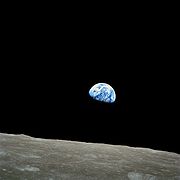
and the first images of our fragile planet floating in the vastness of space; the theory of global warming
Global warming
Global warming refers to the rising average temperature of Earth's atmosphere and oceans and its projected continuation. In the last 100 years, Earth's average surface temperature increased by about with about two thirds of the increase occurring over just the last three decades...
and other ecological threats to our collective existence; new global institutions such as the United Nations
United Nations
The United Nations is an international organization whose stated aims are facilitating cooperation in international law, international security, economic development, social progress, human rights, and achievement of world peace...
, World Trade Organization
World Trade Organization
The World Trade Organization is an organization that intends to supervise and liberalize international trade. The organization officially commenced on January 1, 1995 under the Marrakech Agreement, replacing the General Agreement on Tariffs and Trade , which commenced in 1948...
, or International Criminal Court
International Criminal Court
The International Criminal Court is a permanent tribunal to prosecute individuals for genocide, crimes against humanity, war crimes, and the crime of aggression .It came into being on 1 July 2002—the date its founding treaty, the Rome Statute of the...
; the rise of transnational corporations and integration of markets often termed economic globalization
Globalization
Globalization refers to the increasingly global relationships of culture, people and economic activity. Most often, it refers to economics: the global distribution of the production of goods and services, through reduction of barriers to international trade such as tariffs, export fees, and import...
; the emergence of global NGOs and transnational
Transnationalism
Transnationalism is a social movement and scholarly research agenda grown out of the heightened interconnectivity between people and the receding economic and social significance of boundaries among nation states....
social movements, such as the World Social Forum
World Social Forum
The World Social Forum is an annual meeting of civil society organizations, first held in Brazil, which offers a self-conscious effort to develop an alternative future through the championing of counter-hegemonic globalization...
; and so on. Globalization
Globalization
Globalization refers to the increasingly global relationships of culture, people and economic activity. Most often, it refers to economics: the global distribution of the production of goods and services, through reduction of barriers to international trade such as tariffs, export fees, and import...
, a more common term, typically refers more narrowly to the economic and trade relations and misses the broader cultural, social, political, environmental, demographic, values and knowledge transitions taking place.
Contemporary cosmopolitan thinkers
A number of contemporary theorists propose, directly and indirectly, various ways of becoming or being a cosmopolitan individual.Thich Nhat Hanh discusses what he calls "Interbeing" as a way of living one's life in relation to others; "Interbeing" might easily be compared to cosmopolitanism. Nhat Hanh's philosophical beliefs are grounded in the precepts of Buddhist teachings, which involve compassion and understanding to protect and live in harmony with all people, animals, plants, and minerals (88). He further describes what he calls "Mindfulness Training of the Order of Interbeing" as being aware of sufferings created by, but not limited to, the following causes: fanaticism and intolerances that disrupt compassion and living in harmony with others; indoctrination of narrow-minded beliefs; imposition of views; anger; and miscommunication (89-95). Understanding and compassion for others seems to be achieved by the understanding of others' suffering and the root causes of suffering. Therefore, to be responsible is to recognize and understand suffering, which then leads to compassion. It is through this process that others can be recognized as people.
Other theorists, philosophers, and activists contend that recognizing suffering is necessary to end violence. In Scared Sacred, Velcrow Ripper takes a journey to different sites of great suffering that ultimately leads him toward developing compassion. In "The Planet", Paul Gilroy
Paul Gilroy
-Biography:Born in the East End of London to Guyanese and English parents , he was educated at University College School and obtained his bachelor's degree at Sussex University in 1978. He moved from there to Birmingham University where he completed his Ph.D...
explores how the construction and naturalization of race and the hierarchies produced by difference shape the hatred of others. It is the deconstruction of these ideologies that can lead to the compassion and humanization of others. Thus individual responsibility is being aware of what Judith Butler
Judith Butler
Judith Butler is an American post-structuralist philosopher, who has contributed to the fields of feminism, queer theory, political philosophy, and ethics. She is a professor in the Rhetoric and Comparative Literature departments at the University of California, Berkeley.Butler received her Ph.D...
calls the precariousness of life in self and other; being a cosmopolitan seems to be, above all, a social, ethical enterprise.
In Cosmopolitanism: Ethics in a World of Strangers, Kwame Anthony Appiah
Kwame Anthony Appiah
Kwame Anthony Appiah is a Ghanaian-British-American philosopher, cultural theorist, and novelist whose interests include political and moral theory, the philosophy of language and mind, and African intellectual history. Kwame Anthony Appiah grew up in Ghana and earned a Ph.D. at Cambridge...
notices something important about how social ethics seem to operate: Whatever obligation I might have to another, especially a foreign other, that obligation does not supersede the obligations I have to those people most familiar to me. However, as Judith Butler questions, "at what cost do I establish the familiar as the criterion" for valuing others? (Precarious Life 38). If I value the familiar more than the foreign, what are the consequences? Paul Gilroy offers a possible alternative to this emphasis on familiarity arguing that "methodical cultivation of a degree of estrangement from one's own culture and history ... might qualify as essential to a cosmopolitan commitment" (The Planet 67). This estrangement entails a "process of exposure to otherness" in order to foster "the irreducible value of diversity within sameness" (67). Estrangement, therefore, could lead to de-emphasising the familiar in ethics by integrating otherness.
For Gilroy, being cosmopolitan seems to involve both a social, ethical enterprise and a cultural enterprise. In "The Planet", Gilroy describes the cases of Tom Hurndall
Tom Hurndall
Thomas "Tom" Hurndall was a British photography student, a volunteer for the International Solidarity Movement , and an activist against the Israeli occupation of the Palestinian territories. On 11 April 2003, he was shot in the head in the Gaza Strip by an Israel Defense Forces sniper, Taysir Hayb...
(80) and Rachel Corrie
Rachel Corrie
Rachel Aliene Corrie was an American member of the International Solidarity Movement . She was killed in the Gaza Strip by an Israel Defence Forces bulldozer when she was standing or kneeling in front of a local Palestinian's home, thus acting as a human shield, attempting to prevent the IDF from...
(81); each seems to exemplify what might be considered Gilroy's figure of the cosmopolitan. Both Hurndall and Corrie removed themselves (geographically) from their home cultures, presumably both physically and mentally estranging themselves from their own cultures and histories. Interestingly, though, Hurndall and Corrie were both killed in 2003 (in separate incidents) and their stories might serve as affirmations of familiarity, rather than models of estrangement. Gilroy’s model of estrangement might actually undermine itself through its examples; this might be construed as a failure of Gilroy’s theory to address the practical difficulties of estranging oneself from the familiar.
Some forms of cosmopolitanism also fail to address the potential for economic colonization by powerful countries over less powerful ones. Frantz Fanon
Frantz Fanon
Frantz Fanon was a Martiniquo-Algerian psychiatrist, philosopher, revolutionary and writer whose work is influential in the fields of post-colonial studies, critical theory and Marxism...
, in “The Wretched of the Earth”, observes that when nations achieved independence from European colonizers, frequently there was no system in place to secure their economic future, and they became "manager[s] for Western enterprise...in practise set[ting] up its country as the brothel of Europe" (154). When "third world" nations are drawn into economic partnerships with global capital, ostensibly to improve their national quality of life, often the only ones benefitting from this partnership are well-placed individuals and not the nation itself.
Further, Mahmood Mamdani in Good Muslim, Bad Muslim suggests that the imposition of Western cultural norms, democracy and Christianity to name only two, has historically resulted in nationalist violence; however, Appiah has implied that democracy is a pre-requisite for cosmopolitan intervention in developing nations (Kindness to Strangers 169). Cosmopolitanism, in these instances, appears to be a new form of colonization: the powerful exploit the weak and the weak eventually fight back.
Much of the political thinking of the last two centuries has taken nationalism and the framework of the sovereign nation-state
Nation-state
The nation state is a state that self-identifies as deriving its political legitimacy from serving as a sovereign entity for a nation as a sovereign territorial unit. The state is a political and geopolitical entity; the nation is a cultural and/or ethnic entity...
for granted. Now, with the advance of globalization and the increased facility of travel and communication, some thinkers consider that the political system based on the nation-state has become obsolete and that it is time to design a better and more efficient alternative. Jesús Mosterín
Jesús Mosterín
Jesús Mosterín is a leading Spanish philosopher and a thinker of broad spectrum, often at the frontier between science and philosophy.-Biography:He was born in Bilbao in 1941. He studied in Spain, Germany and the USA...
analyzes how the world political system should be organized in order to maximize individual freedom and individual opportunity. Rejecting as muddled the metaphysical notion of free will, he focuses on political freedom, the absence of coercion or interference by others in personal decisions. Because of the tendencies to violence and aggression that lurk in human nature, some constraint on freedom is necessary for peaceful and fruitful social interaction, but the more freedom we enjoy, the better.
Especially, there is no rational ground for curtailing the cultural freedoms (of language, religion and customs) in the name of the nation, the church or the party. From this point of view, Internet
Internet
The Internet is a global system of interconnected computer networks that use the standard Internet protocol suite to serve billions of users worldwide...
provides a much more attractive model than the nation-state. Neither is there any just reason for restraining the free circulation of people, ideas or goods. Mosterín thinks that the nation-state is incompatible with the full development of freedom, whose blossoming requires the reorganization of the world political system along cosmopolitan lines. He proposes a world without sovereign nation-states, territorially organized in small autonomous but not-sovereign cantonal polities, complemented by strong world organizations. He emphasizes the difference between international institutions, led by representatives of the national governments, and world or universal institutions, with clearly defined aims served by directors selected by their personal qualifications, independently of any national bias or proportion.
Political and sociological cosmopolitanism
Ulrich BeckUlrich Beck
Ulrich Beck is a German sociologist who holds a professorship at Munich University and at the London School of Economics.-Life:...
(b. May 15, 1944) is a sociologist who has posed the new concept of cosmopolitan critical theory in direct opposition to traditional nation-state
Nation-state
The nation state is a state that self-identifies as deriving its political legitimacy from serving as a sovereign entity for a nation as a sovereign territorial unit. The state is a political and geopolitical entity; the nation is a cultural and/or ethnic entity...
politics. Nation-state theory sees power relations only among different state actors, and excludes a global economy, or subjugates it to the nation-state
Nation-state
The nation state is a state that self-identifies as deriving its political legitimacy from serving as a sovereign entity for a nation as a sovereign territorial unit. The state is a political and geopolitical entity; the nation is a cultural and/or ethnic entity...
model. Cosmopolitanism sees global capital as a possible threat to the nation state and places it within a meta-power game in which global capital, states and civil society are its players.
It is important to mark a distinction between Beck's cosmopolitanism and the idea of a world state. For Beck, imposing a single world order is considered hegemonic
Hegemony
Hegemony is an indirect form of imperial dominance in which the hegemon rules sub-ordinate states by the implied means of power rather than direct military force. In Ancient Greece , hegemony denoted the politico–military dominance of a city-state over other city-states...
at best and ethnocentric
Ethnocentrism
Ethnocentrism is the tendency to believe that one's ethnic or cultural group is centrally important, and that all other groups are measured in relation to one's own. The ethnocentric individual will judge other groups relative to his or her own particular ethnic group or culture, especially with...
at worst. Rather, political and sociological cosmopolitanism rests upon these fundamental foundations:
- "Acknowledging the otherness of those who are culturally different"
- "Acknowledging the otherness of the future"
- "Acknowledging the otherness of nature"
- "Acknowledging the otherness of the object"
- "Acknowledging the otherness of other rationalities"
A number of philosophers, including Emmanuel Levinas
Emmanuel Lévinas
Emmanuel Levinas was a Lithuanian-born French Jewish philosopher and Talmudic commentator.-Life:Emanuelis Levinas received a traditional Jewish education in Lithuania...
, have introduced the concept of the "Other
Other
The Other or Constitutive Other is a key concept in continental philosophy; it opposes the Same. The Other refers, or attempts to refer, to that which is Other than the initial concept being considered...
". For Levinas, the Other is given context in ethics and responsibility; we should think of the Other as anyone and everyone outside ourselves. According to Levinas, our initial interactions with the Other occur before we form a will—the ability to make choices. The Other addresses us and we respond: even the absence of response is a response. We are thus conditioned by the Other's address and begin to form culture and identity. After the formation of the will, we choose whether to identify with the addresses by others and, as a result, continue the process of forming identity.
During this process, it is possible to recognize ourselves in our interactions with Others. Even in situations where we engage in the most minimal interaction, we ascribe identities to others and simultaneously to ourselves. Our dependence on the Other for the continuous formation of language, culture, and identity means that we are responsible to others and that they are responsible to us. Also once we've formed a will, it becomes possible to recognize this social interdependence. When we have gained the capacity for recognition, the imperative is to perform that recognition and thereby become ethically responsible to the Other in conscience
Conscience
Conscience is an aptitude, faculty, intuition or judgment of the intellect that distinguishes right from wrong. Moral judgement may derive from values or norms...
.
Cosmopolitanism shares some aspects of universalism
Moral universalism
Moral universalism is the meta-ethical position that some system of ethics, or a universal ethic, applies universally, that is, for "all similarly situated individuals", regardless of culture, race, sex, religion, nationality, sexuality, or any other distinguishing feature...
--namely the globally acceptable notion of human dignity that must be protected and enshrined in international law. However, the theory deviates in recognising the differences between world cultures. Thus, a "cosmopolitan declaration of human rights" would be defined in terms of negatives that no one could disagree over.
In addition, cosmopolitanism calls for equal protection of the environment and against the negative side effects of technological development. Human dignity, however, is convoluted because it is necessary to first distinguish who has the right to be respected and second to consider what rights are protectable. Under cosmopolitanism, all humans have rights; however, history shows that recognition of these rights is not guaranteed.
As an example, Judith Butler
Judith Butler
Judith Butler is an American post-structuralist philosopher, who has contributed to the fields of feminism, queer theory, political philosophy, and ethics. She is a professor in the Rhetoric and Comparative Literature departments at the University of California, Berkeley.Butler received her Ph.D...
discusses a Western discourse of "human" in Precarious Life: The Powers of Mourning and Violence. Butler works through the idea of "human" and notes that "human" has been "naturalized in its 'Western' mold by the contemporary workings of humanism" (32). Thus, there is the idea that not all "human" lives will be supported in the same way, indeed, that some human lives are worth more protection than others.
This idea is reiterated in Sunera Thobani's "Nationality in the Age of Global Terror," where she discusses a discourse in which Muslim people fall into a good/bad dichotomy: a "good Muslim" is one who has been Westernized and a "bad Muslim" is one who visibly rejects Western cultural influences. Thobani notes that it is through media representations that these ideas become naturalized. Individuals who embrace Western ideals are considered fully "human" and are more likely to be afforded dignity and protection than those who defend their non-Westernized cultural identities.
According to those who follow Beck's reasoning, a cosmopolitan world would consist of a plurality of states, which would use global and regional consensus to gain greater bargaining power against opponents. States would also utilise the power of civil society
Civil society
Civil society is composed of the totality of many voluntary social relationships, civic and social organizations, and institutions that form the basis of a functioning society, as distinct from the force-backed structures of a state , the commercial institutions of the market, and private criminal...
actors such as Non-governmental organizations (NGOs) and consumers to strengthen their legitimacy and enlist the help of investors to pursue a cosmopolitan agenda.
Other authors imagine a cosmopolitan world moving beyond today's conception of nation-states. These scholars argue that a truly cosmopolitan identity of Global Citizen will take hold, diminishing the importance of national identities. The formation of a global citizens movement
Global citizens movement
In most discussions, the global citizens movement is a socio-political process rather than a political organization or party structure. The term is often used synonymously with the anti-globalization movement or the global justice movement. Colloquially the term is also used in this imprecise manner...
would lead to the establishment of democratic global institutions, creating the space for global political discourse and decisions, would in turn reinforce the notion of citizenship at a global level. Nested structures of governance balancing the principles of irreducibility (i.e., the notion that certain problems can only be addressed at the global level, such as global warming
Global warming
Global warming refers to the rising average temperature of Earth's atmosphere and oceans and its projected continuation. In the last 100 years, Earth's average surface temperature increased by about with about two thirds of the increase occurring over just the last three decades...
) and subsidiarity
Subsidiarity
Subsidiarity is an organizing principle that matters ought to be handled by the smallest, lowest or least centralized competent authority. The Oxford English Dictionary defines subsidiarity as the idea that a central authority should have a subsidiary function, performing only those tasks which...
(i.e., the notion that decisions should be made at as local a level possible) would thus form the basis for a cosmopolitan political order.
Daniele Archibugi
Daniele Archibugi
Daniele Archibugi is an Italian economic and political theorist. He works on the economics and policy of innovation and technological change, on the political theory of international relations and on political and technological globalisation....
proposes a renewed model for global citizenship: institutional cosmopolitanism. It advocates some reforms in global governance to allow world citizens to take more directly a part into political life. A number of proposals have been made in order to make this possible. Cosmopolitan democracy, for example, suggests strengthening the United Nations and other international organizations by creating a World Parliamentary Assembly.
Resources
- Amanda AndersonAmanda AndersonAmanda Anderson is the Caroline Donovan Professor of English Literature, and the head of the English department at Johns Hopkins University.-Life:...
. 1998. Cosmopolitanism, Universalism, and the Divided Legacies of Modernity. In Cosmopolitics: Thinking and Feeling beyond the Nation, edited by P. Cheah and B. Robbins. Minneapolis and London: University of Minnesota Press. - Daniele ArchibugiDaniele ArchibugiDaniele Archibugi is an Italian economic and political theorist. He works on the economics and policy of innovation and technological change, on the political theory of international relations and on political and technological globalisation....
and David HeldDavid HeldDavid Held is a British political theorist active in the field of international relations. He will be chair of politics and international relations at Durham University from January 2012 and is currently Graham Wallas Professor of Political Science and co-director of the Centre for the Study of...
. editors, 1995. Cosmopolitan Democracy. An Agenda for a New World Order. Cambridge: Polity Press. - Kwame Anthony AppiahKwame Anthony AppiahKwame Anthony Appiah is a Ghanaian-British-American philosopher, cultural theorist, and novelist whose interests include political and moral theory, the philosophy of language and mind, and African intellectual history. Kwame Anthony Appiah grew up in Ghana and earned a Ph.D. at Cambridge...
, 2006. Cosmopolitanism: Ethics in a world of strangers. New York: W. W. Norton and Co. - Simon Caney, 'Cosmopolitanism' in Duncan Bell (ed.), Ethics and World Politics (Oxford University Press, 2010)
- Luke Martell. 2008. Beck's Cosmopolitan Politics Contemporary Politics 2008.
- Bruce RobbinsBruce RobbinsBruce Duane Robbins is a former Major League Baseball pitcher for the Detroit Tigers from 1979 to 1980. Robbins, a left-handed batter, also threw left-handed.- Early life :...
. 1998. Comparative Cosmopolitanisms. In Cosmopolitics: Thinking and Feeling beyond the Nation, edited by P. Cheah and B. Robbins. Minneapolis and London: University of Minnesota Press. - 2005. The Political Philosophy of Cosmopolitanism, edited by Gillian Brock and Harry Brighouse. Cambridge University Press.
- 2005. Power in the Global Age, by Ulrich Beck. Cambridge: Polity Press.
- ref 1: GTI Paper Series see Dawn of the Cosmopolitan: The Hope of a Global Citizens Movement, paper #15, and Global PoliticsGlobal politicsGlobal politics is the discipline that studies the political and economical patterns of the world. It studies the relationships between cities, nation-states, shell-states, multinational corporations, non-governmental organizations and international organizations.It has been argued that global...
and Institutions, paper #3