

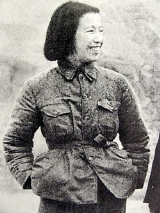
Jiang Qing

Encyclopedia
Jiang Qing was the pseudonym
that was used by Chinese leader Mao Zedong
's last wife and major Communist Party of China
power figure. She went by the stage name
Lan Ping during her acting career, and was known by various other names during her life. She married Mao in Yan'an
in November 1938, and is sometimes referred to as Madame Mao in Western literature, serving as Communist China's first first lady
. Jiang Qing was most well known for playing a major role in the Cultural Revolution
(1966–76) and for forming the radical political alliance known as the "Gang of Four
". She was named the "Great Flag-carrier of the Proletarian Culture" (无产阶级文艺伟大旗手/無產階級文藝偉大旗手).
Jiang Qing served as Mao's personal secretary in the 1940s and was head of the Film Section of the CPC Propaganda Department in the 1950s. In the early 1960s, she made a bid for power during the Cultural Revolution (1966–1976), which resulted in widespread chaos within the communist party. In 1966 she was appointed deputy director of the Central Cultural Revolution Group and claimed real power over Chinese politics for the first time. She became one of the masterminds of the Cultural Revolution, and along with three others, held absolute control over all of the national institutions.
Around the time of Chairman Mao's death, Jiang Qing and her proteges
maintained control of many of China's power institutions, including a heavy hand in the media and propaganda. However, Jiang Qing's political success was limited. When Mao died in 1976, Jiang lost the support and justification for her political activities. She was arrested in October 1976 by Hua Guofeng
and his allies, and was subsequently accused of being counter-revolutionary. Since then, Jiang Qing and Lin Biao
have been branded by official historical documents in China as the "Lin Biao and Jiang Qing Counter-revolutionary Cliques" (林彪江青反革命集团/林彪江青反革命集團), to which most of the blame for the damage and devastation caused by the Cultural Revolution
was assigned. The assessments of western scholars have not been as uniformly critical. Though initially sentenced to execution, her sentence was commuted to life imprisonment in 1983, however, and in May 1991 she was released for medical treatment. Before returning to prison, she committed suicide.
, Shandong Province
on March 20, 1914. Her birth name was Lǐ Shūméng (李淑蒙). She was the only child of Li Dewen (李德文), a carpenter, and his subsidiary wife, or concubine. Her father ran his own carpentry and cabinet making shop. After a violent argument between her parents, her mother left with the child to work as a domestic servant. Some accounts claim that Jiang's mother also worked as a prostitute.
When Jiang Qing enrolled in elementary school, she took the name Lĭ Yúnhè (李云鹤), meaning "Crane in the Clouds", by which she was known for much of her early life. Other students did not view Jiang well due to her family background, and she and her mother moved in with her maternal grandparents when she went to attend middle school. In 1926, when she was 12 years old, her father died. Her mother took her to live with her uncle in Tianjin
where she worked as a child laborer in a cigarette factory for several months. In 1928, she and her mother moved to Jinan
, and in the summer of the following year, she entered an experimental theater and drama school. Her talent brought her to the attention of administrators who selected her to join a drama club in Beijing where she gained more acting skills. She returned to Jinan in May 1931 and married Pei Minglun, the wealthy son of a businessman. The marriage was an unhappy one and they soon divorced.
From July 1931 to April 1933, Lĭ Yúnhè attended Qingdao University
in Qingdao
. She met Yu Qiwei, a biology student three years her senior, who was an underground member of the Communist Party Propaganda Department. By 1932, they had fallen in love and were living together. She joined the "Communist Cultural Front," a circle of artists, writers, and actors, and performed in Put Down Your Whip
, a renowned popular play about a woman who escapes from the Japanese-occupied northeastern China and performs in the streets to survive. In February 1933, Lĭ Yúnhè took the oath of the Chinese Communist Party with Yu Qiwei at her side, and she was appointed member of the Chinese Communist Party youth wing. Yu Qiwei was arrested in April the same year, and Lĭ Yúnhè fled to her parents' home in Shanghai.
When she arrived in Shanghai
, the Yu family did not acknowledge her. She departed, and was soon back at the drama school in Jinan where she was warmly received. Through friendships she had previously established, she received an introduction to attend Shanghai University for the summer where she also taught some general literacy classes. In October, she rejoined the Communist Youth League, and at the same time, began participating in an amateur drama troupe.
In September 1934, Jiang Qing was arrested and jailed for her political activities in Shanghai, but was released three months later, in December of the same year. She then traveled to Beijing where she reunited with Yu Qiwei who had just been released following his prison sentence, and the two began living together again.
Jiang Qing returned to Shanghai in March 1935, and became a professional actress, adopting the stage name "Lán Píng" (meaning "Blue Apple", Chinese
: 蓝苹). She appeared in numerous films and plays, including God of Liberty, The Scenery of City, Blood on Wolf Mountain
and Old Mr. Wang. In Ibsen's play A Doll's House
, Jiang Qing played the role of Nora.
With her career established, she became involved with actor/director Tang Lun, with whom she appeared in Scenes of City Life
and The Statue of Liberty. They were married in Hangzhou
in March 1936, however he soon discovered she was continuing her relationship with Yu Qiwei. The scandal became public knowledge and he made two suicide attempts before their divorce became final. In 1937, Jiang Qing joined the Lianhua Film Company
and starred in the film Big Thunderstorm. She reportedly had an affair with director, Zhang Min, however she denied it in her autobiographical writings.
on July 7, 1937, followed by the Japanese occupation of Shanghai and the Japanese takeover of the Chinese movie industry, at age 23, Jiang Qing left her celebrity life on the stage behind. She went first to Xi'an
, then to the Chinese Communist headquarters in Yan'an
to "join the revolution" and the war to resist the Japanese invasion. In November, she enrolled in the "Anti-Japanese Military and Political University" (Marxist-Leninist Institute) for study. The Lu Xun Academy of Arts was newly founded in Yan'an on April 10, 1938, and Jiang Qing became a drama department instructor, teaching and performing in college plays and operas
.
After arriving in Yan'an, Jiang began to think seriously about "hooking someone". After several affairs, Jiang began seriously plotting the seduction of Mao Zedong
, clapping ostentatiously at his lectures and inviting herself into his cave. Soon after Mao and Jiang became acquainted, Zhou Enlai
discovered Mao having an affair in the wilderness with Jiang, but exercised discretion.
Other Communist leaders were more obviously scandalized by the relationship once it became public. At 45, Mao was nearly twice Jiang's age, and Jiang had lived a highly bourgeois lifestyle before coming to Yan'an. Mao was still married to He Zizhen
, a lifelong Communist who had previously completed the Long March
with him, and with whom Mao had five children. Eventually, Mao arranged a compromise with the other leaders of the CCP: Mao was granted a divorce and permitted to marry Jiang (who was pregnant), but she was required to stay out of public politics for thirty years. Jiang abided by this agreement for thirty years; when these thirty years expired, at the beginning of the Cultural Revolution, Jiang would later seek revenge.
The two were married in a small private ceremony on November 28, 1938 after approval by the Party's Central Committee. Because Mao's marriage to He Zizhen had not yet ended, Jiang Qing was reportedly made to sign a marital contract which stipulated that she would not appear in public with Mao as her escort. Jiang and Mao had one daughter Li Na
who was born in 1940.
, a film about a 19th century beggar who raised money to educate the poor. Jiang supported criticism of the film for celebrating counter-revolutionary ideas.
Following the Great Leap Forward
(1958–1961), Mao was highly criticized within the CCP, and turned to Jiang, among others, to support himself and persecute his enemies. Taking advantage of the power given to her by Mao, Jiang began by reforming the Chinese theatre and then tracked down those whom she felt had wronged her in the past. She led an initiative for reforming modern opera in 1963 that resulted in the "eight model revolutionary operas" established at Peking Opera. This intitiative and others strictly defined permitted works of drama, music, dance, and other arts, including outright bans of unapproved works.
in 1969. By now she has established a close political working relationship with what in due course would be known as the Gang of Four—Zhang Chunqiao
, Yao Wenyuan
and Wang Hongwen
. She was one of the most powerful figures in China during Mao's last years and became a controversial figure.
During this period, Mao Zedong galvanized students and young workers as his Red Guards to attack what he termed as revisionists in the party. Mao told them the revolution was in danger and that they must do all they could to stop the emergence of a privileged class in China. He argued this is what had happened in the Soviet Union under Nikita Khrushchev.
With time, Jiang began playing an increasingly active political role in the movement. She took part in most important Party and government activities. She was supported by a radical coterie, dubbed, by Mao himself, the Gang of Four. Although a prominent member of the Central Cultural Revolution Group
and a major player in Chinese politics from 1966 to 1976, she essentially remained on the sidelines.
The initial storm of the Cultural Revolution came to an end when Liu Shaoqi
was forced from all his posts on October 13, 1968. Lin Biao now became Mao's designated successor. Chairman Mao now gave his support to the Gang of Four
: Jiang Qing, Wang Hongwen
, Yao Wenyuan
and Zhang Chunqiao
. These four radicals occupied powerful positions in the Politburo after the Tenth Party Congress of 1973.
Jiang Qing also directed operas and ballets with communist and revolutionary content as part of an effort to transform China's culture. She dominated the Chinese arts, and in particular attempted to reform the Beijing Opera. She developed a new form of art called the Eight model plays which depicted the world in simple, binary terms: the positive characters ("good guys") were predominantly farmers, workers and revolutionary soldiers, whilst the negative characters ("bad guys") were landlords and anti-revolutionaries. The negative characters, in contrast to their proletarian foils who performed boldly centre stage, were identifiable by their darker make-up and relegation to the outskirts of the stage until direct conflict with a positive character. Critics would argue that her influence on art was too restrictive, because she replaced nearly all earlier works of art with revolutionary Maoist works.
Jiang Qing first collaborated with then second-in-charge Lin Biao
, but after Lin Biao's death in 1971, she turned against him publicly in the Criticize Lin, Criticize Confucius Campaign. By the mid 1970s, Jiang Qing also spearheaded the campaign against Deng Xiaoping (afterwards saying that this was inspired by Mao). The Chinese public became intensely discontented at this time and chose to blame Jiang Qing, a more accessible and easier target than Chairman Mao. By 1973, although was not reported due to it being a personal matter, Mao and his wife Jiang had separated:
Jiang Qing's hobbies included photography, playing cards, and watching foreign movies, especially Gone with the Wind
. It was also revealed that Mao's physician, Li Zhisui
, had diagnosed her as a hypochondriac. When touring a troupe of young girls excelling in marksmanship, she "discovered" Joan Chen
, then 14 years old, launching Joan's career as a Chinese and then international actress.
She developed severe degrees of hypochondriasis and erratic nerves. She required two sedative
s over the course of a day and three sleeping pills to fall asleep. Staff were assigned to chase away birds and cicada
s from her Imperial Fishing Villa. She ordered house servants to cut down on noise by removing their shoes and avoiding clothes rustling. Mild temperature differences bothered her; thermostats were always set to 21.5°C (70.7°F) in winter and 26°C (78.8°F) in summer.
against other senior political leaders and government officials, including Liu Shaoqi, the President
at the time, and Deng Xiaoping
, the Deputy Premier. Internally divided into factions both to the "left" and "right" of Jiang Qing and Mao, not all Red Guards were friendly to Jiang Qing.
Jiang's persecution of those she believed had wronged her was cruel, vindictive, and harsh. At a mass rally in Beijing, Jiang directed a "struggle session" against a woman, Fan Jin, who had married Jiang's second husband after Jiang separated from him in 1931. According to Jiang, Fan had published satirical essays portraying Mao as a megalomaniac, and Jiang herself as a "semi-prostitute", but Fan's real crime was her marriage. Fan was arrested and died soon afterwards.
Jiang's rivalry with, and personal dislike of, Zhou Enlai led Jiang to hurt Zhou where he was most vulnerable. In 1968 Jiang had Zhou's adopted son (Sun Yang
) and daughter (Sun Weishi
) tortured and murdered by Maoist Red Guards
. Sun Yang was murdered in the basement of Renmin University. After Sun Weishi died following seven months of torture in a secret prison (at Jiang's direction), Jiang made sure that Sun's body was cremated and disposed of so that no autopsy could be performed, and so that Sun's family could not have her ashes. In 1968 Jiang forced Zhou to sign an arrest warrant for his own brother. In 1973 and 1974, Jiang directed the "Criticize Lin, Criticize Confucius" campaign against premier Zhou because Zhou was viewed as one of the Jiang's primary political opponents. In 1975, Jiang initiated a campaign named "Criticizing Song Jiang, Evaluating the Water Margin", which encouraged the use of Zhou as an example of a political loser. After Zhou Enlai died in 1976, Jiang initiated the "Five Nos" campaign in order to discourage and prohibit any public mourning for Zhou.
When given free rein, Jiang also wreaked vengeance on Mao's family. Jiang confined Mao's third wife, Jiang's predecessor, to a mental hospital for several decades. When Mao's eldest son was killed in the Korean War
, his widow accused Jiang of feeling "immense ecstasy". Jiang had several of Mao's children, and/or their spouses, arrested. Jiang forced her own daughter with Mao to divorce her husband because her husband was only a farmer, causing Jiang's daughter to go insane.
, Jiang Qing returned from her trip and spent only a few moments in the hospital's Building 202, where Mao was being treated. Later she returned to her own residence in the Spring Lotus Chamber.
On the afternoon of September 7, Mao took a turn for the worse. Mao had just fallen asleep and needed to rest, but Jiang Qing insisted on rubbing his back and moving his limbs, and she sprinkled powder on his body. The medical team protested that the dust from the powder was not good for his lungs, but she instructed the nurses on duty to follow her example later.
The next morning, September 8, she went again. This time she wanted the medical staff to change Mao's sleeping position, claiming that he had been lying too long on his left side. The doctor on duty objected, knowing that he could breathe only on his left side. Jiang had him move Mao nonetheless. As a result, Mao's breathing stopped and his face turned blue. Jiang Qing left the room while the medical staff put Mao on a respirator and performed emergency cardiopulmonary resuscitation.
Eventually, Mao was revived and Hua Guofeng urged Jiang Qing not to interfere further with the doctor's work. However, Mao's organs failed and the Chinese government decided to disconnect Mao's life support mechanism.
Mao's death on September 9, 1976, sent shockwaves through the country. As the symbol of China's revolution, Mao was held in high regard amongst the majority of the Chinese population. Mao's chosen successor, Hua Guofeng
, chaired his funeral committee. It was believed Hua was a compromise candidate between the free-marketeers and the party orthodox. Some argue this may have been due to his ambivalence and his low-key profile, particularly compared to Deng Xiaoping
, the preferred candidate of the market-oriented factions. The party apparatus, under orders from Jiang Qing and Zhang Chunqiao, wrote a eulogy affirming Mao's achievements and in order to justify their claims to power.
By this time state media was effectively under the control of the Gang of Four. State newspapers continued to denounce Deng shortly after Mao's death. Jiang Qing was especially paranoid of Deng's influence on national affairs, whereas she considered Hua Guofeng a mere nuisance. In numerous documents published in the 1980s it was claimed that Jiang Qing was conspiring to make herself the new Chairman of the Communist Party.
, as Mao's designated successor, held the titular power as the acting Chairman of the Communist Party and as Premier. However, Hua was not very influential. Some sources indicate that Mao mentioned Jiang Qing before his death in a note to Hua Guofeng, telling him to "go consult her" if he runs into problems .
Jiang Qing believed that upholding the status quo, where she was one of the highest ranked members of the central authorities, would mean that she effectively held onto power. In addition, her status as Mao's widow meant that it would be difficult to remove her. She continued to invoke Mao's name in her major decisions, and acted as first-in-charge.
Her political ambitions and lack of respect for most of the elder revolutionaries within the Central Committee became notorious. Her support within the Central Committee was dwindling, and her public approval was dismal. Ye Jianying, a renowned general, met in private with Hua Guofeng and Wang Dongxing, commander of a secret service-like organization called the 8341 Special Regiment. They determined that Jiang Qing and her associates must be removed by force in order to restore stability.
On the morning of October 6, 1976, Jiang Qing came to Mao's former residence in Zhongnanhai
, gathered her close aides and Mao's former personal aides in a "Study Mao's Work" session. According to Du Xiuxian, her photographer, Jiang Qing remarked that she knew people within the Central Committee were plotting against her.
After the session, Jiang Qing took several aides to Jingshan Park
to pick apples. In the evening, Jiang Qing, Zhang Chunqiao, Wang Hongwen, and Yao Wenyuan were arrested and kept in the lower level of Zhongnanhai. According to Zhang Yaoci, who carried out the arrest, Jiang Qing did not say much when she was arrested. In a bloodless coup
, the Gang of Four was charged with attempts to seize power by setting up militia coups in Shanghai and Beijing, subverting the government, counterrevolutionary activity, and treason.
After her arrest, Jiang Qing was sent to the Qincheng Prison and detained for five years. In both official and civilian accounts of the period, the fall of the Gang was met with celebrations all over China. Indeed, Jiang Qing's role in the Cultural Revolution was perceived by the public to be largely negative, and the Gang of Four was a convenient scapegoat
for the ten years of political and social turmoil. Her role during the Cultural Revolution is still a subject of historical debate.
began. The trials were televised nationwide. By showing the way the Gang of Four was tried, Deng Xiaoping
wanted the people to realize that a new age had arrived.
Portions of the 20,000-word indictment were printed in China's press before the trial started; they accused the defendants of a host of heinous crimes that took place during the Cultural Revolution. The charges specify that 727,420 Chinese were "persecuted" during that period, and that 34,274 died, though the often vague indictment did not specify exactly how. Among the chief victims: onetime Chief of State Liu Shaoqi
, whose widow Wang Guangmei
, herself imprisoned during the Cultural Revolution for 12 years, attended the trial as an observer.
The indictment described two plots by the "Jiang Qing-Lin Biao Counterrevolutionary Clique" to seize power. Jiang Qing was not accused of conspiring with Lin Biao, or with other members of the Gang of Four who allegedly planned an armed rebellion to "usurp power" in 1976, when Mao was close to death. Instead, the charges against her focused on her systematic persecution of creative artists during the Cultural Revolution. Amongst other things, she was accused of hiring 40 people in Shanghai to disguise themselves as Red Guards and ransack the homes of writers and performers. The apparent purpose was said to find and destroy letters, photos and other potentially damaging materials on Jiang Qing's early career in Shanghai, which she wanted to keep secret.
Despite the seriousness of the accusations against her, Jiang Qing appeared unrepentant. She had not confessed her guilt, something that the Chinese press has emphasized to show her bad attitude. There had been reports that she planned to defend herself by cloaking herself in Mao's mantle, saying that she did only what he approved. As the trial got under way, Jiang Qing dismissed her assigned lawyers, deciding instead to represent herself. During her public trials at the "Special Court", Jiang Qing was the only member of the Gang of Four who bothered to argue on her behalf. The defense's argument was that she obeyed the orders of Chairman Mao Zedong
at all times. Jiang Qing maintained that all she had done was to defend Chairman Mao. It was at this trial that Jiang Qing made the famous quote: "I was Chairman Mao's dog. I bit whomever he asked me to bite." . The official records of the trial have not yet been released.
in 1981. In 1983, her death sentence was commuted to life imprisonment.
While in prison, Jiang Qing was diagnosed with throat cancer, but she refused an operation. She was eventually released, on medical grounds, in 1991. At the hospital, Jiang Qing used the name Lǐ Rùnqīng . She was alleged to have committed suicide on May 14, 1991, aged 77, by hanging herself in a bathroom of her hospital. She reputedly wrote on her suicide note
, "Chairman [Mao]! I love you! Your student and comrade is coming to see you!" (主席,我爱你!您的学生和战友来看您来了!). Her suicide occurred two days short of the 25th anniversary of the Cultural Revolution
.
She wished her remains could be buried in her home province of Shandong
, but in consideration of possible future vandalism to her tomb, the state decided to have her remains moved to a safer common cemetery in Beijing. Jiang Qing is buried in Fukuda Cemetery in the western hills of Beijing. Her grave is marked by a tall white stone inscribed with her school name, not the name by which she was famously known, which reads: "Tomb of Late Mother, Lǐ Yúnhè, 1914–1991" (先母李云鹤之墓,一九一四年至一九九一年).
Her father named her Li Jinhai because he wanted a son, but this was altered after her birth to Li Shumeng. She enrolled in school under a more dignified name, Li Yunhe, and simply changed it for convenience to Li He.
As was customary for Chinese actors during that time (and for some, until the present-day), she chose a stage name, which was used in all the plays and films that credited her roles. Lan Ping was the name she was known by within Chinese film circles and a name she came to identify with.
It is unclear when she changed her name to Jiang Qing, but it probably occurred before her arrival to Yan'an
. It is believed that the character "Qing" was chosen because it related to the concept of Blue ("Lan"). There is some evidence that the name signified her status as a Communist and a severance from her "bourgeoisie" past. She also used Li Jin to pen a number of articles she wrote during the Cultural Revolution.
Eventually, to protect her identity, she used Li Runqing when she was hospitalized after being released from prison. She was buried under her tombstone which bore the name "Li Yunhe".
9 Western name: Madame Mao
Pseudonym
A pseudonym is a name that a person assumes for a particular purpose and that differs from his or her original orthonym...
that was used by Chinese leader Mao Zedong
Mao Zedong
Mao Zedong, also transliterated as Mao Tse-tung , and commonly referred to as Chairman Mao , was a Chinese Communist revolutionary, guerrilla warfare strategist, Marxist political philosopher, and leader of the Chinese Revolution...
's last wife and major Communist Party of China
Communist Party of China
The Communist Party of China , also known as the Chinese Communist Party , is the founding and ruling political party of the People's Republic of China...
power figure. She went by the stage name
Stage name
A stage name, also called a showbiz name or screen name, is a pseudonym used by performers and entertainers such as actors, wrestlers, comedians, and musicians.-Motivation to use a stage name:...
Lan Ping during her acting career, and was known by various other names during her life. She married Mao in Yan'an
Yan'an
Yan'an , is a prefecture-level city in the Shanbei region of Shaanxi province in China, administering several counties, including Zhidan County , which served as the Chinese communist capital before the city of Yan'an proper took that role....
in November 1938, and is sometimes referred to as Madame Mao in Western literature, serving as Communist China's first first lady
First Lady
First Lady or First Gentlemanis the unofficial title used in some countries for the spouse of an elected head of state.It is not normally used to refer to the spouse or partner of a prime minister; the husband or wife of the British Prime Minister is usually informally referred to as prime...
. Jiang Qing was most well known for playing a major role in the Cultural Revolution
Cultural Revolution
The Great Proletarian Cultural Revolution, commonly known as the Cultural Revolution , was a socio-political movement that took place in the People's Republic of China from 1966 through 1976...
(1966–76) and for forming the radical political alliance known as the "Gang of Four
Gang of Four
The Gang of Four was the name given to a political faction composed of four Chinese Communist Party officials. They came to prominence during the Cultural Revolution and were subsequently charged with a series of treasonous crimes...
". She was named the "Great Flag-carrier of the Proletarian Culture" (无产阶级文艺伟大旗手/無產階級文藝偉大旗手).
Jiang Qing served as Mao's personal secretary in the 1940s and was head of the Film Section of the CPC Propaganda Department in the 1950s. In the early 1960s, she made a bid for power during the Cultural Revolution (1966–1976), which resulted in widespread chaos within the communist party. In 1966 she was appointed deputy director of the Central Cultural Revolution Group and claimed real power over Chinese politics for the first time. She became one of the masterminds of the Cultural Revolution, and along with three others, held absolute control over all of the national institutions.
Around the time of Chairman Mao's death, Jiang Qing and her proteges
Gang of Four
The Gang of Four was the name given to a political faction composed of four Chinese Communist Party officials. They came to prominence during the Cultural Revolution and were subsequently charged with a series of treasonous crimes...
maintained control of many of China's power institutions, including a heavy hand in the media and propaganda. However, Jiang Qing's political success was limited. When Mao died in 1976, Jiang lost the support and justification for her political activities. She was arrested in October 1976 by Hua Guofeng
Hua Guofeng
Su Zhu, better known by the nom de guerre Hua Guofeng , was Mao Zedong's designated successor as the Paramount Leader of the Communist Party of China and the People's Republic of China. Upon Zhou Enlai's death in 1976, he succeeded Zhou as the second Premier of the People's Republic of China...
and his allies, and was subsequently accused of being counter-revolutionary. Since then, Jiang Qing and Lin Biao
Lin Biao
Lin Biao was a major Chinese Communist military leader who was pivotal in the communist victory in the Chinese Civil War, especially in Northeastern China...
have been branded by official historical documents in China as the "Lin Biao and Jiang Qing Counter-revolutionary Cliques" (林彪江青反革命集团/林彪江青反革命集團), to which most of the blame for the damage and devastation caused by the Cultural Revolution
Cultural Revolution
The Great Proletarian Cultural Revolution, commonly known as the Cultural Revolution , was a socio-political movement that took place in the People's Republic of China from 1966 through 1976...
was assigned. The assessments of western scholars have not been as uniformly critical. Though initially sentenced to execution, her sentence was commuted to life imprisonment in 1983, however, and in May 1991 she was released for medical treatment. Before returning to prison, she committed suicide.
Early life
Jiang Qing was born in ZhuchengZhucheng
Zhucheng is a county-level city in the southeast of Shandong province, People's Republic of China. It is under the administration of Weifang City and has a population of 1.06 million.-History:Zhucheng was originally known as Langya...
, Shandong Province
Shandong
' is a Province located on the eastern coast of the People's Republic of China. Shandong has played a major role in Chinese history from the beginning of Chinese civilization along the lower reaches of the Yellow River and served as a pivotal cultural and religious site for Taoism, Chinese...
on March 20, 1914. Her birth name was Lǐ Shūméng (李淑蒙). She was the only child of Li Dewen (李德文), a carpenter, and his subsidiary wife, or concubine. Her father ran his own carpentry and cabinet making shop. After a violent argument between her parents, her mother left with the child to work as a domestic servant. Some accounts claim that Jiang's mother also worked as a prostitute.
When Jiang Qing enrolled in elementary school, she took the name Lĭ Yúnhè (李云鹤), meaning "Crane in the Clouds", by which she was known for much of her early life. Other students did not view Jiang well due to her family background, and she and her mother moved in with her maternal grandparents when she went to attend middle school. In 1926, when she was 12 years old, her father died. Her mother took her to live with her uncle in Tianjin
Tianjin
' is a metropolis in northern China and one of the five national central cities of the People's Republic of China. It is governed as a direct-controlled municipality, one of four such designations, and is, thus, under direct administration of the central government...
where she worked as a child laborer in a cigarette factory for several months. In 1928, she and her mother moved to Jinan
Jinan
Jinan is the capital of Shandong province in Eastern China. The area of present-day Jinan has played an important role in the history of the region from the earliest beginnings of civilisation and has evolved into a major national administrative, economic, and transportation hub...
, and in the summer of the following year, she entered an experimental theater and drama school. Her talent brought her to the attention of administrators who selected her to join a drama club in Beijing where she gained more acting skills. She returned to Jinan in May 1931 and married Pei Minglun, the wealthy son of a businessman. The marriage was an unhappy one and they soon divorced.
From July 1931 to April 1933, Lĭ Yúnhè attended Qingdao University
Qingdao University
Qingdao University is located in Qingdao, China. The modern Qingdao University was founded in 1993 with incorporating 3 other local colleges of Qingdao.-Composition:...
in Qingdao
Qingdao
' also known in the West by its postal map spelling Tsingtao, is a major city with a population of over 8.715 million in eastern Shandong province, Eastern China. Its built up area, made of 7 urban districts plus Jimo city, is home to about 4,346,000 inhabitants in 2010.It borders Yantai to the...
. She met Yu Qiwei, a biology student three years her senior, who was an underground member of the Communist Party Propaganda Department. By 1932, they had fallen in love and were living together. She joined the "Communist Cultural Front," a circle of artists, writers, and actors, and performed in Put Down Your Whip
Put Down Your Whip
Put Down Your Whip is a 1939 oil painting by Chinese Realism painter Xu Beihong. Completed during Xu's stay in Singapore, the painting was exhibited numerous times before its disappearance from public view in 1954...
, a renowned popular play about a woman who escapes from the Japanese-occupied northeastern China and performs in the streets to survive. In February 1933, Lĭ Yúnhè took the oath of the Chinese Communist Party with Yu Qiwei at her side, and she was appointed member of the Chinese Communist Party youth wing. Yu Qiwei was arrested in April the same year, and Lĭ Yúnhè fled to her parents' home in Shanghai.
When she arrived in Shanghai
Shanghai
Shanghai is the largest city by population in China and the largest city proper in the world. It is one of the four province-level municipalities in the People's Republic of China, with a total population of over 23 million as of 2010...
, the Yu family did not acknowledge her. She departed, and was soon back at the drama school in Jinan where she was warmly received. Through friendships she had previously established, she received an introduction to attend Shanghai University for the summer where she also taught some general literacy classes. In October, she rejoined the Communist Youth League, and at the same time, began participating in an amateur drama troupe.
In September 1934, Jiang Qing was arrested and jailed for her political activities in Shanghai, but was released three months later, in December of the same year. She then traveled to Beijing where she reunited with Yu Qiwei who had just been released following his prison sentence, and the two began living together again.
Jiang Qing returned to Shanghai in March 1935, and became a professional actress, adopting the stage name "Lán Píng" (meaning "Blue Apple", Chinese
Chinese language
The Chinese language is a language or language family consisting of varieties which are mutually intelligible to varying degrees. Originally the indigenous languages spoken by the Han Chinese in China, it forms one of the branches of Sino-Tibetan family of languages...
: 蓝苹). She appeared in numerous films and plays, including God of Liberty, The Scenery of City, Blood on Wolf Mountain
Blood on Wolf Mountain
Blood on Wolf Mountain, also known as The Wolf Hill, Bloodbath in Langshan, and Bloodshed on Wolf Mountain, is a Chinese film directed by acclaimed Shanghainese film director Fei Mu...
and Old Mr. Wang. In Ibsen's play A Doll's House
A Doll's House
A Doll's House is a three-act play in prose by the Norwegian playwright Henrik Ibsen. It premièred at the Royal Theatre in Copenhagen, Denmark, on 21 December 1879, having been published earlier that month....
, Jiang Qing played the role of Nora.
With her career established, she became involved with actor/director Tang Lun, with whom she appeared in Scenes of City Life
Scenes of City Life
Scenes of City Life is a 1935 Chinese film directed by Yuan Muzhi.The film is also known, in English, as Cityscape.- Cast :*Bai Lu*Lan Ping *Tang Na*Wu Ying*Zhou Boxun*Wu Yinxian...
and The Statue of Liberty. They were married in Hangzhou
Hangzhou
Hangzhou , formerly transliterated as Hangchow, is the capital and largest city of Zhejiang Province in Eastern China. Governed as a sub-provincial city, and as of 2010, its entire administrative division or prefecture had a registered population of 8.7 million people...
in March 1936, however he soon discovered she was continuing her relationship with Yu Qiwei. The scandal became public knowledge and he made two suicide attempts before their divorce became final. In 1937, Jiang Qing joined the Lianhua Film Company
Lianhua Film Company
The Lianhua Film Company was one of two major production companies based in Shanghai, China during the 1930s, the other being the Mingxing Film Company.-Names:...
and starred in the film Big Thunderstorm. She reportedly had an affair with director, Zhang Min, however she denied it in her autobiographical writings.
Flight to Yan'an
After the disastrous Marco Polo Bridge IncidentMarco Polo Bridge Incident
The Marco Polo Bridge Incident was a battle between the Republic of China's National Revolutionary Army and the Imperial Japanese Army, often used as the marker for the start of the Second Sino-Japanese War .The eleven-arch granite bridge, Lugouqiao, is an architecturally significant structure,...
on July 7, 1937, followed by the Japanese occupation of Shanghai and the Japanese takeover of the Chinese movie industry, at age 23, Jiang Qing left her celebrity life on the stage behind. She went first to Xi'an
Xi'an
Xi'an is the capital of the Shaanxi province, and a sub-provincial city in the People's Republic of China. One of the oldest cities in China, with more than 3,100 years of history, the city was known as Chang'an before the Ming Dynasty...
, then to the Chinese Communist headquarters in Yan'an
Yan'an
Yan'an , is a prefecture-level city in the Shanbei region of Shaanxi province in China, administering several counties, including Zhidan County , which served as the Chinese communist capital before the city of Yan'an proper took that role....
to "join the revolution" and the war to resist the Japanese invasion. In November, she enrolled in the "Anti-Japanese Military and Political University" (Marxist-Leninist Institute) for study. The Lu Xun Academy of Arts was newly founded in Yan'an on April 10, 1938, and Jiang Qing became a drama department instructor, teaching and performing in college plays and operas
Chinese opera
Chinese opera is a popular form of drama and musical theatre in China with roots going back as far as the third century CE...
.
After arriving in Yan'an, Jiang began to think seriously about "hooking someone". After several affairs, Jiang began seriously plotting the seduction of Mao Zedong
Mao Zedong
Mao Zedong, also transliterated as Mao Tse-tung , and commonly referred to as Chairman Mao , was a Chinese Communist revolutionary, guerrilla warfare strategist, Marxist political philosopher, and leader of the Chinese Revolution...
, clapping ostentatiously at his lectures and inviting herself into his cave. Soon after Mao and Jiang became acquainted, Zhou Enlai
Zhou Enlai
Zhou Enlai was the first Premier of the People's Republic of China, serving from October 1949 until his death in January 1976...
discovered Mao having an affair in the wilderness with Jiang, but exercised discretion.
Other Communist leaders were more obviously scandalized by the relationship once it became public. At 45, Mao was nearly twice Jiang's age, and Jiang had lived a highly bourgeois lifestyle before coming to Yan'an. Mao was still married to He Zizhen
He Zizhen
He Zizhen was the third wife of Mao Zedong from May 1930 to 1937.- Biography :He Zizhen was born in Yunshan , Jiangxi, during Qing Dynasty China, and joined the Communist Youth League in 1925. She graduated from the Yongxin Girls' School and joined the Communist Party of China in 1926...
, a lifelong Communist who had previously completed the Long March
Long March
The Long March was a massive military retreat undertaken by the Red Army of the Communist Party of China, the forerunner of the People's Liberation Army, to evade the pursuit of the Kuomintang army. There was not one Long March, but a series of marches, as various Communist armies in the south...
with him, and with whom Mao had five children. Eventually, Mao arranged a compromise with the other leaders of the CCP: Mao was granted a divorce and permitted to marry Jiang (who was pregnant), but she was required to stay out of public politics for thirty years. Jiang abided by this agreement for thirty years; when these thirty years expired, at the beginning of the Cultural Revolution, Jiang would later seek revenge.
The two were married in a small private ceremony on November 28, 1938 after approval by the Party's Central Committee. Because Mao's marriage to He Zizhen had not yet ended, Jiang Qing was reportedly made to sign a marital contract which stipulated that she would not appear in public with Mao as her escort. Jiang and Mao had one daughter Li Na
Li Na (daughter of Mao Zedong)
Li Na , or Li Ne, is the daughter of Mao Zedong and his fourth wife Jiang Qing, and their only child together. Her surname is Li rather than Mao, because her father used the pseudonym "Li Desheng" for a period of time during the Chinese Civil War....
who was born in 1940.
Entry into Chinese politics
From the 1940s on, Mao and Jiang quarreled frequently. After the founding of the People's Republic of China in 1949, Jiang became the nation's first lady. She worked as Director of film in the Central Propaganda Department, and as a member of the Ministry of Culture steering committee for the film industry. An uproar in 1950 led the investigation of The Life of Wu XunThe Life of Wu Xun
The Life of Wu Xun is a 1950 Chinese film directed by Sun Yu and starring Zhao Dan. A black-white movie, it was produced by Kunlun Film Studio...
, a film about a 19th century beggar who raised money to educate the poor. Jiang supported criticism of the film for celebrating counter-revolutionary ideas.
Following the Great Leap Forward
Great Leap Forward
The Great Leap Forward of the People's Republic of China was an economic and social campaign of the Communist Party of China , reflected in planning decisions from 1958 to 1961, which aimed to use China's vast population to rapidly transform the country from an agrarian economy into a modern...
(1958–1961), Mao was highly criticized within the CCP, and turned to Jiang, among others, to support himself and persecute his enemies. Taking advantage of the power given to her by Mao, Jiang began by reforming the Chinese theatre and then tracked down those whom she felt had wronged her in the past. She led an initiative for reforming modern opera in 1963 that resulted in the "eight model revolutionary operas" established at Peking Opera. This intitiative and others strictly defined permitted works of drama, music, dance, and other arts, including outright bans of unapproved works.
The Cultural Revolution
Backed by her husband, she was appointed deputy director of the so-called Central Cultural Revolution Group in 1966 and emerged as a serious political figure in the summer of that year. She became a member of the PolitburoPolitburo of the Communist Party of China
The Central Politburo of the Communist Party of China or Political bureau of the CPC Central Committee , formerly as Central Bureau before 1927, is a group of 24 people who oversee the Communist Party of China...
in 1969. By now she has established a close political working relationship with what in due course would be known as the Gang of Four—Zhang Chunqiao
Zhang Chunqiao
Zhang Chunqiao was a prominent Chinese political theorist, writer, and politician...
, Yao Wenyuan
Yao Wenyuan
Yao Wenyuan was a Chinese literary critic, a politician, and a member of the "Gang of Four" during China's Cultural Revolution.-Biography:...
and Wang Hongwen
Wang Hongwen
Wang Hongwen was the youngest member of the Gang of Four. At the pinnacle of his power he ranked third in the Communist Party's hierarchy. He was charged with counterrevolutionary activity in October 1976, and sent to prison.-Biography:Wang was born in a village outside of Changchun...
. She was one of the most powerful figures in China during Mao's last years and became a controversial figure.
During this period, Mao Zedong galvanized students and young workers as his Red Guards to attack what he termed as revisionists in the party. Mao told them the revolution was in danger and that they must do all they could to stop the emergence of a privileged class in China. He argued this is what had happened in the Soviet Union under Nikita Khrushchev.
With time, Jiang began playing an increasingly active political role in the movement. She took part in most important Party and government activities. She was supported by a radical coterie, dubbed, by Mao himself, the Gang of Four. Although a prominent member of the Central Cultural Revolution Group
Cultural Revolution Group
The Cultural Revolution Group was formed in May 1966 as a replacement organisation to the Central Committee Secretariat and the "Five Man Group", and was initially directly responsible to the Standing Committee of the Politburo...
and a major player in Chinese politics from 1966 to 1976, she essentially remained on the sidelines.
The initial storm of the Cultural Revolution came to an end when Liu Shaoqi
Liu Shaoqi
Liu Shaoqi was a Chinese revolutionary, statesman, and theorist. He was Chairman of the People's Republic of China, China's head of state, from 27 April 1959 to 31 October 1968, during which he implemented policies of economic reconstruction in China...
was forced from all his posts on October 13, 1968. Lin Biao now became Mao's designated successor. Chairman Mao now gave his support to the Gang of Four
Gang of Four
The Gang of Four was the name given to a political faction composed of four Chinese Communist Party officials. They came to prominence during the Cultural Revolution and were subsequently charged with a series of treasonous crimes...
: Jiang Qing, Wang Hongwen
Wang Hongwen
Wang Hongwen was the youngest member of the Gang of Four. At the pinnacle of his power he ranked third in the Communist Party's hierarchy. He was charged with counterrevolutionary activity in October 1976, and sent to prison.-Biography:Wang was born in a village outside of Changchun...
, Yao Wenyuan
Yao Wenyuan
Yao Wenyuan was a Chinese literary critic, a politician, and a member of the "Gang of Four" during China's Cultural Revolution.-Biography:...
and Zhang Chunqiao
Zhang Chunqiao
Zhang Chunqiao was a prominent Chinese political theorist, writer, and politician...
. These four radicals occupied powerful positions in the Politburo after the Tenth Party Congress of 1973.
Jiang Qing also directed operas and ballets with communist and revolutionary content as part of an effort to transform China's culture. She dominated the Chinese arts, and in particular attempted to reform the Beijing Opera. She developed a new form of art called the Eight model plays which depicted the world in simple, binary terms: the positive characters ("good guys") were predominantly farmers, workers and revolutionary soldiers, whilst the negative characters ("bad guys") were landlords and anti-revolutionaries. The negative characters, in contrast to their proletarian foils who performed boldly centre stage, were identifiable by their darker make-up and relegation to the outskirts of the stage until direct conflict with a positive character. Critics would argue that her influence on art was too restrictive, because she replaced nearly all earlier works of art with revolutionary Maoist works.
Jiang Qing first collaborated with then second-in-charge Lin Biao
Lin Biao
Lin Biao was a major Chinese Communist military leader who was pivotal in the communist victory in the Chinese Civil War, especially in Northeastern China...
, but after Lin Biao's death in 1971, she turned against him publicly in the Criticize Lin, Criticize Confucius Campaign. By the mid 1970s, Jiang Qing also spearheaded the campaign against Deng Xiaoping (afterwards saying that this was inspired by Mao). The Chinese public became intensely discontented at this time and chose to blame Jiang Qing, a more accessible and easier target than Chairman Mao. By 1973, although was not reported due to it being a personal matter, Mao and his wife Jiang had separated:
- "It was reported that Mao Tsetung and Chiang Ching were separated in 1973. Most people, however, did not know this. Hence Chiang Ching was still able to use her position as Mao's wife to deceive people. Because of her relations to Mao, it was particularly difficult for the Party to deal with her."
Jiang Qing's hobbies included photography, playing cards, and watching foreign movies, especially Gone with the Wind
Gone with the Wind (film)
Gone with the Wind is a 1939 American historical epic film adapted from Margaret Mitchell's Pulitzer-winning 1936 novel of the same name. It was produced by David O. Selznick and directed by Victor Fleming from a screenplay by Sidney Howard...
. It was also revealed that Mao's physician, Li Zhisui
Li Zhisui
Li Zhisui was Mao Zedong's personal physician and confidante. After immigrating to the United States, he wrote a biography of his experiences with Mao entitled The Private Life of Chairman Mao .Weeks after he announced on a TV interview that he was going to write another memoir, Li died of a...
, had diagnosed her as a hypochondriac. When touring a troupe of young girls excelling in marksmanship, she "discovered" Joan Chen
Joan Chen
Joan Chong Chen is a Chinese American actress, film director, screenwriter and film producer. She became famous in China for her performance in the 1979 film Little Flower and came to international attention for her performance in the 1987 Academy Award-winning film The Last Emperor...
, then 14 years old, launching Joan's career as a Chinese and then international actress.
She developed severe degrees of hypochondriasis and erratic nerves. She required two sedative
Sedative
A sedative or tranquilizer is a substance that induces sedation by reducing irritability or excitement....
s over the course of a day and three sleeping pills to fall asleep. Staff were assigned to chase away birds and cicada
Cicada
A cicada is an insect of the order Hemiptera, suborder Auchenorrhyncha , in the superfamily Cicadoidea, with large eyes wide apart on the head and usually transparent, well-veined wings. There are about 2,500 species of cicada around the world, and many of them remain unclassified...
s from her Imperial Fishing Villa. She ordered house servants to cut down on noise by removing their shoes and avoiding clothes rustling. Mild temperature differences bothered her; thermostats were always set to 21.5°C (70.7°F) in winter and 26°C (78.8°F) in summer.
Political persecution of enemies
Jiang Qing incited radical youths organized as Red GuardsRed Guards (China)
Red Guards were a mass movement of civilians, mostly students and other young people in the People's Republic of China , who were mobilized by Mao Zedong in 1966 and 1967, during the Cultural Revolution.-Origins:...
against other senior political leaders and government officials, including Liu Shaoqi, the President
President of the People's Republic of China
The President of the People's Republic of China is a ceremonial office and a part of State organs under the National People's Congress and it is the head of state of the People's Republic of China . The office was created by the 1982 Constitution...
at the time, and Deng Xiaoping
Deng Xiaoping
Deng Xiaoping was a Chinese politician, statesman, and diplomat. As leader of the Communist Party of China, Deng was a reformer who led China towards a market economy...
, the Deputy Premier. Internally divided into factions both to the "left" and "right" of Jiang Qing and Mao, not all Red Guards were friendly to Jiang Qing.
Jiang's persecution of those she believed had wronged her was cruel, vindictive, and harsh. At a mass rally in Beijing, Jiang directed a "struggle session" against a woman, Fan Jin, who had married Jiang's second husband after Jiang separated from him in 1931. According to Jiang, Fan had published satirical essays portraying Mao as a megalomaniac, and Jiang herself as a "semi-prostitute", but Fan's real crime was her marriage. Fan was arrested and died soon afterwards.
Jiang's rivalry with, and personal dislike of, Zhou Enlai led Jiang to hurt Zhou where he was most vulnerable. In 1968 Jiang had Zhou's adopted son (Sun Yang
Sun Yang
Sun Yang is an Olympic and world-record-holding distance swimmer from China. He swam for China at the 2008 Olympics. At the 2010 Asian Games, he won the men's 1500m freestyle in an Asian Record; this swim and his two other medals at the Games were cited in his being named the Rookie of the Year...
) and daughter (Sun Weishi
Sun Weishi
Sun Weishi, was the first female director of modern spoken drama in Chinese history. Sun's father was killed by the Kuomintang in 1927, and Sun was eventually adopted by Zhou Enlai, who later became the first Premier of the People's Republic of China...
) tortured and murdered by Maoist Red Guards
Red Guards (China)
Red Guards were a mass movement of civilians, mostly students and other young people in the People's Republic of China , who were mobilized by Mao Zedong in 1966 and 1967, during the Cultural Revolution.-Origins:...
. Sun Yang was murdered in the basement of Renmin University. After Sun Weishi died following seven months of torture in a secret prison (at Jiang's direction), Jiang made sure that Sun's body was cremated and disposed of so that no autopsy could be performed, and so that Sun's family could not have her ashes. In 1968 Jiang forced Zhou to sign an arrest warrant for his own brother. In 1973 and 1974, Jiang directed the "Criticize Lin, Criticize Confucius" campaign against premier Zhou because Zhou was viewed as one of the Jiang's primary political opponents. In 1975, Jiang initiated a campaign named "Criticizing Song Jiang, Evaluating the Water Margin", which encouraged the use of Zhou as an example of a political loser. After Zhou Enlai died in 1976, Jiang initiated the "Five Nos" campaign in order to discourage and prohibit any public mourning for Zhou.
When given free rein, Jiang also wreaked vengeance on Mao's family. Jiang confined Mao's third wife, Jiang's predecessor, to a mental hospital for several decades. When Mao's eldest son was killed in the Korean War
Korean War
The Korean War was a conventional war between South Korea, supported by the United Nations, and North Korea, supported by the People's Republic of China , with military material aid from the Soviet Union...
, his widow accused Jiang of feeling "immense ecstasy". Jiang had several of Mao's children, and/or their spouses, arrested. Jiang forced her own daughter with Mao to divorce her husband because her husband was only a farmer, causing Jiang's daughter to go insane.
Death of Mao Zedong
By September 5, 1976, Mao's condition turned critical. Upon being contacted by Hua GuofengHua Guofeng
Su Zhu, better known by the nom de guerre Hua Guofeng , was Mao Zedong's designated successor as the Paramount Leader of the Communist Party of China and the People's Republic of China. Upon Zhou Enlai's death in 1976, he succeeded Zhou as the second Premier of the People's Republic of China...
, Jiang Qing returned from her trip and spent only a few moments in the hospital's Building 202, where Mao was being treated. Later she returned to her own residence in the Spring Lotus Chamber.
On the afternoon of September 7, Mao took a turn for the worse. Mao had just fallen asleep and needed to rest, but Jiang Qing insisted on rubbing his back and moving his limbs, and she sprinkled powder on his body. The medical team protested that the dust from the powder was not good for his lungs, but she instructed the nurses on duty to follow her example later.
The next morning, September 8, she went again. This time she wanted the medical staff to change Mao's sleeping position, claiming that he had been lying too long on his left side. The doctor on duty objected, knowing that he could breathe only on his left side. Jiang had him move Mao nonetheless. As a result, Mao's breathing stopped and his face turned blue. Jiang Qing left the room while the medical staff put Mao on a respirator and performed emergency cardiopulmonary resuscitation.
Eventually, Mao was revived and Hua Guofeng urged Jiang Qing not to interfere further with the doctor's work. However, Mao's organs failed and the Chinese government decided to disconnect Mao's life support mechanism.
Mao's death on September 9, 1976, sent shockwaves through the country. As the symbol of China's revolution, Mao was held in high regard amongst the majority of the Chinese population. Mao's chosen successor, Hua Guofeng
Hua Guofeng
Su Zhu, better known by the nom de guerre Hua Guofeng , was Mao Zedong's designated successor as the Paramount Leader of the Communist Party of China and the People's Republic of China. Upon Zhou Enlai's death in 1976, he succeeded Zhou as the second Premier of the People's Republic of China...
, chaired his funeral committee. It was believed Hua was a compromise candidate between the free-marketeers and the party orthodox. Some argue this may have been due to his ambivalence and his low-key profile, particularly compared to Deng Xiaoping
Deng Xiaoping
Deng Xiaoping was a Chinese politician, statesman, and diplomat. As leader of the Communist Party of China, Deng was a reformer who led China towards a market economy...
, the preferred candidate of the market-oriented factions. The party apparatus, under orders from Jiang Qing and Zhang Chunqiao, wrote a eulogy affirming Mao's achievements and in order to justify their claims to power.
By this time state media was effectively under the control of the Gang of Four. State newspapers continued to denounce Deng shortly after Mao's death. Jiang Qing was especially paranoid of Deng's influence on national affairs, whereas she considered Hua Guofeng a mere nuisance. In numerous documents published in the 1980s it was claimed that Jiang Qing was conspiring to make herself the new Chairman of the Communist Party.
1976 coup
Jiang Qing showed few signs of sorrow during the days following Mao's death. It was uncertain who controlled the Communist Party's central organs during this transition period. Hua GuofengHua Guofeng
Su Zhu, better known by the nom de guerre Hua Guofeng , was Mao Zedong's designated successor as the Paramount Leader of the Communist Party of China and the People's Republic of China. Upon Zhou Enlai's death in 1976, he succeeded Zhou as the second Premier of the People's Republic of China...
, as Mao's designated successor, held the titular power as the acting Chairman of the Communist Party and as Premier. However, Hua was not very influential. Some sources indicate that Mao mentioned Jiang Qing before his death in a note to Hua Guofeng, telling him to "go consult her" if he runs into problems .
Jiang Qing believed that upholding the status quo, where she was one of the highest ranked members of the central authorities, would mean that she effectively held onto power. In addition, her status as Mao's widow meant that it would be difficult to remove her. She continued to invoke Mao's name in her major decisions, and acted as first-in-charge.
Her political ambitions and lack of respect for most of the elder revolutionaries within the Central Committee became notorious. Her support within the Central Committee was dwindling, and her public approval was dismal. Ye Jianying, a renowned general, met in private with Hua Guofeng and Wang Dongxing, commander of a secret service-like organization called the 8341 Special Regiment. They determined that Jiang Qing and her associates must be removed by force in order to restore stability.
On the morning of October 6, 1976, Jiang Qing came to Mao's former residence in Zhongnanhai
Zhongnanhai
Zhongnanhai is an area in central Beijing, China adjacent to the Forbidden City which serves as the central headquarters for the Communist Party of China and the State Council of the People's Republic of China. The term Zhongnanhai is closely linked with the central government and senior Communist...
, gathered her close aides and Mao's former personal aides in a "Study Mao's Work" session. According to Du Xiuxian, her photographer, Jiang Qing remarked that she knew people within the Central Committee were plotting against her.
After the session, Jiang Qing took several aides to Jingshan Park
Jingshan Park
Jingshan is an artificial hill in Beijing, China. Covering an area of more than 230,000 m², Jingshan is immediately north of the Forbidden City on the central axis of Beijing. As a result, it is administratively part of both the Xicheng District and the Dongcheng District...
to pick apples. In the evening, Jiang Qing, Zhang Chunqiao, Wang Hongwen, and Yao Wenyuan were arrested and kept in the lower level of Zhongnanhai. According to Zhang Yaoci, who carried out the arrest, Jiang Qing did not say much when she was arrested. In a bloodless coup
Bloodless Coup
Bloodless Coup is the fifth studio album by Irish band Bell X1. It was released on 1 April 2011 in Ireland, Germany, Belgium and the Netherlands, on 4 April in the United Kingdom, and on 5 April in North America....
, the Gang of Four was charged with attempts to seize power by setting up militia coups in Shanghai and Beijing, subverting the government, counterrevolutionary activity, and treason.
After her arrest, Jiang Qing was sent to the Qincheng Prison and detained for five years. In both official and civilian accounts of the period, the fall of the Gang was met with celebrations all over China. Indeed, Jiang Qing's role in the Cultural Revolution was perceived by the public to be largely negative, and the Gang of Four was a convenient scapegoat
Scapegoat
Scapegoating is the practice of singling out any party for unmerited negative treatment or blame. Scapegoating may be conducted by individuals against individuals , individuals against groups , groups against individuals , and groups against groups Scapegoating is the practice of singling out any...
for the ten years of political and social turmoil. Her role during the Cultural Revolution is still a subject of historical debate.
Trial
In 1980, the trials of the Gang of FourGang of Four
The Gang of Four was the name given to a political faction composed of four Chinese Communist Party officials. They came to prominence during the Cultural Revolution and were subsequently charged with a series of treasonous crimes...
began. The trials were televised nationwide. By showing the way the Gang of Four was tried, Deng Xiaoping
Deng Xiaoping
Deng Xiaoping was a Chinese politician, statesman, and diplomat. As leader of the Communist Party of China, Deng was a reformer who led China towards a market economy...
wanted the people to realize that a new age had arrived.
Portions of the 20,000-word indictment were printed in China's press before the trial started; they accused the defendants of a host of heinous crimes that took place during the Cultural Revolution. The charges specify that 727,420 Chinese were "persecuted" during that period, and that 34,274 died, though the often vague indictment did not specify exactly how. Among the chief victims: onetime Chief of State Liu Shaoqi
Liu Shaoqi
Liu Shaoqi was a Chinese revolutionary, statesman, and theorist. He was Chairman of the People's Republic of China, China's head of state, from 27 April 1959 to 31 October 1968, during which he implemented policies of economic reconstruction in China...
, whose widow Wang Guangmei
Wang Guangmei
Wang Guangmei was a respected Chinese politician, philanthropist, and First Lady, the wife of Liu Shaoqi, who served as the Chairman of the People's Republic of China from 1959-1968.-Earlier Years:...
, herself imprisoned during the Cultural Revolution for 12 years, attended the trial as an observer.
The indictment described two plots by the "Jiang Qing-Lin Biao Counterrevolutionary Clique" to seize power. Jiang Qing was not accused of conspiring with Lin Biao, or with other members of the Gang of Four who allegedly planned an armed rebellion to "usurp power" in 1976, when Mao was close to death. Instead, the charges against her focused on her systematic persecution of creative artists during the Cultural Revolution. Amongst other things, she was accused of hiring 40 people in Shanghai to disguise themselves as Red Guards and ransack the homes of writers and performers. The apparent purpose was said to find and destroy letters, photos and other potentially damaging materials on Jiang Qing's early career in Shanghai, which she wanted to keep secret.
Despite the seriousness of the accusations against her, Jiang Qing appeared unrepentant. She had not confessed her guilt, something that the Chinese press has emphasized to show her bad attitude. There had been reports that she planned to defend herself by cloaking herself in Mao's mantle, saying that she did only what he approved. As the trial got under way, Jiang Qing dismissed her assigned lawyers, deciding instead to represent herself. During her public trials at the "Special Court", Jiang Qing was the only member of the Gang of Four who bothered to argue on her behalf. The defense's argument was that she obeyed the orders of Chairman Mao Zedong
Mao Zedong
Mao Zedong, also transliterated as Mao Tse-tung , and commonly referred to as Chairman Mao , was a Chinese Communist revolutionary, guerrilla warfare strategist, Marxist political philosopher, and leader of the Chinese Revolution...
at all times. Jiang Qing maintained that all she had done was to defend Chairman Mao. It was at this trial that Jiang Qing made the famous quote: "I was Chairman Mao's dog. I bit whomever he asked me to bite." . The official records of the trial have not yet been released.
Death
Jiang Qing was sentenced to deathCapital punishment
Capital punishment, the death penalty, or execution is the sentence of death upon a person by the state as a punishment for an offence. Crimes that can result in a death penalty are known as capital crimes or capital offences. The term capital originates from the Latin capitalis, literally...
in 1981. In 1983, her death sentence was commuted to life imprisonment.
While in prison, Jiang Qing was diagnosed with throat cancer, but she refused an operation. She was eventually released, on medical grounds, in 1991. At the hospital, Jiang Qing used the name Lǐ Rùnqīng . She was alleged to have committed suicide on May 14, 1991, aged 77, by hanging herself in a bathroom of her hospital. She reputedly wrote on her suicide note
Suicide note
A suicide note or death note is a message that states the author has died by suicide, and left to be discovered and read in anticipation of suicide....
, "Chairman [Mao]! I love you! Your student and comrade is coming to see you!" (主席,我爱你!您的学生和战友来看您来了!). Her suicide occurred two days short of the 25th anniversary of the Cultural Revolution
Cultural Revolution
The Great Proletarian Cultural Revolution, commonly known as the Cultural Revolution , was a socio-political movement that took place in the People's Republic of China from 1966 through 1976...
.
She wished her remains could be buried in her home province of Shandong
Shandong
' is a Province located on the eastern coast of the People's Republic of China. Shandong has played a major role in Chinese history from the beginning of Chinese civilization along the lower reaches of the Yellow River and served as a pivotal cultural and religious site for Taoism, Chinese...
, but in consideration of possible future vandalism to her tomb, the state decided to have her remains moved to a safer common cemetery in Beijing. Jiang Qing is buried in Fukuda Cemetery in the western hills of Beijing. Her grave is marked by a tall white stone inscribed with her school name, not the name by which she was famously known, which reads: "Tomb of Late Mother, Lǐ Yúnhè, 1914–1991" (先母李云鹤之墓,一九一四年至一九九一年).
Names of Jiang Qing
There are several reasons for Jiang Qing's large repertoire of names. A large part of it has to do with the turbulent historical period she lived in. At the time of her birth, many female children never received given names or formal education.Her father named her Li Jinhai because he wanted a son, but this was altered after her birth to Li Shumeng. She enrolled in school under a more dignified name, Li Yunhe, and simply changed it for convenience to Li He.
As was customary for Chinese actors during that time (and for some, until the present-day), she chose a stage name, which was used in all the plays and films that credited her roles. Lan Ping was the name she was known by within Chinese film circles and a name she came to identify with.
It is unclear when she changed her name to Jiang Qing, but it probably occurred before her arrival to Yan'an
Yan'an
Yan'an , is a prefecture-level city in the Shanbei region of Shaanxi province in China, administering several counties, including Zhidan County , which served as the Chinese communist capital before the city of Yan'an proper took that role....
. It is believed that the character "Qing" was chosen because it related to the concept of Blue ("Lan"). There is some evidence that the name signified her status as a Communist and a severance from her "bourgeoisie" past. She also used Li Jin to pen a number of articles she wrote during the Cultural Revolution.
Eventually, to protect her identity, she used Li Runqing when she was hospitalized after being released from prison. She was buried under her tombstone which bore the name "Li Yunhe".
- Birth name: Lǐ Shūméng
- Given name: Lǐ Jìnhái
- School name: Lǐ Yúnhè
- Modified name: Lǐ Hè
- Stage name: Lán Píng
- Revolutionary pseudonym: Jiāng Qīng
- Pen name: Lǐ Jìn
- Last used name: Lǐ Rùnqīng
9 Western name: Madame Mao
External links
- Feature on Madame Mao by the International Museum of WomenInternational Museum of WomenThe International Museum of Women, , headquartered in San Francisco, California, is an online museum that covers women's issues world-wide.- Creation and expansion :I.M.O.W. was founded as the Women's Heritage Museum in 1985...
. - Jiang Qing's tomb.