

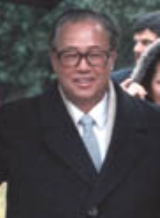
Zhao Ziyang

Encyclopedia
Zhao Ziyang was a high-ranking politician in the People's Republic of China (PRC). He was the third Premier of the People's Republic of China
from 1980 to 1987, and General Secretary
of the Communist Party of China
from 1987 to 1989.
As a senior government official
, Zhao was critical of Maoist policies and instrumental in implementing free-market reforms, first in Sichuan
, subsequently nationwide. He emerged on the national scene due to support from Deng Xiaoping
after the Cultural Revolution
. He also sought measures to streamline the bureaucracy
and fight corruption
, which was severely affecting the Party's legitimacy in the 1980s. Zhao Ziyang was also an advocate of the privatization of state-owned enterprises, the separation of the Party and the state, and general market economic
reforms. Many of these views were shared by then-General Secretary Hu Yaobang
.
His economic reform policies and sympathies to student demonstrators during the Tiananmen Square protests of 1989
placed him at odds with some members of the party leadership, namely Premier Li Peng
. Zhao also began to lose favour with paramount leader
Deng Xiaoping
. In the aftermath of the events, Zhao was purged politically and effectively placed under house arrest
for the next 15 years. He died in Beijing in 2005, but because of his political fall from grace he was not given the funeral rites generally accorded to senior Chinese officials.
, Henan
, who was later murdered by Communist Party officials during a land reform movement in the early 1940s. Zhao joined the Communist Youth League
in 1932,, and became a full member of the Party in 1938.
Unlike many Party members active in the 1930s and 1940s who later became senior Chinese leaders, Zhao joined the Party too late to have participated in the Long March
of 1934-1935. He served in the People's Liberation Army
during the Second Sino-Japanese War
and the subsequent civil war
, but his posts were largely administrative. Zhao's career was not especially notable before he emerged as a Party leader in Guangdong
in the early 1950s.
Zhao rose to prominence in Guangdong
from 1951, initially following a ruthless ultra-leftist, Tao Zhu
, who was notable for his heavy-handed efforts to force local peasants into living and working in "People's Communes". When Mao Zedong
's Great Leap Forward
(1958-1961) created an artificial famine, Mao publicly blamed the nation's food shortages on the greed of rich peasants, who were supposedly hiding China's huge surplus production from the government. Zhao's faith in Mao led him to take a leading role in a local campaign aimed at torturing peasants into revealing their imaginary food supplies. Through supporting the Great Leap Forward, Zhao was partially responsible for the millions of people who died from starvation and malnutrition in Guangdong between 1958 and 1961.
Zhao's experiences during the Great Leap Forward led Zhao to support moderate political and economic policies, including those supported by Deng Xiaoping
and Liu Shaoqi
. He led efforts to re-introduce limited amounts of private agriculture and commerce, and dismantled the People's Communes. Zhao's methods of returning private plots to farmers and assigning production contracts to individual households were replicated in other parts of China, helping the country's agricultural sector recover. After achieving senior positions in Guangdong, Zhao directed a harsh purge of cadres accused of corruption or having ties to the Kuomintang
.
By 1965 Zhao was the Party secretary of Guangdong
province, despite not being a member of the Communist Party Central Committee
. He was forty-six at the time that he first became Party secretary, a notably young age to hold such a prestigious position. Because of his moderate political orientation, Zhao was attacked by Red Guards
during the Cultural Revolution
(1966-1976). He was dismissed from all official positions in 1967, after which he was paraded through Guangzhou
in a dunce cap
and publicly denounced as "a stinking remnant of the landlord class".
in Hunan
, at the Xianzhong Mechanics Factory. Zhao Wujun, the youngest of his four sons, worked with him (Zhao also had a younger daughter). While in political exile, Zhao's family lived in a small apartment close to his factory, with a small suitcase in the living room that served as a dinner table.
Zhao's rehabilitation began in April 1971, when he and his family were woken in the middle of the night by someone banging on the door. Without much explanation, the Party chief of the factory that Zhao was working at informed Zhao that he was to go at once to Changsha, the provincial capital. The factory's only means of transport was a three-wheeled motorcycle, which was ready to take him.
Zhao was driven to Changsha's airport, where a plane had been prepared to fly him to Beijing
. Still unaware of what was happening, Zhao boarded the plane. He was checked into the comfortable Beijing Hotel
, but wasn't able to get to sleep: he later claimed that, after years of living in poverty, the mattress was too soft.
In the morning, Zhao was taken to a meeting with Premier Zhou Enlai
at the Great Hall of the People
. Soon after they met, Zhao began a speech that he had prepared over the previous night: "I have been rethinking the Cultural Revolution during these years as a labourer..." Zhou cut him off, saying "You've been called to Beijing because the Central Committee
has decided to name you as a deputy Party chief of Inner Mongolia
."
After being recalled from political exile, Zhao attempted to portray himself as a born-again Maoist
, and publicly renounced any interest in encouraging private enterprise or material incentive. Zhao's late conversion to Maoism did not last long, and he later became a "principle architect" of the sweeping, pro-capitalist changes that followed the death of Mao. Despite his important role in guiding the economy of China over the course of his career, Zhao had no formal training in economics.
Throughout 1972 Zhou Enlai directed Zhao's political rehabilitation
. Zhao was appointed to the Central Committee, and in Inner Mongolia became the Revolutionary Committee Secretary and Vice Chairman in March 1972. Zhao was elevated to the 10th Central Committee in August 1973, and returned to Guangdong as 1st CPC Secretary and Revolutionary Committee Chair in April 1974. He became Political Commissar of the Chengdu Military Region in December 1975.
Zhao was appointed Party Secretary of Sichuan
in 1975, effectively the province's highest-ranking official. Earlier in the Cultural Revolution, Sichuan had been notable for the violent battles that rival organizations of local Red Guards had fought against each other. At the time, Sichuan was China's most populous province, but it had been economically devastated by the Great Leap Forward and the Cultural Revolution, whose collective policies had collapsed the province's agricultural production to levels not seen since the 1930s, despite a great increase in the province's population. The economic situation was so bad that citizens in Sichuan were reportedly selling their daughters for food. Soon after taking office Zhao introduced a series of successful market-oriented reforms, leading to an increase in industrial production by 81% and agricultural output by 25% within three years. Zhao's reforms made him popular in Sichuan, where the local people created a saying: "yao chi liang, zhao Ziyang". (This saying is a pun on Zhao's name, which can be loosely translated as: "if you want to eat, look for Ziyang.")
province was a strong base of Maoist radicalism during the Cultural Revolution, the ardent followers of the Gang of Four
vehemently opposed Zhao's reforms. However, Zhao's policy had huge popular support and the supporters of the Gang of Four turned to assassination after all other supposedly legal means failed. Over the years in Sichuan during the Cultural Revolution, there were no fewer than half a dozen attempts on Zhao's life, the most serious of which was an ambush of Zhao's jeep in a valley during one of his trips. He narrowly escaped death, but in an attempt to save Zhao's life, his driver/secretary was crushed and buried in the artificially induced landslide. This was the only fatality that resulted from attempts on Zhao's life. The last culprits were not caught until 1983, well after the end of the Cultural Revolution.
as China's "paramount leader" in 1978, Deng Xiaoping
recognized the "Sichuan Experience" as a model for Chinese economic reform
. Deng promoted Zhao to a position as an alternate member of the Politburo of the Communist Party of China
in 1977, and as a full member in 1979. He joined the Politburo Standing Committee
, China's highest ruling organ, in 1982.
After 1978 Zhao's policies were replicated in Anhui
, with similar success. In 1980, after serving under Hua Guofeng
as vice-premier for six months, Zhao replaced Hua as premier with a mandate to introduce his rural reforms across China. Between 1980 and 1984, China's agricultural production rose by 50%.
Zhao developed "preliminary stage theory", a model for transforming the socialist system
via gradual economic reform. As premier, Zhao implemented many of the policies that were successful in Sichuan at a national scale, increasingly de-centralizing industrial and agricultural production. Zhao successfully sought to establish a series of special economic zones in coastal provinces in order to attract foreign investment and create export hubs. Zhao's reforms led to a rapid increases in both agricultural and light-industrial production throughout the 1980s, but his economic reforms were criticized for causing inflation
. Zhao promoted an open foreign policy
, improving China's relations with Western nations in order to support China's economic development.
In the 1980s, Zhao was branded by conservatives as a revisionist of Marxism
, but his advocacy of government transparency and a national dialogue that included ordinary citizens in the policymaking process made him popular with many. Zhao was a solid believer in the Party, but he defined socialism very differently than Party conservatives did. Zhao called political reform "the biggest test facing socialism." He believed economic progress was inextricably linked to democratization
. Zhao was a fan of golf, and is credited with popularizing the game's reintroduction to the mainland in the 1980s.
While Zhao focused on economic reforms during the early 1980s, his superior, Hu Yaobang
, promoted a number of political reforms. In the late 1980s Hu and Zhao collaborated to promote a series of large-scale political reforms with vaguely defined goals. The political reforms of Hu and Zhao included proposals to have candidates directly elected to the Politburo, more elections with more than one candidate, more government transparency, more consultation with the public on policy, and increased personal responsibility directed to officials for their mistakes.
Zhao and Hu also began a large-scale anti-corruption programme, and permitted the investigations of the children of high-ranking Party elders, who had grown up protected by their parents' influence. Hu's investigation of Party officials belonging to this "Crown Prince Party
" made Hu unpopular with many powerful Party officials. In January 1987 a clique of Party elders forced Hu to resign, on the grounds that he had been too lenient to student protestors. After Hu's dismissal, Deng promoted Zhao to replace Hu as CPC General Secretary, putting Zhao in the position to succeed Deng as "paramount leader". One month before Zhao was appointed to the position of General Secretary, Zhao was interviewed by an American reporter, stating: "I am not fit to be the general secretary... I am more fit to look after economic affairs." Zhao's vacated premiership was in turn filled by Li Peng
, a conservative who opposed many of Zhao's economic and political reforms.
In the 1987 Communist Party Congress
Zhao declared that China was in "a primary stage of socialism" that could last 100 years. Under this premise, Zhao believed that China needed to experiment with a variety of economic reforms in order to stimulate production. Zhao proposed to separate the roles of the Party and state, a proposal that has since become taboo.
Western observers generally view the year that Zhao served as General Secretary as the most open in the history of the People's Republic of China. Many limitations on freedom of speech
and freedom of press were relaxed, allowing intellectuals to freely express themselves, and to propose "improvements" for the country. Contrary to popular opinion, Zhao opposed the idea of expanding China's economy by allowing private individuals to purchase stock. The idea of opening China to the stock market remained taboo throughout Zhao's time in government, but was gradually implemented later, in the 1990s.
Zhao's proposal in May 1988 to accelerate price reform led to widespread popular complaints about rampant inflation and gave opponents of rapid reform the opening to call for greater centralization of economic controls and stricter prohibitions against Western influence. This precipitated a political debate, which grew more heated through the winter of 1988 to 1989.
in the 1950s, Zhao often relied on its former members for support, and Zhao's enemies accused him of promoting a "Communist Youth League faction"
within the CCP. Among Beijing's Party elders, Chen Yun
and Li Xiannian
were notably critical of Zhao and his policies.
Despite his criticism of Zhao, Chen Yun was the Party elder most respected by Zhao, and Zhao would frequently attempt to consult with Chen before implementing new policies. Li Xiannian resented Zhao personally for Zhao's interest in foreign culture, and for Zhao's willingness to learn from economic models that had been successful outside of China. According to Zhao, Li Xiannian "hated me because I was implementing Deng Xiaoping's reforms, but since it was difficult for him to openly oppose Deng, he made me the target of the opposition."
Zhao wrote warmly of Hu Yaobang in his autobiography, and generally agreed with Hu on the direction of China's economic reforms. Although Deng Xiaoping was the Zhao's only firm supporter among the Party elders, Deng's support was sufficient to protect Zhao throughout Zhao's career. As late as April 1989, one month before the dramatic end of Zhao's career, Deng assured Zhao that he had secured the support of Chen Yun and Li Xiannian for Zhao to serve two more full terns as Party General Secretary.
The second half of 1988 saw the increasing deterioration of Zhao's political support. Zhao found himself in multi-front turf battles with the Party elders, who grew increasingly dissatisfied with Zhao's hands-off approach to ideological matters. The conservative faction in the politburo, led by Li Peng
and Yao Yilin
, were constantly at odds with Zhao in economic and fiscal policy making. Zhao was under growing pressure to combat runaway corruption by rank-and-file officials and their family members. In the beginning of 1989, it was evident that Zhao was faced with an increasingly difficult uphill battle, and he may have seen that he was fighting for his own political survival. If Zhao was unable to turn things around rapidly, a showdown with the Party conservatives would be all but inevitable. The student protests triggered by the sudden death of former CPC General Secretary Hu Yaobang, widely admired as a reform-minded leader, created a crisis in which Zhao was forced into a confrontation with his political enemies.
Student demonstrators, taking advantage of the loosening political atmosphere, reacted to a variety of causes of discontent. The diverse demands of protesters included greater economic liberalization, political democracy, media freedom, freedom of speech and association, rule of law, and to have the legitimacy of the movement recognized. Some protest leaders spoke against official corruption
and speculation, price stability, social security, and the democratic means to supervise the reform process. Ironically, some of the original invective was also directed against Zhao. Party hardliners increasingly came to the conclusion that the demonstrations were due to Zhao's rapid pace of reform, which they believed caused a sense of confusion and frustration among college students. Protests also spread through many other cities, notably including Shanghai and Guangzhou
. The protesters may have been encouraged by the imminent collapse of other Communist government in Eastern Europe.
The tragic events of the Tiananmen Square protests of 1989
sealed Zhao's fate and rendered impossible any further democratic movement. While he was paying an official visit to Pyongyang
, the party hard-liners exploited the opportunity to declare the ongoing protests "counter-revolutionary." Upon returning from Pyongyang, Zhao made several attempts to steer the course toward what he called "a track based upon democracy and the rule of law". He opened up channels for direct dialogues between students and the government at multiple levels. He also ordered the news media to cover the student demonstrations with unprecedented openness. A number of legislative initiatives aimed at the reform of press, news media and education were also under way. However, Zhao's initiatives, along with his conciliatory attitude toward the students, were seen by the elders and other party hard-liners as hastened steps toward breaking free the party control. The evening of 16 May marked the point of no return of Zhao's political career. At the onset of his meeting with the visiting Soviet leader Mikhail Gorbachev, Zhao made a stunning announcement declaring that Deng Xiaoping, though officially no longer a member of the party central committee, was still having final say in major decision-making. Zhao's move was interpreted by Party elders as an unmistakable sign of parting company with the aging paramount leader, his long-time political patron and mentor. The leadership would not purge Zhao while Gorbachev was still in Beijing. But on the night of 18 May, just after the Soviet leader left, Zhao was summoned to Deng's residence and a hastily called Politburo Standing Committee was called to endorse martial law
with Zhao casting the lone dissenting vote.
Shortly before 5 A.M. on the morning of 19 May, Zhao appeared in Tiananmen Square and wandered among the crowd of protesters. Using a bullhorn, he delivered a now-famous speech to the students gathered at the square. It was first broadcast through China Central Television
nationwide. Here is a translated version:
After a bow, people began to applaud, some students bursted into tears. That was his last public appearance." 我们已经老了,无所谓了。" (trad:我們已經老了,無所謂了。) - "We are already old, it doesn't matter to us any more." became a famous quote after that.
publicly declared martial law
. In the power struggle that ensued, Zhao was stripped of all his positions. Following Zhao's dismissal, Jiang Zemin
replaced Zhao as General Secretary and successor of Deng Xiaoping. Jiang was notable for suppressing similar protests in Shanghai without any bloodshed.
What motivated Zhao remains, even today, a topic of debate by many. Some say he went into the square hoping a conciliatory gesture would gain him leverage against hard-liners like Premier Li Peng. Others believe he supported the protesters and did not want to see them hurt when the military was called in. After the incident, Zhao was placed under indefinite house arrest.
Zhao's rival, Li Peng, later accused Zhao of formenting the Tiananmen Protests exclusively for political gain. According to Li, "Zhao liaised with Bao Tong immediately after his arrival in Beijing (from Pyongyang). Bao gathered some other of Zhao's supporters to hash out the situation. They feared that Zhao's political future was at stake: Zhao did not succeed in [managing] the economy, was not stellar politically, does not have a power base of his own, and his son was suspected of illegal business dealings. As such, it was likely that Zhao would become the 'scapegoat' of the student movement. These advisors suggested to Zhao that he maintain distance with Deng Xiaoping [and] attempt to win the people's hearts in order to save himself; there were no other options." Because Zhao was never formally charged with any wrongdoing, it cannot be known what evidence Li had to support his claims. Zhao himself addressed Li's claims as "slander".
Zhao remained under tight supervision and was allowed to leave his courtyard compound or receive visitors only with permission from the highest echelons of the Party. There were occasional reports of him attending the funeral of a dead comrade, visiting other parts of China or playing golf at Beijing courses, but the government rather successfully kept him hidden from news reports and history books. Over that period, only a few snapshot
s of a gray-haired Zhao leaked out to the media. On at least two occasions Zhao wrote letters, addressed to the Chinese government, in which he put forward the case for a reassessment of the Tiananmen Massacre. One of those letters appeared on the eve of the Communist Party's 15th National Congress. The other came during a 1998 visit to China by U.S. President Bill Clinton
. Neither was ever published in mainland China.
After 1989, Zhao remained ideologically estranged from the Chinese government. He remained popular among those who believed that the government was wrong in ordering the "Tiananmen Massacre", and that the Party should reassess its position on the student protests. He continued to hold China's top leadership responsible for the assault, and refused to accept the official Party line that the demonstrations had been a part of a "counter-revolutionary rebellion". After his arrest, Zhao eventually came to hold a number of beliefs that were much more radical than any positions he had ever expressed while in power. Zhao came to believe that China should adopt a free press, freedom to organize, an independent judiciary, and a multiparty parliamentary democracy.
Zhao lived for fifteen years under house arrest, accompanied by his wife. The hutong
in which Zhao lived had once belonged to a hairdresser of the Qing Dynasty
Empress Dowager, Cixi
, and was located in central Beijing, close to Zhongnanhai
. Despite Zhao's house arrest, no formal charges were ever laid against him, and he was never expelled from the Communist Party. After his arrest, Deng and his successors continued to believe that Zhao and his subordinates had worked secretly to organize the nation-wide protests, and worried that his death might trigger protests similar to the protests sparked by the death of Hu Yaobang.
attack that led to a pulmonary failure and was hospitalized for three weeks. Zhao was hospitalized again with pneumonia on 5 December 2004. Reports of his death were officially denied in early January 2005. Later, on 15 January, he was reported to be in a coma
after multiple strokes. According to Xinhua, Vice President Zeng Qinghong
represented the party's central leadership to visit Zhao at the hospital. Zhao died on 17 January in a Beijing hospital at 07:01, at the age of 85. He was survived by his second wife, Liang Boqi, and five children (a daughter and four sons).
After Zhao's death, China's leaders feared an episode of civil disturbance similar to that which followed the death of Hu Yaobang. In order to manage the news of Zhao's death, the Chinese government created an "Emergency Response Leadership Small Group", which declared "a period of extreme sensitivity", and placed the People's Armed Police on special alert. In order to prevent any mass demonstrations in the capital, the Emergency Group directed the Ministry of Railways to screen travellers headed to Beijing. Chinese newspapers carried a brief obituary, but Xinhua successfully directed China's domestic TV and radio stations not to broadcast the news. In order to prevent any public commemoration of Zhao, Chinese authorities increased security in Tiananmen Square and at Zhao's house.
Under the headline "Comrade Zhao Ziyang has Passed Away", Zhao's obituary stated, "Comrade Zhao had long suffered from multiple diseases affecting his respiratory and cardiovascular systems, and had been hospitalized for medical treatment for several times. His conditions worsened recently, and he passed away Monday after failing to respond to all emergency treatment." All Chinese newspapers carried exactly the same 59-word obituary on the day following his death, leaving the main means of mass dissemination through the Internet. Chinese Internet forum
s, including the Strong Nation Forum
and forums hosted by SINA.com
, Xinhua, and the People's Daily
, were flooded with messages expressing condolences for Zhao: "Time will vindicate him", wrote one commenter; "We will miss you forever" wrote another. These messages were promptly deleted by moderators, leading to more postings attacking the moderators for deleting the postings.
The Chinese government was successful in keeping Zhao's death fairly low key within mainland China. Open, public response was absent, though some online commenters stated that they planned to buy wreaths to mourn his death, or had stood in three minutes of silence to honour Zhao's memory.
In Hong Kong, 10,000–15,000 people attended the candlelight vigil in remembrance of Zhao. Mainlanders such as Chen Juoyi said that it was illegal for Hong Kong legislators to join any farewell ceremony, stating "...under the 'one country, two systems
' a Hong Kong legislator cannot care anything about mainland China." The statement caused a political storm in Hong Kong that continued for three days after his speech. Szeto Wah
, the chairman of The Hong Kong Alliance in Support of Patriotic Democratic Movements in China, said that it was not right for the Communists to suppress the memorial ceremony. The twenty-four pan-democrat legislators went against the chairperson of the Legislative Council of Hong Kong
, who insisted that security be tightened at Tiananmen Square and at Zhao's house, and that the authorities try to prevent any public displays of grief. Similar memorials were held around the world, notably in New York City and Washington, DC where American government officials and exiled political dissidents attended. In the West, Zhao was editorialized as a martyr who died for democracy.
On 29 January 2005 the government held a funeral ceremony for him at the Babaoshan Revolutionary Cemetery
, a place reserved for revolutionary heroes and high government officials, that was attended by some 2,000 mourners, who were pre-approved to attend. Several dissidents, including Zhao's secretary Bao Tong
and Tiananmen Mothers
leader Ding Zilin
, were kept under house arrest and therefore could not attend. Xinhua reported that the most senior official to attend the funeral was Jia Qinglin
, fourth in the party hierarchy, and other officials who attended included He Guoqiang
, Wang Gang
and Hua Jianmin
. Mourners were forbidden to bring flowers or to inscribe their own messages on the government-issued flowers. There was no eulogy at the ceremony because the government and Zhao's family could not agree on its content: while the government wanted to say he made mistakes, his family refused to accept he did anything wrong. On the day of his funeral, state television mentioned Zhao's death for the first time. Xinhua issued a short article on the funerary arrangements, acknowledging Zhao's "contributions to the party and to the people", but said he made "serious mistakes" during the 1989 "political disturbance". According to Du Daozheng, writing in the foreword to the Chinese edition of Zhao's memoirs, the use of the term "serious mistakes" instead of the former verdict of "supporting turmoil and splitting the party" represented a backing down by the party. After the ceremony, Zhao was cremated
. His ashes were taken to his Beijing home, since the government had denied him a place at Babaoshan.
. Outside of China, Zhao's death produced calls from the governments of Taiwan
and Japan
urging China to move toward granting the greater political freedoms that Zhao promoted. The Japanese prime minister, Junichiro Koizumi
, said as part of a statement on Zhao's death: "I want them to make efforts for democratization". A representative of the Taiwanese cabinet, Chen Chi-mai
, stated that Beijing should "face the truth about Tiananment Square" and "push for democratic reforms". The White House
praised Zhao, saying that Zhao "was a man of moral courage who suffered great personal sacrifices for standing by his convictions during difficult times."
Although some of his followers have occasionally attempted to push for Zhao's formal rehabilitation since Zhao's arrest, the Party has been largely successful in removing his name from most public records available in China. Government efforts to delete Zhao's memory from public consciousness include airbrushing his picture from photographs released in China, deleting his name from textbooks, and forbidding the media from mentioning him in any way. In 2005, former NPC Chairman Wan Li
joined more than 20 retired Politburo members, including Tian Jiyun, former Vice Premier, in asking the Central Government to rehabilitate Zhao’s name and hold memorial services for him for his many important contributions to China. The Chinese government agreed to hold a ceremony to honor the late Communist Party chief Zhao Ziyang, but the response fell far short of satisfying the requests from both inside and outside the CPC.
Since 1989, one of the few publications that has dared to print a non-government-approved memorial praising Zhao's legacy has been the magazine China Through the Ages (Yanhuang Chunqiu). The magazine released the pro-Zhao article in July 2010. The article was written by Zhao's former aide, Yang Rudai.
. The 306-page book was crafted over four years from tapes recorded in secret by Zhao, who lived under tightly monitored house arrest for 15 years before dying in 2005. In the last chapter, Zhao praises the Western system of parliamentary democracy and says it is the only way China can solve its problems of corruption and a growing gap between the rich and poor.
Zhao's published autobiography is based on approximately thirty casette tapes which Zhao secretly recorded between 1999 and 2000. The material in his biography was largely consistent with the information from the "Tiananmen Papers
", an unauthorized collection of Chinese governmnent documents published in 2001. The book was also consistent with material from "Captive Conversations", a record of conversations between Zhao and his friend Zong Fengming, which was published only in Chinese.
Prisoner of the State contained minor historical errors, which commenters noted may reflect how out of touch China's leaders are with Chinese society. Although the Beijing populace did spontaneously attempt to block Chinese troops' entrance into Beijing, Zhao's assertion that "groups of old ladies and children slept in the roads" was not correct. Zhao noted that the astrophysicist Fang Lizhi
(the Chinese government's most wanted dissident following the Tiananmen Protests) was out of the country in 1989 and publicly critical of Deng Xiaoping, when in fact Fang was living just outside of Beijing and deliberately kept silent about politics during the 1989 protests.
As of 2009 his memoir was being sold (in both Chinese and English) in Hong Kong but not in mainland China, though a Microsoft Word
file containing the memoir's entire Chinese-language text became available on the Internet and was downloaded widely throughout mainland China.
The recordings highlighted Zhao's heavy Henan accent, making his Mandarin at times hard to follow.
Premier of the People's Republic of China
The Premier of the State Council of the People's Republic of China , sometimes also referred to as the "Prime Minister" informally, is the Leader of the State Council of the People's Republic of China , who is the head of government and holds the highest-ranking of the Civil service of the...
from 1980 to 1987, and General Secretary
General Secretary of the Communist Party of China
The General Secretary of the Communist Party of China , officially General Secretary of the Central Committee of the Communist Party of China, is the highest ranking official within the Communist Party of China, a standing member of the Politburo and head of the Secretariat...
of the Communist Party of China
Communist Party of China
The Communist Party of China , also known as the Chinese Communist Party , is the founding and ruling political party of the People's Republic of China...
from 1987 to 1989.
As a senior government official
Official
An official is someone who holds an office in an organization or government and participates in the exercise of authority .A government official or functionary is an official who is involved in public...
, Zhao was critical of Maoist policies and instrumental in implementing free-market reforms, first in Sichuan
Sichuan
' , known formerly in the West by its postal map spellings of Szechwan or Szechuan is a province in Southwest China with its capital in Chengdu...
, subsequently nationwide. He emerged on the national scene due to support from Deng Xiaoping
Deng Xiaoping
Deng Xiaoping was a Chinese politician, statesman, and diplomat. As leader of the Communist Party of China, Deng was a reformer who led China towards a market economy...
after the Cultural Revolution
Cultural Revolution
The Great Proletarian Cultural Revolution, commonly known as the Cultural Revolution , was a socio-political movement that took place in the People's Republic of China from 1966 through 1976...
. He also sought measures to streamline the bureaucracy
Bureaucracy
A bureaucracy is an organization of non-elected officials of a governmental or organization who implement the rules, laws, and functions of their institution, and are occasionally characterized by officialism and red tape.-Weberian bureaucracy:...
and fight corruption
Political corruption
Political corruption is the use of legislated powers by government officials for illegitimate private gain. Misuse of government power for other purposes, such as repression of political opponents and general police brutality, is not considered political corruption. Neither are illegal acts by...
, which was severely affecting the Party's legitimacy in the 1980s. Zhao Ziyang was also an advocate of the privatization of state-owned enterprises, the separation of the Party and the state, and general market economic
Market economy
A market economy is an economy in which the prices of goods and services are determined in a free price system. This is often contrasted with a state-directed or planned economy. Market economies can range from hypothetically pure laissez-faire variants to an assortment of real-world mixed...
reforms. Many of these views were shared by then-General Secretary Hu Yaobang
Hu Yaobang
Hu Yaobang was a leader of the People's Republic of China who served as both Chairman and Party General Secretary. Hu joined the Chinese Communist Party in the 1930s, and rose to prominence as a comrade of Deng Xiaoping...
.
His economic reform policies and sympathies to student demonstrators during the Tiananmen Square protests of 1989
Tiananmen Square protests of 1989
The Tiananmen Square protests of 1989, also known as the June Fourth Incident in Chinese , were a series of demonstrations in and near Tiananmen Square in Beijing in the People's Republic of China beginning on 15 April 1989...
placed him at odds with some members of the party leadership, namely Premier Li Peng
Li Peng
Li Peng served as the fourth Premier of the People's Republic of China, between 1987 and 1998, and the Chairman of the Standing Committee of the National People's Congress, China's top legislative body, from 1998 to 2003. For much of the 1990s Li was ranked second in the Communist Party of China ...
. Zhao also began to lose favour with paramount leader
Paramount leader
Paramount leader literally "the highest leader of the party and the state ", in modern Chinese political science, unofficially refers to the political leader of the People's Republic of China....
Deng Xiaoping
Deng Xiaoping
Deng Xiaoping was a Chinese politician, statesman, and diplomat. As leader of the Communist Party of China, Deng was a reformer who led China towards a market economy...
. In the aftermath of the events, Zhao was purged politically and effectively placed under house arrest
House arrest
In justice and law, house arrest is a measure by which a person is confined by the authorities to his or her residence. Travel is usually restricted, if allowed at all...
for the next 15 years. He died in Beijing in 2005, but because of his political fall from grace he was not given the funeral rites generally accorded to senior Chinese officials.
Early career
Zhao was born "Zhao Xiuye" (赵修业), but changed his given name to "Ziyang" while attending middle school. He was the son of a wealthy landlord in Hua CountyHua County, Henan
Hua County is a county under Anyang municipality, Henan, China.-Location:The Hua county is located in the southmost part of Anyang. To its north lies Neihuang County, also in Anyang; to its east Puyang County in Puyang; to its south the counties of Changyuan and Fengqiu, both in Xinxiang; to its...
, Henan
Henan
Henan , is a province of the People's Republic of China, located in the central part of the country. Its one-character abbreviation is "豫" , named after Yuzhou , a Han Dynasty state that included parts of Henan...
, who was later murdered by Communist Party officials during a land reform movement in the early 1940s. Zhao joined the Communist Youth League
Communist Youth League
The Communist Youth League of China also known as the China Youth League is a youth movement of the People's Republic of China for youth between the ages of fourteen and twenty-eight, run by Communist Party of China. The league is organized on the party pattern. Its leader is its First Secretary...
in 1932,, and became a full member of the Party in 1938.
Unlike many Party members active in the 1930s and 1940s who later became senior Chinese leaders, Zhao joined the Party too late to have participated in the Long March
Long March
The Long March was a massive military retreat undertaken by the Red Army of the Communist Party of China, the forerunner of the People's Liberation Army, to evade the pursuit of the Kuomintang army. There was not one Long March, but a series of marches, as various Communist armies in the south...
of 1934-1935. He served in the People's Liberation Army
People's Liberation Army
The People's Liberation Army is the unified military organization of all land, sea, strategic missile and air forces of the People's Republic of China. The PLA was established on August 1, 1927 — celebrated annually as "PLA Day" — as the military arm of the Communist Party of China...
during the Second Sino-Japanese War
Second Sino-Japanese War
The Second Sino-Japanese War was a military conflict fought primarily between the Republic of China and the Empire of Japan. From 1937 to 1941, China fought Japan with some economic help from Germany , the Soviet Union and the United States...
and the subsequent civil war
Chinese Civil War
The Chinese Civil War was a civil war fought between the Kuomintang , the governing party of the Republic of China, and the Communist Party of China , for the control of China which eventually led to China's division into two Chinas, Republic of China and People's Republic of...
, but his posts were largely administrative. Zhao's career was not especially notable before he emerged as a Party leader in Guangdong
Guangdong
Guangdong is a province on the South China Sea coast of the People's Republic of China. The province was previously often written with the alternative English name Kwangtung Province...
in the early 1950s.
Zhao rose to prominence in Guangdong
Guangdong
Guangdong is a province on the South China Sea coast of the People's Republic of China. The province was previously often written with the alternative English name Kwangtung Province...
from 1951, initially following a ruthless ultra-leftist, Tao Zhu
Tao Zhu
Tao Zhu is a Former Member of the 8th Communist Party of China Politburo Standing Committee.-Biography:He was Secretary of the Guangdong Provincial Committee and Commander of the Guangzhou Military Region....
, who was notable for his heavy-handed efforts to force local peasants into living and working in "People's Communes". When Mao Zedong
Mao Zedong
Mao Zedong, also transliterated as Mao Tse-tung , and commonly referred to as Chairman Mao , was a Chinese Communist revolutionary, guerrilla warfare strategist, Marxist political philosopher, and leader of the Chinese Revolution...
's Great Leap Forward
Great Leap Forward
The Great Leap Forward of the People's Republic of China was an economic and social campaign of the Communist Party of China , reflected in planning decisions from 1958 to 1961, which aimed to use China's vast population to rapidly transform the country from an agrarian economy into a modern...
(1958-1961) created an artificial famine, Mao publicly blamed the nation's food shortages on the greed of rich peasants, who were supposedly hiding China's huge surplus production from the government. Zhao's faith in Mao led him to take a leading role in a local campaign aimed at torturing peasants into revealing their imaginary food supplies. Through supporting the Great Leap Forward, Zhao was partially responsible for the millions of people who died from starvation and malnutrition in Guangdong between 1958 and 1961.
Zhao's experiences during the Great Leap Forward led Zhao to support moderate political and economic policies, including those supported by Deng Xiaoping
Deng Xiaoping
Deng Xiaoping was a Chinese politician, statesman, and diplomat. As leader of the Communist Party of China, Deng was a reformer who led China towards a market economy...
and Liu Shaoqi
Liu Shaoqi
Liu Shaoqi was a Chinese revolutionary, statesman, and theorist. He was Chairman of the People's Republic of China, China's head of state, from 27 April 1959 to 31 October 1968, during which he implemented policies of economic reconstruction in China...
. He led efforts to re-introduce limited amounts of private agriculture and commerce, and dismantled the People's Communes. Zhao's methods of returning private plots to farmers and assigning production contracts to individual households were replicated in other parts of China, helping the country's agricultural sector recover. After achieving senior positions in Guangdong, Zhao directed a harsh purge of cadres accused of corruption or having ties to the Kuomintang
Kuomintang
The Kuomintang of China , sometimes romanized as Guomindang via the Pinyin transcription system or GMD for short, and translated as the Chinese Nationalist Party is a founding and ruling political party of the Republic of China . Its guiding ideology is the Three Principles of the People, espoused...
.
By 1965 Zhao was the Party secretary of Guangdong
Guangdong
Guangdong is a province on the South China Sea coast of the People's Republic of China. The province was previously often written with the alternative English name Kwangtung Province...
province, despite not being a member of the Communist Party Central Committee
Central Committee of the Communist Party of China
The Central Committee of the Communist Party of China is the highest authority within the Communist Party of China. Its approximately 350 members and alternates are selected once every five years by the National Party Congress....
. He was forty-six at the time that he first became Party secretary, a notably young age to hold such a prestigious position. Because of his moderate political orientation, Zhao was attacked by Red Guards
Red Guards (China)
Red Guards were a mass movement of civilians, mostly students and other young people in the People's Republic of China , who were mobilized by Mao Zedong in 1966 and 1967, during the Cultural Revolution.-Origins:...
during the Cultural Revolution
Cultural Revolution
The Great Proletarian Cultural Revolution, commonly known as the Cultural Revolution , was a socio-political movement that took place in the People's Republic of China from 1966 through 1976...
(1966-1976). He was dismissed from all official positions in 1967, after which he was paraded through Guangzhou
Guangzhou
Guangzhou , known historically as Canton or Kwangchow, is the capital and largest city of the Guangdong province in the People's Republic of China. Located in southern China on the Pearl River, about north-northwest of Hong Kong, Guangzhou is a key national transportation hub and trading port...
in a dunce cap
Dunce cap
A dunce cap, also variously known as a dunce hat, dunce's cap, or dunce's hat, is a pointed hat. In popular culture, it is typically made of paper and often marked with a D or the word "dunce", and given to schoolchildren to wear as punishment by public humiliation for misbehavior and, as the name...
and publicly denounced as "a stinking remnant of the landlord class".
Return to government
Zhao spent four years as a fitterMachinist
A machinist is a person who uses machine tools to make or modify parts, primarily metal parts, a process known as machining. This is accomplished by using machine tools to cut away excess material much as a woodcarver cuts away excess wood to produce his work. In addition to metal, the parts may...
in Hunan
Hunan
' is a province of South-Central China, located to the south of the middle reaches of the Yangtze River and south of Lake Dongting...
, at the Xianzhong Mechanics Factory. Zhao Wujun, the youngest of his four sons, worked with him (Zhao also had a younger daughter). While in political exile, Zhao's family lived in a small apartment close to his factory, with a small suitcase in the living room that served as a dinner table.
Zhao's rehabilitation began in April 1971, when he and his family were woken in the middle of the night by someone banging on the door. Without much explanation, the Party chief of the factory that Zhao was working at informed Zhao that he was to go at once to Changsha, the provincial capital. The factory's only means of transport was a three-wheeled motorcycle, which was ready to take him.
Zhao was driven to Changsha's airport, where a plane had been prepared to fly him to Beijing
Beijing
Beijing , also known as Peking , is the capital of the People's Republic of China and one of the most populous cities in the world, with a population of 19,612,368 as of 2010. The city is the country's political, cultural, and educational center, and home to the headquarters for most of China's...
. Still unaware of what was happening, Zhao boarded the plane. He was checked into the comfortable Beijing Hotel
Beijing Hotel
The Beijing Hotel is a five-star state-owned hotel in the Dongcheng District of Beijing, China.-Overview:It is located at the southern end of Wangfujing Street, at the corner with East Chang'an Avenue, 1.5km from Beijing Railway Station with views of the Forbidden City and part of Tiananmen Square...
, but wasn't able to get to sleep: he later claimed that, after years of living in poverty, the mattress was too soft.
In the morning, Zhao was taken to a meeting with Premier Zhou Enlai
Zhou Enlai
Zhou Enlai was the first Premier of the People's Republic of China, serving from October 1949 until his death in January 1976...
at the Great Hall of the People
Great Hall of the People
The Great Hall of the People is located at the western edge of Tiananmen Square, Beijing, People's Republic of China, and is used for legislative and ceremonial activities by the People's Republic of China and the Communist Party of China. It functions as the People's Republic of China's...
. Soon after they met, Zhao began a speech that he had prepared over the previous night: "I have been rethinking the Cultural Revolution during these years as a labourer..." Zhou cut him off, saying "You've been called to Beijing because the Central Committee
Central Committee of the Communist Party of China
The Central Committee of the Communist Party of China is the highest authority within the Communist Party of China. Its approximately 350 members and alternates are selected once every five years by the National Party Congress....
has decided to name you as a deputy Party chief of Inner Mongolia
Inner Mongolia
Inner Mongolia is an autonomous region of the People's Republic of China, located in the northern region of the country. Inner Mongolia shares an international border with the countries of Mongolia and the Russian Federation...
."
After being recalled from political exile, Zhao attempted to portray himself as a born-again Maoist
Maoism
Maoism, also known as the Mao Zedong Thought , is claimed by Maoists as an anti-Revisionist form of Marxist communist theory, derived from the teachings of the Chinese political leader Mao Zedong . Developed during the 1950s and 1960s, it was widely applied as the political and military guiding...
, and publicly renounced any interest in encouraging private enterprise or material incentive. Zhao's late conversion to Maoism did not last long, and he later became a "principle architect" of the sweeping, pro-capitalist changes that followed the death of Mao. Despite his important role in guiding the economy of China over the course of his career, Zhao had no formal training in economics.
Throughout 1972 Zhou Enlai directed Zhao's political rehabilitation
Political rehabilitation
Political rehabilitation is the process by which a member of a political organization or government who has fallen into disgrace, is restored to public life. It is usually applied to leaders or other prominent individuals who regain their prominence after a period in which they have no influence or...
. Zhao was appointed to the Central Committee, and in Inner Mongolia became the Revolutionary Committee Secretary and Vice Chairman in March 1972. Zhao was elevated to the 10th Central Committee in August 1973, and returned to Guangdong as 1st CPC Secretary and Revolutionary Committee Chair in April 1974. He became Political Commissar of the Chengdu Military Region in December 1975.
Zhao was appointed Party Secretary of Sichuan
Sichuan
' , known formerly in the West by its postal map spellings of Szechwan or Szechuan is a province in Southwest China with its capital in Chengdu...
in 1975, effectively the province's highest-ranking official. Earlier in the Cultural Revolution, Sichuan had been notable for the violent battles that rival organizations of local Red Guards had fought against each other. At the time, Sichuan was China's most populous province, but it had been economically devastated by the Great Leap Forward and the Cultural Revolution, whose collective policies had collapsed the province's agricultural production to levels not seen since the 1930s, despite a great increase in the province's population. The economic situation was so bad that citizens in Sichuan were reportedly selling their daughters for food. Soon after taking office Zhao introduced a series of successful market-oriented reforms, leading to an increase in industrial production by 81% and agricultural output by 25% within three years. Zhao's reforms made him popular in Sichuan, where the local people created a saying: "yao chi liang, zhao Ziyang". (This saying is a pun on Zhao's name, which can be loosely translated as: "if you want to eat, look for Ziyang.")
Assassination attempts
Since SichuanSichuan
' , known formerly in the West by its postal map spellings of Szechwan or Szechuan is a province in Southwest China with its capital in Chengdu...
province was a strong base of Maoist radicalism during the Cultural Revolution, the ardent followers of the Gang of Four
Gang of Four
The Gang of Four was the name given to a political faction composed of four Chinese Communist Party officials. They came to prominence during the Cultural Revolution and were subsequently charged with a series of treasonous crimes...
vehemently opposed Zhao's reforms. However, Zhao's policy had huge popular support and the supporters of the Gang of Four turned to assassination after all other supposedly legal means failed. Over the years in Sichuan during the Cultural Revolution, there were no fewer than half a dozen attempts on Zhao's life, the most serious of which was an ambush of Zhao's jeep in a valley during one of his trips. He narrowly escaped death, but in an attempt to save Zhao's life, his driver/secretary was crushed and buried in the artificially induced landslide. This was the only fatality that resulted from attempts on Zhao's life. The last culprits were not caught until 1983, well after the end of the Cultural Revolution.
Political activities
After ousting Hua GuofengHua Guofeng
Su Zhu, better known by the nom de guerre Hua Guofeng , was Mao Zedong's designated successor as the Paramount Leader of the Communist Party of China and the People's Republic of China. Upon Zhou Enlai's death in 1976, he succeeded Zhou as the second Premier of the People's Republic of China...
as China's "paramount leader" in 1978, Deng Xiaoping
Deng Xiaoping
Deng Xiaoping was a Chinese politician, statesman, and diplomat. As leader of the Communist Party of China, Deng was a reformer who led China towards a market economy...
recognized the "Sichuan Experience" as a model for Chinese economic reform
Chinese economic reform
The Chinese economic reform refers to the program of economic reforms called "Socialism with Chinese characteristics" in the People's Republic of China that were started in December 1978 by reformists within the Communist Party of China led by Deng Xiaoping.China had one of the world's largest...
. Deng promoted Zhao to a position as an alternate member of the Politburo of the Communist Party of China
Politburo of the Communist Party of China
The Central Politburo of the Communist Party of China or Political bureau of the CPC Central Committee , formerly as Central Bureau before 1927, is a group of 24 people who oversee the Communist Party of China...
in 1977, and as a full member in 1979. He joined the Politburo Standing Committee
Politburo Standing Committee of the Communist Party of China
The Politburo Standing Committee of the Communist Party of China is a committee consisting of the top leadership of the Communist Party of China, whose membership varies between 5 and 9 people. The inner workings of the PSC are not well known, although it is believed that decisions of the PSC are...
, China's highest ruling organ, in 1982.
After 1978 Zhao's policies were replicated in Anhui
Anhui
Anhui is a province in the People's Republic of China. Located in eastern China across the basins of the Yangtze River and the Huai River, it borders Jiangsu to the east, Zhejiang to the southeast, Jiangxi to the south, Hubei to the southwest, Henan to the northwest, and Shandong for a tiny...
, with similar success. In 1980, after serving under Hua Guofeng
Hua Guofeng
Su Zhu, better known by the nom de guerre Hua Guofeng , was Mao Zedong's designated successor as the Paramount Leader of the Communist Party of China and the People's Republic of China. Upon Zhou Enlai's death in 1976, he succeeded Zhou as the second Premier of the People's Republic of China...
as vice-premier for six months, Zhao replaced Hua as premier with a mandate to introduce his rural reforms across China. Between 1980 and 1984, China's agricultural production rose by 50%.
Zhao developed "preliminary stage theory", a model for transforming the socialist system
Socialism
Socialism is an economic system characterized by social ownership of the means of production and cooperative management of the economy; or a political philosophy advocating such a system. "Social ownership" may refer to any one of, or a combination of, the following: cooperative enterprises,...
via gradual economic reform. As premier, Zhao implemented many of the policies that were successful in Sichuan at a national scale, increasingly de-centralizing industrial and agricultural production. Zhao successfully sought to establish a series of special economic zones in coastal provinces in order to attract foreign investment and create export hubs. Zhao's reforms led to a rapid increases in both agricultural and light-industrial production throughout the 1980s, but his economic reforms were criticized for causing inflation
Inflation
In economics, inflation is a rise in the general level of prices of goods and services in an economy over a period of time.When the general price level rises, each unit of currency buys fewer goods and services. Consequently, inflation also reflects an erosion in the purchasing power of money – a...
. Zhao promoted an open foreign policy
Foreign relations of the People's Republic of China
The foreign relations of the People's Republic of China guides the way in which it interacts with foreign nations. As a great power and emerging superpower, China's foreign policy and strategic thinking is highly influential. China officially states it "unswervingly pursues an independent foreign...
, improving China's relations with Western nations in order to support China's economic development.
In the 1980s, Zhao was branded by conservatives as a revisionist of Marxism
Marxism
Marxism is an economic and sociopolitical worldview and method of socioeconomic inquiry that centers upon a materialist interpretation of history, a dialectical view of social change, and an analysis and critique of the development of capitalism. Marxism was pioneered in the early to mid 19th...
, but his advocacy of government transparency and a national dialogue that included ordinary citizens in the policymaking process made him popular with many. Zhao was a solid believer in the Party, but he defined socialism very differently than Party conservatives did. Zhao called political reform "the biggest test facing socialism." He believed economic progress was inextricably linked to democratization
Democracy
Democracy is generally defined as a form of government in which all adult citizens have an equal say in the decisions that affect their lives. Ideally, this includes equal participation in the proposal, development and passage of legislation into law...
. Zhao was a fan of golf, and is credited with popularizing the game's reintroduction to the mainland in the 1980s.
While Zhao focused on economic reforms during the early 1980s, his superior, Hu Yaobang
Hu Yaobang
Hu Yaobang was a leader of the People's Republic of China who served as both Chairman and Party General Secretary. Hu joined the Chinese Communist Party in the 1930s, and rose to prominence as a comrade of Deng Xiaoping...
, promoted a number of political reforms. In the late 1980s Hu and Zhao collaborated to promote a series of large-scale political reforms with vaguely defined goals. The political reforms of Hu and Zhao included proposals to have candidates directly elected to the Politburo, more elections with more than one candidate, more government transparency, more consultation with the public on policy, and increased personal responsibility directed to officials for their mistakes.
Zhao and Hu also began a large-scale anti-corruption programme, and permitted the investigations of the children of high-ranking Party elders, who had grown up protected by their parents' influence. Hu's investigation of Party officials belonging to this "Crown Prince Party
Crown Prince Party
In modern usage, the Crown Prince Party, or The Princelings, refers to the descendants of prominent and influential senior communist officials in the People's Republic of China. It is not a political party, but an informal, and often derogatory, categorization to signify those benefiting from...
" made Hu unpopular with many powerful Party officials. In January 1987 a clique of Party elders forced Hu to resign, on the grounds that he had been too lenient to student protestors. After Hu's dismissal, Deng promoted Zhao to replace Hu as CPC General Secretary, putting Zhao in the position to succeed Deng as "paramount leader". One month before Zhao was appointed to the position of General Secretary, Zhao was interviewed by an American reporter, stating: "I am not fit to be the general secretary... I am more fit to look after economic affairs." Zhao's vacated premiership was in turn filled by Li Peng
Li Peng
Li Peng served as the fourth Premier of the People's Republic of China, between 1987 and 1998, and the Chairman of the Standing Committee of the National People's Congress, China's top legislative body, from 1998 to 2003. For much of the 1990s Li was ranked second in the Communist Party of China ...
, a conservative who opposed many of Zhao's economic and political reforms.
In the 1987 Communist Party Congress
National Congress of the Communist Party of China
The National Congress of the Communist Party of China is a party congress that is held about once every five years. The National Congress is theoretically the highest body within the Communist Party of China, but in practice important decisions are made before the meeting. Since 1987 the National...
Zhao declared that China was in "a primary stage of socialism" that could last 100 years. Under this premise, Zhao believed that China needed to experiment with a variety of economic reforms in order to stimulate production. Zhao proposed to separate the roles of the Party and state, a proposal that has since become taboo.
Western observers generally view the year that Zhao served as General Secretary as the most open in the history of the People's Republic of China. Many limitations on freedom of speech
Freedom of speech
Freedom of speech is the freedom to speak freely without censorship. The term freedom of expression is sometimes used synonymously, but includes any act of seeking, receiving and imparting information or ideas, regardless of the medium used...
and freedom of press were relaxed, allowing intellectuals to freely express themselves, and to propose "improvements" for the country. Contrary to popular opinion, Zhao opposed the idea of expanding China's economy by allowing private individuals to purchase stock. The idea of opening China to the stock market remained taboo throughout Zhao's time in government, but was gradually implemented later, in the 1990s.
Zhao's proposal in May 1988 to accelerate price reform led to widespread popular complaints about rampant inflation and gave opponents of rapid reform the opening to call for greater centralization of economic controls and stricter prohibitions against Western influence. This precipitated a political debate, which grew more heated through the winter of 1988 to 1989.
Relationship with Party elders
Because Zhao had risen to power through his work in the provinces, he never enjoyed strong connections among the Party leadership in Beijing. Because he had led the Communist Youth LeagueCommunist Youth League
The Communist Youth League of China also known as the China Youth League is a youth movement of the People's Republic of China for youth between the ages of fourteen and twenty-eight, run by Communist Party of China. The league is organized on the party pattern. Its leader is its First Secretary...
in the 1950s, Zhao often relied on its former members for support, and Zhao's enemies accused him of promoting a "Communist Youth League faction"
Tuanpai
Tuanpai , is a term used by political observers to represent cadres and government officials in the Communist Party of China who originated from the Communist Youth League. The term is also used to represent Hu Jintao and his group of populist associates and other political allies...
within the CCP. Among Beijing's Party elders, Chen Yun
Chen Yun
Chen Yun was one of the most influential leaders of the People's Republic of China during the 1980s and 90s, and one of the top leaders of the Communist Party of China for almost its entire history. He was also known as Liao Chengyun ; it's unclear whether this was his original name or a pseudonym...
and Li Xiannian
Li Xianniàn
Li Xiannian was President of the People's Republic of China between 1983 and 1988 and then chairman of the Chinese People's Political Consultative Conference until his death. He was an influential political figure throughout the PRC, having been a member of the Politburo of the Communist Party of...
were notably critical of Zhao and his policies.
Despite his criticism of Zhao, Chen Yun was the Party elder most respected by Zhao, and Zhao would frequently attempt to consult with Chen before implementing new policies. Li Xiannian resented Zhao personally for Zhao's interest in foreign culture, and for Zhao's willingness to learn from economic models that had been successful outside of China. According to Zhao, Li Xiannian "hated me because I was implementing Deng Xiaoping's reforms, but since it was difficult for him to openly oppose Deng, he made me the target of the opposition."
Zhao wrote warmly of Hu Yaobang in his autobiography, and generally agreed with Hu on the direction of China's economic reforms. Although Deng Xiaoping was the Zhao's only firm supporter among the Party elders, Deng's support was sufficient to protect Zhao throughout Zhao's career. As late as April 1989, one month before the dramatic end of Zhao's career, Deng assured Zhao that he had secured the support of Chen Yun and Li Xiannian for Zhao to serve two more full terns as Party General Secretary.
The second half of 1988 saw the increasing deterioration of Zhao's political support. Zhao found himself in multi-front turf battles with the Party elders, who grew increasingly dissatisfied with Zhao's hands-off approach to ideological matters. The conservative faction in the politburo, led by Li Peng
Li Peng
Li Peng served as the fourth Premier of the People's Republic of China, between 1987 and 1998, and the Chairman of the Standing Committee of the National People's Congress, China's top legislative body, from 1998 to 2003. For much of the 1990s Li was ranked second in the Communist Party of China ...
and Yao Yilin
Yao Yilin
Yao Yilin was a deputy Vice Premier of the People's Republic of China from 1983 to 1988, and the country's First Vice Premier from 1988 to 1993. He was born in Hong Kong in 1917, and spent his early years in Guichi, Chizhou, Anhui. Yao joined the Communist Party of China in 1935...
, were constantly at odds with Zhao in economic and fiscal policy making. Zhao was under growing pressure to combat runaway corruption by rank-and-file officials and their family members. In the beginning of 1989, it was evident that Zhao was faced with an increasingly difficult uphill battle, and he may have seen that he was fighting for his own political survival. If Zhao was unable to turn things around rapidly, a showdown with the Party conservatives would be all but inevitable. The student protests triggered by the sudden death of former CPC General Secretary Hu Yaobang, widely admired as a reform-minded leader, created a crisis in which Zhao was forced into a confrontation with his political enemies.
The Tiananmen Protests
Zhao was General Secretary for little more than a year before the death of Hu Yaobang on 15 April 1989, coupled with a growing sense of public outrage caused by high inflation, provided the backdrop for the large-scale protest of 1989 by students, intellectuals, and other parts of a disaffected urban population. The Tiananmen protests initially began as a spontaneous public mourning for Hu, but evolved into nation-wide protests supporting political reform and demanding an end to Party corruption.Student demonstrators, taking advantage of the loosening political atmosphere, reacted to a variety of causes of discontent. The diverse demands of protesters included greater economic liberalization, political democracy, media freedom, freedom of speech and association, rule of law, and to have the legitimacy of the movement recognized. Some protest leaders spoke against official corruption
Crown Prince Party
In modern usage, the Crown Prince Party, or The Princelings, refers to the descendants of prominent and influential senior communist officials in the People's Republic of China. It is not a political party, but an informal, and often derogatory, categorization to signify those benefiting from...
and speculation, price stability, social security, and the democratic means to supervise the reform process. Ironically, some of the original invective was also directed against Zhao. Party hardliners increasingly came to the conclusion that the demonstrations were due to Zhao's rapid pace of reform, which they believed caused a sense of confusion and frustration among college students. Protests also spread through many other cities, notably including Shanghai and Guangzhou
Guangzhou
Guangzhou , known historically as Canton or Kwangchow, is the capital and largest city of the Guangdong province in the People's Republic of China. Located in southern China on the Pearl River, about north-northwest of Hong Kong, Guangzhou is a key national transportation hub and trading port...
. The protesters may have been encouraged by the imminent collapse of other Communist government in Eastern Europe.
The tragic events of the Tiananmen Square protests of 1989
Tiananmen Square protests of 1989
The Tiananmen Square protests of 1989, also known as the June Fourth Incident in Chinese , were a series of demonstrations in and near Tiananmen Square in Beijing in the People's Republic of China beginning on 15 April 1989...
sealed Zhao's fate and rendered impossible any further democratic movement. While he was paying an official visit to Pyongyang
Pyongyang
Pyongyang is the capital of the Democratic People's Republic of Korea, commonly known as North Korea, and the largest city in the country. Pyongyang is located on the Taedong River and, according to preliminary results from the 2008 population census, has a population of 3,255,388. The city was...
, the party hard-liners exploited the opportunity to declare the ongoing protests "counter-revolutionary." Upon returning from Pyongyang, Zhao made several attempts to steer the course toward what he called "a track based upon democracy and the rule of law". He opened up channels for direct dialogues between students and the government at multiple levels. He also ordered the news media to cover the student demonstrations with unprecedented openness. A number of legislative initiatives aimed at the reform of press, news media and education were also under way. However, Zhao's initiatives, along with his conciliatory attitude toward the students, were seen by the elders and other party hard-liners as hastened steps toward breaking free the party control. The evening of 16 May marked the point of no return of Zhao's political career. At the onset of his meeting with the visiting Soviet leader Mikhail Gorbachev, Zhao made a stunning announcement declaring that Deng Xiaoping, though officially no longer a member of the party central committee, was still having final say in major decision-making. Zhao's move was interpreted by Party elders as an unmistakable sign of parting company with the aging paramount leader, his long-time political patron and mentor. The leadership would not purge Zhao while Gorbachev was still in Beijing. But on the night of 18 May, just after the Soviet leader left, Zhao was summoned to Deng's residence and a hastily called Politburo Standing Committee was called to endorse martial law
Martial law
Martial law is the imposition of military rule by military authorities over designated regions on an emergency basis— only temporary—when the civilian government or civilian authorities fail to function effectively , when there are extensive riots and protests, or when the disobedience of the law...
with Zhao casting the lone dissenting vote.
Shortly before 5 A.M. on the morning of 19 May, Zhao appeared in Tiananmen Square and wandered among the crowd of protesters. Using a bullhorn, he delivered a now-famous speech to the students gathered at the square. It was first broadcast through China Central Television
China Central Television
China Central Television or Chinese Central Television, commonly abbreviated as CCTV, is the major state television broadcaster in mainland China. CCTV has a network of 19 channels broadcasting different programmes and is accessible to more than one billion viewers...
nationwide. Here is a translated version:
After a bow, people began to applaud, some students bursted into tears. That was his last public appearance." 我们已经老了,无所谓了。" (trad:我們已經老了,無所謂了。) - "We are already old, it doesn't matter to us any more." became a famous quote after that.
House arrest
The protesters did not disperse. A day after Zhao's 19 May visit to Tiananmen Square, Premier Li PengLi Peng
Li Peng served as the fourth Premier of the People's Republic of China, between 1987 and 1998, and the Chairman of the Standing Committee of the National People's Congress, China's top legislative body, from 1998 to 2003. For much of the 1990s Li was ranked second in the Communist Party of China ...
publicly declared martial law
Martial law
Martial law is the imposition of military rule by military authorities over designated regions on an emergency basis— only temporary—when the civilian government or civilian authorities fail to function effectively , when there are extensive riots and protests, or when the disobedience of the law...
. In the power struggle that ensued, Zhao was stripped of all his positions. Following Zhao's dismissal, Jiang Zemin
Jiang Zemin
Jiang Zemin is a former Chinese politician, who served as General Secretary of the Communist Party of China from 1989 to 2002, as President of the People's Republic of China from 1993 to 2003, and as Chairman of the Central Military Commission from 1989 to 2005...
replaced Zhao as General Secretary and successor of Deng Xiaoping. Jiang was notable for suppressing similar protests in Shanghai without any bloodshed.
What motivated Zhao remains, even today, a topic of debate by many. Some say he went into the square hoping a conciliatory gesture would gain him leverage against hard-liners like Premier Li Peng. Others believe he supported the protesters and did not want to see them hurt when the military was called in. After the incident, Zhao was placed under indefinite house arrest.
Zhao's rival, Li Peng, later accused Zhao of formenting the Tiananmen Protests exclusively for political gain. According to Li, "Zhao liaised with Bao Tong immediately after his arrival in Beijing (from Pyongyang). Bao gathered some other of Zhao's supporters to hash out the situation. They feared that Zhao's political future was at stake: Zhao did not succeed in [managing] the economy, was not stellar politically, does not have a power base of his own, and his son was suspected of illegal business dealings. As such, it was likely that Zhao would become the 'scapegoat' of the student movement. These advisors suggested to Zhao that he maintain distance with Deng Xiaoping [and] attempt to win the people's hearts in order to save himself; there were no other options." Because Zhao was never formally charged with any wrongdoing, it cannot be known what evidence Li had to support his claims. Zhao himself addressed Li's claims as "slander".
Zhao remained under tight supervision and was allowed to leave his courtyard compound or receive visitors only with permission from the highest echelons of the Party. There were occasional reports of him attending the funeral of a dead comrade, visiting other parts of China or playing golf at Beijing courses, but the government rather successfully kept him hidden from news reports and history books. Over that period, only a few snapshot
Snapshot (photography)
A snapshot is popularly defined as a photograph that is "shot" spontaneously and quickly, most often without artistic or journalistic intent. Snapshots are commonly considered to be technically "imperfect" or amateurish—out of focus or poorly framed or composed...
s of a gray-haired Zhao leaked out to the media. On at least two occasions Zhao wrote letters, addressed to the Chinese government, in which he put forward the case for a reassessment of the Tiananmen Massacre. One of those letters appeared on the eve of the Communist Party's 15th National Congress. The other came during a 1998 visit to China by U.S. President Bill Clinton
Bill Clinton
William Jefferson "Bill" Clinton is an American politician who served as the 42nd President of the United States from 1993 to 2001. Inaugurated at age 46, he was the third-youngest president. He took office at the end of the Cold War, and was the first president of the baby boomer generation...
. Neither was ever published in mainland China.
After 1989, Zhao remained ideologically estranged from the Chinese government. He remained popular among those who believed that the government was wrong in ordering the "Tiananmen Massacre", and that the Party should reassess its position on the student protests. He continued to hold China's top leadership responsible for the assault, and refused to accept the official Party line that the demonstrations had been a part of a "counter-revolutionary rebellion". After his arrest, Zhao eventually came to hold a number of beliefs that were much more radical than any positions he had ever expressed while in power. Zhao came to believe that China should adopt a free press, freedom to organize, an independent judiciary, and a multiparty parliamentary democracy.
Zhao lived for fifteen years under house arrest, accompanied by his wife. The hutong
Hutong
Hutongs are a type of narrow streets or alleys, most commonly associated with Beijing, China.In Beijing, hutongs are alleys formed by lines of siheyuan, traditional courtyard residences. Many neighbourhoods were formed by joining one siheyuan to another to form a hutong, and then joining one...
in which Zhao lived had once belonged to a hairdresser of the Qing Dynasty
Qing Dynasty
The Qing Dynasty was the last dynasty of China, ruling from 1644 to 1912 with a brief, abortive restoration in 1917. It was preceded by the Ming Dynasty and followed by the Republic of China....
Empress Dowager, Cixi
Cixi
Cixi may refer to:*Empress Dowager Cixi , empress of the Qing Dynasty*Cixi City, in Ningbo, Zhejiang, China...
, and was located in central Beijing, close to Zhongnanhai
Zhongnanhai
Zhongnanhai is an area in central Beijing, China adjacent to the Forbidden City which serves as the central headquarters for the Communist Party of China and the State Council of the People's Republic of China. The term Zhongnanhai is closely linked with the central government and senior Communist...
. Despite Zhao's house arrest, no formal charges were ever laid against him, and he was never expelled from the Communist Party. After his arrest, Deng and his successors continued to believe that Zhao and his subordinates had worked secretly to organize the nation-wide protests, and worried that his death might trigger protests similar to the protests sparked by the death of Hu Yaobang.
Death and muted response
In February 2004, Zhao had a pneumoniaPneumonia
Pneumonia is an inflammatory condition of the lung—especially affecting the microscopic air sacs —associated with fever, chest symptoms, and a lack of air space on a chest X-ray. Pneumonia is typically caused by an infection but there are a number of other causes...
attack that led to a pulmonary failure and was hospitalized for three weeks. Zhao was hospitalized again with pneumonia on 5 December 2004. Reports of his death were officially denied in early January 2005. Later, on 15 January, he was reported to be in a coma
Coma
In medicine, a coma is a state of unconsciousness, lasting more than 6 hours in which a person cannot be awakened, fails to respond normally to painful stimuli, light or sound, lacks a normal sleep-wake cycle and does not initiate voluntary actions. A person in a state of coma is described as...
after multiple strokes. According to Xinhua, Vice President Zeng Qinghong
Zeng Qinghong
Zeng Qinghong was the Vice-President of the People's Republic of China from 2003 to 2008. He became a member of the Politburo Standing Committee and member of the Secretariat of the CPC Central Committee during the 2002 16th Party Congress. Although he was formally ranked fifth in the nine PSC...
represented the party's central leadership to visit Zhao at the hospital. Zhao died on 17 January in a Beijing hospital at 07:01, at the age of 85. He was survived by his second wife, Liang Boqi, and five children (a daughter and four sons).
After Zhao's death, China's leaders feared an episode of civil disturbance similar to that which followed the death of Hu Yaobang. In order to manage the news of Zhao's death, the Chinese government created an "Emergency Response Leadership Small Group", which declared "a period of extreme sensitivity", and placed the People's Armed Police on special alert. In order to prevent any mass demonstrations in the capital, the Emergency Group directed the Ministry of Railways to screen travellers headed to Beijing. Chinese newspapers carried a brief obituary, but Xinhua successfully directed China's domestic TV and radio stations not to broadcast the news. In order to prevent any public commemoration of Zhao, Chinese authorities increased security in Tiananmen Square and at Zhao's house.
Under the headline "Comrade Zhao Ziyang has Passed Away", Zhao's obituary stated, "Comrade Zhao had long suffered from multiple diseases affecting his respiratory and cardiovascular systems, and had been hospitalized for medical treatment for several times. His conditions worsened recently, and he passed away Monday after failing to respond to all emergency treatment." All Chinese newspapers carried exactly the same 59-word obituary on the day following his death, leaving the main means of mass dissemination through the Internet. Chinese Internet forum
Internet forum
An Internet forum, or message board, is an online discussion site where people can hold conversations in the form of posted messages. They differ from chat rooms in that messages are at least temporarily archived...
s, including the Strong Nation Forum
Strong Nation Forum
The Strengthening Nation Forum is a Chinese bulletin board on the website of the People's Daily, an official newspaper of the Communist Party of China.The purpose of the forum is for discussion on how to make China a stronger nation...
and forums hosted by SINA.com
SINA.com
SINA is an online media company for China and Chinese communities around the world. SINA operates four major business lines: Sina Weibo, SINA Mobile, SINA Online, and SINA.net. SINA has over 100 million registered users worldwide...
, Xinhua, and the People's Daily
People's Daily
The People's Daily is a daily newspaper in the People's Republic of China. The paper is an organ of the Central Committee of the Communist Party of China , published worldwide with a circulation of 3 to 4 million. In addition to its main Chinese-language edition, it has editions in English,...
, were flooded with messages expressing condolences for Zhao: "Time will vindicate him", wrote one commenter; "We will miss you forever" wrote another. These messages were promptly deleted by moderators, leading to more postings attacking the moderators for deleting the postings.
The Chinese government was successful in keeping Zhao's death fairly low key within mainland China. Open, public response was absent, though some online commenters stated that they planned to buy wreaths to mourn his death, or had stood in three minutes of silence to honour Zhao's memory.
In Hong Kong, 10,000–15,000 people attended the candlelight vigil in remembrance of Zhao. Mainlanders such as Chen Juoyi said that it was illegal for Hong Kong legislators to join any farewell ceremony, stating "...under the 'one country, two systems
One country, two systems
"One country, two systems" is an idea originally proposed by Deng Xiaoping, then Paramount Leader of the People's Republic of China , for the reunification of China during the early 1980s...
' a Hong Kong legislator cannot care anything about mainland China." The statement caused a political storm in Hong Kong that continued for three days after his speech. Szeto Wah
Szeto Wah
Szeto Wah was a politician of the pan-democracy camp of Hong Kong. He was formerly the chairman of The Hong Kong Alliance in Support of Patriotic Democratic Movements in China and a member of the Legislative Council from 1985 to 1997 and 1998 to 2004.Although the Hong Kong government prior to as...
, the chairman of The Hong Kong Alliance in Support of Patriotic Democratic Movements in China, said that it was not right for the Communists to suppress the memorial ceremony. The twenty-four pan-democrat legislators went against the chairperson of the Legislative Council of Hong Kong
Legislative Council of Hong Kong
The Legislative Council is the unicameral legislature of Hong Kong.-History:The Legislative Council of Hong Kong was set up in 1843 as a colonial legislature under British rule...
, who insisted that security be tightened at Tiananmen Square and at Zhao's house, and that the authorities try to prevent any public displays of grief. Similar memorials were held around the world, notably in New York City and Washington, DC where American government officials and exiled political dissidents attended. In the West, Zhao was editorialized as a martyr who died for democracy.
On 29 January 2005 the government held a funeral ceremony for him at the Babaoshan Revolutionary Cemetery
Babaoshan Revolutionary Cemetery
The Babaoshan Revolutionary Cemetery is Beijing's main resting place for revolutionary heroes, high government officials and in recent years, any individual deemed important due to their contributions to society. In Chinese, Babaoshan literally means "The Eight-Treasure Mountains"...
, a place reserved for revolutionary heroes and high government officials, that was attended by some 2,000 mourners, who were pre-approved to attend. Several dissidents, including Zhao's secretary Bao Tong
Bao Tong
Bao Tong was former Director of the Office of Political Reform of the CPC Central Committee and the Policy Secretary of Zhao Ziyang, Premier of the State Council, from 1980 to 1985. He was also Director of the Drafting Committee for the CCP 13th Party Congresses, known for its strong support for...
and Tiananmen Mothers
Tiananmen Mothers
The Tiananmen Mothers is a group of Chinese democracy activists promoting a change in the government's position over the suppression of the Tiananmen Square protests of 1989...
leader Ding Zilin
Ding Zilin
Professor Ding Zilin is currently the leader of the political pressure group Tiananmen Mothers.-Biography:...
, were kept under house arrest and therefore could not attend. Xinhua reported that the most senior official to attend the funeral was Jia Qinglin
Jia Qinglin
Jia Qinglin is a senior leader of the People's Republic of China. He is the fourth ranking member of the Politburo Standing Committee of the Communist Party of China, the Chairman and Party secretary of the National Committee of the People's Political Consultative Conference. Jia's functions as...
, fourth in the party hierarchy, and other officials who attended included He Guoqiang
He Guoqiang
He Guoqiang is a high-ranking government official in the government of the People's Republic of China. Currently he is the eighth ranked member of the Politburo Standing Committee, and the head of the new Central Commission for Discipline Inspection....
, Wang Gang
Wang Gang
Wang Gang may refer to:*Wang Gang , Chinese politician and a leader of the Communist Party of China*Wang Gang , Chinese actor, TV host*Wang Gang , Chinese footballer...
and Hua Jianmin
Hua Jianmin
Hua Jianmin currently serves as one of the vice chairmen of the standing committee of the 11th National People's Congress of the People's Republic of China...
. Mourners were forbidden to bring flowers or to inscribe their own messages on the government-issued flowers. There was no eulogy at the ceremony because the government and Zhao's family could not agree on its content: while the government wanted to say he made mistakes, his family refused to accept he did anything wrong. On the day of his funeral, state television mentioned Zhao's death for the first time. Xinhua issued a short article on the funerary arrangements, acknowledging Zhao's "contributions to the party and to the people", but said he made "serious mistakes" during the 1989 "political disturbance". According to Du Daozheng, writing in the foreword to the Chinese edition of Zhao's memoirs, the use of the term "serious mistakes" instead of the former verdict of "supporting turmoil and splitting the party" represented a backing down by the party. After the ceremony, Zhao was cremated
Cremation
Cremation is the process of reducing bodies to basic chemical compounds such as gasses and bone fragments. This is accomplished through high-temperature burning, vaporization and oxidation....
. His ashes were taken to his Beijing home, since the government had denied him a place at Babaoshan.
Push for rehabilitation
After Zhao's death, there were a number of calls in China and abroad urging China to reconsider Zhao's role in history. Within China, these calls were largely led by Zhao's former secretary, Bao TongBao Tong
Bao Tong was former Director of the Office of Political Reform of the CPC Central Committee and the Policy Secretary of Zhao Ziyang, Premier of the State Council, from 1980 to 1985. He was also Director of the Drafting Committee for the CCP 13th Party Congresses, known for its strong support for...
. Outside of China, Zhao's death produced calls from the governments of Taiwan
Taiwan
Taiwan , also known, especially in the past, as Formosa , is the largest island of the same-named island group of East Asia in the western Pacific Ocean and located off the southeastern coast of mainland China. The island forms over 99% of the current territory of the Republic of China following...
and Japan
Japan
Japan is an island nation in East Asia. Located in the Pacific Ocean, it lies to the east of the Sea of Japan, China, North Korea, South Korea and Russia, stretching from the Sea of Okhotsk in the north to the East China Sea and Taiwan in the south...
urging China to move toward granting the greater political freedoms that Zhao promoted. The Japanese prime minister, Junichiro Koizumi
Junichiro Koizumi
is a Japanese politician who served as Prime Minister of Japan from 2001 to 2006. He retired from politics when his term in parliament ended.Widely seen as a maverick leader of the Liberal Democratic Party , he became known as an economic reformer, focusing on Japan's government debt and the...
, said as part of a statement on Zhao's death: "I want them to make efforts for democratization". A representative of the Taiwanese cabinet, Chen Chi-mai
Chen Chi-mai
Chen Chi-mai is a Taiwanese politician, currently the spokesperson of the Democratic Progressive Party and the Chief executive officer of the Democratic Progressive Party Policy Research and Coordinating Committee...
, stated that Beijing should "face the truth about Tiananment Square" and "push for democratic reforms". The White House
White House
The White House is the official residence and principal workplace of the president of the United States. Located at 1600 Pennsylvania Avenue NW in Washington, D.C., the house was designed by Irish-born James Hoban, and built between 1792 and 1800 of white-painted Aquia sandstone in the Neoclassical...
praised Zhao, saying that Zhao "was a man of moral courage who suffered great personal sacrifices for standing by his convictions during difficult times."
Although some of his followers have occasionally attempted to push for Zhao's formal rehabilitation since Zhao's arrest, the Party has been largely successful in removing his name from most public records available in China. Government efforts to delete Zhao's memory from public consciousness include airbrushing his picture from photographs released in China, deleting his name from textbooks, and forbidding the media from mentioning him in any way. In 2005, former NPC Chairman Wan Li
Wan Li
Wan Li was during a long administrative career in the People's Republic of China Vice Premier, National People's Congress Chairman, and a member of the Communist Party of China Central Committee, its Secretariat and its Politburo...
joined more than 20 retired Politburo members, including Tian Jiyun, former Vice Premier, in asking the Central Government to rehabilitate Zhao’s name and hold memorial services for him for his many important contributions to China. The Chinese government agreed to hold a ceremony to honor the late Communist Party chief Zhao Ziyang, but the response fell far short of satisfying the requests from both inside and outside the CPC.
Since 1989, one of the few publications that has dared to print a non-government-approved memorial praising Zhao's legacy has been the magazine China Through the Ages (Yanhuang Chunqiu). The magazine released the pro-Zhao article in July 2010. The article was written by Zhao's former aide, Yang Rudai.
Memoirs
On 14 May 2009, a published edition of Zhao's memoirs was released to the public, under the English title Prisoner of the State: The Secret Journal of Premier Zhao ZiyangPrisoner of the State: The Secret Journal of Premier Zhao Ziyang
Prisoner of the State: The Secret Journal of Premier Zhao Ziyang is a 360-page book in English published in May 2009 containing the memoirs of People's Republic of China's former communist leader who was sacked after the Tiananmen Square protests in 1989. It is based on a series of about 30 audio...
. The 306-page book was crafted over four years from tapes recorded in secret by Zhao, who lived under tightly monitored house arrest for 15 years before dying in 2005. In the last chapter, Zhao praises the Western system of parliamentary democracy and says it is the only way China can solve its problems of corruption and a growing gap between the rich and poor.
Zhao's published autobiography is based on approximately thirty casette tapes which Zhao secretly recorded between 1999 and 2000. The material in his biography was largely consistent with the information from the "Tiananmen Papers
Tiananmen Papers
The Tiananmen Papers was first published in English in January 2001 by PublicAffairs. The extended Chinese version of this book was published in April that same year under the title 中國六四真相 by Mirror Books in Hong Kong...
", an unauthorized collection of Chinese governmnent documents published in 2001. The book was also consistent with material from "Captive Conversations", a record of conversations between Zhao and his friend Zong Fengming, which was published only in Chinese.
Prisoner of the State contained minor historical errors, which commenters noted may reflect how out of touch China's leaders are with Chinese society. Although the Beijing populace did spontaneously attempt to block Chinese troops' entrance into Beijing, Zhao's assertion that "groups of old ladies and children slept in the roads" was not correct. Zhao noted that the astrophysicist Fang Lizhi
Fang Lizhi
Fang Lizhi is a professor of astrophysics and former vice-president of the University of Science and Technology of China whose liberal ideas inspired the pro-democracy student movement of 1986-87 and, finally, the Tiananmen Square protests of 1989...
(the Chinese government's most wanted dissident following the Tiananmen Protests) was out of the country in 1989 and publicly critical of Deng Xiaoping, when in fact Fang was living just outside of Beijing and deliberately kept silent about politics during the 1989 protests.
As of 2009 his memoir was being sold (in both Chinese and English) in Hong Kong but not in mainland China, though a Microsoft Word
Microsoft Word
Microsoft Word is a word processor designed by Microsoft. It was first released in 1983 under the name Multi-Tool Word for Xenix systems. Subsequent versions were later written for several other platforms including IBM PCs running DOS , the Apple Macintosh , the AT&T Unix PC , Atari ST , SCO UNIX,...
file containing the memoir's entire Chinese-language text became available on the Internet and was downloaded widely throughout mainland China.
The recordings highlighted Zhao's heavy Henan accent, making his Mandarin at times hard to follow.
See also
- Tiananmen Square protests of 1989Tiananmen Square protests of 1989The Tiananmen Square protests of 1989, also known as the June Fourth Incident in Chinese , were a series of demonstrations in and near Tiananmen Square in Beijing in the People's Republic of China beginning on 15 April 1989...
- Politics of the People's Republic of ChinaPolitics of the People's Republic of ChinaThe politics of the People's Republic of China take place in a framework of a single-party socialist republic. The leadership of the Communist Party is stated in the Constitution of the People's Republic of China...
- History of the People's Republic of ChinaHistory of the People's Republic of ChinaThe history of the People's Republic of China details the history of mainland China since October 1, 1949, when, after a near complete victory by the Communist Party of China in the Chinese Civil War, Mao Zedong proclaimed the People's Republic of China from atop Tiananmen...
- Censorship in the People's Republic of ChinaCensorship in the People's Republic of ChinaCensorship in the People's Republic of China is implemented or mandated by the PRC's ruling party, the Communist Party of China . The special administrative regions of Hong Kong and Macau have their own legal systems and are largely self-governing, so these censorship policies do not apply...
- Internet censorship in the People's Republic of ChinaInternet censorship in the People's Republic of ChinaInternet censorship in the People's Republic of China is conducted under a wide variety of laws and administrative regulations. There are no specific laws or regulations which the censorship follows...
- Human rights in the People's Republic of ChinaHuman rights in the People's Republic of ChinaHuman rights in the People's Republic of China are a matter of dispute between the Chinese government, other countries, international NGOs, and dissidents inside the country. Organizations such as the U.S. State Department, Amnesty International, and Human Rights Watch have accused the Chinese...
External links and further reading
- Video of Zhao's May 19 speech to Tiananmen protesters
- Zhao Ziyang. Prisoner of the State: The Secret Journal of Premier Zhao ZiyangPrisoner of the State: The Secret Journal of Premier Zhao ZiyangPrisoner of the State: The Secret Journal of Premier Zhao Ziyang is a 360-page book in English published in May 2009 containing the memoirs of People's Republic of China's former communist leader who was sacked after the Tiananmen Square protests in 1989. It is based on a series of about 30 audio...
. Trans & Ed. Bao Pu, Renee Chiang, and Adi Ignatius. New York: Simon and Schuster. 2009. ISBN:1-4391-4938-0. - Pre-publication interview on Prisoner of the State with Bao Pu and excerpts from Zhao tapes (Radio France Internationale in English)
- Alliance Introduction (profile by the democracy movement alliance; in Chinese)
- News collections about Zhao Ziyang (China Digital TimesChina Digital TimesChina Digital Times is a bilingual "collaborative news website covering China’s social and political transition and its emerging role in the world," according to the site's About page...
) - 赵紫阳同志逝世, Zhao Ziyang died at 85 (official Chinese news agency, Xinhua News AgencyXinhua News AgencyThe Xinhua News Agency is the official press agency of the government of the People's Republic of China and the biggest center for collecting information and press conferences in the PRC. It is the largest news agency in the PRC, ahead of the China News Service...
) - China's Purged Chinese leader dies (CNN)
- Obituary: Zhao Ziyang (BBC)
- Chinese media muted on Zhao death (BBC)
- Online tributes to Zhao Ziyang (BBC)
- The Prisoner of Conscience: Zhao Ziyang, 1919-2005 (TIME)
- Chinese Leader Purged for Supporting Tiananmen Protesters Dies at 85 (The New York Times)
- China Gives Zhao's Death Scant Notice (The New York Times)
- Purged Chinese Leader Zhao Ziyang Dies at 85 (The Washington PostThe Washington PostThe Washington Post is Washington, D.C.'s largest newspaper and its oldest still-existing paper, founded in 1877. Located in the capital of the United States, The Post has a particular emphasis on national politics. D.C., Maryland, and Virginia editions are printed for daily circulation...
) - Zhao's Death Puts China in Quandary (The Washington Post)
- The man who came too late (The EconomistThe EconomistThe Economist is an English-language weekly news and international affairs publication owned by The Economist Newspaper Ltd. and edited in offices in the City of Westminster, London, England. Continuous publication began under founder James Wilson in September 1843...
) - Media Barred from Covering Death of Former Communist Leader (International Freedom of Expression ExchangeInternational Freedom of Expression ExchangeThe International Freedom of Expression eXchange , founded in 1992, is a global network of around 90 non-governmental organisations that promotes and defends the right to freedom of expression....
) - Zhao Ziyang: The Times obituary (The Times)
- Retired Politburo Members Appeal for Zhao Ziyang’s Rehabilitation (The Epoch Times)