

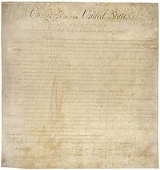
Tenth Amendment to the United States Constitution

Encyclopedia
The Tenth Amendment to the United States Constitution
, which is part of the Bill of Rights
, was ratified on December 15, 1791. The Tenth Amendment states the Constitution's principle of federalism
by providing that powers not granted to the federal government
nor prohibited to the states
by the Constitution are reserved, respectively, to the states or the people.
: "Each state retains its sovereignty, freedom, and independence, and every power, jurisdiction, and right, which is not by this Confederation expressly delegated to the United States, in Congress assembled." After the Constitution was ratified, some wanted to add a similar amendment limiting the federal government
to powers "expressly" delegated, which would have denied implied powers
. However, the word "expressly" ultimately did not appear in the Tenth Amendment as ratified, and therefore the Tenth Amendment did not reject the powers implied by the Necessary and Proper Clause.
When he introduced the Tenth Amendment in Congress, James Madison
explained that many states were anxious to ratify this amendment, despite critics who deemed the amendment superfluous or unnecessary:
The states decided to ratify the Tenth Amendment, and thus declined to signal that there are unenumerated powers in addition to unenumerated rights. The amendment rendered unambiguous what had previously been at most a mere suggestion or implication.
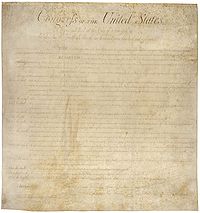
The phrase "...,or to the people." was appended in handwriting as the Bill of Rights
circulated between the two Houses of Congress.
. In United States v. Sprague
(1931) the Supreme Court
asserted that the amendment "added nothing to the [Constitution] as originally ratified."
States and local governments have occasionally attempted to assert exemption from various federal regulations, especially in the areas of labor and environmental controls, using the Tenth Amendment as a basis for their claim. An often-repeated quote, from United States v. Darby, 312 U.S. 100, 124 (1941), reads as follows:
rarely declares laws unconstitutional for violating the Tenth Amendment. In the modern era, the Court has only done so where the federal government compels the states to enforce federal statutes. In 1992, in New York v. United States
, 505 U.S. 144 (1992), for only the second time in 55 years, the Supreme Court invalidated a portion of a federal law for violating the Tenth Amendment. The case challenged a portion of the Low-Level Radioactive Waste Policy Amendments Act of 1985. The act provided three incentives for states to comply with statutory obligations to provide for the disposal of low-level radioactive waste. The first two incentives were monetary. The third, which was challenged in the case, obliged states to take title to any waste within their borders that was not disposed of prior to January 1, 1996, and made each state liable for all damages directly related to the waste. The Court, in a 6–3 decision, ruled that the imposition of that obligation on the states violated the Tenth Amendment. Justice Sandra Day O’Connor
wrote that the federal government can encourage the states to adopt certain regulations through the spending power (e.g. by attaching conditions to the receipt of federal funds, see South Dakota v. Dole
), or through the commerce power (by directly pre-empting state law). However, Congress cannot directly compel states to enforce federal regulations.
In 1997, the Court again ruled that the Brady Handgun Violence Prevention Act
violated the Tenth Amendment (Printz v. United States
, 521 U.S. 898 (1997)). The act required state and local law enforcement officials to conduct background checks on persons attempting to purchase handguns. Justice Antonin Scalia
, writing for the majority, applied New York v. United States to show that the law violated the Tenth Amendment. Since the act “forced participation of the State’s executive in the actual administration of a federal program,” it was unconstitutional.
has become one of the most frequently-used sources of Congress' power, and thus its interpretation is very important in determining the allowable scope of federal government.
In the 20th century, complex economic challenges arising from the Great Depression
triggered a reevaluation in both Congress and the Supreme Court of the use of Commerce Clause powers to maintain a strong national economy.
In Wickard v. Filburn
(1942), in the context of World War II
, the Court ruled that federal regulations of wheat production could constitutionally be applied to wheat grown for "home consumption" on a farm — that is, wheat grown to be fed to farm animals or otherwise consumed on the farm. The rationale was that a farmer's growing "his own wheat" can have a substantial cumulative effect on interstate commerce, because if all farmers were to exceed their production quotas, a significant amount of wheat would either not be sold on the market or would be bought from other producers. Hence, in the aggregate, if farmers were allowed to consume their own wheat, it would affect the interstate market in wheat.
In Garcia v. San Antonio Metropolitan Transit Authority
(1985), the Court changed the analytic framework to be applied in Tenth Amendment cases. Prior to the Garcia decision, the determination of whether there was state immunity from federal regulation turned on whether the state activity was "traditional" for or "integral" to the state government. The Court noted that this analysis was "unsound in principle and unworkable in practice," and rejected it without providing a replacement. The Court's holding declined to set any formula to provide guidance in future cases. Instead, it simply held "...we need go no further than to state that we perceive nothing in the overtime and minimum-wage requirements of the FLSA ... that is destructive of state sovereignty or violative of any constitutional provision." It left to future courts how best to determine when a particular federal regulation may be "destructive of state sovereignty or violative of any constitutional provision."
In United States v. Lopez , a federal law mandating a "gun-free zone" on and around public school campuses was struck down because, the Supreme Court ruled, there was no clause in the Constitution authorizing it. This was the first modern Supreme Court opinion to limit the government's power under the Commerce Clause. The opinion did not mention the Tenth Amendment, and the Court's 1985 Garcia opinion remains the controlling authority on that subject.
Most recently, the Commerce Clause was cited in the 2005 decision Gonzales v. Raich
. In this case, a California woman sued the Drug Enforcement Administration
after her medical marijuana crop was seized and destroyed by federal agents. Medical marijuana was explicitly made legal under California state law by Proposition 215; however, marijuana is prohibited at the federal level by the Controlled Substances Act
. Even though the woman grew the marijuana strictly for her own consumption and never sold any, the Supreme Court stated that growing one's own marijuana affects the interstate market of marijuana. The theory was that the marijuana could enter the stream of interstate commerce, even if it clearly wasn't grown for that purpose and it was unlikely ever to happen (the same reasoning as in the Wickard v. Filburn decision). It therefore ruled that this practice may be regulated by the federal government under the authority of the Commerce Clause.
. However, where Congress or the Executive has the power to implement programs, or otherwise regulate, there are, arguably, certain incentives in the national government encouraging States to become the instruments of such national policy, rather than to implement the program directly. One incentive is that state implementation of national programs places implementation in the hands of local officials who are closer to local circumstances. Another incentive is that implementation of federal programs at the state level would in principle limit the growth of the national bureaucracy.
For this reason, Congress often seeks to exercise its powers by offering or encouraging States to implement national programs consistent with national minimum standards; a system known as cooperative federalism
. One example of the exercise of this device was to condition allocation of federal funding where certain state laws do not conform to federal guidelines. For example, federal educational funds may not be accepted without implementation of special education programs in compliance with IDEA
. Similarly, the nationwide state 55 mph (90 km/h) speed limit
, .08 legal blood alcohol limit, and the nationwide state 21-year drinking age were imposed through this method; the states would lose highway funding if they refused to pass such laws. See e.g. South Dakota v. Dole
, 483 U.S. 203
(1987).
(1958), the Supreme Court of the United States
held that federal law prevails over state law due to the operation of the Supremacy Clause
, and that federal law "can neither be nullified openly and directly by state legislators or state executive or judicial officers nor nullified indirectly by them through evasive schemes . . . ." Thus, state laws purporting to nullify federal statutes or to exempt states and their citizens from federal statutes have only symbolic impact.
, the Necessary and Proper Clause, or the Supremacy Clause would, according to this resolution, be invalid).
, Arizona
, California
, Colorado
, Hawaii
, Maine
, Michigan
, Montana
, Nevada
, New Jersey
, New Mexico
, Oregon
, Rhode Island
, Vermont
, and Washington) and the District of Columbia have passed legislation which permit the use of medical marijuana. California Proposition 19 would have gone one step further, and legalized marijuana use by persons over age 21 for any purpose whatsoever; however, the state constitutional amendment did not pass.
The Obama administration announced in October 2009 that it advised federal prosecutors not to target medicinal marijuana users, or their suppliers, in states that have passed such laws.
Despite this campaign promise, the DEA
has continued to raid medical facilities in several states, and the DOJ
has gone so far as to prevent such cases from being well publicized.
. Though the legislation is still on the books, its implementation has been delayed on several occasions and is currently not being enforced.
. Such provisions include mandatory participation in such a system as well as preserving the right of a patient to pay a health care professional for treatment (and for the professional to accept it) outside of a single-payer system
. Arizona's legislation passed as a proposed constitutional amendment, approved by voters in 2010. On February 1, 2010, the Virginia Senate took a stand against a key provision of a proposed federal health care overhaul, passing legislation declaring that Virginia residents cannot be forced to buy health insurance. On March 17, 2010, Idaho Governor C.L. "Butch" Otter signed a bill requiring the Attorney General to sue the federal government if Idaho residents are required to buy health insurance.
and Afghanistan
); the bills failed in Maryland
and New Mexico
.
fund. If the state legislature determined that a portion of the federal budget was not constitutional, or if the federal government imposed penalties or sanctions upon the state for creating the fund, then the money would be withheld.) None have advanced beyond the introductory stage.
None have advanced beyond the introductory stage.
on federal land. Rep. Christopher Herrod
has introduced the bill in a state where the federal government controls over 60% of the land. The effort has the full support of Republican Attorney General Mark Shurtleff, who would have to defend the law. The proposal includes setting aside $3 million for legal defense.
Intrastate Coal and Use Act (H.B. 2554) was being introduced into the West Virginia House of Delegates
by Delegate Gary Howell
. The bill states that coal sold and used within the borders of West Virginia is not subject to EPA authority because no interstate commerce exists and the state retains the rights to control its own intrastate commerce under the 10th Amendment. The American Legislative Exchange Council
recommends the Intrastate Coal and Use Act for model legislation in other states.
United States Constitution
The Constitution of the United States is the supreme law of the United States of America. It is the framework for the organization of the United States government and for the relationship of the federal government with the states, citizens, and all people within the United States.The first three...
, which is part of the Bill of Rights
United States Bill of Rights
The Bill of Rights is the collective name for the first ten amendments to the United States Constitution. These limitations serve to protect the natural rights of liberty and property. They guarantee a number of personal freedoms, limit the government's power in judicial and other proceedings, and...
, was ratified on December 15, 1791. The Tenth Amendment states the Constitution's principle of federalism
Federalism
Federalism is a political concept in which a group of members are bound together by covenant with a governing representative head. The term "federalism" is also used to describe a system of the government in which sovereignty is constitutionally divided between a central governing authority and...
by providing that powers not granted to the federal government
Federal government of the United States
The federal government of the United States is the national government of the constitutional republic of fifty states that is the United States of America. The federal government comprises three distinct branches of government: a legislative, an executive and a judiciary. These branches and...
nor prohibited to the states
U.S. state
A U.S. state is any one of the 50 federated states of the United States of America that share sovereignty with the federal government. Because of this shared sovereignty, an American is a citizen both of the federal entity and of his or her state of domicile. Four states use the official title of...
by the Constitution are reserved, respectively, to the states or the people.
Text
Drafting and adoption
The Tenth Amendment is similar to an earlier provision of the Articles of ConfederationArticles of Confederation
The Articles of Confederation, formally the Articles of Confederation and Perpetual Union, was an agreement among the 13 founding states that legally established the United States of America as a confederation of sovereign states and served as its first constitution...
: "Each state retains its sovereignty, freedom, and independence, and every power, jurisdiction, and right, which is not by this Confederation expressly delegated to the United States, in Congress assembled." After the Constitution was ratified, some wanted to add a similar amendment limiting the federal government
Federal government of the United States
The federal government of the United States is the national government of the constitutional republic of fifty states that is the United States of America. The federal government comprises three distinct branches of government: a legislative, an executive and a judiciary. These branches and...
to powers "expressly" delegated, which would have denied implied powers
Implied powers
Implied powers, in the United States, are those powers authorized by a legal document which, while not stated, seem to be implied by powers expressly stated...
. However, the word "expressly" ultimately did not appear in the Tenth Amendment as ratified, and therefore the Tenth Amendment did not reject the powers implied by the Necessary and Proper Clause.
When he introduced the Tenth Amendment in Congress, James Madison
James Madison
James Madison, Jr. was an American statesman and political theorist. He was the fourth President of the United States and is hailed as the “Father of the Constitution” for being the primary author of the United States Constitution and at first an opponent of, and then a key author of the United...
explained that many states were anxious to ratify this amendment, despite critics who deemed the amendment superfluous or unnecessary:
I find, from looking into the amendments proposed by the State conventions, that several are particularly anxious that it should be declared in the Constitution, that the powers not therein delegated should be reserved to the several States. Perhaps words which may define this more precisely than the whole of the instrument now does, may be considered as superfluous. I admit they may be deemed unnecessary: but there can be no harm in making such a declaration, if gentlemen will allow that the fact is as stated. I am sure I understand it so, and do therefore propose it.
The states decided to ratify the Tenth Amendment, and thus declined to signal that there are unenumerated powers in addition to unenumerated rights. The amendment rendered unambiguous what had previously been at most a mere suggestion or implication.
The phrase "...,or to the people." was appended in handwriting as the Bill of Rights
Bill of rights
A bill of rights is a list of the most important rights of the citizens of a country. The purpose of these bills is to protect those rights against infringement. The term "bill of rights" originates from England, where it referred to the Bill of Rights 1689. Bills of rights may be entrenched or...
circulated between the two Houses of Congress.
Judicial interpretation
The Tenth Amendment, which makes explicit the idea that the federal government is limited only to the powers granted in the Constitution, is often considered to be a truismTruism
A truism is a claim that is so obvious or self-evident as to be hardly worth mentioning, except as a reminder or as a rhetorical or literary device and is the opposite of falsism....
. In United States v. Sprague
United States v. Sprague
United States v. Sprague, was a United States Supreme Court case that dealt with the Fifth Article of the US Constitution. The defendants had been indicted under the National Prohibition Act and were attempting to quash their indictments, arguing that the Eighteenth Amendment had not been properly...
(1931) the Supreme Court
Supreme Court of the United States
The Supreme Court of the United States is the highest court in the United States. It has ultimate appellate jurisdiction over all state and federal courts, and original jurisdiction over a small range of cases...
asserted that the amendment "added nothing to the [Constitution] as originally ratified."
States and local governments have occasionally attempted to assert exemption from various federal regulations, especially in the areas of labor and environmental controls, using the Tenth Amendment as a basis for their claim. An often-repeated quote, from United States v. Darby, 312 U.S. 100, 124 (1941), reads as follows:
Forced participation or commandeering
The Supreme CourtSupreme Court of the United States
The Supreme Court of the United States is the highest court in the United States. It has ultimate appellate jurisdiction over all state and federal courts, and original jurisdiction over a small range of cases...
rarely declares laws unconstitutional for violating the Tenth Amendment. In the modern era, the Court has only done so where the federal government compels the states to enforce federal statutes. In 1992, in New York v. United States
New York v. United States
New York v. United States, 505 U.S. 144 was a decision of the United States Supreme Court. Justice Sandra Day O'Connor, writing for the majority, found that the "Take Title" provision of the Low-Level Radioactive Waste Policy Amendments Act of 1985 exceeded Congress's power under the Commerce...
, 505 U.S. 144 (1992), for only the second time in 55 years, the Supreme Court invalidated a portion of a federal law for violating the Tenth Amendment. The case challenged a portion of the Low-Level Radioactive Waste Policy Amendments Act of 1985. The act provided three incentives for states to comply with statutory obligations to provide for the disposal of low-level radioactive waste. The first two incentives were monetary. The third, which was challenged in the case, obliged states to take title to any waste within their borders that was not disposed of prior to January 1, 1996, and made each state liable for all damages directly related to the waste. The Court, in a 6–3 decision, ruled that the imposition of that obligation on the states violated the Tenth Amendment. Justice Sandra Day O’Connor
Sandra Day O'Connor
Sandra Day O'Connor is an American jurist who was the first female member of the Supreme Court of the United States. She served as an Associate Justice from 1981 until her retirement from the Court in 2006. O'Connor was appointed by President Ronald Reagan in 1981...
wrote that the federal government can encourage the states to adopt certain regulations through the spending power (e.g. by attaching conditions to the receipt of federal funds, see South Dakota v. Dole
South Dakota v. Dole
South Dakota v. Dole, 483 U.S. 203 , was a case in which the United States Supreme Court considered federalism and the power of the United States Congress under the Taxing and Spending Clause.-Background:...
), or through the commerce power (by directly pre-empting state law). However, Congress cannot directly compel states to enforce federal regulations.
In 1997, the Court again ruled that the Brady Handgun Violence Prevention Act
Brady Handgun Violence Prevention Act
The Brady Handgun Violence Prevention Act is an Act of the United States Congress that, for the first time, instituted federal background checks on firearm purchasers in the United States....
violated the Tenth Amendment (Printz v. United States
Printz v. United States
Printz v. United States, 521 U.S. 898 , was a United States Supreme Court ruling that established the unconstitutionality of certain interim provisions of the Brady Handgun Violence Prevention Act.-The Gun Control Act of 1968:...
, 521 U.S. 898 (1997)). The act required state and local law enforcement officials to conduct background checks on persons attempting to purchase handguns. Justice Antonin Scalia
Antonin Scalia
Antonin Gregory Scalia is an American jurist who serves as an Associate Justice of the Supreme Court of the United States. As the longest-serving justice on the Court, Scalia is the Senior Associate Justice...
, writing for the majority, applied New York v. United States to show that the law violated the Tenth Amendment. Since the act “forced participation of the State’s executive in the actual administration of a federal program,” it was unconstitutional.
Commerce clause
In modern times, the Commerce ClauseCommerce Clause
The Commerce Clause is an enumerated power listed in the United States Constitution . The clause states that the United States Congress shall have power "To regulate Commerce with foreign Nations, and among the several States, and with the Indian Tribes." Courts and commentators have tended to...
has become one of the most frequently-used sources of Congress' power, and thus its interpretation is very important in determining the allowable scope of federal government.
In the 20th century, complex economic challenges arising from the Great Depression
Great Depression
The Great Depression was a severe worldwide economic depression in the decade preceding World War II. The timing of the Great Depression varied across nations, but in most countries it started in about 1929 and lasted until the late 1930s or early 1940s...
triggered a reevaluation in both Congress and the Supreme Court of the use of Commerce Clause powers to maintain a strong national economy.
In Wickard v. Filburn
Wickard v. Filburn
Wickard v. Filburn, 317 U.S. 111 , was a U.S. Supreme Court decision that recognized the power of the federal government to regulate economic activity. A farmer, Roscoe Filburn, was growing wheat for on-farm consumption. The U.S...
(1942), in the context of World War II
World War II
World War II, or the Second World War , was a global conflict lasting from 1939 to 1945, involving most of the world's nations—including all of the great powers—eventually forming two opposing military alliances: the Allies and the Axis...
, the Court ruled that federal regulations of wheat production could constitutionally be applied to wheat grown for "home consumption" on a farm — that is, wheat grown to be fed to farm animals or otherwise consumed on the farm. The rationale was that a farmer's growing "his own wheat" can have a substantial cumulative effect on interstate commerce, because if all farmers were to exceed their production quotas, a significant amount of wheat would either not be sold on the market or would be bought from other producers. Hence, in the aggregate, if farmers were allowed to consume their own wheat, it would affect the interstate market in wheat.
In Garcia v. San Antonio Metropolitan Transit Authority
Garcia v. San Antonio Metropolitan Transit Authority
Garcia v. San Antonio Metropolitan Transit Authority, 469 U.S. 528 , is a United States Supreme Court decision that holds that the Congress has the power under the Commerce Clause of the Constitution to extend the Fair Labor Standards Act, which requires that employers provide minimum wage and...
(1985), the Court changed the analytic framework to be applied in Tenth Amendment cases. Prior to the Garcia decision, the determination of whether there was state immunity from federal regulation turned on whether the state activity was "traditional" for or "integral" to the state government. The Court noted that this analysis was "unsound in principle and unworkable in practice," and rejected it without providing a replacement. The Court's holding declined to set any formula to provide guidance in future cases. Instead, it simply held "...we need go no further than to state that we perceive nothing in the overtime and minimum-wage requirements of the FLSA ... that is destructive of state sovereignty or violative of any constitutional provision." It left to future courts how best to determine when a particular federal regulation may be "destructive of state sovereignty or violative of any constitutional provision."
In United States v. Lopez , a federal law mandating a "gun-free zone" on and around public school campuses was struck down because, the Supreme Court ruled, there was no clause in the Constitution authorizing it. This was the first modern Supreme Court opinion to limit the government's power under the Commerce Clause. The opinion did not mention the Tenth Amendment, and the Court's 1985 Garcia opinion remains the controlling authority on that subject.
Most recently, the Commerce Clause was cited in the 2005 decision Gonzales v. Raich
Gonzales v. Raich
Gonzales v. Raich , 545 U.S. 1 , was a decision by the United States Supreme Court ruling that under the Commerce Clause of the United States Constitution, the United States Congress may criminalize the production and use of home-grown cannabis even where states approve its use for medicinal...
. In this case, a California woman sued the Drug Enforcement Administration
Drug Enforcement Administration
The Drug Enforcement Administration is a federal law enforcement agency under the United States Department of Justice, tasked with combating drug smuggling and use within the United States...
after her medical marijuana crop was seized and destroyed by federal agents. Medical marijuana was explicitly made legal under California state law by Proposition 215; however, marijuana is prohibited at the federal level by the Controlled Substances Act
Controlled Substances Act
The Controlled Substances Act was enacted into law by the Congress of the United States as Title II of the Comprehensive Drug Abuse Prevention and Control Act of 1970. The CSA is the federal U.S. drug policy under which the manufacture, importation, possession, use and distribution of certain...
. Even though the woman grew the marijuana strictly for her own consumption and never sold any, the Supreme Court stated that growing one's own marijuana affects the interstate market of marijuana. The theory was that the marijuana could enter the stream of interstate commerce, even if it clearly wasn't grown for that purpose and it was unlikely ever to happen (the same reasoning as in the Wickard v. Filburn decision). It therefore ruled that this practice may be regulated by the federal government under the authority of the Commerce Clause.
Federal funding
The federal system limits the ability of the federal government to use state governments as an instrument of the national government, as held in Printz v. United States, 521 U.S. 898 (1997)Printz v. United States
Printz v. United States, 521 U.S. 898 , was a United States Supreme Court ruling that established the unconstitutionality of certain interim provisions of the Brady Handgun Violence Prevention Act.-The Gun Control Act of 1968:...
. However, where Congress or the Executive has the power to implement programs, or otherwise regulate, there are, arguably, certain incentives in the national government encouraging States to become the instruments of such national policy, rather than to implement the program directly. One incentive is that state implementation of national programs places implementation in the hands of local officials who are closer to local circumstances. Another incentive is that implementation of federal programs at the state level would in principle limit the growth of the national bureaucracy.
For this reason, Congress often seeks to exercise its powers by offering or encouraging States to implement national programs consistent with national minimum standards; a system known as cooperative federalism
Cooperative Federalism
Cooperative federalism is a concept of federalism in which national, state, and local governments interact cooperatively and collectively to solve common problems, rather than making policies separately but more or less equally or clashing over a policy in a system dominated by the national...
. One example of the exercise of this device was to condition allocation of federal funding where certain state laws do not conform to federal guidelines. For example, federal educational funds may not be accepted without implementation of special education programs in compliance with IDEA
Individuals with Disabilities Education Act
The Individuals with Disabilities Education Act is a United States federal law that governs how states and public agencies provide early intervention, special education, and related services to children with disabilities...
. Similarly, the nationwide state 55 mph (90 km/h) speed limit
Speed limit
Road speed limits are used in most countries to regulate the speed of road vehicles. Speed limits may define maximum , minimum or no speed limit and are normally indicated using a traffic sign...
, .08 legal blood alcohol limit, and the nationwide state 21-year drinking age were imposed through this method; the states would lose highway funding if they refused to pass such laws. See e.g. South Dakota v. Dole
South Dakota v. Dole
South Dakota v. Dole, 483 U.S. 203 , was a case in which the United States Supreme Court considered federalism and the power of the United States Congress under the Taxing and Spending Clause.-Background:...
, 483 U.S. 203
Case citation
Case citation is the system used in many countries to identify the decisions in past court cases, either in special series of books called reporters or law reports, or in a 'neutral' form which will identify a decision wherever it was reported...
(1987).
State legislative actions in protest of federal actions
Several states have introduced various resolutions and legislation in protest to federal actions. Despite this, the Supreme Court has explicitly rejected the idea that the states can nullify federal law. In Cooper v. AaronCooper v. Aaron
Cooper v. Aaron, 358 U.S. 1 , was a landmark decision of the Supreme Court of the United States, which held that the states were bound by the Court's decisions, and could not choose to ignore them.-Background of the case:...
(1958), the Supreme Court of the United States
Supreme Court of the United States
The Supreme Court of the United States is the highest court in the United States. It has ultimate appellate jurisdiction over all state and federal courts, and original jurisdiction over a small range of cases...
held that federal law prevails over state law due to the operation of the Supremacy Clause
Supremacy Clause
Article VI, Clause 2 of the United States Constitution, known as the Supremacy Clause, establishes the U.S. Constitution, U.S. Treaties, and Federal Statutes as "the supreme law of the land." The text decrees these to be the highest form of law in the U.S...
, and that federal law "can neither be nullified openly and directly by state legislators or state executive or judicial officers nor nullified indirectly by them through evasive schemes . . . ." Thus, state laws purporting to nullify federal statutes or to exempt states and their citizens from federal statutes have only symbolic impact.
State sovereignty resolutions ("10th Amendment resolutions")
These resolutions attempt to reassert state sovereignty over any area not listed among the "enumerated powers" (i.e., any law based on an "expansive reading" of the Commerce ClauseCommerce Clause
The Commerce Clause is an enumerated power listed in the United States Constitution . The clause states that the United States Congress shall have power "To regulate Commerce with foreign Nations, and among the several States, and with the Indian Tribes." Courts and commentators have tended to...
, the Necessary and Proper Clause, or the Supremacy Clause would, according to this resolution, be invalid).
- During 2009, "state sovereignty resolutions" or "10th Amendment Resolutions" were introduced in the legislatures of 37 states; in seven states the resolutions passed (AlaskaAlaskaAlaska is the largest state in the United States by area. It is situated in the northwest extremity of the North American continent, with Canada to the east, the Arctic Ocean to the north, and the Pacific Ocean to the west and south, with Russia further west across the Bering Strait...
, IdahoIdahoIdaho is a state in the Rocky Mountain area of the United States. The state's largest city and capital is Boise. Residents are called "Idahoans". Idaho was admitted to the Union on July 3, 1890, as the 43rd state....
, North DakotaNorth DakotaNorth Dakota is a state located in the Midwestern region of the United States of America, along the Canadian border. The state is bordered by Canada to the north, Minnesota to the east, South Dakota to the south and Montana to the west. North Dakota is the 19th-largest state by area in the U.S....
, South DakotaSouth DakotaSouth Dakota is a state located in the Midwestern region of the United States. It is named after the Lakota and Dakota Sioux American Indian tribes. Once a part of Dakota Territory, South Dakota became a state on November 2, 1889. The state has an area of and an estimated population of just over...
, OklahomaOklahomaOklahoma is a state located in the South Central region of the United States of America. With an estimated 3,751,351 residents as of the 2010 census and a land area of 68,667 square miles , Oklahoma is the 28th most populous and 20th-largest state...
, LouisianaLouisianaLouisiana is a state located in the southern region of the United States of America. Its capital is Baton Rouge and largest city is New Orleans. Louisiana is the only state in the U.S. with political subdivisions termed parishes, which are local governments equivalent to counties...
, and TennesseeTennesseeTennessee is a U.S. state located in the Southeastern United States. It has a population of 6,346,105, making it the nation's 17th-largest state by population, and covers , making it the 36th-largest by total land area...
). - During 2010, resolutions were introduced or reintroduced into the legislatures of 21 states; the resolution passed in seven states (AlabamaAlabamaAlabama is a state located in the southeastern region of the United States. It is bordered by Tennessee to the north, Georgia to the east, Florida and the Gulf of Mexico to the south, and Mississippi to the west. Alabama ranks 30th in total land area and ranks second in the size of its inland...
, ArizonaArizonaArizona ; is a state located in the southwestern region of the United States. It is also part of the western United States and the mountain west. The capital and largest city is Phoenix...
, KansasKansasKansas is a US state located in the Midwestern United States. It is named after the Kansas River which flows through it, which in turn was named after the Kansa Native American tribe, which inhabited the area. The tribe's name is often said to mean "people of the wind" or "people of the south...
, NebraskaNebraskaNebraska is a state on the Great Plains of the Midwestern United States. The state's capital is Lincoln and its largest city is Omaha, on the Missouri River....
, South CarolinaSouth CarolinaSouth Carolina is a state in the Deep South of the United States that borders Georgia to the south, North Carolina to the north, and the Atlantic Ocean to the east. Originally part of the Province of Carolina, the Province of South Carolina was one of the 13 colonies that declared independence...
, UtahUtahUtah is a state in the Western United States. It was the 45th state to join the Union, on January 4, 1896. Approximately 80% of Utah's 2,763,885 people live along the Wasatch Front, centering on Salt Lake City. This leaves vast expanses of the state nearly uninhabited, making the population the...
, and WyomingWyomingWyoming is a state in the mountain region of the Western United States. The western two thirds of the state is covered mostly with the mountain ranges and rangelands in the foothills of the Eastern Rocky Mountains, while the eastern third of the state is high elevation prairie known as the High...
). - A state sovereignty resolution has been prefiled for the upcoming 2011 session of the Texas LegislatureTexas LegislatureThe Legislature of the state of Texas is the state legislature of the U.S. state of Texas. The legislature is a bicameral body composed of a 31-member Senate and a 150-member House of Representatives. The Legislature meets at the Capitol in Austin...
(a prior 2009 resolution did not pass).
State sovereignty bills ("10th Amendment Bills")
A "State Sovereignty Bill" is one step beyond a State Sovereignty Resolution. The bill would mandate action against what the state legislature perceives as unconstitutional federal legislation.- During 2010 such legislation was introduced in six states (FloridaFloridaFlorida is a state in the southeastern United States, located on the nation's Atlantic and Gulf coasts. It is bordered to the west by the Gulf of Mexico, to the north by Alabama and Georgia and to the east by the Atlantic Ocean. With a population of 18,801,310 as measured by the 2010 census, it...
, GeorgiaGeorgia (U.S. state)Georgia is a state located in the southeastern United States. It was established in 1732, the last of the original Thirteen Colonies. The state is named after King George II of Great Britain. Georgia was the fourth state to ratify the United States Constitution, on January 2, 1788...
, MichiganMichiganMichigan is a U.S. state located in the Great Lakes Region of the United States of America. The name Michigan is the French form of the Ojibwa word mishigamaa, meaning "large water" or "large lake"....
, MissouriMissouriMissouri is a US state located in the Midwestern United States, bordered by Iowa, Illinois, Kentucky, Tennessee, Arkansas, Oklahoma, Kansas and Nebraska. With a 2010 population of 5,988,927, Missouri is the 18th most populous state in the nation and the fifth most populous in the Midwest. It...
, New HampshireNew HampshireNew Hampshire is a state in the New England region of the northeastern United States of America. The state was named after the southern English county of Hampshire. It is bordered by Massachusetts to the south, Vermont to the west, Maine and the Atlantic Ocean to the east, and the Canadian...
, and OklahomaOklahomaOklahoma is a state located in the South Central region of the United States of America. With an estimated 3,751,351 residents as of the 2010 census and a land area of 68,667 square miles , Oklahoma is the 28th most populous and 20th-largest state...
); however, none made it past the introductory stage.
Firearms freedom legislation and federal gun laws nullification
This proposed legislation would "...declare that any firearms made and retained in-state are beyond the authority of Congress under its constitutional power to regulate commerce among the states". The legislation would require that the firearm be prominently marked as being "Made in {name of state}" and further prohibit federal regulation solely on the basis that "basic materials" and "generic and insignificant parts" of the firearm may have their origins from outside the state.- Through 2010 resolutions have been introduced in the legislatures of 27 states that would nullify federal authority over such local firearms. The legislation passed in MontanaMontanaMontana is a state in the Western United States. The western third of Montana contains numerous mountain ranges. Smaller, "island ranges" are found in the central third of the state, for a total of 77 named ranges of the Rocky Mountains. This geographical fact is reflected in the state's name,...
and TennesseeTennesseeTennessee is a U.S. state located in the Southeastern United States. It has a population of 6,346,105, making it the nation's 17th-largest state by population, and covers , making it the 36th-largest by total land area...
in 2009 and in AlaskaAlaskaAlaska is the largest state in the United States by area. It is situated in the northwest extremity of the North American continent, with Canada to the east, the Arctic Ocean to the north, and the Pacific Ocean to the west and south, with Russia further west across the Bering Strait...
, ArizonaArizonaArizona ; is a state located in the southwestern region of the United States. It is also part of the western United States and the mountain west. The capital and largest city is Phoenix...
, IdahoIdahoIdaho is a state in the Rocky Mountain area of the United States. The state's largest city and capital is Boise. Residents are called "Idahoans". Idaho was admitted to the Union on July 3, 1890, as the 43rd state....
, South DakotaSouth DakotaSouth Dakota is a state located in the Midwestern region of the United States. It is named after the Lakota and Dakota Sioux American Indian tribes. Once a part of Dakota Territory, South Dakota became a state on November 2, 1889. The state has an area of and an estimated population of just over...
, UtahUtahUtah is a state in the Western United States. It was the 45th state to join the Union, on January 4, 1896. Approximately 80% of Utah's 2,763,885 people live along the Wasatch Front, centering on Salt Lake City. This leaves vast expanses of the state nearly uninhabited, making the population the...
, and WyomingWyomingWyoming is a state in the mountain region of the Western United States. The western two thirds of the state is covered mostly with the mountain ranges and rangelands in the foothills of the Eastern Rocky Mountains, while the eastern third of the state is high elevation prairie known as the High...
the following year. South CarolinaSouth CarolinaSouth Carolina is a state in the Deep South of the United States that borders Georgia to the south, North Carolina to the north, and the Atlantic Ocean to the east. Originally part of the Province of Carolina, the Province of South Carolina was one of the 13 colonies that declared independence...
has taken the issue one step further: in 2010 a bill was introduced which would effectively nullify all gun registration laws within the state. - Texas has prefiled and West VirginiaWest VirginiaWest Virginia is a state in the Appalachian and Southeastern regions of the United States, bordered by Virginia to the southeast, Kentucky to the southwest, Ohio to the northwest, Pennsylvania to the northeast and Maryland to the east...
has filed similar legislation for the current 2011 legislative session.
Medical marijuana laws
, 15 states (AlaskaAlaska
Alaska is the largest state in the United States by area. It is situated in the northwest extremity of the North American continent, with Canada to the east, the Arctic Ocean to the north, and the Pacific Ocean to the west and south, with Russia further west across the Bering Strait...
, Arizona
Arizona
Arizona ; is a state located in the southwestern region of the United States. It is also part of the western United States and the mountain west. The capital and largest city is Phoenix...
, California
California
California is a state located on the West Coast of the United States. It is by far the most populous U.S. state, and the third-largest by land area...
, Colorado
Colorado
Colorado is a U.S. state that encompasses much of the Rocky Mountains as well as the northeastern portion of the Colorado Plateau and the western edge of the Great Plains...
, Hawaii
Hawaii
Hawaii is the newest of the 50 U.S. states , and is the only U.S. state made up entirely of islands. It is the northernmost island group in Polynesia, occupying most of an archipelago in the central Pacific Ocean, southwest of the continental United States, southeast of Japan, and northeast of...
, Maine
Maine
Maine is a state in the New England region of the northeastern United States, bordered by the Atlantic Ocean to the east and south, New Hampshire to the west, and the Canadian provinces of Quebec to the northwest and New Brunswick to the northeast. Maine is both the northernmost and easternmost...
, Michigan
Michigan
Michigan is a U.S. state located in the Great Lakes Region of the United States of America. The name Michigan is the French form of the Ojibwa word mishigamaa, meaning "large water" or "large lake"....
, Montana
Montana
Montana is a state in the Western United States. The western third of Montana contains numerous mountain ranges. Smaller, "island ranges" are found in the central third of the state, for a total of 77 named ranges of the Rocky Mountains. This geographical fact is reflected in the state's name,...
, Nevada
Nevada
Nevada is a state in the western, mountain west, and southwestern regions of the United States. With an area of and a population of about 2.7 million, it is the 7th-largest and 35th-most populous state. Over two-thirds of Nevada's people live in the Las Vegas metropolitan area, which contains its...
, New Jersey
New Jersey
New Jersey is a state in the Northeastern and Middle Atlantic regions of the United States. , its population was 8,791,894. It is bordered on the north and east by the state of New York, on the southeast and south by the Atlantic Ocean, on the west by Pennsylvania and on the southwest by Delaware...
, New Mexico
New Mexico
New Mexico is a state located in the southwest and western regions of the United States. New Mexico is also usually considered one of the Mountain States. With a population density of 16 per square mile, New Mexico is the sixth-most sparsely inhabited U.S...
, Oregon
Oregon
Oregon is a state in the Pacific Northwest region of the United States. It is located on the Pacific coast, with Washington to the north, California to the south, Nevada on the southeast and Idaho to the east. The Columbia and Snake rivers delineate much of Oregon's northern and eastern...
, Rhode Island
Rhode Island
The state of Rhode Island and Providence Plantations, more commonly referred to as Rhode Island , is a state in the New England region of the United States. It is the smallest U.S. state by area...
, Vermont
Vermont
Vermont is a state in the New England region of the northeastern United States of America. The state ranks 43rd in land area, , and 45th in total area. Its population according to the 2010 census, 630,337, is the second smallest in the country, larger only than Wyoming. It is the only New England...
, and Washington) and the District of Columbia have passed legislation which permit the use of medical marijuana. California Proposition 19 would have gone one step further, and legalized marijuana use by persons over age 21 for any purpose whatsoever; however, the state constitutional amendment did not pass.
The Obama administration announced in October 2009 that it advised federal prosecutors not to target medicinal marijuana users, or their suppliers, in states that have passed such laws.
Despite this campaign promise, the DEA
DEA
DEA is the commonly used acronym for the Drug Enforcement Administration, a United States law enforcement agency.DEA or Dea may also refer to:- Organizations :* DEA , UK development education charity...
has continued to raid medical facilities in several states, and the DOJ
United States Department of Justice
The United States Department of Justice , is the United States federal executive department responsible for the enforcement of the law and administration of justice, equivalent to the justice or interior ministries of other countries.The Department is led by the Attorney General, who is nominated...
has gone so far as to prevent such cases from being well publicized.
REAL ID Act
, 25 states (beginning with Maine in 2007) have passed legislation and/or resolutions which opposed the REAL ID ActREAL ID Act
The REAL ID Act of 2005, , was an Act of Congress that modified U.S. federal law pertaining to security, authentication, and issuance procedures standards for the state driver's licenses and identification cards, as well as various immigration issues pertaining to terrorism.The law set forth...
. Though the legislation is still on the books, its implementation has been delayed on several occasions and is currently not being enforced.
National health care nullification
, legislators in 30 states had introduced legislation which would declare certain provisions of any proposed national health care bill to be null and void within the state; the legislation passed in Arizona, Idaho, Utah, and VirginiaVirginia
The Commonwealth of Virginia , is a U.S. state on the Atlantic Coast of the Southern United States. Virginia is nicknamed the "Old Dominion" and sometimes the "Mother of Presidents" after the eight U.S. presidents born there...
. Such provisions include mandatory participation in such a system as well as preserving the right of a patient to pay a health care professional for treatment (and for the professional to accept it) outside of a single-payer system
Single-payer health care
Single-payer health care is medical care funded from a single insurance pool, run by the state. Under a single-payer system, universal health care for an entire population can be financed from a pool to which many parties employees, employers, and the state have contributed...
. Arizona's legislation passed as a proposed constitutional amendment, approved by voters in 2010. On February 1, 2010, the Virginia Senate took a stand against a key provision of a proposed federal health care overhaul, passing legislation declaring that Virginia residents cannot be forced to buy health insurance. On March 17, 2010, Idaho Governor C.L. "Butch" Otter signed a bill requiring the Attorney General to sue the federal government if Idaho residents are required to buy health insurance.
"Bring the Guard home"
, legislators in seven states had introduced legislation which would permit the governor of the state to recall any National Guard troops from overseas deployments (such as in IraqIraq
Iraq ; officially the Republic of Iraq is a country in Western Asia spanning most of the northwestern end of the Zagros mountain range, the eastern part of the Syrian Desert and the northern part of the Arabian Desert....
and Afghanistan
Afghanistan
Afghanistan , officially the Islamic Republic of Afghanistan, is a landlocked country located in the centre of Asia, forming South Asia, Central Asia and the Middle East. With a population of about 29 million, it has an area of , making it the 42nd most populous and 41st largest nation in the world...
); the bills failed in Maryland
Maryland
Maryland is a U.S. state located in the Mid Atlantic region of the United States, bordering Virginia, West Virginia, and the District of Columbia to its south and west; Pennsylvania to its north; and Delaware to its east...
and New Mexico
New Mexico
New Mexico is a state located in the southwest and western regions of the United States. New Mexico is also usually considered one of the Mountain States. With a population density of 16 per square mile, New Mexico is the sixth-most sparsely inhabited U.S...
.
Constitutional tender
, legislators in seven states have introduced legislation which would seek to nullify federal legal tender laws in the state by authorizing payment in gold and silver or a paper note backed 100% by gold or silver; the legislation failed in Colorado and Montana."Cap-and-trade" nullification
, legislators in four states have introduced legislation which would nullify any proposed federal emissions regulation under the "cap-and-trade" model; none have advanced beyond the introductory stage.State sovereignty and federal tax funds acts
, legislators in three states have introduced legislation which would require businesses (and in some cases, individuals) to remit their federal tax payments to the state treasurer (or equivalent body) for deposit into an escrowEscrow
An escrow is:* an arrangement made under contractual provisions between transacting parties, whereby an independent trusted third party receives and disburses money and/or documents for the transacting parties, with the timing of such disbursement by the third party dependent on the fulfillment of...
fund. If the state legislature determined that a portion of the federal budget was not constitutional, or if the federal government imposed penalties or sanctions upon the state for creating the fund, then the money would be withheld.) None have advanced beyond the introductory stage.
"Sheriffs first" legislation
, legislators in three states had introduced legislation which would make it a crime for any federal agent to make an arrest, search or seizure within the state without getting the advance, written permission of the sheriff of the county in which the event would take place. The bills would provide for the following exceptions:- Actions on federal property
- A federal employee witnesses a crime requiring an immediate arrest
- Actions under either close pursuitImmediate pursuitImmediate pursuit is a common law principle describing rules of engagement to enter into combat with or apprehend and forcibly detain another, invade one's privacy, etc. Immediate pursuit enables, for example, a citizen to arrest a person committing some offence, without incurring legal liability...
or involving immigration - The person to be apprehended is either an elected county or state officer, an employee of the sheriff's office, or has such close connection with the sheriff that the person is likely to be notified by the sheriff of any impending action.
None have advanced beyond the introductory stage.
"Federal land" legislation
, legislators in Utah have introduced legislation to allow the use of eminent domainEminent domain
Eminent domain , compulsory purchase , resumption/compulsory acquisition , or expropriation is an action of the state to seize a citizen's private property, expropriate property, or seize a citizen's rights in property with due monetary compensation, but without the owner's consent...
on federal land. Rep. Christopher Herrod
Christopher Herrod
Christopher N. Herrod is a real estate developer and Republican member of the Utah House of Representatives from Provo, representing the 62nd district.- Background :...
has introduced the bill in a state where the federal government controls over 60% of the land. The effort has the full support of Republican Attorney General Mark Shurtleff, who would have to defend the law. The proposal includes setting aside $3 million for legal defense.
"Nullification of federal intrastate commerce regulation"
, legislators in four states had introduced legislation which would nullify federal regulation of commerce and activities which are solely within the boundaries of a state and which do not cross state lines. The Virginia legislation has passed one house."Sanctuary city"
Another form of protest against enforcement of immigration laws, several United States cities have declared themselves sanctuary cities, whereby they have ordered the local police department to specifically not work with United States Customs and Border Protection officials to arrest persons illegally residing within the boundaries of the city, and to not inquire as to a person's immigration status, even if the person was arrested.Intrastate Coal and Use Act
In protest of the Environmental Protection Agency allegedly overstepping its authority by interfering with intrastate commerce, the West VirginiaWest Virginia
West Virginia is a state in the Appalachian and Southeastern regions of the United States, bordered by Virginia to the southeast, Kentucky to the southwest, Ohio to the northwest, Pennsylvania to the northeast and Maryland to the east...
Intrastate Coal and Use Act (H.B. 2554) was being introduced into the West Virginia House of Delegates
West Virginia House of Delegates
The West Virginia House of Delegates is the lower house of the West Virginia Legislature. Only three states—Maryland, Virginia, and West Virginia—refer to their lower house as the House of Delegates.-Historical:-Current:-District organization:...
by Delegate Gary Howell
Gary Howell
Gary Howell is an American politician and businessman from West Virginia. He is currently a member of the West Virginia House of Delegates for the 49th district and chairman of the Mineral County Republican Executive Committee.-Biography:Howell has lived his entire life in Keyser, West Virginia...
. The bill states that coal sold and used within the borders of West Virginia is not subject to EPA authority because no interstate commerce exists and the state retains the rights to control its own intrastate commerce under the 10th Amendment. The American Legislative Exchange Council
American Legislative Exchange Council
The American Legislative Exchange Council is a politically conservative 501 non-profit Policy Organization, consisting of both state legislators and members of the private sector. ALEC's mission statement describes the organization's purpose as the advancement of free-market principles, limited...
recommends the Intrastate Coal and Use Act for model legislation in other states.
External links
- CRS Annotated Constitution: Tenth Amendment Cornell's Annotated Constitution.
- Tenth Amendment Center The Tenth Amendment Center works to preserve and protect Tenth Amendment freedoms through information and education. The center serves as a forum for the study and exploration of states’ rights issues, focusing primarily on the decentralization of federal government power.
- Exploring Constitutional Conflicts by Doug Lindner: This site explores some of the issues and controversies that surround the U.S. Constitution.
- Missouri Sovereignty Project "Institutionalizing" the 10th Amendment into the populace and political fabrics of Missouri.