
All Topics  
New York Stock Exchange


   Email Print
   Bookmark   Link


New York Stock Exchange


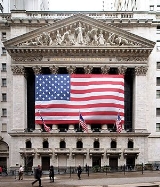
New York Stock Exchange (NYSE or colloquially Wall Street) is a stock exchange
Stock exchange

A stock exchange, securities exchange or bourse is a corporation or mutual organization which provides "trading" facilities for stock brokers and trader s, to trade stocks and other security ....
 based in New York City, New York. It is the largest stock exchange in the world by dollar
United States dollar

The United States dollar is the unit of currency of the United States and was defined by the Coinage Act of 1792 to be between 371 and 416 grains of silver ....
 value
Market capitalization

Market capitalization/capitalisation is a measurement of corporate or economic wealth equal to the share price times the number of shares outstanding of a public company....
 of its listed companies' securities
Security (finance)

A security is a fungible, negotiable instrument representing financial value. Securities are broadly categorized into debt securities , and stock securities; e.g., common stocks....
. As of October 2008, the combined capitalization
Market capitalization

Market capitalization/capitalisation is a measurement of corporate or economic wealth equal to the share price times the number of shares outstanding of a public company....
 of all domestic New York Stock Exchange listed companies was US$
United States dollar

The United States dollar is the unit of currency of the United States and was defined by the Coinage Act of 1792 to be between 371 and 416 grains of silver ....
10.1 trillion.

The NYSE is operated by NYSE Euronext, which was formed by the NYSE's 2007 merger with the fully-electronic stock exchange Euronext
Euronext

Euronext Naamloze Vennootschap is a pan-European stock exchange based in Paris and with subsidiaries in Belgium, France, Netherlands, Luxembourg, Portugal and the United Kingdom....
.


Discussion
Ask a question about 'New York Stock Exchange'
Start a new discussion about 'New York Stock Exchange'
Answer questions from other users
Full Discussion Forum


Timeline

1792   Buttonwood Agreement is signed, beginnings of New York Stock Exchange

1893   Panic of 1893: Crash on the New York Stock Exchange starts a depression.

1907   A major American financial crisis was averted when J. P. Morgan, E. H. Harriman, James Stillman, Henry Clay Frick, and other Wall Street financiers created a $25,000,000 pool to invest in the shares on the plunging New York Stock Exchange leading to the bank panic of 1907.

1914   World War I: Following a war-induced closure in July, the New York Stock Exchange re-opens for bond trading.

1929   Black Tuesday stock market crash on the New York Stock Exchange

1938   Great Depression: In an effort to try restore investor confidence, the New York Stock Exchange unveils a fifteen-point program aimed to upgrade protection for the investing publi

1995   Because of the "quadruple-witching" option expiration, volume on the New York Stock Exchange hits 638 million shares, the highest single-day volume since October 20, 1987 when the Dow staged a stunning recovery a day after Black Monday.

1997   Stock markets around the world crash because of a global economic crisis scare. The Dow Jones Industrial Average follows suit and plummets 554.26, or 7.18%, to 7,161.15. The points loss exceeds the loss from Black Monday. Officials at the New York Stock Exchange for the first time invoke the "circuit breaker" rule to stop trading (this was a very controversial move and prompted a quick change in the rule; trading stops will only occur when the DJIA drops at least 10 or 20 percent) (see October 27, 1997 mini-crash).

1997   The bulls come running back as the Dow Jones Industrial Average gains a record 337.17 to 7,498.32. One billion shares are traded on the New York Stock Exchange for the first time ever.

2001   The New York Stock Exchange reopens following the terrorist attacks in New York.


Encyclopedia


New York Stock Exchange (NYSE or colloquially Wall Street) is a stock exchange
Stock exchange

A stock exchange, securities exchange or bourse is a corporation or mutual organization which provides "trading" facilities for stock brokers and trader s, to trade stocks and other security ....
 based in New York City, New York. It is the largest stock exchange in the world by dollar
United States dollar

The United States dollar is the unit of currency of the United States and was defined by the Coinage Act of 1792 to be between 371 and 416 grains of silver ....
 value
Market capitalization

Market capitalization/capitalisation is a measurement of corporate or economic wealth equal to the share price times the number of shares outstanding of a public company....
 of its listed companies' securities
Security (finance)

A security is a fungible, negotiable instrument representing financial value. Securities are broadly categorized into debt securities , and stock securities; e.g., common stocks....
. As of October 2008, the combined capitalization
Market capitalization

Market capitalization/capitalisation is a measurement of corporate or economic wealth equal to the share price times the number of shares outstanding of a public company....
 of all domestic New York Stock Exchange listed companies was US$
United States dollar

The United States dollar is the unit of currency of the United States and was defined by the Coinage Act of 1792 to be between 371 and 416 grains of silver ....
10.1 trillion.

The NYSE is operated by NYSE Euronext, which was formed by the NYSE's 2007 merger with the fully-electronic stock exchange Euronext
Euronext

Euronext Naamloze Vennootschap is a pan-European stock exchange based in Paris and with subsidiaries in Belgium, France, Netherlands, Luxembourg, Portugal and the United Kingdom....
. The NYSE trading floor
Trading room

The notion of "trading room" is widely used in financial markets to refer to the office space where market activities are concentrated in banks or brokerage houses....
 is located at 11 Wall Street
Wall Street

Wall Street is a street in lower Manhattan, New York City, New York, United States. It runs east from Broadway to South Street on the East River, through the historical center of the Financial District, Manhattan....
 and is composed of four rooms used for the facilitation of trading. A fifth trading room, located at 30 Broad Street
Broad Street (Manhattan)

Broad Street is located in the Financial District in the New York City borough of Manhattan, stretching from South Street to Wall Street.Broad Street was named for the Broad Canal, which it replaced....
, was closed in February 2007. The main building, located at 18 Broad Street, between the corners of Wall Street and Exchange Place
Exchange Place

Exchange Place can be the name of:*Exchange Place , an office building complex*Exchange Place, Jersey City, a district/neighborhood**Exchange Place ...
, was designated a National Historic Landmark
National Historic Landmark

A National Historic Landmark is a building, :wiktionary:site, structure, object, or district, that is officially recognized by the Federal government of the United States for its historical significance....
 in 1978, as was the 11 Wall Street building.

History

The origin of the NYSE can be traced to May 17, 1792, when the Buttonwood Agreement
Buttonwood Agreement

The Buttonwood Agreement, which took place on May 17, 1792, started the New York Stock & Exchange Board . This agreement was signed by twenty-four stock brokers outside of 68 Wall Street in New York under a buttonwood tree....
 was signed by 24 stock broker
Stock broker

A stock broker or stockbroker is a regulated professional who buys and sells share s and other security through market makers or Agency Only Firms on behalf of investors....
s outside of 68 Wall Street
Wall Street

Wall Street is a street in lower Manhattan, New York City, New York, United States. It runs east from Broadway to South Street on the East River, through the historical center of the Financial District, Manhattan....
 in New York under a buttonwood tree on Wall Street. On March 8, 1817, the organization drafted a constitution and renamed itself the "New York Stock & Exchange Board". Anthony Stockholm
Anthony Stockholm

Anthony Stockholm was the first president of the New York Stock Exchange. He was president from 1817 - 1818.The origin of the NYSE can be traced to May 17, 1792, when the Buttonwood Agreement was signed by 24 stock brokers outside of 68 Wall Street in New York under a buttonwood tree on Wall Street which earlier was the site of a stockade fe...
 was elected the Exchange's first president. (For other presidents, see List of presidents of the New York Stock Exchange
List of presidents of the New York Stock Exchange

This is a list of presidents of the New York Stock Exchange.*1817 - 1818 : Anthony Stockholm*1818 - 1824 : G. S. Mumford*1824 - 1827 : Edward Lyde...
.) The first central location of the Exchange was a room, rented in 1817 for $200 a month, located at 40 Wall Street. After that location was destroyed in the Great Fire of New York (1835), the Exchange moved to a temporary headquarters. In 1863, the New York Stock & Exchange Board changed to its current name, the New York Stock Exchange. In 1865, the Exchange moved to 10-12 Broad Street.

The volume of stocks traded increased six-fold in the years between 1896 and 1901, and a larger space was required to conduct business in the expanding marketplace. Eight New York City architects were invited to participate in a design competition for a new building; ultimately, the Exchange selected the neoclassic design submitted by architect George B. Post
George B. Post

George Browne Post was an United States architect trained in the Beaux-Arts architecture....
. Demolition of the Exchange building at 10 Broad Street, and adjacent buildings, started on May 10, 1901.

The new building, located at 18 Broad Street, cost $4 million and opened on April 22, 1903. The trading floor, at 109 x 140 feet (33 x 42.5 m), was one of the largest volumes of space in the city at the time, and had a skylight set into a -high ceiling. The main façade of the building features six tall Corinthian capitals, topped by a marble sculpture by John Quincy Adams Ward
John Quincy Adams Ward

John Quincy Adams Ward was an United States sculptor, who is most familiar for his over-lifesize standing statue of George Washington on the steps of Federal Hall in Wall Street....
, called “Integrity Protecting the Works of Man”. The building was listed as a National Historic Landmark
National Historic Landmark

A National Historic Landmark is a building, :wiktionary:site, structure, object, or district, that is officially recognized by the Federal government of the United States for its historical significance....
 and added to the National Register of Historic Places
List of Registered Historic Places in New York County, New York

There are approximately 506 properties and districts listed on the National Register of Historic Places on Manhattan and adjacent smaller islands in New York County, New York....
 on June 2, 1978.

In 1922, a building for offices, designed by Trowbridge & Livingston
Trowbridge & Livingston

Trowbridge & Livingston was an architecture practice based in New York City in the early 20th century. The firm's partners were Samuel Beck Parkman Trowbridge and Goodhue Livingston ....
, was added at 11 Broad Street, as well as a new trading floor called "the garage". Additional trading floor space was added in 1969 and 1988 (the "blue room") with the latest technology for information display and communication. Yet another trading floor was opened at 30 Broad Street in 2000. As the NYSE introduced its hybrid market
Hybrid market

A hybrid market allows a stock broker to either have his order executed immediately in a fully automated electronic stock exchange, or to have it routed to the Trading room where it is completed manually via the more traditional live auction method in the presence of a specialist broker....
, a greater proportion of trading came to be executed electronically, and due to the resulting reduction in demand for trading floor space, the NYSE decided to close the 30 Broad Street trading room in early 2006. As the adoption of electronic trading continued to reduce the number of traders and employees on the floor, in late 2007, the NYSE closed the rooms created by the 1969 and 1988 expansions.

The Stock Exchange Luncheon Club
Stock Exchange Luncheon Club

The Stock Exchange Luncheon Club was a members-only dining club situated on the seventh floor of the New York Stock Exchange at 11 Wall Street, Manhattan....
 was situated on the seventh floor from 1898 until its closure in 2006.

Events

The exchange was closed shortly after the beginning of World War I
World War I

World War I, or the First World War , was a global military conflict which involved the Great powers, organized into two opposing military alliances: the Allies of World War I and the Central Powers....
 (July 31, 1914), but it partially re-opened on November 28 of that year in order to help the war effort by trading bonds
Bond (finance)

In finance, a bond is a debt security , in which the authorized issuer owes the holders a debt and, depending on the terms of the bond, is obliged to pay interest and/or to repay the principal at a later date, termed Maturity ....
, and completely reopened for stock trading in mid-December. On September 16, 1920, a bomb exploded on Wall Street
Wall Street bombing

The Wall Street bombing was an incident that occurred at 12:01 p.m. on September 16, 1920, in the Financial District of New York City. Thirty-eight were killed and 400 persons were injured by the blast....
 outside the NYSE building, killing 33 people and injuring more than 400. The perpetrators were never found. The NYSE building and some buildings nearby, such as the JP Morgan
JPMorgan Chase & Co.

JPMorgan Chase & Co. is one of the oldest financial services firms in the world. It is a leader in financial services with assets of $2.3 trillion., and the largest market capitalization and deposit base of any United States banking institution....
 building, still have marks on their facades caused by the bombing.

The Black Thursday crash of the Exchange on October 24, 1929, and the sell-off panic which started on Black Tuesday, October 29, are often blamed for precipitating the Great Depression of 1929. In an effort to try to restore investor confidence, the Exchange unveiled a fifteen-point program aimed to upgrade protection for the investing public on October 31, 1938.

On October 1, 1934, the exchange was registered as a national securities exchange with the U.S. Securities and Exchange Commission, with a president and a thirty-three member board. On February 18, 1971 the non-profit corporation was formed, and the number of board members was reduced to twenty-five.

One of Abbie Hoffman
Abbie Hoffman

Abbot Howard "Abbie" Hoffman was a social and political activism in the United States who co-founded the Youth International Party . Later he became a fugitive from the law, living under an alias and working as an enviromentalist following a conviction for dealing cocaine....
's well-known protests took place on August 24, 1967, when he led members of the Yippie movement to the gallery of the New York Stock Exchange (NYSE). The protesters threw fistfuls of dollars (most of the bills were fake) down to the traders below, some of whom booed, while others began to scramble frantically to grab the money as fast as they could. Hoffman claimed to be pointing out that, metaphorically, that's what NYSE traders "were already doing." "We didn't call the press," wrote Hoffman, "at that time we really had no notion of anything called a media event." The press was quick to respond and by evening the event was reported around the world. Since that incident, the stock exchange has spent $20,000 to enclose the gallery with bulletproof glass.

On October 19, 1987, the Dow Jones Industrial Average
Dow Jones Industrial Average

The Dow Jones Industrial Average is one of several stock market index, created by nineteenth-century The Wall Street Journal editor and Dow Jones & Company co-founder Charles Dow....
 (DJIA) dropped 508 points, a 22.6% loss in a single day, the second-biggest one-day drop the exchange had experienced, prompting officials at the exchange to invoke for the first time the "circuit breaker
Trading curb

A trading curb, also known as a circuit breaker, is a point at which a stock market will stop trading for a period of time in response to substantial drops in value....
" rule to halt all trading. This was a very controversial move and led to a quick change in the rule; trading now halts for an hour, two hours, or the rest of the day when the DJIA drops 10, 20, or 30 percent, respectively. In the afternoon, the 10% and 20% drops will halt trading for a shorter period of time, but a 30% drop will always close the exchange for the day. The rationale behind the trading halt was to give investors a chance to cool off and reevaluate their positions. Black Monday was followed by Terrible Tuesday, a day in which the Exchange's systems did not perform well and some people had difficulty completing their trades.

There was a panic similar to many with a fall of 7.2% in value (554.26 points) on October 27, 1997 prompted by falls in Asian markets, from which the NYSE recovered quickly.

On January 26, 2000, an altercation during filming of the music video for Sleep Now in the Fire
Sleep Now in the Fire

"Sleep Now in the Fire" is the fifth track from the 1999 album The Battle of Los Angeles by the band Rage Against the Machine. It was released as a single in 2000....
, which was directed by Michael Moore
Michael Moore

Michael Francis Moore is an Academy Award-winning United States filmmaker, author and Modern liberalism in the United States political commentator....
, caused the doors of the exchange to be closed and the band, Rage Against the Machine
Rage Against the Machine

Rage Against the Machine is an American Rock music band, formed in Los Angeles, California in 1991. The band's lineup, unchanged since formation, consists of vocalist Zack de la Rocha, guitarist Tom Morello, bassist Tim Commerford, and drummer Brad Wilk....
, to be escorted from the site by security, after band members attempted to gain entry into the exchange. Trading on the exchange floor, however, continued uninterrupted.
Nysesecurity
The NYSE was closed from September 11 until September 17, 2001 as a result of the September 11 attacks.

On September 17, 2003, NYSE chairman and chief executive Richard Grasso
Richard Grasso

Richard A. Grasso usually known by the nickname 'Dick,' was chairman and chief executive of the New York Stock Exchange from 1995 to 2003, the culmination of a career that began in 1968 when Grasso was hired by the Exchange as a floor clerk....
 stepped down as a result of controversy concerning the size of his deferred compensation package. He was replaced as CEO by John S. Reed
John S. Reed

John Shepard Reed is the former Chairman of the New York Stock Exchange. He previously served as Chairman and CEO of Citicorp, Citibank, and post-merger, Citigroup....
, the former Chairman of Citigroup
Citigroup

Citigroup Inc., doing business as Citi, is a major United States financial services company based in New York City. Citigroup was formed from one of the world's largest mergers in history by combining the banking giant Citicorp and financial conglomerate Travelers Group on April 7, 1998....
.

The NYSE announced its plans to acquire Archipelago on April 21, 2005, in a deal intended to reorganize the NYSE as a publicly traded company. NYSE's governing board voted to acquire rival Archipelago on December 6, 2005, and become a for-profit, public company. It began trading under the name NYSE Group on March 8, 2006. A little over one year later, on April 4, 2007, the NYSE Group completed its merger with Euronext, the European combined stock market, thus forming the NYSE Euronext, the first transatlantic stock exchange.

Presently, Marsh Carter is Chairman of the New York Stock Exchange, having succeeded John S. Reed
John S. Reed

John Shepard Reed is the former Chairman of the New York Stock Exchange. He previously served as Chairman and CEO of Citicorp, Citibank, and post-merger, Citigroup....
 and the CEO is Duncan Niederauer, having succeeded John Thain
John Thain

John Alexander Thain was the last chairman and chief executive officer of Merrill Lynch before its distressed merger with Bank of America. Thain was designated to become president of global banking, securities, and wealth management at the newly combined company, but he resigned on January 22, 2009....
.

Timeline

  • 1792 - The NYSE acquires its first traded securities
  • 1817 - The constitution of the New York Stock and Exchange Board is adopted
  • 1867 - The First Stock Ticker
  • 1896 - Dow Jones Industrial Average
    Dow Jones Industrial Average

    The Dow Jones Industrial Average is one of several stock market index, created by nineteenth-century The Wall Street Journal editor and Dow Jones & Company co-founder Charles Dow....
     first published in The Wall Street Journal
    The Wall Street Journal

    The Wall Street Journal is an English language international daily newspaper published by Dow Jones & Company in New York, New York with Asian and European editions....
     
  • 1903 - NYSE moves into new quarters at 18 Broad Street
    Broad Street (Manhattan)

    Broad Street is located in the Financial District in the New York City borough of Manhattan, stretching from South Street to Wall Street.Broad Street was named for the Broad Canal, which it replaced....
  • 1906 - Dow exceeds 100 on January 12
  • 1907 - Panic of 1907
    Panic of 1907

    The Panic of 1907, also known as the 1907 Bankers' Panic, was a financial crisis that occurred in the United States when the New York Stock Exchange fell close to 50 percent from its peak the previous year....
  • 1914 - World War I
    World War I

    World War I, or the First World War , was a global military conflict which involved the Great powers, organized into two opposing military alliances: the Allies of World War I and the Central Powers....
     causes the longest exchange shutdown: four months, two weeks; re-opening December 12 brings the largest one-day percentage drop in the DJIA (24.4%)
  • 1915 - Market price is given in dollars
  • 1929 - Central quote system established; Black Thursday
    Wall Street Crash of 1929

    The Wall Street Crash of 1929, also known as the Great Crash, was the most devastating stock market crash in the history of the United States, taking into consideration the full extent and longevity of its fallout....
    , October 24 and Black Tuesday
    Wall Street Crash of 1929

    The Wall Street Crash of 1929, also known as the Great Crash, was the most devastating stock market crash in the history of the United States, taking into consideration the full extent and longevity of its fallout....
    , October 29 signal the end of the Roaring Twenties
    Roaring Twenties

    Roaring Twenties is a phrase used to describe the 1920s, principally in North America, that emphasizes the period's social, artistic, and cultural dynamism....
     bull market
  • 1943 - Trading floor is opened to women
time (December 2008)]]
  • 1949 - Longest (eight-year) bull market
    Market trends

    A Market trend is the direction in which a financial market is moving. Market trends can be classified as primary trends, secondary trends , and secular trends ....
     begins
  • 1954 - Dow surpasses its 1929 peak in inflation-adjusted dollars
  • 1956 - Dow closes above 500 for the first time on March 12
  • 1966 - NYSE creates the Common Stock Index; floor data fully automated
  • 1967 - Protesters led by Abbie Hoffman
    Abbie Hoffman

    Abbot Howard "Abbie" Hoffman was a social and political activism in the United States who co-founded the Youth International Party . Later he became a fugitive from the law, living under an alias and working as an enviromentalist following a conviction for dealing cocaine....
     throw mostly fake dollar bills at traders from gallery, leading to the installation of bullet-proof glass
  • 1970 - Securities Investor Protection Corporation
    Securities Investor Protection Corporation

    The Securities Investor Protection Corporation is a federally mandated Non-profit organization corporation in the United States that protects Security investors from financial harm if a broker-dealer company fails....
     established
  • 1971 - NYSE recognized as Not-for-Profit organization
  • 1972 - Dow closes above 1,000 for the first time on November 14
  • 1977 - Foreign brokers are admitted to NYSE
  • 1979 - New York Futures Exchange established
  • 1982 - Longest bull market in DJIA history begins
  • 1987 - Black Monday
    Black Monday (1987)

    In financial markets, Black Monday refers to Monday, October 19, 1987, when stock markets around the world Stock market crash, shedding a huge value in a very short time....
    , October 19, sees the second-largest one-day DJIA percentage drop (22.6%) in history
  • 1991 - Dow exceeds 3,000
  • 1995 - Dow exceeds 5,000
  • 1996 - Real-time ticker introduced
  • 1999 - Dow exceeds 10,000 on March 29
  • 2000 - Dow peaks at 11,722.98 on January 14; first NYSE global index is launched under the ticker NYIID
  • 2001 - Trading in fractions (n/16) ends, replaced by decimals (increments of $.01, see Decimalisation
    Decimalisation

    In the management of currency, decimalisation is the process of converting from traditional denominations to a "decimal" system, usually with two units differing by a factor of one hundred....
    ); September 11, 2001 attacks occur, closing NYSE for 4 sessions
  • 2003 - NYSE Composite
    NYSE Composite

    The NYSE Composite is a stock market index covering all common stock listed on the New York Stock Exchange, including American Depositary Receipts, Real Estate Investment Trusts, tracking stocks, and foreign listings....
     Index relaunched and value set equal to 5,000 points
  • 2006 - NYSE and ArcaEx merge, creating NYSE Arca
    NYSE Arca

    NYSE Arca, previously known as ArcaEx, an abbreviation of Archipelago Exchange, is a securities exchange on which both stocks and options are traded....
     and forming the publicly owned, for-profit NYSE Group, Inc.; in turn, NYSE Group merges with Euronext
    Euronext

    Euronext Naamloze Vennootschap is a pan-European stock exchange based in Paris and with subsidiaries in Belgium, France, Netherlands, Luxembourg, Portugal and the United Kingdom....
    , creating the first trans-Atlantic stock exchange group; DJIA tops 12,000 on October 19
  • 2007 - US President George W. Bush
    George W. Bush

    George Walker Bush served as the List of Presidents of the United States President of the United States from 2001 to 2009. He was the 46th List of Governors of Texas from 1995 to 2000 before being United States presidential inauguration as President on January 20, 2001....
     shows up unannounced to the Floor about an hour and a half before a Federal Open Market Committee
    Federal Open Market Committee

    The Federal Open Market Committee , a component of the Federal Reserve System, is charged under United States law with overseeing the nation's open market operations....
     interest-rate decision on January 31. NYSE announces its merger with the American Stock Exchange
    American Stock Exchange

    NYSE Alternext U.S., formerly known as the American Stock Exchange is an United States stock exchange situated in New York City. AMEX was a mutual organization, owned by its members....
    ; NYSE Composite closes above 10,000 on June 1; DJIA exceeds 14,000 on July 19 and closes at a peak of 14,164.53 on October 9.
  • 2008 - On September 15, also known as "Ugly Monday" , the DJIA loses more than 500 points amid fears of bank failures, resulting in a permanent prohibition of naked short selling
    Naked short selling

    Naked short selling, or naked shorting, is a type of financial Speculation. It is the practice of Short , without first Securities lending or ensuring that the shares can be borrowed as is done in a conventional short sale....
     and a three-week temporary ban on all short selling
    Short selling

    In finance, short selling or "shorting" is the practice of selling a financial instrument that the seller does not own at the time of the sale....
     of financial stocks; in spite of this, record volatility continues for the next two months, culminating at 5 1/2-year market lows.
  • 2009 - Markets methodically fall to new 12-year lows in March, briefly trading below 4,200 on the NYSE Composite and 6,500 on the Dow.


Trading

Nyse Opening Bell
The New York Stock Exchange (sometimes referred to as "the Big Board") provides a means for buyers and sellers to trade
Trader (finance)

In finance, a trader is someone who buys and sells financial instruments such as stock, bond s and derivative .Traders are either professionals working in a financial institution or a corporation, or individual investors, or day traders....
 shares
Share (finance)

File:Stora Kopparberg 1288.jpgIn finance, a share is a unit of account for various financial instruments including stocks , and investments in mutual funds, limited partnerships, and Real estate investment trust's....
 of stock
STOCK

Software for fixed assets management and stock control developed in 2004. Stocktaking process is carried using a hand-held mobile terminal equipped with barcode reader or RFID technology....
 in companies registered for public trading. The NYSE is open for trading Monday through Friday between 9:30–16:00 ET
North American Eastern Time Zone

The Eastern Time Zone of the Western Hemisphere falls mostly along the east coast of North America and the west coast of South America. Its time offset is -5 hrs GMT or UTC-5 during standard time and UTC-4 during daylight saving time....
, with the exception of holidays declared by the Exchange in advance.

On the trading floor, the NYSE trades in a continuous auction format, where traders can execute stock transactions on behalf of investors. They will gather around the appropriate post where a specialist broker, who is employed by an NYSE member firm (that is, he/she is not an employee of the New York Stock Exchange), acts as an auctioneer in an open outcry auction market environment to bring buyers and sellers together and to manage the actual auction. They do on occasion (approximately 10% of the time) facilitate the trades by committing their own capital and as a matter of course disseminate information to the crowd that helps to bring buyers and sellers together.

As of January 24, 2007, all NYSE stocks can be traded via its electronic Hybrid Market
Hybrid market

A hybrid market allows a stock broker to either have his order executed immediately in a fully automated electronic stock exchange, or to have it routed to the Trading room where it is completed manually via the more traditional live auction method in the presence of a specialist broker....
 (except for a small group of very high-priced stocks). Customers can now send orders for immediate electronic execution, or route orders to the floor for trade in the auction market. In the first three months of 2007, in excess of 82% of all order volume was delivered to the floor electronically.

The right to directly trade shares on the exchange is conferred upon owners of the 1366 "seats". The term comes from the fact that up until the 1870s NYSE members sat in chairs to trade. In 1868, the number of seats was fixed at 533, and this number was increased several times over the years. In 1953, the exchange stopped at 1366 seats. These seats are a sought-after commodity as they confer the ability to directly trade stock on the NYSE. Seat prices have varied widely over the years, generally falling during recessions and rising during economic expansions. The most expensive inflation-adjusted seat was sold in 1929 for $625,000, which, today, would be over six million dollars. In recent times, seats have sold for as high as $4 million in the late 1990s and $1 million in 2001. In 2005, seat prices shot up to $3.25 million as the exchange was set to merge with Archipelago and become a for-profit, publicly traded company. Seat owners received $500,000 cash per seat and 77,000 shares of the newly formed corporation. The NYSE now sells one-year licenses to trade directly on the exchange.

NYSE Composite Index

In the mid-1960s, the NYSE Composite Index was created, with a base value of 50 points equal to the 1965 yearly close, to reflect the value of all stocks trading at the exchange instead of just the 30 stocks included in the Dow Jones Industrial Average
Dow Jones Industrial Average

The Dow Jones Industrial Average is one of several stock market index, created by nineteenth-century The Wall Street Journal editor and Dow Jones & Company co-founder Charles Dow....
. To raise the profile of the composite index, in 2003 the NYSE set its new base value of 5,000 points equal to the 2002 yearly close.

See also

  • Economy of New York City
    Economy of New York City

    The economy of New York City is the largest regional economy in the United States and the second largest city economy in the world after Tokyo....
  • List of American stock exchanges
    List of American stock exchanges

    This is a list of American stock exchanges. Stock exchanges in Latin America use the term Bolsa de Valores, meaning 'bag' or 'purse' of 'values'....


Bibliography


External links