

Rome Statute of the International Criminal Court

Encyclopedia
The Rome Statute of the International Criminal Court (often referred to as the International Criminal Court Statute or the Rome Statute) is the treaty
that established the International Criminal Court
(ICC). It was adopted at a diplomatic conference in Rome
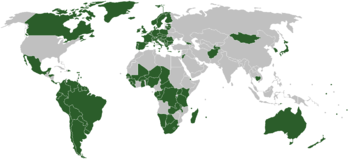
on 17 July 1998 and it entered into force on 1 July 2002. As of 13 October 2011, 119 states are party to the statute. Among other things, the statute establishes the court's functions, jurisdiction and structure.
Under the Rome Statute, the ICC
can only investigate and prosecute the core international crimes (genocide, crimes against humanity, war crimes and the crime of aggression) in situations where states are unable or unwilling to do so themselves. Thus, the majority of international crimes continue to go unpunished unless and until domestic systems can properly deal with them. Therefore, permanent solutions to impunity
must be found at the domestic level.
and other serious international crime
s, such as crimes against humanity
, war crimes
and the recently defined crimes of aggression, the United Nations General Assembly
convened a five-week diplomatic conference in Rome in June 1998 "to finalize and adopt a convention on the establishment of an international criminal court". On 17 July 1998, the Rome Statute was adopted by a vote of 120 to 7, with 21 countries abstaining. The seven countries that voted against the treaty were Iraq
, Israel
, Libya
, the People's Republic of China
, Qatar
, the United States
, and Yemen
.
On 11 April 2002, ten countries ratified the statute at the same time at a special ceremony held at the United Nations
headquarters in New York City
, bringing the total number of signatories to sixty, which was the minimum number required to bring the statute into force, as defined in Article 126. The treaty entered into force on 1 July 2002; the ICC can only prosecute crimes committed on or after that date. The statute was modified in 2010 after the Review Conference in Kampala
, Uganda
, but the amendments to the statute
that were adopted at that time are not effective yet.
The Rome Statute is the result of multiple attempts for the creation of a supranational and international tribunal. At the end of 19th century, the international community took the first steps towards the institution of permanent courts with supranational jurisdiction. With the Hague International Peace Conferences, representatives of the most powerful nations made an attempt to harmonize laws of war
and to limit the use of technologically advanced weapons. After World War I
and even more after the heinous crimes committed during World War II
, it became a priority to prosecute individuals responsible for crimes so serious that needed to be called "against humanity". In order to re-affirm basic principles of democratic civilisation, the alleged criminals were not executed in public squares or sent to torture camps, but instead treated as criminals: with a regular trial, the right to defense
and the presumption of innocence
. The Nuremberg trials
marked a crucial moment in legal history
, and after that, some treaties that led to the drafting of the Rome Statute were signed.
UN General Assembly Resolution n. 260 9 December 1948, the Convention on the Prevention and Punishment of the Crime of Genocide
, was the first step towards the establishment of an international permanent criminal tribunal with jurisdiction on crimes yet to be defined in international treaties. In the resolution there was a hope for an effort from the Legal UN commission in that direction. The General Assembly, after the considerations expressed from the commission, established a committee to draft a statute and study the related legal issues. In 1951 a first draft was presented; a second followed in 195] but there were a number of delays, officially due to the difficulties in the definition of the crime of aggression, that were only solved with diplomatic assemblies in the years following the statute's coming into force. The geopolitical tensions of the Cold War
also contributed to the delays.
Trinidad and Tobago
asked the General Assembly in December 1989 to re-open the talks for the establishment of an international criminal court and in 1994 presented a draft Statute. The General Assembly created an ad hoc committee for the International Criminal Court and, after hearing the conclusions, a Preparatory Committee that worked for two years (1996-1998) on the draft. Meanwhile, the United Nations created the ad hoc tribunals for the former Yugoslavia (ICTY
) and for Rwanda (ICTR
) using statutes—and amendments due to issues raised during pre-trial or trial stages of the proceedings—that are quite similar to the Rome Statute.
During its 52nd session the UN General Assembly decided to convene a diplomatic conference for the establishment of the International Criminal Court, held in Rome 15 June–17 July 1998 to define the treaty, entered into force on 1 July 2002.
Any amendment to the list of crimes within the jurisdiction of the court will only apply to those states parties that have ratified it. It does not need a seven-eighths majority of ratifications.
The states parties held a Review Conference in Kampala, Uganda from 31 May to 11 June 2010. The Review Conference adopted a definition of the crime of aggression, thereby allowing the ICC to exercise jurisdiction over the crime for the first time. It also adopted an expansion of the list of war crimes.
Treaty
A treaty is an express agreement under international law entered into by actors in international law, namely sovereign states and international organizations. A treaty may also be known as an agreement, protocol, covenant, convention or exchange of letters, among other terms...
that established the International Criminal Court
International Criminal Court
The International Criminal Court is a permanent tribunal to prosecute individuals for genocide, crimes against humanity, war crimes, and the crime of aggression .It came into being on 1 July 2002—the date its founding treaty, the Rome Statute of the...
(ICC). It was adopted at a diplomatic conference in Rome
Rome
Rome is the capital of Italy and the country's largest and most populated city and comune, with over 2.7 million residents in . The city is located in the central-western portion of the Italian Peninsula, on the Tiber River within the Lazio region of Italy.Rome's history spans two and a half...
on 17 July 1998 and it entered into force on 1 July 2002. As of 13 October 2011, 119 states are party to the statute. Among other things, the statute establishes the court's functions, jurisdiction and structure.
Under the Rome Statute, the ICC
ICC
-Political:* International Control Commission, which oversaw the 1954 Geneva Accords ending the First Indochina War* International Communist Current, a communist organization* Interstate Commerce Commission, a now defunct US Government regulatory body...
can only investigate and prosecute the core international crimes (genocide, crimes against humanity, war crimes and the crime of aggression) in situations where states are unable or unwilling to do so themselves. Thus, the majority of international crimes continue to go unpunished unless and until domestic systems can properly deal with them. Therefore, permanent solutions to impunity
Impunity
Impunity means "exemption from punishment or loss or escape from fines". In the international law of human rights, it refers to the failure to bring perpetrators of human rights violations to justice and, as such, itself constitutes a denial of the victims' right to justice and redress...
must be found at the domestic level.
History
Following years of negotiations aimed at establishing a permanent international tribunal to prosecute individuals accused of genocideGenocide
Genocide is defined as "the deliberate and systematic destruction, in whole or in part, of an ethnic, racial, religious, or national group", though what constitutes enough of a "part" to qualify as genocide has been subject to much debate by legal scholars...
and other serious international crime
International crime
International crime may refer to:*Crime against international law*Crime against humanity*Crime against peace*War crime*International criminal lawor it may refer to transnational crimes...
s, such as crimes against humanity
Crime against humanity
Crimes against humanity, as defined by the Rome Statute of the International Criminal Court Explanatory Memorandum, "are particularly odious offenses in that they constitute a serious attack on human dignity or grave humiliation or a degradation of one or more human beings...
, war crimes
War crime
War crimes are serious violations of the laws applicable in armed conflict giving rise to individual criminal responsibility...
and the recently defined crimes of aggression, the United Nations General Assembly
United Nations General Assembly
For two articles dealing with membership in the General Assembly, see:* General Assembly members* General Assembly observersThe United Nations General Assembly is one of the five principal organs of the United Nations and the only one in which all member nations have equal representation...
convened a five-week diplomatic conference in Rome in June 1998 "to finalize and adopt a convention on the establishment of an international criminal court". On 17 July 1998, the Rome Statute was adopted by a vote of 120 to 7, with 21 countries abstaining. The seven countries that voted against the treaty were Iraq
Iraq
Iraq ; officially the Republic of Iraq is a country in Western Asia spanning most of the northwestern end of the Zagros mountain range, the eastern part of the Syrian Desert and the northern part of the Arabian Desert....
, Israel
Israel
The State of Israel is a parliamentary republic located in the Middle East, along the eastern shore of the Mediterranean Sea...
, Libya
Libya
Libya is an African country in the Maghreb region of North Africa bordered by the Mediterranean Sea to the north, Egypt to the east, Sudan to the southeast, Chad and Niger to the south, and Algeria and Tunisia to the west....
, the People's Republic of China
People's Republic of China
China , officially the People's Republic of China , is the most populous country in the world, with over 1.3 billion citizens. Located in East Asia, the country covers approximately 9.6 million square kilometres...
, Qatar
Qatar
Qatar , also known as the State of Qatar or locally Dawlat Qaṭar, is a sovereign Arab state, located in the Middle East, occupying the small Qatar Peninsula on the northeasterly coast of the much larger Arabian Peninsula. Its sole land border is with Saudi Arabia to the south, with the rest of its...
, the United States
United States
The United States of America is a federal constitutional republic comprising fifty states and a federal district...
, and Yemen
Yemen
The Republic of Yemen , commonly known as Yemen , is a country located in the Middle East, occupying the southwestern to southern end of the Arabian Peninsula. It is bordered by Saudi Arabia to the north, the Red Sea to the west, and Oman to the east....
.
On 11 April 2002, ten countries ratified the statute at the same time at a special ceremony held at the United Nations
United Nations
The United Nations is an international organization whose stated aims are facilitating cooperation in international law, international security, economic development, social progress, human rights, and achievement of world peace...
headquarters in New York City
New York City
New York is the most populous city in the United States and the center of the New York Metropolitan Area, one of the most populous metropolitan areas in the world. New York exerts a significant impact upon global commerce, finance, media, art, fashion, research, technology, education, and...
, bringing the total number of signatories to sixty, which was the minimum number required to bring the statute into force, as defined in Article 126. The treaty entered into force on 1 July 2002; the ICC can only prosecute crimes committed on or after that date. The statute was modified in 2010 after the Review Conference in Kampala
Kampala
Kampala is the largest city and capital of Uganda. The city is divided into five boroughs that oversee local planning: Kampala Central Division, Kawempe Division, Makindye Division, Nakawa Division and Lubaga Division. The city is coterminous with Kampala District.-History: of Buganda, had chosen...
, Uganda
Uganda
Uganda , officially the Republic of Uganda, is a landlocked country in East Africa. Uganda is also known as the "Pearl of Africa". It is bordered on the east by Kenya, on the north by South Sudan, on the west by the Democratic Republic of the Congo, on the southwest by Rwanda, and on the south by...
, but the amendments to the statute
Amendments to the Rome Statute of the International Criminal Court
Amendments to the Rome Statute of the International Criminal Court must be proposed, adopted, and ratified in accordance with articles 121 and 122 of the Statute....
that were adopted at that time are not effective yet.
The Rome Statute is the result of multiple attempts for the creation of a supranational and international tribunal. At the end of 19th century, the international community took the first steps towards the institution of permanent courts with supranational jurisdiction. With the Hague International Peace Conferences, representatives of the most powerful nations made an attempt to harmonize laws of war
Laws of war
The law of war is a body of law concerning acceptable justifications to engage in war and the limits to acceptable wartime conduct...
and to limit the use of technologically advanced weapons. After World War I
World War I
World War I , which was predominantly called the World War or the Great War from its occurrence until 1939, and the First World War or World War I thereafter, was a major war centred in Europe that began on 28 July 1914 and lasted until 11 November 1918...
and even more after the heinous crimes committed during World War II
World War II
World War II, or the Second World War , was a global conflict lasting from 1939 to 1945, involving most of the world's nations—including all of the great powers—eventually forming two opposing military alliances: the Allies and the Axis...
, it became a priority to prosecute individuals responsible for crimes so serious that needed to be called "against humanity". In order to re-affirm basic principles of democratic civilisation, the alleged criminals were not executed in public squares or sent to torture camps, but instead treated as criminals: with a regular trial, the right to defense
Defense (legal)
In civil proceedings and criminal prosecutions under the common law, a defendant may raise a defense in an attempt to avoid criminal or civil liability...
and the presumption of innocence
Presumption of innocence
The presumption of innocence, sometimes referred to by the Latin expression Ei incumbit probatio qui dicit, non qui negat, is the principle that one is considered innocent until proven guilty. Application of this principle is a legal right of the accused in a criminal trial, recognised in many...
. The Nuremberg trials
Nuremberg Trials
The Nuremberg Trials were a series of military tribunals, held by the victorious Allied forces of World War II, most notable for the prosecution of prominent members of the political, military, and economic leadership of the defeated Nazi Germany....
marked a crucial moment in legal history
Legal history
Legal history or the history of law is the study of how law has evolved and why it changed. Legal history is closely connected to the development of civilizations and is set in the wider context of social history...
, and after that, some treaties that led to the drafting of the Rome Statute were signed.
UN General Assembly Resolution n. 260 9 December 1948, the Convention on the Prevention and Punishment of the Crime of Genocide
Convention on the Prevention and Punishment of the Crime of Genocide
The Convention on the Prevention and Punishment of the Crime of Genocide was adopted by the United Nations General Assembly on 9 December 1948 as General Assembly Resolution 260. The Convention entered into force on 12 January 1951. It defines genocide in legal terms, and is the culmination of...
, was the first step towards the establishment of an international permanent criminal tribunal with jurisdiction on crimes yet to be defined in international treaties. In the resolution there was a hope for an effort from the Legal UN commission in that direction. The General Assembly, after the considerations expressed from the commission, established a committee to draft a statute and study the related legal issues. In 1951 a first draft was presented; a second followed in 195] but there were a number of delays, officially due to the difficulties in the definition of the crime of aggression, that were only solved with diplomatic assemblies in the years following the statute's coming into force. The geopolitical tensions of the Cold War
Cold War
The Cold War was the continuing state from roughly 1946 to 1991 of political conflict, military tension, proxy wars, and economic competition between the Communist World—primarily the Soviet Union and its satellite states and allies—and the powers of the Western world, primarily the United States...
also contributed to the delays.
Trinidad and Tobago
Trinidad and Tobago
Trinidad and Tobago officially the Republic of Trinidad and Tobago is an archipelagic state in the southern Caribbean, lying just off the coast of northeastern Venezuela and south of Grenada in the Lesser Antilles...
asked the General Assembly in December 1989 to re-open the talks for the establishment of an international criminal court and in 1994 presented a draft Statute. The General Assembly created an ad hoc committee for the International Criminal Court and, after hearing the conclusions, a Preparatory Committee that worked for two years (1996-1998) on the draft. Meanwhile, the United Nations created the ad hoc tribunals for the former Yugoslavia (ICTY
International Criminal Tribunal for the former Yugoslavia
The International Tribunal for the Prosecution of Persons Responsible for Serious Violations of International Humanitarian Law Committed in the Territory of the Former Yugoslavia since 1991, more commonly referred to as the International Criminal Tribunal for the former Yugoslavia or ICTY, is a...
) and for Rwanda (ICTR
International Criminal Tribunal for Rwanda
The International Criminal Tribunal for Rwanda is an international court established in November 1994 by the United Nations Security Council in Resolution 955 in order to judge people responsible for the Rwandan Genocide and other serious violations of international law in Rwanda, or by Rwandan...
) using statutes—and amendments due to issues raised during pre-trial or trial stages of the proceedings—that are quite similar to the Rome Statute.
During its 52nd session the UN General Assembly decided to convene a diplomatic conference for the establishment of the International Criminal Court, held in Rome 15 June–17 July 1998 to define the treaty, entered into force on 1 July 2002.
Ratification status
Review and amendment
Any amendment to the Rome Statute requires the support of a two-thirds majority of the states parties, and an amendment (except those amending the list of crimes) will not enter into force until it has been ratified by seven-eighths of the states parties. A state party which has not ratified such an amendment may withdraw with immediate effect.Any amendment to the list of crimes within the jurisdiction of the court will only apply to those states parties that have ratified it. It does not need a seven-eighths majority of ratifications.
The states parties held a Review Conference in Kampala, Uganda from 31 May to 11 June 2010. The Review Conference adopted a definition of the crime of aggression, thereby allowing the ICC to exercise jurisdiction over the crime for the first time. It also adopted an expansion of the list of war crimes.
Further reading
- Roy S Lee (ed.), The International Criminal Court: The Making of the Rome Statute. The Hague: Kluwer Law InternationalWolters KluwerWolters Kluwer N.V. is a global information services and publishing company. The company provides products and services for professionals in the health, tax, accounting, corporate, financial services, legal and regulatory sectors...
(1999). ISBN 90-411-1212-X. - Roy S Lee & Hakan Friman (eds.), The International Criminal Court: Elements of Crimes and Rules of Procedure and Evidence. Ardsley, NY: Transnational Publishers (2001). ISBN 1-57105-209-7.
- William A. Schabas, Flavia Lattanzi (eds.), Essays on the Rome Statute of the International Criminal Court Volume I. Fagnano Alto: il Sirente (1999). ISBN 8887847001
- Claus Kress, Flavia Lattanzi (eds.), The Rome Statute and Domestic Legal Orders Volume I. Fagnano Alto: il Sirente (2000). ISBN 8887847010
- Antonio CasseseAntonio CasseseAntonio Cassese was an Italian jurist who specialized in public international law. He was formerly associated with the Special Tribunal for Lebanon which he presided over until his resignation on health grounds in 1 October 2011...
, Paola Gaeta & John R.W.D. Jones (eds.), The Rome Statute of the International Criminal Court: A Commentary. Oxford: Oxford University PressOxford University PressOxford University Press is the largest university press in the world. It is a department of the University of Oxford and is governed by a group of 15 academics appointed by the Vice-Chancellor known as the Delegates of the Press. They are headed by the Secretary to the Delegates, who serves as...
(2002). ISBN 978-0-19-829862-5. - William A. Schabas, Flavia Lattanzi (eds.), Essays on the Rome Statute of the International Criminal Court Volume II. Fagnano Alto: il Sirente (2004). ISBN 8887847029
- William A Schabas, An Introduction to the International Criminal Court (2nd ed.). Cambridge: Cambridge University PressCambridge University PressCambridge University Press is the publishing business of the University of Cambridge. Granted letters patent by Henry VIII in 1534, it is the world's oldest publishing house, and the second largest university press in the world...
(2004). ISBN 0-521-01149-3. - Claus Kress, Flavia Lattanzi (eds.), The Rome Statute and Domestic Legal Orders Volume II. Fagnano Alto: il SirenteIl SirenteEditrice il Sirente is an Italian book publisher with specialisms in arabic fiction and comics, investigation, actuality and international law. .The company was founded in 1998...
(2005). ISBN 978-88-87847-03-1
External links
- Text of the statute
- Rome Statute of the International Criminal Court — United Nations website
- Official website of the Rome Conference — speeches, press releases, photos and other materials from the conference that adopted the Statute
- International Criminal Court website
- A list of the State Parties to the Rome Statute
- Text of the Rome Statute of the International Criminal Court — Human Rights & International Criminal Law Online Forum
- http://www.pgaction.orgParliamentary network mobilized in support of the universality of the Rome Statute