

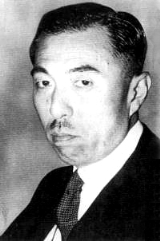
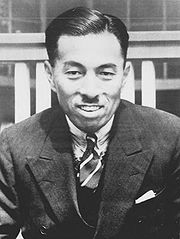
Fumimaro Konoe

Encyclopedia
Prince
was a politician
in the Empire of Japan
who served as the 34th, 38th and 39th Prime Minister of Japan
and founder/leader of the Taisei Yokusankai
.
in Tokyo
. This was a highly prestigious Japanese family, so lofty that the older and more powerful noble, Saionji Kinmochi
, addressed the young student as "your Excellency" when he first met him. The Prince received a broad education, acquiring both German
and English
. He was particularly drawn to Socialist writings, and at age 23 translated and published Oscar Wilde
’s The Soul of Man Under Socialism
.
Konoe’s father, Atsumaro
, had been politically active, having organized the Anti-Russia Society in 1903. Atsumaro had been considered a potential candidate for Prime Minister, but died in 1904. That left Konoe with the title of Prince, plenty of social standing but not much money, and plenty of room for a mentor/father-figure. That mentor was Saionji
. Even so, Konoe never fully embraced his mentor’s pro-Western attitudes.
. Konoe made a considerable public splash in 1918 when he published—in advance of Versailles
—an essay titled Reject the Anglo-American-Centered Peace. He wrote approvingly of the ideals of democracy
and humanitarianism
, and his expectation that these values would come to permeate Japanese society. However, he castigated Japanese leaders who seemed enthralled by the British
and the Americans
and who spoke in favor of Woodrow Wilson
’s Fourteen Points and the League of Nations
, claiming these countries used idealism
as "a mask for their own self-interest."
Konoe asserted that the proposed League of Nations was designed to cement the hegemony
of the victorious nations. This could mean that the late-comers, like Japan, would be frozen out of economic and political opportunities. The upcoming peace conference should break the hold of economic imperialism
, or else the League and its enforced arms reductions would relegate Japan to permanent inferiority.
Apparently, Saionji had not seen the article, or had not taken it seriously. However, when anti-Japanese American journalist Thomas Franklin Fairfax Millard
had it translated, and wrote a rebuttal in his journal, Millard's Review, he reprimanded Konoe. Saionji felt very strongly that Japan’s foreign policy depended upon good relations with Britain, France, and the US. He did not want that relationship threatened by a young hothead.
Once the conference was concluded, Konoe left the delegation and visited France and Germany, then England and the United States. He wrote an essay on the conference, concluding that the powerful had won out. He noted the refusal to adopt the racial equality clause, proposed by a weak country, but the conference’s adoption of a US-demanded clause that enshrined the Monroe Doctrine
. Even so, he gave credit to Wilson for trying to forge something new and progressive, and observed that time would tell whether the ideals of the League would make a difference.
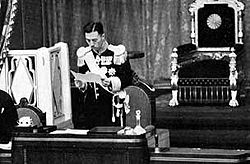 Konoe as a traveler was very taken with Western society. He liked the informality of manners, the food, even the fact that one did not have to wear a kimono
for a formal dinner and could leave shoes on all day. He thought the manners of the British aristocracy were very democratic in comparison to the Japanese nobility, where "…everything is bound by tradition, imperfection, and artificiality. I think they [the nobility] need reform from top to bottom."
He gained favorable public attention by supporting a universal manhood suffrage bill
in 1925, despite the reservations of his fellow nobles
. Even though Saionji considered him brash and "ill-informed," Konoe was considered his protégée by all parties, including Saionji himself. Despite his outspokenness, Prince Konoe was destined to achieve the very heights of political life in Japan. His title gave him a seat in the Upper Chamber
of the Diet of Japan
, and in 1933, he was elected President of the House of Peers. He was awarded the Grand Cordon of the Order of the Sacred Treasure
in 1934.
Prince Konoe went on to serve three times as Japan’s Prime Minister.
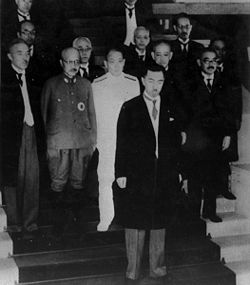
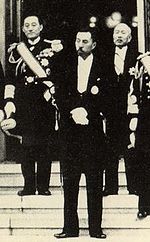 In June 1937, Prince Fumimaro Konoe became Prime Minister of Japan. Saionji
had recommended Konoe to Emperor Hirohito
despite his hesitations, because he felt that the Prince might be able to keep the Imperial Japanese Army
in check and protect the position of the Emperor. One month after he came into office, Japanese troops clashed with Chinese troops near Peking in the Marco Polo Bridge Incident
. The Kwantung Army and its homeland allies saw this as an opportunity to seize northern China
. Konoe yielded to pressure and dispatched three divisions of troops, admonishing the military to be sure not to escalate the conflict. The Army had no such intention, however, and within three weeks it launched a general assault.
Prime Minister Konoe began to realize that he was in a very difficult predicament. Much as he wished to contain the conflict, even considering personal diplomacy with Kuomintang
Chinese leader Chiang Kai-shek
, he and his cabinet feared that Japanese troops would not respect any peace agreement. He was also unsure that Chiang could control his own forces. In August, Chinese soldiers murdered two Japanese marines in Shanghai
. Konoe agreed with Army Minister General Hajime Sugiyama to send two divisions to defend Japanese honor. His cabinet then issued a declaration, accusing both nationalist and communist Chinese of "increasingly provocative and insulting" behavior toward Japan. The declaration ended:
These incidents became the basis for a full-scale war
against China. Fellow Cabinet members describe Konoe as remarkably passive during their discussions of how to respond to the Chinese. Konoe's biographer suggests that his subject was shocked by how little control he had over the military, and at how factional the military itself was. One member confided to his diary, quoting Konoe, "Right now the civilian government is too weak to do anything. Worse, the military is so divided that we do not know who to deal with…."
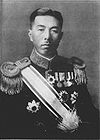 In December, Imperial General Headquarters
, a structure completely autonomous from the elected government, ordered its forces in China to drive toward Nanking, the Chinese capital. Nanking was captured within a few weeks, after which the Army committed the infamous Nanking massacre
. Such aggressive moves were received exuberantly by an elated public and press, inspired in part by the National Spiritual Mobilization Movement
, as the Army seemed invincible.
Konoe's biographer reports that the seizure of Chiang's capital left "the entire nation… lightheaded over the victory." This was the apex of Japanese military success in China, and the government's peace proposals to Chiang were suitably ambitious:
Chiang refused the terms put forth by the Japanese.
 Frustrated, Konoe's government announced in January 1938 that it would no longer deal with Chiang, but would await the development of a new regime. When later asked for clarifications, Konoe said he meant more than just non-recognition of Chiang's regime but "rejected it" and would "eradicate it".,
Meanwhile, Konoe and the military pushed a National Mobilization Law
through the Diet. This allowed the central government to control all manpower and material.
Japanese victories continued at Hsuchow, Hankow, Canton, Wuchang, Hanyang – but still the Chinese kept on fighting. Konoe was not the only one to be frustrated; the Army wanted a settlement so that it could transfer more troops to the north in order to be prepared for combat with the Soviet Union
. Attempts were made to establish a puppet Chinese government, under Nationalist defector Wang Ching-wei, but this also proved unsuccessful. Konoe, stating that he was tired of being a "robot" for the military, resigned in January 1939, and was appointed chairman of the Privy Council
. Kiichirō Hiranuma
succeeded him as Prime Minister. Konoe was awarded the 1st class of the Order of the Rising Sun
in 1939.
Konoe was also discouraged over his failure to negotiate an end to the conflict in China, having broken off the Trautmann Mediation
with Chiang. This action was also of great importance for the Communist Party of China
, as it has been argued that following the Nanjing Massacre Chiang's failure to break off the Trautmann Mediation led to the perception that the entire Kuomintang
was weak.
occupation of the Netherlands
and France
in May–June 1940 altered the situation for the Japanese government. The Army was dissatisfied with the policies of Prime Minister Mitsumasa Yonai
, who worked against an alliance with the German government and demanded Konoe's recall as Prime Minister. On June 23, Konoe resigned his position as Chairman of the Privy Council, and on July 16, 1940, the Yonai cabinet resigned and Konoe was appointed Prime Minister. One of his first moves was to launch the League of Diet Members Believing the Objectives of the Holy War
to counter opposition from politicians such as deputy Saitō Takao
who had spoken against the Second Sino-Japanese War
in the Diet on 2 February.
Against the advice of his political allies, and the misgivings of the Emperor, Konoe appointed Yosuke Matsuoka
as his foreign minister. Matsuoka was on good terms with the Army—indeed, he had been recommended by the Army. He was also popular with the Japanese public, having established himself as the man who angrily led Japan out of the League of Nations in 1933. Matsuoka was described as inventive, eloquent, headstrong, and quick to anger. Konoe knew he was not acquiring a tame cabinet member, but he hoped that Matsuoka would be able to navigate the deeply complex international waters to Japan's advantage.
Konoe and Matsuoka based their foreign policy on a document that had been drawn up by the Army. Army theorists saw Japan standing on the verge of a new world. To secure its place, it must create a New Order in Greater East Asia, based on the proper alignment of Japan-Manchukuo-China. Dubbing this the "Greater East Asia Co-prosperity Sphere
", Matsuoka publicly announced that this should also include Indochina
(nominally French) and the East Indies (nominally Dutch). Within the government, it was agreed that Japan would try to secure its position in China, defuse the conflict with the Soviet Union, move troops into Indochina, and prepare for a military response from Britain and possibly the United States.
 With the fall of the French government, and the creation of the Vichy regime
, French Indochina
was left completely vulnerable. In September, 1940, Japan pushed the local authorities to allow it to station troops in their territory. Meanwhile, Hitler had decided that a more firm alliance with Japan would secure a potential ally against the Soviet Union. He also hoped that this would increase United States anxiety over its Pacific flank, and disrupt the growing Anglo-American alliance, which was predominantly focused on Europe. This fit nicely with Matsuoka's plans, and on September 27, 1940, the Tripartite Pact
was signed. Japan, Germany, and Italy
were now allied. Each pledged to recognize the other's sphere of influence. Each pledged to come to each other's aid if a new party (presumably the US) entered the fray. Each agreed that the pact did not change current relations with the Soviet Union. In fact, Germany assured Japan that it would help broker a neutrality agreement with the Russians—something that Matsuoka dearly sought.
The Germans followed through on their promise. In October, German Foreign Minister Ribbentrop
proposed to Stalin
the idea of a conference to reach a complete understanding about spheres of influence. The German Foreign Minister suggested that Soviet Foreign Minister Molotov
come to Berlin
to begin negotiations. Molotov duly arrived in November. Believing that Hitler needed Russian neutrality in order to defeat Britain, Stalin prepared a strong set of initial demands, which Hitler had no intention of accepting. Hitler decided not to respond, and instead instructed his military to begin planning for an attack on the Soviet Union.
Matsuoka attempted to secure Japan's position with a further agreement. On his journey back through Russia, he stopped in Moscow and negotiated a neutrality agreement between Japan and the Soviet Union with Molotov and Stalin. Japan agreed to relinquish mineral extraction rights in the northern half of Sakhalin
, but otherwise made no concessions. For Japan, the pact made it less likely that the United States and the Soviet Union would team up against them. Stalin, feeling that he had reduced the prospect of a combined Axis attack, was so pleased that he personally came to the station to see Matsuoka off. This neutrality agreement was honored by both sides—for different reasons—until 1945.
, Konoe had in hand what he believed to be a promising peace proposal from the United States. The proposal included American recognition of Manchukuo, the merging of Chiang's government with the Japan-backed Reorganized National Government of China, withdrawal of Japanese troops from China and mutual respect for its independence, and even an agreement that Japanese immigration to the United States shall proceed "on the basis of equality with other nationals and free from discrimination". A meeting for negotiation between United States President Franklin D. Roosevelt
and Konoe was proposed for Honolulu, to commence as early as May.
There was only one problem with the document. Each side believed that it represented the starting position of the other side, but in reality, it had been drawn up by two American Maryknoll priests and two mid-level Japanese officials. The Japanese Ambassador to the United States Nomura knew this, but managed to give each government the idea that the other had already agreed to the draft as the basis for negotiation. Konoe was elated by this development, and began to line up support for the idea of a summit conference in Hawaii
. However, Secretary of State Cordell Hull
and Roosevelt had no intention of bargaining from this draft. Throughout the next six months, Konoe continued to hope that somehow he would convince Roosevelt to meet with him and settle differences—without having to give up Japanese hegemony in East Asia. He never succeeded.
Opposition to Konoe's diplomatic initiative began at home. Matsuoka was furious that Konoe had offered concessions behind his back. He bitterly opposed this line, believing that Japan must be firm with the Americans. Konoe was unable to wear him down, and was afraid of the Army's reaction if he overrode the Foreign Minister. In the end, Matsuoka gutted the draft, replacing it with a reiteration of Japan's "co-prosperity" policy. This document was conveyed to the Americans on May 12, and found to be unacceptable.
On June 22, 1941, Germany invaded the Soviet Union and once again Japan was caught completely by surprise. Hurried conferences took place at the highest levels. The question was whether this represented an opportunity for Japan. Both Army and Navy representatives agreed that the time was right for a military occupation of all of French Indochina. This would position them well for dominance of southern China, and of the entire region, including the oil-producing Dutch East Indies (now Indonesia). Matsuoka argued that, on the contrary, this was the perfect time to attack the Soviet Union.
In the end, the formal leadership group, called the Imperial Headquarters-Cabinet Liaison Conference, agreed on the "southern" strategy. Nevertheless, it also agreed that German progress should be closely monitored. If Hitler was successful, then Japan could strike when the Soviets were at their weakest. The Japanese would pluck the fruit "when the persimmon is ripe". Matsuoka was not reconciled to this decision, nor to Konoe's attempt to negotiate with the United States. He transmitted a provocative statement to Hull, and informed the Soviet Ambassador that the Axis agreement took precedence over the Japan-Soviet neutrality pact. Konoe resigned, only to form a new government without Matsuoka as Foreign Minister. The new Foreign Minister assured the Soviet Ambassador that Japan would honor the neutrality agreement, even though Germany was urging its Japanese ally to attack the Russians from the east.
On July 28, 1941, Japanese forces occupied all of French Indochina. The United States was forewarned of this move through its monitoring of Japan's cable traffic. Roosevelt immediately froze Japanese assets in the United States. Great Britain and the Dutch East Indies government did likewise. Roosevelt also placed an embargo on oil exports to Japan. This was not expected by Konoe and the leadership group. The military had been certain that the United States would not take this drastic measure in response to its southern move.
The Japanese military machine ran on American oil. Over 80% of Japan's need was being met through American imports. On July 31, the navy informed the Emperor that Japan's oil stockpiles would be completely depleted in two years. Konoe had been counting on the Navy to restrain the Army from its aggressive designs. Now, however, the Navy Chief of Staff Osami Nagano argued that if war with the United States was inevitable, it should start right away.
Konoe made one more desperate attempt to avert war. He proposed a personal summit with Roosevelt–in the United States if necessary–to come to some understanding. Konoe secured backing from the Navy and the Emperor for this move. The Army reluctantly agreed, provided that Konoe adhere to the consensus foreign policy, and be prepared to go to war if his initiative failed. Konoe secretly confided to a friend that he intended to grant further concessions to the United States, including withdrawal from China, using direct authority from the Emperor. His friend cautioned that he would be assassinated upon his return. Konoe agreed that this was likely, but felt that it was worth the personal risk.
Roosevelt and Hull played along, even though they felt that negotiations were probably a waste of time. They also doubted that Konoe could make an agreement that was both acceptable to the United States and to the militarists at home. Time was what they wanted most. Time to build more airplanes and ships; time to manufacture munitions and train new soldiers; time to rush more supplies to Great Britain and the Soviet Union. Roosevelt told Ambassador Nomura that he would like to see more details of Konoe's proposal, and he suggested that Juneau, Alaska
, might be a good spot for a meeting.
On September 5, Konoe met the Emperor with chiefs of staff General Hajime Sugiyama and Admiral Osami Nagano. Alarmed, the Emperor asked what happened to the negotiations with Roosevelt. Konoe replied that, of course, negotiations were primary, and the military option was only a fall-back position if negotiations failed. The Emperor then questioned Sugiyama about the chances of success of an open war with the Occident. After Sugiyama answered positively, Hirohito scolded him, remembering that the Army had predicted that the invasion of China would be completed in only three months.
The next day the policy about the preparation for war against "United States, England and Holland" was formally proposed at the Imperial Conference. Yoshimichi Hara
, the Privy Council President, observed that the plan seemed to put military action ahead of diplomacy. Standing in for the Emperor, he asked if that was the case. The Navy Minister made a reply along the lines that Konoe had stated in his private conference. Then there was silence. No other figure, including Konoe, attempted to answer the question.
The Emperor then stunned the gathering by speaking out. He stated that Hara's question was an important one, and that it was "regrettable" that none of the senior leaders had addressed it. He then read a verse that had been composed by the Emperor Meiji
:
He stated that he had often reflected on this verse, which represented the Emperor Meiji's desire for peace, a desire that he shared. Stung by this unexpected rebuke, Navy Chief of Staff Nagano rose to defend the policy, assuring the Emperor that this consensus document was not a decision to go to war and that priority would be given to negotiations.
The Imperial Conference adopted the policy that would result in the attack on Pearl Harbor
. The policy established a set of minimum demands that must be met through negotiations. If Konoe's negotiations did not bear fruit by mid-October, Japan would commence hostilities against the United States, the Netherlands, and the United Kingdom. The minimum demands included a halt to the economic and oil embargoes, withdrawal of political and economic support for the Chinese Nationalist government, agreement to keep Western military forces in the Pacific at their current level, and non-interference in Japan's attempts to bring "peace" to China. In other words, to accept Japanese hegemony over China, Manchuria, and French Indochina, and Japanese military primacy in an even broader swath of the East.
While the Emperor received detailed reports from Sugiyama and Nagano about the operations in Southeast Asia and the attack of Pearl Harbor, Prime Minister Konoe made one last desperate attempt to avoid war. That very evening, he arranged a secret dinner conference with American Ambassador Joseph Grew
. He told Grew that he was prepared to travel to meet Roosevelt on a moment's notice. The ship had already been prepared. He was convinced that the United States and Japan could reach a true agreement, and when that happened, he would radio back to the palace, and the Emperor would issue a rescript ordering a complete halt to all aggressive activities.
Ambassador Grew was impressed with Konoe's sincerity. He cabled back, urging his superiors to advise Roosevelt to accept the summit proposal. The State Department continued to think that an open-ended summit was a waste of time. If Japan were serious, it would begin meaningful and detailed negotiations that would be affirmed at a summit. Konoe's last push for a diplomatic solution was taken in vain.
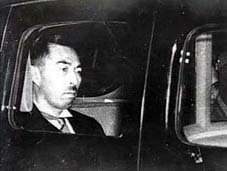 Throughout September the Army and Navy continued to prepare for war. Konoe had hoped that the October deadline would not be observed. The Army and Navy leaders disabused him of this notion. Japan had to act soon, because of the oil embargo. Otherwise it would be conceding defeat through delay. This came to a head at a cabinet meeting on October 14. Army Minister Hideki Tōjō
stated that negotiations had failed, the deadline had passed. Konoe and his allies had become convinced that if the Army would only agree, in principle, to an ultimate withdrawal from China, a negotiated settlement could be reached with the United States. This was brought up at the meeting and General Tōjō responded heatedly:
To yield to the American demand and withdraw their troops, he exploded, would wipe out all the fruits of the China War, endanger Manchukuo, and jeopardize the governing of Korea. To accept troop withdrawal in name only would not benefit Japan either, he said. Withdrawal would mean retreat. It would depress morale. A demoralized Army would be as worthless as no Army. Our troops in China are the "heart of the matter", he persisted. Having made one concession after another, why should Japan now yield the "heart?" "If we concede this, what is diplomacy? It is surrender … a stain on the history of our empire!"
At the close of this meeting, Konoe realized that he had lost the struggle with the military. He knew that many in the Navy were convinced that war with the United States would end in disaster. Yet he was not able to win Navy backing against the adamant Army stance. Admiral Nagano summed up his service's ambivalent attitude during this period by observing "The government has decided that if there is no war, the fate of the nation is sealed. Even if there is a war, the country may be ruined. Nevertheless, a nation that does not fight in this plight has lost its spirit and is doomed."
Konoe resigned on October 16, 1941, one day after having recommended Prince Naruhiko Higashikuni to the emperor as his successor. Two days later, Hirohito chose General Tōjō as Prime Minister despite the wish of the Navy and the Army, who would have preferred Prince Higashikuni. In 1946, he explained this decision: "I actually thought Prince Higashikuni suitable as chief of staff of the Army; but I think the appointment of a member of the imperial house to a political office must be considered very carefully. Above all, in time of peace this is fine, but when there is a fear that there may even be a war, then more importantly, considering the welfare of the imperial house, I wonder about the wisdom of a member of the imperial family serving [as prime minister]." Six weeks later, Japan attacked Pearl Harbor.
Konoe justified his demission to his secretary Kenji Tomita. "Of course His Imperial Majesty is a pacifist and he wished to avoid war. When I told him that to initiate war was a mistake, he agreed. But the next day, he would tell me: 'You were worried about it yesterday but you do not have to worry so much.' Thus, gradually he began to lead to war. And the next time I met him, he leaned even more to war. I felt the Emperor was telling me: 'My prime minister does not understand military matters. I know much more.' In short, the Emperor had absorbed the view of the army and the navy high commands."
 Konoe played a role in the fall of the Tōjō government in 1944. In February 1945, during the first private audience he had been allowed in three years he advised the Emperor to begin negotiations to end World War II
. According to Grand Chamberlain Hisanori Fujita
, Hirohito, still looking for a tennozan (a great victory), firmly rejected Konoe's recommendation.
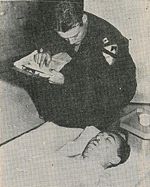
After the beginning of the American occupation, Konoe served in the cabinet of Prince Naruhiko Higashikuni, the first post-war government. Having refused to collaborate with Bonner Fellers
in "Operation Blacklist" to exonerate Hirohito and the imperial family of criminal responsibility, he came under suspicion of war crime
s. In December 1945, during the last call by the Americans for alleged war criminals to report to the Americans, he took potassium cyanide
poison and committed suicide
. It was 1945, exactly 1300 years after his ancestor, Fujiwara no Kamatari
, led a coup d'état at court during the Soga clan. So symbolically ended the era of the Fujiwara regents. His grave is at the Konoe clan cemetery at the temple of Daitoku-ji
in Kyoto.
His grandson, Morihiro Hosokawa
, became prime minister fifty years later.
(1941).
His brother Hidemaro Konoye
was a well-known orchestra
l conductor
and composer
.
Prince
Prince is a general term for a ruler, monarch or member of a monarch's or former monarch's family, and is a hereditary title in the nobility of some European states. The feminine equivalent is a princess...
was a politician
Politician
A politician, political leader, or political figure is an individual who is involved in influencing public policy and decision making...
in the Empire of Japan
Empire of Japan
The Empire of Japan is the name of the state of Japan that existed from the Meiji Restoration on 3 January 1868 to the enactment of the post-World War II Constitution of...
who served as the 34th, 38th and 39th Prime Minister of Japan
Prime Minister of Japan
The is the head of government of Japan. He is appointed by the Emperor of Japan after being designated by the Diet from among its members, and must enjoy the confidence of the House of Representatives to remain in office...
and founder/leader of the Taisei Yokusankai
Taisei Yokusankai
The was Japan's para-fascist organization created by Prime Minister Fumimaro Konoe on October 12, 1940 to promote the goals of his Shintaisei movement...
.
Early life
Prince Fumimaro Konoe was born into the ancient Fujiwara clan, and was the heir of the princely Konoe familyKonoe family
The Konoe family is a branch of the Fujiwara clan, a powerful noble family in Japan. As one of the five regent houses, the Konoe family monopolized the offices of Sessho and Kampaku along with Takatsukasa, Kujō, Ichijō and Nijō families. They are collectively known as the Five regent houses.With...
in Tokyo
Tokyo
, ; officially , is one of the 47 prefectures of Japan. Tokyo is the capital of Japan, the center of the Greater Tokyo Area, and the largest metropolitan area of Japan. It is the seat of the Japanese government and the Imperial Palace, and the home of the Japanese Imperial Family...
. This was a highly prestigious Japanese family, so lofty that the older and more powerful noble, Saionji Kinmochi
Saionji Kinmochi
Prince was a Japanese politician, statesman and twice Prime Minister of Japan. His title does not signify the son of an emperor, but the highest rank of Japanese hereditary nobility; he was elevated from marquis to prince in 1920...
, addressed the young student as "your Excellency" when he first met him. The Prince received a broad education, acquiring both German
German language
German is a West Germanic language, related to and classified alongside English and Dutch. With an estimated 90 – 98 million native speakers, German is one of the world's major languages and is the most widely-spoken first language in the European Union....
and English
English language
English is a West Germanic language that arose in the Anglo-Saxon kingdoms of England and spread into what was to become south-east Scotland under the influence of the Anglian medieval kingdom of Northumbria...
. He was particularly drawn to Socialist writings, and at age 23 translated and published Oscar Wilde
Oscar Wilde
Oscar Fingal O'Flahertie Wills Wilde was an Irish writer and poet. After writing in different forms throughout the 1880s, he became one of London's most popular playwrights in the early 1890s...
’s The Soul of Man Under Socialism
The Soul of Man under Socialism
"The Soul of Man under Socialism" is an 1891 essay by Oscar Wilde in which he expounds an anarchist worldview. The creation of "The Soul of Man" followed Wilde's conversion to anarchist philosophy, following his reading of the works of Peter Kropotkin....
.
Konoe’s father, Atsumaro
Konoe Atsumaro
Prince was a Japanese politician and journalist of the Meiji era. He served as the 3rd President of the House of Peers and 7th President of the Gakushūin Peer's School in Meiji period Japan...
, had been politically active, having organized the Anti-Russia Society in 1903. Atsumaro had been considered a potential candidate for Prime Minister, but died in 1904. That left Konoe with the title of Prince, plenty of social standing but not much money, and plenty of room for a mentor/father-figure. That mentor was Saionji
Saionji Kinmochi
Prince was a Japanese politician, statesman and twice Prime Minister of Japan. His title does not signify the son of an emperor, but the highest rank of Japanese hereditary nobility; he was elevated from marquis to prince in 1920...
. Even so, Konoe never fully embraced his mentor’s pro-Western attitudes.
Trip to Versailles
Prince Konoe convinced Saionji to include him in the Japanese delegation to the Paris Peace Conference, 1919Paris Peace Conference, 1919
The Paris Peace Conference was the meeting of the Allied victors following the end of World War I to set the peace terms for the defeated Central Powers following the armistices of 1918. It took place in Paris in 1919 and involved diplomats from more than 32 countries and nationalities...
. Konoe made a considerable public splash in 1918 when he published—in advance of Versailles
Versailles
Versailles , a city renowned for its château, the Palace of Versailles, was the de facto capital of the kingdom of France for over a century, from 1682 to 1789. It is now a wealthy suburb of Paris and remains an important administrative and judicial centre...
—an essay titled Reject the Anglo-American-Centered Peace. He wrote approvingly of the ideals of democracy
Democracy
Democracy is generally defined as a form of government in which all adult citizens have an equal say in the decisions that affect their lives. Ideally, this includes equal participation in the proposal, development and passage of legislation into law...
and humanitarianism
Humanitarianism
In its most general form, humanitarianism is an ethic of kindness, benevolence and sympathy extended universally and impartially to all human beings. Humanitarianism has been an evolving concept historically but universality is a common element in its evolution...
, and his expectation that these values would come to permeate Japanese society. However, he castigated Japanese leaders who seemed enthralled by the British
British Empire
The British Empire comprised the dominions, colonies, protectorates, mandates and other territories ruled or administered by the United Kingdom. It originated with the overseas colonies and trading posts established by England in the late 16th and early 17th centuries. At its height, it was the...
and the Americans
United States
The United States of America is a federal constitutional republic comprising fifty states and a federal district...
and who spoke in favor of Woodrow Wilson
Woodrow Wilson
Thomas Woodrow Wilson was the 28th President of the United States, from 1913 to 1921. A leader of the Progressive Movement, he served as President of Princeton University from 1902 to 1910, and then as the Governor of New Jersey from 1911 to 1913...
’s Fourteen Points and the League of Nations
League of Nations
The League of Nations was an intergovernmental organization founded as a result of the Paris Peace Conference that ended the First World War. It was the first permanent international organization whose principal mission was to maintain world peace...
, claiming these countries used idealism
Idealism
In philosophy, idealism is the family of views which assert that reality, or reality as we can know it, is fundamentally mental, mentally constructed, or otherwise immaterial. Epistemologically, idealism manifests as a skepticism about the possibility of knowing any mind-independent thing...
as "a mask for their own self-interest."
- "The peace that the Anglo-American leaders are urging on us amounts to no more than maintaining a status quo that suits their interests. … The true nature of the present conflict [WWI] is a struggle between the established powers and powers not yet established…. At an early stage, Britain and France colonized the ‘less civilized’ regions of the world, and monopolized their exploitation. As a result, Germany and all the late-coming nations also, were left with no land to acquire and no space to expand."
Konoe asserted that the proposed League of Nations was designed to cement the hegemony
Hegemony
Hegemony is an indirect form of imperial dominance in which the hegemon rules sub-ordinate states by the implied means of power rather than direct military force. In Ancient Greece , hegemony denoted the politico–military dominance of a city-state over other city-states...
of the victorious nations. This could mean that the late-comers, like Japan, would be frozen out of economic and political opportunities. The upcoming peace conference should break the hold of economic imperialism
Imperialism
Imperialism, as defined by Dictionary of Human Geography, is "the creation and/or maintenance of an unequal economic, cultural, and territorial relationships, usually between states and often in the form of an empire, based on domination and subordination." The imperialism of the last 500 years,...
, or else the League and its enforced arms reductions would relegate Japan to permanent inferiority.
- "Should their policy prevail, Japan, which is small, resource-poor, and unable to consume all its own industrial products, would have no resort but to destroy the status quo for the sake of self-preservation, just like Germany. … We must require all the powers to open the doors of their colonies to others, so that all nations will have equal access to the markets and natural resources of the colonial areas. It is also imperative that Japan insist upon the eradication of racial discrimination."
Apparently, Saionji had not seen the article, or had not taken it seriously. However, when anti-Japanese American journalist Thomas Franklin Fairfax Millard
Thomas Franklin Fairfax Millard
Thomas Franklin Fairfax Millard was an American journalist, newspaper editor, founder of the China Weekly Review, author of seven influential books on the Far East and first American political adviser to the Chinese Republic, serving for over fifteen years...
had it translated, and wrote a rebuttal in his journal, Millard's Review, he reprimanded Konoe. Saionji felt very strongly that Japan’s foreign policy depended upon good relations with Britain, France, and the US. He did not want that relationship threatened by a young hothead.
Once the conference was concluded, Konoe left the delegation and visited France and Germany, then England and the United States. He wrote an essay on the conference, concluding that the powerful had won out. He noted the refusal to adopt the racial equality clause, proposed by a weak country, but the conference’s adoption of a US-demanded clause that enshrined the Monroe Doctrine
Monroe Doctrine
The Monroe Doctrine is a policy of the United States introduced on December 2, 1823. It stated that further efforts by European nations to colonize land or interfere with states in North or South America would be viewed as acts of aggression requiring U.S. intervention...
. Even so, he gave credit to Wilson for trying to forge something new and progressive, and observed that time would tell whether the ideals of the League would make a difference.
Kimono
The is a Japanese traditional garment worn by men, women and children. The word "kimono", which literally means a "thing to wear" , has come to denote these full-length robes...
for a formal dinner and could leave shoes on all day. He thought the manners of the British aristocracy were very democratic in comparison to the Japanese nobility, where "…everything is bound by tradition, imperfection, and artificiality. I think they [the nobility] need reform from top to bottom."
He gained favorable public attention by supporting a universal manhood suffrage bill
General Election Law
The ' was a law passed in Taishō period Japan, extending suffrage to all males aged 25 and over. It was proposed by the Kenseito political party and it was passed by the Diet of Japan on 5 May 1925.-Background:...
in 1925, despite the reservations of his fellow nobles
Kazoku
The was the hereditary peerage of the Empire of Japan that existed between 1869 and 1947.-Origins:Following the Meiji Restoration of 1868, the ancient court nobility of Kyoto regained some of its lost status...
. Even though Saionji considered him brash and "ill-informed," Konoe was considered his protégée by all parties, including Saionji himself. Despite his outspokenness, Prince Konoe was destined to achieve the very heights of political life in Japan. His title gave him a seat in the Upper Chamber
House of Peers (Japan)
The ' was the upper house of the Imperial Diet as mandated under the Constitution of the Empire of Japan ....
of the Diet of Japan
Diet of Japan
The is Japan's bicameral legislature. It is composed of a lower house, called the House of Representatives, and an upper house, called the House of Councillors. Both houses of the Diet are directly elected under a parallel voting system. In addition to passing laws, the Diet is formally...
, and in 1933, he was elected President of the House of Peers. He was awarded the Grand Cordon of the Order of the Sacred Treasure
Order of the Sacred Treasure
The is a Japanese Order, established on January 4, 1888 by Emperor Meiji of Japan as the Order of Meiji. It is awarded in eight classes . It is generally awarded for long and/or meritorious service and considered to be the lowest of the Japanese orders of merit...
in 1934.
Prince Konoe went on to serve three times as Japan’s Prime Minister.
Prime Minister and war with China
Saionji
Saionji is a Japanese family name of former kuge descent.People with the name include:*The Saionji family, kuge family.*Prince Saionji Kinmochi, 12th and 14th Prime Minister of Japan*Empress Saionji, wife of Emperor Go-Fukakusa...
had recommended Konoe to Emperor Hirohito
Hirohito
, posthumously in Japan officially called Emperor Shōwa or , was the 124th Emperor of Japan according to the traditional order, reigning from December 25, 1926, until his death in 1989. Although better known outside of Japan by his personal name Hirohito, in Japan he is now referred to...
despite his hesitations, because he felt that the Prince might be able to keep the Imperial Japanese Army
Imperial Japanese Army
-Foundation:During the Meiji Restoration, the military forces loyal to the Emperor were samurai drawn primarily from the loyalist feudal domains of Satsuma and Chōshū...
in check and protect the position of the Emperor. One month after he came into office, Japanese troops clashed with Chinese troops near Peking in the Marco Polo Bridge Incident
Marco Polo Bridge Incident
The Marco Polo Bridge Incident was a battle between the Republic of China's National Revolutionary Army and the Imperial Japanese Army, often used as the marker for the start of the Second Sino-Japanese War .The eleven-arch granite bridge, Lugouqiao, is an architecturally significant structure,...
. The Kwantung Army and its homeland allies saw this as an opportunity to seize northern China
North China
thumb|250px|Northern [[People's Republic of China]] region.Northern China or North China is a geographical region of China. The heartland of North China is the North China Plain....
. Konoe yielded to pressure and dispatched three divisions of troops, admonishing the military to be sure not to escalate the conflict. The Army had no such intention, however, and within three weeks it launched a general assault.
Prime Minister Konoe began to realize that he was in a very difficult predicament. Much as he wished to contain the conflict, even considering personal diplomacy with Kuomintang
Kuomintang
The Kuomintang of China , sometimes romanized as Guomindang via the Pinyin transcription system or GMD for short, and translated as the Chinese Nationalist Party is a founding and ruling political party of the Republic of China . Its guiding ideology is the Three Principles of the People, espoused...
Chinese leader Chiang Kai-shek
Chiang Kai-shek
Chiang Kai-shek was a political and military leader of 20th century China. He is known as Jiǎng Jièshí or Jiǎng Zhōngzhèng in Mandarin....
, he and his cabinet feared that Japanese troops would not respect any peace agreement. He was also unsure that Chiang could control his own forces. In August, Chinese soldiers murdered two Japanese marines in Shanghai
Shanghai
Shanghai is the largest city by population in China and the largest city proper in the world. It is one of the four province-level municipalities in the People's Republic of China, with a total population of over 23 million as of 2010...
. Konoe agreed with Army Minister General Hajime Sugiyama to send two divisions to defend Japanese honor. His cabinet then issued a declaration, accusing both nationalist and communist Chinese of "increasingly provocative and insulting" behavior toward Japan. The declaration ended:
In this matter, the Chinese have contemptuously inflicted every sort of awful outrage upon Imperial Japan…. Imperial Japan has at long last exhausted its patience and is now compelled to take resolute action to punish the atrocious Chinese army and to bring the Nanking government to its senses.
These incidents became the basis for a full-scale war
Second Sino-Japanese War
The Second Sino-Japanese War was a military conflict fought primarily between the Republic of China and the Empire of Japan. From 1937 to 1941, China fought Japan with some economic help from Germany , the Soviet Union and the United States...
against China. Fellow Cabinet members describe Konoe as remarkably passive during their discussions of how to respond to the Chinese. Konoe's biographer suggests that his subject was shocked by how little control he had over the military, and at how factional the military itself was. One member confided to his diary, quoting Konoe, "Right now the civilian government is too weak to do anything. Worse, the military is so divided that we do not know who to deal with…."
Imperial General Headquarters
The as part of the Supreme War Council was established in 1893 to coordinate efforts between the Imperial Japanese Army and Imperial Japanese Navy during wartime...
, a structure completely autonomous from the elected government, ordered its forces in China to drive toward Nanking, the Chinese capital. Nanking was captured within a few weeks, after which the Army committed the infamous Nanking massacre
Nanking Massacre
The Nanking Massacre or Nanjing Massacre, also known as the Rape of Nanking, was a mass murder, genocide and war rape that occurred during the six-week period following the Japanese capture of the city of Nanjing , the former capital of the Republic of China, on December 13, 1937 during the Second...
. Such aggressive moves were received exuberantly by an elated public and press, inspired in part by the National Spiritual Mobilization Movement
National Spiritual Mobilization Movement
an organization in the Empire of Japan established as part of the controls on civilian organizations under the National Mobilization Law by Prime Minister Fumimaro Konoe....
, as the Army seemed invincible.
Konoe's biographer reports that the seizure of Chiang's capital left "the entire nation… lightheaded over the victory." This was the apex of Japanese military success in China, and the government's peace proposals to Chiang were suitably ambitious:
- China would provide diplomatic recognitionDiplomatic recognitionDiplomatic recognition in international law is a unilateral political act with domestic and international legal consequences, whereby a state acknowledges an act or status of another state or government in control of a state...
of ManchukuoManchukuoManchukuo or Manshū-koku was a puppet state in Manchuria and eastern Inner Mongolia, governed under a form of constitutional monarchy. The region was the historical homeland of the Manchus, who founded the Qing Empire in China...
. - Chiang would cease cooperating with the communist forces, and join Japan in combating communism.
- China would agree to continued Japanese occupation in certain critical areas.
- China would allow local government in North China that would facilitate "co-prosperity" between Japan, Manchukuo, and China.
- China would pay reparations.
Chiang refused the terms put forth by the Japanese.
Meanwhile, Konoe and the military pushed a National Mobilization Law
National Mobilization Law
was legislated in the Diet of Japan by Prime Minister Fumimaro Konoe on 24 March 1938 to put the national economy of the Empire of Japan on war-time footing after the start of the Second Sino-Japanese War....
through the Diet. This allowed the central government to control all manpower and material.
Japanese victories continued at Hsuchow, Hankow, Canton, Wuchang, Hanyang – but still the Chinese kept on fighting. Konoe was not the only one to be frustrated; the Army wanted a settlement so that it could transfer more troops to the north in order to be prepared for combat with the Soviet Union
Soviet Union
The Soviet Union , officially the Union of Soviet Socialist Republics , was a constitutionally socialist state that existed in Eurasia between 1922 and 1991....
. Attempts were made to establish a puppet Chinese government, under Nationalist defector Wang Ching-wei, but this also proved unsuccessful. Konoe, stating that he was tired of being a "robot" for the military, resigned in January 1939, and was appointed chairman of the Privy Council
Privy council
A privy council is a body that advises the head of state of a nation, typically, but not always, in the context of a monarchic government. The word "privy" means "private" or "secret"; thus, a privy council was originally a committee of the monarch's closest advisors to give confidential advice on...
. Kiichirō Hiranuma
Kiichiro Hiranuma
Baron was a prominent pre–World War II right-wing Japanese politician and the 35th Prime Minister of Japan from 5 January 1939 to 30 August 1939. The modern Japanese politician, Takeo Hiranuma, is his adopted son.- Early life :...
succeeded him as Prime Minister. Konoe was awarded the 1st class of the Order of the Rising Sun
Order of the Rising Sun
The is a Japanese order, established in 1875 by Emperor Meiji of Japan. The Order was the first national decoration awarded by the Japanese Government, created on April 10, 1875 by decree of the Council of State. The badge features rays of sunlight from the rising sun...
in 1939.
Konoe was also discouraged over his failure to negotiate an end to the conflict in China, having broken off the Trautmann Mediation
Trautmann mediation
The Trautmann Mediation was an attempt to agree peace between Prime Minister Konoe of Japan and Chiang Kai-Shek of the Chinese Kuomintang Party. The peace agreement was being mediated by the German ambassador Oskar Trautmann. During the Trautmann Mediation, unfortunately, the Rape of Nanking took...
with Chiang. This action was also of great importance for the Communist Party of China
Communist Party of China
The Communist Party of China , also known as the Chinese Communist Party , is the founding and ruling political party of the People's Republic of China...
, as it has been argued that following the Nanjing Massacre Chiang's failure to break off the Trautmann Mediation led to the perception that the entire Kuomintang
Kuomintang
The Kuomintang of China , sometimes romanized as Guomindang via the Pinyin transcription system or GMD for short, and translated as the Chinese Nationalist Party is a founding and ruling political party of the Republic of China . Its guiding ideology is the Three Principles of the People, espoused...
was weak.
Konoe's second term, the Matsuoka foreign policy
The GermanNazi Germany
Nazi Germany , also known as the Third Reich , but officially called German Reich from 1933 to 1943 and Greater German Reich from 26 June 1943 onward, is the name commonly used to refer to the state of Germany from 1933 to 1945, when it was a totalitarian dictatorship ruled by...
occupation of the Netherlands
Netherlands
The Netherlands is a constituent country of the Kingdom of the Netherlands, located mainly in North-West Europe and with several islands in the Caribbean. Mainland Netherlands borders the North Sea to the north and west, Belgium to the south, and Germany to the east, and shares maritime borders...
and France
France
The French Republic , The French Republic , The French Republic , (commonly known as France , is a unitary semi-presidential republic in Western Europe with several overseas territories and islands located on other continents and in the Indian, Pacific, and Atlantic oceans. Metropolitan France...
in May–June 1940 altered the situation for the Japanese government. The Army was dissatisfied with the policies of Prime Minister Mitsumasa Yonai
Mitsumasa Yonai
was an admiral in the Imperial Japanese Navy, and politician. He was the 37th Prime Minister of Japan from 16 January to 22 July 1940.-Early life & Naval career:...
, who worked against an alliance with the German government and demanded Konoe's recall as Prime Minister. On June 23, Konoe resigned his position as Chairman of the Privy Council, and on July 16, 1940, the Yonai cabinet resigned and Konoe was appointed Prime Minister. One of his first moves was to launch the League of Diet Members Believing the Objectives of the Holy War
League of Diet Members Believing the Objectives of the Holy War
The League of Diet Members Carry Through the Holy War was set up by a group of the Diet of Japan on March 25, 1940, in support of Japanese Army in pursuing the Second Sino-Japanese War. It was disbanded on June 11, 1940....
to counter opposition from politicians such as deputy Saitō Takao
Saito Takao
was a Japanese politician and longtime member of the Imperial Diet from Hyōgo Prefecture. He was a member of the Rikken Minseito party. On February 2, 1940, he made a speech in which he sharply questioned the prosecution and justification of Japan's "holy war" in China. For this, he was expelled...
who had spoken against the Second Sino-Japanese War
Second Sino-Japanese War
The Second Sino-Japanese War was a military conflict fought primarily between the Republic of China and the Empire of Japan. From 1937 to 1941, China fought Japan with some economic help from Germany , the Soviet Union and the United States...
in the Diet on 2 February.
Against the advice of his political allies, and the misgivings of the Emperor, Konoe appointed Yosuke Matsuoka
Yosuke Matsuoka
was a diplomat and Minister of Foreign Affairs of the Empire of Japan during the early stages of World War II. He is best known for his defiant speech at the League of Nations in 1933, ending Japan’s participation in that organization...
as his foreign minister. Matsuoka was on good terms with the Army—indeed, he had been recommended by the Army. He was also popular with the Japanese public, having established himself as the man who angrily led Japan out of the League of Nations in 1933. Matsuoka was described as inventive, eloquent, headstrong, and quick to anger. Konoe knew he was not acquiring a tame cabinet member, but he hoped that Matsuoka would be able to navigate the deeply complex international waters to Japan's advantage.
Konoe and Matsuoka based their foreign policy on a document that had been drawn up by the Army. Army theorists saw Japan standing on the verge of a new world. To secure its place, it must create a New Order in Greater East Asia, based on the proper alignment of Japan-Manchukuo-China. Dubbing this the "Greater East Asia Co-prosperity Sphere
Greater East Asia Co-Prosperity Sphere
The Greater East Asia Co-Prosperity Sphere was a concept created and promulgated during the Shōwa era by the government and military of the Empire of Japan. It represented the desire to create a self-sufficient "bloc of Asian nations led by the Japanese and free of Western powers"...
", Matsuoka publicly announced that this should also include Indochina
Indochina
The Indochinese peninsula, is a region in Southeast Asia. It lies roughly southwest of China, and east of India. The name has its origins in the French, Indochine, as a combination of the names of "China" and "India", and was adopted when French colonizers in Vietnam began expanding their territory...
(nominally French) and the East Indies (nominally Dutch). Within the government, it was agreed that Japan would try to secure its position in China, defuse the conflict with the Soviet Union, move troops into Indochina, and prepare for a military response from Britain and possibly the United States.
Vichy France
Vichy France, Vichy Regime, or Vichy Government, are common terms used to describe the government of France that collaborated with the Axis powers from July 1940 to August 1944. This government succeeded the Third Republic and preceded the Provisional Government of the French Republic...
, French Indochina
French Indochina
French Indochina was part of the French colonial empire in southeast Asia. A federation of the three Vietnamese regions, Tonkin , Annam , and Cochinchina , as well as Cambodia, was formed in 1887....
was left completely vulnerable. In September, 1940, Japan pushed the local authorities to allow it to station troops in their territory. Meanwhile, Hitler had decided that a more firm alliance with Japan would secure a potential ally against the Soviet Union. He also hoped that this would increase United States anxiety over its Pacific flank, and disrupt the growing Anglo-American alliance, which was predominantly focused on Europe. This fit nicely with Matsuoka's plans, and on September 27, 1940, the Tripartite Pact
Tripartite Pact
The Tripartite Pact, also the Three-Power Pact, Axis Pact, Three-way Pact or Tripartite Treaty was a pact signed in Berlin, Germany on September 27, 1940, which established the Axis Powers of World War II...
was signed. Japan, Germany, and Italy
Italy
Italy , officially the Italian Republic languages]] under the European Charter for Regional or Minority Languages. In each of these, Italy's official name is as follows:;;;;;;;;), is a unitary parliamentary republic in South-Central Europe. To the north it borders France, Switzerland, Austria and...
were now allied. Each pledged to recognize the other's sphere of influence. Each pledged to come to each other's aid if a new party (presumably the US) entered the fray. Each agreed that the pact did not change current relations with the Soviet Union. In fact, Germany assured Japan that it would help broker a neutrality agreement with the Russians—something that Matsuoka dearly sought.
The Germans followed through on their promise. In October, German Foreign Minister Ribbentrop
Joachim von Ribbentrop
Ulrich Friedrich Wilhelm Joachim von Ribbentrop was Foreign Minister of Germany from 1938 until 1945. He was later hanged for war crimes after the Nuremberg Trials.-Early life:...
proposed to Stalin
Joseph Stalin
Joseph Vissarionovich Stalin was the Premier of the Soviet Union from 6 May 1941 to 5 March 1953. He was among the Bolshevik revolutionaries who brought about the October Revolution and had held the position of first General Secretary of the Communist Party of the Soviet Union's Central Committee...
the idea of a conference to reach a complete understanding about spheres of influence. The German Foreign Minister suggested that Soviet Foreign Minister Molotov
Vyacheslav Molotov
Vyacheslav Mikhailovich Molotov was a Soviet politician and diplomat, an Old Bolshevik and a leading figure in the Soviet government from the 1920s, when he rose to power as a protégé of Joseph Stalin, to 1957, when he was dismissed from the Presidium of the Central Committee by Nikita Khrushchev...
come to Berlin
Berlin
Berlin is the capital city of Germany and is one of the 16 states of Germany. With a population of 3.45 million people, Berlin is Germany's largest city. It is the second most populous city proper and the seventh most populous urban area in the European Union...
to begin negotiations. Molotov duly arrived in November. Believing that Hitler needed Russian neutrality in order to defeat Britain, Stalin prepared a strong set of initial demands, which Hitler had no intention of accepting. Hitler decided not to respond, and instead instructed his military to begin planning for an attack on the Soviet Union.
Matsuoka attempted to secure Japan's position with a further agreement. On his journey back through Russia, he stopped in Moscow and negotiated a neutrality agreement between Japan and the Soviet Union with Molotov and Stalin. Japan agreed to relinquish mineral extraction rights in the northern half of Sakhalin
Sakhalin
Sakhalin or Saghalien, is a large island in the North Pacific, lying between 45°50' and 54°24' N.It is part of Russia, and is Russia's largest island, and is administered as part of Sakhalin Oblast...
, but otherwise made no concessions. For Japan, the pact made it less likely that the United States and the Soviet Union would team up against them. Stalin, feeling that he had reduced the prospect of a combined Axis attack, was so pleased that he personally came to the station to see Matsuoka off. This neutrality agreement was honored by both sides—for different reasons—until 1945.
Konoe's final term, attempts to avoid war with the United States
In April, 1941, a triumphant Matsuoka returned to Japan, convinced that he had played the role of world statesman. But Prime Minister Konoe had a surprise for Matsuoka. Through Japan's ambassador to the United States, Kichisaburo NomuraKichisaburo Nomura
-External links:...
, Konoe had in hand what he believed to be a promising peace proposal from the United States. The proposal included American recognition of Manchukuo, the merging of Chiang's government with the Japan-backed Reorganized National Government of China, withdrawal of Japanese troops from China and mutual respect for its independence, and even an agreement that Japanese immigration to the United States shall proceed "on the basis of equality with other nationals and free from discrimination". A meeting for negotiation between United States President Franklin D. Roosevelt
Franklin D. Roosevelt
Franklin Delano Roosevelt , also known by his initials, FDR, was the 32nd President of the United States and a central figure in world events during the mid-20th century, leading the United States during a time of worldwide economic crisis and world war...
and Konoe was proposed for Honolulu, to commence as early as May.
There was only one problem with the document. Each side believed that it represented the starting position of the other side, but in reality, it had been drawn up by two American Maryknoll priests and two mid-level Japanese officials. The Japanese Ambassador to the United States Nomura knew this, but managed to give each government the idea that the other had already agreed to the draft as the basis for negotiation. Konoe was elated by this development, and began to line up support for the idea of a summit conference in Hawaii
Hawaii
Hawaii is the newest of the 50 U.S. states , and is the only U.S. state made up entirely of islands. It is the northernmost island group in Polynesia, occupying most of an archipelago in the central Pacific Ocean, southwest of the continental United States, southeast of Japan, and northeast of...
. However, Secretary of State Cordell Hull
Cordell Hull
Cordell Hull was an American politician from the U.S. state of Tennessee. He is best known as the longest-serving Secretary of State, holding the position for 11 years in the administration of President Franklin Delano Roosevelt during much of World War II...
and Roosevelt had no intention of bargaining from this draft. Throughout the next six months, Konoe continued to hope that somehow he would convince Roosevelt to meet with him and settle differences—without having to give up Japanese hegemony in East Asia. He never succeeded.
Opposition to Konoe's diplomatic initiative began at home. Matsuoka was furious that Konoe had offered concessions behind his back. He bitterly opposed this line, believing that Japan must be firm with the Americans. Konoe was unable to wear him down, and was afraid of the Army's reaction if he overrode the Foreign Minister. In the end, Matsuoka gutted the draft, replacing it with a reiteration of Japan's "co-prosperity" policy. This document was conveyed to the Americans on May 12, and found to be unacceptable.
On June 22, 1941, Germany invaded the Soviet Union and once again Japan was caught completely by surprise. Hurried conferences took place at the highest levels. The question was whether this represented an opportunity for Japan. Both Army and Navy representatives agreed that the time was right for a military occupation of all of French Indochina. This would position them well for dominance of southern China, and of the entire region, including the oil-producing Dutch East Indies (now Indonesia). Matsuoka argued that, on the contrary, this was the perfect time to attack the Soviet Union.
In the end, the formal leadership group, called the Imperial Headquarters-Cabinet Liaison Conference, agreed on the "southern" strategy. Nevertheless, it also agreed that German progress should be closely monitored. If Hitler was successful, then Japan could strike when the Soviets were at their weakest. The Japanese would pluck the fruit "when the persimmon is ripe". Matsuoka was not reconciled to this decision, nor to Konoe's attempt to negotiate with the United States. He transmitted a provocative statement to Hull, and informed the Soviet Ambassador that the Axis agreement took precedence over the Japan-Soviet neutrality pact. Konoe resigned, only to form a new government without Matsuoka as Foreign Minister. The new Foreign Minister assured the Soviet Ambassador that Japan would honor the neutrality agreement, even though Germany was urging its Japanese ally to attack the Russians from the east.
On July 28, 1941, Japanese forces occupied all of French Indochina. The United States was forewarned of this move through its monitoring of Japan's cable traffic. Roosevelt immediately froze Japanese assets in the United States. Great Britain and the Dutch East Indies government did likewise. Roosevelt also placed an embargo on oil exports to Japan. This was not expected by Konoe and the leadership group. The military had been certain that the United States would not take this drastic measure in response to its southern move.
The Japanese military machine ran on American oil. Over 80% of Japan's need was being met through American imports. On July 31, the navy informed the Emperor that Japan's oil stockpiles would be completely depleted in two years. Konoe had been counting on the Navy to restrain the Army from its aggressive designs. Now, however, the Navy Chief of Staff Osami Nagano argued that if war with the United States was inevitable, it should start right away.
Konoe made one more desperate attempt to avert war. He proposed a personal summit with Roosevelt–in the United States if necessary–to come to some understanding. Konoe secured backing from the Navy and the Emperor for this move. The Army reluctantly agreed, provided that Konoe adhere to the consensus foreign policy, and be prepared to go to war if his initiative failed. Konoe secretly confided to a friend that he intended to grant further concessions to the United States, including withdrawal from China, using direct authority from the Emperor. His friend cautioned that he would be assassinated upon his return. Konoe agreed that this was likely, but felt that it was worth the personal risk.
Roosevelt and Hull played along, even though they felt that negotiations were probably a waste of time. They also doubted that Konoe could make an agreement that was both acceptable to the United States and to the militarists at home. Time was what they wanted most. Time to build more airplanes and ships; time to manufacture munitions and train new soldiers; time to rush more supplies to Great Britain and the Soviet Union. Roosevelt told Ambassador Nomura that he would like to see more details of Konoe's proposal, and he suggested that Juneau, Alaska
Juneau, Alaska
The City and Borough of Juneau is a unified municipality located on the Gastineau Channel in the panhandle of the U.S. state of Alaska. It has been the capital of Alaska since 1906, when the government of the then-District of Alaska was moved from Sitka as dictated by the U.S. Congress in 1900...
, might be a good spot for a meeting.
On September 5, Konoe met the Emperor with chiefs of staff General Hajime Sugiyama and Admiral Osami Nagano. Alarmed, the Emperor asked what happened to the negotiations with Roosevelt. Konoe replied that, of course, negotiations were primary, and the military option was only a fall-back position if negotiations failed. The Emperor then questioned Sugiyama about the chances of success of an open war with the Occident. After Sugiyama answered positively, Hirohito scolded him, remembering that the Army had predicted that the invasion of China would be completed in only three months.
The next day the policy about the preparation for war against "United States, England and Holland" was formally proposed at the Imperial Conference. Yoshimichi Hara
Yoshimichi Hara
Yoshimichi Hara was a Japanese statesman and the president of the Japanese privy council during World War II, from June 1940 until his death. Hara was always reluctant to use military force. In particular, he protested against the outbreak of the Pacific war at Gozen Kaigi...
, the Privy Council President, observed that the plan seemed to put military action ahead of diplomacy. Standing in for the Emperor, he asked if that was the case. The Navy Minister made a reply along the lines that Konoe had stated in his private conference. Then there was silence. No other figure, including Konoe, attempted to answer the question.
The Emperor then stunned the gathering by speaking out. He stated that Hara's question was an important one, and that it was "regrettable" that none of the senior leaders had addressed it. He then read a verse that had been composed by the Emperor Meiji
Emperor Meiji
The or was the 122nd emperor of Japan according to the traditional order of succession, reigning from 3 February 1867 until his death...
:
- Throughout the world
- Everywhere we are all brothers
- Why then do the winds and waves rage so turbulently?
He stated that he had often reflected on this verse, which represented the Emperor Meiji's desire for peace, a desire that he shared. Stung by this unexpected rebuke, Navy Chief of Staff Nagano rose to defend the policy, assuring the Emperor that this consensus document was not a decision to go to war and that priority would be given to negotiations.
The Imperial Conference adopted the policy that would result in the attack on Pearl Harbor
Attack on Pearl Harbor
The attack on Pearl Harbor was a surprise military strike conducted by the Imperial Japanese Navy against the United States naval base at Pearl Harbor, Hawaii, on the morning of December 7, 1941...
. The policy established a set of minimum demands that must be met through negotiations. If Konoe's negotiations did not bear fruit by mid-October, Japan would commence hostilities against the United States, the Netherlands, and the United Kingdom. The minimum demands included a halt to the economic and oil embargoes, withdrawal of political and economic support for the Chinese Nationalist government, agreement to keep Western military forces in the Pacific at their current level, and non-interference in Japan's attempts to bring "peace" to China. In other words, to accept Japanese hegemony over China, Manchuria, and French Indochina, and Japanese military primacy in an even broader swath of the East.
While the Emperor received detailed reports from Sugiyama and Nagano about the operations in Southeast Asia and the attack of Pearl Harbor, Prime Minister Konoe made one last desperate attempt to avoid war. That very evening, he arranged a secret dinner conference with American Ambassador Joseph Grew
Joseph Grew
Joseph Clark Grew was a United States diplomat and career foreign service officer. He was the chargé d'affaires at the U.S. embassy in Vienna when Austria-Hungary severed diplomatic relations with the United States on April 9, 1917. Later he was the U.S. Ambassador to Denmark 1920–1921 and U.S....
. He told Grew that he was prepared to travel to meet Roosevelt on a moment's notice. The ship had already been prepared. He was convinced that the United States and Japan could reach a true agreement, and when that happened, he would radio back to the palace, and the Emperor would issue a rescript ordering a complete halt to all aggressive activities.
Ambassador Grew was impressed with Konoe's sincerity. He cabled back, urging his superiors to advise Roosevelt to accept the summit proposal. The State Department continued to think that an open-ended summit was a waste of time. If Japan were serious, it would begin meaningful and detailed negotiations that would be affirmed at a summit. Konoe's last push for a diplomatic solution was taken in vain.
Hideki Tōjō
Hideki Tōjō was a general of the Imperial Japanese Army , the leader of the Taisei Yokusankai, and the 40th Prime Minister of Japan during most of World War II, from 17 October 1941 to 22 July 1944...
stated that negotiations had failed, the deadline had passed. Konoe and his allies had become convinced that if the Army would only agree, in principle, to an ultimate withdrawal from China, a negotiated settlement could be reached with the United States. This was brought up at the meeting and General Tōjō responded heatedly:
To yield to the American demand and withdraw their troops, he exploded, would wipe out all the fruits of the China War, endanger Manchukuo, and jeopardize the governing of Korea. To accept troop withdrawal in name only would not benefit Japan either, he said. Withdrawal would mean retreat. It would depress morale. A demoralized Army would be as worthless as no Army. Our troops in China are the "heart of the matter", he persisted. Having made one concession after another, why should Japan now yield the "heart?" "If we concede this, what is diplomacy? It is surrender … a stain on the history of our empire!"
At the close of this meeting, Konoe realized that he had lost the struggle with the military. He knew that many in the Navy were convinced that war with the United States would end in disaster. Yet he was not able to win Navy backing against the adamant Army stance. Admiral Nagano summed up his service's ambivalent attitude during this period by observing "The government has decided that if there is no war, the fate of the nation is sealed. Even if there is a war, the country may be ruined. Nevertheless, a nation that does not fight in this plight has lost its spirit and is doomed."
Konoe resigned on October 16, 1941, one day after having recommended Prince Naruhiko Higashikuni to the emperor as his successor. Two days later, Hirohito chose General Tōjō as Prime Minister despite the wish of the Navy and the Army, who would have preferred Prince Higashikuni. In 1946, he explained this decision: "I actually thought Prince Higashikuni suitable as chief of staff of the Army; but I think the appointment of a member of the imperial house to a political office must be considered very carefully. Above all, in time of peace this is fine, but when there is a fear that there may even be a war, then more importantly, considering the welfare of the imperial house, I wonder about the wisdom of a member of the imperial family serving [as prime minister]." Six weeks later, Japan attacked Pearl Harbor.
Konoe justified his demission to his secretary Kenji Tomita. "Of course His Imperial Majesty is a pacifist and he wished to avoid war. When I told him that to initiate war was a mistake, he agreed. But the next day, he would tell me: 'You were worried about it yesterday but you do not have to worry so much.' Thus, gradually he began to lead to war. And the next time I met him, he leaned even more to war. I felt the Emperor was telling me: 'My prime minister does not understand military matters. I know much more.' In short, the Emperor had absorbed the view of the army and the navy high commands."
Final years of the war and suicide
World War II
World War II, or the Second World War , was a global conflict lasting from 1939 to 1945, involving most of the world's nations—including all of the great powers—eventually forming two opposing military alliances: the Allies and the Axis...
. According to Grand Chamberlain Hisanori Fujita
Hisanori Fujita
was a Japanese naval officer, and after retiring from the navy was an assistant to the Emperor of Japan during World War II.Fujita graduated from the Japanese Naval Staff College, and became Commander of the Japanese battleship Kirishima on December 1, 1924. In 1929, he attained the rank of...
, Hirohito, still looking for a tennozan (a great victory), firmly rejected Konoe's recommendation.
After the beginning of the American occupation, Konoe served in the cabinet of Prince Naruhiko Higashikuni, the first post-war government. Having refused to collaborate with Bonner Fellers
Bonner Fellers
Bonner Frank Fellers , was a U.S. Army officer who served during World War II as military attaché and psychological warfare director. He was a considered a protégé of General Douglas MacArthur.-World War II:...
in "Operation Blacklist" to exonerate Hirohito and the imperial family of criminal responsibility, he came under suspicion of war crime
War crime
War crimes are serious violations of the laws applicable in armed conflict giving rise to individual criminal responsibility...
s. In December 1945, during the last call by the Americans for alleged war criminals to report to the Americans, he took potassium cyanide
Potassium cyanide
Potassium cyanide is an inorganic compound with the formula KCN. This colorless crystalline compound, similar in appearance to sugar, is highly soluble in water. Most KCN is used in gold mining, organic synthesis, and electroplating. Smaller applications include jewelry for chemical gilding and...
poison and committed suicide
Suicide
Suicide is the act of intentionally causing one's own death. Suicide is often committed out of despair or attributed to some underlying mental disorder, such as depression, bipolar disorder, schizophrenia, alcoholism, or drug abuse...
. It was 1945, exactly 1300 years after his ancestor, Fujiwara no Kamatari
Fujiwara no Kamatari
Fujiwara no Kamatari was a Japanese statesman, courtier and politician during the Asuka period.Kamatari was the founder of the Fujiwara clan in Japan. His birth clan was the Nakatomi. He was the son of Nakatomi no Mikeko, and his birth name was Nakatomi no Kamatari...
, led a coup d'état at court during the Soga clan. So symbolically ended the era of the Fujiwara regents. His grave is at the Konoe clan cemetery at the temple of Daitoku-ji
Daitoku-ji
is a Buddhist temple, one of fourteen autonomous branches of the Rinzai school of Japanese Zen. It is located in Kita-ku, Kyoto, Japan. The "mountain name" , who is known by the title Daitō Kokushi, or "National Teacher of the Great Lamp," that he was given by Emperor Go-Daigo...
in Kyoto.
His grandson, Morihiro Hosokawa
Morihiro Hosokawa
is a Japanese politician who was the 79th Prime Minister of Japan from August 9, 1993 to April 28, 1994. His coalition was the first non-Liberal Democratic Party government since 1955.- Early life :...
, became prime minister fifty years later.
Miscellaneous
While prime minister, Konoe authorized the publications of the two most important propaganda works of the Showa regime: Kokutai no Hongi (1937) and Shinmin no MichiShinmin no Michi
The was an ideological manifesto issued by the Ministry of Education of Japan during World War II aimed at Japan’s domestic audience to explain in clear terms what was expected of them "as a people, nation and race".- Origins :...
(1941).
His brother Hidemaro Konoye
Hidemaro Konoye
Viscount was a conductor and composer of classical music in Shōwa period Japan. He was the brother of pre-war Japanese Prime Minister Fumimaro Konoe.-Biography:...
was a well-known orchestra
Orchestra
An orchestra is a sizable instrumental ensemble that contains sections of string, brass, woodwind, and percussion instruments. The term orchestra derives from the Greek ορχήστρα, the name for the area in front of an ancient Greek stage reserved for the Greek chorus...
l conductor
Conducting
Conducting is the art of directing a musical performance by way of visible gestures. The primary duties of the conductor are to unify performers, set the tempo, execute clear preparations and beats, and to listen critically and shape the sound of the ensemble...
and composer
Composer
A composer is a person who creates music, either by musical notation or oral tradition, for interpretation and performance, or through direct manipulation of sonic material through electronic media...
.