


Charles IV, Holy Roman Emperor

Encyclopedia
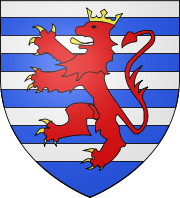
Prague
Prague is the capital and largest city of the Czech Republic. Situated in the north-west of the country on the Vltava river, the city is home to about 1.3 million people, while its metropolitan area is estimated to have a population of over 2.3 million...
– 29 November 1378), born Wenceslaus (Václav
Václav
Václav is a Czech male first name of Slavic origin, sometimes translated into English as Wenceslaus or Wenceslas . These forms are derived from the old Slavic/Czech form of this name: Vencslav.- People :...
), was the second king of Bohemia
Bohemia
Bohemia is a historical region in central Europe, occupying the western two-thirds of the traditional Czech Lands. It is located in the contemporary Czech Republic with its capital in Prague...
from the House of Luxembourg
House of Luxembourg
The House of Luxembourg was a late medieval German dynasty, which between 1308 and 1437 ruled the Holy Roman Empire, twice interrupted by the rivaling House of Wittelsbach.-History:...
, and the first king of Bohemia to also become Holy Roman Emperor
Holy Roman Emperor
The Holy Roman Emperor is a term used by historians to denote a medieval ruler who, as German King, had also received the title of "Emperor of the Romans" from the Pope...
.
He was the eldest son and heir of John the Blind, who died (in the Battle of Crécy
Battle of Crécy
The Battle of Crécy took place on 26 August 1346 near Crécy in northern France, and was one of the most important battles of the Hundred Years' War...
) on 26 August 1346. Charles inherited the County of Luxembourg and the Kingdom of Bohemia. On 2 September 1347 Charles was crowned King of Bohemia.
On 11 July 1346 Prince-elector
Prince-elector
The Prince-electors of the Holy Roman Empire were the members of the electoral college of the Holy Roman Empire, having the function of electing the Roman king or, from the middle of the 16th century onwards, directly the Holy Roman Emperor.The heir-apparent to a prince-elector was known as an...
s had elected him King of the Romans
King of the Romans
King of the Romans was the title used by the ruler of the Holy Roman Empire following his election to the office by the princes of the Kingdom of Germany...
(rex Romanorum) in opposition to Emperor Louis IV
Louis IV, Holy Roman Emperor
Louis IV , called the Bavarian, of the house of Wittelsbach, was the King of Germany from 1314, the King of Italy from 1327 and the Holy Roman Emperor from 1328....
. Charles was crowned on 26 November 1346 in Bonn
Bonn
Bonn is the 19th largest city in Germany. Located in the Cologne/Bonn Region, about 25 kilometres south of Cologne on the river Rhine in the State of North Rhine-Westphalia, it was the capital of West Germany from 1949 to 1990 and the official seat of government of united Germany from 1990 to 1999....
. After his opponent had died, he was re-elected in 1349 (17 June) and crowned (25 July) King of the Romans. In 1355 he was also crowned King of Italy
King of Italy
King of Italy is a title adopted by many rulers of the Italian peninsula after the fall of the Roman Empire...
on 6 January and Holy Roman Emperor
Holy Roman Emperor
The Holy Roman Emperor is a term used by historians to denote a medieval ruler who, as German King, had also received the title of "Emperor of the Romans" from the Pope...
on 5 April. With his coronation as King of Burgundy
King of Burgundy
The following is a list of the Kings of the two Kingdoms of Burgundy, and a number of related political entities devolving from Carolingian machinations over family relations.- Kings of the Burgundians :...
, delayed until 4 June 1365, he became the personal ruler of all the kingdoms of the Holy Roman Empire
Holy Roman Empire
The Holy Roman Empire was a realm that existed from 962 to 1806 in Central Europe.It was ruled by the Holy Roman Emperor. Its character changed during the Middle Ages and the Early Modern period, when the power of the emperor gradually weakened in favour of the princes...
.
Life
Charles was born to John and Elisabeth of Bohemia in PraguePrague
Prague is the capital and largest city of the Czech Republic. Situated in the north-west of the country on the Vltava river, the city is home to about 1.3 million people, while its metropolitan area is estimated to have a population of over 2.3 million...
as Wenceslaus (Václav), the name of his maternal grandfather. He later chose the name Charles at his confirmation after he went to stay at the court of his uncle, Charles IV of France
Charles IV of France
Charles IV, known as the Fair , was the King of France and of Navarre and Count of Champagne from 1322 to his death: he was the last French king of the senior Capetian lineage....
, where he remained for seven years.
He received French
France
The French Republic , The French Republic , The French Republic , (commonly known as France , is a unitary semi-presidential republic in Western Europe with several overseas territories and islands located on other continents and in the Indian, Pacific, and Atlantic oceans. Metropolitan France...
education and was literate and fluent in five languages: Latin, Czech
Czech language
Czech is a West Slavic language with about 12 million native speakers; it is the majority language in the Czech Republic and spoken by Czechs worldwide. The language was known as Bohemian in English until the late 19th century...
, German
German language
German is a West Germanic language, related to and classified alongside English and Dutch. With an estimated 90 – 98 million native speakers, German is one of the world's major languages and is the most widely-spoken first language in the European Union....
, French
French language
French is a Romance language spoken as a first language in France, the Romandy region in Switzerland, Wallonia and Brussels in Belgium, Monaco, the regions of Quebec and Acadia in Canada, and by various communities elsewhere. Second-language speakers of French are distributed throughout many parts...
, and Italian
Italian language
Italian is a Romance language spoken mainly in Europe: Italy, Switzerland, San Marino, Vatican City, by minorities in Malta, Monaco, Croatia, Slovenia, France, Libya, Eritrea, and Somalia, and by immigrant communities in the Americas and Australia...
. In 1331 he gained some experience of warfare in Italy with his father. From 1333 he administered the lands of the Bohemian Crown
Lands of the Bohemian Crown
The Lands of the Bohemian Crown , also called the Lands of the Crown of Saint Wenceslas or simply the Bohemian Crown or Czech Crown lands , refers to the area connected by feudal relations under the joint rule of the Bohemian kings...
due to his father's frequent absence and later also deteriorating eyesight. In 1334, he was named Margrave of Moravia, the traditional title for heirs to the throne. Two years later, he undertook the government of Tirol
Tyrol (state)
Tyrol is a state or Bundesland, located in the west of Austria. It comprises the Austrian part of the historical region of Tyrol.The state is split into two parts–called North Tyrol and East Tyrol–by a -wide strip of land where the state of Salzburg borders directly on the Italian province of...
on behalf of his brother, John Henry
John Henry, Margrave of Moravia
John Henry of Luxembourg, Czech: Jan Jindřich, German: Johann Heinrich , was Count of Tyrol from 1335 to 1341 and Margrave of Moravia from 1349 until his death....
, and was soon actively involved in a struggle for the possession of this county.
King of the Romans
On 11 July 1346, in consequence of an alliance between his father and Pope Clement VIPope Clement VI
Pope Clement VI , bornPierre Roger, the fourth of the Avignon Popes, was pope from May 1342 until his death in December of 1352...
, relentless enemy of the emperor Louis IV
Louis IV, Holy Roman Emperor
Louis IV , called the Bavarian, of the house of Wittelsbach, was the King of Germany from 1314, the King of Italy from 1327 and the Holy Roman Emperor from 1328....
, Charles was chosen as Roman king in opposition
Antiking
An Antiking is a would-be king who, due to succession disputes or simple political opposition, declares himself king in opposition to a reigning monarch. Antikings are more often found in elected monarchies than in hereditary monarchies like those of England and France; such figures in hereditary...
to Louis by some of the prince-electors at Rhens
Rhens
Rhens is a municipality in the district Mayen-Koblenz, in Rhineland-Palatinate, Germany. It is situated on the left bank of the Rhine, approx. 10 km south of Koblenz.Rhens is the seat of the Verbandsgemeinde Rhens....
. As he had previously promised to be subservient to Clement, he made extensive concessions to the Pope in 1347. Confirming the papacy in the possession of wide territories, he promised to annul the acts of Louis against Clement, to take no part in Italian affairs, and to defend and protect the church.
Charles IV was initially in a very weak position in Germany. Owing to the terms of his election, he was derisively referred to by some as a "priest's king" (Pfaffenkönig). Many bishops and nearly all of the Imperial cities
Imperial State
An Imperial State or Imperial Estate was an entity in the Holy Roman Empire with a vote in the Imperial Diet assemblies. Several territories of the Empire were not represented, while some officials were non-voting members; neither qualified as Imperial States.Rulers of Imperial States were...
remained loyal to Louis the Bavarian. Worse yet, Charles backed the wrong horse in the Hundred Years' War
Hundred Years' War
The Hundred Years' War was a series of separate wars waged from 1337 to 1453 by the House of Valois and the House of Plantagenet, also known as the House of Anjou, for the French throne, which had become vacant upon the extinction of the senior Capetian line of French kings...
, losing his father and many of his best knights at the Battle of Crecy
Battle of Crécy
The Battle of Crécy took place on 26 August 1346 near Crécy in northern France, and was one of the most important battles of the Hundred Years' War...
in August 1346, with Charles himself escaping wounded from the field.
Civil War in Germany was prevented, however, when Louis IV died on 11 October 1347 after suffering a stroke during a bear-hunt. In January 1349, Wittelsbach
Wittelsbach
The Wittelsbach family is a European royal family and a German dynasty from Bavaria.Members of the family served as Dukes, Electors and Kings of Bavaria , Counts Palatine of the Rhine , Margraves of Brandenburg , Counts of Holland, Hainaut and Zeeland , Elector-Archbishops of Cologne , Dukes of...
partisans attempted to secure the election of Günther von Schwarzburg
Günther von Schwarzburg
Günther XXI von Schwarzburg , German king, was a descendant of the counts of Schwarzburg and the younger son of Henry VII, count of Blankenburg....
as king, but he attracted few supporters and died unnoticed and unmourned after a few months. Thereafter, Charles faced no direct threat to his claim to the Imperial throne.
Charles initially worked to secure his power base. Bohemia
Bohemia
Bohemia is a historical region in central Europe, occupying the western two-thirds of the traditional Czech Lands. It is located in the contemporary Czech Republic with its capital in Prague...
had remained untouched by the plague. Prague
Prague
Prague is the capital and largest city of the Czech Republic. Situated in the north-west of the country on the Vltava river, the city is home to about 1.3 million people, while its metropolitan area is estimated to have a population of over 2.3 million...
became his capital, and he rebuilt the city on the model of Paris, establishing the New Town
New Town, Prague
The New Town is a quarter in the city of Prague in the Czech Republic. New Town is the youngest and largest of the five independent towns that today comprise the historic center of modern Prague...
of Prague (Nové Město). In 1348, he founded the University of Prague
Charles University in Prague
Charles University in Prague is the oldest and largest university in the Czech Republic. Founded in 1348, it was the first university in Central Europe and is also considered the earliest German university...
, named after him, the first university in Central Europe. This served as a training ground for bureaucrats and lawyers. Soon Prague emerged as the intellectual and cultural center of Central Europe.
Charles, having made good use of the difficulties of his opponents, was again elected and recrowned at Aachen
Aachen
Aachen has historically been a spa town in North Rhine-Westphalia, Germany. Aachen was a favoured residence of Charlemagne, and the place of coronation of the Kings of Germany. Geographically, Aachen is the westernmost town of Germany, located along its borders with Belgium and the Netherlands, ...
on 25 July 1349, and was soon the undisputed ruler of the Empire. Gifts or promises had won the support of the Rhenish and Swabia
Swabia
Swabia is a cultural, historic and linguistic region in southwestern Germany.-Geography:Like many cultural regions of Europe, Swabia's borders are not clearly defined...
n towns; a marriage alliance secured the friendship of the Habsburgs; and that of Rudolf II of Bavaria
Rudolf II, Duke of Bavaria
Rudolf II "the blind" was Count Palatine of the Rhine from 1329 to 1353....
, Count Palatine of the Rhine, was obtained when Charles, who had become a widower in 1348, married his daughter Anna
Anna of Bavaria
Anna of Bavaria was a Queen consort of Bohemia. She was the daughter of Rudolf II, Duke of Bavaria and Count Palatine of the Rhine, and of Anna, daughter of Otto II, Duke of Carinthia....
.
In 1350 the king was visited at Prague by the Roman
History of Rome
The history of Rome spans 2,800 years of the existence of a city that grew from a small Italian village in the 9th century BC into the centre of a vast civilisation that dominated the Mediterranean region for centuries. Its political power was eventually replaced by that of peoples of mostly...
tribune Cola di Rienzo
Cola di Rienzo
Cola di Rienzo was an Italian medieval politician and popular leader, tribune of the Roman people in the mid-14th century.-Early career:Cola was born in Rome of humble origins...
, who urged him to go to Italy, where the poet Petrarch
Petrarch
Francesco Petrarca , known in English as Petrarch, was an Italian scholar, poet and one of the earliest humanists. Petrarch is often called the "Father of Humanism"...
and the citizens of Florence
Florence
Florence is the capital city of the Italian region of Tuscany and of the province of Florence. It is the most populous city in Tuscany, with approximately 370,000 inhabitants, expanding to over 1.5 million in the metropolitan area....
also implored his presence. Turning a deaf ear to these entreaties, Charles kept Cola in prison for a year, and then handed him as a prisoner to Clement at Avignon
Avignon
Avignon is a French commune in southeastern France in the départment of the Vaucluse bordered by the left bank of the Rhône river. Of the 94,787 inhabitants of the city on 1 January 2010, 12 000 live in the ancient town centre surrounded by its medieval ramparts.Often referred to as the...
.
Outside of Prague, Charles attempted to expand the Bohemian crown lands, using his imperial authority to acquire fiefs in Silesia
Silesia
Silesia is a historical region of Central Europe located mostly in Poland, with smaller parts also in the Czech Republic, and Germany.Silesia is rich in mineral and natural resources, and includes several important industrial areas. Silesia's largest city and historical capital is Wrocław...
, the Upper Palatinate
Upper Palatinate
The Upper Palatinate is one of the seven administrative regions of Bavaria, Germany, located in the east of Bavaria.- History :The region took its name first in the early 16th century, because it was by the Treaty of Pavia one of the main portions of the territory of the Wittelsbach Elector...
, and Franconia
Franconia
Franconia is a region of Germany comprising the northern parts of the modern state of Bavaria, a small part of southern Thuringia, and a region in northeastern Baden-Württemberg called Tauberfranken...
. The latter regions comprised "New Bohemia," a string of possessions intended to link Bohemia with the Luxemburg territories in the Rhineland. The Bohemian estates were not, however, willing to support Charles in these ventures. When Charles sought to codify Bohemian law in the Majestas Carolina of 1355 he met with sharp resistance. After that point, Charles found it expedient to scale back his efforts at centralization.
Holy Roman Emperor
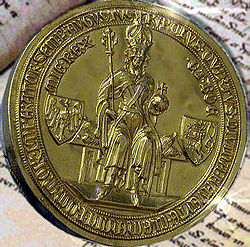
Alps
The Alps is one of the great mountain range systems of Europe, stretching from Austria and Slovenia in the east through Italy, Switzerland, Liechtenstein and Germany to France in the west....
without an army, received the Lombard crown
Iron Crown of Lombardy
The Iron Crown of Lombardy is both a reliquary and one of the most ancient royal insignia of Europe. The crown became one of the symbols of the Kingdom of Lombards and later of the medieval Kingdom of Italy...
in St. Ambrose Basilica
Basilica of Sant'Ambrogio
The Basilica of Sant'Ambrogio is a church in Milan, northern Italy.-History:One of the most ancient churches in Milan, it was built by St. Ambrose in 379-386, in an area where numerous martyrs of the Roman persecutions had been buried. The first name of the church was in fact Basilica...
, Milan
Milan
Milan is the second-largest city in Italy and the capital city of the region of Lombardy and of the province of Milan. The city proper has a population of about 1.3 million, while its urban area, roughly coinciding with its administrative province and the bordering Province of Monza and Brianza ,...
on 5 January 1355, and was crowned emperor at Rome
Rome
Rome is the capital of Italy and the country's largest and most populated city and comune, with over 2.7 million residents in . The city is located in the central-western portion of the Italian Peninsula, on the Tiber River within the Lazio region of Italy.Rome's history spans two and a half...
by a cardinal
Cardinal (Catholicism)
A cardinal is a senior ecclesiastical official, usually an ordained bishop, and ecclesiastical prince of the Catholic Church. They are collectively known as the College of Cardinals, which as a body elects a new pope. The duties of the cardinals include attending the meetings of the College and...
in the April of the same year. His sole object appears to have been to obtain the imperial crown in peace, and in accordance with a promise previously made to Pope Clement. He only remained in the city for a few hours, in spite of the expressed wishes of the Roman people. Having virtually abandoned all the imperial rights in Italy, the emperor recrossed the Alps, pursued by the scornful words of Petrarch but laden with considerable wealth. On his return Charles was occupied with the administration of the Empire, then just recovering from the Black Death
Black Death
The Black Death was one of the most devastating pandemics in human history, peaking in Europe between 1348 and 1350. Of several competing theories, the dominant explanation for the Black Death is the plague theory, which attributes the outbreak to the bacterium Yersinia pestis. Thought to have...
, and in 1356 he promulgated the famous Golden Bull
Golden Bull of 1356
The Golden Bull of 1356 was a decree issued by the Reichstag assembly in Nuremberg headed by the Luxembourg Emperor Charles IV that fixed, for a period of more than four hundred years, important aspects of the constitutional structure of the Holy Roman Empire...
to regulate the election of the king.
Having given Moravia
Moravia
Moravia is a historical region in Central Europe in the east of the Czech Republic, and one of the former Czech lands, together with Bohemia and Silesia. It takes its name from the Morava River which rises in the northwest of the region...
to one brother, John Henry, and erected the county of Luxembourg into a duchy for another, Wenceslaus, King of the Romans
Wenceslaus, King of the Romans
Wenceslaus ) was, by election, German King from 1376 and, by inheritance, King of Bohemia from 1378. He was the third Bohemian and second German monarch of the Luxembourg dynasty...
, he was unremitting in his efforts to secure other territories as compensation and to strengthen the Bohemian monarchy. To this end he purchased part of the upper Palatinate of the Rhine
Palatinate of the Rhine
The Palatinate , historically also Rhenish Palatinate , is a region in south-western Germany. It occupies more than a quarter of the German federal state of Rhineland-Palatinate .-Geography:...
in 1353, and in 1367 annexed Lower Lusatia
Lower Lusatia
Lower Lusatia is a historical region stretching from the southeast of the Brandenburg state of Germany to the southwest of the Lubusz Voivodeship in Poland. Important towns beside the historic capital Lübben include Calau, Cottbus, Guben , Luckau, Spremberg, Finsterwalde, Senftenberg and Żary...
to Bohemia and bought numerous estates in various parts of Germany. On the death of Meinhard, Duke of Upper Bavaria
Meinhard III of Gorizia-Tyrol
Meinhard III was Duke of Upper Bavaria and the last Count of Tyrol from the House of Wittelsbach.Meinhard was the son of Duke Louis V of Bavaria with Countess Margaret of Gorizia-Tyrol and as such also the last descendant of Meinhard I, Count of Gorizia .-Biography:Meinhard III was born in Landshut...
and Count of Tyrol in 1363, Upper Bavaria
Upper Bavaria
Upper Bavaria is one of the seven administrative regions of Bavaria, Germany.- Geography :Upper Bavaria is located in the southern portion of Bavaria, and is centered around the city of Munich. It is subdivided into four regions : Ingolstadt, Munich, Bayerisches Oberland , and Südostoberbayern...
was claimed by the sons of the emperor Louis IV, and Tyrol
Tyrol
Tyrol is an historical region in Western Central Europe. The term has its origin in the former County of Tyrol, and today can be referred to different regions and entities.- Prehistory :...
by Rudolf IV, Duke of Austria
Rudolf IV, Duke of Austria
Rudolf IV der Stifter was a scion of the House of Habsburg and Duke of Austria and Duke of Styria and Carinthia from 1358, as well as Count of Tyrol from 1363 and first Duke of Carniola from 1364 until his death...
.
Both claims were admitted by Charles on the understanding that if these families died out both territories should pass to the House of Luxembourg
House of Luxembourg
The House of Luxembourg was a late medieval German dynasty, which between 1308 and 1437 ruled the Holy Roman Empire, twice interrupted by the rivaling House of Wittelsbach.-History:...
. At about the same time he was promised the succession to the Margravate of Brandenburg, which he actually obtained for his son Wenceslaus in 1373. He also gained a considerable portion of Silesian
Silesian
Silesian or Upper Silesian is considered either a dialect of the Polish language , or a separate Slavic language of the Lechitic group spoken in the region of Silesia...
territory, partly by inheritance through his third wife, Anna von Schweidnitz
Anna von Schweidnitz
Anna of Schweidnitz was Queen of Bohemia, German Queen, and Empress of the Holy Roman Empire. She was the third wife of Emperor Charles IV.-Biography:...
, daughter of Henry II, Duke of Świdnica and Catherine of Hungary
Catherine of Hungary (d. 1355)
Catherine of Hungary was a daughter of King Charles I of Hungary. Her mother is uncertain. She was a member of the House of Anjou and was a Hungarian princess.- Family :...
. In 1365 Charles visited Pope Urban V
Pope Urban V
Pope Urban V , born Guillaume Grimoard, was Pope from 1362 to 1370.-Biography:Grimoard was a native of Grizac in Languedoc . He became a Benedictine and a doctor in Canon Law, teaching at Montpellier and Avignon...
at Avignon
Avignon
Avignon is a French commune in southeastern France in the départment of the Vaucluse bordered by the left bank of the Rhône river. Of the 94,787 inhabitants of the city on 1 January 2010, 12 000 live in the ancient town centre surrounded by its medieval ramparts.Often referred to as the...
and undertook to escort him to Rome; and on the same occasion was crowned King of Burgundy
Lower Burgundy
Lower Burgundy was a historical kingdom in what is now southeastern France, so-called because it was lower down the Rhone Valley than Upper Burgundy. Lower Burgundy is sometimes called the Kingdom of Arelat or the Kingdom of Cisjurane Burgundy...
at Arles
Arles
Arles is a city and commune in the south of France, in the Bouches-du-Rhône department, of which it is a subprefecture, in the former province of Provence....
.
His second journey to Italy took place in 1368, when he had a meeting with Pope Urban VI
Pope Urban VI
Pope Urban VI , born Bartolomeo Prignano, was Pope from 1378 to 1389.-Biography:Born in Itri, he was a devout monk and learned casuist, trained at Avignon. On March 21, 1364, he was consecrated Archbishop of Acerenza in the Kingdom of Naples...
at Viterbo
Viterbo
See also Viterbo, Texas and Viterbo UniversityViterbo is an ancient city and comune in the Lazio region of central Italy, the capital of the province of Viterbo. It is approximately 80 driving / 80 walking kilometers north of GRA on the Via Cassia, and it is surrounded by the Monti Cimini and...
, was besieged in his palace at Siena
Siena
Siena is a city in Tuscany, Italy. It is the capital of the province of Siena.The historic centre of Siena has been declared by UNESCO a World Heritage Site. It is one of the nation's most visited tourist attractions, with over 163,000 international arrivals in 2008...
, and left the country before the end of the year 1369. During his later years, the emperor took little part in German affairs beyond securing the election of his son Wenceslaus as king of the Romans in 1376, and negotiating a peace between the Swabian League
Swabian League
The Swabian League was an association of Imperial States - cities, prelates, principalities and knights - principally in the territory of the Early medieval stem duchy of Swabia, established in 1488 at the behest of Emperor Frederick III of Habsburg and supported as well by Bertold von...
and some nobles in 1378. After dividing his lands between his three sons, he died in November 1378 at Prague
Prague
Prague is the capital and largest city of the Czech Republic. Situated in the north-west of the country on the Vltava river, the city is home to about 1.3 million people, while its metropolitan area is estimated to have a population of over 2.3 million...
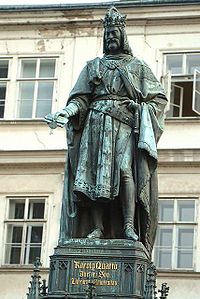
, where he was buried, and where a statue was erected to his memory in 1848.
Charles IV suffered from gout
Gout
Gout is a medical condition usually characterized by recurrent attacks of acute inflammatory arthritis—a red, tender, hot, swollen joint. The metatarsal-phalangeal joint at the base of the big toe is the most commonly affected . However, it may also present as tophi, kidney stones, or urate...
(metabolic arthritis), a painful disease quite common in that time.
Evaluation and legacy
Golden Age
The term Golden Age comes from Greek mythology and legend and refers to the first in a sequence of four or five Ages of Man, in which the Golden Age is first, followed in sequence, by the Silver, Bronze, and Iron Ages, and then the present, a period of decline...
of Bohemia. He promulgated the Golden Bull of 1356
Golden Bull of 1356
The Golden Bull of 1356 was a decree issued by the Reichstag assembly in Nuremberg headed by the Luxembourg Emperor Charles IV that fixed, for a period of more than four hundred years, important aspects of the constitutional structure of the Holy Roman Empire...
whereby the succession to the imperial title was laid down, which held for the next four centuries.
He also organized the states of the empire into peace-keeping confederations. In these, the Imperial cities figured prominently. The Swabian Landfriede confederation of 1370 was made up almost entirely of Imperial Cities
Free Imperial City
In the Holy Roman Empire, a free imperial city was a city formally ruled by the emperor only — as opposed to the majority of cities in the Empire, which were governed by one of the many princes of the Empire, such as dukes or prince-bishops...
. At the same time, the leagues were organized and led by the crown and its agents. As with the electors, the cities which served in these leagues were given privileges to aid them in their efforts to keep the peace.
He assured his dominance over the eastern borders of the Empire through succession treaties with the Habsburg
Habsburg
The House of Habsburg , also found as Hapsburg, and also known as House of Austria is one of the most important royal houses of Europe and is best known for being an origin of all of the formally elected Holy Roman Emperors between 1438 and 1740, as well as rulers of the Austrian Empire and...
s and the purchase of Brandenburg. He also claimed imperial lordship over the crusader states of Prussia
Prussia
Prussia was a German kingdom and historic state originating out of the Duchy of Prussia and the Margraviate of Brandenburg. For centuries, the House of Hohenzollern ruled Prussia, successfully expanding its size by way of an unusually well-organized and effective army. Prussia shaped the history...
and Livonia
Livonia
Livonia is a historic region along the eastern shores of the Baltic Sea. It was once the land of the Finnic Livonians inhabiting the principal ancient Livonian County Metsepole with its center at Turaida...
.
Patronage of culture and the arts
He made Prague the imperial capital, refusing even at the insistence of Petrarch to move to Rome, and he was a great builder in that city, which bears his name in so many spots: Charles University, Charles BridgeCharles Bridge
The Charles Bridge is a famous historic bridge that crosses the Vltava river in Prague, Czech Republic. Its construction started in 1357 under the auspices of King Charles IV, and finished in the beginning of the 15th century...
, and Charles Square
Charles Square
Charles Square is a city square in the New Town of Prague, Czech Republic. It is one of the largest squares in the world and very likely the largest medieval square in Europe. Founded in 1348 as the main square of the New Town by Charles IV, it was known as Dobytčí trh from the 15th century and...
. Prague Castle
Prague Castle
Prague Castle is a castle in Prague where the Kings of Bohemia, Holy Roman Emperors and presidents of Czechoslovakia and the Czech Republic have had their offices. The Czech Crown Jewels are kept here...
and much of the cathedral of Saint Vitus, by Peter Parler
Peter Parler
Peter Parler, , Schwäbisch Gmünd – July 13, 1399, Prague) was a German architect, best known for building Saint Vitus Cathedral and Charles Bridge in Prague, where he lived from about 1356....
, were completed under his patronage. Finally, it is from the reign of Charles that dates the first flowering of manuscript painting in Prague. In the present Czech Republic
Czech Republic
The Czech Republic is a landlocked country in Central Europe. The country is bordered by Poland to the northeast, Slovakia to the east, Austria to the south, and Germany to the west and northwest....
, he is still regarded as Pater Patriae
Pater Patriae
Pater Patriae , also seen as Parens Patriae, is a Latin honorific meaning "Father of the Country," or more literally, "Father of the Fatherland".- Roman history :...
(father of the country
Father of the Nation
Father of the Nation is an honorific title given to a man considered the driving force behind the establishment of their country, state or nation...
or otec vlasti), a title first coined by Adalbertus Ranconis de Ericinio
Adalbertus Ranconis de Ericinio
Adalbertus Ranconis de Ericinio was a Czech theologian and philosopher. In 1355 he was appointed a rector of the University of Paris. He wrote the Tractatus de communione, a treatise on confession and the offering of the eucharist by laymen...
at his funeral.
Charles IV also had strong ties to Nuremberg
Nuremberg
Nuremberg[p] is a city in the German state of Bavaria, in the administrative region of Middle Franconia. Situated on the Pegnitz river and the Rhine–Main–Danube Canal, it is located about north of Munich and is Franconia's largest city. The population is 505,664...
, staying within its city walls 52 times and thereby strengthening its reputation amongst German cities. Charles was the patron of the Nuremberg Frauenkirche
Nuremberg Frauenkirche
The Frauenkirche is a church in Nuremberg, Germany. It stands on the eastern side of the main market. An example of brick Gothic architecture, it was built on the initiative of Charles IV, Holy Roman Emperor between 1352 and 1362. The church contains many sculptures, some of them heavily restored...
, built between 1352 and 1362 (the architect was likely Peter Parler
Peter Parler
Peter Parler, , Schwäbisch Gmünd – July 13, 1399, Prague) was a German architect, best known for building Saint Vitus Cathedral and Charles Bridge in Prague, where he lived from about 1356....
), where the imperial court worshiped during its stays in Nuremberg.
Charles's imperial policy was focused on the dynastic sphere and abandoned the lofty ideal of the Empire as a universal monarchy of Christendom. In 1353, he granted Luxembourg to his nephew, Jobst
Jobst of Moravia
Jobst of Moravia, Jobst von Mähren from the House of Luxembourg was the eldest son of Margrave John Henry of Moravia, the younger brother of Emperor Charles IV....
. He concentrated his energies chiefly on the economic and intellectual development of Bohemia, where he founded the university in 1348 and encouraged the early humanists
Renaissance humanism
Renaissance humanism was an activity of cultural and educational reform engaged by scholars, writers, and civic leaders who are today known as Renaissance humanists. It developed during the fourteenth and the beginning of the fifteenth centuries, and was a response to the challenge of Mediæval...
. Indeed, he corresponded with Petrarch
Petrarch
Francesco Petrarca , known in English as Petrarch, was an Italian scholar, poet and one of the earliest humanists. Petrarch is often called the "Father of Humanism"...
, whom he invited to visit his residence in Prague, but the great Italian hoped — to no avail — to see Charles move his residence to Rome and reawaken tradition of the Roman Empire
Roman Empire
The Roman Empire was the post-Republican period of the ancient Roman civilization, characterised by an autocratic form of government and large territorial holdings in Europe and around the Mediterranean....
.
Charles's sister Bona, married the eldest son of Philip VI of France
Philip VI of France
Philip VI , known as the Fortunate and of Valois, was the King of France from 1328 to his death. He was also Count of Anjou, Maine, and Valois from 1325 to 1328...
, the future John II of France
John II of France
John II , called John the Good , was the King of France from 1350 until his death. He was the second sovereign of the House of Valois and is perhaps best remembered as the king who was vanquished at the Battle of Poitiers and taken as a captive to England.The son of Philip VI and Joan the Lame,...
, in 1335. Thus, Charles was the maternal uncle of Charles V of France
Charles V of France
Charles V , called the Wise, was King of France from 1364 to his death in 1380 and a member of the House of Valois...
, who solicited his relative's advice at Metz
Metz
Metz is a city in the northeast of France located at the confluence of the Moselle and the Seille rivers.Metz is the capital of the Lorraine region and prefecture of the Moselle department. Located near the tripoint along the junction of France, Germany, and Luxembourg, Metz forms a central place...
in 1356 during the Parisian Revolt. This family connection was celebrated publicly when Charles IV made a solemn visit to his nephew in 1378, just months before his death. A detailed account of the occasion, enriched by many splendid miniatures, can be found in Charles V's copy of the Grandes Chroniques de France
Grandes Chroniques de France
The Grandes Chroniques de France is a royal compilation of the history of France, its manuscripts remarkably illuminated. It was compiled between the thirteenth and fifteenth centuries, beginning in the reign of Saint Louis, who wished to preserve the history of the Franks from the coming of the...
.
Genealogy
| Henry VII Henry VII, Holy Roman Emperor Henry VII was the King of Germany from 1308 and Holy Roman Emperor from 1312. He was the first emperor of the House of Luxembourg... 12 July 1275(6) – 24 August 1313 |
Margaret of Brabant Margaret of Brabant Margaret of Brabant , was the daughter of John I, Duke of Brabant and Margaret of Flanders. She was the wife of Count Henry of Luxemburg and after his coronation in 1308, she became Queen of Germany.-Family:... 4 October 1276 – 14 December 1311 |
Wenceslaus II 27 September 1271 – 21 June 1305 |
Judith of Habsburg Judith of Habsburg Judith of Habsburg was the youngest daughter of Rudolph I of Germany and his wife Gertrude of Hohenburg. Judith was a member of the Habsburg family.-Biography:When Judith was five, she became the object of her father's political plans... 13 March 1271 – 18 June 1297 |
||||||||||
| John of Bohemia 10 August 1296 – 26 August 1346 |
Elisabeth of Bohemia 20 January 1292 – 28 September 1330 |
||||||||||||
| 1 Blanche of Valois Blanche of Valois Blanche of Valois was the youngest daughter of Charles of Valois and his third wife Mahaut of Châtillon.-Family:Her paternal grandparents were Philip III of France and Isabella of Aragon. Her maternal grandparents were Guy IV, Count of Saint-Pol and Marie of Brittany.Marie was a daughter of John... 1316 – 1 August 1348 OO 15 May 1323 |
2 Anna of Bavaria Anna of Bavaria Anna of Bavaria was a Queen consort of Bohemia. She was the daughter of Rudolf II, Duke of Bavaria and Count Palatine of the Rhine, and of Anna, daughter of Otto II, Duke of Carinthia.... 26 September 1329 – 2 February 1353 OO March 1349 |
Charles IV 14 May 1316 – 29 November 1378 |
3 Anna von Schweidnitz Anna von Schweidnitz Anna of Schweidnitz was Queen of Bohemia, German Queen, and Empress of the Holy Roman Empire. She was the third wife of Emperor Charles IV.-Biography:... 1339 – 11 July 1362 OO 27 May 1353 |
4 Elizabeth of Pomerania Elizabeth of Pomerania Elizabeth of Pomerania was the fourth and final wife of Charles IV, Holy Roman Emperor and king of Bohemia. Her parents were Bogislaw V, Duke of Pomerania and Elizabeth of Poland,... 1346(7) – 14 February 1393 OO 21 May 1363 |
|||||||||||
| 1 | 1 | 2 | 3 | 3 | 3 | 4 | |||||||||
| son b.1334 |
Margaret of Bohemia 1335–49 |
Catherine of Bohemia Katharine of Bohemia Catherine of Bohemia was an Electress of Brandenburg, the second daughter of Emperor Charles IV and Blanche of Valois.-Childhood and family:... 1342–95 |
Wenceslas 1350–51 |
Elisabeth of Bohemia 1358–73 |
Wenceslaus, King of the Romans Wenceslaus, King of the Romans Wenceslaus ) was, by election, German King from 1376 and, by inheritance, King of Bohemia from 1378. He was the third Bohemian and second German monarch of the Luxembourg dynasty... 1361–1419 |
son 1362 |
Anne of Bohemia Anne of Bohemia Anne of Bohemia was Queen of England as the first wife of King Richard II. A member of the House of Luxembourg, she was the eldest daughter of Charles IV, Holy Roman Emperor, and Elizabeth of Pomerania.... 1366–94 |
||||||||
| 4 | 4 | 4 | 4 | 4 | |||||||||||
| Sigismund, Holy Roman Emperor Sigismund, Holy Roman Emperor Sigismund of Luxemburg KG was King of Hungary, of Croatia from 1387 to 1437, of Bohemia from 1419, and Holy Roman Emperor for four years from 1433 until 1437, the last Emperor of the House of Luxemburg. He was also King of Italy from 1431, and of Germany from 1411... 1368–1437 |
John of Görlitz 1370–96 |
Charles 1372–73 |
Margaret of Bohemia Margaret of Bohemia (1373-1410) Margaret of Bohemia was the younger daughter of Holy Roman Emperor Charles IV and his fourth wife Elizabeth of Pomerania. Her siblings included Anne of Bohemia and Holy Roman Emperor Sigismund.- Biography :... 1373–1410 |
Henry 1377–78 |
|||||||||||
Family and children
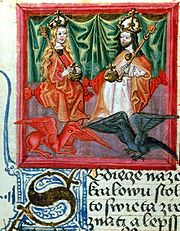
Blanche of Valois
Blanche of Valois was the youngest daughter of Charles of Valois and his third wife Mahaut of Châtillon.-Family:Her paternal grandparents were Philip III of France and Isabella of Aragon. Her maternal grandparents were Guy IV, Count of Saint-Pol and Marie of Brittany.Marie was a daughter of John...
, (1316–48), daughter of Charles
Charles of Valois
Charles of Valois was the fourth son of Philip III of France and Isabella of Aragon. His mother was a daughter of James I of Aragon and Yolande of Hungary. He was a member of the House of Capet and founded the House of Valois...
, Count of Valois, and a half-sister of Philip VI of France
Philip VI of France
Philip VI , known as the Fortunate and of Valois, was the King of France from 1328 to his death. He was also Count of Anjou, Maine, and Valois from 1325 to 1328...
. They had three children:
- a son (b.1334), died young
- Margaret of Bohemia; married Louis I of Hungary.
- Katharine of BohemiaKatharine of BohemiaCatherine of Bohemia was an Electress of Brandenburg, the second daughter of Emperor Charles IV and Blanche of Valois.-Childhood and family:...
(1342–95); married Rudolf IV of Austria and Otto V, Duke of BavariaOtto V, Duke of BavariaOtto V, Duke of Bavaria , was a duke of Bavaria and Elector of Brandenburg as Otto VII. Otto was the fourth son of Holy Roman Emperor Louis IV by his second wife Margaret II of Avesnes, countess of Hainaut and Holland.-Biography:...
, Elector of Brandenburg.
He secondly married Anna of Bavaria
Anna of Bavaria
Anna of Bavaria was a Queen consort of Bohemia. She was the daughter of Rudolf II, Duke of Bavaria and Count Palatine of the Rhine, and of Anna, daughter of Otto II, Duke of Carinthia....
, (1329–53), daughter of the Count Palatine Rudolph II
Rudolf II, Duke of Bavaria
Rudolf II "the blind" was Count Palatine of the Rhine from 1329 to 1353....
and they had one son:
- Wenceslaus (1350–51).
His third wife was Anna von Schweidnitz
Anna von Schweidnitz
Anna of Schweidnitz was Queen of Bohemia, German Queen, and Empress of the Holy Roman Empire. She was the third wife of Emperor Charles IV.-Biography:...
, (1339–62), daughter of Henry II, Duke of Świdnica and Katharina of Anjou (daughter of Charles I Robert, King of Hungary
Charles I of Hungary
Charles I , also known as Charles Robert , was the first King of Hungary and Croatia of the House of Anjou. He was also descended from the old Hungarian Árpád dynasty. His claim to the throne of Hungary was contested by several pretenders...
), by whom he had three children:
- Elisabeth of Bohemia (1358-1373) (19 April 1358 – 4 September 1373); married Albert III of Austria.
- WenceslausWenceslaus, King of the RomansWenceslaus ) was, by election, German King from 1376 and, by inheritance, King of Bohemia from 1378. He was the third Bohemian and second German monarch of the Luxembourg dynasty...
(1361 – 1419); later elected King of Germany (formally King of the Romans) and, on his father's death, became King of Bohemia (as Wenceslaus IV) and Emperor-elect of the Holy Roman Empire; married firstly to Joanna of Bavaria in 1370 and secondly to Sophia of Bavaria in 1389. - son (born and died 11 July 1362).
His fourth wife was Elizabeth of Pomerania
Elizabeth of Pomerania
Elizabeth of Pomerania was the fourth and final wife of Charles IV, Holy Roman Emperor and king of Bohemia. Her parents were Bogislaw V, Duke of Pomerania and Elizabeth of Poland,...
, (1345 or 1347–1393), daughter of Duke Bogislaw V, Duke of Pomerania
Bogislaw V, Duke of Pomerania
Bogislaw V was a Duke of Pomerania.Eldest son of Duke Wartislaw IV and Elisabeth of Silesia, Bogislaw had two brothers, Barnim IV and Wartislaw V. The brothers were joint rulers from their father's death in 1326. They allied with King Casimir III of Poland, whose daughter Elisabeth married...
and Elisabeth of Poland, daughter of Casimir III of Poland
Casimir III of Poland
Casimir III the Great , last King of Poland from the Piast dynasty , was the son of King Władysław I the Elbow-high and Hedwig of Kalisz.-Biography:...
. They had six children:
- Anne of BohemiaAnne of BohemiaAnne of Bohemia was Queen of England as the first wife of King Richard II. A member of the House of Luxembourg, she was the eldest daughter of Charles IV, Holy Roman Emperor, and Elizabeth of Pomerania....
(1366–94); married Richard II of EnglandRichard II of EnglandRichard II was King of England, a member of the House of Plantagenet and the last of its main-line kings. He ruled from 1377 until he was deposed in 1399. Richard was a son of Edward, the Black Prince, and was born during the reign of his grandfather, Edward III... - SigismundSigismund, Holy Roman EmperorSigismund of Luxemburg KG was King of Hungary, of Croatia from 1387 to 1437, of Bohemia from 1419, and Holy Roman Emperor for four years from 1433 until 1437, the last Emperor of the House of Luxemburg. He was also King of Italy from 1431, and of Germany from 1411...
(1368 – 1437); later Holy Roman Emperor, King of Hungary and Bohemia, and Margrave of Brandenburg; married firstly Mary of HungaryMary of HungaryMary of Anjou was queen regnant of Hungary from 1382 until her death in 1395.-Childhood:...
in 1385, and secondly to Barbara of Cilli in 1405/1408. - John of Görlitz (1370–96); later Margrave of Moravia and Duke of Görlitz; married Richardis Catherine of Sweden.
- Charles (13 March 1372–24 July 1373).
- Margaret of BohemiaMargaret of Bohemia (1373-1410)Margaret of Bohemia was the younger daughter of Holy Roman Emperor Charles IV and his fourth wife Elizabeth of Pomerania. Her siblings included Anne of Bohemia and Holy Roman Emperor Sigismund.- Biography :...
(1373–1410); married John III, Burgrave of NurembergBurgrave of Nuremberg- Further reading :* Sigmund Benker, Andreas Kraus : Geschichte Frankens bis zum Ausgang des 18. Jahrhunderts . 3rd edition. Beck, Munich 1997. ISBN 3-406-39451-5...
. - Henry (1377–78)
Named after Charles IV
Several places have been named after Charles:- Karlstein Castle and the nearby village Karlštejn (Beroun District)Karlštejn (Beroun District)Karlštejn is a market town in the Central Bohemian Region of the Czech Republic.In 1952, it was named after Karlštejn Castle.-External links:*...
- Kašperk Castle
- Karlsfried Castle
- Carlsbad (several places)
- 16951 Carolus Quartus16951 Carolus Quartus16951 Carolus Quartus is a main-belt asteroid discovered on May 19, 1998 by P. Pravec at the Ondřejov Observatory.- External links :*...
(an asteroid) - Charles BridgeCharles BridgeThe Charles Bridge is a famous historic bridge that crosses the Vltava river in Prague, Czech Republic. Its construction started in 1357 under the auspices of King Charles IV, and finished in the beginning of the 15th century...
(Karlův most) - Charles SquareCharles SquareCharles Square is a city square in the New Town of Prague, Czech Republic. It is one of the largest squares in the world and very likely the largest medieval square in Europe. Founded in 1348 as the main square of the New Town by Charles IV, it was known as Dobytčí trh from the 15th century and...
(Karlovo náměstí) - Charles University in PragueCharles University in PragueCharles University in Prague is the oldest and largest university in the Czech Republic. Founded in 1348, it was the first university in Central Europe and is also considered the earliest German university...
(Karlova Univerzita)