


Silesian

Encyclopedia
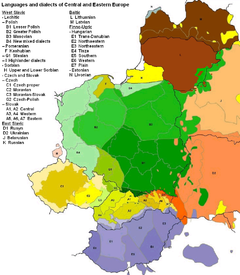
Dialect
The term dialect is used in two distinct ways, even by linguists. One usage refers to a variety of a language that is a characteristic of a particular group of the language's speakers. The term is applied most often to regional speech patterns, but a dialect may also be defined by other factors,...
of the Polish language
Polish language
Polish is a language of the Lechitic subgroup of West Slavic languages, used throughout Poland and by Polish minorities in other countries...
(apart from the Lach dialects
Lach dialects
The Lach dialects , are a group of dialects of Silesian language. They represent a hybrid or mix of the West Slavic languages.The Lach dialects are spoken in parts of Czech Silesia, the Hlučín region, and northeastern Moravia, as well as in some adjacent villages in Poland...
, which are usually regarded as a branch of the Czech language
Czech language
Czech is a West Slavic language with about 12 million native speakers; it is the majority language in the Czech Republic and spoken by Czechs worldwide. The language was known as Bohemian in English until the late 19th century...
), or a separate Slavic language of the Lechitic group
Lechitic languages
The Lechitic languages include three languages spoken in Central Europe, mainly in Poland, and historically also in the eastern and northern parts of modern Germany. This language group is a branch of the larger West Slavic language family...
spoken in the region of Silesia
Silesia
Silesia is a historical region of Central Europe located mostly in Poland, with smaller parts also in the Czech Republic, and Germany.Silesia is rich in mineral and natural resources, and includes several important industrial areas. Silesia's largest city and historical capital is Wrocław...
. The ISO 639-3
ISO 639-3
ISO 639-3:2007, Codes for the representation of names of languages — Part 3: Alpha-3 code for comprehensive coverage of languages, is an international standard for language codes in the ISO 639 series. The standard describes three‐letter codes for identifying languages. It extends the ISO 639-2...
language code is szl.
Distribution
Silesian speakers currently live in the region of Upper SilesiaUpper Silesia
Upper Silesia is the southeastern part of the historical and geographical region of Silesia. Since the 9th century, Upper Silesia has been part of Greater Moravia, the Duchy of Bohemia, the Piast Kingdom of Poland, again of the Lands of the Bohemian Crown and the Holy Roman Empire, as well as of...
, which is split between southwestern Poland
Poland
Poland , officially the Republic of Poland , is a country in Central Europe bordered by Germany to the west; the Czech Republic and Slovakia to the south; Ukraine, Belarus and Lithuania to the east; and the Baltic Sea and Kaliningrad Oblast, a Russian exclave, to the north...
and the northeastern Czech Republic
Czech Republic
The Czech Republic is a landlocked country in Central Europe. The country is bordered by Poland to the northeast, Slovakia to the east, Austria to the south, and Germany to the west and northwest....
. At present Silesian is commonly spoken in the area between historical border of Silesia on the east, and a line from Syców
Syców
Syców is a town in Oleśnica County, Lower Silesian Voivodeship, in south-western Poland. It is the seat of the administrative district called Gmina Syców....
to Prudnik
Prudnik
Prudnik is a town in Poland, located in the southern part of Opole Voivodeship. Its population numbers 26,400 inhabitants . It is the capital of Prudnik County.- Education :* * * II Liceum Ogólnokształcące w Prudniku...
on the west, as well as in the Rawicz
Rawicz
Rawicz is a town in central Poland with 21,398 inhabitants . It is situated in the Greater Poland Voivodeship ; previously it was in Leszno Voivodeship . It is the capital of Rawicz County.-History:...
area. Until 1945 Silesian was also spoken in enclaves in Lower Silesia
Lower Silesia
Lower Silesia ; is the northwestern part of the historical and geographical region of Silesia; Upper Silesia is to the southeast.Throughout its history Lower Silesia has been under the control of the medieval Kingdom of Poland, the Kingdom of Bohemia and the Austrian Habsburg Monarchy from 1526...
, as Lower Silesian
Silesian German
Silesian German language , is a German dialect/language spoken in Silesia. Today, the area is mainly in southwestern Poland, but as well as in northeastern Czech Republic and in eastern Germany...
, a German dialect, was spoken by the ethnic German majority population of that region at the time.
According to the last official census in Poland (2002)
Polish census of 2002
- Significant ethnic minorities :In addition to Poles, ethnic groups of more than 25,000 people compose the following:-References:...
, above 56,000 people declared Silesian as their native language
First language
A first language is the language a person has learned from birth or within the critical period, or that a person speaks the best and so is often the basis for sociolinguistic identity...
, and over 173,000 people declared Silesian nationality
Silesians
Silesians , are the inhabitants of Silesia in Poland, Germany and the Czech Republic. A small diaspora community also exists in Karnes County, Texas in the USA....
(mainly in the Silesian Voivodeship
Silesian Voivodeship
Silesian Voivodeship, or Silesia Province , is a voivodeship, or province, in southern Poland, centering on the historic region known as Upper Silesia...
). There are also about 100,000 Silesian (Cieszyn Silesian
Cieszyn Silesian dialect
Cieszyn Silesian dialect is one of the Silesian dialects. It has its roots mainly in Polish and has also strong Czech and German influences and even Vlachs' and Slovak. It is spoken in Cieszyn Silesia, a region on both sides of the Polish-Czech border. It lacks some official codification and...
) speakers living in the Czech Republic; Cieszyn Silesian is also commonly spoken in the Polish part of Cieszyn Silesia
Cieszyn Silesia
Cieszyn Silesia or Těšín Silesia or Teschen Silesia is a historical region in south-eastern Silesia, centered around the towns of Cieszyn and Český Těšín and bisected by the Olza River. Since 1920 it has been divided between Poland and Czechoslovakia, and later the Czech Republic...
. Speakers of Cieszyn Silesian dialect usually identify themselves on the nationality level as Poles. According to the last official census in Czech Republic, 10,878 Czechs declared Silesian nationality.
Recognition
In 2003, the National Publishing Company of Silesia (Narodowa Oficyna Śląska) commenced operations. This publisher was founded by the Alliance of People of the Silesian Nation (Związek Ludności Narodowości Śląskiej) and it prints books about Silesia and books in Silesian language.In July 2007, the Slavic Silesian language was recognized by an ISO
International Organization for Standardization
The International Organization for Standardization , widely known as ISO, is an international standard-setting body composed of representatives from various national standards organizations. Founded on February 23, 1947, the organization promulgates worldwide proprietary, industrial and commercial...
Joint Advisory Committee, Library of Congress
Library of Congress
The Library of Congress is the research library of the United States Congress, de facto national library of the United States, and the oldest federal cultural institution in the United States. Located in three buildings in Washington, D.C., it is the largest library in the world by shelf space and...
, International Information Centre for Terminology and SIL International
SIL International
SIL International is a U.S.-based, worldwide, Christian non-profit organization, whose main purpose is to study, develop and document languages, especially those that are lesser-known, in order to expand linguistic knowledge, promote literacy, translate the Christian Bible into local languages,...
. Language was attributed ISO
International Organization for Standardization
The International Organization for Standardization , widely known as ISO, is an international standard-setting body composed of representatives from various national standards organizations. Founded on February 23, 1947, the organization promulgates worldwide proprietary, industrial and commercial...
code: SZL.
On 6 September 2007, 23 politicians of the Polish parliament notified about a project of a new law to give the Silesian language the official status of a regional language.
The first official National Dictation contest of the Silesian language (Ogólnopolskie Dyktando Języka Śląskiego) took place in August 2007.
On 30 January 2008 and in June 2008, two organizations promoting Silesian language were established: Pro Loquela Silesiana and "Tôwarzistwo Piastowaniô Ślónskij Môwy "Danga".
On 26 May 2008, Silesian Wikipedia
Silesian Wikipedia
Silesian Wikipedia is the Silesian edition of Wikipedia. It was started on 26 May 2008.- History :The first attempt to launch the Silesian Wikipedia project took place in March 2006, but because of negative comments in the discussion section, the proposal was rejected.In 2007 officially registered...
was founded.
On 30 June 2008 in the edifice of the Silesian Parliament
Silesian Parliament
Silesian Parliament or Silesian Sejm was the governing body of the Silesian Voivodeship , an autonomous voivodeship of the Second Polish Republic between 1920 and 1945. It was elected in democratic elections and had certain influence over the usage of taxes collected in Silesia...
in Katowice
Katowice
Katowice is a city in Silesia in southern Poland, on the Kłodnica and Rawa rivers . Katowice is located in the Silesian Highlands, about north of the Silesian Beskids and about southeast of the Sudetes Mountains.It is the central district of the Upper Silesian Metropolis, with a population of 2...
, a conference took place on the status of Silesian language. This conference was a forum for politicians, linguists, representatives of interested organizations, and persons who deal with the Silesian language. The conference was titled "Silesian - still a dialect or already a language?" ("Śląsko godka - jeszcze gwara czy jednak już język"?).
Steuer's Silesian alphabet
The attempts at codification of Silesian are numerous. One of the first alphabetAlphabet
An alphabet is a standard set of letters—basic written symbols or graphemes—each of which represents a phoneme in a spoken language, either as it exists now or as it was in the past. There are other systems, such as logographies, in which each character represents a word, morpheme, or semantic...
s created specifically for Silesian was Steuer's Silesian alphabet, used by Feliks Steuer
Feliks Steuer
Dr. Feliks Steuer was a Silesian educationist.Born in Zülkowitz , he was educated in Leobschütz...
to write his poems in Silesian.
The alphabet
Alphabet
An alphabet is a standard set of letters—basic written symbols or graphemes—each of which represents a phoneme in a spoken language, either as it exists now or as it was in the past. There are other systems, such as logographies, in which each character represents a word, morpheme, or semantic...
consists of 30 graphemes and eight digraphs
Digraph (orthography)
A digraph or digram is a pair of characters used to write one phoneme or a sequence of phonemes that does not correspond to the normal values of the two characters combined...
.
Letters: A
A
A is the first letter and a vowel in the basic modern Latin alphabet. It is similar to the Ancient Greek letter Alpha, from which it derives.- Origins :...
, B
B
B is the second letter in the basic modern Latin alphabet. It is used to represent a variety of bilabial sounds , most commonly a voiced bilabial plosive.-History:...
, C
C
Ĉ or ĉ is a consonant in Esperanto orthography, representing the sound .Esperanto orthography uses a diacritic for all four of its postalveolar consonants, as do the Latin-based Slavic alphabets...
, Ć
C
Ĉ or ĉ is a consonant in Esperanto orthography, representing the sound .Esperanto orthography uses a diacritic for all four of its postalveolar consonants, as do the Latin-based Slavic alphabets...
, D
D
D is the fourth letter in the basic modern Latin alphabet.- History :The Semitic letter Dâlet may have developed from the logogram for a fish or a door. There are various Egyptian hieroglyphs that might have inspired this. In Semitic, Ancient Greek, and Latin, the letter represented ; in the...
, E
E
E is the fifth letter and a vowel in the basic modern Latin alphabet. It is the most commonly used letter in the Czech, Danish, Dutch, English, French, German, Hungarian, Latin, Norwegian, Spanish, and Swedish languages.-History:...
, F
F
F is the sixth letter in the basic modern Latin alphabet.-History:The origin of ⟨f⟩ is the Semitic letter vâv that represented a sound like or . Graphically, it originally probably depicted either a hook or a club...
, G
G
G is the seventh letter in the basic modern Latin alphabet.-History:The letter 'G' was introduced in the Old Latin period as a variant of ⟨c⟩ to distinguish voiced, from voiceless, . The recorded originator of ⟨g⟩ is freedman Spurius Carvilius Ruga, the first Roman to open a fee-paying school,...
, H
H
H .) is the eighth letter in the basic modern Latin alphabet.-History:The Semitic letter ⟨ח⟩ most likely represented the voiceless pharyngeal fricative . The form of the letter probably stood for a fence or posts....
, I
I
I is the ninth letter and a vowel in the basic modern Latin alphabet.-History:In Semitic, the letter may have originated in a hieroglyph for an arm that represented a voiced pharyngeal fricative in Egyptian, but was reassigned to by Semites, because their word for "arm" began with that sound...
, J
J
Ĵ or ĵ is a letter in Esperanto orthography representing the sound .While Esperanto orthography uses a diacritic for its four postalveolar consonants, as do the Latin-based Slavic alphabets, the base letters are Romano-Germanic...
, K
K
K is the eleventh letter of the English and basic modern Latin alphabet.-History and usage:In English, the letter K usually represents the voiceless velar plosive; this sound is also transcribed by in the International Phonetic Alphabet and X-SAMPA....
, L
L
Ł or ł, described in English as L with stroke, is a letter of the Polish, Kashubian, Sorbian, Łacinka , Łatynka , Wilamowicean, Navajo, Dene Suline, Inupiaq, Zuni, Hupa, and Dogrib alphabets, several proposed alphabets for the Venetian language, and the ISO 11940 romanization of the Thai alphabet...
, Ł, M
M
M is the thirteenth letter of the basic modern Latin alphabet.-History:The letter M is derived from the Phoenician Mem, via the Greek Mu . Semitic Mem probably originally pictured water...
, N
N
N is the fourteenth letter in the basic modern Latin alphabet.- History of the forms :One of the most common hieroglyphs, snake, was used in Egyptian writing to stand for a sound like English ⟨J⟩, because the Egyptian word for "snake" was djet...
, Ń
N
N is the fourteenth letter in the basic modern Latin alphabet.- History of the forms :One of the most common hieroglyphs, snake, was used in Egyptian writing to stand for a sound like English ⟨J⟩, because the Egyptian word for "snake" was djet...
, O
O
O is the fifteenth letter and a vowel in the basic modern Latin alphabet.The letter was derived from the Semitic `Ayin , which represented a consonant, probably , the sound represented by the Arabic letter ع called `Ayn. This Semitic letter in its original form seems to have been inspired by a...
, P
P
P is the sixteenth letter of the basic modern Latin alphabet.-Usage:In English and most other European languages, P is a voiceless bilabial plosive. Both initial and final Ps can be combined with many other discrete consonants in English words...
, R
R
R is the eighteenth letter of the basic modern Latin alphabet.-History:The original Semitic letter may have been inspired by an Egyptian hieroglyph for tp, "head". It was used for by Semites because in their language, the word for "head" was rêš . It developed into Greek Ρ and Latin R...
, S
S
S is the nineteenth letter in the ISO basic Latin alphabet.-History: Semitic Šîn represented a voiceless postalveolar fricative . Greek did not have this sound, so the Greek sigma came to represent...
, Ś
S
S is the nineteenth letter in the ISO basic Latin alphabet.-History: Semitic Šîn represented a voiceless postalveolar fricative . Greek did not have this sound, so the Greek sigma came to represent...
, T
T
T is the 20th letter in the basic modern Latin alphabet. It is the most commonly used consonant and the second most common letter in the English language.- History :Taw was the last letter of the Western Semitic and Hebrew alphabets...
, U
U
U is the twenty-first letter and a vowel in the basic modern Latin alphabet.-History:The letter U ultimately comes from the Semitic letter Waw by way of the letter Y. See the letter Y for details....
, Ů
U
U is the twenty-first letter and a vowel in the basic modern Latin alphabet.-History:The letter U ultimately comes from the Semitic letter Waw by way of the letter Y. See the letter Y for details....
, W
W
W is the 23rd letter in the basic modern Latin alphabet.In other Germanic languages, including German, its pronunciation is similar or identical to that of English V...
, Y
Y
Y is the twenty-fifth letter in the basic modern Latin alphabet and represents either a vowel or a consonant in English.-Name:In Latin, Y was named Y Graeca "Greek Y". This was pronounced as I Graeca "Greek I", since Latin speakers had trouble pronouncing , which was not a native sound...
, Z
Z
Z is the twenty-sixth and final letter of the basic modern Latin alphabet.-Name and pronunciation:In most dialects of English, the letter's name is zed , reflecting its derivation from the Greek zeta but in American English, its name is zee , deriving from a late 17th century English dialectal...
, Ź
Z
Z is the twenty-sixth and final letter of the basic modern Latin alphabet.-Name and pronunciation:In most dialects of English, the letter's name is zed , reflecting its derivation from the Greek zeta but in American English, its name is zee , deriving from a late 17th century English dialectal...
, Ż
Z
Z is the twenty-sixth and final letter of the basic modern Latin alphabet.-Name and pronunciation:In most dialects of English, the letter's name is zed , reflecting its derivation from the Greek zeta but in American English, its name is zee , deriving from a late 17th century English dialectal...
Digraphs: Au, Ch
Ch (digraph)
Ch is a digraph in the Roman alphabet and Uyghur. It is treated as a letter of its own in Chamorro, Czech, Slovak, Polish, Igbo, Quechua, Guarani, Welsh, Cornish, Breton and Belarusian Łacinka alphabets. In Vietnamese, it also used to be considered a letter for collation purposes but this is no...
, Cz, Dz
Dz (digraph)
Dz is a digraph of the Latin alphabet, used in Polish, Kashubian, Macedonian, Slovak, and Hungarian to represent . In Dene Suline and Cantonese Pinyin it represents .-In Polish:dz generally represents...
, Dź
Dz (digraph)
Dz is a digraph of the Latin alphabet, used in Polish, Kashubian, Macedonian, Slovak, and Hungarian to represent . In Dene Suline and Cantonese Pinyin it represents .-In Polish:dz generally represents...
, Dż
Dz (digraph)
Dz is a digraph of the Latin alphabet, used in Polish, Kashubian, Macedonian, Slovak, and Hungarian to represent . In Dene Suline and Cantonese Pinyin it represents .-In Polish:dz generally represents...
, Rz, Sz
Tadzikowy muster
This alphabet came into being in the 1990s. It was created by Ted Jeczalik (Tadzik Jeczalik, Tadeusz Jaczalik) from the USAUnited States
The United States of America is a federal constitutional republic comprising fifty states and a federal district...
(one of jurors of National Dictation contest of the Silesian language / Ogólnopolskie Dyktando Języka Śląskiego). This alphabet is based on the standard Latin alphabet
Latin alphabet
The Latin alphabet, also called the Roman alphabet, is the most recognized alphabet used in the world today. It evolved from a western variety of the Greek alphabet called the Cumaean alphabet, which was adopted and modified by the Etruscans who ruled early Rome...
/English alphabet
English alphabet
The modern English alphabet is a Latin alphabet consisting of 26 letters and 2 ligatures – the same letters that are found in the Basic modern Latin alphabet:...
(compatible with ISO
International Organization for Standardization
The International Organization for Standardization , widely known as ISO, is an international standard-setting body composed of representatives from various national standards organizations. Founded on February 23, 1947, the organization promulgates worldwide proprietary, industrial and commercial...
) and consists of 26 graphemes and 15 digraphs. Instead of special diacritics, an apostrophe
Apostrophe
The apostrophe is a punctuation mark, and sometimes a diacritic mark, in languages that use the Latin alphabet or certain other alphabets...
after a letter is used.
| Majuscule Forms (also called uppercase or capital letters) | |||||||||||||||||||||||||
|---|---|---|---|---|---|---|---|---|---|---|---|---|---|---|---|---|---|---|---|---|---|---|---|---|---|
| A A A is the first letter and a vowel in the basic modern Latin alphabet. It is similar to the Ancient Greek letter Alpha, from which it derives.- Origins :... |
B B B is the second letter in the basic modern Latin alphabet. It is used to represent a variety of bilabial sounds , most commonly a voiced bilabial plosive.-History:... |
C C Ĉ or ĉ is a consonant in Esperanto orthography, representing the sound .Esperanto orthography uses a diacritic for all four of its postalveolar consonants, as do the Latin-based Slavic alphabets... |
D D D is the fourth letter in the basic modern Latin alphabet.- History :The Semitic letter Dâlet may have developed from the logogram for a fish or a door. There are various Egyptian hieroglyphs that might have inspired this. In Semitic, Ancient Greek, and Latin, the letter represented ; in the... |
E E E is the fifth letter and a vowel in the basic modern Latin alphabet. It is the most commonly used letter in the Czech, Danish, Dutch, English, French, German, Hungarian, Latin, Norwegian, Spanish, and Swedish languages.-History:... |
F F F is the sixth letter in the basic modern Latin alphabet.-History:The origin of ⟨f⟩ is the Semitic letter vâv that represented a sound like or . Graphically, it originally probably depicted either a hook or a club... |
G G G is the seventh letter in the basic modern Latin alphabet.-History:The letter 'G' was introduced in the Old Latin period as a variant of ⟨c⟩ to distinguish voiced, from voiceless, . The recorded originator of ⟨g⟩ is freedman Spurius Carvilius Ruga, the first Roman to open a fee-paying school,... |
H H H .) is the eighth letter in the basic modern Latin alphabet.-History:The Semitic letter ⟨ח⟩ most likely represented the voiceless pharyngeal fricative . The form of the letter probably stood for a fence or posts.... |
I I I is the ninth letter and a vowel in the basic modern Latin alphabet.-History:In Semitic, the letter may have originated in a hieroglyph for an arm that represented a voiced pharyngeal fricative in Egyptian, but was reassigned to by Semites, because their word for "arm" began with that sound... |
J J Ĵ or ĵ is a letter in Esperanto orthography representing the sound .While Esperanto orthography uses a diacritic for its four postalveolar consonants, as do the Latin-based Slavic alphabets, the base letters are Romano-Germanic... |
K K K is the eleventh letter of the English and basic modern Latin alphabet.-History and usage:In English, the letter K usually represents the voiceless velar plosive; this sound is also transcribed by in the International Phonetic Alphabet and X-SAMPA.... |
L L Ł or ł, described in English as L with stroke, is a letter of the Polish, Kashubian, Sorbian, Łacinka , Łatynka , Wilamowicean, Navajo, Dene Suline, Inupiaq, Zuni, Hupa, and Dogrib alphabets, several proposed alphabets for the Venetian language, and the ISO 11940 romanization of the Thai alphabet... |
M M M is the thirteenth letter of the basic modern Latin alphabet.-History:The letter M is derived from the Phoenician Mem, via the Greek Mu . Semitic Mem probably originally pictured water... |
N N N is the fourteenth letter in the basic modern Latin alphabet.- History of the forms :One of the most common hieroglyphs, snake, was used in Egyptian writing to stand for a sound like English ⟨J⟩, because the Egyptian word for "snake" was djet... |
O O O is the fifteenth letter and a vowel in the basic modern Latin alphabet.The letter was derived from the Semitic `Ayin , which represented a consonant, probably , the sound represented by the Arabic letter ع called `Ayn. This Semitic letter in its original form seems to have been inspired by a... |
P P P is the sixteenth letter of the basic modern Latin alphabet.-Usage:In English and most other European languages, P is a voiceless bilabial plosive. Both initial and final Ps can be combined with many other discrete consonants in English words... |
Q Q Q is the seventeenth letter of the basic modern Latin alphabet.- History :The Semitic sound value of Qôp was , a sound common to Semitic languages, but not found in English or most Indo-European ones... |
R R R is the eighteenth letter of the basic modern Latin alphabet.-History:The original Semitic letter may have been inspired by an Egyptian hieroglyph for tp, "head". It was used for by Semites because in their language, the word for "head" was rêš . It developed into Greek Ρ and Latin R... |
S S S is the nineteenth letter in the ISO basic Latin alphabet.-History: Semitic Šîn represented a voiceless postalveolar fricative . Greek did not have this sound, so the Greek sigma came to represent... |
T T T is the 20th letter in the basic modern Latin alphabet. It is the most commonly used consonant and the second most common letter in the English language.- History :Taw was the last letter of the Western Semitic and Hebrew alphabets... |
U U U is the twenty-first letter and a vowel in the basic modern Latin alphabet.-History:The letter U ultimately comes from the Semitic letter Waw by way of the letter Y. See the letter Y for details.... |
V V V is the twenty-second letter in the basic modern Latin alphabet.-Letter:The letter V comes from the Semitic letter Waw, as do the modern letters F, U, W, and Y. See F for details.... |
W W W is the 23rd letter in the basic modern Latin alphabet.In other Germanic languages, including German, its pronunciation is similar or identical to that of English V... |
X X X is the twenty-fourth letter in the basic modern Latin alphabet.-Uses:In mathematics, x is commonly used as the name for an independent variable or unknown value. The usage of x to represent an independent or unknown variable can be traced back to the Arabic word šay شيء = “thing,” used in Arabic... |
Y Y Y is the twenty-fifth letter in the basic modern Latin alphabet and represents either a vowel or a consonant in English.-Name:In Latin, Y was named Y Graeca "Greek Y". This was pronounced as I Graeca "Greek I", since Latin speakers had trouble pronouncing , which was not a native sound... |
Z Z Z is the twenty-sixth and final letter of the basic modern Latin alphabet.-Name and pronunciation:In most dialects of English, the letter's name is zed , reflecting its derivation from the Greek zeta but in American English, its name is zee , deriving from a late 17th century English dialectal... |
| Minuscule Forms (also called lowercase or small letters) | |||||||||||||||||||||||||
| a | b | c | d | e | f | g | h | i | j | k | l | m | n | o | p | q | r | s | t | u | v | w | x | y | z |
| Digraphs Digraph (orthography) A digraph or digram is a pair of characters used to write one phoneme or a sequence of phonemes that does not correspond to the normal values of the two characters combined... |
|||||||||||||||||||||||||
| c' | ci | l' | n' | ni | oo | rz | s' | si | z' | zi | dz | dz' | dzi | drz | |||||||||||
Phonetic Silesian alphabet
In 2006 a new Silesian alphabet was proposed. It consists of 32 graphemes and four digraphs.Letters: A, B, C, Ć
C
Ĉ or ĉ is a consonant in Esperanto orthography, representing the sound .Esperanto orthography uses a diacritic for all four of its postalveolar consonants, as do the Latin-based Slavic alphabets...
, Č
C
Ĉ or ĉ is a consonant in Esperanto orthography, representing the sound .Esperanto orthography uses a diacritic for all four of its postalveolar consonants, as do the Latin-based Slavic alphabets...
, D, E, F, G, H, I, J, K, L, M, N, Ń
N
N is the fourteenth letter in the basic modern Latin alphabet.- History of the forms :One of the most common hieroglyphs, snake, was used in Egyptian writing to stand for a sound like English ⟨J⟩, because the Egyptian word for "snake" was djet...
, O, P, R, Ř
R
R is the eighteenth letter of the basic modern Latin alphabet.-History:The original Semitic letter may have been inspired by an Egyptian hieroglyph for tp, "head". It was used for by Semites because in their language, the word for "head" was rêš . It developed into Greek Ρ and Latin R...
, S, Ś
S
S is the nineteenth letter in the ISO basic Latin alphabet.-History: Semitic Šîn represented a voiceless postalveolar fricative . Greek did not have this sound, so the Greek sigma came to represent...
, Š
Š
The grapheme Š, š is used in various contexts, usually denoting the voiceless postalveolar fricative. In the International Phonetic Alphabet this sound is denoted with , but the lowercase š is used in the Americanist phonetic notation, as well as in the Uralic Phonetic Alphabet.For use in computer...
, T, U, Ů
U
U is the twenty-first letter and a vowel in the basic modern Latin alphabet.-History:The letter U ultimately comes from the Semitic letter Waw by way of the letter Y. See the letter Y for details....
, W, Y, Z, Ź
Z
Z is the twenty-sixth and final letter of the basic modern Latin alphabet.-Name and pronunciation:In most dialects of English, the letter's name is zed , reflecting its derivation from the Greek zeta but in American English, its name is zee , deriving from a late 17th century English dialectal...
, Ž
Ž
The grapheme Ž is formed from Latin Z with the addition of caron . It is used in various contexts, usually denoting the voiced postalveolar fricative, a sound similar to English g in mirage, or Portuguese and French j...
Digraphs: Ch, Dz, Dź
DZ
DZ or dz may refer to:* Delftsche Zwervers, a Dutch student society and rover crew* Delta Zeta, a college sorority in the USA* Dimension Zero , a melodic death metal band...
, Dž
Dž
Dž is the seventh letter of the Croatian and Bosnian alphabets, and the Latin forms of Serbian, Montenegrin and Macedonian, after D and before Đ. It is pronounced . Dž is a digraph that corresponds to the letter Dzhe of the Cyrillic alphabet used for writing the Serbian, Montenegrin and...
.
Polish alphabet for Silesian
Silesian is also written in an adaptation of the Polish alphabet. It contains 30 graphemes and 7 digraphs.Letters: A, B, C, Ć, D, E, F, G, H, I, J, K, L, Ł, M, N, Ń, O, Ó
Ó
is a letter in the Faroese, Hungarian, Icelandic, Kashubian, Polish, Czech, Slovak, and Sorbian languages. This letter also appears in the Catalan, Irish, Occitan, Portuguese, Spanish, Italian and Vietnamese languages as a variant of letter “o”. It is also used in English for other purposes...
, P, R, S, Ś, T, U, W, Y, Z, Ź, Ż
Digraphs: Ch, Cz, Dz, Dź, Dż, Rz, Sz
It is widely used, as Silesians
Silesians
Silesians , are the inhabitants of Silesia in Poland, Germany and the Czech Republic. A small diaspora community also exists in Karnes County, Texas in the USA....
in Poland
Poland
Poland , officially the Republic of Poland , is a country in Central Europe bordered by Germany to the west; the Czech Republic and Slovakia to the south; Ukraine, Belarus and Lithuania to the east; and the Baltic Sea and Kaliningrad Oblast, a Russian exclave, to the north...
are taught in Polish
Poland
Poland , officially the Republic of Poland , is a country in Central Europe bordered by Germany to the west; the Czech Republic and Slovakia to the south; Ukraine, Belarus and Lithuania to the east; and the Baltic Sea and Kaliningrad Oblast, a Russian exclave, to the north...
schools and they know only the Polish way of writing. This method is used in approximately half of Silesian-language web page
Web page
A web page or webpage is a document or information resource that is suitable for the World Wide Web and can be accessed through a web browser and displayed on a monitor or mobile device. This information is usually in HTML or XHTML format, and may provide navigation to other web pages via hypertext...
s and book
Book
A book is a set or collection of written, printed, illustrated, or blank sheets, made of hot lava, paper, parchment, or other materials, usually fastened together to hinge at one side. A single sheet within a book is called a leaf or leaflet, and each side of a leaf is called a page...
s.
Writing in this alphabet is rather problematic, since there are many ways to write one sound, e.g. ź ([ʑ]) from the "phonetic alphabet" used inter alia on the Silesian Wikipedia
Silesian Wikipedia
Silesian Wikipedia is the Silesian edition of Wikipedia. It was started on 26 May 2008.- History :The first attempt to launch the Silesian Wikipedia project took place in March 2006, but because of negative comments in the discussion section, the proposal was rejected.In 2007 officially registered...
can be written as ź or zi, but zi in the phonetic script stands for [zi]. There is also the risk of losing the characteristic Silesian pronunciation - there is not one method of writing ů ([o]) - the word Ślůnsk can be written as Ślonsk, Ślónsk, Ślunsk and even Śląsk (although there are no phonemic nasal vowel
Nasal vowel
A nasal vowel is a vowel that is produced with a lowering of the velum so that air escapes both through nose as well as the mouth. By contrast, oral vowels are ordinary vowels without this nasalisation...
s in Silesian).
The same thing is with the diphthong
Diphthong
A diphthong , also known as a gliding vowel, refers to two adjacent vowel sounds occurring within the same syllable. Technically, a diphthong is a vowel with two different targets: That is, the tongue moves during the pronunciation of the vowel...
uo ([wɔ]). According to the Polish orthography it must be transcribed unetymologically as ło, which is wrong, because it destroys the rule that "ł" comes from a velarized l
Velarized alveolar lateral approximant
-See also:* Lateral consonant* Velarization* l-vocalization* Ł...
. This alphabet is criticised by supporters of radical writings.
Grammar
In contrast with Polish, Silesian retains the pluperfect ("joech śe była uobaliyła" - "I had slipped") and separate past conditional ("jo bych śe była uobaliyła" - "I would have slipped").Another major difference is in question-forming. In Polish, questions that do not contain interrogative word
Interrogative word
In linguistics, an interrogative word is a function word used for the item interrupted in an information statement. Interrogative words are sometimes called wh-words because most of English interrogative words start with wh-...
s are formed either by using intonation or the interrogative particle "czy." In Silesian, questions that do not contain interrogative words are formed by using intonation (with a markedly different intonation pattern than in Polish) or inversion (e.g. "je to na mapie?"); there is no interrogative particle.
Example
The Lord's PrayerLord's Prayer
The Lord's Prayer is a central prayer in Christianity. In the New Testament of the Christian Bible, it appears in two forms: in the Gospel of Matthew as part of the discourse on ostentation in the Sermon on the Mount, and in the Gospel of Luke, which records Jesus being approached by "one of his...
in Silesian, Polish and Czech.
| Silesian (Steuer spelling) | Polish | Czech |
|---|---|---|
|
|
|
Dialects of Silesian ethnolect

- Dialects spoken in areas which are now part of the Czech RepublicCzech RepublicThe Czech Republic is a landlocked country in Central Europe. The country is bordered by Poland to the northeast, Slovakia to the east, Austria to the south, and Germany to the west and northwest....
:- Cieszyn Silesian dialectCieszyn Silesian dialectCieszyn Silesian dialect is one of the Silesian dialects. It has its roots mainly in Polish and has also strong Czech and German influences and even Vlachs' and Slovak. It is spoken in Cieszyn Silesia, a region on both sides of the Polish-Czech border. It lacks some official codification and...
- Opava (Troppau) Silesian dialect
- Jabłonków Silesian dialect
- Lach Silesian dialect
- Cieszyn Silesian dialect
- Dialects spoken in areas which are now part of PolandPolandPoland , officially the Republic of Poland , is a country in Central Europe bordered by Germany to the west; the Czech Republic and Slovakia to the south; Ukraine, Belarus and Lithuania to the east; and the Baltic Sea and Kaliningrad Oblast, a Russian exclave, to the north...
:- Niemodlin Silesian dialectNiemodlin dialectThe Niemodlin dialect is a Silesian dialect, used in the parts of Niemodlin city, now in Poland. Linguists differ in the classification of this dialect, some consider it a dialect of Silesian, some of the Polish language...
- Gliwice Silesian dialect
- Kluczbork Silesian dialect
- Prudnik Silesian dialect
- Opole Silesian dialect
- Sulkovian Silesian dialectSulkovian dialectThe Sulkovian dialect is one of the Silesian dialects, extracted by Feliks Steuer in his work Dialekt sułkowski...
- Niemodlin Silesian dialect
Dialect vs language
Opinions are divided between linguistLinguistics
Linguistics is the scientific study of human language. Linguistics can be broadly broken into three categories or subfields of study: language form, language meaning, and language in context....
s whether Silesian is a distinct language or simply another dialect of Polish. The issue can be contentious as some Silesians consider themselves to be a nationality within Poland. Some linguists from Poland, for example; Jan Niecisław Baudouin de Courtenay (19th-20th century) Jolanta Tambor, Tomasz Wicherkiewicz and sociolinguist Tomasz Kamusella
Tomasz Kamusella
Tomasz Kamusella is a European scholar pursuing interdisciplinary research in language politics, nationalism and ethnicity.-Education:...
support its status as a language, some others don't, eg. Jan Miodek
Jan Miodek
Jan Miodek , Professor of Wroclaw University, is a Polish linguist in the normative tradition....
(Silesian roots) and Edward Polański.
International linguists and other scholars such as Reinhold Olesch
Reinhold Olesch
Reinhold Olesch was a linguist, Slavic studies Professor of University of Vienna. He researched the Slavonic dialects of Upper Silesia, which he recognized as his mother language...
from Germany
Germany
Germany , officially the Federal Republic of Germany , is a federal parliamentary republic in Europe. The country consists of 16 states while the capital and largest city is Berlin. Germany covers an area of 357,021 km2 and has a largely temperate seasonal climate...
, Ewald Osers
Ewald Osers
Ewald Osers , was a Czech translator born in Austria-Hungary. He was one of the most outstanding translators of Central European literature into English.-Career:...
(1949), Norman Davies
Norman Davies
Professor Ivor Norman Richard Davies FBA, FRHistS is a leading English historian of Welsh descent, noted for his publications on the history of Europe, Poland, and the United Kingdom.- Academic career :...
from the United Kingdom
United Kingdom
The United Kingdom of Great Britain and Northern IrelandIn the United Kingdom and Dependencies, other languages have been officially recognised as legitimate autochthonous languages under the European Charter for Regional or Minority Languages...
, and Czech Óndra Łysohorsky also support the status of Silesian as a Slavic language .
Gerd Hentschel wrote "Das Schlesische ... kann somit ... ohne Zweifel als Dialekt des Polnischen beschrieben werden" (engl.: Silesian ... can thus ... without doubt be described as a dialect of Polish.). Also in his book "Das Schlesische – eine neue (oder auch nicht neue) slavische Sprache? (engl.: The Silesian - a new (or not new) Slavic language?) he conclude that it's a dialect.
Encyclopædia Britannica defines it as a dialect of Polish. However, Lach dialects
Lach dialects
The Lach dialects , are a group of dialects of Silesian language. They represent a hybrid or mix of the West Slavic languages.The Lach dialects are spoken in parts of Czech Silesia, the Hlučín region, and northeastern Moravia, as well as in some adjacent villages in Poland...
are considered part of the Czech language.
Culture
The Silesian language has recently seen an increased use in culture, for example:- TV and radio stations (for example: TV Silesia, Sfera TV, Slonsky Radio, Radio Piekary);
- music groups (for example: Hasiok, Dohtor Miód, FEET);
- theatre (for example: "Polterabend" in Silesian TheatreSilesian TheatreSilesian Theatre dedicated to Stanisław Wyspiański is the largest theatre in Silesia. It is located on the market square in Katowice. It was built as "German Theatre" in the years 1905-1907, its Golden Age was in the late-1940s and the 1950s....
); - film (for example: Grzeszny żywot Franciszka Buły (Sinful Life of Franciszek Buła)
- books (for example, the so-called Silesian's Bible)
- teaching aids (for example, a Silesian basal readerBasal readerBasal readers are textbooks used to teach reading and associated skills to schoolchildren. Commonly called "reading books" or "readers" they are usually published as anthologies that combine previously published short stories, excerpts of longer narratives, and original works...
)
History
The Book of HenrykówBook of Henryków
The Book of Henryków is a Latin chronicle of the Cistercian abbey in Henryków in Lower Silesia. Originally created as a registry of belongings looted by the Mongol raids of 1241, with time it was extended to include the history of the monastery...
(1270) is the earliest document to include a sentence written in the Silesian language, although the sentence has also been recognised as being in ether Polish
Polish language
Polish is a language of the Lechitic subgroup of West Slavic languages, used throughout Poland and by Polish minorities in other countries...
or Czech
Czech language
Czech is a West Slavic language with about 12 million native speakers; it is the majority language in the Czech Republic and spoken by Czechs worldwide. The language was known as Bohemian in English until the late 19th century...
. The Book of Henrykow itself calls it "polish" ("Hoc est in polonico").
See also
- Lower Silesian language
- Texas SilesianTexas SilesianTexas Silesian is a language used by Texas Silesians in American settlements from 1852 to the present. It is a variant of Silesian and a part of Opole dialect. The dialect evolved after Silesian exile around the village of Panna Maria...
- Vilamovian language