
All Topics  
Buttress

 
Buttress

   Email Print
   Bookmark   Link


Buttress


Buttresses can also be a slang term for buttocks
Buttocks

The buttocks are rounded portions of the anatomy located on the posterior of the pelvic region of the apes, including humans and many other bipeds or quadrupeds....
.
A buttress is an architectural
Architecture

The term architecture can refer to a process, a profession or documentation.As a process, architecture is the activity of designing and construction buildings and other physical structures by a person or a computer, primarily to provide shelter....
 structure built against (a counterfort) or projecting from a wall
Wall

A wall is a usually solid structure that defines and sometimes protects an area. Most commonly, a wall delineates a building and supports its superstructure, separates space in buildings into Room s, or protects or delineates a space in the open air....
 which serves to support or reinforce the wall.


Discussion
Ask a question about 'Buttress'
Start a new discussion about 'Buttress'
Answer questions from other users
Full Discussion Forum


Encyclopedia


Buttresses can also be a slang term for buttocks
Buttocks

The buttocks are rounded portions of the anatomy located on the posterior of the pelvic region of the apes, including humans and many other bipeds or quadrupeds....
.
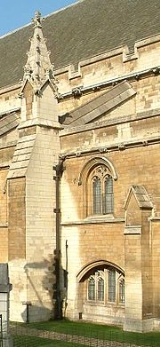
Buttress   Palace of Westminster   London   England   040404
A buttress is an architectural
Architecture

The term architecture can refer to a process, a profession or documentation.As a process, architecture is the activity of designing and construction buildings and other physical structures by a person or a computer, primarily to provide shelter....
 structure built against (a counterfort) or projecting from a wall
Wall

A wall is a usually solid structure that defines and sometimes protects an area. Most commonly, a wall delineates a building and supports its superstructure, separates space in buildings into Room s, or protects or delineates a space in the open air....
 which serves to support or reinforce the wall. Buttresses are fairly common on more ancient buildings, especially in Germany
Germany

Germany , officially the Federal Republic of Germany , is a country in Central Europe. It is bordered to the north by the North Sea, Denmark, and the Baltic Sea; to the east by Poland and the Czech Republic; to the south by Austria and Switzerland; and to the west by France, Luxembourg, Belgium, and the Netherlands....
, as a means of providing support to act against the lateral (sideways) force
Force

In physics, a force is that which can cause an object with mass to change its velocity. Force has both Euclidean_vector#Length of a vector and Direction , making it a Vector quantity....
s arising out of the roof
Roof

A roof is the covering on the uppermost part of a building. A roof protects the building and its contents from the effects of weather. Structures that require roofs range from a letter box to a cathedral or stadium, dwellings being the most numerous....
 structures that lack adequate bracing.

The word buttress, in a more general sense, means to support; one might buttress another person's arguments, for instance. By visual analogy, that which looks like a buttress may be called so; a projecting tree root at the base of the trunk, for example, may be referred to as a buttress.

Types of buttress

In architectural terms, there are at least five distinct types of buttress:

  • Clasping buttresses support two walls as they meet at a corner by making some length of both walls at the corner thicker than the remainder of the wall.
  • Angle buttresses, like clasping buttresses, support walls at the corner by building each wall out beyond the corner, so that in plan the corner in fact is a cross shape.
  • Flying buttress
    Flying buttress

    A flying buttress, or arc-boutant, is a specific type of buttress usually found on a religious building such as a cathedral. They are used to transmit the horizontal thrust of a Vault across an intervening space , to a buttress outside the building....
    es
    may be thought of as half- or semi-arch
    Arch

    An arch is a structure that Span a space while supporting weight . Arches appeared as early as the 2nd millennium BC in Mesopotamian brick architecture, but their systematic use started with the Ancient Rome who were the first to apply the technique to a wide range of structures....
    es; the elevated end of the arch supports the wall and the lower end of the arch is mounted on foundations
    Foundation (architecture)

    A foundation is a structure that transfers loads to the earth. Foundations are generally broken into two categories: shallow foundations and deep foundations....
    , or on pillar
    Column

    File:National Capitol Columns - Washington, D.C..jpgA column in structural engineering is a vertical structural element that transmits, through physical compression, the weight of the structure above to other structural elements below....
    s or other flying buttresses. Flying buttresses are especially common in medieval cathedral design.
  • Set-back buttresses support walls near a corner but set back from it.
  • Diagonal buttresses support walls at corners but are built diagonally out of the corner of the wall, so forming a 135° angle between the buttress and each wall.
  • Wall buttresses are attacdhed to walls at any interval and may be in the form of columns Engaged column
    Engaged column

    In architecture, an engaged column is a column embedded in a wall and partly projecting from the surface of the wall, sometimes defined as semi or three-quarter detached....
    s or Blind Arcades
    Blind arcade

    Blind Arcade ? is an arcade that is composed of a series of arches that has no actual openings and that is applied to the surface of a wall as a decorative element: i.e....
    .


The picture of the Palace of Westminster
Palace of Westminster

The Palace of Westminster, also known as the Houses of Parliament or Westminster Palace, in London, is where the two Houses of the Parliament of the United Kingdom meet....
 to the right, shows a buttress serving two functions; it buttresses the lower wall as an ordinary buttress; supports a flying buttress (only the top diagonal of which can be seen) which in turn supports the inset, higher of the two walls. The image below shows no less than four different buttress designs: the two featured in the top image; diagonal buttresses around the base of the statue's plinth; a plain buttress to the far right of the picture.

Flying buttress
Flying buttress

A flying buttress, or arc-boutant, is a specific type of buttress usually found on a religious building such as a cathedral. They are used to transmit the horizontal thrust of a Vault across an intervening space , to a buttress outside the building....
es deserve additional mention for the part they played in enabling Gothic
Gothic architecture

Gothic architecture is a style of architecture which flourished during the high and late Middle Ages. It evolved from Romanesque architecture and was succeeded by Renaissance architecture....
 cathedral
Cathedral

A cathedral is a Christian church that contains the seat of a bishop. It is a Religion building for worship, specifically of a denomination with an episcopal hierarchy, such as the Roman Catholic Church, Anglicanism, Orthodox Christian and some Lutheranism churches, which serves as a bishop's seat, and thus as the central church of a dioc...
s to be developed into massive and splendidly airy structures. The three elements key to the move from the older, smaller and thicker walled Romanesque architecture
Romanesque architecture

Romanesque architecture is the term that is used to describe the architecture of Middle Ages Europe which evolved into the Gothic architecture style beginning in the 12th century....
 were pointed arches, ribbed vaulted roofs and flying buttresses. These worked together to enable the construction of roofs having widths and weights greater than could be contemplated using hammer-beam roof constructions. Ribbed vaulted roofs are a form of arch extended across the floor-space to be roofed, subdivided by ribs (for instance from the four supporting pillars of a roof section) and coming together at a point, rather than continuing in a smooth semicircle as would a plain arch. Such roofs exert force down, but also out, laterally, away from their centre. These forces act on the top of the walls supporting the roof, pushing them apart; the flying buttress' design provides for an equal and opposite force to be imposed on the wall, thus keeping the wall in balance. This, firstly, enables the vaulted roof and, secondly, by externalising some of the structural elements of the wall, allows the wall so supported to be thinner, which in turn enables the development of large arched window sections to let in light and be filled by stained glass
Stained glass

For the Blackford Oakes novel, see Stained Glass The term stained glass can refer to the material of coloured glass or the craft of working with it....
.

The pier section of a flying buttresses - that part which rises vertically from the ground (or other support) - is often taller than the flying end of the buttress. The additional height provides a deadweight pressing down on the pier, the function of which is to keep the line of force being opposed by the buttress within the line of the pier. The lateral force exerted by the roof travels down through the arched section of the buttress, and into the pier. Without the additional weight of the over-height pier, the line of force would exit the pier at some point way above the ground; if it did so, the pier would be unable to resist the force and so would collapse at that point. Combining the two force vectors, both from the roof and from the deadweight, keeps the line of force within the masonry of the pier.

In more modern buildings, better internal bracing of structures arising out of a more well-developed understanding of structural engineering diminishes the use of buttresses; however they are by no means obsolete, and will continue to be found as integral parts of certain structures, not least in certain designs of free standing curtain and retaining walls.

Gallery