

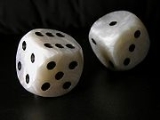
Dice

Encyclopedia
A die is a small throwable object with multiple resting positions, used for generating random numbers
. This makes dice suitable as gambling
devices for games like craps
, or for use in non-gambling tabletop game
s.
A traditional die is an often rounded cube, with each of its six faces showing a different number from 1-6. The design as a whole is aimed at the die providing a randomly determined integer
from one to six, each of those values being equally likely. A variety of similar devices are also described as dice; such specialized dice may have polyhedral or irregular shapes and may have faces marked with symbols instead of numbers. They may be used to produce results other than one through six. Loaded and crooked dice are designed to favor some results over others for purposes of cheating
or amusement.
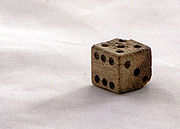
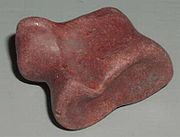
 Dice have been used throughout Asia since before recorded history; the oldest known dice were excavated as part of a 5000-year-old backgammon
set at the Burnt City, an archeological site in south-eastern Iran
. Other excavations from ancient tombs in the Indus Valley civilization
indicate a South Asia
n origin. Dicing is mentioned as an Indian
game in the Rigveda
, Atharvaveda
and Buddha games list
; it also plays a critical role in the great Hindu
epic Mahabharata
, where Yudhisthira
plays a game of dice against the Kauravas for the northern kingdom of Hastinapura
, which becomes the trigger for a war. There are several biblical
references to "casting lots", as in Psalm
22, indicating that dicing was commonplace in the region during King David's reign. Knucklebones was a skill game
played by women and children; a derivative form had the four sides of the bone receive different values and count as modern dice. Gambling with two or three dice was a very popular form of amusement in Greece
, especially with the upper classes, and an invariable accompaniment to symposia
.
Dice were originally made from the talus
of hoofed animals, colloquially known as "knucklebones
". These are approximately tetrahedral, giving the term "bones" used for dice. Modern Mongolia
ns still use such bones as shagai
, for games and fortunetelling. Besides bone, materials like ivory
, wood and recently plastic
s like cellulose acetate
have been used. Dice are hard to differentiate from knucklebones because ancient writers confused the two, but both were used in prehistoric times.
The Romans
were passionate gamblers, especially at the peak of the Roman Empire
, and dicing was common though forbidden except during the Saturnalia
. Horace
derided what he thought as a typical youth of the period, who wasted time on dicing instead of horse
-chasing. Throwing dice for money was the cause of many special laws in Rome; one of these stated that no lawsuit
could be filed by a person who allowed gambling in his house, even if he had been cheated or assaulted. Professional gamblers were common; some of their loaded dice are preserved in museum
s. The public houses were the resorts of gamblers, and fresco
s exist showing two quarrelling dicers being ejected by the host. Twenty-sided dice date back to the 2nd century AD.
Tacitus stated that the Germans were passionately fond of dicing, so much that they would stake their personal liberty when bankrupt. During the Middle Ages, dicing became the favorite pastime of the knight
s, with dicing schools and guilds. After the downfall of feudalism
, the landsknecht
s established a reputation as the most notorious dicing gamblers of their time; many of the dice then were curiously carved in the images of men and beasts. In France, dicing was played by both knights and ladies, despite repeated legislation, including interdictions on the part of St. Louis
in 1254 and 1256. The markings on Chinese dominoes
evolved from the markings on dice.
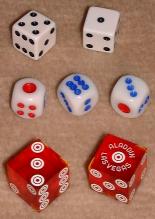 Common dice are small cubes most commonly 1.6 cm across, whose faces are numbered from one to six, usually by patterns of round dots called pips. Traditionally, opposite sides of a die add up to seven, implying that the 1, 2 and 3 faces share a vertex; these faces may be placed clockwise or counterclockwise about this vertex. If the 1, 2 and 3 faces run counterclockwise, the die is called right-handed and vice versa. Western dice are normally right-handed and Chinese dice are normally left-handed.
The pips on dice are arranged in specific patterns as shown in the picture to the left. Asian style dice bear similar patterns to Western ones, but the pips are closer to the centre of the face; the one's pip is larger than the others, with that and the four's pips coloured red. In some older sets, the "one" pip is a colorless depression. It is suggested that an entirely black and white color combination on the one's and four's sides would be unlucky; red, a lucky color in Chinese culture, would counteract this. The word for four in Chinese is a homophone
of the word for death and is considered unlucky; it is probable that red fours are of Indian origin.
The result of a die roll is determined by the way it is thrown, according to the laws of classical mechanics
; they are made random by uncertainty due to factors like movements in the thrower's hand. Thus, they are a type of hardware random number generator
. Some people claim that the pips on the faces of certain styles of dice cause a small bias, but there is no research to support this claim; this is reduced somewhat in the Asian die with its oversized single pip. Casino dice have flush markings, offering the assurance that this brings them very close to providing true uniformly distributed random numbers.
Dice are thrown, singly or in groups, from the hand or from a container designed for this, onto a flat surface; the face of the die that is uppermost when it comes to rest provides the value of the throw. A typical dice game today is craps
, where two dice are thrown at a time and wagers are made on the total value of the two dice. Dice are frequently used to randomize moves in board game
s, usually by deciding the distance through which a piece will move along the board; examples of this are backgammon
and Monopoly
.
Clones of board games must use computer generated dice; the values are usually determined by a pseudorandom number generator
, then displayed as a visual representation of a die. The reverse is also possible, with bar coded dice shuffling as a source of true random data for computers.
process. The pips or numbers on the dice are a part of the mold. The coloring for numbering is achieved by submersing the dice entirely in paint, which is allowed to dry and then polished via a tumble finishing process, similar to rock polishing. The abrasive agent scrapes off all of the paint except for the indents of the numbering. A finer abrasive is then used to polish the die. This process also creates the smoother, rounded edges on the dice.
as the material used for the dice, such that the dice are as close to perfectly cubical as possible. All such dice are stamped with a serial number to prevent potential cheaters from substituting a die. Precision backgammon
dice are made the same way; they tend to be slightly smaller and have rounded corners and edges, to allow better movement inside the dice cup and stop forceful rolls from damaging the playing surface.
, deuce, trey, cater, cinque and sice have been made obsolete by one to six, they are still used by some professional gamblers to designate different sides of the dice. Ace is from the Latin as, meaning "a unit"; the others are 2 to 6 in old French.
drop in a reservoir at the center, with a capillary tube
leading to another reservoir at a side; the load is activated by tapping the die so that the mercury travels to the side.
Another type of loaded die is hollow with a small weight and a semi-solid substance inside whose melting point
is just lower than the temperature of the human body, allowing the cheater to change the loading of the die by applying body heat, causing the semi-solid to melt and the weight to drift down, making the chosen opposite face more likely to land up. A less common type of loaded die can be made by inserting a magnet into the die and embedding a coil of wire in the game table; running current through the coil increases the likelihood of a certain side landing on the bottom, depending on the direction of the current. Transparent acetate
dice, used in all reputable casinos, are harder to tamper with than other dice.
before playing.
, directions for Warhammer Fantasy Battle
, and instructions for sexual acts using sex dice
.

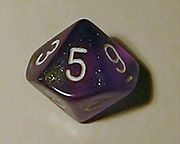 Seven- and eight-sided dice are stated in the 13th century Libro de los juegos
to have been invented by Alfonso X
in order to speed up play in chess variants. Around the early 1950s, such non-cubical dice became popular among players of wargames
, and since have been employed extensively in RPGs
and TCGs. Although these are relative novelties now, ancient cultures appear to have used them in games, as evidenced by the discovery of two icosahedral dice dating from ancient Rome
, currently on display in the British Museum
. Reciprocally symmetric numerals are distinguished with a dot or by being underlined.
The Platonic solid
s are the most common non-cubical dice; these can make for 4
, 8
, 12, and 20
faces. The only other common non-cubical die is the 10-sided die
. More uncommon dice include 3, 5, 7, 14, 16, 18, 30, 50, and the 100 sided Zocchihedron
. Using these dice in various ways, like 10-sided dice in pairs to produce a uniform distribution of random percentages and summing multiple dice to produce approximations to normal distributions, games can closely approximate the real probability distributions of the events they simulate. The tetrahedral die is marked with three numbers such that when it settles, the numbers at the vertex pointing up are the same and the one counted.
The zocchihedron
, invented by Lou Zocchi
, is a 100-sided die that can be found in hobby and game stores, and is used in narrative role-playing games like Dungeons & Dragons
. This, unlike other dice, is not a true polyhedron; it is made by flattening 100 facets on a sphere and is typically filled with small plastic objects to dampen the die's momentum when rolled. Since it is equivalent to a pair of ten-sided dice, it is rarely seen and is generally more of a novelty item.
s, and optionally the pentagonal trapezohedron
, whose faces are ten kites
, each with two different edge lengths and three different angles; the die's vertices also are of two different kinds.
Normally, the faces on a die will be numbered sequentially beginning with 1, and opposite faces will thus add up to one more than the number of faces (but in the case of the d4 and dice with an odd-number of faces, this is simply not possible). Some dice, such as d10, are usually numbered sequentially beginning with 0, in which case the opposite faces will add to one less than the number of faces.
The full geometric set of "uniform fair dice" (face-transitive) are:
.svg.png) For a single roll of a fair s-sided die, the probability of rolling each value is exactly 1/s; this is an example of a discrete uniform distribution.
For a single roll of a fair s-sided die, the probability of rolling each value is exactly 1/s; this is an example of a discrete uniform distribution.
For n multiple rolls, with a s-sided die the possibility space
is equal to s^n. So, for n rolls of an s-sided die the probability of any result is 1/s^n.
However, if we are rolling two dice and adding the result together, as in the game craps
, the total is distributed in a triangular curve (approaching the normal distribution); the case for common dice follows:
As the number of dice increases, the distribution tends to normal distribution by the central limit theorem
; the exact value of a sum of n s-sided dice, k, is

where Fs,1(k) = 1/s for 1 ≤ k ≤ s and 0 otherwise.
A faster algorithm would adapt the exponentiation by squaring
algorithm:
 .
.
In the triangular curve described above,

Equivalently, the probability can be calculated using combinations
:

The probability of rolling an exact sequence of numbers is 1/sn.
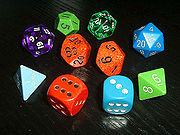 The fantasy role-playing game Dungeons & Dragons
(D&D) is largely credited with popularizing dice in such games. Some games use only one type, like Exalted
which uses only ten-sided dice. Others use numerous types for different game purposes, such as D&D, which makes use of all common polyhedral dice.
Dice are used to determine the outcome of events; such usage is called a check. Games typically determine results either as a total on one or more dice above or below a fixed number, or a certain number of rolls above a certain number on one or more dice. Due to circumstances or character skill, the initial roll may have a number added to or subtracted from the final result, or have the player roll extra or fewer dice. To keep track of rolls easily, dice notation
is frequently used.
A common special case is percentile rolls, referred to as
are large, almost spherical, and difficult to read, percentile rolls are instead handled by rolling two ten-sided dice together, using one as the "tens" and the other as the "units". A roll of ten or zero on either die is taken as a zero, unless both are zeros or tens, in which case this is 100. Some sets of percentile dice explicitly mark one die in tens and the other in units to avoid ambiguity.
Dice for role-playing games are usually plastic; early polyhedral dice from the 1970s and 1980s were made of a soft plastic that would easily wear as the die was used, and wear would gradually render the die unusable. Many early dice were unmarked, and players took great care in painting them. Some twenty-sided dice then were numbered zero through nine twice; half of the numbers had to be painted a contrasting color to differentiate faces. These could double as a ten-sided die by ignoring the distinguishing coloring.
. A pair of common dice is usual, though other forms of polyhedra can be used. Tibetan Buddhists sometimes use this method of divination. It is highly likely that the Pythagoreans used the Platonic solids as dice; they referred to such dice as "the dice of the gods" and they sought to understand the universe through an understanding of geometry in polyhedra.
Astrological dice are a specialized set of three 12-sided dice for divination; the first die represents planets, the Sun, the Moon, and the nodes
of the Moon; the second die represents the 12 zodiac signs; and the third represents the 12 houses. An icosahedron provides the answers of the Magic 8-Ball
, conventionally used to provide advice on yes-or-no questions.
Statistical randomness
A numeric sequence is said to be statistically random when it contains no recognizable patterns or regularities; sequences such as the results of an ideal dice roll, or the digits of π exhibit statistical randomness....
. This makes dice suitable as gambling
Gambling
Gambling is the wagering of money or something of material value on an event with an uncertain outcome with the primary intent of winning additional money and/or material goods...
devices for games like craps
Craps
Craps is a dice game in which players place wagers on the outcome of the roll, or a series of rolls, of a pair of dice. Players may wager money against each other or a bank...
, or for use in non-gambling tabletop game
Tabletop game
Tabletop game is a general term used to refer to board games, card games, dice games, miniatures wargames, tile-based games and other games that are normally played on a table or other flat surface...
s.
A traditional die is an often rounded cube, with each of its six faces showing a different number from 1-6. The design as a whole is aimed at the die providing a randomly determined integer
Integer
The integers are formed by the natural numbers together with the negatives of the non-zero natural numbers .They are known as Positive and Negative Integers respectively...
from one to six, each of those values being equally likely. A variety of similar devices are also described as dice; such specialized dice may have polyhedral or irregular shapes and may have faces marked with symbols instead of numbers. They may be used to produce results other than one through six. Loaded and crooked dice are designed to favor some results over others for purposes of cheating
Cheating
Cheating refers to the breaking of rules to gain advantage in a competitive situation. The rules infringed may be explicit, or they may be from an unwritten code of conduct based on morality, ethics or custom, making the identification of cheating a subjective process. Cheating can refer...
or amusement.
History
Backgammon
Backgammon is one of the oldest board games for two players. The playing pieces are moved according to the roll of dice, and players win by removing all of their pieces from the board. There are many variants of backgammon, most of which share common traits...
set at the Burnt City, an archeological site in south-eastern Iran
Iran
Iran , officially the Islamic Republic of Iran , is a country in Southern and Western Asia. The name "Iran" has been in use natively since the Sassanian era and came into use internationally in 1935, before which the country was known to the Western world as Persia...
. Other excavations from ancient tombs in the Indus Valley civilization
Indus Valley Civilization
The Indus Valley Civilization was a Bronze Age civilization that was located in the northwestern region of the Indian subcontinent, consisting of what is now mainly modern-day Pakistan and northwest India...
indicate a South Asia
South Asia
South Asia, also known as Southern Asia, is the southern region of the Asian continent, which comprises the sub-Himalayan countries and, for some authorities , also includes the adjoining countries to the west and the east...
n origin. Dicing is mentioned as an Indian
History of India
The history of India begins with evidence of human activity of Homo sapiens as long as 75,000 years ago, or with earlier hominids including Homo erectus from about 500,000 years ago. The Indus Valley Civilization, which spread and flourished in the northwestern part of the Indian subcontinent from...
game in the Rigveda
Rigveda
The Rigveda is an ancient Indian sacred collection of Vedic Sanskrit hymns...
, Atharvaveda
Atharvaveda
The Atharvaveda is a sacred text of Hinduism and one of the four Vedas, often called the "fourth Veda"....
and Buddha games list
Buddha games list
The Buddha games list is a list of games which it is reputed that Gautama Buddha said that he would not play. As such it dates back to the 6th or 5th century BC and is the earliest known list of games....
; it also plays a critical role in the great Hindu
Hindu
Hindu refers to an identity associated with the philosophical, religious and cultural systems that are indigenous to the Indian subcontinent. As used in the Constitution of India, the word "Hindu" is also attributed to all persons professing any Indian religion...
epic Mahabharata
Mahabharata
The Mahabharata is one of the two major Sanskrit epics of ancient India and Nepal, the other being the Ramayana. The epic is part of itihasa....
, where Yudhisthira
Yudhisthira
In the great Hindu epic Mahabharata, Yudhisthira , the eldest son of King Pandu and Queen Kunti, was king of Indraprastha and later of Hastinapura. He was the leader of the Pandava side in the Kurukshetra War...
plays a game of dice against the Kauravas for the northern kingdom of Hastinapura
Hastinapura
Hastinapur is a town and a nagar panchayat in Meerut district in the Indian state of Uttar Pradesh.-History:Hastinapur was the capital of the kingdom of the Kauravas, belonging to the Kuru dynasty of kings. The throne of this city was the prize over which the Kurukshetra War of the epic...
, which becomes the trigger for a war. There are several biblical
Bible
The Bible refers to any one of the collections of the primary religious texts of Judaism and Christianity. There is no common version of the Bible, as the individual books , their contents and their order vary among denominations...
references to "casting lots", as in Psalm
Psalms
The Book of Psalms , commonly referred to simply as Psalms, is a book of the Hebrew Bible and the Christian Bible...
22, indicating that dicing was commonplace in the region during King David's reign. Knucklebones was a skill game
Game of skill
A game of skill is a game where the outcome is determined mainly by mental and/or physical skill, rather than by pure chance.One benefit of games of skill is that they are a means of exploring one's own capabilities. Games encourage the player to look at, understand, and experience things...
played by women and children; a derivative form had the four sides of the bone receive different values and count as modern dice. Gambling with two or three dice was a very popular form of amusement in Greece
Greece
Greece , officially the Hellenic Republic , and historically Hellas or the Republic of Greece in English, is a country in southeastern Europe....
, especially with the upper classes, and an invariable accompaniment to symposia
Symposium
In ancient Greece, the symposium was a drinking party. Literary works that describe or take place at a symposium include two Socratic dialogues, Plato's Symposium and Xenophon's Symposium, as well as a number of Greek poems such as the elegies of Theognis of Megara...
.
Dice were originally made from the talus
Talus
Talus may refer to:* Talus , a sloped portion of a fortified wall* Talus, California, a community in Inyo County* Talus bone, an ankle bone* Talus, fictional planet in Star Wars...
of hoofed animals, colloquially known as "knucklebones
Knucklebones
Knucklebones also known as astragaloi, hucklebones, dibs, dibstones, jackstones, chuckstones or five-stones, is a game of very ancient origin, played with five small objects, originally the "knucklebones" of a sheep, which are thrown up and caught in various ways...
". These are approximately tetrahedral, giving the term "bones" used for dice. Modern Mongolia
Mongolia
Mongolia is a landlocked country in East and Central Asia. It is bordered by Russia to the north and China to the south, east and west. Although Mongolia does not share a border with Kazakhstan, its western-most point is only from Kazakhstan's eastern tip. Ulan Bator, the capital and largest...
ns still use such bones as shagai
Shagai
Shagai , chükö , asyk/ashyk/oshuq refers to the astragalus of the ankle of a sheep or goat. The bones are collected and used for traditional games and fortunetelling throughout Central Asia, and games involving the ankle bones may also be referred to by the name of the bones. They may be painted...
, for games and fortunetelling. Besides bone, materials like ivory
Ivory
Ivory is a term for dentine, which constitutes the bulk of the teeth and tusks of animals, when used as a material for art or manufacturing. Ivory has been important since ancient times for making a range of items, from ivory carvings to false teeth, fans, dominoes, joint tubes, piano keys and...
, wood and recently plastic
Plastic
A plastic material is any of a wide range of synthetic or semi-synthetic organic solids used in the manufacture of industrial products. Plastics are typically polymers of high molecular mass, and may contain other substances to improve performance and/or reduce production costs...
s like cellulose acetate
Cellulose acetate
Cellulose acetate , first prepared in 1865, is the acetate ester of cellulose. Cellulose acetate is used as a film base in photography, as a component in some adhesives, and as a frame material for eyeglasses; it is also used as a synthetic fiber and in the manufacture of cigarette filters and...
have been used. Dice are hard to differentiate from knucklebones because ancient writers confused the two, but both were used in prehistoric times.
The Romans
Culture of ancient Rome
Ancient Roman culture existed throughout the almost 1200-year history of the civilization of Ancient Rome. The term refers to the culture of the Roman Republic, later the Roman Empire, which, at its peak, covered an area from Lowland Scotland and Morocco to the Euphrates.Life in ancient Rome...
were passionate gamblers, especially at the peak of the Roman Empire
Roman Empire
The Roman Empire was the post-Republican period of the ancient Roman civilization, characterised by an autocratic form of government and large territorial holdings in Europe and around the Mediterranean....
, and dicing was common though forbidden except during the Saturnalia
Saturnalia
Saturnalia is an Ancient Roman festival/ celebration held in honour of Saturn , the youngest of the Titans, father of the major gods of the Greeks and Romans, and son of Uranus and Gaia...
. Horace
Horace
Quintus Horatius Flaccus , known in the English-speaking world as Horace, was the leading Roman lyric poet during the time of Augustus.-Life:...
derided what he thought as a typical youth of the period, who wasted time on dicing instead of horse
Horse
The horse is one of two extant subspecies of Equus ferus, or the wild horse. It is a single-hooved mammal belonging to the taxonomic family Equidae. The horse has evolved over the past 45 to 55 million years from a small multi-toed creature into the large, single-toed animal of today...
-chasing. Throwing dice for money was the cause of many special laws in Rome; one of these stated that no lawsuit
Lawsuit
A lawsuit or "suit in law" is a civil action brought in a court of law in which a plaintiff, a party who claims to have incurred loss as a result of a defendant's actions, demands a legal or equitable remedy. The defendant is required to respond to the plaintiff's complaint...
could be filed by a person who allowed gambling in his house, even if he had been cheated or assaulted. Professional gamblers were common; some of their loaded dice are preserved in museum
Museum
A museum is an institution that cares for a collection of artifacts and other objects of scientific, artistic, cultural, or historical importance and makes them available for public viewing through exhibits that may be permanent or temporary. Most large museums are located in major cities...
s. The public houses were the resorts of gamblers, and fresco
Fresco
Fresco is any of several related mural painting types, executed on plaster on walls or ceilings. The word fresco comes from the Greek word affresca which derives from the Latin word for "fresh". Frescoes first developed in the ancient world and continued to be popular through the Renaissance...
s exist showing two quarrelling dicers being ejected by the host. Twenty-sided dice date back to the 2nd century AD.
Tacitus stated that the Germans were passionately fond of dicing, so much that they would stake their personal liberty when bankrupt. During the Middle Ages, dicing became the favorite pastime of the knight
Knight
A knight was a member of a class of lower nobility in the High Middle Ages.By the Late Middle Ages, the rank had become associated with the ideals of chivalry, a code of conduct for the perfect courtly Christian warrior....
s, with dicing schools and guilds. After the downfall of feudalism
Feudalism
Feudalism was a set of legal and military customs in medieval Europe that flourished between the 9th and 15th centuries, which, broadly defined, was a system for ordering society around relationships derived from the holding of land in exchange for service or labour.Although derived from the...
, the landsknecht
Landsknecht
Landsknechte were European, predominantly German mercenary pikemen and supporting foot soldiers from the late 15th to the late 16th century, and achieved the reputation for being the universal mercenary of Early modern Europe.-Etymology:The term is from German, Land "land, country" + Knecht...
s established a reputation as the most notorious dicing gamblers of their time; many of the dice then were curiously carved in the images of men and beasts. In France, dicing was played by both knights and ladies, despite repeated legislation, including interdictions on the part of St. Louis
Louis IX of France
Louis IX , commonly Saint Louis, was King of France from 1226 until his death. He was also styled Louis II, Count of Artois from 1226 to 1237. Born at Poissy, near Paris, he was an eighth-generation descendant of Hugh Capet, and thus a member of the House of Capet, and the son of Louis VIII and...
in 1254 and 1256. The markings on Chinese dominoes
Chinese dominoes
Chinese dominoes are used in several tile-based games, namely, Tien Gow, Pai Gow, Che Deng, Tiu U and Kap Tai Shap. In Cantonese they are called 骨牌 "Gwat Pai", which literally means "bone tiles", it is also the name of a northern Chinese game, where the rules are quite different from the southern...
evolved from the markings on dice.
Construction
The pips on dice are arranged in specific patterns as shown in the picture to the left. Asian style dice bear similar patterns to Western ones, but the pips are closer to the centre of the face; the one's pip is larger than the others, with that and the four's pips coloured red. In some older sets, the "one" pip is a colorless depression. It is suggested that an entirely black and white color combination on the one's and four's sides would be unlucky; red, a lucky color in Chinese culture, would counteract this. The word for four in Chinese is a homophone
Homophone
A homophone is a word that is pronounced the same as another word but differs in meaning. The words may be spelled the same, such as rose and rose , or differently, such as carat, caret, and carrot, or to, two, and too. Homophones that are spelled the same are also both homographs and homonyms...
of the word for death and is considered unlucky; it is probable that red fours are of Indian origin.
The result of a die roll is determined by the way it is thrown, according to the laws of classical mechanics
Classical mechanics
In physics, classical mechanics is one of the two major sub-fields of mechanics, which is concerned with the set of physical laws describing the motion of bodies under the action of a system of forces...
; they are made random by uncertainty due to factors like movements in the thrower's hand. Thus, they are a type of hardware random number generator
Hardware random number generator
In computing, a hardware random number generator is an apparatus that generates random numbers from a physical process. Such devices are often based on microscopic phenomena that generate a low-level, statistically random "noise" signal, such as thermal noise or the photoelectric effect or other...
. Some people claim that the pips on the faces of certain styles of dice cause a small bias, but there is no research to support this claim; this is reduced somewhat in the Asian die with its oversized single pip. Casino dice have flush markings, offering the assurance that this brings them very close to providing true uniformly distributed random numbers.
Dice are thrown, singly or in groups, from the hand or from a container designed for this, onto a flat surface; the face of the die that is uppermost when it comes to rest provides the value of the throw. A typical dice game today is craps
Craps
Craps is a dice game in which players place wagers on the outcome of the roll, or a series of rolls, of a pair of dice. Players may wager money against each other or a bank...
, where two dice are thrown at a time and wagers are made on the total value of the two dice. Dice are frequently used to randomize moves in board game
Board game
A board game is a game which involves counters or pieces being moved on a pre-marked surface or "board", according to a set of rules. Games may be based on pure strategy, chance or a mixture of the two, and usually have a goal which a player aims to achieve...
s, usually by deciding the distance through which a piece will move along the board; examples of this are backgammon
Backgammon
Backgammon is one of the oldest board games for two players. The playing pieces are moved according to the roll of dice, and players win by removing all of their pieces from the board. There are many variants of backgammon, most of which share common traits...
and Monopoly
Monopoly (game)
Marvin Gardens, the leading yellow property on the board shown, is actually a misspelling of the original location name, Marven Gardens. The misspelling was said to be introduced by Charles Todd and passed on when his home-made Monopoly board was copied by Charles Darrow and thence to Parker...
.
Clones of board games must use computer generated dice; the values are usually determined by a pseudorandom number generator
Pseudorandom number generator
A pseudorandom number generator , also known as a deterministic random bit generator , is an algorithm for generating a sequence of numbers that approximates the properties of random numbers...
, then displayed as a visual representation of a die. The reverse is also possible, with bar coded dice shuffling as a source of true random data for computers.
Manufacturing
Non-precision dice are manufactured via the plastic injection moldingInjection molding
Injection molding is a manufacturing process for producing parts from both thermoplastic and thermosetting plastic materials. Material is fed into a heated barrel, mixed, and forced into a mold cavity where it cools and hardens to the configuration of the cavity...
process. The pips or numbers on the dice are a part of the mold. The coloring for numbering is achieved by submersing the dice entirely in paint, which is allowed to dry and then polished via a tumble finishing process, similar to rock polishing. The abrasive agent scrapes off all of the paint except for the indents of the numbering. A finer abrasive is then used to polish the die. This process also creates the smoother, rounded edges on the dice.
Precision dice
Precision casino dice may have a polished or sand finish, making them transparent or translucent respectively. Casino dice have their pips drilled, then filled flush with a paint of the same densityDensity
The mass density or density of a material is defined as its mass per unit volume. The symbol most often used for density is ρ . In some cases , density is also defined as its weight per unit volume; although, this quantity is more properly called specific weight...
as the material used for the dice, such that the dice are as close to perfectly cubical as possible. All such dice are stamped with a serial number to prevent potential cheaters from substituting a die. Precision backgammon
Backgammon
Backgammon is one of the oldest board games for two players. The playing pieces are moved according to the roll of dice, and players win by removing all of their pieces from the board. There are many variants of backgammon, most of which share common traits...
dice are made the same way; they tend to be slightly smaller and have rounded corners and edges, to allow better movement inside the dice cup and stop forceful rolls from damaging the playing surface.
Terms
While the terms aceAce
An ace is a playing card. In the standard French deck, an ace has a single suit symbol located in the middle of the card, sometimes large and decorated, especially in the case of the Ace of Spades...
, deuce, trey, cater, cinque and sice have been made obsolete by one to six, they are still used by some professional gamblers to designate different sides of the dice. Ace is from the Latin as, meaning "a unit"; the others are 2 to 6 in old French.
Notation
In many gaming contexts, especially tabletop RPGs, the count and number of sides of dice to be rolled at any given time is reduced to a common set of notations; typically these involve the letter "d" for dice. Hence,6d8 means six eight-sided dice and 2d6 two common dice. Various arithmetic operations are often added at the end; 3d6+4 is three six-sided dice plus four to the outcome.Loaded dice
A loaded, weighted or crooked die is one that has been tampered with to land with a specific side facing upwards more often than it normally would. There are several methods for creating loaded dice; these include round and off-square faces and (if not transparent) weights. Tappers have a mercuryMercury (element)
Mercury is a chemical element with the symbol Hg and atomic number 80. It is also known as quicksilver or hydrargyrum...
drop in a reservoir at the center, with a capillary tube
Capillary action
Capillary action, or capilarity, is the ability of a liquid to flow against gravity where liquid spontanously rise in a narrow space such as between the hair of a paint-brush, in a thin tube, or in porous material such as paper or in some non-porous material such as liquified carbon fiber, or in a...
leading to another reservoir at a side; the load is activated by tapping the die so that the mercury travels to the side.
Another type of loaded die is hollow with a small weight and a semi-solid substance inside whose melting point
Melting point
The melting point of a solid is the temperature at which it changes state from solid to liquid. At the melting point the solid and liquid phase exist in equilibrium. The melting point of a substance depends on pressure and is usually specified at standard atmospheric pressure...
is just lower than the temperature of the human body, allowing the cheater to change the loading of the die by applying body heat, causing the semi-solid to melt and the weight to drift down, making the chosen opposite face more likely to land up. A less common type of loaded die can be made by inserting a magnet into the die and embedding a coil of wire in the game table; running current through the coil increases the likelihood of a certain side landing on the bottom, depending on the direction of the current. Transparent acetate
Acetate
An acetate is a derivative of acetic acid. This term includes salts and esters, as well as the anion found in solution. Most of the approximately 5 billion kilograms of acetic acid produced annually in industry are used in the production of acetates, which usually take the form of polymers. In...
dice, used in all reputable casinos, are harder to tamper with than other dice.
Shaved dice
A die may be shaved on one side, making it slightly shorter in one dimension, thus affecting its outcome. One countermeasure employed by casinos against shaved dice is to measure the dice with a micrometerMicrometer
A micrometer , sometimes known as a micrometer screw gauge, is a device incorporating a calibrated screw used widely for precise measurement of small distances in mechanical engineering and machining as well as most mechanical trades, along with other metrological instruments such as dial, vernier,...
before playing.
Dice with faces other than digit sequences
The faces of most dice are labelled using sequences of whole numbers, usually starting at one, expressed with either pips or digits. However, there are some applications that require results other than numbers. Examples include letters for BoggleBoggle
Boggle is a word game designed by Allan Turoff and trademarked by Parker Brothers, a division of Hasbro. The game is played using a plastic grid of lettered dice, in which players attempt to find words in sequences of adjacent letters.-Rules:...
, directions for Warhammer Fantasy Battle
Warhammer Fantasy Battle
Warhammer: The Game of Fantasy Battles is a tabletop wargame created by Games Workshop. It is the origin of the Warhammer Fantasy setting....
, and instructions for sexual acts using sex dice
Sex dice
Sex dice is a dice game intended to heighten the sexual atmosphere and promote foreplay. Instead of numbers, each face on the die contains the name of a body part; the body part that faces up when the die is rolled must then be given sexual attention...
.
Non-cubic dice
Libro de los juegos
The Libro de los Juegos, , or Libro de acedrex, dados e tablas, was commissioned by Alfonso X of Castile, Galicia and León and completed in his scriptorium in Toledo in 1283, is an exemplary piece of Alfonso’s medieval literary legacy.Consisting of ninety-seven leaves of parchment, many with color...
to have been invented by Alfonso X
Alfonso X of Castile
Alfonso X was a Castilian monarch who ruled as the King of Castile, León and Galicia from 1252 until his death...
in order to speed up play in chess variants. Around the early 1950s, such non-cubical dice became popular among players of wargames
Wargaming
A wargame is a strategy game that deals with military operations of various types, real or fictional. Wargaming is the hobby dedicated to the play of such games, which can also be called conflict simulations, or consims for short. When used professionally to study warfare, it is generally known as...
, and since have been employed extensively in RPGs
Role-playing game
A role-playing game is a game in which players assume the roles of characters in a fictional setting. Players take responsibility for acting out these roles within a narrative, either through literal acting, or through a process of structured decision-making or character development...
and TCGs. Although these are relative novelties now, ancient cultures appear to have used them in games, as evidenced by the discovery of two icosahedral dice dating from ancient Rome
Ancient Rome
Ancient Rome was a thriving civilization that grew on the Italian Peninsula as early as the 8th century BC. Located along the Mediterranean Sea and centered on the city of Rome, it expanded to one of the largest empires in the ancient world....
, currently on display in the British Museum
British Museum
The British Museum is a museum of human history and culture in London. Its collections, which number more than seven million objects, are amongst the largest and most comprehensive in the world and originate from all continents, illustrating and documenting the story of human culture from its...
. Reciprocally symmetric numerals are distinguished with a dot or by being underlined.
The Platonic solid
Platonic solid
In geometry, a Platonic solid is a convex polyhedron that is regular, in the sense of a regular polygon. Specifically, the faces of a Platonic solid are congruent regular polygons, with the same number of faces meeting at each vertex; thus, all its edges are congruent, as are its vertices and...
s are the most common non-cubical dice; these can make for 4
Tetrahedron
In geometry, a tetrahedron is a polyhedron composed of four triangular faces, three of which meet at each vertex. A regular tetrahedron is one in which the four triangles are regular, or "equilateral", and is one of the Platonic solids...
, 8
Octahedron
In geometry, an octahedron is a polyhedron with eight faces. A regular octahedron is a Platonic solid composed of eight equilateral triangles, four of which meet at each vertex....
, 12, and 20
Icosahedron
In geometry, an icosahedron is a regular polyhedron with 20 identical equilateral triangular faces, 30 edges and 12 vertices. It is one of the five Platonic solids....
faces. The only other common non-cubical die is the 10-sided die
Pentagonal trapezohedron
The pentagonal trapezohedron or deltohedron is the third in an infinite series of face-transitive polyhedra which are dual polyhedra to the antiprisms. It has ten faces which are congruent kites....
. More uncommon dice include 3, 5, 7, 14, 16, 18, 30, 50, and the 100 sided Zocchihedron
Zocchihedron
Zocchihedron is the trademark of a 100-sided die invented by Lou Zocchi, which debuted in 1985. Rather than being a polyhedron, it is more like a ball with 100 flattened planes...
. Using these dice in various ways, like 10-sided dice in pairs to produce a uniform distribution of random percentages and summing multiple dice to produce approximations to normal distributions, games can closely approximate the real probability distributions of the events they simulate. The tetrahedral die is marked with three numbers such that when it settles, the numbers at the vertex pointing up are the same and the one counted.
The zocchihedron
Zocchihedron
Zocchihedron is the trademark of a 100-sided die invented by Lou Zocchi, which debuted in 1985. Rather than being a polyhedron, it is more like a ball with 100 flattened planes...
, invented by Lou Zocchi
Lou Zocchi
Louis Zocchi, Sergeant, USAF , is a gaming hobbyist, former game distributor and publisher, and maker and seller of polyhedral game dice....
, is a 100-sided die that can be found in hobby and game stores, and is used in narrative role-playing games like Dungeons & Dragons
Dungeons & Dragons
Dungeons & Dragons is a fantasy role-playing game originally designed by Gary Gygax and Dave Arneson, and first published in 1974 by Tactical Studies Rules, Inc. . The game has been published by Wizards of the Coast since 1997...
. This, unlike other dice, is not a true polyhedron; it is made by flattening 100 facets on a sphere and is typically filled with small plastic objects to dampen the die's momentum when rolled. Since it is equivalent to a pair of ten-sided dice, it is rarely seen and is generally more of a novelty item.
Standard variations
Dice are often sold in sets, matching in color, of five or six different shapes: the five Platonic solids, whose faces are regular polygonRegular polygon
A regular polygon is a polygon that is equiangular and equilateral . Regular polygons may be convex or star.-General properties:...
s, and optionally the pentagonal trapezohedron
Trapezohedron
The n-gonal trapezohedron, antidipyramid or deltohedron is the dual polyhedron of an n-gonal antiprism. Its 2n faces are congruent kites . The faces are symmetrically staggered.The n-gon part of the name does not reference the faces here but arrangement of vertices around an axis of symmetry...
, whose faces are ten kites
Kite (geometry)
In Euclidean geometry a kite is a quadrilateral whose four sides can be grouped into two pairs of equal-length sides that are next to each other. In contrast, a parallelogram also has two pairs of equal-length sides, but they are opposite each other rather than next to each other...
, each with two different edge lengths and three different angles; the die's vertices also are of two different kinds.
Normally, the faces on a die will be numbered sequentially beginning with 1, and opposite faces will thus add up to one more than the number of faces (but in the case of the d4 and dice with an odd-number of faces, this is simply not possible). Some dice, such as d10, are usually numbered sequentially beginning with 0, in which case the opposite faces will add to one less than the number of faces.
| Sides | Shape | Notes | |
|---|---|---|---|
| 4 | tetrahedron Tetrahedron In geometry, a tetrahedron is a polyhedron composed of four triangular faces, three of which meet at each vertex. A regular tetrahedron is one in which the four triangles are regular, or "equilateral", and is one of the Platonic solids... |
 |
Each face has three numbers: they are arranged such that the upright number (which counts) is the same on all three visible faces. Alternatively, all of the sides have the same number in the lowest edge and no number on the top. This die does not roll well and thus it is usually thrown into the air instead. |
| 6 | cube |  |
A common die. The sum of the numbers on opposite faces is seven. |
| 8 | octahedron Octahedron In geometry, an octahedron is a polyhedron with eight faces. A regular octahedron is a Platonic solid composed of eight equilateral triangles, four of which meet at each vertex.... |
 |
Each face is triangular; looks like two square pyramid Square pyramid In geometry, a square pyramid is a pyramid having a square base. If the apex is perpendicularly above the center of the square, it will have C4v symmetry.- Johnson solid :... s attached base-to-base. Usually, the sum of the opposite faces is 9. |
| 10 | pentagonal trapezohedron Pentagonal trapezohedron The pentagonal trapezohedron or deltohedron is the third in an infinite series of face-transitive polyhedra which are dual polyhedra to the antiprisms. It has ten faces which are congruent kites.... |
 |
Each face is a kite. The die has two sharp corners, where five kites meet, and ten blunter corners, where three kites meet. The ten faces usually bear numbers from zero to nine, rather than one to ten (zero being read as "ten" in many applications). Often all odd numbered faces converge at one sharp corner, and the even ones at the other. The sum of the numbers on opposite faces is usually 9 (numbered 0-9) or 11 (number 1-10). |
| 12 | dodecahedron |  |
Each face is a regular pentagon. The sum of the numbers on opposite faces is usually 13. |
| 20 | icosahedron Icosahedron In geometry, an icosahedron is a regular polyhedron with 20 identical equilateral triangular faces, 30 edges and 12 vertices. It is one of the five Platonic solids.... |
 |
Faces are equilateral triangles. A 2nd century AD Roman icosahedron die is in the collection of the British Museum British Museum The British Museum is a museum of human history and culture in London. Its collections, which number more than seven million objects, are amongst the largest and most comprehensive in the world and originate from all continents, illustrating and documenting the story of human culture from its... , though the game for which it was used is not known. These are sometimes numbered 0-9 twice as an alternative to 10-sided dice. The sum of the numbers on opposite faces is 21 if numbered 1-20. |
Rarer variations
| Sides | Shape | Notes |
|---|---|---|
| 1 | sphere Sphere A sphere is a perfectly round geometrical object in three-dimensional space, such as the shape of a round ball. Like a circle in two dimensions, a perfect sphere is completely symmetrical around its center, with all points on the surface lying the same distance r from the center point... |
Most commonly a joke Practical joke A practical joke is a mischievous trick played on someone, typically causing the victim to experience embarrassment, indignity, or discomfort. Practical jokes differ from confidence tricks in that the victim finds out, or is let in on the joke, rather than being fooled into handing over money or... die , this is just a sphere with a 1 marked on it. About spherical dice that may produce more than one result, see the section non-cubical dice above. See also Monostatic polytope Monostatic polytope In geometry, a monostatic polytope is a d-polytope which "can stand on only one face". They were described in 1969 by J.H. Conway, M. Goldberg and R.K. Guy. The monostatic polytope in 3-space they constructed has only 19 faces, the record so far.- Definition :A polytope is called monostatic if,... , Gömböc Gömböc A gömböc is a convex three-dimensional homogeneous body which, when resting on a flat surface, has just one stable and one unstable point of equilibrium. Its existence was conjectured by Russian mathematician Vladimir Arnold in 1995 and proven in 2006 by Hungarian scientists Gábor Domokos and Péter... . |
| 2 | cylinder Cylinder (geometry) A cylinder is one of the most basic curvilinear geometric shapes, the surface formed by the points at a fixed distance from a given line segment, the axis of the cylinder. The solid enclosed by this surface and by two planes perpendicular to the axis is also called a cylinder... |
This is nothing more than a coin shape with 1 marked on one side and 2 on the other. While some tasks in roleplaying require flipping a coin, the game rules usually simply call for the use of a coin rather than requiring the use of a two-sided die. It is possible, however, to find dice of this sort for purchase, but they are rare, and can typically be found among other joke dice. |
| 3 | Rounded-off triangular prism Triangular prism In geometry, a triangular prism is a three-sided prism; it is a polyhedron made of a triangular base, a translated copy, and 3 faces joining corresponding sides.... |
This is a rounded-off triangular prism, intended to be rolled like a rolling-pin style die. The die is rounded-off at the edges to make it impossible for it to somehow land on the triangular sides, which makes it look a bit like a jewel. When the die is rolled, one edge (rather than a side) appears facing upwards. On either side of each edge the same number is printed (from 1 to 3). The numbers on either side of the up-facing edge are read as the result of the die roll. Another possible shape is the "American Football American football American football is a sport played between two teams of eleven with the objective of scoring points by advancing the ball into the opposing team's end zone. Known in the United States simply as football, it may also be referred to informally as gridiron football. The ball can be advanced by... " or "Rugby ball" shape, where the ends are pointed (with rounded points) rather than just rounded. A third variety features faces that resemble warped squares. |
| 5 | Triangular prism Triangular prism In geometry, a triangular prism is a three-sided prism; it is a polyhedron made of a triangular base, a translated copy, and 3 faces joining corresponding sides.... |
This is a prism that is thin enough to land either on its "edge" or "face". When landing on an edge, the result is displayed by digits (2–4) close to the prism's top edge. The triangular faces are labeled with the digits 1 and 5. |
| 7 | Pentagonal prism Pentagonal prism In geometry, the pentagonal prism is a prism with a pentagonal base. It is a type of heptahedron with 7 faces, 15 edges, and 10 vertices.- As a semiregular polyhedron :... |
Similar in constitution to the 5-sided die. When landing on an edge, the topmost edge has pips for 1–5. The pentagonal faces are labeled with the digits 6 and 7. This kind of die is particularly odd since it has pips for five of its results and digits for two of them. Seven-sided dice are used in a seven-player variant of backgammon Backgammon Backgammon is one of the oldest board games for two players. The playing pieces are moved according to the roll of dice, and players win by removing all of their pieces from the board. There are many variants of backgammon, most of which share common traits... . Some variants have heptagonal ends and rectangular faces. |
| 12 | rhombic dodecahedron Rhombic dodecahedron In geometry, the rhombic dodecahedron is a convex polyhedron with 12 rhombic faces. It is an Archimedean dual solid, or a Catalan solid. Its dual is the cuboctahedron.-Properties:... |
Each face is a rhombus Rhombus In Euclidean geometry, a rhombus or rhomb is a convex quadrilateral whose four sides all have the same length. The rhombus is often called a diamond, after the diamonds suit in playing cards, or a lozenge, though the latter sometimes refers specifically to a rhombus with a 45° angle.Every... . |
| 14 | heptagonal trapezohedron Trapezohedron The n-gonal trapezohedron, antidipyramid or deltohedron is the dual polyhedron of an n-gonal antiprism. Its 2n faces are congruent kites . The faces are symmetrically staggered.The n-gon part of the name does not reference the faces here but arrangement of vertices around an axis of symmetry... |
Each face is a kite Kite (geometry) In Euclidean geometry a kite is a quadrilateral whose four sides can be grouped into two pairs of equal-length sides that are next to each other. In contrast, a parallelogram also has two pairs of equal-length sides, but they are opposite each other rather than next to each other... . |
| 16 | octagonal dipyramid Octagonal bipyramid The octagonal bipyramid is one of the infinite set of bipyramids, dual to the infinite prisms. If an octagonal bipyramid is to be face-transitive, all faces must be isosceles triangles... |
Each face is an isosceles triangle. |
| 24 | tetrakis hexahedron Tetrakis hexahedron In geometry, a tetrakis hexahedron is a Catalan solid. Its dual is the truncated octahedron, an Archimedean solid. It can be seen as a cube with square pyramids covering each square face; that is, it is the Kleetope of the cube.... |
Each face is an isosceles triangle. |
| 24 | deltoidal icositetrahedron Deltoidal icositetrahedron In geometry, a deltoidal icositetrahedron is a Catalan solid which looks a bit like an overinflated cube. Its dual polyhedron is the rhombicuboctahedron.... |
Each face is a kite. |
| 30 | rhombic triacontahedron Rhombic triacontahedron In geometry, the rhombic triacontahedron is a convex polyhedron with 30 rhombic faces. It is an Archimedean dual solid, or a Catalan solid. It is the polyhedral dual of the icosidodecahedron, and it is a zonohedron.... |
Each face is a rhombus. Although not included in most dice kits, it can be found in most hobby and game stores. |
| 34 | heptadecagonal Polygon In geometry a polygon is a flat shape consisting of straight lines that are joined to form a closed chain orcircuit.A polygon is traditionally a plane figure that is bounded by a closed path, composed of a finite sequence of straight line segments... trapezohedron |
Each face is a kite. |
| 50 | icosakaipentagonal trapezohedron | The faces of the 50-sided die are kites, although very narrow. |
| 100 | Zocchihedron Zocchihedron Zocchihedron is the trademark of a 100-sided die invented by Lou Zocchi, which debuted in 1985. Rather than being a polyhedron, it is more like a ball with 100 flattened planes... |
100-sided dice can be found in hobby and game stores, and such a die is used in some narrative role-playing games such as Dungeons & Dragons Dungeons & Dragons Dungeons & Dragons is a fantasy role-playing game originally designed by Gary Gygax and Dave Arneson, and first published in 1974 by Tactical Studies Rules, Inc. . The game has been published by Wizards of the Coast since 1997... . They are not, however, a true polyhedron. A 100-sided die is made by flattening 100 facets on a sphere. The name Zocchihedron was taken from its creator, Lou Zocchi Lou Zocchi Louis Zocchi, Sergeant, USAF , is a gaming hobbyist, former game distributor and publisher, and maker and seller of polyhedral game dice.... . A typical d100 will be hollow and filled with small plastic objects to dampen the die's momentum when rolled (lest it take off like a golf ball Golf ball A golf ball is a ball designed to be used in the game of golf.Under the Rules of Golf, a golf ball weighs no more than 1.620 oz , has a diameter not less than 1.680 in , and performs within specified velocity, distance, and symmetry limits... ). A 100-sided die is equivalent to a pair of ten-sided dice, and so, even in role-playing games, the Zocchihedron is rarely seen and is generally more of a novelty item. |
The full geometric set of "uniform fair dice" (face-transitive) are:
- Platonic solidPlatonic solidIn geometry, a Platonic solid is a convex polyhedron that is regular, in the sense of a regular polygon. Specifically, the faces of a Platonic solid are congruent regular polygons, with the same number of faces meeting at each vertex; thus, all its edges are congruent, as are its vertices and...
s, the five regular polyhedra: 4, 6, 8, 12, 20 sides - Catalan solidCatalan solidIn mathematics, a Catalan solid, or Archimedean dual, is a dual polyhedron to an Archimedean solid. The Catalan solids are named for the Belgian mathematician, Eugène Catalan, who first described them in 1865....
s, the dualsDual polyhedronIn geometry, polyhedra are associated into pairs called duals, where the vertices of one correspond to the faces of the other. The dual of the dual is the original polyhedron. The dual of a polyhedron with equivalent vertices is one with equivalent faces, and of one with equivalent edges is another...
of the 13 Archimedean solidArchimedean solidIn geometry an Archimedean solid is a highly symmetric, semi-regular convex polyhedron composed of two or more types of regular polygons meeting in identical vertices...
s: 12, 24, 30, 48, 60, 120 sides - BipyramidBipyramidAn n-gonal bipyramid or dipyramid is a polyhedron formed by joining an n-gonal pyramid and its mirror image base-to-base.The referenced n-gon in the name of the bipyramids is not an external face but an internal one, existing on the primary symmetry plane which connects the two pyramid halves.The...
s, the duals of the infinite set of prismPrism (geometry)In geometry, a prism is a polyhedron with an n-sided polygonal base, a translated copy , and n other faces joining corresponding sides of the two bases. All cross-sections parallel to the base faces are the same. Prisms are named for their base, so a prism with a pentagonal base is called a...
, with triangle faces: any even number above 4 - TrapezohedronTrapezohedronThe n-gonal trapezohedron, antidipyramid or deltohedron is the dual polyhedron of an n-gonal antiprism. Its 2n faces are congruent kites . The faces are symmetrically staggered.The n-gon part of the name does not reference the faces here but arrangement of vertices around an axis of symmetry...
s, the duals of the infinite set of antiprismAntiprismIn geometry, an n-sided antiprism is a polyhedron composed of two parallel copies of some particular n-sided polygon, connected by an alternating band of triangles...
s, with kite faces: any even number above 4 - DisphenoidDisphenoidA disphenoid is a polyhedron whose four faces are identical triangles. The faces of a tetragonal disphenoid are isosceles; the faces of a rhombic disphenoid are scalene. If the faces are equilateral triangles, one obtains a regular tetrahedron, which is not normally considered a disphenoid.All the...
s, an infinite set of tetrahedra made from congruent non-regular triangles: 4 sides - "Rolling-pin style dice" (also called "rolling logs") are the only way to make dice with an odd number of flat faces. They are based on an infinite set of prismsPrism (geometry)In geometry, a prism is a polyhedron with an n-sided polygonal base, a translated copy , and n other faces joining corresponding sides of the two bases. All cross-sections parallel to the base faces are the same. Prisms are named for their base, so a prism with a pentagonal base is called a...
. All the (rectangular) faces they may actually land on are congruent, so they are equally fair. (The other 2 sides of the prism are rounded or capped with a pyramid, designed so that the die never actually rests on those faces.)
Probability
For n multiple rolls, with a s-sided die the possibility space
Probability space
In probability theory, a probability space or a probability triple is a mathematical construct that models a real-world process consisting of states that occur randomly. A probability space is constructed with a specific kind of situation or experiment in mind...
is equal to s^n. So, for n rolls of an s-sided die the probability of any result is 1/s^n.
However, if we are rolling two dice and adding the result together, as in the game craps
Craps
Craps is a dice game in which players place wagers on the outcome of the roll, or a series of rolls, of a pair of dice. Players may wager money against each other or a bank...
, the total is distributed in a triangular curve (approaching the normal distribution); the case for common dice follows:
| Sum | |
|
|
|
|
|
|
|
|
|
|
|---|---|---|---|---|---|---|---|---|---|---|---|
| Probability | |
|
|
|
|
|
|
|
|
|
|
As the number of dice increases, the distribution tends to normal distribution by the central limit theorem
Central limit theorem
In probability theory, the central limit theorem states conditions under which the mean of a sufficiently large number of independent random variables, each with finite mean and variance, will be approximately normally distributed. The central limit theorem has a number of variants. In its common...
; the exact value
of a sum of n s-sided dice, k, iswhere Fs,1(k) = 1/s for 1 ≤ k ≤ s and 0 otherwise.
A faster algorithm would adapt the exponentiation by squaring
Exponentiation by squaring
Exponentiating by squaring is a general method for fast computation of large integer powers of a number. Some variants are commonly referred to as square-and-multiply algorithms or binary exponentiation. In additive notation the appropriate term is double-and-add...
algorithm:
.In the triangular curve described above,
Equivalently, the probability can be calculated using combinations
Binomial coefficient
In mathematics, binomial coefficients are a family of positive integers that occur as coefficients in the binomial theorem. They are indexed by two nonnegative integers; the binomial coefficient indexed by n and k is usually written \tbinom nk , and it is the coefficient of the x k term in...
:
The probability of rolling an exact sequence of numbers is 1/sn.
Application in role-playing games
Dungeons & Dragons
Dungeons & Dragons is a fantasy role-playing game originally designed by Gary Gygax and Dave Arneson, and first published in 1974 by Tactical Studies Rules, Inc. . The game has been published by Wizards of the Coast since 1997...
(D&D) is largely credited with popularizing dice in such games. Some games use only one type, like Exalted
Exalted
Exalted is a role-playing game published by White Wolf Publishing. The game is classified as high fantasy, but may be more accurately described as "mythic fantasy", as the developer specifically avoided drawing on J. R. R. Tolkien, but rather turned to a mixture of world mythologies for inspiration...
which uses only ten-sided dice. Others use numerous types for different game purposes, such as D&D, which makes use of all common polyhedral dice.
Dice are used to determine the outcome of events; such usage is called a check. Games typically determine results either as a total on one or more dice above or below a fixed number, or a certain number of rolls above a certain number on one or more dice. Due to circumstances or character skill, the initial roll may have a number added to or subtracted from the final result, or have the player roll extra or fewer dice. To keep track of rolls easily, dice notation
Dice notation
Dice notation is a system to represent different combinations of dice in role-playing games using simple algebra-like notation such as 2d6+12....
is frequently used.
A common special case is percentile rolls, referred to as
1d100 or 1d%. Since actual hundred-sided diceZocchihedron
Zocchihedron is the trademark of a 100-sided die invented by Lou Zocchi, which debuted in 1985. Rather than being a polyhedron, it is more like a ball with 100 flattened planes...
are large, almost spherical, and difficult to read, percentile rolls are instead handled by rolling two ten-sided dice together, using one as the "tens" and the other as the "units". A roll of ten or zero on either die is taken as a zero, unless both are zeros or tens, in which case this is 100. Some sets of percentile dice explicitly mark one die in tens and the other in units to avoid ambiguity.
Dice for role-playing games are usually plastic; early polyhedral dice from the 1970s and 1980s were made of a soft plastic that would easily wear as the die was used, and wear would gradually render the die unusable. Many early dice were unmarked, and players took great care in painting them. Some twenty-sided dice then were numbered zero through nine twice; half of the numbers had to be painted a contrasting color to differentiate faces. These could double as a ten-sided die by ignoring the distinguishing coloring.
Application in divination
Dice can be used for divination; using dice for such a purpose is called cleromancyCleromancy
Cleromancy is a form of divination using sortition, casting of lots, or casting bones or stones, in which an outcome is determined by means that normally would be considered random, such as the rolling of dice, but are sometimes believed to reveal the will of God, or other supernatural entities.-In...
. A pair of common dice is usual, though other forms of polyhedra can be used. Tibetan Buddhists sometimes use this method of divination. It is highly likely that the Pythagoreans used the Platonic solids as dice; they referred to such dice as "the dice of the gods" and they sought to understand the universe through an understanding of geometry in polyhedra.
Astrological dice are a specialized set of three 12-sided dice for divination; the first die represents planets, the Sun, the Moon, and the nodes
Orbital node
An orbital node is one of the two points where an orbit crosses a plane of reference to which it is inclined. An orbit which is contained in the plane of reference has no nodes.-Planes of reference:...
of the Moon; the second die represents the 12 zodiac signs; and the third represents the 12 houses. An icosahedron provides the answers of the Magic 8-Ball
Magic 8-ball
The Magic 8 Ball is a toy used for fortune-telling or seeking advice, manufactured by Mattel.-Origin:While Magic 8-Ball did not exist in its current form until 1950, the functional component was invented by Albert C. Carter, who was inspired by a "spirit writing" device used by his mother, Mary, a...
, conventionally used to provide advice on yes-or-no questions.
See also
- Barrel dieBarrel dieA barrel die is an uncommon type of die used most often by players of role playing games and wargames.It is similar to rolling logs.Its shape is roughly cylindrical with between four and twenty flattened triangular facets, each numbered. Each triangular face alternates in alignment about 180 degrees...
- Crown and AnchorCrown and anchorCrown and Anchor is a simple dice game, traditionally played for gambling purposes by sailors in the British Royal Navy, and also in the British merchant and fishing fleets.The game originated in the 18th century...
- d20 systemD20 SystemThe d20 System is a role-playing game system published in 2000 by Wizards of the Coast originally developed for the third edition of Dungeons & Dragons...
- DreidelDreidelA dreidel is a four-sided spinning top, played with during the Jewish holiday of Hanukkah.Each side of the dreidel bears a letter of the Hebrew alphabet:נ ,ג ,ה ,ש ,...
- Fuzzy diceFuzzy diceFuzzy dice, known in the British Isles as furry dice or fluffy dice, are an automotive decoration consisting of two over-sized plush dice which hang from the rear-view mirror.-Origin and history:...
- Nontransitive diceNontransitive diceA set of nontransitive dice is a set of dice for which the relation "is more likely to roll a higher number" is not transitive. See also intransitivity....
- TeetotumTeetotumA teetotum is a form of gambling spinning top. It has a polygonal body marked with letters or numbers, which indicate the result of each spin. In its earliest form the body was square , marked on the four sides by the letters A A teetotum (or T-totum) is a form of gambling spinning top. It has a...
- Urim and ThummimUrim and ThummimIn ancient Israelite religion and culture, Urim and Thummim is a phrase from the Hebrew Scriptures or Torah associated with the Hoshen , divination in general, and cleromancy in particular...
External links
Analysis of dice probabilities, also features Uspenski's work on rolling multiple dice.- mathematically "Fair Dice"
- Fair Dice is an illustrated Math Games column about all the possible fair dice, and the mathematical reasons why other shapes are not fair.
- a complete list of all possible Fair Dice which has nice illustrations
- Animation clearly demonstrating the probability space of dice
- World's Largest Dice Collection Links, Photos, Information about dice
- Computer Simulation of Irregular Dice
- A Pair Of Dice Which Never Roll 7
- The oldest backgammon set found in Iran
- A Brief History of Dice (in Dungeons & DragonsDungeons & DragonsDungeons & Dragons is a fantasy role-playing game originally designed by Gary Gygax and Dave Arneson, and first published in 1974 by Tactical Studies Rules, Inc. . The game has been published by Wizards of the Coast since 1997...
games) - How do you make loaded dice?, The Straight Dope, July 14, 2009
- a discussion linking dice and Tarot cards
- Why Dice Behave The Way They Do, Popular Science July 1945
- Dice size chart shows common dice dimensions
- Dice - A Dicey Love Affair A list of board games with special dice