


Dungeons & Dragons

Encyclopedia
Dungeons & Dragons is a fantasy role-playing game (RPG) originally designed by Gary Gygax
and Dave Arneson
, and first published in 1974 by Tactical Studies Rules, Inc.
(TSR). The game has been published by Wizards of the Coast
since 1997. It was derived from miniature wargames
with a variation of the Chainmail
game serving as the initial rule system. D&D publication is widely regarded as the beginning of modern role-playing games and the role-playing game industry.
D&D departs from traditional wargaming and assigns each player a specific character
to play instead of a military formation. These characters embark upon imaginary adventures within a fantasy setting. A Dungeon Master
serves as the game's referee and storyteller, while also maintaining the setting in which the adventures occur and playing the role of the inhabitants. The characters form a party that interacts with the setting's inhabitants (and each other). Together they solve dilemmas, engage in battles and gather treasure and knowledge. In the process the characters earn experience points to become increasingly powerful over a series of sessions.
The early success of Dungeons & Dragons led to a proliferation of similar game systems. Despite this competition, D&D enjoys a dominant market position in the role-playing game industry. In 1977, the game was split into two versions: the relatively rules-light game system of Dungeons & Dragons and the more structured, rules-heavy game system of Advanced Dungeons & Dragons (abbreviated as AD&D or ADnD). AD&D 2nd Edition was published in 1989. In 2000, the original version of the game was discontinued and the AD&D version was renamed Dungeons & Dragons with the release of its 3rd edition. These rules formed the basis of the d20 System
that is available under the Open Game License for use by other publishers. Dungeons & Dragons version 3.5 was released in June 2003, with a 4th edition in June 2008.
As of 2006, Dungeons & Dragons remained the best-known and best-selling role-playing game, with an estimated 20 million people having played the game and more than US$
1 billion in book and equipment sales. The game has been supplemented by many pre-made adventures
as well as commercial campaign settings
suitable for use by regular gaming groups. Dungeons & Dragons is known beyond the game for other D&D-branded products
, references in popular culture
and some of the controversies
that have surrounded it, particularly a moral panic
in the 1980s falsely linking it to Satanism
and suicide. The game has won multiple awards and has been translated into many languages beyond the original English.
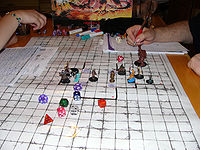 Dungeons & Dragons is a structured yet open-ended role-playing game. It is normally played indoors with the participants seated around a tabletop. Typically, each player controls only a single character, which represents an individual in a fictional setting. When working together as a group, these player characters (PCs) are often described as a 'party' of adventurers, with each member often having his or her own areas of specialty that contributes to the success of the whole. During the course of play, each player directs the actions of his or her character and its interactions with the other characters in the game. This activity is performed through the verbal impersonation of the characters by the players, while also employing a variety of social and other useful cognitive skills, such as logic, basic mathematics and imagination. A game often continues over a series of meetings to complete a single adventure
, and longer into a series of related gaming adventures, called a 'campaign
'.
The results of the party's choices and the overall storyline for the game are determined by the Dungeon Master
(DM) according to the rules of the game and the DM's interpretation of those rules. The DM selects and describes the various non-player character
s (NPCs), the party encounters, the settings in which these interactions occur, and the outcomes of those encounters based on the players' choices and actions. Encounters often take the form of battles with 'monster
s' – a generic term used in D&D to describe potentially hostile beings such as animals, aberrant beings or mythical creatures. The game's extensive rules – which cover diverse subjects such as social interactions, magic use
, combat, and the effect of the environment on PCs – help the DM to make these decisions. The DM may choose to deviate from the published rules or make up new ones if he or she feels it is necessary.
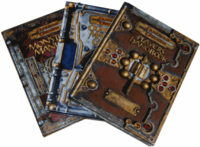 The most recent versions of the game's rules are detailed in three core rulebooks
: The Player's Handbook
, the Dungeon Master's Guide
and the Monster Manual
. A Basic Game
boxed set contains abbreviated rules to help beginners learn the game.
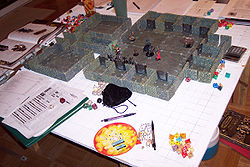
The only items required to play the game are the rulebooks, a character sheet for each player and a number of polyhedral dice. The current editions also assume, but do not require, the use of miniature figures or markers on a gridded surface. Earlier editions did not make this assumption. Many optional accessories are available to enhance the game, such as expansion rulebooks, pre-designed adventures
and various campaign settings
.
 Before the game begins, each player creates
his or her player character and records the details (described below) on a character sheet
. First, a player determines his or her character's ability scores, which consist of Strength, Constitution, Dexterity, Intelligence, Wisdom, and Charisma. Each edition of the game has offered differing methods of determining these statistics; as of 4th Edition, players generally assign their ability scores from a list or use points to "buy" them. The player then chooses a race (species) such as Human or Elf, a character class
(occupation) such as Fighter or Wizard, an alignment
(a moral and ethical outlook which may have a Good or Evil component, a Lawful or Chaotic component, or something in between), and a number of powers, skills and feats to enhance the character's basic abilities. Additional background history
, usually not covered by specific rules, is often also used to further develop the character.
During the game, players describe their PC's intended actions, such as punching an opponent or picking a lock, and converse with the DM in character – who then describes the result or response. Trivial actions, such as picking up a letter or opening an unlocked door, are usually automatically successful. The outcomes of more complex or risky actions are determined by rolling dice. Factors contributing to the outcome include the character's ability scores, skills and the difficulty of the task. In circumstances where a character does not have control of an event, such as when a trap or magical effect is triggered or a spell is cast, a saving throw
can be used to determine whether the resulting damage is reduced or avoided. In this case the odds of success are influenced by the character's class, levels and (with the 3rd and later editions) ability scores.
As the game is played, each PC changes over time and generally increases in capability. Characters gain (or sometimes lose) experience, skills and wealth, and may even alter their alignment or add additional character classes. The key way characters progress is by earning experience points (XP/EXP), which happens when they defeat an enemy or accomplish a difficult task. Acquiring enough XP allows a PC to advance a level
, which grants the character improved class features, abilities and skills. Up through the 3rd edition, XP can also be lost in some circumstances, such as encounters with creatures that drain life energy, or by use of certain magical powers that require payment of an XP cost.
Hit points (HP) are a measure of a character's vitality and health and are determined by the class, level and constitution of each character. They can be temporarily lost when a character sustains wounds in combat or otherwise comes to harm, and loss of HP is the most common way for a character to die in the game. Death can also result from the loss of key ability scores or character levels. When a PC dies, it is often possible for the dead character to be resurrected through magic, although some penalties may be imposed as a result. If resurrection is not possible or not desired, the player may instead create a new PC to resume playing the game.
(previously known as "modules") that have been published throughout the history of Dungeons & Dragons. Published adventures typically include a background story, illustrations, maps and goals for PCs to achieve. Some also include location descriptions and handouts. Although a small adventure entitled 'Temple of the Frog
' was included in the Blackmoor
rules supplement in 1975, the first stand-alone D&D module published by TSR was 1978's Steading of the Hill Giant Chief, written by Gygax.
A linked series of adventures is commonly referred to as a 'campaign
'. The locations where these adventures occur, such as a city, country, planet or an entire fictional universe
, are also sometimes called 'campaigns' but are more correctly referred to as 'worlds' or 'campaign setting
s'. D&D settings are based in various fantasy subgenres and feature varying levels of magic and technology. Popular commercially published campaign settings for Dungeons & Dragons
include Greyhawk
, Dragonlance
, Forgotten Realms
, Mystara
, Spelljammer
, Ravenloft
, Dark Sun
, Planescape
, Birthright
, and Eberron
. Alternatively, DMs may develop their own fictional worlds to use as campaign settings.
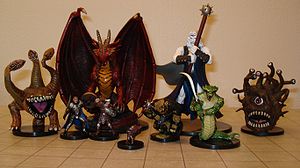
from which Dungeons & Dragons evolved used miniature figures to represent combatants. D&D initially continued the use of miniatures in a fashion similar to its direct precursors. The original D&D set of 1974 required the use of the Chainmail
miniatures game for combat resolution. By the publication of the 1977 game editions, combat was mostly resolved verbally. Thus miniatures were no longer required for game play, although some players continued to use them as a visual reference.
In the 1970s, numerous companies began to sell miniature figures specifically for Dungeons & Dragons and similar games. Licensed miniature manufacturers who produced official figures include Grenadier Miniatures
(1980–1983), Citadel Miniatures
(1984–1986), Ral Partha, and TSR itself. Most of these miniatures used the 25 mm scale, with the exception of Ral Partha's 15 mm scale miniatures for the 1st edition Battlesystem.
Periodically, Dungeons & Dragons has returned to its wargaming roots with supplementary rules systems for miniatures-based wargaming. Supplements such as Battlesystem
(1985 & 1989) and a new edition of Chainmail (2001) provided rule systems to handle battles between armies by using miniatures.
Dungeons & Dragons 3rd Edition (2000) assumes the use of miniatures to represent combat situations in play, an aspect of the game that was further emphasized in the v3.5 revision. The Dungeons & Dragons Miniatures Game
(2003) is sold as sets of plastic, randomly assorted, pre-painted miniatures, and can be used as either part of a standard Dungeons & Dragons game or as a stand-alone collectible miniatures game
.
, whose additions included a fantasy supplement, before the game was published as Chainmail
. When Dave Wesely entered the service in 1970, his friend and fellow Napoleonics wargamer Dave Arneson
began a medieval variation of Wesely's Braunstein games, where players control individuals instead of armies. Arneson used Chainmail to resolve combats. As play progressed, Arneson added such innovations as character classes, experience points, level advancement, armor class, and others. Having partnered previously with Gygax on Don't Give Up the Ship!
, Arneson introduced Gygax to his Blackmoor
game and the two then collaborated on developing "The Fantasy Game", the role-playing game (RPG) that became Dungeons & Dragons, with the final writing and preparation of the text being done by Gygax.
Many Dungeons & Dragons elements also appear in hobbies of the mid-to-late 20th century (though these elements also existed previously). Character-based role playing, for example, can be seen in improvisational theatre
. Game-world simulations were well developed in wargaming
. Fantasy milieus specifically designed for gaming could be seen in Glorantha
's board games among others. Ultimately, however, Dungeons & Dragons represents a unique blending of these elements.
The theme of D&D was influenced by mythology
, pulp fiction
, and contemporary fantasy authors of the 1960s and 1970s. The presence of halflings, elves
, dwarves
, half-elves
, orcs
, dragons
, and the like, often draw comparisons to the work of J.R.R. Tolkien. Gygax maintained that he was influenced very little by The Lord of the Rings
(although the owners of that work's copyright forced the name changes of hobbit to 'halfling', ent to 'treant', and balrog to 'Type VI demon [balor]'), stating that he included these elements as a marketing move to draw on the popularity of the work.
The magic system, in which wizards memorize spells that are used up once cast (and must be re-memorized the next day), was heavily influenced by the Dying Earth
stories and novels of Jack Vance
. The original alignment system (which grouped all characters and creatures into 'Law', 'Neutrality' and 'Chaos') was derived from the novel Three Hearts and Three Lions
by Poul Anderson
. A troll described in this work also influenced the D&D definition of that monster.
Other influences include the works of Robert E. Howard
, Edgar Rice Burroughs
, A. Merritt
, H. P. Lovecraft
, Fritz Leiber
, L. Sprague de Camp
, Fletcher Pratt
, Roger Zelazny
, and Michael Moorcock
. Monsters, spells, and magic items used in the game have been inspired by hundreds of individual works ranging from A. E. van Vogt's "Black Destroyer", Coeurl
(the Displacer Beast
), Lewis Carroll
's "Jabberwocky
" (vorpal
sword) to the Book of Genesis (the clerical spell 'Blade Barrier' was inspired by the "flaming sword which turned every way" at the gates of Eden
).
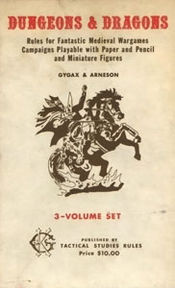 The original Dungeons & Dragons
, now referred to as OD&D, was a small box set of three booklets published in 1974. It was amateurish in production and written from a perspective that assumed the reader was familiar with wargaming. Nevertheless it grew rapidly in popularity, first among wargamers and then expanding to a more general audience of college and high school students. Roughly 1,000 copies of the game were sold in the first year followed by 4,000 in 1975, with sales increasing thereafter. This first set went through many printings and was supplemented with several official additions, such as the original Greyhawk
and Blackmoor
supplements (both 1975), as well as magazine articles in TSR's official publications and countless fanzine
s.
boxed edition was introduced that cleaned up the presentation of the essential rules, made the system understandable to the general public, and was sold in a package that could be stocked in toy stores. In 1978, Advanced Dungeons & Dragons (AD&D) was published, which brought together the various published rules, options and corrections, then expanded them into a definitive, unified game for hobbyist gamers. The basic set directed players who exhausted the possibilities of that game to switch to the advanced rules.
Unfortunately, almost from its inception, differences of design philosophy caused this dual marketing approach to go awry. Gygax, who wrote the advanced game, wanted an expansive game with rulings on any conceivable situation which might come up during play. J. Eric Holmes, the editor of the basic game, preferred a lighter tone with more room for personal improvisation. As a result, the basic game included many rules and concepts which contradicted comparable ones in the advanced game. Confusing matters further, the original D&D boxed set remained in publication until 1979, since it remained a healthy seller for TSR.
Advanced Dungeons & Dragons was designed to create a tighter, more structured game system than the loose framework of the original game. While seen by many as a revision of the original D&D, AD&D was at the time declared to be "neither an expansion nor a revision of the old game, it is a new game". The AD&D game was not intended to be directly compatible with D&D and it required some conversion to play between the rule sets. The term Advanced described the more complex rules and did not imply "for higher-level gaming abilities". Between 1977 and 1979, three hardcover rulebooks, commonly referred to as the "core rulebooks", were released: the Player's Handbook
(PHB), the Dungeon Master's Guide
(DMG), and the Monster Manual
(MM). Several supplementary books were published throughout the 1980s, notably Unearthed Arcana
(1985) that included a large number of new rules.
In 1981, the "basic" version of Dungeons & Dragons was revised by Tom Moldvay and split into several versions. This game was promoted as a continuation of the original D&D tone, whereas AD&D was promoted as advancement of the mechanics. Although simpler overall than the Advanced game, it included rules for some situations not covered in AD&D. There were five sets: Basic (1977, revised in 1981 and again in 1983), Expert
(1981, revised in 1983), Companion
(1983), Master
(1985), and Immortals
(1986, revised in 1991). Each set covered game play for more powerful characters than the previous. The first four sets were later compiled as a single hardcover book, the Dungeons & Dragons Rules Cyclopedia
(1991).
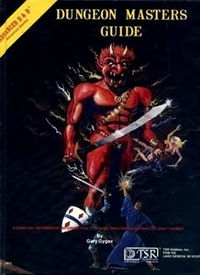 Advanced Dungeons & Dragons 2nd Edition, sometimes referred to as "Second Edition", was published in 1989, again as three core rulebooks; the primary designer was David "Zeb" Cook. The Monster Manual was replaced by the Monstrous Compendium
, a loose-leaf binder that was subsequently replaced by the hardcover Monstrous Manual in 1993. In 1995, the core rulebooks were slightly revised, although still referred to by TSR as the 2nd Edition, and a series of Player’s Option manuals were released as optional rulebooks.
The release of AD&D2 deliberately excluded some aspects of the game that had attracted negative publicity. References to demons and devils, sexually suggestive artwork, and playable, evil-aligned character types – such as assassins and half-orcs – were removed. The edition moved away from a theme of 1960s and 1970s "sword and sorcery" fantasy fiction to a mixture of medieval history and mythology. The rules underwent minor changes, including the addition of non-weapon proficiencies – skill-like abilities that originally appeared in 1st Edition supplements. The game's magic spells were divided into schools and spheres. A major difference was the promotion of various game settings beyond that of traditional fantasy. This included blending fantasy with other genres, such as horror (Ravenloft
), science fiction (Spelljammer
), and apocalyptic (Dark Sun
), as well as alternative historical and non-European mythological settings.
. Following three years of development, Dungeons & Dragons 3rd Edition was released in 2000. This game is referred to as D&D3 or 3E and is not to be confused with the 1983 edition of the basic D&D game, though the Player's Handbook and Dungeon Master's Guides of this edition state "Dungeons & Dragons." The new release folded the Basic and Advanced lines back into a single unified game. It was the largest revision of the D&D rules to date, and also served as the basis for a multi-genre role-playing system designed around 20-sided dice, called the d20 System
. The 3rd Edition rules were designed to be internally consistent and less restrictive than previous editions of the game, allowing players more flexibility to create the characters they wanted to play. Skills and feats were introduced into the core rules to encourage further customization of characters. The new rules also standardized the mechanics of action resolution and combat.
In 2003, Dungeons & Dragons v.3.5, also known as Revised 3rd Edition or D&D3.5, was released as a revision of the 3rd Edition rules. This release incorporated hundreds of rule changes, mostly minor, and expanded the core rulebooks.
In early 2005, Wizards of the Coast's R&D team started to develop Dungeons & Dragons 4th Edition, prompted mainly by the feedback obtained from the D&D playing community and a desire to make the game faster, more intuitive, and with a better play experience than under the 3rd Edition. The new game was developed through a number of design phases spanning from May 2005 until its release.
Dungeons & Dragons 4th Edition was announced at Gen Con
in August 2007, and the initial three core books were released June 6, 2008. 4th Edition streamlined the game into a simplified form and introduced numerous rules changes. Many character abilities were restructured into "Powers". These altered the spell-using classes by adding abilities that could be used at will, per encounter, or per day. Likewise, non-magic-using classes were provided with parallel sets of options. Wizards of the Coast is releasing other supplementary material virtually through their website, including player character and monster building programs.
edition in 1982, Dungeons & Dragons has been translated into many languages beyond the original English. By 2004, consumers had spent more than US$1 billion on Dungeons & Dragons products and the game had been played by more than 20 million people. As many as 6 million people played the game in 2007.
The various editions of Dungeons & Dragons have won many Origins Award
s, including All Time Best Roleplaying Rules of 1977, Best Roleplaying Rules of 1989, and Best Roleplaying Game of 2000 for the three flagship editions of the game. Both Dungeons & Dragons and Advanced Dungeons & Dragons are Origins Hall of Fame Games inductees as they were deemed sufficiently distinct to merit separate inclusion on different occasions. The independent Games magazine placed Dungeons & Dragons on their Games 100 list from 1980 through 1983, then entered the game into the magazine’s Hall of Fame in 1984.
Dungeons & Dragons was the first modern role-playing game and it established many of the conventions that have dominated the genre. Particularly notable are the use of dice as a game mechanic
, character record sheets
, use of numerical attributes
and gamemaster-centered group dynamics. Within months of Dungeons & Dragons’s release, new role-playing game writers and publishers began releasing their own role-playing games, with most of these being in the fantasy genre. Some of the earliest other role-playing games inspired by D&D include Tunnels & Trolls (1975), Empire of the Petal Throne
(1975), and Chivalry & Sorcery (1976).
The role-playing movement initiated by D&D would lead to release of the science fiction game Traveller (1977) and fantasy game RuneQuest
(1978), and subsequent game systems such as Chaosium
’s Call of Cthulhu
(1981), Champions (1982), GURPS
(1986), and Vampire: The Masquerade
(1991). Dungeons & Dragons and the games it influenced fed back into the genre’s origin – miniatures wargames – with combat strategy games like Warhammer Fantasy Battles. D&D also had a large impact on modern video games.
Director Jon Favreau
credits Dungeons & Dragons with giving him "...a really strong background in imagination, storytelling, understanding how to create tone and a sense of balance."
With the launch of Dungeons & Dragons’s 3rd Edition
, Wizards of the Coast made the d20 System
available under the Open Game License (OGL) and d20 trademark license. Under these licenses, authors are free to use the d20 System when writing games and game supplements. The OGL and d20 Trademark License also made possible new games, some based on licensed products like Star Wars
, and also new versions of older games, such as Call of Cthulhu.
During the 2000s, there has been a trend towards recreating older editions of D&D. Necromancer Games
, with its slogan "Third Edition Rules, First Edition Feel" and Goodman Games Dungeon Crawl Classics range are both examples of this in material for d20 System. Other companies have created complete game systems based on earlier editions of D&D. An example is HackMaster
(2001) by Kenzer and Company, a licensed, non-OGL, semi-satirical follow-on to 1st and 2nd Edition. Castles & Crusades
(2005), by Troll Lord Games
, is a reimagining of early editions by streamlining rules from OGL that was supported by Gary Gygax prior to his death.
With the release of the fourth edition, Wizards of the Coast has introduced its Game System License
, which represents a significant restriction compared to the very open policies embodied by the OGL. In part as a response to this, some publishers (such as Paizo Publishing
with its Pathfinder Roleplaying Game
) who previously produced materials in support of the D&D product line, have decided to continue supporting the 3rd Edition rules, thereby competing directly with Wizards of the Coast. Others, such as Kenzer & Company
, are returning to the practice of publishing unlicensed supplements and arguing that copyright law does not allow Wizards of the Coast to restrict third-party usage.
groups, for alleged promotion of such practices as devil worship, witchcraft
, suicide, and murder, and for naked breasts in drawings of female humanoids in the original AD&D manuals (mainly monsters such as Harpies
, Succubi
, and so on.). These controversies led TSR to remove many potentially controversial references and artwork when releasing the 2nd Edition of AD&D. Many of these references, including the use of the names "devils
" and "demons
", were reintroduced in the 3rd edition. The moral panic
over the game also led to problems for fans of D&D who faced social ostracism, unfair treatment, and false association with the occult and Satanism
, regardless of an individual fan's actual religious affiliation and beliefs.
Dungeons & Dragons has also been the subject of rumors regarding players having difficulty separating fantasy from reality, even leading to psychotic episodes. The most notable of these was the saga of James Dallas Egbert III, the facts of which were fictionalized in the novel Mazes and Monsters
and later made into a TV movie
. The game was also blamed for some of the actions of Chris Pritchard
, who was convicted in 1990 of murdering his stepfather. Research by various psychologists, the first being that of Armando Simon, has concluded that no harmful effects are related to the playing of D&D.
The game’s commercial success was a factor that led to lawsuits regarding distribution of royalties
between original creators Gygax and Arneson. Gygax later became embroiled in a political struggle for control of TSR which culminated in a court battle and Gygax’s decision to sell his ownership interest in the company in 1985.
 D&D’s commercial success has led to many other related products, including Dragon Magazine
, Dungeon Magazine
, an animated television series
, a film series
, an official role-playing soundtrack
, novels
, and computer games such as the MMORPG
Dungeons & Dragons Online: Stormreach
. Hobby and toy stores sell dice, miniatures, adventures
, and other game aids related to D&D and its game offspring.
dom, and have become the basis of much geek and gamer humor and satire. Famous D&D players include professional basketball player Tim Duncan
, comedian Stephen Colbert
, and actors Vin Diesel
and Robin Williams
. D&D and its fans have been the subject of spoof films, including Fear of Girls
.
:Category:Dungeons & Dragons creatures
Gary Gygax
Ernest Gary Gygax was an American writer and game designer best known for co-creating the pioneering role-playing game Dungeons & Dragons with Dave Arneson. Gygax is generally acknowledged as the father of role-playing games....
and Dave Arneson
Dave Arneson
David Lance "Dave" Arneson was an American game designer best known for co-developing the first published role-playing game , Dungeons & Dragons, with Gary Gygax, in the early 1970s...
, and first published in 1974 by Tactical Studies Rules, Inc.
TSR, Inc.
Blume and Gygax, the remaining owners, incorporated a new company called TSR Hobbies, Inc., with Blume and his father, Melvin Blume, owning the larger share. The former assets of the partnership were transferred to TSR Hobbies, Inc....
(TSR). The game has been published by Wizards of the Coast
Wizards of the Coast
Wizards of the Coast is an American publisher of games, primarily based on fantasy and science fiction themes, and formerly an operator of retail stores for games...
since 1997. It was derived from miniature wargames
Miniature wargaming
Miniature wargaming is a form of wargaming that incorporates miniature figures, miniature armor and modeled terrain as the main components of play...
with a variation of the Chainmail
Chainmail (game)
Chainmail is a medieval miniatures wargame created by Gary Gygax and Jeff Perren. Gygax developed the game with fellow Lake Geneva Tactical Studies Association member Perren, a hobby-shop owner with whom he had become friendly, and the game was first published in 1971...
game serving as the initial rule system. D&D publication is widely regarded as the beginning of modern role-playing games and the role-playing game industry.
D&D departs from traditional wargaming and assigns each player a specific character
Player character
A player character or playable character is a character in a video game or role playing game who is controlled or controllable by a player, and is typically a protagonist of the story told in the course of the game. A player character is a persona of the player who controls it. Player characters...
to play instead of a military formation. These characters embark upon imaginary adventures within a fantasy setting. A Dungeon Master
Dungeon Master
In the Dungeons & Dragons role-playing game, the Dungeon Master is the game organizer and participant in charge of creating the details and challenges of a given adventure, while maintaining a realistic continuity of events...
serves as the game's referee and storyteller, while also maintaining the setting in which the adventures occur and playing the role of the inhabitants. The characters form a party that interacts with the setting's inhabitants (and each other). Together they solve dilemmas, engage in battles and gather treasure and knowledge. In the process the characters earn experience points to become increasingly powerful over a series of sessions.
The early success of Dungeons & Dragons led to a proliferation of similar game systems. Despite this competition, D&D enjoys a dominant market position in the role-playing game industry. In 1977, the game was split into two versions: the relatively rules-light game system of Dungeons & Dragons and the more structured, rules-heavy game system of Advanced Dungeons & Dragons (abbreviated as AD&D or ADnD). AD&D 2nd Edition was published in 1989. In 2000, the original version of the game was discontinued and the AD&D version was renamed Dungeons & Dragons with the release of its 3rd edition. These rules formed the basis of the d20 System
D20 System
The d20 System is a role-playing game system published in 2000 by Wizards of the Coast originally developed for the third edition of Dungeons & Dragons...
that is available under the Open Game License for use by other publishers. Dungeons & Dragons version 3.5 was released in June 2003, with a 4th edition in June 2008.
As of 2006, Dungeons & Dragons remained the best-known and best-selling role-playing game, with an estimated 20 million people having played the game and more than US$
United States dollar
The United States dollar , also referred to as the American dollar, is the official currency of the United States of America. It is divided into 100 smaller units called cents or pennies....
1 billion in book and equipment sales. The game has been supplemented by many pre-made adventures
Adventure (Dungeons & Dragons)
In the Dungeons & Dragons role-playing game, an adventure or module is a pre-packaged book or box set that helps the Dungeon Master manage the plot or story of a game...
as well as commercial campaign settings
Dungeons & Dragons campaign settings
The flexibility of the Dungeons & Dragons rules means that Dungeon Masters are free to create their own fantasy campaign settings. For those who wanted a pre-packaged setting in which to play, TSR, Wizards of the Coast , and other publishers have created many settings in which D&D games can be based...
suitable for use by regular gaming groups. Dungeons & Dragons is known beyond the game for other D&D-branded products
Dungeons & Dragons related products
The Dungeons & Dragons fantasy role-playing game has spawned many related products, including magazines, films and videogames.- Magazines :In 1975, TSR began publishing The Strategic Review...
, references in popular culture
Dungeons & Dragons in popular culture
Dungeons & Dragons is a fantasy role-playing game that was first published in 1974. As the popularity of the game grew throughout the late 1970s and 1980s, it became more frequently referenced in popular culture...
and some of the controversies
Dungeons & Dragons controversies
Dungeons & Dragons controversies concern the role-playing game Dungeons & Dragons , which has received significant attention in the media and in popular culture. The game has received some negative coverage, especially during the game's early years in the early 1980s...
that have surrounded it, particularly a moral panic
Moral panic
A moral panic is the intensity of feeling expressed in a population about an issue that appears to threaten the social order. According to Stanley Cohen, author of Folk Devils and Moral Panics and credited creator of the term, a moral panic occurs when "[a] condition, episode, person or group of...
in the 1980s falsely linking it to Satanism
Satanism
Satanism is a group of religions that is composed of a diverse number of ideological and philosophical beliefs and social phenomena. Their shared feature include symbolic association with, admiration for the character of, and even veneration of Satan or similar rebellious, promethean, and...
and suicide. The game has won multiple awards and has been translated into many languages beyond the original English.
Play overview
Adventure (Dungeons & Dragons)
In the Dungeons & Dragons role-playing game, an adventure or module is a pre-packaged book or box set that helps the Dungeon Master manage the plot or story of a game...
, and longer into a series of related gaming adventures, called a 'campaign
Campaign (role-playing games)
In role-playing games, a campaign is a continuing storyline or set of adventures, typically involving the same characters. The purpose of the continuing storyline is to introduce a further aspect into the game: that of development, improvement, and growth of the characters. In a campaign, a...
'.
The results of the party's choices and the overall storyline for the game are determined by the Dungeon Master
Dungeon Master
In the Dungeons & Dragons role-playing game, the Dungeon Master is the game organizer and participant in charge of creating the details and challenges of a given adventure, while maintaining a realistic continuity of events...
(DM) according to the rules of the game and the DM's interpretation of those rules. The DM selects and describes the various non-player character
Non-player character
A non-player character , sometimes known as a non-person character or non-playable character, in a game is any fictional character not controlled by a player. In electronic games, this usually means a character controlled by the computer through artificial intelligence...
s (NPCs), the party encounters, the settings in which these interactions occur, and the outcomes of those encounters based on the players' choices and actions. Encounters often take the form of battles with 'monster
Monster
A monster is any fictional creature, usually found in legends or horror fiction, that is somewhat hideous and may produce physical harm or mental fear by either its appearance or its actions...
s' – a generic term used in D&D to describe potentially hostile beings such as animals, aberrant beings or mythical creatures. The game's extensive rules – which cover diverse subjects such as social interactions, magic use
Spells of Dungeons & Dragons
Magic of Dungeons & Dragons consists of spells used in the settings of the role-playing game, Dungeons & Dragons . There is little if any similarity between these fictional spells and any actual historical mythology. D&D defined the genre of fantasy role-playing games, and remains the most...
, combat, and the effect of the environment on PCs – help the DM to make these decisions. The DM may choose to deviate from the published rules or make up new ones if he or she feels it is necessary.
Dungeons & Dragons manuals
Three books are required for the Dungeons & Dragons fantasy role-playing game. The current Dungeons & Dragons requires the Player's Handbook, the Dungeon Master's Guide, and the Monster Manual...
: The Player's Handbook
Player's Handbook
The Player's Handbook is a book of rules for the fantasy role-playing game Dungeons & Dragons . It does not contain the complete set of rules, but only those for use by players of the game...
, the Dungeon Master's Guide
Dungeon Master's Guide
The Dungeon Master's Guide is a book of rules for the fantasy role-playing game Dungeons & Dragons...
and the Monster Manual
Monster Manual
The Monster Manual is the primary bestiary sourcebook for monsters in the Dungeons & Dragons fantasy role-playing game. It includes monsters derived from mythology, and folklore, as well as creatures created for D&D specifically...
. A Basic Game
Dungeons & Dragons Basic Game
The Dungeons & Dragons Basic Game is an introductory version of Dungeons & Dragons role-playing game packaged in the form of a board game. The current version of this game was released in September 2006...
boxed set contains abbreviated rules to help beginners learn the game.
The only items required to play the game are the rulebooks, a character sheet for each player and a number of polyhedral dice. The current editions also assume, but do not require, the use of miniature figures or markers on a gridded surface. Earlier editions did not make this assumption. Many optional accessories are available to enhance the game, such as expansion rulebooks, pre-designed adventures
Adventure (Dungeons & Dragons)
In the Dungeons & Dragons role-playing game, an adventure or module is a pre-packaged book or box set that helps the Dungeon Master manage the plot or story of a game...
and various campaign settings
Dungeons & Dragons campaign settings
The flexibility of the Dungeons & Dragons rules means that Dungeon Masters are free to create their own fantasy campaign settings. For those who wanted a pre-packaged setting in which to play, TSR, Wizards of the Coast , and other publishers have created many settings in which D&D games can be based...
.
Game mechanics
Character creation
Character creation is the process of defining a game character or other character. Typically, a character's individual strengths and weaknesses are represented by a set of statistics. Games with a largely fictional setting may include traits such as race and class...
his or her player character and records the details (described below) on a character sheet
Character sheet
A character sheet is a record of a player character in a role-playing game, including whatever details, notes, game statistics, and background information a player would need during a play session. Character sheets can be found in use in both traditional and action role-playing games...
. First, a player determines his or her character's ability scores, which consist of Strength, Constitution, Dexterity, Intelligence, Wisdom, and Charisma. Each edition of the game has offered differing methods of determining these statistics; as of 4th Edition, players generally assign their ability scores from a list or use points to "buy" them. The player then chooses a race (species) such as Human or Elf, a character class
Character class (Dungeons & Dragons)
A character class is a fundamental part of the identity and nature of characters in the Dungeons & Dragons role-playing game. A character's capabilities, strengths, and weaknesses are largely defined by his or her chosen class; choosing a class is one of the first steps a player takes in order to...
(occupation) such as Fighter or Wizard, an alignment
Alignment (Dungeons & Dragons)
In the Dungeons & Dragons fantasy role-playing game, alignment is a categorization of the ethical and moral perspective of people, creatures and societies....
(a moral and ethical outlook which may have a Good or Evil component, a Lawful or Chaotic component, or something in between), and a number of powers, skills and feats to enhance the character's basic abilities. Additional background history
Back-story
A back-story, background story, or backstory is the literary device of a narrative chronologically earlier than, and related to, a narrative of primary interest. Generally, it is the history of characters or other elements that underlie the situation existing at the main narrative's start...
, usually not covered by specific rules, is often also used to further develop the character.
During the game, players describe their PC's intended actions, such as punching an opponent or picking a lock, and converse with the DM in character – who then describes the result or response. Trivial actions, such as picking up a letter or opening an unlocked door, are usually automatically successful. The outcomes of more complex or risky actions are determined by rolling dice. Factors contributing to the outcome include the character's ability scores, skills and the difficulty of the task. In circumstances where a character does not have control of an event, such as when a trap or magical effect is triggered or a spell is cast, a saving throw
Saving throw
In role-playing games, a saving throw is a roll of dice used to determine whether magic, poison, or various other types of attacks are effective against a character or monster....
can be used to determine whether the resulting damage is reduced or avoided. In this case the odds of success are influenced by the character's class, levels and (with the 3rd and later editions) ability scores.
As the game is played, each PC changes over time and generally increases in capability. Characters gain (or sometimes lose) experience, skills and wealth, and may even alter their alignment or add additional character classes. The key way characters progress is by earning experience points (XP/EXP), which happens when they defeat an enemy or accomplish a difficult task. Acquiring enough XP allows a PC to advance a level
Level Up
Level Up was a UK children's TV programme that was broadcast on CBBC. It was launched on the 3rd April 2006, replacing Xchange. The show was an hour long and during the school year broadcasting from 7:30am until 8:30am...
, which grants the character improved class features, abilities and skills. Up through the 3rd edition, XP can also be lost in some circumstances, such as encounters with creatures that drain life energy, or by use of certain magical powers that require payment of an XP cost.
Hit points (HP) are a measure of a character's vitality and health and are determined by the class, level and constitution of each character. They can be temporarily lost when a character sustains wounds in combat or otherwise comes to harm, and loss of HP is the most common way for a character to die in the game. Death can also result from the loss of key ability scores or character levels. When a PC dies, it is often possible for the dead character to be resurrected through magic, although some penalties may be imposed as a result. If resurrection is not possible or not desired, the player may instead create a new PC to resume playing the game.
Adventures, campaigns, and modules
A typical Dungeons & Dragons game consists of an 'adventure', which is roughly equivalent to a single story. The DM can either design an adventure on his or her own, or follow one of the many additional pre-made adventuresAdventure (Dungeons & Dragons)
In the Dungeons & Dragons role-playing game, an adventure or module is a pre-packaged book or box set that helps the Dungeon Master manage the plot or story of a game...
(previously known as "modules") that have been published throughout the history of Dungeons & Dragons. Published adventures typically include a background story, illustrations, maps and goals for PCs to achieve. Some also include location descriptions and handouts. Although a small adventure entitled 'Temple of the Frog
Temple of the Frog
Temple of the Frog is a 48-page 1986 adventure module for the Dungeons & Dragons roleplaying game. Its module code is DA2 and its TSR product code is TSR 9175...
' was included in the Blackmoor
Blackmoor (supplement)
Blackmoor is a supplementary rulebook for the original edition of the Dungeons & Dragons fantasy role-playing game written by Dave Arneson...
rules supplement in 1975, the first stand-alone D&D module published by TSR was 1978's Steading of the Hill Giant Chief, written by Gygax.
A linked series of adventures is commonly referred to as a 'campaign
Campaign (role-playing games)
In role-playing games, a campaign is a continuing storyline or set of adventures, typically involving the same characters. The purpose of the continuing storyline is to introduce a further aspect into the game: that of development, improvement, and growth of the characters. In a campaign, a...
'. The locations where these adventures occur, such as a city, country, planet or an entire fictional universe
Fictional universe
A fictional universe is a self-consistent fictional setting with elements that differ from the real world. It may also be called an imagined, constructed or fictional realm ....
, are also sometimes called 'campaigns' but are more correctly referred to as 'worlds' or 'campaign setting
Campaign setting
A campaign setting is usually a fictional world which serves as a setting for a role-playing game or wargame campaign. A campaign is a series of individual adventures, and a campaign setting is the world in which such adventures and campaigns take place...
s'. D&D settings are based in various fantasy subgenres and feature varying levels of magic and technology. Popular commercially published campaign settings for Dungeons & Dragons
Dungeons & Dragons campaign settings
The flexibility of the Dungeons & Dragons rules means that Dungeon Masters are free to create their own fantasy campaign settings. For those who wanted a pre-packaged setting in which to play, TSR, Wizards of the Coast , and other publishers have created many settings in which D&D games can be based...
include Greyhawk
Greyhawk
Greyhawk, also known as the World of Greyhawk, is a fictional world designed as a campaign setting for the Dungeons & Dragons fantasy roleplaying game...
, Dragonlance
Dragonlance
Dragonlance is a shared universe created by Laura and Tracy Hickman, and expanded by Tracy Hickman and Margaret Weis under the direction of TSR, Inc. into a series of popular fantasy novels. The Hickmans conceived Dragonlance while driving in their car on the way to TSR for a job application...
, Forgotten Realms
Forgotten Realms
The Forgotten Realms is a campaign setting for the Dungeons & Dragons fantasy role-playing game. Commonly referred to by players and game designers alike as "The Realms", it was created by game designer Ed Greenwood around 1967 as a setting for his childhood stories...
, Mystara
Mystara
Mystara is a campaign setting for the Dungeons & Dragons fantasy role playing game. Although it has officially been dropped from production by its creators, many fans continue to develop and evolve this fantasy setting jointly, continuing its original theme of group development.-Development:It...
, Spelljammer
Spelljammer
Spelljammer is a campaign setting for the Advanced Dungeons & Dragons role-playing game, which features a fantastical outer space environment....
, Ravenloft
Ravenloft
Ravenloft is a campaign setting for the Dungeons & Dragons roleplaying game. It is an alternate time-space existence known as a pocket dimension called the Demiplane of Dread, which consists of a collection of land pieces called domains brought together by a mysterious force known only as "The Dark...
, Dark Sun
Dark Sun
Dark Sun is a Dungeons & Dragons campaign setting featuring the fictional desert world of Athas. The original Dark Sun Boxed Set campaign setting was released in 1991....
, Planescape
Planescape
Planescape is a campaign setting for the Dungeons & Dragons fantasy role-playing game, originally designed by Zeb Cook. The Planescape setting was published in 1994...
, Birthright
Birthright (campaign setting)
Birthright is a Dungeons & Dragons campaign setting that was first released by TSR in 1995. The setting based on the world of Aebrynis on the continent of Cerilia, in which the players take on the role of the divinely-empowered rulers, with emphasis on the political rulership level of gameplay...
, and Eberron
Eberron
Eberron is a campaign setting for the Dungeons & Dragons role-playing game, set in a period after a vast destructive war on the continent of Khorvaire...
. Alternatively, DMs may develop their own fictional worlds to use as campaign settings.
Miniature figures
The wargamesWargaming
A wargame is a strategy game that deals with military operations of various types, real or fictional. Wargaming is the hobby dedicated to the play of such games, which can also be called conflict simulations, or consims for short. When used professionally to study warfare, it is generally known as...
from which Dungeons & Dragons evolved used miniature figures to represent combatants. D&D initially continued the use of miniatures in a fashion similar to its direct precursors. The original D&D set of 1974 required the use of the Chainmail
Chainmail (game)
Chainmail is a medieval miniatures wargame created by Gary Gygax and Jeff Perren. Gygax developed the game with fellow Lake Geneva Tactical Studies Association member Perren, a hobby-shop owner with whom he had become friendly, and the game was first published in 1971...
miniatures game for combat resolution. By the publication of the 1977 game editions, combat was mostly resolved verbally. Thus miniatures were no longer required for game play, although some players continued to use them as a visual reference.
In the 1970s, numerous companies began to sell miniature figures specifically for Dungeons & Dragons and similar games. Licensed miniature manufacturers who produced official figures include Grenadier Miniatures
Grenadier Miniatures
Grenadier Models Inc. of Springfield, Pennsylvania produced lead miniature figures for wargames and role-playing games with fantasy, science fiction and heroic themes between 1975 and 1996. Grenadier Models Inc...
(1980–1983), Citadel Miniatures
Citadel Miniatures
Citadel Miniatures Limited is a company which produces metal, resin and plastic miniature figures for tabletop wargames such as Warhammer Fantasy Battle and Warhammer 40,000....
(1984–1986), Ral Partha, and TSR itself. Most of these miniatures used the 25 mm scale, with the exception of Ral Partha's 15 mm scale miniatures for the 1st edition Battlesystem.
Periodically, Dungeons & Dragons has returned to its wargaming roots with supplementary rules systems for miniatures-based wargaming. Supplements such as Battlesystem
Battlesystem
Battlesystem is a tabletop miniature wargame designed as a supplement for use with the Dungeons & Dragons role-playing game. It was first released in 1985, compatible with either Advanced Dungeons & Dragons or the Basic / Expert Dungeons & Dragons...
(1985 & 1989) and a new edition of Chainmail (2001) provided rule systems to handle battles between armies by using miniatures.
Dungeons & Dragons 3rd Edition (2000) assumes the use of miniatures to represent combat situations in play, an aspect of the game that was further emphasized in the v3.5 revision. The Dungeons & Dragons Miniatures Game
Dungeons & Dragons Miniatures Game
The Dungeons & Dragons Miniatures Game is a collectible miniatures game played with pre-painted, plastic miniature figures based on characters and monsters from the Dungeons & Dragons game. The figures are 30mm in scale...
(2003) is sold as sets of plastic, randomly assorted, pre-painted miniatures, and can be used as either part of a standard Dungeons & Dragons game or as a stand-alone collectible miniatures game
Collectible miniatures game
Collectible miniatures games or CMGs are a form of miniature wargaming that is also similar to collectible card games — the primary difference being that while CCGs are card-based games, CMGs feature miniature figures....
.
Sources and influences
An immediate predecessor of Dungeons & Dragons was a set of medieval miniature rules written by Jeff Perren. These were expanded by Gary GygaxGary Gygax
Ernest Gary Gygax was an American writer and game designer best known for co-creating the pioneering role-playing game Dungeons & Dragons with Dave Arneson. Gygax is generally acknowledged as the father of role-playing games....
, whose additions included a fantasy supplement, before the game was published as Chainmail
Chainmail (game)
Chainmail is a medieval miniatures wargame created by Gary Gygax and Jeff Perren. Gygax developed the game with fellow Lake Geneva Tactical Studies Association member Perren, a hobby-shop owner with whom he had become friendly, and the game was first published in 1971...
. When Dave Wesely entered the service in 1970, his friend and fellow Napoleonics wargamer Dave Arneson
Dave Arneson
David Lance "Dave" Arneson was an American game designer best known for co-developing the first published role-playing game , Dungeons & Dragons, with Gary Gygax, in the early 1970s...
began a medieval variation of Wesely's Braunstein games, where players control individuals instead of armies. Arneson used Chainmail to resolve combats. As play progressed, Arneson added such innovations as character classes, experience points, level advancement, armor class, and others. Having partnered previously with Gygax on Don't Give Up the Ship!
Don't Give Up The Ship!
Don't Give Up the Ship! is a set of rules for conducting Napoleonic era naval wargames. The game was published by Guidon Games in 1972 and republished by TSR, Inc. in 1975. It was the first collaboration between Dave Arneson and Gary Gygax, the co-creators of Dungeons & Dragons...
, Arneson introduced Gygax to his Blackmoor
Blackmoor
Blackmoor is a fantasy role-playing game campaign setting generally associated with the game Dungeons & Dragons. It originally evolved in the early 1970s as the personal setting of Dave Arneson, the co-creator of Dungeons & Dragons, first as a setting for Arneson's miniature wargames, then as an...
game and the two then collaborated on developing "The Fantasy Game", the role-playing game (RPG) that became Dungeons & Dragons, with the final writing and preparation of the text being done by Gygax.
Many Dungeons & Dragons elements also appear in hobbies of the mid-to-late 20th century (though these elements also existed previously). Character-based role playing, for example, can be seen in improvisational theatre
Improvisational theatre
Improvisational theatre takes many forms. It is best known as improv or impro, which is often comedic, and sometimes poignant or dramatic. In this popular, often topical art form improvisational actors/improvisers use improvisational acting techniques to perform spontaneously...
. Game-world simulations were well developed in wargaming
Wargaming
A wargame is a strategy game that deals with military operations of various types, real or fictional. Wargaming is the hobby dedicated to the play of such games, which can also be called conflict simulations, or consims for short. When used professionally to study warfare, it is generally known as...
. Fantasy milieus specifically designed for gaming could be seen in Glorantha
Glorantha
Glorantha is the Fantasy world created by Greg Stafford and since used as the background for several role-playing games, including RuneQuest , Hero Wars and HeroQuest , as well as several works of fiction and the computer strategy game King of Dragon Pass...
's board games among others. Ultimately, however, Dungeons & Dragons represents a unique blending of these elements.
The theme of D&D was influenced by mythology
Mythology
The term mythology can refer either to the study of myths, or to a body or collection of myths. As examples, comparative mythology is the study of connections between myths from different cultures, whereas Greek mythology is the body of myths from ancient Greece...
, pulp fiction
Pulp magazine
Pulp magazines , also collectively known as pulp fiction, refers to inexpensive fiction magazines published from 1896 through the 1950s. The typical pulp magazine was seven inches wide by ten inches high, half an inch thick, and 128 pages long...
, and contemporary fantasy authors of the 1960s and 1970s. The presence of halflings, elves
Elf (Dungeons & Dragons)
In the Dungeons & Dragons fantasy role-playing game, elves are a fictional humanoid race that is one of the primary races available for play as player characters. Elves are renowned for their grace and mastery of magic and weapons such as the sword and bow...
, dwarves
Dwarf (Dungeons & Dragons)
In the Dungeons & Dragons fantasy roleplaying game, dwarves are a humanoid race, one of the primary races available for play as player characters...
, half-elves
Half-elf (Dungeons & Dragons)
-Advanced Dungeons & Dragons 1st edition :The half-elf appeared as a player character race in the original Player's Handbook . The half-elf also appeared in the original Monster Manual...
, orcs
Orc (Dungeons & Dragons)
In the Dungeons & Dragons roleplaying game, orcs are a primitive race of savage, bestial, barbaric humanoid.-Publication history:The orc was one of the earliest creatures introduced in the D&D game. The D&D orc is largely based upon the orcs appearing in the works of J.R.R...
, dragons
Dragon (Dungeons & Dragons)
In the Dungeons & Dragons fantasy role-playing game , dragons are an iconic type of monstrous creature used as adversaries or, less commonly, allies of player characters...
, and the like, often draw comparisons to the work of J.R.R. Tolkien. Gygax maintained that he was influenced very little by The Lord of the Rings
The Lord of the Rings
The Lord of the Rings is a high fantasy epic written by English philologist and University of Oxford professor J. R. R. Tolkien. The story began as a sequel to Tolkien's earlier, less complex children's fantasy novel The Hobbit , but eventually developed into a much larger work. It was written in...
(although the owners of that work's copyright forced the name changes of hobbit to 'halfling', ent to 'treant', and balrog to 'Type VI demon [balor]'), stating that he included these elements as a marketing move to draw on the popularity of the work.
The magic system, in which wizards memorize spells that are used up once cast (and must be re-memorized the next day), was heavily influenced by the Dying Earth
Dying Earth series
The Dying Earth is a series of picaresque fantasy fixups by American author Jack Vance.-Works:The series consists of the following works:*The Dying Earth...
stories and novels of Jack Vance
Jack Vance
John Holbrook Vance is an American mystery, fantasy and science fiction author. Most of his work has been published under the name Jack Vance. Vance has published 11 mysteries as John Holbrook Vance and 3 as Ellery Queen...
. The original alignment system (which grouped all characters and creatures into 'Law', 'Neutrality' and 'Chaos') was derived from the novel Three Hearts and Three Lions
Three Hearts and Three Lions
Three Hearts and Three Lions is a 1961 fantasy novel by Poul Anderson. It is also a 1953 novella by Poul Anderson which appeared in Fantasy & Science Fiction.-Plot:...
by Poul Anderson
Poul Anderson
Poul William Anderson was an American science fiction author who began his career during one of the Golden Ages of the genre and continued to write and remain popular into the 21st century. Anderson also authored several works of fantasy, historical novels, and a prodigious number of short stories...
. A troll described in this work also influenced the D&D definition of that monster.
Other influences include the works of Robert E. Howard
Robert E. Howard
Robert Ervin Howard was an American author who wrote pulp fiction in a diverse range of genres. Best known for his character Conan the Barbarian, he is regarded as the father of the sword and sorcery subgenre....
, Edgar Rice Burroughs
Edgar Rice Burroughs
Edgar Rice Burroughs was an American author, best known for his creation of the jungle hero Tarzan and the heroic Mars adventurer John Carter, although he produced works in many genres.-Biography:...
, A. Merritt
A. Merritt
Abraham Grace Merritt — known by his byline, A. Merritt — was an American editor and author of works of fantastic fiction.-Life:...
, H. P. Lovecraft
H. P. Lovecraft
Howard Phillips Lovecraft --often credited as H.P. Lovecraft — was an American author of horror, fantasy and science fiction, especially the subgenre known as weird fiction....
, Fritz Leiber
Fritz Leiber
Fritz Reuter Leiber, Jr. was an American writer of fantasy, horror and science fiction. He was also a poet, actor in theatre and films, playwright, expert chess player and a champion fencer. Possibly his greatest chess accomplishment was winning clear first in the 1958 Santa Monica Open.. With...
, L. Sprague de Camp
L. Sprague de Camp
Lyon Sprague de Camp was an American author of science fiction and fantasy books, non-fiction and biography. In a writing career spanning 60 years, he wrote over 100 books, including novels and notable works of non-fiction, including biographies of other important fantasy authors...
, Fletcher Pratt
Fletcher Pratt
Murray Fletcher Pratt was an American writer of science fiction, fantasy and history, particularly noted for his works on naval history and on the American Civil War.- Life and work :...
, Roger Zelazny
Roger Zelazny
Roger Joseph Zelazny was an American writer of fantasy and science fiction short stories and novels, best known for his The Chronicles of Amber series...
, and Michael Moorcock
Michael Moorcock
Michael John Moorcock is an English writer, primarily of science fiction and fantasy, who has also published a number of literary novels....
. Monsters, spells, and magic items used in the game have been inspired by hundreds of individual works ranging from A. E. van Vogt's "Black Destroyer", Coeurl
Coeurl
Coeurl is a fictional alien race of predators created by the late science fiction novelist A. E. van Vogt and featured in his first published short story "Black Destroyer" , later incorporated in the novel The Voyage of the Space Beagle...
(the Displacer Beast
Displacer beast
A displacer beast is a fictional creature from the Dungeons & Dragons role-playing game.-Publication history:The displacer beast was inspired by the coeurl, a feline-like creature from the 1939 science fiction story "Black Destroyer" by A. E...
), Lewis Carroll
Lewis Carroll
Charles Lutwidge Dodgson , better known by the pseudonym Lewis Carroll , was an English author, mathematician, logician, Anglican deacon and photographer. His most famous writings are Alice's Adventures in Wonderland and its sequel Through the Looking-Glass, as well as the poems "The Hunting of the...
's "Jabberwocky
Jabberwocky
"Jabberwocky" is a nonsense verse poem written by Lewis Carroll in his 1872 novel Through the Looking-Glass, and What Alice Found There, a sequel to Alice's Adventures in Wonderland...
" (vorpal
Vorpal
Vorpal sword is a phrase used by Lewis Carroll in his nonsense poem "Jabberwocky".- Context and definition :Carroll published Through the Looking-Glass in 1871. Near the beginning, Alice discovers and reads "Jabberwocky"...
sword) to the Book of Genesis (the clerical spell 'Blade Barrier' was inspired by the "flaming sword which turned every way" at the gates of Eden
Garden of Eden
The Garden of Eden is in the Bible's Book of Genesis as being the place where the first man, Adam, and his wife, Eve, lived after they were created by God. Literally, the Bible speaks about a garden in Eden...
).
Edition history
Dungeons & Dragons has gone through several revisions. Parallel versions and inconsistent naming practices can make it difficult to distinguish between the different editions.Dungeons & Dragons (1974)
The original Dungeons & Dragons boxed set by Gary Gygax and Dave Arneson was published by TSR, Inc. in 1974. It initially included the original edition of the Dungeons & Dragons fantasy role-playing game...
, now referred to as OD&D, was a small box set of three booklets published in 1974. It was amateurish in production and written from a perspective that assumed the reader was familiar with wargaming. Nevertheless it grew rapidly in popularity, first among wargamers and then expanding to a more general audience of college and high school students. Roughly 1,000 copies of the game were sold in the first year followed by 4,000 in 1975, with sales increasing thereafter. This first set went through many printings and was supplemented with several official additions, such as the original Greyhawk
Greyhawk (supplement)
Greyhawk is a supplementary rulebook written by Gary Gygax and Robert J. Kuntz for the original edition of the Dungeons & Dragons fantasy role-playing game...
and Blackmoor
Blackmoor (supplement)
Blackmoor is a supplementary rulebook for the original edition of the Dungeons & Dragons fantasy role-playing game written by Dave Arneson...
supplements (both 1975), as well as magazine articles in TSR's official publications and countless fanzine
Fanzine
A fanzine is a nonprofessional and nonofficial publication produced by fans of a particular cultural phenomenon for the pleasure of others who share their interest...
s.
Two-pronged strategy
In 1977, TSR created the first element of a two-pronged strategy that would divide the D&D game for over two decades. A Dungeons & Dragons Basic SetDungeons & Dragons Basic Set
The original Dungeons & Dragons Basic Set boxed set was first published by TSR, Inc. in 1977, and comprised a separate edition of the Dungeons & Dragons fantasy role-playing game, distinct from the first edition of the Advanced Dungeons & Dragons game, which was initially published in the same...
boxed edition was introduced that cleaned up the presentation of the essential rules, made the system understandable to the general public, and was sold in a package that could be stocked in toy stores. In 1978, Advanced Dungeons & Dragons (AD&D) was published, which brought together the various published rules, options and corrections, then expanded them into a definitive, unified game for hobbyist gamers. The basic set directed players who exhausted the possibilities of that game to switch to the advanced rules.
Unfortunately, almost from its inception, differences of design philosophy caused this dual marketing approach to go awry. Gygax, who wrote the advanced game, wanted an expansive game with rulings on any conceivable situation which might come up during play. J. Eric Holmes, the editor of the basic game, preferred a lighter tone with more room for personal improvisation. As a result, the basic game included many rules and concepts which contradicted comparable ones in the advanced game. Confusing matters further, the original D&D boxed set remained in publication until 1979, since it remained a healthy seller for TSR.
Advanced Dungeons & Dragons was designed to create a tighter, more structured game system than the loose framework of the original game. While seen by many as a revision of the original D&D, AD&D was at the time declared to be "neither an expansion nor a revision of the old game, it is a new game". The AD&D game was not intended to be directly compatible with D&D and it required some conversion to play between the rule sets. The term Advanced described the more complex rules and did not imply "for higher-level gaming abilities". Between 1977 and 1979, three hardcover rulebooks, commonly referred to as the "core rulebooks", were released: the Player's Handbook
Player's Handbook
The Player's Handbook is a book of rules for the fantasy role-playing game Dungeons & Dragons . It does not contain the complete set of rules, but only those for use by players of the game...
(PHB), the Dungeon Master's Guide
Dungeon Master's Guide
The Dungeon Master's Guide is a book of rules for the fantasy role-playing game Dungeons & Dragons...
(DMG), and the Monster Manual
Monster Manual
The Monster Manual is the primary bestiary sourcebook for monsters in the Dungeons & Dragons fantasy role-playing game. It includes monsters derived from mythology, and folklore, as well as creatures created for D&D specifically...
(MM). Several supplementary books were published throughout the 1980s, notably Unearthed Arcana
Unearthed Arcana
Unearthed Arcana is the title shared by two hardback books published for different editions of the Dungeons & Dragons fantasy role-playing game...
(1985) that included a large number of new rules.
Revised editions
In the 1980s, the rules for Advanced Dungeons & Dragons and "basic" Dungeons & Dragons remained separate, each developing along different paths.In 1981, the "basic" version of Dungeons & Dragons was revised by Tom Moldvay and split into several versions. This game was promoted as a continuation of the original D&D tone, whereas AD&D was promoted as advancement of the mechanics. Although simpler overall than the Advanced game, it included rules for some situations not covered in AD&D. There were five sets: Basic (1977, revised in 1981 and again in 1983), Expert
Dungeons & Dragons Expert Set
The Expert Set is an expansion boxed set for the Dungeons & Dragons fantasy role-playing game. It was first published in 1981 as an expansion to the Basic Set.-1981 printing:The D&D Basic Set saw a major revision in 1981 by Tom Moldvay...
(1981, revised in 1983), Companion
Dungeons & Dragons Companion Set
The Companion Set is an expansion boxed set for the Dungeons & Dragons fantasy role-playing game. It was first published in 1984 as an expansion to the Basic Set.-Publication history:...
(1983), Master
Dungeons & Dragons Master Rules
Dungeons & Dragons Master Rules is an expansion boxed set for the Dungeons & Dragons fantasy role-playing game. It was first published in 1985 as an expansion to the Basic Set.-Publication history:...
(1985), and Immortals
Dungeons & Dragons Immortals Rules
Dungeons & Dragons Immortals Rules is an expansion boxed set for the Dungeons & Dragons fantasy role-playing game. It was first published in 1986 as an expansion to the Basic Set.-Publication history:...
(1986, revised in 1991). Each set covered game play for more powerful characters than the previous. The first four sets were later compiled as a single hardcover book, the Dungeons & Dragons Rules Cyclopedia
Dungeons & Dragons Rules Cyclopedia
The Dungeons & Dragons Rules Cyclopedia was published by TSR, Inc. in 1991, as a continuation of the basic edition of the Dungeons & Dragons fantasy role-playing game, which ran concurrently with Advanced Dungeons & Dragons. Its product designation was TSR 1071...
(1991).
Monstrous Compendium
The Monstrous Compendium is a series of accessories for the Advanced Dungeons & Dragons fantasy role-playing game.-Volumes:MC1 Monstrous Compendium, Volume One was published by TSR in 1989...
, a loose-leaf binder that was subsequently replaced by the hardcover Monstrous Manual in 1993. In 1995, the core rulebooks were slightly revised, although still referred to by TSR as the 2nd Edition, and a series of Player’s Option manuals were released as optional rulebooks.
The release of AD&D2 deliberately excluded some aspects of the game that had attracted negative publicity. References to demons and devils, sexually suggestive artwork, and playable, evil-aligned character types – such as assassins and half-orcs – were removed. The edition moved away from a theme of 1960s and 1970s "sword and sorcery" fantasy fiction to a mixture of medieval history and mythology. The rules underwent minor changes, including the addition of non-weapon proficiencies – skill-like abilities that originally appeared in 1st Edition supplements. The game's magic spells were divided into schools and spheres. A major difference was the promotion of various game settings beyond that of traditional fantasy. This included blending fantasy with other genres, such as horror (Ravenloft
Ravenloft
Ravenloft is a campaign setting for the Dungeons & Dragons roleplaying game. It is an alternate time-space existence known as a pocket dimension called the Demiplane of Dread, which consists of a collection of land pieces called domains brought together by a mysterious force known only as "The Dark...
), science fiction (Spelljammer
Spelljammer
Spelljammer is a campaign setting for the Advanced Dungeons & Dragons role-playing game, which features a fantastical outer space environment....
), and apocalyptic (Dark Sun
Dark Sun
Dark Sun is a Dungeons & Dragons campaign setting featuring the fictional desert world of Athas. The original Dark Sun Boxed Set campaign setting was released in 1991....
), as well as alternative historical and non-European mythological settings.
Wizards of the Coast
In 1997, a near-bankrupt TSR was purchased by Wizards of the CoastWizards of the Coast
Wizards of the Coast is an American publisher of games, primarily based on fantasy and science fiction themes, and formerly an operator of retail stores for games...
. Following three years of development, Dungeons & Dragons 3rd Edition was released in 2000. This game is referred to as D&D3 or 3E and is not to be confused with the 1983 edition of the basic D&D game, though the Player's Handbook and Dungeon Master's Guides of this edition state "Dungeons & Dragons." The new release folded the Basic and Advanced lines back into a single unified game. It was the largest revision of the D&D rules to date, and also served as the basis for a multi-genre role-playing system designed around 20-sided dice, called the d20 System
D20 System
The d20 System is a role-playing game system published in 2000 by Wizards of the Coast originally developed for the third edition of Dungeons & Dragons...
. The 3rd Edition rules were designed to be internally consistent and less restrictive than previous editions of the game, allowing players more flexibility to create the characters they wanted to play. Skills and feats were introduced into the core rules to encourage further customization of characters. The new rules also standardized the mechanics of action resolution and combat.
In 2003, Dungeons & Dragons v.3.5, also known as Revised 3rd Edition or D&D3.5, was released as a revision of the 3rd Edition rules. This release incorporated hundreds of rule changes, mostly minor, and expanded the core rulebooks.
In early 2005, Wizards of the Coast's R&D team started to develop Dungeons & Dragons 4th Edition, prompted mainly by the feedback obtained from the D&D playing community and a desire to make the game faster, more intuitive, and with a better play experience than under the 3rd Edition. The new game was developed through a number of design phases spanning from May 2005 until its release.
Dungeons & Dragons 4th Edition was announced at Gen Con
Gen Con
Gen Con is one of the largest and most prominent annual gaming conventions in North America. It features traditional pen-and-paper, board, and card-style games, including role-playing games, miniatures wargames, board games, live action role-playing games, collectible card games, non-collectible...
in August 2007, and the initial three core books were released June 6, 2008. 4th Edition streamlined the game into a simplified form and introduced numerous rules changes. Many character abilities were restructured into "Powers". These altered the spell-using classes by adding abilities that could be used at will, per encounter, or per day. Likewise, non-magic-using classes were provided with parallel sets of options. Wizards of the Coast is releasing other supplementary material virtually through their website, including player character and monster building programs.
Acclaim and influence
Beginning with a French languageFrench language
French is a Romance language spoken as a first language in France, the Romandy region in Switzerland, Wallonia and Brussels in Belgium, Monaco, the regions of Quebec and Acadia in Canada, and by various communities elsewhere. Second-language speakers of French are distributed throughout many parts...
edition in 1982, Dungeons & Dragons has been translated into many languages beyond the original English. By 2004, consumers had spent more than US$1 billion on Dungeons & Dragons products and the game had been played by more than 20 million people. As many as 6 million people played the game in 2007.
The various editions of Dungeons & Dragons have won many Origins Award
Origins Award
The Origins Awards are American awards for outstanding work in the game industry. They are presented by the Academy of Adventure Gaming Arts and Design at the Origins Game Fair on an annual basis for the previous year, so the 1979 awards were given at the 1980 Origins.The Origins Award is commonly...
s, including All Time Best Roleplaying Rules of 1977, Best Roleplaying Rules of 1989, and Best Roleplaying Game of 2000 for the three flagship editions of the game. Both Dungeons & Dragons and Advanced Dungeons & Dragons are Origins Hall of Fame Games inductees as they were deemed sufficiently distinct to merit separate inclusion on different occasions. The independent Games magazine placed Dungeons & Dragons on their Games 100 list from 1980 through 1983, then entered the game into the magazine’s Hall of Fame in 1984.
Dungeons & Dragons was the first modern role-playing game and it established many of the conventions that have dominated the genre. Particularly notable are the use of dice as a game mechanic
Game mechanic
Game mechanics are constructs of rules intended to produce an enjoyable game or gameplay. All games use mechanics; however, theories and styles differ as to their ultimate importance to the game...
, character record sheets
Character sheet
A character sheet is a record of a player character in a role-playing game, including whatever details, notes, game statistics, and background information a player would need during a play session. Character sheets can be found in use in both traditional and action role-playing games...
, use of numerical attributes
Statistic (role-playing games)
A statistic in role-playing games is a piece of data which represents a particular aspect of a fictional character. That piece of data is usually a integer or, in some cases, a set of dice....
and gamemaster-centered group dynamics. Within months of Dungeons & Dragons’s release, new role-playing game writers and publishers began releasing their own role-playing games, with most of these being in the fantasy genre. Some of the earliest other role-playing games inspired by D&D include Tunnels & Trolls (1975), Empire of the Petal Throne
Tékumel
Tékumel is a fantasy world created by Professor M. A. R. Barker over the course of several decades from around 1940. With time Barker also created the role-playing game Empire of the Petal Throne, set in the Tékumel fictional universe and first published in 1975 by TSR, Inc...
(1975), and Chivalry & Sorcery (1976).
The role-playing movement initiated by D&D would lead to release of the science fiction game Traveller (1977) and fantasy game RuneQuest
RuneQuest
RuneQuest is a fantasy role-playing game first published in 1978 by Chaosium, created by Steve Perrin and set in Greg Stafford's mythical world of Glorantha. RuneQuest was notable for its original gaming system and for its verisimilitude in adhering to an original fantasy world...
(1978), and subsequent game systems such as Chaosium
Chaosium
Chaosium is one of the longer lived publishers of role-playing games still in existence. Founded by Greg Stafford, its first game was actually a wargame, White Bear and Red Moon, which later mutated into Dragon Pass and its sequel, Nomad Gods...
’s Call of Cthulhu
Call of Cthulhu (role-playing game)
Call of Cthulhu is a horror fiction role-playing game based on H. P. Lovecraft's story of the same name and the associated Cthulhu Mythos.The game, often abbreviated as CoC, is published by Chaosium.-Setting:...
(1981), Champions (1982), GURPS
GURPS
The Generic Universal RolePlaying System, or GURPS, is a tabletop role-playing game system designed to allow for play in any game setting...
(1986), and Vampire: The Masquerade
Vampire: The Masquerade
Vampire: The Masquerade is a role-playing game. Created by Mark Rein·Hagen, it was the first of White Wolf Game Studio's World of Darkness role-playing games, based on the Storyteller System and centered around vampires in a modern gothic-punk world....
(1991). Dungeons & Dragons and the games it influenced fed back into the genre’s origin – miniatures wargames – with combat strategy games like Warhammer Fantasy Battles. D&D also had a large impact on modern video games.
Director Jon Favreau
Jon Favreau
Jonathan Kolia "Jon" Favreau is an American actor, screenwriter, film director and comedian. As an actor, he is best known for his roles in Rudy, Swingers , Very Bad Things, and The Break-Up. His notable directorial efforts include Elf, Iron Man and its sequel, and Cowboys & Aliens...
credits Dungeons & Dragons with giving him "...a really strong background in imagination, storytelling, understanding how to create tone and a sense of balance."
Licensing
Early in the game’s history, TSR took no action against small publishers' production of D&D compatible material. This attitude changed in the mid 1980s when TSR took legal action to try to prevent others from publishing compatible material. This angered many fans and led to resentment by the other gaming companies. Although TSR took legal action against several publishers in an attempt to restrict third-party usage, it never brought any court cases to completion, instead settling out of court in every instance. TSR itself also ran afoul of intellectual property law in several cases.With the launch of Dungeons & Dragons’s 3rd Edition
Editions of Dungeons & Dragons
Several different editions of the Dungeons & Dragons fantasy role-playing game have been produced since 1974. The current publisher of Dungeons & Dragons , Wizards of the Coast, produces new materials only for the most current edition of the game...
, Wizards of the Coast made the d20 System
D20 System
The d20 System is a role-playing game system published in 2000 by Wizards of the Coast originally developed for the third edition of Dungeons & Dragons...
available under the Open Game License (OGL) and d20 trademark license. Under these licenses, authors are free to use the d20 System when writing games and game supplements. The OGL and d20 Trademark License also made possible new games, some based on licensed products like Star Wars
Star Wars Roleplaying Game (Wizards of the Coast)
On June 5, 2007, Wizards released the Star Wars Roleplaying Game: Saga Edition. The game was streamlined to be easier to play and a greater emphasis was placed on miniatures. Some of the major changes include:...
, and also new versions of older games, such as Call of Cthulhu.
During the 2000s, there has been a trend towards recreating older editions of D&D. Necromancer Games
Necromancer Games
Necromancer Games was an American publisher of role-playing games. With offices in Seattle, Washington and Coeur d'Alene, Idaho, the company specialized in material for the d20 System, with most of its products being released under the Open Game License of Wizards of the Coast.The company's...
, with its slogan "Third Edition Rules, First Edition Feel" and Goodman Games Dungeon Crawl Classics range are both examples of this in material for d20 System. Other companies have created complete game systems based on earlier editions of D&D. An example is HackMaster
HackMaster
HackMaster is a role-playing game produced by Kenzer & Company, being a revised expansion of Advanced Dungeons & Dragons. It started out as a fictional game, a parody of the most ludicrous aspects of D&D played by the characters of the Knights of the Dinner Table comic strip by Jolly R. Blackburn...
(2001) by Kenzer and Company, a licensed, non-OGL, semi-satirical follow-on to 1st and 2nd Edition. Castles & Crusades
Castles & Crusades
Castles & Crusades is a role-playing game published by Troll Lord Games in 2004. It was conceived as a reimagining of classic Dungeons & Dragons using streamlined mechanics from third edition Dungeons & Dragons. The game uses many of the d20 System mechanics, but eliminates skills and feats and...
(2005), by Troll Lord Games
Troll Lord Games
Troll Lord Games is an American publisher of role-playing games , The Crusader magazine and other board/dice/card games....
, is a reimagining of early editions by streamlining rules from OGL that was supported by Gary Gygax prior to his death.
With the release of the fourth edition, Wizards of the Coast has introduced its Game System License
Game System License
The 4th edition Game System License was released to the public on June 17, 2008. This license is similar to, but more restrictive than, the Open Game License that was created for 3rd edition of Dungeons & Dragons...
, which represents a significant restriction compared to the very open policies embodied by the OGL. In part as a response to this, some publishers (such as Paizo Publishing
Paizo Publishing
Paizo Publishing is an American publishing company in Redmond, Washington that specializes in game aids and adventures for "the world's oldest fantasy roleplaying game" and its flagship spin-off game and setting, Pathfinder...
with its Pathfinder Roleplaying Game
Pathfinder Roleplaying Game
The Pathfinder Roleplaying Game is a fantasy role-playing game first published in 2009 by Paizo Publishing...
) who previously produced materials in support of the D&D product line, have decided to continue supporting the 3rd Edition rules, thereby competing directly with Wizards of the Coast. Others, such as Kenzer & Company
Kenzer & Company
Kenzer & Company is a Waukegan based publisher of comic books, role-playing games, board games, card games, and miniature games....
, are returning to the practice of publishing unlicensed supplements and arguing that copyright law does not allow Wizards of the Coast to restrict third-party usage.
Controversy and notoriety
At various times in its history, Dungeons & Dragons has received negative publicity, in particular from some ChristianChristian
A Christian is a person who adheres to Christianity, an Abrahamic, monotheistic religion based on the life and teachings of Jesus of Nazareth as recorded in the Canonical gospels and the letters of the New Testament...
groups, for alleged promotion of such practices as devil worship, witchcraft
Witchcraft
Witchcraft, in historical, anthropological, religious, and mythological contexts, is the alleged use of supernatural or magical powers. A witch is a practitioner of witchcraft...
, suicide, and murder, and for naked breasts in drawings of female humanoids in the original AD&D manuals (mainly monsters such as Harpies
Harpy (Dungeons & Dragons)
In the Dungeons & Dragons fantasy role-playing game, the harpy is a monstrous monstrous humanoid creature with the lower body, legs, and wings of a reptilian creature.-Dungeons & Dragons :...
, Succubi
Succubus (Dungeons & Dragons)
In the Dungeons & Dragons fantasy role-playing game, a succubus is a female demon. Under 4th edition rules, a succubus is a devil.-Publication history:The succubus is based on the succubi from Western medieval legend.-Dungeons & Dragons :...
, and so on.). These controversies led TSR to remove many potentially controversial references and artwork when releasing the 2nd Edition of AD&D. Many of these references, including the use of the names "devils
Devil (Dungeons & Dragons)
In the Dungeons & Dragons roleplaying game, devils are a powerful group of monsters used as a high-level challenge for players of the game. Devils are Lawful Evil in alignment and originate from the Nine Hells of Baator. True to their Lawful Evil alignment, devils are locked in a strict and brutal...
" and "demons
Demon (Dungeons & Dragons)
In the Dungeons & Dragons fantasy role-playing game, demons are the most widespread race of fiends. The demons are chaotic evil by nature, and are native to the Abyss...
", were reintroduced in the 3rd edition. The moral panic
Moral panic
A moral panic is the intensity of feeling expressed in a population about an issue that appears to threaten the social order. According to Stanley Cohen, author of Folk Devils and Moral Panics and credited creator of the term, a moral panic occurs when "[a] condition, episode, person or group of...
over the game also led to problems for fans of D&D who faced social ostracism, unfair treatment, and false association with the occult and Satanism
Satanism
Satanism is a group of religions that is composed of a diverse number of ideological and philosophical beliefs and social phenomena. Their shared feature include symbolic association with, admiration for the character of, and even veneration of Satan or similar rebellious, promethean, and...
, regardless of an individual fan's actual religious affiliation and beliefs.
Dungeons & Dragons has also been the subject of rumors regarding players having difficulty separating fantasy from reality, even leading to psychotic episodes. The most notable of these was the saga of James Dallas Egbert III, the facts of which were fictionalized in the novel Mazes and Monsters
Mazes and Monsters (novel)
Mazes and Monsters is a 1981 novel by Rona Jaffe. The novel is a cautionary tale regarding the then-new hobby of fantasy role-playing games. The book was adapted into a made-for-television movie by the same name in 1982 starring young Tom Hanks....
and later made into a TV movie
Mazes and Monsters
Mazes and Monsters is a 1982 made-for-TV movie directed by Steven Hilliard Stern about a group of college students and their interest in a fictitious role-playing game of the same name. The movie starred a 26-year-old Tom Hanks in his first major leading film role.- Background :The film was...
. The game was also blamed for some of the actions of Chris Pritchard
Chris Pritchard
Christopher "Chris" W. Pritchard is an American man convicted for masterminding the attempted murder of his mother Bonnie Von Stein and the murder of his stepfather Lieth Von Stein in 1988 in Washington, North Carolina...
, who was convicted in 1990 of murdering his stepfather. Research by various psychologists, the first being that of Armando Simon, has concluded that no harmful effects are related to the playing of D&D.
The game’s commercial success was a factor that led to lawsuits regarding distribution of royalties
Royalties
Royalties are usage-based payments made by one party to another for the right to ongoing use of an asset, sometimes an intellectual property...
between original creators Gygax and Arneson. Gygax later became embroiled in a political struggle for control of TSR which culminated in a court battle and Gygax’s decision to sell his ownership interest in the company in 1985.
Related products
Dragon (magazine)
Dragon is one of the two official magazines for source material for the Dungeons & Dragons role-playing game and associated products, the other being Dungeon. TSR, Inc. originally launched the monthly printed magazine in 1976 to succeed the company's earlier publication, The Strategic Review. The...
, Dungeon Magazine
Dungeon (magazine)
Dungeon Adventures, or simply Dungeon, was a magazine targeting consumers of role-playing games, particularly Dungeons & Dragons. It was first published by TSR, Inc. in 1986 as a bimonthly periodical. It went monthly in May 2003 and ceased print publication altogether in September 2007 with Issue 150...
, an animated television series
Dungeons & Dragons (TV series)
Dungeons & Dragons is an American fantasy animated television series based on TSR's Dungeons & Dragons role-playing game. A co-production of Marvel Productions and TSR, the show originally ran from 1985 through 1987 for three seasons on CBS for a total of twenty seven episodes.The show focused on a...
, a film series
Dungeons & Dragons (film)
Dungeons & Dragons is a 2000 American fantasy film directed by Courtney Solomon and ostensibly based on the Dungeons & Dragons role-playing game...
, an official role-playing soundtrack
Dungeons & Dragons (album)
Dungeons & Dragons is a studio album by Midnight Syndicate, released August 12, 2003 by Entity Productions. The album is designed as a soundtrack to the role-playing game Dungeons & Dragons and was produced by Midnight Syndicate at the request of Wizards of the Coast, the company which owns the...
, novels
Dungeons & Dragons (novels)
Dungeons & Dragons novels are works of fantasy fiction that are based upon campaign settings released for the Dungeons & Dragons role-playing game.-History:The first novel based on the Dungeons & Dragons game was Quag Keep by Andre Norton...
, and computer games such as the MMORPG
MMORPG
Massively multiplayer online role-playing game is a genre of role-playing video games in which a very large number of players interact with one another within a virtual game world....
Dungeons & Dragons Online: Stormreach
Dungeons & Dragons Online: Stormreach
Dungeons & Dragons Online: Eberron Unlimited is a massively multiplayer online role-playing game developed by Turbine, Inc. for Microsoft Windows, and originally marketed as Dungeons & Dragons Online: Stormreach...
. Hobby and toy stores sell dice, miniatures, adventures
Adventure (Dungeons & Dragons)
In the Dungeons & Dragons role-playing game, an adventure or module is a pre-packaged book or box set that helps the Dungeon Master manage the plot or story of a game...
, and other game aids related to D&D and its game offspring.
In popular culture
D&D grew in popularity through the late 1970s and 1980s. Numerous games, films, and cultural references based on D&D or D&D-like fantasies, characters or adventures have been ubiquitous since the end of the 1970s. D&D players are (sometimes pejoratively) portrayed as the epitome of geekGeek
The word geek is a slang term, with different meanings ranging from "a computer expert or enthusiast" to "a carnival performer who performs sensationally morbid or disgusting acts", with a general pejorative meaning of "a peculiar or otherwise dislikable person, esp[ecially] one who is perceived to...
dom, and have become the basis of much geek and gamer humor and satire. Famous D&D players include professional basketball player Tim Duncan
Tim Duncan
Timothy Theodore "Tim" Duncan is an American professional basketball player for the San Antonio Spurs of the National Basketball Association . The 6-foot 11-inch , 255-pound power forward/center is a four-time NBA champion, two-time NBA MVP, three-time NBA Finals MVP, and NBA Rookie of the Year...
, comedian Stephen Colbert
Stephen Colbert
Stephen Tyrone Colbert is an American political satirist, writer, comedian, television host, and actor. He is the host of Comedy Central's The Colbert Report, a satirical news show in which Colbert portrays a caricatured version of conservative political pundits.Colbert originally studied to be an...
, and actors Vin Diesel
Vin Diesel
Vin Diesel is an American actor, writer, director and producer. He became known in the early 2000s, appearing in several successful Hollywood films, including The Fast and the Furious and xXx...
and Robin Williams
Robin Williams
Robin McLaurin Williams is an American actor and comedian. Rising to fame with his role as the alien Mork in the TV series Mork and Mindy, and later stand-up comedy work, Williams has performed in many feature films since 1980. He won the Academy Award for Best Supporting Actor for his performance...
. D&D and its fans have been the subject of spoof films, including Fear of Girls
Fear of Girls
Fear of Girls is a series of short mockumentaries created by Dangerously Adorable Productions and written and directed by Ryan Wood. They detail the lives of two heavy Dungeons & Dragons players and LARPers, Doug Douglason and Raymond Ractburger...
.
See also
:Category:Dungeons & Dragons creatures
- Spells of Dungeons & DragonsSpells of Dungeons & DragonsMagic of Dungeons & Dragons consists of spells used in the settings of the role-playing game, Dungeons & Dragons . There is little if any similarity between these fictional spells and any actual historical mythology. D&D defined the genre of fantasy role-playing games, and remains the most...
- D&D Championship SeriesD&D Championship SeriesThe D&D Championship Series is a yearly Dungeons & Dragons championship run at Gen Con. Prior to 2008, the event was known as the D&D Open Championship. The Open first ran in 1977. Teams of players compete to complete and score well in pre-written, multi-part adventure, with higher ranking teams...
External links
- The Hypertext d20 SRD: 3rd edition D&D rules online.
- D&D Wiki: A Wiki dedicated to 3.5/4e and Modern D&D.
- Dungeons & Dragons Wiki: Another major D&D-related Wiki.
- The Acaeum: Site with detailed information on all 1st edition Dungeons & Dragons items produced by TSR up through roughly 1989.
- TSR info archive: an archive of Dungeons & Dragons releases