
Home      Discussion      Topics      Dictionary      Almanac
Signup       Login
Quadrilateral

Quadrilateral

Overview
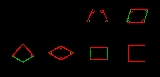
In Euclidean plane geometry
Euclidean geometry
Euclidean geometry is a mathematical system attributed to the Alexandrian Greek mathematician Euclid, which he described in his textbook on geometry: the Elements. Euclid's method consists in assuming a small set of intuitively appealing axioms, and deducing many other propositions from these...

, a quadrilateral is a polygon
Polygon
In geometry a polygon is a flat shape consisting of straight lines that are joined to form a closed chain orcircuit.A polygon is traditionally a plane figure that is bounded by a closed path, composed of a finite sequence of straight line segments...

 with four sides (or 'edges') and four vertices or corners. Sometimes, the term quadrangle is used, by analogy with triangle
Triangle
A triangle is one of the basic shapes of geometry: a polygon with three corners or vertices and three sides or edges which are line segments. A triangle with vertices A, B, and C is denoted ....

, and sometimes tetragon for consistency with pentagon
Pentagon
In geometry, a pentagon is any five-sided polygon. A pentagon may be simple or self-intersecting. The sum of the internal angles in a simple pentagon is 540°. A pentagram is an example of a self-intersecting pentagon.- Regular pentagons :In a regular pentagon, all sides are equal in length and...

 (5-sided), hexagon (6-sided) and so on. The word quadrilateral is made of the words quad (meaning "four") and lateral (meaning "of sides").
Discussion
Ask a question about 'Quadrilateral'
Start a new discussion about 'Quadrilateral'
Answer questions from other users
Full Discussion Forum
 
Unanswered Questions
Recent Discussions
Encyclopedia
In Euclidean plane geometry
Euclidean geometry
Euclidean geometry is a mathematical system attributed to the Alexandrian Greek mathematician Euclid, which he described in his textbook on geometry: the Elements. Euclid's method consists in assuming a small set of intuitively appealing axioms, and deducing many other propositions from these...

, a quadrilateral is a polygon
Polygon
In geometry a polygon is a flat shape consisting of straight lines that are joined to form a closed chain orcircuit.A polygon is traditionally a plane figure that is bounded by a closed path, composed of a finite sequence of straight line segments...

 with four sides (or 'edges') and four vertices or corners. Sometimes, the term quadrangle is used, by analogy with triangle
Triangle
A triangle is one of the basic shapes of geometry: a polygon with three corners or vertices and three sides or edges which are line segments. A triangle with vertices A, B, and C is denoted ....

, and sometimes tetragon for consistency with pentagon
Pentagon
In geometry, a pentagon is any five-sided polygon. A pentagon may be simple or self-intersecting. The sum of the internal angles in a simple pentagon is 540°. A pentagram is an example of a self-intersecting pentagon.- Regular pentagons :In a regular pentagon, all sides are equal in length and...

 (5-sided), hexagon (6-sided) and so on. The word quadrilateral is made of the words quad (meaning "four") and lateral (meaning "of sides").

The origin of the word quadrilateral is from the two Latin words "quadri", a variant of four, and "latus" meaning side.

Quadrilaterals are simple
Simple polygon
In geometry, a simple polygon is a closed polygonal chain of line segments in the plane which do not have points in common other than the common vertices of pairs of consecutive segments....

 (not self-intersecting) or complex
Complex polygon
The term complex polygon can mean two different things:*In computer graphics, as a polygon which is neither convex nor concave.*In geometry, as a polygon in the unitary plane, which has two complex dimensions.-Computer graphics:...

 (self-intersecting), also called crossed. Simple quadrilaterals are either convex
Convex polygon
In geometry, a polygon can be either convex or concave .- Convex polygons :A convex polygon is a simple polygon whose interior is a convex set...

 or concave.

The interior angles of a simple quadrilateral add up to 360 degrees of arc. This is a special case of the n-gon interior angle sum formula (n - 2)×180°. In a crossed quadrilateral, the interior angles on either side of the crossing add up to 720°.

All convex quadrilaterals tile the plane
Tessellation
A tessellation or tiling of the plane is a pattern of plane figures that fills the plane with no overlaps and no gaps. One may also speak of tessellations of parts of the plane or of other surfaces. Generalizations to higher dimensions are also possible. Tessellations frequently appeared in the art...

 by repeated rotation around the midpoints of their edges.

Convex quadrilaterals - parallelograms


A parallelogram
Parallelogram
In Euclidean geometry, a parallelogram is a convex quadrilateral with two pairs of parallel sides. The opposite or facing sides of a parallelogram are of equal length and the opposite angles of a parallelogram are of equal measure...

 is a quadrilateral with two pairs of parallel sides. Equivalent conditions are that opposite sides are of equal length; that opposite angles are equal; or that the diagonals bisect each other. Parallelograms also include the square, rectangle, rhombus and rhomboid.
  • Rhombus
    Rhombus
    In Euclidean geometry, a rhombus or rhomb is a convex quadrilateral whose four sides all have the same length. The rhombus is often called a diamond, after the diamonds suit in playing cards, or a lozenge, though the latter sometimes refers specifically to a rhombus with a 45° angle.Every...

     or rhomb: all four sides are of equal length. Equivalent conditions are that opposite sides are parallel and opposite angles are equal, or that the diagonals perpendicularly bisect each other. An informal description is "a pushed-over square" (including a square).
  • Rhomboid
    Rhomboid
    Traditionally, in two-dimensional geometry, a rhomboid is a parallelogram in which adjacent sides are of unequal lengths and angles are oblique.A parallelogram with sides of equal length is a rhombus but not a rhomboid....

    : a parallelogram in which adjacent sides are of unequal lengths and angles are oblique (not right angles). Informally: "a pushed-over rectangle with no right angles."
  • Rectangle
    Rectangle
    In Euclidean plane geometry, a rectangle is any quadrilateral with four right angles. The term "oblong" is occasionally used to refer to a non-square rectangle...

    : all four angles are right angles. An equivalent condition is that the diagonals bisect each other and are equal in length. Informally: "a box or oblong" (including a square).
  • Square
    Square (geometry)
    In geometry, a square is a regular quadrilateral. This means that it has four equal sides and four equal angles...

     (regular quadrilateral): all four sides are of equal length (equilateral), and all four angles are right angles. An equivalent condition is that opposite sides are parallel (a square is a parallelogram), that the diagonals perpendicularly bisect each other, and are of equal length. A quadrilateral is a square if and only if it is both a rhombus and a rectangle (four equal sides and four equal angles).
  • Oblong
    Rectangle
    In Euclidean plane geometry, a rectangle is any quadrilateral with four right angles. The term "oblong" is occasionally used to refer to a non-square rectangle...

    : a term sometimes used to denote a rectangle which has unequal adjacent sides (i.e. a rectangle that is not a square).

Convex quadrilaterals - other

  • Kite
    Kite (geometry)
    In Euclidean geometry a kite is a quadrilateral whose four sides can be grouped into two pairs of equal-length sides that are next to each other. In contrast, a parallelogram also has two pairs of equal-length sides, but they are opposite each other rather than next to each other...

    : two pairs of adjacent sides are of equal length. This implies that one diagonal divides the kite into congruent triangles, and so the angles between the two pairs of equal sides are equal in measure. It also implies that the diagonals are perpendicular. (It is common, especially in the discussions on plane tessellations, to refer to the concave quadrilateral with these properties as a dart or arrowhead, with term kite being restricted to the convex shape.)
  • Orthodiagonal quadrilateral
    Orthodiagonal quadrilateral
    In Euclidean geometry, an orthodiagonal quadrilateral is a quadrilateral in which the diagonals cross at right angles. In other words, it is a four-sided figure in which the line segments between non-adjacent vertices are orthogonal to each other....

    : the diagonals cross at right angle
    Right angle
    In geometry and trigonometry, a right angle is an angle that bisects the angle formed by two halves of a straight line. More precisely, if a ray is placed so that its endpoint is on a line and the adjacent angles are equal, then they are right angles...

    s.
  • Trapezium
    Trapezoid
    In Euclidean geometry, a convex quadrilateral with one pair of parallel sides is referred to as a trapezoid in American English and as a trapezium in English outside North America. A trapezoid with vertices ABCD is denoted...

     (British English
    British English
    British English, or English , is the broad term used to distinguish the forms of the English language used in the United Kingdom from forms used elsewhere...

    ) or trapezoid
    Trapezoid
    In Euclidean geometry, a convex quadrilateral with one pair of parallel sides is referred to as a trapezoid in American English and as a trapezium in English outside North America. A trapezoid with vertices ABCD is denoted...

     (American English
    American English
    American English is a set of dialects of the English language used mostly in the United States. Approximately two-thirds of the world's native speakers of English live in the United States....

    ): one pair of opposite
    Opposite
    Opposite may refer to:* Opposite , a word that means the opposite of a word* Botany: "Opposite" is a kind of arrangement of leaves* Additive inverse, in mathematics, taking the negative of a number...

     sides are parallel
    Parallel (geometry)
    Parallelism is a term in geometry and in everyday life that refers to a property in Euclidean space of two or more lines or planes, or a combination of these. The assumed existence and properties of parallel lines are the basis of Euclid's parallel postulate. Two lines in a plane that do not...

    .
  • Isosceles trapezium (Brit.) or isosceles trapezoid
    Isosceles trapezoid
    In Euclidean geometry, an isosceles trapezoid is a convex quadrilateral with a line of symmetry bisecting one pair of opposite sides, making it automatically a trapezoid...

     (NAm.): one pair of opposite sides are parallel and the base angle
    Angle
    In geometry, an angle is the figure formed by two rays sharing a common endpoint, called the vertex of the angle.Angles are usually presumed to be in a Euclidean plane with the circle taken for standard with regard to direction. In fact, an angle is frequently viewed as a measure of an circular arc...

    s are equal in measure. This implies that the other two sides are of equal length, and that the diagonals are of equal length. An alternative definition is: "a quadrilateral with an axis of symmetry bisecting one pair of opposite sides".
  • Trapezium
    Trapezium
    The word trapezium has several meanings:* - a quadrilateral with one pair of parallel sides ....

     (NAm.): no sides are parallel. (In British English this would be called an irregular quadrilateral, and was once called a trapezoid.)
  • Cyclic quadrilateral
    Cyclic quadrilateral
    In Euclidean geometry, a cyclic quadrilateral is a quadrilateral whose vertices all lie on a single circle. This circle is called the circumcircle or circumscribed circle, and the vertices are said to be concyclic. Other names for these quadrilaterals are chordal quadrilateral and inscribed...

    : the four vertices lie on a circumscribed circle. A quadrilateral is cyclic if and only if opposite angles sum to 180°.
  • Tangential quadrilateral
    Tangential quadrilateral
    In Euclidean geometry, a tangential quadrilateral or circumscribed quadrilateral is a convex quadrilateral whose sides all lie tangent to a single circle inscribed within the quadrilateral. This circle is called the incircle...

    : the four edges are tangential to an inscribed circle. Another term for a tangential polygon is inscriptible.
  • Bicentric quadrilateral
    Bicentric quadrilateral
    In Euclidean geometry, a bicentric quadrilateral is a convex quadrilateral that has both an incircle and a circumcircle. This means they have all the properties of both tangential quadrilaterals and cyclic quadrilaterals...

    : both cyclic and tangential.
  • Ex-tangential quadrilateral
    Ex-tangential quadrilateral
    In Euclidean geometry, an ex-tangential quadrilateral is a convex quadrilateral where the extensions of all four sides are tangent to a circle outside the quadrilateral. It has also been called an exscriptible quadrilateral. The circle is called its excircle or its escribed circle, its radius the...

    : the four extensions of the sides are tangent to an excircle.


More quadrilaterals

  • A geometric chevron (dart or arrowhead) is a concave quadrilateral with bilateral symmetry like a kite, but one interior angle is reflex.
  • A self-intersecting quadrilateral is called variously a cross-quadrilateral, crossed quadrilateral, butterfly
    Butterfly
    A butterfly is a mainly day-flying insect of the order Lepidoptera, which includes the butterflies and moths. Like other holometabolous insects, the butterfly's life cycle consists of four parts: egg, larva, pupa and adult. Most species are diurnal. Butterflies have large, often brightly coloured...

     quadrilateral
    or bow-tie quadrilateral. A special case of crossed quadrilaterals are the antiparallelogram
    Antiparallelogram
    An antiparallelogram is a quadrilateral in which, like a parallelogram, the pairs of nonadjacent sides are congruent, but in which two opposite sides intersect and are therefore not parallel.-Properties:Every antiparallelogram has an axis of symmetry through its crossing point...

    s, crossed quadrilaterals in which (like a parallelogram
    Parallelogram
    In Euclidean geometry, a parallelogram is a convex quadrilateral with two pairs of parallel sides. The opposite or facing sides of a parallelogram are of equal length and the opposite angles of a parallelogram are of equal measure...

    ) each pair of nonadjacent sides has equal length.
  • A non-planar quadrilateral is called a skew quadrilateral. Formulas to compute its dihedral angles from the edge lengths and the angle between two adjacent edges were derived for work on the properties of molecules such as cyclobutane
    Cyclobutane
    Cyclobutane is an organic compound with the formula 4. Cyclobutane is a colourless gas and commercially available as a liquefied gas. Derivatives of cyclobutane are called cyclobutanes...

     that contain a "puckered" ring of four atoms. See skew polygon
    Skew polygon
    In geometry, a skew polygon is a polygon whose vertices do not lie in a plane. Skew polygons must have at least 4 vertices.A regular skew polygon is a skew polygon with equal edge lengths and which is vertex-transitive....

     for more.

Area of a convex quadrilateral


There are various general formulas for the area
Area
Area is a quantity that expresses the extent of a two-dimensional surface or shape in the plane. Area can be understood as the amount of material with a given thickness that would be necessary to fashion a model of the shape, or the amount of paint necessary to cover the surface with a single coat...

 K of a convex quadrilateral.

The area of a quadrilateral ABCD can be calculated using vectors. Let vectors AC and BD form the diagonals from A to C and from B to D. The area of the quadrilateral is then

which is the magnitude of the cross product
Cross product
In mathematics, the cross product, vector product, or Gibbs vector product is a binary operation on two vectors in three-dimensional space. It results in a vector which is perpendicular to both of the vectors being multiplied and normal to the plane containing them...

 of vectors AC and BD. In two-dimensional Euclidean space, expressing vector AC as a free vector in Cartesian space equal to (x1,y1) and BD as (x2,y2), this can be rewritten as:

The area can be expressed in trigonometric terms as

where the lengths of the diagonals are p and q and the angle between them is . In the case of an orthodiagonal quadrilateral e.g. rhombus, square, and kite, this formula reduces to since is 90°.

Bretschneider's formula expresses the area in terms of the sides and angles:

where the sides in sequence are , where is the semiperimeter, and and are any two opposite angles. This reduces to Brahmagupta's formula
Brahmagupta's formula
In Euclidean geometry, Brahmagupta's formula finds the area of any quadrilateral given the lengths of the sides and some of the angles. In its most common form, it yields the area of quadrilaterals that can be inscribed in a circle.- Basic form :...

 for the area of a cyclic quadrilateral when = 180°.

Another area formula in terms of the sides and angles, with being between sides b and c and being between sides a and d (adjacent sides belonged to the angles), is

In the case of a cyclic quadrilateral, the latter formula becomes

In a parallelogram, where both pairs of opposite sides and angles are equal, this formula reduces to

Next, the following formula expresses the area in terms of the sides and diagonals:

where p and q are the diagonals. Again, this reduces to Brahmagupta's formula in the cyclic quadrilateral case, since then .

Alternatively, we can write the area in terms of the sides and the intersection angle of the diagonals, so long as this angle is not 90°:

In the case of a parallelogram, the latter formula becomes

Area inequalities


If a convex quadrilateral has the consecutive sides a, b, c, d and the diagonals p, q, then its area K satisfy with equality only for a rectangle
Rectangle
In Euclidean plane geometry, a rectangle is any quadrilateral with four right angles. The term "oblong" is occasionally used to refer to a non-square rectangle...

. with equality only for a square
Square (geometry)
In geometry, a square is a regular quadrilateral. This means that it has four equal sides and four equal angles...

. with equality only if the diagonals are perpendicular and equal.

Euler's quadrilateral theorems


In any convex quadrilateral ABCD, the sum of the squares of the four sides is equal to the sum of the squares of the two diagonals plus four times the square of the line segment connecting the midpoints of the diagonals. Thus
where M and N are the midpoint of the diagonals AC and BD. This is sometimes known as Euler's quadrilateral theorem and is a generalization of the parallelogram law
Parallelogram law
In mathematics, the simplest form of the parallelogram law belongs to elementary geometry. It states that the sum of the squares of the lengths of the four sides of a parallelogram equals the sum of the squares of the lengths of the two diagonals...

.

Euler
Leonhard Euler
Leonhard Euler was a pioneering Swiss mathematician and physicist. He made important discoveries in fields as diverse as infinitesimal calculus and graph theory. He also introduced much of the modern mathematical terminology and notation, particularly for mathematical analysis, such as the notion...

 also generalized Ptolemy's theorem
Ptolemy's theorem
In Euclidean geometry, Ptolemy's theorem is a relation between the four sides and two diagonals of a cyclic quadrilateral . The theorem is named after the Greek astronomer and mathematician Ptolemy...

, which is an equality in a cyclic quadrilateral
Cyclic quadrilateral
In Euclidean geometry, a cyclic quadrilateral is a quadrilateral whose vertices all lie on a single circle. This circle is called the circumcircle or circumscribed circle, and the vertices are said to be concyclic. Other names for these quadrilaterals are chordal quadrilateral and inscribed...

, into an inequality for a convex quadrilateral. It states that
where there is equality if and only if
If and only if
In logic and related fields such as mathematics and philosophy, if and only if is a biconditional logical connective between statements....

 the quadrilateral is cyclic.

Miscellaneous facts about quadrilaterals in general

  • The length of the diagonal that is opposite to the adjacent sides a and b at angle θ is given by which is derived from the law of cosines
    Law of cosines
    In trigonometry, the law of cosines relates the lengths of the sides of a plane triangle to the cosine of one of its angles. Using notation as in Fig...

    .
  • The midpoints of the sides of a quadrilateral are the vertices of a parallelogram. The area of this inner parallelogram equals one-half the area of the outer quadrilateral. The perimeter of the inner parallelogram equals the sum of the diagonals of the outer quadrilateral.
  • Let exterior squares be drawn on all sides of a quadrilateral. The segments connecting the centers of opposite squares are (a) equal in length, and (b) perpendicular.
  • The line segment joining the midpoints of two opposite sides of any quadrilateral, the segment joining the midpoints of the other two sides, and the segment joining the midpoints of the diagonals are concurrent
    Concurrent lines
    In geometry, two or more lines are said to be concurrent if they intersect at a single point.In a triangle, four basic types of sets of concurrent lines are altitudes, angle bisectors, medians, and perpendicular bisectors:...

     and are all bisected by their point of intersection.
  • The internal bisectors of the angles of a quadrilateral form a cyclic quadrilateral
    Cyclic quadrilateral
    In Euclidean geometry, a cyclic quadrilateral is a quadrilateral whose vertices all lie on a single circle. This circle is called the circumcircle or circumscribed circle, and the vertices are said to be concyclic. Other names for these quadrilaterals are chordal quadrilateral and inscribed...

    .
  • Among all quadrilaterals with a given perimeter, the one with the largest area is the square
    Square (geometry)
    In geometry, a square is a regular quadrilateral. This means that it has four equal sides and four equal angles...

    . This is called the isoperimetric theorem for quadrilaterals.
  • For any simple quadrilateral with given edge lengths, there is a cyclic quadrilateral
    Cyclic quadrilateral
    In Euclidean geometry, a cyclic quadrilateral is a quadrilateral whose vertices all lie on a single circle. This circle is called the circumcircle or circumscribed circle, and the vertices are said to be concyclic. Other names for these quadrilaterals are chordal quadrilateral and inscribed...

     with the same edge lengths.
  • The quadrilateral with given side lengths that has the maximum
    Maxima and minima
    In mathematics, the maximum and minimum of a function, known collectively as extrema , are the largest and smallest value that the function takes at a point either within a given neighborhood or on the function domain in its entirety .More generally, the...

     area is the cyclic quadrilateral
    Cyclic quadrilateral
    In Euclidean geometry, a cyclic quadrilateral is a quadrilateral whose vertices all lie on a single circle. This circle is called the circumcircle or circumscribed circle, and the vertices are said to be concyclic. Other names for these quadrilaterals are chordal quadrilateral and inscribed...

    .

Special line segments

  • The two diagonals of a convex quadrilateral are the line segment
    Line segment
    In geometry, a line segment is a part of a line that is bounded by two end points, and contains every point on the line between its end points. Examples of line segments include the sides of a triangle or square. More generally, when the end points are both vertices of a polygon, the line segment...

    s that connect opposite vertices.

  • The two bimedians of a convex quadrilateral are the line segments that connect the midpoints of opposite sides. They intersect at the centroid
    Centroid
    In geometry, the centroid, geometric center, or barycenter of a plane figure or two-dimensional shape X is the intersection of all straight lines that divide X into two parts of equal moment about the line. Informally, it is the "average" of all points of X...

     of the quadrilateral.

  • The four maltitudes of a convex quadrilateral are the perpendiculars to a side through the midpoint of the opposite side.

  • The eight tangent lengths of a tangential quadrilateral
    Tangential quadrilateral
    In Euclidean geometry, a tangential quadrilateral or circumscribed quadrilateral is a convex quadrilateral whose sides all lie tangent to a single circle inscribed within the quadrilateral. This circle is called the incircle...

     are the line segments from a vertex
    Vertex (geometry)
    In geometry, a vertex is a special kind of point that describes the corners or intersections of geometric shapes.-Of an angle:...

     to the points where the incircle is tangent
    Tangent
    In geometry, the tangent line to a plane curve at a given point is the straight line that "just touches" the curve at that point. More precisely, a straight line is said to be a tangent of a curve at a point on the curve if the line passes through the point on the curve and has slope where f...

     to the sides. From each vertex there are two congruent tangent lengths.

  • The two tangency chords of a tangential quadrilateral are the line segments that connect points on opposite sides where the incircle is tangent to these sides. These are also the diagonals of the contact quadrilateral.

Bimedians


The length of the bimedians in a convex quadrilateral with sides a, b, c, d are given by


and


where p and q are the length of the diagonals. Hence

Taxonomy


A taxonomy
Taxonomy
Taxonomy is the science of identifying and naming species, and arranging them into a classification. The field of taxonomy, sometimes referred to as "biological taxonomy", revolves around the description and use of taxonomic units, known as taxa...

 of quadrilaterals is illustrated by the following graph. Lower forms are special cases of higher forms. Note that "trapezium" here is referring to the British definition (the North American equivalent is a trapezoid), and "kite" excludes the concave kite (arrowhead or dart). Inclusive definitions are used throughout.


Miscellaneous facts about special quadrilaterals

  • The diagonals of a crossed or concave quadrilateral do not intersect inside the shape.
  • The diagonals of a rhombus bisect the angles.
  • Let ABCD be a trapezoid (in the U.S. sense of having two parallel sides) with vertices A, B, C, and D in sequence and with parallel sides AB and DC. Let E be the intersection of the diagonals, and let F be on side DA and G be on side BC such that FEG is parallel to AB and CD. Then FG is the harmonic mean
    Harmonic mean
    In mathematics, the harmonic mean is one of several kinds of average. Typically, it is appropriate for situations when the average of rates is desired....

     of AB and DC:
  • A parallelogram with equal diagonals is a rectangle.
  • A cyclic quadrilateral with successive sides a, b, c, d and diagonals p, q has pq=ac+bd.
  • A cyclic quadrilateral with successive vertices A, B, C, D and successive sides a=AB, b=BC, c=CD, and d=DA and with diagonals p=AC and q=BD has:
    and
  • A cyclic quadrilateral with successive sides a, b, c, d and semiperimeter s has circumradius (the radius of the circumscribing circle) given by
  • A parallelogram with diagonals p, q and successive sides a, b, c, and d with d=b and c=a has
  • For any point P in the interior of a rectangle with successive vertices A, B, C, D, we have
  • Any line through the midpoint (centroid) of a parallelogram bisects the area.
  • An orthodiagonal quadrilateral
    Orthodiagonal quadrilateral
    In Euclidean geometry, an orthodiagonal quadrilateral is a quadrilateral in which the diagonals cross at right angles. In other words, it is a four-sided figure in which the line segments between non-adjacent vertices are orthogonal to each other....

     (one with perpendicular diagonals) with sides a, b, c, d in sequence has
  • There are no cyclic quadrilaterals with unequal rational sides in arithmetic progression and with rational area.
  • There are no cyclic quadrilaterals with unequal rational sides in geometric progression and with rational area.

See also

  • Bicentric quadrilateral
    Bicentric quadrilateral
    In Euclidean geometry, a bicentric quadrilateral is a convex quadrilateral that has both an incircle and a circumcircle. This means they have all the properties of both tangential quadrilaterals and cyclic quadrilaterals...

  • Cyclic quadrilateral
    Cyclic quadrilateral
    In Euclidean geometry, a cyclic quadrilateral is a quadrilateral whose vertices all lie on a single circle. This circle is called the circumcircle or circumscribed circle, and the vertices are said to be concyclic. Other names for these quadrilaterals are chordal quadrilateral and inscribed...

  • Ex-tangential quadrilateral
    Ex-tangential quadrilateral
    In Euclidean geometry, an ex-tangential quadrilateral is a convex quadrilateral where the extensions of all four sides are tangent to a circle outside the quadrilateral. It has also been called an exscriptible quadrilateral. The circle is called its excircle or its escribed circle, its radius the...

  • Kite
    Kite (geometry)
    In Euclidean geometry a kite is a quadrilateral whose four sides can be grouped into two pairs of equal-length sides that are next to each other. In contrast, a parallelogram also has two pairs of equal-length sides, but they are opposite each other rather than next to each other...

  • Orthodiagonal quadrilateral
    Orthodiagonal quadrilateral
    In Euclidean geometry, an orthodiagonal quadrilateral is a quadrilateral in which the diagonals cross at right angles. In other words, it is a four-sided figure in which the line segments between non-adjacent vertices are orthogonal to each other....

  • Parallelogram
    Parallelogram
    In Euclidean geometry, a parallelogram is a convex quadrilateral with two pairs of parallel sides. The opposite or facing sides of a parallelogram are of equal length and the opposite angles of a parallelogram are of equal measure...

  • Rectangle
    Rectangle
    In Euclidean plane geometry, a rectangle is any quadrilateral with four right angles. The term "oblong" is occasionally used to refer to a non-square rectangle...

  • Rhombus
    Rhombus
    In Euclidean geometry, a rhombus or rhomb is a convex quadrilateral whose four sides all have the same length. The rhombus is often called a diamond, after the diamonds suit in playing cards, or a lozenge, though the latter sometimes refers specifically to a rhombus with a 45° angle.Every...

  • Square
    Square (geometry)
    In geometry, a square is a regular quadrilateral. This means that it has four equal sides and four equal angles...

  • Tangential quadrilateral
    Tangential quadrilateral
    In Euclidean geometry, a tangential quadrilateral or circumscribed quadrilateral is a convex quadrilateral whose sides all lie tangent to a single circle inscribed within the quadrilateral. This circle is called the incircle...

  • Trapezoid
    Trapezoid
    In Euclidean geometry, a convex quadrilateral with one pair of parallel sides is referred to as a trapezoid in American English and as a trapezium in English outside North America. A trapezoid with vertices ABCD is denoted...


External links