

27th century BC

Encyclopedia
The 27th century BC is a century
which lasted from the year 2700 BC to 2601 BC.
Century
A century is one hundred consecutive years. Centuries are numbered ordinally in English and many other languages .-Start and end in the Gregorian Calendar:...
which lasted from the year 2700 BC to 2601 BC.
Events
- 2900 BC – 2334 BC: MesopotamiaMesopotamiaMesopotamia is a toponym for the area of the Tigris–Euphrates river system, largely corresponding to modern-day Iraq, northeastern Syria, southeastern Turkey and southwestern Iran.Widely considered to be the cradle of civilization, Bronze Age Mesopotamia included Sumer and the...
n wars of the Early Dynastic period. - 2775 BC – 2650 BC: Second Dynasty wars in EgyptEgyptEgypt , officially the Arab Republic of Egypt, Arabic: , is a country mainly in North Africa, with the Sinai Peninsula forming a land bridge in Southwest Asia. Egypt is thus a transcontinental country, and a major power in Africa, the Mediterranean Basin, the Middle East and the Muslim world...
. - 2750 BC – 2600 BC: Ancient burial sites with human Skeletons are created; they are later discovered in Ibbankatuwa, DambullaDambullaThe city of Dambulla is situated in the Matale District in the Central Province of Sri Lanka, situated 148 km north-east of Colombo and 72 km north of Kandy....
in Sri LankaSri LankaSri Lanka, officially the Democratic Socialist Republic of Sri Lanka is a country off the southern coast of the Indian subcontinent. Known until 1972 as Ceylon , Sri Lanka is an island surrounded by the Indian Ocean, the Gulf of Mannar and the Palk Strait, and lies in the vicinity of India and the...
. - 2737 BC: Invention of teaTeaTea is an aromatic beverage prepared by adding cured leaves of the Camellia sinensis plant to hot water. The term also refers to the plant itself. After water, tea is the most widely consumed beverage in the world...
as a beverage by ShennongShennongShennong , which names mean "Divine Farmer", but also known as the Emperor of the Five Grains , was a legendary ruler of China and culture hero reputed to have lived some 5,000 years ago...
, according to a Chinese legend. - 2700 BC: Early Dynastic (ArchaicEarly Dynastic Period of EgyptThe Archaic or Early Dynastic Period of Egypt immediately follows the unification of Lower and Upper Egypt c. 3100 BC. It is generally taken to include the First and Second Dynasties, lasting from the Protodynastic Period of Egypt until about 2686 BC, or the beginning of the Old Kingdom...
) period ended in Ancient EgyptAncient EgyptAncient Egypt was an ancient civilization of Northeastern Africa, concentrated along the lower reaches of the Nile River in what is now the modern country of Egypt. Egyptian civilization coalesced around 3150 BC with the political unification of Upper and Lower Egypt under the first pharaoh...
(according to FrenchFranceThe French Republic , The French Republic , The French Republic , (commonly known as France , is a unitary semi-presidential republic in Western Europe with several overseas territories and islands located on other continents and in the Indian, Pacific, and Atlantic oceans. Metropolitan France...
Egyptologist Nicolas Grimol). This period includes 1st and 2nd Dyasties. - c. 2700 BC: Old KingdomOld KingdomOld Kingdom is the name given to the period in the 3rd millennium BC when Egypt attained its first continuous peak of civilization in complexity and achievement – the first of three so-called "Kingdom" periods, which mark the high points of civilization in the lower Nile Valley .The term itself was...
started in Ancient EgyptAncient EgyptAncient Egypt was an ancient civilization of Northeastern Africa, concentrated along the lower reaches of the Nile River in what is now the modern country of Egypt. Egyptian civilization coalesced around 3150 BC with the political unification of Upper and Lower Egypt under the first pharaoh...
. 3rd–6th Dynasties. - c. 2697 BC:Yellow EmperorYellow EmperorThe Yellow Emperor or Huangdi1 is a legendary Chinese sovereign and culture hero, included among the Three Sovereigns and Five Emperors. Tradition holds that he reigned from 2697–2597 or 2696–2598 BC...
started in ChinaChinaChinese civilization may refer to:* China for more general discussion of the country.* Chinese culture* Greater China, the transnational community of ethnic Chinese.* History of China* Sinosphere, the area historically affected by Chinese culture...
. - c. 2686 BC: Early Dynastic (Archaic) period ends in Ancient EgyptAncient EgyptAncient Egypt was an ancient civilization of Northeastern Africa, concentrated along the lower reaches of the Nile River in what is now the modern country of Egypt. Egyptian civilization coalesced around 3150 BC with the political unification of Upper and Lower Egypt under the first pharaoh...
(other date is 2700 BC). - c. 2686 BC: Old Kingdom starts in Ancient Egypt (other date is 2700 BC).
- 2686 BC: EgyptEgyptEgypt , officially the Arab Republic of Egypt, Arabic: , is a country mainly in North Africa, with the Sinai Peninsula forming a land bridge in Southwest Asia. Egypt is thus a transcontinental country, and a major power in Africa, the Mediterranean Basin, the Middle East and the Muslim world...
: End of Second DynastySecond dynasty of EgyptThe second dynasty of ancient Egypt is often combined with Dynasty I under the group title Early Dynastic Period. It dates approximately from 2890 to 2686 BC. The capital at that time was Thinis.-Rulers:...
, start of Third DynastyThird dynasty of EgyptFor the Sumerian Renaissance, see Third Dynasty of Ur.The Third Dynasty of ancient Egypt is the first dynasty of the Old Kingdom. Other dynasties of the Old Kingdom include the Fourth, Fifth and Sixth...
. PharaohPharaohPharaoh is a title used in many modern discussions of the ancient Egyptian rulers of all periods. The title originates in the term "pr-aa" which means "great house" and describes the royal palace...
KhasekhemwyKhasekhemwyKhasekhemwy was the fifth and final king of the Second dynasty of Egypt. Little is known of Khasekhemwy, other than that he led several significant military campaigns and built several monuments, still extant, mentioning war against the Northerners...
died. PharaohPharaohPharaoh is a title used in many modern discussions of the ancient Egyptian rulers of all periods. The title originates in the term "pr-aa" which means "great house" and describes the royal palace...
SanakhteSanakhteSanakht, generally identified with the Nebka of much later king lists, was probably either the first or second pharaoh of the Third Dynasty of Ancient Egypt. The dates assigned to his reign by Shaw are ca. 2686-2667 BC; for various conjectures of other scholars, see the...
started to reign. - c. 2685 BC: Bull lyreLyres of UrThe Lyres of Ur or Harps of Ur are considered to be the worlds oldest surviving stringed instruments. In 1929, archaeologists discovered pieces of three lyres and one harp in Ur, located in what was Ancient Mesopotamia and is contemporary Iraq...
, from the tomb of Queen PuabiPuabiPuabi , also called Shubad in Sumerian, was an important person in the Sumerian city of Ur, during the First Dynasty of Ur . Commonly labeled as a "queen", her status is somewhat in dispute. Several cylinder seals in her tomb identify her by the title "nin" or "eresh", a Sumerian word which can...
, UrUrUr was an important city-state in ancient Sumer located at the site of modern Tell el-Muqayyar in Iraq's Dhi Qar Governorate...
(modern Muqaiyir, IraqIraqIraq ; officially the Republic of Iraq is a country in Western Asia spanning most of the northwestern end of the Zagros mountain range, the eastern part of the Syrian Desert and the northern part of the Arabian Desert....
) was made. It is now in University MuseumUniversity MuseumUniversity Museum is a historic building that houses several museums on the campus of Harvard University on 11-25 Divinity Avenue in Cambridge, Massachusetts. The building houses both the Harvard Museum of Natural History and the Peabody Museum of Archaeology and Ethnology.The structure was built...
, University of PennsylvaniaUniversity of PennsylvaniaThe University of Pennsylvania is a private, Ivy League university located in Philadelphia, Pennsylvania, United States. Penn is the fourth-oldest institution of higher education in the United States,Penn is the fourth-oldest using the founding dates claimed by each institution...
, Philadelphia. - c. 2681 BC – c. 2662 BC: Reign of DjoserDjoserNetjerikhet or Djoser is the best-known pharaoh of the Third dynasty of Egypt. He commissioned his official, Imhotep, to build the first of the pyramids, a step pyramid for him at Saqqara...
, PharaohPharaohPharaoh is a title used in many modern discussions of the ancient Egyptian rulers of all periods. The title originates in the term "pr-aa" which means "great house" and describes the royal palace...
of EgyptEgyptEgypt , officially the Arab Republic of Egypt, Arabic: , is a country mainly in North Africa, with the Sinai Peninsula forming a land bridge in Southwest Asia. Egypt is thus a transcontinental country, and a major power in Africa, the Mediterranean Basin, the Middle East and the Muslim world...
, Third Dynasty. - 2668 BC: PharaohPharaohPharaoh is a title used in many modern discussions of the ancient Egyptian rulers of all periods. The title originates in the term "pr-aa" which means "great house" and describes the royal palace...
SanakhteSanakhteSanakht, generally identified with the Nebka of much later king lists, was probably either the first or second pharaoh of the Third Dynasty of Ancient Egypt. The dates assigned to his reign by Shaw are ca. 2686-2667 BC; for various conjectures of other scholars, see the...
died. - c. 2667 BC: PharaohPharaohPharaoh is a title used in many modern discussions of the ancient Egyptian rulers of all periods. The title originates in the term "pr-aa" which means "great house" and describes the royal palace...
DjoserDjoserNetjerikhet or Djoser is the best-known pharaoh of the Third dynasty of Egypt. He commissioned his official, Imhotep, to build the first of the pyramids, a step pyramid for him at Saqqara...
starts to rule (other date is 2681 BC). - 2660 BC: ArchaicEarly Dynastic Period of EgyptThe Archaic or Early Dynastic Period of Egypt immediately follows the unification of Lower and Upper Egypt c. 3100 BC. It is generally taken to include the First and Second Dynasties, lasting from the Protodynastic Period of Egypt until about 2686 BC, or the beginning of the Old Kingdom...
period ends in Ancient EgyptAncient EgyptAncient Egypt was an ancient civilization of Northeastern Africa, concentrated along the lower reaches of the Nile River in what is now the modern country of Egypt. Egyptian civilization coalesced around 3150 BC with the political unification of Upper and Lower Egypt under the first pharaoh...
. - c. 2660 BC: Old KingdomOld KingdomOld Kingdom is the name given to the period in the 3rd millennium BC when Egypt attained its first continuous peak of civilization in complexity and achievement – the first of three so-called "Kingdom" periods, which mark the high points of civilization in the lower Nile Valley .The term itself was...
in Ancient EgyptAncient EgyptAncient Egypt was an ancient civilization of Northeastern Africa, concentrated along the lower reaches of the Nile River in what is now the modern country of Egypt. Egyptian civilization coalesced around 3150 BC with the political unification of Upper and Lower Egypt under the first pharaoh...
started (Another date is 2715 BC). - c. 2648 BC: PharaohPharaohPharaoh is a title used in many modern discussions of the ancient Egyptian rulers of all periods. The title originates in the term "pr-aa" which means "great house" and describes the royal palace...
DjoserDjoserNetjerikhet or Djoser is the best-known pharaoh of the Third dynasty of Egypt. He commissioned his official, Imhotep, to build the first of the pyramids, a step pyramid for him at Saqqara...
dies (another date is 2662 BC). - c. 2640 BC: The cultivation and weaving of silkSilkSilk is a natural protein fiber, some forms of which can be woven into textiles. The best-known type of silk is obtained from the cocoons of the larvae of the mulberry silkworm Bombyx mori reared in captivity...
starts to be a closely guarded secret in ChinaChinaChinese civilization may refer to:* China for more general discussion of the country.* Chinese culture* Greater China, the transnational community of ethnic Chinese.* History of China* Sinosphere, the area historically affected by Chinese culture...
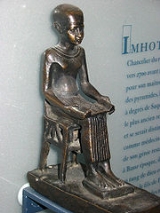
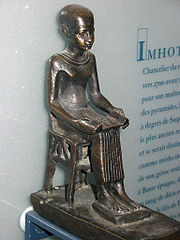
. - 2630 BC – 2611 BC: ImhotepImhotepImhotep , fl. 27th century BC was an Egyptian polymath, who served under the Third Dynasty king Djoser as chancellor to the pharaoh and high priest of the sun god Ra at Heliopolis...
, Vizier of EgyptEgyptEgypt , officially the Arab Republic of Egypt, Arabic: , is a country mainly in North Africa, with the Sinai Peninsula forming a land bridge in Southwest Asia. Egypt is thus a transcontinental country, and a major power in Africa, the Mediterranean Basin, the Middle East and the Muslim world...
, constructs the Pyramid of DjoserPyramid of DjoserThe Pyramid of Djoser , or step pyramid is an archeological remain in the Saqqara necropolis, Egypt, northwest of the city of Memphis. It was built during the 27th century BC for the burial of Pharaoh Djoser by Imhotep, his vizier... - 2627 BC – 2000 BC: Construction of the CaralCaralCaral was a large settlement in the Supe Valley, near Supe, Barranca province, Peru, some 200 km north of Lima. Caral is the most ancient city of the Americas, and is a well-studied site of the Caral civilization or Norte Chico civilization.- History :...
metropolis in PeruPeruPeru , officially the Republic of Peru , is a country in western South America. It is bordered on the north by Ecuador and Colombia, on the east by Brazil, on the southeast by Bolivia, on the south by Chile, and on the west by the Pacific Ocean.... - 2613 BC: EgyptEgyptEgypt , officially the Arab Republic of Egypt, Arabic: , is a country mainly in North Africa, with the Sinai Peninsula forming a land bridge in Southwest Asia. Egypt is thus a transcontinental country, and a major power in Africa, the Mediterranean Basin, the Middle East and the Muslim world...
—End of Third DynastyThird dynasty of EgyptFor the Sumerian Renaissance, see Third Dynasty of Ur.The Third Dynasty of ancient Egypt is the first dynasty of the Old Kingdom. Other dynasties of the Old Kingdom include the Fourth, Fifth and Sixth...
, start of Fourth DynastyFourth dynasty of EgyptThe fourth dynasty of ancient Egypt is characterized as a "golden age" of the Old Kingdom. Dynasty IV lasted from ca. 2613 to 2494 BC...
. PharaohPharaohPharaoh is a title used in many modern discussions of the ancient Egyptian rulers of all periods. The title originates in the term "pr-aa" which means "great house" and describes the royal palace...
HuniHuniHuni was the last Pharaoh of Egypt of the Third dynasty. He was the successor to Khaba.-Family:Huni was the father of Hetepheres I, the wife of Sneferu who was the first king of the Fourth Dynasty...
died. PharaohPharaohPharaoh is a title used in many modern discussions of the ancient Egyptian rulers of all periods. The title originates in the term "pr-aa" which means "great house" and describes the royal palace...
SneferuSneferuSneferu, also spelled as Snephru, Snefru or Snofru , was the founder of the Fourth dynasty of Egypt. Estimates of his reign vary, with for instance The Oxford History of Ancient Egypt suggesting a reign from around 2613 BC to 2589 BC, a reign of 24 years, while Rolf Krauss suggests a 30-year reign...
started to reign. - c. 2613 BC – 2494 BC: The Great Sphinx at Giza is built. Fourth DynastyFourth dynasty of EgyptThe fourth dynasty of ancient Egypt is characterized as a "golden age" of the Old Kingdom. Dynasty IV lasted from ca. 2613 to 2494 BC...
. - c. 2601 BC – c. 2515 BC: Great Pyramids at Giza are built for Menkaure, Khafre and KhufuKhufuKhufu , also known as Cheops or, in Manetho, Suphis , was a Pharaoh of Ancient Egypt's Old Kingdom. He reigned from around 2589 to 2566 BC. Khufu was the second pharaoh of the Fourth Dynasty. He is generally accepted as being the builder of the Great Pyramid of Giza, one of the Seven Wonders of...
. Fourth DynastyFourth dynasty of EgyptThe fourth dynasty of ancient Egypt is characterized as a "golden age" of the Old Kingdom. Dynasty IV lasted from ca. 2613 to 2494 BC...
. - c. 2601 BC: KhufuKhufuKhufu , also known as Cheops or, in Manetho, Suphis , was a Pharaoh of Ancient Egypt's Old Kingdom. He reigned from around 2589 to 2566 BC. Khufu was the second pharaoh of the Fourth Dynasty. He is generally accepted as being the builder of the Great Pyramid of Giza, one of the Seven Wonders of...
started to rule in Ancient EgyptAncient EgyptAncient Egypt was an ancient civilization of Northeastern Africa, concentrated along the lower reaches of the Nile River in what is now the modern country of Egypt. Egyptian civilization coalesced around 3150 BC with the political unification of Upper and Lower Egypt under the first pharaoh...
. - 2600 BC: Mature HarappanHarappanHarappan can refer to:* Aspects related to Harappa an archaeological site and city in northeast Pakistan* The Indus Valley Civilization that thrived along Indus River...
phase of the Indus Valley CivilizationIndus Valley CivilizationThe Indus Valley Civilization was a Bronze Age civilization that was located in the northwestern region of the Indian subcontinent, consisting of what is now mainly modern-day Pakistan and northwest India...
begins. The cities of HarappaHarappaHarappa is an archaeological site in Punjab, northeast Pakistan, about west of Sahiwal. The site takes its name from a modern village located near the former course of the Ravi River. The current village of Harappa is from the ancient site. Although modern Harappa has a train station left from...
and Mohenjo-daroMohenjo-daroMohenjo-daro is an archeological site situated in what is now the province of Sindh, Pakistan. Built around 2600 BC, it was one of the largest settlements of the ancient Indus Valley Civilization, and one of the world's earliest major urban settlements, existing at the same time as the...
become large metropolises and the civilization expands to over 2,500 cities and settlements across the whole of PakistanPakistanPakistan , officially the Islamic Republic of Pakistan is a sovereign state in South Asia. It has a coastline along the Arabian Sea and the Gulf of Oman in the south and is bordered by Afghanistan and Iran in the west, India in the east and China in the far northeast. In the north, Tajikistan...
, much of northern India, and parts of AfghanistanAfghanistanAfghanistan , officially the Islamic Republic of Afghanistan, is a landlocked country located in the centre of Asia, forming South Asia, Central Asia and the Middle East. With a population of about 29 million, it has an area of , making it the 42nd most populous and 41st largest nation in the world...
and IranIranIran , officially the Islamic Republic of Iran , is a country in Southern and Western Asia. The name "Iran" has been in use natively since the Sassanian era and came into use internationally in 1935, before which the country was known to the Western world as Persia...
, covering a region of around one million square miles, which was larger than the land area of its contemporaries EgyptEgyptEgypt , officially the Arab Republic of Egypt, Arabic: , is a country mainly in North Africa, with the Sinai Peninsula forming a land bridge in Southwest Asia. Egypt is thus a transcontinental country, and a major power in Africa, the Mediterranean Basin, the Middle East and the Muslim world...
and MesopotamiaMesopotamiaMesopotamia is a toponym for the area of the Tigris–Euphrates river system, largely corresponding to modern-day Iraq, northeastern Syria, southeastern Turkey and southwestern Iran.Widely considered to be the cradle of civilization, Bronze Age Mesopotamia included Sumer and the...
combined, and also had superior urban planningUrban planningUrban planning incorporates areas such as economics, design, ecology, sociology, geography, law, political science, and statistics to guide and ensure the orderly development of settlements and communities....
and sewageSewageSewage is water-carried waste, in solution or suspension, that is intended to be removed from a community. Also known as wastewater, it is more than 99% water and is characterized by volume or rate of flow, physical condition, chemical constituents and the bacteriological organisms that it contains...
systems. The civilization began using the mature Indus scriptIndus scriptThe term Indus script refers to short strings of symbols associated with the Indus Valley Civilization, in use during the Early Harappan and Mature Harappan period, between the 35th and 20th centuries BC. In spite of many attempts at decipherments and claims, it is as yet undeciphered...
for its writing system. - 2600 BC: End of the Early Dynastic II Period and the beginning of the Early Dynastic IIIa Period in MesopotamiaMesopotamiaMesopotamia is a toponym for the area of the Tigris–Euphrates river system, largely corresponding to modern-day Iraq, northeastern Syria, southeastern Turkey and southwestern Iran.Widely considered to be the cradle of civilization, Bronze Age Mesopotamia included Sumer and the...
. - 2700 BC: Mesoamericans begin to plant and domesticate cornMaizeMaize known in many English-speaking countries as corn or mielie/mealie, is a grain domesticated by indigenous peoples in Mesoamerica in prehistoric times. The leafy stalk produces ears which contain seeds called kernels. Though technically a grain, maize kernels are used in cooking as a vegetable...
.
Significant persons
- DjoserDjoserNetjerikhet or Djoser is the best-known pharaoh of the Third dynasty of Egypt. He commissioned his official, Imhotep, to build the first of the pyramids, a step pyramid for him at Saqqara...
, first PharaohPharaohPharaoh is a title used in many modern discussions of the ancient Egyptian rulers of all periods. The title originates in the term "pr-aa" which means "great house" and describes the royal palace...
of the Third dynasty of EgyptEgyptEgypt , officially the Arab Republic of Egypt, Arabic: , is a country mainly in North Africa, with the Sinai Peninsula forming a land bridge in Southwest Asia. Egypt is thus a transcontinental country, and a major power in Africa, the Mediterranean Basin, the Middle East and the Muslim world... - ImhotepImhotepImhotep , fl. 27th century BC was an Egyptian polymath, who served under the Third Dynasty king Djoser as chancellor to the pharaoh and high priest of the sun god Ra at Heliopolis...
, Vizier of EgyptEgyptEgypt , officially the Arab Republic of Egypt, Arabic: , is a country mainly in North Africa, with the Sinai Peninsula forming a land bridge in Southwest Asia. Egypt is thus a transcontinental country, and a major power in Africa, the Mediterranean Basin, the Middle East and the Muslim world...
and architectArchitectAn architect is a person trained in the planning, design and oversight of the construction of buildings. To practice architecture means to offer or render services in connection with the design and construction of a building, or group of buildings and the space within the site surrounding the...