

Tigris and Euphrates

Encyclopedia
Tigris and Euphrates is a German
strategy board game
designed by Reiner Knizia
and first published in 1997 by Hans im Glück
in German
(as Euphrat und Tigris). Before its publication, it was highly anticipated by German gamers hearing rumors of a "gamer
's game" designed by Knizia. Tigris and Euphrates won first prize in the 1998 Deutscher Spiele Preis
. A card game
version was released in 2005.
The game is set as a clash between neighboring dynasties at the dawn of civilization. The game is named after the rivers Tigris
and Euphrates
in the region now called the Middle-East. The rivers together formed natural borders for an area which harboured several grand ancient civilizations, including Sumer
, Babylonia
, and Assyria
. The Greeks called this area Mesopotamia
, which literally means "between the rivers".
and strategic
objectives. As with many games, short term objectives gain prominence when more players participate, as players have less chance to follow up on previous moves. Luck plays a role, as players draw tiles
from a bag, but it is seldom decisive. Players may selectively discard and redraw their tiles at the cost of one "action point", of which each has two per turn. The game does not use dice
.
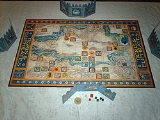
The board is a map of the two rivers, marked with a square grid. There are four types of tiles with corresponding leaders: temples and priests (red), farms and farmers (blue), markets and merchants (green) and settlements and kings (black). The game starts with ten isolated temple tiles already placed on the board. Players play tiles and leaders onto the board, creating and expanding regions and kingdoms. Monuments are built on the board when four tiles of the same color are played into a square pattern.
Two leaders of the same type can not coexist in the same kingdom. Internal conflicts are caused by players adding a second leader of a type to a kingdom. External conflicts are caused by players playing tiles to merge two existing kingdoms.
During the game, players collect points
in each of the four colors as a result of playing tiles, resolving conflicts and controlling monuments. After the final round each player sorts his or her points by color, including any "treasures" which they have acquired, which count as any color the player wishes. In order to limit specialization the player with the most points in their weakest category wins.
For example:
Players must balance their scoring and avoid overspecializing. Knizia later used this mechanism as the basis for Ingenious
.
Germany
Germany , officially the Federal Republic of Germany , is a federal parliamentary republic in Europe. The country consists of 16 states while the capital and largest city is Berlin. Germany covers an area of 357,021 km2 and has a largely temperate seasonal climate...
strategy board game
German-style board game
German-style board games, frequently referred to in gaming circles as Euro Games or Euro-style, are a broad class of tabletop games that generally have simple rules, short to medium playing times, indirect player interaction and abstract physical components...
designed by Reiner Knizia
Reiner Knizia
Reiner Knizia is a prolific German-style board game designer. Born in Germany, he developed his first game at the age of eight. He has a PhD in mathematics, and has been a full-time game designer since 1997, when he quit his job from the board of a large international bank...
and first published in 1997 by Hans im Glück
Hans im Glück
Hans im Glück Verlags-GmbH is a German board and card game publisher. Though many of their own games are language-independent they themselves publish only printings for the domestic market which include only German-language rules; English-language printings of their games have been published...
in German
German language
German is a West Germanic language, related to and classified alongside English and Dutch. With an estimated 90 – 98 million native speakers, German is one of the world's major languages and is the most widely-spoken first language in the European Union....
(as Euphrat und Tigris). Before its publication, it was highly anticipated by German gamers hearing rumors of a "gamer
Gamer
Historically, the term "gamer" usually referred to someone who played role-playing games and wargames. Since they became very popular, the term has included players of video games...
's game" designed by Knizia. Tigris and Euphrates won first prize in the 1998 Deutscher Spiele Preis
Deutscher Spiele Preis
The Deutscher Spiele Preis is an important award for boardgames. It was started in 1990 by the German magazine "Die Pöppel-Revue", which collects votes from the industry's stores, magazines, professionals and game clubs. The results are announced every October at the Spiel game fair in Essen,...
. A card game
Card game
A card game is any game using playing cards as the primary device with which the game is played, be they traditional or game-specific. Countless card games exist, including families of related games...
version was released in 2005.
The game is set as a clash between neighboring dynasties at the dawn of civilization. The game is named after the rivers Tigris
Tigris
The Tigris River is the eastern member of the two great rivers that define Mesopotamia, the other being the Euphrates. The river flows south from the mountains of southeastern Turkey through Iraq.-Geography:...
and Euphrates
Euphrates
The Euphrates is the longest and one of the most historically important rivers of Western Asia. Together with the Tigris, it is one of the two defining rivers of Mesopotamia...
in the region now called the Middle-East. The rivers together formed natural borders for an area which harboured several grand ancient civilizations, including Sumer
Sumer
Sumer was a civilization and historical region in southern Mesopotamia, modern Iraq during the Chalcolithic and Early Bronze Age....
, Babylonia
Babylon
Babylon was an Akkadian city-state of ancient Mesopotamia, the remains of which are found in present-day Al Hillah, Babil Province, Iraq, about 85 kilometers south of Baghdad...
, and Assyria
Assyria
Assyria was a Semitic Akkadian kingdom, extant as a nation state from the mid–23rd century BC to 608 BC centred on the Upper Tigris river, in northern Mesopotamia , that came to rule regional empires a number of times through history. It was named for its original capital, the ancient city of Assur...
. The Greeks called this area Mesopotamia
Mesopotamia
Mesopotamia is a toponym for the area of the Tigris–Euphrates river system, largely corresponding to modern-day Iraq, northeastern Syria, southeastern Turkey and southwestern Iran.Widely considered to be the cradle of civilization, Bronze Age Mesopotamia included Sumer and the...
, which literally means "between the rivers".
Gameplay
The game can be played by 2, 3 or 4 people. The play offers both tacticalMilitary tactics
Military tactics, the science and art of organizing an army or an air force, are the techniques for using weapons or military units in combination for engaging and defeating an enemy in battle. Changes in philosophy and technology over time have been reflected in changes to military tactics. In...
and strategic
Strategy
Strategy, a word of military origin, refers to a plan of action designed to achieve a particular goal. In military usage strategy is distinct from tactics, which are concerned with the conduct of an engagement, while strategy is concerned with how different engagements are linked...
objectives. As with many games, short term objectives gain prominence when more players participate, as players have less chance to follow up on previous moves. Luck plays a role, as players draw tiles
Tile-based game
A tile-based game is a game that uses tiles as one of the fundamental elements of play. Traditional tile-based games use small tiles as playing pieces for gambling or entertainment games...
from a bag, but it is seldom decisive. Players may selectively discard and redraw their tiles at the cost of one "action point", of which each has two per turn. The game does not use dice
Dice
A die is a small throwable object with multiple resting positions, used for generating random numbers...
.
The board is a map of the two rivers, marked with a square grid. There are four types of tiles with corresponding leaders: temples and priests (red), farms and farmers (blue), markets and merchants (green) and settlements and kings (black). The game starts with ten isolated temple tiles already placed on the board. Players play tiles and leaders onto the board, creating and expanding regions and kingdoms. Monuments are built on the board when four tiles of the same color are played into a square pattern.
Two leaders of the same type can not coexist in the same kingdom. Internal conflicts are caused by players adding a second leader of a type to a kingdom. External conflicts are caused by players playing tiles to merge two existing kingdoms.
During the game, players collect points
Score (game)
In games, score refers to an abstract quantity associated with a player or team. Score is usually measured in the abstract unit of points, and events in the game can raise or lower the score of different parties...
in each of the four colors as a result of playing tiles, resolving conflicts and controlling monuments. After the final round each player sorts his or her points by color, including any "treasures" which they have acquired, which count as any color the player wishes. In order to limit specialization the player with the most points in their weakest category wins.
For example:
- Alice has 6 black, 8 red, 12 green and 12 blue points; thus has a score of 6.
- Bob has 9 black, 10 red, 7 green and 15 blue points; thus has a score of 7.
- Charlie has 14 black, 14 red, 5 green and 20 blue points; thus has a score of 5.
Players must balance their scoring and avoid overspecializing. Knizia later used this mechanism as the basis for Ingenious
Ingenious
Ingenious is the English name for Einfach Genial , a German abstract strategy board game designed by Reiner Knizia under commission from Sophisticated Games and published in 2004 by Kosmos...
.
External links
- Free, licensed online version at GameTable Online