
All Topics  
Snakes and ladders


   Email Print
   Bookmark   Link


Snakes and ladders


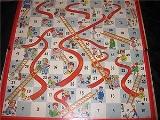
Snakes and ladders, or Chutes and ladders, is a classic children's board gameBoard game

A board game is a game played with counters or pieces that are placed on, removed from, or moved across a "board" ....
. It is played between 2 or more playerPlayer (game) Overview

A player of a game is a participant therein....
s on a playing board with numbered grid squares. On certain squares on the grid are drawn a number of "ladders" connecting two squares together, and a number of "snakes" or "chutes" also connecting squares together. The size of the grid (most commonly 8×8, 10×10 or 12×12) varies from board to board, as does the exact arrangement of the chutes and the ladders: both of these may affect the duration of game play. As a result, the game can be represented as a state absorbing Markov chainMarkov chain

In mathematics, a Markov chain, named after Andrey Markov, is a discrete-time stochastic process with the Markov property....
.

The game was sold as Snakes and ladders in EnglandEngland

England is the largest and most populous constituent country of the United Kingdom....
 before Milton BradleyMilton Bradley

Milton Bradley was an American game pioneer, credited by many with launching the game industry in North America....
 introduced the basic concept in the United StatesUnited States

The United States of America, also known as the United States, the U.S., the U.S.A., and America, is...
 as Chutes and ladders, an "improved new version of ... England's famous indoor sport." Its simplicity and the see-sawing nature of the contest make it popular with younger children, but the lack of any skill component in the game makes it less appealing for older players.

History

Snakes and ladders originated in India as a game based on morality. This game made its way to EnglandEngland

England is the largest and most populous constituent country of the United Kingdom....
, and was eventually introduced in the United States of America by game- pioneer Milton BradleyMilton Bradley

Milton Bradley was an American game pioneer, credited by many with launching the game industry in North America....
 in 1943.

The game was played widely in ancient IndiaIndia

India , officially the Republic of India, is a country in South Asia....
 by the name of Moksha Patamu, the earliest known Jain version Gyanbazi dating back to 16th century. The game was called "Leela" - and reflected the HinduismHinduism

Hinduism is a set of religious traditions that originated mainly in the Indian subcontinent....
 consciousness around everyday life. Impressed by the ideals behind the game, a newer version was introduced in Victorian England in 1892, possibly by John Jacques of Jacques of London.

Moksha Patamu was perhaps invented by Hindu spiritual teachers to teach children about the effects of good deeds as opposed to bad deeds. The Ladders represented virtues such as generosity, faith, humility, etc., and the Snakes represented vices such as lust, anger, murder, theft, etc. The moral of the game was that a person can attain salvation through performing good deeds whereas by doing evil one takes rebirth in lower forms of life (Patamu). The number of Ladders was less than the number of Snakes as a reminder that treading the path of good is very difficult compared to committing sins. Presumably the number "100" represented Moksha (Salvation).

Playing


Each player starts with a token in the starting square (usually the "1" grid square in the bottom left corner, or simply, the imaginary space beside the "1" grid square) and takes turns to roll a single dieDice

A die is a small polyhedral object, usually cubical, used for generating random numbers or other symbols....
 to move the token by the number of squares indicated by the die roll, following a fixed route marked on the gameboard which usually follows a boustrophedonBoustrophedon

Boustrophedon or boustrephedon is an ancient way of writing manuscripts and other inscriptions in which, rather than g...
 track from the bottom to the top of the playing area, passing once through every square. If, on completion of this move, they land on the lower-numbered end of the squares with a "ladder", they can move their token up to the higher-numbered square. If they land on the higher-numbered square of a pair with a "snake" (or chute), they must move their token down to the lower-numbered square.
A player who rolls a 6 with their die may, after moving, immediately take another turn; otherwise, the play passes to the next player in turn. If a player rolls three 6s on the die, they return to the beginning of the game and may not move until they roll another 6. The winner is the player whose token first reaches the last square of the track.

A variation exists where a player must roll the exact number to reach the final square (hence winning). Depending on the particular variation, if the roll of the die is too large the token remains where it is, or the token may proceed to the final square and then go backwards until it has transversed the same number of squares as the die shows. In some variations, there is one space with a ladder that leads directly to the final space.

Specific editions

The most widely known edition of Chutes and Ladders in the USA is Chutes and Ladders, produced by Milton BradleyMilton Bradley Company

The Milton Bradley Company was an American game company established by Milton Bradley in Springfield, Massachusetts in 1860....
 (which was purchased by the game's current distributor HasbroHasbro

Hasbro is an American toy and game company....
). It is played on a 10×10 board, and players advance their pieces according to a rather than a die. The theme of the board design is playgroundPlayground

A playground is an area designed for children to play freely....
 equipment--children climb ladders to go down chutes. The artwork on the board teaches a moralityMorality

Morality refers to the concept of human ethics which pertains to matters of good and evil —also referred to as "right ...
 lesson, the squares on the bottom of the ladders show a child doing a good or sensible deed and at the top of the ladder there is an image of the child enjoying the reward. At the top of the chutes, there are pictures of children engaging in mischievous or foolish behavior and the images on the bottom show the child suffering the consequences.
There have also been many Pop Culture versions of the game produced in recent years, with graphics featuring such characters as Dora the ExplorerDora the Explorer

Dora the Explorer is an American animated television series for preschool-age children that is broadcast on Nickelodeon ...
 and SpongeBob SquarePantsSpongeBob SquarePants

SpongeBob SquarePants is an American animated television series and media franchise....
.

In Canada the game has been traditionally sold as Snakes and Ladders, and produced by the Canada Games CompanyCanada Games Company

Canada Games was a Canadian games manufacturing company based in Brampton, Ontario, before moving to Concord....
. Several Canadian specific versions have been produced over the years, including version substituting TobogganToboggan

A toboggan is a simple sled used on snow, to carry one or, more usually, several people down a hill or other slope, for recr...
 runs for the snakes. With the demise of the Canada Games Company Chutes and Ladders produced by Milton Bradley/Hasbro has been gaining in popularity.

A version sold as Snakes & Ladders is available from Cardinal Games in both Canada and the United States.

The most common in the United Kingdom is Spear's Games'J. W. Spear & Sons

J. W. Spear and Sons was a significant manufacturer of board games during the 20th century....
 Edition of Snakes and Ladders, played on a 10x10 board where a single die is used.

During the early 1990s in South Africa, Chutes and Ladders games made from cardboard were distributed on the back of egg boxes as part of a promotion.

Mathematics of the game

Any version of Snakes and Ladders can be represented exactly as a Markov chainMarkov chain

In mathematics, a Markov chain, named after Andrey Markov, is a discrete-time stochastic process with the Markov property....
, since from any square the odds of moving to any other square are fixed and independent of any previous game history. The Milton Bradley version of Chutes and Ladders has 100 squares, with 19 chutes and ladders. A player will need an average of 45.6 spins to move from the starting point, which is off the board, to square 100.

In the book Winning Ways the authors show how to treat Snakes and Ladders as a impartial gameImpartial game

In combinatorial game theory, an impartial game is a game in which the allowable moves depend only on the position and not o...
 in combinatorial game theoryCombinatorial game theory

Combinatorial game theory is a mathematical theory that only studies two-player games which have a position which the pl...
 even though it is very far from a natural fit to this category. To this end they make a few "minor" rule changes such as allowing any player to move any counter any number of spaces, and declaring the winner to be the one who gets the last counter home. It is hard to deny that this version, which they call Adders-and-Ladders, involves more skill than does the original game.

External links

  • at tradgames.org
  • Sufi 
  • Ancient IndiaFacts About India

    India , officially the Republic of India, is a country in South Asia....
    n version of
  • Hasbro's official page
  • of Chutes and Ladders* by Harish Johari