


German-style board game

Encyclopedia
German-style board games, frequently referred to in gaming circles as Euro Games or Euro-style, are a broad class of tabletop game
s that generally have simple rules, short to medium playing times, indirect player interaction and abstract physical components (wood preferred to plastic). The games emphasize strategy, play down luck and conflict, lean towards economic rather than military themes, and usually keep all the players in the game until it ends. German-style games are sometimes contrasted with American-style games, which generally involve more luck, conflict, and drama.
German-style games are usually less abstract
than chess
, but more abstract than wargames
and train game
s. Likewise, they generally require more thought and planning than party game
s, such as Pictionary
or Trivial Pursuit
, but less than classic strategy games, such as chess
and Go
. Their rulebooks are typically four to twelve pages long and playing times are on the order of 30 to 120 minutes. These games appeal to a wide range of ages, though generally not very young children. The audience includes casual gamers, who play with family and friends, as well as more serious hobby gamers.
Not all German-style board games are German
, and not all German-style games are board games. As a result, various other names have been offered for the class. Eurogame is a common, though still imprecise, alternative label. Because most of these games feature the name of the designer prominently on the box they are sometimes known as designer games. Other names include family strategy game and hobby game. Shorter, lighter games in this class are known as gateway games, whereas longer, heavier games are known as gamers' games.
, appeared in the 1960s. However, the genre as a more concentrated design movement began in the late 1970s and early 1980s in Germany
. Germany publishes more board games than any other country per capita, hence the name. Today the phenomenon has spread to other Europe
an countries such as France
, the Netherlands
and Sweden
. While many games are published and played in other markets such as the United States
and the United Kingdom
, they occupy a niche status there.
The Settlers of Catan
, first published in 1995, paved the way for the genre in the United States and outside Europe. It was neither the first "German game" nor the first such game to find an audience outside Germany, but it became much more popular than any of its predecessors. It quickly sold millions of copies in Germany, and in the process brought money and attention to the genre as a whole. Other games in the genre to achieve widespread popularity include Carcassonne
, Puerto Rico, Ticket to Ride
and Alhambra
.
and go
or restrictions on allowable conversations or actions found in some highly competitive games such as contract bridge
. German-style games are generally much simpler than the wargames
which flourished in the 1970s and 1980s from publishers such as SPI
and Avalon Hill
, but nonetheless often have a considerable depth of play, especially in some "gamers' games" such as Tigris and Euphrates
and Caylus.
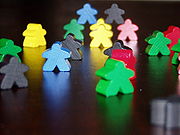 German-style games tend to have a theme (role-play element or a background story)—more like Monopoly
or Clue, rather than poker
or Tic Tac Toe. Game mechanics are not restricted by the theme, however — unlike a simulation game, the theme of a German game is often merely mnemonic. It is somewhat common for a game to be designed with one theme and published with another, or for the same game to be given a significantly different theme for a later republication, or for two games on wildly different themes to have very similar mechanics. Combat themes are uncommon and player conflict is often indirect (for example, competing for a scarce resource).
Example themes are:
or Carcassonne
. Usually each player plays for himself, rather than in a partnership or team.
In keeping with their social orientation, numbers are usually low in magnitude, often under ten, and any arithmetic
in the game is typically trivial.
Playing time varies from a half hour to a few hours, with one to two hours being typical. In contrast to games such as Risk
or Monopoly, in which a close game can extend indefinitely, German-style games usually have a mechanism to stop the game within its stated playing time. Common mechanisms include a pre-determined winning score, a set number of game turns, or depletion of limited game resources. For example, Ra
and Carcassonne
have limited tiles to exhaust.
Balancing mechanisms are often integrated into the rules, giving slight advantages to lagging players and slight hindrances to the leaders. This helps to keep the game competitive to the very end.
s and usually do not contain much text outside of the rules. Game components often use symbols and icons instead of words, reducing the amount of text to be translated between localized editions. Gameplay also tends to de-emphasize or entirely exclude verbal communication as a game element, with many games being fully playable if all players know the rules, even if they all speak different languages.
Some publishers design games that contain instructions and game elements in more than one language, e.g. the game Ursuppe comes with rules and cards in both German and English; Khronos
features instructions in French, English and German, and a Swiss game, Enchanted Owls, provides French, German, Italian and Romansh rules. However, this is usually not the case if the rights to sell the game outside its country of origin are sold to another publisher.
English editions are often available, either published in the USA or co-published by a German company cooperating with a USA company, or the reverse (example: Dominion
).
rather than chess
or Scrabble
); the board is often random (like Settlers of Catan) or has random elements (like Tikal
). Some boards are merely mnemonic or organizational and contribute only to ease of play, like a cribbage
board; examples of this include Puerto Rico and Princes of Florence. Random elements are often present, but do not usually dominate the game. While rules are light to moderate, they allow depth of play, usually requiring thought, planning, and a shift of tactics through the game and often with a chess- or backgammon-like opening game
, middle game, and end game.
and Tintenherz
.
 Some of the most notable designers of German-style board games include:
and Goldsieber. Often German producers will try to establish a line of similar games, such as Kosmos
's two-player card game series or Alea's big box line.
The rights to sell the game in English are often sold to separate companies. Some try to change the game as little as possible, such as Rio Grande Games
. Others, including Mayfair Games
, substantially change the visual design of the game, and sometimes the rules as well.
("game of the year"). The award is very family-oriented. Shorter, more approachable games such as Ticket to Ride
and Elfenland
are usually preferred by the committee that gives out the award. In contrast, the Deutscher Spiele Preis
("German game prize") is often awarded to games that are more complex and strategic, such as Puerto Rico. However, there are a few games with broad enough appeal to win both awards: The Settlers of Catan (1995), Carcassonne (2001), Dominion (2009).
has included popular games from the genre, with Catan
being released to strong sales on May 13, 2007, Carcassonne
being released on June 27, 2007. Lost Cities
and Ticket to Ride
soon followed. Alhambra
was due to follow later in 2007 until being cancelled.
The iPhone has released versions of Settlers of Catan and Zooloretto
in 2009. Carcassonne was added to the iPhone App Store in June 2010.
Tabletop game
Tabletop game is a general term used to refer to board games, card games, dice games, miniatures wargames, tile-based games and other games that are normally played on a table or other flat surface...
s that generally have simple rules, short to medium playing times, indirect player interaction and abstract physical components (wood preferred to plastic). The games emphasize strategy, play down luck and conflict, lean towards economic rather than military themes, and usually keep all the players in the game until it ends. German-style games are sometimes contrasted with American-style games, which generally involve more luck, conflict, and drama.
German-style games are usually less abstract
Abstract strategy game
An abstract strategy game is a strategy game, aiming to minimise luck, and without a theme. Almost all abstract strategy games will conform to the strictest definition of: a board or card game, in which there is no hidden information, no non-deterministic elements , in which two players or teams...
than chess
Chess
Chess is a two-player board game played on a chessboard, a square-checkered board with 64 squares arranged in an eight-by-eight grid. It is one of the world's most popular games, played by millions of people worldwide at home, in clubs, online, by correspondence, and in tournaments.Each player...
, but more abstract than wargames
Wargaming
A wargame is a strategy game that deals with military operations of various types, real or fictional. Wargaming is the hobby dedicated to the play of such games, which can also be called conflict simulations, or consims for short. When used professionally to study warfare, it is generally known as...
and train game
Train game
A train game or railway game is a board game that represents the construction and operation of railways. Train games tend to be highly involved hobby games that take several hours to play...
s. Likewise, they generally require more thought and planning than party game
Party game
Party games are games that some people play as forms of entertainment at social gatherings. Party games usually involve more than one player. There are a large number and styles of party games available and the one selected will depend on the atmosphere that is sought to be generated...
s, such as Pictionary
Pictionary
Pictionary is a guessing word game designed by Robert Angel and first published in 1985 by Seattle Games Inc. The game is played with teams with players trying to identify specific words from their teammates' drawings.-Objective:...
or Trivial Pursuit
Trivial Pursuit
Trivial Pursuit is a board game in which progress is determined by a player's ability to answer general knowledge and popular culture questions. The game was created in 1979 in Montreal, Quebec, Canada, by Canadian Chris Haney, a photo editor for Montreal's The Gazette and Scott Abbott, a sports...
, but less than classic strategy games, such as chess
Chess
Chess is a two-player board game played on a chessboard, a square-checkered board with 64 squares arranged in an eight-by-eight grid. It is one of the world's most popular games, played by millions of people worldwide at home, in clubs, online, by correspondence, and in tournaments.Each player...
and Go
Go (board game)
Go , is an ancient board game for two players that originated in China more than 2,000 years ago...
. Their rulebooks are typically four to twelve pages long and playing times are on the order of 30 to 120 minutes. These games appeal to a wide range of ages, though generally not very young children. The audience includes casual gamers, who play with family and friends, as well as more serious hobby gamers.
Not all German-style board games are German
Germany
Germany , officially the Federal Republic of Germany , is a federal parliamentary republic in Europe. The country consists of 16 states while the capital and largest city is Berlin. Germany covers an area of 357,021 km2 and has a largely temperate seasonal climate...
, and not all German-style games are board games. As a result, various other names have been offered for the class. Eurogame is a common, though still imprecise, alternative label. Because most of these games feature the name of the designer prominently on the box they are sometimes known as designer games. Other names include family strategy game and hobby game. Shorter, lighter games in this class are known as gateway games, whereas longer, heavier games are known as gamers' games.
History
Early examples of German-style board games, such as AcquireAcquire
Acquire is a board game designed by Sid Sackson.The game was originally published in 1962 by 3M as a part of their bookshelf games series. In most versions, the theme of the game is investing in hotel chains. In the 1990s Hasbro edition, the hotel chains were replaced by generic corporations,...
, appeared in the 1960s. However, the genre as a more concentrated design movement began in the late 1970s and early 1980s in Germany
Germany
Germany , officially the Federal Republic of Germany , is a federal parliamentary republic in Europe. The country consists of 16 states while the capital and largest city is Berlin. Germany covers an area of 357,021 km2 and has a largely temperate seasonal climate...
. Germany publishes more board games than any other country per capita, hence the name. Today the phenomenon has spread to other Europe
Europe
Europe is, by convention, one of the world's seven continents. Comprising the westernmost peninsula of Eurasia, Europe is generally 'divided' from Asia to its east by the watershed divides of the Ural and Caucasus Mountains, the Ural River, the Caspian and Black Seas, and the waterways connecting...
an countries such as France
France
The French Republic , The French Republic , The French Republic , (commonly known as France , is a unitary semi-presidential republic in Western Europe with several overseas territories and islands located on other continents and in the Indian, Pacific, and Atlantic oceans. Metropolitan France...
, the Netherlands
Netherlands
The Netherlands is a constituent country of the Kingdom of the Netherlands, located mainly in North-West Europe and with several islands in the Caribbean. Mainland Netherlands borders the North Sea to the north and west, Belgium to the south, and Germany to the east, and shares maritime borders...
and Sweden
Sweden
Sweden , officially the Kingdom of Sweden , is a Nordic country on the Scandinavian Peninsula in Northern Europe. Sweden borders with Norway and Finland and is connected to Denmark by a bridge-tunnel across the Öresund....
. While many games are published and played in other markets such as the United States
United States
The United States of America is a federal constitutional republic comprising fifty states and a federal district...
and the United Kingdom
United Kingdom
The United Kingdom of Great Britain and Northern IrelandIn the United Kingdom and Dependencies, other languages have been officially recognised as legitimate autochthonous languages under the European Charter for Regional or Minority Languages...
, they occupy a niche status there.
The Settlers of Catan
The Settlers of Catan
The Settlers of Catan is a multiplayer board game designed by Klaus Teuber and first published in 1995 in Germany by Franckh-Kosmos Verlag as Die Siedler von Catan. Players assume the roles of settlers, each attempting to build and develop their settlement while trading and acquiring resources...
, first published in 1995, paved the way for the genre in the United States and outside Europe. It was neither the first "German game" nor the first such game to find an audience outside Germany, but it became much more popular than any of its predecessors. It quickly sold millions of copies in Germany, and in the process brought money and attention to the genre as a whole. Other games in the genre to achieve widespread popularity include Carcassonne
Carcassonne (board game)
Carcassonne is a tile-based German-style board game for two to five players, designed by Klaus-Jürgen Wrede and published in 2000 by Hans im Glück in German and Rio Grande Games in English....
, Puerto Rico, Ticket to Ride
Ticket to Ride (board game)
Ticket to Ride is a railway-themed German-style board game designed by Alan R. Moon and published in 2004 by Days of Wonder. The game is also known as Zug um Zug , Les Aventuriers du Rail , Aventureros al Tren , Wsiąść do pociągu , and Menolippu .The game won the 2004 Spiel des Jahres, the Origins...
and Alhambra
Alhambra (board game)
Alhambra The Palace of the Alhambra") is a 2003 tile-based German-style board game designed by Dirk Henn. It was originally published in Germany by Queen Games in a language-interdependent version; an English-specific version was released in North America by the now-defunct Überplay...
.
Characteristics
As far as generalities can be made about such a large and diverse group of games, German-style games are usually multiplayer and can be learned easily and played in a relatively short time, perhaps multiple times in a single session. A certain amount of socializing might typically be expected during game play, as opposed to the relative silence sometimes expected during some strategy games like chessChess
Chess is a two-player board game played on a chessboard, a square-checkered board with 64 squares arranged in an eight-by-eight grid. It is one of the world's most popular games, played by millions of people worldwide at home, in clubs, online, by correspondence, and in tournaments.Each player...
and go
Go (board game)
Go , is an ancient board game for two players that originated in China more than 2,000 years ago...
or restrictions on allowable conversations or actions found in some highly competitive games such as contract bridge
Contract bridge
Contract bridge, usually known simply as bridge, is a trick-taking card game using a standard deck of 52 playing cards played by four players in two competing partnerships with partners sitting opposite each other around a small table...
. German-style games are generally much simpler than the wargames
Wargaming
A wargame is a strategy game that deals with military operations of various types, real or fictional. Wargaming is the hobby dedicated to the play of such games, which can also be called conflict simulations, or consims for short. When used professionally to study warfare, it is generally known as...
which flourished in the 1970s and 1980s from publishers such as SPI
Simulations Publications
Simulations Publications, Inc. was an influential American publisher of board wargames and related magazines, particularly its flagship Strategy & Tactics, in the 1970s and early 1980s...
and Avalon Hill
Avalon Hill
Avalon Hill was a game company that specialized in wargames and strategic board games. Its logo contained its initials "AH", and it was often referred to by this abbreviation. It also published the occasional miniature wargaming rules, role-playing game, and had a popular line of sports simulations...
, but nonetheless often have a considerable depth of play, especially in some "gamers' games" such as Tigris and Euphrates
Tigris and Euphrates
Tigris and Euphrates is a German strategy board game designed by Reiner Knizia and first published in 1997 by Hans im Glück in German . Before its publication, it was highly anticipated by German gamers hearing rumors of a "gamer's game" designed by Knizia. Tigris and Euphrates won first prize in...
and Caylus.
Themes
Monopoly (game)
Marvin Gardens, the leading yellow property on the board shown, is actually a misspelling of the original location name, Marven Gardens. The misspelling was said to be introduced by Charles Todd and passed on when his home-made Monopoly board was copied by Charles Darrow and thence to Parker...
or Clue, rather than poker
Poker
Poker is a family of card games that share betting rules and usually hand rankings. Poker games differ in how the cards are dealt, how hands may be formed, whether the high or low hand wins the pot in a showdown , limits on bet sizes, and how many rounds of betting are allowed.In most modern poker...
or Tic Tac Toe. Game mechanics are not restricted by the theme, however — unlike a simulation game, the theme of a German game is often merely mnemonic. It is somewhat common for a game to be designed with one theme and published with another, or for the same game to be given a significantly different theme for a later republication, or for two games on wildly different themes to have very similar mechanics. Combat themes are uncommon and player conflict is often indirect (for example, competing for a scarce resource).
Example themes are:
- CarcassonneCarcassonne (board game)Carcassonne is a tile-based German-style board game for two to five players, designed by Klaus-Jürgen Wrede and published in 2000 by Hans im Glück in German and Rio Grande Games in English....
- build a medieval landscape complete with walled cities and monasteries, roads and fields. - Puerto Rico - develop a plantation on the island of Puerto RicoPuerto RicoPuerto Rico , officially the Commonwealth of Puerto Rico , is an unincorporated territory of the United States, located in the northeastern Caribbean, east of the Dominican Republic and west of both the United States Virgin Islands and the British Virgin Islands.Puerto Rico comprises an...
, set in the 18th century. - Tropic Euro - a re-theme of Puerto Rico, set in 1946.
- ImperialImperial (board game)Imperial is a German-style board game designed by Mac Gerdts in which the object is to accumulate wealth in the form of bond holdings in successful countries and cash. Players take on the role of international financiers who purchase government bonds in the six pre-World War I empires of...
- as an international investor, influence the politics of pre-World War IWorld War IWorld War I , which was predominantly called the World War or the Great War from its occurrence until 1939, and the First World War or World War I thereafter, was a major war centred in Europe that began on 28 July 1914 and lasted until 11 November 1918...
European empires.
Games made for everyone
While many titles (especially the strategically heavier ones) are enthusiastically played by gamers as a hobby, German-style games are, for the most part, well suited to social play. In keeping with this social function, various characteristics of the games tend to support that aspect well, and these have become quite common across the genre. For example, generally German-style games do not have a fixed number of players like chess or bridge; though there is a sizable body of German-style games that are designed for exactly two players, most games can accommodate anywhere from two to six players (with varying degrees of suitability). Six-player games are somewhat rare, or require expansions, as with The Settlers of CatanThe Settlers of Catan
The Settlers of Catan is a multiplayer board game designed by Klaus Teuber and first published in 1995 in Germany by Franckh-Kosmos Verlag as Die Siedler von Catan. Players assume the roles of settlers, each attempting to build and develop their settlement while trading and acquiring resources...
or Carcassonne
Carcassonne (board game)
Carcassonne is a tile-based German-style board game for two to five players, designed by Klaus-Jürgen Wrede and published in 2000 by Hans im Glück in German and Rio Grande Games in English....
. Usually each player plays for himself, rather than in a partnership or team.
In keeping with their social orientation, numbers are usually low in magnitude, often under ten, and any arithmetic
Arithmetic
Arithmetic or arithmetics is the oldest and most elementary branch of mathematics, used by almost everyone, for tasks ranging from simple day-to-day counting to advanced science and business calculations. It involves the study of quantity, especially as the result of combining numbers...
in the game is typically trivial.
Playing time varies from a half hour to a few hours, with one to two hours being typical. In contrast to games such as Risk
Risk (game)
Risk is a strategic board game, produced by Parker Brothers . It was invented by French film director Albert Lamorisse and originally released in 1957 as La Conquête du Monde in France. Risk is a turn-based game for two to six players...
or Monopoly, in which a close game can extend indefinitely, German-style games usually have a mechanism to stop the game within its stated playing time. Common mechanisms include a pre-determined winning score, a set number of game turns, or depletion of limited game resources. For example, Ra
Ra (board game)
Ra is a board game for two to five players designed by Reiner Knizia and themed around Ra, the sun-god of Heliopolis in ancient Egyptian culture....
and Carcassonne
Carcassonne (board game)
Carcassonne is a tile-based German-style board game for two to five players, designed by Klaus-Jürgen Wrede and published in 2000 by Hans im Glück in German and Rio Grande Games in English....
have limited tiles to exhaust.
No player elimination
Another prominent characteristic of these games is the lack of player elimination. Eliminating players before the end of the game is seen as counterproductive. Most of these games are designed to keep all players in the game as long as possible, so it is rare to be certain of victory or defeat until relatively late in the game. Some of the mechanics, like hidden scoring or scoring at the end of the game, are also designed around this avoidance of player elimination.Balancing mechanisms are often integrated into the rules, giving slight advantages to lagging players and slight hindrances to the leaders. This helps to keep the game competitive to the very end.
Made for an international audience
These games are designed for international audiences, so they are not word gameWord game
Word games and puzzles are spoken or board games often designed to test ability with language or to explore its properties.Word games are generally engaged as a source of entertainment, but have been found to serve an educational purpose as well...
s and usually do not contain much text outside of the rules. Game components often use symbols and icons instead of words, reducing the amount of text to be translated between localized editions. Gameplay also tends to de-emphasize or entirely exclude verbal communication as a game element, with many games being fully playable if all players know the rules, even if they all speak different languages.
Some publishers design games that contain instructions and game elements in more than one language, e.g. the game Ursuppe comes with rules and cards in both German and English; Khronos
Khronos (game)
Khronos is a game for two to five players designed by Ludovic Vialla and Arnaud Urbon. In the game, players build domains by laying tiles representing buildings on three game boards, each representing the same area in three different ages. By paying one coin, players can travel between the...
features instructions in French, English and German, and a Swiss game, Enchanted Owls, provides French, German, Italian and Romansh rules. However, this is usually not the case if the rights to sell the game outside its country of origin are sold to another publisher.
English editions are often available, either published in the USA or co-published by a German company cooperating with a USA company, or the reverse (example: Dominion
Dominion (game)
Dominion is a designer card game created by Donald X. Vaccarino, and published by Rio Grande Games. The game was released at Spiel 2008 in multiple languages, and voted best game of the fair by the Fairplay polls with a rating of 1.75 from 147 votes. Within two months of its release, Dominion was...
).
Game mechanics
A wide variety of often innovative mechanics are used, and familiar mechanics like rolling dice and moving, capture, or trick taking are avoided. If a game has a board, the board is usually irregular rather than uniform or symmetric (like RiskRisk (game)
Risk is a strategic board game, produced by Parker Brothers . It was invented by French film director Albert Lamorisse and originally released in 1957 as La Conquête du Monde in France. Risk is a turn-based game for two to six players...
rather than chess
Chess
Chess is a two-player board game played on a chessboard, a square-checkered board with 64 squares arranged in an eight-by-eight grid. It is one of the world's most popular games, played by millions of people worldwide at home, in clubs, online, by correspondence, and in tournaments.Each player...
or Scrabble
Scrabble
Scrabble is a word game in which two to four players score points by forming words from individual lettered tiles on a game board marked with a 15-by-15 grid. The words are formed across and down in crossword fashion and must appear in a standard dictionary. Official reference works provide a list...
); the board is often random (like Settlers of Catan) or has random elements (like Tikal
Tikal (board game)
Tikal is a German-style board game designed by Wolfgang Kramer and Michael Kiesling and published in 1999 by Ravensburger in German and by Rio Grande Games in English...
). Some boards are merely mnemonic or organizational and contribute only to ease of play, like a cribbage
Cribbage
Cribbage, or crib, is a card game traditionally for two players, but commonly played with three, four or more, that involves playing and grouping cards in combinations which gain points...
board; examples of this include Puerto Rico and Princes of Florence. Random elements are often present, but do not usually dominate the game. While rules are light to moderate, they allow depth of play, usually requiring thought, planning, and a shift of tactics through the game and often with a chess- or backgammon-like opening game
Chess opening
A chess opening is the group of initial moves of a chess game. Recognized sequences of opening moves are referred to as openings as initiated by White or defenses, as created in reply by Black. There are many dozens of different openings, and hundreds of named variants. The Oxford Companion to...
, middle game, and end game.
Game designer as auteur
Although not relevant to actual play, the name of the game's designer is often prominently mentioned on the box, or at least in the rule book. Top designers enjoy considerable following among enthusiasts of German games. For this reason, the name "designer games" is often offered as a description of the genre. Recently, there has also been a wave of games designed as spin-offs of popular novels, such as the games taking their style from the German bestsellers Der SchwarmThe Swarm (novel)
The Swarm is a science fiction novel by German author Frank Schätzing. It was first published in Germany and Austria in 2004 and soon became a bestseller.-Plot:...
and Tintenherz
Inkworld trilogy
The Inkheart trilogy is a series of three fantasy novels written by German author Cornelia Funke, comprising Inkheart , Inkspell , and Inkdeath...
.
Designers
- Reiner KniziaReiner KniziaReiner Knizia is a prolific German-style board game designer. Born in Germany, he developed his first game at the age of eight. He has a PhD in mathematics, and has been a full-time game designer since 1997, when he quit his job from the board of a large international bank...
is one of the most well-known German game designers, having designed over 200 published games, and usually works as the sole designer. Recurring mechanisms in his games include auctions (RaRa (board game)Ra is a board game for two to five players designed by Reiner Knizia and themed around Ra, the sun-god of Heliopolis in ancient Egyptian culture....
and Modern ArtModern Art (game)Modern Art is a bidding game designed by Reiner Knizia and first published in 1992 by Hans im Glück in German. Players represent art dealers, both buying and selling works of art by five different fictional artists. At the end of each round, they sell the paintings they bought back to the "bank"...
), tile placement (Tigris and EuphratesTigris and EuphratesTigris and Euphrates is a German strategy board game designed by Reiner Knizia and first published in 1997 by Hans im Glück in German . Before its publication, it was highly anticipated by German gamers hearing rumors of a "gamer's game" designed by Knizia. Tigris and Euphrates won first prize in...
and IngeniousIngeniousIngenious is the English name for Einfach Genial , a German abstract strategy board game designed by Reiner Knizia under commission from Sophisticated Games and published in 2004 by Kosmos...
) and intricate scoring rules (SamuraiSamurai (board game)Samurai is a German-style board game invented by Reiner Knizia, distributed by Hans im Glück in Germany and Rio Grande Games in the United States. It won the Deutscher Spiele Preis 4th place award in 1999...
). He has also designed many card games such as Lost CitiesLost CitiesLost Cities is a 60-card card game, designed in 1999 by game designer Reiner Knizia and published by several publishers. The objective of the game is to mount profitable expeditions to one or more of the five lost cities...
, Schotten-TottenSchotten-TottenSchotten-Totten is a card game designed by Reiner Knizia, first published in 1999.-Gameplay:Gameplay in Schotten-Totten resembles simultaneous play of nine separate hands of poker, but where each hand has only three cards in it. There are nine "boundary" stones between players at the start of the...
and Blue MoonBlue Moon (game)Blue Moon, published by Kosmos/Fantasy Flight Games, is Reiner Knizia's most successful take on the collectible card game genre. It is a card game for two players that bears some resemblance to the well-known Magic: The Gathering , although the game mechanics are quite different...
, and the cooperative board gameCooperative board gameIn a cooperative board game, players work together in order to achieve a goal, either winning or losing as a group. As the name suggests, cooperative games stress cooperation over competition. Participants typically play against the game, and sometimes against one or two other players as well, who...
The Lord of the RingsLord of the Rings (board game)Lord of the Rings is a board game designed by Reiner Knizia based on The Lord of the Rings by J. R. R. Tolkien. The game was published in 2000 by Kosmos and Fantasy Flight Games, and won a Spiel des Jahres special award for best use of literature in a game. It features artwork by illustrator John...
. - Klaus TeuberKlaus TeuberKlaus Teuber is a German designer of board games. He won the Spiel des Jahres award four times, for The Settlers of Catan, Barbarossa, Drunter und Drüber and Adel Verpflichtet. He retired from his profession as a dental technician to become a full-time game designer in 1999. , he lives in ...
has designed a small number of games, many of which became extremely popular. Some have won the Spiel des JahresSpiel des JahresThe Spiel des Jahres is an award for board and card games, created in 1978 with the stated purpose of rewarding excellence in game design, and promoting top-quality games in the German market. It is thought that the existence and popularity of the award is one of the major drivers of the quality...
Award. Titles include The Settlers of CatanThe Settlers of CatanThe Settlers of Catan is a multiplayer board game designed by Klaus Teuber and first published in 1995 in Germany by Franckh-Kosmos Verlag as Die Siedler von Catan. Players assume the roles of settlers, each attempting to build and develop their settlement while trading and acquiring resources...
and Adel Verpflichtet. - Wolfgang KramerWolfgang KramerWolfgang Kramer is a German board game designer.Kramer formerly worked as an operations manager and computer scientist, but since 1989 he has worked full-time on game design. He has designed over 100 games, many which have been nominated for or have won the Spiel des Jahres...
often works with other game designers. Some of his best-known titles include El GrandeEl GrandeEl Grande is a German-style board game for 2-5 players, designed by Wolfgang Kramer and Richard Ulrich, and published in 1995 by Hans im Glück in German, by Rio Grande Games in English, and by 999 Games in Dutch. The game board represents renaissance-era Spain where the nobility fight for control...
, TikalTikal (board game)Tikal is a German-style board game designed by Wolfgang Kramer and Michael Kiesling and published in 1999 by Ravensburger in German and by Rio Grande Games in English...
, Princes of Florence and TorresTorres (board game)Torres is a German-style board game designed by Wolfgang Kramer and Michael Kiesling and published in 1999 by FX Schmid in German and by Rio Grande Games in English. The game strongly influenced Kramer and Kiesling's Mask Trilogy of games, but is not considered to be a part of the trilogy...
. His games often have some sort of action point system, and include some geometric element. - Andreas SeyfarthAndreas SeyfarthAndreas Seyfarth is a German-style board game designer, who is most famous for creating Puerto Rico, which is rated #2 on BoardGameGeek. In 2002, the game was awarded first place for the prestigious Deutscher Spiele Preis...
has designed the award-winning games ManhattanManhattan (game)Manhattan is a boardgame designed by Andreas Seyfarth and originally published by the German company Hans im Glück. It was the winner of Spiel des Jahres in 1994. An English language version was published by Mayfair Games in 1996.-External links:...
, Puerto Rico, and (with Karen Seyfarth) Thurn and TaxisThurn and Taxis (board game)Thurn and Taxis is a board game designed by Karen and Andreas Seyfarth and published in 2006 by Hans im Glück in German and by Rio Grande Games in English. In the game, players seek to build postal networks and post offices in Bavaria and surrounding areas, as did the house of Thurn und Taxis in...
. - Alan R. MoonAlan R. MoonAlan R. Moon is an author of board games, born in Southampton, England, and currently living in the United States. Despite his nationality, he is generally considered to be one of the foremost designers of German-style board games. Many of his games can be seen as board game variations on the...
British born designer of numerous games, often with a railway theme, including the Spiel des Jahres winning Ticket to RideTicket to Ride (board game)Ticket to Ride is a railway-themed German-style board game designed by Alan R. Moon and published in 2004 by Days of Wonder. The game is also known as Zug um Zug , Les Aventuriers du Rail , Aventureros al Tren , Wsiąść do pociągu , and Menolippu .The game won the 2004 Spiel des Jahres, the Origins...
and ElfenlandElfenlandElfenland is a German-style board game designed by Alan R. Moon and published by Amigo Spiele in German and Rio Grande Games in English in 1998....
. His games are often characterized by selecting a single action from a choice of several (e.g. gather new cards or use existing cards) - Uwe RosenbergUwe RosenbergUwe Rosenberg is a German game designer. He has become known mainly for his card game Bohnanza, which is successful both in Germany and internationally...
designed AgricolaAgricola (board game)Agricola is a German-style board game created by Uwe Rosenberg, and published by Lookout Games in Europe and Z-Man Games in the US. The goal of the game is to build the most well-balanced farm at the end of 14 rounds, consisting of plowed fields for crops and fenced pastures for livestock. The...
, a past top-ranked game on BoardGameGeekBoardGameGeekBoardGameGeek is a website that was founded in January 2000 by Scott Alden and Derk Solko as a resource for the board gaming hobby. The database holds reviews, articles, and session reports for over 45,000 different games, expansions, and designers. BoardGameGeek includes German-style board games,...
, as well as BohnanzaBohnanzaBohnanza is a German-style card game of trading and politics, designed by Uwe Rosenberg and released in 1997 by Amigo Spiele in German and by Rio Grande Games in English. It is played with a deck of cards with comical illustrations of eleven different types of beans , which the players are trying...
, Le HavreLe Havre (board game)Le Havre is a board game about the development of the town of Le Havre. It was inspired by the games Caylus and Agricola and was developed in December 2007....
and several others. - Leo ColoviniLeo ColoviniLeo Colovini is a designer of German-style board games born in Venice 1964. His most popular game is Cartagena. He is one of the few top board game designers who has owned a game store....
is best known for his board games CartagenaCartagena (board game)Cartagena is a critically acclaimed German-style board game released in 2000, that takes as its theme the legendary 1672 pirate-led jailbreak from the dreaded fortress of Cartagena...
and Carcassonne: The Discovery. - Sid SacksonSid SacksonSid Sackson was a significant American board game designer and collector.His most popular creation is probably the business game Acquire...
, Prolific American designer. Several of his games were only published in Germany but never in the United States.
Publishers
There are many German companies producing board games, such as Hans im GlückHans im Glück
Hans im Glück Verlags-GmbH is a German board and card game publisher. Though many of their own games are language-independent they themselves publish only printings for the domestic market which include only German-language rules; English-language printings of their games have been published...
and Goldsieber. Often German producers will try to establish a line of similar games, such as Kosmos
Kosmos (game publisher)
Franckh-Kosmos Verlags-GmbH & Co. is a media publishing house based in Stuttgart, Germany, founded in 1822 by Johann Friedrich Franckh. In the nineteenth century the company published the fairy tales of Wilhelm Hauff as well as works by Wilhelm Waiblinger and Eduard Mörike.The "Friends of Nature...
's two-player card game series or Alea's big box line.
The rights to sell the game in English are often sold to separate companies. Some try to change the game as little as possible, such as Rio Grande Games
Rio Grande Games
Rio Grande Games is a board game publisher based in Rio Rancho, New Mexico. The company primarily imports and localizes foreign language German-style board games.-History:...
. Others, including Mayfair Games
Mayfair Games
Mayfair Games is a publisher of board, card, and roleplaying games. They also license German-style board games and publish them in English throughout the world...
, substantially change the visual design of the game, and sometimes the rules as well.
Awards
The most prestigious German board game award is the Spiel des JahresSpiel des Jahres
The Spiel des Jahres is an award for board and card games, created in 1978 with the stated purpose of rewarding excellence in game design, and promoting top-quality games in the German market. It is thought that the existence and popularity of the award is one of the major drivers of the quality...
("game of the year"). The award is very family-oriented. Shorter, more approachable games such as Ticket to Ride
Ticket to Ride (board game)
Ticket to Ride is a railway-themed German-style board game designed by Alan R. Moon and published in 2004 by Days of Wonder. The game is also known as Zug um Zug , Les Aventuriers du Rail , Aventureros al Tren , Wsiąść do pociągu , and Menolippu .The game won the 2004 Spiel des Jahres, the Origins...
and Elfenland
Elfenland
Elfenland is a German-style board game designed by Alan R. Moon and published by Amigo Spiele in German and Rio Grande Games in English in 1998....
are usually preferred by the committee that gives out the award. In contrast, the Deutscher Spiele Preis
Deutscher Spiele Preis
The Deutscher Spiele Preis is an important award for boardgames. It was started in 1990 by the German magazine "Die Pöppel-Revue", which collects votes from the industry's stores, magazines, professionals and game clubs. The results are announced every October at the Spiel game fair in Essen,...
("German game prize") is often awarded to games that are more complex and strategic, such as Puerto Rico. However, there are a few games with broad enough appeal to win both awards: The Settlers of Catan (1995), Carcassonne (2001), Dominion (2009).
Influence
Xbox Live ArcadeXbox Live Arcade
Xbox Live Arcade is a type of video game download distribution available primarily in a section of the Xbox Live Marketplace, Microsoft's digital distribution network for the Xbox 360, that focuses on smaller downloadable games from both major publishers and independent game developers...
has included popular games from the genre, with Catan
Catan
Catan is the Xbox Live Arcade version of Klaus Teuber's The Settlers of Catan, developed by Big Huge Games in collaboration with Teuber. It was released on May 2, 2007 for 800 Microsoft Points...
being released to strong sales on May 13, 2007, Carcassonne
Carcassonne (video game)
Carcassonne is the Xbox Live Arcade version of the popular board game of the same name designed by Klaus-Jürgen Wrede for the Xbox 360, and developed by Sierra Studios. The game was released on June 27, 2007, and is the second designer board game to be released on Arcade, the first being Catan. It...
being released on June 27, 2007. Lost Cities
Lost Cities
Lost Cities is a 60-card card game, designed in 1999 by game designer Reiner Knizia and published by several publishers. The objective of the game is to mount profitable expeditions to one or more of the five lost cities...
and Ticket to Ride
Ticket to Ride (video game)
Ticket to Ride is the Xbox Live Arcade version of Alan R. Moon's German-style board game of the same name, developed by Next Level Games and published by Playful Entertainment, Inc...
soon followed. Alhambra
Alhambra (video game)
Alhambra is the cancelled Xbox Live Arcade version of the popular board game designed by Dirk Henn for the Xbox 360, and developed by Vivendi Games, and was to be the third designer board game to be released on Arcade, the first two being Catan and Carcassonne.The game was cancelled by Vivendi "due...
was due to follow later in 2007 until being cancelled.
The iPhone has released versions of Settlers of Catan and Zooloretto
Zooloretto
Zooloretto is a board game designed by Michael Schacht, published in 2007 by Abacus Spiele and in English by Rio Grande Games. The premise of the game is that each player is the owner of a zoo, and must collect animals in order to attract visitors to their zoo . Having full, or nearly full,...
in 2009. Carcassonne was added to the iPhone App Store in June 2010.
See also
- List of game designers
- BrettspielWeltBrettspielWeltBrettspielWelt is a large, popular, and free German online gaming site. Its name translates as Boardgame World. It contains online versions of over 70 popular classical and modern board games and card games, such as Backgammon, Bluff, Carcassonne, Can't Stop, Dominion, Go, Settlers of Catan, and...
- BoardGameGeekBoardGameGeekBoardGameGeek is a website that was founded in January 2000 by Scott Alden and Derk Solko as a resource for the board gaming hobby. The database holds reviews, articles, and session reports for over 45,000 different games, expansions, and designers. BoardGameGeek includes German-style board games,...
- Cooperative board gameCooperative board gameIn a cooperative board game, players work together in order to achieve a goal, either winning or losing as a group. As the name suggests, cooperative games stress cooperation over competition. Participants typically play against the game, and sometimes against one or two other players as well, who...
External links
- Brett and Board with information on German-style games (has not been updated in some time)
- Luding.org - board game database with over 15,000 English and German reviewed games
- BoardGameGeek - Large internet database of boardgames and online fan community.