

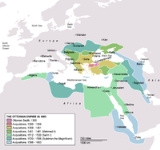
Eastern Question

Encyclopedia
The "Eastern Question", in European history
, encompasses the diplomatic
and political
problems posed by the decay of the Ottoman Empire
. The expression does not apply to any one particular problem, but instead includes a variety of issues raised during the 18th, 19th, and 20th centuries, including instability in the European territories ruled by the Ottoman Empire.
The Eastern Question is normally dated to 1774, when the Russo-Turkish War (1768–1774) ended in defeat for the Ottomans. As the dissolution of the Ottoman Empire was believed to be imminent, the European powers engaged in a power struggle to safeguard their military, strategic and commercial interests in the Ottoman domains. Imperial Russia stood to benefit from the decline of the Ottoman Empire; on the other hand, Austria-Hungary
and the United Kingdom
deemed the preservation of the Empire to be in their best interests. The Eastern Question was put to rest after World War I, one of whose outcomes was the collapse of the Ottoman Empire.
to the combined forces of the Polish-Lithuanian Commonwealth and Austria, under the command of John III Sobieski. Peace was made much later, in 1699, with the Treaty of Karlowitz
, which forced the Ottoman Empire to cede many of its Central European possessions, including Hungary. Its westward expansion arrested, the Ottoman Empire never again posed a serious threat to Austria, which became the dominant power in its region of Europe.
The Eastern Question did not truly develop until the Russo-Turkish Wars of the 18th century. The first of the wars, which began in 1768, ended in 1774 with the Treaty of Kuchuk-Kainarji. The treaty was interpreted as permitting Russia to act as the protector of Orthodox Christians under the sovereignty of the Ottoman Sultan, and established Russia as a major Black Sea
power. Another Russo-Turkish conflict began in 1787. The Empress of Russia, Catherine II
, entered into an alliance with the Austrian ruler, the Emperor Joseph II
; the two agreed to partition the Ottoman Empire between their respective nations, thereby alarming many European powers, especially the United Kingdom, France, and Prussia
. Austria was forced to withdraw from the war in 1791. In the ensuing Treaty of Jassy
(1792), Russia's dominance of the Black Sea grew.
During the early 19th century, the positions of the Great Powers on the Ottoman Empire became clear. Russia was the power most directly concerned with the Eastern Question. She was primarily concerned with control of the Black Sea and access to the Mediterranean (especially by acquiring the important port of Constantinople
). Russia was especially eager to secure navigation rights for her merchant vessels and warships while denying similar privileges to other European powers. Another more or less important Russian interest was the protection of the many Orthodox Christians
in the territories of the Ottoman Empire, given that Russia was the foremost Orthodox world power. Constantinople's status as the home of the most important patriarchate
in Orthodoxy added to the Russian desire to possess it.
Austria was most directly opposed to the Russian designs on the Ottoman Empire. Though the Austrian House of Habsburg was the foremost opponent of the Ottomans in prior centuries, Austria deemed the Ottoman threat to be much less serious than a Russian advance along the Danube River. Austria also feared that the disintegration of the Ottoman Empire into several nation states would foster the sentiment of nationalism
among the many ethnic groups in her own Empire. Thus, Austria made it one of her primary goals to maintain the unity of the Ottoman Empire.
Similarly, Britain saw the containment of the Russian Empire as vital to the security of British colonial possessions in India (seen also in the prosecution of the Great Game in Afghanistan
). It was also concerned that Russian control of the Bosporus
could impede British domination of the eastern Mediterranean, including the Suez Canal
. The UK was also concerned with the preservation of the traditional global balance of power
, which would have been upset by the fall of the Ottoman Empire.
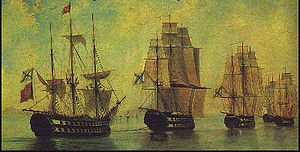 At the beginning of the nineteenth century, the attention of Europe was captured by Napoleon Bonaparte
. To secure his own domination and to render the rest of Europe virtually powerless, Napoleon established an alliance with Russia by concluding the Treaty of Tilsit
in 1807. Russia undertook to aid Napoleon in his war against the United Kingdom; in turn, the Emperor of Russia would receive the Ottoman territories of Moldavia
and Wallachia
. If the Sultan refused to surrender these territories, France and Russia were to attack the Empire, and the Ottoman domains in Europe were to be partitioned between the two allies. The Napoleonic scheme threatened not only the Sultan, but also the United Kingdom, Austria and Prussia, which was almost powerless in the face of such a potent alliance. The alliance naturally proved incommoding to the Austrians, who hoped that a joint Franco-Russian attack, which would probably have utterly devastated the Ottoman Empire, could be prevented by diplomacy; but if diplomatic measures failed, the Austrian minister Klemens Wenzel, Prince von Metternich decided that he would support the partition of the Ottoman Empire—a solution disadvantageous to Austria, but not as dangerous as a complete Russian takeover of Southeastern Europe.
An attack on the Empire, however, did not come to pass, and the alliance concluded at Tilsit was dissolved by the French invasion of Russia
in 1812. Following Napoleon's defeat by the Great Powers in 1815, representatives of the victors met at the Congress of Vienna
, but failed to take any action relating to the territorial integrity of the decaying Ottoman Empire. This omission, together with the exclusion of the Sultan from the Holy Alliance
, was interpreted by many as supportive of the position that the Eastern Question was a Russian domestic issue that did not concern any other European nations.
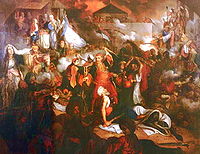 Serbian revolution or Revolutionary Serbia refers to the national
and social revolution
of the Serbian people
between 1804 and 1815, during which Serbia managed to fully emancipate from the Ottoman Empire
and exist as a sovereign European nation-state
, and a latter period (1815–1833), marked by intense negotiations between Belgrade
and Ottoman Empire
. The term was invented by a famous German historian Leopold von Ranke
in his book Die Serbische Revolution, published in 1829. These events marked the foundation of modern Serbia. While the first phase of the revolution (1804–1815) was in fact a war of independence, the second phase (1815–1833) resulted in official recognition of a suzerain Serbian state by the Porte, thus bringing the revolution to its end.
The above mentioned time frame covers several phases of the revolution:First Serbian Uprising
(1804–13), led by Karađorđe Petrović; Hadži Prodan's revolt
(1814);Second Serbian Uprising
(1815) under Miloš Obrenović, followed by the official recognition of the Serbian state (1815–1833) by the Porte.
The Proclamation
(1809) by Karađorđe in the capital Belgrade
represented the peak of the revolution. It called for unity of the Serbian nation
, emphasising the importance of freedom of religion
, Serbian history and rule of law
- all of which Ottoman Empire
couldn't- or has denied to provide, being a non-secular Muslim
state. It also called on Serbs to stop paying tax
es to the Porte because they were based on religious affiliation.
The ultimate result of the uprisings was Serbia's suzerainty
from the Ottoman Empire
. Principality of Serbia was established, governed by its own Parliament, Government, Constitution and its own royal dynasty. Social element of the revolution was achieved through introduction of the bourgeois society values in Serbia, which is why it was considered the world's easternmost bourgeois revolt, which culminated with the abolition of feudalism
in 1806- just 15 years after the French revolution
. First constitution in the Balkans and its oldest university- Belgrade's Great Academy
(1808) added to the achievements of the young Serb state. By 1833, Serbia was officially recognized as a tributary to the Porte and as such, acknowledged as a hereditary monarchy. De jure independence of the Principality was internationally recognized during the second half of the 19th century.
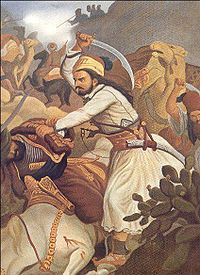 The Eastern Question once again became a major European issue when the Greeks
declared independence from the Sultan in 1821. It was at about this time that the phrase "Eastern Question" was coined. Ever since the defeat of Napoleon in 1815, there had been rumours that the Emperor of Russia sought to invade the Ottoman Empire, and the Greek Revolt seemed to make an invasion even more likely. The British foreign minister, Robert Stewart, Viscount Castlereagh
, as well as the Austrian foreign minister, Metternich, counselled the Emperor of Russia, Alexander I
, not to enter the war. Instead, they pleaded that he maintain the Concert of Europe
(the spirit of broad collaboration in Europe which had persisted since Napoleon's defeat). A desire for peaceful co-operation was also held by Alexander I, who had founded the Holy Alliance. Rather than immediately putting the Eastern Question to rest by aiding the Greeks and attacking the Ottomans, Alexander wavered, ultimately failing to take any decisive action.
Alexander's death in 1825 brought Nicholas I
to the Imperial Throne of Russia. Deciding that he would no longer tolerate negotiations and conferences, he chose to intervene in Greece. The United Kingdom also soon became involved, interested in imposing its will on a newly formed Greek state in part to prevent it becoming a wholly Russian vassal. The spirit of Romanticism
that then dominated Western European cultural life also made support for Greek independence politically viable. France too aligned itself with the Greeks, but Austria (still worried about Russian expansion) did not. Outraged by the interference of the Great Powers, the Ottoman Sultan, Mahmud II
, denounced Russia as an enemy of Islam
, prompting Russia to declare war in 1828. An alarmed Austria sought to form an anti-Russian coalition, but its attempts were in vain.
As the war continued into 1829, Russia gained a firm advantage over the Ottoman Empire. By prolonging hostilities further, however, Russia would have invited Austria to enter the war against her and would have resulted in considerable suspicion in the United Kingdom. Therefore, for the Russians to continue with the war in hopes of destroying the Ottoman Empire would have been inexpedient. At this stage, the King of France, Charles X
, proposed the partition of the Ottoman Empire amongst Austria, Russia and others, but his scheme was presented too belatedly to produce a result.
Thus, Russia was able to secure neither a decisive defeat nor a partition of the Ottoman Empire. She chose, however, to adopt the policy of degrading the Ottoman Empire to a mere dependency. In 1829, the Emperor of Russia concluded the Treaty of Adrianople
with the Sultan; his empire was granted additional territory along the Black Sea, Russian commercial vessels were granted access to the Dardanelles
, and the commercial rights of Russians in the Ottoman Empire were enhanced. The Greek War of Independence was terminated shortly thereafter, as Greece was granted independence by the Treaty of Constantinople
in 1832.
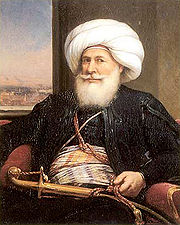 Just as the Greek Revolt was coming to an end, a conflict broke out in the Ottoman Empire between the Sultan and his nominal viceroy
in Egypt
, Muhammad Ali
. The modern and well trained Egyptians looked as though they could conquer the entire empire. The Tsar of Russia, in keeping with his policy of reducing the Ottoman Sultan to a petty vassal, offered to form an alliance with the Sultan. In 1833, the two rulers negotiated the Treaty of Unkiar Skelessi, in which Russia achieved the aim of securing complete dominance over the Ottomans. The Russians undertook to protect the Empire from external attacks; in turn, the Sultan pledged to close the Dardanelles to warships whenever Russia was at war. This provision of the Treaty of Unkiar Skelessi raised a problem known as the "Straits Question." The agreement provided for the closure of all warships, but many European statesmen mistakenly believed that the clause failed to restrict Russian vessels. The United Kingdom and France were angered by the misinterpreted clause; they also sought to contain Russian expansion. The two kingdoms, however, differed on the means of achieving their objective; the British wished to uphold the Sultan, but the French preferred to make Muhammad Ali (whom they saw as more competent) the ruler of the entire Ottoman Empire. Russian intervention led the Sultan to negotiate a peace with Muhammad Ali in 1833, but war broke out once again in 1839.
Sultan Mahmud II died in the same year, leaving the Ottoman Empire to his son, Abd-ul-Mejid I. The state of affairs at the time of the new Sultan's accession were extremely critical; the Ottoman army had been signally defeated by the forces of Muhammad Ali. Another disaster followed when the entire Turkish fleet was seized by the Egyptian forces. Great Britain and Russia now intervened to prevent the collapse of the Ottoman Empire, but France still continued to support Muhammad Ali. In 1840, however, the Great Powers agreed to compromise; Muhammad Ali agreed to make a nominal act of submission to the Sultan, but was granted hereditary control of Egypt.
The only unresolved issue of the period was the Straits Question. In 1841, Russia consented to the abrogation of the Treaty of Unkiar Skelessi by accepting the London Straits Convention
. The Great Powers — Russia, the United Kingdom, France, Austria and Prussia — agreed to the re-establishment of the "ancient rule" of the Ottoman Empire, which provided that the Turkish straits would be closed to all warships whatsoever, with the exception of the Sultan's allies during wartime. With the Straits Convention, the Russian Emperor Nicholas I abandoned the idea of reducing the Sultan to a state of dependence, and returned to the plan of partitioning Ottoman territories in Europe.
Thus, after the resolution of the Egyptian struggle which had begun in 1831, the weak Ottoman Empire was no longer wholly dependent on Russia. It was, however, not a truly independent state, for it relied on the Great Powers of Europe for protection. Attempts were made at internal reform, but they failed to terminate the decline of the once great Empire. By the 1840s, the Ottoman Empire had become the "sick man of Europe
", and its eventual dissolution appeared inevitable.
. Though Russia could have seized the opportunity to attack the Ottoman Empire—France and Austria were at the time occupied by their own insurrections—she chose not to do so. The Emperor Nicholas instead committed his troops to the defence of Austria, deeming that the goodwill established in the process would allow him to seize Ottoman possessions in Europe at a later date.
After the Austrian Revolution was suppressed, an Austro-Russian war against the Ottoman Empire seemed imminent. The Emperors of both Austria and Russia demanded that the Sultan return Austrian rebels who had sought asylum in the Empire, but met with refusal. The indignant monarchs withdrew their ambassadors to the Sublime Porte, threatening armed conflict. Almost immediately, however, the United Kingdom and France sent their fleets to protect the Ottoman Empire. The two Emperors, deeming military hostilities futile, withdrew their demands for the surrender of the fugitives.
and the Church of the Holy Sepulchre
in Palestine
. During the early 1850s, the two sides made demands which the Sultan could not possibly satisfy simultaneously. In 1853, the Sultan adjudicated in favour of the French, despite the vehement protestations of the local Orthodox monks.
The Emperor Nicholas dispatched a diplomat, Prince Menshikov, on a special mission to the Porte. By previous treaties, the Sultan was committed "to protect the Christian religion and its Churches", but Menshikov attempted to negotiate a new treaty, under which Russia would be allowed to interfere whenever she deemed the Sultan's protection inadequate. At the same time, however, the British government sent Stratford Canning, 1st Viscount Stratford de Redcliffe
, who learnt of Menshikov's demands upon arriving. Through skilful diplomacy, Lord Stratford convinced the Sultan to reject the treaty, which compromised the independence of the Ottomans. Shortly after he learnt of the failure of Menshikov's diplomacy, the Emperor Nicholas marched into Moldavia and Wallachia (Ottoman principalities in which Russia was acknowledged as a special guardian of the Orthodox Church), using the Sultan's failure to resolve the issue of the Holy Places as a pretext. The Emperor Nicholas I believed that the European powers would not object strongly to the annexation of a few neighbouring Ottoman provinces, especially given Russian involvement in suppressing the Revolutions of 1848.
When the Emperor sent his troops into Moldavia and Wallachia (the "Danubian Principalities"), the United Kingdom, seeking to maintain the security of the Ottoman Empire, sent a fleet to the Dardanelles, where it was joined by another fleet sent by France. At the same time, however, the European powers hoped for a diplomatic compromise. The representatives of the four neutral Great Powers—United Kingdom, France, Austria and Prussia—met in Vienna
, where they drafted a note which they hoped would be acceptable to Russia and the Empire. The note met with the approval of the Emperor of Russia; it was, however, rejected by Sultan Abd-ul-Mejid I, who felt that the document's poor phrasing left it open to many different interpretations. The United Kingdom, France and Austria were united in proposing amendments to mollify the Sultan, but their suggestions were ignored in the Court of Saint Petersburg
. The United Kingdom and France set aside the idea of continuing negotiations, but Austria and Prussia did not believe that the rejection of the proposed amendments justified the abandonment of the diplomatic process. The Sultan proceeded to war, his armies attacking the Russian army near the Danube. Nicholas responded by despatching warships, which destroyed the entire Ottoman fleet at Sinop
on 30 November 1853, thereby making it possible for Russia to land and supply her forces on the Ottoman shores fairly easily. The destruction of the Ottoman fleet and the threat of Russian expansion alarmed both the United Kingdom and France, who stepped forth in defence of the Ottoman Empire. In 1854, after Russia ignored an Anglo-French ultimatum to withdraw from the Danubian Principalities, the United Kingdom and France declared war.
The Emperor Nicholas I presumed that Austria, in return for the support rendered during the Revolutions of 1848, would side with him, or at the very least remain neutral. Austria, however, felt threatened by the Russian troops in the nearby Danubian Principalities. When the United Kingdom and France demanded the withdrawal of Russian forces from the Principalities, Austria supported them; and, though it did not immediately declare war on Russia, it refused to guarantee its neutrality. When, in the summer of 1854, Austria made another demand for the withdrawal of troops, Russia (fearing that Austria would enter the war) complied.
Though the original grounds for war were lost when Russia withdrew her troops from the Danubian Principalities, the United Kingdom and France failed to cease hostilities. Determined to address the Eastern Question by putting an end to the Russian threat to the Ottoman Empire, the allies proposed several conditions for the cessation of hostilities, including a demand that Russia was to give up her protectorate over the Danubian Principalities; secondly, she was to abandon any claim granting her the right to interfere in Ottoman affairs on the behalf of the Orthodox Christians; thirdly, the Straits Convention of 1841 was to be revised; and finally, all nations were to be granted access to the river Danube. As the Emperor refused to comply with the "Four Points", the Crimean War
proceeded.
Peace negotiations began in 1856 under the Emperor Nicholas I's successor, Alexander II
. Under the ensuing Treaty of Paris
, the "Four Points" plan proposed earlier was largely adhered to; most notably, Russia's special privileges relating to the Danubian Principalities were transferred to the Great Powers as a group. In addition, warships of all nations were perpetually excluded from the Black Sea, once the home to a Russian fleet (which, however, had been destroyed in the course of the war). Furthermore, the Emperor of Russia and the Sultan agreed not to establish any naval or military arsenal on the coast of that sea. The Black Sea clauses came at a tremendous disadvantage to Russia, for it greatly diminished the naval threat she posed to the Ottomans. Moreover, all the Great Powers pledged to respect the independence and territorial integrity of the Ottoman Empire.
The Treaty of Paris stood until 1871, when France was crushed by Prussia in the Franco-Prussian War
. Whilst Prussia and several other German states united to form a powerful German Empire
, the Emperor of the French, Napoleon III
, was deposed to permit the formation of a French Republic
. During his reign (which had begun in 1852), the Emperor Napoleon, eager for the support of the United Kingdom, had opposed Russia over the Eastern Question. Russian interference in the Ottoman Empire, however, did not in any significant manner threaten the interests of France. Thus, France abandoned her opposition to the Emperor of Russia after the establishment of a Republic. Encouraged by the decision of the French, and supported by the German minister Otto, Fürst von Bismarck
, Russia denounced the Black Sea clauses of the treaty agreed to in 1856. As the United Kingdom alone could not enforce the clauses, Russia once again established a fleet in the Black Sea.
rebelled against its ruler, the Sultan, in the now famous Herzegovinian rebellion
, which led to insurrection in the Province of Bosnia as well as in Bulgaria
. The Great Powers believed that their intervention was necessary, lest a disastrous and bloody war break out in the Balkans. The first to act were the members of the League of the Three Emperors
(Germany, Austria-Hungary and Russia), whose common attitude toward the Eastern Question was embodied in the Andrassy Note (named for the Hungarian diplomat Julius, Count Andrassy). The Note, seeking to avoid a widespread conflagration in Southeastern Europe, urged the Sultan to institute various reforms, including one granting religious liberty to Christians. A joint commission of Christians and Muslims was to be established to ensure the enactment of the appropriate reforms. With the approval of the United Kingdom and France, the Note was submitted to the Sultan, whose agreement was secured on 31 January 1876. The Herzegovinian leaders, however, rejected the proposal, pointing out that the Sultan had already made promises to institute reforms but had failed to fulfill them.
Representatives of the Three Emperors met once again in Berlin, where they approved the Berlin Memorandum. To convince the Herzegovinians that the Sultan would indeed keep his promises, the Memorandum suggested that international representatives be allowed to oversee the institution of reforms in the rebelling provinces. Before the Memorandum could be approved by the Porte, the Ottoman Empire was convulsed by internal strife, which led to the deposition of Sultan Abd-ul-Aziz. The new Sultan, Murad V
, was himself deposed three months later due to his mental instability, bringing Abd-ul-Hamid II
to power. In the meantime, the hardships of the Ottomans had increased; their treasury was empty, and they faced an insurrection not only in Bosnia and Herzegovina, but also in Serbia
, Montenegro
and Bulgaria
(the so-called April uprising
). Still, the Ottoman Empire managed to crush the insurgents in August 1876. The result incommoded Russia, which had planned to take possession of various Ottoman territories in Southeastern Europe in the course of the conflict.
After the uprising was largely suppressed, however, rumours of Ottoman atrocities against the rebellious population shocked European sensibilities. Russia now intended to enter the war on the side of the rebels, for she hoped to take advantage of the situation to acquire some of the Ottoman possessions in Southeastern Europe. A further attempt for peace was made by delegates of the Great Powers (who now numbered six due to the rise of Italy) assembled at the Constantinople Conference
in 1876. The Sultan, however, refused to compromise his independence by allowing international representatives to oversee the institution of reforms in Bosnia and Herzegovina. In 1877, the Great Powers once again attempted to negotiate with the Ottoman Empire, but their proposals continued to meet with rejection.
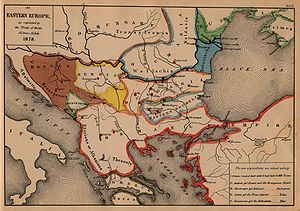 Russia declared war on 24 April 1877. Her chancellor Prince Gorchakov had effectively purchased Austrian neutrality with the Reichstadt Agreement
, under which Ottoman territories captured in the course of the war would be partitioned between the Russian and Austria-Hungarian Empires, with the latter obtaining Bosnia and Herzegovina. The United Kingdom, though still fearing the Russian threat to British dominance in Southern Asia, did not involve herself in the conflict. However, when Russia threatened to secure Constantinople, British Prime Minister Benjamin Disraeli urged Austria and Germany to ally with him against this tyrannical war aim. As a result, Russia sued for peace through the Treaty of San Stefano
, which imposed harsh terms: the Empire was to grant independence to Romania, Serbia, and Montenegro; to grant autonomy to Bulgaria; to institute reforms in Bosnia and Herzegovina; and to cede the Dobruja
and parts of Armenia
to Russia, which would also be paid an enormous indemnity. As Russia could dominate the newly independent states, her influence in Southeastern Europe was greatly increased by the Treaty of San Stefano. Due to the insistence of the Great Powers (especially the United Kingdom), the treaty was heavily revised at the Congress of Berlin
so as to reduce the great advantages acquired by Russia.
The Treaty of Berlin
adjusted the boundaries of the newly independent states in the Ottoman Empire's favour. Furthermore, Bulgaria was divided into two separate states (Bulgaria and Eastern Rumelia
), as it was feared that a single state would be susceptible to Russian domination. Ottoman cessions to Russia were largely sustained, and Bosnia and Herzegovina (though still nominally within the Ottoman Empire) were transferred to Austrian control. In addition, the Ottoman island of Cyprus
was given to the United Kingdom via a secret agreement made between the United Kingdom and the Ottoman Empire. These final two procedures were predominantly forced by Disraeli, who was famously described by Otto von Bismarck
as "The old Jew, that is the man", after his level-headed Palmerstonian approach to the Eastern Question.
in 1879. Germany also became more friendly towards the Ottoman Empire, which became a close German ally. The Germans took over the re-organisation of the Ottoman military and financial system; in return, they received several commercial concessions, including permission to build the Baghdad Railway
, which secured for them access to several important economic markets. Germany was driven not only by commercial interests, but also by an imperialistic and militaristic rivalry with the United Kingdom. The United Kingdom, meanwhile, agreed to the Entente Cordiale
with France in 1904, thereby resolving differences between the two countries over international affairs. The United Kingdom also reconciled with Russia in 1907 with the Anglo-Russian Entente
.
(more commonly called the Young Turks), a political party opposed to the absolute rule of Sultan Abd-ul-Hamid II, led a rebellion against their ruler. The pro-reform Young Turks deposed the Sultan in 1909, replacing him with the ineffective Mehmed V
. In the following years, various constitutional and political reforms were instituted, but the decay of the Ottoman Empire continued.
Austria-Hungary's plans were opposed by Serbia, which sought Russian assistance. Russia, however, could not comply; a defeat in the Russo-Japanese War
had devastated her, and Germany threatened to support Austria-Hungary during a war. The United Kingdom and France, who were not directly concerned by the annexation, did not become involved. Thus unaided, Serbia was forced to renounce her opposition to the annexation of Bosnia and Herzegovina.
History of Europe
History of Europe describes the history of humans inhabiting the European continent since it was first populated in prehistoric times to present, with the first human settlement between 45,000 and 25,000 BC.-Overview:...
, encompasses the diplomatic
Diplomacy
Diplomacy is the art and practice of conducting negotiations between representatives of groups or states...
and political
Politics
Politics is a process by which groups of people make collective decisions. The term is generally applied to the art or science of running governmental or state affairs, including behavior within civil governments, but also applies to institutions, fields, and special interest groups such as the...
problems posed by the decay of the Ottoman Empire
Ottoman Empire
The Ottoman EmpireIt was usually referred to as the "Ottoman Empire", the "Turkish Empire", the "Ottoman Caliphate" or more commonly "Turkey" by its contemporaries...
. The expression does not apply to any one particular problem, but instead includes a variety of issues raised during the 18th, 19th, and 20th centuries, including instability in the European territories ruled by the Ottoman Empire.
The Eastern Question is normally dated to 1774, when the Russo-Turkish War (1768–1774) ended in defeat for the Ottomans. As the dissolution of the Ottoman Empire was believed to be imminent, the European powers engaged in a power struggle to safeguard their military, strategic and commercial interests in the Ottoman domains. Imperial Russia stood to benefit from the decline of the Ottoman Empire; on the other hand, Austria-Hungary
Austria-Hungary
Austria-Hungary , more formally known as the Kingdoms and Lands Represented in the Imperial Council and the Lands of the Holy Hungarian Crown of Saint Stephen, was a constitutional monarchic union between the crowns of the Austrian Empire and the Kingdom of Hungary in...
and the United Kingdom
United Kingdom of Great Britain and Ireland
The United Kingdom of Great Britain and Ireland was the formal name of the United Kingdom during the period when what is now the Republic of Ireland formed a part of it....
deemed the preservation of the Empire to be in their best interests. The Eastern Question was put to rest after World War I, one of whose outcomes was the collapse of the Ottoman Empire.
Background
The Eastern Question emerged as the power of the Ottoman Empire began to decline during the 17th century. The Ottomans were at the height of their power in 1683, when they lost the Battle of ViennaBattle of Vienna
The Battle of Vienna took place on 11 and 12 September 1683 after Vienna had been besieged by the Ottoman Empire for two months...
to the combined forces of the Polish-Lithuanian Commonwealth and Austria, under the command of John III Sobieski. Peace was made much later, in 1699, with the Treaty of Karlowitz
Treaty of Karlowitz
The Treaty of Karlowitz was signed on 26 January 1699 in Sremski Karlovci , concluding the Austro-Ottoman War of 1683–1697 in which the Ottoman side had been defeated at the Battle of Zenta...
, which forced the Ottoman Empire to cede many of its Central European possessions, including Hungary. Its westward expansion arrested, the Ottoman Empire never again posed a serious threat to Austria, which became the dominant power in its region of Europe.
The Eastern Question did not truly develop until the Russo-Turkish Wars of the 18th century. The first of the wars, which began in 1768, ended in 1774 with the Treaty of Kuchuk-Kainarji. The treaty was interpreted as permitting Russia to act as the protector of Orthodox Christians under the sovereignty of the Ottoman Sultan, and established Russia as a major Black Sea
Black Sea
The Black Sea is bounded by Europe, Anatolia and the Caucasus and is ultimately connected to the Atlantic Ocean via the Mediterranean and the Aegean seas and various straits. The Bosphorus strait connects it to the Sea of Marmara, and the strait of the Dardanelles connects that sea to the Aegean...
power. Another Russo-Turkish conflict began in 1787. The Empress of Russia, Catherine II
Catherine II of Russia
Catherine II, also known as Catherine the Great , Empress of Russia, was born in Stettin, Pomerania, Prussia on as Sophie Friederike Auguste von Anhalt-Zerbst-Dornburg...
, entered into an alliance with the Austrian ruler, the Emperor Joseph II
Joseph II, Holy Roman Emperor
Joseph II was Holy Roman Emperor from 1765 to 1790 and ruler of the Habsburg lands from 1780 to 1790. He was the eldest son of Empress Maria Theresa and her husband, Francis I...
; the two agreed to partition the Ottoman Empire between their respective nations, thereby alarming many European powers, especially the United Kingdom, France, and Prussia
Prussia
Prussia was a German kingdom and historic state originating out of the Duchy of Prussia and the Margraviate of Brandenburg. For centuries, the House of Hohenzollern ruled Prussia, successfully expanding its size by way of an unusually well-organized and effective army. Prussia shaped the history...
. Austria was forced to withdraw from the war in 1791. In the ensuing Treaty of Jassy
Treaty of Jassy
The Treaty of Jassy, signed at Jassy in Moldavia , was a pact between the Russian and Ottoman Empires ending the Russo-Turkish War of 1787–92 and confirming Russia's increasing dominance in the Black Sea....
(1792), Russia's dominance of the Black Sea grew.
During the early 19th century, the positions of the Great Powers on the Ottoman Empire became clear. Russia was the power most directly concerned with the Eastern Question. She was primarily concerned with control of the Black Sea and access to the Mediterranean (especially by acquiring the important port of Constantinople
Constantinople
Constantinople was the capital of the Roman, Eastern Roman, Byzantine, Latin, and Ottoman Empires. Throughout most of the Middle Ages, Constantinople was Europe's largest and wealthiest city.-Names:...
). Russia was especially eager to secure navigation rights for her merchant vessels and warships while denying similar privileges to other European powers. Another more or less important Russian interest was the protection of the many Orthodox Christians
Eastern Orthodox Church
The Orthodox Church, officially called the Orthodox Catholic Church and commonly referred to as the Eastern Orthodox Church, is the second largest Christian denomination in the world, with an estimated 300 million adherents mainly in the countries of Belarus, Bulgaria, Cyprus, Georgia, Greece,...
in the territories of the Ottoman Empire, given that Russia was the foremost Orthodox world power. Constantinople's status as the home of the most important patriarchate
Patriarchate
A patriarchate is the office or jurisdiction of a patriarch. A patriarch, as the term is used here, is either* one of the highest-ranking bishops in Eastern Orthodoxy, earlier, the five that were included in the Pentarchy: Rome, Constantinople, Alexandria, Antioch, and Jerusalem, but now nine,...
in Orthodoxy added to the Russian desire to possess it.
Austria was most directly opposed to the Russian designs on the Ottoman Empire. Though the Austrian House of Habsburg was the foremost opponent of the Ottomans in prior centuries, Austria deemed the Ottoman threat to be much less serious than a Russian advance along the Danube River. Austria also feared that the disintegration of the Ottoman Empire into several nation states would foster the sentiment of nationalism
Nationalism
Nationalism is a political ideology that involves a strong identification of a group of individuals with a political entity defined in national terms, i.e. a nation. In the 'modernist' image of the nation, it is nationalism that creates national identity. There are various definitions for what...
among the many ethnic groups in her own Empire. Thus, Austria made it one of her primary goals to maintain the unity of the Ottoman Empire.
Similarly, Britain saw the containment of the Russian Empire as vital to the security of British colonial possessions in India (seen also in the prosecution of the Great Game in Afghanistan
Afghanistan
Afghanistan , officially the Islamic Republic of Afghanistan, is a landlocked country located in the centre of Asia, forming South Asia, Central Asia and the Middle East. With a population of about 29 million, it has an area of , making it the 42nd most populous and 41st largest nation in the world...
). It was also concerned that Russian control of the Bosporus
Bosporus
The Bosphorus or Bosporus , also known as the Istanbul Strait , is a strait that forms part of the boundary between Europe and Asia. It is one of the Turkish Straits, along with the Dardanelles...
could impede British domination of the eastern Mediterranean, including the Suez Canal
Suez Canal
The Suez Canal , also known by the nickname "The Highway to India", is an artificial sea-level waterway in Egypt, connecting the Mediterranean Sea and the Red Sea. Opened in November 1869 after 10 years of construction work, it allows water transportation between Europe and Asia without navigation...
. The UK was also concerned with the preservation of the traditional global balance of power
Balance of power in international relations
In international relations, a balance of power exists when there is parity or stability between competing forces. The concept describes a state of affairs in the international system and explains the behavior of states in that system...
, which would have been upset by the fall of the Ottoman Empire.
Napoleonic Era
Napoleon I
Napoleon Bonaparte was a French military and political leader during the latter stages of the French Revolution.As Napoleon I, he was Emperor of the French from 1804 to 1815...
. To secure his own domination and to render the rest of Europe virtually powerless, Napoleon established an alliance with Russia by concluding the Treaty of Tilsit
Treaties of Tilsit
The Treaties of Tilsit were two agreements signed by Napoleon I of France in the town of Tilsit in July, 1807 in the aftermath of his victory at Friedland. The first was signed on 7 July, between Tsar Alexander I of Russia and Napoleon I of France, when they met on a raft in the middle of the Neman...
in 1807. Russia undertook to aid Napoleon in his war against the United Kingdom; in turn, the Emperor of Russia would receive the Ottoman territories of Moldavia
Moldavia
Moldavia is a geographic and historical region and former principality in Eastern Europe, corresponding to the territory between the Eastern Carpathians and the Dniester river...
and Wallachia
Wallachia
Wallachia or Walachia is a historical and geographical region of Romania. It is situated north of the Danube and south of the Southern Carpathians...
. If the Sultan refused to surrender these territories, France and Russia were to attack the Empire, and the Ottoman domains in Europe were to be partitioned between the two allies. The Napoleonic scheme threatened not only the Sultan, but also the United Kingdom, Austria and Prussia, which was almost powerless in the face of such a potent alliance. The alliance naturally proved incommoding to the Austrians, who hoped that a joint Franco-Russian attack, which would probably have utterly devastated the Ottoman Empire, could be prevented by diplomacy; but if diplomatic measures failed, the Austrian minister Klemens Wenzel, Prince von Metternich decided that he would support the partition of the Ottoman Empire—a solution disadvantageous to Austria, but not as dangerous as a complete Russian takeover of Southeastern Europe.
An attack on the Empire, however, did not come to pass, and the alliance concluded at Tilsit was dissolved by the French invasion of Russia
French invasion of Russia
The French invasion of Russia of 1812 was a turning point in the Napoleonic Wars. It reduced the French and allied invasion forces to a tiny fraction of their initial strength and triggered a major shift in European politics as it dramatically weakened French hegemony in Europe...
in 1812. Following Napoleon's defeat by the Great Powers in 1815, representatives of the victors met at the Congress of Vienna
Congress of Vienna
The Congress of Vienna was a conference of ambassadors of European states chaired by Klemens Wenzel von Metternich, and held in Vienna from September, 1814 to June, 1815. The objective of the Congress was to settle the many issues arising from the French Revolutionary Wars, the Napoleonic Wars,...
, but failed to take any action relating to the territorial integrity of the decaying Ottoman Empire. This omission, together with the exclusion of the Sultan from the Holy Alliance
Holy Alliance
The Holy Alliance was a coalition of Russia, Austria and Prussia created in 1815 at the behest of Czar Alexander I of Russia, signed by the three powers in Paris on September 26, 1815, in the Congress of Vienna after the defeat of Napoleon.Ostensibly it was to instill the Christian values of...
, was interpreted by many as supportive of the position that the Eastern Question was a Russian domestic issue that did not concern any other European nations.
Serbian revolution
Révolution nationale
The Révolution nationale was the official ideological name under which the Vichy regime established by Marshal Philippe Pétain in July 1940 presented its program...
and social revolution
Social revolution
The term social revolution may have different connotations depending on the speaker.In the Trotskyist movement, the term "social revolution" refers to an upheaval in which existing property relations are smashed...
of the Serbian people
Serbs
The Serbs are a South Slavic ethnic group of the Balkans and southern Central Europe. Serbs are located mainly in Serbia, Montenegro and Bosnia and Herzegovina, and form a sizable minority in Croatia, the Republic of Macedonia and Slovenia. Likewise, Serbs are an officially recognized minority in...
between 1804 and 1815, during which Serbia managed to fully emancipate from the Ottoman Empire
Ottoman Empire
The Ottoman EmpireIt was usually referred to as the "Ottoman Empire", the "Turkish Empire", the "Ottoman Caliphate" or more commonly "Turkey" by its contemporaries...
and exist as a sovereign European nation-state
Nation-state
The nation state is a state that self-identifies as deriving its political legitimacy from serving as a sovereign entity for a nation as a sovereign territorial unit. The state is a political and geopolitical entity; the nation is a cultural and/or ethnic entity...
, and a latter period (1815–1833), marked by intense negotiations between Belgrade
Belgrade
Belgrade is the capital and largest city of Serbia. It is located at the confluence of the Sava and Danube rivers, where the Pannonian Plain meets the Balkans. According to official results of Census 2011, the city has a population of 1,639,121. It is one of the 15 largest cities in Europe...
and Ottoman Empire
Ottoman Empire
The Ottoman EmpireIt was usually referred to as the "Ottoman Empire", the "Turkish Empire", the "Ottoman Caliphate" or more commonly "Turkey" by its contemporaries...
. The term was invented by a famous German historian Leopold von Ranke
Leopold von Ranke
Leopold von Ranke was a German historian, considered one of the founders of modern source-based history. Ranke set the standards for much of later historical writing, introducing such ideas as reliance on primary sources , an emphasis on narrative history and especially international politics .-...
in his book Die Serbische Revolution, published in 1829. These events marked the foundation of modern Serbia. While the first phase of the revolution (1804–1815) was in fact a war of independence, the second phase (1815–1833) resulted in official recognition of a suzerain Serbian state by the Porte, thus bringing the revolution to its end.
The above mentioned time frame covers several phases of the revolution:First Serbian Uprising
First Serbian Uprising
The First Serbian Uprising was the first stage of the Serbian Revolution , the successful wars of independence that lasted for 9 years and approximately 9 months , during which Serbia perceived itself as an independent state for the first time after more than three centuries of Ottoman rule and...
(1804–13), led by Karađorđe Petrović; Hadži Prodan's revolt
Hadži Prodanova buna
Hadži Prodan's Revolt was an interphase between the two major uprisings in Serb populated parts of the Ottoman Empire. Despite the collapse of the First Serbian Uprising in 1813, the tensions in the Pashaluk of Belgrade nevertheless persisted. In 1814 an revolt was launched by Hadži Prodan...
(1814);Second Serbian Uprising
Second Serbian Uprising
The Second Serbian Uprising was a second phase of the Serbian revolution against the Ottoman Empire, which erupted shortly after the re-annexation of the country to the Ottoman Empire, in 1813. The occupation was enforced following the defeat of the First Serbian Uprising , during which Serbia...
(1815) under Miloš Obrenović, followed by the official recognition of the Serbian state (1815–1833) by the Porte.
The Proclamation
The Proclamation
The Proclamation of 1809 refers to the political document of Serbian revolution which marked the foundation of modern Serbia. It was issued by Karadjordje in the newly appointed capital Belgrade, which represented the peak of the Serbian revolution...
(1809) by Karađorđe in the capital Belgrade
Belgrade
Belgrade is the capital and largest city of Serbia. It is located at the confluence of the Sava and Danube rivers, where the Pannonian Plain meets the Balkans. According to official results of Census 2011, the city has a population of 1,639,121. It is one of the 15 largest cities in Europe...
represented the peak of the revolution. It called for unity of the Serbian nation
Serbs
The Serbs are a South Slavic ethnic group of the Balkans and southern Central Europe. Serbs are located mainly in Serbia, Montenegro and Bosnia and Herzegovina, and form a sizable minority in Croatia, the Republic of Macedonia and Slovenia. Likewise, Serbs are an officially recognized minority in...
, emphasising the importance of freedom of religion
Serbian Orthodox Church
The Serbian Orthodox Church is one of the autocephalous Orthodox Christian churches, ranking sixth in order of seniority after Constantinople, Alexandria, Antioch, Jerusalem, and Russia...
, Serbian history and rule of law
Rule of law
The rule of law, sometimes called supremacy of law, is a legal maxim that says that governmental decisions should be made by applying known principles or laws with minimal discretion in their application...
- all of which Ottoman Empire
Ottoman Empire
The Ottoman EmpireIt was usually referred to as the "Ottoman Empire", the "Turkish Empire", the "Ottoman Caliphate" or more commonly "Turkey" by its contemporaries...
couldn't- or has denied to provide, being a non-secular Muslim
Muslim
A Muslim, also spelled Moslem, is an adherent of Islam, a monotheistic, Abrahamic religion based on the Quran, which Muslims consider the verbatim word of God as revealed to prophet Muhammad. "Muslim" is the Arabic term for "submitter" .Muslims believe that God is one and incomparable...
state. It also called on Serbs to stop paying tax
Tax
To tax is to impose a financial charge or other levy upon a taxpayer by a state or the functional equivalent of a state such that failure to pay is punishable by law. Taxes are also imposed by many subnational entities...
es to the Porte because they were based on religious affiliation.
The ultimate result of the uprisings was Serbia's suzerainty
Suzerainty
Suzerainty occurs where a region or people is a tributary to a more powerful entity which controls its foreign affairs while allowing the tributary vassal state some limited domestic autonomy. The dominant entity in the suzerainty relationship, or the more powerful entity itself, is called a...
from the Ottoman Empire
Ottoman Empire
The Ottoman EmpireIt was usually referred to as the "Ottoman Empire", the "Turkish Empire", the "Ottoman Caliphate" or more commonly "Turkey" by its contemporaries...
. Principality of Serbia was established, governed by its own Parliament, Government, Constitution and its own royal dynasty. Social element of the revolution was achieved through introduction of the bourgeois society values in Serbia, which is why it was considered the world's easternmost bourgeois revolt, which culminated with the abolition of feudalism
Feudalism
Feudalism was a set of legal and military customs in medieval Europe that flourished between the 9th and 15th centuries, which, broadly defined, was a system for ordering society around relationships derived from the holding of land in exchange for service or labour.Although derived from the...
in 1806- just 15 years after the French revolution
French Revolution
The French Revolution , sometimes distinguished as the 'Great French Revolution' , was a period of radical social and political upheaval in France and Europe. The absolute monarchy that had ruled France for centuries collapsed in three years...
. First constitution in the Balkans and its oldest university- Belgrade's Great Academy
University of Belgrade
The University of Belgrade is the oldest and largest university of Serbia.Founded in 1808 as the Belgrade Higher School in revolutionary Serbia, by 1838 it merged with the Kragujevac-based departments into a single university...
(1808) added to the achievements of the young Serb state. By 1833, Serbia was officially recognized as a tributary to the Porte and as such, acknowledged as a hereditary monarchy. De jure independence of the Principality was internationally recognized during the second half of the 19th century.
Greek Revolt
Greece
Greece , officially the Hellenic Republic , and historically Hellas or the Republic of Greece in English, is a country in southeastern Europe....
declared independence from the Sultan in 1821. It was at about this time that the phrase "Eastern Question" was coined. Ever since the defeat of Napoleon in 1815, there had been rumours that the Emperor of Russia sought to invade the Ottoman Empire, and the Greek Revolt seemed to make an invasion even more likely. The British foreign minister, Robert Stewart, Viscount Castlereagh
Robert Stewart, Viscount Castlereagh
Robert Stewart, 2nd Marquess of Londonderry, KG, GCH, PC, PC , usually known as Lord CastlereaghThe name Castlereagh derives from the baronies of Castlereagh and Ards, in which the manors of Newtownards and Comber were located...
, as well as the Austrian foreign minister, Metternich, counselled the Emperor of Russia, Alexander I
Alexander I of Russia
Alexander I of Russia , served as Emperor of Russia from 23 March 1801 to 1 December 1825 and the first Russian King of Poland from 1815 to 1825. He was also the first Russian Grand Duke of Finland and Lithuania....
, not to enter the war. Instead, they pleaded that he maintain the Concert of Europe
Concert of Europe
The Concert of Europe , also known as the Congress System after the Congress of Vienna, was the balance of power that existed in Europe from the end of the Napoleonic Wars to the outbreak of World War I , albeit with major alterations after the revolutions of 1848...
(the spirit of broad collaboration in Europe which had persisted since Napoleon's defeat). A desire for peaceful co-operation was also held by Alexander I, who had founded the Holy Alliance. Rather than immediately putting the Eastern Question to rest by aiding the Greeks and attacking the Ottomans, Alexander wavered, ultimately failing to take any decisive action.
Alexander's death in 1825 brought Nicholas I
Nicholas I of Russia
Nicholas I , was the Emperor of Russia from 1825 until 1855, known as one of the most reactionary of the Russian monarchs. On the eve of his death, the Russian Empire reached its historical zenith spanning over 20 million square kilometers...
to the Imperial Throne of Russia. Deciding that he would no longer tolerate negotiations and conferences, he chose to intervene in Greece. The United Kingdom also soon became involved, interested in imposing its will on a newly formed Greek state in part to prevent it becoming a wholly Russian vassal. The spirit of Romanticism
Romanticism
Romanticism was an artistic, literary and intellectual movement that originated in the second half of the 18th century in Europe, and gained strength in reaction to the Industrial Revolution...
that then dominated Western European cultural life also made support for Greek independence politically viable. France too aligned itself with the Greeks, but Austria (still worried about Russian expansion) did not. Outraged by the interference of the Great Powers, the Ottoman Sultan, Mahmud II
Mahmud II
Mahmud II was the 30th Sultan of the Ottoman Empire from 1808 until his death in 1839. He was born in the Topkapi Palace, Istanbul, the son of Sultan Abdulhamid I...
, denounced Russia as an enemy of Islam
Islam
Islam . The most common are and . : Arabic pronunciation varies regionally. The first vowel ranges from ~~. The second vowel ranges from ~~~...
, prompting Russia to declare war in 1828. An alarmed Austria sought to form an anti-Russian coalition, but its attempts were in vain.
As the war continued into 1829, Russia gained a firm advantage over the Ottoman Empire. By prolonging hostilities further, however, Russia would have invited Austria to enter the war against her and would have resulted in considerable suspicion in the United Kingdom. Therefore, for the Russians to continue with the war in hopes of destroying the Ottoman Empire would have been inexpedient. At this stage, the King of France, Charles X
Charles X of France
Charles X was known for most of his life as the Comte d'Artois before he reigned as King of France and of Navarre from 16 September 1824 until 2 August 1830. A younger brother to Kings Louis XVI and Louis XVIII, he supported the latter in exile and eventually succeeded him...
, proposed the partition of the Ottoman Empire amongst Austria, Russia and others, but his scheme was presented too belatedly to produce a result.
Thus, Russia was able to secure neither a decisive defeat nor a partition of the Ottoman Empire. She chose, however, to adopt the policy of degrading the Ottoman Empire to a mere dependency. In 1829, the Emperor of Russia concluded the Treaty of Adrianople
Treaty of Adrianople
The Peace Treaty of Adrianople concluded the Russo-Turkish War, 1828-1829 between Russia and the Ottoman Empire. It was signed on September 14, 1829 in Adrianople by Russia's Count Alexey Fyodorovich Orlov and by Turkey's Abdul Kadyr-bey...
with the Sultan; his empire was granted additional territory along the Black Sea, Russian commercial vessels were granted access to the Dardanelles
Dardanelles
The Dardanelles , formerly known as the Hellespont, is a narrow strait in northwestern Turkey connecting the Aegean Sea to the Sea of Marmara. It is one of the Turkish Straits, along with its counterpart the Bosphorus. It is located at approximately...
, and the commercial rights of Russians in the Ottoman Empire were enhanced. The Greek War of Independence was terminated shortly thereafter, as Greece was granted independence by the Treaty of Constantinople
Treaty of Constantinople (1832)
The Τreaty of Constantinople was the product of the Constantinople Conference which opened in February 1832 with the participation of the Great Powers on the one hand and the Ottoman Empire on the other. The factors which shaped the treaty included the refusal of Léopold, King of Belgium, to...
in 1832.
Muhammad Ali
Viceroy
A viceroy is a royal official who runs a country, colony, or province in the name of and as representative of the monarch. The term derives from the Latin prefix vice-, meaning "in the place of" and the French word roi, meaning king. A viceroy's province or larger territory is called a viceroyalty...
in Egypt
Egypt
Egypt , officially the Arab Republic of Egypt, Arabic: , is a country mainly in North Africa, with the Sinai Peninsula forming a land bridge in Southwest Asia. Egypt is thus a transcontinental country, and a major power in Africa, the Mediterranean Basin, the Middle East and the Muslim world...
, Muhammad Ali
Muhammad Ali of Egypt
Muhammad Ali Pasha al-Mas'ud ibn Agha was a commander in the Ottoman army, who became Wāli, and self-declared Khedive of Egypt and Sudan...
. The modern and well trained Egyptians looked as though they could conquer the entire empire. The Tsar of Russia, in keeping with his policy of reducing the Ottoman Sultan to a petty vassal, offered to form an alliance with the Sultan. In 1833, the two rulers negotiated the Treaty of Unkiar Skelessi, in which Russia achieved the aim of securing complete dominance over the Ottomans. The Russians undertook to protect the Empire from external attacks; in turn, the Sultan pledged to close the Dardanelles to warships whenever Russia was at war. This provision of the Treaty of Unkiar Skelessi raised a problem known as the "Straits Question." The agreement provided for the closure of all warships, but many European statesmen mistakenly believed that the clause failed to restrict Russian vessels. The United Kingdom and France were angered by the misinterpreted clause; they also sought to contain Russian expansion. The two kingdoms, however, differed on the means of achieving their objective; the British wished to uphold the Sultan, but the French preferred to make Muhammad Ali (whom they saw as more competent) the ruler of the entire Ottoman Empire. Russian intervention led the Sultan to negotiate a peace with Muhammad Ali in 1833, but war broke out once again in 1839.
Sultan Mahmud II died in the same year, leaving the Ottoman Empire to his son, Abd-ul-Mejid I. The state of affairs at the time of the new Sultan's accession were extremely critical; the Ottoman army had been signally defeated by the forces of Muhammad Ali. Another disaster followed when the entire Turkish fleet was seized by the Egyptian forces. Great Britain and Russia now intervened to prevent the collapse of the Ottoman Empire, but France still continued to support Muhammad Ali. In 1840, however, the Great Powers agreed to compromise; Muhammad Ali agreed to make a nominal act of submission to the Sultan, but was granted hereditary control of Egypt.
The only unresolved issue of the period was the Straits Question. In 1841, Russia consented to the abrogation of the Treaty of Unkiar Skelessi by accepting the London Straits Convention
London Straits Convention
In the London Straits Convention concluded on July 13, 1841 between the Great Powers of Europe at the time - Russia, the United Kingdom, France, Austria and Prussia - the "ancient rule" of the Ottoman Empire was re-established by closing the Turkish straits , which link the Black Sea to the...
. The Great Powers — Russia, the United Kingdom, France, Austria and Prussia — agreed to the re-establishment of the "ancient rule" of the Ottoman Empire, which provided that the Turkish straits would be closed to all warships whatsoever, with the exception of the Sultan's allies during wartime. With the Straits Convention, the Russian Emperor Nicholas I abandoned the idea of reducing the Sultan to a state of dependence, and returned to the plan of partitioning Ottoman territories in Europe.
Thus, after the resolution of the Egyptian struggle which had begun in 1831, the weak Ottoman Empire was no longer wholly dependent on Russia. It was, however, not a truly independent state, for it relied on the Great Powers of Europe for protection. Attempts were made at internal reform, but they failed to terminate the decline of the once great Empire. By the 1840s, the Ottoman Empire had become the "sick man of Europe
Sick man of Europe
"Sick man of Europe" is a nickname that has been used to describe a European country experiencing a time of economic difficulty and/or impoverishment...
", and its eventual dissolution appeared inevitable.
Revolutions of 1848
The Great Powers having reached a compromise to end the revolt of Mehmet Ali, the Eastern Question lay dormant for approximately a decade until revived by the Revolutions of 1848Revolutions of 1848
The European Revolutions of 1848, known in some countries as the Spring of Nations, Springtime of the Peoples or the Year of Revolution, were a series of political upheavals throughout Europe in 1848. It was the first Europe-wide collapse of traditional authority, but within a year reactionary...
. Though Russia could have seized the opportunity to attack the Ottoman Empire—France and Austria were at the time occupied by their own insurrections—she chose not to do so. The Emperor Nicholas instead committed his troops to the defence of Austria, deeming that the goodwill established in the process would allow him to seize Ottoman possessions in Europe at a later date.
After the Austrian Revolution was suppressed, an Austro-Russian war against the Ottoman Empire seemed imminent. The Emperors of both Austria and Russia demanded that the Sultan return Austrian rebels who had sought asylum in the Empire, but met with refusal. The indignant monarchs withdrew their ambassadors to the Sublime Porte, threatening armed conflict. Almost immediately, however, the United Kingdom and France sent their fleets to protect the Ottoman Empire. The two Emperors, deeming military hostilities futile, withdrew their demands for the surrender of the fugitives.
Crimean War
A new conflict was ostensibly provoked during the 1850s by an obscure religious dispute. Under treaties negotiated during the eighteenth century, France was the guardian of Roman Catholics in the Ottoman Empire, whilst Russia was the protector of Orthodox Christians. For several years, however, Catholic and Orthodox monks had disputed possession of the Church of the NativityChurch of the Nativity
The Church of the Nativity in Bethlehem is one of the oldest continuously operating churches in the world. The structure is built over the cave that tradition marks as the birthplace of Jesus of Nazareth, and thus it is considered sacred by Christians...
and the Church of the Holy Sepulchre
Church of the Holy Sepulchre
The Church of the Holy Sepulchre, also called the Church of the Resurrection by Eastern Christians, is a church within the walled Old City of Jerusalem. It is a few steps away from the Muristan....
in Palestine
Palestine
Palestine is a conventional name, among others, used to describe the geographic region between the Mediterranean Sea and the Jordan River, and various adjoining lands....
. During the early 1850s, the two sides made demands which the Sultan could not possibly satisfy simultaneously. In 1853, the Sultan adjudicated in favour of the French, despite the vehement protestations of the local Orthodox monks.
The Emperor Nicholas dispatched a diplomat, Prince Menshikov, on a special mission to the Porte. By previous treaties, the Sultan was committed "to protect the Christian religion and its Churches", but Menshikov attempted to negotiate a new treaty, under which Russia would be allowed to interfere whenever she deemed the Sultan's protection inadequate. At the same time, however, the British government sent Stratford Canning, 1st Viscount Stratford de Redcliffe
Stratford Canning, 1st Viscount Stratford de Redcliffe
Stratford Canning, 1st Viscount Stratford de Redcliffe KG GCB PC , was a British diplomat and politician, best known as the longtime British Ambassador to the Ottoman Empire...
, who learnt of Menshikov's demands upon arriving. Through skilful diplomacy, Lord Stratford convinced the Sultan to reject the treaty, which compromised the independence of the Ottomans. Shortly after he learnt of the failure of Menshikov's diplomacy, the Emperor Nicholas marched into Moldavia and Wallachia (Ottoman principalities in which Russia was acknowledged as a special guardian of the Orthodox Church), using the Sultan's failure to resolve the issue of the Holy Places as a pretext. The Emperor Nicholas I believed that the European powers would not object strongly to the annexation of a few neighbouring Ottoman provinces, especially given Russian involvement in suppressing the Revolutions of 1848.
When the Emperor sent his troops into Moldavia and Wallachia (the "Danubian Principalities"), the United Kingdom, seeking to maintain the security of the Ottoman Empire, sent a fleet to the Dardanelles, where it was joined by another fleet sent by France. At the same time, however, the European powers hoped for a diplomatic compromise. The representatives of the four neutral Great Powers—United Kingdom, France, Austria and Prussia—met in Vienna
Vienna
Vienna is the capital and largest city of the Republic of Austria and one of the nine states of Austria. Vienna is Austria's primary city, with a population of about 1.723 million , and is by far the largest city in Austria, as well as its cultural, economic, and political centre...
, where they drafted a note which they hoped would be acceptable to Russia and the Empire. The note met with the approval of the Emperor of Russia; it was, however, rejected by Sultan Abd-ul-Mejid I, who felt that the document's poor phrasing left it open to many different interpretations. The United Kingdom, France and Austria were united in proposing amendments to mollify the Sultan, but their suggestions were ignored in the Court of Saint Petersburg
Saint Petersburg
Saint Petersburg is a city and a federal subject of Russia located on the Neva River at the head of the Gulf of Finland on the Baltic Sea...
. The United Kingdom and France set aside the idea of continuing negotiations, but Austria and Prussia did not believe that the rejection of the proposed amendments justified the abandonment of the diplomatic process. The Sultan proceeded to war, his armies attacking the Russian army near the Danube. Nicholas responded by despatching warships, which destroyed the entire Ottoman fleet at Sinop
Battle of Sinop
The Battle of Sinop, or the Battle of Sinope, took place on 30 November 1853 at Sinop, a sea port in northern Anatolia, when Imperial Russian warships struck and annihilated a patrol force of Ottoman ships anchored in the harbor...
on 30 November 1853, thereby making it possible for Russia to land and supply her forces on the Ottoman shores fairly easily. The destruction of the Ottoman fleet and the threat of Russian expansion alarmed both the United Kingdom and France, who stepped forth in defence of the Ottoman Empire. In 1854, after Russia ignored an Anglo-French ultimatum to withdraw from the Danubian Principalities, the United Kingdom and France declared war.
The Emperor Nicholas I presumed that Austria, in return for the support rendered during the Revolutions of 1848, would side with him, or at the very least remain neutral. Austria, however, felt threatened by the Russian troops in the nearby Danubian Principalities. When the United Kingdom and France demanded the withdrawal of Russian forces from the Principalities, Austria supported them; and, though it did not immediately declare war on Russia, it refused to guarantee its neutrality. When, in the summer of 1854, Austria made another demand for the withdrawal of troops, Russia (fearing that Austria would enter the war) complied.
Though the original grounds for war were lost when Russia withdrew her troops from the Danubian Principalities, the United Kingdom and France failed to cease hostilities. Determined to address the Eastern Question by putting an end to the Russian threat to the Ottoman Empire, the allies proposed several conditions for the cessation of hostilities, including a demand that Russia was to give up her protectorate over the Danubian Principalities; secondly, she was to abandon any claim granting her the right to interfere in Ottoman affairs on the behalf of the Orthodox Christians; thirdly, the Straits Convention of 1841 was to be revised; and finally, all nations were to be granted access to the river Danube. As the Emperor refused to comply with the "Four Points", the Crimean War
Crimean War
The Crimean War was a conflict fought between the Russian Empire and an alliance of the French Empire, the British Empire, the Ottoman Empire, and the Kingdom of Sardinia. The war was part of a long-running contest between the major European powers for influence over territories of the declining...
proceeded.
Peace negotiations began in 1856 under the Emperor Nicholas I's successor, Alexander II
Alexander II of Russia
Alexander II , also known as Alexander the Liberator was the Emperor of the Russian Empire from 3 March 1855 until his assassination in 1881...
. Under the ensuing Treaty of Paris
Treaty of Paris (1856)
The Treaty of Paris of 1856 settled the Crimean War between Russia and an alliance of the Ottoman Empire, the British Empire, Second French Empire, and the Kingdom of Sardinia. The treaty, signed on March 30, 1856 at the Congress of Paris, made the Black Sea neutral territory, closing it to all...
, the "Four Points" plan proposed earlier was largely adhered to; most notably, Russia's special privileges relating to the Danubian Principalities were transferred to the Great Powers as a group. In addition, warships of all nations were perpetually excluded from the Black Sea, once the home to a Russian fleet (which, however, had been destroyed in the course of the war). Furthermore, the Emperor of Russia and the Sultan agreed not to establish any naval or military arsenal on the coast of that sea. The Black Sea clauses came at a tremendous disadvantage to Russia, for it greatly diminished the naval threat she posed to the Ottomans. Moreover, all the Great Powers pledged to respect the independence and territorial integrity of the Ottoman Empire.
The Treaty of Paris stood until 1871, when France was crushed by Prussia in the Franco-Prussian War
Franco-Prussian War
The Franco-Prussian War or Franco-German War, often referred to in France as the 1870 War was a conflict between the Second French Empire and the Kingdom of Prussia. Prussia was aided by the North German Confederation, of which it was a member, and the South German states of Baden, Württemberg and...
. Whilst Prussia and several other German states united to form a powerful German Empire
German Empire
The German Empire refers to Germany during the "Second Reich" period from the unification of Germany and proclamation of Wilhelm I as German Emperor on 18 January 1871, to 1918, when it became a federal republic after defeat in World War I and the abdication of the Emperor, Wilhelm II.The German...
, the Emperor of the French, Napoleon III
Napoleon III of France
Louis-Napoléon Bonaparte was the President of the French Second Republic and as Napoleon III, the ruler of the Second French Empire. He was the nephew and heir of Napoleon I, christened as Charles Louis Napoléon Bonaparte...
, was deposed to permit the formation of a French Republic
French Third Republic
The French Third Republic was the republican government of France from 1870, when the Second French Empire collapsed due to the French defeat in the Franco-Prussian War, to 1940, when France was overrun by Nazi Germany during World War II, resulting in the German and Italian occupations of France...
. During his reign (which had begun in 1852), the Emperor Napoleon, eager for the support of the United Kingdom, had opposed Russia over the Eastern Question. Russian interference in the Ottoman Empire, however, did not in any significant manner threaten the interests of France. Thus, France abandoned her opposition to the Emperor of Russia after the establishment of a Republic. Encouraged by the decision of the French, and supported by the German minister Otto, Fürst von Bismarck
Otto von Bismarck
Otto Eduard Leopold, Prince of Bismarck, Duke of Lauenburg , simply known as Otto von Bismarck, was a Prussian-German statesman whose actions unified Germany, made it a major player in world affairs, and created a balance of power that kept Europe at peace after 1871.As Minister President of...
, Russia denounced the Black Sea clauses of the treaty agreed to in 1856. As the United Kingdom alone could not enforce the clauses, Russia once again established a fleet in the Black Sea.
Great Eastern Crisis
In 1875, the territory of HerzegovinaHerzegovina
Herzegovina is the southern region of Bosnia and Herzegovina. While there is no official border distinguishing it from the Bosnian region, it is generally accepted that the borders of the region are Croatia to the west, Montenegro to the south, the canton boundaries of the Herzegovina-Neretva...
rebelled against its ruler, the Sultan, in the now famous Herzegovinian rebellion
Herzegovinian rebellion
The Herzegovina Uprising of 1875-1878 was an uprising led by Christians, firstly in Herzegovina and then in Bosnia. It is the most significant of the rebellions against Ottoman rule in Herzegovina...
, which led to insurrection in the Province of Bosnia as well as in Bulgaria
Bulgaria
Bulgaria , officially the Republic of Bulgaria , is a parliamentary democracy within a unitary constitutional republic in Southeast Europe. The country borders Romania to the north, Serbia and Macedonia to the west, Greece and Turkey to the south, as well as the Black Sea to the east...
. The Great Powers believed that their intervention was necessary, lest a disastrous and bloody war break out in the Balkans. The first to act were the members of the League of the Three Emperors
League of the Three Emperors
The League of the Three Emperors was an unstable alliance between Tsar Alexander II of Russia, Emperor Franz Joseph I of Austria-Hungary and Kaiser Wilhelm I of Germany.- Formation 1873 :...
(Germany, Austria-Hungary and Russia), whose common attitude toward the Eastern Question was embodied in the Andrassy Note (named for the Hungarian diplomat Julius, Count Andrassy). The Note, seeking to avoid a widespread conflagration in Southeastern Europe, urged the Sultan to institute various reforms, including one granting religious liberty to Christians. A joint commission of Christians and Muslims was to be established to ensure the enactment of the appropriate reforms. With the approval of the United Kingdom and France, the Note was submitted to the Sultan, whose agreement was secured on 31 January 1876. The Herzegovinian leaders, however, rejected the proposal, pointing out that the Sultan had already made promises to institute reforms but had failed to fulfill them.
Representatives of the Three Emperors met once again in Berlin, where they approved the Berlin Memorandum. To convince the Herzegovinians that the Sultan would indeed keep his promises, the Memorandum suggested that international representatives be allowed to oversee the institution of reforms in the rebelling provinces. Before the Memorandum could be approved by the Porte, the Ottoman Empire was convulsed by internal strife, which led to the deposition of Sultan Abd-ul-Aziz. The new Sultan, Murad V
Murad V
Murad V was the 33rd Sultan of the Ottoman Empire who reigned from 30 May to 31 August 1876.He was born at Istanbul , Topkapı Palace. His father was Abdülmecid I...
, was himself deposed three months later due to his mental instability, bringing Abd-ul-Hamid II
Abdul Hamid II
His Imperial Majesty, The Sultan Abdülhamid II, Emperor of the Ottomans, Caliph of the Faithful was the 34th sultan of the Ottoman Empire...
to power. In the meantime, the hardships of the Ottomans had increased; their treasury was empty, and they faced an insurrection not only in Bosnia and Herzegovina, but also in Serbia
Serbia
Serbia , officially the Republic of Serbia , is a landlocked country located at the crossroads of Central and Southeast Europe, covering the southern part of the Carpathian basin and the central part of the Balkans...
, Montenegro
Montenegro
Montenegro Montenegrin: Crna Gora Црна Гора , meaning "Black Mountain") is a country located in Southeastern Europe. It has a coast on the Adriatic Sea to the south-west and is bordered by Croatia to the west, Bosnia and Herzegovina to the northwest, Serbia to the northeast and Albania to the...
and Bulgaria
Bulgaria
Bulgaria , officially the Republic of Bulgaria , is a parliamentary democracy within a unitary constitutional republic in Southeast Europe. The country borders Romania to the north, Serbia and Macedonia to the west, Greece and Turkey to the south, as well as the Black Sea to the east...
(the so-called April uprising
April Uprising
The April Uprising was an insurrection organised by the Bulgarians in the Ottoman Empire from April to May 1876, which indirectly resulted in the re-establishment of Bulgaria as an autonomous nation in 1878...
). Still, the Ottoman Empire managed to crush the insurgents in August 1876. The result incommoded Russia, which had planned to take possession of various Ottoman territories in Southeastern Europe in the course of the conflict.
After the uprising was largely suppressed, however, rumours of Ottoman atrocities against the rebellious population shocked European sensibilities. Russia now intended to enter the war on the side of the rebels, for she hoped to take advantage of the situation to acquire some of the Ottoman possessions in Southeastern Europe. A further attempt for peace was made by delegates of the Great Powers (who now numbered six due to the rise of Italy) assembled at the Constantinople Conference
Constantinople Conference
The 1876–1877 Constantinople Conference of the Great Powers was held in Constantinople from 23 December 1876 until 20 January 1877...
in 1876. The Sultan, however, refused to compromise his independence by allowing international representatives to oversee the institution of reforms in Bosnia and Herzegovina. In 1877, the Great Powers once again attempted to negotiate with the Ottoman Empire, but their proposals continued to meet with rejection.
Reichstadt Agreement
The Reichstadt agreement was an agreement made between the Austrian Empire and Russia in July 1876, who were at that time in an alliance with each other and Germany in the League of the Three Emperors, or Dreikaiserbund.- Terms of the agreement :...
, under which Ottoman territories captured in the course of the war would be partitioned between the Russian and Austria-Hungarian Empires, with the latter obtaining Bosnia and Herzegovina. The United Kingdom, though still fearing the Russian threat to British dominance in Southern Asia, did not involve herself in the conflict. However, when Russia threatened to secure Constantinople, British Prime Minister Benjamin Disraeli urged Austria and Germany to ally with him against this tyrannical war aim. As a result, Russia sued for peace through the Treaty of San Stefano
Treaty of San Stefano
The Preliminary Treaty of San Stefano was a treaty between Russia and the Ottoman Empire signed at the end of the Russo-Turkish War, 1877–78...
, which imposed harsh terms: the Empire was to grant independence to Romania, Serbia, and Montenegro; to grant autonomy to Bulgaria; to institute reforms in Bosnia and Herzegovina; and to cede the Dobruja
Dobruja
Dobruja is a historical region shared by Bulgaria and Romania, located between the lower Danube river and the Black Sea, including the Danube Delta, Romanian coast and the northernmost part of the Bulgarian coast...
and parts of Armenia
Armenia
Armenia , officially the Republic of Armenia , is a landlocked mountainous country in the Caucasus region of Eurasia...
to Russia, which would also be paid an enormous indemnity. As Russia could dominate the newly independent states, her influence in Southeastern Europe was greatly increased by the Treaty of San Stefano. Due to the insistence of the Great Powers (especially the United Kingdom), the treaty was heavily revised at the Congress of Berlin
Congress of Berlin
The Congress of Berlin was a meeting of the European Great Powers' and the Ottoman Empire's leading statesmen in Berlin in 1878. In the wake of the Russo-Turkish War of 1877–78, the meeting's aim was to reorganize the countries of the Balkans...
so as to reduce the great advantages acquired by Russia.
The Treaty of Berlin
Treaty of Berlin, 1878
The Treaty of Berlin was the final act of the Congress of Berlin , by which the United Kingdom, Austria-Hungary, France, Germany, Italy, Russia and the Ottoman Empire under Sultan Abdul Hamid II revised the Treaty of San Stefano signed on March 3 of the same year...
adjusted the boundaries of the newly independent states in the Ottoman Empire's favour. Furthermore, Bulgaria was divided into two separate states (Bulgaria and Eastern Rumelia
Eastern Rumelia
Eastern Rumelia or Eastern Roumelia was an administratively autonomous province in the Ottoman Empire and Principality of Bulgaria from 1878 to 1908. It was under full Bulgarian control from 1885 on, when it willingly united with the tributary Principality of Bulgaria after a bloodless revolution...
), as it was feared that a single state would be susceptible to Russian domination. Ottoman cessions to Russia were largely sustained, and Bosnia and Herzegovina (though still nominally within the Ottoman Empire) were transferred to Austrian control. In addition, the Ottoman island of Cyprus
Cyprus
Cyprus , officially the Republic of Cyprus , is a Eurasian island country, member of the European Union, in the Eastern Mediterranean, east of Greece, south of Turkey, west of Syria and north of Egypt. It is the third largest island in the Mediterranean Sea.The earliest known human activity on the...
was given to the United Kingdom via a secret agreement made between the United Kingdom and the Ottoman Empire. These final two procedures were predominantly forced by Disraeli, who was famously described by Otto von Bismarck
Otto von Bismarck
Otto Eduard Leopold, Prince of Bismarck, Duke of Lauenburg , simply known as Otto von Bismarck, was a Prussian-German statesman whose actions unified Germany, made it a major player in world affairs, and created a balance of power that kept Europe at peace after 1871.As Minister President of...
as "The old Jew, that is the man", after his level-headed Palmerstonian approach to the Eastern Question.
Germany and the Ottoman Empire
In the latter part of the nineteenth century, the positions of some of the Great Powers in relation to each other and to the Ottoman Empire began to shift. Distressed by the conduct of the Germans in revising the Treaty of San Stefano, Russia left the League of the Three Emperors. Germany drew closer to Austria-Hungary, with whom she concluded the Dual AllianceDual Alliance, 1879
The Dual Alliance was a defensive alliance between Germany and Austria-Hungary, which was created by treaty on October 7, 1879 as part of Bismarck's system of alliances to prevent/limit war. In it, Germany and Austria-Hungary pledged to aid one another in case of an attack by Russia...
in 1879. Germany also became more friendly towards the Ottoman Empire, which became a close German ally. The Germans took over the re-organisation of the Ottoman military and financial system; in return, they received several commercial concessions, including permission to build the Baghdad Railway
Baghdad Railway
The Baghdad Railway , was built from 1903 to 1940 to connect Berlin with the Ottoman Empire city of Baghdad with a line through modern-day Turkey, Syria, and Iraq....
, which secured for them access to several important economic markets. Germany was driven not only by commercial interests, but also by an imperialistic and militaristic rivalry with the United Kingdom. The United Kingdom, meanwhile, agreed to the Entente Cordiale
Entente Cordiale
The Entente Cordiale was a series of agreements signed on 8 April 1904 between the United Kingdom and the French Republic. Beyond the immediate concerns of colonial expansion addressed by the agreement, the signing of the Entente Cordiale marked the end of almost a millennium of intermittent...
with France in 1904, thereby resolving differences between the two countries over international affairs. The United Kingdom also reconciled with Russia in 1907 with the Anglo-Russian Entente
Anglo-Russian Entente
Signed on August 31, 1907, in St. Petersburg, Russia, the Anglo-Russian Convention of 1907 brought shaky British-Russian relations to the forefront by solidifying boundaries that identified respective control in Persia, Afghanistan, and Tibet...
.
Bosnian Crisis
In 1908, the Committee of Union and ProgressYoung Turks
The Young Turks , from French: Les Jeunes Turcs) were a coalition of various groups favouring reformation of the administration of the Ottoman Empire. The movement was against the absolute monarchy of the Ottoman Sultan and favoured a re-installation of the short-lived Kanûn-ı Esâsî constitution...
(more commonly called the Young Turks), a political party opposed to the absolute rule of Sultan Abd-ul-Hamid II, led a rebellion against their ruler. The pro-reform Young Turks deposed the Sultan in 1909, replacing him with the ineffective Mehmed V
Mehmed V
Mehmed V Reshad was the 35th Ottoman Sultan. He was the son of Sultan Abdülmecid I. He was succeeded by his half-brother Mehmed VI.-Birth:...
. In the following years, various constitutional and political reforms were instituted, but the decay of the Ottoman Empire continued.
Austria-Hungary's plans were opposed by Serbia, which sought Russian assistance. Russia, however, could not comply; a defeat in the Russo-Japanese War
Russo-Japanese War
The Russo-Japanese War was "the first great war of the 20th century." It grew out of rival imperial ambitions of the Russian Empire and Japanese Empire over Manchuria and Korea...
had devastated her, and Germany threatened to support Austria-Hungary during a war. The United Kingdom and France, who were not directly concerned by the annexation, did not become involved. Thus unaided, Serbia was forced to renounce her opposition to the annexation of Bosnia and Herzegovina.
See also
- British Occupation of Egypt
- Decline of the Ottoman EmpireDecline of the Ottoman EmpireThe Decline of the Ottoman Empire is the period that followed after the Stagnation of the Ottoman Empire in which the empire experienced several economic and political setbacks. Directly affecting the Empire at this time was Russian imperialism...
- Sick man of EuropeSick man of Europe"Sick man of Europe" is a nickname that has been used to describe a European country experiencing a time of economic difficulty and/or impoverishment...