

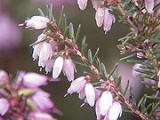
Erica

Encyclopedia
Erica
the heaths or heathers, is a genus
of approximately 860 species of flowering plant
s in the family Ericaceae
. The English common names "heath" and "heather" are shared by some closely related genera of similar appearance.
Most of the species are small shrub
s from 0.2-1.5 m high, though some are taller; the tallest are E. arborea (Tree Heath
) and E. scoparia (Besom Heath), both of which can reach up to 6–7 m tall. All are evergreen
, with minute needle-like leaves
2–15 mm long. Flowers are sometimes axillary, and sometimes in terminal umbels or spikes, and are usually outward or downward facing. Flowers are borne in mass, and the plants are grown as landscape
or garden
plants for their floral effect. The seed
s are very small, and in some species may persist in the soil for decades.
At least 660 of the species are endemic
to South Africa
, and these are often called the Cape heaths, forming the largest genus in the fynbos
. The remaining species are native to other parts of Africa
, Madagascar
, the Mediterranean region, and Europe
.
Like most of the rest of the Ericaceae, Erica species are mainly calcifugous
, being limited to acid
ic or very acidic soils – from dry, sandy soils to extremely wet ones such as bog
. They often dominate
dwarf-shrub habitats (heathland
and moorland
), or the ground vegetation of open acidic woodland
.
The closely related genus Calluna
was formerly included in Erica – it differs in having even smaller scale-leaves (less than 2–3 mm long), and the flower corolla being more divided into separate petals. Erica is sometimes referred to as "Winter (or Spring) Heather" to distinguish it from Calluna
(Summer (or Autumn) Heather).
Plants of this genus are eaten mainly by the larva
e of many Lepidoptera
species including Emperor Moth
, Garden tiger moth
, True Lover's Knot
, Wormwood Pug
and the Coleophora
case-bearers C. juncicolella and C. pyrrhulipennella.
the heaths or heathers, is a genus
Genus
In biology, a genus is a low-level taxonomic rank used in the biological classification of living and fossil organisms, which is an example of definition by genus and differentia...
of approximately 860 species of flowering plant
Flowering plant
The flowering plants , also known as Angiospermae or Magnoliophyta, are the most diverse group of land plants. Angiosperms are seed-producing plants like the gymnosperms and can be distinguished from the gymnosperms by a series of synapomorphies...
s in the family Ericaceae
Ericaceae
The Ericaceae, commonly known as the heath or heather family, is a group of mostly calcifuge flowering plants. The family is large, with roughly 4000 species spread across 126 genera, making it the 14th most speciose family of flowering plants...
. The English common names "heath" and "heather" are shared by some closely related genera of similar appearance.
Most of the species are small shrub
Shrub
A shrub or bush is distinguished from a tree by its multiple stems and shorter height, usually under 5–6 m tall. A large number of plants may become either shrubs or trees, depending on the growing conditions they experience...
s from 0.2-1.5 m high, though some are taller; the tallest are E. arborea (Tree Heath
Tree heath
Erica arborea, the tree heath, is a shrub or small evergreen tree found mostly in the macchia-matorral-maquis shrublands, dry evergreen scrublands, surrounding the Mediterranean Basin and west to Portugal and the Canary and Madeira Islands....
) and E. scoparia (Besom Heath), both of which can reach up to 6–7 m tall. All are evergreen
Evergreen
In botany, an evergreen plant is a plant that has leaves in all seasons. This contrasts with deciduous plants, which completely lose their foliage during the winter or dry season.There are many different kinds of evergreen plants, both trees and shrubs...
, with minute needle-like leaves
Leaf
A leaf is an organ of a vascular plant, as defined in botanical terms, and in particular in plant morphology. Foliage is a mass noun that refers to leaves as a feature of plants....
2–15 mm long. Flowers are sometimes axillary, and sometimes in terminal umbels or spikes, and are usually outward or downward facing. Flowers are borne in mass, and the plants are grown as landscape
Landscape
Landscape comprises the visible features of an area of land, including the physical elements of landforms such as mountains, hills, water bodies such as rivers, lakes, ponds and the sea, living elements of land cover including indigenous vegetation, human elements including different forms of...
or garden
Garden
A garden is a planned space, usually outdoors, set aside for the display, cultivation, and enjoyment of plants and other forms of nature. The garden can incorporate both natural and man-made materials. The most common form today is known as a residential garden, but the term garden has...
plants for their floral effect. The seed
Seed
A seed is a small embryonic plant enclosed in a covering called the seed coat, usually with some stored food. It is the product of the ripened ovule of gymnosperm and angiosperm plants which occurs after fertilization and some growth within the mother plant...
s are very small, and in some species may persist in the soil for decades.
At least 660 of the species are endemic
Endemic (ecology)
Endemism is the ecological state of being unique to a defined geographic location, such as an island, nation or other defined zone, or habitat type; organisms that are indigenous to a place are not endemic to it if they are also found elsewhere. For example, all species of lemur are endemic to the...
to South Africa
South Africa
The Republic of South Africa is a country in southern Africa. Located at the southern tip of Africa, it is divided into nine provinces, with of coastline on the Atlantic and Indian oceans...
, and these are often called the Cape heaths, forming the largest genus in the fynbos
Fynbos
Fynbos is the natural shrubland or heathland vegetation occurring in a small belt of the Western Cape of South Africa, mainly in winter rainfall coastal and mountainous areas with a Mediterranean climate...
. The remaining species are native to other parts of Africa
Africa
Africa is the world's second largest and second most populous continent, after Asia. At about 30.2 million km² including adjacent islands, it covers 6% of the Earth's total surface area and 20.4% of the total land area...
, Madagascar
Madagascar
The Republic of Madagascar is an island country located in the Indian Ocean off the southeastern coast of Africa...
, the Mediterranean region, and Europe
Europe
Europe is, by convention, one of the world's seven continents. Comprising the westernmost peninsula of Eurasia, Europe is generally 'divided' from Asia to its east by the watershed divides of the Ural and Caucasus Mountains, the Ural River, the Caspian and Black Seas, and the waterways connecting...
.
Like most of the rest of the Ericaceae, Erica species are mainly calcifugous
Calcifuge
A calcifuge is a plant that does not tolerate alkaline soil. The word is derived from the Latin 'to flee from chalk'. These plants are also described as ericaceous, as the prototypical calcifuge is the genus Erica...
, being limited to acid
Acid
An acid is a substance which reacts with a base. Commonly, acids can be identified as tasting sour, reacting with metals such as calcium, and bases like sodium carbonate. Aqueous acids have a pH of less than 7, where an acid of lower pH is typically stronger, and turn blue litmus paper red...
ic or very acidic soils – from dry, sandy soils to extremely wet ones such as bog
Bog
A bog, quagmire or mire is a wetland that accumulates acidic peat, a deposit of dead plant material—often mosses or, in Arctic climates, lichens....
. They often dominate
Dominance (ecology)
Ecological dominance is the degree to which a species is more numerous than its competitors in an ecological community, or makes up more of the biomass...
dwarf-shrub habitats (heathland
Heath (habitat)
A heath or heathland is a dwarf-shrub habitat found on mainly low quality acidic soils, characterised by open, low growing woody vegetation, often dominated by plants of the Ericaceae. There are some clear differences between heath and moorland...
and moorland
Moorland
Moorland or moor is a type of habitat, in the temperate grasslands, savannas, and shrublands biome, found in upland areas, characterised by low-growing vegetation on acidic soils and heavy fog...
), or the ground vegetation of open acidic woodland
Woodland
Ecologically, a woodland is a low-density forest forming open habitats with plenty of sunlight and limited shade. Woodlands may support an understory of shrubs and herbaceous plants including grasses. Woodland may form a transition to shrubland under drier conditions or during early stages of...
.
The closely related genus Calluna
Calluna
Calluna vulgaris is the sole species in the genus Calluna in the family Ericaceae. It is a low-growing perennial shrub growing to tall, or rarely to and taller, and is found widely in Europe and Asia Minor on acidic soils in open sunny situations and in moderate shade...
was formerly included in Erica – it differs in having even smaller scale-leaves (less than 2–3 mm long), and the flower corolla being more divided into separate petals. Erica is sometimes referred to as "Winter (or Spring) Heather" to distinguish it from Calluna
Calluna
Calluna vulgaris is the sole species in the genus Calluna in the family Ericaceae. It is a low-growing perennial shrub growing to tall, or rarely to and taller, and is found widely in Europe and Asia Minor on acidic soils in open sunny situations and in moderate shade...
(Summer (or Autumn) Heather).
Plants of this genus are eaten mainly by the larva
Larva
A larva is a distinct juvenile form many animals undergo before metamorphosis into adults. Animals with indirect development such as insects, amphibians, or cnidarians typically have a larval phase of their life cycle...
e of many Lepidoptera
Lepidoptera
Lepidoptera is a large order of insects that includes moths and butterflies . It is one of the most widespread and widely recognizable insect orders in the world, encompassing moths and the three superfamilies of butterflies, skipper butterflies, and moth-butterflies...
species including Emperor Moth
Emperor Moth
The Small Emperor Moth is a moth of the family Saturniidae. It is sometimes placed in the genus Saturnia. It occurs throughout the Palearctic region and is the only member of its family to be found in the British Isles....
, Garden tiger moth
Garden tiger moth
The garden tiger moth is a moth of the Arctiidae family.It has a wingspan of . The design of the wings varies: the front wings are brown with a white pattern , the back wings orange with a pattern of black dots. The conspicuous patterns serve as a warning to predators, because the moth's body...
, True Lover's Knot
True Lover's Knot
The True Lover's Knot is a moth of the family Noctuidae. It has a nearly cosmopolitan distribution. In Europe it is found wherever its food plants grow...
, Wormwood Pug
Wormwood Pug
The Wormwood Pug is a moth of the family Geometridae. It is a common species across the Palearctic region and the Near East, as well as North America....
and the Coleophora
Coleophora
Coleophora is a very large genus of moths of the family Coleophoridae. It contains some 1,350 described species. The genus is represented on all continents, but the majority are found in the Nearctic and Palaearctic regions...
case-bearers C. juncicolella and C. pyrrhulipennella.