

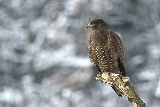
Common Buzzard

Encyclopedia
The Common Buzzard is a medium to large bird of prey
, whose range covers most of Europe
and extends into Asia
. It is usually resident all year, except in the coldest parts of its range, and in the case of one subspecies
.
.
This broad-winged raptor has a wide variety of plumages, and in Europe can be confused with the similar Rough-legged Buzzard
(Buteo lagopus) and the only distantly related Honey Buzzard
(Pernis apivorus), which mimics the Common Buzzard's plumage for a degree of protection from Northern Goshawks . The plumage can vary in Britain from almost pure white to black, but is usually shades of brown, with a pale 'necklace' of feathers.
in his Systema naturae in 1758 as Falco buteo. Buzzard subspecies fall into two groups.
The western Buteo group is mainly resident or short-distance migrants
. They are:
The eastern vulpinus group includes
Two resident forms on islands close to Africa
are often assigned to the first group, but appear to be distinct species
, more closely related to the African Long-legged Buzzard
, based on biogeography
and preliminary mtDNA cytochrome b
sequence
data (Clouet & Wink 2000):
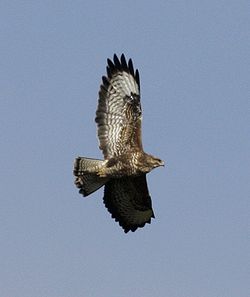 The Common Buzzard breeds in woodland
s, usually on the fringes, but favours hunting over open land. It eats mainly small mammal
s, and will come to carrion
. A great opportunist, it adapts well to a varied diet of pheasant, rabbit, other small mammals to medium mammals, snakes and lizards, and can often be seen walking over recently ploughed fields looking for worms and insects. The birds have incredible strength and are therefore able to pick up food of all weights.
Buzzards do not normally form flocks, but several may be seen together on migration
or in good habitat. The Victorian
writer on Dartmoor
, William Crossing
, noted he had on occasions seen flocks of 15 or more at some places. Though a rare occurrence, as many as 20 buzzards can be spotted in one field area, approximately 30 metres apart, so cannot be classed as a flock in the general sense, consisting of birds without a mate or territory. They are fiercely territorial, and, though rare, fights do break out if one strays onto another pair's territory, but dominant displays of aggression will normally see off the interloper. Pairs mate for life. To attract a mate (or impress his existing mate) the male performs a ritual aerial display before the beginning of spring. This spectacular display is known as 'the roller coaster'. He will rise high up in the sky, to turn and plummet downward, in a spiral, twisting and turning as he comes down. He then rises immediately upward to repeat the exercise.
The call is a plaintive peea-ay, similar to a cat's meow.
, excepting some north Himalayan
birds, and winters in Africa, India and southeastern Asia. In the open country favoured on the wintering grounds, steppe buzzards are often seen perched on roadside telephone poles.
Steppe Buzzard is some times split as a separate species, B. vulpinus. Compared to the nominate form, it is slightly smaller (45–50 cm long), longer winged and longer tailed. There are two colour morphs: the rufous form which gives this subspecies its scientific name (vulpes is Latin for "fox"), and a dark grey form.
The tail of vulpinus is paler than the nominate form, and often quite rufous, recalling North American Red-tailed Hawk
. The upper wings have pale primary patches, and the primary flight feathers are also paler when viewed from below. Adults have a black trailing edge to the wings, and both morphs often have plain underparts, lacking the breast band frequently seen in B. b. buteo.
, B. oreophilus. This is a resident breeding species in woodlands in southern and eastern South Africa.
It is very similar to the abundant summer migrant Steppe Buzzard, but the adult can be distinguished with a good view by its whiter underparts and unbarred flanks. The juvenile differs from the same-age steppe buzzard by its white front and tear-shaped flank streaks.
The Forest Buzzard, as its name implies, inhabits evergreen woodlands, including introduced eucalyptus
and pine
s, whereas the steppe buzzard prefers more open habitats. However, habitat alone is not a good indicator for these forms.
Bird of prey
Birds of prey are birds that hunt for food primarily on the wing, using their keen senses, especially vision. They are defined as birds that primarily hunt vertebrates, including other birds. Their talons and beaks tend to be relatively large, powerful and adapted for tearing and/or piercing flesh....
, whose range covers most of Europe
Europe
Europe is, by convention, one of the world's seven continents. Comprising the westernmost peninsula of Eurasia, Europe is generally 'divided' from Asia to its east by the watershed divides of the Ural and Caucasus Mountains, the Ural River, the Caspian and Black Seas, and the waterways connecting...
and extends into Asia
Asia
Asia is the world's largest and most populous continent, located primarily in the eastern and northern hemispheres. It covers 8.7% of the Earth's total surface area and with approximately 3.879 billion people, it hosts 60% of the world's current human population...
. It is usually resident all year, except in the coldest parts of its range, and in the case of one subspecies
Subspecies
Subspecies in biological classification, is either a taxonomic rank subordinate to species, ora taxonomic unit in that rank . A subspecies cannot be recognized in isolation: a species will either be recognized as having no subspecies at all or two or more, never just one...
.
Description
The Common Buzzard measures between 40 and 58 cm (15.7 and 22.8 in) in length with a 109 – wingspan and a body mass of 427–1364 g (0.941373859529427–3 lb), making it a medium-sized raptorBird of prey
Birds of prey are birds that hunt for food primarily on the wing, using their keen senses, especially vision. They are defined as birds that primarily hunt vertebrates, including other birds. Their talons and beaks tend to be relatively large, powerful and adapted for tearing and/or piercing flesh....
.
This broad-winged raptor has a wide variety of plumages, and in Europe can be confused with the similar Rough-legged Buzzard
Rough-legged Buzzard
The Rough-legged Buzzard , called the Rough-legged Hawk in North America, is a medium-large bird of prey. It is found in Arctic and Subarctic regions of North America and Eurasia during the breeding season and migrates south for the winter.The species exhibits a wide variety of plumage patterns...
(Buteo lagopus) and the only distantly related Honey Buzzard
Honey Buzzard
The European Honey Buzzard , is a bird of prey in the family Accipitridae which also includes many other diurnal raptors such as kites, eagles and harriers....
(Pernis apivorus), which mimics the Common Buzzard's plumage for a degree of protection from Northern Goshawks . The plumage can vary in Britain from almost pure white to black, but is usually shades of brown, with a pale 'necklace' of feathers.
Systematics
The Common Buzzard was first described by LinnaeusCarolus Linnaeus
Carl Linnaeus , also known after his ennoblement as , was a Swedish botanist, physician, and zoologist, who laid the foundations for the modern scheme of binomial nomenclature. He is known as the father of modern taxonomy, and is also considered one of the fathers of modern ecology...
in his Systema naturae in 1758 as Falco buteo. Buzzard subspecies fall into two groups.
The western Buteo group is mainly resident or short-distance migrants
Bird migration
Bird migration is the regular seasonal journey undertaken by many species of birds. Bird movements include those made in response to changes in food availability, habitat or weather. Sometimes, journeys are not termed "true migration" because they are irregular or in only one direction...
. They are:
- Buteo buteo buteo: most of Europe
- B. b. rothschildi: AzoresAzoresThe Archipelago of the Azores is composed of nine volcanic islands situated in the middle of the North Atlantic Ocean, and is located about west from Lisbon and about east from the east coast of North America. The islands, and their economic exclusion zone, form the Autonomous Region of the...
- B. b. insularum: Canary IslandsCanary IslandsThe Canary Islands , also known as the Canaries , is a Spanish archipelago located just off the northwest coast of mainland Africa, 100 km west of the border between Morocco and the Western Sahara. The Canaries are a Spanish autonomous community and an outermost region of the European Union...
- B. b. arrigonii: CorsicaCorsicaCorsica is an island in the Mediterranean Sea. It is located west of Italy, southeast of the French mainland, and north of the island of Sardinia....
and SardiniaSardiniaSardinia is the second-largest island in the Mediterranean Sea . It is an autonomous region of Italy, and the nearest land masses are the French island of Corsica, the Italian Peninsula, Sicily, Tunisia and the Spanish Balearic Islands.The name Sardinia is from the pre-Roman noun *sard[],... - B. b. menetriesi: CaucasusCaucasusThe Caucasus, also Caucas or Caucasia , is a geopolitical region at the border of Europe and Asia, and situated between the Black and the Caspian sea...
- B. b. harterti: MadeiraMadeiraMadeira is a Portuguese archipelago that lies between and , just under 400 km north of Tenerife, Canary Islands, in the north Atlantic Ocean and an outermost region of the European Union...
, doubtfully distinct from nominate Buteo
The eastern vulpinus group includes
- B. b. vulpinus (Steppe Buzzard): EurasiaEurasiaEurasia is a continent or supercontinent comprising the traditional continents of Europe and Asia ; covering about 52,990,000 km2 or about 10.6% of the Earth's surface located primarily in the eastern and northern hemispheres...
: migrant breeder - B. b. burmanicus (Himalayan Buzzard): Himalayas and western China
- B. b. japonicus: JapanJapanJapan is an island nation in East Asia. Located in the Pacific Ocean, it lies to the east of the Sea of Japan, China, North Korea, South Korea and Russia, stretching from the Sea of Okhotsk in the north to the East China Sea and Taiwan in the south...
: resident - B. b. toyoshimai: Izu IslandsIzu IslandsThe are a group of volcanic islands stretching south and east from the Izu Peninsula of Honshū, Japan. Administratively, they form two towns and six villages; all part of Tokyo. The largest is Izu Ōshima, usually called simply Ōshima....
and Bonin Islands - B. b. oshiroi: Daito IslandsDaito IslandsDaitō Islands are three islands that lie about east of Okinawa. From north to south, the islands are:* Data from 2004 Nov 20, 08:55 version of Japanese Wikipedia...
Two resident forms on islands close to Africa
Africa
Africa is the world's second largest and second most populous continent, after Asia. At about 30.2 million km² including adjacent islands, it covers 6% of the Earth's total surface area and 20.4% of the total land area...
are often assigned to the first group, but appear to be distinct species
Species
In biology, a species is one of the basic units of biological classification and a taxonomic rank. A species is often defined as a group of organisms capable of interbreeding and producing fertile offspring. While in many cases this definition is adequate, more precise or differing measures are...
, more closely related to the African Long-legged Buzzard
Long-legged Buzzard
The Long-legged Buzzard is a bird of prey.-Description:It is similar in appearance to the Rough-legged Buzzard , but larger and more robust. There are many different colour forms, but usually Long-leggeds have a clear orange tint to the plumage, red or orange tail, pale head and largely white...
, based on biogeography
Biogeography
Biogeography is the study of the distribution of species , organisms, and ecosystems in space and through geological time. Organisms and biological communities vary in a highly regular fashion along geographic gradients of latitude, elevation, isolation and habitat area...
and preliminary mtDNA cytochrome b
Cytochrome b
Cytochrome b/b6 is the main subunit of transmembrane cytochrome bc1 and b6f complexes. In addition, it commonly refers to a region of mtDNA used for population genetics and phylogenetics.- Function :...
sequence
DNA sequence
The sequence or primary structure of a nucleic acid is the composition of atoms that make up the nucleic acid and the chemical bonds that bond those atoms. Because nucleic acids, such as DNA and RNA, are unbranched polymers, this specification is equivalent to specifying the sequence of...
data (Clouet & Wink 2000):
- Buteo bannermani (Cape Verde BuzzardCape Verde BuzzardThe Cape Verde Buzzard is a medium to large bird of prey that is sometimes considered a subspecies of the widespread Common Buzzard . As its name implies, it is native to Cape Verde. Some taxonomists consider it to be a distinct species and is treated as such here.-References:* Clements, J. F.,...
): Cape Verde Islands - Buteo socotraensis (Socotra BuzzardSocotra BuzzardThe Socotra Buzzard is a medium to large bird of prey that is sometimes considered a subspecies of the widespread Common Buzzard . As its name implies, it is native to Socotra. Some taxonomists consider it to be a distinct species and is treated as such here.-References:* Clements, J. F., T. S....
) of SocotraSocotraSocotra , also spelt Soqotra, is a small archipelago of four islands in the Indian Ocean. The largest island, also called Socotra, is about 95% of the landmass of the archipelago. It lies some east of the Horn of Africa and south of the Arabian Peninsula. The island is very isolated and through...
Behaviour
Woodland
Ecologically, a woodland is a low-density forest forming open habitats with plenty of sunlight and limited shade. Woodlands may support an understory of shrubs and herbaceous plants including grasses. Woodland may form a transition to shrubland under drier conditions or during early stages of...
s, usually on the fringes, but favours hunting over open land. It eats mainly small mammal
Mammal
Mammals are members of a class of air-breathing vertebrate animals characterised by the possession of endothermy, hair, three middle ear bones, and mammary glands functional in mothers with young...
s, and will come to carrion
Carrion
Carrion refers to the carcass of a dead animal. Carrion is an important food source for large carnivores and omnivores in most ecosystems. Examples of carrion-eaters include vultures, hawks, eagles, hyenas, Virginia Opossum, Tasmanian Devils, coyotes, Komodo dragons, and burying beetles...
. A great opportunist, it adapts well to a varied diet of pheasant, rabbit, other small mammals to medium mammals, snakes and lizards, and can often be seen walking over recently ploughed fields looking for worms and insects. The birds have incredible strength and are therefore able to pick up food of all weights.
Buzzards do not normally form flocks, but several may be seen together on migration
Bird migration
Bird migration is the regular seasonal journey undertaken by many species of birds. Bird movements include those made in response to changes in food availability, habitat or weather. Sometimes, journeys are not termed "true migration" because they are irregular or in only one direction...
or in good habitat. The Victorian
Victorian era
The Victorian era of British history was the period of Queen Victoria's reign from 20 June 1837 until her death on 22 January 1901. It was a long period of peace, prosperity, refined sensibilities and national self-confidence...
writer on Dartmoor
Dartmoor
Dartmoor is an area of moorland in south Devon, England. Protected by National Park status, it covers .The granite upland dates from the Carboniferous period of geological history. The moorland is capped with many exposed granite hilltops known as tors, providing habitats for Dartmoor wildlife. The...
, William Crossing
William Crossing
William Crossing was a writer and documenter of Dartmoor and Dartmoor life. He lived successively at South Brent, Brentor and at Mary Tavy but died at Plymouth.-Early life:...
, noted he had on occasions seen flocks of 15 or more at some places. Though a rare occurrence, as many as 20 buzzards can be spotted in one field area, approximately 30 metres apart, so cannot be classed as a flock in the general sense, consisting of birds without a mate or territory. They are fiercely territorial, and, though rare, fights do break out if one strays onto another pair's territory, but dominant displays of aggression will normally see off the interloper. Pairs mate for life. To attract a mate (or impress his existing mate) the male performs a ritual aerial display before the beginning of spring. This spectacular display is known as 'the roller coaster'. He will rise high up in the sky, to turn and plummet downward, in a spiral, twisting and turning as he comes down. He then rises immediately upward to repeat the exercise.
The call is a plaintive peea-ay, similar to a cat's meow.
Steppe Buzzard
The Steppe Buzzard, B. (b.) vulpinus breeds from east Europe eastward to the Far East, excluding Japan. It is a long-distance migrantBird migration
Bird migration is the regular seasonal journey undertaken by many species of birds. Bird movements include those made in response to changes in food availability, habitat or weather. Sometimes, journeys are not termed "true migration" because they are irregular or in only one direction...
, excepting some north Himalayan
Himalayas
The Himalaya Range or Himalaya Mountains Sanskrit: Devanagari: हिमालय, literally "abode of snow"), usually called the Himalayas or Himalaya for short, is a mountain range in Asia, separating the Indian subcontinent from the Tibetan Plateau...
birds, and winters in Africa, India and southeastern Asia. In the open country favoured on the wintering grounds, steppe buzzards are often seen perched on roadside telephone poles.
Steppe Buzzard is some times split as a separate species, B. vulpinus. Compared to the nominate form, it is slightly smaller (45–50 cm long), longer winged and longer tailed. There are two colour morphs: the rufous form which gives this subspecies its scientific name (vulpes is Latin for "fox"), and a dark grey form.
The tail of vulpinus is paler than the nominate form, and often quite rufous, recalling North American Red-tailed Hawk
Red-tailed Hawk
The Red-tailed Hawk is a bird of prey, one of three species colloquially known in the United States as the "chickenhawk," though it rarely preys on standard sized chickens. It breeds throughout most of North America, from western Alaska and northern Canada to as far south as Panama and the West...
. The upper wings have pale primary patches, and the primary flight feathers are also paler when viewed from below. Adults have a black trailing edge to the wings, and both morphs often have plain underparts, lacking the breast band frequently seen in B. b. buteo.
Forest Buzzard
The Forest Buzzard, B. (b.) trizonatus, is another form sometimes upgraded to a full species, though most recent authorities have placed it as a subspecies of another species, the Mountain BuzzardMountain Buzzard
The Mountain Buzzard is a bird of prey that lives in montane forests in East Africa and forests and plantations in South Africa. The latter population is sometimes considered a separate species, the Forest Buzzard The Mountain Buzzard (Buteo oreophilus) is a bird of prey that lives in montane...
, B. oreophilus. This is a resident breeding species in woodlands in southern and eastern South Africa.
It is very similar to the abundant summer migrant Steppe Buzzard, but the adult can be distinguished with a good view by its whiter underparts and unbarred flanks. The juvenile differs from the same-age steppe buzzard by its white front and tear-shaped flank streaks.
The Forest Buzzard, as its name implies, inhabits evergreen woodlands, including introduced eucalyptus
Eucalyptus
Eucalyptus is a diverse genus of flowering trees in the myrtle family, Myrtaceae. Members of the genus dominate the tree flora of Australia...
and pine
Pine
Pines are trees in the genus Pinus ,in the family Pinaceae. They make up the monotypic subfamily Pinoideae. There are about 115 species of pine, although different authorities accept between 105 and 125 species.-Etymology:...
s, whereas the steppe buzzard prefers more open habitats. However, habitat alone is not a good indicator for these forms.
External links
- Madeira Birds: Buzzard. Page about the controversial subspecies harterti. Retrieved 2006-NOV-28.
- Ageing and sexing (PDF) by Javier Blasco-Zumeta