

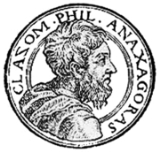
Anaxagoras

Overview
Pre-Socratic philosophy
Pre-Socratic philosophy is Greek philosophy before Socrates . In Classical antiquity, the Presocratic philosophers were called physiologoi...
Greek philosopher
Greek philosophy
Ancient Greek philosophy arose in the 6th century BCE and continued through the Hellenistic period, at which point Ancient Greece was incorporated in the Roman Empire...
. Born in Clazomenae
Clazomenae
Klazomenai was an ancient Greek city of Ionia and a member of the Ionian Dodecapolis , it was one of the first cities to issue silver coinage.-Location:Klazomenai is located in modern Urla on the western coast of...
in Asia Minor
Asia Minor
Asia Minor is a geographical location at the westernmost protrusion of Asia, also called Anatolia, and corresponds to the western two thirds of the Asian part of Turkey...
, Anaxagoras was the first philosopher to bring philosophy from Ionia
Ionia
Ionia is an ancient region of central coastal Anatolia in present-day Turkey, the region nearest İzmir, which was historically Smyrna. It consisted of the northernmost territories of the Ionian League of Greek settlements...
to Athens
Athens
Athens , is the capital and largest city of Greece. Athens dominates the Attica region and is one of the world's oldest cities, as its recorded history spans around 3,400 years. Classical Athens was a powerful city-state...
. He attempted to give a scientific account of eclipse
Eclipse
An eclipse is an astronomical event that occurs when an astronomical object is temporarily obscured, either by passing into the shadow of another body or by having another body pass between it and the viewer...
s, meteor
METEOR
METEOR is a metric for the evaluation of machine translation output. The metric is based on the harmonic mean of unigram precision and recall, with recall weighted higher than precision...
s, rainbow
Rainbow
A rainbow is an optical and meteorological phenomenon that causes a spectrum of light to appear in the sky when the Sun shines on to droplets of moisture in the Earth's atmosphere. It takes the form of a multicoloured arc...
s, and the sun
Sun
The Sun is the star at the center of the Solar System. It is almost perfectly spherical and consists of hot plasma interwoven with magnetic fields...
, which he described as a fiery mass larger than the Peloponnese
Peloponnese
The Peloponnese, Peloponnesos or Peloponnesus , is a large peninsula , located in a region of southern Greece, forming the part of the country south of the Gulf of Corinth...
. According to Diogenes Laertius
Diogenes Laertius
Diogenes Laertius was a biographer of the Greek philosophers. Nothing is known about his life, but his surviving Lives and Opinions of Eminent Philosophers is one of the principal surviving sources for the history of Greek philosophy.-Life:Nothing is definitively known about his life...
and Plutarch
Plutarch
Plutarch then named, on his becoming a Roman citizen, Lucius Mestrius Plutarchus , c. 46 – 120 AD, was a Greek historian, biographer, essayist, and Middle Platonist known primarily for his Parallel Lives and Moralia...
he fled to Lampsacus
Lampsacus
Lampsacus was an ancient Greek city strategically located on the eastern side of the Hellespont in the northern Troad. An inhabitant of Lampsacus was called a Lampsacene. The name has been transmitted in the nearby modern town of Lapseki.-Ancient history:...
due to a backlash against his pupil Pericles
Pericles
Pericles was a prominent and influential statesman, orator, and general of Athens during the city's Golden Age—specifically, the time between the Persian and Peloponnesian wars...
.
Anaxagoras is famous for introducing the cosmological concept of Nous
Nous
Nous , also called intellect or intelligence, is a philosophical term for the faculty of the human mind which is described in classical philosophy as necessary for understanding what is true or real, very close in meaning to intuition...
(mind), as an ordering force.
Unanswered Questions
