

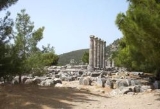
Mycale

Encyclopedia
Mycale, also Mykale and Mycali , called Samsun Daği and Dilek Daği in modern Turkey
, is a mountain on the west coast of central Anatolia
in Turkey, north of the mouth of the Maeander and divided from the Greek island of Samos
by the 1300 metre wide Samos Strait. The mountain forms a ridge
, terminating in what was known anciently as the Trogilium promontory
(Ancient Greek
Τρωγίλιον or Τρωγύλιον). There are several beaches on the north shore ranging from sand to pebbles. The south flank is mainly escarpment
.
In Classical Greece
nearly the entire ridge was a promontory enclosed by the Aegean Sea
. Geopolitically it was part of Ionia
with Priene
placed on the coast on the south flank of the mountain and Miletus
on the coast opposite to the south across the deep embayment into which the Maeander River drained. Somewhat further north was Ephesus
.
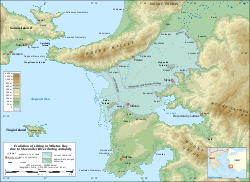
The ruins of the first two Ionian cities mentioned with their harbor facilities remain but today are several miles inland overlooking instead a rich agricultural plain and delta parkland created by deposition of sediments from the river, which continues to form the geological feature named after it, maeander
s. The end of the former bay remains as a lake, Çamiçi Gölü (Lake Bafa
). Samsun Daği does retain a promontory.
The entire ridge was made into a national park of 109.85 square kilometres (27,145 acre), Dilek Yarimadisi Milli Parki ("Dilek Peninsula National Park") in 1966, which is in part accessible to the public. The remainder is a military reservation. The park's isolation has encouraged the return of the native ecology, which is 60% maquis
. It is a refuge for species that formerly were more abundant in the region.
and Arabian plate
s with the Eurasian plate
. The smaller Turkish
and Aegean plates are being pushed together, generating ridges in Turkey. This orogenic belt was in place by 1.6 mya and continues to be a hot spot of earthquakes and volcanos.
Mount Mycale is part of a larger ridge, which continues in Samos
on the other side of the Samos Strait, and to the northeast in the Aydin Dağlari ("Aydin Mountains"), ancient Messogis range, on the other side of low hills and passes. The entire block of mountains around the Menderes (Maeander) River is the Menderes Massif.
Mycale is scored transversely by numerous ravines through which sources drain. The biggest ravine is Oluk Gorge, with cliffs 200 metres (656 ft) high. The main permanent streams are the Bal Deresi, the Sarap Dami and the Oluk Dereleri. The ample water supply supports a verdant maquis.
The rock is primarily metamorphic
: marble
and limestone
formed from rocks originating in the Mesozoic
,crystalline schist
s formed from rocks originating in the Palaeozoic and conglomerate
s of the Cenozoic
. These materials were not wasted on the renowned builders and sculptors of Ionia.
 The ridge and its environs offer a number of different ecologies. The crest is a sharp divide between the xerophytic southern slopes and the forested northern slopes, with 66.24 square kilometres (16,368 acre) of maquis
and 35.74 square kilometres (8,832 acre) of mixed pine.
Around the base of the promontory is a maritime environment.
The maquis vegetation includes Pistacia lentiscus; Laurus nobilis; Quercus ilex, Q. frainetto and Q. ithaburensis; Phillyrea
latifolia; Ceratonia siliqua; Olea europaea; Rubus fruticosus; Myrtus communis; Smilax
; Jasminum fruticans
; Vitex vivifera; Lathyrus
grandiflorus; Erica arborea; and Juncus
on the slopes of the north. In moister areas are to be found Nerium oleander, Platanus orientalis
, Fraxinus ornus
, Laurus nobilis, Cupressus sempervirens
and Rubus fruticosus.
The mixed pine forest goes up to 700 metres (2,297 ft). Its major plant species are Pinus brutia, Juniperus phoenicea
, with broad-leaved trees and shrubs: Ulmus campestris, Acer sempervirens
, Fraxinus ornus
, Castanea sativa
, Tilia platyphyllos
, Sorbus torminalis, Viburnum tinus
, Pyrus eleagrifolia and Prunus dulcis
.
Some mammal
s native to the region are Sus scrofa, Vulpes vulpes, Hystrix cristata, Canis aureus, Canis lupus, Martes martes, Lynx lynx, Felis sylvestris, Ursus arctos, Meles meles, Lepus
, Erinaceus europaeus and Sciurus
. Migrants are Lynx caracal
and Panthera pardus.
Some birds are Columba livia, Alectoris graeca, Perdix perdix, Coturnix coturnix, Scolopax rusticola, Turdus merula, Turdus pilaris, Oriolus oriolus, Merops apiaster, eagle
s, vulture
s, Corvus corax, Pica pica and Sturnus vulgaris.
Monachus monachus breeds in caves around the shores of Mycale. They and other marine predators (including man) feed on Liza
, Pagellus
, Dentex vulgaris and Thunnus thynnus.
and the Maeander appear in the Trojan Battle Order
of the Iliad
, where they are populated by Caria
ns. "The steep heights of Mycale" and Miletus are also in the Hymn to Apollo
, where Leto
, pregnant with Apollo
, an especially Ionian god, travels about the Aegean looking for a home for her son, and settles on Delos
, the major Ionian political, religious and cultural center of Classical Greece
.
A similar metaphor is to be found in the centuries-later Hymn to Delos of Callimachus
, in which Delos
, a swimming island, visits various places in the Aegean, including Parthenia, "Maiden's Isle" (Samos
), where it is entertained by the nymphs of Mycalessos. Just as Parthenia is the previous name of Samos so the reader is to understand Mycalessos as the previous name of Mycale. On being chosen as the birthplace of Apollo, Delos becomes fixed in the sea.
There are no earlier instances of Mycale but some major cities later Ionian appear in Mycenaean Greek and Hittite
records of the Late Bronze Age. Apasa (Ephesus
) was the capital of a state called Arzawa
in which also was Karkisha (Caria
) and Millawanda (Miletus
). In the Linear B
tablets the region is called A-swi-ja (Asia). Documents at Pylos
, Thebes
and Knossos
identify female textile workers in servitude with Asian ethnic names such as Mi-ra-ti-ja, *Milātiai, "Milesians." The regions from which they came were centers of Mycenaean
civilization although the languages they spoke remain unknown.
. Archaeologically it was known as the Proto-geometric and Geometric Periods, which did not belong to any one ethnic group. This is the time to which heavy Ionic migration from mainland Greece to the coast of Ionia and the emergence of Delos
as an Ionian center is believed to apply. These events were over at the start of the brilliant renaissance of the Orientalizing Period
in which Ionia
played a cardinal role.
During this rise to prominence twelve cities were settled or resettled and emerged as Ionia
speaking varieties of Ionic Greek
. Vitruvius
, however, says there were thirteen, the extra state being Melite, which "... as a punishment of the arrogance of its citizens was detached from the other states in a war levied pursuant to the directions of a general council (communi consilio); and in its place ... the city of Smyrna
was admitted into the number of Ionian states (inter Ionas est recepta)." There is no other mention of Melite anywhere but two fragments of Hecataeus
say that Melia was a city of Caria
and an inscription from Priene
confirms that there had been a "Meliac War" against a state located between Priene and Samos
; i.e., on Mycale.
The inscription records the result of an arbitration between Priene and Samos by jurors from Rhodes
. Both litigants claimed that Carium, the fortified settlement of Melia, and Dryussa, another settlement, had been distributed to them at the conclusion of the Meliac War, when the Carians were expelled. Being on the Samian side of the crest Melia had been resettled mainly by Samians and for this reason they had won a similar case brought before Lysimachus
of Macedon
a century earlier. That case is mentioned in an earlier inscription from Priene.
Priene had now reopened the case arguing that their sale of plots from the land demonstrated their continuous ownership of it except for a brief period when an invasion of the Cimmerians
under Lygdamus forced temporary Greek evacuation of the region (about 650 BC). The Samians used a passage from the now missing History of Maeandrius of Miletus to support their claim. The jury found that Maeandrius was not authentic and reversed the earlier decision.
, "of all the Ionians" next to the former Carium. It rose to prominence while the Ionian confederacy was sovereign, became a memory when Ionia was incorporated into other states and empires and finally was lost altogether. The ancient writers remembered that it had been on the north side of the mountain, across the ridge from Priene
.
After a few false identifications in modern times, the ruins of Melia and the Panionium were discovered in 2004 on Dilek Daglari, a smaller peak of Mycale, 15 kilometres (9 mi) to the north of Priene at an elevation of 750 metres (2,461 ft). The Carium must be the early 7th century BC town surrounded by a triangular wall in places as thick as 3 metres (10 ft).
The floruit
was the early 7th, but sherds have been found there from as early as the Protogeometric period. Coldstream characterizes the burial structures as of "a considerable Carian substrate." The cuture was not entirely Carian; the Ionians continued the worship of Poseidon
Heliconius there, which Strabo
says came from Helike
in Peloponnesian Achaea. This event must have been during the Ionian colonization. Melia therefore was a renegade Ionian state.
The temple believed to the Panionium
was constructed next to the Carium about 540 BC. It took over the worship of Poseidon Heliconius, served as the meeting place of the Ionian League
, and was the site of the religious festival and games (panegyris
) called the Panionia. The construction of this temple is a terminus post quem
for the existence of the Ionian League
, which as a constituted body had a name, the koinon Iōnōn ("common thing of the Ionians"), a synedrion ("place to sit down together") and a boulē ("council").
Whether this body existed before the Meliac War is uncertain. Vitruvius' commune consilium seems to translate koinon. Some analysts have postulated an association as early as 800 BC but whether formally constituted remains unknown. There is no sign of it yet on Mycale unless Carium had in fact been it.
, during the Greco-Persian Wars
. Under the leadership of the Sparta
n Leotychides, the Greek fleet defeated the Persian fleet and army. According to Herodotus
, the battle occurred the same day as the Greek victory at Plataea
.
Turkey
Turkey , known officially as the Republic of Turkey , is a Eurasian country located in Western Asia and in East Thrace in Southeastern Europe...
, is a mountain on the west coast of central Anatolia
Anatolia
Anatolia is a geographic and historical term denoting the westernmost protrusion of Asia, comprising the majority of the Republic of Turkey...
in Turkey, north of the mouth of the Maeander and divided from the Greek island of Samos
Samos Island
Samos is a Greek island in the eastern Aegean Sea, south of Chios, north of Patmos and the Dodecanese, and off the coast of Asia Minor, from which it is separated by the -wide Mycale Strait. It is also a separate regional unit of the North Aegean region, and the only municipality of the regional...
by the 1300 metre wide Samos Strait. The mountain forms a ridge
Ridge
A ridge is a geological feature consisting of a chain of mountains or hills that form a continuous elevated crest for some distance. Ridges are usually termed hills or mountains as well, depending on size. There are several main types of ridges:...
, terminating in what was known anciently as the Trogilium promontory
Promontory
Promontory may refer to:*Promontory, a prominent mass of land which overlooks lower lying land or a body of water*Promontory, Utah, the location where the United States first Transcontinental Railroad was completed...
(Ancient Greek
Ancient Greek
Ancient Greek is the stage of the Greek language in the periods spanning the times c. 9th–6th centuries BC, , c. 5th–4th centuries BC , and the c. 3rd century BC – 6th century AD of ancient Greece and the ancient world; being predated in the 2nd millennium BC by Mycenaean Greek...
Τρωγίλιον or Τρωγύλιον). There are several beaches on the north shore ranging from sand to pebbles. The south flank is mainly escarpment
Escarpment
An escarpment is a steep slope or long cliff that occurs from erosion or faulting and separates two relatively level areas of differing elevations.-Description and variants:...
.
In Classical Greece
Classical Greece
Classical Greece was a 200 year period in Greek culture lasting from the 5th through 4th centuries BC. This classical period had a powerful influence on the Roman Empire and greatly influenced the foundation of Western civilizations. Much of modern Western politics, artistic thought, such as...
nearly the entire ridge was a promontory enclosed by the Aegean Sea
Aegean Sea
The Aegean Sea[p] is an elongated embayment of the Mediterranean Sea located between the southern Balkan and Anatolian peninsulas, i.e., between the mainlands of Greece and Turkey. In the north, it is connected to the Marmara Sea and Black Sea by the Dardanelles and Bosporus...
. Geopolitically it was part of Ionia
Ionia
Ionia is an ancient region of central coastal Anatolia in present-day Turkey, the region nearest İzmir, which was historically Smyrna. It consisted of the northernmost territories of the Ionian League of Greek settlements...
with Priene
Priene
Priene was an ancient Greek city of Ionia at the base of an escarpment of Mycale, about north of the then course of the Maeander River, from today's Aydin, from today's Söke and from ancient Miletus...
placed on the coast on the south flank of the mountain and Miletus
Miletus
Miletus was an ancient Greek city on the western coast of Anatolia , near the mouth of the Maeander River in ancient Caria...
on the coast opposite to the south across the deep embayment into which the Maeander River drained. Somewhat further north was Ephesus
Ephesus
Ephesus was an ancient Greek city, and later a major Roman city, on the west coast of Asia Minor, near present-day Selçuk, Izmir Province, Turkey. It was one of the twelve cities of the Ionian League during the Classical Greek era...
.
The ruins of the first two Ionian cities mentioned with their harbor facilities remain but today are several miles inland overlooking instead a rich agricultural plain and delta parkland created by deposition of sediments from the river, which continues to form the geological feature named after it, maeander
Meander
A meander in general is a bend in a sinuous watercourse. A meander is formed when the moving water in a stream erodes the outer banks and widens its valley. A stream of any volume may assume a meandering course, alternately eroding sediments from the outside of a bend and depositing them on the...
s. The end of the former bay remains as a lake, Çamiçi Gölü (Lake Bafa
Lake Bafa
Lake Bafa or Lake Bafa Nature Park is a lake and a nature reserve situated in southwestern Turkey, part of it within the boundaries of Milas district of Muğla Province and the northern part within Aydın Province's Söke district...
). Samsun Daği does retain a promontory.
The entire ridge was made into a national park of 109.85 square kilometres (27,145 acre), Dilek Yarimadisi Milli Parki ("Dilek Peninsula National Park") in 1966, which is in part accessible to the public. The remainder is a military reservation. The park's isolation has encouraged the return of the native ecology, which is 60% maquis
Maquis shrubland
thumb|220px|Low Maquis in Corsica.220px|thumb|High macchia in Sardinia.Maquis or macchia is a shrubland biome in the Mediterranean region, typically consisting of densely growing evergreen shrubs such as holm oak, tree heath, strawberry tree, sage, juniper, buckthorn, spurge olive and myrtle...
. It is a refuge for species that formerly were more abundant in the region.
Geophysics
Western Turkey is mainly fault-block terrain with steep-sided ridges running east-west and rivers in the rifts. The source of the faulting is the closing of Tethys Sea and the collision of the AfricanAfrican Plate
The African Plate is a tectonic plate which includes the continent of Africa, as well as oceanic crust which lies between the continent and various surrounding ocean ridges.-Boundaries:...
and Arabian plate
Arabian Plate
The Arabian Plate is one of three tectonic plates which have been moving northward over millions of years and colliding with the Eurasian Plate...
s with the Eurasian plate
Eurasian Plate
The Eurasian Plate is a tectonic plate which includes most of the continent of Eurasia , with the notable exceptions of the Indian subcontinent, the Arabian subcontinent, and the area east of the Chersky Range in East Siberia...
. The smaller Turkish
Anatolian Plate
The Anatolian Plate is a continental tectonic plate consisting primarily of the country of Turkey.The easterly side is a boundary with the Arabian Plate, the East Anatolian Fault, a left lateral transform fault....
and Aegean plates are being pushed together, generating ridges in Turkey. This orogenic belt was in place by 1.6 mya and continues to be a hot spot of earthquakes and volcanos.
Mount Mycale is part of a larger ridge, which continues in Samos
Samos Island
Samos is a Greek island in the eastern Aegean Sea, south of Chios, north of Patmos and the Dodecanese, and off the coast of Asia Minor, from which it is separated by the -wide Mycale Strait. It is also a separate regional unit of the North Aegean region, and the only municipality of the regional...
on the other side of the Samos Strait, and to the northeast in the Aydin Dağlari ("Aydin Mountains"), ancient Messogis range, on the other side of low hills and passes. The entire block of mountains around the Menderes (Maeander) River is the Menderes Massif.
Mycale is scored transversely by numerous ravines through which sources drain. The biggest ravine is Oluk Gorge, with cliffs 200 metres (656 ft) high. The main permanent streams are the Bal Deresi, the Sarap Dami and the Oluk Dereleri. The ample water supply supports a verdant maquis.
The rock is primarily metamorphic
Metamorphic rock
Metamorphic rock is the transformation of an existing rock type, the protolith, in a process called metamorphism, which means "change in form". The protolith is subjected to heat and pressure causing profound physical and/or chemical change...
: marble
Marble
Marble is a metamorphic rock composed of recrystallized carbonate minerals, most commonly calcite or dolomite.Geologists use the term "marble" to refer to metamorphosed limestone; however stonemasons use the term more broadly to encompass unmetamorphosed limestone.Marble is commonly used for...
and limestone
Limestone
Limestone is a sedimentary rock composed largely of the minerals calcite and aragonite, which are different crystal forms of calcium carbonate . Many limestones are composed from skeletal fragments of marine organisms such as coral or foraminifera....
formed from rocks originating in the Mesozoic
Mesozoic
The Mesozoic era is an interval of geological time from about 250 million years ago to about 65 million years ago. It is often referred to as the age of reptiles because reptiles, namely dinosaurs, were the dominant terrestrial and marine vertebrates of the time...
,crystalline schist
Schist
The schists constitute a group of medium-grade metamorphic rocks, chiefly notable for the preponderance of lamellar minerals such as micas, chlorite, talc, hornblende, graphite, and others. Quartz often occurs in drawn-out grains to such an extent that a particular form called quartz schist is...
s formed from rocks originating in the Palaeozoic and conglomerate
Conglomerate (geology)
A conglomerate is a rock consisting of individual clasts within a finer-grained matrix that have become cemented together. Conglomerates are sedimentary rocks consisting of rounded fragments and are thus differentiated from breccias, which consist of angular clasts...
s of the Cenozoic
Cenozoic
The Cenozoic era is the current and most recent of the three Phanerozoic geological eras and covers the period from 65.5 mya to the present. The era began in the wake of the Cretaceous–Tertiary extinction event at the end of the Cretaceous that saw the demise of the last non-avian dinosaurs and...
. These materials were not wasted on the renowned builders and sculptors of Ionia.
Ecology
Maquis shrubland
thumb|220px|Low Maquis in Corsica.220px|thumb|High macchia in Sardinia.Maquis or macchia is a shrubland biome in the Mediterranean region, typically consisting of densely growing evergreen shrubs such as holm oak, tree heath, strawberry tree, sage, juniper, buckthorn, spurge olive and myrtle...
and 35.74 square kilometres (8,832 acre) of mixed pine.
Around the base of the promontory is a maritime environment.
The maquis vegetation includes Pistacia lentiscus; Laurus nobilis; Quercus ilex, Q. frainetto and Q. ithaburensis; Phillyrea
Phillyrea
Phillyrea is a genus of two species of flowering plants in the family Oleaceae, native to the Mediterranean region, the Canary Islands and Madeira....
latifolia; Ceratonia siliqua; Olea europaea; Rubus fruticosus; Myrtus communis; Smilax
Smilax
Smilax is a genus of about 300-350 species, found in temperate zones, tropics and subtropics worldwide. In China for example about 80 are found , while there are 20 in North America north of Mexico...
; Jasminum fruticans
Jasmine
Jasminum , commonly known as jasmines, is a genus of shrubs and vines in the olive family . It contains around 200 species native to tropical and warm temperate regions of the Old World...
; Vitex vivifera; Lathyrus
Lathyrus
Lathyrus is a genus of flowering plant species known as sweet peas and vetchlings. Lathyrus is in the legume family Fabaceae and contains approximately 160 species. They are native to temperate areas, with a breakdown of 52 species in Europe, 30 species in North America, 78 in Asia, 24 in...
grandiflorus; Erica arborea; and Juncus
Juncus
Juncus is a genus in the plant family Juncaceae. It consists of some 200 to 300 or more species of grassy plants commonly called rushes...
on the slopes of the north. In moister areas are to be found Nerium oleander, Platanus orientalis
Platanus orientalis
Platanus orientalis, or the Oriental plane, is a large, deciduous tree of the Platanaceae family, known for its longevity and spreading crown. The species name derives from its historical distribution eastward from the Balkans, where it was recognized in ancient Greek history and literature....
, Fraxinus ornus
Fraxinus ornus
Fraxinus ornus is a species of Fraxinus native to southern Europe and southwestern Asia, from Spain and Italy north to Austria and the Czech Republic, and east through the Balkans, Turkey, and western Syria to the Lebanon.It is a medium-sized deciduous tree growing to 15–25 m tall with a trunk up...
, Laurus nobilis, Cupressus sempervirens
Cupressus sempervirens
Cupressus sempervirens, the Mediterranean Cypress is a species of cypress native to the eastern Mediterranean region, in northeast Libya, southeast Greece , southern Turkey, Cyprus, Northern Egypt, western Syria, Lebanon, Israel, Malta, Italy, western Jordan, and also a disjunct population in...
and Rubus fruticosus.
The mixed pine forest goes up to 700 metres (2,297 ft). Its major plant species are Pinus brutia, Juniperus phoenicea
Juniperus phoenicea
Juniperus phoenicea, the Phoenicean Juniper or Arâr, is a juniper found throughout the Mediterranean region, from Morocco and Portugal east to Italy, Turkey and Egypt, south on the mountains of Lebanon, Israel, Jordan, and in western Saudi Arabia near the Red Sea, and also on Madeira and the Canary...
, with broad-leaved trees and shrubs: Ulmus campestris, Acer sempervirens
Acer sempervirens
Acer sempervirens is a species of maple native to southeastern Europe and southwestern Asia, in southern Greece and southern Turkey....
, Fraxinus ornus
Fraxinus ornus
Fraxinus ornus is a species of Fraxinus native to southern Europe and southwestern Asia, from Spain and Italy north to Austria and the Czech Republic, and east through the Balkans, Turkey, and western Syria to the Lebanon.It is a medium-sized deciduous tree growing to 15–25 m tall with a trunk up...
, Castanea sativa
Sweet Chestnut
Castanea sativa is a species of the flowering plant family Fagaceae, the tree and its edible seeds are referred to by several common names such Sweet Chestnut or Marron. Originally native to southeastern Europe and Asia Minor, it is now widely dispersed throughout Europe and parts of Asia, such as...
, Tilia platyphyllos
Tilia platyphyllos
Tilia platyphyllos is a deciduous tree native to much of Europe, including locally in southwestern Great Britain, growing on lime-rich soils. The common name Large-leaved Linden is in standard use throughout the English-speaking world except in Britain, where it has largely been replaced by the...
, Sorbus torminalis, Viburnum tinus
Viburnum tinus
Viburnum tinus is a species of flowering plant in the genus Viburnum, belonging to the family Adoxaceae. Laurus signifies the leaves' similarities to bay laurel; tinus means "tenth born".-Description: It is a shrub reaching up to 2-7 m tall, with a dense, rounded crown...
, Pyrus eleagrifolia and Prunus dulcis
Almond
The almond , is a species of tree native to the Middle East and South Asia. Almond is also the name of the edible and widely cultivated seed of this tree...
.
Some mammal
Mammal
Mammals are members of a class of air-breathing vertebrate animals characterised by the possession of endothermy, hair, three middle ear bones, and mammary glands functional in mothers with young...
s native to the region are Sus scrofa, Vulpes vulpes, Hystrix cristata, Canis aureus, Canis lupus, Martes martes, Lynx lynx, Felis sylvestris, Ursus arctos, Meles meles, Lepus
Hare
Hares and jackrabbits are leporids belonging to the genus Lepus. Hares less than one year old are called leverets. Four species commonly known as types of hare are classified outside of Lepus: the hispid hare , and three species known as red rock hares .Hares are very fast-moving...
, Erinaceus europaeus and Sciurus
Sciurus
The genus Sciurus contains most of the common, bushy-tailed squirrels in North America, Europe, temperate Asia, Central America and South America.-Species:There are 30 species.Genus Sciurus - Tree squirrels*Subgenus Sciurus...
. Migrants are Lynx caracal
Caracal
The caracal is a fiercely territorial medium-sized cat ranging over Western Asia, South Asia and Africa.The word caracal comes from the Turkish word "karakulak", meaning "black ear". In North India and Pakistan, the caracal is locally known as syahgosh or shyahgosh, which is a Persian term...
and Panthera pardus.
Some birds are Columba livia, Alectoris graeca, Perdix perdix, Coturnix coturnix, Scolopax rusticola, Turdus merula, Turdus pilaris, Oriolus oriolus, Merops apiaster, eagle
Eagle
Eagles are members of the bird family Accipitridae, and belong to several genera which are not necessarily closely related to each other. Most of the more than 60 species occur in Eurasia and Africa. Outside this area, just two species can be found in the United States and Canada, nine more in...
s, vulture
Vulture
Vulture is the name given to two groups of convergently evolved scavenging birds, the New World Vultures including the well-known Californian and Andean Condors, and the Old World Vultures including the birds which are seen scavenging on carcasses of dead animals on African plains...
s, Corvus corax, Pica pica and Sturnus vulgaris.
Monachus monachus breeds in caves around the shores of Mycale. They and other marine predators (including man) feed on Liza
Liza (genus)
Liza is the largest genus of the 17 in the family Mugilidae. The genus Liza contains 24 species.Note: The mullet species with common name Liza is in factMugil liza, thus in the genus Mugil.-Taxonomy:...
, Pagellus
Pagellus
Pagellus is a genus of porgies in the family Sparidae....
, Dentex vulgaris and Thunnus thynnus.
History
Earliest references
Mycale, MiletusMiletus
Miletus was an ancient Greek city on the western coast of Anatolia , near the mouth of the Maeander River in ancient Caria...
and the Maeander appear in the Trojan Battle Order
Trojan Battle Order
The Trojan Battle Order or Trojan Catalogue is a section of the second book of the Iliad listing the allied contingents that fought for Troy in the Trojan War...
of the Iliad
Iliad
The Iliad is an epic poem in dactylic hexameters, traditionally attributed to Homer. Set during the Trojan War, the ten-year siege of the city of Troy by a coalition of Greek states, it tells of the battles and events during the weeks of a quarrel between King Agamemnon and the warrior Achilles...
, where they are populated by Caria
Caria
Caria was a region of western Anatolia extending along the coast from mid-Ionia south to Lycia and east to Phrygia. The Ionian and Dorian Greeks colonized the west of it and joined the Carian population in forming Greek-dominated states there...
ns. "The steep heights of Mycale" and Miletus are also in the Hymn to Apollo
Homeric Hymns
The Homeric Hymns are a collection of thirty-three anonymous Ancient Greek hymns celebrating individual gods. The hymns are "Homeric" in the sense that they employ the same epic meter—dactylic hexameter—as the Iliad and Odyssey, use many similar formulas and are couched in the same dialect...
, where Leto
Leto
In Greek mythology, Leto is a daughter of the Titans Coeus and Phoebe. The island of Kos is claimed as her birthplace. In the Olympian scheme, Zeus is the father of her twins, Apollo and Artemis, the Letoides, which Leto conceived after her hidden beauty accidentally caught the eyes of Zeus...
, pregnant with Apollo
Apollo
Apollo is one of the most important and complex of the Olympian deities in Greek and Roman mythology...
, an especially Ionian god, travels about the Aegean looking for a home for her son, and settles on Delos
Delos
The island of Delos , isolated in the centre of the roughly circular ring of islands called the Cyclades, near Mykonos, is one of the most important mythological, historical and archaeological sites in Greece...
, the major Ionian political, religious and cultural center of Classical Greece
Classical Greece
Classical Greece was a 200 year period in Greek culture lasting from the 5th through 4th centuries BC. This classical period had a powerful influence on the Roman Empire and greatly influenced the foundation of Western civilizations. Much of modern Western politics, artistic thought, such as...
.
A similar metaphor is to be found in the centuries-later Hymn to Delos of Callimachus
Callimachus
Callimachus was a native of the Greek colony of Cyrene, Libya. He was a noted poet, critic and scholar at the Library of Alexandria and enjoyed the patronage of the Egyptian–Greek Pharaohs Ptolemy II Philadelphus and Ptolemy III Euergetes...
, in which Delos
Delos
The island of Delos , isolated in the centre of the roughly circular ring of islands called the Cyclades, near Mykonos, is one of the most important mythological, historical and archaeological sites in Greece...
, a swimming island, visits various places in the Aegean, including Parthenia, "Maiden's Isle" (Samos
Samos Island
Samos is a Greek island in the eastern Aegean Sea, south of Chios, north of Patmos and the Dodecanese, and off the coast of Asia Minor, from which it is separated by the -wide Mycale Strait. It is also a separate regional unit of the North Aegean region, and the only municipality of the regional...
), where it is entertained by the nymphs of Mycalessos. Just as Parthenia is the previous name of Samos so the reader is to understand Mycalessos as the previous name of Mycale. On being chosen as the birthplace of Apollo, Delos becomes fixed in the sea.
There are no earlier instances of Mycale but some major cities later Ionian appear in Mycenaean Greek and Hittite
History of the Hittites
Hittites were an ancient people who spoke an Indo-European language and established a kingdom centered in Hattusa in northern Anatolia from the 18th century BC. In the 14th century BC, the Hittite Kingdom was at its height, encompassing central Anatolia, south-western Syria as far as Ugarit, and...
records of the Late Bronze Age. Apasa (Ephesus
Ephesus
Ephesus was an ancient Greek city, and later a major Roman city, on the west coast of Asia Minor, near present-day Selçuk, Izmir Province, Turkey. It was one of the twelve cities of the Ionian League during the Classical Greek era...
) was the capital of a state called Arzawa
Arzawa
Arzawa in the second half of the second millennium BC was the name of a region and a political entity in Western Anatolia, the core area of which was centered on the Hermos and Maeander river valleys, corresponding with the Late Bronze Age kingdoms of the...
in which also was Karkisha (Caria
Caria
Caria was a region of western Anatolia extending along the coast from mid-Ionia south to Lycia and east to Phrygia. The Ionian and Dorian Greeks colonized the west of it and joined the Carian population in forming Greek-dominated states there...
) and Millawanda (Miletus
Miletus
Miletus was an ancient Greek city on the western coast of Anatolia , near the mouth of the Maeander River in ancient Caria...
). In the Linear B
Linear B
Linear B is a syllabic script that was used for writing Mycenaean Greek, an early form of Greek. It pre-dated the Greek alphabet by several centuries and seems to have died out with the fall of Mycenaean civilization...
tablets the region is called A-swi-ja (Asia). Documents at Pylos
Pylos
Pylos , historically known under its Italian name Navarino, is a town and a former municipality in Messenia, Peloponnese, Greece. Since the 2011 local government reform it is part of the municipality Pylos-Nestoras, of which it is the seat and a municipal unit. It was the capital of the former...
, Thebes
Thebes, Greece
Thebes is a city in Greece, situated to the north of the Cithaeron range, which divides Boeotia from Attica, and on the southern edge of the Boeotian plain. It played an important role in Greek myth, as the site of the stories of Cadmus, Oedipus, Dionysus and others...
and Knossos
Knossos
Knossos , also known as Labyrinth, or Knossos Palace, is the largest Bronze Age archaeological site on Crete and probably the ceremonial and political centre of the Minoan civilization and culture. The palace appears as a maze of workrooms, living spaces, and store rooms close to a central square...
identify female textile workers in servitude with Asian ethnic names such as Mi-ra-ti-ja, *Milātiai, "Milesians." The regions from which they came were centers of Mycenaean
Mycenaean Greece
Mycenaean Greece was a cultural period of Bronze Age Greece taking its name from the archaeological site of Mycenae in northeastern Argolis, in the Peloponnese of southern Greece. Athens, Pylos, Thebes, and Tiryns are also important Mycenaean sites...
civilization although the languages they spoke remain unknown.
The state of Melia
After the Late Bronze Age the entire Aegean region entered a historical period termed the Greek Dark AgesGreek Dark Ages
The Greek Dark Age or Ages also known as Geometric or Homeric Age are terms which have regularly been used to refer to the period of Greek history from the presumed Dorian invasion and end of the Mycenaean Palatial civilization around 1200 BC, to the first signs of the Greek city-states in the 9th...
. Archaeologically it was known as the Proto-geometric and Geometric Periods, which did not belong to any one ethnic group. This is the time to which heavy Ionic migration from mainland Greece to the coast of Ionia and the emergence of Delos
Delos
The island of Delos , isolated in the centre of the roughly circular ring of islands called the Cyclades, near Mykonos, is one of the most important mythological, historical and archaeological sites in Greece...
as an Ionian center is believed to apply. These events were over at the start of the brilliant renaissance of the Orientalizing Period
Archaic period in Greece
The Archaic period in Greece was a period of ancient Greek history that followed the Greek Dark Ages. This period saw the rise of the polis and the founding of colonies, as well as the first inklings of classical philosophy, theatre in the form of tragedies performed during Dionysia, and written...
in which Ionia
Ionia
Ionia is an ancient region of central coastal Anatolia in present-day Turkey, the region nearest İzmir, which was historically Smyrna. It consisted of the northernmost territories of the Ionian League of Greek settlements...
played a cardinal role.
During this rise to prominence twelve cities were settled or resettled and emerged as Ionia
Ionia
Ionia is an ancient region of central coastal Anatolia in present-day Turkey, the region nearest İzmir, which was historically Smyrna. It consisted of the northernmost territories of the Ionian League of Greek settlements...
speaking varieties of Ionic Greek
Ionic Greek
Ionic Greek was a subdialect of the Attic–Ionic dialect group of Ancient Greek .-History:Ionic dialect appears to have spread originally from the Greek mainland across the Aegean at the time of the Dorian invasions, around the 11th Century B.C.By the end of the Greek Dark Ages in the 5th Century...
. Vitruvius
Vitruvius
Marcus Vitruvius Pollio was a Roman writer, architect and engineer, active in the 1st century BC. He is best known as the author of the multi-volume work De Architectura ....
, however, says there were thirteen, the extra state being Melite, which "... as a punishment of the arrogance of its citizens was detached from the other states in a war levied pursuant to the directions of a general council (communi consilio); and in its place ... the city of Smyrna
Smyrna
Smyrna was an ancient city located at a central and strategic point on the Aegean coast of Anatolia. Thanks to its advantageous port conditions, its ease of defence and its good inland connections, Smyrna rose to prominence. The ancient city is located at two sites within modern İzmir, Turkey...
was admitted into the number of Ionian states (inter Ionas est recepta)." There is no other mention of Melite anywhere but two fragments of Hecataeus
Hecataeus
Hecataeus of Miletus , named after the Greek goddess Hecate, was an early Greek historian of a wealthy family. He flourished during the time of the Persian invasion. After having travelled extensively, he settled in his native city, where he occupied a high position, and devoted his time to the...
say that Melia was a city of Caria
Caria
Caria was a region of western Anatolia extending along the coast from mid-Ionia south to Lycia and east to Phrygia. The Ionian and Dorian Greeks colonized the west of it and joined the Carian population in forming Greek-dominated states there...
and an inscription from Priene
Priene
Priene was an ancient Greek city of Ionia at the base of an escarpment of Mycale, about north of the then course of the Maeander River, from today's Aydin, from today's Söke and from ancient Miletus...
confirms that there had been a "Meliac War" against a state located between Priene and Samos
Samoš
Samoš is a village in Serbia. It is situated in the Kovačica municipality, in the South Banat District, Vojvodina province. The village has a Serb ethnic majority and its population numbering 1,247 people .-See also:...
; i.e., on Mycale.
The inscription records the result of an arbitration between Priene and Samos by jurors from Rhodes
Rhodes
Rhodes is an island in Greece, located in the eastern Aegean Sea. It is the largest of the Dodecanese islands in terms of both land area and population, with a population of 117,007, and also the island group's historical capital. Administratively the island forms a separate municipality within...
. Both litigants claimed that Carium, the fortified settlement of Melia, and Dryussa, another settlement, had been distributed to them at the conclusion of the Meliac War, when the Carians were expelled. Being on the Samian side of the crest Melia had been resettled mainly by Samians and for this reason they had won a similar case brought before Lysimachus
Lysimachus
Lysimachus was a Macedonian officer and diadochus of Alexander the Great, who became a basileus in 306 BC, ruling Thrace, Asia Minor and Macedon.-Early Life & Career:...
of Macedon
Macedon
Macedonia or Macedon was an ancient kingdom, centered in the northeastern part of the Greek peninsula, bordered by Epirus to the west, Paeonia to the north, the region of Thrace to the east and Thessaly to the south....
a century earlier. That case is mentioned in an earlier inscription from Priene.
Priene had now reopened the case arguing that their sale of plots from the land demonstrated their continuous ownership of it except for a brief period when an invasion of the Cimmerians
Cimmerians
The Cimmerians or Kimmerians were ancient equestrian nomads of Indo-European origin.According to the Greek historian Herodotus, of the 5th century BC, the Cimmerians inhabited the region north of the Caucasus and the Black Sea during the 8th and 7th centuries BC, in what is now Ukraine and Russia...
under Lygdamus forced temporary Greek evacuation of the region (about 650 BC). The Samians used a passage from the now missing History of Maeandrius of Miletus to support their claim. The jury found that Maeandrius was not authentic and reversed the earlier decision.
Panionium
The Melians had named their capital Carium, "of Caria" as a Greek word. Considering that it was placed in Ionia, the choice of name suggests a political statement of some sort, although the word may have had a different meaning in the Carian language, now lost except for a few dozen words. The Ionians leagued together to defeat it and continued the league, building a capital they called PanioniumPanionium
The Panionium was an Ionian sanctuary dedicated to Poseidon Helikonios and the meeting place of the Ionian League. It was on the peninsula of Mt. Mycale, about south of Smyrna—now İzmir, in Turkey...
, "of all the Ionians" next to the former Carium. It rose to prominence while the Ionian confederacy was sovereign, became a memory when Ionia was incorporated into other states and empires and finally was lost altogether. The ancient writers remembered that it had been on the north side of the mountain, across the ridge from Priene
Priene
Priene was an ancient Greek city of Ionia at the base of an escarpment of Mycale, about north of the then course of the Maeander River, from today's Aydin, from today's Söke and from ancient Miletus...
.
After a few false identifications in modern times, the ruins of Melia and the Panionium were discovered in 2004 on Dilek Daglari, a smaller peak of Mycale, 15 kilometres (9 mi) to the north of Priene at an elevation of 750 metres (2,461 ft). The Carium must be the early 7th century BC town surrounded by a triangular wall in places as thick as 3 metres (10 ft).
The floruit
Floruit
Floruit , abbreviated fl. , is a Latin verb meaning "flourished", denoting the period of time during which something was active...
was the early 7th, but sherds have been found there from as early as the Protogeometric period. Coldstream characterizes the burial structures as of "a considerable Carian substrate." The cuture was not entirely Carian; the Ionians continued the worship of Poseidon
Poseidon
Poseidon was the god of the sea, and, as "Earth-Shaker," of the earthquakes in Greek mythology. The name of the sea-god Nethuns in Etruscan was adopted in Latin for Neptune in Roman mythology: both were sea gods analogous to Poseidon...
Heliconius there, which Strabo
Strabo
Strabo, also written Strabon was a Greek historian, geographer and philosopher.-Life:Strabo was born to an affluent family from Amaseia in Pontus , a city which he said was situated the approximate equivalent of 75 km from the Black Sea...
says came from Helike
Helike
Helike was an ancient Greek city that sank at night in the winter of 373 BC. The city was located in Achaea, Northern Peloponnesos, two kilometres from the Corinthian Gulf...
in Peloponnesian Achaea. This event must have been during the Ionian colonization. Melia therefore was a renegade Ionian state.
The temple believed to the Panionium
Panionium
The Panionium was an Ionian sanctuary dedicated to Poseidon Helikonios and the meeting place of the Ionian League. It was on the peninsula of Mt. Mycale, about south of Smyrna—now İzmir, in Turkey...
was constructed next to the Carium about 540 BC. It took over the worship of Poseidon Heliconius, served as the meeting place of the Ionian League
Ionian League
The Ionian League , also called the Panionic League, was a confederation formed at the end of the Meliac War in the mid-7th century BC comprising twelve Ionian cities .These were listed by Herodotus as*Miletus, Myus, and...
, and was the site of the religious festival and games (panegyris
Panegyris
A panegyris , is an Ancient Greek general, national or religious assembly. Each was dedicated to the worship of a particular god.It is also associated with saint days and holy festivals.-Relation to Panegyry and Panegyric:...
) called the Panionia. The construction of this temple is a terminus post quem
Terminus post quem
Terminus post quem and terminus ante quem specify approximate dates for events...
for the existence of the Ionian League
Ionian League
The Ionian League , also called the Panionic League, was a confederation formed at the end of the Meliac War in the mid-7th century BC comprising twelve Ionian cities .These were listed by Herodotus as*Miletus, Myus, and...
, which as a constituted body had a name, the koinon Iōnōn ("common thing of the Ionians"), a synedrion ("place to sit down together") and a boulē ("council").
Whether this body existed before the Meliac War is uncertain. Vitruvius' commune consilium seems to translate koinon. Some analysts have postulated an association as early as 800 BC but whether formally constituted remains unknown. There is no sign of it yet on Mycale unless Carium had in fact been it.
Battle of Mycale
In 479 BC, Mycale was the site of one of the two major battles that ended the Persian invasion of GreeceGreece
Greece , officially the Hellenic Republic , and historically Hellas or the Republic of Greece in English, is a country in southeastern Europe....
, during the Greco-Persian Wars
Greco-Persian Wars
The Greco-Persian Wars were a series of conflicts between the Achaemenid Empire of Persia and city-states of the Hellenic world that started in 499 BC and lasted until 449 BC. The collision between the fractious political world of the Greeks and the enormous empire of the Persians began when Cyrus...
. Under the leadership of the Sparta
Sparta
Sparta or Lacedaemon, was a prominent city-state in ancient Greece, situated on the banks of the River Eurotas in Laconia, in south-eastern Peloponnese. It emerged as a political entity around the 10th century BC, when the invading Dorians subjugated the local, non-Dorian population. From c...
n Leotychides, the Greek fleet defeated the Persian fleet and army. According to Herodotus
Herodotus
Herodotus was an ancient Greek historian who was born in Halicarnassus, Caria and lived in the 5th century BC . He has been called the "Father of History", and was the first historian known to collect his materials systematically, test their accuracy to a certain extent and arrange them in a...
, the battle occurred the same day as the Greek victory at Plataea
Battle of Plataea
The Battle of Plataea was the final land battle during the second Persian invasion of Greece. It took place in 479 BC near the city of Plataea in Boeotia, and was fought between an alliance of the Greek city-states, including Sparta, Athens, Corinth and Megara, and the Persian Empire of Xerxes...
.