

Asparagales

Encyclopedia
Asparagales is the name of an order
of plants, used in modern classification systems such as the APG III system
(which is used throughout this article). The order takes its name from the family Asparagaceae
and is placed in the monocots. The order has only recently been recognized in classification systems. It was first put forward by Huber in 1977 and later taken up in the Dahlgren system
of 1985. Before this, many of its families were assigned to the old order Liliales
: a very large order containing almost all monocots with colourful tepal
s and without starch
in their endosperm
. DNA sequence analysis
indicated that Liliales should be divided into at least Liliales, Asparagales and Dioscoreales
. The boundaries of the Asparagales and of its families have undergone a series of changes in recent years; future research may lead to further changes and ultimately greater stability.
The order is clearly circumscribed
on the basis of DNA sequence analysis, but is difficult to define morphologically, since its members are structurally diverse. Thus although most species in the order are herbaceous
, some no more than 15 cm high, there are a number of climbers (e.g. some species of Asparagus
), as well as several genera forming trees (e.g. Agave
, Cordyline
, Yucca
, Dracaena
), some of which can exceed 10 m in height. Succulent genera occur in several families (e.g. Aloe
).
One of the defining characteristics of the order is the presence of phytomelan, a black pigment present in the seed coat, creating a dark crust. Phytomelan is found in most families of the Asparagales (although not in Orchidaceae
, thought to be a sister to the rest of the group).
Almost all species have a tight cluster of leaves (a rosette), either at the base of the plant or at the end of a more-or-less woody stem; the leaves are less often produced along the stem. The flowers are in the main not particularly distinctive, being of a general 'lily type', with six tepal
s, either free or fused from the base.
The order is thought to have first diverged from other related monocots some 120-130 million years ago (early in the Cretaceous period), although given the difficulty in classifying the families involved, estimates are likely to be uncertain.
From an economic point of view, the order Asparagales is second in importance within the monocots to the order Poales
(which includes grasses and cereals). Species are used as food and flavourings (e.g. onion
, garlic
, leek
, asparagus
, vanilla
), as cut flowers (e.g. freesia
, gladiolus
, iris
, orchids), and as garden ornamentals (e.g. day lilies, lily of the valley
, Agapanthus
).
 Most species of Asparagales are herbaceous perennials, although some are climbers (e.g. species of Asparagus
, family Asparagaceae) and some are tree-like. The order also contains many geophytes (bulbs, corms and various kinds of tuber). Almost all species have a tight cluster of leaves (a rosette) at the base of the plant or, in the tree-forming species, at the end of a woody stem. Only in a few cases are leaves produced along the length of the stem. The flowers are often at the tip of the stem and are mainly of a rather generalized 'lily type', with six tepals and up to six stamens.
The orders which have been separated from the old Liliales are difficult to characterize. No single morphological character appears to be diagnostic of the order Asparagales.
.
The families of the Asparagales, as set out in the APG III system
, are briefly surveyed below. For more information follow the links to the main articles.
). The shape of the flowers is very distinctive, making orchids easy to recognize. The flower is bilaterally symmetrical. The three sepal
s are generally colourful and bright (which is why they are sometimes called outer tepal
s), with one on each side ("lateral sepals") and one usually at the top of the flower ("dorsal sepal"), sometimes forming a hood. The three petal
s (or inner tepals), also showy, are located alternately between the sepals, two at the side and one usually at the bottom of the flower. The lower petal is referred to as the "labellum
" or "lip", and is usually distinctively different from the side petals. Thelymitra
is an example of a genus where the lower petal is similar in appearance to the other petals. The pollination systems of orchids are among the most complex and interesting of all the angiosperms.
Orchids include many species of great ornamental value. Vanilla
is obtained from the fruit of the orchid Vanilla planifolia.
plants are native to Australia
.
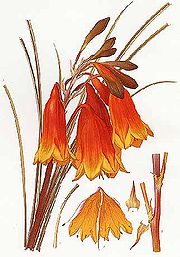
is the only genus in the family Blandfordiaceae, with four species distributed in eastern Australia
. They are commonly called "Christmas Bells", because of the shape of their flowers and their flowering time, which coincides with Christmas
in Australia. They are upright perennial herbs (to about 1.50 m), with distinctive leaves
. The inflorescence
is a raceme
. Individual flowers have jointed pedicels and tepals forming a tubular shape. The seed
s have conspicuous hairs.
. A more or less typical monocotyledon
, the species can be recognized by its shortly branched inflorescence
covered with branched hairs (giving rise to the common name of Lamb's-tail). The flowers are radially symmetrical.
. They are more or less rhizomatous
, with spiral leaves and an inflorescence
that may form a raceme
or a spike. There are large bracts at the base of the inflorescence. The individual flowers are small, with tepals joined at the base.

s of more or less folded leaves with persistent bases and quite prominent nonglandular hairs. The tepals in the outer whorl tend to be green on the outside. The ovary
is inferior with often a thin tubular portion at its apex formed by joined tepals or the tip of the ovary.
to central Asia
. They are herbs with corm
s and an inflorescence
forming a cluster. The individual flowers are blue, shortly tubular, with an inferior ovary
.
, the United States
and Africa
. They are herbs with corm
s and leaves which are sometimes stalked (petiolate) with wide blades. The flowers have tepal
s that open outwards. The stamen
s are strongly dimorphic. The anthers open by pores.
The genus Cyanastrum is sometimes placed in its own family Cyanastraceae.
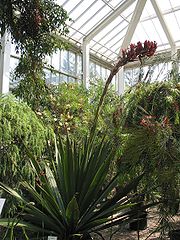
, Australia, being hard not to notice when in flower. The leaves have entire margins but disintegrate into fibres at the apex. The sub-umbel
late inflorescence
s are borne at the end of long stems, having numerous bright red flowers, which are radially symmetric with inferior ovaries
.
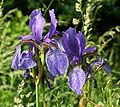
and over 1,600 species
with a worldwide distribution.
Members of the family are usually perennial herbs with sword-shaped unifacial leaves; the inflorescence
is a spike or panicle of solitary flowers, or forms a monochasial cyme or rhipidium (meaning that the successive stems of the flowers follow a zig-zag path in the same plane); and the flower has only three stamens, each opposite to an outer tepal.
Saffron
is obtained from the dried styles of Crocus sativus L., a member of the iris family. The corms of some species of Iridaceae are used as food by some indigenous peoples.
Many species in the iris family have a great economic importance in ornamental horticulture and the cut flower industry, especially Gladiolus
, Freesia
, Sparaxis
, Iris
, Tigridia
(tiger lily), Ixia
(corn lily), Romulea
, Neomarica
, Moraea
(butterfly lily), Nemastylis
, Belamcanda, Sisyrinchium (blue-eyed grass), Crocosmia
and Trimezia
. Many other genera, both perennials
and bulb
s, are grown in gardens in tropical and temperate regions (e.g. Watsonia
, Crocus
, Dietes
, Tritonia
, Hesperantha
and Neomarica
).
Moraea
and Homeria
are two genera of poisonous plants which are a problem in sheep and cattle producing regions, notably in South Africa.
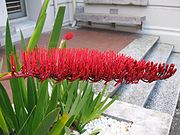
with two species, one found only on the Poor Knights islands in New Zealand
and the other in New Caledonia
. The inflorescence
is crowded with quite large, radial symmetrical flowers, which face upwards. The stamen
s are strongly exserted (i.e. extend out of the flower). The family is still poorly known.
. Based on phylogenetic research, the latest (2009) revision of the APG
classification groups together the former families Hemerocallidaceae, Xanthorrhoeaceae sensu stricto and Asphodelaceae as the Xanthorrhoeaceae. A paper published at the same time proposed that the original three families should be retained as subfamilies within Xanthorrhoeaceae sensu lato. This division has been used here.
It includes perennial herbaceous plants which are glabrous and have short rhizome
s with fibrous roots or are rhizomatous with root tubers. The leaves form a rosette at the base of the plant, and are alternate, distichous, flat, sessile, simple, linear or lanceolate, and parallel veined, with entire margins. The flower is typically somewhat zygomorphic (i.e. not radially symmetrical) and has nectaries. The flowers are arranged in various types of inflorescence
. The group includes eight genera and about 85 species distributed in the temperate zones of Europe and Asia, Malaysia, India, Madagascar, Africa and the Pacific, from Australia and New Zealand to South America.
Two of the genera, Hemerocallis (day lily) and Phormium (New Zealand flax), are grown as ornamentals worldwide.
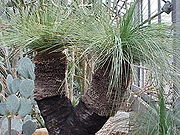
It contains only one genus, Xanthorrhoea
, endemic to Australia
. Many species have an erect woody stem which is covered with persistent dried leaves unless there have been fires, topped by a crown of long thin leaves. The spike-like inflorescence
is erect and densely crowded with small flowers. The fruit
is a capsule. Plants are adapted to bush fires, which can stimulate flowering.
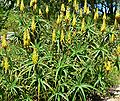
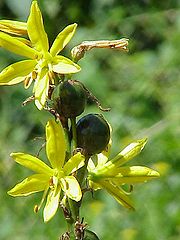
Members of the family are natives of temperate to tropical regions of the Old World
, with 15 genera and 780 species. The greatest diversity occurs in South Africa
, usually in arid habitats. They differ from other related families by often being pachycauline
(i.e. with a thickened trunk, usually wider at the base, which has a water storage function), by usually having succulent leaves, and by possessing a trimerous flower with a superior ovary and seeds with an aryl
.
The most conspicuous genus in the family is Aloe
. Many species of Aloe
are used medicinally and in cosmetics. For example, "aloin" is derived from Aloe vera
and Aloe ferox
and has important medical uses (e.g. as a laxative and in the treatment of burns) as well as cosmetic uses (e.g. in skin and hair products). Other genera are used as ornamental plants, both succulents such as Aloe
, Haworthia
and Gasteria
and perennials such as Kniphofia
, Asphodelus
and Bulbine
.
classification groups together these three families under the conserved name of Amaryllidaceae. (Earlier the APG had used the name Alliaceae for this group.). A paper published at the same time as the 2009 classification proposed that the original three families should be retained as subfamilies within Amaryllidaceae sensu lato. This division has been used here.
Agapanthus
, native to South Africa
, is the sole genus of the subfamily. They are relatively robust herbaceous perennials with short rhizome
s and leaves forming a rosette, individually linear-oblong, flat, rather fleshy. The flowers are quite large, blue or white, forming an umbel
at the end of a stem (scape) which is longer than the leaves. The inflorescences are protected by bract
s joined together along one side. The ovary is superior. Plants do not have the characteristic garlic odor of the allium subfamily (Allioideae). They are set apart from the amaryllis subfamily (Amaryllidoideae) by their superior ovary, the presence of saponin
s and the absence of the alkaloid
s typical of amaryllids.
Agapanthus
is widely grown as an ornamental in temperate gardens.
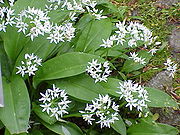
Members of the subfamily are found worldwide, in temperate, subtropical and tropical regions. They are herbaceous perennials, usually with bulb
s, although in some cases they have short rhizome
s. The subfamily can be easily recognized by its characteristic smell (the smell of garlic and onions, singular enough to be called "garlic odour"), by the very soft, fleshy leaves and the umbel-like inflorescence at the end of a stem (scape), which has small to medium flowers with a superior ovary.
The subfamily is of considerable economic importance, being grown as vegetables and seasoning, medicinal plants and ornamentals. The genus Allium
includes some of the most widely used edible plants, such as onion
and shallot
(varieties of Allium cepa), garlic
(A. sativum and A. scordoprasum), leek
(Allium ampeloprasum var. porrum), and various flavourings such as chives
(Allium schoenoprasum).
The organosulphur compounds responsible for the characteristic odour are believed to have antioxidant
, antibiotic and anticarcinogenic properties, to stimulate the immune system
and to be protective of liver functioning.
The family also has important ornamentals, mainly from the dominant genus Allium
, but also including genera such as Ipheion
.
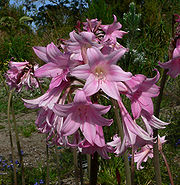
_-_8.jpg)
The subfamily includes 59 genera and approximately 800 species from temperate and tropical regions worldwide. They are herbaceous perennials with bulbs, and can be identified by their rather fleshy leaves, usually large and attractive flowers, with six stamen
s and an inferior ovary. The flowers are solitary or, more frequently, arranged in umbel
late inflorescences at the end of a stem (scape).
Many species of Amaryllidoideae are popular as ornamentals in parks and gardens. A special mention should be made of Narcissus (daffodils and narcissi), cultivated in various parts of the world as an ornamental in gardens and as a cut flower.
classification supports the use of a single broadly defined family, Asparagaceae sensu lato. A paper published at the same time as the 2009 classification proposed seven subfamilies for the families recognized in the very first APG classification of 1998. This division has been used here, although it is not clear whether the approach will be upheld by future research as some of the clades are weakly supported.
The broadly defined family is large, with some 153 genera and 2480 species, and occurs worldwide.
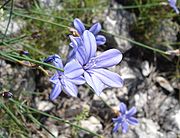
It comprises a single species, Aphyllanthes monspeliensis, found in arid areas of the western Mediterranean
. The inflorescence
is made up of small clusters of blue flowers at the end of a long stem (scape). An unusual feature of the species is that the stem (scape) is actually the main photosynthetic organ, since the paper-like leaves at the base lack chlorophyll.
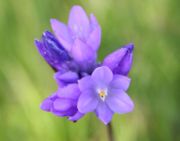
It comprises about a dozen genera which are native to western North America
. Plants are superficially similar to those of the allium subfamily, being perennial herbs with an umbellate inflorescence
made up of quite small flowers. The tepal
s are more or less joined at the base, sometimes with a corona (a structure like the trumpet of a daffodil). The ovary is superior. Plants lack the "garlic odor" typical of the allium subfamily, and have a fibrous corm
rather than a bulb. The inflorescence bracts also differ from those of alliums.
A number of genera, including Brodiaea
and Triteleia, are grown as ornamental plants.

The group includes from 770 to 1,000 species, distributed predominantly in Mediterranean climates, especially South Africa
, the Mediterranean
to Central Asia
and Burma, and South America
. Characteristics of the subfamily include: flowers with six tepals and six stamens, typically arranged in a raceme
; a superior ovary; growing from bulbs; rather fleshy mucilaginous leaves in a basal rosette. Plants contain poisonous compounds, so that they are not edible.
Many spring- and summer-flowering bulbs grown in gardens in temperate climates belong to this subfamily, including genera such as Scilla
(squill), Muscari (grape hyacinth), Hyacinthus (hyacinths),Chionodoxa
(glory of the snow) and Galtonia
(summer hyacinth). Some are used as cut flowers.
Given this broad definition, there are about 23 genera in over 600 species, distributed more or less around the world outside cold areas. South west North America
, including Mexico
, is an area of particular diversity. Some members of the subfamily form trees (such as the Joshua Tree
, a species of Yucca
). They often have large, succulent leaves in rosettes, either at the base or at the end of the branches. Others are herbaceous (e.g. Hosta
, Anthericum
). The flowers have six tepals and six stamens with either a superior or inferior ovary.
Agave
has important economic uses (for example, it is used to make tequila
and mezcal
). Some genera are used as ornamental garden plants in temperate regions (e.g. Hosta
) and as house plants (e.g. Sansevieria
, Chlorophytum
).
The group consists of some 15 genera and about 180 species from Australasia
, south east Asia
, and South America
. The best known genus is Cordyline
. The tepals of the flower persist in the fruit.
Species of Cordyline are grown as house plants and as garden plants in temperate to tropical regions.
The subfamily contains only two genera, one, Asparagus
, with around 150-300 species distributed throughout the Old World
and a small area of Australia
, the other, Hemiphylacus
, with only five species, found in Mexico
. The photosynthetic organs of Asparagus have been the subject of some controversy; however, most authors consider them to be flattened stems rather than leaves (phylloclade
s). The leaves are reduced to non-photosynthetic scales, with the phylloclades in their axils. The flowers are small, bell-shaped, greenish-white to yellowish, with six tepals partially joined together at the base, either single or in small clusters, springing from the junctions of the phylloclades. Asparagus species are usually dioecious
, with male and female flowers on separate plants. The fruit is a small red berry, which is poisonous to humans.
Asparagus officinalis
is used as a vegetable, the young shoots being cut before they become woody. Other species are used as house plants and as greenery in the cut flower trade.
When broadly defined, the group contains some 26 genera and almost 500 species, distributed mainly in the temperate to tropical regions of the Northern Hemisphere. There are few morphological features separating the subfamily from other groups within the Asparagaceae sensu lato. The small flowers are radially symmetrical, with six tepals, usually joined at the base, six stamens and a superior ovary. The fruit is usually a berry with few seeds. Species vary from herbaceous perennials to tree-like forms (e.g. Dracaena
).
There are several examples of convergent evolution between species in this subfamily and those in other subfamilies of the Asparagaceae sensu lato. Ruscus
(butcher's broom) has photosynthetic branches (phylloclades), similar to those of Asparagus
(Asparagoideae); Dracaena draco
has a tree-like habit resembling Yucca
(Agavoideae) and Cordyline
(Lomandroideae).
Some genera are used in horticulture: Sanseviera and Aspidistra
are used as house plants in temperate areas and as garden plants in warmer regions; Polygonatum
and Ophiopogon
are used as garden plants in temperate areas.
. Older systems based on morphology placed many of the species now included in Asparagales into the lily family (Liliaceae); where other families were recognized, these were generally placed into the old order Liliales: a very large order which was used for almost all monocotyledons with colourful tepals and without starch in their endosperm (the lilioid monocot
s). The Liliales was difficult to divide into families because morphological characters were not present in patterns that clearly demarcated groups. Thus the Wettstein system
, last revised in 1935, did not recognise the Asparagales, and placed many of the plants involved in an order called 'Liliiflorae'. The widely used Cronquist system
of 1968-1988 also did not recognise Asparagales, using instead the very broadly defined order Liliales.
system, APG III
, places the order in the clade monocots
with the circumscription
given below. The APG III system is very recent, , so it is not yet employed in many text books; however it is likely to become more influential since its family circumscriptions are being used as the basis of the Kew-hosted World Checklist of Selected Plant Families. With this circumscription, the order consists of 14 families with approximately 1120 genera and 26000 species.
Order Asparagales Link
The earlier 2003 version, APG II
, allowed 'bracketed' families, i.e. families which could either be segregated from more comprehensive families or could be included in them. These are the families given under "including" in the list above. APG III does not allow bracketed families, requiring the use of the more comprehensive family; otherwise the circumscription of the Asparagales is unchanged. A separate paper accompanying the publication of the 2009 APG III system provided subfamilies to accommodate the families which were discontinued.
The first APG system of 1998
contained some extra families, included in square brackets in the list above.
and the Kubitzki system
. The families included in the circumscriptions of the order in these two systems are shown in the first and second columns of the table below. The equivalent family in the APG III system is shown in the third column. Note that although these systems may use the same name for a family, the genera which it includes may be different, so the equivalence between systems is only approximate in some cases.
of 1985 onwards, studies based mainly on morphology had identified the Asparagales as a distinct group, but had also included groups now located in Liliales, Pandanales and Zingiberales. Research in the 21st century has supported the monophyly
of Asparagales, based on morphology, 18S rDNA, and other DNA sequences, although some phylogenetic reconstructions based on molecular data have suggested that Asparagales may be paraphyletic, with Orchidaceae separated from the rest. Within the monocots, Asparagales is the sister of the commelinid clade.
A possible phylogenetic tree
for the Asparagales, including those families recently reduced to subfamilies, is shown below.
The tree shown above can be divided into a basal paraphyletic group, the 'lower Asparagales', from Orchidaceae to Xanthorrhoeaceae sensu lato, and a well-supported monophyletic group of 'core Asparagales', comprising Amaryllidaceae sensu lato and Asparagaceae sensu lato.
Two differences between these two groups (although with exceptions) are: the mode of microsporogenesis and the position of the ovary. The 'lower Asparagales' typically have simultaneous microsporogenesis (i.e. cell walls develop only after both meiotic
divisions), which appears to be an apomorphy within the monocots, whereas the 'core Asparagales' have reverted to successive microsporogenesis (i.e. cell walls develop after each division). The 'lower Asparagales' typically have an inferior ovary, whereas the 'core Asparagales' have reverted to a superior ovary. A 2002 morphological study by Rudall treated possessing an inferior ovary as a synapomorphy
of the Asparagales, stating that reversions to a superior ovary in the 'core Asparagales' could be associated with the presence of nectaries below the ovaries. However, Stevens notes that superior ovaries are distributed among the 'lower Asparagales' in such a way that it is not clear where to place the evolution of different ovary morphologies. The position of the ovary seems a much more flexible character (here and in other angiosperms) than previously thought.
is the largest family of all angiosperms and hence by far the largest in the order. The Dahlgren system
recognized three families of orchids, but DNA sequence analysis later showed that these families are polyphyletic and so should be combined. Several studies suggest (with high bootstrap support) that Orchidaceae is the sister of the rest of the Asparagales. Other studies have placed the orchids differently in the phylogenetic tree, generally among the Boryaceae
-Hypoxidaceae
clade. The position of Orchidaceae shown above seems the best current hypothesis, but cannot be taken as confirmed.
Orchids have simultaneous microsporogenesis and inferior ovaries, two characters that are typical of the 'lower Asparagales'. However, their nectaries are rarely in the septa of the ovaries, and most orchids have dust-like seeds, atypical of the rest of the order. (Some members of Vanilloideae
and Cypripedioideae have crustose seeds, probably associated with dispersal by birds and mammals that are attracted by fermenting fleshy fruit releasing fragrant compounds, e.g. vanilla
.)
In terms of the number of species, Orchidaceae diversification is remarkable. However, although the other Asparagales may be less rich in species, they are more variable morphologically, including tree-like forms.
form a well-supported clade in studies based on DNA sequence analysis. All four contain relatively few species, and it has been suggested that they be combined into one family under the name Hypoxidaceae sensu lato. The relationship between Boryaceae (which includes only two genera, Borya and Alania), and other Asparagales has remained unclear for a long time. The Boryaceae are mycorrhiza
l, but not in the same way as orchids. Morphological studies have suggested a close relationship between Boryaceae and Blandfordiaceae. There is relatively low support for the position of Boryaceae in the tree shown above.
and Tecophilaeaceae
is still unclear. Some studies have supported a clade of these two families, others have not. The position of Doryanthaceae
has also varied, with support for the position shown above, but also support for other positions.
The clade from Iridaceae
upwards appears to have stronger support. All have some genetic characteristics in common, having lost Arabidopsis
-type telomere
s. Iridaceae is distinctive among the Asparagales in the unique structure of the inflorescence
(a ripidium), the combination of an inferior ovary and three stamens, and the common occurrence of unifacial leaves whereas bifacial leaves are the norm in other Asparagales.
Members of the clade from Iridaceae
upwards have infra-locular septal nectaries, which Rudall interpreted as a driver towards secondarily superior ovaries.
(family Xanthorrhoeaceae sensu lato) and Dracaena
(family Asparagaceae sensu lato), with species reaching tree-like proportions.
The 'core Asparagales', comprising Amaryllidaceae sensu lato and Asparagaceae sensu lato, are a strongly supported clade, as are clades for each of the families. Relationships within these broadly defined families appear less clear, particularly within the Asparagaceae sensu lato. Stevens notes that most of its subfamilies are difficult to recognize, and that significantly different divisions have been used in the past, so that the use of a broadly defined family to refer to the entire clade is justified. Thus the relationships among subfamilies shown above, based on APWeb , is somewhat uncertain.
A 2009 study suggests that the Asparagales have the highest diversification rate in the monocots, about the same as the order Poales
, although in both orders the rate is little over half that of the eudicot order Lamiales
, the clade with the highest rate.
Order (biology)
In scientific classification used in biology, the order is# a taxonomic rank used in the classification of organisms. Other well-known ranks are life, domain, kingdom, phylum, class, family, genus, and species, with order fitting in between class and family...
of plants, used in modern classification systems such as the APG III system
APG III system
The APG III system of flowering plant classification is the third version of a modern, mostly molecular-based, system of plant taxonomy...
(which is used throughout this article). The order takes its name from the family Asparagaceae
Asparagaceae
Asparagaceae is the botanical name of a family of flowering plants, placed in the order Asparagales of the monocots.In earlier classification systems, the species involved were often treated as belonging to the family Liliaceae...
and is placed in the monocots. The order has only recently been recognized in classification systems. It was first put forward by Huber in 1977 and later taken up in the Dahlgren system
Dahlgren system
One of the modern systems of plant taxonomy, the Dahlgren system was published by monocot specialist Rolf Dahlgren. His wife Gertrud Dahlgren carried on after his death.According to the extensive listing by Professor Reveal One of the modern systems of plant taxonomy, the Dahlgren system was...
of 1985. Before this, many of its families were assigned to the old order Liliales
Liliales
Liliales is an order of monocotyledonous flowering plants. This order of necessity includes the family Liliaceae, but both the family and the order have had a widely disputed history, with the circumscription varying greatly from one taxonomist to another...
: a very large order containing almost all monocots with colourful tepal
Tepal
Tepals are elements of the perianth, or outer part of a flower, which include the petals or sepals. The term tepal is more often applied specifically when all segments of the perianth are of similar shape and color, or undifferentiated, which is called perigone...
s and without starch
Starch
Starch or amylum is a carbohydrate consisting of a large number of glucose units joined together by glycosidic bonds. This polysaccharide is produced by all green plants as an energy store...
in their endosperm
Endosperm
Endosperm is the tissue produced inside the seeds of most flowering plants around the time of fertilization. It surrounds the embryo and provides nutrition in the form of starch, though it can also contain oils and protein. This makes endosperm an important source of nutrition in human diet...
. DNA sequence analysis
DNA sequencing
DNA sequencing includes several methods and technologies that are used for determining the order of the nucleotide bases—adenine, guanine, cytosine, and thymine—in a molecule of DNA....
indicated that Liliales should be divided into at least Liliales, Asparagales and Dioscoreales
Dioscoreales
Dioscoreales is a botanical name for an order of flowering plants. Of necessity it contains the family Dioscoreaceae.In the APG II system, of 2003, this order was placed in the clade monocots and comprised the families Burmanniaceae, Dioscoreaceae and Nartheciaceae.Under the APG system of 1998,...
. The boundaries of the Asparagales and of its families have undergone a series of changes in recent years; future research may lead to further changes and ultimately greater stability.
The order is clearly circumscribed
Circumscription (taxonomy)
In taxonomy, circumscription is the definition of the limits of a taxonomic group of organisms. One goal of taxonomy is to achieve a stable circumscription for every taxonomic group. Achieving stability can be simple or difficult....
on the basis of DNA sequence analysis, but is difficult to define morphologically, since its members are structurally diverse. Thus although most species in the order are herbaceous
Herbaceous plant
A herbaceous plant is a plant that has leaves and stems that die down at the end of the growing season to the soil level. They have no persistent woody stem above ground...
, some no more than 15 cm high, there are a number of climbers (e.g. some species of Asparagus
Asparagus
Asparagus officinalis is a spring vegetable, a flowering perennialplant species in the genus Asparagus. It was once classified in the lily family, like its Allium cousins, onions and garlic, but the Liliaceae have been split and the onion-like plants are now in the family Amaryllidaceae and...
), as well as several genera forming trees (e.g. Agave
Agave
Agave is a genus of monocots. The plants are perennial, but each rosette flowers once and then dies ; they are commonly known as the century plant....
, Cordyline
Cordyline
Cordyline is a genus of about 15 species of woody monocotyledonous flowering plants in family Asparagaceae, subfamily Lomandroideae. The subfamily has previously been treated as a separate family Laxmanniaceae, or Lomandraceae. Other authors have placed the genus in the Agavaceae...
, Yucca
Yucca
Yucca is a genus of perennial shrubs and trees in the family Asparagaceae, subfamily Agavoideae. Its 40-50 species are notable for their rosettes of evergreen, tough, sword-shaped leaves and large terminal panicles of white or whitish flowers. They are native to the hot and dry parts of North...
, Dracaena
Dracaena (plant)
Dracaena is a genus of about 40 species of trees and succulent shrubs. In the APG III classification system, it is placed in the family Asparagaceae, subfamily Nolinoideae . It has also formerly been separated into the family Dracaenaceae or placed in the Agavaceae...
), some of which can exceed 10 m in height. Succulent genera occur in several families (e.g. Aloe
Aloe
Aloe , also Aloë, is a genus containing about 500 species of flowering succulent plants. The most common and well known of these is Aloe vera, or "true aloe"....
).
One of the defining characteristics of the order is the presence of phytomelan, a black pigment present in the seed coat, creating a dark crust. Phytomelan is found in most families of the Asparagales (although not in Orchidaceae
Orchidaceae
The Orchidaceae, commonly referred to as the orchid family, is a morphologically diverse and widespread family of monocots in the order Asparagales. Along with the Asteraceae, it is one of the two largest families of flowering plants, with between 21,950 and 26,049 currently accepted species,...
, thought to be a sister to the rest of the group).
Almost all species have a tight cluster of leaves (a rosette), either at the base of the plant or at the end of a more-or-less woody stem; the leaves are less often produced along the stem. The flowers are in the main not particularly distinctive, being of a general 'lily type', with six tepal
Tepal
Tepals are elements of the perianth, or outer part of a flower, which include the petals or sepals. The term tepal is more often applied specifically when all segments of the perianth are of similar shape and color, or undifferentiated, which is called perigone...
s, either free or fused from the base.
The order is thought to have first diverged from other related monocots some 120-130 million years ago (early in the Cretaceous period), although given the difficulty in classifying the families involved, estimates are likely to be uncertain.
From an economic point of view, the order Asparagales is second in importance within the monocots to the order Poales
Poales
Poales is a large order of flowering plants in the monocotyledons, and includes families of plants such as the grasses, bromeliads, and sedges. Sixteen plant families are currently recognized by botanists to be part of Poales....
(which includes grasses and cereals). Species are used as food and flavourings (e.g. onion
Onion
The onion , also known as the bulb onion, common onion and garden onion, is the most widely cultivated species of the genus Allium. The genus Allium also contains a number of other species variously referred to as onions and cultivated for food, such as the Japanese bunching onion The onion...
, garlic
Garlic
Allium sativum, commonly known as garlic, is a species in the onion genus, Allium. Its close relatives include the onion, shallot, leek, chive, and rakkyo. Dating back over 6,000 years, garlic is native to central Asia, and has long been a staple in the Mediterranean region, as well as a frequent...
, leek
Leek
The leek, Allium ampeloprasum var. porrum , also sometimes known as Allium porrum, is a vegetable which belongs, along with the onion and garlic, to family Amaryllidaceae, subfamily Allioideae...
, asparagus
Asparagus
Asparagus officinalis is a spring vegetable, a flowering perennialplant species in the genus Asparagus. It was once classified in the lily family, like its Allium cousins, onions and garlic, but the Liliaceae have been split and the onion-like plants are now in the family Amaryllidaceae and...
, vanilla
Vanilla
Vanilla is a flavoring derived from orchids of the genus Vanilla, primarily from the Mexican species, Flat-leaved Vanilla . The word vanilla derives from the Spanish word "", little pod...
), as cut flowers (e.g. freesia
Freesia
Freesia Ecklon ex Klatt is a genus of 14–16 species of flowering plants in the family Iridaceae, native to Africa. Of the 14 species, 12 are native to Cape Province, South Africa, the remaining two to tropical Africa, one species extending north of the equator to Sudan.The genus was named in honor...
, gladiolus
Gladiolus
Gladiolus is a genus of perennial bulbous flowering plants in the iris family...
, iris
Iris (plant)
Iris is a genus of 260-300species of flowering plants with showy flowers. It takes its name from the Greek word for a rainbow, referring to the wide variety of flower colors found among the many species...
, orchids), and as garden ornamentals (e.g. day lilies, lily of the valley
Convallaria
Convallaria majalis , commonly known as the lily-of-the-valley, is a poisonous woodland flowering plant native throughout the cool temperate Northern Hemisphere in Asia and Europe....
, Agapanthus
Agapanthus
Agapanthus is the only genus in the subfamily Agapanthoideae of the flowering plant family Amaryllidaceae. The family is in the monocot order Asparagales....
).
Characteristics
Asparagus
Asparagus officinalis is a spring vegetable, a flowering perennialplant species in the genus Asparagus. It was once classified in the lily family, like its Allium cousins, onions and garlic, but the Liliaceae have been split and the onion-like plants are now in the family Amaryllidaceae and...
, family Asparagaceae) and some are tree-like. The order also contains many geophytes (bulbs, corms and various kinds of tuber). Almost all species have a tight cluster of leaves (a rosette) at the base of the plant or, in the tree-forming species, at the end of a woody stem. Only in a few cases are leaves produced along the length of the stem. The flowers are often at the tip of the stem and are mainly of a rather generalized 'lily type', with six tepals and up to six stamens.
The orders which have been separated from the old Liliales are difficult to characterize. No single morphological character appears to be diagnostic of the order Asparagales.
- The flowers of Asparagales are of a general type among the lilioid monocotLilioid monocotLilioid monocots or lilioids is an informal name used for a grade of five monocot orders in which the majority of species have flowers with relatively large, coloured tepals, broadly similar to those of lilies...
s. Compared to Liliales, they usually have plain tepalTepalTepals are elements of the perianth, or outer part of a flower, which include the petals or sepals. The term tepal is more often applied specifically when all segments of the perianth are of similar shape and color, or undifferentiated, which is called perigone...
s without markings in the form of dots. If nectaries are present, they are in the septaSeptumIn anatomy, a septum is a wall, dividing a cavity or structure into smaller ones.-In human anatomy:...
of the ovaries rather than at the base of the tepals or stamenStamenThe stamen is the pollen producing reproductive organ of a flower...
s.
- Those species which have relatively large dry seeds have a dark, crust-like (crustose) outer layer containing the pigment phytomelan. However, some species with hairy seeds (e.g. EriospermumEriospermumEriospermum is a genus of tuberous flowering plants from South Africa. "Eriospermum" is from the Greek erion for "wool" and sperma for "seed". In the APG III classification system, the genus is placed in the family Asparagaceae, subfamily Nolinoideae . It was formerly placed in its own family,...
, family Asparagaceae s.l.), berries (e.g. MaianthemumMaianthemumMaianthemum is a genus of about 30 species of rhizomatous herbaceous plants native to the understory of woodlands in North and Central America, northern Europe, northern and eastern Asia, and the Himalayas...
, family Asparagaceae s.l.), or highly reduced seeds (e.g. orchids) lack this dark pigment in their seed coats. Phytomelan is not unique to Asparagales (i.e. it is not a synapomorphySynapomorphyIn cladistics, a synapomorphy or synapomorphic character is a trait that is shared by two or more taxa and their most recent common ancestor, whose ancestor in turn does not possess the trait. A synapomorphy is thus an apomorphy visible in multiple taxa, where the trait in question originates in...
) but it is common within the order and rare outside it. The inner portion of the seed coat is usually completely collapsed. In contrast, the morphologically similar seeds of Liliales have no phytomelan, and usually retain a cellular structure in the inner portion of the seed coat.
- Most monocots are unable to thicken their stems once they have formed, since they lack the cylindrical meristemMeristemA meristem is the tissue in most plants consisting of undifferentiated cells , found in zones of the plant where growth can take place....
present in other angiosperm groups. Asparagales have a method of secondary thickening which is otherwise only found inDioscoreaDioscoreaDioscorea is a genus of over 600 species of flowering plants in the family Dioscoreaceae, native throughout the tropical and warm temperate regions of the world. The vast majority of the species are tropical, with only a few species extending into temperate climates...
(in the order Disoscoreales). In a process called 'anomalous secondary growth', they are able to create new vascular bundles around which thickening growth occurs. AgaveAgaveAgave is a genus of monocots. The plants are perennial, but each rosette flowers once and then dies ; they are commonly known as the century plant....
, YuccaYuccaYucca is a genus of perennial shrubs and trees in the family Asparagaceae, subfamily Agavoideae. Its 40-50 species are notable for their rosettes of evergreen, tough, sword-shaped leaves and large terminal panicles of white or whitish flowers. They are native to the hot and dry parts of North...
, AloeAloeAloe , also Aloë, is a genus containing about 500 species of flowering succulent plants. The most common and well known of these is Aloe vera, or "true aloe"....
, DracaenaDracaena (plant)Dracaena is a genus of about 40 species of trees and succulent shrubs. In the APG III classification system, it is placed in the family Asparagaceae, subfamily Nolinoideae . It has also formerly been separated into the family Dracaenaceae or placed in the Agavaceae...
, NolinaNolinaNolina is a genus of tropical xerophytic flowering plants, with the principal distribution being in Mexico and extending into the southern United States. Some botanists have included the genus Beaucarnea in Nolina. In the APG III classification system, it is placed in the family Asparagaceae,...
and CordylineCordylineCordyline is a genus of about 15 species of woody monocotyledonous flowering plants in family Asparagaceae, subfamily Lomandroideae. The subfamily has previously been treated as a separate family Laxmanniaceae, or Lomandraceae. Other authors have placed the genus in the Agavaceae...
can become massive trees, albeit not of the height of the tallest dicots, and with less branching. Other genera in the order, such as Lomandra and Aphyllanthes, have the same type of secondary growth but confined to their underground stems.
- Microsporogenesis (part of pollenPollenPollen is a fine to coarse powder containing the microgametophytes of seed plants, which produce the male gametes . Pollen grains have a hard coat that protects the sperm cells during the process of their movement from the stamens to the pistil of flowering plants or from the male cone to the...
formation) distinguishes some members of Asparagales from Liliales. Microsporogenesis involves a cell dividing twice (meioticallyMeiosisMeiosis is a special type of cell division necessary for sexual reproduction. The cells produced by meiosis are gametes or spores. The animals' gametes are called sperm and egg cells....
) to form four daughter cells. There are two kinds of microsporogenesis: successive and simultaneous (although intermediates exist). In successive microsporogenesis, walls are laid down separating the daughter cells after each division. In simultaneous microsporogenesis, there is no wall formation until all four cell nuclei are present. Liliales all have successive microsporogenesis, which is thought to be the primitive condition in monocots. It seems that when the Asparagales first diverged they developed simultaneous microsporogenesis, which the 'lower' Asparagale families retain. However, the 'core' Asparagales (see #Phylogeny section) have reverted to successive microsporogenesis.
- The Asparagales appear to be unified by a mutation affecting their telomereTelomereA telomere is a region of repetitive DNA sequences at the end of a chromosome, which protects the end of the chromosome from deterioration or from fusion with neighboring chromosomes. Its name is derived from the Greek nouns telos "end" and merοs "part"...
s (a region of repetitive DNADNADeoxyribonucleic acid is a nucleic acid that contains the genetic instructions used in the development and functioning of all known living organisms . The DNA segments that carry this genetic information are called genes, but other DNA sequences have structural purposes, or are involved in...
at the end of a chromosomeChromosomeA chromosome is an organized structure of DNA and protein found in cells. It is a single piece of coiled DNA containing many genes, regulatory elements and other nucleotide sequences. Chromosomes also contain DNA-bound proteins, which serve to package the DNA and control its functions.Chromosomes...
). The typical Arabidopsis-type' sequence of bases has been fully or partially replaced by other sequences, with the 'human-type' predominating.
- Other apomorphic characters of the order according to Stevens are: the presence of chelidonic acid, anthers longer than wide, tapetal cells bi- to tetra-nuclear, tegmen not persistent, endosperm helobial, and loss of mitochondrial gene sdh3.
Diversity
The taxonomic diversity of the monocotyledons is described in detail by Kubitzki. Up-to-date information on the Asparagales can be found on the Angiosperm Phylogeny WebsiteAngiosperm Phylogeny Website
Angiosperm Phylogeny Website is a well-known web site dedicated to research on Angiosperm phylogeny and taxonomy.The site is hosted by the Missouri Botanical Garden website and maintained by researcher Peter F. Stevens, who is a member of the Angiosperm Phylogeny Group...
.
The families of the Asparagales, as set out in the APG III system
APG III system
The APG III system of flowering plant classification is the third version of a modern, mostly molecular-based, system of plant taxonomy...
, are briefly surveyed below. For more information follow the links to the main articles.
Orchidaceae
The orchid family is one of the two largest families of angiosperms (the other is AsteraceaeAsteraceae
The Asteraceae or Compositae , is an exceedingly large and widespread family of vascular plants. The group has more than 22,750 currently accepted species, spread across 1620 genera and 12 subfamilies...
). The shape of the flowers is very distinctive, making orchids easy to recognize. The flower is bilaterally symmetrical. The three sepal
Sepal
A sepal is a part of the flower of angiosperms . Collectively the sepals form the calyx, which is the outermost whorl of parts that form a flower. Usually green, sepals have the typical function of protecting the petals when the flower is in bud...
s are generally colourful and bright (which is why they are sometimes called outer tepal
Tepal
Tepals are elements of the perianth, or outer part of a flower, which include the petals or sepals. The term tepal is more often applied specifically when all segments of the perianth are of similar shape and color, or undifferentiated, which is called perigone...
s), with one on each side ("lateral sepals") and one usually at the top of the flower ("dorsal sepal"), sometimes forming a hood. The three petal
Petal
Petals are modified leaves that surround the reproductive parts of flowers. They often are brightly colored or unusually shaped to attract pollinators. Together, all of the petals of a flower are called a corolla. Petals are usually accompanied by another set of special leaves called sepals lying...
s (or inner tepals), also showy, are located alternately between the sepals, two at the side and one usually at the bottom of the flower. The lower petal is referred to as the "labellum
Labellum
Labellum is the Latin diminutive of labium, meaning lip. These are anatomical terms used descriptively in biology, for example in Entomology and botany.-Botany:...
" or "lip", and is usually distinctively different from the side petals. Thelymitra
Thelymitra
Thelymitra is a genus of orchids known as 'sun orchids' in reference to their habit of only opening in warm weather.- Description :They are about 100 species distributed in higher rainfall areas across Australia , New Zealand , New Caledonia , Timor, Java, and the Philippines.The type species is...
is an example of a genus where the lower petal is similar in appearance to the other petals. The pollination systems of orchids are among the most complex and interesting of all the angiosperms.
Orchids include many species of great ornamental value. Vanilla
Vanilla
Vanilla is a flavoring derived from orchids of the genus Vanilla, primarily from the Mexican species, Flat-leaved Vanilla . The word vanilla derives from the Spanish word "", little pod...
is obtained from the fruit of the orchid Vanilla planifolia.
Boryaceae
The genus Borya contains tree-like species which behave as "resurrection plants". Growing on rocky slopes, the plants dry out during the dry season and become a rusty orange color, but quickly turn green and become active again once it starts to rain. Along with the other genus in the Boryaceae family, Alania, these xerophyticXerophyte
A xerophyte or xerophytic organism is a plant which has adapted to survive in an environment that lacks water, such as a desert. Xerophytic plants may have adapted shapes and forms or internal functions that reduce their water loss or store water during long periods of dryness...
plants are native to Australia
Australia
Australia , officially the Commonwealth of Australia, is a country in the Southern Hemisphere comprising the mainland of the Australian continent, the island of Tasmania, and numerous smaller islands in the Indian and Pacific Oceans. It is the world's sixth-largest country by total area...
.
Blandfordiaceae
BlandfordiaBlandfordia
Blandfordia is a genus of flowering plants, placed in the family Blandfordiaceae of the order Asparagales of the monocots. The genus is native to eastern Australia. Plants in this genus are commonly referred to as Christmas Bells due to the shape of their flowers and the timing of their flowering...
is the only genus in the family Blandfordiaceae, with four species distributed in eastern Australia
Australia
Australia , officially the Commonwealth of Australia, is a country in the Southern Hemisphere comprising the mainland of the Australian continent, the island of Tasmania, and numerous smaller islands in the Indian and Pacific Oceans. It is the world's sixth-largest country by total area...
. They are commonly called "Christmas Bells", because of the shape of their flowers and their flowering time, which coincides with Christmas
Christmas
Christmas or Christmas Day is an annual holiday generally celebrated on December 25 by billions of people around the world. It is a Christian feast that commemorates the birth of Jesus Christ, liturgically closing the Advent season and initiating the season of Christmastide, which lasts twelve days...
in Australia. They are upright perennial herbs (to about 1.50 m), with distinctive leaves
Leaves
-History:Vocalist Arnar Gudjonsson was formerly the guitarist with Mower, and he was joined by Hallur Hallsson , Arnar Ólafsson , Bjarni Grímsson , and Andri Ásgrímsson . Late in 2001 they played with Emiliana Torrini and drew early praise from the New York Times...
. The inflorescence
Inflorescence
An inflorescence is a group or cluster of flowers arranged on a stem that is composed of a main branch or a complicated arrangement of branches. Strictly, it is the part of the shoot of seed plants where flowers are formed and which is accordingly modified...
is a raceme
Raceme
A raceme is a type of inflorescence that is unbranched and indeterminate and bears pedicellate flowers — flowers having short floral stalks called pedicels — along the axis. In botany, axis means a shoot, in this case one bearing the flowers. In a raceme, the oldest flowers are borne...
. Individual flowers have jointed pedicels and tepals forming a tubular shape. The seed
Seed
A seed is a small embryonic plant enclosed in a covering called the seed coat, usually with some stored food. It is the product of the ripened ovule of gymnosperm and angiosperm plants which occurs after fertilization and some growth within the mother plant...
s have conspicuous hairs.
Lanariaceae
Lanaria lanata is the only species in the family Lanariaceae and is found in southern South AfricaSouth Africa
The Republic of South Africa is a country in southern Africa. Located at the southern tip of Africa, it is divided into nine provinces, with of coastline on the Atlantic and Indian oceans...
. A more or less typical monocotyledon
Monocotyledon
Monocotyledons, also known as monocots, are one of two major groups of flowering plants that are traditionally recognized, the other being dicotyledons, or dicots. Monocot seedlings typically have one cotyledon , in contrast to the two cotyledons typical of dicots...
, the species can be recognized by its shortly branched inflorescence
Inflorescence
An inflorescence is a group or cluster of flowers arranged on a stem that is composed of a main branch or a complicated arrangement of branches. Strictly, it is the part of the shoot of seed plants where flowers are formed and which is accordingly modified...
covered with branched hairs (giving rise to the common name of Lamb's-tail). The flowers are radially symmetrical.
Asteliaceae
The Asteliaceae is a family of two to four genera of plants found in the Southern HemisphereSouthern Hemisphere
The Southern Hemisphere is the part of Earth that lies south of the equator. The word hemisphere literally means 'half ball' or "half sphere"...
. They are more or less rhizomatous
Rhizome
In botany and dendrology, a rhizome is a characteristically horizontal stem of a plant that is usually found underground, often sending out roots and shoots from its nodes...
, with spiral leaves and an inflorescence
Inflorescence
An inflorescence is a group or cluster of flowers arranged on a stem that is composed of a main branch or a complicated arrangement of branches. Strictly, it is the part of the shoot of seed plants where flowers are formed and which is accordingly modified...
that may form a raceme
Raceme
A raceme is a type of inflorescence that is unbranched and indeterminate and bears pedicellate flowers — flowers having short floral stalks called pedicels — along the axis. In botany, axis means a shoot, in this case one bearing the flowers. In a raceme, the oldest flowers are borne...
or a spike. There are large bracts at the base of the inflorescence. The individual flowers are small, with tepals joined at the base.
Hypoxidaceae
The family includes some 150 species with a worldwide distribution, excluding Europe and northern Asia. Species can be recognized by their rosetteRosette (botany)
In botany, a rosette is a circular arrangement of leaves, with all the leaves at a single height.Though rosettes usually sit near the soil, their structure is an example of a modified stem.-Function:...
s of more or less folded leaves with persistent bases and quite prominent nonglandular hairs. The tepals in the outer whorl tend to be green on the outside. The ovary
Ovary (plants)
In the flowering plants, an ovary is a part of the female reproductive organ of the flower or gynoecium. Specifically, it is the part of the pistil which holds the ovule and is located above or below or at the point of connection with the base of the petals and sepals...
is inferior with often a thin tubular portion at its apex formed by joined tepals or the tip of the ovary.
Ixioliriaceae
The family includes a single genus, Ixiolirion, with four species distributed from EgyptEgypt
Egypt , officially the Arab Republic of Egypt, Arabic: , is a country mainly in North Africa, with the Sinai Peninsula forming a land bridge in Southwest Asia. Egypt is thus a transcontinental country, and a major power in Africa, the Mediterranean Basin, the Middle East and the Muslim world...
to central Asia
Asia
Asia is the world's largest and most populous continent, located primarily in the eastern and northern hemispheres. It covers 8.7% of the Earth's total surface area and with approximately 3.879 billion people, it hosts 60% of the world's current human population...
. They are herbs with corm
Corm
A corm is a short, vertical, swollen underground plant stem that serves as a storage organ used by some plants to survive winter or other adverse conditions such as summer drought and heat ....
s and an inflorescence
Inflorescence
An inflorescence is a group or cluster of flowers arranged on a stem that is composed of a main branch or a complicated arrangement of branches. Strictly, it is the part of the shoot of seed plants where flowers are formed and which is accordingly modified...
forming a cluster. The individual flowers are blue, shortly tubular, with an inferior ovary
Ovary (plants)
In the flowering plants, an ovary is a part of the female reproductive organ of the flower or gynoecium. Specifically, it is the part of the pistil which holds the ovule and is located above or below or at the point of connection with the base of the petals and sepals...
.
Tecophilaeaceae
The nine genera are found in ChileChile
Chile ,officially the Republic of Chile , is a country in South America occupying a long, narrow coastal strip between the Andes mountains to the east and the Pacific Ocean to the west. It borders Peru to the north, Bolivia to the northeast, Argentina to the east, and the Drake Passage in the far...
, the United States
United States
The United States of America is a federal constitutional republic comprising fifty states and a federal district...
and Africa
Africa
Africa is the world's second largest and second most populous continent, after Asia. At about 30.2 million km² including adjacent islands, it covers 6% of the Earth's total surface area and 20.4% of the total land area...
. They are herbs with corm
Corm
A corm is a short, vertical, swollen underground plant stem that serves as a storage organ used by some plants to survive winter or other adverse conditions such as summer drought and heat ....
s and leaves which are sometimes stalked (petiolate) with wide blades. The flowers have tepal
Tepal
Tepals are elements of the perianth, or outer part of a flower, which include the petals or sepals. The term tepal is more often applied specifically when all segments of the perianth are of similar shape and color, or undifferentiated, which is called perigone...
s that open outwards. The stamen
Stamen
The stamen is the pollen producing reproductive organ of a flower...
s are strongly dimorphic. The anthers open by pores.
The genus Cyanastrum is sometimes placed in its own family Cyanastraceae.
Doryanthaceae
The two species of Doryanthes, the only genus of the family, are huge rosette-forming herbs that are a conspicuous element of the flora in the vicinity of SydneySydney
Sydney is the most populous city in Australia and the state capital of New South Wales. Sydney is located on Australia's south-east coast of the Tasman Sea. As of June 2010, the greater metropolitan area had an approximate population of 4.6 million people...
, Australia, being hard not to notice when in flower. The leaves have entire margins but disintegrate into fibres at the apex. The sub-umbel
Umbel
An umbel is an inflorescence which consists of a number of short flower stalks which are equal in length and spread from a common point, somewhat like umbrella ribs....
late inflorescence
Inflorescence
An inflorescence is a group or cluster of flowers arranged on a stem that is composed of a main branch or a complicated arrangement of branches. Strictly, it is the part of the shoot of seed plants where flowers are formed and which is accordingly modified...
s are borne at the end of long stems, having numerous bright red flowers, which are radially symmetric with inferior ovaries
Ovary (plants)
In the flowering plants, an ovary is a part of the female reproductive organ of the flower or gynoecium. Specifically, it is the part of the pistil which holds the ovule and is located above or below or at the point of connection with the base of the petals and sepals...
.
Iridaceae
The iris family contains about 70 generaGenus
In biology, a genus is a low-level taxonomic rank used in the biological classification of living and fossil organisms, which is an example of definition by genus and differentia...
and over 1,600 species
Species
In biology, a species is one of the basic units of biological classification and a taxonomic rank. A species is often defined as a group of organisms capable of interbreeding and producing fertile offspring. While in many cases this definition is adequate, more precise or differing measures are...
with a worldwide distribution.
Members of the family are usually perennial herbs with sword-shaped unifacial leaves; the inflorescence
Inflorescence
An inflorescence is a group or cluster of flowers arranged on a stem that is composed of a main branch or a complicated arrangement of branches. Strictly, it is the part of the shoot of seed plants where flowers are formed and which is accordingly modified...
is a spike or panicle of solitary flowers, or forms a monochasial cyme or rhipidium (meaning that the successive stems of the flowers follow a zig-zag path in the same plane); and the flower has only three stamens, each opposite to an outer tepal.
Saffron
Saffron
Saffron is a spice derived from the flower of Crocus sativus, commonly known as the saffron crocus. Crocus is a genus in the family Iridaceae. Each saffron crocus grows to and bears up to four flowers, each with three vivid crimson stigmas, which are each the distal end of a carpel...
is obtained from the dried styles of Crocus sativus L., a member of the iris family. The corms of some species of Iridaceae are used as food by some indigenous peoples.
Many species in the iris family have a great economic importance in ornamental horticulture and the cut flower industry, especially Gladiolus
Gladiolus
Gladiolus is a genus of perennial bulbous flowering plants in the iris family...
, Freesia
Freesia
Freesia Ecklon ex Klatt is a genus of 14–16 species of flowering plants in the family Iridaceae, native to Africa. Of the 14 species, 12 are native to Cape Province, South Africa, the remaining two to tropical Africa, one species extending north of the equator to Sudan.The genus was named in honor...
, Sparaxis
Sparaxis
Sparaxis is a genus in the family Iridaceae with about 13 species endemic to Cape Province, South Africa.All are perennials that grow during the wet winter season, flower in spring and survive underground as dormant corms over summer...
, Iris
Iris (plant)
Iris is a genus of 260-300species of flowering plants with showy flowers. It takes its name from the Greek word for a rainbow, referring to the wide variety of flower colors found among the many species...
, Tigridia
Tigridia
Tigridia , the tiger-flowers or shell flowers, is a genus of bulbous or cormous plants, belonging to the family Iridaceae. They have large showy flowers and one species, Tigridia pavonia, is often cultivated for this. The approximately thirty five species in this family grow in the Western...
(tiger lily), Ixia
Ixia
The genus Ixia consists of a number of cormous plants native to South Africa from the Iridaceae family and Ixioideae subfamily. Some of them are known as the corn lily. Some distinctive traits include: sword-like leaves, and long wiry stems with star-shaped flowers. It usually prefers well-drained...
(corn lily), Romulea
Romulea
Romulea is a genus of about 80 species of flowering plants in the iris family distributed in Europe, the Mediterranean, and South Africa. The genus name refers to the legendary Rome founder Romulus, and alludes to the abundance of one of the species in the Roman countryside.Some of the species:*...
, Neomarica
Neomarica
Neomarica is a genus of 16 species of plants in family Iridaceae, native to tropical regions of western Africa, and Central and South America, with the highest diversity in Brazil...
, Moraea
Moraea
Moraea is a genus of plants in the family Iridaceae. The genus name is a tribute to the English botanist Robert Moore.The technical botanical material in this entry is abstracted largely from “The Genera of Southern African Flowering Plants”-Description:...
(butterfly lily), Nemastylis
Nemastylis
Nemastylis is a genus of seven species of flowering plants in the iris family distributed in North America. The genus name is derived from the Greek words nema, meaning "thread", and stylos, meaning "pillar" or "rod".-Species:...
, Belamcanda, Sisyrinchium (blue-eyed grass), Crocosmia
Crocosmia
Crocosmia is a small perennial genus in the iris family Iridaceae, native to the grasslands of Cape Floristic Region, South Africa.They can be evergreen or deciduous perennial herbs, that grow from basal underground corms. The basal, alternate leaves are cauline and distichous...
and Trimezia
Trimezia
Trimezia is a genus of flowering plants in the family Iridaceae, native to the warmer parts of Central America, South America, and the West Indies...
. Many other genera, both perennials
Perennial plant
A perennial plant or simply perennial is a plant that lives for more than two years. The term is often used to differentiate a plant from shorter lived annuals and biennials. The term is sometimes misused by commercial gardeners or horticulturalists to describe only herbaceous perennials...
and bulb
Bulb
A bulb is a short stem with fleshy leaves or leaf bases. The leaves often function as food storage organs during dormancy.A bulb's leaf bases, known as scales, generally do not support leaves, but contain food reserves to enable the plant to survive adverse conditions. At the center of the bulb is...
s, are grown in gardens in tropical and temperate regions (e.g. Watsonia
Watsonia (plant)
Watsonia is a genus of plants in the iris family, subfamily Crocoideae, native to South Africa. The genus is named after Sir William Watson, an 18th century British botanist....
, Crocus
Crocus
Crocus is a genus in the iris family comprising about 80 species of perennials growing from corms. Many are cultivated for their flowers appearing in autumn, winter, or spring...
, Dietes
Dietes
Dietes is a genus of rhizomatous plants of the family Iridaceae. Common names include Fortnight lily, African iris, Morea or Moraea iris, Japanese iris and Butterfly iris, each of which may be used differently in different regions for one or more of the four species within the genus.Most species...
, Tritonia
Tritonia (plant)
Tritonia is a genus of flowering plants in the iris family with around 28 species. They are wildly distributed mainly in South Africa and are close related to the genus Ixia. Small Bulbous plant up to 8 cm. Appears in great numbers in spring. Leaves fan-Shaped...
, Hesperantha
Hesperantha
Hesperantha is a genus of flowering plants in the family Iridaceae. The genus name is derived from the Greek words hesperos, meaning "evening", and anthos, meaning "flower"....
and Neomarica
Neomarica
Neomarica is a genus of 16 species of plants in family Iridaceae, native to tropical regions of western Africa, and Central and South America, with the highest diversity in Brazil...
).
Moraea
Moraea
Moraea is a genus of plants in the family Iridaceae. The genus name is a tribute to the English botanist Robert Moore.The technical botanical material in this entry is abstracted largely from “The Genera of Southern African Flowering Plants”-Description:...
and Homeria
Homeria
Homeria, commonly known as Cape tulips, is a genus of the botanical family Iridaceae, which has 32 species of corm-bearing perennial herbs. In addition, these plants are used as ornamental plants...
are two genera of poisonous plants which are a problem in sheep and cattle producing regions, notably in South Africa.
Xeronemataceae
The family consists of a single genus XeronemaXeronema
Xeronema is a genus of flowering plants containing two species:* The Poor Knights lily is endemic to the Poor Knights Islands and Taranga Island in the north of New Zealand. It was discovered in 1924. The Poor Knights lily has large bottlebrush flower clusters that grow horizontally. The clusters...
with two species, one found only on the Poor Knights islands in New Zealand
New Zealand
New Zealand is an island country in the south-western Pacific Ocean comprising two main landmasses and numerous smaller islands. The country is situated some east of Australia across the Tasman Sea, and roughly south of the Pacific island nations of New Caledonia, Fiji, and Tonga...
and the other in New Caledonia
New Caledonia
New Caledonia is a special collectivity of France located in the southwest Pacific Ocean, east of Australia and about from Metropolitan France. The archipelago, part of the Melanesia subregion, includes the main island of Grande Terre, the Loyalty Islands, the Belep archipelago, the Isle of...
. The inflorescence
Inflorescence
An inflorescence is a group or cluster of flowers arranged on a stem that is composed of a main branch or a complicated arrangement of branches. Strictly, it is the part of the shoot of seed plants where flowers are formed and which is accordingly modified...
is crowded with quite large, radial symmetrical flowers, which face upwards. The stamen
Stamen
The stamen is the pollen producing reproductive organ of a flower...
s are strongly exserted (i.e. extend out of the flower). The family is still poorly known.
Xanthorrhoeaceae sensu lato
The Xanthorrhoeaceae, or grasstree, family has been recognized by most taxonomists, but the limits of the family have varied greatly. In the narrowest definition, the Xanthorrhoeaceae sensu stricto consists only of the genus XanthorrhoeaXanthorrhoea
Xanthorrhoea is a genus of flowering plants native to Australia and a member of family Xanthorrhoeaceae, being the only member of subfamily Xanthorrhoeoideae. The Xanthorrhoeaceae are monocots, part of order Asparagales. There are 28 species and five subspecies of Xanthorrhoea.-Description:All are...
. Based on phylogenetic research, the latest (2009) revision of the APG
Angiosperm Phylogeny Group
The Angiosperm Phylogeny Group, or APG, refers to an informal international group of systematic botanists who came together to try to establish a consensus on the taxonomy of flowering plants that would reflect new knowledge about plant relationships discovered through phylogenetic studies., three...
classification groups together the former families Hemerocallidaceae, Xanthorrhoeaceae sensu stricto and Asphodelaceae as the Xanthorrhoeaceae. A paper published at the same time proposed that the original three families should be retained as subfamilies within Xanthorrhoeaceae sensu lato. This division has been used here.
Hemerocallidoideae
The Hemerocallidoideae, or day lily, subfamily of the Xanthorrhoeaceae sensu lato is treated in some systems as a separate family, the Hemerocallidaceae.It includes perennial herbaceous plants which are glabrous and have short rhizome
Rhizome
In botany and dendrology, a rhizome is a characteristically horizontal stem of a plant that is usually found underground, often sending out roots and shoots from its nodes...
s with fibrous roots or are rhizomatous with root tubers. The leaves form a rosette at the base of the plant, and are alternate, distichous, flat, sessile, simple, linear or lanceolate, and parallel veined, with entire margins. The flower is typically somewhat zygomorphic (i.e. not radially symmetrical) and has nectaries. The flowers are arranged in various types of inflorescence
Inflorescence
An inflorescence is a group or cluster of flowers arranged on a stem that is composed of a main branch or a complicated arrangement of branches. Strictly, it is the part of the shoot of seed plants where flowers are formed and which is accordingly modified...
. The group includes eight genera and about 85 species distributed in the temperate zones of Europe and Asia, Malaysia, India, Madagascar, Africa and the Pacific, from Australia and New Zealand to South America.
Two of the genera, Hemerocallis (day lily) and Phormium (New Zealand flax), are grown as ornamentals worldwide.
Xanthorrhoeoideae
The Xanthorrhoeoideae, or grasstree, subfamily of the Xanthorrhoeaceae sensu lato is treated in some systems as a separate family, the Xanthorrhoeaceae sensu stricto.It contains only one genus, Xanthorrhoea
Xanthorrhoea
Xanthorrhoea is a genus of flowering plants native to Australia and a member of family Xanthorrhoeaceae, being the only member of subfamily Xanthorrhoeoideae. The Xanthorrhoeaceae are monocots, part of order Asparagales. There are 28 species and five subspecies of Xanthorrhoea.-Description:All are...
, endemic to Australia
Australia
Australia , officially the Commonwealth of Australia, is a country in the Southern Hemisphere comprising the mainland of the Australian continent, the island of Tasmania, and numerous smaller islands in the Indian and Pacific Oceans. It is the world's sixth-largest country by total area...
. Many species have an erect woody stem which is covered with persistent dried leaves unless there have been fires, topped by a crown of long thin leaves. The spike-like inflorescence
Inflorescence
An inflorescence is a group or cluster of flowers arranged on a stem that is composed of a main branch or a complicated arrangement of branches. Strictly, it is the part of the shoot of seed plants where flowers are formed and which is accordingly modified...
is erect and densely crowded with small flowers. The fruit
Fruit
In broad terms, a fruit is a structure of a plant that contains its seeds.The term has different meanings dependent on context. In non-technical usage, such as food preparation, fruit normally means the fleshy seed-associated structures of certain plants that are sweet and edible in the raw state,...
is a capsule. Plants are adapted to bush fires, which can stimulate flowering.
Asphodeloideae
The Asphodeloideae, or asphodel, subfamily of the Xanthorrhoeaceae sensu lato is treated in some systems as a separate family, the Asphodelaceae.Members of the family are natives of temperate to tropical regions of the Old World
Old World
The Old World consists of those parts of the world known to classical antiquity and the European Middle Ages. It is used in the context of, and contrast with, the "New World" ....
, with 15 genera and 780 species. The greatest diversity occurs in South Africa
South Africa
The Republic of South Africa is a country in southern Africa. Located at the southern tip of Africa, it is divided into nine provinces, with of coastline on the Atlantic and Indian oceans...
, usually in arid habitats. They differ from other related families by often being pachycauline
Pachycaule
Pachycauls are plants with disproportionately thick stems for their length and few branches. The word is derived from the Greek παχυκαυλ, meaning "thick stem"...
(i.e. with a thickened trunk, usually wider at the base, which has a water storage function), by usually having succulent leaves, and by possessing a trimerous flower with a superior ovary and seeds with an aryl
Aryl
In the context of organic molecules, aryl refers to any functional group or substituent derived from an aromatic ring, be it phenyl, naphthyl, thienyl, indolyl, etc....
.
The most conspicuous genus in the family is Aloe
Aloe
Aloe , also Aloë, is a genus containing about 500 species of flowering succulent plants. The most common and well known of these is Aloe vera, or "true aloe"....
. Many species of Aloe
Aloe
Aloe , also Aloë, is a genus containing about 500 species of flowering succulent plants. The most common and well known of these is Aloe vera, or "true aloe"....
are used medicinally and in cosmetics. For example, "aloin" is derived from Aloe vera
Aloe vera
Aloe vera, pronounced , also known as the true aloe or medicinal aloe, is a species of succulent plant in the genus Aloe that is believed to have originated in the Sudan. Aloe vera grows in arid climates and is widely distributed in Africa, India, Nepal and other arid areas.The species is...
and Aloe ferox
Aloe ferox
Aloe ferox, also known as Cape Aloe, Bitter Aloe, Red Aloe and Tap Aloe, is a species of aloe indigenous to South Africa's Western Cape, Eastern Cape, Free State, KwaZulu-Natal, and Lesotho....
and has important medical uses (e.g. as a laxative and in the treatment of burns) as well as cosmetic uses (e.g. in skin and hair products). Other genera are used as ornamental plants, both succulents such as Aloe
Aloe
Aloe , also Aloë, is a genus containing about 500 species of flowering succulent plants. The most common and well known of these is Aloe vera, or "true aloe"....
, Haworthia
Haworthia
Haworthia is a genus of flowering plants within the family Xanthorrhoeaceae, subfamily Asphodeloideae.. They are small solitary or clump-forming and endemic to South Africa. Some species have firm, tough leaves, usually dark green in color, whereas other are soft and semi-translucent. Their...
and Gasteria
Gasteria
Gasteria is a genus of succulent plants native to South Africa. Closely related genera include Aloe and Haworthia. The genus is named for its stomach-shaped flowers and is part of the family Xanthorrhoeaceae, subfamily Asphodeloideae...
and perennials such as Kniphofia
Kniphofia
Kniphofia , also called Tritoma, Red hot poker, Torch lily or Poker plant, is a genus of plants in the family Xanthorrhoeaceae, subfamily Asphodeloideae, that includes 70 or more species native to Africa...
, Asphodelus
Asphodelus
Asphodelus is a genus of mainly perennial plants native to western, central and southern Europe, but now spread worldwide. Asphodels are popular garden plants, which grow in well-drained soils with abundant natural light...
and Bulbine
Bulbine
Bulbine is a genus of plants in the family Xanthorrhoeaceae, subfamily Asphodeloideae, named for the bulb-shaped tuber shown by many of the species...
.
Amaryllidaceae sensu lato
The amaryllis family has been recognized in many taxonomic systems, but the limits of the family have varied. In the narrowest definition, the Amaryllidaceae sensu stricto is characterized by an umbellate inflorescence with an inferior ovary. Two other groups have similar inflorescences but a superior ovary, and have at times been put into separate families: the Agapanthaceae and the Alliaceae. Based on phylogenetic research, the latest (2009) revision of the APGAngiosperm Phylogeny Group
The Angiosperm Phylogeny Group, or APG, refers to an informal international group of systematic botanists who came together to try to establish a consensus on the taxonomy of flowering plants that would reflect new knowledge about plant relationships discovered through phylogenetic studies., three...
classification groups together these three families under the conserved name of Amaryllidaceae. (Earlier the APG had used the name Alliaceae for this group.). A paper published at the same time as the 2009 classification proposed that the original three families should be retained as subfamilies within Amaryllidaceae sensu lato. This division has been used here.
Agapanthoideae
The agapanthus subfamily of the Amaryllidaceae sensu lato is treated in some systems as a separate family, the Agapanthaceae.Agapanthus
Agapanthus
Agapanthus is the only genus in the subfamily Agapanthoideae of the flowering plant family Amaryllidaceae. The family is in the monocot order Asparagales....
, native to South Africa
South Africa
The Republic of South Africa is a country in southern Africa. Located at the southern tip of Africa, it is divided into nine provinces, with of coastline on the Atlantic and Indian oceans...
, is the sole genus of the subfamily. They are relatively robust herbaceous perennials with short rhizome
Rhizome
In botany and dendrology, a rhizome is a characteristically horizontal stem of a plant that is usually found underground, often sending out roots and shoots from its nodes...
s and leaves forming a rosette, individually linear-oblong, flat, rather fleshy. The flowers are quite large, blue or white, forming an umbel
Umbel
An umbel is an inflorescence which consists of a number of short flower stalks which are equal in length and spread from a common point, somewhat like umbrella ribs....
at the end of a stem (scape) which is longer than the leaves. The inflorescences are protected by bract
Bract
In botany, a bract is a modified or specialized leaf, especially one associated with a reproductive structure such as a flower, inflorescence axis, or cone scale. Bracts are often different from foliage leaves. They may be smaller, larger, or of a different color, shape, or texture...
s joined together along one side. The ovary is superior. Plants do not have the characteristic garlic odor of the allium subfamily (Allioideae). They are set apart from the amaryllis subfamily (Amaryllidoideae) by their superior ovary, the presence of saponin
Saponin
Saponins are a class of chemical compounds, one of many secondary metabolites found in natural sources, with saponins found in particular abundance in various plant species...
s and the absence of the alkaloid
Alkaloid
Alkaloids are a group of naturally occurring chemical compounds that contain mostly basic nitrogen atoms. This group also includes some related compounds with neutral and even weakly acidic properties. Also some synthetic compounds of similar structure are attributed to alkaloids...
s typical of amaryllids.
Agapanthus
Agapanthus
Agapanthus is the only genus in the subfamily Agapanthoideae of the flowering plant family Amaryllidaceae. The family is in the monocot order Asparagales....
is widely grown as an ornamental in temperate gardens.
Allioideae
The allium subfamily of the Amaryllidaceae sensu lato is treated in some systems as a separate family, the Alliaceae.Members of the subfamily are found worldwide, in temperate, subtropical and tropical regions. They are herbaceous perennials, usually with bulb
Bulb
A bulb is a short stem with fleshy leaves or leaf bases. The leaves often function as food storage organs during dormancy.A bulb's leaf bases, known as scales, generally do not support leaves, but contain food reserves to enable the plant to survive adverse conditions. At the center of the bulb is...
s, although in some cases they have short rhizome
Rhizome
In botany and dendrology, a rhizome is a characteristically horizontal stem of a plant that is usually found underground, often sending out roots and shoots from its nodes...
s. The subfamily can be easily recognized by its characteristic smell (the smell of garlic and onions, singular enough to be called "garlic odour"), by the very soft, fleshy leaves and the umbel-like inflorescence at the end of a stem (scape), which has small to medium flowers with a superior ovary.
The subfamily is of considerable economic importance, being grown as vegetables and seasoning, medicinal plants and ornamentals. The genus Allium
Allium
Allium is a monocot genus of flowering plants, informally referred to as the onion genus. The generic name Allium is the Latin word for garlic....
includes some of the most widely used edible plants, such as onion
Onion
The onion , also known as the bulb onion, common onion and garden onion, is the most widely cultivated species of the genus Allium. The genus Allium also contains a number of other species variously referred to as onions and cultivated for food, such as the Japanese bunching onion The onion...
and shallot
Shallot
The shallot is the botanical variety of Allium cepa to which the multiplier onion also belongs. It was formerly classified as the species A. ascalonicum, a name now considered a synonym of the correct name...
(varieties of Allium cepa), garlic
Garlic
Allium sativum, commonly known as garlic, is a species in the onion genus, Allium. Its close relatives include the onion, shallot, leek, chive, and rakkyo. Dating back over 6,000 years, garlic is native to central Asia, and has long been a staple in the Mediterranean region, as well as a frequent...
(A. sativum and A. scordoprasum), leek
Leek
The leek, Allium ampeloprasum var. porrum , also sometimes known as Allium porrum, is a vegetable which belongs, along with the onion and garlic, to family Amaryllidaceae, subfamily Allioideae...
(Allium ampeloprasum var. porrum), and various flavourings such as chives
Chives
Chives are the smallest species of the edible onions. A perennial plant, they are native to Europe, Asia and North America.. Allium schoenoprasum is the only species of Allium native to both the New and the Old World....
(Allium schoenoprasum).
The organosulphur compounds responsible for the characteristic odour are believed to have antioxidant
Antioxidant
An antioxidant is a molecule capable of inhibiting the oxidation of other molecules. Oxidation is a chemical reaction that transfers electrons or hydrogen from a substance to an oxidizing agent. Oxidation reactions can produce free radicals. In turn, these radicals can start chain reactions. When...
, antibiotic and anticarcinogenic properties, to stimulate the immune system
Immune system
An immune system is a system of biological structures and processes within an organism that protects against disease by identifying and killing pathogens and tumor cells. It detects a wide variety of agents, from viruses to parasitic worms, and needs to distinguish them from the organism's own...
and to be protective of liver functioning.
The family also has important ornamentals, mainly from the dominant genus Allium
Allium
Allium is a monocot genus of flowering plants, informally referred to as the onion genus. The generic name Allium is the Latin word for garlic....
, but also including genera such as Ipheion
Ipheion
The plant genus Ipheion belongs to Allioideae subfamily of the Amaryllidaceae family. There has been uncertainty as to the limits of the genus; research published in 2010 suggests that although related to genera such as Tristagma and Nothoscordum, it is a distinct genus of 3 species.The genus...
.
Amaryllidoideae
The amaryllis subfamily of the Amaryllidaceae sensu lato is treated in some systems as a separate family, the Amaryllidaceae sensu stricto.The subfamily includes 59 genera and approximately 800 species from temperate and tropical regions worldwide. They are herbaceous perennials with bulbs, and can be identified by their rather fleshy leaves, usually large and attractive flowers, with six stamen
Stamen
The stamen is the pollen producing reproductive organ of a flower...
s and an inferior ovary. The flowers are solitary or, more frequently, arranged in umbel
Umbel
An umbel is an inflorescence which consists of a number of short flower stalks which are equal in length and spread from a common point, somewhat like umbrella ribs....
late inflorescences at the end of a stem (scape).
Many species of Amaryllidoideae are popular as ornamentals in parks and gardens. A special mention should be made of Narcissus (daffodils and narcissi), cultivated in various parts of the world as an ornamental in gardens and as a cut flower.
Asparagaceae sensu lato
The members of this group have a complex taxonomic history, having been assigned to widely differing families in different classification systems. Proposed subgroups are difficult to recognise, having similar 'lily-like' flowers, with the result that some members of the group have been included in different subgroups at different times. Based on phylogenetic research, the latest (2009) revision of the APGAngiosperm Phylogeny Group
The Angiosperm Phylogeny Group, or APG, refers to an informal international group of systematic botanists who came together to try to establish a consensus on the taxonomy of flowering plants that would reflect new knowledge about plant relationships discovered through phylogenetic studies., three...
classification supports the use of a single broadly defined family, Asparagaceae sensu lato. A paper published at the same time as the 2009 classification proposed seven subfamilies for the families recognized in the very first APG classification of 1998. This division has been used here, although it is not clear whether the approach will be upheld by future research as some of the clades are weakly supported.
The broadly defined family is large, with some 153 genera and 2480 species, and occurs worldwide.
Aphyllanthoideae
The Aphyllanthoideae subfamily of the Asparagaceae sensu lato is treated in some systems as a separate family, the Aphyllanthaceae.It comprises a single species, Aphyllanthes monspeliensis, found in arid areas of the western Mediterranean
Mediterranean Sea
The Mediterranean Sea is a sea connected to the Atlantic Ocean surrounded by the Mediterranean region and almost completely enclosed by land: on the north by Anatolia and Europe, on the south by North Africa, and on the east by the Levant...
. The inflorescence
Inflorescence
An inflorescence is a group or cluster of flowers arranged on a stem that is composed of a main branch or a complicated arrangement of branches. Strictly, it is the part of the shoot of seed plants where flowers are formed and which is accordingly modified...
is made up of small clusters of blue flowers at the end of a long stem (scape). An unusual feature of the species is that the stem (scape) is actually the main photosynthetic organ, since the paper-like leaves at the base lack chlorophyll.
Brodiaeoideae
The Brodiaeoideae subfamily of the Asparagaceae sensu lato is treated in some systems as a separate family, under the name Themidaceae.It comprises about a dozen genera which are native to western North America
North America
North America is a continent wholly within the Northern Hemisphere and almost wholly within the Western Hemisphere. It is also considered a northern subcontinent of the Americas...
. Plants are superficially similar to those of the allium subfamily, being perennial herbs with an umbellate inflorescence
Inflorescence
An inflorescence is a group or cluster of flowers arranged on a stem that is composed of a main branch or a complicated arrangement of branches. Strictly, it is the part of the shoot of seed plants where flowers are formed and which is accordingly modified...
made up of quite small flowers. The tepal
Tepal
Tepals are elements of the perianth, or outer part of a flower, which include the petals or sepals. The term tepal is more often applied specifically when all segments of the perianth are of similar shape and color, or undifferentiated, which is called perigone...
s are more or less joined at the base, sometimes with a corona (a structure like the trumpet of a daffodil). The ovary is superior. Plants lack the "garlic odor" typical of the allium subfamily, and have a fibrous corm
Corm
A corm is a short, vertical, swollen underground plant stem that serves as a storage organ used by some plants to survive winter or other adverse conditions such as summer drought and heat ....
rather than a bulb. The inflorescence bracts also differ from those of alliums.
A number of genera, including Brodiaea
Brodiaea
Brodiaea is a monocot genus of flowering plants in the family Asparagaceae, subfamily Brodiaeoideae, also known by the common name cluster-lilies...
and Triteleia, are grown as ornamental plants.
Scilloideae
The Scilloideae, or scilla, subfamily of the Asparagaceae sensu lato is treated in some systems as a separate family, under the name Hyacinthaceae.The group includes from 770 to 1,000 species, distributed predominantly in Mediterranean climates, especially South Africa
South Africa
The Republic of South Africa is a country in southern Africa. Located at the southern tip of Africa, it is divided into nine provinces, with of coastline on the Atlantic and Indian oceans...
, the Mediterranean
Mediterranean Sea
The Mediterranean Sea is a sea connected to the Atlantic Ocean surrounded by the Mediterranean region and almost completely enclosed by land: on the north by Anatolia and Europe, on the south by North Africa, and on the east by the Levant...
to Central Asia
Central Asia
Central Asia is a core region of the Asian continent from the Caspian Sea in the west, China in the east, Afghanistan in the south, and Russia in the north...
and Burma, and South America
South America
South America is a continent situated in the Western Hemisphere, mostly in the Southern Hemisphere, with a relatively small portion in the Northern Hemisphere. The continent is also considered a subcontinent of the Americas. It is bordered on the west by the Pacific Ocean and on the north and east...
. Characteristics of the subfamily include: flowers with six tepals and six stamens, typically arranged in a raceme
Raceme
A raceme is a type of inflorescence that is unbranched and indeterminate and bears pedicellate flowers — flowers having short floral stalks called pedicels — along the axis. In botany, axis means a shoot, in this case one bearing the flowers. In a raceme, the oldest flowers are borne...
; a superior ovary; growing from bulbs; rather fleshy mucilaginous leaves in a basal rosette. Plants contain poisonous compounds, so that they are not edible.
Many spring- and summer-flowering bulbs grown in gardens in temperate climates belong to this subfamily, including genera such as Scilla
Scilla
Scilla is a genus of about 50 bulb-forming perennial herbs in the family Asparagaceae, subfamily Scilloideae, native to woodlands, subalpine meadows, and seashores throughout Europe and Asia...
(squill), Muscari (grape hyacinth), Hyacinthus (hyacinths),Chionodoxa
Chionodoxa
Chionodoxa ' is a small genus of bulbous perennials in the family Asparagaceae, subfamily Scilloideae. The genus is endemic to the eastern Mediterranean region, specifically Crete, Cyprus and Turkey. The blue, white or pink flowers appear early in the year making them valuable garden ornamentals...
(glory of the snow) and Galtonia
Galtonia
Galtonia is genus of plants in the family Asparagaceae, subfamily Scilloideae; native to South Africa they are named after Sir Francis Galton. G. candicans, also known as Cape Hyacinth, is much propagated as a garden plant. Another species is the pale green flowering G. viridiflora....
(summer hyacinth). Some are used as cut flowers.
Agavoideae
The Agavoideae, or agave, subfamily of the Asparagaceae sensu lato is treated in some systems as a separate family, under a variety of names, including Agavaceae. It includes species formerly placed in several other families (e.g. Anthericaceae and Hesperocallidaceae). Many species currently assigned to this group have been placed in other groups at different times. Stevens notes "The broad concept of Agavoideae adopted here may not seem very satisfactory, but I fear that none of the alternative solutions is much better ...".Given this broad definition, there are about 23 genera in over 600 species, distributed more or less around the world outside cold areas. South west North America
North America
North America is a continent wholly within the Northern Hemisphere and almost wholly within the Western Hemisphere. It is also considered a northern subcontinent of the Americas...
, including Mexico
Mexico
The United Mexican States , commonly known as Mexico , is a federal constitutional republic in North America. It is bordered on the north by the United States; on the south and west by the Pacific Ocean; on the southeast by Guatemala, Belize, and the Caribbean Sea; and on the east by the Gulf of...
, is an area of particular diversity. Some members of the subfamily form trees (such as the Joshua Tree
Joshua tree
Yucca brevifolia is a plant species belonging to the genus Yucca. It is tree-like in habit, which is reflected in its common names: Joshua tree, Yucca palm, Tree yucca, and Palm tree yucca....
, a species of Yucca
Yucca
Yucca is a genus of perennial shrubs and trees in the family Asparagaceae, subfamily Agavoideae. Its 40-50 species are notable for their rosettes of evergreen, tough, sword-shaped leaves and large terminal panicles of white or whitish flowers. They are native to the hot and dry parts of North...
). They often have large, succulent leaves in rosettes, either at the base or at the end of the branches. Others are herbaceous (e.g. Hosta
Hosta
Hosta is a genus of about 23–45 species of lily-like plants in the family Asparagaceae, subfamily Agavoideae, native to northeast Asia. They have been placed in their own family, Hostaceae ; like many 'lilioid monocots', they were once classified in the Liliaceae...
, Anthericum
Anthericum
Anthericum is a genus of about 300 species, rhizomatous perennial plants in the family Asparagaceae, subfamily Agavoideae. It was formerly placed in its own family, Anthericeae. The species have rhizomatous or tuberous roots, long narrow leaves and branched stems carrying starry white flowers...
). The flowers have six tepals and six stamens with either a superior or inferior ovary.
Agave
Agave
Agave is a genus of monocots. The plants are perennial, but each rosette flowers once and then dies ; they are commonly known as the century plant....
has important economic uses (for example, it is used to make tequila
Tequila
Tequila is a spirit made from the blue agave plant, primarily in the area surrounding the city of Tequila, northwest of Guadalajara, and in the highlands of the western Mexican state of Jalisco....
and mezcal
Mezcal
Mezcal, or mescal, is a distilled alcoholic beverage made from the maguey plant native to Mexico. The word mezcal comes from Nahuatl metl and ixcalli which mean 'oven cooked agave.'...
). Some genera are used as ornamental garden plants in temperate regions (e.g. Hosta
Hosta
Hosta is a genus of about 23–45 species of lily-like plants in the family Asparagaceae, subfamily Agavoideae, native to northeast Asia. They have been placed in their own family, Hostaceae ; like many 'lilioid monocots', they were once classified in the Liliaceae...
) and as house plants (e.g. Sansevieria
Sansevieria
Sansevieria is a genus of about 70 species of flowering plants, whose common names include mother-in-law's tongue, devil's tongue, jinn's tongue, bow string hemp, snake plant and snake tongue. It is often included in the genus Dracaena; in the APG III classification system, both genera are placed...
, Chlorophytum
Chlorophytum
Chlorophytum is a genus of about 200-220 species of evergreen perennial flowering plants in family Asparagaceae, subfamily Agavoideae, native to the tropical and subtropical regions of Africa and Asia....
).
Lomandroideae
The Lomandroideae subfamily of the Asparagaceae sensu lato is treated in some systems as a separate family, Laxmanniaceae.The group consists of some 15 genera and about 180 species from Australasia
Australasia
Australasia is a region of Oceania comprising Australia, New Zealand, the island of New Guinea, and neighbouring islands in the Pacific Ocean. The term was coined by Charles de Brosses in Histoire des navigations aux terres australes...
, south east Asia
Asia
Asia is the world's largest and most populous continent, located primarily in the eastern and northern hemispheres. It covers 8.7% of the Earth's total surface area and with approximately 3.879 billion people, it hosts 60% of the world's current human population...
, and South America
South America
South America is a continent situated in the Western Hemisphere, mostly in the Southern Hemisphere, with a relatively small portion in the Northern Hemisphere. The continent is also considered a subcontinent of the Americas. It is bordered on the west by the Pacific Ocean and on the north and east...
. The best known genus is Cordyline
Cordyline
Cordyline is a genus of about 15 species of woody monocotyledonous flowering plants in family Asparagaceae, subfamily Lomandroideae. The subfamily has previously been treated as a separate family Laxmanniaceae, or Lomandraceae. Other authors have placed the genus in the Agavaceae...
. The tepals of the flower persist in the fruit.
Species of Cordyline are grown as house plants and as garden plants in temperate to tropical regions.
Asparagoideae
The asparagus subfamily of the Amaryllidaceae sensu lato is treated in some systems as a separate family, the Asparagaceae sensu stricto.The subfamily contains only two genera, one, Asparagus
Asparagus (genus)
Asparagus is a genus in the plant family Asparagaceae, subfamily Asparagoideae. It comprises up to 300 species. Most are evergreen long-lived perennial plants growing from the understory as lianas, bushes or climbing plants. The best-known species is the edible Asparagus officinalis, commonly...
, with around 150-300 species distributed throughout the Old World
Old World
The Old World consists of those parts of the world known to classical antiquity and the European Middle Ages. It is used in the context of, and contrast with, the "New World" ....
and a small area of Australia
Australia
Australia , officially the Commonwealth of Australia, is a country in the Southern Hemisphere comprising the mainland of the Australian continent, the island of Tasmania, and numerous smaller islands in the Indian and Pacific Oceans. It is the world's sixth-largest country by total area...
, the other, Hemiphylacus
Hemiphylacus
Hemiphylacus is a genus of flowering plants found in Mexico. In the APG III classification system, it is placed in the family Asparagaceae, subfamily Asparagoideae ....
, with only five species, found in Mexico
Mexico
The United Mexican States , commonly known as Mexico , is a federal constitutional republic in North America. It is bordered on the north by the United States; on the south and west by the Pacific Ocean; on the southeast by Guatemala, Belize, and the Caribbean Sea; and on the east by the Gulf of...
. The photosynthetic organs of Asparagus have been the subject of some controversy; however, most authors consider them to be flattened stems rather than leaves (phylloclade
Phylloclade
Phylloclades are cladodes, i.e., flattened, photosynthetic shoots, which are modified branches. Phylloclades are cladodes that greatly resemble or perform the function of leaves, as in Butcher's broom as well as Asparagus and Phyllanthus species. Phyllocladus, a genus of conifer, is named after...
s). The leaves are reduced to non-photosynthetic scales, with the phylloclades in their axils. The flowers are small, bell-shaped, greenish-white to yellowish, with six tepals partially joined together at the base, either single or in small clusters, springing from the junctions of the phylloclades. Asparagus species are usually dioecious
Dioecious
Dioecy is the property of a group of biological organisms that have males and females, but not members that have organs of both sexes at the same time. I.e., those whose individual members can usually produce only one type of gamete; each individual organism is thus distinctly female or male...
, with male and female flowers on separate plants. The fruit is a small red berry, which is poisonous to humans.
Asparagus officinalis
Asparagus
Asparagus officinalis is a spring vegetable, a flowering perennialplant species in the genus Asparagus. It was once classified in the lily family, like its Allium cousins, onions and garlic, but the Liliaceae have been split and the onion-like plants are now in the family Amaryllidaceae and...
is used as a vegetable, the young shoots being cut before they become woody. Other species are used as house plants and as greenery in the cut flower trade.
Nolinoideae
The Nolinoideae subfamily of the Asparagaceae sensu lato is treated in some systems as a separate family, under a variety of names, including Ruscaceae sensu lato. As with the subfamily Agavoideae, the Nolinoideae contains genera previously classified in a number of different families (including Ruscaceae sensu stricto, Nolinaceae sensu stricto, Convallariaceae sensu stricto and Eriospermaceae sensu stricto).When broadly defined, the group contains some 26 genera and almost 500 species, distributed mainly in the temperate to tropical regions of the Northern Hemisphere. There are few morphological features separating the subfamily from other groups within the Asparagaceae sensu lato. The small flowers are radially symmetrical, with six tepals, usually joined at the base, six stamens and a superior ovary. The fruit is usually a berry with few seeds. Species vary from herbaceous perennials to tree-like forms (e.g. Dracaena
Dracaena (plant)
Dracaena is a genus of about 40 species of trees and succulent shrubs. In the APG III classification system, it is placed in the family Asparagaceae, subfamily Nolinoideae . It has also formerly been separated into the family Dracaenaceae or placed in the Agavaceae...
).
There are several examples of convergent evolution between species in this subfamily and those in other subfamilies of the Asparagaceae sensu lato. Ruscus
Ruscus
Ruscus is a genus of six species of flowering plants, native to western and southern Europe , Macaronesia, northwest Africa, and southwestern Asia east to the Caucasus. In the APG III classification system, it is placed in the family Asparagaceae, subfamily Nolinoideae...
(butcher's broom) has photosynthetic branches (phylloclades), similar to those of Asparagus
Asparagus (genus)
Asparagus is a genus in the plant family Asparagaceae, subfamily Asparagoideae. It comprises up to 300 species. Most are evergreen long-lived perennial plants growing from the understory as lianas, bushes or climbing plants. The best-known species is the edible Asparagus officinalis, commonly...
(Asparagoideae); Dracaena draco
Dracaena draco
Dracaena draco, the Canary Islands Dragon Tree or Drago isa subtropical Dragon Tree native to the Canary Islands, Cape Verde, Madeira, and locally in western Morocco, and introduced to the Azores...
has a tree-like habit resembling Yucca
Yucca
Yucca is a genus of perennial shrubs and trees in the family Asparagaceae, subfamily Agavoideae. Its 40-50 species are notable for their rosettes of evergreen, tough, sword-shaped leaves and large terminal panicles of white or whitish flowers. They are native to the hot and dry parts of North...
(Agavoideae) and Cordyline
Cordyline
Cordyline is a genus of about 15 species of woody monocotyledonous flowering plants in family Asparagaceae, subfamily Lomandroideae. The subfamily has previously been treated as a separate family Laxmanniaceae, or Lomandraceae. Other authors have placed the genus in the Agavaceae...
(Lomandroideae).
Some genera are used in horticulture: Sanseviera and Aspidistra
Aspidistra
Aspidistra is a genus of flowering plants in the family Asparagaceae, subfamily Nolinoideae, native to Asia, common worldwide as house plants.-Ecology and diversity:...
are used as house plants in temperate areas and as garden plants in warmer regions; Polygonatum
Polygonatum
Polygonatum , King Solomon's-seal or Solomon's Seal, is a genus of about 50 species of flowering plants. In the APG III classification system, it is placed in the family Asparagaceae, subfamily Nolinoideae...
and Ophiopogon
Ophiopogon
Ophiopogon is a genus of herbaceous perennial plants with about 65 species, native to warm temperate to tropical east, southeast, and south Asia. The name of the genus is derived from Greek Όφις ophis, "snake", and πόγὦν pogon, "beard", most probably referring to its leaves and its tuffed growth...
are used as garden plants in temperate areas.
Taxonomy
The order Asparagales has only recently been recognized in classification systems, with the advent of phylogeneticsPhylogenetics
In biology, phylogenetics is the study of evolutionary relatedness among groups of organisms , which is discovered through molecular sequencing data and morphological data matrices...
. Older systems based on morphology placed many of the species now included in Asparagales into the lily family (Liliaceae); where other families were recognized, these were generally placed into the old order Liliales: a very large order which was used for almost all monocotyledons with colourful tepals and without starch in their endosperm (the lilioid monocot
Lilioid monocot
Lilioid monocots or lilioids is an informal name used for a grade of five monocot orders in which the majority of species have flowers with relatively large, coloured tepals, broadly similar to those of lilies...
s). The Liliales was difficult to divide into families because morphological characters were not present in patterns that clearly demarcated groups. Thus the Wettstein system
Wettstein system
A system of plant taxonomy, the Wettstein system recognised the following main groups, according to* I. phylum Schizophyta*::: 1. classis Schizophyceae*::: 2. classis Schizomycetes* II. phylum Monadophyta* III. phylum Myxophyta...
, last revised in 1935, did not recognise the Asparagales, and placed many of the plants involved in an order called 'Liliiflorae'. The widely used Cronquist system
Cronquist system
The Cronquist system is a taxonomic classification system of flowering plants. It was developed by Arthur Cronquist in his texts An Integrated System of Classification of Flowering Plants and The Evolution and Classification of Flowering Plants .Cronquist's system places flowering plants into two...
of 1968-1988 also did not recognise Asparagales, using instead the very broadly defined order Liliales.
APG system
The 2009 revision of the Angiosperm Phylogeny GroupAngiosperm Phylogeny Group
The Angiosperm Phylogeny Group, or APG, refers to an informal international group of systematic botanists who came together to try to establish a consensus on the taxonomy of flowering plants that would reflect new knowledge about plant relationships discovered through phylogenetic studies., three...
system, APG III
APG III system
The APG III system of flowering plant classification is the third version of a modern, mostly molecular-based, system of plant taxonomy...
, places the order in the clade monocots
Monocotyledon
Monocotyledons, also known as monocots, are one of two major groups of flowering plants that are traditionally recognized, the other being dicotyledons, or dicots. Monocot seedlings typically have one cotyledon , in contrast to the two cotyledons typical of dicots...
with the circumscription
Circumscription (taxonomy)
In taxonomy, circumscription is the definition of the limits of a taxonomic group of organisms. One goal of taxonomy is to achieve a stable circumscription for every taxonomic group. Achieving stability can be simple or difficult....
given below. The APG III system is very recent, , so it is not yet employed in many text books; however it is likely to become more influential since its family circumscriptions are being used as the basis of the Kew-hosted World Checklist of Selected Plant Families. With this circumscription, the order consists of 14 families with approximately 1120 genera and 26000 species.
Order Asparagales Link
- Family AmaryllidaceaeAmaryllidaceaeAmaryllidoideae is the subfamily of flowering plants that takes its name from the genus Amaryllis. It is part of the family Amaryllidaceae, in order Asparagales...
J.St.-Hil. (including Agapanthaceae F.Voigt, Alliaceae Borkh.) - Family AsparagaceaeAsparagaceaeAsparagaceae is the botanical name of a family of flowering plants, placed in the order Asparagales of the monocots.In earlier classification systems, the species involved were often treated as belonging to the family Liliaceae...
Juss. (including Agavaceae Dumort.[which includes Anemarrhenaceae, Anthericaceae, Behniaceae and Herreriaceae] , Aphyllanthaceae Burnett, Hesperocallidaceae Traub, Hyacinthaceae Batsch ex Borkh., Laxmanniaceae Bubani, Ruscaceae M.Roem.[which includes Convallariaceae] and Themidaceae Salisb.) - Family AsteliaceaeAsteliaceaeAsteliaceae is the botanical name of a family of flowering plants, placed in the order Asparagales of the monocots.The family has only recently been recognized by taxonomists. The APG III system of 2009 does recognize this family...
Dumort. - Family Blandfordiaceae R.Dahlgren & Clifford
- Family BoryaceaeBoryaceaeBoryaceae is a family of arborescent, or tree forming, highly drought-tolerant flowering plants native to Australia, placed in the order Asparagales of the monocots...
M.W.Chase, Rudall & Conran - Family DoryanthaceaeDoryanthaceaeDoryanthaceae is the botanical name of a family of flowering plants, placed in the order Asparagales of the monocots.The family has only recently been recognized by taxonomists. The APG III system of 2009 does recognize this family...
R.Dahlgren & Clifford - Family HypoxidaceaeHypoxidaceaeHypoxidaceae is the botanical name of a family of flowering plants, placed in the order Asparagales of the monocots.The family has only recently been recognized by taxonomists. The APG III system of 2009 does recognize this family...
R.Br. - Family IridaceaeIridaceaeThe Iris family or Iridaceae is a family of perennial, herbaceous and bulbous plants included in the monocot order Asparagales, taking its name from the genus Iris. Almost worldwide in distribution and one of the most important families in horticulture, it includes more than 2000 species...
Juss. - Family IxioliriaceaeIxioliriaceaeIxiolirion is the botanical name of a genus of flowering plants from Southwest Asia, placed in the mongeneric family Ixioliriaceae in the order Asparagales of the monocots....
Nakai - Family LanariaceaeLanariaceaeLanariaceae is the botanical name of a family of flowering plants, placed in the order Asparagales of the monocots.The family has only recently been recognized by taxonomists. The APG III system of 2009 does recognize this family. The family then includes a single species Lanariaceae is the...
R.Dahlgren & A.E.van Wyk - Family OrchidaceaeOrchidaceaeThe Orchidaceae, commonly referred to as the orchid family, is a morphologically diverse and widespread family of monocots in the order Asparagales. Along with the Asteraceae, it is one of the two largest families of flowering plants, with between 21,950 and 26,049 currently accepted species,...
Juss. - Family TecophilaeaceaeTecophilaeaceaeTecophilaeaceae is the botanical name of a family of flowering plants, placed in the order Asparagales of the monocots.The family has only recently been recognized by taxonomists. The APG III system of 2009 does recognize this family...
Leyb. - Family XanthorrhoeaceaeXanthorrhoeaceaeXanthorrhoeaceae is the botanical name of a family of flowering plants in the order Asparagales. Such a family has been recognized by most taxonomists, but the circumscription of the family has varied wildly....
Dumort. (including Asphodelaceae Juss. and Hemerocallidaceae R.Br.) - Family XeronemataceaeXeronemataceaeXeronemataceae is the botanical name of a family of flowering plants, placed in the order Asparagales of the monocots.The name was published in 2000 and has therefore been recognized only in recent taxonomies...
M.W.Chase, Rudall & M.F.Fay
The earlier 2003 version, APG II
APG II system
The APG II system of plant classification is the second, now obsolete, version of a modern, mostly molecular-based, system of plant taxonomy that was published in April 2003 by the Angiosperm Phylogeny Group. It was a revision of the first APG system, published in 1998, and was superseded in 2009...
, allowed 'bracketed' families, i.e. families which could either be segregated from more comprehensive families or could be included in them. These are the families given under "including" in the list above. APG III does not allow bracketed families, requiring the use of the more comprehensive family; otherwise the circumscription of the Asparagales is unchanged. A separate paper accompanying the publication of the 2009 APG III system provided subfamilies to accommodate the families which were discontinued.
The first APG system of 1998
APG system
The APG system of plant classification is the first, now obsolete, version of a modern, mostly molecular-based, system of plant taxonomy that was published in 1998 by the Angiosperm Phylogeny Group. It was superseded in 2003 by a revision, the APG II system, and then in 2009 by a further...
contained some extra families, included in square brackets in the list above.
Other systems
Two other systems which use the order Asparagales are the Dahlgren systemDahlgren system
One of the modern systems of plant taxonomy, the Dahlgren system was published by monocot specialist Rolf Dahlgren. His wife Gertrud Dahlgren carried on after his death.According to the extensive listing by Professor Reveal One of the modern systems of plant taxonomy, the Dahlgren system was...
and the Kubitzki system
Kubitzki system
A system of plant taxonomy, the Kubitzki system is the product of an ongoing survey of vascular plants, entitled The Families and Genera of Vascular Plants....
. The families included in the circumscriptions of the order in these two systems are shown in the first and second columns of the table below. The equivalent family in the APG III system is shown in the third column. Note that although these systems may use the same name for a family, the genera which it includes may be different, so the equivalence between systems is only approximate in some cases.
| Dahlgren system | Kubitzki system | APG III system |
|---|---|---|
| — | Agapanthaceae | Amaryllidaceae: Agapanthoideae |
| Agavaceae | Asparagaceae: Agavoideae | |
| Alliaceae | Amaryllidaceae: Allioideae | |
| Amaryllidaceae | Amaryllidaceae: Amaryllidoideae | |
| — | Anemarrhenaceae | Asparagaceae: Agavoideae |
| Anthericaceae | Asparagaceae: Agavoideae | |
| Aphyllanthaceae | Asparagaceae: Aphyllanthoideae | |
| Asparagaceae | Asparagaceae: Asparagoideae | |
| Asphodelaceae | Xanthorrhoeaceae: Asphodeloideae | |
| Asteliaceae | Asteliaceae | |
| — | Behniaceae | Asparagaceae: Agavoideae |
| Blandfordiaceae | Blandfordiaceae | |
| — | Boryaceae | Boryaceae |
| Calectasiaceae | — | Not in Asparagales (family Dasypogonaceae, unplaced as to order, clade commelinids) |
| Convallariaceae | Asparagaceae: Nolinoideae | |
| Cyanastraceae | — | Tecophilaeaceae |
| Dasypogonaceae | — | Not in Asparagales (family Dasypogonaceae, unplaced as to order, clade commelinids) |
| Doryanthaceae | Doryanthaceae | |
| Dracaenaceae | Asparagaceae: Nolinoideae | |
| Eriospermaceae | Asparagaceae: Nolinoideae | |
| Hemerocallidaceae | Xanthorrhoeaceae: Hemerocallidoideae | |
| Herreriaceae | Asparagaceae: Agavoideae | |
| Hostaceae | Asparagaceae: Agavoideae | |
| Hyacinthaceae | Asparagaceae: Scilloideae | |
| Hypoxidaceae | Hypoxidaceae | |
| — | Iridaceae | Iridaceae |
| Ixioliriaceae | Ixioliriaceae | |
| — | Johnsoniaceae | Xanthorrhoeaceae: Hemerocallidoideae |
| Lanariaceae | Lanariaceae | |
| Luzuriagaceae | — | Not in Asparagales (family Alstroemeriaceae, order Liliales) |
| — | Lomandraceae | Asparagaceae: Lomandroideae |
| Nolinaceae | Asparagaceae: Nolinoideae | |
| — | Orchidaceae | Orchidaceae |
| Philesiaceae | — | Not in Asparagales (family Philesiaceae, order Liliales) |
| Phormiaceae | — | Xanthorrhoeaceae: Hemerocallidoideae |
| Ruscaceae | Asparagaceae: Nolinoideae | |
| Tecophilaeaceae | Tecophilaeaceae | |
| — | Themidaceae | Asparagaceae: Brodiaeoideae |
| Xanthorrhoeaceae | Xanthorrhoeaceae: Xanthorrhoeoideae | |
Phylogeny
From the Dahlgren systemDahlgren system
One of the modern systems of plant taxonomy, the Dahlgren system was published by monocot specialist Rolf Dahlgren. His wife Gertrud Dahlgren carried on after his death.According to the extensive listing by Professor Reveal One of the modern systems of plant taxonomy, the Dahlgren system was...
of 1985 onwards, studies based mainly on morphology had identified the Asparagales as a distinct group, but had also included groups now located in Liliales, Pandanales and Zingiberales. Research in the 21st century has supported the monophyly
Monophyly
In common cladistic usage, a monophyletic group is a taxon which forms a clade, meaning that it contains all the descendants of the possibly hypothetical closest common ancestor of the members of the group. The term is synonymous with the uncommon term holophyly...
of Asparagales, based on morphology, 18S rDNA, and other DNA sequences, although some phylogenetic reconstructions based on molecular data have suggested that Asparagales may be paraphyletic, with Orchidaceae separated from the rest. Within the monocots, Asparagales is the sister of the commelinid clade.
A possible phylogenetic tree
Phylogenetic tree
A phylogenetic tree or evolutionary tree is a branching diagram or "tree" showing the inferred evolutionary relationships among various biological species or other entities based upon similarities and differences in their physical and/or genetic characteristics...
for the Asparagales, including those families recently reduced to subfamilies, is shown below.
The tree shown above can be divided into a basal paraphyletic group, the 'lower Asparagales', from Orchidaceae to Xanthorrhoeaceae sensu lato, and a well-supported monophyletic group of 'core Asparagales', comprising Amaryllidaceae sensu lato and Asparagaceae sensu lato.
Two differences between these two groups (although with exceptions) are: the mode of microsporogenesis and the position of the ovary. The 'lower Asparagales' typically have simultaneous microsporogenesis (i.e. cell walls develop only after both meiotic
Meiosis
Meiosis is a special type of cell division necessary for sexual reproduction. The cells produced by meiosis are gametes or spores. The animals' gametes are called sperm and egg cells....
divisions), which appears to be an apomorphy within the monocots, whereas the 'core Asparagales' have reverted to successive microsporogenesis (i.e. cell walls develop after each division). The 'lower Asparagales' typically have an inferior ovary, whereas the 'core Asparagales' have reverted to a superior ovary. A 2002 morphological study by Rudall treated possessing an inferior ovary as a synapomorphy
Synapomorphy
In cladistics, a synapomorphy or synapomorphic character is a trait that is shared by two or more taxa and their most recent common ancestor, whose ancestor in turn does not possess the trait. A synapomorphy is thus an apomorphy visible in multiple taxa, where the trait in question originates in...
of the Asparagales, stating that reversions to a superior ovary in the 'core Asparagales' could be associated with the presence of nectaries below the ovaries. However, Stevens notes that superior ovaries are distributed among the 'lower Asparagales' in such a way that it is not clear where to place the evolution of different ovary morphologies. The position of the ovary seems a much more flexible character (here and in other angiosperms) than previously thought.
Orchid clade
OrchidaceaeOrchidaceae
The Orchidaceae, commonly referred to as the orchid family, is a morphologically diverse and widespread family of monocots in the order Asparagales. Along with the Asteraceae, it is one of the two largest families of flowering plants, with between 21,950 and 26,049 currently accepted species,...
is the largest family of all angiosperms and hence by far the largest in the order. The Dahlgren system
Dahlgren system
One of the modern systems of plant taxonomy, the Dahlgren system was published by monocot specialist Rolf Dahlgren. His wife Gertrud Dahlgren carried on after his death.According to the extensive listing by Professor Reveal One of the modern systems of plant taxonomy, the Dahlgren system was...
recognized three families of orchids, but DNA sequence analysis later showed that these families are polyphyletic and so should be combined. Several studies suggest (with high bootstrap support) that Orchidaceae is the sister of the rest of the Asparagales. Other studies have placed the orchids differently in the phylogenetic tree, generally among the Boryaceae
Boryaceae
Boryaceae is a family of arborescent, or tree forming, highly drought-tolerant flowering plants native to Australia, placed in the order Asparagales of the monocots...
-Hypoxidaceae
Hypoxidaceae
Hypoxidaceae is the botanical name of a family of flowering plants, placed in the order Asparagales of the monocots.The family has only recently been recognized by taxonomists. The APG III system of 2009 does recognize this family...
clade. The position of Orchidaceae shown above seems the best current hypothesis, but cannot be taken as confirmed.
Orchids have simultaneous microsporogenesis and inferior ovaries, two characters that are typical of the 'lower Asparagales'. However, their nectaries are rarely in the septa of the ovaries, and most orchids have dust-like seeds, atypical of the rest of the order. (Some members of Vanilloideae
Vanilloideae
Vanilloideae is one of the subfamilies of orchids belonging to the large family Orchidaceae.Lindley and even Garay used to treat it as a separate family Vanillaceae. But their single, incumbent anther and poorly organised pollinia led to their recognition as at best a subgroup of monandrous...
and Cypripedioideae have crustose seeds, probably associated with dispersal by birds and mammals that are attracted by fermenting fleshy fruit releasing fragrant compounds, e.g. vanilla
Vanilla
Vanilla is a flavoring derived from orchids of the genus Vanilla, primarily from the Mexican species, Flat-leaved Vanilla . The word vanilla derives from the Spanish word "", little pod...
.)
In terms of the number of species, Orchidaceae diversification is remarkable. However, although the other Asparagales may be less rich in species, they are more variable morphologically, including tree-like forms.
Boryaceae to Hypoxidaceae
The four families excluding BoryaceaeBoryaceae
Boryaceae is a family of arborescent, or tree forming, highly drought-tolerant flowering plants native to Australia, placed in the order Asparagales of the monocots...
form a well-supported clade in studies based on DNA sequence analysis. All four contain relatively few species, and it has been suggested that they be combined into one family under the name Hypoxidaceae sensu lato. The relationship between Boryaceae (which includes only two genera, Borya and Alania), and other Asparagales has remained unclear for a long time. The Boryaceae are mycorrhiza
Mycorrhiza
A mycorrhiza is a symbiotic association between a fungus and the roots of a vascular plant....
l, but not in the same way as orchids. Morphological studies have suggested a close relationship between Boryaceae and Blandfordiaceae. There is relatively low support for the position of Boryaceae in the tree shown above.
Ixioliriaceae to Xeronemataceae
The relationship shown between IxioliriaceaeIxioliriaceae
Ixiolirion is the botanical name of a genus of flowering plants from Southwest Asia, placed in the mongeneric family Ixioliriaceae in the order Asparagales of the monocots....
and Tecophilaeaceae
Tecophilaeaceae
Tecophilaeaceae is the botanical name of a family of flowering plants, placed in the order Asparagales of the monocots.The family has only recently been recognized by taxonomists. The APG III system of 2009 does recognize this family...
is still unclear. Some studies have supported a clade of these two families, others have not. The position of Doryanthaceae
Doryanthaceae
Doryanthaceae is the botanical name of a family of flowering plants, placed in the order Asparagales of the monocots.The family has only recently been recognized by taxonomists. The APG III system of 2009 does recognize this family...
has also varied, with support for the position shown above, but also support for other positions.
The clade from Iridaceae
Iridaceae
The Iris family or Iridaceae is a family of perennial, herbaceous and bulbous plants included in the monocot order Asparagales, taking its name from the genus Iris. Almost worldwide in distribution and one of the most important families in horticulture, it includes more than 2000 species...
upwards appears to have stronger support. All have some genetic characteristics in common, having lost Arabidopsis
Arabidopsis
Arabidopsis is a genus in the family Brassicaceae. They are small flowering plants related to cabbage and mustard. This genus is of great interest since it contains thale cress , one of the model organisms used for studying plant biology and the first plant to have its entire genome sequenced...
-type telomere
Telomere
A telomere is a region of repetitive DNA sequences at the end of a chromosome, which protects the end of the chromosome from deterioration or from fusion with neighboring chromosomes. Its name is derived from the Greek nouns telos "end" and merοs "part"...
s. Iridaceae is distinctive among the Asparagales in the unique structure of the inflorescence
Inflorescence
An inflorescence is a group or cluster of flowers arranged on a stem that is composed of a main branch or a complicated arrangement of branches. Strictly, it is the part of the shoot of seed plants where flowers are formed and which is accordingly modified...
(a ripidium), the combination of an inferior ovary and three stamens, and the common occurrence of unifacial leaves whereas bifacial leaves are the norm in other Asparagales.
Members of the clade from Iridaceae
Iridaceae
The Iris family or Iridaceae is a family of perennial, herbaceous and bulbous plants included in the monocot order Asparagales, taking its name from the genus Iris. Almost worldwide in distribution and one of the most important families in horticulture, it includes more than 2000 species...
upwards have infra-locular septal nectaries, which Rudall interpreted as a driver towards secondarily superior ovaries.
Xanthorrhoeaceae sensu lato + 'core Asparagales'
The next node in the tree (Xanthorrhoeaceae sensu lato + the 'core Asparagales') has strong support. 'Anomalous' secondary thickening occurs among this clade, e.g. in XanthorrhoeaXanthorrhoea
Xanthorrhoea is a genus of flowering plants native to Australia and a member of family Xanthorrhoeaceae, being the only member of subfamily Xanthorrhoeoideae. The Xanthorrhoeaceae are monocots, part of order Asparagales. There are 28 species and five subspecies of Xanthorrhoea.-Description:All are...
(family Xanthorrhoeaceae sensu lato) and Dracaena
Dracaena (plant)
Dracaena is a genus of about 40 species of trees and succulent shrubs. In the APG III classification system, it is placed in the family Asparagaceae, subfamily Nolinoideae . It has also formerly been separated into the family Dracaenaceae or placed in the Agavaceae...
(family Asparagaceae sensu lato), with species reaching tree-like proportions.
The 'core Asparagales', comprising Amaryllidaceae sensu lato and Asparagaceae sensu lato, are a strongly supported clade, as are clades for each of the families. Relationships within these broadly defined families appear less clear, particularly within the Asparagaceae sensu lato. Stevens notes that most of its subfamilies are difficult to recognize, and that significantly different divisions have been used in the past, so that the use of a broadly defined family to refer to the entire clade is justified. Thus the relationships among subfamilies shown above, based on APWeb , is somewhat uncertain.
Evolution
Several studies have attempted to date the evolution of the Asparagales, based on phylogenetic evidence. Earlier studies generally give younger dates than more recent studies, which have been preferred in the table below.| Approx. date in Millions of Years Ago | Event |
|---|---|
| 133-120 | Origin of Asparagales, i.e. first divergence from other monocots |
| 93 | Split between Xanthorrhoeaceae sensu lato and the 'core group' Asparagales |
| 91–89 | Origin of Alliodeae and Asparagoideae |
| 47 | Divergence of Agavoideae and Nolinoideae |
A 2009 study suggests that the Asparagales have the highest diversification rate in the monocots, about the same as the order Poales
Poales
Poales is a large order of flowering plants in the monocotyledons, and includes families of plants such as the grasses, bromeliads, and sedges. Sixteen plant families are currently recognized by botanists to be part of Poales....
, although in both orders the rate is little over half that of the eudicot order Lamiales
Lamiales
Lamiales is an order in the asterid group of dicotyledonous flowering plants. It includes approximately 11,000 species divided into about 20 families...
, the clade with the highest rate.