
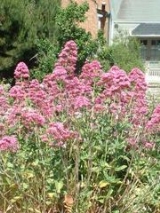
A
perennial plant or simply
perennial (Latin
per, "through",
annus, "year") is a
plantPlants are living organisms belonging to the kingdom Plantae. Precise definitions of the kingdom vary, but as the term is used here, plants include familiar organisms such as trees, flowers, herbs, bushes, grasses, vines, ferns, mosses, and green algae. The group is also called green plants or...
that lives for more than two years. The term is often used to differentiate a plant from shorter lived
annualsAn annual plant is a plant that usually germinates, flowers, and dies in a year or season. True annuals will only live longer than a year if they are prevented from setting seed...
and
biennialsA biennial plant is a flowering plant that takes two years to complete its biological lifecycle. In the first year the plant grows leaves, stems, and roots , then it enters a period of dormancy over the colder months. Usually the stem remains very short and the leaves are low to the ground, forming...
. The term is sometimes misused by commercial gardeners or horticulturalists to describe only
herbaceousA herbaceous plant is a plant that has leaves and stems that die down at the end of the growing season to the soil level. They have no persistent woody stem above ground...
perennials. More correctly,
woody plantA woody plant is a plant that uses wood as its structural tissue. These are typically perennial plants whose stems and larger roots are reinforced with wood produced adjacent to the vascular tissues. The main stem, larger branches, and roots of these plants are usually covered by a layer of...
s like
shrubA shrub or bush is distinguished from a tree by its multiple stems and shorter height, usually under 5–6 m tall. A large number of plants may become either shrubs or trees, depending on the growing conditions they experience...
s and
treeA tree is a perennial woody plant. It is most often defined as a woody plant that has many secondary branches supported clear of the ground on a single main stem or trunk with clear apical dominance. A minimum height specification at maturity is cited by some authors, varying from 3 m to...
s are also perennials.
Perennials, especially small
flowering plantThe flowering plants , also known as Angiospermae or Magnoliophyta, are the most diverse group of land plants. Angiosperms are seed-producing plants like the gymnosperms and can be distinguished from the gymnosperms by a series of synapomorphies...
s, grow and bloom over the spring and summer and then die back every autumn and winter, then return in the spring from their root-stock rather than seeding themselves as an
annual plantAn annual plant is a plant that usually germinates, flowers, and dies in a year or season. True annuals will only live longer than a year if they are prevented from setting seed...
does. These are known as
herbaceous perennials. However, depending on the rigors of local climate, a plant that is a perennial in its native habitat, or in a milder garden, may be treated by a gardener as an annual and planted out every year, from seed, from cuttings or from divisions.
The symbol for a perennial plant, based on
Species PlantarumSpecies Plantarum was first published in 1753, as a two-volume work by Carl Linnaeus. Its prime importance is perhaps that it is the primary starting point of plant nomenclature as it exists today. This means that the first names to be considered validly published in botany are those that appear...
by Linnaeus, is
, which is also the astronomical symbol for the planet
JupiterJupiter is the fifth planet from the Sun and the largest planet within the Solar System. It is a gas giant with mass one-thousandth that of the Sun but is two and a half times the mass of all the other planets in our Solar System combined. Jupiter is classified as a gas giant along with Saturn,...
.
Life cycle
Perennial plants can be short-lived (only a few years) or they can be long-lived, as are some woody plants like trees which can live for over 4,000 years. They can vary in height from only a few millimeters to over 100 meters tall. They include a wide assortment of plant groups from
fernA fern is any one of a group of about 12,000 species of plants belonging to the botanical group known as Pteridophyta. Unlike mosses, they have xylem and phloem . They have stems, leaves, and roots like other vascular plants...
s and
liverwortsThe Marchantiophyta are a division of bryophyte plants commonly referred to as hepatics or liverworts. Like other bryophytes, they have a gametophyte-dominant life cycle, in which cells of the plant carry only a single set of genetic information....
to the highly diverse flowering plants like orchids and
grassGrasses, or more technically graminoids, are monocotyledonous, usually herbaceous plants with narrow leaves growing from the base. They include the "true grasses", of the Poaceae family, as well as the sedges and the rushes . The true grasses include cereals, bamboo and the grasses of lawns ...
es.
Plants that flower and fruit only once and then die are termed
monocarpicMonocarpic plants are those that flower, set seeds and then die. Other terms with the same meaning are hapaxanth and semelparous. The term was first used by Alphonse de Candolle....
or semelparous. However, most perennials are
polycarpicPolycarpic plants are those that flower and set seeds many times before dying....
, flowering over many seasons in their lifetime.
Structure
Perennials typically grow structures that allow them to adapt to living from one year to the next through a form of
vegetative reproductionVegetative reproduction is a form of asexual reproduction in plants. It is a process by which new individuals arise without production of seeds or spores...
rather than seeding. These structures include
bulbA bulb is a short stem with fleshy leaves or leaf bases. The leaves often function as food storage organs during dormancy.A bulb's leaf bases, known as scales, generally do not support leaves, but contain food reserves to enable the plant to survive adverse conditions. At the center of the bulb is...
s,
tuberTubers are various types of modified plant structures that are enlarged to store nutrients. They are used by plants to survive the winter or dry months and provide energy and nutrients for regrowth during the next growing season and they are a means of asexual reproduction...
s, woody crowns,
rhizomeIn botany and dendrology, a rhizome is a characteristically horizontal stem of a plant that is usually found underground, often sending out roots and shoots from its nodes...
s plus others. They might have specialized
stemA stem is one of two main structural axes of a vascular plant. The stem is normally divided into nodes and internodes, the nodes hold buds which grow into one or more leaves, inflorescence , conifer cones, roots, other stems etc. The internodes distance one node from another...
s or
crownThe crown of a plant refers to the totality of the plant's aboveground parts, including stems, leaves, and reproductive structures. A plant canopy consists of one or more plant crowns growing in a given area....
s that allow them to survive periods of
dormancyDormancy is a period in an organism's life cycle when growth, development, and physical activity are temporarily stopped. This minimizes metabolic activity and therefore helps an organism to conserve energy. Dormancy tends to be closely associated with environmental conditions...
over cold or dry seasons during the year.
AnnualAn annual plant is a plant that usually germinates, flowers, and dies in a year or season. True annuals will only live longer than a year if they are prevented from setting seed...
s produce seeds to continue the species as a new generation while the growing season is suitable, and the seeds survive over the cold or dry period to begin growth when the conditions are again suitable.
Many perennials, in contrast, have specialized to survive under extreme environmental conditions: some have adapted to survive hot and dry conditions, or to survive under cold temperatures. Those plants tend to invest a lot of resource into their adaptations and often do not flower and set seed until after a few years of growth. Many perennials produce relatively large seeds, which can have an advantage, with larger
seedlingthumb|Monocot and dicot seedlingsA seedling is a young plant sporophyte developing out of a plant embryo from a seed. Seedling development starts with germination of the seed. A typical young seedling consists of three main parts: the radicle , the hypocotyl , and the cotyledons...
s produced after
germinationGermination is the process in which a plant or fungus emerges from a seed or spore, respectively, and begins growth. The most common example of germination is the sprouting of a seedling from a seed of an angiosperm or gymnosperm. However the growth of a sporeling from a spore, for example the...
that can better compete with other plants or more quickly develop leaves for
photosynthesisPhotosynthesis is a chemical process that converts carbon dioxide into organic compounds, especially sugars, using the energy from sunlight. Photosynthesis occurs in plants, algae, and many species of bacteria, but not in archaea. Photosynthetic organisms are called photoautotrophs, since they can...
. Annuals tend to produce many more seeds per plant since they will die at the end of the
growing seasonIn botany, horticulture, and agriculture the growing season is the period of each year when native plants and ornamental plants grow; and when crops can be grown....
, while perennials are not under the same pressure to produce large numbers of seeds but can produce seeds over many years.
Growth
In warmer and more favorable
climateClimate encompasses the statistics of temperature, humidity, atmospheric pressure, wind, rainfall, atmospheric particle count and other meteorological elemental measurements in a given region over long periods...
s, perennials grow continuously. In seasonal climates, their growth is limited to the growing season. For example, in temperate regions a perennial plant may grow and bloom during the warm part of the year, with the foliage dying back in the winter. These plants are
deciduousDeciduous means "falling off at maturity" or "tending to fall off", and is typically used in reference to trees or shrubs that lose their leaves seasonally, and to the shedding of other plant structures such as petals after flowering or fruit when ripe...
perennials. Regrowth is from existing stem tissue. In many parts of the world, seasonality is expressed as wet and dry periods rather than warm and cold periods. In some species, perennials retain their foliage all year round; these are
evergreenIn botany, an evergreen plant is a plant that has leaves in all seasons. This contrasts with deciduous plants, which completely lose their foliage during the winter or dry season.There are many different kinds of evergreen plants, both trees and shrubs...
perennials.
With their roots protected below ground in the soil layer, perennial plants are notably tolerant of
wildfireA wildfire is any uncontrolled fire in combustible vegetation that occurs in the countryside or a wilderness area. Other names such as brush fire, bushfire, forest fire, desert fire, grass fire, hill fire, squirrel fire, vegetation fire, veldfire, and wilkjjofire may be used to describe the same...
.
HerbaceousA herbaceous plant is a plant that has leaves and stems that die down at the end of the growing season to the soil level. They have no persistent woody stem above ground...
perennials are also able to tolerate the extremes of cold in temperate and
ArcticThe Arctic is a region located at the northern-most part of the Earth. The Arctic consists of the Arctic Ocean and parts of Canada, Russia, Greenland, the United States, Norway, Sweden, Finland, and Iceland. The Arctic region consists of a vast, ice-covered ocean, surrounded by treeless permafrost...
winters, with less sensitivity than trees or shrubs.
Knowing the planting zone can be very useful when you are planning your garden and flower bed areas. Gardeners should compare their garden climates with the climate where a plant is known to grow well. Most plants are marked with a zone number which corresponds with a region on a map where that plant will survive. While a range of zones might be listed, the lower of the zone numbers indicates the lowest recommended zone in which that plant can survive. It is possible that a plant might thrive outside a labeled zone area.
Benefits in agriculture
Although most of humanity is fed by seeds from
annualAn annual plant is a plant that usually germinates, flowers, and dies in a year or season. True annuals will only live longer than a year if they are prevented from setting seed...
grain crops, perennial crops provide numerous benefits. Perennial plants often have deep, extensive root systems which can hold soil to prevent
erosionErosion is when materials are removed from the surface and changed into something else. It only works by hydraulic actions and transport of solids in the natural environment, and leads to the deposition of these materials elsewhere...
, capture dissolved
nitrogenNitrogen is a chemical element that has the symbol N, atomic number of 7 and atomic mass 14.00674 u. Elemental nitrogen is a colorless, odorless, tasteless, and mostly inert diatomic gas at standard conditions, constituting 78.08% by volume of Earth's atmosphere...
before it can contaminate ground and surface water, and outcompete weeds (reducing the need for
herbicideHerbicides, also commonly known as weedkillers, are pesticides used to kill unwanted plants. Selective herbicides kill specific targets while leaving the desired crop relatively unharmed. Some of these act by interfering with the growth of the weed and are often synthetic "imitations" of plant...
s). These potential benefits of perennials have resulted in new attempts to increase the seed yield of perennial species, which could result in the creation of new perennial grain crops. Some examples of new perennial crops being developed are
perennial ricePerennial rice are varieties of long-lived rice that are capable of regrowing season after season without reseeding; they are being developed by plant geneticists at several institutions...
and intermediate wheatgrass.
Location
Perennial plants dominate many natural
ecosystemAn ecosystem is a biological environment consisting of all the organisms living in a particular area, as well as all the nonliving , physical components of the environment with which the organisms interact, such as air, soil, water and sunlight....
s on land and in fresh water, with only a very few (e.g.
ZosteraZostera is a small genus of widely distributed seagrass, commonly called marine eelgrass or simply eelgrass . The genus Zostera contains sixteen species.-Ecology:Zostera is found on sandy substrates or in estuaries submerged or partially floating...
) occurring in shallow sea water.
HerbaceousA herbaceous plant is a plant that has leaves and stems that die down at the end of the growing season to the soil level. They have no persistent woody stem above ground...
perennial plants are particularly dominant in conditions too fire-prone for trees and shrubs, e.g., most plants on
prairiePrairies are considered part of the temperate grasslands, savannas, and shrublands biome by ecologists, based on similar temperate climates, moderate rainfall, and grasses, herbs, and shrubs, rather than trees, as the dominant vegetation type...
s and
steppeIn physical geography, steppe is an ecoregion, in the montane grasslands and shrublands and temperate grasslands, savannas, and shrublands biomes, characterized by grassland plains without trees apart from those near rivers and lakes...
s are perennials; they are also dominant on
tundraIn physical geography, tundra is a biome where the tree growth is hindered by low temperatures and short growing seasons. The term tundra comes through Russian тундра from the Kildin Sami word tūndâr "uplands," "treeless mountain tract." There are three types of tundra: Arctic tundra, alpine...
too cold for tree growth. Nearly all
forestA forest, also referred to as a wood or the woods, is an area with a high density of trees. As with cities, depending where you are in the world, what is considered a forest may vary significantly in size and have various classification according to how and what of the forest is composed...
plants are perennials, including the trees and shrubs.
Perennial plants are usually better competitors than annual plants, especially under stable, resource-poor conditions. This is due to the development of larger
rootIn vascular plants, the root is the organ of a plant that typically lies below the surface of the soil. This is not always the case, however, since a root can also be aerial or aerating . Furthermore, a stem normally occurring below ground is not exceptional either...
systems which can access water and soil nutrients deeper in the soil and to earlier emergence in the spring.
Types
- Examples of evergreen
In botany, an evergreen plant is a plant that has leaves in all seasons. This contrasts with deciduous plants, which completely lose their foliage during the winter or dry season.There are many different kinds of evergreen plants, both trees and shrubs...
perennials include BegoniaBegonia is a genus in the flowering plant family Begoniaceae and is a perennial. The only other members of the family Begoniaceae are Hillebrandia, a genus with a single species in the Hawaiian Islands, and the genus Symbegonia which more recently was included in Begonia...
and bananaBanana is the common name for herbaceous plants of the genus Musa and for the fruit they produce. Bananas come in a variety of sizes and colors when ripe, including yellow, purple, and red....
.
- Examples of deciduous
Deciduous means "falling off at maturity" or "tending to fall off", and is typically used in reference to trees or shrubs that lose their leaves seasonally, and to the shedding of other plant structures such as petals after flowering or fruit when ripe...
perennials include goldenrodSolidago, commonly called goldenrods, is a genus of about 100 species of flowering plants in the family Asteraceae. Most are herbaceous perennial species found in the meadows and pastures, along roads, ditches and waste areas in North America. There are also a few species native to Mexico, South...
and mintMentha is a genus of flowering plants in the family Lamiaceae . The species are not clearly distinct and estimates of the number of species varies from 13 to 18. Hybridization between some of the species occurs naturally...
.
- Examples of monocarpic
Monocarpic plants are those that flower, set seeds and then die. Other terms with the same meaning are hapaxanth and semelparous. The term was first used by Alphonse de Candolle....
perennials include AgaveAgave is a genus of monocots. The plants are perennial, but each rosette flowers once and then dies ; they are commonly known as the century plant....
and some species of StreptocarpusStreptocarpus is a genus of herbaceous flowering plants in the family Gesneriaceae, closely related to the genus Saintpaulia. One common name is Cape Primrose, referring to the nativity of several species to South Africa and their superficial resemblance to the genus Primula...
.
- Examples of woody
A woody plant is a plant that uses wood as its structural tissue. These are typically perennial plants whose stems and larger roots are reinforced with wood produced adjacent to the vascular tissues. The main stem, larger branches, and roots of these plants are usually covered by a layer of...
perennials include mapleAcer is a genus of trees or shrubs commonly known as maple.Maples are variously classified in a family of their own, the Aceraceae, or together with the Hippocastanaceae included in the family Sapindaceae. Modern classifications, including the Angiosperm Phylogeny Group system, favour inclusion in...
, pinePines are trees in the genus Pinus ,in the family Pinaceae. They make up the monotypic subfamily Pinoideae. There are about 115 species of pine, although different authorities accept between 105 and 125 species.-Etymology:...
, and appleThe apple is the pomaceous fruit of the apple tree, species Malus domestica in the rose family . It is one of the most widely cultivated tree fruits, and the most widely known of the many members of genus Malus that are used by humans. Apple grow on small, deciduous trees that blossom in the spring...
trees.
- Examples of herbaceous
A herbaceous plant is a plant that has leaves and stems that die down at the end of the growing season to the soil level. They have no persistent woody stem above ground...
perennials used in agriculture include alfalfaAlfalfa is a flowering plant in the pea family Fabaceae cultivated as an important forage crop in the US, Canada, Argentina, France, Australia, the Middle East, South Africa, and many other countries. It is known as lucerne in the UK, France, Australia, South Africa and New Zealand, and known as...
, Thinopyrum intermediumThinopyrum intermedium is a sod-forming perennial grass. It is part of a group of plants commonly called wheatgrass because of the similarity of their seed heads or 'ears' to common wheat...
, and Red cloverTrifolium pratense is a species of clover, native to Europe, Western Asia and northwest Africa, but planted and naturalised in many other regions....
.
Perennial fruits
- Apple
The apple is the pomaceous fruit of the apple tree, species Malus domestica in the rose family . It is one of the most widely cultivated tree fruits, and the most widely known of the many members of genus Malus that are used by humans. Apple grow on small, deciduous trees that blossom in the spring...
- Apricot
The apricot, Prunus armeniaca, is a species of Prunus, classified with the plum in the subgenus Prunus. The native range is somewhat uncertain due to its extensive prehistoric cultivation.- Description :...
- Avocado
The avocado is a tree native to Central Mexico, classified in the flowering plant family Lauraceae along with cinnamon, camphor and bay laurel...
- Banana
Banana is the common name for herbaceous plants of the genus Musa and for the fruit they produce. Bananas come in a variety of sizes and colors when ripe, including yellow, purple, and red....
- Technically a herb.
- Blackcurrant
Blackcurrant, Ribes nigrum, is a species of Ribes berry native to central and northern Europe and northern Asia, and is a perennial....
- Blueberry
Blueberries are flowering plants of the genus Vaccinium with dark-blue berries and are perennial...
- Currant
Ribes is a genus of about 150 species of flowering plants native throughout the temperate regions of the Northern Hemisphere. It is usually treated as the only genus in the family Grossulariaceae. Seven subgenera are recognized....
- Feijoa
Acca sellowiana, a species of flowering plant in the myrtle family, Myrtaceae, is native to the highlands of southern Brazil, Colombia, Uruguay, and northern Argentina. It is widely cultivated as a garden plant and fruiting tree in New Zealand, and can be found as a garden plant in Australia and...
- Grape
A grape is a non-climacteric fruit, specifically a berry, that grows on the perennial and deciduous woody vines of the genus Vitis. Grapes can be eaten raw or they can be used for making jam, juice, jelly, vinegar, wine, grape seed extracts, raisins, molasses and grape seed oil. Grapes are also...
- Kiwi Fruit
- Japanese Wineberry
Rubus phoenicolasius is a species of raspberry native to northern China, Japan, and Korea. The species was introduced to Europe and North America as an ornamental plant and for its potential in breeding hybrid raspberries...
- Pear
The pear is any of several tree species of genus Pyrus and also the name of the pomaceous fruit of these trees. Several species of pear are valued by humans for their edible fruit, but the fruit of other species is small, hard, and astringent....
- Persimmon
A persimmon is the edible fruit of a number of species of trees in the genus Diospyros in the ebony wood family . The word Diospyros means "the fire of Zeus" in ancient Greek. As a tree, it is a perennial plant...
- Pineapple
Pineapple is the common name for a tropical plant and its edible fruit, which is actually a multiple fruit consisting of coalesced berries. It was given the name pineapple due to its resemblance to a pine cone. The pineapple is by far the most economically important plant in the Bromeliaceae...
- Plum
A plum or gage is a stone fruit tree in the genus Prunus, subgenus Prunus. The subgenus is distinguished from other subgenera in the shoots having a terminal bud and solitary side buds , the flowers in groups of one to five together on short stems, and the fruit having a groove running down one...
- Raspberries
Raspberry may refer to:* Raspberry, various fruit-bearing plants in the genus Rubus, especially two commercially grown species, the red-fruited Rubus idaeus and the black-fruited Rubus occidentalis...
- Strawberry
Fragaria is a genus of flowering plants in the rose family, Rosaceae, commonly known as strawberries for their edible fruits. Although it is commonly thought that strawberries get their name from straw being used as a mulch in cultivating the plants, the etymology of the word is uncertain. There...
- Strawberry Tree
Perennial herbs
- Agastache
Agastache, is a genus of 9–12 species of perennial herbs in the family Lamiaceae, native to eastern Asia and North America ....
- Alfalfa
Alfalfa is a flowering plant in the pea family Fabaceae cultivated as an important forage crop in the US, Canada, Argentina, France, Australia, the Middle East, South Africa, and many other countries. It is known as lucerne in the UK, France, Australia, South Africa and New Zealand, and known as...
- Basil, many varieties: African Blue, East Indian
Basil, or Sweet Basil, is a common name for the culinary herb Ocimum basilicum , of the family Lamiaceae , sometimes known as Saint Joseph's Wort in some English-speaking countries....
- Chives
Chives are the smallest species of the edible onions. A perennial plant, they are native to Europe, Asia and North America.. Allium schoenoprasum is the only species of Allium native to both the New and the Old World....
- Dill
Dill is a perennial herb. It is the sole species of the genus Anethum, though classified by some botanists in a related genus as Peucedanum graveolens C.B.Clarke.-Growth:...
- Fennel
Fennel is a plant species in the genus Foeniculum . It is a member of the family Apiaceae . It is a hardy, perennial, umbelliferous herb, with yellow flowers and feathery leaves...
- Ferula
Ferula is a genus of about 170 species of flowering plants in the family Apiaceae, native to the Mediterranean region east to central Asia, mostly growing in arid climates. They are herbaceous perennial plants growing to 1–4 m tall, with stout, hollow, somewhat succulent stems...
- Garlic
Allium sativum, commonly known as garlic, is a species in the onion genus, Allium. Its close relatives include the onion, shallot, leek, chive, and rakkyo. Dating back over 6,000 years, garlic is native to central Asia, and has long been a staple in the Mediterranean region, as well as a frequent...
- Ginger
Ginger is the rhizome of the plant Zingiber officinale, consumed as a delicacy, medicine, or spice. It lends its name to its genus and family . Other notable members of this plant family are turmeric, cardamom, and galangal....
- Hops
Hops are the female flower clusters , of a hop species, Humulus lupulus. They are used primarily as a flavoring and stability agent in beer, to which they impart a bitter, tangy flavor, though hops are also used for various purposes in other beverages and herbal medicine...
-Humulus
- Horseradish
Horseradish is a perennial plant of the Brassicaceae family, which also includes mustard, wasabi, broccoli, and cabbages. The plant is probably native to south eastern Europe and the Arab World , but is popular around the world today...
- Lavender
The lavenders are a genus of 39 species of flowering plants in the mint family, Lamiaceae. An Old World genus, distributed from Macaronesia across Africa, the Mediterranean, South-West Asia, Arabia, Western Iran and South-East India...
- Lemon Balm
Lemon balm , not to be confused with bee balm, Monarda species, is a perennial herb in the mint family Lamiaceae, native to southern Europe and the Mediterranean region....
- Mint
Mentha is a genus of flowering plants in the family Lamiaceae . The species are not clearly distinct and estimates of the number of species varies from 13 to 18. Hybridization between some of the species occurs naturally...
- Onions, many varieties: Potato onions, Shallots, Egyptian onions, Japanese bunching onions, Welsh onions, Chinese leeks
- Oregano
Oregano – scientifically named Origanum vulgare by Carolus Linnaeus – is a common species of Origanum, a genus of the mint family . It is native to warm-temperate western and southwestern Eurasia and the Mediterranean region.Oregano is a perennial herb, growing from 20–80 cm tall,...
- Piper nigrum (black pepper)
- Rosemary
Rosemary, , is a woody, perennial herb with fragrant, evergreen, needle-like leaves and white, pink, purple or blue flowers, native to the Mediterranean region. It is a member of the mint family Lamiaceae, which includes many other herbs, and is one of two species in the genus Rosmarinus...
- Sage
- Thyme
Thyme is a culinary and medicinal herb of the genus Thymus.-History:Ancient Egyptians used thyme for embalming. The ancient Greeks used it in their baths and burnt it as incense in their temples, believing it was a source of courage...
- Valerian
Valerian is a hardy perennial flowering plant, with heads of sweetly scented pink or white flowers which bloom in the summer months. Valerian flower extracts were used as a perfume in the sixteenth century....
- White Horehound -Marrubium vulgare
Marrubium vulgare is a flowering plant in the family Lamiaceae, native to Europe, northern Africa and Asia....
- Yarrow (Achillea millefolium)
Perennial vegetables
- Allium tricoccum: commonly known as ramps, spring onion, ramson, wild leek, or ail des bois
- Asparagus
Asparagus officinalis is a spring vegetable, a flowering perennialplant species in the genus Asparagus. It was once classified in the lily family, like its Allium cousins, onions and garlic, but the Liliaceae have been split and the onion-like plants are now in the family Amaryllidaceae and...
- Broccoli: Nine Star
Broccoli is a plant in the cabbage family, whose large flower head is used as a vegetable.-General:The word broccoli, from the Italian plural of , refers to "the flowering top of a cabbage"....
- Chicory
Common chicory, Cichorium intybus, is a somewhat woody, perennial herbaceous plant usually with bright blue flowers, rarely white or pink. Various varieties are cultivated for salad leaves, chicons , or for roots , which are baked, ground, and used as a coffee substitute and additive. It is also...
- Chives
Chives are the smallest species of the edible onions. A perennial plant, they are native to Europe, Asia and North America.. Allium schoenoprasum is the only species of Allium native to both the New and the Old World....
- Colocasia esculenta
Colocasia esculenta is a tropical plant grown primarily for its edible corms, the root vegetables whose many names include Taro and Eddoe. It is believed to be one of the earliest cultivated plants.-Description:Rhizomes of different shapes and sizes...
- Eggplant
- Globe artichoke
The globe artichoke is a perennial thistle of the Cynara genus originating in Southern Europe around the Mediterranean. It grows to tall, with arching, deeply lobed, silvery, glaucous-green leaves long. The flowers develop in a large head from an edible bud about diameter with numerous...
- Ground Nut (Apios americana)
Apios americana, sometimes called the potato bean, hopniss, Indian potato or groundnut is a perennial vine native to eastern North America, and bears edible beans and large edible tubers. It grows to 3–4 m long, with pinnate leaves 8–15 cm long with 5–7 leaflets...
- Hog nut
- Jerusalem Artichoke
The Jerusalem artichoke , also called the sunroot, sunchoke, earth apple or topinambour, is a species of sunflower native to eastern North America, and found from Eastern Canada and Maine west to North Dakota, and south to northern Florida and Texas...
- Konjac
Konjac , also known as konjak, konjaku, konnyaku potato, devil's tongue, voodoo lily, snake palm, or elephant yam , is a plant of the genus Amorphophallus...
- Lamb's quarter
- Leek
The leek, Allium ampeloprasum var. porrum , also sometimes known as Allium porrum, is a vegetable which belongs, along with the onion and garlic, to family Amaryllidaceae, subfamily Allioideae...
- Milkweed (Asclepias)
- Okra
Okra is a flowering plant in the mallow family. It is valued for its edible green seed pods. The geographical origin of okra is disputed, with supporters of South Asian, Ethiopian and West African origins...
- Potato
The potato is a starchy, tuberous crop from the perennial Solanum tuberosum of the Solanaceae family . The word potato may refer to the plant itself as well as the edible tuber. In the region of the Andes, there are some other closely related cultivated potato species...
- Radicchio or a.k.a. Italian Chicory
Radicchio is a leaf chicory , sometimes known as Italian chicory and is a perennial. It is grown as a leaf vegetable which usually has white-veined red leaves. It has a bitter and spicy taste, which mellows when it is grilled or roasted.- History :Humans have been using radicchio since ancient times...
- Rhubarb
Rhubarb is a group of plants that belong to the genus Rheum in the family Polygonaceae. They are herbaceous perennial plants growing from short, thick rhizomes. They have large leaves that are somewhat triangular-shaped with long fleshy petioles...
- Shallot
The shallot is the botanical variety of Allium cepa to which the multiplier onion also belongs. It was formerly classified as the species A. ascalonicum, a name now considered a synonym of the correct name...
- Siberian Pea Tree (Caragana arborescens)
Caragana arborescens, or Caragana or Siberian peashrub, is a species of legume. It is a perennial shrub growing to heights of 12 feet or more. Typically, it has a moderate to fast growth rate, being able to grow one to three feet during the first year after trimming. The plant is native to Siberia...
- Sorrel
Common sorrel or garden sorrel , often simply called sorrel, is a perennial herb that is cultivated as a garden herb or leaf vegetable...
- Rakkyo
- Sea Kale
- Spinach varieties: Ceylon Spinach, Sissoo Spinach, New Zealand Spinach
Spinach is an edible flowering plant in the family of Amaranthaceae. It is native to central and southwestern Asia. It is an annual plant , which grows to a height of up to 30 cm. Spinach may survive over winter in temperate regions...
- Sweet potato
The sweet potato is a dicotyledonous plant that belongs to the family Convolvulaceae. Its large, starchy, sweet-tasting, tuberous roots are an important root vegetable. The young leaves and shoots are sometimes eaten as greens. Of the approximately 50 genera and more than 1,000 species of...
- Taro
Taro is a common name for the corms and tubers of several plants in the family Araceae . Of these, Colocasia esculenta is the most widely cultivated, and is the subject of this article. More specifically, this article describes the 'dasheen' form of taro; another variety is called eddoe.Taro is...
- Watercress
Watercresses are fast-growing, aquatic or semi-aquatic, perennial plants native from Europe to central Asia, and one of the oldest known leaf vegetables consumed by human beings...
See also
- Annual plant
An annual plant is a plant that usually germinates, flowers, and dies in a year or season. True annuals will only live longer than a year if they are prevented from setting seed...
- Biennial plant
A biennial plant is a flowering plant that takes two years to complete its biological lifecycle. In the first year the plant grows leaves, stems, and roots , then it enters a period of dormancy over the colder months. Usually the stem remains very short and the leaves are low to the ground, forming...
- Herbchronology
Herbchronology is the analysis of annual growth rings in the secondary root xylem of perennial herbaceous plants. While leaves and stems of perennial herbs die down at the end of the growing season the root often persists for many years or even the entire life...
- Herbaceous
A herbaceous plant is a plant that has leaves and stems that die down at the end of the growing season to the soil level. They have no persistent woody stem above ground...
- Perennial grain
While many fruit, nut and forage crops are long-lived perennial plants, all major grain crops are annuals or short-lived perennials grown as annuals. Scientists from several nations have argued that perennial versions of today's grain crops could be developed and that these perennial grains could...
External links