

Convallaria

Encyclopedia
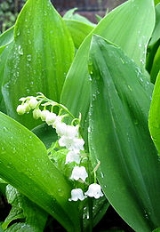
Convallaria majalis commonly known as the lily-of-the-valley, is a poisonous woodland flowering plant
native throughout the cool temperate Northern Hemisphere
in Asia
and Europe
.
It is possibly the only species in the genus Convallaria (or one of two or three, if C. keiskei and C. transcaucasica are recognised as separate species). In the APG III system
, the genus is placed in the family
Asparagaceae
, subfamily Nolinoideae (formerly the family Ruscaceae). It was formerly placed in its own family Convallariaceae, or earlier, like many lilioid monocot
s, in the lily family Liliaceae
.
A limited native population occurs in Eastern USA (Convallaria majalis var. montana). There is, however, some debate as to the native status of the American variety.
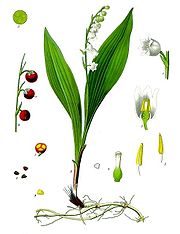 C. majalis is a herbaceous
perennial plant that forms extensive colonies by spreading underground stem
s called rhizome
s. New upright shoots are formed at the ends of stolon
s in summer, these upright dormant stems are often called pips. These grow in the spring into new leafy shoots that still remain connected to the other shoots under ground, often forming extensive colonies. The stems grow to 15–30 cm tall, with one or two leaves
10–25 cm long, flowering stems have two leaves and a raceme
of 5–15 flower
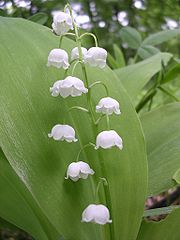
s on the stem apex. The flowers are white tepal
s (rarely pink), bell-shaped, 5–10 mm diameter, and sweetly scented; flowering is in late spring, in mild winters in the Northern Hemisphere it is in early March. The fruit
is a small orange-red berry
5–7 mm diameter that contains a few large whitish to brownish colored seeds that dry to a clear translucent round bead 1–3 mm wide. Plants are self-sterile, and colonies consisting of a single clone do not set seed.
Convallaria transcaucasica is recognised as a distinct species by some authorities, while the species formerly called Convallaria japonica is now classified as Ophiopogon japonicus.
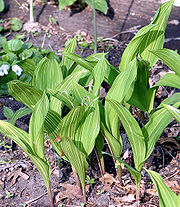 Convallaria majalis is a popular garden
plant, grown for its scented flowers and for its ground-covering abilities in shady locations. Some consider it a weed
, as it can spread over a wide area in gardens and can be difficult to contain or remove.
Various kinds and cultivar
s are grown, including those with double flowers, rose-colored flowers, variegated foliage and ones that grow larger than the typical species.
Traditionally Convallaria majalis has been grown in pots and winter forced to provide flowers during the winter months, both for as potted plants and as cut flowers.
All parts of the plant are poisonous and the red berries may be attractive to children; if eaten even in small amounts, the plant can cause abdominal pain, vomiting, and a reduced heart rate.
e of some Lepidoptera
species including the Grey Chi
.
 The flower is also known as Our Lady's tears, since, according to Christian legend, the lily of the valley came into being from Eve's tears after she was driven with Adam from the Garden of Eden
, although this seems unlikely, since in Catholic parlance, "Our Lady" refers to the Virgin Mary. Another Christian legend states that Mary's tears turned to lily of the valley when she cried at the crucifixion of Jesus
, and because of this it is also known as Mary's tears. According to another legend, lilies of the valley also sprang from the blood of Saint Leonard of Noblac during his battles with a dragon.
The name "lily of the valley" is also used in some English translations of the Bible
in Song of Songs
2:1, although whether or not the Hebrew
word "shoshana" (usually denoting a rose
) originally used there refers to this species is uncertain.
It is a symbol of humility in religious painting. Lily of the valley is considered the sign of Christ's second coming. The power of men to envision a better world was also attributed to the lily of the valley.
The sweet fragrance and whiteness of the flowers symbolize the humility and purity of its patron goddess
Its scientific name, majalis or maialis, means "of or belonging to May", and old astrological books place the plant under the dominion of Mercury
, since Maia
, the daughter of Atlas
, was the mother of Mercury or Hermes
.
In the "language of flowers
", the lily of the valley signifies the return of happiness. Legend tells of the affection of a lily of the valley for a nightingale that did not come back to the woods until the flower bloomed in May.
Lily of the valley was the floral emblem
of Yugoslavia and it also became the national flower of Finland
in 1967.
The Norwegian municipality Lunner
has a lily of the valley in its coat-of-arms. It is the official flower of Alpha Delta Phi
fraternity, Pi Kappa Alpha
fraternity, Kappa Sigma fraternity, Delta Omicron
fraternity, Alpha Epsilon Phi
sorority, and Alpha Phi
sorority. It is also the official flower of Job's Daughters International
.
s (cardenolides) have been found in the plant, some among others:
The plant also contains saponin
s. Although deadly, the plant has been used as a folk remedy in moderate amounts, and is currently used by herbalists as a restricted herbal remedy. If the plant is touched or handled, hands should be washed before doing anything else.
includes the poisonous effects of Lily of the Valley as a significant plot point during the final two episodes of the season as it is the flower that Walter White used to poison Brock Cantillo. Lily of the Valley poisoning symptoms are described as flu-like and are compared to those from ricin
poisoning.
Flowering plant
The flowering plants , also known as Angiospermae or Magnoliophyta, are the most diverse group of land plants. Angiosperms are seed-producing plants like the gymnosperms and can be distinguished from the gymnosperms by a series of synapomorphies...
native throughout the cool temperate Northern Hemisphere
Northern Hemisphere
The Northern Hemisphere is the half of a planet that is north of its equator—the word hemisphere literally means “half sphere”. It is also that half of the celestial sphere north of the celestial equator...
in Asia
Asia
Asia is the world's largest and most populous continent, located primarily in the eastern and northern hemispheres. It covers 8.7% of the Earth's total surface area and with approximately 3.879 billion people, it hosts 60% of the world's current human population...
and Europe
Europe
Europe is, by convention, one of the world's seven continents. Comprising the westernmost peninsula of Eurasia, Europe is generally 'divided' from Asia to its east by the watershed divides of the Ural and Caucasus Mountains, the Ural River, the Caspian and Black Seas, and the waterways connecting...
.
It is possibly the only species in the genus Convallaria (or one of two or three, if C. keiskei and C. transcaucasica are recognised as separate species). In the APG III system
APG III system
The APG III system of flowering plant classification is the third version of a modern, mostly molecular-based, system of plant taxonomy...
, the genus is placed in the family
Family (biology)
In biological classification, family is* a taxonomic rank. Other well-known ranks are life, domain, kingdom, phylum, class, order, genus, and species, with family fitting between order and genus. As for the other well-known ranks, there is the option of an immediately lower rank, indicated by the...
Asparagaceae
Asparagaceae
Asparagaceae is the botanical name of a family of flowering plants, placed in the order Asparagales of the monocots.In earlier classification systems, the species involved were often treated as belonging to the family Liliaceae...
, subfamily Nolinoideae (formerly the family Ruscaceae). It was formerly placed in its own family Convallariaceae, or earlier, like many lilioid monocot
Lilioid monocot
Lilioid monocots or lilioids is an informal name used for a grade of five monocot orders in which the majority of species have flowers with relatively large, coloured tepals, broadly similar to those of lilies...
s, in the lily family Liliaceae
Liliaceae
The Liliaceae, or the lily family, is a family of monocotyledons in the order Liliales. Plants in this family have linear leaves, mostly with parallel veins but with several having net venation , and flower arranged in threes. Several have bulbs, while others have rhizomes...
.
A limited native population occurs in Eastern USA (Convallaria majalis var. montana). There is, however, some debate as to the native status of the American variety.
Description
Herbaceous
A herbaceous plant is a plant that has leaves and stems that die down at the end of the growing season to the soil level. They have no persistent woody stem above ground...
perennial plant that forms extensive colonies by spreading underground stem
Plant stem
A stem is one of two main structural axes of a vascular plant. The stem is normally divided into nodes and internodes, the nodes hold buds which grow into one or more leaves, inflorescence , conifer cones, roots, other stems etc. The internodes distance one node from another...
s called rhizome
Rhizome
In botany and dendrology, a rhizome is a characteristically horizontal stem of a plant that is usually found underground, often sending out roots and shoots from its nodes...
s. New upright shoots are formed at the ends of stolon
Stolon
In biology, stolons are horizontal connections between organisms. They may be part of the organism, or of its skeleton; typically, animal stolons are external skeletons.-In botany:...
s in summer, these upright dormant stems are often called pips. These grow in the spring into new leafy shoots that still remain connected to the other shoots under ground, often forming extensive colonies. The stems grow to 15–30 cm tall, with one or two leaves
Leaf
A leaf is an organ of a vascular plant, as defined in botanical terms, and in particular in plant morphology. Foliage is a mass noun that refers to leaves as a feature of plants....
10–25 cm long, flowering stems have two leaves and a raceme
Raceme
A raceme is a type of inflorescence that is unbranched and indeterminate and bears pedicellate flowers — flowers having short floral stalks called pedicels — along the axis. In botany, axis means a shoot, in this case one bearing the flowers. In a raceme, the oldest flowers are borne...
of 5–15 flower
Flower
A flower, sometimes known as a bloom or blossom, is the reproductive structure found in flowering plants . The biological function of a flower is to effect reproduction, usually by providing a mechanism for the union of sperm with eggs...
s on the stem apex. The flowers are white tepal
Tepal
Tepals are elements of the perianth, or outer part of a flower, which include the petals or sepals. The term tepal is more often applied specifically when all segments of the perianth are of similar shape and color, or undifferentiated, which is called perigone...
s (rarely pink), bell-shaped, 5–10 mm diameter, and sweetly scented; flowering is in late spring, in mild winters in the Northern Hemisphere it is in early March. The fruit
Fruit
In broad terms, a fruit is a structure of a plant that contains its seeds.The term has different meanings dependent on context. In non-technical usage, such as food preparation, fruit normally means the fleshy seed-associated structures of certain plants that are sweet and edible in the raw state,...
is a small orange-red berry
Berry
The botanical definition of a berry is a fleshy fruit produced from a single ovary. Grapes are an example. The berry is the most common type of fleshy fruit in which the entire ovary wall ripens into an edible pericarp. They may have one or more carpels with a thin covering and fleshy interiors....
5–7 mm diameter that contains a few large whitish to brownish colored seeds that dry to a clear translucent round bead 1–3 mm wide. Plants are self-sterile, and colonies consisting of a single clone do not set seed.
Taxonomy
There are three varieties that have sometimes been separated out as distinct species or subspecies by some botanists.- Convallaria majalis var. keiskei - from China and Japan, with red fruit and bowl-shaped flowers (now widely cited as Convallaria keiskei)
- C. majalis var. majalis - from Eurasia, with white midribs on the flowers
- C. majalis var. montana - from the USA, with green-tinted midribs on the flowers
Convallaria transcaucasica is recognised as a distinct species by some authorities, while the species formerly called Convallaria japonica is now classified as Ophiopogon japonicus.
Garden use
Garden
A garden is a planned space, usually outdoors, set aside for the display, cultivation, and enjoyment of plants and other forms of nature. The garden can incorporate both natural and man-made materials. The most common form today is known as a residential garden, but the term garden has...
plant, grown for its scented flowers and for its ground-covering abilities in shady locations. Some consider it a weed
Weed
A weed in a general sense is a plant that is considered by the user of the term to be a nuisance, and normally applied to unwanted plants in human-controlled settings, especially farm fields and gardens, but also lawns, parks, woods, and other areas. More specifically, the term is often used to...
, as it can spread over a wide area in gardens and can be difficult to contain or remove.
Various kinds and cultivar
Cultivar
A cultivar'Cultivar has two meanings as explained under Formal definition. When used in reference to a taxon, the word does not apply to an individual plant but to all those plants sharing the unique characteristics that define the cultivar. is a plant or group of plants selected for desirable...
s are grown, including those with double flowers, rose-colored flowers, variegated foliage and ones that grow larger than the typical species.
- C. majalis 'Albostriata' has white-striped leaves
- C. majalis 'Green Tapestry', 'Haldon Grange', 'Hardwick Hall', 'Hofheim', 'Marcel', 'Variegata' and 'Vic Pawlowski's Gold' are other variegated cultivars
- C. majalis 'Berlin Giant' and C. majalis 'Géant de Fortin' (syn. 'Fortin's Giant') are larger-growing cultivars
- C. majalis 'Flore Pleno' has double flowers.
- C. majalis 'Rosea' sometimes found under the name C. majalis var. rosea, has pink flowers.
Traditionally Convallaria majalis has been grown in pots and winter forced to provide flowers during the winter months, both for as potted plants and as cut flowers.
All parts of the plant are poisonous and the red berries may be attractive to children; if eaten even in small amounts, the plant can cause abdominal pain, vomiting, and a reduced heart rate.
Foodplant for insect larvae
Lily of the valley is used as a food plant by the larvaLarva
A larva is a distinct juvenile form many animals undergo before metamorphosis into adults. Animals with indirect development such as insects, amphibians, or cnidarians typically have a larval phase of their life cycle...
e of some Lepidoptera
Lepidoptera
Lepidoptera is a large order of insects that includes moths and butterflies . It is one of the most widespread and widely recognizable insect orders in the world, encompassing moths and the three superfamilies of butterflies, skipper butterflies, and moth-butterflies...
species including the Grey Chi
Grey Chi
The Grey Chi is a moth of the family Noctuidae. It is distributed throughout Europe. Although it is not present in southern Spain and Greece, as well as northern Fennoscandia...
.
Christian legend
Garden of Eden
The Garden of Eden is in the Bible's Book of Genesis as being the place where the first man, Adam, and his wife, Eve, lived after they were created by God. Literally, the Bible speaks about a garden in Eden...
, although this seems unlikely, since in Catholic parlance, "Our Lady" refers to the Virgin Mary. Another Christian legend states that Mary's tears turned to lily of the valley when she cried at the crucifixion of Jesus
Crucifixion of Jesus
The crucifixion of Jesus and his ensuing death is an event that occurred during the 1st century AD. Jesus, who Christians believe is the Son of God as well as the Messiah, was arrested, tried, and sentenced by Pontius Pilate to be scourged, and finally executed on a cross...
, and because of this it is also known as Mary's tears. According to another legend, lilies of the valley also sprang from the blood of Saint Leonard of Noblac during his battles with a dragon.
The name "lily of the valley" is also used in some English translations of the Bible
Bible
The Bible refers to any one of the collections of the primary religious texts of Judaism and Christianity. There is no common version of the Bible, as the individual books , their contents and their order vary among denominations...
in Song of Songs
Song of songs
Song of Songs, also known as the Song of Solomon, is a book of the Hebrew Bible or Old Testament. It may also refer to:In music:* Song of songs , the debut album by David and the Giants* A generic term for medleysPlays...
2:1, although whether or not the Hebrew
Hebrew language
Hebrew is a Semitic language of the Afroasiatic language family. Culturally, is it considered by Jews and other religious groups as the language of the Jewish people, though other Jewish languages had originated among diaspora Jews, and the Hebrew language is also used by non-Jewish groups, such...
word "shoshana" (usually denoting a rose
Rose
A rose is a woody perennial of the genus Rosa, within the family Rosaceae. There are over 100 species. They form a group of erect shrubs, and climbing or trailing plants, with stems that are often armed with sharp prickles. Flowers are large and showy, in colours ranging from white through yellows...
) originally used there refers to this species is uncertain.
It is a symbol of humility in religious painting. Lily of the valley is considered the sign of Christ's second coming. The power of men to envision a better world was also attributed to the lily of the valley.
Norse mythology
In Norse mythology lilies are associated with the virgin goddess of spring Ostara. The lily symbolizes life to Pagans and the blooming of lily of the valley flower heralds the feast of Ostara.The sweet fragrance and whiteness of the flowers symbolize the humility and purity of its patron goddess
Other names and legends
Other names include May lily, May bells, lily constancy, ladder-to-heaven, male lily, and muguet (French).Its scientific name, majalis or maialis, means "of or belonging to May", and old astrological books place the plant under the dominion of Mercury
Mercury (mythology)
Mercury was a messenger who wore winged sandals, and a god of trade, the son of Maia Maiestas and Jupiter in Roman mythology. His name is related to the Latin word merx , mercari , and merces...
, since Maia
Maia (mythology)
In Greek mythology, Maia is one of the Pleiades and the mother of Hermes. The goddess known as Maia among the Romans may have originated independently, but attracted the myths of Greek Maia because the two figures shared the same name.-Birth:...
, the daughter of Atlas
Atlas (mythology)
In Greek mythology, Atlas was the primordial Titan who supported the heavens. Although associated with various places, he became commonly identified with the Atlas Mountains in north-west Africa...
, was the mother of Mercury or Hermes
Hermes
Hermes is the great messenger of the gods in Greek mythology and a guide to the Underworld. Hermes was born on Mount Kyllini in Arcadia. An Olympian god, he is also the patron of boundaries and of the travelers who cross them, of shepherds and cowherds, of the cunning of thieves, of orators and...
.
In the "language of flowers
Language of flowers
The language of flowers, sometimes called floriography, was a Victorian-era means of communication in which various flowers and floral arrangements were used to send coded messages, allowing individuals to express feelings which otherwise could not be spoken...
", the lily of the valley signifies the return of happiness. Legend tells of the affection of a lily of the valley for a nightingale that did not come back to the woods until the flower bloomed in May.
Symbolic uses
Traditionally, lily of the valley is sold in the streets of France on May 1.Lily of the valley was the floral emblem
Floral emblem
In a number of countries, plants have been chosen as symbols to represent specific geographic areas. Some countries have a country-wide floral emblem; others in addition have symbols representing subdivisions. Different processes have been used to adopt these symbols - some are conferred by...
of Yugoslavia and it also became the national flower of Finland
Finland
Finland , officially the Republic of Finland, is a Nordic country situated in the Fennoscandian region of Northern Europe. It is bordered by Sweden in the west, Norway in the north and Russia in the east, while Estonia lies to its south across the Gulf of Finland.Around 5.4 million people reside...
in 1967.
The Norwegian municipality Lunner
Lunner
Lunner is a municipality in Oppland county, Norway. It is part of the traditional region of Hadeland. The administrative centre of the municipality is the village of Roa...
has a lily of the valley in its coat-of-arms. It is the official flower of Alpha Delta Phi
Alpha Delta Phi
Alpha Delta Phi is a Greek-letter social college fraternity and the fourth-oldest continuous Greek-letter fraternity in the United States and Canada. Alpha Delta Phi was founded on October 29, 1832 by Samuel Eells at Hamilton College and includes former U.S. Presidents, Chief Justices of the U.S....
fraternity, Pi Kappa Alpha
Pi Kappa Alpha
Pi Kappa Alpha is a Greek social fraternity with over 230 chapters and colonies and over 250,000 lifetime initiates in the United States and Canada.-History:...
fraternity, Kappa Sigma fraternity, Delta Omicron
Delta Omicron
Delta Omicron is a co-ed international professional music honors fraternity whose mission is to promote and support excellence in music and musicianship.-History:...
fraternity, Alpha Epsilon Phi
Alpha Epsilon Phi
Alpha Epsilon Phi is a sorority and member of the National Panhellenic Conference. It was founded on October 24, 1909 at Barnard College in New York City by seven Jewish women; Helen Phillips Lipman, Ida Beck Carlin, Rose Gerstein Smolin, Augustina "Tina" Hess Solomon, Lee Reiss Liebert, Rose...
sorority, and Alpha Phi
Alpha Phi
Alpha Phi International Women's Fraternity was founded at Syracuse University on September 18, 1872. Alpha Phi currently has 152 active chapters and over 200,000 initiated members. Its celebrated Founders' Day is October 10. It was the third Greek-letter organization founded for women. In Alpha...
sorority. It is also the official flower of Job's Daughters International
Job's Daughters International
Job's Daughters International is a Masonic-sponsored youth organization for girls and young women aged 10 to 20. The organization is commonly referred to as simply Job's Daughters, and sometimes abbreviated as JDI...
.
Toxicity
All parts, including the berries, of the lily of the valley are highly poisonous. Roughly 38 different cardiac glycosideCardiac glycoside
Cardiac glycosides are drugs used in the treatment of congestive heart failure and cardiac arrhythmia. These glycosides are found as secondary metabolites in several plants, but also in some animals, such as the milkweed butterflies. -Function:...
s (cardenolides) have been found in the plant, some among others:
- convallarinConvallarinConvallarin is a crystalline glucoside extracted from Convallaria majalisIt may be obtained from the alcoholic extract of the residue from which the convallamarin has been removed with water. The alcoholic solution is treated with lead acetate, the filtrate freed from lead by hydrogen sulfide, and...
- convallamarinConvallamarinConvallamarin is a crystalline glucoside extracted from Convallaria majalis...
- convallatoxinConvallatoxinConvallatoxin is a glycoside extracted from Convallaria majalis....
- convallotoxoloside
- convallosid
- neoconvallosideNeoconvallosideNeoconvalloside is a cardenolide glycoside extracted from Convallaria majalis....
- glucoconvalloside
- majaloside
- convallatoxon
- corglycon
- cannogenol-3-O-α-L-rhamnoside
- cannogenol-3-O-β-D-allomethyloside
- cannogenol-3-O-6-deoxy-β-D-allosido-β-D-glucosideGlucosideA glucoside is a glycoside that is derived from glucose. Glucosides are common in plants, but rare in animals. Glucose is produced when a glucoside is hydrolysed by purely chemical means, or decomposed by fermentation or enzymes....
, - cannogenol-3-O-6-deoxy-β-D-allosido-α-L-rhamnoside,
- strophanthidinStrophanthidink-Strophanthidin is a cardenolide found in species of the genus Strophanthus. It is the aglycone of k-strophanthin, an analogue of ouabain. k-strophanthin is found in the ripe seeds of Strophanthus kombé....
-3-O-6-deoxy-β-D-allosido-α-L-rhamnoside, - strophanthidin-3-O-6-deoxy-β-D-allosido-α-L-arabinoside,
- strophanthidin-3-O-α-L-rhamnosido-2-β-D-glucoside,
- sarmentogenin-3-O-6-deoxy-β-D-allosido-α-L-rhamnoside
- sarmentogenin-3-O-6-deoxy-β-D-guloside
- 19-hydroxy-sarmentogenin-3-O-α-L-rhamnoside,
- 19-hydroxy-sarmentogenin
- arabinosido-6-deoxyallose
- lokundjoside
The plant also contains saponin
Saponin
Saponins are a class of chemical compounds, one of many secondary metabolites found in natural sources, with saponins found in particular abundance in various plant species...
s. Although deadly, the plant has been used as a folk remedy in moderate amounts, and is currently used by herbalists as a restricted herbal remedy. If the plant is touched or handled, hands should be washed before doing anything else.
In popular culture
Season 4 of the AMC television series Breaking BadBreaking Bad
Breaking Bad is an American television drama series created and produced by Vince Gilligan. Set and produced in Albuquerque, New Mexico, Breaking Bad is the story of Walter White , a struggling high school chemistry teacher who is diagnosed with advanced lung cancer at the beginning of the series...
includes the poisonous effects of Lily of the Valley as a significant plot point during the final two episodes of the season as it is the flower that Walter White used to poison Brock Cantillo. Lily of the Valley poisoning symptoms are described as flu-like and are compared to those from ricin
Ricin
Ricin , from the castor oil plant Ricinus communis, is a highly toxic, naturally occurring protein. A dose as small as a few grains of salt can kill an adult. The LD50 of ricin is around 22 micrograms per kilogram Ricin , from the castor oil plant Ricinus communis, is a highly toxic, naturally...
poisoning.