
All Topics  
Arabidopsis

 
Arabidopsis

   Email Print
   Bookmark   Link


Arabidopsis


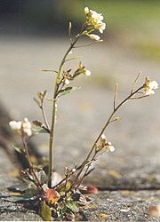
Arabidopsis (A-ra-bi-dóp-sis
Syllable stress of Botanical Latin

Syllable stress of botanical names varies with the language spoken by the person using the botanical name. In English-speaking countries the Botanical Latin places syllable stress for botanical names derived from ancient Greek and Latin broadly according to two systems, either the Reformed academic pronunciation, or the pronunciation develop...
, rockcress) is a genus in the family Brassicaceae
Brassicaceae

Brassicaceae or Cruciferae, also known as the crucifers, the mustard family or cabbage family is a Family of flowering plants ....
. They are small flowering plant
Flowering plant

The flowering plants or angiosperms are the most widespread group of Embryophytes. The flowering plants and the gymnosperms are the only extant groups of Spermatophyte....
s related to cabbage
Cabbage

The cabbage is a leafy garden plant of the Family Brassicaceae , used as a Leaf vegetable. It is a herbaceous, biennial plant, dicotyledonous flowering plant distinguished by a short stem upon which is crowded a mass of leaves, usually green but in some varieties red or purplish, forming a characteristic compact, globular cluster ....
 and mustard
Mustard plant

Mustards are several plant species in the genera Brassica and Sinapis whose small mustard seeds are used as a spice and, by grinding and mixing them with water, vinegar or other liquids, are turned into the condiment known as Mustard ....
. This genus is of great interest since it contains thale cress (Arabidopsis thaliana), one of the model organism
Model organism

A model organism is a species that is extensively studied to understand particular biology phenomena, with the expectation that discoveries made in the organism model will provide insight into the workings of other organisms....
s used for studying plant biology and the first plant to have its entire genome sequenced. Changes in thale cress are easily observed, making it a very useful model.

ently the genus Arabidopsis has nine species and a further eight subspecies recognised.


Discussion
Ask a question about 'Arabidopsis'
Start a new discussion about 'Arabidopsis'
Answer questions from other users
Full Discussion Forum


Recent Posts


Encyclopedia


Arabidopsis (A-ra-bi-dóp-sis
Syllable stress of Botanical Latin

Syllable stress of botanical names varies with the language spoken by the person using the botanical name. In English-speaking countries the Botanical Latin places syllable stress for botanical names derived from ancient Greek and Latin broadly according to two systems, either the Reformed academic pronunciation, or the pronunciation develop...
, rockcress) is a genus in the family Brassicaceae
Brassicaceae

Brassicaceae or Cruciferae, also known as the crucifers, the mustard family or cabbage family is a Family of flowering plants ....
. They are small flowering plant
Flowering plant

The flowering plants or angiosperms are the most widespread group of Embryophytes. The flowering plants and the gymnosperms are the only extant groups of Spermatophyte....
s related to cabbage
Cabbage

The cabbage is a leafy garden plant of the Family Brassicaceae , used as a Leaf vegetable. It is a herbaceous, biennial plant, dicotyledonous flowering plant distinguished by a short stem upon which is crowded a mass of leaves, usually green but in some varieties red or purplish, forming a characteristic compact, globular cluster ....
 and mustard
Mustard plant

Mustards are several plant species in the genera Brassica and Sinapis whose small mustard seeds are used as a spice and, by grinding and mixing them with water, vinegar or other liquids, are turned into the condiment known as Mustard ....
. This genus is of great interest since it contains thale cress (Arabidopsis thaliana), one of the model organism
Model organism

A model organism is a species that is extensively studied to understand particular biology phenomena, with the expectation that discoveries made in the organism model will provide insight into the workings of other organisms....
s used for studying plant biology and the first plant to have its entire genome sequenced. Changes in thale cress are easily observed, making it a very useful model.

Status

Currently the genus Arabidopsis has nine species and a further eight subspecies recognised. This delimitation is quite recent, and is based on morphological and molecular phylogenies by O'Kane & Al-Shehbaz (1997, 2003) and others.

Their findings confirm that the species formerly included in Arabidopsis made it polyphyletic. The most recent reclassification moves two species previously placed in Cardaminopsis and Hylandra
Hylandra

A cruciferous plant, a brassica related to oil seeds. Its origin is Swedish to Linnaeus "Hylandra ?. L?ve" ironically Arab, Swedish, and oil-based....
 and three species of Arabis
Arabis

'Arabis' is a genus of flowering plants, within the family Brassicaceae, subfamily Brassicoideae.Though traditionally recognized as a large genus with many Old World and New World members, more recent evaluations of the relationships among these species using genetic data suggest that there are two major groups within the old genus Ar...
 into Arabidopsis, but excludes 50 species that have been moved into the new genera Beringia, Crucihimalaya, Ianhedgea, Olimarabidopsis, and Pseudoarabidopsis.

All of the species in Arabidopsis are indigenous to Europe
Europe

Europe is, conventionally, one of the world's seven continents. Comprising the westernmost peninsula of Eurasia, Europe is generally divided from Asia to its east by the water divide of the Ural Mountains, the Ural , the Caspian Sea, and by the Caucasus Mountains to the southeast....
, while two of the species have broad ranges also extending into North America
North America

North America is the northern continent of the Americas, situated in the Earth's northern hemisphere and almost totally in the western hemisphere....
 and Asia
Asia

Asia is the world's largest and most populous continent. It covers 8.6% of the Earth's total surface area and, with over 4 billion people, it contains more than 60% of the world's current human population....
.

In the last two decades, Arabidopsis thaliana
Arabidopsis thaliana

Arabidopsis thaliana , is a small flowering plant native to Europe, Asia, and northwestern Africa. A spring annual with a relatively short life cycle, Arabidopsis is popular as a model organism in plant biology and genetics....
 has gained much interest from the scientific community as a model organism
Model organism

A model organism is a species that is extensively studied to understand particular biology phenomena, with the expectation that discoveries made in the organism model will provide insight into the workings of other organisms....
 for research in plant systematics. In Europe, the model organism resource centre for Arabidopsis germplasm
Germplasm

A germplasm is a collection of genetic resources for an organism. For plants, the germplasm may be stored as a seed collection or, for trees, in a nursery....
, bioinformatics
Bioinformatics

Bioinformatics is the application of information technology to the field of molecular biology. The term bioinformatics was coined by Paulien Hogeweg in 1978 for the study of informatic processes in biotic systems....
 and molecular biology
Molecular biology

Molecular biology is the study of biology at a molecule level. The field overlaps with other areas of biology and chemistry, particularly genetics and biochemistry....
 resources (including GeneChips) is the Nottingham Arabidopsis Stock Centre
Nottingham Arabidopsis Stock Centre

The Nottingham Arabidopsis Stock Centre provides seed and information resources to the International Arabidopsis Genome Project and the wider research community....
 – NASC
NASC

The acronym NASC can refer to:* North American Solar Challenge, a solar car race in the United States and Canada* Naval Air Systems Command , the command of the United States Navy which provides material support for naval aircraft and airborne weapons systems...
 whilst in North America similar services are provided by the Arabidopsis Biological Resource Center, (ABRC) based at the Ohio State University
Ohio State University

The Ohio State University is a public university research university in the state of Ohio. It was founded in 1870 as a land-grant university and is currently the List of largest United States universities by enrollment in the United States....
. The ordering systems for both stock centres are incorporated into The Arabidopsis Information Resource (TAIR) database, providing a unified resource for the Arabidopsis research community.

List of species and subspecies

  • Arabidopsis arenosa (L.) Lawalrée,
A. arenosa subsp. arenosa
Distribution: Europe: native in Austria, Belarus, Bosnia Herzegovina, Bulgaria, Croatia, Czech Republic, NE France, Germany, Hungary, N Italy, Latvia, Lithuania, Macedonia, Poland, Romania, Slovakia, Slovenia, Switzerland, Ukraine, and Yugoslavia; naturalized in Belgium, Denmark, Estonia, Finland, Netherlands, Norway, Russia and W Siberia, and Sweden; absent in Albania, Greece, C and S Italy, and Turkey.

A. arenosa subsp. borbasii
Distribution: E Belgium, Czech Republic, NE France, Germany, Hungary, Poland, Romania, Slovakia, Switzerland, Ukraine. Doubtfully occurring in Denmark.

  • Arabidopsis cebennensis (D.C.)
Distribution: SE France.

  • Arabidopsis croatica (Schott)
Distribution: Bosnia, Croatia.

  • Arabidopsis halleri (L.)
A. halleri subsp. halleri
Distribution: Austria, Croatia, Czech Republic, Germany, N and C Italy, Poland, Romania, Slovakia, Slovenia, Switzerland, and S Ukraine. Probably introduced in N France and extinct in Belgium.

A. halleri subsp. ovirensis (Wulfen)
Distribution: Albania, Austria, NE Italy, Romania, Slovakia, Slovenia, SW Ukraine, Yugoslavia.

A. halleri subsp. gemmifera (Matsumura)
Distribution: Russian Far East, northeastern China, Korea, Japan, and Taiwan.

  • Arabidopsis lyrata (L.) O'Kane & Al-Shehbaz
A. lyrata subsp. lyrata
Distribution: NE European Russia, Alaska, Canada (Ontario west into British Columbia), and southeastern and central United States (Vermont south into northern Georgia and Mississippi northward into Missouri and Minnesota).

A. lyrata subsp. petraea (Linnaeus) O'Kane & Al-Shehbaz
Distribution: Austria, Czech Republic, England, Germany, Hungary, Iceland, Ireland, N. Italy, Norway, Russia (NW Russia, Siberia and Far East), Scotland, Sweden, Ukraine, boreal North America (Alaska and Yukon). Apparently extinct in Poland.

A. lyrata subsp. kamchatica (Fischer ex D.C.) O'Kane & Al-Shehbaz
Distribution: boreal Alaska, Canada (Yukon, Mackenzie District, British Columbia, northern Saskatchewan), Aleutian Islands, eastern Siberia, the Russian Far East, Korea, northern China, Japan, and Taiwan.

  • Arabidopsis neglecta (Schultes)
Distribution: Carpathian Mountains (Poland, Romania, Slovakia, and adjacent Ukraine).

  • Arabidopsis pedemontana (Boiss.)
Distribution: northwestern Italy and, presumably extinct, in adjacent SW Switzerland.

  • Arabidopsis suecica (Fries) Norrlin, Meddel.
Distribution: Fennoscandinavia and the Baltic region.

  • Arabidopsis thaliana
    Arabidopsis thaliana

    Arabidopsis thaliana , is a small flowering plant native to Europe, Asia, and northwestern Africa. A spring annual with a relatively short life cycle, Arabidopsis is popular as a model organism in plant biology and genetics....
    (L.) Heynh.
Distribution: native range almost all Europe to central Asia, now naturalized worldwide.

Cytogenetics

Cytogenetic
Cytogenetics

Cytogenetics is a branch of genetics that is concerned with the study of the structure and function of the cell, especially the chromosomes. It includes routine analysis of G banding chromosomes, other cytogenetic banding techniques, as well as molecular cytogenetics such as fluorescent in situ hybridization and comparative genomic hybridiz...
 analysis has shown that the haploid chromosome
Chromosome

A chromosome is an organized structure of DNA and protein that is found in Cell . A chromosome is a single piece of DNA that contains many genes, regulatory sequence and other genetic sequence....
 number is variable and can be n = 5, 8, 13, and 16.

A. thaliana is n=5 and the DNA sequencing of this species was completed in 2001.

A. suecica is n=13 and is an amphidiploid
Polyploidy

Polyploidy occurs in biological cell and organisms when there are more than two Homologous Chromosomes sets of chromosomes.Polyploidy is a state different from most organisms which are normally diploid meaning they have only two sets of chromosomes - one set inherited from each parent; polyploidy may occur due to abnormal cell division....
 species originated through hybridization between
A. thaliana and diploid A. arenosa.

A. neglecta is n=8 as are the various subspecies of A. halleri.

Various subspecies of
A. lyrata and A. arenosa can be either n=8 (diploid) or n=16 (tetraploid).

As of 2005,
A. cebennensis, A. croatica and A. pedemontana have not been investigated cytologically.

Reclassified species

The following species previously placed in
Arabidopsis are not currently considered part of the genus.
  • A. bactriana =
  • A. brevicaulis = Crucihimalaya himalaica
  • A. bursifolia = Beringia bursifolia
  • A. campestris = Crucihimalaya wallichii
  • A. dentata = Murbeckiella pinnatifida
  • A. drassiana =
  • A. erysimoides = Erysimum hedgeanum
  • A. eseptata = Olimarabidopsis umbrosa
  • A. gamosepala = Neotorularia gamosepala
  • A. glauca = Thellungiella salsuginea
  • A. griffithiana = Olimarabidopsis pumila
  • A. himalaica = Crucihimalaya himalaica
  • A. huetii = Murbeckiella huetii
  • A. kneuckeri = Crucihimalaya kneuckeri
  • A. korshinskyi = Olimarabidopsis cabulica
  • A. lasiocarpa = Crucihimalaya lasiocarpa
  • A. minutiflora = Ianhedgea minutiflora
  • A. mollis = Beringia bursifolia
  • A. mollissima = Crucihimalaya mollissima
  • A. monachorum = Crucihimalaya lasiocarpa
  • A. mongolica = Crucihimalaya mongolica
  • A. multicaulis = Arabis tibetica
  • A. novae-anglicae = Neotorularia humilis
  • A. nuda = Drabopsis nuda
  • A. ovczinnikovii = Crucihimalaya mollissima
  • A. parvula = Thellungiella parvula
  • A. pinnatifida = Murbeckiella pinnatifida
  • A. pumila = Olimarabidopsis pumila
  • A. qiranica = Sisymbriopsis mollipila
  • A. richardsonii = Neotorularia humilis
  • A. russeliana = Crucihimalaya wallichii
  • A. salsuginea = Thellungiella salsuginea
  • A. sarbalica = Crucihimalaya wallichii
  • A. schimperi = Robeschia schimperi
  • A. stenocarpa = Beringia bursifolia
  • A. stewartiana = Olimarabidopsis pumila
  • A. stricta = Crucihimalaya stricta
  • A. taraxacifolia = Crucihimalaya wallichii
  • A. tenuisiliqua = Arabis tenuisiliqua
  • A. tibetica = Crucihimalaya himalaica
  • A. tibetica = Arabis tibetica
  • A. toxophylla = Pseudoarabidopsis toxophylla
  • A. trichocarpa = Neotorularia humilis
  • A. trichopoda = Beringia bursifolia
  • A. tschuktschorum = Beringia bursifolia
  • A. tuemurnica = Neotorularia humilis
  • A. verna = Drabopsis nuda
  • A. virgata = Beringia bursifolia
  • A. wallichii = Crucihimalaya wallichii
  • A. yadungensis =


Sources

  • O'Kane Jr, S. L., & Al-Shehbaz, I. A. (1997). A synopsis of Arabidopsis (Brassicaceae): Novon 7: 323–327.
  • Al-Shehbaz, I. A., O'Kane, Steve L. (2002). Taxonomy and Phylogeny of Arabidopsis (Brassicaceae). The Arabidopsis Book: 1-22. .
  • O'Kane Jr, S. L., & Al-Shehbaz, I. A. (2003). Phylogenetic position and generic limits of Arabidopsis (Brassicaceae) based on sequences of nuclear ribosomal DNA: Annals of the Missouri Botanical Garden 90 (4): 603-612