

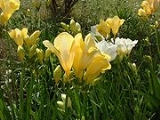
Freesia

Encyclopedia
Freesia Ecklon ex Klatt is a genus
of 14–16 species of flowering plant
s in the family Iridaceae
, native to Africa
. Of the 14 species, 12 are native to Cape Province
, South Africa
, the remaining two to tropical Africa, one species extending north of the equator to Sudan
.
The genus was named in honor of Friedrich Heinrich Theodor Freese (1795–1876), German physician.
They are herbaceous
plants which grow from a corm
1–2.5 cm diameter, which sends up a tuft of narrow leaves
10–30 cm long, and a sparsely branched stem 10–40 cm tall bearing a few leaves and a loose one-sided spike of fragrant narrowly funnel-shaped flower
s.
Species
Freesias are used as food plants by the larva
e of some Lepidoptera
species including Large Yellow Underwing
.
plants, grown for their often strongly scented flowers. The most commonly cultivated species is F. refracta, which was crossed with F. leichtlinii in the 19th century. Numerous cultivar
s have been bred from these species and the pink- and yellow-flowered forms of F. corymbosa. Modern tetraploid cultivars have flowers ranging from white to yellow, pink, red and blue-mauve. They are widely cultivated and readily increased from seed. Due to their specific and pleasing scent, they are often used in hand creams, shampoos, candles, etc.
Genus
In biology, a genus is a low-level taxonomic rank used in the biological classification of living and fossil organisms, which is an example of definition by genus and differentia...
of 14–16 species of flowering plant
Flowering plant
The flowering plants , also known as Angiospermae or Magnoliophyta, are the most diverse group of land plants. Angiosperms are seed-producing plants like the gymnosperms and can be distinguished from the gymnosperms by a series of synapomorphies...
s in the family Iridaceae
Iridaceae
The Iris family or Iridaceae is a family of perennial, herbaceous and bulbous plants included in the monocot order Asparagales, taking its name from the genus Iris. Almost worldwide in distribution and one of the most important families in horticulture, it includes more than 2000 species...
, native to Africa
Africa
Africa is the world's second largest and second most populous continent, after Asia. At about 30.2 million km² including adjacent islands, it covers 6% of the Earth's total surface area and 20.4% of the total land area...
. Of the 14 species, 12 are native to Cape Province
Cape Province
The Province of the Cape of Good Hope was a province in the Union of South Africa and subsequently the Republic of South Africa...
, South Africa
South Africa
The Republic of South Africa is a country in southern Africa. Located at the southern tip of Africa, it is divided into nine provinces, with of coastline on the Atlantic and Indian oceans...
, the remaining two to tropical Africa, one species extending north of the equator to Sudan
Sudan
Sudan , officially the Republic of the Sudan , is a country in North Africa, sometimes considered part of the Middle East politically. It is bordered by Egypt to the north, the Red Sea to the northeast, Eritrea and Ethiopia to the east, South Sudan to the south, the Central African Republic to the...
.
The genus was named in honor of Friedrich Heinrich Theodor Freese (1795–1876), German physician.
They are herbaceous
Herbaceous
A herbaceous plant is a plant that has leaves and stems that die down at the end of the growing season to the soil level. They have no persistent woody stem above ground...
plants which grow from a corm
Corm
A corm is a short, vertical, swollen underground plant stem that serves as a storage organ used by some plants to survive winter or other adverse conditions such as summer drought and heat ....
1–2.5 cm diameter, which sends up a tuft of narrow leaves
Leaf
A leaf is an organ of a vascular plant, as defined in botanical terms, and in particular in plant morphology. Foliage is a mass noun that refers to leaves as a feature of plants....
10–30 cm long, and a sparsely branched stem 10–40 cm tall bearing a few leaves and a loose one-sided spike of fragrant narrowly funnel-shaped flower
Flower
A flower, sometimes known as a bloom or blossom, is the reproductive structure found in flowering plants . The biological function of a flower is to effect reproduction, usually by providing a mechanism for the union of sperm with eggs...
s.
Species
- Freesia albaFreesia albaFreesia alba is a species of flowering plant in the iris family. It is native to South Africa, but this species and hybrids are known on other continents where they have been introduced. Freesia alba is a perennial herb growing from a corm and producing an erect, often branched stem up to 40...
- Freesia andersoniae
- Freesia caryophyllacea
- Freesia corymbosa
- Freesia fergusoniae
- Freesia fucata
- Freesia grandiflora
- Freesia laxaFreesia laxaFreesia laxa or False Freesia is an ornamental plant....
(syn. Anomatheca laxa, Lapeirousia laxa) - Freesia leichtlinii
- Freesia occidentalis
- Freesia refracta
- Freesia sparrmannii
- Freesia speciosa
- Freesia verrucosa
- Freesia viridis (syn. Anomatheca viridis)
Freesias are used as food plants by the larva
Larva
A larva is a distinct juvenile form many animals undergo before metamorphosis into adults. Animals with indirect development such as insects, amphibians, or cnidarians typically have a larval phase of their life cycle...
e of some Lepidoptera
Lepidoptera
Lepidoptera is a large order of insects that includes moths and butterflies . It is one of the most widespread and widely recognizable insect orders in the world, encompassing moths and the three superfamilies of butterflies, skipper butterflies, and moth-butterflies...
species including Large Yellow Underwing
Large Yellow Underwing
The Large Yellow Underwing is a moth, the type species for the family Noctuidae. It is an abundant species throughout Europe, one of the most common and most familiar moths of the region. In some years the species is highly migratory with large numbers appearing suddenly in marginal parts of the...
.
Cultivation and uses
Freesias are very popular gardenGarden
A garden is a planned space, usually outdoors, set aside for the display, cultivation, and enjoyment of plants and other forms of nature. The garden can incorporate both natural and man-made materials. The most common form today is known as a residential garden, but the term garden has...
plants, grown for their often strongly scented flowers. The most commonly cultivated species is F. refracta, which was crossed with F. leichtlinii in the 19th century. Numerous cultivar
Cultivar
A cultivar'Cultivar has two meanings as explained under Formal definition. When used in reference to a taxon, the word does not apply to an individual plant but to all those plants sharing the unique characteristics that define the cultivar. is a plant or group of plants selected for desirable...
s have been bred from these species and the pink- and yellow-flowered forms of F. corymbosa. Modern tetraploid cultivars have flowers ranging from white to yellow, pink, red and blue-mauve. They are widely cultivated and readily increased from seed. Due to their specific and pleasing scent, they are often used in hand creams, shampoos, candles, etc.