

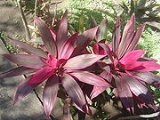
Cordyline

Overview
Genus
In biology, a genus is a low-level taxonomic rank used in the biological classification of living and fossil organisms, which is an example of definition by genus and differentia...
of about 15 species of woody monocotyledon
Monocotyledon
Monocotyledons, also known as monocots, are one of two major groups of flowering plants that are traditionally recognized, the other being dicotyledons, or dicots. Monocot seedlings typically have one cotyledon , in contrast to the two cotyledons typical of dicots...
ous flowering plant
Flowering plant
The flowering plants , also known as Angiospermae or Magnoliophyta, are the most diverse group of land plants. Angiosperms are seed-producing plants like the gymnosperms and can be distinguished from the gymnosperms by a series of synapomorphies...
s in family
Family (biology)
In biological classification, family is* a taxonomic rank. Other well-known ranks are life, domain, kingdom, phylum, class, order, genus, and species, with family fitting between order and genus. As for the other well-known ranks, there is the option of an immediately lower rank, indicated by the...
Asparagaceae
Asparagaceae
Asparagaceae is the botanical name of a family of flowering plants, placed in the order Asparagales of the monocots.In earlier classification systems, the species involved were often treated as belonging to the family Liliaceae...
, subfamily Lomandroideae
Lomandroideae
Lomandroideae is a subfamily of monocot flowering plants in the family Asparagaceae, order Asparagales, according to the APG III system of 2009. The subfamily name is derived from the generic name of the type genus, Lomandra. The group has previously been treated as a separate family Laxmanniaceae...
. The subfamily has previously been treated as a separate family Laxmanniaceae, or Lomandraceae. Other authors have placed the genus in the Agavaceae (now Agavoideae). Cordyline is native to the western Pacific Ocean
Pacific Ocean
The Pacific Ocean is the largest of the Earth's oceanic divisions. It extends from the Arctic in the north to the Southern Ocean in the south, bounded by Asia and Australia in the west, and the Americas in the east.At 165.2 million square kilometres in area, this largest division of the World...
region, from New Zealand
New Zealand
New Zealand is an island country in the south-western Pacific Ocean comprising two main landmasses and numerous smaller islands. The country is situated some east of Australia across the Tasman Sea, and roughly south of the Pacific island nations of New Caledonia, Fiji, and Tonga...
, eastern Australia
Australia
Australia , officially the Commonwealth of Australia, is a country in the Southern Hemisphere comprising the mainland of the Australian continent, the island of Tasmania, and numerous smaller islands in the Indian and Pacific Oceans. It is the world's sixth-largest country by total area...
, southeastern Asia
Asia
Asia is the world's largest and most populous continent, located primarily in the eastern and northern hemispheres. It covers 8.7% of the Earth's total surface area and with approximately 3.879 billion people, it hosts 60% of the world's current human population...
, Polynesia
Polynesia
Polynesia is a subregion of Oceania, made up of over 1,000 islands scattered over the central and southern Pacific Ocean. The indigenous people who inhabit the islands of Polynesia are termed Polynesians and they share many similar traits including language, culture and beliefs...
and Hawaii
Hawaii
Hawaii is the newest of the 50 U.S. states , and is the only U.S. state made up entirely of islands. It is the northernmost island group in Polynesia, occupying most of an archipelago in the central Pacific Ocean, southwest of the continental United States, southeast of Japan, and northeast of...
.
The name Cordyline comes from the Greek word kordyle, meaning "club," a reference to the enlarged underground stems or rhizome
Rhizome
In botany and dendrology, a rhizome is a characteristically horizontal stem of a plant that is usually found underground, often sending out roots and shoots from its nodes...
s.
- Cordyline australis (G.Forst.) Endl. – Cabbage Tree (New ZealandNew ZealandNew Zealand is an island country in the south-western Pacific Ocean comprising two main landmasses and numerous smaller islands. The country is situated some east of Australia across the Tasman Sea, and roughly south of the Pacific island nations of New Caledonia, Fiji, and Tonga...
) - Cordyline banksiiCordyline banksiiCordyline banksii is a monocot tree endemic to New Zealand. The species name banksii refers to the 18th-century botanist Joseph Banks.-Distribution:...
Hook.f. (New Zealand) - Cordyline cannifoliaCordyline cannifoliaCordyline cannifolia, is one of a several plants known as the Palm Lily. It is an evergreen Australian plant. A shrub to 5 metres tall though in other situations it may be fully grown at only 60 cm tall. Found only in Queensland and the Northern Territory in rainforests and wet eucalyptus forests...
R.Br. (Australia) - Cordyline congestaCordyline congestaCordyline congesta, commonly known as narrow-leaved palm lily is an evergreen Australian plant. A rare shrub to 3 metres tall found on the margins of rainforest, and in riverine scrub and moist gullies in eucalyptus forest...
(Sweet) Steud. (eastern Australia) - Cordyline dracaenoides Kunth
- Cordyline fruticosa (L.) A.Chev. (southeast Asia, Melanesia, northeastern Australia, the Indian Ocean, Polynesia)
- Cordyline haageana
- Cordyline indivisaCordyline indivisaCordyline indivisa is a monocot tree endemic to New Zealand, where it has the common name Mountain cabbage tree. It is also known as the Broad-leaved cabbage tree, or Tōī.-Distribution:...
(G.Forst.) Steud. – Mountain Cabbage Tree (New Zealand) - Cordyline manners-suttoniaeCordyline manners-suttoniaeCordyline manners-suttoniae, known as the Broad Leafed Palm Lily or Swamp Palm Lily is an evergreen Australian plant. A shrub to 5 metres tall. Found only in Queensland, in swampy places, often in rainforests....
F.Muell. (Queensland, Australia) - Cordyline murchisoniaeCordyline murchisoniaeCordyline murchisoniae, known as the Dwarf Palm Lily is an evergreen Australian plant. A shrub to 6 metres tall. The range of distribution is coastal Queensland rainforests....
F.Muell. (Queensland, Australia) - Cordyline obtectaCordyline obtectaCordyline obtecta is a widely branching monocot tree native to Norfolk Island , and to northern New Zealand...
(Graham) Baker (Norfolk IslandNorfolk IslandNorfolk Island is a small island in the Pacific Ocean located between Australia, New Zealand and New Caledonia. The island is part of the Commonwealth of Australia, but it enjoys a large degree of self-governance...
and northern New Zealand, syn.
