

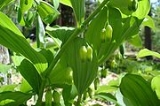
Polygonatum

Encyclopedia
Polygonatum King Solomon's-seal or Solomon's Seal, is a genus of about 50 species of flowering plant
s. In the APG III classification system
, it is placed in the family
Asparagaceae
, subfamily Nolinoideae (formerly the family Ruscaceae). It has also been classified in the former family Convallariaceae and, like many lilioid monocot
s, was formerly classified in the lily family Liliaceae
.
Some species of this genus are believed to have medicinal properties, and some (in particular P. sibiricum) are used as a tisane in Korea, which is called dungulle.
Some Polygonatum shoots are edible, cooked like asparagus, as are the roots - after appropriate treatment - being a good source of starch.
to broken bones. As a topical application, the root are said to expedite the healing
of cuts and bruises, skin irritation
s and inflammation
s, and as a face wash is good for acne
, blemish
es and all kinds of imperfections of the skin. Its use to fight diabetes was first observed in 1930 by Hedwig Langecker. After experiments, she concluded that it was effective in fighting nutritional hyperglycemia
, though not that caused by adrenaline release, probably due to its content in glucokinin.
Flowering plant
The flowering plants , also known as Angiospermae or Magnoliophyta, are the most diverse group of land plants. Angiosperms are seed-producing plants like the gymnosperms and can be distinguished from the gymnosperms by a series of synapomorphies...
s. In the APG III classification system
APG III system
The APG III system of flowering plant classification is the third version of a modern, mostly molecular-based, system of plant taxonomy...
, it is placed in the family
Family (biology)
In biological classification, family is* a taxonomic rank. Other well-known ranks are life, domain, kingdom, phylum, class, order, genus, and species, with family fitting between order and genus. As for the other well-known ranks, there is the option of an immediately lower rank, indicated by the...
Asparagaceae
Asparagaceae
Asparagaceae is the botanical name of a family of flowering plants, placed in the order Asparagales of the monocots.In earlier classification systems, the species involved were often treated as belonging to the family Liliaceae...
, subfamily Nolinoideae (formerly the family Ruscaceae). It has also been classified in the former family Convallariaceae and, like many lilioid monocot
Lilioid monocot
Lilioid monocots or lilioids is an informal name used for a grade of five monocot orders in which the majority of species have flowers with relatively large, coloured tepals, broadly similar to those of lilies...
s, was formerly classified in the lily family Liliaceae
Liliaceae
The Liliaceae, or the lily family, is a family of monocotyledons in the order Liliales. Plants in this family have linear leaves, mostly with parallel veins but with several having net venation , and flower arranged in threes. Several have bulbs, while others have rhizomes...
.
Some species of this genus are believed to have medicinal properties, and some (in particular P. sibiricum) are used as a tisane in Korea, which is called dungulle.
Some Polygonatum shoots are edible, cooked like asparagus, as are the roots - after appropriate treatment - being a good source of starch.
Traditional medicine
Traditionally, "Solomon's Seal" purportedly alleviates a range of afflictions from menopauseMenopause
Menopause is a term used to describe the permanent cessation of the primary functions of the human ovaries: the ripening and release of ova and the release of hormones that cause both the creation of the uterine lining and the subsequent shedding of the uterine lining...
to broken bones. As a topical application, the root are said to expedite the healing
Healing
Physiological healing is the restoration of damaged living tissue, organs and biological system to normal function. It is the process by which the cells in the body regenerate and repair to reduce the size of a damaged or necrotic area....
of cuts and bruises, skin irritation
Irritation
Irritation or exacerbation, in biology and physiology, is a state of inflammation or painful reaction to allergy or cell-lining damage. A stimulus or agent which induces the state of irritation is an irritant...
s and inflammation
Inflammation
Inflammation is part of the complex biological response of vascular tissues to harmful stimuli, such as pathogens, damaged cells, or irritants. Inflammation is a protective attempt by the organism to remove the injurious stimuli and to initiate the healing process...
s, and as a face wash is good for acne
Acne vulgaris
Acne vulgaris is a common human skin disease, characterized by areas of skin with seborrhea , comedones , papules , pustules , Nodules and possibly scarring...
, blemish
Blemish
Blemish may refer to:*A minor imperfection. For skin imperfection, see Acne vulgaris*Blemish a music album from David Sylvian released in 2003.*Blemish a Brazilian alternative rock band...
es and all kinds of imperfections of the skin. Its use to fight diabetes was first observed in 1930 by Hedwig Langecker. After experiments, she concluded that it was effective in fighting nutritional hyperglycemia
Hyperglycemia
Hyperglycemia or Hyperglycæmia, or high blood sugar, is a condition in which an excessive amount of glucose circulates in the blood plasma. This is generally a glucose level higher than 13.5mmol/l , but symptoms may not start to become noticeable until even higher values such as 15-20 mmol/l...
, though not that caused by adrenaline release, probably due to its content in glucokinin.
Selected species
| Genus & Species | Common Name | Native Range |
|---|---|---|
| Polygonatum biflorum Polygonatum biflorum Polygonatum biflorum is a species of the family Polygonatum native to eastern North America.-External links:*... |
Smooth or Great Solomon's Seal | Eastern North America |
| Polygonatum cirrhifolium | Tendril-leaf Solomon's Seal | Asia |
| Polygonatum cobrense | McKittrick's or Southwest Solomon's Seal | Southwestern U.S. |
| Polygonatum commutatum Polygonatum commutatum Polygonatum commutatum, Solomon's seal or Smooth Solomon's seal, is a widespread native plant of North America, located mainly from the eastern seaboard through the Great Plains. It is usually located in semi-shaded locations.... |
Solomon's Seal | Eastern North America |
| Polygonatum cyrtonema | Solomon's Seal | Eastern Asia |
| Polygonatum falcatum | Eastern Asia | |
| Polygonatum hirsutum | Broadleaf Solomon's Seal | Eastern North America |
| Polygonatum humile | Dwarf Solomon's Seal | Eastern Asia |
| Polygonatum inflatum | Eastern Asia | |
| Polygonatum involucratum | Asia | |
| Polygonatum kingianum | Solomon's Seal | Asia |
| Polygonatum lasianthum | Solomon's Seal | Eastern Asia |
| Polygonatum latifolium | Broadleaf Solomon's Seal | Europe |
| Polygonatum macropodum | Big Footed Solomon's Seal | Asia |
| Polygonatum maximowiczii | ||
| Polygonatum multiflorum Polygonatum multiflorum Polygonatum multiflorum is a plant species of the genus Polygonatum. In Britain it is one of three native species of the genus, the others being Angular Solomon's-seal and Whorled Solomon's-seal.-References:*Matthew Wood. Random House, 1997. ISBN 9781556432323; pp. 397–408... |
(Common) Solomon's Seal | Europe |
| Polygonatum odoratum Polygonatum odoratum Polygonatum odoratum, commonly known as Angular Solomon's-seal or Scented Solomon's-seal, is a plant species of the genus Polygonatum... |
Scented (or Angular) Solomon's Seal | Europe |
| Polygonatum orientale | Oriental Solomon's Seal | Western Asia, Eastern Europe |
| Polygonatum pubescens | Downy/Hairy Solomon's Seal | Eastern North America |
| Polygonatum sibiricum | Huang Jing, Siberian Solomon's Seal | Eastern Asia |
| Polygonatum stenanthum | Eastern Asia | |
| Polygonatum verticillatum Polygonatum verticillatum Polygonatum verticillatum or Whorled Solomon's-seal is a plant species of the genus Polygonatum.... |
Whorled Solomon's Seal | Europe |
| Polygonatum × hybridum Polygonatum × hybridum Polygonatum × hybridum is a hybrid cross between Common Solomon's-seal and Angular Solomon's-seal... |
Garden Solomon's Seal | Europe |