

Hypoxidaceae

Encyclopedia
Hypoxidaceae is the botanical name
of a family
of flowering plants, placed in the order
Asparagales
of the monocots.
The family has only recently been recognized by taxonomists. The APG III system
of 2009 (unchanged from the 1998
and 2003
versions) does recognize this family. The family consists of probably over half-a-dozen genera totalling some one hundred to two hundred species.
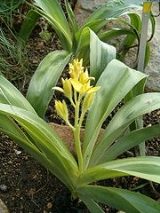
The members of the family are small to medium herbs, with grass-like leaves and an invisible stem, modified into a corm
or a rhizome
. The flowers are born on leafless shoots, also called scapes. The flowers are trimerous, radially symmetric. The ovary is inferior, developing into a capsule or a berry
.
Botanical name
A botanical name is a formal scientific name conforming to the International Code of Botanical Nomenclature and, if it concerns a plant cultigen, the additional cultivar and/or Group epithets must conform to the International Code of Nomenclature for Cultivated Plants...
of a family
Family (biology)
In biological classification, family is* a taxonomic rank. Other well-known ranks are life, domain, kingdom, phylum, class, order, genus, and species, with family fitting between order and genus. As for the other well-known ranks, there is the option of an immediately lower rank, indicated by the...
of flowering plants, placed in the order
Order (biology)
In scientific classification used in biology, the order is# a taxonomic rank used in the classification of organisms. Other well-known ranks are life, domain, kingdom, phylum, class, family, genus, and species, with order fitting in between class and family...
Asparagales
Asparagales
Asparagales is the name of an order of plants, used in modern classification systems such as the APG III system . The order takes its name from the family Asparagaceae and is placed in the monocots. The order has only recently been recognized in classification systems...
of the monocots.
The family has only recently been recognized by taxonomists. The APG III system
APG III system
The APG III system of flowering plant classification is the third version of a modern, mostly molecular-based, system of plant taxonomy...
of 2009 (unchanged from the 1998
APG system
The APG system of plant classification is the first, now obsolete, version of a modern, mostly molecular-based, system of plant taxonomy that was published in 1998 by the Angiosperm Phylogeny Group. It was superseded in 2003 by a revision, the APG II system, and then in 2009 by a further...
and 2003
APG II system
The APG II system of plant classification is the second, now obsolete, version of a modern, mostly molecular-based, system of plant taxonomy that was published in April 2003 by the Angiosperm Phylogeny Group. It was a revision of the first APG system, published in 1998, and was superseded in 2009...
versions) does recognize this family. The family consists of probably over half-a-dozen genera totalling some one hundred to two hundred species.
The members of the family are small to medium herbs, with grass-like leaves and an invisible stem, modified into a corm
Corm
A corm is a short, vertical, swollen underground plant stem that serves as a storage organ used by some plants to survive winter or other adverse conditions such as summer drought and heat ....
or a rhizome
Rhizome
In botany and dendrology, a rhizome is a characteristically horizontal stem of a plant that is usually found underground, often sending out roots and shoots from its nodes...
. The flowers are born on leafless shoots, also called scapes. The flowers are trimerous, radially symmetric. The ovary is inferior, developing into a capsule or a berry
Berry
The botanical definition of a berry is a fleshy fruit produced from a single ovary. Grapes are an example. The berry is the most common type of fleshy fruit in which the entire ovary wall ripens into an edible pericarp. They may have one or more carpels with a thin covering and fleshy interiors....
.
External links
- Hypoxidaceae in L. Watson and M.J. Dallwitz (1992 onwards). The families of flowering plants: descriptions, illustrations, identification, information retrieval. Version: 27 April 2006. http://delta-intkey.com
- NCBI Taxonomy Browser
- links at CSDL, Texas