

Jewish state

Encyclopedia
A homeland for the Jewish people was an idea that rose to the fore in the 19th century in the wake of growing anti-Semitism
and Jewish assimilation
. Jewish emancipation
in Europe paved the way for two ideological solutions to the Jewish Question
: cultural assimilation, as envisaged by Moses Mendelssohn
, and Zionism
, promoted by Theodore Herzl. In the late 19th century, Herzl set out his vision of a Jewish state
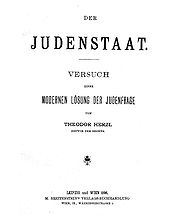
and homeland for the Jewish people in his book Der Judenstaat
. Herzl was later hailed as the founding father of the State of Israel. In the Balfour Declaration of 1917, the United Kingdom
became the first world power to endorse the establishment in Palestine
of a "national home for the Jewish people." The British government confirmed this commitment by accepting the British Mandate for Palestine in 1922. In 1948, the State of Israel was established as a Jewish state.
 Though the Jewish aspiration to return to Zion has been a part of Jewish religious thought for several millennia, the modern movement for the creation of a homeland for the Jewish people was largely perceived as a solution to the widespread persecution of Jews due to antisemitism in Europe.
The modern effort to establish a national homeland for the Jewish people began in 1839 with the petition by Sir Moses Montefiore to Sa'id
, Khedive of Egypt, for a Jewish homeland in the region of Palestine
.
and homeland for the Jewish people in his book Der Judenstaat
. He then proceeded to found the Zionist Organisation.
The draft of the objective of the modern Zionist movement submitted to the First Zionist Congress
of the Zionist Organization in 1897 read: "Zionism
seeks to establish a home for the Jewish people in Palestine
secured under public law." Numerous delegates sought to insert the phrase "by international law", which was opposed by others. A compromise formula was adopted, which came to be known as the Basel program, and read:
The Sykes–Picot Agreement of 16 May 1916 set aside the region of Palestine
for "international administration" under British control. The first official use of the phrase "national home for the Jewish people" was in the Balfour Declaration of 1917, the final version of which referred to:
The phrase "national home" was intentionally used instead of "state" because of opposition to the Zionist program within the British Cabinet. The initial draft of the declaration referred to the principle "that Palestine should be reconstituted as the National Home of the Jewish people." In the final text, the word that was replaced with in to avoid committing the entirety of Palestine to this purpose.
In 1919 the General Secretary (and future President) of the Zionist Organization, Nahum Sokolow, published a History of Zionism (1600-1918). He also represented the Zionist Organization at the Paris Peace Conference. He explained:
Britain officially committed itself to the objective set out in the Balfour Declaration by insisting on it forming the basis of the Mandate of Palestine (which it could have avoided), which was formally approved by the League of Nations
in June 1922, and which formalised British
rule in Palestine which had started in 1917. The preamble of the Mandate declared:
was considered until the possibility was denied by the Curtin
government. With the support of the then Premier of Tasmania, Robert Cosgrove
, Critchley Parker proposed a Jewish settlement at Port Davey, in south west Tasmania. Parker surveyed the area, but his death in 1942 put an end to the idea.
was adopted as the platform of the Zionist Organization, with an explicit call "that Palestine be established as a Jewish Commonwealth." In 1946, the Anglo-American Committee of Inquiry
, also known as the Grady-Morrison Committee, noted that the demand for a Jewish State went beyond the obligations of either the Balfour Declaration or the Mandate and had been expressly disowned by the Chairman of the Jewish Agency as recently as 1932.
The United Nations Special Committee on Palestine said the Jewish National Home, which derived from the formulation of Zionist aspirations in the 1897 Basle program has provoked many discussions concerning its meaning, scope and legal character, especially since it had no known legal connotation and there are no precedents in international law for its interpretation. It was used in the Balfour Declaration and in the Mandate, both of which promised the establishment of a "Jewish National Home" without, however, defining its meaning. A statement on "British Policy in Palestine," issued on 3 June 1922 by the Colonial Office, placed a restrictive construction upon the Balfour Declaration. The statement excluded "the disappearance or subordination of the Arabic population, language or customs in Palestine" or "the imposition of Jewish nationality upon the inhabitants of Palestine as a whole", and made it clear that in the eyes of the mandatory Power, the Jewish National Home was to be founded in Palestine and not that Palestine as a whole was to be converted into a Jewish National Home. The Committee noted that the construction, which restricted considerably the scope of the National Home, was made prior to the confirmation of the Mandate by the Council of the League of Nations and was formally accepted at the time by the Executive of the Zionist Organization.
for the Jewish people in the British Mandate of Palestine was enshrined in Israeli national policy and reflected in many of Israel's public and national institutions. The concept was expressed in the Declaration of the Establishment of the State of Israel
on 14 May 1948 and given concrete expression in the Law of Return
, passed by the Knesset
on 5 July 1950, which declared: "Every Jew has the right to come to this country as an oleh
." This was extended in 1970 to include non-Jews with a Jewish grandparent, and their spouses.
While nowadays the concept of a Jewish homeland means almost always the State of Israel under some variation of its current borders, in the course of Jewish history
after ancient Israel and Judah
there have been other proposals
. While some of those have come into existence, others never came to be implemented.
in schools, and enshrine certain laws of Kashrut
and Shabbat
observance. This debate reflects a historical divide within Zionism
and among the Jewish citizens of Israel, which has large secular
and traditional/Orthodox
minorities as well as a majority which lies somewhere in between.
Secular Zionism, the historically dominant stream, is rooted in a concept of the Jews as a people
that have a right to self-determination
. Another reason sometimes submitted for such establishment was to have a state where Jews would not be afraid of antisemitic attacks and live in peace. But such a reason is not a requirement of the self-determination right and so is subsidiary to it in secular Zionist thinking.
Religious Zionists
, who believe that religious beliefs and traditional practices are central to Jewish peoplehood
, counter that assimilating to be a secular "nation like any other" would be oxymoron
ic in nature, and harm more than help the Jewish people. They seek instead to establish what they see as an "authentic Jewish commonwealth" which preserves and encourages Jewish heritage.
Drawing an analogy to diaspora Jews
who assimilated
into other cultures and abandoned Jewish culture, whether voluntary or otherwise, they argue that the creation of a secular state in Israel is tantamount to establishing a state where Jews assimilate en masse as a nation, and therefore anathema to what they view as Jewish national aspirations. Zionism is rooted in a concept of the Jews as a nation
, in this capacity, they believe that Israel has a mandate to promote Judaism, to be the center of Jewish culture and center of its population, perhaps even the sole legitimate representative of Jews worldwide.
Partisans of the first view are predominantly, though by no means exclusively, secular or less traditional. Partisans of the second view are almost exclusively traditional or Orthodox, although they also include supporters who follow other streams of Judaism or are less traditional but conservative
and would not object to a more prominent state role in promoting Jewish beliefs — although not to the point of creating a purely Halachic state
.
The debate is therefore characterized by significant polarities. Secular and religious Zionists argue passionately about what a Jewish state should represent. Post-Zionists
and Zionists argue about whether a Jewish state should exist at all. Because Israel was created within the sphere of international law as the instrument for Jewish self-determination, these polarities are captured by the questions Should Israel maintain and strengthen its status as a state for the Jewish people, or become a state purely for "all of its citizens", or identify as both? And, if both, how to resolve any tensions that arise from their coexistence. To date, Israel has steered a course between secularism
and Jewish identity
, usually depending on who controls the Israeli High Court of Justice
.
On the 19 November 2008, Israeli Foreign Minister Tzipi Livni
addressed the United Jewish Communities
General Assembly in Jerusalem. In her speech, she announced: "These two goals of Israel as a Jewish and a democratic state
must coexist and not contradict each other. So, what does that mean, a Jewish state? It is not only a matter of the number of Jews who live in Israel. It is not just a matter of numbers but a matter of values. The Jewish state is a matter of values, but it is not just a matter of religion, it is also a matter of nationality. And a Jewish state is not a monopoly of rabbis. It is not. It is about the nature of the State of Israel. It is about Jewish tradition. It is about Jewish history, regardless of the question of what each and every Israeli citizen does in his own home on Saturdays and what he does on the Jewish holidays. We need to maintain the nature of the State of Israel, the character of the State of Israel, because this is the raison d'etre of the State of Israel."http://www.mfa.gov.il/MFA/Government/Speeches+by+Israeli+leaders/2008/Address_FM_Livni_UJC_GA_19-Nov-2008
Anti-Semitism
Antisemitism is suspicion of, hatred toward, or discrimination against Jews for reasons connected to their Jewish heritage. According to a 2005 U.S...
and Jewish assimilation
Jewish assimilation
Jewish assimilation refers to the cultural assimilation and social integration of Jews in their surrounding culture. Assimilation became legally possible in Europe during the Age of Enlightenment.-Background:Judaism forbids the worship of other gods...
. Jewish emancipation
Jewish Emancipation
Jewish emancipation was the external and internal process of freeing the Jewish people of Europe, including recognition of their rights as equal citizens, and the formal granting of citizenship as individuals; it occurred gradually between the late 18th century and the early 20th century...
in Europe paved the way for two ideological solutions to the Jewish Question
Jewish Question
The Jewish question encompasses the issues and resolutions surrounding the historically unequal civil, legal and national statuses between minority Ashkenazi Jews and non-Jews, particularly in Europe. The first issues discussed and debated by societies, politicians and writers in western and...
: cultural assimilation, as envisaged by Moses Mendelssohn
Moses Mendelssohn
Moses Mendelssohn was a German Jewish philosopher to whose ideas the renaissance of European Jews, Haskalah is indebted...
, and Zionism
Zionism
Zionism is a Jewish political movement that, in its broadest sense, has supported the self-determination of the Jewish people in a sovereign Jewish national homeland. Since the establishment of the State of Israel, the Zionist movement continues primarily to advocate on behalf of the Jewish state...
, promoted by Theodore Herzl. In the late 19th century, Herzl set out his vision of a Jewish state
Jewish state
A homeland for the Jewish people was an idea that rose to the fore in the 19th century in the wake of growing anti-Semitism and Jewish assimilation. Jewish emancipation in Europe paved the way for two ideological solutions to the Jewish Question: cultural assimilation, as envisaged by Moses...
and homeland for the Jewish people in his book Der Judenstaat
Der Judenstaat
Der Judenstaat is a book written by Theodor Herzl and published in 1896 in Leipzig and Vienna by M. Breitenstein's Verlags-Buchhandlung...
. Herzl was later hailed as the founding father of the State of Israel. In the Balfour Declaration of 1917, the United Kingdom
United Kingdom
The United Kingdom of Great Britain and Northern IrelandIn the United Kingdom and Dependencies, other languages have been officially recognised as legitimate autochthonous languages under the European Charter for Regional or Minority Languages...
became the first world power to endorse the establishment in Palestine
Palestine
Palestine is a conventional name, among others, used to describe the geographic region between the Mediterranean Sea and the Jordan River, and various adjoining lands....
of a "national home for the Jewish people." The British government confirmed this commitment by accepting the British Mandate for Palestine in 1922. In 1948, the State of Israel was established as a Jewish state.
History
The modern effort to establish a national homeland for the Jewish people began in 1839 with the petition by Sir Moses Montefiore to Sa'id
Sa'id of Egypt
Muhammad Sa'id Pasha was the Wāli self-declared Khedive of Egypt and Sudan from 1854 until 1863, officially owing fealty to the Ottoman Sultan but in practice exercising virtual independence. He was the fourth son of Muhammad Ali Pasha. Sa'id was a Francophone, educated in Paris.Under Sa'id's rule...
, Khedive of Egypt, for a Jewish homeland in the region of Palestine
Palestine
Palestine is a conventional name, among others, used to describe the geographic region between the Mediterranean Sea and the Jordan River, and various adjoining lands....
.
Zionist objective
In 1896, Theodore Herzl set out his vision of a Jewish stateJewish state
A homeland for the Jewish people was an idea that rose to the fore in the 19th century in the wake of growing anti-Semitism and Jewish assimilation. Jewish emancipation in Europe paved the way for two ideological solutions to the Jewish Question: cultural assimilation, as envisaged by Moses...
and homeland for the Jewish people in his book Der Judenstaat
Der Judenstaat
Der Judenstaat is a book written by Theodor Herzl and published in 1896 in Leipzig and Vienna by M. Breitenstein's Verlags-Buchhandlung...
. He then proceeded to found the Zionist Organisation.
The draft of the objective of the modern Zionist movement submitted to the First Zionist Congress
First Zionist Congress
The First Zionist Congress was the inaugural congress of the Zionist Organization held in Basel , Switzerland, from August 29 to August 31, 1897. It was convened and chaired by Theodor Herzl, the founder of the modern Zionism movement...
of the Zionist Organization in 1897 read: "Zionism
Zionism
Zionism is a Jewish political movement that, in its broadest sense, has supported the self-determination of the Jewish people in a sovereign Jewish national homeland. Since the establishment of the State of Israel, the Zionist movement continues primarily to advocate on behalf of the Jewish state...
seeks to establish a home for the Jewish people in Palestine
Palestine
Palestine is a conventional name, among others, used to describe the geographic region between the Mediterranean Sea and the Jordan River, and various adjoining lands....
secured under public law." Numerous delegates sought to insert the phrase "by international law", which was opposed by others. A compromise formula was adopted, which came to be known as the Basel program, and read:
- Zionism aims at establishing for the Jewish people a publicly and legally assured home in Palestine.
The Sykes–Picot Agreement of 16 May 1916 set aside the region of Palestine
Palestine
Palestine is a conventional name, among others, used to describe the geographic region between the Mediterranean Sea and the Jordan River, and various adjoining lands....
for "international administration" under British control. The first official use of the phrase "national home for the Jewish people" was in the Balfour Declaration of 1917, the final version of which referred to:
- the establishment in Palestine of a national home for the Jewish people.
The phrase "national home" was intentionally used instead of "state" because of opposition to the Zionist program within the British Cabinet. The initial draft of the declaration referred to the principle "that Palestine should be reconstituted as the National Home of the Jewish people." In the final text, the word that was replaced with in to avoid committing the entirety of Palestine to this purpose.
In 1919 the General Secretary (and future President) of the Zionist Organization, Nahum Sokolow, published a History of Zionism (1600-1918). He also represented the Zionist Organization at the Paris Peace Conference. He explained:
- The object of Zionism is to establish for the Jewish people a home in Palestine secured by public law. "... It has been said and is still being obstinately repeated by anti-Zionists again and again, that Zionism aims at the creation of an independent "Jewish State" But this is wholly fallacious. The "Jewish State" was never part of the Zionist programme. The Jewish State was the title of Herzl's first pamphlet, which had the supreme merit of forcing people to think. This pamphlet was followed by the first Zionist CongressFirst Zionist CongressThe First Zionist Congress was the inaugural congress of the Zionist Organization held in Basel , Switzerland, from August 29 to August 31, 1897. It was convened and chaired by Theodor Herzl, the founder of the modern Zionism movement...
, which accepted the Basle programme - the only programme in existence."
Britain officially committed itself to the objective set out in the Balfour Declaration by insisting on it forming the basis of the Mandate of Palestine (which it could have avoided), which was formally approved by the League of Nations
League of Nations
The League of Nations was an intergovernmental organization founded as a result of the Paris Peace Conference that ended the First World War. It was the first permanent international organization whose principal mission was to maintain world peace...
in June 1922, and which formalised British
British Empire
The British Empire comprised the dominions, colonies, protectorates, mandates and other territories ruled or administered by the United Kingdom. It originated with the overseas colonies and trading posts established by England in the late 16th and early 17th centuries. At its height, it was the...
rule in Palestine which had started in 1917. The preamble of the Mandate declared:
- Whereas the Principal Allied Powers have also agreed that the Mandatory should be responsible for putting into effect the declaration originally made on November 2nd, 1917, by the Government of His Britannic Majesty, and adopted by the said Powers, in favour of the establishment in Palestine of a national home for the Jewish people...
Other possibilities
In the late 1930s, the British Zionist League considered a number of other places where a Jewish homeland could be established. The Kimberley region in AustraliaAustralia
Australia , officially the Commonwealth of Australia, is a country in the Southern Hemisphere comprising the mainland of the Australian continent, the island of Tasmania, and numerous smaller islands in the Indian and Pacific Oceans. It is the world's sixth-largest country by total area...
was considered until the possibility was denied by the Curtin
John Curtin
John Joseph Curtin , Australian politician, served as the 14th Prime Minister of Australia. Labor under Curtin formed a minority government in 1941 after the crossbench consisting of two independent MPs crossed the floor in the House of Representatives, bringing down the Coalition minority...
government. With the support of the then Premier of Tasmania, Robert Cosgrove
Robert Cosgrove
Sir Robert Cosgrove KCMG was an Australian politician, trade unionist, and twice Premier of Tasmania from 18 December 1939 to 18 December 1947 and 25 February 1948 to 26 August 1958....
, Critchley Parker proposed a Jewish settlement at Port Davey, in south west Tasmania. Parker surveyed the area, but his death in 1942 put an end to the idea.
Moves to statehood
In 1942, the Biltmore ProgramBiltmore Conference
The Biltmore Conference, also known by its resolution as the Biltmore Program, was a fundamental departure from traditional Zionist policy with its demand "that Palestine be established as a Jewish Commonwealth." The meeting was held in New York City at the prestigious Biltmore Hotel from May 6...
was adopted as the platform of the Zionist Organization, with an explicit call "that Palestine be established as a Jewish Commonwealth." In 1946, the Anglo-American Committee of Inquiry
Anglo-American Committee of Inquiry
The Anglo-American Committee of Inquiry was a joint British and American attempt in 1946 to agree upon a policy as regards the admission of Jews to Palestine. The Committee was tasked to consult representative Arabs and Jews on the problems of Palestine, and to make other recommendations 'as may be...
, also known as the Grady-Morrison Committee, noted that the demand for a Jewish State went beyond the obligations of either the Balfour Declaration or the Mandate and had been expressly disowned by the Chairman of the Jewish Agency as recently as 1932.
The United Nations Special Committee on Palestine said the Jewish National Home, which derived from the formulation of Zionist aspirations in the 1897 Basle program has provoked many discussions concerning its meaning, scope and legal character, especially since it had no known legal connotation and there are no precedents in international law for its interpretation. It was used in the Balfour Declaration and in the Mandate, both of which promised the establishment of a "Jewish National Home" without, however, defining its meaning. A statement on "British Policy in Palestine," issued on 3 June 1922 by the Colonial Office, placed a restrictive construction upon the Balfour Declaration. The statement excluded "the disappearance or subordination of the Arabic population, language or customs in Palestine" or "the imposition of Jewish nationality upon the inhabitants of Palestine as a whole", and made it clear that in the eyes of the mandatory Power, the Jewish National Home was to be founded in Palestine and not that Palestine as a whole was to be converted into a Jewish National Home. The Committee noted that the construction, which restricted considerably the scope of the National Home, was made prior to the confirmation of the Mandate by the Council of the League of Nations and was formally accepted at the time by the Executive of the Zionist Organization.
Founding of the State
The concept of a national homelandHomeland
A homeland is the concept of the place to which an ethnic group holds a long history and a deep cultural association with —the country in which a particular national identity began. As a common noun, it simply connotes the country of one's origin...
for the Jewish people in the British Mandate of Palestine was enshrined in Israeli national policy and reflected in many of Israel's public and national institutions. The concept was expressed in the Declaration of the Establishment of the State of Israel
Declaration of the Establishment of the State of Israel
The Israeli Declaration of Independence , made on 14 May 1948 , the day before the British Mandate was due to expire, was the announcement by David Ben-Gurion, the Executive Head of the World Zionist Organization and chairman of the Jewish Agency for Palestine, that the new Jewish state named the...
on 14 May 1948 and given concrete expression in the Law of Return
Law of Return
The Law of Return is Israeli legislation, passed on 5 July 1950, that gives Jews the right of return and settlement in Israel and gain citizenship...
, passed by the Knesset
Knesset
The Knesset is the unicameral legislature of Israel, located in Givat Ram, Jerusalem.-Role in Israeli Government :The legislative branch of the Israeli government, the Knesset passes all laws, elects the President and Prime Minister , approves the cabinet, and supervises the work of the government...
on 5 July 1950, which declared: "Every Jew has the right to come to this country as an oleh
Aliyah
Aliyah is the immigration of Jews to the Land of Israel . It is a basic tenet of Zionist ideology. The opposite action, emigration from Israel, is referred to as yerida . The return to the Holy Land has been a Jewish aspiration since the Babylonian exile...
." This was extended in 1970 to include non-Jews with a Jewish grandparent, and their spouses.
While nowadays the concept of a Jewish homeland means almost always the State of Israel under some variation of its current borders, in the course of Jewish history
Jewish history
Jewish history is the history of the Jews, their religion and culture, as it developed and interacted with other peoples, religions and cultures. Since Jewish history is over 4000 years long and includes hundreds of different populations, any treatment can only be provided in broad strokes...
after ancient Israel and Judah
History of ancient Israel and Judah
Israel and Judah were related Iron Age kingdoms of ancient Palestine. The earliest known reference to the name Israel in archaeological records is in the Merneptah stele, an Egyptian record of c. 1209 BCE. By the 9th century BCE the Kingdom of Israel had emerged as an important local power before...
there have been other proposals
Proposals for a Jewish state
There were several proposals for a Jewish state in the course of Jewish history between the destruction of ancient Israel and the founding of the modern State of Israel. While some of those have come into existence, others were never implemented. The Jewish national homeland usually refers to the...
. While some of those have come into existence, others never came to be implemented.
Jewish state or a state of Jews?
There has been ongoing debate in Israel on the character of the state, regarding whether it should enshrine more Jewish culture, encourage JudaismJudaism
Judaism ) is the "religion, philosophy, and way of life" of the Jewish people...
in schools, and enshrine certain laws of Kashrut
Kashrut
Kashrut is the set of Jewish dietary laws. Food in accord with halakha is termed kosher in English, from the Ashkenazi pronunciation of the Hebrew term kashér , meaning "fit" Kashrut (also kashruth or kashrus) is the set of Jewish dietary laws. Food in accord with halakha (Jewish law) is termed...
and Shabbat
Shabbat
Shabbat is the seventh day of the Jewish week and a day of rest in Judaism. Shabbat is observed from a few minutes before sunset on Friday evening until a few minutes after when one would expect to be able to see three stars in the sky on Saturday night. The exact times, therefore, differ from...
observance. This debate reflects a historical divide within Zionism
Zionism
Zionism is a Jewish political movement that, in its broadest sense, has supported the self-determination of the Jewish people in a sovereign Jewish national homeland. Since the establishment of the State of Israel, the Zionist movement continues primarily to advocate on behalf of the Jewish state...
and among the Jewish citizens of Israel, which has large secular
Secularism
Secularism is the principle of separation between government institutions and the persons mandated to represent the State from religious institutions and religious dignitaries...
and traditional/Orthodox
Orthodox Judaism
Orthodox Judaism , is the approach to Judaism which adheres to the traditional interpretation and application of the laws and ethics of the Torah as legislated in the Talmudic texts by the Sanhedrin and subsequently developed and applied by the later authorities known as the Gaonim, Rishonim, and...
minorities as well as a majority which lies somewhere in between.
Secular Zionism, the historically dominant stream, is rooted in a concept of the Jews as a people
People
People is a plurality of human beings or other beings possessing enough qualities constituting personhood. It has two usages:* as the plural of person or a group of people People is a plurality of human beings or other beings possessing enough qualities constituting personhood. It has two usages:*...
that have a right to self-determination
Self-determination
Self-determination is the principle in international law that nations have the right to freely choose their sovereignty and international political status with no external compulsion or external interference...
. Another reason sometimes submitted for such establishment was to have a state where Jews would not be afraid of antisemitic attacks and live in peace. But such a reason is not a requirement of the self-determination right and so is subsidiary to it in secular Zionist thinking.
Religious Zionists
Religious Zionism
Religious Zionism is an ideology that combines Zionism and Jewish religious faith...
, who believe that religious beliefs and traditional practices are central to Jewish peoplehood
Jewish peoplehood
Jewish peoplehood is the awareness of the underlying unity that makes an individual Jew a part of the Jewish people....
, counter that assimilating to be a secular "nation like any other" would be oxymoron
Oxymoron
An oxymoron is a figure of speech that combines contradictory terms...
ic in nature, and harm more than help the Jewish people. They seek instead to establish what they see as an "authentic Jewish commonwealth" which preserves and encourages Jewish heritage.
Drawing an analogy to diaspora Jews
Jewish diaspora
The Jewish diaspora is the English term used to describe the Galut גלות , or 'exile', of the Jews from the region of the Kingdom of Judah and Roman Iudaea and later emigration from wider Eretz Israel....
who assimilated
Cultural assimilation
Cultural assimilation is a socio-political response to demographic multi-ethnicity that supports or promotes the assimilation of ethnic minorities into the dominant culture. The term assimilation is often used with regard to immigrants and various ethnic groups who have settled in a new land. New...
into other cultures and abandoned Jewish culture, whether voluntary or otherwise, they argue that the creation of a secular state in Israel is tantamount to establishing a state where Jews assimilate en masse as a nation, and therefore anathema to what they view as Jewish national aspirations. Zionism is rooted in a concept of the Jews as a nation
Nation
A nation may refer to a community of people who share a common language, culture, ethnicity, descent, and/or history. In this definition, a nation has no physical borders. However, it can also refer to people who share a common territory and government irrespective of their ethnic make-up...
, in this capacity, they believe that Israel has a mandate to promote Judaism, to be the center of Jewish culture and center of its population, perhaps even the sole legitimate representative of Jews worldwide.
Partisans of the first view are predominantly, though by no means exclusively, secular or less traditional. Partisans of the second view are almost exclusively traditional or Orthodox, although they also include supporters who follow other streams of Judaism or are less traditional but conservative
Conservatism
Conservatism is a political and social philosophy that promotes the maintenance of traditional institutions and supports, at the most, minimal and gradual change in society. Some conservatives seek to preserve things as they are, emphasizing stability and continuity, while others oppose modernism...
and would not object to a more prominent state role in promoting Jewish beliefs — although not to the point of creating a purely Halachic state
Halachic state
The concept of a Halachic state refers to a hypothetical Jewish commonwealth in the Land of Israel governed by Halacha. In such a state, Jews would be required to adhere to the laws of the Torah, and non-Jews have the status of ger toshav and would be required to follow Noahide law.-Stances of...
.
The debate is therefore characterized by significant polarities. Secular and religious Zionists argue passionately about what a Jewish state should represent. Post-Zionists
Post-Zionism
Post-Zionism refers to the opinions of some Israelis, diaspora Jews and others, particularly in academia, that Zionism has fulfilled its ideological mission with the creation of the modern State of Israel in 1948, and that Zionist ideology should therefore be considered at an end...
and Zionists argue about whether a Jewish state should exist at all. Because Israel was created within the sphere of international law as the instrument for Jewish self-determination, these polarities are captured by the questions Should Israel maintain and strengthen its status as a state for the Jewish people, or become a state purely for "all of its citizens", or identify as both? And, if both, how to resolve any tensions that arise from their coexistence. To date, Israel has steered a course between secularism
Secularism
Secularism is the principle of separation between government institutions and the persons mandated to represent the State from religious institutions and religious dignitaries...
and Jewish identity
Jewish identity
Jewish identity is the objective or subjective state of perceiving oneself as a Jew and as relating to being Jewish. Under the broader definition, the Jewish identity does not depend on whether or not a person is regarded as a Jew by others, or by an external set of religious, or legal, or...
, usually depending on who controls the Israeli High Court of Justice
Supreme Court of Israel
The Supreme Court is at the head of the court system and highest judicial instance in Israel. The Supreme Court sits in Jerusalem.The area of its jurisdiction is all of Israel and the Israeli-occupied territories. A ruling of the Supreme Court is binding upon every court, other than the Supreme...
.
On the 19 November 2008, Israeli Foreign Minister Tzipi Livni
Tzipi Livni
Tzipporah Malkah "Tzipi" Livni is an Israeli lawyer and politician. She is the current Israeli Opposition Leader and leader of Kadima, the largest party in the Knesset. Raised an ardent nationalist, Livni has become one of her nation's leading voices for the two-state solution. In Israel she has...
addressed the United Jewish Communities
United Jewish Communities
The Jewish Federations of North America , is an American Jewish umbrella organization representing 157 Jewish Federations and the Network of Independent Communities, 400 smaller Jewish communities across North America. The JFNA was formed from the 1999 merger of the United Jewish Appeal, the...
General Assembly in Jerusalem. In her speech, she announced: "These two goals of Israel as a Jewish and a democratic state
A Jewish and Democratic State
"A Jewish and Democratic State" is the definition of the nature and character of the State of Israel, as the Jewish nature was first defined within the Declaration of Independence of 1948, and the "Democratic" character was first officially added to the "Jewish" nature in the amendment to the Basic...
must coexist and not contradict each other. So, what does that mean, a Jewish state? It is not only a matter of the number of Jews who live in Israel. It is not just a matter of numbers but a matter of values. The Jewish state is a matter of values, but it is not just a matter of religion, it is also a matter of nationality. And a Jewish state is not a monopoly of rabbis. It is not. It is about the nature of the State of Israel. It is about Jewish tradition. It is about Jewish history, regardless of the question of what each and every Israeli citizen does in his own home on Saturdays and what he does on the Jewish holidays. We need to maintain the nature of the State of Israel, the character of the State of Israel, because this is the raison d'etre of the State of Israel."http://www.mfa.gov.il/MFA/Government/Speeches+by+Israeli+leaders/2008/Address_FM_Livni_UJC_GA_19-Nov-2008
See also
- Proposals for a Jewish stateProposals for a Jewish stateThere were several proposals for a Jewish state in the course of Jewish history between the destruction of ancient Israel and the founding of the modern State of Israel. While some of those have come into existence, others were never implemented. The Jewish national homeland usually refers to the...
- Jewish Autonomous OblastJewish Autonomous OblastThe Jewish Autonomous Oblast is a federal subject of Russia situated in the Russian Far East, bordering Khabarovsk Krai and Amur Oblast of Russia and Heilongjiang province of China. Its administrative center is the town of Birobidzhan....
- Jewish and democratic state
- Jewish stateJewish stateA homeland for the Jewish people was an idea that rose to the fore in the 19th century in the wake of growing anti-Semitism and Jewish assimilation. Jewish emancipation in Europe paved the way for two ideological solutions to the Jewish Question: cultural assimilation, as envisaged by Moses...
- Land of IsraelLand of IsraelThe Land of Israel is the Biblical name for the territory roughly corresponding to the area encompassed by the Southern Levant, also known as Canaan and Palestine, Promised Land and Holy Land. The belief that the area is a God-given homeland of the Jewish people is based on the narrative of the...
/ PalestinePalestinePalestine is a conventional name, among others, used to describe the geographic region between the Mediterranean Sea and the Jordan River, and various adjoining lands.... - History of IsraelHistory of IsraelThe State of Israel declared independence on May 14, 1948 after almost two millennia of Jewish dispersal and persecution around the Mediterranean. From the late 19th century the Zionist movement worked towards the goal of recreating a homeland for the Jewish people...
/ History of the Palestinian peopleHistory of the Palestinian peopleThe Palestinian people are an Arabic-speaking people with family origins in the region of Palestine. Since 1948, they have been referred to as Palestinians , but before that they were usually referred to as Palestinian Arabs .... - Binational solutionBinational solutionThe one-state solution and the similar binational solution are proposed approaches to resolving the Israeli-Palestinian conflict. Proponents of a binational solution to the conflict advocate either a single state in Israel, the West Bank and Gaza Strip, or a single state in Israel and the West...
- 1947 UN Partition Plan1947 UN Partition PlanThe United Nations Partition Plan for Palestine was created by the United Nations Special Committee on Palestine in 1947 to replace the British Mandate for Palestine with "Independent Arab and Jewish States" and a "Special International Regime for the City of Jerusalem" administered by the United...
- Christian ZionismChristian ZionismChristian Zionism is a belief among some Christians that the return of the Jews to the Holy Land, and the establishment of the State of Israel in 1948, is in accordance with Biblical prophecy. It overlaps with, but is distinct from, the nineteenth century movement for the Restoration of the Jews...
External links
- Jewish State.com Zionism, News, Links
- Israeli Jewish scene from ynetnewsYnetnewsYnetnews is the online English language Israeli news website of Yedioth Ahronoth, Israel’s most-read newspaper, and the Hebrew Israel news portal, Ynet...
- Israel as a Jewish state from the Jerusalem Center for Public AffairsJerusalem Center for Public AffairsThe Jerusalem Center for Public Affairs is a public policy think tank devoted to research and analysis of critical issues facing the Middle East. The center is located in Jerusalem, Israel...
- 'Israel a Jewish state first', says former High Court Justice Dalia Dorner