
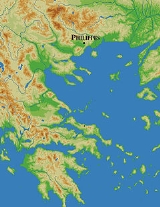
Philippi was a city in eastern
MacedoniaMacedonia is a geographical and historical region of the Balkan peninsula in southeastern Europe. Its boundaries have changed considerably over time, but nowadays the region is considered to include parts of five Balkan countries: Greece, the Republic of Macedonia, Bulgaria, Albania, Serbia, as...
, established by
Philip IIPhilip II of Macedon "friend" + ἵππος "horse" — transliterated ; 382 – 336 BC), was a king of Macedon from 359 BC until his assassination in 336 BC. He was the father of Alexander the Great and Philip III.-Biography:...
in 356 BC and abandoned in the 14th century after the
OttomanThe Ottoman EmpireIt was usually referred to as the "Ottoman Empire", the "Turkish Empire", the "Ottoman Caliphate" or more commonly "Turkey" by its contemporaries...
conquest. The present municipality
FilippoiFilippoi , is a village and a former municipality in the Kavala peripheral unit, East Macedonia and Thrace, Greece. Since the 2011 local government reform it is part of the municipality Kavala, of which it is a municipal unit. The 2001 census reported a population of 10,827 for the municipal unit...
is located near the ruins of the ancient city and it is part of the periphery of
East MacedoniaEast Macedonia and Thrace is one of the thirteen regions of Greece. It consists of the northeastern parts of the country, comprising the eastern part of the region of Macedonia along with the region of Thrace, and the islands of Thasos and Samothrace....
in
GreeceGreece , officially the Hellenic Republic , and historically Hellas or the Republic of Greece in English, is a country in southeastern Europe....
.
History
Philippi was established by the king of Macedon, Philip II, on the site of the
ThasianThasos or Thassos is a Greek island in the northern Aegean Sea, close to the coast of Thrace and the plain of the river Nestos but geographically part of Macedonia. It is the northernmost Greek island, and 12th largest by area...
colony of Krinides or Crenides , near the head of the
Aegean SeaThe Aegean Sea[p] is an elongated embayment of the Mediterranean Sea located between the southern Balkan and Anatolian peninsulas, i.e., between the mainlands of Greece and Turkey. In the north, it is connected to the Marmara Sea and Black Sea by the Dardanelles and Bosporus...
at the foot of Mt. Orbelos about 8 miles north-west of Kavalla, on the northern border of the marsh that in Antiquity covered the entire plain separating it from the
Pangaion hillsThe Pangaion Hills , ancient forms: Pangaeon, Pangaeum, Homeric name: Nysa are a mountain range in Greece, approximately 40 km from Kavala. The highest elevation is 1,956 m and the mountaintop name is Koutra...
to the south of Greece.
The objective of founding the town was to take control of the neighbouring
goldGold is a chemical element with the symbol Au and an atomic number of 79. Gold is a dense, soft, shiny, malleable and ductile metal. Pure gold has a bright yellow color and luster traditionally considered attractive, which it maintains without oxidizing in air or water. Chemically, gold is a...
mines and to establish a garrison at a strategic passage: the site controlled the route between
AmphipolisAmphipolis was an ancient Greek city in the region once inhabited by the Edoni people in the present-day region of Central Macedonia. It was built on a raised plateau overlooking the east bank of the river Strymon where it emerged from Lake Cercinitis, about 3 m. from the Aegean Sea. Founded in...
and
NeapolisKavala , is the second largest city in northern Greece, the principal seaport of eastern Macedonia and the capital of Kavala peripheral unit. It is situated on the Bay of Kavala, across from the island of Thasos...
, part of the great royal route which crosses Macedonia from the east to the west and which was reconstructed later by the
Roman EmpireThe Roman Empire was the post-Republican period of the ancient Roman civilization, characterised by an autocratic form of government and large territorial holdings in Europe and around the Mediterranean....
as the
Via EgnatiaThe Via Egnatia was a road constructed by the Romans in the 2nd century BC. It crossed the Roman provinces of Illyricum, Macedonia, and Thrace, running through territory that is now part of modern Albania, the Republic of Macedonia, Greece, and European Turkey.Starting at Dyrrachium on the...
. Philip II endowed the new city with important fortifications, which partially blocked the passage between the swamp and Mt. Orbelos, and sent colonists to occupy it. Philip also had the marsh partially drained, as is attested by the writer
TheophrastusTheophrastus , a Greek native of Eresos in Lesbos, was the successor to Aristotle in the Peripatetic school. He came to Athens at a young age, and initially studied in Plato's school. After Plato's death he attached himself to Aristotle. Aristotle bequeathed to Theophrastus his writings, and...
. Philippi preserved its autonomy within the kingdom of Macedon and had its own political institutions (the
AssemblyThe ecclesia or ekklesia was the principal assembly of the democracy of ancient Athens during its "Golden Age" . It was the popular assembly, opened to all male citizens over the age of 30 with 2 years of military service by Solon in 594 BC meaning that all classes of citizens in Athens were able...
of the
demos). The discovery of new gold mines near the city, at Asyla, contributed to the wealth of the kingdom and Philip established a mint there. The city was finally fully integrated into the kingdom under
Philip VPhilip V was King of Macedon from 221 BC to 179 BC. Philip's reign was principally marked by an unsuccessful struggle with the emerging power of Rome. Philip was attractive and charismatic as a young man...
.
The city remained. It contained 2,000 people. When the Romans destroyed the
Antigonid dynastyThe Antigonid dynasty was a dynasty of Hellenistic kings descended from Alexander the Great's general Antigonus I Monophthalmus .-History:...
of Macedon in 167 BC and divided it into four separate states (
merides), it was Amphipolis and not Philippi that became the capital of the eastern Macedonian state.
Almost nothing is known about the city in this period, aside from the walls, the Greek theatre, the foundations of a house under the Roman forum and a little temple dedicated to a hero cult. This monument covers the tomb of a certain Exekestos, is possibly situated on the
agoraThe Agora was an open "place of assembly" in ancient Greek city-states. Early in Greek history , free-born male land-owners who were citizens would gather in the Agora for military duty or to hear statements of the ruling king or council. Later, the Agora also served as a marketplace where...
and is dedicated to the κτίστης (
ktistès), the foundation hero of the city.
The Roman era
The city reappears in the sources during the Roman civil war that followed the assassination of
Julius CaesarGaius Julius Caesar was a Roman general and statesman and a distinguished writer of Latin prose. He played a critical role in the gradual transformation of the Roman Republic into the Roman Empire....
. His heirs
Mark AntonyMarcus Antonius , known in English as Mark Antony, was a Roman politician and general. As a military commander and administrator, he was an important supporter and loyal friend of his mother's cousin Julius Caesar...
and Octavian confronted the assassins of Caesar,
Marcus Junius BrutusMarcus Junius Brutus , often referred to as Brutus, was a politician of the late Roman Republic. After being adopted by his uncle he used the name Quintus Servilius Caepio Brutus, but eventually returned to using his original name...
and
CassiusGaius Cassius Longinus was a Roman senator, a leading instigator of the plot to kill Julius Caesar, and the brother in-law of Marcus Junius Brutus.-Early life:...
, at the
Battle of PhilippiThe Battle of Philippi was the final battle in the Wars of the Second Triumvirate between the forces of Mark Antony and Octavian and the forces of Julius Caesar's assassins Marcus Junius Brutus and Gaius Cassius Longinus in 42 BC, at Philippi in Macedonia...
in the plain to the west of the city during October in 42 BC. Antony and Octavian were victorious in this final battle against the partisans of the Republic. They released some of their veteran soldiers, probably from
legionA Roman legion normally indicates the basic ancient Roman army unit recruited specifically from Roman citizens. The organization of legions varied greatly over time but they were typically composed of perhaps 5,000 soldiers, divided into maniples and later into "cohorts"...
XXVIII and colonized them in the city, which was refounded as
Colonia Victrix Philippensium. In 30 BC, Octavian became
Roman emperorThe Roman emperor was the ruler of the Roman State during the imperial period . The Romans had no single term for the office although at any given time, a given title was associated with the emperor...
, reorganized the colony, and established more settlers there, veterans possibly from the
Praetorian GuardThe Praetorian Guard was a force of bodyguards used by Roman Emperors. The title was already used during the Roman Republic for the guards of Roman generals, at least since the rise to prominence of the Scipio family around 275 BC...
and other Italians. The city was renamed
Colonia Iulia Philippensis, and then
Colonia Augusta Iulia Philippensis after January, 27 BC, when Octavian received the title
AugustusAugustus ;23 September 63 BC – 19 August AD 14) is considered the first emperor of the Roman Empire, which he ruled alone from 27 BC until his death in 14 AD.The dates of his rule are contemporary dates; Augustus lived under two calendars, the Roman Republican until 45 BC, and the Julian...
from the
Roman SenateThe Senate of the Roman Republic was a political institution in the ancient Roman Republic, however, it was not an elected body, but one whose members were appointed by the consuls, and later by the censors. After a magistrate served his term in office, it usually was followed with automatic...
.
Following this second renaming, and perhaps after the first, the territory of Philippi was centuriated (divided into squares of land) and distributed to the colonists. The city kept its Macedonian walls, and its general plan was modified only partially by the construction of a forum, a little to the east of the site of Greek agora. It was a "miniature Rome," under the municipal law of Rome and governed by two military officers, the
duumviri, who were appointed directly from Rome.
The colony recognized its dependence on the mines that brought it its privileged position on the
Via EgnatiaThe Via Egnatia was a road constructed by the Romans in the 2nd century BC. It crossed the Roman provinces of Illyricum, Macedonia, and Thrace, running through territory that is now part of modern Albania, the Republic of Macedonia, Greece, and European Turkey.Starting at Dyrrachium on the...
. This wealth was shown by the many monuments that were particularly imposing considering the relatively small size of the urban area: the forum, laid out in two terraces on both sides of the main road, was constructed in several phases between the reigns of
ClaudiusClaudius , was Roman Emperor from 41 to 54. A member of the Julio-Claudian dynasty, he was the son of Drusus and Antonia Minor. He was born at Lugdunum in Gaul and was the first Roman Emperor to be born outside Italy...
and
Antoninus PiusAntoninus Pius , also known as Antoninus, was Roman Emperor from 138 to 161. He was a member of the Nerva-Antonine dynasty and the Aurelii. He did not possess the sobriquet "Pius" until after his accession to the throne...
, and the theatre was enlarged and expanded in order to hold Roman games. There is an abundance of
LatinLatin is an Italic language originally spoken in Latium and Ancient Rome. It, along with most European languages, is a descendant of the ancient Proto-Indo-European language. Although it is considered a dead language, a number of scholars and members of the Christian clergy speak it fluently, and...
inscriptions testifying to the prosperity of the city.
The early Christian era
According to the
New TestamentThe New Testament is the second major division of the Christian biblical canon, the first such division being the much longer Old Testament....
, in AD 49 or 50, the city was visited by the apostle
PaulPaul the Apostle , also known as Saul of Tarsus, is described in the Christian New Testament as one of the most influential early Christian missionaries, with the writings ascribed to him by the church forming a considerable portion of the New Testament...
. From the Acts of the Apostles and the letter to the Philippians , early Christians concluded that Paul had founded their community. Accompanied by
SilasSaint Silas or Saint Silvanus was a leading member of the Early Christian community, who later accompanied Paul in some of his missionary journeys....
, Timothy and possibly
LukeLuke the Evangelist was an Early Christian writer whom Church Fathers such as Jerome and Eusebius said was the author of the Gospel of Luke and the Acts of the Apostles...
, the author of the
Acts of the ApostlesThe Acts of the Apostles , usually referred to simply as Acts, is the fifth book of the New Testament; Acts outlines the history of the Apostolic Age...
, he is believed to have preached for the first time on European soil in Philippi . According to the New Testament, Paul visited the city on two other occasions, in 56 and 57. The
Epistle to the PhilippiansThe Epistle of Paul to the Philippians, usually referred to simply as Philippians, is the eleventh book in the New Testament. Biblical scholars agree that it was written by St. Paul to the church of Philippi, an early center of Christianity in Greece around 62 A.D. Other scholars argue for an...
dates from around 61-62 and is believed to show the immediate impact of Paul's instruction.
The development of
ChristianityChristianity is a monotheistic religion based on the life and teachings of Jesus as presented in canonical gospels and other New Testament writings...
in Philippi is indicated by a
letter from Polycarp of SmyrnaThe Letter to the Philippians is an epistle composed around 110 to 140 ADby one of the Apostolic Fathers, Polycarp of Smyrna from Antioch, to the early Christian church in Philippi...
addressed to the community in Philippi around AD 160 and by funerary inscriptions.
The first church described in the city is a small building that was probably originally a small prayer house. This
Basilica of Paul, identified by an
mosaicMosaic is the art of creating images with an assemblage of small pieces of colored glass, stone, or other materials. It may be a technique of decorative art, an aspect of interior decoration, or of cultural and spiritual significance as in a cathedral...
inscription on the pavement, is dated around 343 from a mention by the bishop Porphyrios, who was present at the Council of
SerdicaSofia is the capital and largest city of Bulgaria and the 12th largest city in the European Union with a population of 1.27 million people. It is located in western Bulgaria, at the foot of Mount Vitosha and approximately at the centre of the Balkan Peninsula.Prehistoric settlements were excavated...
that year.
The prosperity of the city in the 5th and 6th centuries was attributed to Paul and to his ministry. As in other cities, many new ecclesiastical buildings were constructed at this time. Seven different churches were constructed in Philippi between the mid-4th century and the end of the 6th, some of which competed in size and decoration with the most beautiful buildings in Thessalonica, or even those of
ConstantinopleConstantinople was the capital of the Roman, Eastern Roman, Byzantine, Latin, and Ottoman Empires. Throughout most of the Middle Ages, Constantinople was Europe's largest and wealthiest city.-Names:...
. The relationship of the plan and of the architectural decoration of Basilica B with
Hagia SophiaHagia Sophia is a former Orthodox patriarchal basilica, later a mosque, and now a museum in Istanbul, Turkey...
and Saint Irene in Constantinople accorded a privileged place to this church in the history of early Christian art. The complex cathedral which took the place of the Basilica of Paul at the end of the 5th century, constructed around an octagonal church, also rivaled the churches of Constantinople.
In the same age, the fortifications of the city were rebuilt in order to better defend against the growing instability in the
BalkansThe Balkans is a geopolitical and cultural region of southeastern Europe...
. In 473, the city was besieged by the Ostrogoths, who were unable to take it but burned down the surrounding villages.
The Byzantine and Ottoman era
Already weakened by the
SlavicThe Slavic people are an Indo-European panethnicity living in Eastern Europe, Southeast Europe, North Asia and Central Asia. The term Slavic represents a broad ethno-linguistic group of people, who speak languages belonging to the Slavic language family and share, to varying degrees, certain...
invasions at the end of the 6th century, which ruined the agrarian economy of Macedonia and probably also by the
Plague of JustinianThe Plague of Justinian was a pandemic that afflicted the Eastern Roman Empire , including its capital Constantinople, in 541–542 AD. It was one of the greatest plagues in history. The most commonly accepted cause of the pandemic is bubonic plague, which later became infamous for either causing or...
in 547, the city was almost totally destroyed by an
earthquakeAn earthquake is the result of a sudden release of energy in the Earth's crust that creates seismic waves. The seismicity, seismism or seismic activity of an area refers to the frequency, type and size of earthquakes experienced over a period of time...
around 619, from which it never recovered. There was a small amount of activity there in the 7th century, but the city was now hardly more than a village.
The
Byzantine EmpireThe Byzantine Empire was the Eastern Roman Empire during the periods of Late Antiquity and the Middle Ages, centred on the capital of Constantinople. Known simply as the Roman Empire or Romania to its inhabitants and neighbours, the Empire was the direct continuation of the Ancient Roman State...
possibly maintained a garrison there, but in 838 the city was taken by the
BulgarsThe Bulgars were a semi-nomadic who flourished in the Pontic Steppe and the Volga basin in the 7th century.The Bulgars emerge after the collapse of the Hunnic Empire in the 5th century....
under
kavhan IsbulIsbul was the kavhan, or first minister, of the First Bulgarian Empire during the reigns of Omurtag, Malamir and Presian I...
, who celebrated their victory with a monumental inscription on the
stylobateIn classical Greek architecture, a stylobate is the top step of the crepidoma, the stepped platform on which colonnades of temple columns are placed...
in Basilica B, now partially in ruins. The site of Philippi was so strategically sound that the Byzantines attempted very soon to recapture it ca. 850. Several seals of civil servants and other Byzantine officials, dated to the first half of the 9th century, prove the presence of Byzantine armies in the city.
Around 969, Emperor Nicephorus II Phocas rebuilt the fortifications on the acropolis and in part of the city. These gradually helped weaken Bulgar power and strengthen the Byzantine presence in the area. In 1077, Bishop Basil Kartzimopoulos rebuilt part of the defenses inside the city. The city began to prosper once more, as witnessed by the
ArabArab people, also known as Arabs , are a panethnicity primarily living in the Arab world, which is located in Western Asia and North Africa. They are identified as such on one or more of genealogical, linguistic, or cultural grounds, with tribal affiliations, and intra-tribal relationships playing...
geographerA geographer is a scholar whose area of study is geography, the study of Earth's natural environment and human society.Although geographers are historically known as people who make maps, map making is actually the field of study of cartography, a subset of geography...
Al Idrisi, who mentions it as a centre of business and
wineWine is an alcoholic beverage, made of fermented fruit juice, usually from grapes. The natural chemical balance of grapes lets them ferment without the addition of sugars, acids, enzymes, or other nutrients. Grape wine is produced by fermenting crushed grapes using various types of yeast. Yeast...
production around 1150.
After a brief occupation by the
FranksThe Franks were a confederation of Germanic tribes first attested in the third century AD as living north and east of the Lower Rhine River. From the third to fifth centuries some Franks raided Roman territory while other Franks joined the Roman troops in Gaul. Only the Salian Franks formed a...
after the
Fourth CrusadeThe Fourth Crusade was originally intended to conquer Muslim-controlled Jerusalem by means of an invasion through Egypt. Instead, in April 1204, the Crusaders of Western Europe invaded and conquered the Christian city of Constantinople, capital of the Eastern Roman Empire...
and the capture of Constantinople in 1204, the city fell into the hands of the
SerbsThe Serbs are a South Slavic ethnic group of the Balkans and southern Central Europe. Serbs are located mainly in Serbia, Montenegro and Bosnia and Herzegovina, and form a sizable minority in Croatia, the Republic of Macedonia and Slovenia. Likewise, Serbs are an officially recognized minority in...
. Still, it remained a notable fortification on the route of the ancient
Via EgnatiaThe Via Egnatia was a road constructed by the Romans in the 2nd century BC. It crossed the Roman provinces of Illyricum, Macedonia, and Thrace, running through territory that is now part of modern Albania, the Republic of Macedonia, Greece, and European Turkey.Starting at Dyrrachium on the...
; in 1354, the pretender to the Byzantine throne, Matthew Cantacuzenus, was captured there by the Serbs.
The city was abandoned at an unknown date, but when the
FrenchThe French Republic , The French Republic , The French Republic , (commonly known as France , is a unitary semi-presidential republic in Western Europe with several overseas territories and islands located on other continents and in the Indian, Pacific, and Atlantic oceans. Metropolitan France...
traveller Pierre Belon visited it in the 16th century, there were nothing but ruins, used by the Turks as a quarry. The name of the city was preserved at first by a Turkish village on the nearby plain, Philibedjik (Filibecik, "Little
FilibePlovdiv is the second-largest city in Bulgaria after Sofia with a population of 338,153 inhabitants according to Census 2011. Plovdiv's history spans some 6,000 years, with traces of a Neolithic settlement dating to roughly 4000 BC; it is one of the oldest cities in Europe...
" in Turkish), which has since disappeared and then by a Greek village in the mountains.
Archaeological excavation of the site
Noted or briefly described by 16th century travellers, the first archaeological description of the city was made in 1856 by Perrot, then in 1861 by L. Heuzey and H. Daumet in their famous
Mission archéologique de Macédoine. Nevertheless the first excavations did not begin until the summer of 1914, and were soon interrupted by the First World War. The excavations, carried out by the École française d'Athènes, were renewed in 1920 and continued until 1937. During this time the Greek theatre, the forum, Basilicas A and B, the baths and the walls were excavated. After the Second World War, Greek archaeologists returned to the site. From 1958 to 1978, the Société Archéologique, then the Service archéologique and the University of Thessalonica uncovered the bishop's quarter and the octagonal church, large private residences, a new basilica near the Museum and two others in the
necropolisA necropolis is a large cemetery or burial ground, usually including structural tombs. The word comes from the Greek νεκρόπολις - nekropolis, literally meaning "city of the dead"...
to the east of the city.
In the Bible
According to the
New TestamentThe New Testament is the second major division of the Christian biblical canon, the first such division being the much longer Old Testament....
, in AD 49 or 50 the city was visited by the apostle
PaulPaul the Apostle , also known as Saul of Tarsus, is described in the Christian New Testament as one of the most influential early Christian missionaries, with the writings ascribed to him by the church forming a considerable portion of the New Testament...
who was guided there by a vision . Accompanied by
SilasSaint Silas or Saint Silvanus was a leading member of the Early Christian community, who later accompanied Paul in some of his missionary journeys....
, Timothy and possibly
LukeLuke the Evangelist was an Early Christian writer whom Church Fathers such as Jerome and Eusebius said was the author of the Gospel of Luke and the Acts of the Apostles...
, the author of the
Acts of the ApostlesThe Acts of the Apostles , usually referred to simply as Acts, is the fifth book of the New Testament; Acts outlines the history of the Apostolic Age...
, he preached for the first time on European soil in Philippi and baptized
LydiaLydia of Thyatira is a character in the New Testament. She is regarded as the first recorded convert to Christianity in Europe.-Name:The name, "Lydia", meaning "the Lydian woman", by which she was known indicates that she was from Lydia in Asia Minor. Though she is commonly known as “St...
, a
purplePurple is a range of hues of color occurring between red and blue, and is classified as a secondary color as the colors are required to create the shade....
dye merchant, in a river to the west of the city. While in Philippi, his exorcism of a demon from a slave girl caused a great uproar in the city, which led to their (Paul and Silas) arrest and public beating . An earthquake caused their prison to be opened. When the jailer awoke, he prepared to kill himself, thinking all the prisoners had escaped and knowing that he would be severely punished. Paul stopped him, indicating that all the prisoners were in fact still there. The jailer then became one of the first Christians in Europe .
Paul visited the city at least on two other occasions, in 56 and 57. The
Epistle to the PhilippiansThe Epistle of Paul to the Philippians, usually referred to simply as Philippians, is the eleventh book in the New Testament. Biblical scholars agree that it was written by St. Paul to the church of Philippi, an early center of Christianity in Greece around 62 A.D. Other scholars argue for an...
dates from around 61-62 and shows the immediate impact of Paul's instruction.
External links