


Unmanned NASA missions

Encyclopedia
Following is a sampling of some of NASA's past and present programs excluding manned spacecrafts. The years in brackets are for first and latest launching. A program is a number of flights or missions with the same kind of satellite therefore the name of the program and the name of the satellite used will often be the same. In all NASA have made more than 1,000 unmanned missions into Earth orbit or beyond.
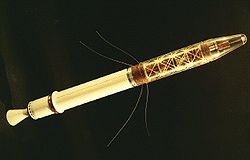 The Explorer program continues and over more than five decades has launched 90+ missions into Space. It has matured into one of NASA's lower-cost mission programs, relative to its other programs.
It began as a U.S. Army proposal to place a scientific satellite into orbit during the International Geophysical Year
(1957-58); however, that proposal was rejected in favor of the U.S. Navy's Project Vanguard
. The Explorer program was later reestablished to catch up with the Soviet Union after that nation's launch of Sputnik 1 on October, 1957. Explorer 1 was launched January 31, 1958; at this time the project still belonged to ABMA and JPL. Besides being the first U.S. satellite, it is known for discovering the Van Allen radiation belt.
The Explorer program was transferred to NASA, which continued to use the name for an ongoing series of relatively small space missions, typically an artificial satellite with a science focus. Over the years, NASA has launched a series of Explorer spacecraft carrying a wide variety of scientific investigations.
and Pioneer 11
, which explored the outer planets and left the solar system
. Both carry a golden plaque
, depicting a man and a woman and information about the origin and the creators of the probes, should any extraterrestrials
find them someday.
Additionally, the Pioneer mission to Venus consisted of two components, launched separately. Pioneer Venus 1 or Pioneer Venus Orbiter was launched in 1978 and studied the planet for more than a decade after orbital insertion in 1978. Pioneer Venus 2 or Pioneer Venus Multiprobe sent four small probes into the Venusian atmosphere.
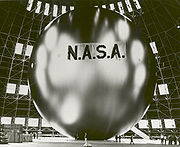
Project Echo was the first passive communications satellite
experiment. Each spacecraft was a metalized balloon satellite
to be inflated in space and acting as a passive reflector
of microwave
signals. Communication signals were bounced off of them from one point on Earth to another.
NASA
's Echo 1 satellite was built by Gilmore Schjeldahl
Company in Northfield, Minnesota
. Following the failure of the Delta rocket
carrying Echo 1 on May 13, 1960, Echo 1A was put successfully into a 944 to 1,048 mi orbit by another Thor-Delta and a microwave transmission from the Jet Propulsion Laboratory in Pasadena, California was received at Bell Laboratories in Homdel, New Jersey on August 12, 1960.
Echo 2 was a 41.1-meter (135 ft) diameter metalized PET film balloon, which was the last balloon satellite launched by Project Echo. It used an improved inflation system to improve the balloon's smoothness and sphericity. It was launched January 25, 1964 on a Thor Agena rocket.
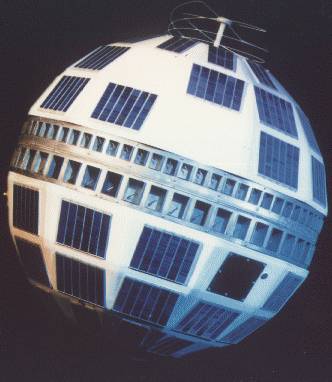 Telstar was not a NASA program but a commercial communication satellite project. NASA's contribution to it was limited to launch services, as well as tracking and telemetry duties. The first two Telstar satellites were experimental and nearly identical. Telstar 1 was launched on top of a Thor-Delta
rocket on July 10, 1962. It successfully relayed through space the first television pictures, telephone calls, fax
images and provided the first live transatlantic television feed. Telstar 2 was launched May 7, 1963.
Bell Telephone Laboratories designed and built the Telstar spacecrafts. They were prototypes intended to prove various concepts behind the large constellation of orbiting satellites. The faceted 171 lb (77 kg) sphere had a diameter of a little more than 34 inches (about 1 m). Bell Telephone Laboratories also developed much of the technology required for satellite communication, including transistors, solar cells, and traveling wave tube
amplifiers. To handle Telstar communications, AT&T
built ground stations at Andover, Maine; Pleumeur-Bodou, France; and Goonhilly Downs, Britain. These were similar to, but larger than, the ground station used for project Echo.
Telstar was a technical success. A US. Information Agency (USIA) poll showed that Telstar was better known in Great Britain than Sputnik had been in 1957. In contrast to Sputnik, Telstar's signals were useful.
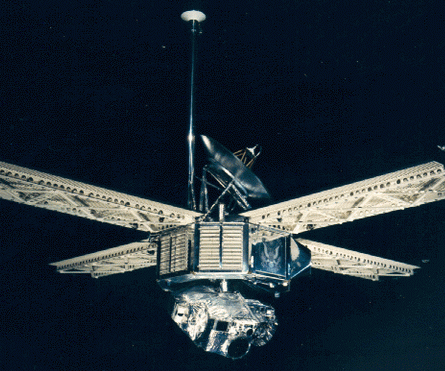 The Mariner program conducted by NASA launched a series of robotic
interplanetary probes
designed to investigate Mars
, Venus
and Mercury
. The program included a number of firsts, including the first planetary flyby, the first pictures from another planet, the first planetary orbiter
, and the first gravity assist
maneuver.
Of the ten vehicles in the Mariner series, seven were successful and three were lost. The planned Mariner 11 and Mariner 12 vehicles evolved into Voyager 1
and Voyager 2
of the Voyager program
, while the Viking 1
and Viking 2
Mars orbiters were enlarged versions of the Mariner 9
spacecraft. Other Mariner-based spacecraft, launched since Voyager, included the Magellan probe to Venus, and the Galileo
probe to Jupiter
. A second-generation Mariner spacecraft, called the Mariner Mark II
series, eventually evolved into the Cassini–Huygens probe, now in orbit around Saturn
.
All Mariner spacecraft were based on a hexagonal or octagonal "bus", which housed all of the electronics, and to which all components were attached, such as antennae, cameras, propulsion, and power sources. All probes except Mariner 1
, Mariner 2
and Mariner 5
had TV cameras. The first five Mariners were launched on Atlas-Agena
rocket
s, while the last five used the Atlas-Centaur
. All Mariner-based probes after Mariner 10
used the Titan III
E, Titan IV
unmanned rockets or the Space Shuttle
with a solid-fueled Inertial Upper Stage
and multiple planetary flybys.
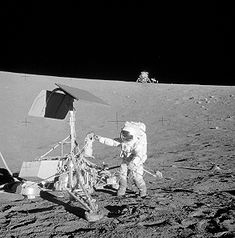
The Surveyor Program was a NASA
program that, from 1966 through 1968, sent seven robotic spacecraft
to the surface of the Moon
. Its primary goal was to demonstrate the feasibility of soft landing
s on the Moon. The mission called for the craft to travel directly to the moon on an impact trajectory (no orbit first), on a journey that lasted 63 to 65 hours, and ended with a deceleration of just over three minutes to a soft-landing. The program was implemented by NASA's Jet Propulsion Laboratory
(JPL) to prepare for the Apollo program. The total cost of the Surveyor program was officially $469 million dollars.
Five of the Surveyor craft successfully soft-landed on the moon, including the first one. Two failed: Surveyor 2 crashed at high velocity after a failed mid-course correction, and Surveyor 4 was lost for contact (possibly exploding) 2.5 minutes before its scheduled touch-down.
All seven spacecraft are still on the Moon; none of the missions included returning them to Earth. Some parts of Surveyor 3
were returned to Earth by the crew of Apollo 12
, which landed near it in 1969. The camera from this craft is on display at the National Air and Space Museum
in Washington, DC.
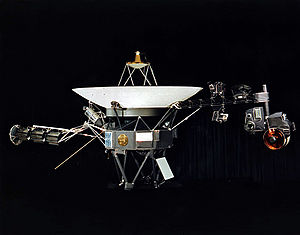 The Voyager program is a series of NASA unmanned space missions that consists of a pair of unmanned scientific probe
s, Voyager 1
and Voyager 2
. They were launched in 1977 to take advantage of a favorable planetary alignment of the late 1970s. Although they were officially designated to study just Jupiter
and Saturn
, the two probes were able to continue their mission into the outer solar system. Both probes have achieved escape velocity from the solar system and will never return. Both missions have gathered large amounts of data about the gas giant
s of the solar system
, of which little was previously known.
, Voyager 1 was at a distance of 115.251 AU
(17.242 billion
km, or 10.712 billion miles), traveling away from both the Earth and the Sun
at a speed of 17 kilometres (10.6 mi)/s, which corresponds to a greater specific orbital energy
than any other probe.
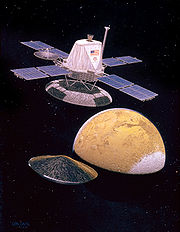 The Viking program consisted of a pair of space probes sent to Mars—Viking 1
and Viking 2
. Each vehicle was composed of two main parts, an orbiter designed to photograph the surface of Mars from orbit
, and a lander designed to study the planet from the surface. The orbiters also served as communication relays for the landers once they touched down. Viking 1 was launch
ed on August 20, 1975, and the second craft, Viking 2, was launched on September 9, 1975, both riding atop Titan III-E
rockets with Centaur
upper stages. By discovering many geological forms that are typically formed from large amounts of water, the Viking program caused a revolution in scientific ideas about water on Mars.
The primary objectives of the Viking orbiters were to transport the landers to Mars, perform reconnaissance to locate and certify landing sites, act as a communications relays for the landers, and to perform their own scientific investigations. The orbiter, based on the earlier Mariner 9
spacecraft, was an octagon approximately 2.5 m across. The total launch mass was 2328 kilograms (5,132.4 lb), of which 1445 kilograms (3,185.7 lb) were propellant and attitude control gas.
 The Helios I and Helios II space probes, also known as Helios-A and Helios-B, were a pair of probes launched into heliocentric
orbit
for the purpose of studying solar
processes. A joint venture of the Federal Republic of Germany (West Germany
) and NASA, the probes were launched from Cape Canaveral Air Force Station
, Florida, on Dec. 10, 1974, and Jan. 15, 1976, respectively. The probes are notable for setting a maximum speed record among spacecraft at 252792 kilometres (157,078.1 mi)/h (157,078 mi/h or 43.63 mi/s or 70.22 kilometres (43.6 mi)/s or 0.000234c
). The Helios space probes completed their primary missions by the early 1980s, but they continued to send data up to 1985. The probes are no longer functional but still remain in their elliptical orbit around the Sun.
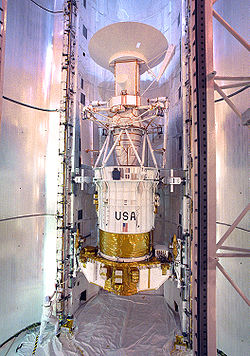 The Magellan spacecraft was a space probe sent to the planet Venus, the first unmanned interplanetary spacecraft to be launched by NASA since its successful Pioneer Orbiter, also to Venus, in 1978. It was also the first of three deep-space probes to be launched on the Space Shuttle, and the first spacecraft to employ aerobraking
techniques to lower its orbit.
Magellan created the first (and currently the best) high resolution mapping of the planet's surface features. Prior Venus missions had created low resolution radar globes of general, continent-sized formations. Magellan, performed detailed imaging and analysis of craters, hills, ridges, and other geologic formations, to a degree comparable to the visible-light photographic mapping of other planets.
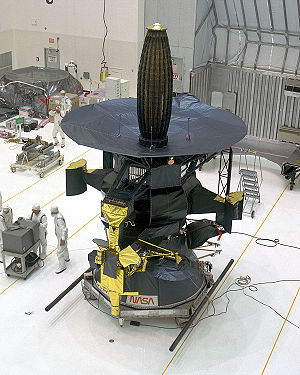 Galileo was an unmanned spacecraft
sent by NASA to study the planet Jupiter
and its moon
s. It was launched on October 18, 1989 by the Space Shuttle Atlantis
on the STS-34
mission. It arrived at Jupiter on December 7, 1995, a little more than six years later, via gravitational assist flybys of Venus and Earth
.
Despite antenna problems, Galileo conducted the first asteroid
flyby, discovered the first asteroid moon
, was the first spacecraft to orbit Jupiter, and launched the first probe into Jupiter's atmosphere. Galileo's prime mission was a two-year study of the Jovian system. The spacecraft traveled around Jupiter in elongated ellipse
s, each orbit lasting about two months. The differing distances from Jupiter afforded by these orbits allowed Galileo to sample different parts of the planet's extensive magnetosphere
. The orbits were designed for close up flybys of Jupiter's largest moons. Once Galileo's prime mission was concluded, an extended mission followed starting on December 7, 1997; the spacecraft made a number of daring close flybys of Jupiter's moons Europa
and Io
. The closest approach was 180 kilometres (111.8 mi) (112 mi) on October 15, 2001.
On September 21, 2003, after 14 years in space and eight years of service in the Jovian system (around Jupiter), Galileo′s mission was terminated by sending the orbiter into Jupiter's atmosphere at a speed of nearly 50 kilometers per second. The programs funding was running out and the spacecraft was low on propellant, in addition to many systems were damaged. One of the reasons given for its destruction was to avoid the chance of it contaminating local moons with bacteria from Earth
. Of particular interest was the ice-crusted moon Europa
, which, thanks to Galileo, scientists now suspect harbors a salt water ocean beneath its surface.
that was carried into orbit
by a Space Shuttle in April 1990. It is named after American astronomer
Edwin Hubble
. Although not the first space telescope, Hubble is one of the largest and most versatile, and is well known as both a vital research tool and a public relations boon for astronomy
. The HST is a collaboration between NASA and the European Space Agency
, and is one of NASA's Great Observatories
, along with the Compton Gamma Ray Observatory
, the Chandra X-ray Observatory
, and the Spitzer Space Telescope
. The HST's success has paved the way for greater collaboration between the agencies.
The HST was created with a relatively small budget of $2 billion and has continued operation since 1990, delighting both scientists and the public. Some of its images, such as the groundbreaking Hubble Deep Field
, have become famous.

UARS is a science satellite used from 1991 to 2005 to study Earth's atmosphere, including the ozone layer
. Planned for a three year mission, it proved much more durable, allowing extended observation from its instrument suite. It was launched aboard Space Shuttle Discovery
and deployed into space from the payload bay with its robotic arm, under guidance from the crew. The satellite was expected to undergo atmospheric re-entry in the late evening of Friday September 23, 2011 or early morning of Saturday September 24, 2011, Eastern Daylight Time. On 24 September 2011 1:09 a.m. EDT UARS made its re-entry.
At around about 6 tonnes, it was be the heaviest NASA satellites to undergo uncontrolled atmospheric entry since Skylab
in the summer 1979, which was roughly 70 tonnes. It is heavier then Pegasus 2
, which fell back in fall of 1979, but weighed less than 2 tonnes.
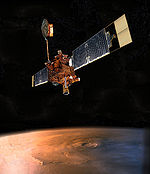 The Mars Global Surveyor
(MGS) was developed by NASA's Jet Propulsion Laboratory and launched November 1996. It began the United States' return to Mars after a 10-year absence. It completed its primary mission in January 2001 and was in its third extended mission phase when, on November 2, 2006, the spacecraft failed to respond to commands. In January 2007 NASA officially ended the mission.
The Surveyor spacecraft used a series of high-resolution cameras to explore the surface of Mars during its mission, returning more than 240,000 images spanning portions of 4.8 Martian years, from September 1997 to November 2006. The surveyor's cameras utilized 3 instruments: a narrow angle camera that took (black-and-white) high resolution images (usually 1.5 to 12 m per pixel) red and blue wide angle pictures for context (240 m per pixel) and daily global imaging (7.5 kilometres (4.7 mi) per pixel).
 The Mars Pathfinder (MESUR Pathfinder,) later renamed the Carl Sagan Memorial Station, was launched on December 4, 1996, just a month after the Mars Global Surveyor was launched. Onboard the lander
was a small rover
called Sojourner that would execute many experiments on the Martian surface. It was the second project from NASA's Discovery Program
, which promotes the use of low-cost spacecraft and frequent launches under the motto "cheaper, faster and better" promoted by the then administrator, Daniel Goldin
. The mission was directed by the Jet Propulsion Laboratory, a division of the California Institute of Technology
, responsible for NASA's Mars Exploration Program
.
This mission, besides being the first of a series of missions to Mars that included rovers (robotic exploration vehicles), was the most important since the Vikings
landed on the red planet in 1976, and also was the first successful mission to send a rover to a planet. In addition to scientific objectives, the Mars Pathfinder mission was also a "proof-of-concept" for various technologies, such as airbag
-mediated touchdown and automated obstacle avoidance, both later exploited by the Mars Exploration Rover
s. The Mars Pathfinder was also remarkable for its extremely low price relative to other unmanned space missions to Mars.
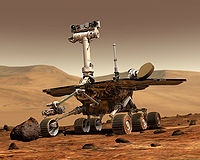 NASA's Mars Exploration Rover Mission (MER), is an ongoing robotic space mission involving two rovers exploring the planet Mars. The mission is managed for NASA by the Jet Propulsion Laboratory, which designed, built and is operating the rovers.
The mission began in 2003 with the sending of the two rover
s—MER-A Spirit
and MER-B Opportunity
—to explore the Martian surface and geology. The mission's scientific objective is to search for and characterize a wide range of rocks
and soil
s that hold clues to past water activity on Mars. The mission is part of NASA's Mars Exploration Program which includes three previous successful landers: the two Viking program
landers in 1976 and Mars Pathfinder
probe in 1997.
The total cost of building, launching, landing and operating the rovers on the surface for the initial 90-Martian-day (sol) primary mission was US$820 million. Since the rovers continued to function far beyond their initial 90 sol primary mission (six years to failure for Spirit, seven years and counting for Opportunity), they have each received multiple mission extensions.
In recognition of the vast amount of scientific information
amassed by both rovers, two asteroid
s have been named in their honor: 37452 Spirit
and 39382 Opportunity
.
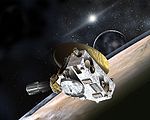
Pluto
. It is expected to be the first spacecraft
to fly by and study Pluto and its moons, Charon
, Nix
, and Hydra
. Once New Horizons leaves the Solar System, NASA may also approve flybys of one or more other Kuiper Belt Objects
.
New Horizons was launched on January 19, 2006 directly into an Earth-and-solar-escape trajectory
. It had an Earth-relative velocity of about 16.26 kilometres (10.1 mi)/s or 58536 kilometres (36,372.7 mi)/h (10.10 mi/s or 36,373 mi/h) after its last engine shut down. Thus, it left Earth at the fastest launch speed ever recorded for a man-made object (although its specific orbital energy
is less than that of Voyager 1
, and the Helios probes retain the maximum speed record for a spacecraft). New Horizons flew by Jupiter
on February 28, 2007 and Saturn's orbit on June 8, 2008. It will arrive at Pluto on July 14, 2015 and then continue into the Kuiper belt
.
mission was successfully launched for Mars. The mission is scheduled to land the robotic "Curiosity" rover on the surface of Mars in August 2012, whereupon the rover will search for evidence of past or present life on Mars.
Explorer program (1958-2011)
It began as a U.S. Army proposal to place a scientific satellite into orbit during the International Geophysical Year
International Geophysical Year
The International Geophysical Year was an international scientific project that lasted from July 1, 1957, to December 31, 1958. It marked the end of a long period during the Cold War when scientific interchange between East and West was seriously interrupted...
(1957-58); however, that proposal was rejected in favor of the U.S. Navy's Project Vanguard
Project Vanguard
Project Vanguard was a program managed by the United States Naval Research Laboratory , which intended to launch the first artificial satellite into Earth orbit using a Vanguard rocket as the launch vehicle from Cape Canaveral Missile Annex, Florida....
. The Explorer program was later reestablished to catch up with the Soviet Union after that nation's launch of Sputnik 1 on October, 1957. Explorer 1 was launched January 31, 1958; at this time the project still belonged to ABMA and JPL. Besides being the first U.S. satellite, it is known for discovering the Van Allen radiation belt.
The Explorer program was transferred to NASA, which continued to use the name for an ongoing series of relatively small space missions, typically an artificial satellite with a science focus. Over the years, NASA has launched a series of Explorer spacecraft carrying a wide variety of scientific investigations.
Pioneer program (1958-1978)
The Pioneer program is a series of NASA unmanned space missions that was designed for planetary exploration. There were a number of such missions in the program, but the most notable were Pioneer 10Pioneer 10
Pioneer 10 is a 258-kilogram robotic space probe that completed the first interplanetary mission to Jupiter, and became the first spacecraft to achieve escape velocity from the Solar System. The project was managed by the NASA Ames Research Center and the contract for the construction of the...
and Pioneer 11
Pioneer 11
Pioneer 11 is a 259-kilogram robotic space probe launched by NASA on April 6, 1973 to study the asteroid belt, the environment around Jupiter and Saturn, solar wind, cosmic rays, and eventually the far reaches of the solar system and heliosphere...
, which explored the outer planets and left the solar system
Solar System
The Solar System consists of the Sun and the astronomical objects gravitationally bound in orbit around it, all of which formed from the collapse of a giant molecular cloud approximately 4.6 billion years ago. The vast majority of the system's mass is in the Sun...
. Both carry a golden plaque
Pioneer plaque
The Pioneer plaques are a pair of gold-anodized aluminium plaques which were placed on board the 1972 Pioneer 10 and 1973 Pioneer 11 spacecraft, featuring a pictorial message, in case either Pioneer 10 or 11 are intercepted by extraterrestrial life...
, depicting a man and a woman and information about the origin and the creators of the probes, should any extraterrestrials
Extraterrestrial life
Extraterrestrial life is defined as life that does not originate from Earth...
find them someday.
Additionally, the Pioneer mission to Venus consisted of two components, launched separately. Pioneer Venus 1 or Pioneer Venus Orbiter was launched in 1978 and studied the planet for more than a decade after orbital insertion in 1978. Pioneer Venus 2 or Pioneer Venus Multiprobe sent four small probes into the Venusian atmosphere.
Echo Project (1960-1964)
Project Echo was the first passive communications satellite
Communications satellite
A communications satellite is an artificial satellite stationed in space for the purpose of telecommunications...
experiment. Each spacecraft was a metalized balloon satellite
Balloon satellite
A balloon satellite is a satellite that is inflated with gas after it has been put into orbit.-List of Balloon Satellites:...
to be inflated in space and acting as a passive reflector
Reflection (physics)
Reflection is the change in direction of a wavefront at an interface between two differentmedia so that the wavefront returns into the medium from which it originated. Common examples include the reflection of light, sound and water waves...
of microwave
Microwave
Microwaves, a subset of radio waves, have wavelengths ranging from as long as one meter to as short as one millimeter, or equivalently, with frequencies between 300 MHz and 300 GHz. This broad definition includes both UHF and EHF , and various sources use different boundaries...
signals. Communication signals were bounced off of them from one point on Earth to another.
NASA
NASA
The National Aeronautics and Space Administration is the agency of the United States government that is responsible for the nation's civilian space program and for aeronautics and aerospace research...
's Echo 1 satellite was built by Gilmore Schjeldahl
Gilmore Schjeldahl
Gilmore Tilmen Schjeldahl was an American businessman and inventor in plastics, adhesives, and circuitry. He was awarded 16 US patents and may be best known for inventing the plastic-lined airsickness bag....
Company in Northfield, Minnesota
Northfield, Minnesota
As of the census of 2000, there were 17,147 people, 4,909 households, and 3,210 families residing in the city. The population density was 2,452.2 people per square mile . There were 5,119 housing units at an average density of 732.1 per square mile...
. Following the failure of the Delta rocket
Delta rocket
Delta is a versatile family of expendable launch systems that has provided space launch capability in the United States since 1960. There have been more than 300 Delta rockets launched, with a 95 percent success rate. Two Delta launch systems – Delta II and Delta IV – are in active use...
carrying Echo 1 on May 13, 1960, Echo 1A was put successfully into a 944 to 1,048 mi orbit by another Thor-Delta and a microwave transmission from the Jet Propulsion Laboratory in Pasadena, California was received at Bell Laboratories in Homdel, New Jersey on August 12, 1960.
Echo 2 was a 41.1-meter (135 ft) diameter metalized PET film balloon, which was the last balloon satellite launched by Project Echo. It used an improved inflation system to improve the balloon's smoothness and sphericity. It was launched January 25, 1964 on a Thor Agena rocket.
Telstar (1962-1963)
Thor-Delta
The Thor-Delta, also known as Delta DM-19 or just Delta was an early American expendable launch system used for 12 orbital launches in the early 1960s. A derivative of the Thor-Able, it was a member of the Thor family of rockets, and the first member of the Delta family.The first stage was a Thor...
rocket on July 10, 1962. It successfully relayed through space the first television pictures, telephone calls, fax
Fax
Fax , sometimes called telecopying, is the telephonic transmission of scanned printed material , normally to a telephone number connected to a printer or other output device...
images and provided the first live transatlantic television feed. Telstar 2 was launched May 7, 1963.
Bell Telephone Laboratories designed and built the Telstar spacecrafts. They were prototypes intended to prove various concepts behind the large constellation of orbiting satellites. The faceted 171 lb (77 kg) sphere had a diameter of a little more than 34 inches (about 1 m). Bell Telephone Laboratories also developed much of the technology required for satellite communication, including transistors, solar cells, and traveling wave tube
Traveling wave tube
A traveling-wave tube is an electronic device used to amplify radio frequency signals to high power, usually in an electronic assembly known as a traveling-wave tube amplifier ....
amplifiers. To handle Telstar communications, AT&T
AT&T
AT&T Inc. is an American multinational telecommunications corporation headquartered in Whitacre Tower, Dallas, Texas, United States. It is the largest provider of mobile telephony and fixed telephony in the United States, and is also a provider of broadband and subscription television services...
built ground stations at Andover, Maine; Pleumeur-Bodou, France; and Goonhilly Downs, Britain. These were similar to, but larger than, the ground station used for project Echo.
Telstar was a technical success. A US. Information Agency (USIA) poll showed that Telstar was better known in Great Britain than Sputnik had been in 1957. In contrast to Sputnik, Telstar's signals were useful.
Mariner program (1963-1973)
Robotic spacecraft
A robotic spacecraft is a spacecraft with no humans on board, that is usually under telerobotic control. A robotic spacecraft designed to make scientific research measurements is often called a space probe. Many space missions are more suited to telerobotic rather than crewed operation, due to...
interplanetary probes
Space probe
A robotic spacecraft is a spacecraft with no humans on board, that is usually under telerobotic control. A robotic spacecraft designed to make scientific research measurements is often called a space probe. Many space missions are more suited to telerobotic rather than crewed operation, due to...
designed to investigate Mars
Mars
Mars is the fourth planet from the Sun in the Solar System. The planet is named after the Roman god of war, Mars. It is often described as the "Red Planet", as the iron oxide prevalent on its surface gives it a reddish appearance...
, Venus
Venus
Venus is the second planet from the Sun, orbiting it every 224.7 Earth days. The planet is named after Venus, the Roman goddess of love and beauty. After the Moon, it is the brightest natural object in the night sky, reaching an apparent magnitude of −4.6, bright enough to cast shadows...
and Mercury
Mercury (planet)
Mercury is the innermost and smallest planet in the Solar System, orbiting the Sun once every 87.969 Earth days. The orbit of Mercury has the highest eccentricity of all the Solar System planets, and it has the smallest axial tilt. It completes three rotations about its axis for every two orbits...
. The program included a number of firsts, including the first planetary flyby, the first pictures from another planet, the first planetary orbiter
Orbiter
An orbiter is a space probe that orbits a planet.-Asteroids:*NEAR Shoemaker...
, and the first gravity assist
Gravitational slingshot
In orbital mechanics and aerospace engineering, a gravitational slingshot, gravity assist maneuver, or swing-by is the use of the relative movement and gravity of a planet or other celestial body to alter the path and speed of a spacecraft, typically in order to save propellant, time, and expense...
maneuver.
Of the ten vehicles in the Mariner series, seven were successful and three were lost. The planned Mariner 11 and Mariner 12 vehicles evolved into Voyager 1
Voyager 1
The Voyager 1 spacecraft is a 722-kilogram space probe launched by NASA in 1977, to study the outer Solar System and eventually interstellar space. Operating for as of today , the spacecraft receives routine commands and transmits data back to the Deep Space Network. At a distance of as of...
and Voyager 2
Voyager 2
The Voyager 2 spacecraft is a 722-kilogram space probe launched by NASA on August 20, 1977 to study the outer Solar System and eventually interstellar space...
of the Voyager program
Voyager program
The Voyager program is a U.S program that launched two unmanned space missions, scientific probes Voyager 1 and Voyager 2. They were launched in 1977 to take advantage of a favorable planetary alignment of the late 1970s...
, while the Viking 1
Viking 1
Viking 1 was the first of two spacecraft sent to Mars as part of NASA's Viking program. It was the first spacecraft to successfully land on Mars and perform its mission, and until May 19, 2010 held the record for the second longest Mars surface mission of 6 years and 116 days .- Mission :Following...
and Viking 2
Viking 2
The Viking 2 mission was part of the American Viking program to Mars, and consisted of an orbiter and a lander essentially identical to that of the Viking 1 mission. The Viking 2 lander operated on the surface for 1,281 Mars days and was turned off on 11 April 1980 when its batteries failed...
Mars orbiters were enlarged versions of the Mariner 9
Mariner 9
Mariner 9 was a NASA space orbiter that helped in the exploration of Mars and was part of the Mariner program. Mariner 9 was launched toward Mars on May 30, 1971 from Cape Canaveral Air Force Station and reached the planet on November 13 of the same year, becoming the first spacecraft to orbit...
spacecraft. Other Mariner-based spacecraft, launched since Voyager, included the Magellan probe to Venus, and the Galileo
Galileo spacecraft
Galileo was an unmanned spacecraft sent by NASA to study the planet Jupiter and its moons. Named after the astronomer and Renaissance pioneer Galileo Galilei, it was launched on October 18, 1989 by the Space Shuttle Atlantis on the STS-34 mission...
probe to Jupiter
Jupiter
Jupiter is the fifth planet from the Sun and the largest planet within the Solar System. It is a gas giant with mass one-thousandth that of the Sun but is two and a half times the mass of all the other planets in our Solar System combined. Jupiter is classified as a gas giant along with Saturn,...
. A second-generation Mariner spacecraft, called the Mariner Mark II
Mariner Mark II
Mariner Mark II was NASA's planned family of unmanned spacecraft for the exploration of the outer solar system that were to be developed and operated by JPL between 1990 through the year 2010....
series, eventually evolved into the Cassini–Huygens probe, now in orbit around Saturn
Saturn
Saturn is the sixth planet from the Sun and the second largest planet in the Solar System, after Jupiter. Saturn is named after the Roman god Saturn, equated to the Greek Cronus , the Babylonian Ninurta and the Hindu Shani. Saturn's astronomical symbol represents the Roman god's sickle.Saturn,...
.
All Mariner spacecraft were based on a hexagonal or octagonal "bus", which housed all of the electronics, and to which all components were attached, such as antennae, cameras, propulsion, and power sources. All probes except Mariner 1
Mariner 1
Mariner 1 was the first spacecraft of the American Mariner program. Launched on July 22, 1962 as a Venus flyby mission, a range safety officer ordered its destructive abort at 09:26:16 UT, 294.5 seconds after launch....
, Mariner 2
Mariner 2
Mariner 2 , an American space probe to Venus, was the first space probe to conduct a successful planetary encounter . The first successful spacecraft in the NASA Mariner program, it was a simplified version of the Block I spacecraft of the Ranger program and an exact copy of Mariner 1...
and Mariner 5
Mariner 5
Mariner 5 was a spacecraft of the Mariner program that carried a complement of experiments to probe Venus' atmosphere by radio occultation, measure the hydrogen Lyman-alpha spectrum, and sample the solar particles and magnetic field fluctuations above the planet...
had TV cameras. The first five Mariners were launched on Atlas-Agena
Atlas-Agena
The Atlas-Agena was an American expendable launch system derived from the SM-65 Atlas missile. It was a member of the Atlas family of rockets, and was used for 119 orbital launches between 1960 and 1978....
rocket
Rocket
A rocket is a missile, spacecraft, aircraft or other vehicle which obtains thrust from a rocket engine. In all rockets, the exhaust is formed entirely from propellants carried within the rocket before use. Rocket engines work by action and reaction...
s, while the last five used the Atlas-Centaur
Atlas-Centaur
The Atlas-Centaur was an American expendable launch system designed and built by General Dynamics Convair Division in San Diego, CA. It was derived from the SM-65 Atlas missile. It was a member of the Atlas family of rockets, and was used for 61 orbital launches between 1962 and 1983. It was...
. All Mariner-based probes after Mariner 10
Mariner 10
Mariner 10 was an American robotic space probe launched by NASA on November 3, 1973, to fly by the planets Mercury and Venus. It was launched approximately two years after Mariner 9 and was the last spacecraft in the Mariner program...
used the Titan III
Titan III
The Titan IIIC was a space booster used by the United States Air Force. It was launched from Cape Canaveral Air Force Station, FL., and Vandenberg Air Force Base, CA. It was planned to be used as a launch vehicle in the cancelled Dyna-Soar and Manned Orbiting Laboratory programs...
E, Titan IV
Titan IV
The Titan IV family of space boosters were used by the U.S. Air Force. They were launched from Cape Canaveral Air Force Station, Florida, and Vandenberg Air Force Base, California. At the time of its introduction, the Titan IV was the "largest unmanned space booster used by the Air Force."The...
unmanned rockets or the Space Shuttle
Space Shuttle
The Space Shuttle was a manned orbital rocket and spacecraft system operated by NASA on 135 missions from 1981 to 2011. The system combined rocket launch, orbital spacecraft, and re-entry spaceplane with modular add-ons...
with a solid-fueled Inertial Upper Stage
Inertial Upper Stage
The Inertial Upper Stage , originally known as the Interim Upper Stage, is a two-stage solid-fueled booster rocket developed by the U.S...
and multiple planetary flybys.
Surveyor program (1966-1968)
The Surveyor Program was a NASA
NASA
The National Aeronautics and Space Administration is the agency of the United States government that is responsible for the nation's civilian space program and for aeronautics and aerospace research...
program that, from 1966 through 1968, sent seven robotic spacecraft
Robotic spacecraft
A robotic spacecraft is a spacecraft with no humans on board, that is usually under telerobotic control. A robotic spacecraft designed to make scientific research measurements is often called a space probe. Many space missions are more suited to telerobotic rather than crewed operation, due to...
to the surface of the Moon
Moon
The Moon is Earth's only known natural satellite,There are a number of near-Earth asteroids including 3753 Cruithne that are co-orbital with Earth: their orbits bring them close to Earth for periods of time but then alter in the long term . These are quasi-satellites and not true moons. For more...
. Its primary goal was to demonstrate the feasibility of soft landing
Landing
thumb|A [[Mute Swan]] alighting. Note the ruffled feathers on top of the wings indicate that the swan is flying at the [[Stall |stall]]ing speed...
s on the Moon. The mission called for the craft to travel directly to the moon on an impact trajectory (no orbit first), on a journey that lasted 63 to 65 hours, and ended with a deceleration of just over three minutes to a soft-landing. The program was implemented by NASA's Jet Propulsion Laboratory
Jet Propulsion Laboratory
Jet Propulsion Laboratory is a federally funded research and development center and NASA field center located in the San Gabriel Valley area of Los Angeles County, California, United States. The facility is headquartered in the city of Pasadena on the border of La Cañada Flintridge and Pasadena...
(JPL) to prepare for the Apollo program. The total cost of the Surveyor program was officially $469 million dollars.
Five of the Surveyor craft successfully soft-landed on the moon, including the first one. Two failed: Surveyor 2 crashed at high velocity after a failed mid-course correction, and Surveyor 4 was lost for contact (possibly exploding) 2.5 minutes before its scheduled touch-down.
All seven spacecraft are still on the Moon; none of the missions included returning them to Earth. Some parts of Surveyor 3
Surveyor 3
Surveyor 3 was the third lander of the American unmanned Surveyor program sent to explore the surface of the Moon. Launched on April 17, 1967, Surveyor 3 landed on April 20, 1967 at the Mare Cognitum portion of the Oceanus Procellarum...
were returned to Earth by the crew of Apollo 12
Apollo 12
Apollo 12 was the sixth manned flight in the American Apollo program and the second to land on the Moon . It was launched on November 14, 1969 from the Kennedy Space Center, Florida, four months after Apollo 11. Mission commander Charles "Pete" Conrad and Lunar Module Pilot Alan L...
, which landed near it in 1969. The camera from this craft is on display at the National Air and Space Museum
National Air and Space Museum
The National Air and Space Museum of the Smithsonian Institution holds the largest collection of historic aircraft and spacecraft in the world. It was established in 1976. Located in Washington, D.C., United States, it is a center for research into the history and science of aviation and...
in Washington, DC.
Voyager program (1977)
Space probe
A robotic spacecraft is a spacecraft with no humans on board, that is usually under telerobotic control. A robotic spacecraft designed to make scientific research measurements is often called a space probe. Many space missions are more suited to telerobotic rather than crewed operation, due to...
s, Voyager 1
Voyager 1
The Voyager 1 spacecraft is a 722-kilogram space probe launched by NASA in 1977, to study the outer Solar System and eventually interstellar space. Operating for as of today , the spacecraft receives routine commands and transmits data back to the Deep Space Network. At a distance of as of...
and Voyager 2
Voyager 2
The Voyager 2 spacecraft is a 722-kilogram space probe launched by NASA on August 20, 1977 to study the outer Solar System and eventually interstellar space...
. They were launched in 1977 to take advantage of a favorable planetary alignment of the late 1970s. Although they were officially designated to study just Jupiter
Jupiter
Jupiter is the fifth planet from the Sun and the largest planet within the Solar System. It is a gas giant with mass one-thousandth that of the Sun but is two and a half times the mass of all the other planets in our Solar System combined. Jupiter is classified as a gas giant along with Saturn,...
and Saturn
Saturn
Saturn is the sixth planet from the Sun and the second largest planet in the Solar System, after Jupiter. Saturn is named after the Roman god Saturn, equated to the Greek Cronus , the Babylonian Ninurta and the Hindu Shani. Saturn's astronomical symbol represents the Roman god's sickle.Saturn,...
, the two probes were able to continue their mission into the outer solar system. Both probes have achieved escape velocity from the solar system and will never return. Both missions have gathered large amounts of data about the gas giant
Gas giant
A gas giant is a large planet that is not primarily composed of rock or other solid matter. There are four gas giants in the Solar System: Jupiter, Saturn, Uranus, and Neptune...
s of the solar system
Solar System
The Solar System consists of the Sun and the astronomical objects gravitationally bound in orbit around it, all of which formed from the collapse of a giant molecular cloud approximately 4.6 billion years ago. The vast majority of the system's mass is in the Sun...
, of which little was previously known.
, Voyager 1 was at a distance of 115.251 AU
Astronomical unit
An astronomical unit is a unit of length equal to about or approximately the mean Earth–Sun distance....
(17.242 billion
1000000000 (number)
1,000,000,000 is the natural number following 999,999,999 and preceding 1,000,000,001.In scientific notation, it is written as 109....
km, or 10.712 billion miles), traveling away from both the Earth and the Sun
Sun
The Sun is the star at the center of the Solar System. It is almost perfectly spherical and consists of hot plasma interwoven with magnetic fields...
at a speed of 17 kilometres (10.6 mi)/s, which corresponds to a greater specific orbital energy
Specific orbital energy
In the gravitational two-body problem, the specific orbital energy \epsilon\,\! of two orbiting bodies is the constant sum of their mutual potential energy and their total kinetic energy , divided by the reduced mass...
than any other probe.
Viking program (1975)
Viking 1
Viking 1 was the first of two spacecraft sent to Mars as part of NASA's Viking program. It was the first spacecraft to successfully land on Mars and perform its mission, and until May 19, 2010 held the record for the second longest Mars surface mission of 6 years and 116 days .- Mission :Following...
and Viking 2
Viking 2
The Viking 2 mission was part of the American Viking program to Mars, and consisted of an orbiter and a lander essentially identical to that of the Viking 1 mission. The Viking 2 lander operated on the surface for 1,281 Mars days and was turned off on 11 April 1980 when its batteries failed...
. Each vehicle was composed of two main parts, an orbiter designed to photograph the surface of Mars from orbit
Orbit
In physics, an orbit is the gravitationally curved path of an object around a point in space, for example the orbit of a planet around the center of a star system, such as the Solar System...
, and a lander designed to study the planet from the surface. The orbiters also served as communication relays for the landers once they touched down. Viking 1 was launch
Rocket launch
A rocket launch is the takeoff phase of the flight of a rocket. Launches for orbital spaceflights, or launches into interplanetary space, are usually from a fixed location on the ground, but may also be from a floating platform such as the San Marco platform, or the Sea Launch launch...
ed on August 20, 1975, and the second craft, Viking 2, was launched on September 9, 1975, both riding atop Titan III-E
Titan III
The Titan IIIC was a space booster used by the United States Air Force. It was launched from Cape Canaveral Air Force Station, FL., and Vandenberg Air Force Base, CA. It was planned to be used as a launch vehicle in the cancelled Dyna-Soar and Manned Orbiting Laboratory programs...
rockets with Centaur
Centaur (rocket stage)
Centaur is a rocket stage designed for use as the upper stage of space launch vehicles. Centaur boosts its satellite payload to geosynchronous orbit or, in the case of an interplanetary space probe, to or near to escape velocity...
upper stages. By discovering many geological forms that are typically formed from large amounts of water, the Viking program caused a revolution in scientific ideas about water on Mars.
The primary objectives of the Viking orbiters were to transport the landers to Mars, perform reconnaissance to locate and certify landing sites, act as a communications relays for the landers, and to perform their own scientific investigations. The orbiter, based on the earlier Mariner 9
Mariner 9
Mariner 9 was a NASA space orbiter that helped in the exploration of Mars and was part of the Mariner program. Mariner 9 was launched toward Mars on May 30, 1971 from Cape Canaveral Air Force Station and reached the planet on November 13 of the same year, becoming the first spacecraft to orbit...
spacecraft, was an octagon approximately 2.5 m across. The total launch mass was 2328 kilograms (5,132.4 lb), of which 1445 kilograms (3,185.7 lb) were propellant and attitude control gas.
Helios probes (1974-1976)
Heliocentric orbit
A heliocentric orbit is an orbit around the Sun. All planets, comets, and asteroids in our Solar System are in such orbits, as are many artificial probes and pieces of debris. The moons of planets in the Solar System, by contrast, are not in heliocentric orbits as they orbit their respective planet...
orbit
Orbit
In physics, an orbit is the gravitationally curved path of an object around a point in space, for example the orbit of a planet around the center of a star system, such as the Solar System...
for the purpose of studying solar
Sun
The Sun is the star at the center of the Solar System. It is almost perfectly spherical and consists of hot plasma interwoven with magnetic fields...
processes. A joint venture of the Federal Republic of Germany (West Germany
West Germany
West Germany is the common English, but not official, name for the Federal Republic of Germany or FRG in the period between its creation in May 1949 to German reunification on 3 October 1990....
) and NASA, the probes were launched from Cape Canaveral Air Force Station
Cape Canaveral Air Force Station
Cape Canaveral Air Force Station is an installation of the United States Air Force Space Command's 45th Space Wing, headquartered at nearby Patrick Air Force Base. Located on Cape Canaveral in the state of Florida, CCAFS is the primary launch head of America's Eastern Range with four launch pads...
, Florida, on Dec. 10, 1974, and Jan. 15, 1976, respectively. The probes are notable for setting a maximum speed record among spacecraft at 252792 kilometres (157,078.1 mi)/h (157,078 mi/h or 43.63 mi/s or 70.22 kilometres (43.6 mi)/s or 0.000234c
Speed of light
The speed of light in vacuum, usually denoted by c, is a physical constant important in many areas of physics. Its value is 299,792,458 metres per second, a figure that is exact since the length of the metre is defined from this constant and the international standard for time...
). The Helios space probes completed their primary missions by the early 1980s, but they continued to send data up to 1985. The probes are no longer functional but still remain in their elliptical orbit around the Sun.
Magellan probe (1989)
Aerobraking
Aerobraking is a spaceflight maneuver that reduces the high point of an elliptical orbit by flying the vehicle through the atmosphere at the low point of the orbit . The resulting drag slows the spacecraft...
techniques to lower its orbit.
Magellan created the first (and currently the best) high resolution mapping of the planet's surface features. Prior Venus missions had created low resolution radar globes of general, continent-sized formations. Magellan, performed detailed imaging and analysis of craters, hills, ridges, and other geologic formations, to a degree comparable to the visible-light photographic mapping of other planets.
Galileo probe (1989)
Unmanned spacecraft
Unmanned spacecraft are spacecraft without people on board, and probably includes unmanned resupply spacecraft, space probes, and most space observatories. A difference between robotic spacecraft and unmanned spacecraft, is that unmanned spacecraft is inclusive to non-robotic unmanned spacecraft,...
sent by NASA to study the planet Jupiter
Jupiter
Jupiter is the fifth planet from the Sun and the largest planet within the Solar System. It is a gas giant with mass one-thousandth that of the Sun but is two and a half times the mass of all the other planets in our Solar System combined. Jupiter is classified as a gas giant along with Saturn,...
and its moon
Natural satellite
A natural satellite or moon is a celestial body that orbits a planet or smaller body, which is called its primary. The two terms are used synonymously for non-artificial satellites of planets, of dwarf planets, and of minor planets....
s. It was launched on October 18, 1989 by the Space Shuttle Atlantis
Space Shuttle Atlantis
The Space Shuttle Atlantis is a retired Space Shuttle orbiter in the Space Shuttle fleet belonging to the National Aeronautics and Space Administration , the spaceflight and space exploration agency of the United States...
on the STS-34
STS-34
STS-34 was a NASA Space Shuttle mission using Space Shuttle Atlantis. It was the 31st shuttle mission overall, and the 5th flight for Atlantis. During the mission, the Jupiter-bound Galileo probe was deployed into space...
mission. It arrived at Jupiter on December 7, 1995, a little more than six years later, via gravitational assist flybys of Venus and Earth
Earth
Earth is the third planet from the Sun, and the densest and fifth-largest of the eight planets in the Solar System. It is also the largest of the Solar System's four terrestrial planets...
.
Despite antenna problems, Galileo conducted the first asteroid
Asteroid
Asteroids are a class of small Solar System bodies in orbit around the Sun. They have also been called planetoids, especially the larger ones...
flyby, discovered the first asteroid moon
Asteroid moon
A minor planet moon is an astronomical body that orbits a minor planet as its natural satellite. It is thought that many asteroids and Kuiper belt objects may possess moons, in some cases quite substantial in size...
, was the first spacecraft to orbit Jupiter, and launched the first probe into Jupiter's atmosphere. Galileo's prime mission was a two-year study of the Jovian system. The spacecraft traveled around Jupiter in elongated ellipse
Ellipse
In geometry, an ellipse is a plane curve that results from the intersection of a cone by a plane in a way that produces a closed curve. Circles are special cases of ellipses, obtained when the cutting plane is orthogonal to the cone's axis...
s, each orbit lasting about two months. The differing distances from Jupiter afforded by these orbits allowed Galileo to sample different parts of the planet's extensive magnetosphere
Magnetosphere
A magnetosphere is formed when a stream of charged particles, such as the solar wind, interacts with and is deflected by the intrinsic magnetic field of a planet or similar body. Earth is surrounded by a magnetosphere, as are the other planets with intrinsic magnetic fields: Mercury, Jupiter,...
. The orbits were designed for close up flybys of Jupiter's largest moons. Once Galileo's prime mission was concluded, an extended mission followed starting on December 7, 1997; the spacecraft made a number of daring close flybys of Jupiter's moons Europa
Europa (moon)
Europa Slightly smaller than Earth's Moon, Europa is primarily made of silicate rock and probably has an iron core. It has a tenuous atmosphere composed primarily of oxygen. Its surface is composed of ice and is one of the smoothest in the Solar System. This surface is striated by cracks and...
and Io
Io (moon)
Io ) is the innermost of the four Galilean moons of the planet Jupiter and, with a diameter of , the fourth-largest moon in the Solar System. It was named after the mythological character of Io, a priestess of Hera who became one of the lovers of Zeus....
. The closest approach was 180 kilometres (111.8 mi) (112 mi) on October 15, 2001.
On September 21, 2003, after 14 years in space and eight years of service in the Jovian system (around Jupiter), Galileo′s mission was terminated by sending the orbiter into Jupiter's atmosphere at a speed of nearly 50 kilometers per second. The programs funding was running out and the spacecraft was low on propellant, in addition to many systems were damaged. One of the reasons given for its destruction was to avoid the chance of it contaminating local moons with bacteria from Earth
Earth
Earth is the third planet from the Sun, and the densest and fifth-largest of the eight planets in the Solar System. It is also the largest of the Solar System's four terrestrial planets...
. Of particular interest was the ice-crusted moon Europa
Europa (moon)
Europa Slightly smaller than Earth's Moon, Europa is primarily made of silicate rock and probably has an iron core. It has a tenuous atmosphere composed primarily of oxygen. Its surface is composed of ice and is one of the smoothest in the Solar System. This surface is striated by cracks and...
, which, thanks to Galileo, scientists now suspect harbors a salt water ocean beneath its surface.
Hubble Space Telescope (1990)
The Hubble Space Telescope (HST) is a space telescopeSpace observatory
A space observatory is any instrument in outer space which is used for observation of distant planets, galaxies, and other outer space objects...
that was carried into orbit
Low Earth orbit
A low Earth orbit is generally defined as an orbit within the locus extending from the Earth’s surface up to an altitude of 2,000 km...
by a Space Shuttle in April 1990. It is named after American astronomer
Astronomer
An astronomer is a scientist who studies celestial bodies such as planets, stars and galaxies.Historically, astronomy was more concerned with the classification and description of phenomena in the sky, while astrophysics attempted to explain these phenomena and the differences between them using...
Edwin Hubble
Edwin Hubble
Edwin Powell Hubble was an American astronomer who profoundly changed the understanding of the universe by confirming the existence of galaxies other than the Milky Way - our own galaxy...
. Although not the first space telescope, Hubble is one of the largest and most versatile, and is well known as both a vital research tool and a public relations boon for astronomy
Astronomy
Astronomy is a natural science that deals with the study of celestial objects and phenomena that originate outside the atmosphere of Earth...
. The HST is a collaboration between NASA and the European Space Agency
European Space Agency
The European Space Agency , established in 1975, is an intergovernmental organisation dedicated to the exploration of space, currently with 18 member states...
, and is one of NASA's Great Observatories
Great Observatories program
NASA's series of Great Observatories satellites are four large, powerful space-based telescopes. Each of the Great Observatories has had a similar size and cost at program outset, and each has made a substantial contribution to astronomy...
, along with the Compton Gamma Ray Observatory
Compton Gamma Ray Observatory
The Compton Gamma Ray Observatory was a space observatory detecting light from 20 KeV to 30 GeV in Earth orbit from 1991 to 2000. It featured four main telescopes in one spacecraft covering x-rays and gamma-rays, including various specialized sub-instruments and detectors...
, the Chandra X-ray Observatory
Chandra X-ray Observatory
The Chandra X-ray Observatory is a satellite launched on STS-93 by NASA on July 23, 1999. It was named in honor of Indian-American physicist Subrahmanyan Chandrasekhar who is known for determining the maximum mass for white dwarfs. "Chandra" also means "moon" or "luminous" in Sanskrit.Chandra...
, and the Spitzer Space Telescope
Spitzer Space Telescope
The Spitzer Space Telescope , formerly the Space Infrared Telescope Facility is an infrared space observatory launched in 2003...
. The HST's success has paved the way for greater collaboration between the agencies.
The HST was created with a relatively small budget of $2 billion and has continued operation since 1990, delighting both scientists and the public. Some of its images, such as the groundbreaking Hubble Deep Field
Hubble Deep Field
The Hubble Deep Field is an image of a small region in the constellation Ursa Major, constructed from a series of observations by the Hubble Space Telescope. It covers an area 2.5 arcminutes across, two parts in a million of the whole sky, which is equivalent in angular size to a 65 mm tennis...
, have become famous.
Upper Atmosphere Research Satellite, UARS (1991)
UARS is a science satellite used from 1991 to 2005 to study Earth's atmosphere, including the ozone layer
Ozone layer
The ozone layer is a layer in Earth's atmosphere which contains relatively high concentrations of ozone . This layer absorbs 97–99% of the Sun's high frequency ultraviolet light, which is potentially damaging to the life forms on Earth...
. Planned for a three year mission, it proved much more durable, allowing extended observation from its instrument suite. It was launched aboard Space Shuttle Discovery
Space Shuttle Discovery
Space Shuttle Discovery is one of the retired orbiters of the Space Shuttle program of NASA, the space agency of the United States, and was operational from its maiden flight, STS-41-D on August 30, 1984, until its final landing during STS-133 on March 9, 2011...
and deployed into space from the payload bay with its robotic arm, under guidance from the crew. The satellite was expected to undergo atmospheric re-entry in the late evening of Friday September 23, 2011 or early morning of Saturday September 24, 2011, Eastern Daylight Time. On 24 September 2011 1:09 a.m. EDT UARS made its re-entry.
At around about 6 tonnes, it was be the heaviest NASA satellites to undergo uncontrolled atmospheric entry since Skylab
Skylab
Skylab was a space station launched and operated by NASA, the space agency of the United States. Skylab orbited the Earth from 1973 to 1979, and included a workshop, a solar observatory, and other systems. It was launched unmanned by a modified Saturn V rocket, with a mass of...
in the summer 1979, which was roughly 70 tonnes. It is heavier then Pegasus 2
Pegasus 2
Pegasus 2 or Pegasus II, known before launch as Pegasus B was an American satellite which was launched in 1965 to study micrometeoroid impacts in Low Earth orbit. It was the second of three Pegasus satellites to be launched, following the launch of Pegasus 1 three months earlier...
, which fell back in fall of 1979, but weighed less than 2 tonnes.
Mars Global Surveyor (1996)
Mars Global Surveyor
The Mars Global Surveyor was a US spacecraft developed by NASA's Jet Propulsion Laboratory and launched November 1996. It began the United States's return to Mars after a 10-year absence. It completed its primary mission in January 2001 and was in its third extended mission phase when, on 2...
(MGS) was developed by NASA's Jet Propulsion Laboratory and launched November 1996. It began the United States' return to Mars after a 10-year absence. It completed its primary mission in January 2001 and was in its third extended mission phase when, on November 2, 2006, the spacecraft failed to respond to commands. In January 2007 NASA officially ended the mission.
The Surveyor spacecraft used a series of high-resolution cameras to explore the surface of Mars during its mission, returning more than 240,000 images spanning portions of 4.8 Martian years, from September 1997 to November 2006. The surveyor's cameras utilized 3 instruments: a narrow angle camera that took (black-and-white) high resolution images (usually 1.5 to 12 m per pixel) red and blue wide angle pictures for context (240 m per pixel) and daily global imaging (7.5 kilometres (4.7 mi) per pixel).
Mars Pathfinder (1996)
Lander (spacecraft)
A lander is a spacecraft which descends toward and comes to rest on the surface of an astronomical body. For bodies with atmospheres, the landing is called atmospheric reentry and the lander descends as a re-entry vehicle...
was a small rover
Rover (space exploration)
A rover is a space exploration vehicle designed to move across the surface of a planet or other astronomical body. Some rovers have been designed to transport members of a human spaceflight crew; others have been partially or fully autonomous robots...
called Sojourner that would execute many experiments on the Martian surface. It was the second project from NASA's Discovery Program
Discovery Program
NASA's Discovery Program is a series of lower-cost, highly-focused American scientific space missions that are exploring the Solar System. It was founded in 1992 to implement then-NASA Administrator Daniel S. Goldin's vision of "faster, better, cheaper" planetary missions...
, which promotes the use of low-cost spacecraft and frequent launches under the motto "cheaper, faster and better" promoted by the then administrator, Daniel Goldin
Daniel Goldin
Daniel Saul Goldin served as the 9th and longest-tenured Administrator of NASA from April 1, 1992, to November 17, 2001. He was appointed by President George H. W. Bush and also served under President William Jefferson Clinton and George W...
. The mission was directed by the Jet Propulsion Laboratory, a division of the California Institute of Technology
California Institute of Technology
The California Institute of Technology is a private research university located in Pasadena, California, United States. Caltech has six academic divisions with strong emphases on science and engineering...
, responsible for NASA's Mars Exploration Program
Exploration of Mars
The exploration of Mars has been an important part of the space exploration programs of the Soviet Union, the United States, Europe, and Japan. Dozens of robotic spacecraft, including orbiters, landers, and rovers, have been launched toward Mars since the 1960s...
.
This mission, besides being the first of a series of missions to Mars that included rovers (robotic exploration vehicles), was the most important since the Vikings
Viking program
The Viking program consisted of a pair of American space probes sent to Mars, Viking 1 and Viking 2. Each spacecraft was composed of two main parts, an orbiter designed to photograph the surface of Mars from orbit, and a lander designed to study the planet from the surface...
landed on the red planet in 1976, and also was the first successful mission to send a rover to a planet. In addition to scientific objectives, the Mars Pathfinder mission was also a "proof-of-concept" for various technologies, such as airbag
Airbag
An Airbag is a vehicle safety device. It is an occupant restraint consisting of a flexible envelope designed to inflate rapidly during an automobile collision, to prevent occupants from striking interior objects such as the steering wheel or a window...
-mediated touchdown and automated obstacle avoidance, both later exploited by the Mars Exploration Rover
Mars Exploration Rover
NASA's Mars Exploration Rover Mission is an ongoing robotic space mission involving two rovers, Spirit and Opportunity, exploring the planet Mars...
s. The Mars Pathfinder was also remarkable for its extremely low price relative to other unmanned space missions to Mars.
Mars Exploration Rovers (2003)
The mission began in 2003 with the sending of the two rover
Rover (space exploration)
A rover is a space exploration vehicle designed to move across the surface of a planet or other astronomical body. Some rovers have been designed to transport members of a human spaceflight crew; others have been partially or fully autonomous robots...
s—MER-A Spirit
Spirit rover
Spirit, MER-A , is a robotic rover on Mars, active from 2004 to 2010. It was one of two rovers of NASA's ongoing Mars Exploration Rover Mission. It landed successfully on Mars at 04:35 Ground UTC on January 4, 2004, three weeks before its twin, Opportunity , landed on the other side of the planet...
and MER-B Opportunity
Opportunity rover
Opportunity, MER-B , is a robotic rover on the planet Mars, active since 2004. It is the remaining rover in NASA's ongoing Mars Exploration Rover Mission...
—to explore the Martian surface and geology. The mission's scientific objective is to search for and characterize a wide range of rocks
Rock (geology)
In geology, rock or stone is a naturally occurring solid aggregate of minerals and/or mineraloids.The Earth's outer solid layer, the lithosphere, is made of rock. In general rocks are of three types, namely, igneous, sedimentary, and metamorphic...
and soil
Soil
Soil is a natural body consisting of layers of mineral constituents of variable thicknesses, which differ from the parent materials in their morphological, physical, chemical, and mineralogical characteristics...
s that hold clues to past water activity on Mars. The mission is part of NASA's Mars Exploration Program which includes three previous successful landers: the two Viking program
Viking program
The Viking program consisted of a pair of American space probes sent to Mars, Viking 1 and Viking 2. Each spacecraft was composed of two main parts, an orbiter designed to photograph the surface of Mars from orbit, and a lander designed to study the planet from the surface...
landers in 1976 and Mars Pathfinder
Mars Pathfinder
Mars Pathfinder was an American spacecraft that landed a base station with roving probe on Mars in 1997. It consisted of a lander, renamed the Carl Sagan Memorial Station, and a lightweight wheeled robotic rover named Sojourner.Launched on December 4, 1996 by NASA aboard a Delta II booster a...
probe in 1997.
The total cost of building, launching, landing and operating the rovers on the surface for the initial 90-Martian-day (sol) primary mission was US$820 million. Since the rovers continued to function far beyond their initial 90 sol primary mission (six years to failure for Spirit, seven years and counting for Opportunity), they have each received multiple mission extensions.
In recognition of the vast amount of scientific information
Scientific information from the Mars Exploration Rover mission
NASA's 2003 Mars Exploration Rover Mission has amassed an enormous amount of scientific information related to the Martian geology and atmosphere, as well as providing some astronomical observations from Mars. This article covers information gathered by the Opportunity rover during the initial...
amassed by both rovers, two asteroid
Asteroid
Asteroids are a class of small Solar System bodies in orbit around the Sun. They have also been called planetoids, especially the larger ones...
s have been named in their honor: 37452 Spirit
37452 Spirit
Asteroid 37452 Spirit was discovered on September 24, 1960 by Ingrid van Houten-Groeneveld, Cornelis Johannes van Houten, and Tom Gehrels. The asteroid was spotted by examining photographic plates of images taken by telescopes at the Palomar Observatory. 37452 Spirit is part of a small group of...
and 39382 Opportunity
39382 Opportunity
Asteroid 39382 Opportunity was discovered on September 24, 1960, by Ingrid van Houten-Groeneveld, Cornelis Johannes van Houten and Tom Gehrels. The asteroid was spotted by examining photographic plates taken by telescopes at the Palomar Observatory....
.
New Horizons probe (2006)
New Horizons is a NASA robotic spacecraft mission currently en route to the dwarf planetDwarf planet
A dwarf planet, as defined by the International Astronomical Union , is a celestial body orbiting the Sun that is massive enough to be spherical as a result of its own gravity but has not cleared its neighboring region of planetesimals and is not a satellite...
Pluto
Pluto
Pluto, formal designation 134340 Pluto, is the second-most-massive known dwarf planet in the Solar System and the tenth-most-massive body observed directly orbiting the Sun...
. It is expected to be the first spacecraft
Spacecraft
A spacecraft or spaceship is a craft or machine designed for spaceflight. Spacecraft are used for a variety of purposes, including communications, earth observation, meteorology, navigation, planetary exploration and transportation of humans and cargo....
to fly by and study Pluto and its moons, Charon
Charon (moon)
Charon is the largest satellite of the dwarf planet Pluto. It was discovered in 1978 at the United States Naval Observatory Flagstaff Station. Following the 2005 discovery of two other natural satellites of Pluto , Charon may also be referred to as Pluto I...
, Nix
Nix (moon)
Nix is a natural satellite of Pluto. It was discovered along with Hydra in June 2005, and is to be visited along with Pluto by the New Horizons mission in July 2015.- Discovery :...
, and Hydra
Hydra (moon)
Hydra is the second outermost known natural satellite of Pluto. It was discovered along with Nix in June 2005, and is to be visited along with Pluto by the New Horizons mission in July 2015.- Discovery :...
. Once New Horizons leaves the Solar System, NASA may also approve flybys of one or more other Kuiper Belt Objects
Kuiper belt
The Kuiper belt , sometimes called the Edgeworth–Kuiper belt, is a region of the Solar System beyond the planets extending from the orbit of Neptune to approximately 50 AU from the Sun. It is similar to the asteroid belt, although it is far larger—20 times as wide and 20 to 200 times as massive...
.
New Horizons was launched on January 19, 2006 directly into an Earth-and-solar-escape trajectory
Escape velocity
In physics, escape velocity is the speed at which the kinetic energy plus the gravitational potential energy of an object is zero gravitational potential energy is negative since gravity is an attractive force and the potential is defined to be zero at infinity...
. It had an Earth-relative velocity of about 16.26 kilometres (10.1 mi)/s or 58536 kilometres (36,372.7 mi)/h (10.10 mi/s or 36,373 mi/h) after its last engine shut down. Thus, it left Earth at the fastest launch speed ever recorded for a man-made object (although its specific orbital energy
Specific orbital energy
In the gravitational two-body problem, the specific orbital energy \epsilon\,\! of two orbiting bodies is the constant sum of their mutual potential energy and their total kinetic energy , divided by the reduced mass...
is less than that of Voyager 1
Voyager 1
The Voyager 1 spacecraft is a 722-kilogram space probe launched by NASA in 1977, to study the outer Solar System and eventually interstellar space. Operating for as of today , the spacecraft receives routine commands and transmits data back to the Deep Space Network. At a distance of as of...
, and the Helios probes retain the maximum speed record for a spacecraft). New Horizons flew by Jupiter
Jupiter
Jupiter is the fifth planet from the Sun and the largest planet within the Solar System. It is a gas giant with mass one-thousandth that of the Sun but is two and a half times the mass of all the other planets in our Solar System combined. Jupiter is classified as a gas giant along with Saturn,...
on February 28, 2007 and Saturn's orbit on June 8, 2008. It will arrive at Pluto on July 14, 2015 and then continue into the Kuiper belt
Kuiper belt
The Kuiper belt , sometimes called the Edgeworth–Kuiper belt, is a region of the Solar System beyond the planets extending from the orbit of Neptune to approximately 50 AU from the Sun. It is similar to the asteroid belt, although it is far larger—20 times as wide and 20 to 200 times as massive...
.
Mars Curiosity Rover (2011)
On 26 November 2011, NASA's Mars Science LaboratoryMars Science Laboratory
The Mars Science Laboratory is a National Aeronautics and Space Administration mission with the aim to land and operate a rover named Curiosity on the surface of Mars. The MSL was launched November 26, 2011, at 10:02 EST and is scheduled to land on Mars at Gale Crater between August 6 and 20, 2012...
mission was successfully launched for Mars. The mission is scheduled to land the robotic "Curiosity" rover on the surface of Mars in August 2012, whereupon the rover will search for evidence of past or present life on Mars.