


Hubble Deep Field

Encyclopedia

Constellation
In modern astronomy, a constellation is an internationally defined area of the celestial sphere. These areas are grouped around asterisms, patterns formed by prominent stars within apparent proximity to one another on Earth's night sky....
Ursa Major
Ursa Major
Ursa Major , also known as the Great Bear, is a constellation visible throughout the year in most of the northern hemisphere. It can best be seen in April...
, constructed from a series of observations by the Hubble Space Telescope
Hubble Space Telescope
The Hubble Space Telescope is a space telescope that was carried into orbit by a Space Shuttle in 1990 and remains in operation. A 2.4 meter aperture telescope in low Earth orbit, Hubble's four main instruments observe in the near ultraviolet, visible, and near infrared...
. It covers an area 2.5 arcminutes across, two parts in a million of the whole sky, which is equivalent in angular size to a 65 mm tennis ball at a distance of 100 metres. The image was assembled from 342 separate exposures taken with the Space Telescope's Wide Field and Planetary Camera 2
Wide Field and Planetary Camera 2
The Wide Field and Planetary Camera 2 is a baby grand piano sized camera built by the Jet Propulsion Laboratory and formerly installed on the Hubble Space Telescope. It was installed by servicing mission 1 in 1993, replacing the telescope's original Wide Field and Planetary Camera...
over ten consecutive days between December 18 and December 28, 1995.
The field is so small that only a few foreground star
Star
A star is a massive, luminous sphere of plasma held together by gravity. At the end of its lifetime, a star can also contain a proportion of degenerate matter. The nearest star to Earth is the Sun, which is the source of most of the energy on Earth...
s in the Milky Way
Milky Way
The Milky Way is the galaxy that contains the Solar System. This name derives from its appearance as a dim un-resolved "milky" glowing band arching across the night sky...
lie within it; thus, almost all of the 3,000 objects in the image are galaxies
Galaxy
A galaxy is a massive, gravitationally bound system that consists of stars and stellar remnants, an interstellar medium of gas and dust, and an important but poorly understood component tentatively dubbed dark matter. The word galaxy is derived from the Greek galaxias , literally "milky", a...
, some of which are among the youngest and most distant known. By revealing such large numbers of very young galaxies, the HDF has become a landmark image in the study of the early universe
Physical cosmology
Physical cosmology, as a branch of astronomy, is the study of the largest-scale structures and dynamics of the universe and is concerned with fundamental questions about its formation and evolution. For most of human history, it was a branch of metaphysics and religion...
, with the associated scientific paper having received over 800 citations by the end of 2008.
Three years after the HDF observations were taken, a region in the south celestial hemisphere was imaged in a similar way and named the Hubble Deep Field South
Hubble Deep Field South
The Hubble Deep Field South is a composite of several hundred individual images taken using the Hubble Space Telescope's Wide Field and Planetary Camera 2 over 10 days in September and October 1998. It followed the great success of the original Hubble Deep Field in facilitating the study of...
. The similarities between the two regions strengthened the belief that the universe
Universe
The Universe is commonly defined as the totality of everything that exists, including all matter and energy, the planets, stars, galaxies, and the contents of intergalactic space. Definitions and usage vary and similar terms include the cosmos, the world and nature...
is uniform over large scales and that the Earth occupies a typical region in the universe (the cosmological principle
Cosmological Principle
In modern physical cosmology, the cosmological principle is the working assumption that observers on Earth do not occupy an unusual or privileged location within the universe as a whole, judged as observers of the physical phenomena produced by uniform and universal laws of physics...
). A wider but shallower survey was also made as part of the Great Observatories Origins Deep Survey
Great Observatories Origins Deep Survey
The Great Observatories Origins Deep Survey or GOODS is an astronomical survey combining deep observations from three of NASAs Great Observatories: the Hubble Space Telescope, the Spitzer Space Telescope and the Chandra X-ray Observatory along with data from other space-based telescopes, such as...
. In 2004 a deeper image, known as the Hubble Ultra-Deep Field (HUDF), was constructed from a total of eleven days of observations. The HUDF image is the deepest (most sensitive) astronomical
Astronomy
Astronomy is a natural science that deals with the study of celestial objects and phenomena that originate outside the atmosphere of Earth...
image ever made at visible wavelengths.
Conception
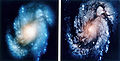
Optical resolution
Optical resolution describes the ability of an imaging system to resolve detail in the object that is being imaged.An imaging system may have many individual components including a lens and recording and display components...
to study distant galaxies to a level of detail that was not possible from the ground. Positioned above the atmosphere
Atmosphere
An atmosphere is a layer of gases that may surround a material body of sufficient mass, and that is held in place by the gravity of the body. An atmosphere may be retained for a longer duration, if the gravity is high and the atmosphere's temperature is low...
, Hubble avoids atmospheric airglow
Airglow
Airglow is the very weak emission of light by a planetary atmosphere. In the case of Earth's atmosphere, this optical phenomenon causes the night sky to never be completely dark .-Development:The airglow phenomenon was first identified in 1868 by Swedish scientist...
allowing it to take more sensitive visible and ultraviolet light images than can be obtained with seeing-limited ground-based telescopes (when good adaptive optics
Adaptive optics
Adaptive optics is a technology used to improve the performance of optical systems by reducing the effect of wavefront distortions. It is used in astronomical telescopes and laser communication systems to remove the effects of atmospheric distortion, and in retinal imaging systems to reduce the...
correction at visible wavelengths becomes possible, 10 m ground-based telescopes may become competitive). Although the telescope's mirror suffered from spherical aberration
Spherical aberration
thumb|right|Spherical aberration. A perfect lens focuses all incoming rays to a point on the [[Optical axis|optic axis]]. A real lens with spherical surfaces suffers from spherical aberration: it focuses rays more tightly if they enter it far from the optic axis than if they enter closer to the...
when the telescope was launched in 1990, it could still be used to take images of more distant galaxies than had previously been obtainable. Because light takes billions of years to reach Earth from very distant galaxies, we see them as they were billions of years ago; thus, extending the scope of such research to increasingly distant galaxies allows a better understanding of how they evolve.
After the spherical aberration was corrected during Space Shuttle
Space Shuttle
The Space Shuttle was a manned orbital rocket and spacecraft system operated by NASA on 135 missions from 1981 to 2011. The system combined rocket launch, orbital spacecraft, and re-entry spaceplane with modular add-ons...
mission STS-61
STS-61
STS-61 was the first Hubble Space Telescope servicing mission, and the fifth flight of the Space Shuttle Endeavour. The mission launched on 2 December 1993 from Kennedy Space Center in Florida. The mission restored the spaceborne observatory's vision, marred by spherical aberration, with the...
in 1993, the improved imaging capabilities of the telescope were used to study increasingly distant and faint galaxies. The Medium Deep Survey (MDS) used the Wide Field and Planetary Camera 2 (WFPC2) to take deep images of random fields while other instruments were being used for scheduled observations. At the same time, other dedicated programs focused on galaxies that were already known through ground-based observation. All of these studies revealed substantial differences between the properties of galaxies today and those that existed several billion years ago.
Up to 10% of the HST's observation time is designated as Director's Discretionary (DD) Time, and is typically awarded to astronomers who wish to study unexpected transient phenomena, such as supernova
Supernova
A supernova is a stellar explosion that is more energetic than a nova. It is pronounced with the plural supernovae or supernovas. Supernovae are extremely luminous and cause a burst of radiation that often briefly outshines an entire galaxy, before fading from view over several weeks or months...
e. Once Hubble's corrective optics were shown to be performing well, Robert Williams, the then-director of the Space Telescope Science Institute
Space Telescope Science Institute
The Space Telescope Science Institute is the science operations center for the Hubble Space Telescope and for the James Webb Space Telescope...
, decided to devote a substantial fraction of his DD time during 1995 to the study of distant galaxies. A special Institute Advisory Committee recommended that the WFPC2 be used to image a "typical" patch of sky at a high galactic latitude, using several optical filters. A working group
Working group
A working group is an interdisciplinary collaboration of researchers working on new research activities that would be difficult to develop under traditional funding mechanisms . The lifespan of the WG can last anywhere between a few months and several years...
was set up to develop and implement the project.
Target selection

Milky Way
The Milky Way is the galaxy that contains the Solar System. This name derives from its appearance as a dim un-resolved "milky" glowing band arching across the night sky...
's disc prevents observations of distant galaxies at low galactic latitudes. The target field had to avoid known bright sources of visible light (such as foreground stars), and infrared
Infrared
Infrared light is electromagnetic radiation with a wavelength longer than that of visible light, measured from the nominal edge of visible red light at 0.74 micrometres , and extending conventionally to 300 µm...
, ultraviolet
Ultraviolet
Ultraviolet light is electromagnetic radiation with a wavelength shorter than that of visible light, but longer than X-rays, in the range 10 nm to 400 nm, and energies from 3 eV to 124 eV...
and X-ray
X-ray
X-radiation is a form of electromagnetic radiation. X-rays have a wavelength in the range of 0.01 to 10 nanometers, corresponding to frequencies in the range 30 petahertz to 30 exahertz and energies in the range 120 eV to 120 keV. They are shorter in wavelength than UV rays and longer than gamma...
emissions, to facilitate later studies at many wavelengths of the objects in the deep field, and also needed to be in a region with a low background infrared 'cirrus'
Infrared Cirrus
Infrared cirrus are filamentary structures seen in infrared light. The name is given because the structure looks cloud-like in appearance. First detected by the Infrared Astronomy Satellite at wavelengths of 60 and 100 micrometres.-External links:...
, the diffuse, wispy infrared emission believed to be caused by warm dust grains in cool clouds of hydrogen
Hydrogen
Hydrogen is the chemical element with atomic number 1. It is represented by the symbol H. With an average atomic weight of , hydrogen is the lightest and most abundant chemical element, constituting roughly 75% of the Universe's chemical elemental mass. Stars in the main sequence are mainly...
gas (H I region
H I region
An H I region is an interstellar cloud composed of neutral atomic hydrogen , in addition to the local abundance of helium and other elements. These regions are non-luminous, save for emission of the 21-cm region spectral line. This line has a very low transition probability, so requires large...
s).
These criteria restricted the field of potential target areas. It was decided that the target should be in Hubble's 'continuous viewing zones' (CVZs)—the areas of sky which are not occulted
Occultation
An occultation is an event that occurs when one object is hidden by another object that passes between it and the observer. The word is used in astronomy . It can also refer to any situation wherein an object in the foreground blocks from view an object in the background...
by the Earth or the moon
Moon
The Moon is Earth's only known natural satellite,There are a number of near-Earth asteroids including 3753 Cruithne that are co-orbital with Earth: their orbits bring them close to Earth for periods of time but then alter in the long term . These are quasi-satellites and not true moons. For more...
during Hubble's orbit. The working group decided to concentrate on the northern CVZ, so that northern-hemisphere telescopes such as the Keck telescopes
Keck telescopes
The W. M. Keck Observatory is a two-telescope astronomical observatory at an elevation of near the summit of Mauna Kea in Hawai'i. The primary mirrors of each of the two telescopes are in diameter, making them the second largest optical telescopes in the world, slightly behind the Gran Telescopio...
, the Kitt Peak National Observatory
Kitt Peak National Observatory
The Kitt Peak National Observatory is a United States astronomical observatory located on 2,096 m Kitt Peak of the Quinlan Mountains in the Arizona-Sonoran Desert on the Tohono O'odham Nation, southwest of Tucson...
telescopes and the Very Large Array
Very Large Array
The Very Large Array is a radio astronomy observatory located on the Plains of San Agustin, between the towns of Magdalena and Datil, some fifty miles west of Socorro, New Mexico, USA...
(VLA) could conduct follow-up observations.
Twenty fields satisfying these criteria were initially identified, from which three optimal candidate fields were selected, all within the constellation of Ursa Major
Ursa Major
Ursa Major , also known as the Great Bear, is a constellation visible throughout the year in most of the northern hemisphere. It can best be seen in April...
. Radio
Radio
Radio is the transmission of signals through free space by modulation of electromagnetic waves with frequencies below those of visible light. Electromagnetic radiation travels by means of oscillating electromagnetic fields that pass through the air and the vacuum of space...
snapshot observations with the VLA
VLA
VLA may refer to:Transport* RUM-139 VL-ASROC, a vertically-launched anti-submarine rocket* Very Light Aircraft, a category of aircraft, per the European EASA CS-VLA specificationsGovernment Agencies...
ruled out one of these fields because it contained a bright radio source, and the final decision between the other two was made on the basis of the availability of guide stars near the field: Hubble observations normally require a pair of nearby stars on which the telescope's Fine Guidance Sensors can lock during an exposure, but given the importance of the HDF observations, the working group required a second set of back-up guide stars. The field that was eventually selected is located at a right ascension
Right ascension
Right ascension is the astronomical term for one of the two coordinates of a point on the celestial sphere when using the equatorial coordinate system. The other coordinate is the declination.-Explanation:...
of and a declination
Declination
In astronomy, declination is one of the two coordinates of the equatorial coordinate system, the other being either right ascension or hour angle. Declination in astronomy is comparable to geographic latitude, but projected onto the celestial sphere. Declination is measured in degrees north and...
of ; in area it is a mere 5.3 square arcminutes. This is approximately 1/28,000,000 of the total area of the sky.
Observations

Filter (optics)
Optical filters are devices which selectively transmit light of different wavelengths, usually implemented as plane glass or plastic devices in the optical path which are either dyed in the mass or have interference coatings....
s the observations would use; WFPC2 is equipped with forty-eight filters, including narrowband
Narrowband
In radio, narrowband describes a channel in which the bandwidth of the message does not significantly exceed the channel's coherence bandwidth. It is a common misconception that narrowband refers to a channel which occupies only a "small" amount of space on the radio spectrum.The opposite of...
filters isolating particular emission lines of astrophysical interest, and broadband
Broadband
The term broadband refers to a telecommunications signal or device of greater bandwidth, in some sense, than another standard or usual signal or device . Different criteria for "broad" have been applied in different contexts and at different times...
filters useful for the study of the colours of stars and galaxies. The choice of filters to be used for the HDF depended on the 'throughput
Throughput
In communication networks, such as Ethernet or packet radio, throughput or network throughput is the average rate of successful message delivery over a communication channel. This data may be delivered over a physical or logical link, or pass through a certain network node...
' of each filter—the total proportion of light that it allows through—and the spectral coverage available. Filters with bandpasses overlapping as little as possible were desirable.
In the end, four broadband filters were chosen, centred at wavelength
Wavelength
In physics, the wavelength of a sinusoidal wave is the spatial period of the wave—the distance over which the wave's shape repeats.It is usually determined by considering the distance between consecutive corresponding points of the same phase, such as crests, troughs, or zero crossings, and is a...
s of 300 nm
Nanometre
A nanometre is a unit of length in the metric system, equal to one billionth of a metre. The name combines the SI prefix nano- with the parent unit name metre .The nanometre is often used to express dimensions on the atomic scale: the diameter...
(near-ultraviolet
Ultraviolet
Ultraviolet light is electromagnetic radiation with a wavelength shorter than that of visible light, but longer than X-rays, in the range 10 nm to 400 nm, and energies from 3 eV to 124 eV...
), 450 nm (blue light), 606 nm (red light) and 814 nm (near-infrared
Infrared
Infrared light is electromagnetic radiation with a wavelength longer than that of visible light, measured from the nominal edge of visible red light at 0.74 micrometres , and extending conventionally to 300 µm...
). Because the quantum efficiency
Quantum efficiency
Quantum efficiency is a quantity defined for a photosensitive device such as photographic film or a charge-coupled device as the percentage of photons hitting the photoreactive surface that will produce an electron–hole pair. It is an accurate measurement of the device's electrical sensitivity to...
of Hubble's detectors is quite low at 300 nm, the noise in observations at this wavelength is primarily due to CCD
Charge-coupled device
A charge-coupled device is a device for the movement of electrical charge, usually from within the device to an area where the charge can be manipulated, for example conversion into a digital value. This is achieved by "shifting" the signals between stages within the device one at a time...
noise rather than sky background; thus, these observations could be conducted at times when high background noise would have harmed the efficiency of observations in other passbands.
Between December 18 and December 28, 1995—during which time Hubble orbited the Earth about 150 times—342 images of the target area in the chosen filters were taken. The total exposure times at each wavelength were 42.7 hours (300 nm), 33.5 hours (450 nm), 30.3 hours (606 nm) and 34.3 hours (814 nm), divided into 342 individual exposures to prevent significant damage to individual images by cosmic ray
Cosmic ray
Cosmic rays are energetic charged subatomic particles, originating from outer space. They may produce secondary particles that penetrate the Earth's atmosphere and surface. The term ray is historical as cosmic rays were thought to be electromagnetic radiation...
s, which cause bright streaks to appear when they strike CCD detectors. A further 10 Hubble orbits were used to make short exposures of flanking fields to aid follow-up observations by other instruments.
Data processing
Wavelength
In physics, the wavelength of a sinusoidal wave is the spatial period of the wave—the distance over which the wave's shape repeats.It is usually determined by considering the distance between consecutive corresponding points of the same phase, such as crests, troughs, or zero crossings, and is a...
was a complex process. Bright pixel
Pixel
In digital imaging, a pixel, or pel, is a single point in a raster image, or the smallest addressable screen element in a display device; it is the smallest unit of picture that can be represented or controlled....
s caused by cosmic ray impacts during exposures were removed by comparing exposures of equal length taken one after the other, and identifying pixels that were affected by cosmic ray
Cosmic ray
Cosmic rays are energetic charged subatomic particles, originating from outer space. They may produce secondary particles that penetrate the Earth's atmosphere and surface. The term ray is historical as cosmic rays were thought to be electromagnetic radiation...
s in one exposure but not the other. Trails of space debris
Space debris
Space debris, also known as orbital debris, space junk, and space waste, is the collection of objects in orbit around Earth that were created by humans but no longer serve any useful purpose. These objects consist of everything from spent rocket stages and defunct satellites to erosion, explosion...
and artificial satellites were present in the original images, and were carefully removed.
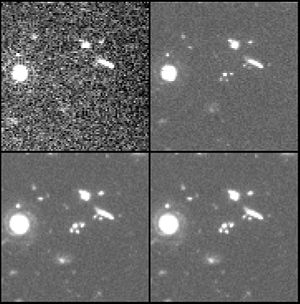
Scattered light from the Earth was evident in about a quarter of the data frames, creating a visible "X" pattern on the images. This was removed by taking an image affected by scattered light, aligning it with an unaffected image, and subtracting the unaffected image from the affected one. The resulting image was smoothed, and could then be subtracted from the bright frame. This procedure removed almost all of the scattered light from the affected images.
Once the 342 individual images were cleaned of cosmic-ray hits and corrected for scattered light, they had to be combined. Scientists involved in the HDF observations pioneered a technique called 'drizzling
Drizzle (image processing)
Drizzle is a digital image processing method for the linear reconstruction of undersampled images. It is normally used for the combination of astronomical images and was originally developed for the Hubble Deep Field observations made by the Hubble Space Telescope...
', in which the pointing of the telescope was varied minutely between sets of exposures. Each pixel on the WFPC2 CCD chips recorded an area of sky 0.09 arcseconds across, but by changing the direction in which the telescope was pointing by less than that between exposures, the resulting images were combined using sophisticated image-processing techniques to yield a final angular resolution better than this value. The HDF images produced at each wavelength had final pixel sizes of 0.03985 arcseconds.
The data processing yielded four monochrome
Monochrome
Monochrome describes paintings, drawings, design, or photographs in one color or shades of one color. A monochromatic object or image has colors in shades of limited colors or hues. Images using only shades of grey are called grayscale or black-and-white...
images (at 300 nm, 450 nm, 606 nm and 814 nm), one at each wavelength. One image was designated as red (814 nm), the second as green (606 nm) and the third as blue (450 nm), and the three images were combined to give a colour image. Because the wavelengths at which the images were taken do not correspond to the wavelengths of red, green and blue light, the colours in the final image only give an approximate representation of the actual colours of the galaxies in the image; the choice of filters for the HDF (and the majority of Hubble images) was primarily designed to maximize the scientific utility of the observations rather than to create colours corresponding to what the human eye
Human eye
The human eye is an organ which reacts to light for several purposes. As a conscious sense organ, the eye allows vision. Rod and cone cells in the retina allow conscious light perception and vision including color differentiation and the perception of depth...
would actually perceive.
Contents of the Deep Field
The final images were released at a meeting of the American Astronomical SocietyAmerican Astronomical Society
The American Astronomical Society is an American society of professional astronomers and other interested individuals, headquartered in Washington, DC...
in January 1996, and revealed a plethora of distant, faint galaxies. About 3,000 distinct galaxies could be identified in the images, with both irregular
Irregular galaxy
An irregular galaxy is a galaxy that does not have a distinct regular shape, like a spiral or an elliptical galaxy. The shape of an irregular galaxy is uncommon – they do not fall into any of the regular classes of the Hubble sequence, and they are often chaotic in appearance, with neither a...
and spiral galaxies
Spiral galaxy
A spiral galaxy is a certain kind of galaxy originally described by Edwin Hubble in his 1936 work The Realm of the Nebulae and, as such, forms part of the Hubble sequence. Spiral galaxies consist of a flat, rotating disk containing stars, gas and dust, and a central concentration of stars known as...
clearly visible, although some galaxies in the field are only a few pixels across. In all, the HDF is thought to contain fewer than twenty galactic foreground stars; by far the majority of objects in the field are distant galaxies.
There are about fifty blue point-like objects in the HDF. Many seem to be associated with nearby galaxies, which together form chains and arcs: these are likely to be regions of intense star formation
Star formation
Star formation is the process by which dense parts of molecular clouds collapse into a ball of plasma to form a star. As a branch of astronomy star formation includes the study of the interstellar medium and giant molecular clouds as precursors to the star formation process and the study of young...
. Others may be distant quasar
Quasar
A quasi-stellar radio source is a very energetic and distant active galactic nucleus. Quasars are extremely luminous and were first identified as being high redshift sources of electromagnetic energy, including radio waves and visible light, that were point-like, similar to stars, rather than...
s. Astronomers initially ruled out the possibility that some of the point-like objects are white dwarf
White dwarf
A white dwarf, also called a degenerate dwarf, is a small star composed mostly of electron-degenerate matter. They are very dense; a white dwarf's mass is comparable to that of the Sun and its volume is comparable to that of the Earth. Its faint luminosity comes from the emission of stored...
s, because they are too blue to be consistent with theories of white dwarf evolution prevalent at the time. However, more recent work has found that many white dwarfs become bluer as they age, lending support to the idea that the HDF might contain white dwarfs.
Scientific results

Redshift
In physics , redshift happens when light seen coming from an object is proportionally increased in wavelength, or shifted to the red end of the spectrum...
values.
As the universe expands, more distant objects recede from the Earth faster, in what is called the Hubble Flow. The light from very distant galaxies is significantly affected by the cosmological redshift. While quasar
Quasar
A quasi-stellar radio source is a very energetic and distant active galactic nucleus. Quasars are extremely luminous and were first identified as being high redshift sources of electromagnetic energy, including radio waves and visible light, that were point-like, similar to stars, rather than...
s with high redshifts were known, very few galaxies with redshifts greater than one were known before the HDF images were produced. The HDF, however, contained many galaxies with redshifts as high as six, corresponding to distances of about 12 billion light-year
Light-year
A light-year, also light year or lightyear is a unit of length, equal to just under 10 trillion kilometres...
s. Due to redshift the most distant objects in the HDF (Lyman-break galaxies) are not actually visible in the Hubble images; they can only be detected in images of the HDF taken at longer wavelengths by ground-based telescopes.
The HDF galaxies contained a considerably larger proportion of disturbed and irregular galaxies than the local universe; galaxy collisions and mergers were more common in the young universe as it was much smaller than today. It is believed that giant elliptical galaxies
Elliptical galaxy
An elliptical galaxy is a galaxy having an approximately ellipsoidal shape and a smooth, nearly featureless brightness profile. They range in shape from nearly spherical to highly flat and in size from hundreds of millions to over one trillion stars...
form when spirals and irregular galaxies collide.
The wealth of galaxies at different stages of their evolution also allowed astronomers to estimate the variation in the rate of star formation
Star formation
Star formation is the process by which dense parts of molecular clouds collapse into a ball of plasma to form a star. As a branch of astronomy star formation includes the study of the interstellar medium and giant molecular clouds as precursors to the star formation process and the study of young...
over the lifetime of the universe. While estimates of the redshifts of HDF galaxies are somewhat crude, astronomers believe that star formation was occurring at its maximum rate 8–10 billion years ago, and has decreased by a factor of about 10 since then.
Another important result from the HDF was the very small number of foreground stars present. For years astronomers had been puzzling over the nature of dark matter
Dark matter
In astronomy and cosmology, dark matter is matter that neither emits nor scatters light or other electromagnetic radiation, and so cannot be directly detected via optical or radio astronomy...
, mass which seems to be undetectable but which observations implied made up about 90% of the mass of the universe. One theory was that dark matter might consist of Massive Astrophysical Compact Halo Objects (MACHO
Macho
Macho typically refers to machismo. Other uses include:*Macho , a short-lived disco group in the late 1970s*Pique macho, Bolivian dish*Macho Man , a 1978 disco song performed by the Village People...
s)—faint but massive objects such as red dwarf
Red dwarf
According to the Hertzsprung-Russell diagram, a red dwarf star is a small and relatively cool star, of the main sequence, either late K or M spectral type....
s and planet
Planet
A planet is a celestial body orbiting a star or stellar remnant that is massive enough to be rounded by its own gravity, is not massive enough to cause thermonuclear fusion, and has cleared its neighbouring region of planetesimals.The term planet is ancient, with ties to history, science,...
s in the outer regions of galaxies. The HDF showed, however, that there were not significant numbers of red dwarfs in the outer parts of our galaxy.
Multifrequency followup

Infrared astronomy
Infrared astronomy is the branch of astronomy and astrophysics that studies astronomical objects visible in infrared radiation. The wavelength of infrared light ranges from 0.75 to 300 micrometers...
or submillimetre
Submillimetre astronomy
Submillimetre astronomy or submillimeter astronomy is the branch of observational astronomy that is conducted at submillimetre wavelengths of the electromagnetic spectrum. Astronomers place the submillimetre waveband between the far-infrared and microwave wavebands, typically taken to be between a...
wavelength surveys of the HDF instead. Observations with the Infrared Space Observatory
Infrared Space Observatory
The Infrared Space Observatory was a space telescope for infrared light designed and operated by the European Space Agency , in cooperation with ISAS and NASA...
(ISO) indicated infrared emission from 13 galaxies visible in the optical images, attributed to large quantities of dust associated with intense star formation. Infrared observations have also been made with the Spitzer Space Telescope
Spitzer Space Telescope
The Spitzer Space Telescope , formerly the Space Infrared Telescope Facility is an infrared space observatory launched in 2003...
. Submillimeter observations of the field have been made with SCUBA on the James Clerk Maxwell Telescope
James Clerk Maxwell Telescope
The James Clerk Maxwell Telescope is a submillimetre-wavelength telescope at Mauna Kea Observatory in Hawaii. Its primary mirror is 15 metres across: it is the largest astronomical telescope that operates in submillimetre wavelengths of the electromagnetic spectrum...
, initially detecting 5 sources, although with very low resolution. Observations have also been made with the Subaru
Subaru (telescope)
Subaru Telescope is the 8.2 metre flagship telescope of the National Astronomical Observatory of Japan, located at the Mauna Kea Observatory on Hawaii. It is named after the open star cluster known in English as the Pleiades...
telescope in Hawaii.
X-ray observations by the Chandra X-ray Observatory
Chandra X-ray Observatory
The Chandra X-ray Observatory is a satellite launched on STS-93 by NASA on July 23, 1999. It was named in honor of Indian-American physicist Subrahmanyan Chandrasekhar who is known for determining the maximum mass for white dwarfs. "Chandra" also means "moon" or "luminous" in Sanskrit.Chandra...
revealed six sources in the HDF, which were found to correspond to three elliptical galaxies: one spiral galaxy, one active galactic nucleus
Active galactic nucleus
An active galactic nucleus is a compact region at the centre of a galaxy that has a much higher than normal luminosity over at least some portion, and possibly all, of the electromagnetic spectrum. Such excess emission has been observed in the radio, infrared, optical, ultra-violet, X-ray and...
and one extremely red object, thought to be a distant galaxy containing a large amount of dust
Dust
Dust consists of particles in the atmosphere that arise from various sources such as soil dust lifted up by wind , volcanic eruptions, and pollution...
absorbing its blue light emissions.
Ground-based radio images taken using the VLA revealed seven radio sources in the HDF, all of which correspond to galaxies visible in the optical images. The field has also been surveyed with the Westerbork Synthesis Radio Telescope
Westerbork Synthesis Radio Telescope
The Westerbork Synthesis Radio Telescope is an aperture synthesis interferometer near camp Westerbork, north of the village of Westerbork, Midden-Drenthe, in the northeastern Netherlands. It consists of a linear array of 14 antennas with a diameter of 25 metres arranged on a 2.7 km East-West line...
and the MERLIN
MERLIN
The Multi-Element Radio Linked Interferometer Network is an interferometer array of radio telescopes spread across England. The array is run from Jodrell Bank Observatory in Cheshire by the University of Manchester on behalf of STFC as a National Facility.The array consists of up to seven radio...
array of radio telescopes at 1.4 GHz; the combination of VLA and MERLIN maps made at wavelengths of 3.5 and 20 cm have located 16 radio sources in the HDF-N field, with many more in the flanking fields. Radio images of some individual sources in the field have been made with the European VLBI Network
European VLBI Network
The European VLBI Network was formed in 1980 by a consortium of five of the major radio astronomy institutes in Europe . Since 1980, the EVN and the Consortium has grown to include 9 institutes with 12 radio telescopes in 8 western European countries as well as associated institutes with...
at 1.6 GHz with a higher resolution than the Hubble maps.
Subsequent HST observations
An HDF counterpart in the southern celestial hemisphere was created in 1998: the HDF-SouthHubble Deep Field South
The Hubble Deep Field South is a composite of several hundred individual images taken using the Hubble Space Telescope's Wide Field and Planetary Camera 2 over 10 days in September and October 1998. It followed the great success of the original Hubble Deep Field in facilitating the study of...
. Created using a similar observing strategy, the HDF-S was very similar in appearance to the original HDF. This supports the cosmological principle
Cosmological Principle
In modern physical cosmology, the cosmological principle is the working assumption that observers on Earth do not occupy an unusual or privileged location within the universe as a whole, judged as observers of the physical phenomena produced by uniform and universal laws of physics...
that at its largest scale the universe is homogeneous
Homogeneity (physics)
In general, homogeneity is defined as the quality or state of being homogeneous . For instance, a uniform electric field would be compatible with homogeneity...
. The HDF-S survey used the Space Telescope Imaging Spectrograph
Space Telescope Imaging Spectrograph
The Space Telescope Imaging Spectrograph is a spectrograph, also with a camera mode, installed on the Hubble Space Telescope. It operated continuously from 1997 until a power supply failure in 2004. After repairs, it began operating again in 2009...
(STIS) and the Near Infrared Camera and Multi-Object Spectrometer
Near Infrared Camera and Multi-Object Spectrometer
The Near Infrared Camera and Multi-Object Spectrometer is a scientific instrument for infrared astronomy, installed on the Hubble Space Telescope , operating from 1997 to 1999, and from 2002 to 2008...
(NICMOS) instruments installed on the HST in 1997; the Hubble Deep Field has since been re-observed several times using WFPC2, as well as by the NICMOS and STIS instruments. Several supernova
Supernova
A supernova is a stellar explosion that is more energetic than a nova. It is pronounced with the plural supernovae or supernovas. Supernovae are extremely luminous and cause a burst of radiation that often briefly outshines an entire galaxy, before fading from view over several weeks or months...
events were detected by comparing the first and second epoch observations of the HDF-N.
A wider survey, but less sensitive, was carried out as part of the Great Observatories Origins Deep Survey
Great Observatories Origins Deep Survey
The Great Observatories Origins Deep Survey or GOODS is an astronomical survey combining deep observations from three of NASAs Great Observatories: the Hubble Space Telescope, the Spitzer Space Telescope and the Chandra X-ray Observatory along with data from other space-based telescopes, such as...
; a section of this was then observed for longer to create the Hubble Ultra-Deep Field, which is the most sensitive optical deep field image to date.