


Apollo 12

Encyclopedia
Apollo 12 was the sixth manned flight in the American
Apollo program and the second to land on the Moon
(an H type mission). It was launched on November 14, 1969 from the Kennedy Space Center
, Florida
, four months after Apollo 11
. Mission commander Charles "Pete" Conrad
and Lunar Module Pilot Alan L. Bean performed just over one day and seven hours of lunar surface activity while Command Module Pilot Richard F. Gordon
remained in lunar orbit. The landing site for the mission was located in the southeastern portion of the Ocean of Storms. Key objectives were achievement of a more precise landing (which had not been achieved by Apollo 11), and to visit the Surveyor 3
probe to remove parts for analysis. The mission ended on November 24 with a successful splashdown
, having completed the main mission parameters successfully.
. Thirty-six-and-a-half seconds after lift-off, the vehicle triggered a lightning
discharge through itself and down to the earth through the Saturn's ionized plume. Protective circuits on the fuel cells in the service module falsely detected overloads and took all three fuel cell
s offline, along with much of the CSM
instrumentation. A second strike at 52 seconds after launch knocked out the "8-ball" attitude indicator
. The telemetry stream at Mission Control was garbled. However, the Saturn V continued to fly correctly; the strikes had not affected the Saturn V's Instrument Unit.
The loss of all three fuel cells put the CSM entirely on batteries. They were unable to maintain normal 28V DC bus voltages into the heavy 75 amp launch loads. One of the AC inverter
s dropped offline. These power supply problems lit nearly every warning light on the control panel and caused much of the instrumentation to malfunction.
Legendary EECOM John Aaron
(the original NASA "steely eyed missile man") remembered the telemetry failure pattern from an earlier test when a power supply malfunctioned in the CSM Signal Conditioning Equipment (SCE). The SCE converts raw signals from instrumentation to standard voltages for the spacecraft instrument displays and telemetry encoders.
Aaron made a call: "Try SCE to aux". This switched the SCE to a backup power supply. The switch was fairly obscure and neither the Flight Director
, CAPCOM, nor Commander Conrad immediately recognized it. Lunar module pilot Alan Bean, flying in the right seat as the CSM systems engineer, remembered the SCE switch from a training incident a year earlier when the same failure had been simulated. Aaron's quick thinking and Bean's memory saved what could have been an aborted mission
. Bean put the fuel cells back on line, and with telemetry restored, the launch continued successfully. Once in earth parking orbit
, the crew carefully checked out their spacecraft before re-igniting the S-IVB
third stage for trans-lunar injection. The lightning strikes had caused no serious permanent damage.
Initially it was feared that the lightning strike could have caused the command module's parachute mechanism to prematurely fire, disabling the explosive bolts that open the parachute compartment to deploy them. If they were indeed disabled, the command module would have crashed uncontrollably into the Pacific Ocean and killed the crew instantly. Since there was no way to figure out whether or not this was the case, ground controllers decided not to tell the astronauts about the possibility. Fortunately, the parachutes deployed and functioned normally at the end of the mission.
After lunar module separation, the S-IVB was intended to fly into solar orbit. The S-IVB auxiliary propulsion system was fired and the remaining propellants vented to slow it down to fly past the Moon's trailing edge (the Apollo spacecraft always approached the Moon's leading edge). The Moon's gravity would then slingshot the stage into solar orbit. However, a small error in the state vector in the Saturn's guidance system caused the S-IVB to fly past the Moon at too high an altitude to achieve earth escape velocity. It remained in a semi-stable earth orbit after passing the Moon on November 18, 1969. It finally escaped earth orbit in 1971 but was briefly recaptured in Earth orbit 31 years later. It was discovered by amateur astronomer Bill Yeung who gave it the temporary designation J002E3
before it was determined to be an artificial object.
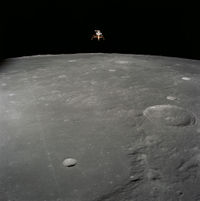 The Apollo 12 mission landed on an area of the Ocean of Storms that had been visited earlier by several unmanned missions (Luna 5
, Surveyor 3
, and Ranger 7
). The International Astronomical Union
, recognizing this, christened this region Mare Cognitum
(Known Sea). The Lunar coordinates
of the landing site were 3.01239° S latitude, 23.42157° W longitude. The landing site would thereafter be listed as Statio Cognitum on lunar maps (Conrad and Bean did not formally name their landing site, interestingly enough, though the intended touchdown point was nicknamed Pete's Parking Lot by Conrad).
The second lunar landing was an exercise in precision targeting, using a Doppler effect
radar technique developed to allow the pinpoint landings needed for future Apollo missions. Most of the descent was automatic, with manual control assumed by Conrad during the final few hundred feet of descent. Unlike Apollo 11 where Neil Armstrong took partial control of the lander and directed it further down range when he noticed that the intended landing site was strewn with boulders, Apollo 12 succeeded, on November 19, in landing within walking distance (less than 200 meters) of its intended target - the Surveyor 3 probe, which had landed on the Moon in April 1967. This was the first — and, to date, only — occasion in which humans have "caught up" to a probe sent to land on another world.
Conrad actually landed Intrepid 580 feet (176.8 m) short of Pete's Parking Lot because the planned landing point looked rougher than anticipated during the final approach to touchdown, and was a little under 1180 feet (359.7 m) from Surveyor 3, a distance that was chosen to eliminate the possibility of lunar dust (being kicked up by Intrepid's descent engine during landing) from covering Surveyor 3. But the actual touchdown point — 600 feet (182.9 m) from Surveyor 3 — did cause a thin film of dust to coat the probe, giving it a light tan hue.
, stepped onto the lunar surface, his first words were "Whoopie! Man, that may have been a small one for Neil, but that's a long one for me." This was not an off-the-cuff remark: Conrad had made a $500 bet with reporter Oriana Fallaci
he would say these words, after she had queried whether NASA had instructed Neil Armstrong what to say as he stepped onto the Moon. Conrad later said he was never able to collect the money.
To improve the quality of television pictures from the Moon, a color camera was carried on Apollo 12 (unlike the monochrome camera that was used on Apollo 11). Unfortunately, when Bean carried the camera to the place near the lunar module where it was to be set up, he inadvertently pointed it directly into the Sun, destroying the SEC tube. Television coverage of this mission was thus terminated almost immediately.See also: Apollo TV camera
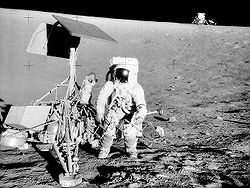
Apollo 12 successfully landed within walking distance of the Surveyor 3
probe. Conrad and Bean removed pieces of the probe to be taken back to Earth for analysis. It is claimed that the common bacterium Streptococcus mitis
was found to have accidentally contaminated the spacecraft's camera prior to launch and survived dormant in this harsh environment for two and a half years. However, this finding has since been disputed: see Reports of Streptococcus mitis on the Moon
.
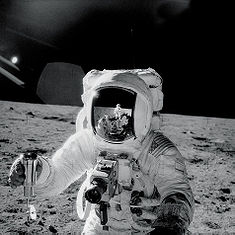
Astronauts Conrad and Bean also collected rocks and set up equipment that took measurements of the Moon's seismicity, solar wind flux and magnetic field, and relayed the measurements to Earth. The instruments were part of the first complete nuclear-powered ALSEP station set up by astronauts on the Moon to relay long-term data from the lunar surface. The instruments on Apollo 11 were not as extensive or designed to operate long term. The astronauts also took photographs, although by accident Bean left several rolls of exposed film on the lunar surface. Meanwhile Gordon, on board the Yankee Clipper in lunar orbit, took multi-spectral photographs of the surface.
The lunar plaque
attached to the descent stage of Intrepid is unique in that unlike the other plaques, it (a) did not have a depiction of the Earth, and (b) it was textured differently (the other plaques had black lettering on polished stainless steel while the Apollo 12 plaque had the lettering in polished stainless steel while the background was brushed flat).
 Intrepid's ascent stage was dropped (per normal procedures) after Conrad and Bean rejoined Gordon in orbit. It impacted the Moon on November 20, 1969 at 3.94°S 21.20°W. The seismometers the astronauts had left on the lunar surface registered the vibrations for more than an hour.
The crew stayed an extra day in lunar orbit taking photographs, for a total lunar surface stay of 31 and a half hours and a total time in lunar orbit of eighty-nine hours.
On the return flight to Earth after leaving lunar orbit, the crew of Apollo 12 witnessed (and photographed) a solar eclipse
, though this one was of the Earth eclipsing the sun.
) in the Pacific Ocean
, approximately 500 nautical miles (800 km) east of American Samoa
. During splashdown, a 16 mm camera dislodged from storage and struck Bean in the forehead, rendering him briefly unconscious. He suffered a mild concussion and needed six stitches. After recovery by the USS Hornet
, they were flown to Pago Pago International Airport
in Tafuna
for a reception, before being flown on a C-141 cargo plane to Honolulu
.
, who was killed on October 5, 1967, after a mechanical failure caused the controls of his T-38 trainer to stop responding. He trained with Conrad and Gordon as part of the back-up crew for what would be the Apollo 9
mission, and would have been assigned as Lunar Module pilot for Apollo 12.
in Hampton, Virginia
.
In 2002, astronomers thought they might have discovered another moon orbiting Earth, which they designated J002E3
, that turned out to be the third stage of the Apollo 12 Saturn V rocket.
The Lunar Module Intrepid impacted the Moon November 20, 1969 at 22:17:17.7 UT (5:17 PM EST) 3.94°S 21.20°W. In 2009, the Lunar Reconnaissance Orbiter
photographed the Apollo 12 landing site. The Intrepid lunar module descent stage, experiment package (ALSEP), Surveyor 3 spacecraft, and astronaut footpaths are all visible. In 2011, the Lunar Reconnaissance Orbiter
returned to the landing site at a lower altitude to take higher resolution photographs.
, Tom Verica
, and Dave Foley
, respectively. Conrad had been portrayed by a different actor, Peter Scolari
, in the first two episodes.
United States
The United States of America is a federal constitutional republic comprising fifty states and a federal district...
Apollo program and the second to land on the Moon
Moon
The Moon is Earth's only known natural satellite,There are a number of near-Earth asteroids including 3753 Cruithne that are co-orbital with Earth: their orbits bring them close to Earth for periods of time but then alter in the long term . These are quasi-satellites and not true moons. For more...
(an H type mission). It was launched on November 14, 1969 from the Kennedy Space Center
Kennedy Space Center
The John F. Kennedy Space Center is the NASA installation that has been the launch site for every United States human space flight since 1968. Although such flights are currently on hiatus, KSC continues to manage and operate unmanned rocket launch facilities for America's civilian space program...
, Florida
Florida
Florida is a state in the southeastern United States, located on the nation's Atlantic and Gulf coasts. It is bordered to the west by the Gulf of Mexico, to the north by Alabama and Georgia and to the east by the Atlantic Ocean. With a population of 18,801,310 as measured by the 2010 census, it...
, four months after Apollo 11
Apollo 11
In early 1969, Bill Anders accepted a job with the National Space Council effective in August 1969 and announced his retirement as an astronaut. At that point Ken Mattingly was moved from the support crew into parallel training with Anders as backup Command Module Pilot in case Apollo 11 was...
. Mission commander Charles "Pete" Conrad
Pete Conrad
Charles "Pete" Conrad, Jr. was an American naval officer, astronaut and engineer, and the third person to walk on the Moon during the Apollo 12 mission. He set an eight-day space endurance record along with command pilot Gordon Cooper on the Gemini 5 mission, and commanded the Gemini 11 mission...
and Lunar Module Pilot Alan L. Bean performed just over one day and seven hours of lunar surface activity while Command Module Pilot Richard F. Gordon
Richard F. Gordon, Jr.
Richard Francis Gordon, Jr., Captain, USN, Ret. is a retired NASA astronaut. He is one of only 24 people to have flown to the Moon.-Military and flight experience:Gordon was born in Seattle, Washington...
remained in lunar orbit. The landing site for the mission was located in the southeastern portion of the Ocean of Storms. Key objectives were achievement of a more precise landing (which had not been achieved by Apollo 11), and to visit the Surveyor 3
Surveyor 3
Surveyor 3 was the third lander of the American unmanned Surveyor program sent to explore the surface of the Moon. Launched on April 17, 1967, Surveyor 3 landed on April 20, 1967 at the Mare Cognitum portion of the Oceanus Procellarum...
probe to remove parts for analysis. The mission ended on November 24 with a successful splashdown
Splashdown (spacecraft landing)
Splashdown is the method of landing a spacecraft by parachute in a body of water. It was used by American manned spacecraft prior to the Space Shuttle program. It is also possible for the Russian Soyuz spacecraft and Chinese Shenzhou spacecraft to land in water, though this is only a contingency...
, having completed the main mission parameters successfully.
Crew
Backup crew
Flight directors
- Gerry Griffin, Gold team
- Pete Frank, Orange team
- Cliff Charlesworth, Green team
- Milton Windler, Maroon team
Mission parameters
- Landing Site: W3.01239°S 23.42157°W
LM–CSM docking
- Undocked: November 19, 1969 – 04:16:02 UTC
- Redocked: November 20, 1969 – 17:58:20 UTC
EVA 1 start: November 19, 1969, 11:32:35 UTC
- Conrad — EVA 1
- Stepped onto Moon: 11:44:22 UTC
- LM ingress: 15:27:17 UTC
- Bean — EVA 1
- Stepped onto Moon: 12:13:50 UTC
- LM ingress: 15:14:18 UTC
EVA 2 start: November 20, 1969, 03:54:45 UTC
- Conrad — EVA 2
- Stepped onto Moon: 03:59:00 UTC
- LM ingress: 07:42:00 UTC
- Bean — EVA 2
- Stepped onto Moon: 04:06:00 UTC
- LM ingress: 07:30:00 UTC
Mission highlights
 |
 |
 |
Launch and transfer
Apollo 12 launched on schedule from Kennedy Space Center, during a rainstorm. It was the first rocket launch attended by an incumbent US president, Richard NixonRichard Nixon
Richard Milhous Nixon was the 37th President of the United States, serving from 1969 to 1974. The only president to resign the office, Nixon had previously served as a US representative and senator from California and as the 36th Vice President of the United States from 1953 to 1961 under...
. Thirty-six-and-a-half seconds after lift-off, the vehicle triggered a lightning
Lightning
Lightning is an atmospheric electrostatic discharge accompanied by thunder, which typically occurs during thunderstorms, and sometimes during volcanic eruptions or dust storms...
discharge through itself and down to the earth through the Saturn's ionized plume. Protective circuits on the fuel cells in the service module falsely detected overloads and took all three fuel cell
Fuel cell
A fuel cell is a device that converts the chemical energy from a fuel into electricity through a chemical reaction with oxygen or another oxidizing agent. Hydrogen is the most common fuel, but hydrocarbons such as natural gas and alcohols like methanol are sometimes used...
s offline, along with much of the CSM
Apollo Command/Service Module
The Command/Service Module was one of two spacecraft, along with the Lunar Module, used for the United States Apollo program which landed astronauts on the Moon. It was built for NASA by North American Aviation...
instrumentation. A second strike at 52 seconds after launch knocked out the "8-ball" attitude indicator
Attitude indicator
An attitude indicator , also known as gyro horizon or artificial horizon, is an instrument used in an aircraft to inform the pilot of the orientation of the aircraft relative to earth. It indicates pitch and bank or roll and is a primary instrument for flight in instrument meteorological conditions...
. The telemetry stream at Mission Control was garbled. However, the Saturn V continued to fly correctly; the strikes had not affected the Saturn V's Instrument Unit.
The loss of all three fuel cells put the CSM entirely on batteries. They were unable to maintain normal 28V DC bus voltages into the heavy 75 amp launch loads. One of the AC inverter
Inverter (electrical)
An inverter is an electrical device that converts direct current to alternating current ; the converted AC can be at any required voltage and frequency with the use of appropriate transformers, switching, and control circuits....
s dropped offline. These power supply problems lit nearly every warning light on the control panel and caused much of the instrumentation to malfunction.
Legendary EECOM John Aaron
John Aaron
John W. Aaron is a former NASA engineer, and was a flight controller during the Apollo program. He is widely credited with saving the Apollo 12 mission when it was struck by lightning shortly after liftoff and played an important role during the Apollo 13 crisis, earning him the highly...
(the original NASA "steely eyed missile man") remembered the telemetry failure pattern from an earlier test when a power supply malfunctioned in the CSM Signal Conditioning Equipment (SCE). The SCE converts raw signals from instrumentation to standard voltages for the spacecraft instrument displays and telemetry encoders.
Aaron made a call: "Try SCE to aux". This switched the SCE to a backup power supply. The switch was fairly obscure and neither the Flight Director
Flight director
The term flight director can refer to any one of the following:* the flight controller of a space flight* the flight director of an aviation navigation system...
, CAPCOM, nor Commander Conrad immediately recognized it. Lunar module pilot Alan Bean, flying in the right seat as the CSM systems engineer, remembered the SCE switch from a training incident a year earlier when the same failure had been simulated. Aaron's quick thinking and Bean's memory saved what could have been an aborted mission
Apollo abort modes
During the launch of an Apollo spacecraft by the Saturn V rocket, the flight could be aborted to rescue the crew if the rocket failed catastrophically. Depending on how far into the flight the crew were, they would use different procedures or modes...
. Bean put the fuel cells back on line, and with telemetry restored, the launch continued successfully. Once in earth parking orbit
Parking orbit
A parking orbit is a temporary orbit used during the launch of a satellite or other space probe. A launch vehicle boosts into the parking orbit, then coasts for a while, then fires again to enter the final desired trajectory...
, the crew carefully checked out their spacecraft before re-igniting the S-IVB
S-IVB
The S-IVB was built by the Douglas Aircraft Company and served as the third stage on the Saturn V and second stage on the Saturn IB. It had one J-2 engine...
third stage for trans-lunar injection. The lightning strikes had caused no serious permanent damage.
Initially it was feared that the lightning strike could have caused the command module's parachute mechanism to prematurely fire, disabling the explosive bolts that open the parachute compartment to deploy them. If they were indeed disabled, the command module would have crashed uncontrollably into the Pacific Ocean and killed the crew instantly. Since there was no way to figure out whether or not this was the case, ground controllers decided not to tell the astronauts about the possibility. Fortunately, the parachutes deployed and functioned normally at the end of the mission.
After lunar module separation, the S-IVB was intended to fly into solar orbit. The S-IVB auxiliary propulsion system was fired and the remaining propellants vented to slow it down to fly past the Moon's trailing edge (the Apollo spacecraft always approached the Moon's leading edge). The Moon's gravity would then slingshot the stage into solar orbit. However, a small error in the state vector in the Saturn's guidance system caused the S-IVB to fly past the Moon at too high an altitude to achieve earth escape velocity. It remained in a semi-stable earth orbit after passing the Moon on November 18, 1969. It finally escaped earth orbit in 1971 but was briefly recaptured in Earth orbit 31 years later. It was discovered by amateur astronomer Bill Yeung who gave it the temporary designation J002E3
J002E3
J002E3 is the designation given to a supposed asteroid discovered by amateur astronomer Bill Yeung on September 3, 2002. Further examination revealed the object was not a rock asteroid but instead the S-IVB third stage of the Apollo 12 Saturn V rocket .When it was first discovered it was quickly...
before it was determined to be an artificial object.
Landing
Luna 5
Luna 5 was an unmanned space mission of the Luna program, also called Lunik 5. It was designed to continue investigations of a lunar soft landing. The retrorocket system failed, and the spacecraft impacted the lunar surface at the Sea of Clouds....
, Surveyor 3
Surveyor 3
Surveyor 3 was the third lander of the American unmanned Surveyor program sent to explore the surface of the Moon. Launched on April 17, 1967, Surveyor 3 landed on April 20, 1967 at the Mare Cognitum portion of the Oceanus Procellarum...
, and Ranger 7
Ranger 7
Ranger 7 was the first US space probe to successfully transmit close images of the lunar surface back to Earth. It was also the first completely successful flight of the Ranger program. Launched on 28 July 1964, Ranger 7 was designed to achieve a lunar impact trajectory and to transmit...
). The International Astronomical Union
International Astronomical Union
The International Astronomical Union IAU is a collection of professional astronomers, at the Ph.D. level and beyond, active in professional research and education in astronomy...
, recognizing this, christened this region Mare Cognitum
Mare Cognitum
Mare Cognitum is a lunar mare located in a basin or large crater which sits in the second ring of the Procellarum basin. The basin material is of the Lower Imbrian epoch, while the basaltic mare material is of the Upper Imbrian epoch...
(Known Sea). The Lunar coordinates
Selenographic coordinates
Selenographic coordinates are used to refer to locations on the surface of Earth's moon. Any position on the lunar surface can be referenced by specifying two numerical values, which are comparable to the latitude and longitude of Earth...
of the landing site were 3.01239° S latitude, 23.42157° W longitude. The landing site would thereafter be listed as Statio Cognitum on lunar maps (Conrad and Bean did not formally name their landing site, interestingly enough, though the intended touchdown point was nicknamed Pete's Parking Lot by Conrad).
The second lunar landing was an exercise in precision targeting, using a Doppler effect
Doppler effect
The Doppler effect , named after Austrian physicist Christian Doppler who proposed it in 1842 in Prague, is the change in frequency of a wave for an observer moving relative to the source of the wave. It is commonly heard when a vehicle sounding a siren or horn approaches, passes, and recedes from...
radar technique developed to allow the pinpoint landings needed for future Apollo missions. Most of the descent was automatic, with manual control assumed by Conrad during the final few hundred feet of descent. Unlike Apollo 11 where Neil Armstrong took partial control of the lander and directed it further down range when he noticed that the intended landing site was strewn with boulders, Apollo 12 succeeded, on November 19, in landing within walking distance (less than 200 meters) of its intended target - the Surveyor 3 probe, which had landed on the Moon in April 1967. This was the first — and, to date, only — occasion in which humans have "caught up" to a probe sent to land on another world.
Conrad actually landed Intrepid 580 feet (176.8 m) short of Pete's Parking Lot because the planned landing point looked rougher than anticipated during the final approach to touchdown, and was a little under 1180 feet (359.7 m) from Surveyor 3, a distance that was chosen to eliminate the possibility of lunar dust (being kicked up by Intrepid's descent engine during landing) from covering Surveyor 3. But the actual touchdown point — 600 feet (182.9 m) from Surveyor 3 — did cause a thin film of dust to coat the probe, giving it a light tan hue.
EVAs
When Conrad, who was somewhat shorter than Neil ArmstrongNeil Armstrong
Neil Alden Armstrong is an American former astronaut, test pilot, aerospace engineer, university professor, United States Naval Aviator, and the first person to set foot upon the Moon....
, stepped onto the lunar surface, his first words were "Whoopie! Man, that may have been a small one for Neil, but that's a long one for me." This was not an off-the-cuff remark: Conrad had made a $500 bet with reporter Oriana Fallaci
Oriana Fallaci
Oriana Fallaci was an Italian journalist, author, and political interviewer. A former partisan during World War II, she had a long and successful journalistic career...
he would say these words, after she had queried whether NASA had instructed Neil Armstrong what to say as he stepped onto the Moon. Conrad later said he was never able to collect the money.
To improve the quality of television pictures from the Moon, a color camera was carried on Apollo 12 (unlike the monochrome camera that was used on Apollo 11). Unfortunately, when Bean carried the camera to the place near the lunar module where it was to be set up, he inadvertently pointed it directly into the Sun, destroying the SEC tube. Television coverage of this mission was thus terminated almost immediately.See also: Apollo TV camera
Apollo TV camera
Television cameras used on the Apollo Project's missions varied in design, with image quality improving significantly with each design. A camera was carried in the Apollo Command Module...
Apollo 12 successfully landed within walking distance of the Surveyor 3
Surveyor 3
Surveyor 3 was the third lander of the American unmanned Surveyor program sent to explore the surface of the Moon. Launched on April 17, 1967, Surveyor 3 landed on April 20, 1967 at the Mare Cognitum portion of the Oceanus Procellarum...
probe. Conrad and Bean removed pieces of the probe to be taken back to Earth for analysis. It is claimed that the common bacterium Streptococcus mitis
Streptococcus mitis
Streptococcus mitis is a mesophilic alpha-hemolytic species of Streptococcus that inhabits the human mouth. It is a Gram positive, coccus, facultative anaerobe and catalase negative. It can cause endocarditis...
was found to have accidentally contaminated the spacecraft's camera prior to launch and survived dormant in this harsh environment for two and a half years. However, this finding has since been disputed: see Reports of Streptococcus mitis on the Moon
Reports of Streptococcus mitis on the moon
As part of the Apollo 12 mission, the camera from the Surveyor 3 probe was brought back to Earth. On analyzing the camera it was found that the common bacterium Streptococcus mitis was alive on the camera...
.
Astronauts Conrad and Bean also collected rocks and set up equipment that took measurements of the Moon's seismicity, solar wind flux and magnetic field, and relayed the measurements to Earth. The instruments were part of the first complete nuclear-powered ALSEP station set up by astronauts on the Moon to relay long-term data from the lunar surface. The instruments on Apollo 11 were not as extensive or designed to operate long term. The astronauts also took photographs, although by accident Bean left several rolls of exposed film on the lunar surface. Meanwhile Gordon, on board the Yankee Clipper in lunar orbit, took multi-spectral photographs of the surface.
The lunar plaque
Lunar plaque
Lunar plaques are rectangular stainless steel plaques attached to the ladders on the descent stages of the American lunar modules used from Apollo 11 through Apollo 17. All of the plaques bear facsimiles of the participating astronauts' signatures. Two of the plaques bear a facsimile of the...
attached to the descent stage of Intrepid is unique in that unlike the other plaques, it (a) did not have a depiction of the Earth, and (b) it was textured differently (the other plaques had black lettering on polished stainless steel while the Apollo 12 plaque had the lettering in polished stainless steel while the background was brushed flat).
Return
The crew stayed an extra day in lunar orbit taking photographs, for a total lunar surface stay of 31 and a half hours and a total time in lunar orbit of eighty-nine hours.
On the return flight to Earth after leaving lunar orbit, the crew of Apollo 12 witnessed (and photographed) a solar eclipse
Solar eclipse
As seen from the Earth, a solar eclipse occurs when the Moon passes between the Sun and the Earth, and the Moon fully or partially blocks the Sun as viewed from a location on Earth. This can happen only during a new moon, when the Sun and the Moon are in conjunction as seen from Earth. At least...
, though this one was of the Earth eclipsing the sun.
Splashdown
Yankee Clipper returned to Earth on November 24, 1969, at 20:58 UTC (3:58pm EST, 10:58am HSTHawaii-Aleutian time zone
The Hawaii-Aleutian Time Zone observes Hawaii-Aleutian Standard Time , by subtracting ten hours from Coordinated Universal Time . The clock time in this zone is based on the mean solar time of the 150th meridian west of the Greenwich Observatory....
) in the Pacific Ocean
Pacific Ocean
The Pacific Ocean is the largest of the Earth's oceanic divisions. It extends from the Arctic in the north to the Southern Ocean in the south, bounded by Asia and Australia in the west, and the Americas in the east.At 165.2 million square kilometres in area, this largest division of the World...
, approximately 500 nautical miles (800 km) east of American Samoa
American Samoa
American Samoa is an unincorporated territory of the United States located in the South Pacific Ocean, southeast of the sovereign state of Samoa...
. During splashdown, a 16 mm camera dislodged from storage and struck Bean in the forehead, rendering him briefly unconscious. He suffered a mild concussion and needed six stitches. After recovery by the USS Hornet
USS Hornet (CV-12)
USS Hornet is a United States Navy aircraft carrier of the Essex class. Construction started in August 1942; she was originally named , but was renamed in honor of the , which was lost in October 1942, becoming the eighth ship to bear the name.Hornet was commissioned in November 1943, and after...
, they were flown to Pago Pago International Airport
Pago Pago International Airport
Pago Pago International Airport , also referred to as Tafuna Airport , Tafuna Airfield, Tafuna Airbase or Pago Pago International with airport designation PPG is a public airport located seven miles southwest of the central business district of Pago Pago, in the village and plains of Tafuna on...
in Tafuna
Tafuna, American Samoa
Tafuna is a village on the east coast of Tutuila Island, American Samoa. It is located on a peninsular a mile north of Pago Pago International Airport and one mile south of Nu'uuli, American Samoa. Tafuna is the largest village in American Samoa, with a population of 8,209 according to the US...
for a reception, before being flown on a C-141 cargo plane to Honolulu
Honolulu, Hawaii
Honolulu is the capital and the most populous city of the U.S. state of Hawaii. Honolulu is the southernmost major U.S. city. Although the name "Honolulu" refers to the urban area on the southeastern shore of the island of Oahu, the city and county government are consolidated as the City and...
.
Stunts and mementos
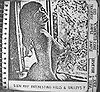
- Alan Bean smuggled a camera-shutter self-timer device on to the mission with the intent of taking a photograph with himself, Pete Conrad and the Surveyor 3 probe in the frame. As the timer was not part of their standard equipment, such an image would have thrown post-mission photo analysts into confusion over how the photo was taken. However, the self-timer was misplaced during the EVA and the plan was never executed.
- As one of the many pranks pulled during the friendly rivalry between the all-Navy prime crew and the all-Air Force backup crew, the Apollo 12 backup crew managed to insert into the astronaut's lunar checklist (attached to the wrists of Conrad's and Bean's spacesuits) reduced-sized pictures of PlayboyPlayboyPlayboy is an American men's magazine that features photographs of nude women as well as journalism and fiction. It was founded in Chicago in 1953 by Hugh Hefner and his associates, and funded in part by a $1,000 loan from Hefner's mother. The magazine has grown into Playboy Enterprises, Inc., with...
centerfolds, surprising Conrad and Bean when they looked through the checklist flip-book during their first EVA. The Apollo Lunar Surface Journal website contains a PDF file with the photocopies of their cuff checklists showing these photos. Appearing in Conrad's checklist were Angela Dorian, Miss September 1967Victoria Vetri-Biography:Vetri was born in San Francisco, California to parents who were immigrants from Italy. She attended Hollywood High School in Hollywood, California between 1959 and 1963 and later studied art at Los Angeles City College. She began acting and modelling in her teens. Vetri is a singer and...
(with the caption "SEEN ANY INTERESTING HILLS & VALLEYS ?") and Reagan Wilson, Miss October 1967Reagan WilsonReagan Diana Wilson is an American model and actress who was Playboy magazine's Playmate of the Month for its October 1967 issue. Her centerfold was photographed by Ron Vogel....
("PREFERRED TETHER PARTNER", referring to a special procedure that would require the sharing of life support resources). The photos in Bean's cuff checklist were of Cynthia Myers, Miss December 1968Cynthia MyersCynthia Myers was an American model and actress, and Playboy magazine's Playmate of the Month for the December 1968 issue.-Career:...
("DON'T FORGET - DESCRIBE THE PROTUBERANCES") and Leslie Bianchini, Miss January 1969 ("SURVEY - HER ACTIVITY", in punPunThe pun, also called paronomasia, is a form of word play which suggests two or more meanings, by exploiting multiple meanings of words, or of similar-sounding words, for an intended humorous or rhetorical effect. These ambiguities can arise from the intentional use and abuse of homophonic,...
of Surveyor). The backup crew who did this later flew to the Moon themselves on Apollo 15Apollo 15Apollo 15 was the ninth manned mission in the American Apollo space program, the fourth to land on the Moon and the eighth successful manned mission. It was the first of what were termed "J missions", long duration stays on the Moon with a greater focus on science than had been possible on previous...
, with Jim Irwin dedicating his life to Christian ministry after his mission. Also at the back of Conrad's checklist were two pages of pre-prepared complex geological terminology, added as a joke to give him the option to sound to Mission Control like he was as skilled as a professional career geologist. The third crewmember orbiting the Moon was not left out of the Playboy prank, as a November 1969 calendar featuring DeDe Lind, Miss August 1967DeDe LindDeDe Lind is an American glamour model famous for her appearance in Playboy magazine as the Playmate of the Month for August 1967.-Playboy:...
had been stowed in a locker that Dick Gordon found while his crewmates were on the lunar surface. In 2011, he put this calendar up for auction. Its value was estimated by RRAuction at $12,000-$16,000. While the CMP calendar was in full color, the lunar checklists carried black & white photocopies (although these were dramatized in From the Earth to the Moon as full color photos in the checklists). - The artist Forrest (Frosty) Myers claims to have installed the art piece "Moon MuseumMoon MuseumThe Moon Museum is a small ceramic wafer three-quarters of an inch by half an inch in size, containing artworks by six prominent artists from the late 1960s...
" on "a leg of the Intrepid landing module with the help of an unnamed engineer at the Grumman Corporation after attempts to move the project forward through NASA's official channels were unsuccessful." - Alan Bean left a memento on the Moon: his silver astronaut pin. This pin signified an astronaut who completed training but had not yet flown in space; he had worn it for six years. He was to get a gold astronaut pin for successfully completing the mission after the flight and felt he wouldn't need the silver pin thereafter. Tossing his pin into a lunar crater extended the common tradition among military pilots to ceremonially dispose of their originally awarded flight wings.
Mission insignia
The Apollo 12 mission patch shows the crew's Navy background. It features a clipper ship arriving at the Moon, representing the command module Yankee Clipper. The ship trails fire and flies the flag of the United States. The mission name APOLLO XII and the crew names are on a wide gold border, with a small blue trim. Blue and gold are traditionally Navy colors. The patch has four stars on it — one each for the three astronauts who flew the mission and one for Clifton WilliamsClifton Williams
This article is about the American astronaut. For the composer, see Clifton Williams .Clifton Curtis 'C.C.' Williams was a NASA astronaut, a Naval Aviator, and a Major in the United States Marine Corps who was killed in a plane crash; he had never been to space...
, who was killed on October 5, 1967, after a mechanical failure caused the controls of his T-38 trainer to stop responding. He trained with Conrad and Gordon as part of the back-up crew for what would be the Apollo 9
Apollo 9
Apollo 9, the third manned mission in the American Apollo space program, was the first flight of the Command/Service Module with the Lunar Module...
mission, and would have been assigned as Lunar Module pilot for Apollo 12.
Spacecraft location
The Apollo 12 Command Module Yankee Clipper is on display at the Virginia Air and Space CenterVirginia Air and Space Center
The Virginia Air and Space Center is a museum and educational facility in Hampton, Virginia that also serves as the visitors center for NASA's Langley Research Center...
in Hampton, Virginia
Hampton, Virginia
Hampton is an independent city that is not part of any county in Southeast Virginia. Its population is 137,436. As one of the seven major cities that compose the Hampton Roads metropolitan area, it is on the southeastern end of the Virginia Peninsula. Located on the Hampton Roads Beltway, it hosts...
.
In 2002, astronomers thought they might have discovered another moon orbiting Earth, which they designated J002E3
J002E3
J002E3 is the designation given to a supposed asteroid discovered by amateur astronomer Bill Yeung on September 3, 2002. Further examination revealed the object was not a rock asteroid but instead the S-IVB third stage of the Apollo 12 Saturn V rocket .When it was first discovered it was quickly...
, that turned out to be the third stage of the Apollo 12 Saturn V rocket.
The Lunar Module Intrepid impacted the Moon November 20, 1969 at 22:17:17.7 UT (5:17 PM EST) 3.94°S 21.20°W. In 2009, the Lunar Reconnaissance Orbiter
Lunar Reconnaissance Orbiter
The Lunar Precursor Robotic Program is a program of robotic spacecraft missions which NASA will use to prepare for future human spaceflight missions to the Moon. Two LPRP missions, the Lunar Reconnaissance Orbiter and the Lunar Crater Observation and Sensing Satellite , were launched in June 2009...
photographed the Apollo 12 landing site. The Intrepid lunar module descent stage, experiment package (ALSEP), Surveyor 3 spacecraft, and astronaut footpaths are all visible. In 2011, the Lunar Reconnaissance Orbiter
Lunar Reconnaissance Orbiter
The Lunar Precursor Robotic Program is a program of robotic spacecraft missions which NASA will use to prepare for future human spaceflight missions to the Moon. Two LPRP missions, the Lunar Reconnaissance Orbiter and the Lunar Crater Observation and Sensing Satellite , were launched in June 2009...
returned to the landing site at a lower altitude to take higher resolution photographs.
Depiction in media
Portions of the Apollo 12 mission are dramatized in the miniseries From the Earth to the Moon episode entitled "That's All There Is". Conrad, Gordon, and Bean were portrayed by Paul McCranePaul McCrane
Paul David McCrane is an American film, television and theatre actor, as well as an occasional television director. He is perhaps best known for his portrayal of Montgomery MacNeil in the 1980 film Fame and Dr. Robert Romano on the NBC medical drama television series ER.-Early life:McCrane was...
, Tom Verica
Tom Verica
Tom Verica is an American actor and director, known for his role of Jack Pryor on the NBC drama American Dreams. He played Astronaut Dick Gordon in the HBO miniseries From The Earth To The Moon...
, and Dave Foley
Dave Foley
David Scott "Dave" Foley is a Canadian comedian, writer, director, and producer best known for his work in The Kids in the Hall, NewsRadio, A Bug's Life, and Celebrity Poker Showdown...
, respectively. Conrad had been portrayed by a different actor, Peter Scolari
Peter Scolari
Peter Scolari is an American television, film and stage actor best known for his roles in the television shows Newhart, Honey, I Shrunk the Kids: The TV Show, and Bosom Buddies.-Career:...
, in the first two episodes.
See also
- Extra-vehicular activityExtra-vehicular activityExtra-vehicular activity is work done by an astronaut away from the Earth, and outside of a spacecraft. The term most commonly applies to an EVA made outside a craft orbiting Earth , but also applies to an EVA made on the surface of the Moon...
- List of spacewalks
- SplashdownSplashdown (spacecraft landing)Splashdown is the method of landing a spacecraft by parachute in a body of water. It was used by American manned spacecraft prior to the Space Shuttle program. It is also possible for the Russian Soyuz spacecraft and Chinese Shenzhou spacecraft to land in water, though this is only a contingency...
- List of artificial objects on the Moon
- Google MoonGoogle MoonGoogle Moon is a service similar to Google Maps that shows satellite images of the Moon. It was launched by Google on July 20, 2005, the 36th anniversary of the Apollo 11 lunar landing...
External links
- NASA Apollo 12 press kit - Nov 5, 1969
- Image of mission patch
- Map of surface activities for Apollo 12
- Apollo 12 entry in Encyclopedia Astronautica
- NASA NSSDC Master Catalog
- APOLLO BY THE NUMBERS: A Statistical Reference by Richard W. Orloff (NASA)
- The Apollo Spacecraft: A Chronology
- Apollo Program Summary Report
- Apollo 12 Science Experiments
- Actual Mission Audio Recordings
- Apollo 12: There and Back Again - image slideshow by Life magazine

