


Inertial Upper Stage

Encyclopedia
.jpg)
Titan III
The Titan IIIC was a space booster used by the United States Air Force. It was launched from Cape Canaveral Air Force Station, FL., and Vandenberg Air Force Base, CA. It was planned to be used as a launch vehicle in the cancelled Dyna-Soar and Manned Orbiting Laboratory programs...
(later Titan IV
Titan IV
The Titan IV family of space boosters were used by the U.S. Air Force. They were launched from Cape Canaveral Air Force Station, Florida, and Vandenberg Air Force Base, California. At the time of its introduction, the Titan IV was the "largest unmanned space booster used by the Air Force."The...
) rocket or from the payload bay of the Space Shuttle
Space Shuttle
The Space Shuttle was a manned orbital rocket and spacecraft system operated by NASA on 135 missions from 1981 to 2011. The system combined rocket launch, orbital spacecraft, and re-entry spaceplane with modular add-ons...
.
Development of the IUS
During the development phase of the Space Shuttle (1969–1974), NASA, with reluctant support from the Air Force, wanted an upper stage that can be used on the Space Shuttle, but at the same time, can be switched over to the Titan III rocket (then the most powerful unmanned rocket in the U.S. fleet, since the Saturn INT-21Saturn INT-21
The Saturn INT-21 was a study for an American orbital launch vehicle of the 1970s. It was derived from the Saturn V rocket used for the Apollo program, using its first and second stages, but lacking the third stage. The guidance unit would be moved from the top of the third stage to the top of the...
, a derivative of the Saturn V
Saturn V
The Saturn V was an American human-rated expendable rocket used by NASA's Apollo and Skylab programs from 1967 until 1973. A multistage liquid-fueled launch vehicle, NASA launched 13 Saturn Vs from the Kennedy Space Center, Florida with no loss of crew or payload...
rocket, was only used once for the launch of Skylab
Skylab
Skylab was a space station launched and operated by NASA, the space agency of the United States. Skylab orbited the Earth from 1973 to 1979, and included a workshop, a solar observatory, and other systems. It was launched unmanned by a modified Saturn V rocket, with a mass of...
in 1973), in the case the Shuttle ran into lengthy delays either from development or testing. Although NASA wanted to adopt a version of the Centaur upper stage for its planetary missions, the Air Force wanted to use the "Transtage," a hypergolic upper stage used on most Titan III launches in which the Centaur was not needed, and unlike the Centaur, used the same fuel and oxidizer used on the Shuttle OMS and RCS systems.
The solid-fueled IUS was created as a compromise between the Transtage, which was not powerful enough for most NASA payloads, and the Centaur, which was not needed for all military and intelligence payloads. IUS was powerful enough to deliver two large DoD
United States Department of Defense
The United States Department of Defense is the U.S...
or NSA
National Security Agency
The National Security Agency/Central Security Service is a cryptologic intelligence agency of the United States Department of Defense responsible for the collection and analysis of foreign communications and foreign signals intelligence, as well as protecting U.S...
satellites into proper orbits over the former Soviet Union
Soviet Union
The Soviet Union , officially the Union of Soviet Socialist Republics , was a constitutionally socialist state that existed in Eurasia between 1922 and 1991....
, or a single NASA payload (most notably the TDRS
TDRS
A Tracking and Data Relay Satellite is a type of communications satellite that forms part of the Tracking and Data Relay Satellite System used by NASA and other United States government agencies for communications to and from independent "User Platforms" such as satellites, balloons, aircraft,...
(Tracking and Data Relay Satellite) constellation into a geostationary orbit
Geostationary orbit
A geostationary orbit is a geosynchronous orbit directly above the Earth's equator , with a period equal to the Earth's rotational period and an orbital eccentricity of approximately zero. An object in a geostationary orbit appears motionless, at a fixed position in the sky, to ground observers...
on either the Shuttle (STS), Titan III
Titan III
The Titan IIIC was a space booster used by the United States Air Force. It was launched from Cape Canaveral Air Force Station, FL., and Vandenberg Air Force Base, CA. It was planned to be used as a launch vehicle in the cancelled Dyna-Soar and Manned Orbiting Laboratory programs...
, or Titan IV
Titan IV
The Titan IV family of space boosters were used by the U.S. Air Force. They were launched from Cape Canaveral Air Force Station, Florida, and Vandenberg Air Force Base, California. At the time of its introduction, the Titan IV was the "largest unmanned space booster used by the Air Force."The...
.
IUS's first launch was in 1982 on a Titan 34D
http://www.globalsecurity.org/space/library/report/1994/cape/cape2-6.htm rocket from the Cape Canaveral Air Force Station
Cape Canaveral Air Force Station
Cape Canaveral Air Force Station is an installation of the United States Air Force Space Command's 45th Space Wing, headquartered at nearby Patrick Air Force Base. Located on Cape Canaveral in the state of Florida, CCAFS is the primary launch head of America's Eastern Range with four launch pads...
shortly before the STS-6
STS-6
STS-6 was a NASA Space Shuttle mission conducted using Space Shuttle Challenger, carrying the first Tracking and Data Relay Satellite, TDRS-1, into orbit. Launched on 4 April 1983, STS-6 was the sixth shuttle mission and the first of the ten missions flown by Challenger...
mission. Boeing
Boeing
The Boeing Company is an American multinational aerospace and defense corporation, founded in 1916 by William E. Boeing in Seattle, Washington. Boeing has expanded over the years, merging with McDonnell Douglas in 1997. Boeing Corporate headquarters has been in Chicago, Illinois since 2001...
was the primary contractor for the IUS http://www.globalsecurity.org/space/systems/t4-config-2b.htm. Chemical Systems Division of United Technologies built the IUS solid rocket motors http://science.ksc.nasa.gov/shuttle/technology/sts-newsref/carriers.html.
IUS Function
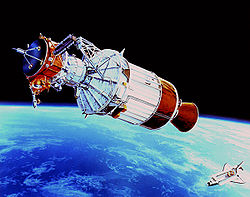
The IUS was a two-stage rocket launched by either a Titan family booster or as a "cargo" by the Space Shuttle. On Titan launches, the Titan booster would launch the IUS, carrying the payload into low earth orbit where it was separated from the Titan and ignited its first stage, which carried it into an elliptical "transfer" orbit to higher altitude.On Shuttle launches, the cargo bay was opened, the IUS and its payload raised to a 50° angle, and released. After the Shuttle separated from the payload to a safe distance, the IUS first stage ignited and, as on a Titan booster mission, entered "transfer orbit". Upon reaching apogee, the first stage and an interstage structure were jettisoned. The second stage then fired to circularlize the orbit, after which it released the satellite and, using its attitude control jets, began a retrograde maneuver to enter a lower orbit to avoid any possibility of collision with its payload.
In addition to the Communication and Reconnaissance missions described above, which placed the payload into stationary (24 hour) orbit, the IUS was also used to boost Planetary spacecraft. For these missions, the second IUS stage was separated and ignited immediately after first stage burnout. Igniting the second stage at low altitude provided the extra velocity the spacecraft needed to escape from earth orbit.
Missions That Used the IUS
, the following missions have used the IUS rocket, most of them from the Space Shuttle, especially after the Shuttle version of the Centaur upper stage was banned due to an after effect of the Challenger Disaster in 1986.| # | Launch Date | Launch Vehicle | Payload | Notes | Image |
| 1 | October 30, 1982 | Titan 34D Titan 34D The Titan 34D was an American rocket, used to launch a number of satellites for mostly military applications. After its retirement from military service, a small number were converted to the Commercial Titan III configuration, which included a stretched second stage, and a larger fairing... |
DSCS-II F16 DSCS-III A1 |
Mission successful despite telemetry loss for most of the flight. | |
| 2 | April 4, 1983 | STS-6 STS-6 STS-6 was a NASA Space Shuttle mission conducted using Space Shuttle Challenger, carrying the first Tracking and Data Relay Satellite, TDRS-1, into orbit. Launched on 4 April 1983, STS-6 was the sixth shuttle mission and the first of the ten missions flown by Challenger... |
TDRS A Tracking and Data Relay Satellite A Tracking and Data Relay Satellite is a type of communications satellite that forms part of the Tracking and Data Relay Satellite System used by NASA and other United States government agencies for communications to and from independent "User Platforms" such as satellites, balloons, aircraft,... |
Second stage tumbled due to a control system failure. Over the period of several weeks, ground controllers used excess fuel in the TDRS to move it into proper orbit. | 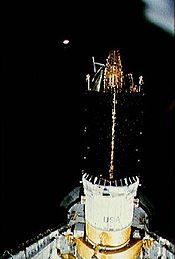 |
| 3 | January 24, 1985 | STS-51-C STS-51-C STS-51-C was the 15th flight of NASA's Space Shuttle program, and the third flight of Space Shuttle Discovery. It was also the first shuttle mission to deploy a dedicated United States Department of Defense payload, and as such many mission details remain classified... |
Magnum 1 Magnum (satellite) Magnum is the code name for a class of SIGINT spy satellites reportedly operated by the National Reconnaissance Office for the United States Central Intelligence Agency... |
Classified DoD payload. | |
| 4 | October 3, 1985 | STS-51-J STS-51-J STS-51-J was a NASA Space Shuttle mission. It was the first flight of Space Shuttle Atlantis and the 21st shuttle mission overall. It launched from Kennedy Space Center, Florida, on 3 October 1985, carrying a payload for the U.S... |
DSCS-III B4 DSCS-III B5 |
Classified DoD payload. | |
| 5 | January 28, 1986 | STS-51-L STS-51-L STS-51-L was the twenty-fifth flight of the American Space Shuttle program, which marked the first time an ordinary civilian, schoolteacher Christa McAuliffe, had flown aboard the Space Shuttle. The mission used Space Shuttle Challenger, which lifted off from the Launch Complex 39-B on 28 January... |
TDRS B Tracking and Data Relay Satellite A Tracking and Data Relay Satellite is a type of communications satellite that forms part of the Tracking and Data Relay Satellite System used by NASA and other United States government agencies for communications to and from independent "User Platforms" such as satellites, balloons, aircraft,... |
Destroyed due to Challenger disaster. | |
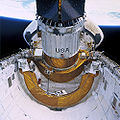
| 6 | September 29, 1988 | STS-26 STS-26 STS-26 was the 26th NASA Space Shuttle mission and the seventh flight of the Discovery orbiter. The mission launched from Kennedy Space Center, Florida, on 29 September 1988, and landed four days later on 3 October. STS-26 was declared the "Return to Flight" mission, being the first mission after... |
TDRS C Tracking and Data Relay Satellite A Tracking and Data Relay Satellite is a type of communications satellite that forms part of the Tracking and Data Relay Satellite System used by NASA and other United States government agencies for communications to and from independent "User Platforms" such as satellites, balloons, aircraft,... |
 |
|
| 7 | March 13, 1989 | STS-29 STS-29 -Mission parameters:*Mass:**Orbiter liftoff: **Orbiter landing: **Payload: *Perigee: *Apogee: *Inclination: 28.5°*Period: 90.6 min-Mission summary:Space Shuttle Discovery lifted off from Pad B, Launch... |
TDRS D Tracking and Data Relay Satellite A Tracking and Data Relay Satellite is a type of communications satellite that forms part of the Tracking and Data Relay Satellite System used by NASA and other United States government agencies for communications to and from independent "User Platforms" such as satellites, balloons, aircraft,... |
||
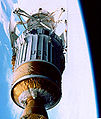
| 8 | May 4, 1989 | STS-30 STS-30 STS-30 was a NASA Space Shuttle mission, during which Space Shuttle Atlantis deployed the Venus-bound Magellan probe into orbit. The mission launched from Kennedy Space Center, Florida, on 4 May 1989, and landed four days later... |
Magellan Magellan probe The Magellan spacecraft, also referred to as the Venus Radar Mapper, was a 1,035-kilogram robotic space probe launched by NASA on May 4, 1989, to map the surface of Venus using Synthetic Aperture Radar and measure the planetary gravity... |
Science probe to Venus Venus Venus is the second planet from the Sun, orbiting it every 224.7 Earth days. The planet is named after Venus, the Roman goddess of love and beauty. After the Moon, it is the brightest natural object in the night sky, reaching an apparent magnitude of −4.6, bright enough to cast shadows... |
 |
| 9 | June 14, 1989 | Titan IVA Titan IV The Titan IV family of space boosters were used by the U.S. Air Force. They were launched from Cape Canaveral Air Force Station, Florida, and Vandenberg Air Force Base, California. At the time of its introduction, the Titan IV was the "largest unmanned space booster used by the Air Force."The... |
DSP 14 Defense Support Program The Defense Support Program is a program of the U.S. Air Force that operates the reconnaissance satellites which form the principal component of the Satellite Early Warning System currently used by the United States.... |
||
| 10 | October 18, 1989 | STS-34 STS-34 STS-34 was a NASA Space Shuttle mission using Space Shuttle Atlantis. It was the 31st shuttle mission overall, and the 5th flight for Atlantis. During the mission, the Jupiter-bound Galileo probe was deployed into space... |
Galileo | Science probe for Jupiter Jupiter Jupiter is the fifth planet from the Sun and the largest planet within the Solar System. It is a gas giant with mass one-thousandth that of the Sun but is two and a half times the mass of all the other planets in our Solar System combined. Jupiter is classified as a gas giant along with Saturn,... and its moons |
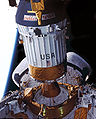 |
| 11 | November 22, 1989 | STS-33 STS-33 -Crew notes:S. David Griggs, the originally scheduled pilot for STS-33, died in a plane crash in June 1989, five months prior to the scheduled launch, and was replaced by John E... |
Magnum 2 Magnum (satellite) Magnum is the code name for a class of SIGINT spy satellites reportedly operated by the National Reconnaissance Office for the United States Central Intelligence Agency... |
Classified DoD payload. | |
| 12 | October 6, 1990 | STS-41 STS-41 STS-41 was the eleventh mission of the Space Shuttle Discovery. The four-day mission with a primary objective to launch the Ulysses probe as part of the "International Solar Polar Mission".-Crew:-Mission parameters:*Mass:... |
Ulysses | 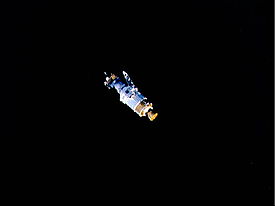 |
|
| 13 | November 13, 1990 | Titan IVA Titan IV The Titan IV family of space boosters were used by the U.S. Air Force. They were launched from Cape Canaveral Air Force Station, Florida, and Vandenberg Air Force Base, California. At the time of its introduction, the Titan IV was the "largest unmanned space booster used by the Air Force."The... |
DSP 15 Defense Support Program The Defense Support Program is a program of the U.S. Air Force that operates the reconnaissance satellites which form the principal component of the Satellite Early Warning System currently used by the United States.... |
||
| 14 | November 15, 1990 | STS-38 STS-38 -Mission parameters:*Mass:**Payload: Magnum ELINT satellite ~ **Booster: IUS upper stage ~ **Total: ~ *Perigee: *Apogee: *Inclination: 28.5°*Period: 87.5 min-Preparations and Launch:... |
Magnum 3 Magnum (satellite) Magnum is the code name for a class of SIGINT spy satellites reportedly operated by the National Reconnaissance Office for the United States Central Intelligence Agency... or an SDS-2 Satellite Data System The Satellite Data System is a system of United States military communications satellites. At least three generations have been used: SDS-1 from 1976 to 1987; SDS-2 from 1989 to 1996; SDS-3 from 1998 to the present... Exact payload unknown |
Classified DoD payload. | |
| 15 | August 2, 1991 | STS-43 STS-43 -Mission parameters:*Mass:**Orbiter landing with payload: **Payload: *Perigee: *Apogee: *Inclination: 28.5°*Period: 90.6 min-Preparations and Launch:The launch took place on 2 August 1991, 11:01:59 am EDT... |
TDRS E Tracking and Data Relay Satellite A Tracking and Data Relay Satellite is a type of communications satellite that forms part of the Tracking and Data Relay Satellite System used by NASA and other United States government agencies for communications to and from independent "User Platforms" such as satellites, balloons, aircraft,... |
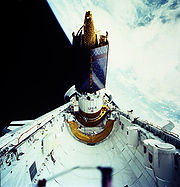 |
|
| 16 | November 24, 1991 | STS-44 STS-44 -Mission parameters:**Launch: **Orbiter landing with payload: **Payload: *Perigee: *Apogee: *Inclination: 28.5°*Period: 91.9 minutes-Mission highlights:The launch was on 24 November 1991 at 6:44:00 pm EST... |
DSP 16 Defense Support Program The Defense Support Program is a program of the U.S. Air Force that operates the reconnaissance satellites which form the principal component of the Satellite Early Warning System currently used by the United States.... |
||
| 17 | January 13, 1993 | STS-54 STS-54 -Mission parameters:*Mass:**Orbiter landing with payload: **Payload: *Perigee: *Apogee: *Inclination: 28.5°*Period: 90.6 min-Space walks:* Harbaugh and Runco – EVA 1*EVA 1 Start: 17 January 1993... |
TDRS F Tracking and Data Relay Satellite A Tracking and Data Relay Satellite is a type of communications satellite that forms part of the Tracking and Data Relay Satellite System used by NASA and other United States government agencies for communications to and from independent "User Platforms" such as satellites, balloons, aircraft,... |
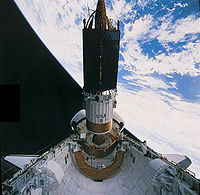 |
|
| 18 | December 22, 1994 | Titan IVA Titan IV The Titan IV family of space boosters were used by the U.S. Air Force. They were launched from Cape Canaveral Air Force Station, Florida, and Vandenberg Air Force Base, California. At the time of its introduction, the Titan IV was the "largest unmanned space booster used by the Air Force."The... |
DSP 17 Defense Support Program The Defense Support Program is a program of the U.S. Air Force that operates the reconnaissance satellites which form the principal component of the Satellite Early Warning System currently used by the United States.... |
||
| 19 | July 13, 1995 | STS-70 STS-70 STS-70 was the 21st flight of the Space Shuttle Discovery, and the last of 7 shuttle missions to carry a Tracking and Data Relay Satellite . This was the first shuttle mission controlled from the new Mission Control Center room at the Johnson Space Center in Houston... |
TDRS G Tracking and Data Relay Satellite A Tracking and Data Relay Satellite is a type of communications satellite that forms part of the Tracking and Data Relay Satellite System used by NASA and other United States government agencies for communications to and from independent "User Platforms" such as satellites, balloons, aircraft,... |
||
| 20 | February 23, 1997 | Titan IVB Titan IV The Titan IV family of space boosters were used by the U.S. Air Force. They were launched from Cape Canaveral Air Force Station, Florida, and Vandenberg Air Force Base, California. At the time of its introduction, the Titan IV was the "largest unmanned space booster used by the Air Force."The... |
DSP 18 Defense Support Program The Defense Support Program is a program of the U.S. Air Force that operates the reconnaissance satellites which form the principal component of the Satellite Early Warning System currently used by the United States.... |
||
| 21 | April 9, 1999 | Titan IVB Titan IV The Titan IV family of space boosters were used by the U.S. Air Force. They were launched from Cape Canaveral Air Force Station, Florida, and Vandenberg Air Force Base, California. At the time of its introduction, the Titan IV was the "largest unmanned space booster used by the Air Force."The... |
DSP 19 Defense Support Program The Defense Support Program is a program of the U.S. Air Force that operates the reconnaissance satellites which form the principal component of the Satellite Early Warning System currently used by the United States.... |
Spacecraft failed to separate from the second IUS stage. | |
| 22 | July 23, 1999 | STS-93 STS-93 STS-93 marked the 95th launch of the Space Shuttle, the 26th launch of Columbia, and the 21st night launch of a Space Shuttle. Eileen Collins became the first female shuttle Commander on this flight. Its primary payload was the Chandra X-ray Observatory. It would also be the last mission of... |
Chandra X-ray Observatory Chandra X-ray Observatory The Chandra X-ray Observatory is a satellite launched on STS-93 by NASA on July 23, 1999. It was named in honor of Indian-American physicist Subrahmanyan Chandrasekhar who is known for determining the maximum mass for white dwarfs. "Chandra" also means "moon" or "luminous" in Sanskrit.Chandra... |
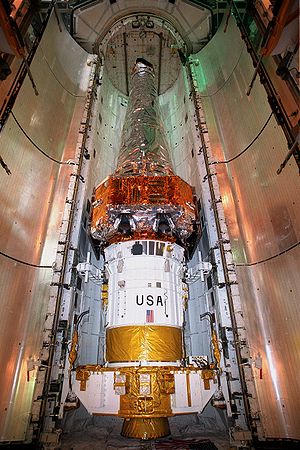 |
|
| 23 | May 8, 2000 | Titan IVB Titan IV The Titan IV family of space boosters were used by the U.S. Air Force. They were launched from Cape Canaveral Air Force Station, Florida, and Vandenberg Air Force Base, California. At the time of its introduction, the Titan IV was the "largest unmanned space booster used by the Air Force."The... |
DSP 20 Defense Support Program The Defense Support Program is a program of the U.S. Air Force that operates the reconnaissance satellites which form the principal component of the Satellite Early Warning System currently used by the United States.... |
||
| 24 | August 6, 2001 | Titan IVB Titan IV The Titan IV family of space boosters were used by the U.S. Air Force. They were launched from Cape Canaveral Air Force Station, Florida, and Vandenberg Air Force Base, California. At the time of its introduction, the Titan IV was the "largest unmanned space booster used by the Air Force."The... |
DSP 21 Defense Support Program The Defense Support Program is a program of the U.S. Air Force that operates the reconnaissance satellites which form the principal component of the Satellite Early Warning System currently used by the United States.... |
||
| 25 | February 14, 2004 | Titan IVB Titan IV The Titan IV family of space boosters were used by the U.S. Air Force. They were launched from Cape Canaveral Air Force Station, Florida, and Vandenberg Air Force Base, California. At the time of its introduction, the Titan IV was the "largest unmanned space booster used by the Air Force."The... |
DSP 22 Defense Support Program The Defense Support Program is a program of the U.S. Air Force that operates the reconnaissance satellites which form the principal component of the Satellite Early Warning System currently used by the United States.... |
||
Current status
Currently, because of the use of the more efficient Centaur upper stage on the Atlas rockets, including the new Atlas VAtlas V
Atlas V is an active expendable launch system in the Atlas rocket family. Atlas V was formerly operated by Lockheed Martin, and is now operated by the Lockheed Martin-Boeing joint venture United Launch Alliance...
, the IUS has been in effect placed into "semi-retired" status, although it may be used in the future to augment the Delta IV rocket
Delta IV rocket
Delta IV is an active expendable launch system in the Delta rocket family. Delta IV uses rockets designed by Boeing's Integrated Defense Systems division and built in the United Launch Alliance facility in Decatur, Alabama. Final assembly is completed at the launch site by ULA...
or even the planned Shuttle Derived Launch Vehicle (the Ares I
Ares I
Ares I was the crew launch vehicle that was being developed by NASA as part of the Constellation Program. The name "Ares" refers to the Greek deity Ares, who is identified with the Roman god Mars...
and Ares V
Ares V
The Ares V was the planned cargo launch component of the Constellation program, which was to have replaced the Space Shuttle after its retirement in 2011. Ares V was also planned to carry supplies for a human presence on Mars...
rockets). Although this is highly unlikely, as the final IUS launch used the last IUS vehicle and the Boeing IUS team has been disbanded, making the future production of IUS vehicles quite costly.
External links
- Evolution of the Inertial Upper Stage Crosslink Winter 2003 (published by The Aerospace Corporation)
- Inertial Upper Stage at Federation of American Scientists