

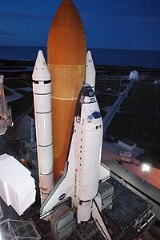
Space Shuttle Atlantis

Encyclopedia
The Space Shuttle Atlantis (Orbiter Vehicle Designation
: OV-104) is a retired Space Shuttle orbiter
in the Space Shuttle
fleet belonging to the National Aeronautics and Space Administration
(NASA), the spaceflight
and space exploration
agency of the United States. Atlantis was the fourth operational (and the next-to-the-last) Space Shuttle to be constructed by the Rockwell International
company in Southern California
, and it was delivered to the John F. Kennedy Space Center
in eastern Florida in April 1985. Atlantis was the only orbiter which lacked the ability to draw power from the International Space Station while docked there; it had to continue to provide its own power through fuel cells.
The last mission of Atlantis was STS-135
, the last flight before the Shuttle program ended
. This final flight was authorized by President Barack Obama
in October 2010, to bring additional supplies to the International Space Station
and take advantage of the processing performed for the Launch on Need mission, which would only have been flown in the event that Endeavour's STS-134
crew required rescue.
Atlantis launched successfully for the final time on 8 July 2011 at 16:29 UTC, landing at the John F. Kennedy Space Center on 21 July 2011 at 09:57 UTC.
By the end of its final mission, Atlantis had orbited the Earth 4,848 times, traveling nearly 126 million miles in space or more than 525 times the distance from the Earth to the Moon.
Atlantis was named after RV Atlantis
, a two-masted sailing ship that operated as the primary research vessel for the Woods Hole Oceanographic Institution
from 1930 to 1966. The 460-ton ketch carried a crew of 17 and had room for 5 scientists.
, the second dedicated Department of Defense flight. It flew one other mission, STS-61-B
, the second night launch in the shuttle program, before the Space Shuttle Challenger disaster
temporarily grounded the shuttle fleet in 1986. Atlantis was used for ten flights between 1988 and 1992. Two of these, both flown in 1989, deployed the planetary probes Magellan to Venus
(on STS-30
) and Galileo to Jupiter
(on STS-34
). With STS-30 Atlantis became the first shuttle to launch an interplanetary probe. During another mission, STS-37
flown in 1991, Atlantis deployed the Compton Gamma Ray Observatory
. Beginning in 1995 with STS-71
, Atlantis made seven straight flights to the former Russia
n space station
Mir
as part of the Shuttle-Mir Program
. STS-71 marked a number of firsts in human spaceflight: 100th U.S. manned space flight; first U.S. shuttle-Russian Space Station Mir docking and joint on-orbit operations; and first on-orbit changeout of shuttle crew. When linked, Atlantis and Mir together formed the largest spacecraft in orbit at the time.
Shuttle Atlantis also delivered several vital components for the construction of the International Space Station (ISS). During the February 2001 mission STS-98
to the ISS, Atlantis delivered the Destiny Module, the primary operating facility for U.S. research payloads aboard the ISS. The five hour 25 minute third spacewalk performed by astronauts Robert Curbeam and Thomas Jones during STS-98 marked NASA's 100th extra vehicular activity in space. The Quest Joint Airlock, was flown and installed to the ISS by Atlantis during the mission STS-104
in July 2001. The successful installation of the airlock gave on-board space station crews the ability to stage repair and maintenance spacewalks outside the ISS using U.S. EMU
or Russian Orlan space suits. The first mission flown by Atlantis after the Space Shuttle Columbia disaster
was STS-115
, conducted during September 2006. The mission carried the P3/P4 truss segments and solar arrays to the ISS. On ISS assembly flight STS-122
in February 2008, Atlantis delivered the Columbus laboratory
to the ISS. Columbus laboratory is the largest single contribution to the ISS made by the European Space Agency
(ESA).
In May 2009 Atlantis flew a seven member crew to the Hubble Space Telescope
for its Servicing Mission 4, STS-125
. The mission was a success, with the crew completing five space walks totaling 37 hours to install new cameras, batteries, a gyroscope and other components to the telescope.
Among the five space shuttles flown into space, Atlantis conducted a subsequent mission in the shortest time after the previous mission when it launched in November, 1985 on STS-61-B, only 50 days after its previous mission, STS-51-J.
The longest mission flown using shuttle Atlantis was STS-117
and lasted almost 14 days in June 2007. During STS-117, Atlantis' crew added a new starboard truss segment and solar array pair (the S3/S4
truss), folded the P6 array in preparation for its relocation and performed four spacewalks. Atlantis was not equipped to take advantage of the Station-to-Shuttle Power Transfer System so missions could not be extended by making use of power provided by ISS.
During the STS-129
post-flight interview on 16 November 2009 shuttle launch director Mike Leinbach said that Atlantis officially beat shuttle Discovery on the record low amount of Interim Problem Reports, with a total of just 54 listed since returning from the STS-125. He continued to add "It is due to the team and the hardware processing. They just did a great job. The record will probably never be broken again in the history of the Space Shuttle Program, so congratulations to them". However, during the STS-132
post-launch interview on 14 May 2010, shuttle launch director Mike Leinbach said that Atlantis beat its previous record low amount of Interim Problem Reports, with a total of 46 listed between STS-129 and STS-132.
Atlantis arrived at Palmdale, California
in October 1992 for OMDP-1. During that visit 165 modifications were made over the next 20 months. These included the installation of a drag chute, new plumbing lines to configure the orbiter for extended duration, more than 800 new heat tiles and blankets and new insulation for main landing gear and structural modifications to the airframe.
On 5 November 1997, Atlantis again arrived at Palmdale for OMDP-2 which was completed on 24 September 1998. The 130 modifications carried out during OMDP-2 included glass cockpit displays, replacement of TACAN navigation with GPS and ISS airlock and docking installation. Several weight reduction modifications were also performed on the orbiter including replacement of Advanced Flexible Reusable Surface Insulation (AFRSI) insulation blankets on upper surfaces with FRSI. Moreover lightweight crew seats were installed and the Extended Duration Orbiter
(EDO) package installed on OMDP-1 was removed to lighten Atlantis to better serve its prime mission of servicing the ISS.
During the stand down period post Columbia accident, Atlantis went through over 75 modifications to the orbiter ranging from very minor bolt change-outs to window change-outs and different fluid systems.
Atlantis was known among the shuttle workforce as being more prone than the others in the fleet to problems that needed to be addressed while readying the vehicle for launch leading to some nicknaming her "Britney
".
, prior to the end of the shuttle program, but the extension of the Shuttle program into 2011 led to Atlantis being the STS-135
, the final Space Shuttle mission in July 2011.
Once Atlantis is finally decommissioned, it will be displayed at the Kennedy Space Center Visitor Complex
. NASA Administrator Charles Bolden announced the decision at an employee event held on 12 April 2011 to commemorate the 30th anniversary of the first shuttle flight
: "First, here at the Kennedy Space Center where every shuttle mission and so many other historic human space flights have originated, we'll showcase my old friend, Atlantis."
The Visitor Complex plans to suspend Atlantis with cargo bay doors opened such that it appears to be back in orbit around the Earth. A multi-story digital projection of the home planet that will rotate behind the orbiter in a 64000 square feet (5,945.8 m²) indoor facility is also proposed. Ground breaking of the facility is planned to begin in 2012 with the exhibit opening in 2013.
Astronaut Clayton Anderson
, ESA astronaut Leopold Eyharts
and Russian cosmonauts Nikolai Budarin
and Anatoly Solovyev
only launched on Atlantis. Similarly, astronauts Daniel Tani and Sunita Williams
, as well as cosmonauts Vladimir Dezhurov
and Gennady Strekalov
only landed with Atlantis. Only 146 men and women both launched and landed aboard Atlantis.
Some of those people however, flew with Atlantis more than once. Taking them into account, 203 total seats were filled over Atlantis 32 missions. Astronaut Jerry Ross
holds the record for the most flights aboard Atlantis at five.
Astronaut Rodolfo Neri Vela
who flew aboard Atlantis on STS-61-B mission in 1985 became the first and so far only Mexican to have traveled to space. ESA astronaut Dirk Frimout who flew on STS-45 as a payload specialist was the first Belgian
in space. STS-46 mission specialist Claude Nicollier
was the first astronaut from Switzerland
. On the same flight, astronaut Franco Malerba
became the first citizen of Italy to travel to space.
Astronaut Michael Massimino who flew on STS-125 mission became the first person to use Twitter in space in May 2009.
Having flown aboard Atlantis as part of the STS-132 crew in May 2010 and Discovery as part of the STS-133
crew in February/March 2011, Stephen Bowen became the first NASA astronaut to be launched on consecutive missions.
s (COPV) were designed for a 10 year life and later cleared for an additional 10 years; they exceeded this life in 2005. NASA said it cannot guarantee any longer that the vessels on Atlantis will not burst or explode under full pressure
. Failure of these tanks could damage parts of the shuttle and even wound or kill ground personnel. An in-flight failure of a pressure vessel could even result in the loss of the orbiter and its crew. NASA analyses originally assumed that the vessels would leak before they burst, but new tests showed that they could in fact burst before leaking.
Because the original vendor was no longer in business, and a new manufacturer could not be qualified before 2010, when the shuttles were scheduled to be retired, NASA decided to continue operations with the existing tanks. Therefore, to reduce the risk of failure and the cumulative effects of load, the vessels will be maintained at 80 percent of the operating pressure as late in the launch countdown as possible, and the launch pad will be cleared of all but essential personnel when pressure is increased to 100 percent. The new launch procedure will be employed during the remaining Atlantis launches if no other resolution is found. Atlantis will have to fly at least once under this requirement.
However, since the problem was discovered, the two COPV's deemed to have the highest risk of failure have been replaced.
). Had the removal of the knob been unsuccessful, the worst-case scenario is that Atlantis could have been retired from the fleet, leaving Discovery and Endeavour to complete the manifest alone. On 29 June 2009, Atlantis was pressurised to 17 psi (117,210.9 Pa) (3psi-delta), which forced the Orbiter to expand slightly. The knob was then frozen with dry ice, and was successfully removed. Small areas of damage to the window were discovered where the edges of the knob had been embedded into the pane. Subsequent investigation of the window damage discovered a maximum defect depth of approximately 0.0003 in (0.000762 cm), less than the reportable depth threshold of 0.0015 in (0.00381 cm) and not serious enough to warrant the pane’s replacement.
Orbiter Vehicle Designation
Each NASA space shuttle designation is composed of a prefix and suffix separated by a dash. The prefix for operational shuttles is OV, for Orbiter Vehicle.The suffix is composed of two parts: the series and the vehicle number.Series:...
: OV-104) is a retired Space Shuttle orbiter
Space Shuttle Orbiter
The Space Shuttle orbiter was the orbital spacecraft of the Space Shuttle program operated by NASA, the space agency of the United States. The orbiter was a reusable winged "space-plane", a mixture of rockets, spacecraft, and aircraft...
in the Space Shuttle
Space Shuttle
The Space Shuttle was a manned orbital rocket and spacecraft system operated by NASA on 135 missions from 1981 to 2011. The system combined rocket launch, orbital spacecraft, and re-entry spaceplane with modular add-ons...
fleet belonging to the National Aeronautics and Space Administration
NASA
The National Aeronautics and Space Administration is the agency of the United States government that is responsible for the nation's civilian space program and for aeronautics and aerospace research...
(NASA), the spaceflight
Spaceflight
Spaceflight is the act of travelling into or through outer space. Spaceflight can occur with spacecraft which may, or may not, have humans on board. Examples of human spaceflight include the Russian Soyuz program, the U.S. Space shuttle program, as well as the ongoing International Space Station...
and space exploration
Space exploration
Space exploration is the use of space technology to explore outer space. Physical exploration of space is conducted both by human spaceflights and by robotic spacecraft....
agency of the United States. Atlantis was the fourth operational (and the next-to-the-last) Space Shuttle to be constructed by the Rockwell International
Rockwell International
Rockwell International was a major American manufacturing conglomerate in the latter half of the 20th century, involved in aircraft, the space industry, both defense-oriented and commercial electronics, automotive and truck components, printing presses, valves and meters, and industrial automation....
company in Southern California
Southern California
Southern California is a megaregion, or megapolitan area, in the southern area of the U.S. state of California. Large urban areas include Greater Los Angeles and Greater San Diego. The urban area stretches along the coast from Ventura through the Southland and Inland Empire to San Diego...
, and it was delivered to the John F. Kennedy Space Center
Kennedy Space Center
The John F. Kennedy Space Center is the NASA installation that has been the launch site for every United States human space flight since 1968. Although such flights are currently on hiatus, KSC continues to manage and operate unmanned rocket launch facilities for America's civilian space program...
in eastern Florida in April 1985. Atlantis was the only orbiter which lacked the ability to draw power from the International Space Station while docked there; it had to continue to provide its own power through fuel cells.
The last mission of Atlantis was STS-135
STS-135
STS-135 was the final mission of the American Space Shuttle program. It used the orbiter Atlantis and hardware originally processed for the STS-335 contingency mission, which was not flown. STS-135 launched on 8 July and was originally scheduled to land on 20 July 2011, but the mission was...
, the last flight before the Shuttle program ended
Space Shuttle retirement
The retirement of NASA's Space Shuttle fleet took place from March to July 2011. Discovery was the first of the three active space shuttles to be retired, completing its final mission on March 9, 2011; Space Shuttle Endeavour did so on June 1...
. This final flight was authorized by President Barack Obama
Barack Obama
Barack Hussein Obama II is the 44th and current President of the United States. He is the first African American to hold the office. Obama previously served as a United States Senator from Illinois, from January 2005 until he resigned following his victory in the 2008 presidential election.Born in...
in October 2010, to bring additional supplies to the International Space Station
International Space Station
The International Space Station is a habitable, artificial satellite in low Earth orbit. The ISS follows the Salyut, Almaz, Cosmos, Skylab, and Mir space stations, as the 11th space station launched, not including the Genesis I and II prototypes...
and take advantage of the processing performed for the Launch on Need mission, which would only have been flown in the event that Endeavour's STS-134
STS-134
STS-134 was the penultimate mission of NASA's Space Shuttle program. The mission marked the 25th and final flight of . This flight delivered the Alpha Magnetic Spectrometer and an ExPRESS Logistics Carrier to the International Space Station. Mark Kelly served as the mission commander...
crew required rescue.
Atlantis launched successfully for the final time on 8 July 2011 at 16:29 UTC, landing at the John F. Kennedy Space Center on 21 July 2011 at 09:57 UTC.
By the end of its final mission, Atlantis had orbited the Earth 4,848 times, traveling nearly 126 million miles in space or more than 525 times the distance from the Earth to the Moon.
Atlantis was named after RV Atlantis
RV Atlantis
RV Atlantis is a sailboat that served as the first and also the main research vessel for the Woods Hole Oceanographic Institution from 1931 to 1964. Several ships, including RV Atlantis and the Space Shuttle Atlantis were named after Atlantis...
, a two-masted sailing ship that operated as the primary research vessel for the Woods Hole Oceanographic Institution
Woods Hole Oceanographic Institution
The Woods Hole Oceanographic Institution is a private, nonprofit research and higher education facility dedicated to the study of all aspects of marine science and engineering and to the education of marine researchers. Established in 1930, it is the largest independent oceanographic research...
from 1930 to 1966. The 460-ton ketch carried a crew of 17 and had room for 5 scientists.
Construction milestones
| 29 January 1979 | Contract Award – Rockwell International Rockwell International Rockwell International was a major American manufacturing conglomerate in the latter half of the 20th century, involved in aircraft, the space industry, both defense-oriented and commercial electronics, automotive and truck components, printing presses, valves and meters, and industrial automation.... Space Transportation Systems Division in Downey, California Downey, California Downey is a city located in southeast Los Angeles County, California, United States, southeast of downtown Los Angeles. The city is best known as the birthplace of the Apollo space program, and is the city where folk singer Karen Carpenter lived and died... |
| 30 March 1980 | Start structural assembly of crew module |
| 23 November 1981 | Start structural assembly of aft-fuselage |
| 13 June 1983 | Wings arrive at Palmdale from Grumman |
| 2 December 1983 | Start of final assembly |
| 10 April 1984 | Completed final assembly |
| 6 March 1985 | Rollout from Palmdale |
| 3 April 1985 | Overland transport from Palmdale to Edwards Edwards Air Force Base Edwards Air Force Base is a United States Air Force base located on the border of Kern County, Los Angeles County, and San Bernardino County, California, in the Antelope Valley. It is southwest of the central business district of North Edwards, California and due east of Rosamond.It is named in... |
| 9 April 1985 | Delivery to Kennedy Space Center |
| 5 September 1985 | Flight Readiness Firing |
Specifications
- Weight (with three shuttle main engines): 176,413 pounds (80 tons)
- Length: 122.17 feet (37.2 m)
- Height: 56.58 feet (17.2 m)
- Wingspan: 78.06 feet (23.7 m)
- Atlantis was completed in about half the time it took to build Space Shuttle ColumbiaSpace Shuttle ColumbiaSpace Shuttle Columbia was the first spaceworthy Space Shuttle in NASA's orbital fleet. First launched on the STS-1 mission, the first of the Space Shuttle program, it completed 27 missions before being destroyed during re-entry on February 1, 2003 near the end of its 28th, STS-107. All seven crew...
.
- When it rolled out of the Palmdale assembly plant, weighing 151,315 pounds Atlantis was nearly 3.5 tons lighter than Columbia. Atlantis is the lightest shuttle of the remaining fleet, weighing three pounds less than the Space Shuttle EndeavourSpace Shuttle EndeavourSpace Shuttle Endeavour is one of the retired orbiters of the Space Shuttle program of NASA, the space agency of the United States. Endeavour was the fifth and final spaceworthy NASA space shuttle to be built, constructed as a replacement for Challenger...
(with the three main engines).
Notable missions
Space Shuttle Atlantis lifted off on its maiden voyage on 3 October 1985, on mission STS-51-JSTS-51-J
STS-51-J was a NASA Space Shuttle mission. It was the first flight of Space Shuttle Atlantis and the 21st shuttle mission overall. It launched from Kennedy Space Center, Florida, on 3 October 1985, carrying a payload for the U.S...
, the second dedicated Department of Defense flight. It flew one other mission, STS-61-B
STS-61-B
STS-61-B was NASA's 23rd Space Shuttle mission, and its second using Space Shuttle Atlantis. The shuttle was launched from Kennedy Space Center, Florida, on 26 November 1985. During STS-61-B, the shuttle crew deployed three communications satellites, and tested techniques of constructing...
, the second night launch in the shuttle program, before the Space Shuttle Challenger disaster
Space Shuttle Challenger disaster
The Space Shuttle Challenger disaster occurred on January 28, 1986, when Space Shuttle Challenger broke apart 73 seconds into its flight, leading to the deaths of its seven crew members. The spacecraft disintegrated over the Atlantic Ocean, off the coast of central Florida at 11:38 am EST...
temporarily grounded the shuttle fleet in 1986. Atlantis was used for ten flights between 1988 and 1992. Two of these, both flown in 1989, deployed the planetary probes Magellan to Venus
Venus
Venus is the second planet from the Sun, orbiting it every 224.7 Earth days. The planet is named after Venus, the Roman goddess of love and beauty. After the Moon, it is the brightest natural object in the night sky, reaching an apparent magnitude of −4.6, bright enough to cast shadows...
(on STS-30
STS-30
STS-30 was a NASA Space Shuttle mission, during which Space Shuttle Atlantis deployed the Venus-bound Magellan probe into orbit. The mission launched from Kennedy Space Center, Florida, on 4 May 1989, and landed four days later...
) and Galileo to Jupiter
Jupiter
Jupiter is the fifth planet from the Sun and the largest planet within the Solar System. It is a gas giant with mass one-thousandth that of the Sun but is two and a half times the mass of all the other planets in our Solar System combined. Jupiter is classified as a gas giant along with Saturn,...
(on STS-34
STS-34
STS-34 was a NASA Space Shuttle mission using Space Shuttle Atlantis. It was the 31st shuttle mission overall, and the 5th flight for Atlantis. During the mission, the Jupiter-bound Galileo probe was deployed into space...
). With STS-30 Atlantis became the first shuttle to launch an interplanetary probe. During another mission, STS-37
STS-37
STS-37, the eighth flight of the Space Shuttle Atlantis, was a six-day mission with the primary objective of launching the Compton Gamma Ray Observatory , the second of the Great Observatories program which included the visible-spectrum Hubble Space Telescope, the Chandra X-ray Observatory and the...
flown in 1991, Atlantis deployed the Compton Gamma Ray Observatory
Compton Gamma Ray Observatory
The Compton Gamma Ray Observatory was a space observatory detecting light from 20 KeV to 30 GeV in Earth orbit from 1991 to 2000. It featured four main telescopes in one spacecraft covering x-rays and gamma-rays, including various specialized sub-instruments and detectors...
. Beginning in 1995 with STS-71
STS-71
STS-71 was the third mission of the US/Russian Shuttle-Mir Program, which carried out the first Space Shuttle docking to Mir, a Russian space station. The mission used Space Shuttle Atlantis, which lifted off from launch pad 39A on 27 June 1995 from Kennedy Space Center, Florida...
, Atlantis made seven straight flights to the former Russia
Russia
Russia or , officially known as both Russia and the Russian Federation , is a country in northern Eurasia. It is a federal semi-presidential republic, comprising 83 federal subjects...
n space station
Space station
A space station is a spacecraft capable of supporting a crew which is designed to remain in space for an extended period of time, and to which other spacecraft can dock. A space station is distinguished from other spacecraft used for human spaceflight by its lack of major propulsion or landing...
Mir
Mir
Mir was a space station operated in low Earth orbit from 1986 to 2001, at first by the Soviet Union and then by Russia. Assembled in orbit from 1986 to 1996, Mir was the first modular space station and had a greater mass than that of any previous spacecraft, holding the record for the...
as part of the Shuttle-Mir Program
Shuttle-Mir Program
The Shuttle–Mir Program was a collaborative space program between Russia and the United States, which involved American Space Shuttles visiting the Russian space station Mir, Russian cosmonauts flying on the shuttle and an American astronaut flying aboard a Soyuz spacecraft to engage in...
. STS-71 marked a number of firsts in human spaceflight: 100th U.S. manned space flight; first U.S. shuttle-Russian Space Station Mir docking and joint on-orbit operations; and first on-orbit changeout of shuttle crew. When linked, Atlantis and Mir together formed the largest spacecraft in orbit at the time.
Shuttle Atlantis also delivered several vital components for the construction of the International Space Station (ISS). During the February 2001 mission STS-98
STS-98
STS-98 was a 2001 Space Shuttle mission to the International Space Station flown by Space Shuttle Atlantis. STS-98 delivered to the station the Destiny Laboratory Module...
to the ISS, Atlantis delivered the Destiny Module, the primary operating facility for U.S. research payloads aboard the ISS. The five hour 25 minute third spacewalk performed by astronauts Robert Curbeam and Thomas Jones during STS-98 marked NASA's 100th extra vehicular activity in space. The Quest Joint Airlock, was flown and installed to the ISS by Atlantis during the mission STS-104
STS-104
STS-104 was a Space Shuttle mission to the International Space Station flown by Space Shuttle Atlantis. Its primary objectives were to install the Quest Joint Airlock and help perform maintenance on the International Space Station...
in July 2001. The successful installation of the airlock gave on-board space station crews the ability to stage repair and maintenance spacewalks outside the ISS using U.S. EMU
Extravehicular Mobility Unit
The Space Shuttle/International Space Station Extravehicular Mobility Unit is an independent anthropomorphic system that provides environmental protection, mobility, life support, and communications for a Space Shuttle or International Space Station crew member to perform extra-vehicular activity...
or Russian Orlan space suits. The first mission flown by Atlantis after the Space Shuttle Columbia disaster
Space Shuttle Columbia disaster
The Space Shuttle Columbia disaster occurred on February 1, 2003, when shortly before it was scheduled to conclude its 28th mission, STS-107, the Space Shuttle Columbia disintegrated over Texas and Louisiana during re-entry into the Earth's atmosphere, resulting in the death of all seven crew members...
was STS-115
STS-115
Note:The P3/P4 Truss segment and batteries were so heavy that the crew count was reduced from seven to six.-Crew notes:...
, conducted during September 2006. The mission carried the P3/P4 truss segments and solar arrays to the ISS. On ISS assembly flight STS-122
STS-122
STS-122 was a NASA Space Shuttle mission to the International Space Station , flown by the Space Shuttle Atlantis. STS-122 marked the 24th shuttle mission to the ISS, and the 121st space shuttle flight since STS-1....
in February 2008, Atlantis delivered the Columbus laboratory
Columbus (ISS module)
Columbus is a science laboratory that is part of the International Space Station and is the largest single contribution to the ISS made by the European Space Agency ....
to the ISS. Columbus laboratory is the largest single contribution to the ISS made by the European Space Agency
European Space Agency
The European Space Agency , established in 1975, is an intergovernmental organisation dedicated to the exploration of space, currently with 18 member states...
(ESA).
In May 2009 Atlantis flew a seven member crew to the Hubble Space Telescope
Hubble Space Telescope
The Hubble Space Telescope is a space telescope that was carried into orbit by a Space Shuttle in 1990 and remains in operation. A 2.4 meter aperture telescope in low Earth orbit, Hubble's four main instruments observe in the near ultraviolet, visible, and near infrared...
for its Servicing Mission 4, STS-125
STS-125
STS-125, or HST-SM4 , was the fifth and final space shuttle servicing mission to the Hubble Space Telescope .Launch occurred on 11 May 2009 at 2:01 pm EDT...
. The mission was a success, with the crew completing five space walks totaling 37 hours to install new cameras, batteries, a gyroscope and other components to the telescope.
Among the five space shuttles flown into space, Atlantis conducted a subsequent mission in the shortest time after the previous mission when it launched in November, 1985 on STS-61-B, only 50 days after its previous mission, STS-51-J.
The longest mission flown using shuttle Atlantis was STS-117
STS-117
- Crew Notes :The initial crew manifest before the Columbia accident was:Astronaut Mark Polansky was originally slated to pilot this mission, but was moved to STS-116, which he commanded...
and lasted almost 14 days in June 2007. During STS-117, Atlantis' crew added a new starboard truss segment and solar array pair (the S3/S4
Integrated Truss Structure
the Integrated Truss Structure forms the backbone of the International Space Station, with mountings for unpressurized logistics carriers, radiators, solar arrays, and other equipment.-History:...
truss), folded the P6 array in preparation for its relocation and performed four spacewalks. Atlantis was not equipped to take advantage of the Station-to-Shuttle Power Transfer System so missions could not be extended by making use of power provided by ISS.
During the STS-129
STS-129
-Crew seat assignments:-Mission payload:-ExPRESS Logistics Carriers 1 and 2:The primary payload of STS-129 was the ExPRESS Logistics Carrier and the ELC-2. The mass capacity of each ELC is with a volume of 30 meters cubed...
post-flight interview on 16 November 2009 shuttle launch director Mike Leinbach said that Atlantis officially beat shuttle Discovery on the record low amount of Interim Problem Reports, with a total of just 54 listed since returning from the STS-125. He continued to add "It is due to the team and the hardware processing. They just did a great job. The record will probably never be broken again in the history of the Space Shuttle Program, so congratulations to them". However, during the STS-132
STS-132
STS-132 was a NASA Space Shuttle mission, during which Space Shuttle Atlantis docked with the International Space Station on 16 May 2010. STS-132 was launched from the Kennedy Space Center on 14 May 2010. The primary payload was the Russian Rassvet Mini-Research Module, along with an Integrated...
post-launch interview on 14 May 2010, shuttle launch director Mike Leinbach said that Atlantis beat its previous record low amount of Interim Problem Reports, with a total of 46 listed between STS-129 and STS-132.
Orbiter Maintenance Down Periods
Atlantis went through two overhauls of scheduled Orbiter Maintenance Down Periods (OMDPs) during its operational history.Atlantis arrived at Palmdale, California
Palmdale, California
Palmdale is a city located in the center of northern Los Angeles County, California, United States.Palmdale was the first community within the Antelope Valley to incorporate as a city on August 24, 1962; 47 years later, voters approved creating a charter city in November, 2009. Palmdale is...
in October 1992 for OMDP-1. During that visit 165 modifications were made over the next 20 months. These included the installation of a drag chute, new plumbing lines to configure the orbiter for extended duration, more than 800 new heat tiles and blankets and new insulation for main landing gear and structural modifications to the airframe.
On 5 November 1997, Atlantis again arrived at Palmdale for OMDP-2 which was completed on 24 September 1998. The 130 modifications carried out during OMDP-2 included glass cockpit displays, replacement of TACAN navigation with GPS and ISS airlock and docking installation. Several weight reduction modifications were also performed on the orbiter including replacement of Advanced Flexible Reusable Surface Insulation (AFRSI) insulation blankets on upper surfaces with FRSI. Moreover lightweight crew seats were installed and the Extended Duration Orbiter
Extended Duration Orbiter
The Extended Duration Orbiter program was a project by NASA to prepare for long-term microgravity research aboard Space Station Freedom, which later evolved into the International Space Station. Scientists and NASA needed practical experience in managing progressively longer times for their...
(EDO) package installed on OMDP-1 was removed to lighten Atlantis to better serve its prime mission of servicing the ISS.
During the stand down period post Columbia accident, Atlantis went through over 75 modifications to the orbiter ranging from very minor bolt change-outs to window change-outs and different fluid systems.
Atlantis was known among the shuttle workforce as being more prone than the others in the fleet to problems that needed to be addressed while readying the vehicle for launch leading to some nicknaming her "Britney
Britney Spears
Britney Jean Spears is an American recording artist and entertainer. Born in McComb, Mississippi, and raised in Kentwood, Louisiana, Spears began performing as a child, landing acting roles in stage productions and television shows. She signed with Jive Records in 1997 and released her debut album...
".
Planned decommissioning
NASA had planned to withdraw Atlantis from service in 2008, as the orbiter would have been due to undergo its third scheduled OMDP. However, because of the final retirement of the shuttle fleet in 2010, this was deemed uneconomical. It was planned that Atlantis would be kept in near flight condition to be used as a parts hulk for Discovery and Endeavour. However, with the significant planned flight schedule up to 2010, the decision was taken to extend the time between OMDPs, allowing Atlantis to be retained for operations. Atlantis has been swapped for one flight of each Discovery and Endeavour in the current flight manifest. Atlantis had completed what was meant to be its last flight, STS-132STS-132
STS-132 was a NASA Space Shuttle mission, during which Space Shuttle Atlantis docked with the International Space Station on 16 May 2010. STS-132 was launched from the Kennedy Space Center on 14 May 2010. The primary payload was the Russian Rassvet Mini-Research Module, along with an Integrated...
, prior to the end of the shuttle program, but the extension of the Shuttle program into 2011 led to Atlantis being the STS-135
STS-135
STS-135 was the final mission of the American Space Shuttle program. It used the orbiter Atlantis and hardware originally processed for the STS-335 contingency mission, which was not flown. STS-135 launched on 8 July and was originally scheduled to land on 20 July 2011, but the mission was...
, the final Space Shuttle mission in July 2011.
Once Atlantis is finally decommissioned, it will be displayed at the Kennedy Space Center Visitor Complex
Kennedy Space Center Visitor Complex
The Kennedy Space Center Visitor Complex is the visitor center at NASA's Kennedy Space Center in Florida. It features exhibits and displays, historic spacecraft and memorabilia, shows, two IMAX theaters, a range of bus tours of the spaceport, and the Shuttle Launch Experience, a simulated ride into...
. NASA Administrator Charles Bolden announced the decision at an employee event held on 12 April 2011 to commemorate the 30th anniversary of the first shuttle flight
STS-1
STS-1 was the first orbital flight of NASA's Space Shuttle program. Space Shuttle Columbia launched on 12 April 1981, and returned to Earth on 14 April, having orbited the Earth 37 times during the 54.5-hour mission. It was the first American manned space flight since the Apollo-Soyuz Test Project...
: "First, here at the Kennedy Space Center where every shuttle mission and so many other historic human space flights have originated, we'll showcase my old friend, Atlantis."
The Visitor Complex plans to suspend Atlantis with cargo bay doors opened such that it appears to be back in orbit around the Earth. A multi-story digital projection of the home planet that will rotate behind the orbiter in a 64000 square feet (5,945.8 m²) indoor facility is also proposed. Ground breaking of the facility is planned to begin in 2012 with the exhibit opening in 2013.
Crews
A total of 156 unique individuals flew with Space Shuttle Atlantis over the course of its 33 missions. Because the shuttle sometimes flew crew members arriving and departing Mir and the ISS, not all of them launched and landed on Atlantis.Astronaut Clayton Anderson
Clayton Anderson
Clayton Conrad Anderson is an American engineer and a NASA astronaut. Launched on STS-117, he replaced Sunita Williams on June 10, 2007 as a member of the ISS Expedition 15 crew.-Education:...
, ESA astronaut Leopold Eyharts
Léopold Eyharts
Léopold Eyharts is a Brigadier General in the French Air Force and an ESA astronaut.-Background:Eyharts was born April 28, 1957, in Biarritz, Pyrénées-Atlantiques, France...
and Russian cosmonauts Nikolai Budarin
Nikolai Budarin
Nikolai Mikhailovich Budarin is a Russian cosmonaut, a veteran of three extended space missions aboard the Mir Space Station and the International Space Station...
and Anatoly Solovyev
Anatoly Solovyev
Anatoly Yakovlevich Solovyev is a former Soviet pilot, cosmonaut, and Colonel. Solovyev holds the world record on the number of spacewalks performed , and accumulated time spent spacewalking .- Family :...
only launched on Atlantis. Similarly, astronauts Daniel Tani and Sunita Williams
Sunita Williams
Sunita Williams is a United States Naval officer and a NASA astronaut. She was assigned to the International Space Station as a member of Expedition 14 and then joined Expedition 15...
, as well as cosmonauts Vladimir Dezhurov
Vladimir Dezhurov
Vladimir Nikolayevich Dezhurov is a former cosmonaut who resides in Star City, Moscow. He is a veteran of two spaceflights, to the Mir and International Space Stations. During his career, Duzhurov also conducted nine spacewalks before his retirement on July 12, 2004.- Personal :Dezhurov was born...
and Gennady Strekalov
Gennady Strekalov
Gennadi Mikhailovich Strekalov was an Instructor-Test-Cosmonaut and Department Head at Russian aerospace firm RSC Energia. He has been decorated twice as Hero of the Soviet Union...
only landed with Atlantis. Only 146 men and women both launched and landed aboard Atlantis.
Some of those people however, flew with Atlantis more than once. Taking them into account, 203 total seats were filled over Atlantis 32 missions. Astronaut Jerry Ross
Jerry Ross
Jerry Ross may refer to:* Jerry Ross , Gerald, American painter* Jerry Ross , Jerold, American lyricist and composer* Jerry L...
holds the record for the most flights aboard Atlantis at five.
Astronaut Rodolfo Neri Vela
Rodolfo Neri Vela
Rodolfo Neri Vela is a Mexican scientist and astronaut who flow aboard a NASA Space Shuttle mission in 1985. He is the first and only Mexican, and then the second Latin-American, to have traveled to space.-Personal :...
who flew aboard Atlantis on STS-61-B mission in 1985 became the first and so far only Mexican to have traveled to space. ESA astronaut Dirk Frimout who flew on STS-45 as a payload specialist was the first Belgian
Belgium
Belgium , officially the Kingdom of Belgium, is a federal state in Western Europe. It is a founding member of the European Union and hosts the EU's headquarters, and those of several other major international organisations such as NATO.Belgium is also a member of, or affiliated to, many...
in space. STS-46 mission specialist Claude Nicollier
Claude Nicollier
Claude Nicollier is the first astronaut from Switzerland, and has flown on four Space Shuttle missions. His first spaceflight was in 1992, and his final spaceflight was in 1999. He took part in two servicing missions to the Hubble Space Telescope...
was the first astronaut from Switzerland
Switzerland
Switzerland name of one of the Swiss cantons. ; ; ; or ), in its full name the Swiss Confederation , is a federal republic consisting of 26 cantons, with Bern as the seat of the federal authorities. The country is situated in Western Europe,Or Central Europe depending on the definition....
. On the same flight, astronaut Franco Malerba
Franco Malerba
Franco Egidio Malerba is an Italian astronaut. He was the first citizen of Italy to travel to space....
became the first citizen of Italy to travel to space.
Astronaut Michael Massimino who flew on STS-125 mission became the first person to use Twitter in space in May 2009.
Having flown aboard Atlantis as part of the STS-132 crew in May 2010 and Discovery as part of the STS-133
STS-133
STS-133 was the 133rd mission in NASA's Space Shuttle program; during the mission, Space Shuttle Discovery docked with the International Space Station. It was Discoverys 39th and final mission. The mission launched on 24 February 2011, and landed on 9 March 2011...
crew in February/March 2011, Stephen Bowen became the first NASA astronaut to be launched on consecutive missions.
Flight listing
| # | Launch date | Designation | Launch Pad | Landing Location | Duration | Distance | Notes |
|---|---|---|---|---|---|---|---|
| 1 | 3 October 1985 | STS-51-J STS-51-J STS-51-J was a NASA Space Shuttle mission. It was the first flight of Space Shuttle Atlantis and the 21st shuttle mission overall. It launched from Kennedy Space Center, Florida, on 3 October 1985, carrying a payload for the U.S... |
39A | Edwards AFB | 4 days, 1 hour, 44 minutes, 38 seconds | 1682641 miles (2,707,941.5 km) | First Atlantis mission; mission dedicated to Department of Defense. Deployed two DSCS-III (Defense Satellite Communications System Defense Satellite Communications System The Defense Satellite Communications System provides the United States with military communications to support globally distributed military users. DSCS will be replaced by the Wideband Global SATCOM system. A total of 14 DSCS III satellites were launched between the early 1980s and 2003. Two... ) satellites into stationary orbit. |
| 2 | 26 November 1985 | STS-61-B STS-61-B STS-61-B was NASA's 23rd Space Shuttle mission, and its second using Space Shuttle Atlantis. The shuttle was launched from Kennedy Space Center, Florida, on 26 November 1985. During STS-61-B, the shuttle crew deployed three communications satellites, and tested techniques of constructing... |
39A | Edwards AFB | 6 days, 21 hours, 4 minutes, 49 seconds | 2466956 miles (3,970,171 km) | 3 communications satellites deployed: MORELOS-B, AUSSAT-2 and SATCOM KU-2 |
| 3 | 2 December 1988 | STS-27 STS-27 STS-27 was a NASA Space Shuttle mission, the 27th shuttle mission overall and the third flight of Space Shuttle Atlantis. Launching on 2 December 1988 on a four-day mission, it was the second shuttle flight after the Space Shuttle Challenger disaster of 1986. STS-27 carried a classified payload for... |
39B | Edwards AFB | 4 days, 9 hours, 5 minutes, 37 seconds | 1812075 miles (2,916,244.8 km) | Mission dedicated to Department of Defense. Deployed the Lacrosse 1 Lacrosse (satellite) For the 2009 Lunar Impactor Mission designed to crash into the moon, see LCROSS.Lacrosse and Onyx are the code names for the United States' National Reconnaissance Office terrestrial radar imaging reconnaissance satellite. While not officially confirmed by the NRO or anybody in the U.S... satellite, for the US National Reconnaissance Office National Reconnaissance Office The National Reconnaissance Office , located in Chantilly, Virginia, is one of the 16 U.S. intelligence agencies. It designs, builds, and operates the spy satellites of the United States government.-Mission:... (NRO) and the Central Intelligence Agency Central Intelligence Agency The Central Intelligence Agency is a civilian intelligence agency of the United States government. It is an executive agency and reports directly to the Director of National Intelligence, responsible for providing national security intelligence assessment to senior United States policymakers... (CIA). Atlantis' Thermal Protection System tiles sustained unusually severe damage during the flight; over 700 damaged tiles were noted, and one tile was missing. |
| 4 | 4 May 1989 | STS-30 STS-30 STS-30 was a NASA Space Shuttle mission, during which Space Shuttle Atlantis deployed the Venus-bound Magellan probe into orbit. The mission launched from Kennedy Space Center, Florida, on 4 May 1989, and landed four days later... |
39B | Edwards AFB | 4 days, 0 hours, 56 minutes, 28 seconds | 1477500 miles (2,377,799.9 km) | Deployed the Magellan probe bound for Venus Venus Venus is the second planet from the Sun, orbiting it every 224.7 Earth days. The planet is named after Venus, the Roman goddess of love and beauty. After the Moon, it is the brightest natural object in the night sky, reaching an apparent magnitude of −4.6, bright enough to cast shadows... . |
| 5 | 18 October 1989 | STS-34 STS-34 STS-34 was a NASA Space Shuttle mission using Space Shuttle Atlantis. It was the 31st shuttle mission overall, and the 5th flight for Atlantis. During the mission, the Jupiter-bound Galileo probe was deployed into space... |
39B | Edwards AFB | 4 days, 23 hours, 39 minutes, 20 seconds | 1800000 miles (2,896,812 km) | Deployed the Galileo probe bound for Jupiter Jupiter Jupiter is the fifth planet from the Sun and the largest planet within the Solar System. It is a gas giant with mass one-thousandth that of the Sun but is two and a half times the mass of all the other planets in our Solar System combined. Jupiter is classified as a gas giant along with Saturn,... . |
| 6 | 28 February 1990 | STS-36 STS-36 STS-36 was a NASA Space Shuttle mission, during which Space Shuttle Atlantis carried a classified payload for the U.S. Department of Defense into orbit. STS-36 was the 34th shuttle mission overall, the sixth flight for Atlantis, and the fourth night launch of the shuttle program... |
39A | Edwards AFB | 4 days, 10 hours, 18 minutes, 22 seconds | 1837962 miles (2,957,905.8 km) | Mission dedicated to Department of Defense. STS-36 deployed a single satellite believed to have been a Misty reconnaissance satellite. |
| 7 | 15 November 1990 | STS-38 STS-38 -Mission parameters:*Mass:**Payload: Magnum ELINT satellite ~ **Booster: IUS upper stage ~ **Total: ~ *Perigee: *Apogee: *Inclination: 28.5°*Period: 87.5 min-Preparations and Launch:... |
39A | KSC | 4 days, 21 hours, 54 minutes, 31 seconds | 2045056 miles (3,291,190.4 km) | Mission dedicated to Department of Defense. Deployed USA-67 believed to have been a secret Magnum Magnum (satellite) Magnum is the code name for a class of SIGINT spy satellites reportedly operated by the National Reconnaissance Office for the United States Central Intelligence Agency... ELINT (ELectronic INTtelligence) gathering satellite. |
| 8 | 5 April 1991 | STS-37 STS-37 STS-37, the eighth flight of the Space Shuttle Atlantis, was a six-day mission with the primary objective of launching the Compton Gamma Ray Observatory , the second of the Great Observatories program which included the visible-spectrum Hubble Space Telescope, the Chandra X-ray Observatory and the... |
39B | Edwards AFB | 5 days, 23 hours, 32 minutes, 44 seconds | 2487075 miles (4,002,549.3 km) | Deployed Compton Gamma Ray Observatory Compton Gamma Ray Observatory The Compton Gamma Ray Observatory was a space observatory detecting light from 20 KeV to 30 GeV in Earth orbit from 1991 to 2000. It featured four main telescopes in one spacecraft covering x-rays and gamma-rays, including various specialized sub-instruments and detectors... (GRO), the second of the Great Observatories program Great Observatories program NASA's series of Great Observatories satellites are four large, powerful space-based telescopes. Each of the Great Observatories has had a similar size and cost at program outset, and each has made a substantial contribution to astronomy... . |
| 9 | 2 August 1991 | STS-43 STS-43 -Mission parameters:*Mass:**Orbiter landing with payload: **Payload: *Perigee: *Apogee: *Inclination: 28.5°*Period: 90.6 min-Preparations and Launch:The launch took place on 2 August 1991, 11:01:59 am EDT... |
39A | KSC | 8 days, 21 hours, 21 minutes, 25 seconds | 3700400 miles (5,955,201.7 km) | Deployed Tracking and Data Relay Satellite Tracking and Data Relay Satellite A Tracking and Data Relay Satellite is a type of communications satellite that forms part of the Tracking and Data Relay Satellite System used by NASA and other United States government agencies for communications to and from independent "User Platforms" such as satellites, balloons, aircraft,... -5 (TDRS-5 or TDRS-E). |
| 10 | 24 November 1991 | STS-44 STS-44 -Mission parameters:**Launch: **Orbiter landing with payload: **Payload: *Perigee: *Apogee: *Inclination: 28.5°*Period: 91.9 minutes-Mission highlights:The launch was on 24 November 1991 at 6:44:00 pm EST... |
39A | Edwards AFB | 6 days, 22 hours, 50 minutes, 44 seconds | 2890067 miles (4,651,100.4 km) | Mission dedicated to Department of Defense. The unclassified payload included a Defense Support Program Defense Support Program The Defense Support Program is a program of the U.S. Air Force that operates the reconnaissance satellites which form the principal component of the Satellite Early Warning System currently used by the United States.... (DSP) satellite deployed on flight day one. |
| 11 | 24 March 1992 | STS-45 STS-45 STS-45 was a 1992 spaceflight using Space Shuttle Atlantis.-Crew:-Mission parameters:*Mass:**Orbiter landing with payload: **Payload: *Perigee: *Apogee: *Inclination: 57.0°*Period: 90.3 min... |
39A | KSC | 8 days, 22 hours, 9 minutes 28 seconds | 3274946 miles (5,270,501.6 km) | Carried first Atmospheric Laboratory for Applications and Science (ATLAS-1). ATLAS-1 equipped with 12 instruments conducted studies in atmospheric chemistry, solar radiation, space plasma physics and ultraviolet astronomy. |
| 12 | 31 July 1992 | STS-46 STS-46 STS-46 was a NASA space shuttle mission using orbiter Atlantis and launched on 31 July 1992 at 9:56:48 am EDT.-Crew:-Mission parameters:*Mass:**Orbiter landing with payload: **Payload: *Perigee: *Apogee:... |
39A | KSC | 7 days, 23 hours, 15 minutes, 3 seconds | 3321007 miles (5,344,629.4 km) | Deployed the Tethered Satellite System (TSS), a joint NASA NASA The National Aeronautics and Space Administration is the agency of the United States government that is responsible for the nation's civilian space program and for aeronautics and aerospace research... /Italian Space Agency Italian Space Agency The Italian Space Agency is a government agency established in 1988 to fund, regulate and coordinate space exploration activities in Italy... experiment. The satellite only reached a maximum of 860 feet (262.1 m) instead of 12.5 miles (20.1 km), because of a jammed tether line. The European Retrievable Carrier (EURECA) satellite was deployed for the European Space Agency European Space Agency The European Space Agency , established in 1975, is an intergovernmental organisation dedicated to the exploration of space, currently with 18 member states... (ESA). |
| 13 | 3 November 1994 | STS-66 STS-66 STS-66 was a Space Shuttle program mission that was flown by the Space Shuttle Atlantis. STS-66 launched on 3 November 1994 at 11:59:43.060 am EDT from Launch Pad 39-B at NASA's Kennedy Space Center... |
39B | Edwards AFB | 10 days, 22 hours, 34 minutes, 2 seconds | 4554791 miles (7,330,207.3 km) | Carried Atmospheric Laboratory for Applications and Sciences – 3 (ATLAS-03) to study the energy of the sun and how it affects the Earth's climate and environment. In addition, STS-66 included deployment and retrieval of the Cryogenic Infrared Spectrometer Telescope for Atmosphere (CRISTA) to explore the variability of the atmosphere and provide measurements. |
| 14 | 29 June 1995 | STS-71 STS-71 STS-71 was the third mission of the US/Russian Shuttle-Mir Program, which carried out the first Space Shuttle docking to Mir, a Russian space station. The mission used Space Shuttle Atlantis, which lifted off from launch pad 39A on 27 June 1995 from Kennedy Space Center, Florida... |
39A | KSC | 9 days, 19 hours, 22 minutes, 17 seconds | 4100000 miles (6,598,294 km) | First shuttle docking with space station Space station A space station is a spacecraft capable of supporting a crew which is designed to remain in space for an extended period of time, and to which other spacecraft can dock. A space station is distinguished from other spacecraft used for human spaceflight by its lack of major propulsion or landing... Mir Mir Mir was a space station operated in low Earth orbit from 1986 to 2001, at first by the Soviet Union and then by Russia. Assembled in orbit from 1986 to 1996, Mir was the first modular space station and had a greater mass than that of any previous spacecraft, holding the record for the... . 100th U.S manned space flight. Atlantis transported two cosmonauts Anatoly Solovyev and Nikolai Budarin to Mir and returned astronaut Norman Thagard and cosmonauts Vladimir Dezhurov Vladimir Dezhurov Vladimir Nikolayevich Dezhurov is a former cosmonaut who resides in Star City, Moscow. He is a veteran of two spaceflights, to the Mir and International Space Stations. During his career, Duzhurov also conducted nine spacewalks before his retirement on July 12, 2004.- Personal :Dezhurov was born... and Gennady Strekalov Gennady Strekalov Gennadi Mikhailovich Strekalov was an Instructor-Test-Cosmonaut and Department Head at Russian aerospace firm RSC Energia. He has been decorated twice as Hero of the Soviet Union... . The joint U.S-Russian crew performed life sciences investigations aboard SPACELAB Spacelab Spacelab was a reusable laboratory used on certain spaceflights flown by the Space Shuttle. The laboratory consisted of multiple components, including a pressurized module, an unpressurized carrier and other related hardware housed in the Shuttle's cargo bay... /Mir. |
| 15 | 12 November 1995 | STS-74 STS-74 STS-74 was a Space Shuttle Atlantis mission to the Mir space station. It was the fourth mission of the US/Russian Shuttle-Mir Program, and it carried out the second docking of a space shuttle to Mir. Atlantis lifted off for the mission on 12 November 1995 from Kennedy Space Center launch pad 39A,... |
39A | KSC | 8 days, 4 hours, 31 minutes, 42 seconds | 3400000 miles (5,471,756 km) | Carried docking module to Mir and docked to the Kristall module. During the three days of combined shuttle-Mir operations, Atlantis's crew transferred water, supplies, equipment and two new solar arrays to upgrade Mir. |
| 16 | 22 March 1996 | STS-76 STS-76 STS-76 was NASA's 76th Space Shuttle mission, and the 16th mission for Atlantis. STS-76 launched on 22 March 1996 at 3:13 am EST from Kennedy Space Center launch pad 39B... |
39B | Edwards AFB | 9 days, 5 hours, 16 minutes, 48 seconds | 3800000 miles (6,115,492 km) | Rendezvous with Mir, including crew transfer of Shannon Lucid Shannon Lucid Shannon Matilda Wells Lucid is an American biochemist and a NASA astronaut. At one time, she held the record for the longest duration stay in space by an American, as well as by a woman... . STS-76 marked first flight of SPACEHAB SPACEHAB Astrotech Corporation , formerly Spacehab Inc., is an aerospace company headquartered in Austin, Texas which provides commercial space products and services to NASA, the U.S. Department of Defense, international space agencies, and global commercial customers... pressurized module to support Shuttle-Mir dockings. Spacewalkers Linda Godwin Linda M. Godwin Linda Maxine Godwin is an American scientist and a NASA astronaut. Godwin is the Assistant to the Director for Exploration, Flight Crew Operations Directorate at the Johnson Space Center.-Background:... and Michael Clifford Michael R. Clifford Michael Richard Uram "Rich" Clifford , is a former U.S. Army officer and NASA astronaut. Michael Clifford was born in San Bernardino, California, but considers Ogden, Utah to be his hometown. Clifford is married and has two sons... conducted the first U.S. extravehicular activity (EVA) around the two mated spacecrafts. |
| 17 | 16 September 1996 | STS-79 STS-79 STS-79 was a Space Shuttle Atlantis mission to the Mir space station. It was the first shuttle mission to dock with Mir once it was fully assembled.-Crew:-Mission parameters:*Mass:**Spacehab-Double Module **Orbiter Docking System... |
39A | KSC | 10 days, 3 hours, 19 minutes, 28 seconds | 3900000 miles (6,276,426 km) | Rendezvous with Mir, including crew transfer of Shannon Lucid and John Blaha. First shuttle mission to the fully completed Mir in its final configuration. STS-79 also marked second flight of SPACEHAB module in support of Shuttle-Mir activities and first flight of SPACEHAB Double Module configuration. |
| 18 | 12 January 1997 | STS-81 STS-81 STS-81 was a January 1997 Space Shuttle Atlantis mission to the Mir space station.-Crew:-Mission parameters:*Mass: *Perigee: *Apogee: *Inclination: 51.6°*Period: 92.2 min-Fifth Mir docking mission:... |
39B | KSC | 10 days, 4 hours, 56 minutes, 30 seconds | 3900000 miles (6,276,426 km) | Rendezvous with Mir, including crew transfer of John Blaha and Jerry Linenger. Carried the SPACEHAB double module and during five days of docked operations with Mir, the crews transferred water and supplies. |
| 19 | 15 May 1997 | STS-84 STS-84 STS-84 was a manned spaceflight mission by Space Shuttle Atlantis to the Mir space station.-Crew:-Mission parameters:*Mass:**Orbiter landing with payload: **Spacehab-DM: ** Orbiter Docking System: **Cargo delivered to Mir:... |
39A | KSC | 9 days, 5 hours, 20 minutes, 47 seconds | 3600000 miles (5,793,624 km) | Rendezvous with Mir, including crew transfer of Jerry Linenger and Michael Foale Michael Foale Colin Michael Foale, CBE, PhD is a British-American astrophysicist with dual citizenship and a NASA astronaut. He is a veteran of six space shuttle missions and extended stays on both Mir and the International Space Station... . Carried the SPACEHAB double module. |
| 20 | 25 September 1997 | STS-86 STS-86 STS-86 was a Space Shuttle Atlantis mission to the Mir space station. This was the last Atlantis mission before it was taken out of service temporarily for maintenance and upgrades, including the glass cockpit.-Crew:-Crew notes:... |
39A | KSC | 10 days, 19 hours, 22 minutes, 12 seconds | 4225000 miles (6,799,461.5 km) | Rendezvous with Mir, including crew transfer of Michael Foale and David A. Wolf. Highlights of STS-86 included five days of docked operations and the first joint U.S.-Russian spacewalk during a shuttle mission conducted by cosmonaut Vladimir Titov and astronaut Scott Parazynski Scott E. Parazynski Scott Edward Parazynski, M.D. is an American physician and a former NASA astronaut. A veteran of five Space Shuttle flights and seven spacewalks, Parazynski's latest mission was STS-120 in October, 2007 --- highlighted by a dramatic, unplanned EVA to repair a live solar array... . |
| 21 | 19 May 2000 | STS-101 STS-101 -Mission parameters:* Mass:** Orbiter landing with payload: ** Payload: * Perigee: * Apogee: * Inclination: 51.6°* Period: 91 min-Space walks:* Voss and Williams – EVA 1... |
39A | KSC | 9 days, 21 hours, 10 minutes, 10 seconds | 5076281 miles (8,169,462.1 km) | International Space Station International Space Station The International Space Station is a habitable, artificial satellite in low Earth orbit. The ISS follows the Salyut, Almaz, Cosmos, Skylab, and Mir space stations, as the 11th space station launched, not including the Genesis I and II prototypes... resupply mission with supplies carried up using a SPACEHAB double module and SPACEHAB Integrated Cargo Carrier pallet. Astronauts James Voss James S. Voss James Shelton Voss is the Vice President of Engineering at SpaceDev. He is a retired U.S. Army Colonel and NASA astronaut. During his time with NASA, Voss flew in space five times on board the Space Shuttle and International Space Station... and Jeffrey Williams performed a spacewalk and Atlantis also reboosted the ISS. |
| 22 | 8 September 2000 | STS-106 STS-106 STS-106 was a Space Shuttle mission to the International Space Station flown by Space Shuttle Atlantis.-Crew:-Mission parameters:*Mass:**Orbiter Liftoff: **Orbiter Landing: **Payload: *Perigee: 233 mi... |
39B | KSC | 11 days, 19 hours, 12 minutes, 15 seconds | 4919243 miles (7,916,734.5 km) | International Space Station resupply mission. STS-106 utilized the SPACEHAB Double Module and the Integrated Cargo Carrier (ICC) to bring supplies to the ISS. The mission also included two spacewalks. |
| 23 | 7 February 2001 | STS-98 STS-98 STS-98 was a 2001 Space Shuttle mission to the International Space Station flown by Space Shuttle Atlantis. STS-98 delivered to the station the Destiny Laboratory Module... |
39A | Edwards AFB | 12 days, 21 hours, 21 minutes | 5369576 miles (8,641,473.4 km) | International Space Station assembly mission (carried and assembled the Destiny Laboratory Module). Three spacewalks including the 100th in the U.S. manned spaceflight program were conducted to complete its assembly. |
| 24 | 12 July 2001 | STS-104 STS-104 STS-104 was a Space Shuttle mission to the International Space Station flown by Space Shuttle Atlantis. Its primary objectives were to install the Quest Joint Airlock and help perform maintenance on the International Space Station... |
39B | KSC | 12 days, 18 hours, 36 minutes, 39 seconds | 5309429 miles (8,544,676.5 km) | International Space Station assembly mission (carried and assembled the Quest Joint Airlock). Astronauts Michael Gernhardt Michael L. Gernhardt Michael Landon Gernhardt is a NASA astronaut and manager of Environmental Physiology Laboratory and principal investigator of the Prebreathe Reduction Program at the Lyndon B. Johnson Space Center.... and James Reilly James F. Reilly James Francis Reilly, II, Ph.D. is an American geologist and a former NASA astronaut who has flown on three space shuttle missions: STS-89, STS-104 and STS-117. He was born at Mountain Home Air Force Base, Idaho and considers Mesquite, Texas to be his hometown... conducted three space walks while Atlantis was docked to the ISS. STS-104 was the first shuttle mission to fly with a "Block II" SSME Space Shuttle main engine The RS-25, otherwise known as the Space Shuttle Main Engine , is a reusable liquid-fuel rocket engine built by Pratt & Whitney Rocketdyne for the Space Shuttle, running on liquid hydrogen and oxygen. Each Space Shuttle was propelled by three SSMEs mated to one powerhead... . |
| 25 | 8 April 2002 | STS-110 STS-110 STS-110 was a Space Shuttle mission to the International Space Station on 8–19 April 2002 flown by Space Shuttle Atlantis. The main purpose was to install the S0 Truss segment, which forms the backbone of the truss structure on the station.- Crew :... |
39B | KSC | 10 days, 19 hours, 43 minutes, 48 seconds | 4525299 miles (7,282,744.7 km) | International Space Station assembly mission (carried and assembled the S0 truss Integrated Truss Structure the Integrated Truss Structure forms the backbone of the International Space Station, with mountings for unpressurized logistics carriers, radiators, solar arrays, and other equipment.-History:... segment) which forms the backbone of the truss structure on the ISS. STS-110 also delivered the Mobile Transporter (MT). Four spacewalks were also conducted in support of ISS construction. |
| 26 | 7 October 2002 | STS-112 STS-112 STS-112 was an 11-day space shuttle mission to the International Space Station flown by . Space Shuttle Atlantis was launched on 7 October 2002 at 19:45 UTC from the Kennedy Space Center's launch pad 39B to deliver the 28,000 pound Starboard 1 truss segment to the Space Station... |
39B | KSC | 10 days, 19 hours, 58 minutes, 44 seconds | 4513015 miles (7,262,975.6 km) | International Space Station assembly mission (carried and assembled the S1 truss Integrated Truss Structure the Integrated Truss Structure forms the backbone of the International Space Station, with mountings for unpressurized logistics carriers, radiators, solar arrays, and other equipment.-History:... segment). Atlantis also delivered the Crew Equipment Translation Aid (CETA). Astronauts David Wolf and Piers Sellers conducted three spacewalks. A camera mounted to the shuttle's external tank captured the ascent to orbit. This was the first time such footage was recorded. |
| 27 | 9 September 2006 | STS-115 STS-115 Note:The P3/P4 Truss segment and batteries were so heavy that the crew count was reduced from seven to six.-Crew notes:... |
39B | KSC | 11 days, 19 hours, 6 minutes, 35 seconds | 4910288 miles (7,902,322.9 km) | International Space Station resupply and construction (P3 and P4 truss Integrated Truss Structure the Integrated Truss Structure forms the backbone of the International Space Station, with mountings for unpressurized logistics carriers, radiators, solar arrays, and other equipment.-History:... segments, solar arrays 2A and 4A and batteries). STS-115 was the first assembly mission to the ISS after the Columbia disaster Space Shuttle Columbia disaster The Space Shuttle Columbia disaster occurred on February 1, 2003, when shortly before it was scheduled to conclude its 28th mission, STS-107, the Space Shuttle Columbia disintegrated over Texas and Louisiana during re-entry into the Earth's atmosphere, resulting in the death of all seven crew members... . A total of three spacewalks were performed, during which the crew connected the systems on the installed trusses, prepared them for deployment and did other maintenance work on the ISS. |
| 28 | 8 June 2007 | STS-117 STS-117 - Crew Notes :The initial crew manifest before the Columbia accident was:Astronaut Mark Polansky was originally slated to pilot this mission, but was moved to STS-116, which he commanded... |
39A | Edwards AFB | 13 days, 20 hours, 12 minutes, 44 seconds | 5809363 miles (9,349,240.3 km) | International Space Station resupply and construction (S3 and S4 truss Integrated Truss Structure the Integrated Truss Structure forms the backbone of the International Space Station, with mountings for unpressurized logistics carriers, radiators, solar arrays, and other equipment.-History:... and a set of solar arrays segments) The launch of STS-117 marked the 250th orbital human spaceflight. STS-117 brought Expedition 15 Expedition 15 Expedition 15 was the 15th expedition to the International Space Station . Four crew members participated in the expedition, although for most of the expedition's duration only three were on the station at any one time... crewmember Clayton Anderson Clayton Anderson Clayton Conrad Anderson is an American engineer and a NASA astronaut. Launched on STS-117, he replaced Sunita Williams on June 10, 2007 as a member of the ISS Expedition 15 crew.-Education:... to the ISS, and returned with Sunita Williams Sunita Williams Sunita Williams is a United States Naval officer and a NASA astronaut. She was assigned to the International Space Station as a member of Expedition 14 and then joined Expedition 15... . |
| 29 | 7 February 2008 | STS-122 STS-122 STS-122 was a NASA Space Shuttle mission to the International Space Station , flown by the Space Shuttle Atlantis. STS-122 marked the 24th shuttle mission to the ISS, and the 121st space shuttle flight since STS-1.... |
39A | KSC | 12 days, 18 hours, 21 minutes, 50 seconds | 5296842 miles (8,524,419.7 km) | International Space Station construction (Columbus laboratory Columbus (ISS module) Columbus is a science laboratory that is part of the International Space Station and is the largest single contribution to the ISS made by the European Space Agency .... ). STS-122 carried ESA astronaut Léopold Eyharts Léopold Eyharts Léopold Eyharts is a Brigadier General in the French Air Force and an ESA astronaut.-Background:Eyharts was born April 28, 1957, in Biarritz, Pyrénées-Atlantiques, France... , a French Flight Engineer representing ESA to the ISS and returned Expedition 16 Expedition 16 Expedition 16 was the 16th expedition to the International Space Station .The first two crew members, Yuri Malenchenko and Peggy Whitson, launched on 10 October 2007, aboard Soyuz TMA-11, and were joined by spaceflight participant Sheikh Muszaphar Shukor, the first Malaysian in space.Expedition 15... Flight Engineer Daniel M. Tani Daniel M. Tani Daniel Tani is an American engineer and a NASA astronaut. Although born in Ridley Park, Pennsylvania, he considers Lombard, Illinois, to be his hometown... to Earth. Three spacewalks were performed by mission specialists Rex Walheim Rex J. Walheim Rex Joseph Walheim is a United States Air Force officer and a NASA astronaut. He has flown three space shuttle missions, STS-110, STS-122, and STS-135. Rex has logged over 566 hours in space, including 36 hours and 23 minutes of spacewalk time... and Stanley Love Stanley G. Love Dr. Stanley G. Love, PH.D. is an American scientist and a NASA astronaut.-Early Life:Stanley G. Love was born on June 8, 1965 to Glen A. Love and Rhoda M. Love in San Diego, California. However, Love has stated he considers Eugene, Oregon to be his hometown. Love graduated from Winston Churchill... . |
| 30 | 11 May 2009 | STS-125 STS-125 STS-125, or HST-SM4 , was the fifth and final space shuttle servicing mission to the Hubble Space Telescope .Launch occurred on 11 May 2009 at 2:01 pm EDT... |
39A | Edwards AFB | 12 days, 21 hours, 37 minutes, 9 seconds | 5276000 miles (8,490,877.8 km) | Final Hubble Space Telescope Hubble Space Telescope The Hubble Space Telescope is a space telescope that was carried into orbit by a Space Shuttle in 1990 and remains in operation. A 2.4 meter aperture telescope in low Earth orbit, Hubble's four main instruments observe in the near ultraviolet, visible, and near infrared... Servicing Mission 4. Atlantis carried two new instruments to the Hubble Space Telescope, the Cosmic Origins Spectrograph Cosmic Origins Spectrograph The Cosmic Origins Spectrograph is a science instrument that was installed on the Hubble Space Telescope during Servicing Mission 4 in May 2009. It is designed for ultraviolet spectroscopy of faint point sources with a resolving power of ≈1,550–24,000... and the Wide Field Camera 3 Wide Field Camera 3 The Wide Field Camera 3 is the Hubble Space Telescope's last and most technologically advanced instrument to take images in the visible spectrum... . The mission also replaced a Fine Guidance Sensor Fine Guidance Sensor The Fine Guidance Sensor is an interferometric instrument on board the Hubble Space Telescope that provides high-precision pointing information as input to the observatory's attitude control systems.... , six gyroscope Gyroscope A gyroscope is a device for measuring or maintaining orientation, based on the principles of angular momentum. In essence, a mechanical gyroscope is a spinning wheel or disk whose axle is free to take any orientation... s, and two battery Battery (electricity) An electrical battery is one or more electrochemical cells that convert stored chemical energy into electrical energy. Since the invention of the first battery in 1800 by Alessandro Volta and especially since the technically improved Daniell cell in 1836, batteries have become a common power... unit modules. The mission included five spacewalks totaling 37 hours. STS-125 carried an IMAX IMAX IMAX is a motion picture film format and a set of proprietary cinema projection standards created by the Canadian company IMAX Corporation. IMAX has the capacity to record and display images of far greater size and resolution than conventional film systems... camera to document the progress of the mission. |
| 31 | 16 November 2009 | STS-129 STS-129 -Crew seat assignments:-Mission payload:-ExPRESS Logistics Carriers 1 and 2:The primary payload of STS-129 was the ExPRESS Logistics Carrier and the ELC-2. The mass capacity of each ELC is with a volume of 30 meters cubed... |
39A | KSC | 10 days, 19 hours, 16 minutes, 13 seconds | 4490138 miles (7,226,158.7 km) | International Space Station resupply and construction (ELC-1/ELC-2 EXPRESS Logistics Carrier An ExPRESS logistics carrier is an unpressurized attached payload platform for the International Space Station that provides mechanical mounting surfaces, electrical power, and command and data handling services for Orbital Replacement Units as well as science experiments on the ISS... ). STS-129 was the first flight of an ExPRESS Logistics Carrier EXPRESS Logistics Carrier An ExPRESS logistics carrier is an unpressurized attached payload platform for the International Space Station that provides mechanical mounting surfaces, electrical power, and command and data handling services for Orbital Replacement Units as well as science experiments on the ISS... and focused on staging spare components outside the space station. The mission included three spacewalks. |
| 32 | 14 May 2010 | STS-132 STS-132 STS-132 was a NASA Space Shuttle mission, during which Space Shuttle Atlantis docked with the International Space Station on 16 May 2010. STS-132 was launched from the Kennedy Space Center on 14 May 2010. The primary payload was the Russian Rassvet Mini-Research Module, along with an Integrated... |
39A | KSC | 11 days, 18 hours, 29 minutes, 09 seconds | 4879978 miles (7,853,543.8 km) | International Space Station construction (Mini-Research Module 1 Rassvet (ISS module) Rassvet , also known as the Mini-Research Module 1 and formerly known as the Docking Cargo Module , is a component of the International Space Station . The module's design is similar to the Mir Docking Module launched on STS-74 in 1995. Rassvet is primarily used for cargo storage and as a docking... and the cargo pallet, Integrated Cargo Carrier-Vertical Light Deployable (ICC-VLD)). The mission included three spacewalks. |
| 33 | 8 July 2011 | STS-135 STS-135 STS-135 was the final mission of the American Space Shuttle program. It used the orbiter Atlantis and hardware originally processed for the STS-335 contingency mission, which was not flown. STS-135 launched on 8 July and was originally scheduled to land on 20 July 2011, but the mission was... |
39A | KSC | 12 days, 18 hours, 28 minutes, 50 seconds | 5284862 miles (8,505,139.8 km) | International Space Station resupply using the Raffaello Multi-Purpose Logistics Module and the Lightweight Multi-Purpose Carrier (LMC). The failed ammonia pump module that was replaced in August 2010 returned inside Atlantis' payload bay. This was the final mission of Space Shuttle Atlantis and the last mission for the Space Shuttle Program. STS-135 flew with a crew of 4 astronauts; the reduced crew size allowed for rescue by regularly scheduled Soyuz Soyuz programme The Soyuz programme is a human spaceflight programme that was initiated by the Soviet Union in the early 1960s, originally part of a Moon landing project intended to put a Soviet cosmonaut on the Moon... missions if necessary. |
Composite overwrapped pressure vessels
NASA announced in 2007 that 24 helium and nitrogen gas tanks in Atlantis were older than their designed lifetime. These composite overwrapped pressure vesselComposite overwrapped pressure vessel
A composite overwrapped pressure vessel is a vessel consisting of a thin, non-structural liner wrapped with a structural fiber composite, designed to hold a fluid under pressure...
s (COPV) were designed for a 10 year life and later cleared for an additional 10 years; they exceeded this life in 2005. NASA said it cannot guarantee any longer that the vessels on Atlantis will not burst or explode under full pressure
Pressure
Pressure is the force per unit area applied in a direction perpendicular to the surface of an object. Gauge pressure is the pressure relative to the local atmospheric or ambient pressure.- Definition :...
. Failure of these tanks could damage parts of the shuttle and even wound or kill ground personnel. An in-flight failure of a pressure vessel could even result in the loss of the orbiter and its crew. NASA analyses originally assumed that the vessels would leak before they burst, but new tests showed that they could in fact burst before leaking.
Because the original vendor was no longer in business, and a new manufacturer could not be qualified before 2010, when the shuttles were scheduled to be retired, NASA decided to continue operations with the existing tanks. Therefore, to reduce the risk of failure and the cumulative effects of load, the vessels will be maintained at 80 percent of the operating pressure as late in the launch countdown as possible, and the launch pad will be cleared of all but essential personnel when pressure is increased to 100 percent. The new launch procedure will be employed during the remaining Atlantis launches if no other resolution is found. Atlantis will have to fly at least once under this requirement.
However, since the problem was discovered, the two COPV's deemed to have the highest risk of failure have been replaced.
Window damage
After the STS-125 mission, a work light knob was discovered jammed in the space between one of Atlantiss front interior windows and the Orbiter dashboard structure. The knob was believed to have entered the space during flight, when the pressurized Orbiter was expanded to its maximum size. Then, once back on Earth, the Orbiter contracted, jamming the knob in place. Leaving "as-is" was considered unsafe for flight, and some options for removal (including window replacement) would have included a 6 month delay of Atlantiss next mission (planned to be STS-129STS-129
-Crew seat assignments:-Mission payload:-ExPRESS Logistics Carriers 1 and 2:The primary payload of STS-129 was the ExPRESS Logistics Carrier and the ELC-2. The mass capacity of each ELC is with a volume of 30 meters cubed...
). Had the removal of the knob been unsuccessful, the worst-case scenario is that Atlantis could have been retired from the fleet, leaving Discovery and Endeavour to complete the manifest alone. On 29 June 2009, Atlantis was pressurised to 17 psi (117,210.9 Pa) (3psi-delta), which forced the Orbiter to expand slightly. The knob was then frozen with dry ice, and was successfully removed. Small areas of damage to the window were discovered where the edges of the knob had been embedded into the pane. Subsequent investigation of the window damage discovered a maximum defect depth of approximately 0.0003 in (0.000762 cm), less than the reportable depth threshold of 0.0015 in (0.00381 cm) and not serious enough to warrant the pane’s replacement.
Gallery
 |
|||
| Liftoff of first flight of Atlantis and the STS-51-J STS-51-J STS-51-J was a NASA Space Shuttle mission. It was the first flight of Space Shuttle Atlantis and the 21st shuttle mission overall. It launched from Kennedy Space Center, Florida, on 3 October 1985, carrying a payload for the U.S... mission. |
Underside view of Atlantis during STS-117 STS-117 - Crew Notes :The initial crew manifest before the Columbia accident was:Astronaut Mark Polansky was originally slated to pilot this mission, but was moved to STS-116, which he commanded... as it approached the International Space Station and performed a Rendezvous Pitch Maneuver Rendezvous pitch maneuver The R-bar pitch maneuver , popularly called the rendezvous pitch maneuver, was a maneuver performed by the space shuttle as it rendezvoused with the International Space Station prior to docking. The shuttle performed a backflip that exposed its heat-shield to the crew of the ISS that made... . |
Atlantis landing at the Kennedy Space Center Kennedy Space Center The John F. Kennedy Space Center is the NASA installation that has been the launch site for every United States human space flight since 1968. Although such flights are currently on hiatus, KSC continues to manage and operate unmanned rocket launch facilities for America's civilian space program... following STS-122 STS-122 STS-122 was a NASA Space Shuttle mission to the International Space Station , flown by the Space Shuttle Atlantis. STS-122 marked the 24th shuttle mission to the ISS, and the 121st space shuttle flight since STS-1.... . |
Atlantis carrying the S1 Truss segment on mission STS-112 STS-112 STS-112 was an 11-day space shuttle mission to the International Space Station flown by . Space Shuttle Atlantis was launched on 7 October 2002 at 19:45 UTC from the Kennedy Space Center's launch pad 39B to deliver the 28,000 pound Starboard 1 truss segment to the Space Station... . |
 |
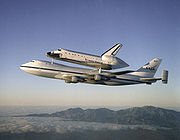 |
||
| Atlantis and its STS-125 STS-125 STS-125, or HST-SM4 , was the fifth and final space shuttle servicing mission to the Hubble Space Telescope .Launch occurred on 11 May 2009 at 2:01 pm EDT... crew head toward Earth orbit and rendezvous with the Hubble Space Telescope Hubble Space Telescope The Hubble Space Telescope is a space telescope that was carried into orbit by a Space Shuttle in 1990 and remains in operation. A 2.4 meter aperture telescope in low Earth orbit, Hubble's four main instruments observe in the near ultraviolet, visible, and near infrared... . |
Space Shuttle Atlantis after it undocked from the International Space Station on 17 September 2006. | The Space Shuttle Atlantis landing in 1997, at the end of STS-86 STS-86 STS-86 was a Space Shuttle Atlantis mission to the Mir space station. This was the last Atlantis mission before it was taken out of service temporarily for maintenance and upgrades, including the glass cockpit.-Crew:-Crew notes:... . |
Atlantis on top of the Shuttle Carrier Aircraft Shuttle Carrier Aircraft The Shuttle Carrier Aircraft are two extensively modified Boeing 747 airliners that NASA uses to transport Space Shuttle orbiters... in 1998. |
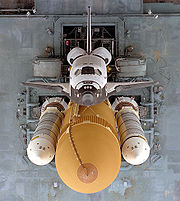 |
 |
||
| An overhead view of Atlantis as it sits atop the Mobile Launcher Platform before STS-79 STS-79 STS-79 was a Space Shuttle Atlantis mission to the Mir space station. It was the first shuttle mission to dock with Mir once it was fully assembled.-Crew:-Mission parameters:*Mass:**Spacehab-Double Module **Orbiter Docking System... . |
An overhead image of Atlantis during STS-115 STS-115 Note:The P3/P4 Truss segment and batteries were so heavy that the crew count was reduced from seven to six.-Crew notes:... , as recorded by an Expedition 13 Expedition 13 Expedition 13 was the 13th expedition to the International Space Station , and launched at 02:30 UTC on 30 March 2006. The expedition used the Soyuz TMA-8 spacecraft, which stayed at the station for the duration of the expedition for emergency evacuation.... crew member on board the International Space Station |
The Hubble Space Telescope aboard Atlantis during the STS-125 STS-125 STS-125, or HST-SM4 , was the fifth and final space shuttle servicing mission to the Hubble Space Telescope .Launch occurred on 11 May 2009 at 2:01 pm EDT... mission |
Atlantis STS-135 STS-135 was the final mission of the American Space Shuttle program. It used the orbiter Atlantis and hardware originally processed for the STS-335 contingency mission, which was not flown. STS-135 launched on 8 July and was originally scheduled to land on 20 July 2011, but the mission was... mission. |
Tribute and mission insignias
| NASA Orbiter Tribute for Space Shuttle Atlantis | ||||||
|---|---|---|---|---|---|---|
| Mission insignia for Atlantis flights | ||||||
 |
 |
 |
 |
 |
 |
 |
| STS-51-J STS-51-J was a NASA Space Shuttle mission. It was the first flight of Space Shuttle Atlantis and the 21st shuttle mission overall. It launched from Kennedy Space Center, Florida, on 3 October 1985, carrying a payload for the U.S... |
STS-61-B STS-61-B was NASA's 23rd Space Shuttle mission, and its second using Space Shuttle Atlantis. The shuttle was launched from Kennedy Space Center, Florida, on 26 November 1985. During STS-61-B, the shuttle crew deployed three communications satellites, and tested techniques of constructing... |
|
|
|
|
|
 |
 |
 |
 |
 |
 |
 |
| |
|
|
|
|
|
STS-71 STS-71 was the third mission of the US/Russian Shuttle-Mir Program, which carried out the first Space Shuttle docking to Mir, a Russian space station. The mission used Space Shuttle Atlantis, which lifted off from launch pad 39A on 27 June 1995 from Kennedy Space Center, Florida... |
 |
 |
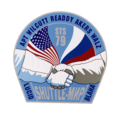 |
 |
 |
 |
 |
| |
|
|
|
|
|
|
 |
 |
 |
 |
 |
 |
 |
| |
|
|
|
|
|
|
 |
 |
|||||
| |
|
|
|
STS-135 STS-135 was the final mission of the American Space Shuttle program. It used the orbiter Atlantis and hardware originally processed for the STS-335 contingency mission, which was not flown. STS-135 launched on 8 July and was originally scheduled to land on 20 July 2011, but the mission was... |
||
See also
- List of human spaceflights
- List of Space Shuttle crews
- List of space shuttle missions
- Timeline of Space Shuttle missionsTimeline of Space Shuttle missions-See also:...
- STS-135STS-135STS-135 was the final mission of the American Space Shuttle program. It used the orbiter Atlantis and hardware originally processed for the STS-335 contingency mission, which was not flown. STS-135 launched on 8 July and was originally scheduled to land on 20 July 2011, but the mission was...
- SpaceCampSpaceCampSpaceCamp is a 1986 American film based on a book by Patrick Bailey and Larry B. Williams and inspired by the U.S. Space Camp in Huntsville, Alabama. Directed by Harry Winer from a screenplay by Clifford Green and Casey T. Mitchell, the film stars Kate Capshaw, Kelly Preston, Larry B...
, a 1986 film starring Kate CapshawKate CapshawKate Capshaw is an American actress. She is known for her role as Willie Scott in Indiana Jones and the Temple of Doom. She is married to Steven Spielberg.-Early life:...
and Lea ThompsonLea ThompsonLea Katherine Thompson is an American actress and director. She is best known for her 1990s NBC situation comedy Caroline in the City and her portrayal of Lorraine Baines McFly, Marty McFly's mother, in the Back to the Future trilogy...
that prominently features Atlantis.
External links
- Orbiter Vehicles
- Shuttle Orbiter Atlantis (OV-104)
- 16 April 2007: Consolidated Launch Manifest: Space Shuttle Flights and ISS Assembly Sequence
- Space Shuttle Atlantis: Last Flight – slideshow by Life magazine
- Atlantis photo essay From Boston.com.
- Atlantis over the Canary Islands during STS-132, in GoogleEarth image overlay
- (YouTube) STS-135 shuttle astronauts arrive at Kennedy Space Center for final launch practice
- (YouTube) STS-135: More of Atlantis on the launch pad ready for the final space shuttle mission
- (YouTube) STS-135: Atlantis sits on the launch pad ready for the final space shuttle mission
- (YouTube) STS-135: External tank is mated to the solid rocket boosters for space shuttle Atlantis launch
- (YouTube) STS-117: Space Shuttle Atlantis On Top Of 747 SCA Lands At KSC
- (YouTube) STS-117: Atlantis & 747 Taxi Off Runway After Landing At KSC