

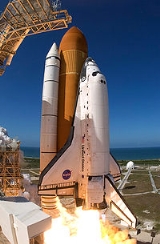
Space Shuttle Discovery

Encyclopedia
Space Shuttle Discovery (Orbiter Vehicle Designation
: OV-103) is one of the retired orbiters
of the Space Shuttle program
of NASA
, the space agency of the United States, and was operational from its maiden flight, STS-41-D
on August 30, 1984, until its final landing during STS-133
on March 9, 2011. Prior to its retirement, Discovery was NASA's Orbiter Fleet leader, having flown 39 successful missions in over 27 years of service. In 1984, Discovery became the third operational orbiter following Columbia
and Challenger
, and made its final touchdown at Kennedy Space Center
on March 9, 2011 at 10:57:17 CST, having spent a cumulative total of one full year (365 days) in space. Discovery has performed both research and International Space Station
(ISS) assembly missions. Discovery also flew the Hubble Space Telescope
into orbit, and was the only orbiter to take other parts of the telescope to space. Discovery was the first operational shuttle to be retired, followed by Endeavour
and Atlantis
.
, one of the ships commanded by Captain James Cook
during his third and final major voyage from 1776 to 1779.
Others include
Discovery was the shuttle that launched the Hubble Space Telescope
. The second
and third
Hubble service missions were also conducted by Discovery. It has also launched the Ulysses probe
and three TDRS
satellites. Discovery has been chosen twice as the "Return To Flight" Orbiter, first in 1988 after the 1986 Challenger disaster
, and then for the twin "Return To Flight" missions in July 2005 and July 2006 after the 2003 Columbia disaster
. Discovery also carried Project Mercury
astronaut John Glenn
, who was 77 at the time, back into space during STS-95
on October 29, 1998, making him the oldest person to go into space.
Had the planned STS-62-A
mission from Vandenberg Air Force Base
in 1986 for the United States Department of Defense
gone ahead, Discovery would have flown it. Its final mission, STS-133, landed on March 9, 2011, in Kennedy Space Center, Florida. After decommissioning and delivery, the spacecraft will be displayed in Virginia at the Steven F. Udvar-Hazy Center
, an annex of the Smithsonian Institution
's National Air and Space Museum
.
Beginning in late 1995, the orbiter underwent a nine-month Orbiter Maintenance Down Period (OMDP) in Palmdale California. This included outfitting the vehicle with a 5th set of cryogenic tanks and an external airlock to support missions to the International Space Station. It can be attached to the top of specialized aircraft and did so in June 1996 when it returned to the Kennedy Space Center, riding piggy-back
on a modified Boeing 747
.
After STS-105
, Discovery became the first of the orbiter fleet to undergo Orbiter Major Modification (OMM) period at the Kennedy Space Center. Work began in September 2002 to prepare the vehicle for Return to Flight. This included scheduled upgrades and additional safety modifications. Discovery is 6 pounds (2.7 kg) heavier than Atlantis
and 363 pounds (164.7 kg) heavier than Endeavour
.
on March 9, 2011.
NASA has offered Discovery to the Smithsonian Institution
's National Air and Space Museum
for public display and preservation, after a months-long decontamination
process, as part of the national collection after the orbiter has been retired. Discovery will replace in the Smithsonian's display at the Steven F. Udvar-Hazy Center
in Virginia.
 By its last mission, Discovery had flown 148 million miles (238 million km) in 39 missions, completed 5,830 orbits, and spent 365 days in orbit in over 27 years. Discovery is the Orbiter Fleet leader, having flown more flights than any other Orbiter Shuttle in the fleet, including four in 1985 alone. Discovery flew all three "return to flight" missions after the Challenger
and Columbia
disasters: STS-26
in 1988, STS-114
in 2005, and STS-121
in 2006. Discovery flew the third to the last mission of the Space Shuttle program, STS-133
, having launched on (NET) February 24, 2011. Endeavour flew aboard STS-134
and Atlantis performed STS-135
, NASA's last Space Shuttle mission. On February 24, 2011, Space Shuttle Discovery launched from Kennedy Space Center's Launch Complex 39-A to begin its final orbital flight.
Notable missions:
‡ Longest shuttle mission for Discovery
– shortest shuttle mission for Discovery
shot her down and destroyed her.
Orbiter Vehicle Designation
Each NASA space shuttle designation is composed of a prefix and suffix separated by a dash. The prefix for operational shuttles is OV, for Orbiter Vehicle.The suffix is composed of two parts: the series and the vehicle number.Series:...
: OV-103) is one of the retired orbiters
Space Shuttle Orbiter
The Space Shuttle orbiter was the orbital spacecraft of the Space Shuttle program operated by NASA, the space agency of the United States. The orbiter was a reusable winged "space-plane", a mixture of rockets, spacecraft, and aircraft...
of the Space Shuttle program
Space Shuttle program
NASA's Space Shuttle program, officially called Space Transportation System , was the United States government's manned launch vehicle program from 1981 to 2011...
of NASA
NASA
The National Aeronautics and Space Administration is the agency of the United States government that is responsible for the nation's civilian space program and for aeronautics and aerospace research...
, the space agency of the United States, and was operational from its maiden flight, STS-41-D
STS-41-D
STS-41-D was the first flight of NASA's Space Shuttle orbiter Discovery. It was the 12th mission of the Space Shuttle program, and was launched from Kennedy Space Center, Florida, on 30 August 1984...
on August 30, 1984, until its final landing during STS-133
STS-133
STS-133 was the 133rd mission in NASA's Space Shuttle program; during the mission, Space Shuttle Discovery docked with the International Space Station. It was Discoverys 39th and final mission. The mission launched on 24 February 2011, and landed on 9 March 2011...
on March 9, 2011. Prior to its retirement, Discovery was NASA's Orbiter Fleet leader, having flown 39 successful missions in over 27 years of service. In 1984, Discovery became the third operational orbiter following Columbia
Space Shuttle Columbia
Space Shuttle Columbia was the first spaceworthy Space Shuttle in NASA's orbital fleet. First launched on the STS-1 mission, the first of the Space Shuttle program, it completed 27 missions before being destroyed during re-entry on February 1, 2003 near the end of its 28th, STS-107. All seven crew...
and Challenger
Space Shuttle Challenger
Space Shuttle Challenger was NASA's second Space Shuttle orbiter to be put into service, Columbia having been the first. The shuttle was built by Rockwell International's Space Transportation Systems Division in Downey, California...
, and made its final touchdown at Kennedy Space Center
Kennedy Space Center
The John F. Kennedy Space Center is the NASA installation that has been the launch site for every United States human space flight since 1968. Although such flights are currently on hiatus, KSC continues to manage and operate unmanned rocket launch facilities for America's civilian space program...
on March 9, 2011 at 10:57:17 CST, having spent a cumulative total of one full year (365 days) in space. Discovery has performed both research and International Space Station
International Space Station
The International Space Station is a habitable, artificial satellite in low Earth orbit. The ISS follows the Salyut, Almaz, Cosmos, Skylab, and Mir space stations, as the 11th space station launched, not including the Genesis I and II prototypes...
(ISS) assembly missions. Discovery also flew the Hubble Space Telescope
Hubble Space Telescope
The Hubble Space Telescope is a space telescope that was carried into orbit by a Space Shuttle in 1990 and remains in operation. A 2.4 meter aperture telescope in low Earth orbit, Hubble's four main instruments observe in the near ultraviolet, visible, and near infrared...
into orbit, and was the only orbiter to take other parts of the telescope to space. Discovery was the first operational shuttle to be retired, followed by Endeavour
Space Shuttle Endeavour
Space Shuttle Endeavour is one of the retired orbiters of the Space Shuttle program of NASA, the space agency of the United States. Endeavour was the fifth and final spaceworthy NASA space shuttle to be built, constructed as a replacement for Challenger...
and Atlantis
Space Shuttle Atlantis
The Space Shuttle Atlantis is a retired Space Shuttle orbiter in the Space Shuttle fleet belonging to the National Aeronautics and Space Administration , the spaceflight and space exploration agency of the United States...
.
History
The spacecraft takes its name from four British ships of exploration named Discovery, primarily HMS DiscoveryHMS Discovery (1774)
HMS Discovery was the consort ship of James Cook's third expedition to the Pacific Ocean in 1776 - 1780. Like Cook's other ships, Discovery was a Whitby-built collier of 298 tons, originally named Diligence when she was built in 1774. Originally a brig, Cook had her changed to a full rigged ship...
, one of the ships commanded by Captain James Cook
James Cook
Captain James Cook, FRS, RN was a British explorer, navigator and cartographer who ultimately rose to the rank of captain in the Royal Navy...
during his third and final major voyage from 1776 to 1779.
Others include
- Henry HudsonHenry HudsonHenry Hudson was an English sea explorer and navigator in the early 17th century. Hudson made two attempts on behalf of English merchants to find a prospective Northeast Passage to Cathay via a route above the Arctic Circle...
's DiscoveryDiscovery (1602 ship)Discovery was a 20-ton "fly-boat" of the British East India Company, launched before 1602.Discovery was the smallest of three ships that were led by Captain Christopher Newport on the voyage that resulted in the founding of Jamestown in the new Colony of Virginia in 1607...
, which he used in 1610–1611 to search for a Northwest PassageNorthwest PassageThe Northwest Passage is a sea route through the Arctic Ocean, along the northern coast of North America via waterways amidst the Canadian Arctic Archipelago, connecting the Atlantic and Pacific Oceans...
. This ship had previously been used in the 1607 founding of JamestownJamestown, VirginiaJamestown was a settlement in the Colony of Virginia. Established by the Virginia Company of London as "James Fort" on May 14, 1607 , it was the first permanent English settlement in what is now the United States, following several earlier failed attempts, including the Lost Colony of Roanoke...
, the first permanent English settlement in what was to become the United States; - HMS DiscoveryHMS Discovery (1874)HMS Discovery was a wooden screw storeship, formerly the whaling ship Bloodhound. She was purchased in 1874 for the British Arctic Expedition of 1875–1876 and was sold in 1902.-Design and Construction:...
, one of the ships which took Captain George NaresGeorge NaresVice-Admiral Sir George Strong Nares KCB FRS was a British naval officer and Arctic explorer. He commanded both the Challenger Expedition and the British Arctic Expedition, and was highly thought of a leader and a scientific explorer...
' British Arctic ExpeditionBritish Arctic ExpeditionThe British Arctic Expedition of 1875-1876, led by Sir George Strong Nares, was sent by the British Admiralty to attempt to reach the North Pole via Smith Sound. Two ships, HMS Alert and HMS Discovery , sailed from Portsmouth on 29 May 1875...
of 1875–1876 to the North Pole; and - RRS DiscoveryRRS DiscoveryThe RRS Discovery was the last traditional wooden three-masted ship to be built in Britain. Designed for Antarctic research, she was launched in 1901. Her first mission was the British National Antarctic Expedition, carrying Robert Falcon Scott and Ernest Shackleton on their first, successful...
, a Royal Geographical SocietyRoyal Geographical SocietyThe Royal Geographical Society is a British learned society founded in 1830 for the advancement of geographical sciences...
research vesselResearch vesselA research vessel is a ship designed and equipped to carry out research at sea. Research vessels carry out a number of roles. Some of these roles can be combined into a single vessel, others require a dedicated vessel...
which, under the command of Captain Robert Falcon ScottRobert Falcon ScottCaptain Robert Falcon Scott, CVO was a Royal Navy officer and explorer who led two expeditions to the Antarctic regions: the Discovery Expedition, 1901–04, and the ill-fated Terra Nova Expedition, 1910–13...
and Ernest ShackletonErnest ShackletonSir Ernest Henry Shackleton, CVO, OBE was a notable explorer from County Kildare, Ireland, who was one of the principal figures of the period known as the Heroic Age of Antarctic Exploration...
, was the main ship of the 1901–1904 "Discovery ExpeditionDiscovery ExpeditionThe British National Antarctic Expedition, 1901–04, generally known as the Discovery Expedition, was the first official British exploration of the Antarctic regions since James Clark Ross's voyage sixty years earlier...
" to Antarctica which is still preserved as a museum.
Discovery was the shuttle that launched the Hubble Space Telescope
Hubble Space Telescope
The Hubble Space Telescope is a space telescope that was carried into orbit by a Space Shuttle in 1990 and remains in operation. A 2.4 meter aperture telescope in low Earth orbit, Hubble's four main instruments observe in the near ultraviolet, visible, and near infrared...
. The second
STS-82
STS-82 was a Hubble Space Telescope servicing mission by Space Shuttle Discovery. The mission launched from Kennedy Space Center, Florida, on 11 February 1997 and returned to earth on 21 February 1997 at Kennedy Space Center.-Crew:...
and third
STS-103
STS-103 was a Hubble Space Telescope servicing mission by Space Shuttle Discovery. The mission launched from Kennedy Space Center, Florida, on 19 December 1999 and returned on 27 December 1999.-Crew:-Mission parameters:*Mass:...
Hubble service missions were also conducted by Discovery. It has also launched the Ulysses probe
Ulysses probe
Ulysses is a decommissioned robotic space probe that was designed to study the Sun as a joint venture of NASA and the European Space Agency . The spacecraft was originally named Odysseus, because of its lengthy and indirect trajectory to near Solar distance...
and three TDRS
TDRS
A Tracking and Data Relay Satellite is a type of communications satellite that forms part of the Tracking and Data Relay Satellite System used by NASA and other United States government agencies for communications to and from independent "User Platforms" such as satellites, balloons, aircraft,...
satellites. Discovery has been chosen twice as the "Return To Flight" Orbiter, first in 1988 after the 1986 Challenger disaster
STS-51-L
STS-51-L was the twenty-fifth flight of the American Space Shuttle program, which marked the first time an ordinary civilian, schoolteacher Christa McAuliffe, had flown aboard the Space Shuttle. The mission used Space Shuttle Challenger, which lifted off from the Launch Complex 39-B on 28 January...
, and then for the twin "Return To Flight" missions in July 2005 and July 2006 after the 2003 Columbia disaster
Space Shuttle Columbia disaster
The Space Shuttle Columbia disaster occurred on February 1, 2003, when shortly before it was scheduled to conclude its 28th mission, STS-107, the Space Shuttle Columbia disintegrated over Texas and Louisiana during re-entry into the Earth's atmosphere, resulting in the death of all seven crew members...
. Discovery also carried Project Mercury
Project Mercury
In January 1960 NASA awarded Western Electric Company a contract for the Mercury tracking network. The value of the contract was over $33 million. Also in January, McDonnell delivered the first production-type Mercury spacecraft, less than a year after award of the formal contract. On February 12,...
astronaut John Glenn
John Glenn
John Herschel Glenn, Jr. is a former United States Marine Corps pilot, astronaut, and United States senator who was the first American to orbit the Earth and the third American in space. Glenn was a Marine Corps fighter pilot before joining NASA's Mercury program as a member of NASA's original...
, who was 77 at the time, back into space during STS-95
STS-95
STS-95 was a Space Shuttle Discovery mission launched from Kennedy Space Center, Florida on 29 October 1998. It was the 25th flight of Discovery and the 92nd mission flown since the start of the Space Shuttle program in April 1981. It was a highly publicized mission due to former Project Mercury...
on October 29, 1998, making him the oldest person to go into space.
Had the planned STS-62-A
STS-62-A
STS-62-A was a planned Space Shuttle mission to deliver a reconnaissance payload into polar orbit. It was expected to use Discovery. It would have been the first manned launch from Vandenberg Air Force Base, California...
mission from Vandenberg Air Force Base
Vandenberg Air Force Base
Vandenberg Air Force Base is a United States Air Force Base, located approximately northwest of Lompoc, California. It is under the jurisdiction of the 30th Space Wing, Air Force Space Command ....
in 1986 for the United States Department of Defense
United States Department of Defense
The United States Department of Defense is the U.S...
gone ahead, Discovery would have flown it. Its final mission, STS-133, landed on March 9, 2011, in Kennedy Space Center, Florida. After decommissioning and delivery, the spacecraft will be displayed in Virginia at the Steven F. Udvar-Hazy Center
Steven F. Udvar-Hazy Center
The Steven F. Udvar-Hazy Center is the Smithsonian National Air and Space Museum 's annex at Washington Dulles International Airport in the Chantilly area of Fairfax County, Virginia, United States....
, an annex of the Smithsonian Institution
Smithsonian Institution
The Smithsonian Institution is an educational and research institute and associated museum complex, administered and funded by the government of the United States and by funds from its endowment, contributions, and profits from its retail operations, concessions, licensing activities, and magazines...
's National Air and Space Museum
National Air and Space Museum
The National Air and Space Museum of the Smithsonian Institution holds the largest collection of historic aircraft and spacecraft in the world. It was established in 1976. Located in Washington, D.C., United States, it is a center for research into the history and science of aviation and...
.
Construction milestones
| Date | Milestone |
|---|---|
| 1979 January 29 | Contract Award to Rockwell International Rockwell International Rockwell International was a major American manufacturing conglomerate in the latter half of the 20th century, involved in aircraft, the space industry, both defense-oriented and commercial electronics, automotive and truck components, printing presses, valves and meters, and industrial automation.... 's Space Transportation Systems Division in Downey, California Downey, California Downey is a city located in southeast Los Angeles County, California, United States, southeast of downtown Los Angeles. The city is best known as the birthplace of the Apollo space program, and is the city where folk singer Karen Carpenter lived and died... |
| 1979 August 27 | Start long lead fabrication of Crew Module |
| 1980 June 20 | Start fabrication lower fuselage Fuselage The fuselage is an aircraft's main body section that holds crew and passengers or cargo. In single-engine aircraft it will usually contain an engine, although in some amphibious aircraft the single engine is mounted on a pylon attached to the fuselage which in turn is used as a floating hull... |
| 1980 November 10 | Start structural assembly of aft-fuselage |
| 1980 December 8 | Start initial system installation aft fuselage |
| 1981 March 2 | Start fabrication/assembly of payload bay doors |
| 1981 October 26 | Start initial system installation, crew module, Downey |
| 1982 January 4 | Start initial system installation upper forward fuselage |
| 1982 March 16 | Midfuselage on dock, Palmdale, California Palmdale, California Palmdale is a city located in the center of northern Los Angeles County, California, United States.Palmdale was the first community within the Antelope Valley to incorporate as a city on August 24, 1962; 47 years later, voters approved creating a charter city in November, 2009. Palmdale is... |
| 1982 March 30 | Elevon Elevon Elevons are aircraft control surfaces that combine the functions of the elevator and the aileron , hence the name. They are frequently used on tailless aircraft such as flying wings. An elevon that is not part of the main wing, but instead is a separate tail surface, is a stabilator... s on dock, Palmdale |
| 1982 April 30 | Wing Wing A wing is an appendage with a surface that produces lift for flight or propulsion through the atmosphere, or through another gaseous or liquid fluid... s arrive at Palmdale from Grumman |
| 1982 April 30 | Lower forward fuselage on dock, Palmdale |
| 1982 July 16 | Upper forward fuselage on dock, Palmdale |
| 1982 August 5 | Vertical stabilizer Vertical stabilizer The vertical stabilizers, vertical stabilisers, or fins, of aircraft, missiles or bombs are typically found on the aft end of the fuselage or body, and are intended to reduce aerodynamic side slip. It is analogical to a skeg on boats and ships.On aircraft, vertical stabilizers generally point upwards... on dock, Palmdale |
| 1982 September 3 | Start of Final Assembly |
| 1982 October 15 | Body flap on dock, Palmdale |
| 1983 January 11 | Aft fuselage on dock, Palmdale |
| 1983 February 25 | Complete final assembly and closeout installation, Palmdale |
| 1983 February 28 | Start initial subsystems test, power-on, Palmdale |
| 1983 May 13 | Complete initial subsystems testing |
| 1983 July 26 | Complete subsystems testing |
| 1983 August 12 | Completed Final Acceptance |
| 1983 October 16 | Rollout from Palmdale |
| 1983 November 5 | Overland transport from Palmdale to Edwards Air Force Base Edwards Air Force Base Edwards Air Force Base is a United States Air Force base located on the border of Kern County, Los Angeles County, and San Bernardino County, California, in the Antelope Valley. It is southwest of the central business district of North Edwards, California and due east of Rosamond.It is named in... |
| 1983 November 9 | Delivery to Kennedy Space Center Kennedy Space Center The John F. Kennedy Space Center is the NASA installation that has been the launch site for every United States human space flight since 1968. Although such flights are currently on hiatus, KSC continues to manage and operate unmanned rocket launch facilities for America's civilian space program... |
| 1984 June 2 | Flight Readiness Firing |
| 1984 August 30 | First Flight (STS-41-D STS-41-D STS-41-D was the first flight of NASA's Space Shuttle orbiter Discovery. It was the 12th mission of the Space Shuttle program, and was launched from Kennedy Space Center, Florida, on 30 August 1984... ) |
Upgrades and features
Discovery weighed some 6870 pounds (3,116.2 kg) less than Columbia when it was brought into service due to optimizations determined during the construction and testing of Enterprise, Columbia and Challenger.Beginning in late 1995, the orbiter underwent a nine-month Orbiter Maintenance Down Period (OMDP) in Palmdale California. This included outfitting the vehicle with a 5th set of cryogenic tanks and an external airlock to support missions to the International Space Station. It can be attached to the top of specialized aircraft and did so in June 1996 when it returned to the Kennedy Space Center, riding piggy-back
Piggy-back
Piggy-backed is riding on the back of something else. To piggy-back is to ride on someone's back or shoulders or head.-Etymology:...
on a modified Boeing 747
Boeing 747
The Boeing 747 is a wide-body commercial airliner and cargo transport, often referred to by its original nickname, Jumbo Jet, or Queen of the Skies. It is among the world's most recognizable aircraft, and was the first wide-body ever produced...
.
After STS-105
STS-105
STS-105 was a mission of the Space Shuttle Discovery to the International Space Station, launched from Kennedy Space Center, Florida, 10 August 2001. This mission was Discoverys final mission until STS-114, because Discovery was grounded for a refit, and then all Shuttles were grounded in the wake...
, Discovery became the first of the orbiter fleet to undergo Orbiter Major Modification (OMM) period at the Kennedy Space Center. Work began in September 2002 to prepare the vehicle for Return to Flight. This included scheduled upgrades and additional safety modifications. Discovery is 6 pounds (2.7 kg) heavier than Atlantis
Space Shuttle Atlantis
The Space Shuttle Atlantis is a retired Space Shuttle orbiter in the Space Shuttle fleet belonging to the National Aeronautics and Space Administration , the spaceflight and space exploration agency of the United States...
and 363 pounds (164.7 kg) heavier than Endeavour
Space Shuttle Endeavour
Space Shuttle Endeavour is one of the retired orbiters of the Space Shuttle program of NASA, the space agency of the United States. Endeavour was the fifth and final spaceworthy NASA space shuttle to be built, constructed as a replacement for Challenger...
.
Decommissioning
Discovery was decommissionedShip decommissioning
To decommission a ship is to terminate her career in service in the armed forces of her nation. A somber occasion, it has little of the elaborate ceremony of ship commissioning, but carries significant tradition....
on March 9, 2011.
NASA has offered Discovery to the Smithsonian Institution
Smithsonian Institution
The Smithsonian Institution is an educational and research institute and associated museum complex, administered and funded by the government of the United States and by funds from its endowment, contributions, and profits from its retail operations, concessions, licensing activities, and magazines...
's National Air and Space Museum
National Air and Space Museum
The National Air and Space Museum of the Smithsonian Institution holds the largest collection of historic aircraft and spacecraft in the world. It was established in 1976. Located in Washington, D.C., United States, it is a center for research into the history and science of aviation and...
for public display and preservation, after a months-long decontamination
Decontamination
Decontamination is the process of cleansing the human body to remove contamination by hazardous materials including chemicals, radioactive substances, and infectious material...
process, as part of the national collection after the orbiter has been retired. Discovery will replace in the Smithsonian's display at the Steven F. Udvar-Hazy Center
Steven F. Udvar-Hazy Center
The Steven F. Udvar-Hazy Center is the Smithsonian National Air and Space Museum 's annex at Washington Dulles International Airport in the Chantilly area of Fairfax County, Virginia, United States....
in Virginia.
Flights
Space Shuttle Challenger disaster
The Space Shuttle Challenger disaster occurred on January 28, 1986, when Space Shuttle Challenger broke apart 73 seconds into its flight, leading to the deaths of its seven crew members. The spacecraft disintegrated over the Atlantic Ocean, off the coast of central Florida at 11:38 am EST...
and Columbia
Space Shuttle Columbia disaster
The Space Shuttle Columbia disaster occurred on February 1, 2003, when shortly before it was scheduled to conclude its 28th mission, STS-107, the Space Shuttle Columbia disintegrated over Texas and Louisiana during re-entry into the Earth's atmosphere, resulting in the death of all seven crew members...
disasters: STS-26
STS-26
STS-26 was the 26th NASA Space Shuttle mission and the seventh flight of the Discovery orbiter. The mission launched from Kennedy Space Center, Florida, on 29 September 1988, and landed four days later on 3 October. STS-26 was declared the "Return to Flight" mission, being the first mission after...
in 1988, STS-114
STS-114
-Original crew:This mission was to carry the Expedition 7 crew to the ISS and bring home the Expedition 6 crew. The original crew was to be:-Mission highlights:...
in 2005, and STS-121
STS-121
STS-121 was a space shuttle mission to the International Space Station flown by Space Shuttle Discovery. The main purposes of the mission were to test new safety and repair techniques introduced following the Columbia disaster of February 2003 as well as to deliver supplies, equipment and...
in 2006. Discovery flew the third to the last mission of the Space Shuttle program, STS-133
STS-133
STS-133 was the 133rd mission in NASA's Space Shuttle program; during the mission, Space Shuttle Discovery docked with the International Space Station. It was Discoverys 39th and final mission. The mission launched on 24 February 2011, and landed on 9 March 2011...
, having launched on (NET) February 24, 2011. Endeavour flew aboard STS-134
STS-134
STS-134 was the penultimate mission of NASA's Space Shuttle program. The mission marked the 25th and final flight of . This flight delivered the Alpha Magnetic Spectrometer and an ExPRESS Logistics Carrier to the International Space Station. Mark Kelly served as the mission commander...
and Atlantis performed STS-135
STS-135
STS-135 was the final mission of the American Space Shuttle program. It used the orbiter Atlantis and hardware originally processed for the STS-335 contingency mission, which was not flown. STS-135 launched on 8 July and was originally scheduled to land on 20 July 2011, but the mission was...
, NASA's last Space Shuttle mission. On February 24, 2011, Space Shuttle Discovery launched from Kennedy Space Center's Launch Complex 39-A to begin its final orbital flight.
Notable missions:
- STS-41-DSTS-41-DSTS-41-D was the first flight of NASA's Space Shuttle orbiter Discovery. It was the 12th mission of the Space Shuttle program, and was launched from Kennedy Space Center, Florida, on 30 August 1984...
: Space Shuttle Discovery's maiden spaceflight - STS-51-DSTS-51-DSTS-51-D was the sixteenth flight of NASA's Space Shuttle program, and the fourth flight of Space Shuttle Discovery. The launch of STS-51-D from Kennedy Space Center , Florida, on 12 April 1985 was delayed by 55 minutes, after a boat strayed into the restricted Solid Rocket Booster recovery zone...
: Carried first incumbent United States member of Congress into space, Senator Jake GarnJake GarnEdwin Jacob "Jake" Garn is an American politician, a member of the Republican Party, and served as a U.S. Senator representing Utah from 1974 to 1993...
(RRepublican Party (United States)The Republican Party is one of the two major contemporary political parties in the United States, along with the Democratic Party. Founded by anti-slavery expansion activists in 1854, it is often called the GOP . The party's platform generally reflects American conservatism in the U.S...
–UtahUtahUtah is a state in the Western United States. It was the 45th state to join the Union, on January 4, 1896. Approximately 80% of Utah's 2,763,885 people live along the Wasatch Front, centering on Salt Lake City. This leaves vast expanses of the state nearly uninhabited, making the population the...
) - STS-26STS-26STS-26 was the 26th NASA Space Shuttle mission and the seventh flight of the Discovery orbiter. The mission launched from Kennedy Space Center, Florida, on 29 September 1988, and landed four days later on 3 October. STS-26 was declared the "Return to Flight" mission, being the first mission after...
: First "Return to Flight" after ChallengerSpace Shuttle ChallengerSpace Shuttle Challenger was NASA's second Space Shuttle orbiter to be put into service, Columbia having been the first. The shuttle was built by Rockwell International's Space Transportation Systems Division in Downey, California...
disaster (STS-51-LSTS-51-LSTS-51-L was the twenty-fifth flight of the American Space Shuttle program, which marked the first time an ordinary civilian, schoolteacher Christa McAuliffe, had flown aboard the Space Shuttle. The mission used Space Shuttle Challenger, which lifted off from the Launch Complex 39-B on 28 January...
) - STS-31STS-31STS-31 was the thirty-fifth mission of the American Space Shuttle program, which launched the Hubble Space Telescope astronomical observatory into Earth orbit...
: Launch of the Hubble Space TelescopeHubble Space TelescopeThe Hubble Space Telescope is a space telescope that was carried into orbit by a Space Shuttle in 1990 and remains in operation. A 2.4 meter aperture telescope in low Earth orbit, Hubble's four main instruments observe in the near ultraviolet, visible, and near infrared... - STS-48STS-48-Mission parameters:*Mass:**Orbiter landing with payload: **Payload: *Perigee: *Apogee: *Inclination: 57.0°*Period: 96.2 min-Mission highlights:...
: Launch of the Upper Atmosphere Research SatelliteUpper Atmosphere Research SatelliteThe Upper Atmosphere Research Satellite was a NASA-operated orbital observatory whose mission was to study the Earth’s atmosphere, particularly the protective ozone layer. The satellite was deployed from Space Shuttle Discovery during the STS-48 mission on September 15, 1991... - STS-60STS-60STS-60 was the first mission of the US/Russian Shuttle-Mir Program, which carried Sergei K. Krikalev, the first Russian cosmonaut to fly aboard a Space Shuttle. The mission used Space Shuttle Discovery, which lifted off from Launch Pad 39A on 3 February 1994 from Kennedy Space Center, Florida...
: First RussiaRussiaRussia or , officially known as both Russia and the Russian Federation , is a country in northern Eurasia. It is a federal semi-presidential republic, comprising 83 federal subjects...
n launched in an American spacecraft (Sergei KrikalevSergei KrikalevSergei Konstantinovich Krikalev is a Russian cosmonaut and mechanical engineer. As a prominent rocket scientist, he has been veteran of six space flights and currently has spent more time in space than any other human being.On August 16, 2005 at 1:44 a.m...
) - STS-63: First female shuttle pilot Eileen CollinsEileen CollinsEileen Marie Collins is a retired American astronaut and a retired U.S. Air Force Colonel. A former military instructor and test pilot, Collins was the first female pilot and first female commander of a Space Shuttle. She was awarded several medals for her work. Col. Collins has logged 38 days 8...
. - STS-95STS-95STS-95 was a Space Shuttle Discovery mission launched from Kennedy Space Center, Florida on 29 October 1998. It was the 25th flight of Discovery and the 92nd mission flown since the start of the Space Shuttle program in April 1981. It was a highly publicized mission due to former Project Mercury...
: Second flight of John GlennJohn GlennJohn Herschel Glenn, Jr. is a former United States Marine Corps pilot, astronaut, and United States senator who was the first American to orbit the Earth and the third American in space. Glenn was a Marine Corps fighter pilot before joining NASA's Mercury program as a member of NASA's original...
, who has been 77 at that time, the oldest man in space and third incumbent member of Congress to enter space - STS-96STS-96STS-96 was a Space Shuttle mission to the International Space Station flown by Space Shuttle Discovery, and the first shuttle flight to dock with the International Space Station. The shuttle carried the Spacehab module in the payload, filled with cargo for station outfitting...
: First Orbiter Shuttle and first mission flight to dock with the International Space Station - STS-92STS-92STS-92 was a Space Shuttle mission to the International Space Station flown by Space Shuttle Discovery. STS-92 marked the 100th mission of the Space Shuttle...
: The 100th Space Shuttle mission - STS-114STS-114-Original crew:This mission was to carry the Expedition 7 crew to the ISS and bring home the Expedition 6 crew. The original crew was to be:-Mission highlights:...
: Second "Return to Flight" missions after ColumbiaSpace Shuttle ColumbiaSpace Shuttle Columbia was the first spaceworthy Space Shuttle in NASA's orbital fleet. First launched on the STS-1 mission, the first of the Space Shuttle program, it completed 27 missions before being destroyed during re-entry on February 1, 2003 near the end of its 28th, STS-107. All seven crew...
disasterSpace Shuttle Columbia disasterThe Space Shuttle Columbia disaster occurred on February 1, 2003, when shortly before it was scheduled to conclude its 28th mission, STS-107, the Space Shuttle Columbia disintegrated over Texas and Louisiana during re-entry into the Earth's atmosphere, resulting in the death of all seven crew members...
(STS-107STS-107-Mission parameters:*Mass:**Orbiter Liftoff: **Orbiter Landing: **Payload: *Perigee: *Apogee: *Inclination: 39.0°*Period: 90.1 min- Insignia :...
) - STS-116STS-116-Crew notes:Originally this mission was to carry the Expedition 8 crew to the ISS. The original crew was to be:-Mission highlights:* The STS-116 mission delivered and attached the International Space Station's third port truss segment, the P5 truss....
: First night time launch of a Space Shuttle since the Columbia disasterSpace Shuttle Columbia disasterThe Space Shuttle Columbia disaster occurred on February 1, 2003, when shortly before it was scheduled to conclude its 28th mission, STS-107, the Space Shuttle Columbia disintegrated over Texas and Louisiana during re-entry into the Earth's atmosphere, resulting in the death of all seven crew members...
. Last Shuttle launch from LC-39B - STS-131STS-131STS-131 was a NASA Space Shuttle mission to the International Space Station . launched on 5 April 2010 at 6:22 am from Kennedy Space Center's launch pad 39A, and landed at 9:08 am on 20 April 2010 on runway 33 at the Kennedy Space Center's Shuttle Landing Facility...
: Longest mission for this Orbiter with 15 days to its credit - STS-133STS-133STS-133 was the 133rd mission in NASA's Space Shuttle program; during the mission, Space Shuttle Discovery docked with the International Space Station. It was Discoverys 39th and final mission. The mission launched on 24 February 2011, and landed on 9 March 2011...
: Final mission for this Space Shuttle
Flights listing
| # | Date | Designation | Notes | Length of journey |
|---|---|---|---|---|
| 1 | STS-41-D STS-41-D STS-41-D was the first flight of NASA's Space Shuttle orbiter Discovery. It was the 12th mission of the Space Shuttle program, and was launched from Kennedy Space Center, Florida, on 30 August 1984... |
First Discovery mission: Launched two communications satellite Communications satellite A communications satellite is an artificial satellite stationed in space for the purpose of telecommunications... s, including LEASAT F2 Syncom Syncom started as a 1961 NASA program for active geosynchronous communication satellites, all of which were developed and manufactured by Hughes Space and Communications... . |
6 days, 00 hours, 56 minutes, 04 seconds |
|
| 2 | STS-51-A STS-51-A STS-51-A was the second flight of Space Shuttle Discovery, and the 14th flight of NASA's Space Shuttle program. The mission launched from Kennedy Space Center on 8 November 1984, and landed just under eight days later on 16 November.... |
Launched two and rescued two communications satellites including LEASAT F1. | 7 days, 23 hours, 44 minutes, 56 seconds |
|
| 3 | STS-51-C STS-51-C STS-51-C was the 15th flight of NASA's Space Shuttle program, and the third flight of Space Shuttle Discovery. It was also the first shuttle mission to deploy a dedicated United States Department of Defense payload, and as such many mission details remain classified... |
Launched DOD United States Department of Defense The United States Department of Defense is the U.S... Magnum Magnum (satellite) Magnum is the code name for a class of SIGINT spy satellites reportedly operated by the National Reconnaissance Office for the United States Central Intelligence Agency... ELINT satellite. |
3 days, 01 hours, 33 minutes, 23 seconds- |
|
| 4 | STS-51-D STS-51-D STS-51-D was the sixteenth flight of NASA's Space Shuttle program, and the fourth flight of Space Shuttle Discovery. The launch of STS-51-D from Kennedy Space Center , Florida, on 12 April 1985 was delayed by 55 minutes, after a boat strayed into the restricted Solid Rocket Booster recovery zone... |
Launched two communications satellites including LEASAT F3. | 6 days, 23 hours, 55 minutes, 23 seconds |
|
| 5 | STS-51-G STS-51-G STS-51-G was the eighteenth flight of NASA's Space Shuttle program, and the fifth flight of Space Shuttle Discovery. The mission launched from Kennedy Space Center, Florida, on 17 June 1985... |
Launched two communications satellites, Sultan Salman al-Saud becomes first Saudi Arabia Saudi Arabia The Kingdom of Saudi Arabia , commonly known in British English as Saudi Arabia and in Arabic as as-Sa‘ūdiyyah , is the largest state in Western Asia by land area, constituting the bulk of the Arabian Peninsula, and the second-largest in the Arab World... n in space. |
7 days, 01 hours, 38 minutes, 52 seconds |
|
| 6 | STS-51-I STS-51-I STS-51-I was the twentieth mission of NASA's Space Shuttle program and the sixth flight of Space Shuttle Discovery. During the mission, Discovery deployed three communications satellites into orbit... |
Launched two communications satellites including LEASAT F4. Recovered, repaired, and redeployed LEASAT F3. | 7 days, 02 hours, 17 minutes, 42 seconds |
|
| 7 | STS-26 STS-26 STS-26 was the 26th NASA Space Shuttle mission and the seventh flight of the Discovery orbiter. The mission launched from Kennedy Space Center, Florida, on 29 September 1988, and landed four days later on 3 October. STS-26 was declared the "Return to Flight" mission, being the first mission after... |
Return to flight after Space Shuttle Challenger disaster Space Shuttle Challenger disaster The Space Shuttle Challenger disaster occurred on January 28, 1986, when Space Shuttle Challenger broke apart 73 seconds into its flight, leading to the deaths of its seven crew members. The spacecraft disintegrated over the Atlantic Ocean, off the coast of central Florida at 11:38 am EST... , launched TDRS Tracking and Data Relay Satellite A Tracking and Data Relay Satellite is a type of communications satellite that forms part of the Tracking and Data Relay Satellite System used by NASA and other United States government agencies for communications to and from independent "User Platforms" such as satellites, balloons, aircraft,... . |
4 days, 01 hours, 00 minutes, 11 seconds |
|
| 8 | STS-29 STS-29 -Mission parameters:*Mass:**Orbiter liftoff: **Orbiter landing: **Payload: *Perigee: *Apogee: *Inclination: 28.5°*Period: 90.6 min-Mission summary:Space Shuttle Discovery lifted off from Pad B, Launch... |
Launched TDRS. | 4 days, 23 hours, 38 minutes, 52 seconds |
|
| 9 | STS-33 STS-33 -Crew notes:S. David Griggs, the originally scheduled pilot for STS-33, died in a plane crash in June 1989, five months prior to the scheduled launch, and was replaced by John E... |
Launched DOD Magnum ELINT satellite. | 5 days, 00 hours, 06 minutes, 49 seconds |
|
| 10 | STS-31 STS-31 STS-31 was the thirty-fifth mission of the American Space Shuttle program, which launched the Hubble Space Telescope astronomical observatory into Earth orbit... |
Launch of Hubble Space Telescope Hubble Space Telescope The Hubble Space Telescope is a space telescope that was carried into orbit by a Space Shuttle in 1990 and remains in operation. A 2.4 meter aperture telescope in low Earth orbit, Hubble's four main instruments observe in the near ultraviolet, visible, and near infrared... (HST). |
5 days, 01 hours, 16 minutes, 06 seconds |
|
| 11 | STS-41 STS-41 STS-41 was the eleventh mission of the Space Shuttle Discovery. The four-day mission with a primary objective to launch the Ulysses probe as part of the "International Solar Polar Mission".-Crew:-Mission parameters:*Mass:... |
Launch of Ulysses. | 4 days, 02 hours, 10 minutes, 04 seconds |
|
| 12 | STS-39 STS-39 -Mission parameters:*Mass:**Orbiter landing with payload: **Payload: *Perigee: *Apogee: *Inclination: 57.0°*Period: 89.6 min-Mission highlights:... |
Launched DOD Air Force Program-675 (AFP-675 AFP-675 AFP-675 was a Space Shuttle experiment package that was carried into orbit on Discovery as part of STS-39.AFP-675 consisted of six experiment packages mounted on a pallet in the Discovery's cargo bay. The total weight of the package was 5,080 kilograms... ) satellite. |
8 days, 07 hours, 22 minutes, 23 seconds |
|
| 13 | STS-48 STS-48 -Mission parameters:*Mass:**Orbiter landing with payload: **Payload: *Perigee: *Apogee: *Inclination: 57.0°*Period: 96.2 min-Mission highlights:... |
Upper Atmosphere Research Satellite Upper Atmosphere Research Satellite The Upper Atmosphere Research Satellite was a NASA-operated orbital observatory whose mission was to study the Earth’s atmosphere, particularly the protective ozone layer. The satellite was deployed from Space Shuttle Discovery during the STS-48 mission on September 15, 1991... (UARS). |
5 days, 08 hours, 27 minutes, 38 seconds |
|
| 14 | STS-42 STS-42 STS-42 was a Space Shuttle Discovery mission with the Spacelab module. Liftoff which was originally scheduled for 8:45 EST 22 January 1992, but the launch was delayed due to weather constraints. Discovery successfully lifted off an hour later at 9:52 EST . The main goal of the mission was to study... |
International Microgravity Laboratory-1 (IML-1). | 8 days, 01 hours, 14 minutes, 44 seconds |
|
| 15 | STS-53 STS-53 -Mission parameters:*Mass:**Orbiter landing with payload: **Payload: *Perigee: *Apogee: *Inclination: 57.0°*Period: 92.0 min-Mission highlights:... |
Department of Defense payload. | 7 days, 07 hours, 19 minutes, 47 seconds |
|
| 16 | STS-56 STS-56 STS-56 was a Space Shuttle Discovery mission to perform special experiments. The mission launched from Kennedy Space Center, Florida, on 8 April 1993.-Crew:-Mission parameters:*Mass:**Orbiter landing with payload: **Payload:... |
Atmospheric Laboratory (ATLAS-2). | 9 days, 06 hours, 08 minutes, 24 seconds |
|
| 17 | STS-51 STS-51 STS-51 was a Space Shuttle Discovery mission that launched the Advanced Communications Technology Satellite ACTS in September 1993. The flight also featured the deployment and retrieval of the SPAS-ORFEUS satellite and its IMAX camera, which captured spectacular footage of Discovery in space... |
Advanced Communications Technology Satellite (ACTS). | 9 days, 20 hours, 11 minutes, 11 seconds |
|
| 18 | STS-60 STS-60 STS-60 was the first mission of the US/Russian Shuttle-Mir Program, which carried Sergei K. Krikalev, the first Russian cosmonaut to fly aboard a Space Shuttle. The mission used Space Shuttle Discovery, which lifted off from Launch Pad 39A on 3 February 1994 from Kennedy Space Center, Florida... |
First Shuttle-Mir mission; Wake Shield Facility (WSF). | 8 days, 07 hours, 09 minutes, 22 seconds |
|
| 19 | STS-64 STS-64 STS-64 was a Space Shuttle Discovery mission to perform multiple experiment packages. It was launched from Kennedy Space Center, Florida, on 9 September 1994.-Crew:-Mission parameters:*Mass: payload*Perigee: *Apogee:... |
LIDAR In-Space Technology Experiment (LITE). | 10 days, 22 hours, 49 minutes, 57 seconds |
|
| 20 | STS-63 | Rendezvous with Mir Mir Mir was a space station operated in low Earth orbit from 1986 to 2001, at first by the Soviet Union and then by Russia. Assembled in orbit from 1986 to 1996, Mir was the first modular space station and had a greater mass than that of any previous spacecraft, holding the record for the... space station. |
8 days, 06 hours, 29 minutes, 36 seconds |
|
| 21 | STS-70 STS-70 STS-70 was the 21st flight of the Space Shuttle Discovery, and the last of 7 shuttle missions to carry a Tracking and Data Relay Satellite . This was the first shuttle mission controlled from the new Mission Control Center room at the Johnson Space Center in Houston... |
7th Tracking and Data Relay Satellite (TDRS). | 8 days, 22 hours, 20 minutes, 05 seconds |
|
| 22 | STS-82 STS-82 STS-82 was a Hubble Space Telescope servicing mission by Space Shuttle Discovery. The mission launched from Kennedy Space Center, Florida, on 11 February 1997 and returned to earth on 21 February 1997 at Kennedy Space Center.-Crew:... |
Servicing Hubble Space Telescope Hubble Space Telescope The Hubble Space Telescope is a space telescope that was carried into orbit by a Space Shuttle in 1990 and remains in operation. A 2.4 meter aperture telescope in low Earth orbit, Hubble's four main instruments observe in the near ultraviolet, visible, and near infrared... (HST) (HSM-2). |
9 days, 23 hours, 38 minutes, 09 seconds |
|
| 23 | STS-85 STS-85 STS-85 was a Space Shuttle Discovery mission to perform multiple space science packages. It was launched from Kennedy Space Center, Florida, on 7 August 1997.-Crew:-Crew notes:... |
Cryogenic Infrared Spectrometers and Telescopes (CRISTA). | 11 days, 20 hours, 28 minutes, 07 seconds |
|
| 24 | STS-91 STS-91 STS-91 was the final Space Shuttle mission to the Mir space station. It was flown by Space Shuttle Discovery, and launched from Kennedy Space Center, Florida, on 2 June 1998.-Crew:-Mission parameters:*Mass:... |
Final Shuttle/Mir Docking Mission. | 9 days, 19 hours, 55 minutes, 01 seconds |
|
| 25 | STS-95 STS-95 STS-95 was a Space Shuttle Discovery mission launched from Kennedy Space Center, Florida on 29 October 1998. It was the 25th flight of Discovery and the 92nd mission flown since the start of the Space Shuttle program in April 1981. It was a highly publicized mission due to former Project Mercury... |
SPACEHAB SPACEHAB Astrotech Corporation , formerly Spacehab Inc., is an aerospace company headquartered in Austin, Texas which provides commercial space products and services to NASA, the U.S. Department of Defense, international space agencies, and global commercial customers... , second flight of John Glenn John Glenn John Herschel Glenn, Jr. is a former United States Marine Corps pilot, astronaut, and United States senator who was the first American to orbit the Earth and the third American in space. Glenn was a Marine Corps fighter pilot before joining NASA's Mercury program as a member of NASA's original... , Pedro Duque Pedro Duque Pedro Duque Duque is a Spanish astronaut and a veteran of two space missions.Duque earned a degree in Aeronautical Engineering from the Universidad Politécnica de Madrid in 1986. He worked for GMV and for the European Space Agency for six years before being selected as an astronaut candidate in... becomes first Spaniard in space. |
8 days, 21 hours, 44 minutes, 56 seconds |
|
| 26 | STS-96 STS-96 STS-96 was a Space Shuttle mission to the International Space Station flown by Space Shuttle Discovery, and the first shuttle flight to dock with the International Space Station. The shuttle carried the Spacehab module in the payload, filled with cargo for station outfitting... |
Resupply mission for the International Space Station. | 9 days, 19 hours, 13 minutes, 57 seconds |
|
| 27 | STS-103 STS-103 STS-103 was a Hubble Space Telescope servicing mission by Space Shuttle Discovery. The mission launched from Kennedy Space Center, Florida, on 19 December 1999 and returned on 27 December 1999.-Crew:-Mission parameters:*Mass:... |
Servicing Hubble Space Telescope Hubble Space Telescope The Hubble Space Telescope is a space telescope that was carried into orbit by a Space Shuttle in 1990 and remains in operation. A 2.4 meter aperture telescope in low Earth orbit, Hubble's four main instruments observe in the near ultraviolet, visible, and near infrared... (HST) (HSM-3A). |
7 days, 23 hours, 11 minutes, 34 seconds |
|
| 28 | STS-92 STS-92 STS-92 was a Space Shuttle mission to the International Space Station flown by Space Shuttle Discovery. STS-92 marked the 100th mission of the Space Shuttle... |
International Space Station Assembly Flight (carried and assembled the Z1 truss); 100th Shuttle mission. | 12 days, 21 hours, 43 minutes, 47 seconds |
|
| 29 | STS-102 STS-102 STS-102 was a Space Shuttle mission to the International Space Station flown by Space Shuttle Discovery and launched from Kennedy Space Center, Florida... |
International Space Station crew rotation flight (Expedition 1 Expedition 1 Expedition 1, or Expedition One, was the first long-duration stay on the International Space Station . The three-person crew stayed aboard the station for 136 days, from November 2000 to March 2001. It was the beginning of an uninterrupted human presence on the station which still continues, as of... and Expedition 2 Expedition 2 Expedition 2 was the second long-duration spaceflight aboard the International Space Station, immediately following Expedition 1. Its three person crew stayed aboard the station from March to August 2001... ) |
12 days, 19 hours, 51 minutes, 57 seconds |
|
| 30 | STS-105 STS-105 STS-105 was a mission of the Space Shuttle Discovery to the International Space Station, launched from Kennedy Space Center, Florida, 10 August 2001. This mission was Discoverys final mission until STS-114, because Discovery was grounded for a refit, and then all Shuttles were grounded in the wake... |
International Space Station crew and supplies delivery (Expedition 2 Expedition 2 Expedition 2 was the second long-duration spaceflight aboard the International Space Station, immediately following Expedition 1. Its three person crew stayed aboard the station from March to August 2001... and Expedition 3 Expedition 3 Expedition 3 was the third expedition to the International Space Station. Commander Frank Culbertson was the only American crew member, and as such the only American not on Earth during the September 11 terrorist attacks, which the crew photographed and videoed from the ISS.- Crew :- Mission... ) |
11 days 21 hours, 13 minutes, 52 seconds |
|
| 31 | STS-114 STS-114 -Original crew:This mission was to carry the Expedition 7 crew to the ISS and bring home the Expedition 6 crew. The original crew was to be:-Mission highlights:... |
"Return To Flight" mission since Space Shuttle Columbia disaster Space Shuttle Columbia disaster The Space Shuttle Columbia disaster occurred on February 1, 2003, when shortly before it was scheduled to conclude its 28th mission, STS-107, the Space Shuttle Columbia disintegrated over Texas and Louisiana during re-entry into the Earth's atmosphere, resulting in the death of all seven crew members... ; International Space Station International Space Station The International Space Station is a habitable, artificial satellite in low Earth orbit. The ISS follows the Salyut, Almaz, Cosmos, Skylab, and Mir space stations, as the 11th space station launched, not including the Genesis I and II prototypes... (ISS) supplies delivery, new safety procedures testing and evaluation, Multi-Purpose Logistics Module Multi-Purpose Logistics Module A Multi-Purpose Logistics Module is a large pressurized container used on Space Shuttle missions to transfer cargo to and from the International Space Station . An MPLM was carried in the cargo bay of a Shuttle and berthed to the Unity or Harmony modules on the ISS. From there, supplies were... (MPLM) Raffaello. |
13 days, 21 hours, 33 minutes, 00 seconds |
|
| 32 | STS-121 STS-121 STS-121 was a space shuttle mission to the International Space Station flown by Space Shuttle Discovery. The main purposes of the mission were to test new safety and repair techniques introduced following the Columbia disaster of February 2003 as well as to deliver supplies, equipment and... |
Second "Return To Flight" mission since the Space Shuttle Columbia disaster Space Shuttle Columbia disaster The Space Shuttle Columbia disaster occurred on February 1, 2003, when shortly before it was scheduled to conclude its 28th mission, STS-107, the Space Shuttle Columbia disintegrated over Texas and Louisiana during re-entry into the Earth's atmosphere, resulting in the death of all seven crew members... ; International Space Station International Space Station The International Space Station is a habitable, artificial satellite in low Earth orbit. The ISS follows the Salyut, Almaz, Cosmos, Skylab, and Mir space stations, as the 11th space station launched, not including the Genesis I and II prototypes... (ISS) supplies delivery, test new safety and repair techniques. |
12 days, 18 hours, 37 minutes, 54 seconds |
|
| 33 | STS-116 STS-116 -Crew notes:Originally this mission was to carry the Expedition 8 crew to the ISS. The original crew was to be:-Mission highlights:* The STS-116 mission delivered and attached the International Space Station's third port truss segment, the P5 truss.... |
ISS crew rotation and assembly (carries and assembles the P5 truss segment); Last flight to launch on pad 39-B Kennedy Space Center Launch Complex 39 Launch Complex 39 is a rocket launch site at the John F. Kennedy Space Center on Merritt Island in Florida, USA. The site and its collection of facilities were originally built for the Apollo program, and later modified to support Space Shuttle operations. NASA began modifying LC-39 in 2007 to... ; First night launch since Space Shuttle Columbia disaster. |
12 days, 20 hours, 44 minutes, 16 seconds |
|
| 34 | STS-120 STS-120 -Crew notes:As commander of STS-120, Pamela Melroy became the second woman to command a space shuttle mission. Additionally, the Expedition 16 crew that received STS-120 was commanded by Peggy Whitson, the first female ISS commander... |
ISS crew rotation and assembly (carries and assembles the Harmony module). | 15 days, 02 hours, 23 minutes, 55 seconds |
|
| 35 | STS-124 STS-124 STS-124 was a Space Shuttle mission, flown by Space Shuttle Discovery to the International Space Station. Discovery launched on 31 May 2008 at 17:02 EDT, moved from an earlier scheduled launch date of 25 May 2008, and landed safely at the Kennedy Space Center's Shuttle Landing Facility, at 11:15... |
ISS crew rotation and assembly (carries and assembles the Kibō Kibo Kibo may refer to:*Kibo , Japanese Experiment Module , component of the International Space Station*Kibo , volcanic cone forming the main summit of Mount Kilimanjaro... JEM PM module). |
13 days, 18 hours, 13 minutes, 07 seconds |
|
| 36 | STS-119 STS-119 -Crew notes:This mission was originally scheduled to bring the Expedition 9 crew to the ISS. This crew would have consisted of:-Mission parameters:* Mass:* Orbiter liftoff: * Orbiter landing: * Perigee: * Apogee:... |
International Space Station crew rotation and assembly of a fourth starboard truss segment (ITS S6) and a fourth set of solar arrays and batteries. Also replaced a failed unit for a system that converts urine to drinking water. |
12 days, 19 hours, 29 minutes, 33 seconds |
|
| 37 | STS-128 STS-128 -Crew notes:Nicole Stott was originally scheduled to return aboard Soyuz TMA-15, but a change in the flight plan was made due to the possible flight delays in future shuttle missions, which may extend Canadian astronaut Robert Thirsk's mission beyond the six-month duration preferred for station... |
International Space Station crew rotation and ISS resupply using the Leonardo Multi-Purpose Logistics Module. Also carried the C.O.L.B.E.R.T Treadmill with Vibration Isolation System The Treadmill with Vibration Isolation Stabilization System, commonly abbreviated as TVIS, is a treadmill for use on-board the International Space Station and is designed to allow astronauts to run without vibrating delicate microgravity science experiments in adjacent labs... treadmill named after Stephen Colbert Stephen Colbert Stephen Tyrone Colbert is an American political satirist, writer, comedian, television host, and actor. He is the host of Comedy Central's The Colbert Report, a satirical news show in which Colbert portrays a caricatured version of conservative political pundits.Colbert originally studied to be an... |
13 days 20 hours, 54 minutes, 40 seconds | |
| 38 | STS-131 STS-131 STS-131 was a NASA Space Shuttle mission to the International Space Station . launched on 5 April 2010 at 6:22 am from Kennedy Space Center's launch pad 39A, and landed at 9:08 am on 20 April 2010 on runway 33 at the Kennedy Space Center's Shuttle Landing Facility... |
ISS resupply using the Leonardo Multi-Purpose Logistics Module. The mission also marked the 1st time that 4 women were in space & the 1st time that 2 Japanese astronauts were together in space station | 15 days 2 hours, 47 minutes 11 seconds‡ | |
| 39 | STS-133 STS-133 STS-133 was the 133rd mission in NASA's Space Shuttle program; during the mission, Space Shuttle Discovery docked with the International Space Station. It was Discoverys 39th and final mission. The mission launched on 24 February 2011, and landed on 9 March 2011... |
The mission launched at 4:53 pm EST on February 24, was carrying the Permanent Multipurpose Module (PMM) Leonardo, the ELC-4 and Robonaut 2 to the ISS. This was the final mission for the Space Shuttle Discovery. | 12 days 19 hours, 4 minutes, 50 seconds |
‡ Longest shuttle mission for Discovery
– shortest shuttle mission for Discovery
Gallery
 |
 |
|||
| The launch of STS-41-D STS-41-D STS-41-D was the first flight of NASA's Space Shuttle orbiter Discovery. It was the 12th mission of the Space Shuttle program, and was launched from Kennedy Space Center, Florida, on 30 August 1984... , Discovery’s first mission. |
STS-121 STS-121 STS-121 was a space shuttle mission to the International Space Station flown by Space Shuttle Discovery. The main purposes of the mission were to test new safety and repair techniques introduced following the Columbia disaster of February 2003 as well as to deliver supplies, equipment and... launched on Independence Day, the first and the only shuttle to launch on July 4. |
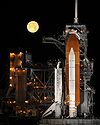
STS-119 STS-119 -Crew notes:This mission was originally scheduled to bring the Expedition 9 crew to the ISS. This crew would have consisted of:-Mission parameters:* Mass:* Orbiter liftoff: * Orbiter landing: * Perigee: * Apogee:... on the morning of March 11, 2009. |
Discovery sits atop a modified Boeing 747 Boeing 747 The Boeing 747 is a wide-body commercial airliner and cargo transport, often referred to by its original nickname, Jumbo Jet, or Queen of the Skies. It is among the world's most recognizable aircraft, and was the first wide-body ever produced... as it touches down. |
Discovery lands after her first flight, STS-41-D STS-41-D STS-41-D was the first flight of NASA's Space Shuttle orbiter Discovery. It was the 12th mission of the Space Shuttle program, and was launched from Kennedy Space Center, Florida, on 30 August 1984... . |
 |
||||
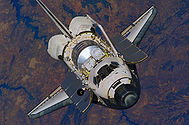
| Discovery performing the Rendezvous pitch maneuver Rendezvous pitch maneuver The R-bar pitch maneuver , popularly called the rendezvous pitch maneuver, was a maneuver performed by the space shuttle as it rendezvoused with the International Space Station prior to docking. The shuttle performed a backflip that exposed its heat-shield to the crew of the ISS that made... prior to docking with the International Space Station International Space Station The International Space Station is a habitable, artificial satellite in low Earth orbit. The ISS follows the Salyut, Almaz, Cosmos, Skylab, and Mir space stations, as the 11th space station launched, not including the Genesis I and II prototypes... . |
The Space Shuttle Discovery soon after landing | Modified Boeing 747 carrying Discovery. | STS-124 STS-124 STS-124 was a Space Shuttle mission, flown by Space Shuttle Discovery to the International Space Station. Discovery launched on 31 May 2008 at 17:02 EDT, moved from an earlier scheduled launch date of 25 May 2008, and landed safely at the Kennedy Space Center's Shuttle Landing Facility, at 11:15... comes to a close as Discovery lands at the Kennedy Space Center Kennedy Space Center The John F. Kennedy Space Center is the NASA installation that has been the launch site for every United States human space flight since 1968. Although such flights are currently on hiatus, KSC continues to manage and operate unmanned rocket launch facilities for America's civilian space program... . |
Discovery's final touchdown on Kennedy Space Center's runway, concluding the STS-133 STS-133 STS-133 was the 133rd mission in NASA's Space Shuttle program; during the mission, Space Shuttle Discovery docked with the International Space Station. It was Discoverys 39th and final mission. The mission launched on 24 February 2011, and landed on 9 March 2011... mission and Discovery's career as an operating Orbiter Shuttle. |
Tribute and mission insignias
| NASA Orbiter Tribute for Space Shuttle Discovery | |||||||
|---|---|---|---|---|---|---|---|
| Mission insignia for Discovery flights | |||||||
 |
 |
 |
 |
 |
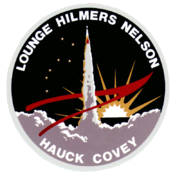 |
 |
|
| STS-41-D STS-41-D was the first flight of NASA's Space Shuttle orbiter Discovery. It was the 12th mission of the Space Shuttle program, and was launched from Kennedy Space Center, Florida, on 30 August 1984... |
STS-51-A STS-51-A was the second flight of Space Shuttle Discovery, and the 14th flight of NASA's Space Shuttle program. The mission launched from Kennedy Space Center on 8 November 1984, and landed just under eight days later on 16 November.... |
STS-51-C STS-51-C was the 15th flight of NASA's Space Shuttle program, and the third flight of Space Shuttle Discovery. It was also the first shuttle mission to deploy a dedicated United States Department of Defense payload, and as such many mission details remain classified... |
STS-51-D STS-51-D was the sixteenth flight of NASA's Space Shuttle program, and the fourth flight of Space Shuttle Discovery. The launch of STS-51-D from Kennedy Space Center , Florida, on 12 April 1985 was delayed by 55 minutes, after a boat strayed into the restricted Solid Rocket Booster recovery zone... |
STS-51-G STS-51-G was the eighteenth flight of NASA's Space Shuttle program, and the fifth flight of Space Shuttle Discovery. The mission launched from Kennedy Space Center, Florida, on 17 June 1985... |
STS-51-I STS-51-I was the twentieth mission of NASA's Space Shuttle program and the sixth flight of Space Shuttle Discovery. During the mission, Discovery deployed three communications satellites into orbit... |
|
|
 |
 |
 |
 |
 |
 |
 |
 |
| |
|
|
|
|
|
|
|
 |
 |
 |
 |
 |
 |
 |
 |
| |
|
|
|
|
|
|
|
 |
 |
 |
 |
 |
 |
 |
 |
| |
|
|
|
|
|
|
|
 |
 |
||||||
| |
|
|
|
|
|
|
|
In media
Discovery was featured in Transformers: Dark of the Moon. She was used as a booster vehicle for the Autobots' spacecraft Xantium when they were exiled from Earth, but StarscreamStarscream
Starscream is a fictional character in the Transformers franchise. He is one of the most prolific characters in the Transformers fictional work, appearing in almost all incarnations of the story. Starscream is usually portrayed with the same characterization...
shot her down and destroyed her.
See also
- List of human spaceflights
- List of human spaceflights chronologically
- List of Space Shuttle crews
- List of space shuttle missions
- Timeline of Space Shuttle missionsTimeline of Space Shuttle missions-See also:...
External links
- Part 1: Discovery space shuttle up close and personal tour at KSC
- Part 2: Discovery space shuttle up close and personal tour at KSC
- Part 3: Discovery space shuttle up close and personal tour at KSC
- STS-133 Space Shuttle Discovery Is Towed Back To the Hangar After Landing
- STS-133 Landing – Space Shuttle Discovery Completes Final Mission To Space
- STS-133 space shuttle Discovery launches for the final time
- Return to Flight mission STS-114 and STS-121
- Shuttle Orbiter Discovery (OV-103)
- Night Launch of the Space Shuttle Discovery
- Discovery on Servicing Mission 2 at ESA/Hubble site
- Discovery on Servicing Mission 3A at ESA/Hubble site
- Pictures of preparations for a launch of Discovery
- A Space Shuttle's Final Rollout – slideshow by Life magazine
- April 16, 2007: Consolidated Launch Manifest: Space Shuttle Flights and ISS Assembly Sequence.